Almshouses, Relief Station, Flats and a Viaduct

Almshouses, Relief Station, Flats and a Viaduct is the next section of my walk in Peckham on Sunday 12th February 1989, The previous post on this walk was Consort Road Peckham.

Beeston's Gift Alms Houses, Consort Rd, Peckham, Southwark, 1989 89-2f-54
Beeston’s Gift Alms Houses, 272, Consort Rd, Peckham, Southwark, 1989 89-2f-54

My walk continued down Consort Road to these almshouses on the west side close to the south end of the road. Although the main block of these almhouses was built in 1834, there are four later blocks, probably from around the 1960s of which this is one. In 1961 the ten charities responsible for these almshouses and those nearby on Montpelior Road, also established by a bequest to the Girdlers Company began to amalgamate and rebuild, and by 1980 this had become their only site, where they still provide independent accommodation for 20 residents in 18 units with a Almshouse Manager employed by the company. There is now a single charity, known since 1997 as Beeston’s, Andrewes’ and Palyn’s Charity.

This picture is one of two blocks named Palyn House on the almshouse site, one of the four more or less identical blocks added to the orginal site.

Beeston's Gift Alms Houses, Consort Rd, Peckham, Southwark, 1989 89-2f-55
Beeston’s Gift Alms Houses, Consort Rd, Peckham, Southwark, 1989 89-2f-55

These are the Beeston’s Gift Almshouses, built by the Girdlers’ Company in 1834 and Grade II listed. Past Master Cuthbert Beeston died in 1582 leaving seven houses near London Bridge run by charitable trusts, These were sold in 1834 to provide the funds to build these almshouses on Consort Road. They (together with the more recent buildings) still provide housing for around 20 poor persons, chosen by the charity from Freemen of the City of London, workers former workers “in trades akin to that of a Girdler (including workers in metals, leather, cloths and fabrics)” and those resident in the former administrative county of London.

The gates, railings and water pump to the almhouses are also Grade II listed.

Relief Station, Consort Rd, Nunhead Green, Southwark, 1989 89-2f-41
Relief Station, Consort Rd, Nunhead Green, Southwark, 1989

The Relief Station was built in 1901 to provide for the poor in the area and later became Consort Road Clinic. Disused for some years it has been converted into eight self-contained dwellings, retaining the facade and complementing it with a new link building.

Flats, Peckham Rye, Peckham, Southwark, 1989 89-2f-44

At the end of Consort Road I turned right into Nunhead Lane and walked down to Peckham Rye. These flats, Creed House and Goodwin House, seen from Peckham Rye are on the north side of Nunhead Crescent and are a part of the Nunhead estate built around 1956. Southwark Council commissioned a structural survey in 2021 on state of these blocks having consulted the previous year on the possibility of building an extra storey on top of these blocks and others in the estate.

Railway Bridges, Consort Rd, Peckham, Southwark, 1989 89-2f-34

I turned into Philip Walk, taking a photograph (not online) of the houses on its north side, solid late Victorian semis, the made my way through a recently built estate back to Consort Road where I made this picture of the splendid viaduct and bridge carrying the line to Nunhead over the street at the junction with Copeland Road. In the arches to the right were a number of businesses, with a part of the arch containing the Westminster Guild in my picture. They seem to have been brass founders and the arches further along are now Bronzewood Metalworks.

Works, Copeland Rd, Peckham, Southwark, 1989 89-2f-35

Copeland Road is best known for the Bussey building and Copeland Park, a few yards further west from this works, their entrance just out of picture, home to many years of the sporting goods factory owned by George Gibson Bussey. I can’t make out the name that was once above one of the buildings, though it clearly starts with SOUTH and I suspect the next word was LONDON.

These rather more humble premises, possibly from the inter-war period, are still there, now housing a barbers, a car wash and a catering company. The semi-detached pair of houses are also still presnet, but their higher end wall at extreme left is now simply a wall with the chimneys and nothing beyond.

My walk in Peckham was almost complete and I made my way back to Rye Lane, but there are just a few more pictures from the end and after taking a bus on my way home that will feature in a final post – and the following month I returned for another Peckham walk. The first post on this walk was Aged Pilgrims, Sceaux, Houses & Lettsom.


Consort Road Peckham

The previous post on this walk on Sunday 12th February 1989 was Gold Bullion, Victoriana, Flats, Insurance and Vats – Peckham.

House, Consort Rd, Peckham, Southwark, 1989 89-2e-16

Back in the 1930s there were at least five Albert Roads in London, along with a number of Albert Streets, Albert Mews etc and the authorities embarked on an orgy of renaming to sort out the confusions that could arise. Albert had been particularly popular after Prince Albert of Saxe-Coburg and Gotha had married Queen Victoria in 1840 and at the time of his death in 1861, and some, such as Consort Road, were renamed to reflect their original dedication.

15 Consort Road is Grade II listed and described as “Mid C19, recently restored” and it rather looks as if my picture was taken during that restoration, with the house in excellent condition but the garden rather lacking. Its listing is perhaps more about its part in a group of similar houses rather than its individual merit, and 11,13 and 17 are also listed.

Rather better known now is its new neighbour, 15 and a half Consort Road, an long, low and unobtrusive house now alongside the right hand side of this house with a wood-covered frontage extending a little closer to the road. From the front it rather looks like a garage which someone forget to put in the door, but it was a truly innovative building by Richard Paxton Architects in 2002, shortlisted in the RIBA Awards 2006, and featured on TV’s Grand Designs.

House, Consort Rd, Peckham, Southwark, 1989 89-2f-64

Two railway lines with three bridges cross Consort Road just a few yards from each other, one leading from Peckham Rye to Nunhead and the other from Peckham Rye to Queen’s Road Peckham, along which is now planned to build an urban linear corridor park, the Coal Line, which I visited in 2015.

The bridges and the area around them have changed considerably since 1989. But I think the viaduct is of the line to Nunhead and this house on the edge of the workhouse site has since been demolished.

Consort Works, House, Consort Rd, Peckham, Southwark, 1989 89-2f-65

Limited were in a post-war building on Consort Road just a little south of the railway bridges and I think they made waterproof products using rubber on glass cloth. Their building replaced some older Victorian terrace housing, some of which was still there at the right when I made this picture. I think the company under a slightly different name is still in business elsewhere.

These buildings have all been replaced by modern flats and an industrial unit.

Closed Shop,  Consort Rd, Peckham, Southwark, 1989 89-2f-66
Closed Shop, Consort Rd, Peckham, Southwark, 1989 89-2f-66

This shop was obviously on a street corner, almost certainly one of the four corners with Consort Road and Brayards Rd. I was interested in the shapes and the tiling as well as the fly posting and crude graffiti – which appears to be two practices at producing the final result at right, perhaps a stylised ’68’. The doorway with a rusticated keystone seemed unusually tall and narrow. It was probably Victorian although the shopfront seemed later.

Gold Diggers Arms, pub, Brayards Rd, Consort Rd, Peckham, Southwark, 1989 89-2f-62

The Gold Diggers Arms was a sizeable pub on the northeast corner of Brayards Road and Consort Road and was still in business when I made this picture. It had been here since at least 1871, but closed in 2001 and was demolished in 2005. The site is now a modern development, Dayak Court, flats above ground floor commercial premises.

The Hooper Hall, Consort Rd, Peckham, Southwark, 1989 89-2f-53

Hooper Hall at 111 Consort Road opened as a mission of St Mary Magdalene in St Mary’s Rd in 1907, which was destroyed by a land mine in 1940. Worship continued here and in the church hall while money was raised to build a new church, opened in 1962 and itself replaced in 2011. The mission has lasted rather better.

A notice tells us that in 1989 it was used by both St Mary Magdalene and the Peckham Christian Fellowship. Later it became home to the Christ Miracle Gospel Ministries International but was put up for sale in 2012, and I think the church moved to Edmonton. A fence was put up around Hooper Hall around 2015 as if building work was about to begin, but little seems to have happened since. It appears still to be available for sale.


This walk will continue in a later post. The first post on this walk was Aged Pilgrims, Sceaux, Houses & Lettsom.


Blessing The River Thames

Blessing the Thames London Bridge, Sunday 11th January, 2009

Blessing The River Thames
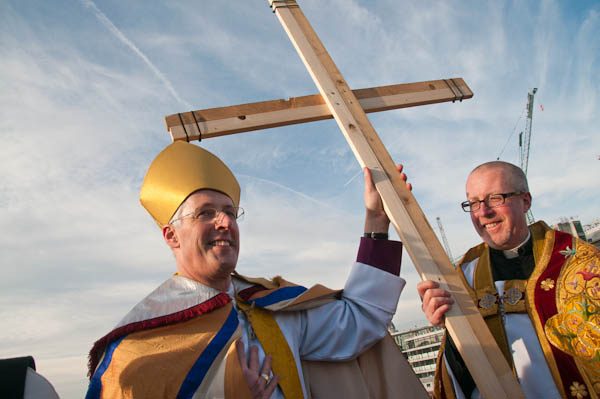
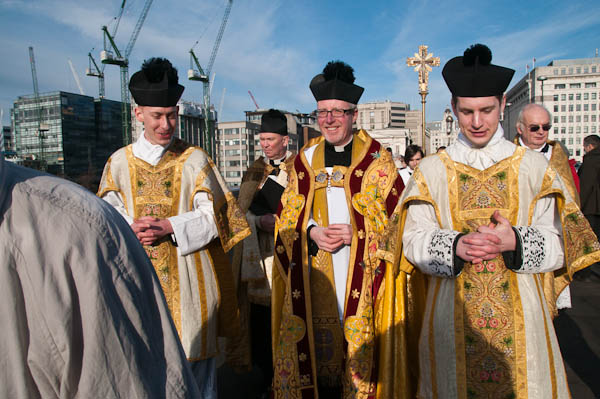
The Bishop of Woolwich throws a cross into the River Thames – below another cross in the sky

Fr Philip Warner was impressed by the annual Blessing of the Waters ceremony he saw in the Orthodox churches of Serbia. When he became the priest at St Magnus the Martyr at the City end of the old London Bridge he decided to begin an annual ceremony to bless the River Thames.

Blessing The River Thames
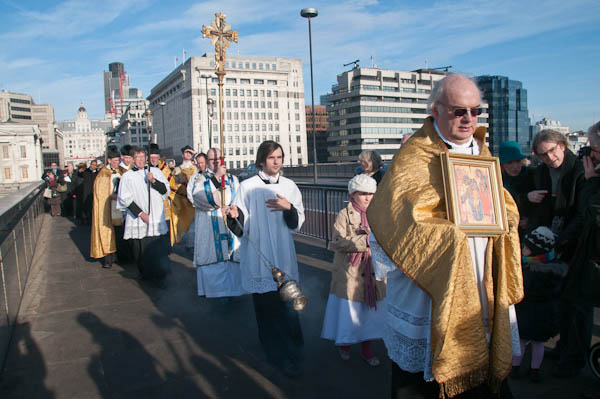
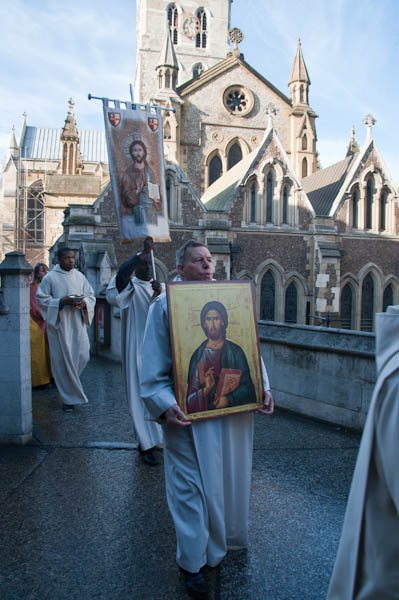
The procession from Southwark Cathedral

His parish and that of Southwark Cathedral meet at the centre of the current London Bridge, and in 2004 processions from both churches met there on the Sunday closest to Epiphany (January 6th) for a short service.

Blessing The River Thames
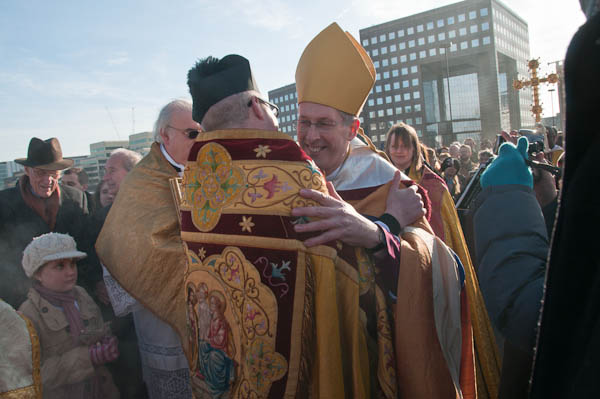
The procession from St Magnus the Martyr comes to join them

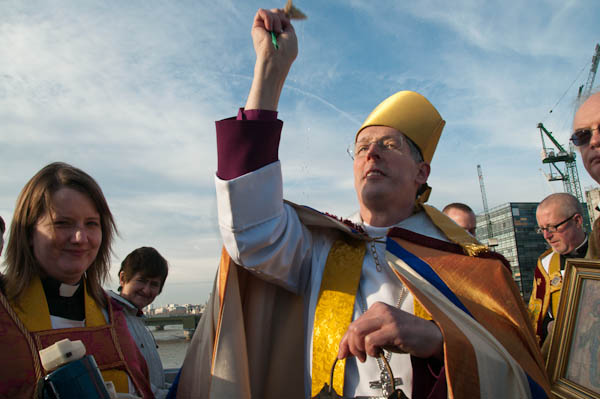
Prayers were said for all those who work on the river and in particular for those killed close to this point in the 1989 sinking of the Marchioness. Incense was swung around liberally, but dispersed by the breeze. The river was then blessed by throwing in a large wooden cross. Water was then sprinkled over those taking part in the ceremony before all those present were invited to process to one of the churches for a lunch.

They meet

I photographed this event in 2007 and 2008 as well as 2009, though it was only in 2008 that I was able to stay for the lunch, that year at St Magnus. By the third of these years the event had grown, with too many photographers, mainly amateurs, coming along and getting both in my way and in the way of those celebrating. I felt I had already taken enough pictures by then and crossed it off my list of annual events to cover.

The bishop prepares to throw the cross in the river

When I first began photographing events in London, both protests and cultural events, there were few photographers at most of them except the large national marches. At many smaller events I would find myself the only person with a camera, and of course everything was still on film. But in the last 15 or so years things have changed.

And we all get sprinkled with water

Back then even when there were more of us taking pictures we were all photographers and at least doing so in a professional way. We tried to respect the others and so far as possible keep out of each others way, though of course that wasn’t always possible. Sometimes there were arguments between those of us who liked to work close to our subjects with wide-angle lenses and those who carried giant, heavy, usually white, telephoto zooms and always wanted to use them from a distance. But generally we worked together.

And everyone (except me) goes back to Southwark Cathedral for lunch

Then came cheap digital cameras and camera phones. Everyone now has something that can take picture, and can readily share them on social media. And there has been huge movement from taking still images to recording video. Video leads to a different attitude, with many becoming unaware of anything outside the screen of their phone around them. At any event now I can be sure that at least one person will walk in front of my lens talking into their phone totally oblivious of my presence and blocking my view.

Of course I don’t claim any special right to take pictures, and others have the same rights as me. But unless we respect the rights of others it becomes difficult and frustrating to work; we have to work together.

More pictures from 2009 Blessing the Thames.


Protests on January 11th

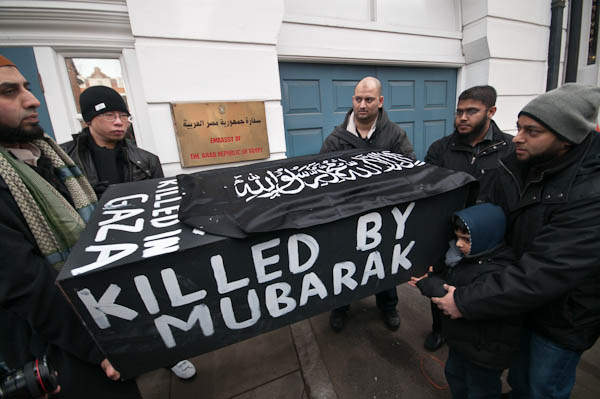
In 2009 I was sorry not to have time to stay for the lunch at Southwark Cathedral, particularly as two of my friends were present, one a frequent worshipper there. But there were a couple of protests to photograph. The first was a march by Hizb ut-Tahrir Britain against the Israeli attacks on Gaza, aimed at Arab dictators who collude with Israeli terrorism and going to Egyptian, Syrian and Saudi Embassies.

More at Hizb ut-Tahrir Britain Gaza march.

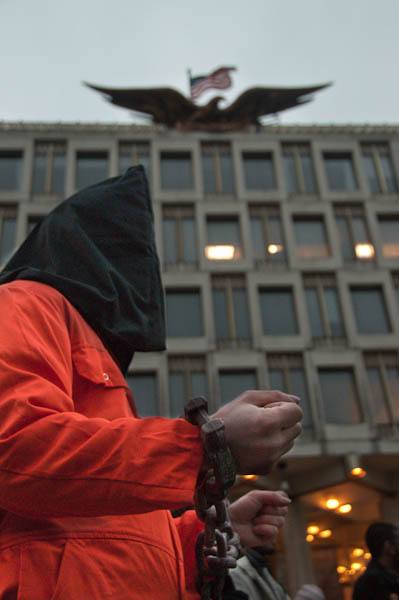
And it was the 11th of January, and the anniversary of the setting up of the US torture camp at Guantanamo in 2004 was marked by a late afternoon protest at the US Embassy, still then in Grosvenor Square.

More at Guantanámo – 7 Years


Asylum Protest and Bow Walk – 2008

I went up to London on Tuesday 8 January, 2008 for two reasons. To photograph the monthly protest outside one of our asylum reporting centres and to collect three pictures that had been in a group exhibition. I took advantage of this to have a walk around Bow starting at Limehouse DLR station and after collecting the four pictures continuing to Canary Wharf to catch the Jubilee Line back to Waterloo.


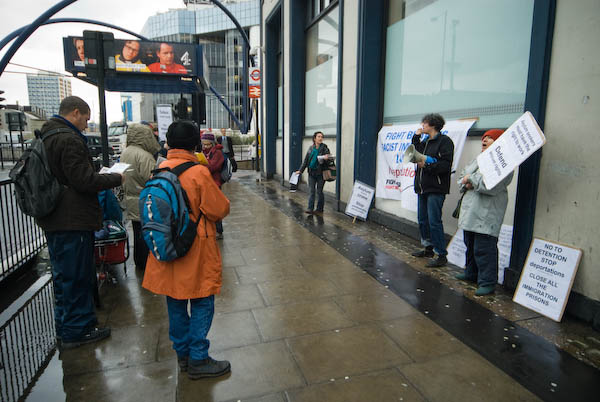
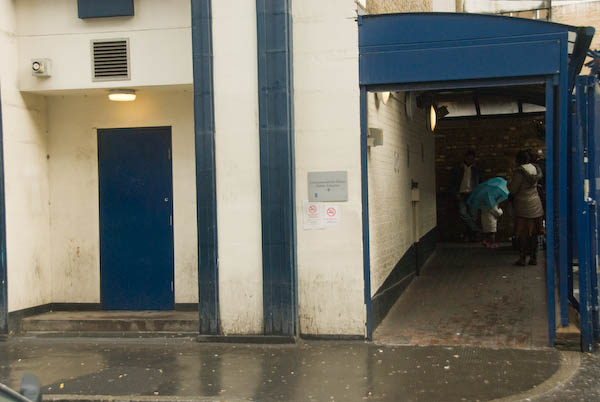
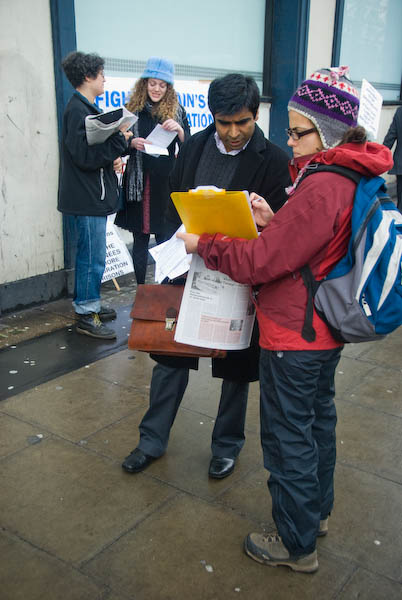
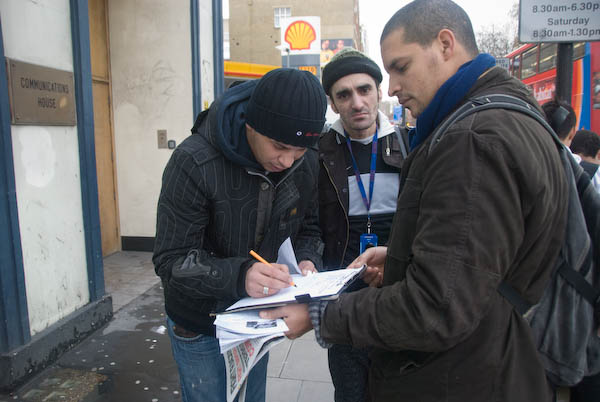
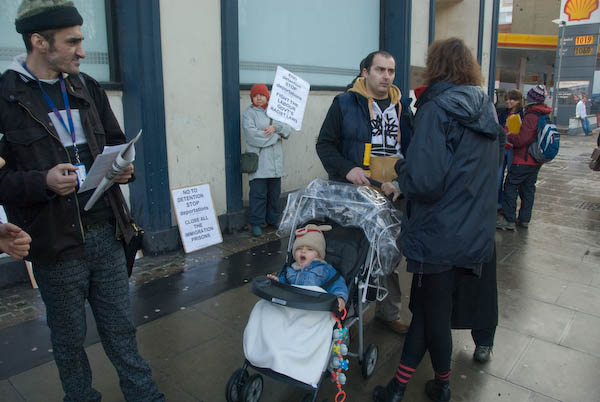
Defend Asylum Seekers: Monthly London Protest – Communications House, Old Street

Asylum Protest and Bow Walk - 2008

Communications House on the south-west corner of the Old Street roundabout a few yards from Old Street station has now been demolished and replaced by newer offices, and asylum seekers now have to report at either Lunar House in Croydon or Eaton House out to the west on Hounslow Heath.

Asylum Protest and Bow Walk - 2008

So asylum seekers no longer have to enter the dingy entrance down a side street, Mallow St but many have longer and less convenient journeys to make their regular visits. They still know when they enter that these may be their last steps as free persons on British soil, and they may emerge in the back of a van on their way to a detention centre to wait for a flight back to possible imprisonment and torture in their country of origin.

Asylum Protest and Bow Walk - 2008

Few of those who walked past the protest knew what went on in the rather anonymous building on their lunch break knew what went on inside, and those who bothered to listen or take leaflets from the protesters, were surprised when they were told, with many stopping to add their names to the petition. The monthly protests here were organised by London Fight Racism! Fight Imperialism! (FRFI) but others including some asylum seekers came to speak.

Asylum Protest and Bow Walk - 2008

I commented back then: “It is hard to take the claims that this is a Christian country seriously when you look at the way we treat those who are seeking asylum here, or indeed other migrants who are here. With the recent news frenzies about Tony Blair becoming a Catholic my thoughts were that he should be spending some awfully long and difficult sessions in the confessional, and his policies towards the asylum seekers would be one of many difficult items. And surely that father in the manse that Mr Brown likes to parade should be screaming “Gordon, Read your effing Bible!”

Neither the Church of England nor the Roman Catholic authorities have taken the kind of firm and clear public stand they should to oppose the UK’s increasingly racist policies over immigration. There have been statements by the leaders of the churches and others but these are soon lost in the media. But there has been a lack of the concerted action and a failure to arouse popular opinion to bring about an end to the ‘more racist than thou‘ race between the parties to appeal to the right – and our right-wing billionaire press. Fewer people than in past years populate the pews, but if mobilised they could still be an important body, forcing governments to provide safe routes and fair treatment rather than trying to simply send back people to where they had fled persecution and fly asylum seekers to Rwanda.

Defend Asylum Seekers


Bow and Roof Unit

Rood Unit is a working space for photographers and was then based in a former furniture (or soap or perhaps both) factory in Bow, later moving to a floor above the Four Corners photography gallery in Roman Road. I had been invited to take part in a show they were presenting, Roof Unit Foundations, at [space] in Hackney and had shown four colour pictures from around River Lea in the 1980s.

This was one of them – and the others as well as a review of the show are in a post on this blog at the time, ROOF UNIT at [ space ]. And you can see these and many other of my pictures of the Lea Valley and the Lea Navigation in my River Lea web site, as well as in my book ‘Before the Olympics‘.

I took the DLR to Limehouse and made my way rather indirectly to their studio in Pixley Street on the corner with Copenhagen Place. The old factory is still there, though Roof Unit have moved out. I spent a short time talking with some of the photographers and was taken up onto their roof terrace where I took some more pictures, all using my Nikon D200.

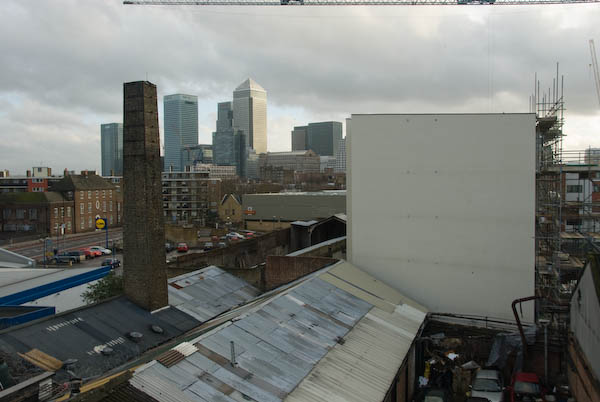
I couldn’t resist adding the factory chimney to those at Canary Wharf as another tower, and the long arm of a crane made a little of a border across most of the top of the image. But I took quite a few more pictures – a few of which are in the post on My London Diary.

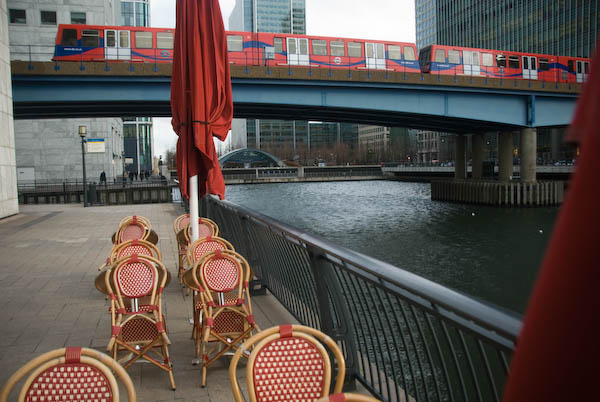
Fortunately my exhibition prints were quite small, 30x20cm, and unframed on dibond aluminium, so it wasn’t hard to carry them, though I didn’t stop to take many more pictures before the short bus ride to Canary Wharf. By now the light was beginning to fade, but I took a short walk around – and a few more pictures – before getting the underground back to Waterloo.

Bow and Roof Unit


Gold Bullion, Higgins & Jones And Vats – Peckham

The previous post on this walk on Sunday 12th February 1989 was School, Meeting House, Houses & Shops – Peckham

Peckham Gold Bullion, Peckham High St, Peckham, Southwark, 1989 89-2e-26

Peckham Gold Bullion has “We wish to Purchase all Precious Metals & Stones” above the shop windows and a great deal of elaboration on notices in and on the windows below. I don’t know when the ‘EST 50 YEARS’ was painted proudly on the column at left, but the business must have been going since at latest the 1930s.

This shop, at 38 Peckham High Street on the corner of Bellenden Road is currently a mobile phone shop and internet cafe, also offering money transfer, travel agency, computer repair etc. Welch’s Florists is also long gone, its window covered by advertising for the phone shop.

Peckham High St, Peckham, Southwark, 1989 89-2e-11
Jones & Higgins, Peckham High St, Peckham, Southwark, 1989 89-2e-11

Jones & Higgins opened their first small shop on Rye Lane in 1867 which grew into the large and well-known department store. The magnificent building by local architects Henry Jarvis & Sons on the corner of Rye Lane and Peckham High St dates from 1894, and the company developed down Rye Lane as far as Hanover Park, though the property on the corner there was leased to a bank (and still is a bank.) The department store closed in 1980 and by the time I made this picture the upper floors were in use as the Peckham Palais nightclub which closed around 2010, leaving much of the building unoccupied and deteriorating – and for some time a part of it was a brothel. There is a long and detailed YouTube video on the history of the site, and the shop which was built when Rye Lane Peckham was a shopping centre to rival Oxford Street. The section on Jones and Higgins begins around 19 minutes in.

Part of the store, including the orginal shop had already been demolished for the unnecessarily ugly The Aylesham Centre a small part of which is at the right which opened in 1988. There are currently plans to redevelop this eyesore including a massive 27 storey block which are opposed by local campaign group Aylesham Community Action (ACA).

The former 1894 Jones & Higgins Department Store is unlisted, and was one of the Victorian Society’s
Top Ten Endangered Buildings 2021
.

Flats, Queens Rd, Peckham, Southwark, 1989 89-2e-12
Wood Dene Flats, Queens Rd, Peckham, Southwark, 1989 89-2e-12

This huge monolithic development along Queens Road was the Wood Dene estate, a part of the Acorn Estate built in the 1960s. It was demolished in 2007, its fate possibly hastened after the shocking murder of a woman, Zainab Kalokoh, who was holding her baby holding her baby at a christening in the estate’s community centre when shot by teenage gang robbers.

When the two joined blocks of 323 council homes were demolished in 2007 promises were made to 173 ‘temporarily’ decanted tenants that they would be allowed to return to the new homes on the site.

But the site was sold off on the cheap by Southwark Council to Notting Hill Housing Trust who originally promised to include around 116 social housing homes in the 333 new homes to be built on the site, now called Peckham Place. The housing association, now Notting Hill Genesis, took 12 years to complete the development, largely spent in bargaining the number of social homes in the scheme down to 54. But eventually they failed to provided any at all, with those 54 being marketed as “affordable” homes.

Queens House, Queens Rd, Peckham, Southwark, 1989 89-2e-13
Queen’s House, Queens Rd, Peckham, Southwark, 1989 89-2e-13

Queen’s House, close to the corner of Queen’s Road and Wood’s Rd attracted my attention because of the unusual layout of its windows, with four on the first floor and only three symmetrically above, as well as its very solid-looking porch. This Grade II listed building is thought to date from around 1725.

Woods Rd, Queens Rd, Peckham, Southwark, 1989 89-2e-14

Another Grade II listed building, described as “Terrace of 3 houses, now shops and offices. c1700, with later alterations” and listed as 6,8 and 10 Queen’s Road.

It now looks rather better with the shopfronts removed, though as often the frontage is decorated by a large number of wheelie bins. The Surgery building at left is still there.

Carty & Sons, Woods Rd, Peckham, Southwark, 1989 89-2e-15

This house is also Grade II listed and thought to be late seventeenth century with alterations from around 1820. I’m unsure if the factory buildings and chimney behind were a part of Carty’s works which as my picture shows were ‘MAKERS OF VATS & WOODEN TANKS’ but think they are probably those of another company. There was at one time a sauce and pickle manufacturer in this area.

The house and yard behind was more recently occupied by a scaffolding company, but now the whole area around the house, including the Tuke School and the factory buildings has been cleared as far as Cossall Park has been cleared and rebuilt as housing and the listed house renovated.

This walk will continue in a later post. The first post on this walk was Aged Pilgrims, Sceaux, Houses & Lettsom.


School, Meeting House, Houses & Shops – Peckham

The previous post on this walk on Sunday 12th February 1989 was A Market, Chapel & More Houses – Peckham

School, Bellenden Rd, Peckham, Southwark, 1989 89-2e-45
Highshore School, Bellenden Rd, Peckham, Southwark, 1989 89-2e-45

You will look in vain for this school on Bellenden Road now. The school, a special school, moved to a shared site with Archbishop Michael Ramsey School,Camberwell in 2013 leaving the building empty. It was demolished in 2015 and replaced by Cherry Garden special school, which moved out of Bermondsey to here.

I’m unsure as to the date of this school, though it was clearly postwar, possibly dating from the 1960s. Perhaps surprisingly it was not mentioned by Cherry and Pevsner in their London 2: South volume though it seemed to me to be clearly of architectural interest. Southwark Council described it as “a distinctive post-war school” but wanted to knock it down so went on to say “it is not of sufficient quality of construction nor is it sufficiently unique to warrant the particular protection given by listing“. I can’t comment on the structural soundness from the four pictures I took but can’t think where you can find a similar building. It gets a rather deprecating comment in the Holly Grove Conservation Area Appraisal, “Highshore School, immediately adjacent to the conservation area, was built using standardised lightweight constructional systems and open site-planning principles which undermine the established morphology of street frontages“, not fitting in neatly with the Georgian housing in the area.

House, Highshore Rd, Peckham, Southwark, 1989 89-2e-33
House, Highshore Rd, Elm Grove, Peckham, Southwark, 1989 89-2e-33

This house is on the corner of Higshore Road and Elm Grove and I think its address is 64 Elm Grove. It is certainly a very impressive and substantial late Victorian house with a quirkiness I found appealing enough to take a second frame.

House, Highshore Rd, Peckham, Southwark, 1989 89-2e-34

Post Office Depot, Highshore Rd, Peckham, Southwark, 1989 89-2e-35

I didn’t photograph the listed houses in Highshore Road, perhaps suffering from a surfeit of rather standard Georgian or early Victorian houses in the area. Fine though they are I didn’t feel a need to photograph all of them.

The Post Office Depot is rather less usual and carries a ‘Historic Southwark’ board as well as being Grade II listed. This is possibly the earliest building in what was then known as Hanover Street, built in 1816 as the Friends Meeting House, apparently on the site of a pond. It was considerably enlarged in 1843.

Shops, Rye Lane, Peckham High St, Peckham, Southwark, 1989 89-2e-21

These buildings are stll there at the north end of Rye Lane, though now with different shops, but almost all the buildings visible on Peckham High Street in the picture have gone. There is still a bank at 65 Peckham High Street the extreme corner of which can just be seen but the rest of the buildings including the Midland Bank have gone, with a walkway here now leading to the Peckham Pulse Leisure Centre built in 1998.

Shops, Peckham High St, Peckham, Southwark, 1989 89-2e-22

I took another picture of these shops from a slightly different viewpoint to one I had made a month earlier which I wrote about aat some length in a post on that earlier walk. The building housing ‘Stiletto Ecpresso’ has been replaced since 1989 by a taller and rather less interesting structure but the rest still look much the same, though with different uses.

Canal Head, Peckham High St, Peckham, Southwark, 1989 89-2e-23

Had I been aware of the changes that were soon to take place in this area I would have made more than this picture at Canal Head. This was the start of the walk along the route of the Peckham Branch of the Surrey Canal, at the back of what is now the The Drovers Arms, roughly at the south-east corner of the more recent Leisure Centre.

Doorway, Peckham High St, Peckham, Southwark, 1989 89-2e-24

The Drovers Arms has the address 71-79 Peckham High St and tucked away down a short driveway at its read is this building at 71, now a dental surgery, Peckham Dental Care. The building at right with a bricked up and painted over doorway is the pub, which has a rather grander and more useful entrance on the High Street, opened in 2000.

The main building at 73-79 was built around the end of the 19th century, according to Historic England by architects J & J W Edmeston, for the London and South Western Bank. The Edmestons were a family of architects working in London, of whom the best known was probably James Edmeston Jr (1823-98). I think 71 may be a little earlier.


This walk will continue in a later post. The first post on this walk was Aged Pilgrims, Sceaux, Houses & Lettsom.

On the Buses & Consent

On the Buses & Consent

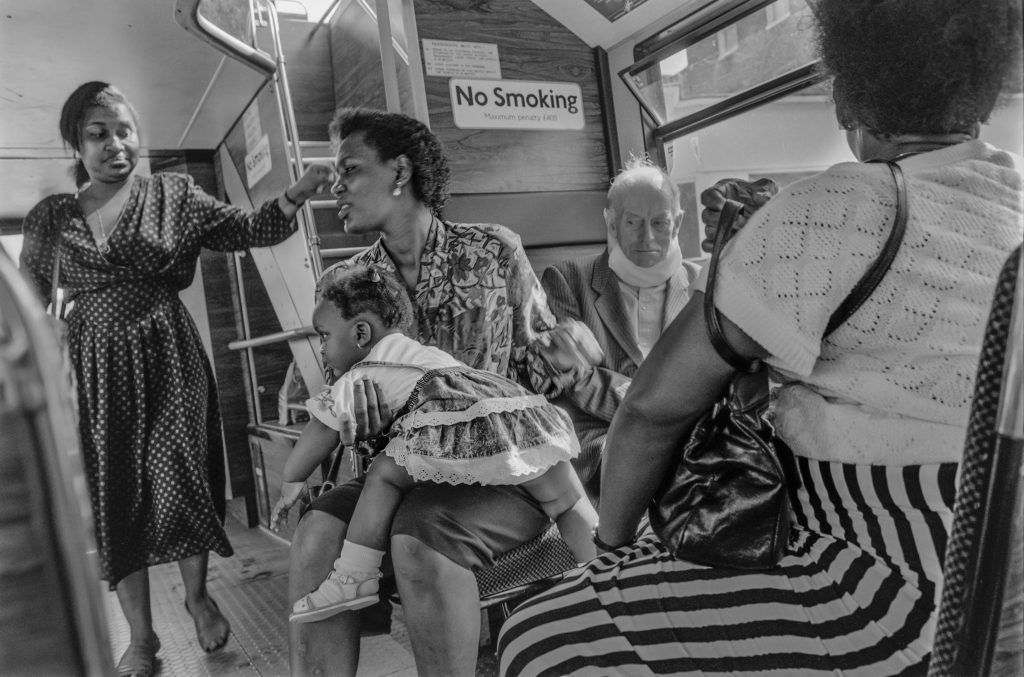
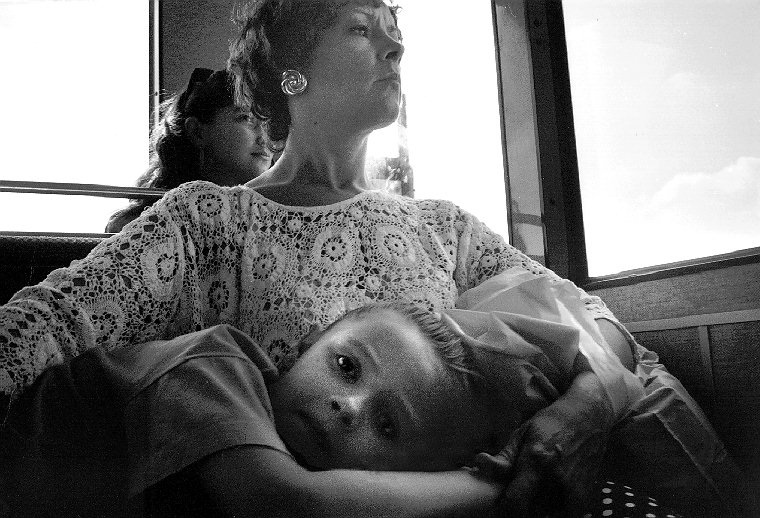
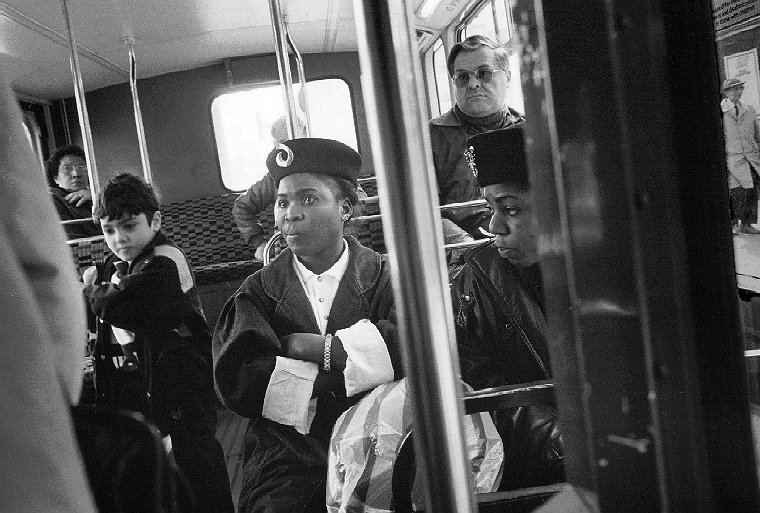
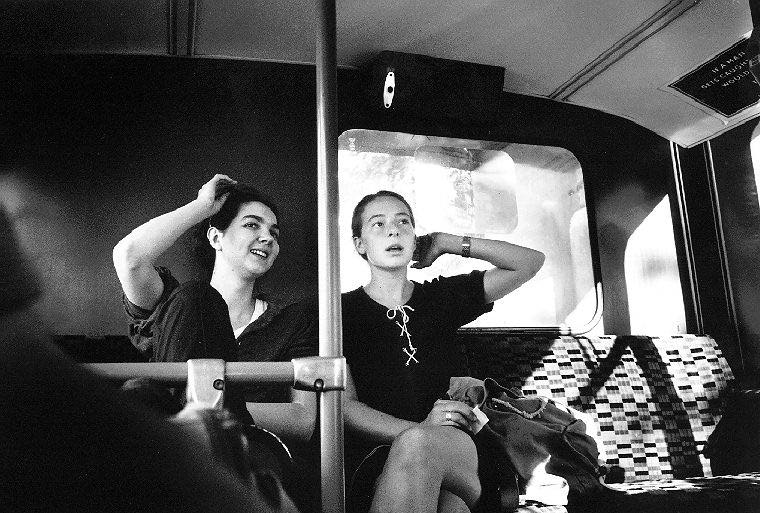
I was reminded the other day by a long thread on a private Facebook group about the controversy over taking photographs of people in public without their consent. It’s something that had a significant effect on my own practice in the 1980s before I finally came to a conclusion.

On the Buses & Consent

Back in 1938 and 1941, Walker Evans spent a great deal of time making a photographic study of people on the New York subway – their equivalent of London’s Underground system. He used a 35mm camera, a Contax, hidden under his overcoat with just the lens poking out and a cable release running down his sleeve to his hand to remain unnoticed by those he was photographing on seats opposite.

On the Buses & Consent

You can see some of the pictures he took on a page on ASX. The group at the top of the page there shows that he at least sometimes made multiple images of the same person, so he must have put a hand inside his coat to wind on between each picture. The Contax had a wind-on knob which takes a noticeable pressure to turn and its hard to see how he managed this without being obvious, but I suppose people were then completely unaware of the possibility of being photographed in this environment, and few would have identified the glass fronted object between Evan’s coat buttons as a camera lens.

Evans worked in this way to produce portraits that were entirely natural that would only rely on the individuality of the people he sat facing, a kind of raw photography where the only control he retained was over when to press the release.

Although Evans showed the pictures to friends – and got his collaborator the writer James Agee to write an introduction to them – which included the words ‘Each, also, is an individual existence, as matchless as a thumbprint or a snowflake‘ in 1940, he had reservations about publishing them about the invasion of privacy that was involved. It was only in 1966, over 25 years after they were taken, that he finally felt able to publish them in the book ‘ Many Are Called‘.

It’s clear in UK law that people have no copyright on their faces, they are not intellectual property, and that here we can generally take pictures in public of whatever we like – subject to a few specific restrictions and laws such as those governing decency and preventing stalking. But it isn’t always clear what spaces are public and which are private, and at least in theory bylaws may prohibit photography even in some that seem clearly public, including Trafalgar Square and many recent developments.

UK law makes a distinction between being in public and being where we have “a reasonable expectation of privacy“, and I think this is a very useful guide. On the open street – or on the subway or Underground – there is no such expectation, though there are still certain rules of behaviour we should observe, whether or not we are taking photographs. Generally we should not be rude or obtrusive, threatening or interfering unless there is very good reason to be so.

Apart from this, if we take and publish photographs – with or without consent – I think we have a responsibility towards those we photograph not to misrepresent them or treat them in a derogatory manner. That doesn’t mean always making ‘nice’ photographs, and if people are behaving badly there is nothing wrong with pictures that make that clear.

So, do I ask for consent when taking pictures? Occasionally but only very occasionally. Generally it seems less of an intrusion not to do so. Most of the pictures I take are of people involved in events where there is at least an implied permission and often an actual desire to be photographed. If you are taking part in a protest you are making a public statement and wish that to be recorded and publicised – and should there be some particular reason for your face not to appear, then you can always wear a mask – something Covid has made even more acceptable.

So when do I ask, either verbally or by gesture? Mainly when I want to invade someone’s personal space, going in close for an image, just very occasionally when I want them to do something. I never actually pose people but occasionally may ask them to face in a particular direction or hold a placard higher – or turn it the correct way up.

I had to sort out my views on consent clearly around 1990, when I took part in a project on transport in London which was exhibited at the Museum of London. I had two sets of pictures in the show, one of which showed the building of the DLR extension to B which involved no such problems, though perhaps a little trespassing to get the viewpoints I wanted.

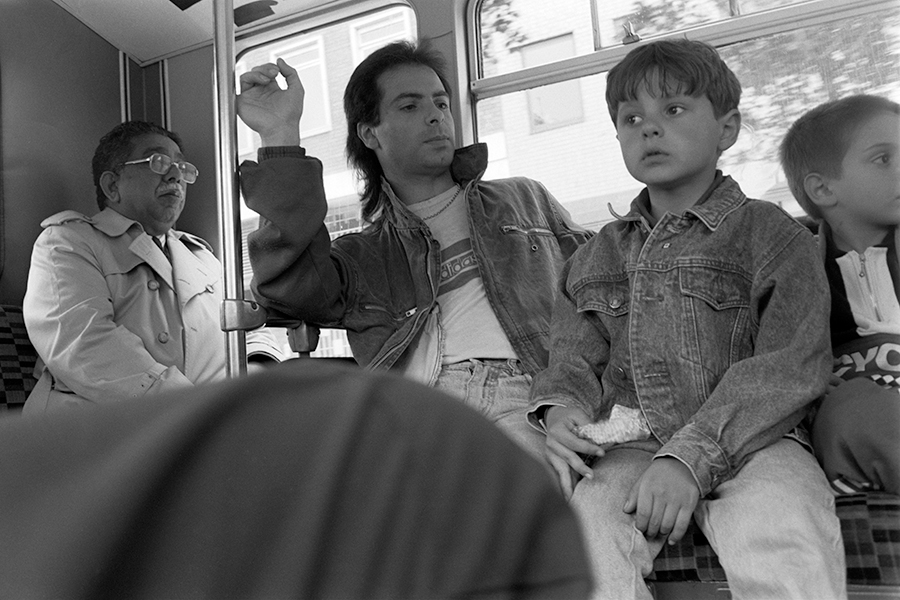
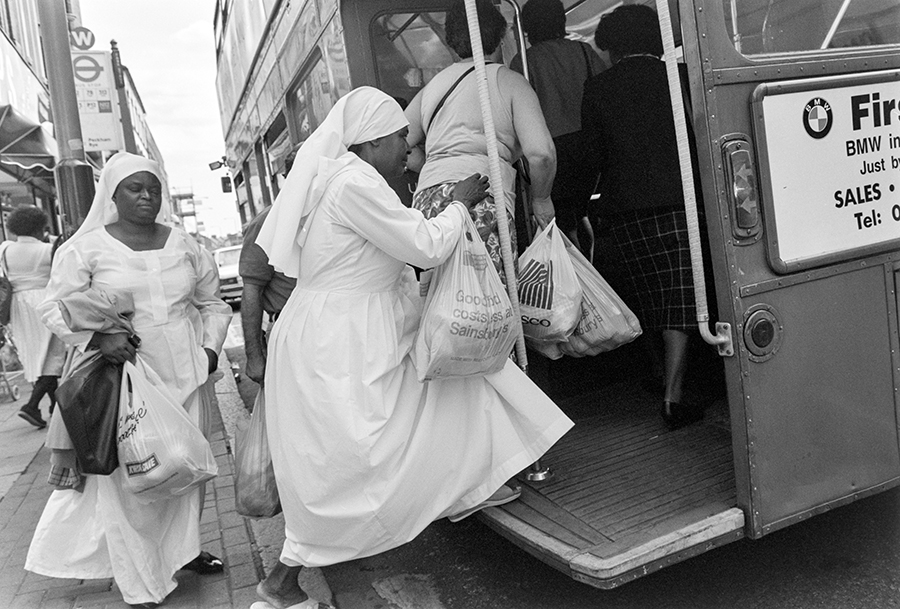
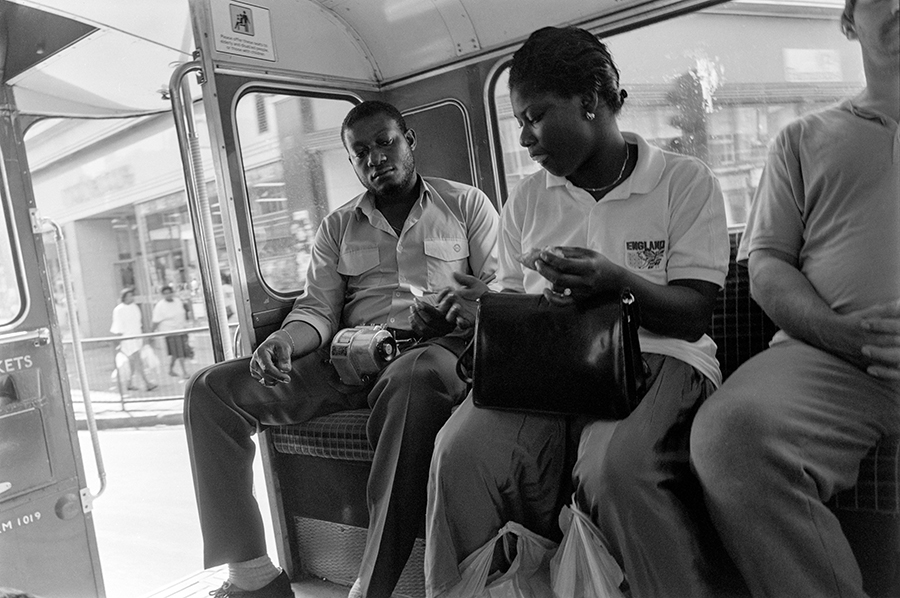
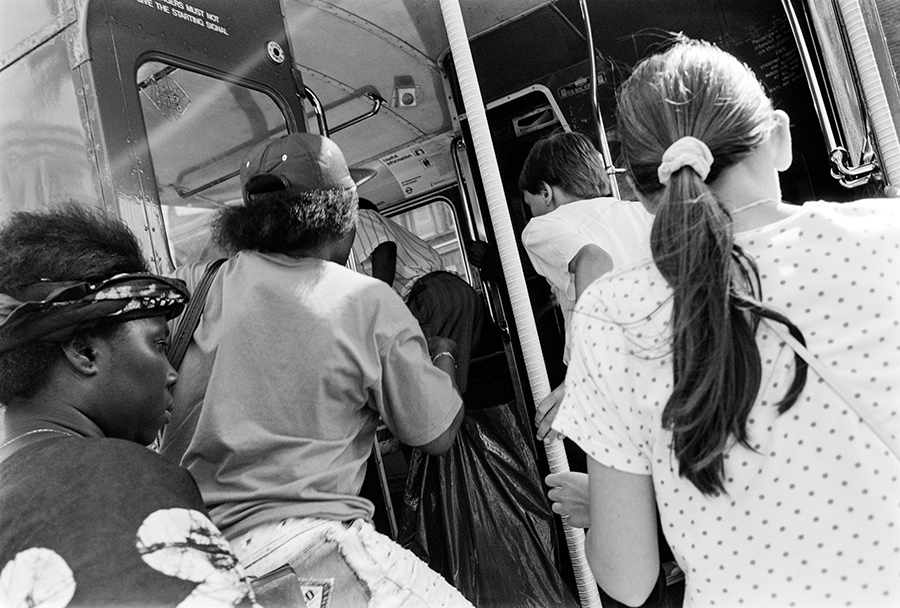
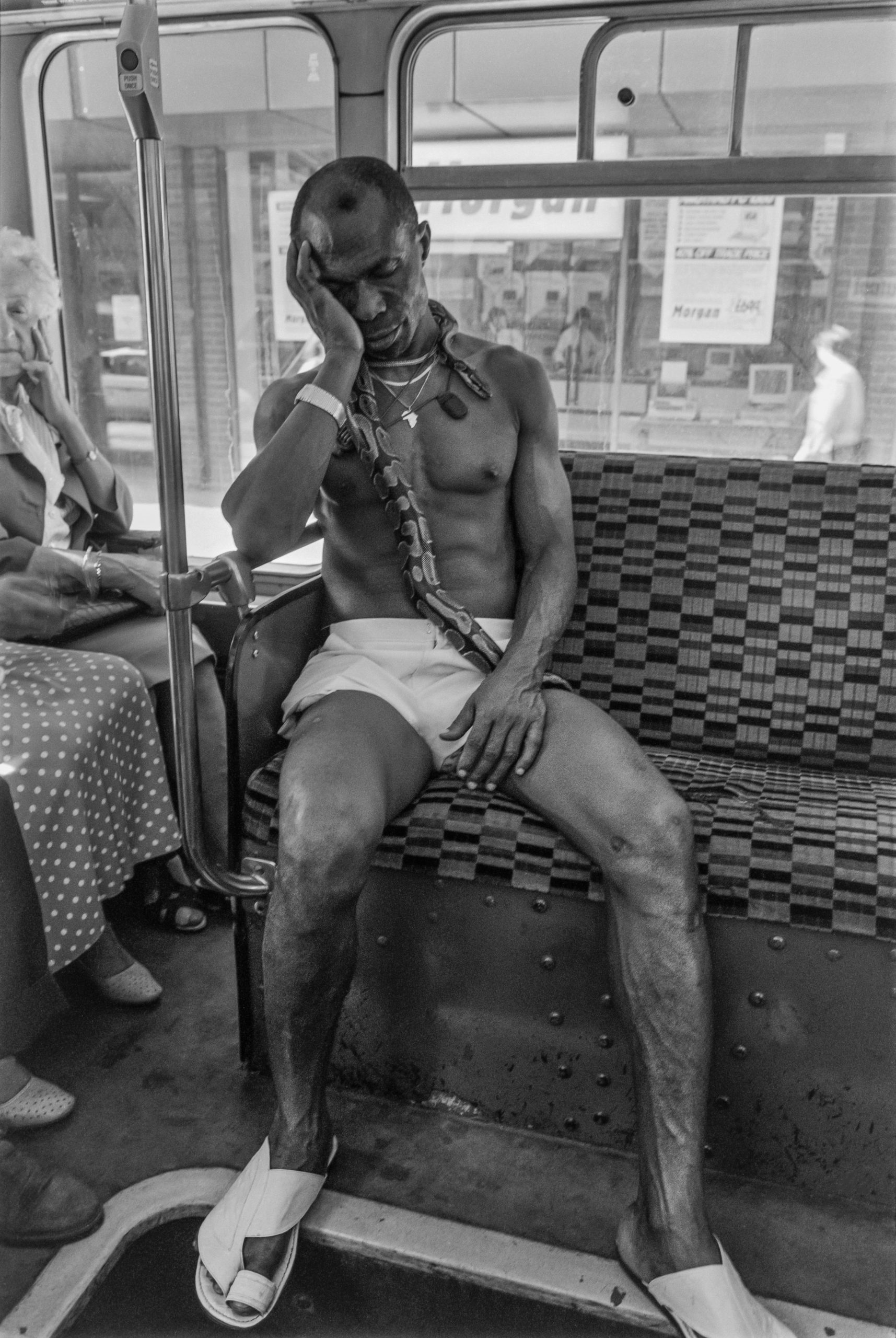
But for a second set I decided to photograph people on buses, which very much did. There seemed to be no way I could make any kind of pictures I wanted by always asking for permission. I decided to make pictures, not quite like Walker Evans, but without seeking consent, sometimes holding the camera away from my eye when taking pictures, partly to get a more interesting viewpoint. A few people did see me taking pictures but only one objected – the man wearing a snake.

It’s perhaps time now, over 30 years after taking these pictures that I made a book of them.


Wishing You a Happy Christmas

Just a few of my Christmassy pictures from over the years. Today I’ll be having a quiet Christmas at home with a few family members. Well, fairly quiet as we usually sing a few carols in the evening, rather boisterously. Fortunately for them our neighbours are away visiting family elsewhere.

I looked through some of the older files on my computer a couple of days ago and found these – and scheduled this post. Some of them are images I’ve used in Christmas Cards in previous years – and one a few friends got this year.

Wishing You a Happy Christmas
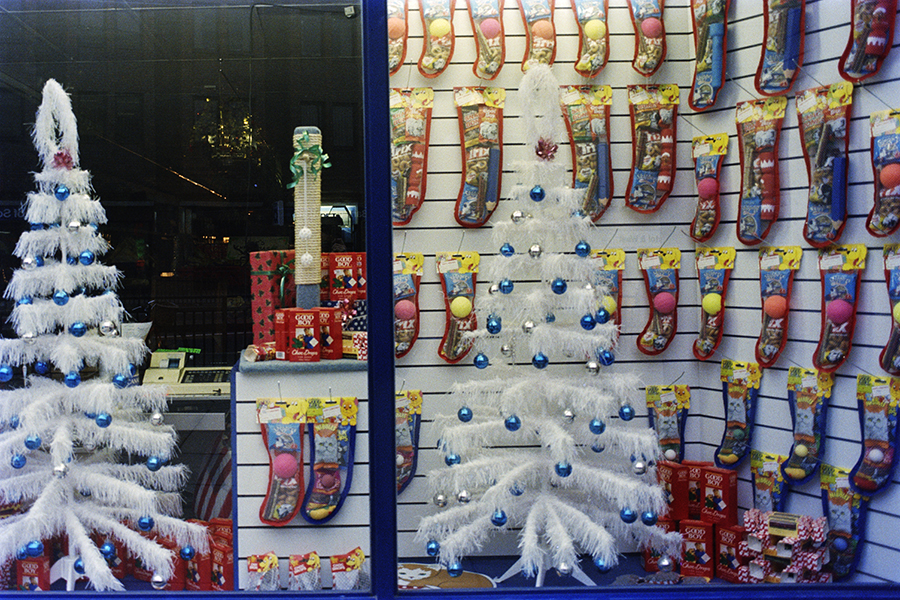
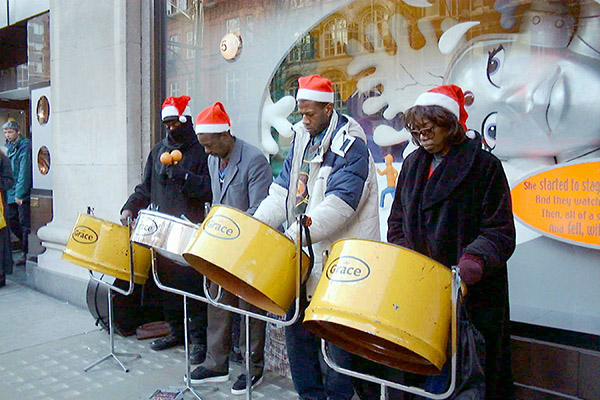
Shop window, 1988
Wishing You a Happy Christmas
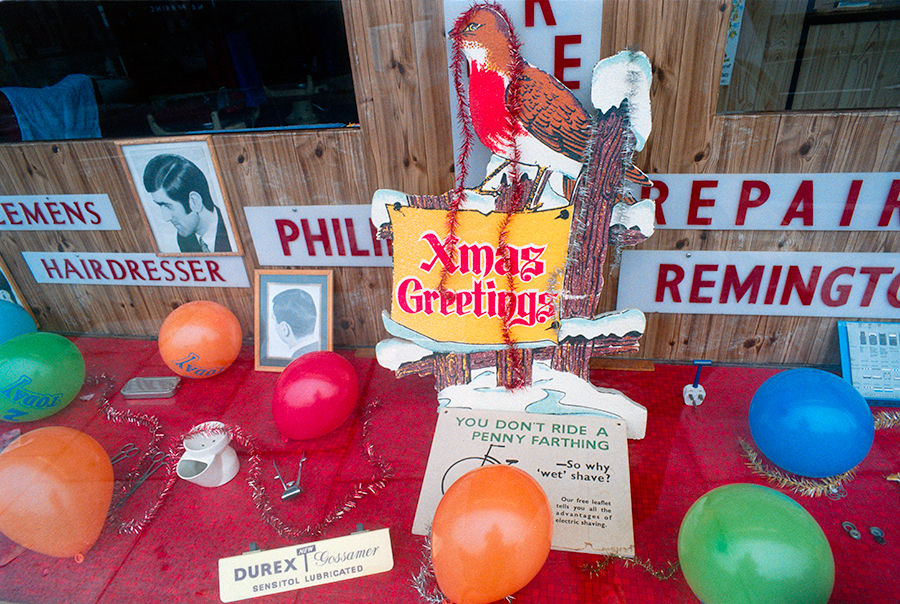
Shop window, 1989
Wishing You a Happy Christmas
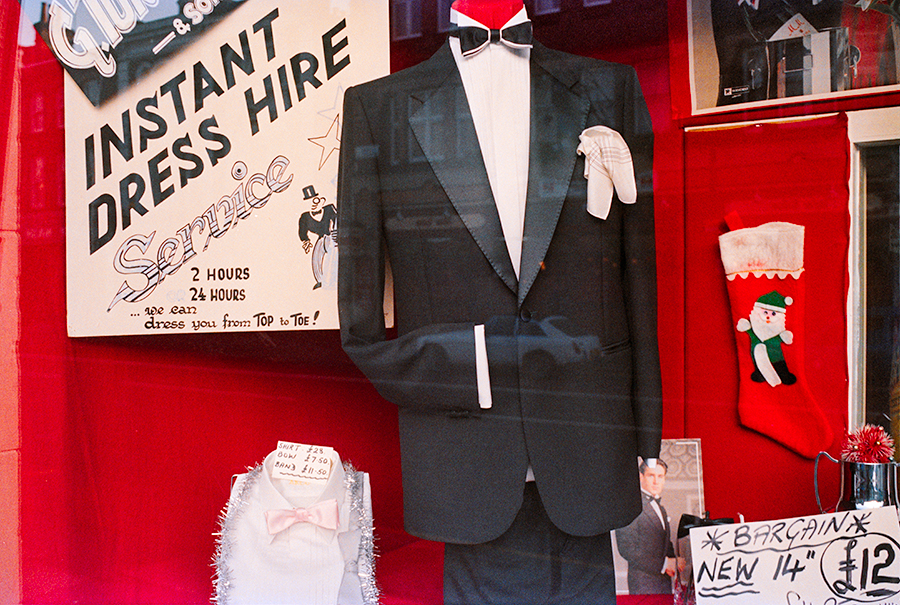
Shop window, 1990
Wishing You a Happy Christmas
Oxford St, 1999
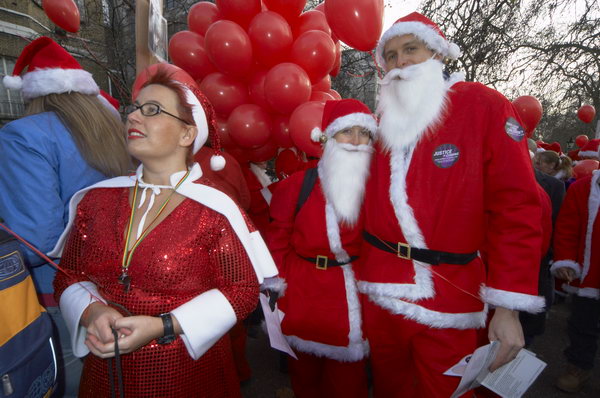
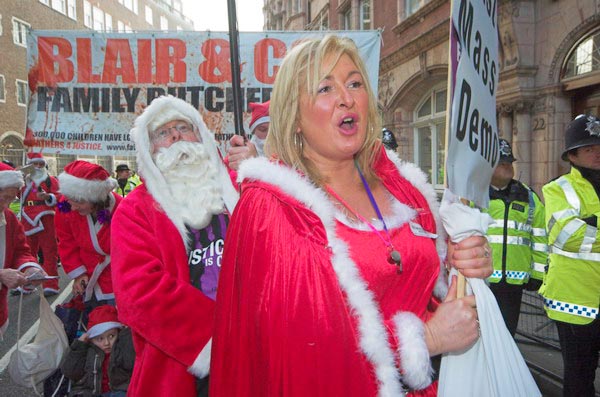
Fathers4Justice (and Mothers) 2004
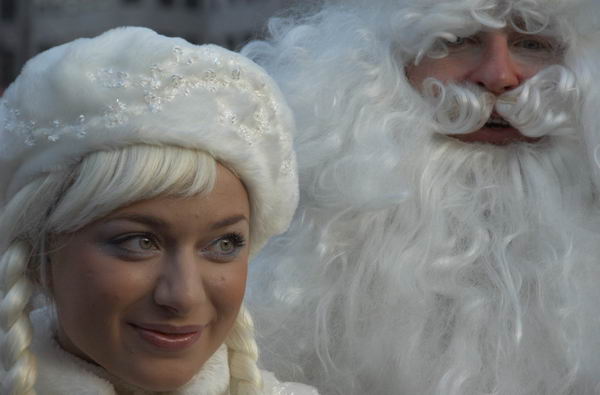
Snow Maiden & Father Frost 2005
More Santas and Mama Santas from Fathers4Justice 2005
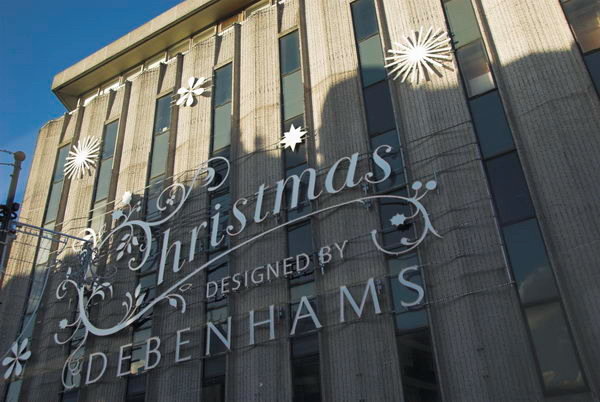
Christmas Designed by Debenhams, 2006
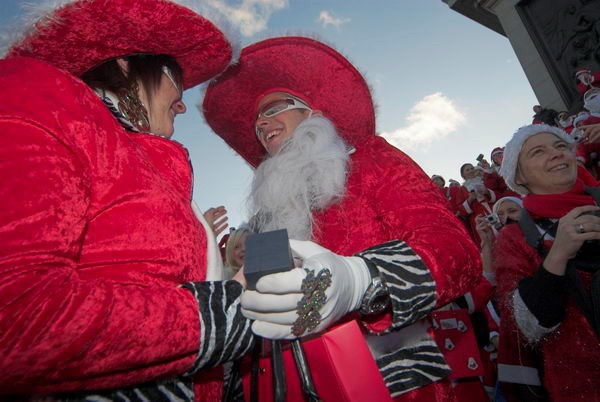
Santacon – Santas get engaged
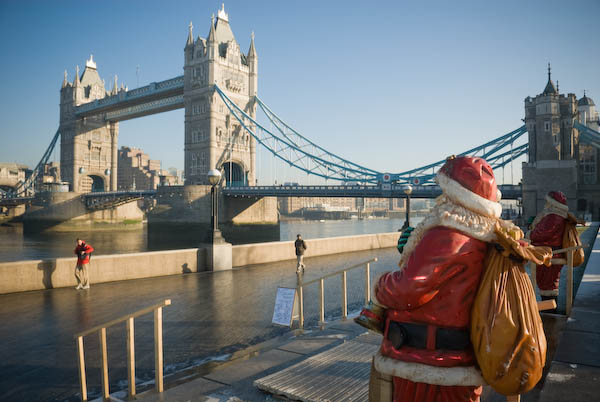
Tower Bridge, 2007

For many it hasn’t been a great year but perhaps this will be one of the better parts of it. I hope you can enjoy Christmas.


A Market, Chapel & More Houses – Peckham

The previous (and first) post on this walk was Aged Pilgrims, Sceaux, Houses & Lettsom.
House, Lyndhurst Way, Peckham, Southwark, 1989 89-2d-25

At the end of Lyndhurst Grove I came to Lyndhurst Way and had to make the choice of whether to turn left or right along it. Both ways looked interesting but I chose left and found a short terrace or four rather unusual houses at 13-19, two of which had the decoration on the window bays. There are also differences in the treatment of the doorway and windows of these two houses, which are the only ones of the four with entrances leading down to the pavement – those at the end of the block have their doors at the sides.

I continued to Lyndhurst Square then turned back, walking down Lyndhurst Way to Holly Grove, taking a few pictures on the way, none of which are online.

House, Holly Grove, Peckham, Southwark, 1989 89-2e-55

Holly Grove was developed by George Choumert (1746-1831), a Frenchman who married Lydia Fendall from a wealthy family of tanners in Bermondsey. He had a number of houses built in what was then George Lane around 1815-20. This picture shows No 14 and 15 – the houses are numbered consequently as there are no houses on the north side of the road which is Holly Grove Shrubbery, ‘a Victorian shrubbery with a serpentine boundary with a footpath winding through it’ between Holly Grove (then South Grove) and Elm Grove. All the houses from 5-24, 32 and 33 are Grade II listed.

Indoor Market, Rye Lane, Peckham, Southwark, 1989 89-2e-56

Peckham Indoor Market was built around 1938 or shortly after as Rye Lane Bargain Centre with an imposing frontage for a narrow arcade leading back to a large covered market. It’s a style that rather makes it look like a cinema. Across the top is the message ‘Come Rain Or Shine It’s Always Fine at Peckham Indoor Market’.

In the early 2000s the market at the back was reduced in size with part now redeveloped as flats but the front section remains and is now Rye Lane Market, housing over 50 small shop units.

Rye Lane Chapel, Rye Lane, Peckham, Southwark, 1989 89-2e-41

You can read a detailed history of the chapel up to 1927 on the web. The first Baptist worship in the area was begun around 1817 when Mr Spencer, a deacon from Blackfriars Baptist church moved into what is now Peckham Hill St, a more rural location, for the sake of his health and began services in his home. Soon the congregation got too large for this and they bought a plot of land on Rye Lane and built a large and expensive chapel on the corner of Blenheim Grove and Rye Lane which opened in 1819.

Unfortunately when the railway came the chapel was exactly where it ran and the railway company were to build their station. So the chapel had to go, and a new chapel was built on the opposite side of the road a short distance to the north in 1863. That one was built on a firm concrete foundation and is still standing and still in use, having been restored after wartime bomb damage.

Houses, Elm Grove, Peckham, Southwark, 1989 89-2e-43

I turned back west from Rye Lane along Elm Grove, which contains a number of houses of interest, including half a dozen that are Grade II listed but it was this group that prompted me to take a photograph.

Elm Grove was developed around 1830 although from the maps it appears much was added later in the century, and these probably date from the middle of the century. In the Holly Grove Conservation Area document the photograph from Elm Grove of these houses comes with the description “a row of pale brick houses (No. 48-54) built with prominently projecting square bays and distinctive Gothic features on the upper storey, particularly the window glazing patterns and parapet detailing.” There is more about them and other houses in Elm Grove later in the document

This walk will continue in a later post.


Vestry Road, Camberwell to Lyndhurst Grove, Peckham

The previous and first post on this walk was Aged Pilgrims, Sceaux, Houses & Lettsom.
Vestry Rd, Camberwell, Southwark, 1989 89-2d-53

Vestries such as that in the parish of Camberwell St Giles were the bodies that provided municipal services before local government was organised into boroughs – and in this area the Metropolitan Borough of Camberwell took over their duties in 1900. In the 1820s and 1830s the Vestry here was responsible for the closing down of Camberwell Fair, as a part of “widespread campaign in the early 19th Century, to impose social and moral control over the growing working classes“.

Perhaps Vestry Road got its name as the vestry bought the land and began the development there. The road is not present on Cary’s New Plan of London in 1837, but was present with these houses shown on the Ordnance Survey‘s map surveyed in 1869 to 1871, when the road ended a little past Grace’s Road. These houses were probably quite new then. The road was extended further south by thhe mid 1890s.

The Maisonettes, Vestry Rd, Camberwell, Southwark, 1989 89-2d-55

The Maisonettes at the north end of Vestry Road face Lucas Gardens. They were built in 1907.

Immediately to the north of these maisonettes is the Camberwell Bunker Garden, on top of the now disused Southwark Borough Control Bunker, a cold-war control centre built underneath a now demolished health centre on the corner of Peckham Road and Vestry Road.

Houses, Vestry Rd, Camberwell, Southwark, 1989 89-2d-56

This long terrace of mid-19th century working class homes at 2-24 is probably the earliest development on Vestry Road.

Trees, Lucas Gardens, Vestry Rd, Camberwell, Southwark, 1989 89-2d-42

Around 1790 a terrace of 12 Georgian houses was built on the south of Peckham Road called East Terrace, and in the 1880s these became an extension to the Camberwell House Lunatic Asylum which had opened on the opposite side of Peckham Road in 1846. It was one of the largest asylums in London, with only that at Bow being larger.

The asylum remained private when the NHS was formed and closed in 1955. It had extensive gardens for its patients to roam, and those on the north side provided a site for the Sceaux Gardens estate while on the south they formed this public park, Lucas Gardens.

House, Crofton Rd, Camberwell, Southwark, 1989 89-2d-34

I walked down Vestry Road to Lyndhurst Grove and then east along this to Crofton Road. There are a very large number of similar houses in this area and I cannot decide exactly where I made this picture. These houses are I think late Victorian.

House, Talfourd Rd, Camberwell, Southwark, 1989 89-2d-36
House, Talfourd Rd, Peckham, Southwark, 1989 89-2d-36

Charles Booth described Talfourd Road as ‘good middle-class‘ and it has a varied selection of houses. Some of these were already present on the 1860 map. Wikipedia lists two notable Talfourds:
“Sir Thomas Noon Talfourd (1795–1854), English judge, politician, and writer” and “Francis Talfourd (1828–1862), English lawyer and dramatist, son of Thomas”. Neither seems to have any obvious connection with Peckham, but the street seems to have been named after the judge.

Although my contact sheet labels this as Talfourd Road and it is certainly somewhere close I cannot find the exact location of this property.

House, Lyndhurst Grove, Peckham, Southwark, 1989 89-2d-24
Houses, Lyndhurst Grove, Peckham,, Peckham, Southwark, 1989 89-2d-24

96 and 98 Lyndhurst Grove are rather easier to find, roughly opposite the end of Denman Road. According – as usual – to Wikipedia, John Copley, born in 1772 in Boston became 1st Baron Lyndhurst and “was a British lawyer and politician. He was three times Lord High Chancellor of Great Britain” and “Thomas Denman, 1st Baron Denman, PC was an English lawyer, judge and politician” and Lord Chief Justice between 1832 and 1850. This is a thoroughly legal area.

More on this walk in later posts.