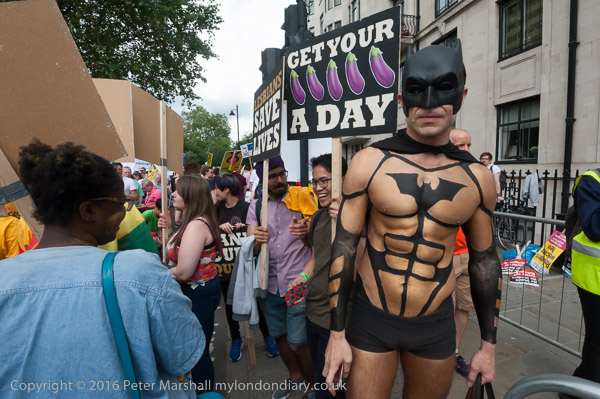
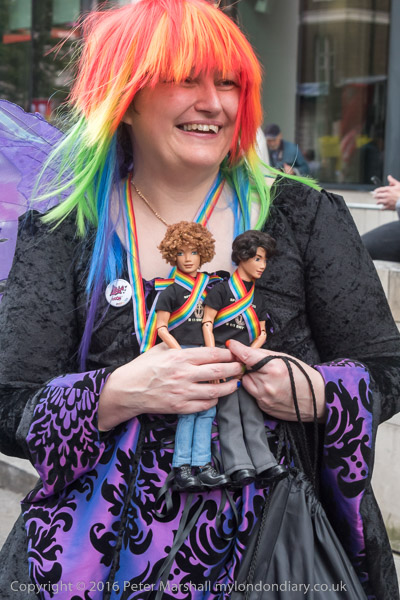
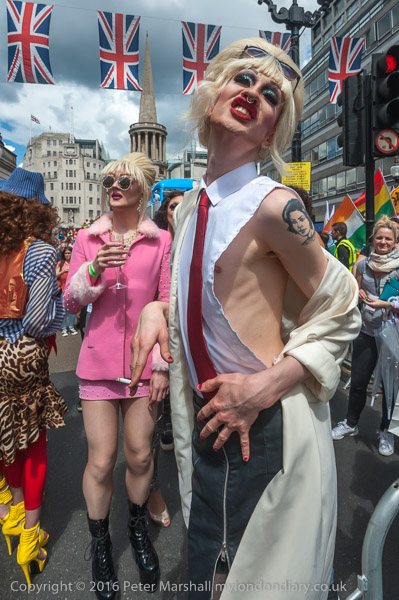
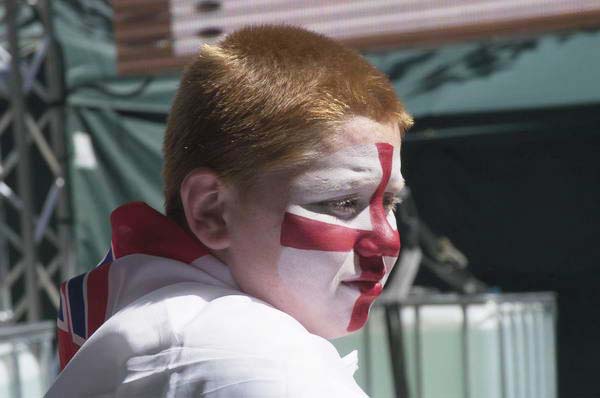
Pride and Migrant Rights & Anti-Racist Pride: Saturday 25th June was I think the last time that Pride was an open event where people who wanted to take part in Pride as a protest could just turn up and join in.
When I first photographed Pride in 1993 it was much smaller and very definitely a protest. Over the years it has become a parade with many corporate groups taking part and dominating the event attracting huge audiences to watch it on the route through the West End.
And now to be in the parade you need a wristband, free for LGBT+ Community Groups but cotsing between £7.50 and £35 for others – and the media centre is insistent we call it Pride in London rather than ‘London Pride’ or ‘gay pride’, hashtag #PrideInLondon.
I can’t remember if I had bothered to get official accreditation for the event in 2016, I certainly did some years and suspect by 2016 it was needed to be able to walk around and take photographs as people were preparing for the parade. And they wanted to be photographed.
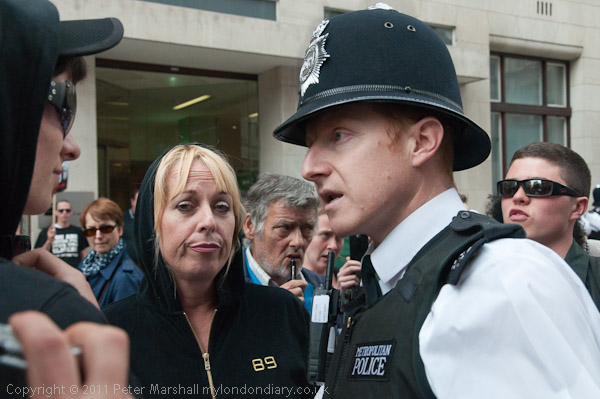
In my pictures I concentrated on those who I felt were continuing the tradition of Pride as a protest, including many I had photographed at other protests. But there were others I couldn’t ignore.
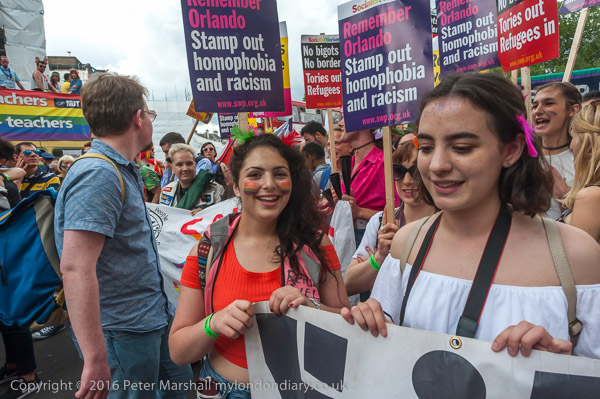
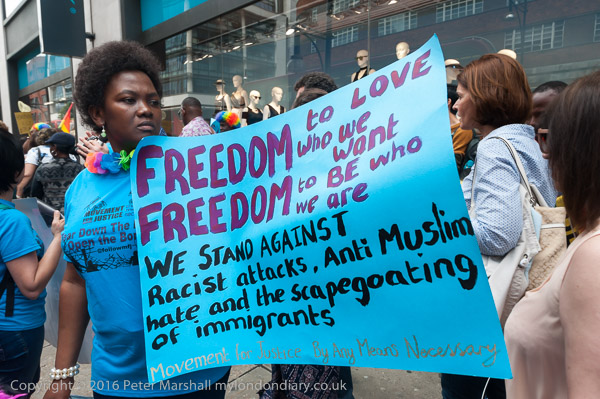
I left the official area where the parade was setting up with its corporate floats and walked down Oxford Street to where people were meeting for a Migrant Rights and Anti-Racist Pride march to join the main parade.
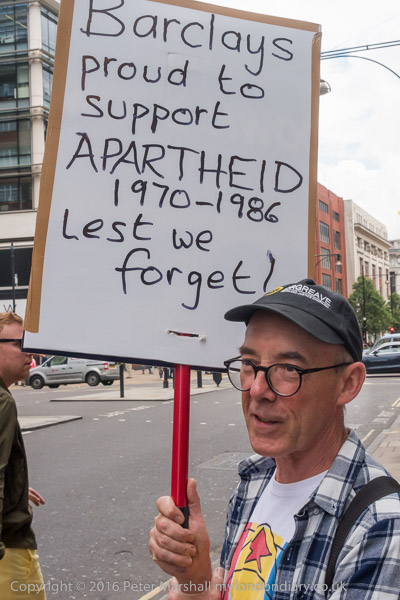
Movement for Justice who had organised this were joined by other protesters including London in Solidarity with Istanbul LGBTI Pride protesting the banning of Istanbul Pride, Lesbians and Gays Support the Migrants and other protesters who feel the official event has been taken over by corporate sponsors such as Barclays and BAE systems and is a parade rather than a protest, no longer representing its roots.
They marched up Oxford Street and Regent Street past the front of the main parade and went to its rear where they joined other protest groups relegated to the extreme end of the Pride parade. They tried to do this again the following year but were prevented by Pride stewards and ended up maching ahead of the main procession past cheering crowds along the main route.
Pensions, Cuts, Murdoch & Cafe Jiro: Thursday 23rd June 2011 – Trade unionists march against public sector pension cuts, a protest against Murdoch being allowed to take over BSkyB and one of my favourite artists turns a St John’s Wood gallery into his café.
20,000 March for Pensions & Against Cuts
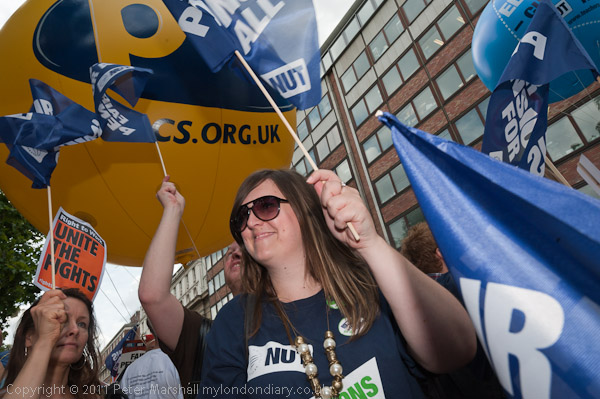
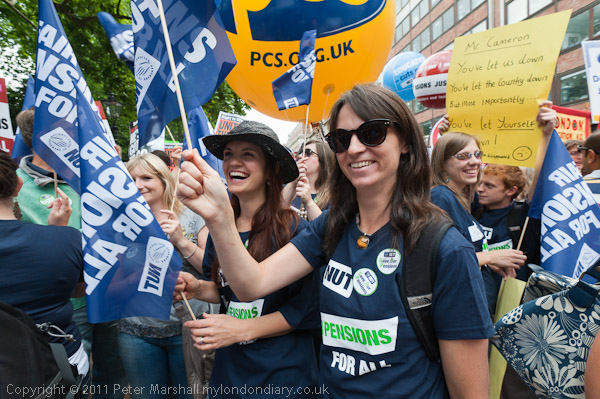
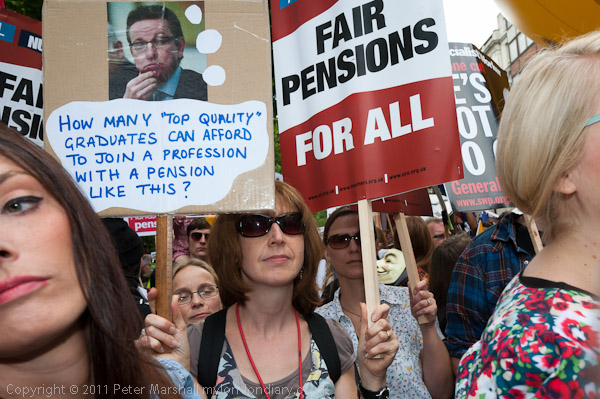
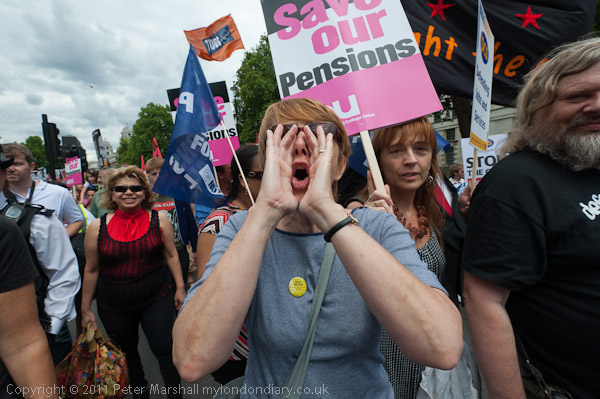
Public Service unions had organised a march against pension cuts and itt was joined by many thousands of union members as well as many others protesting against cuts in public services made by the Tory coalition government.
There was a large crowd waiting when I arrived in Lincoln’s Inn Fields over an hour before the march was due to begin and more were arriving as it left a little early as the organisers and police worried about overcrowding in London’s largest square – around 28,000 square metres.
Sally Hunt, UCU, Mary Bousted ATL, Christine Blower NUT, Mark Serwotka PCS & John McDonnell MP,
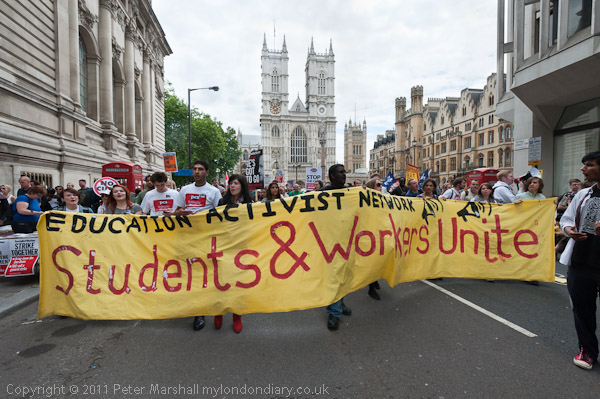
Before we left there had been speeches by several union leaders and the march was led to Parliament by Christine Blower NUT, Mark Serwotka PCS and Mary Bousted ATL along with MP John McDonnell.
The Hutton review had clearly shown that the government was lying when it said that public service pensions were not affordable. This report had said it expected “benefit payments to fall gradually to around 1.4 per cent of GDP in 2059-60, after peaking at 1.9 per cent of gross domestic product (GDP) in 2010-11.”
There seemed to be a huge number of police on the street for a peaceful march, particularly one that was mainly composed of teachers and civil servants with only a token presence from militant students and anarchists.
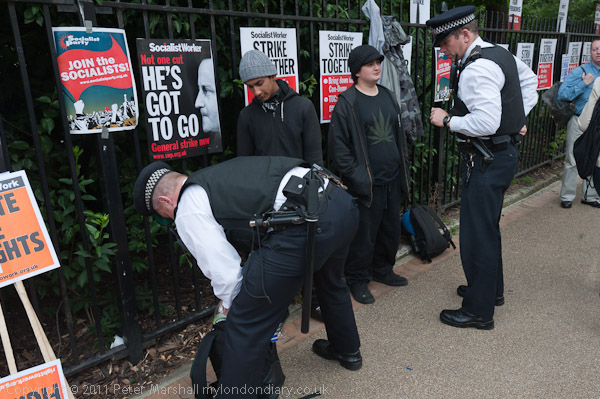
Police had earlier been busy in Lincoln’s Inn Fields where they appeared to be conducting stop and searches on any young male demonstrators in black clothing.
Things did get just a little agitated when for some reason police decided to stop the march on Strand for around 20 minutes and it got very noisy on Whitehall as it passed Downing St.
I stood outside Westminster Central Hall for around an hour as more and more marchers arrived from the main march I had been on and a number of others from various parts of London. Police and march stewards there objected to Charlie Veitch and other ‘Love Police’ haranguing the crowd in his usual deadpan fashion upholding his right to freedom of expression and they moved away.
Westminster Central Hall is a large venue but far too small for the numbers at the event and there was a large overflow rally in Tothill Street at the side of the church. A group of 20 or 30 black-clad protesters there were told by police they must remove their hoods and dark glasses and there were some arguments. I heard later in the day there were a few scuffles with them and police in Whitehall and they were kettled for a few hours in Trafalgar Square.
Save UK Democracy From Murdoch – Dept Culture, Media & Sport
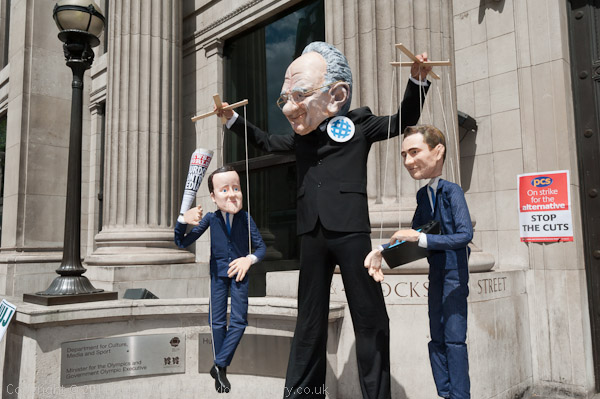
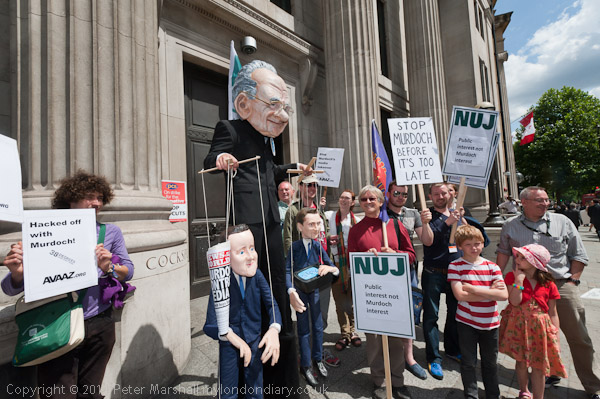
Outside the Department of Culture, Media and Sport was a protest organised by on-line global campaign network Avaaz and my union the NUJ against the decision by Jeremy Hunt to let Rupert Murdoch to take over BSkyB.
This was an emergency protest organised within minutes of the news breaking early that morning, and the email calling it went out when many were already on their way to work or to attend the pensions protest, so numbers were small.
Obviously some planning had taken place earlier and there was a tall stilt walker with a large but rather inappropriately avuncular head of Rupert Murdoch, surely one of the ugliest figures in world media and pursuing a clear aim of world domination, toying with two large string puppets representing David Cameron and Jeremy Hunt.
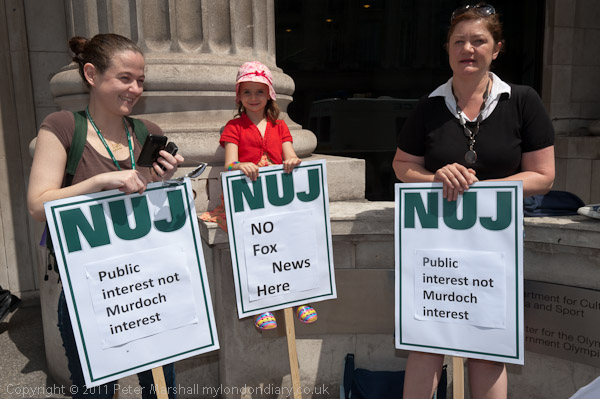
But most of the posters were clearly last minute, with laser-printed sheets being glued onto generic NUJ placards. NUJ members were “appalled – like most of the thinking population – by the thought of the UK’s largest commercial broadcaster falling into Murdoch’s hands, and the threat that this poses for in particular for news coverage, but also for a diverse and broadly based media culture. “
“They want the government to act in the public interest rather than as puppets for Murdoch’s interest and don’t want Sky News to become another Fox News.”
Café Jiro 2011 – Queen’s Terrace Café, St John’s Wood
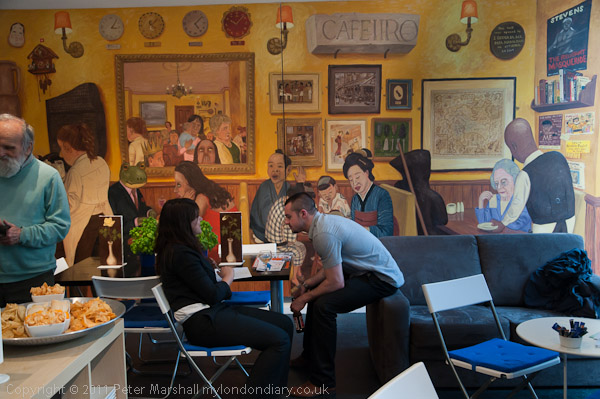
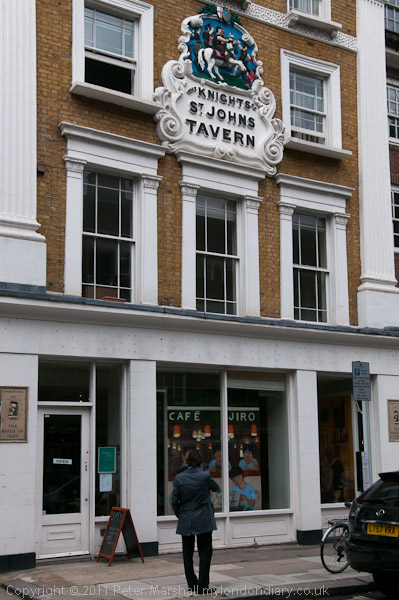
In the evening I was at The Queen’s Terrace Café, which had opened in April 2011. This was no ordinary café, but a cultural café, run by Mireille Galinou, who for some years had run a charity called the London Arts Café, which never quite managed to open a café but did organise a dozen or so exhibitions and numerous other art events in London.
London Arts Café and The Queen’s Terrace Café are no longer with us, but you can still read online about many of the the activities the London Arts Café organised during its existence from 1996-2007. For some of this time I was Treasurer of the organisation and also wrote the web site.
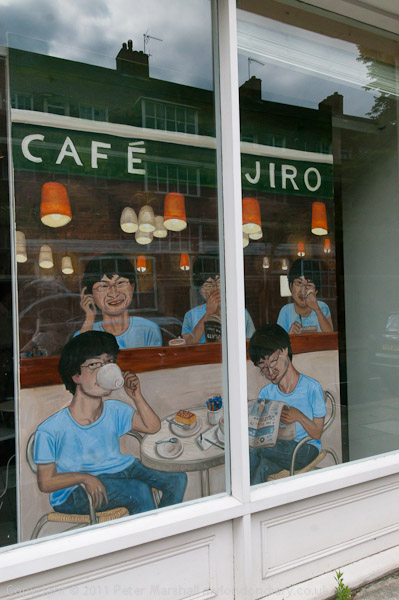
One of the most enjoyable art shows I went to in 2009 was Café Jiro, an installation in the Flowers Gallery in Cork St, London by a friend of mine, the Japanese artist Jiro Osuga who grow up in north London. The 2011 was a smaller and more intimate version of that show, with one of the large wall-size panels from the Flowers show, along with a number of other works specially produced for this space – including three in the smallest room.
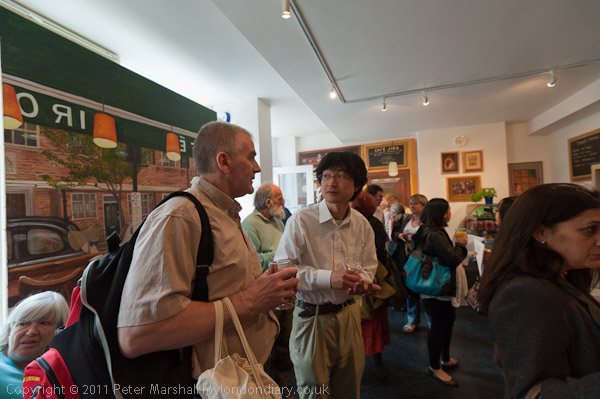
The small gallery was packed for the opening – and for me a great opportunity to meet some old friends, and it was good to see Jiro’s work in a real café environment. You can read more about the show on a 2011 post in >Re:PHOTO.
More from my walk on Sunday September 3rd 1989 which had begun in Stratford, from which some images appeared in my web site and self-published book ‘1989’, ISBN: 978-1-909363-01-4, still available. For those images which were in the book I’ll show the book pages here.
Posters, High Rd, Leytonstone, Waltham Forest, 1989 89-9a-44Plough & Harrow, pub, 419, High Rd, Leytonstone, Waltham Forest, 1989 89-9a-45
London City Mission, Ferndale Rd, Leytonstone, Waltham Forest, 1989 89-9a-46
The Victoria County History records an incredible number of missions in Leytonstone mostly formed in the late nineteenth century when this area must have seemed particularly Godless. This mission in Ferndale Road began about 1895 “when the five children of Henry Borton, a builders’ merchant at Wanstead, began holding evangelistic services in the Assembly Rooms. In 1901 their father built for them the present hall in Ferndale Road, designed in brick and stone with baroque features by T. & W. Stone. “
In 1948 the last of these children working there invited the London City Mission to take charge of the building and it became their central Hall. Google Street view shows it in 2008 as Christ Apostolic Church but by 2018 it had become Gospel Generation, “A Church Like No Other“.
Hyams Gymnasium, 857 High Rd, Leyton, Waltham Forest, 1989 89-9a-32
I can find little or nothing on-line about Hyams Gynasioum other than my pictures, but the building is still there this side on Gainsborough Road with its entrance on High Rd, but in very different use.
This is now The Walnut Tree, a Wetherspoon pub, and as often it has some history of the area it its web page, but this does not mention Hyams Gym. The figures on the building’s side have gone and its groundfloor windows have been bricked up but the rows of 8 or 9 upper floor gym windows remain.
Leytonstone House has lost its Virginia creeper but otherwise looks much the same, though I think its surroundsings are now different.
Wikipedia states “Leytonstone House, built 1800 and Grade II-listed, was the home of Sir Edward Buxton, MP and conservationist, who with his brother played a big part in preserving Epping, Hainault and Hatfield forests. It housed Bethnal Green School for the juvenile poor from 1868 to 1936.”
Leyton Flats in Snaresbrook is not a tower block but a green space that is part of Epping Forest, largely open grass land but some woodland and two large ponds, Hollow Pond and Eagle Pond which is one of the oldest in the forest and swarms with swans, probably because many injured swans nursed to health by swan resuce organisations on the Thames have been released here. But people are more likely to be imprisoned as the Flats is also home to Snaresbrook Crown Court.
The house in the distance here is at 85, 85a and 87 Whipps Cross Rd, on the corner of Chadwick Road. Locally listed, The Gables was built in 1895 and was part of the Wallwood Park estate which was once the home of the Governor of the Bank of England William Cotton who died in 1845.
Men are fishing in the Hollow Pond on Leyton Flats, close to the Whipps Cross roundabout and Whipps Cross Hospital. The pond, the result of gravel workings, is also a boating lake. Water from the ponds may eventually find its way into the River Roding, but they have never as has been claimed fed the ornamental lakes of Wanstead Park.
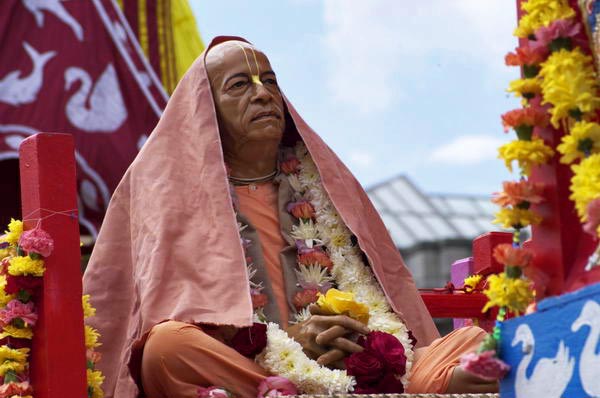
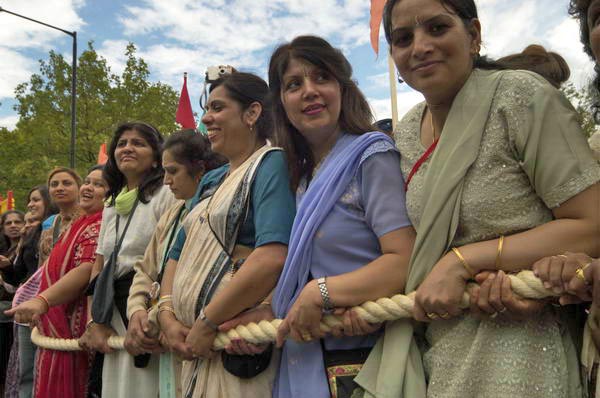
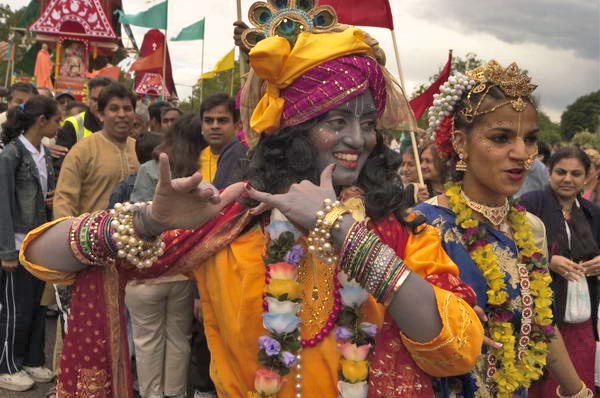
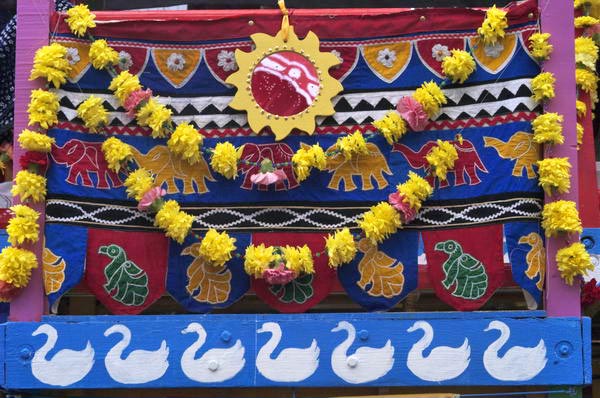
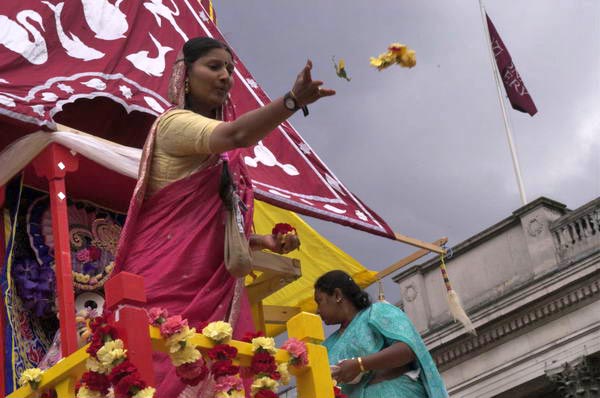
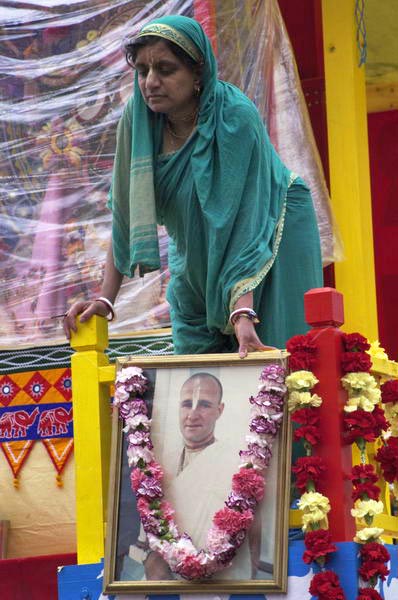
Rathayatra – the Festival of Chariots: Every year in June or July people pull huge decorated chariots through the streets of London. The first festival here took place in 1969 but such chariot festivals have taken place in India since 1150 CE.
In 1968 three American couples came from San Francisco and organised London’s first Rathayatra festival, on July 27, 1969. The deities Jagannatha, Baladeva, and Subhadra made for this are still worshipped in London.
International Society for Krishna Consciousness (ISKCON) or Hare Krishna, a Gaudiya Vaishnava Hindu religious movement founded in New York in 1966 became well jknown in the UK particularly because the Beatles had visited India in 1967 and they became friends of thye Hare Krishnas with George Harrison particularly promoting them.
He persuaded Apple Records to release a single “Hare Krishna Mantra” released in August 1969, and funds from this enabled them to set up a temple in London. They outgrew this and in 1973 Harrison bought a manor house with extensive grounds in Radlett, Hertfordshire which he gave to them as was renamed Bhaktivedanta Manor.
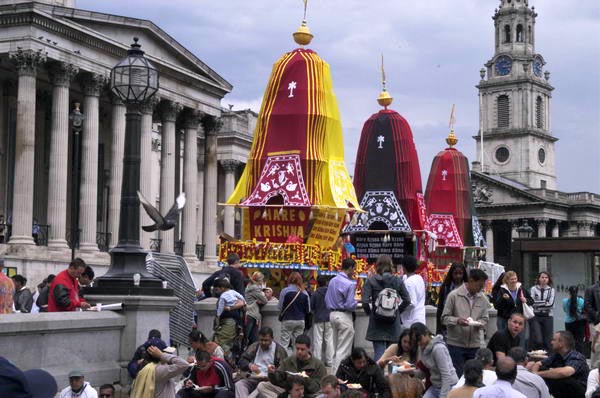
The first occasion I photographed the procession was on 20th June 2004 when I followed the procession from Hyde Park to a festival in Trafalgar Square. Here I’ll reproduce (with corrections to case & spelling) what I wrote back then, along with a few of the pictures I took.
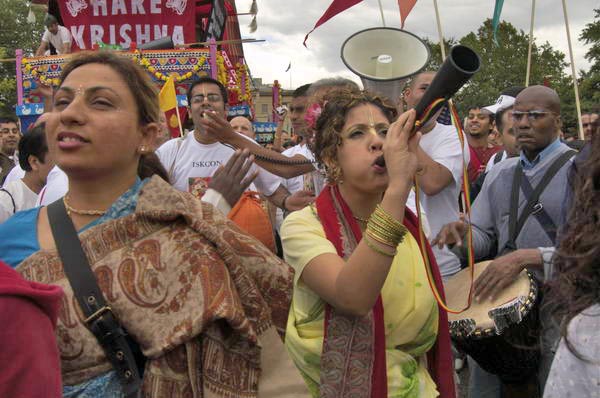
“Sunday the streets of London were alive to the sound of ‘Hare Khrisna, Hare Krishna , Krsna Krishna , Hare Hare, Hare Rama, Hare Rama, Rama Rama, Hare Hare….’ as several thousand supporters pulled three 40ft tall decorated wooden chariots from Hyde park to Trafalgar square to celebrate the Indian festival of Rathayatra – the Carnival of Chariots.
An extension from Hinduism, Krishna Consciousness isn’t my thing, involving abstinence from alcohol, coffee, meat, onions, mushrooms and sex except for the purposes of procreation.
The movement has come a long way from its roots in New York’s Lower East Side in the flower-power years, but still seems a part of those times.
All respect to the sincerity, honesty and friendliness of these people, and it was a great show, the biggest in London yet, but a few hours of being kind and good and aiming for perfection was enough to last me the year.
I also photographed the festival in several later year and put accounts and pictures on-line. You can find more pictures from 20th June 2004 on My London Diary.
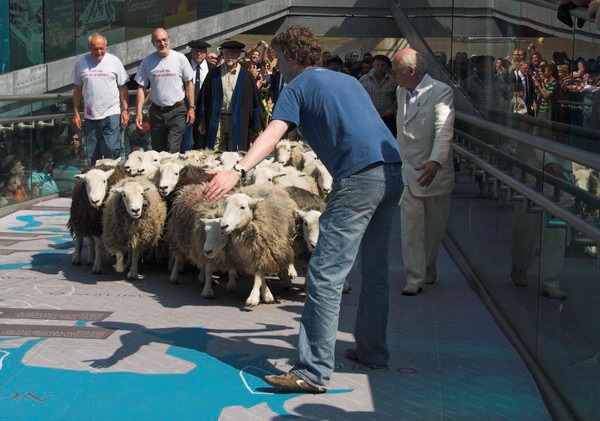
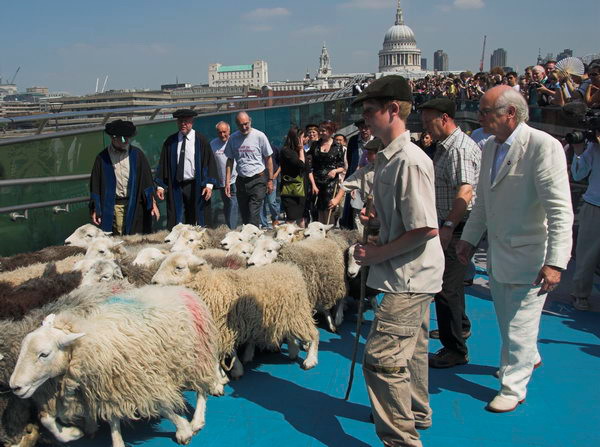
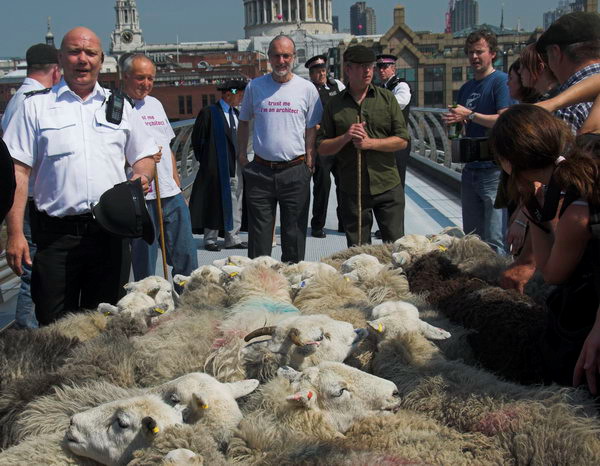
Sheep Drive Across the Thames: The sheep drive from Southwark Cathedral to Smithfield Market on Saturday 17 June, 2006 organised as a part of the London Architecture Biennale and if not really leading the sheep, accompanying the sheep over the Millennium Bridge were architects Richard Rogers and Renzo Piano in Biennale “Trust me, I’m an architect” T-shirts as well as Freemen from the Butcher’s Company.
The right dates back to the establishment of Freemen of the city, and was first recorded in 1237. Freemen were allowed to drive their sheep across London Bridge – then and for many years the only bridge across the River Thames – without paying the normal Bridge Toll, giving them an important commercial advantage when taking sheep from south of the river to the Wool Exchange or Smithfield Meat Market.
It wasn’t just sheep but applied to any livestock such as cattle, pigs, chickens, ducks, geese although some of these might be difficult to drive, and so far as I’m aware there have been no modern revivals involving anything but sheep.
Freeman also gained other important privileges, such as immunity from being taken to serve on ships by the press gang and being allowed to carry your sword drawn against muggers when walking around the City.
In 2006 there were no signs of the press gang and I didn’t see any of the Freemen present carrying swords. Nor were any convicted of murder or treason and allowed to claim the rather doubtful privilege of being hung by a silk rope.
So far as I’m aware first modern revival of the sheep drive came during the Millennium celebrations when the Lord Mayor Sir Clive Haydn Martin arranged for the driving of some pedigree sheep across London Bridge by some members of the Livery Companies – though carefully avoiding the two who might have sheared or slaughtered them, the Woolmen and Butchers.
The London Architecture Biennale in 2006 made use not of London Bridge, but the pedestrian Millennium Bridge and this was certainly the first sheep drive across this, fortunately long cured of its initial wobbles, though I did rather wonder if the event might exceed its design loadings. This was perhaps why the police insisted on holding up spectators until the flock had cleared the bridge, much to the annoyance of me and the other press who felt a Press Card should have let us through.
Since 2006 there have been more sheep drives – in 2008 by World Tradeers and in 2009 for the 800th anniversary of Old London Bridge, by the City whose then Lord Mayor David Lewis was the grandson of a Welsh sheep-farmer. And in 2013 it became the Great Annual Sheep Drive organised for Freemen of the City by the Worshipful Company of Woolmen, held on London Bridge in September (though in recent years on Southwark Bridge.)
In 2006 around 30 sheep had brought to a pen at Southwark Cathedral by farmer Andrew Sharp who was a stallholder in Borough Market, and came with several shepherds to help and was also aided by members of the clergy including the Bishop of Southwark, Tom Butler.
Also facing the cathedral were a small and noisy crowd of animal rights protesters. As I commented, “here the sheep were being treated well, by people who so obviously cared for them. You can’t be a successful sheep farmer without having a feeling for and and understanding of them and a dedication to care for them.” Probably for the sheep the most disturbing thing of their day out in London was the shouts of the protesters.
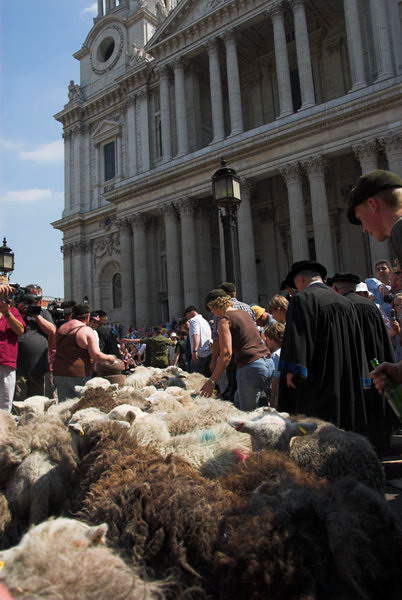
I took pictures of the start of the procession and then of the flock and those accompanying it as far as the south end of the Millennium Bridge. Some of the protesters had followed as well. Police then stopped everyone then behind the sheep of while the crossing continued. A few minutes later we were allowed to proceed and I caught up with the sheep as they reached St Paul’s Cathedral and walked with them to Smithfield Market.
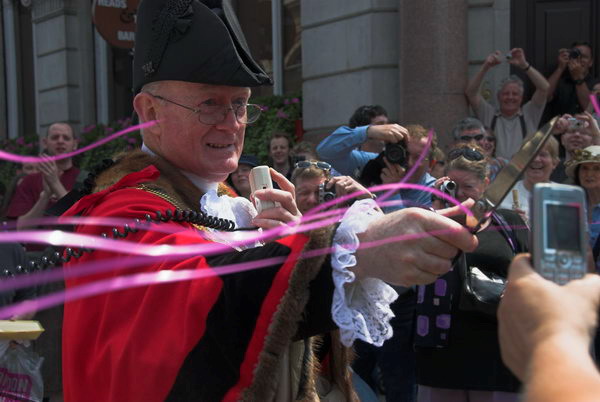
The drive ended in Smithfield, with the Sheriff of London opening the Bartholomew Fair by cutting a number of pink ribbons. I took a few pictures around the fair, and of the flypast taking place for the Queens official 80th birthday before going to St John’s Wood where mounted soldiers were coming back to barracks with a gun carriage before joining a guided tour around the trees in the area.
More pictures from the Sheep Drive as well as the other things I photographed on the day beginning here on My London Diary
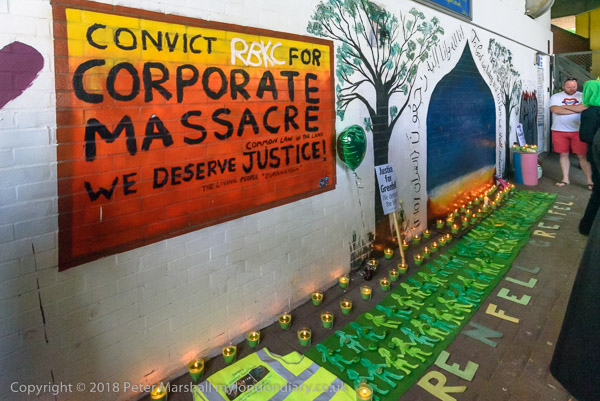
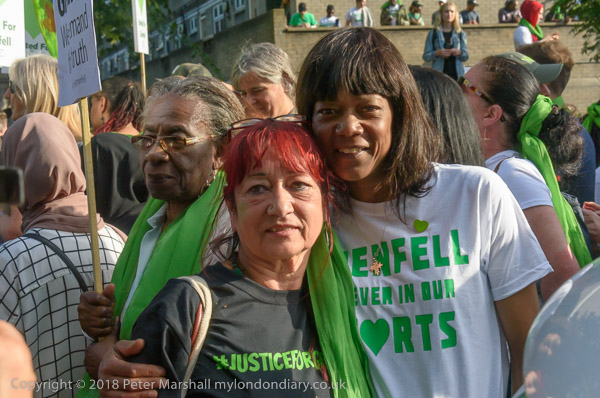
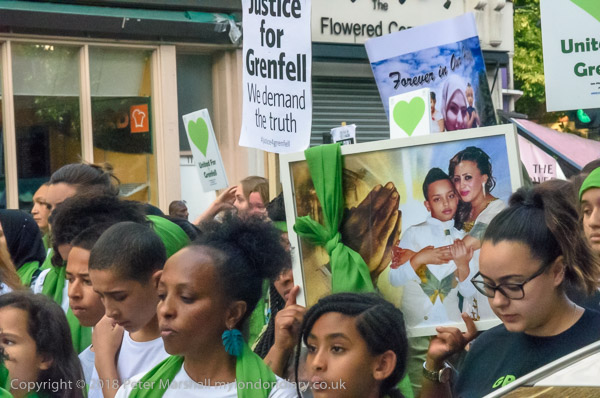
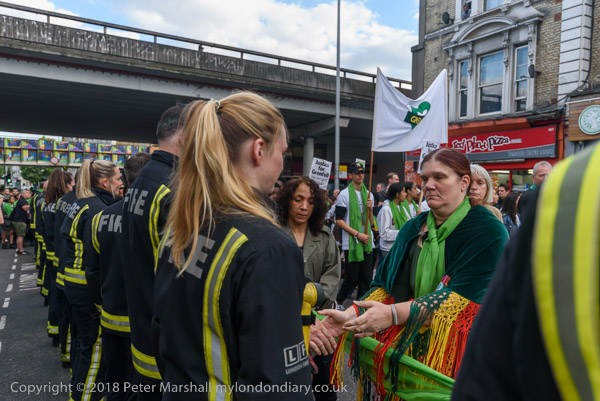
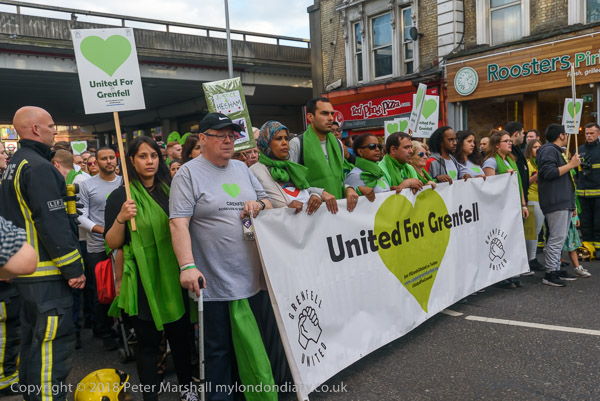
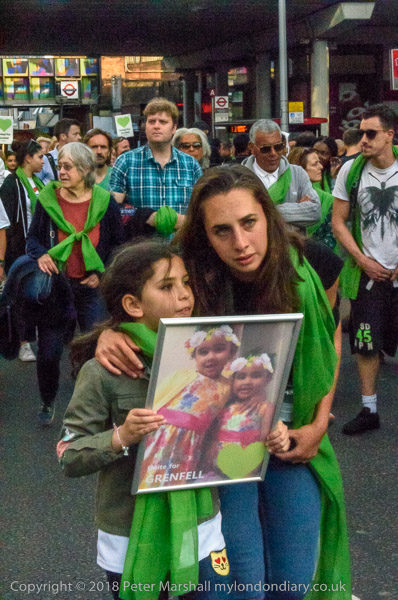
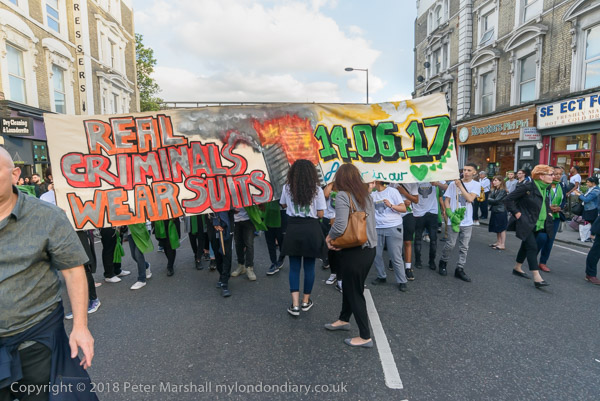
Grenfell – 7 Years On: Seven years after the terrible fire that killed 72 people in Grenfell Tower and left many others traumatised we still have no justice. None of those whose deliberate actions and failures that set up this firetrap and made a disaster virtually inevitable has yet to be brought to court.
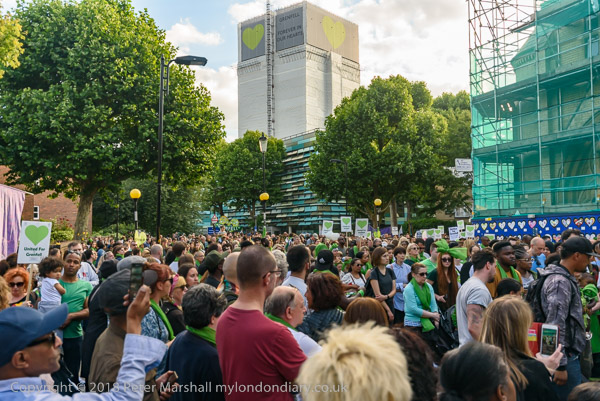
Pictures here are from the first anniversary of the fire on Thursday 14th June 2018. You can see my account of this and more pictures on My London Diary.
The inquiry dragged on and although it has ended taking evidence its final report has been delayed and delayed. Initially due in late 2023 it is now expected to be released in Autumn 2024, although that may well be delayed yet again.
When it does come it will almost certainly be too little as well as far too late. Grenfell was a crime and the major criminals were obvious from the start. The inquiry – as it was always meant too – has tied the hands of the police in pursuing the criminals and bringing them to justice. It seems doubtful there will be many if any prosecutions and if they take place they are likely to be only for minor offences.
I don’t think anything much of significance has emerged from the years of the inquiry that was not already evident in early reports on the fire – such as that published by Architects for Social Housing in July 2017, although we have some more detail. But the inquiry has mainly served as an opportunity for some involved to take part in buck-passing and blame others or to claim ignorance of the obvious.
And of course to generate considerable incomes for the lawyers, who have had a field day thanks to the excessive adversarial nature of the inquiry. The delays in publishing the report are all down to the inquiry having to consult with those who are named in it. We urgently need a streamlined process for such inquiries – and this should almost certainly involve prosecutions of the more obvious criminals before the inquiry begins.
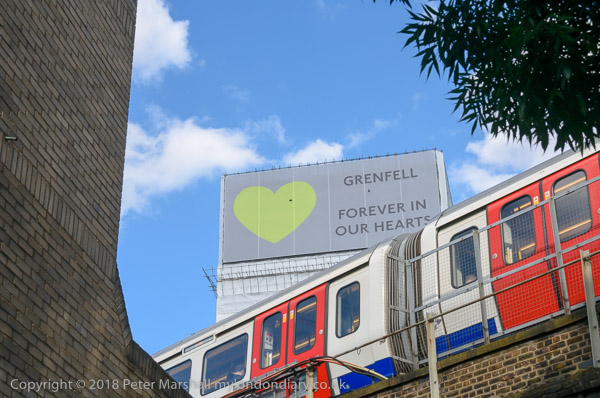
But although the grass has grown longer, Grenfell Tower is still there as a reminder of the terrible events which began which shortly before 1am on Tuesday, 14 June 2017. Although by the first anniversary in 2018, from which the pictures here come, its scarred and blackened bulk had been hidden by white sheetong. But at the top was a grey panel with a large green Grenfell heart and the message ‘Grenfell – Forever In Our Hearts‘.
As I wrote in 2018, “Some felt it should have been left standing uncovered – particularly as the disaster was caused by covering up the building to make it look nicer for the academy at its base. Without that covering the fire would have been a minor incident with no loss of life.”
I continued “The academy in front of the tower was also built without proper regard for access for fire engines to fight the fire when it happened. To make things worse, Boris Johnson had cut the fire service drastically and they no longer had the equipment to fight the fire in the upper stories – it had to come from Surrey – and successive governments had removed regulations and cut safety inspections (they called it ‘red tape) which would have prevented the inferno.”
Here are the details from the Grenfell United web site of the 7th Anniversary Silent Walk:
Join us at the Silent Walk on 14 June 2024 to mark 7 years since the Grenfell Tower Fire. We will gather at the Nottinghill Methodist Church from 6pm and the walk will begin at 6:30pm. There will be speeches and a call to justice at the end.
Please walk in silence with us to show those responsible we are not going anywhere until we see justice.
You can see more from the first anniversary walk in 2018 at Massive Silent Walk for Grenfell Anniversary Among those taking part were both then Labour Party Leader Jeremy Corbyn and Shadow Home Secretary Diane Abbott.
Greenwich, Bikefest and the 1940s: Twenty years ago on Sunday 13th June 2004 I had a day out in London, beginning with a walk beside the Thames at Greenwich, then coming to Westminster for a bike festival in Trafalgar Square and then a rather peaceful ‘War in the West End’ in Leicester Square. You can find what I wrote then about all these a little way down the June 2004 page of My London Diary.
Greenwich to North Greenwich Walk
I’d decided to get up early on Sunday and take a walk by the River Thames in Greenwich. Unfortunately engineering work meant no trains were running there so I had rather a long bus journey from Waterloo to get there. At least there was little traffic to hold the bus up.
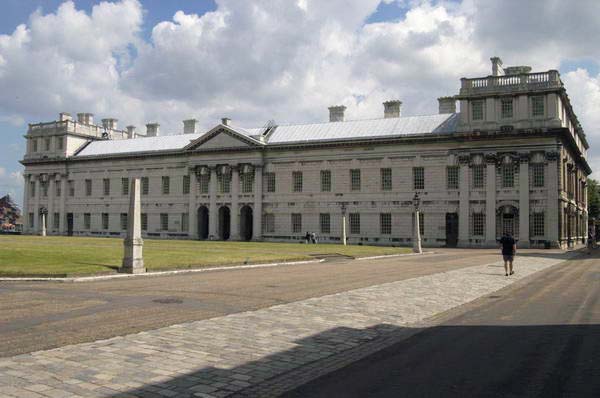
I began with a walk around the grounds of the former Royal Naval College, now Greenwich University before taking the path past the power station and along Ballast Quay an on.
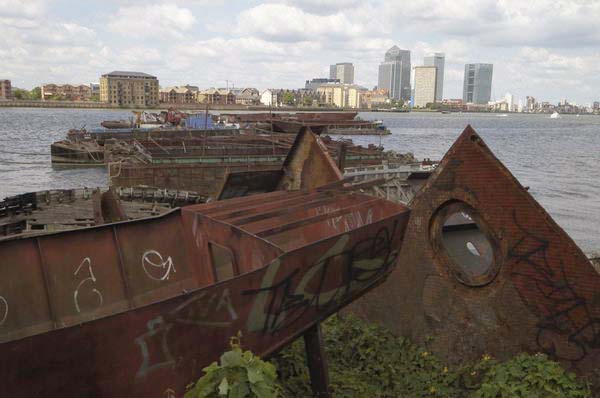
The path was open to North Greenwich and I made my way along it. Some of the pictures I made are now difficult to locate as this whole riverside is getting replaced by blocks of flats.
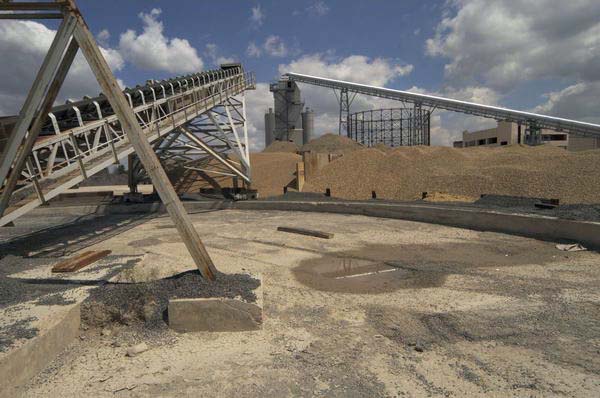
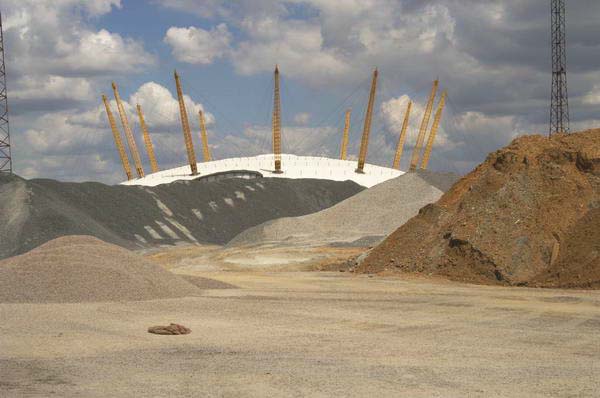
I didn’t put many images on line in 2004, as most viewers were still on slow internet connections. Further on towards North Greenwich there is still – at least the last time I walked along here a couple of years ago – an aggregate wharf with huge piles of sand and gravel on the landward side.
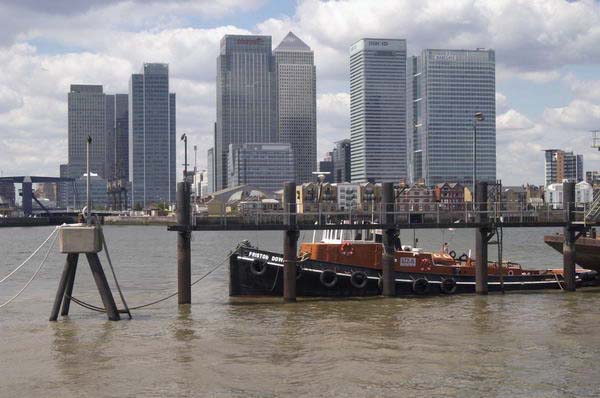
One of the huge gasholders at Greenwich was still standing in 2004, since demolished, and across the river Canary Wharf tower for long the only tower on the site was now almost hidden by others sprouting around it.
Eventually I could see the Millennium Dome looming above the sand and gravel which I felt “perhaps looks more at home in this almost lunar landscape” and I knew I was not far from North Greenwich station where I could catch the tube to Westminster.
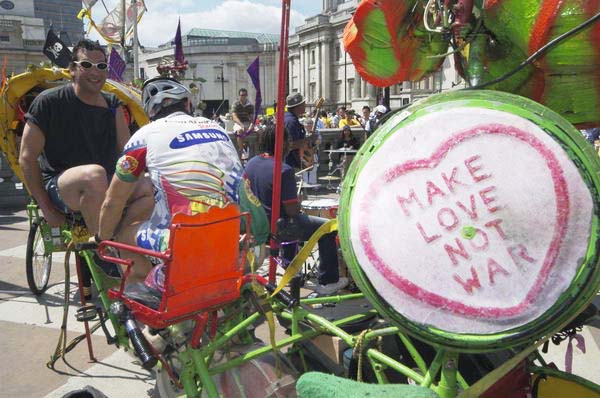
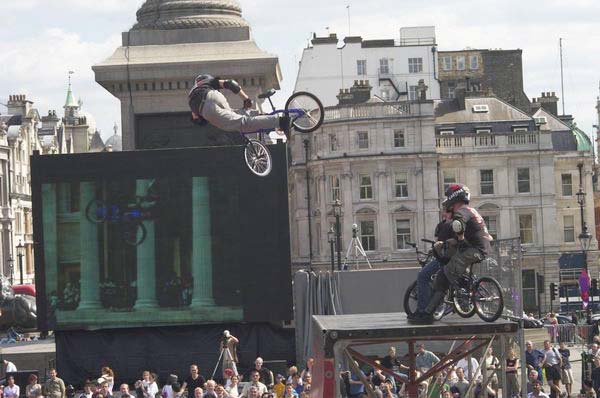
Bikefest was the first bicycle festival in Trafalgar Square, but I was surprised to find that bicycles were not allowed on the square. Though perhaps they would have got in the way, but it would have been nice at least to have had some temporary secure bike parking.
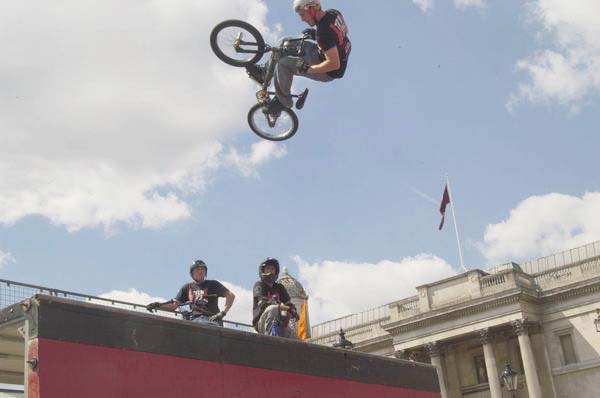
Except of course those taking part officially in the event including Team Extreme performing on the half-pipe and some great cycle powered musical systems such as Rinky-Dink.
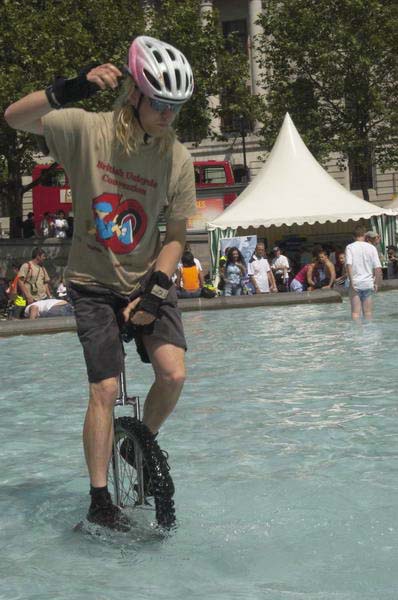
But I had agreed to meet one of my sons there and he managed to smuggle his unicycle in to the event. But by the time I found him he had already been hassled by the heritage wardens (who I described as ‘Ken’s SS’) but he still decided to have a go at riding in the fountains where he could not possibly be endangering the public.
But he had hardly got going when he was ordered out and made to leave the area, though he did so riding the unicycle after a few quick bounces to shake off the water.
I went back to watching Team Extreme and taking a few more pictures, although I found it hard to convey quite how extreme they were, before leaving to join the Second World War in Leicester Square.
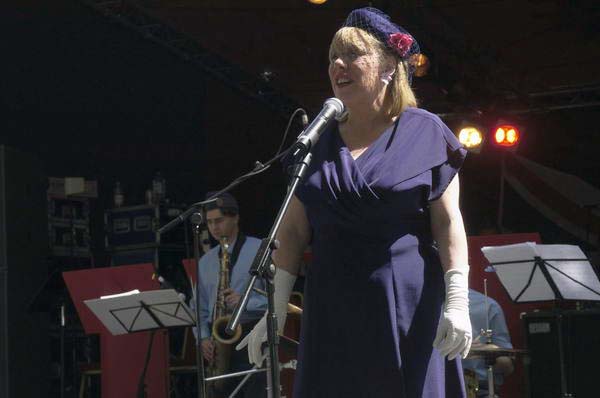
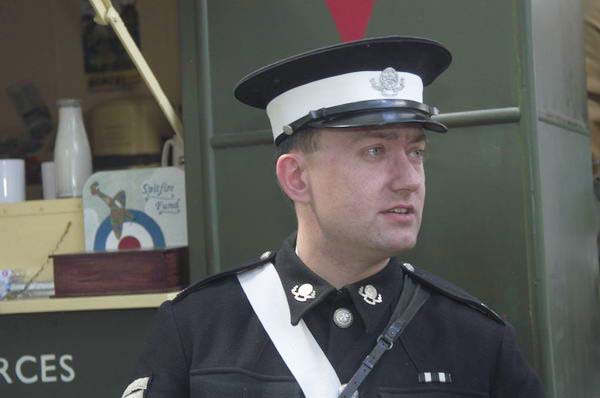
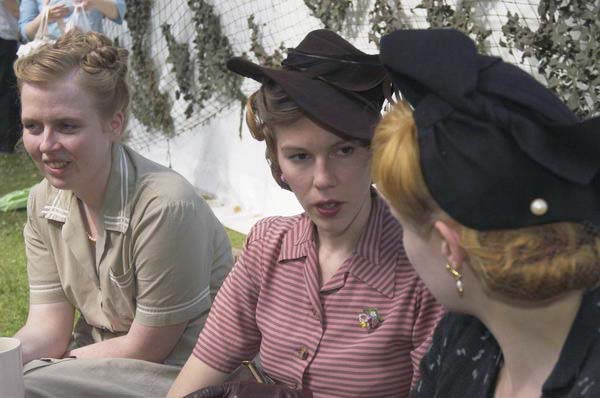
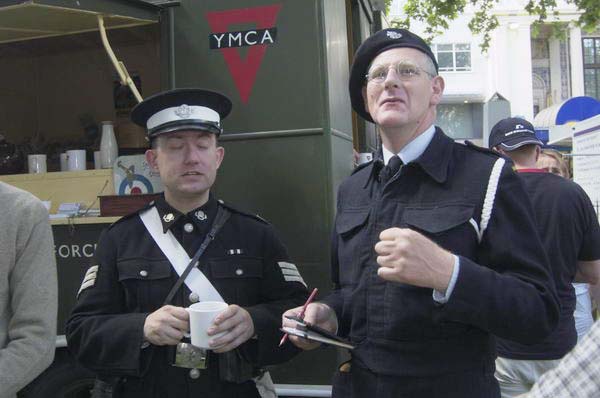
Westminster Council had organised a festival turning Leicester Square into 1940’s London for the weekend, going back 60 years to 1944.
Although 60 years ago bombs were still falling on Westminster and rationing made life difficult (though for the wealthy – and there were plenty in Westminster – the black market was flourishing) the West End was full of servicemen on leave and many servicewomen determined to have fun, “letting their hair down” in cinemas, on dance floors, in clubs, pubs and hotels.
I found the scene in the square rather sad, although obviously a lot of effort had been put into the displays and performances and there were a few 1940s dressed re-enactors among the crowds in modern dress.
60 Years earlier Allied troops had landed in France on D-Day to fight to reclaim Europe, but the previous Thursday we had seen a large vote here in the European Parliament election rejecting it with both Conservative and Labour votes well down and the Lib-Dems coming in 4th place behind the UK Independence Party.
Things of course got worse in 2016, when the leave vote gained a small majority over those wishing to remain. Although the vote was not binding, stupidly Tory Prime Minister David Cameron had promised to abide by it – rather than more sensibly pointing out that a major constitutional change such as this should require a substantial majority rather than a momentary electoral whim – as would surely have been the case if we had a written constitution. And for once a politician kept his promise.
The latest opinion poll (May 1st 2024) has 55% saying we were wrong to leave against 31% thinking we were right with 13% of Don’t Knows.
Carshalton Carnival, Merton Priory: On Saturday 12th June 2004 I went to photograph the carnival in Carshalton and from there went on to an open day at Merton Priory, a scheduled ancient monument.
Carshalton Carnival
It seems unclear when Carshalton Carnival first began, but it was certainly taking place in the 1930s, usually held on the second Saturday in June.
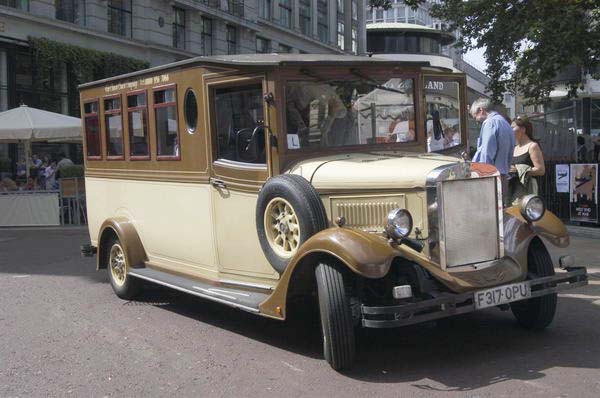
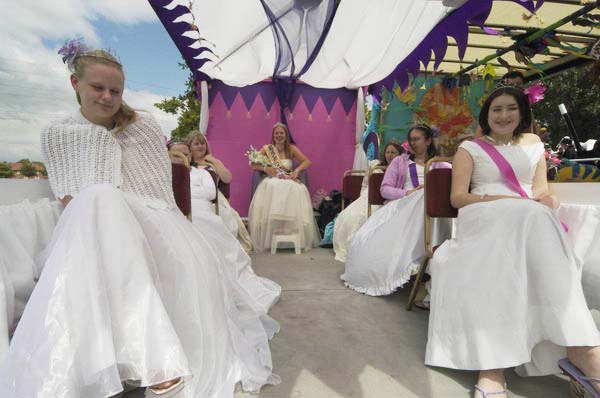
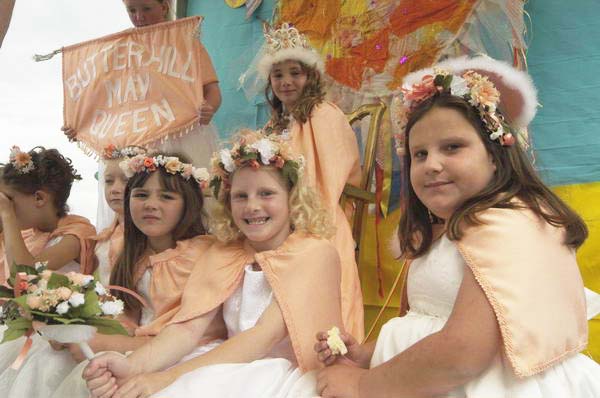
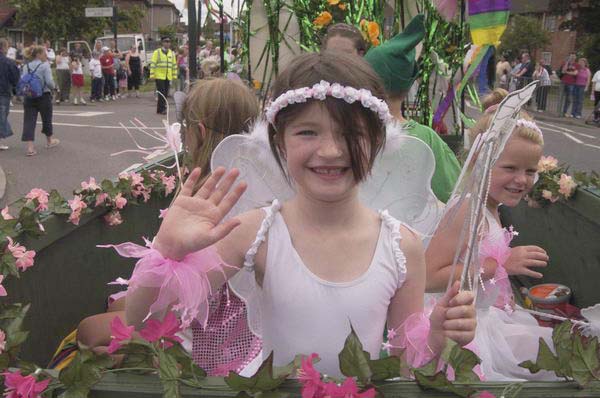
By 2004 many other local carnivals were fading away but the event in Carshalton appeared to still be going strong, although there were fewer floats than I had expected and almost all the groups taking part seemed to be groups of children.
Carnivals like this, organised by the local Rotary and Round Table, raise money for various charities and the Rotary had brought their Santa waving from the chimney of a very small mobile home. Carshalton’s Lavender Farm was represented by a bike-hauled trailer.
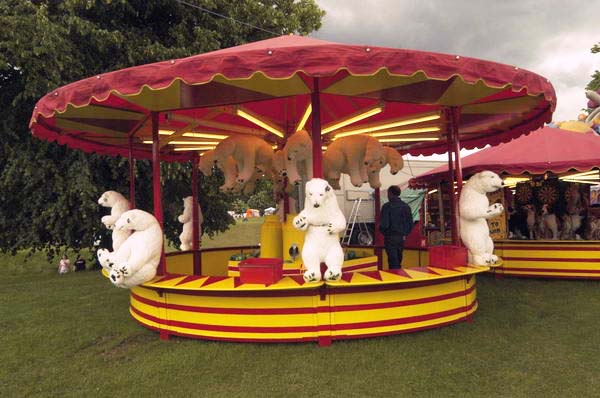
The parade ended at the funfair taking place in Carshalton Park. I took a few pictures there too.
Merton Abbey was one of the most important places in England from 1114 until Henry VIII dissolved it in 1538. The Abbey church was around the same size as Westminster Abbey and as fine a building as existing cathedrals such as Salisbury, but its fine stonework was taken down and used in other buildings, particularly Henry VI1I’s new Nonsuch Palace in nearby Cheam where building began the same year, though this in turn was demolished in 1683.
Merton Abbey was more important than Westminster or Canterbury. Here the first English laws, the eleven ‘statutes of merton’ were written in 1236, and its college established here moved to Oxford an became one of the three that started Oxford University in the 1260s.
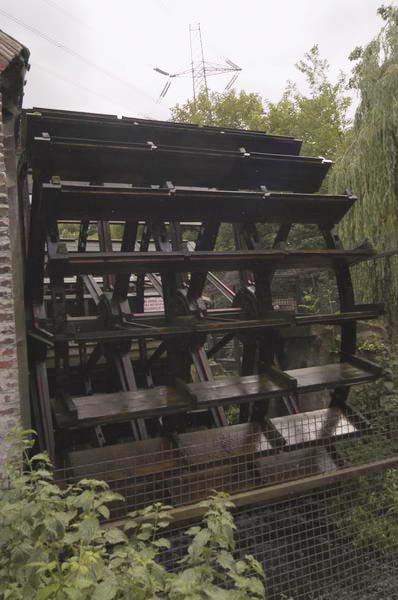
The site remained derelict but part by the River Wandle became a calico printing works in 1724 using the power of a large waterwheel.
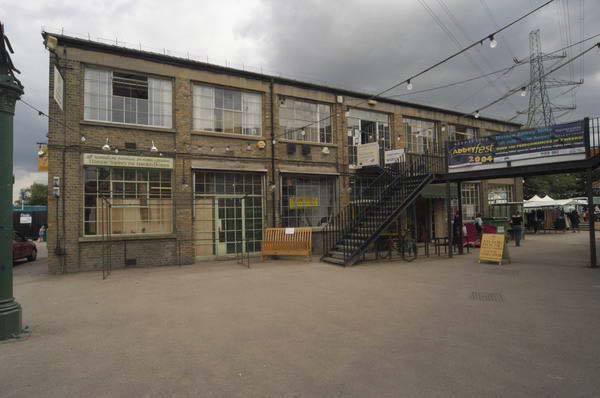
Alfred Liberty took over Littler’s Print Works here to print the fabrics for his Regent Street store, taking over the site completely in 1904 and using parts of it until 1977.
A little to the north in the Abbey site William Morris set up works in 1881 which produced decorated glass, printing fabrics and other goods until 1940. I don’t think anything remains of his works but there is a William Morris pub on the former Liberty site. And the world’s first public railway, the horse-drawn Surrey Iron Railway, ran through the site beside the River Wandle in 1804, taking goods to the Thames at Wandsworth.
Archaelogical investigations of the site between 1914-1920 established the floor plans of the former Abbey, uncovering its foundations. In 1959 a garden was created on the site of the main altar of the church and ‘given in perpetuity‘ to the people of Merton.
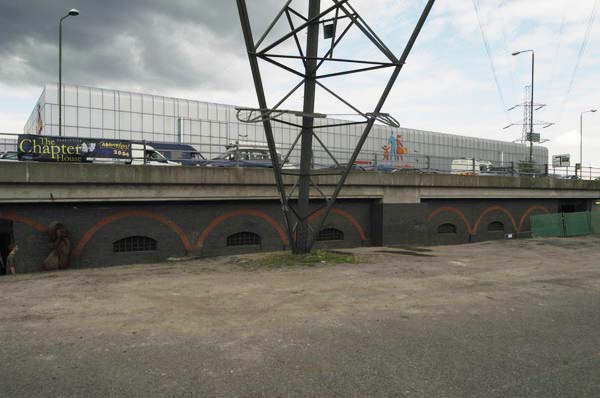
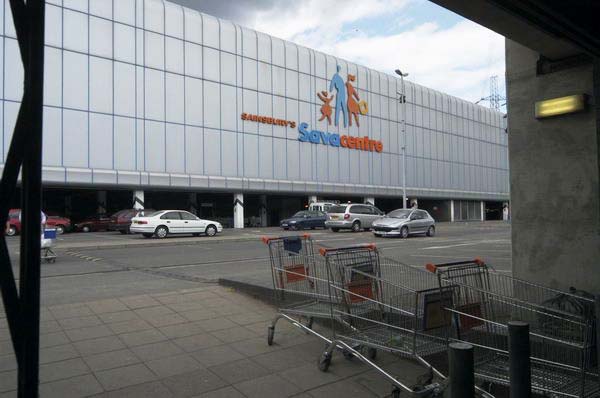
This now lies several feet below the surface of the car park of the Sainsbury’s ‘savacentre’ along with most of the rest of the huge church site, with just a little still present beneath the edge of the supermarket. Some parts of the original walls around the large Abbey site have survived.
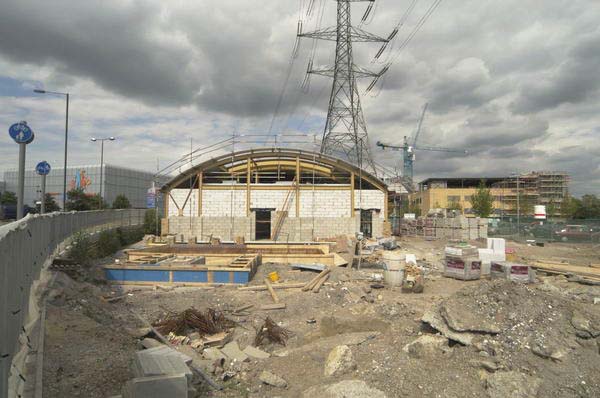
A new dual carriageway, Merantun Way was built for the new traffic to the various shops, and the ruins of the chapter house were preserved in an enclosed area under this. Local volunteers had formed the Merton Priory Trust in 2003 and were holding an open day when I visited.
Back then the area under the road was rather dimly lit and I don’t think I took any pictures of the interior with its foundations. Cerrtainly I put none online. Now it has much better lighting and a new visitor centre with a small museum and is open on Summer Sundays to the public. You can see pictures on the IanVisits site. The Wandle Valley site shows pictures of some of the work being carried out and there is much more on the Merton Priory site.
Slutwalk, Syrians & More Naked Bikers: Three events in London on Saturday 11th June 2011.
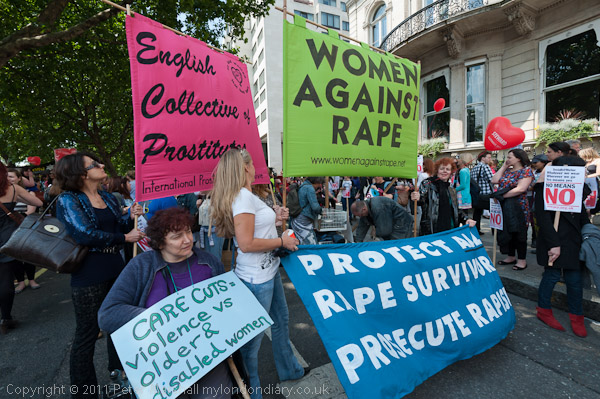
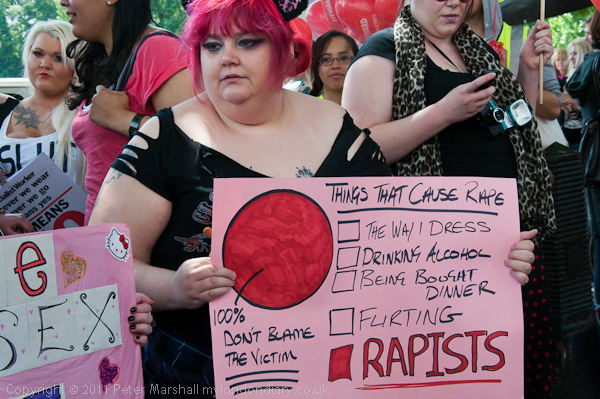
Slutwalk London – Piccadilly to Trafalgar Square
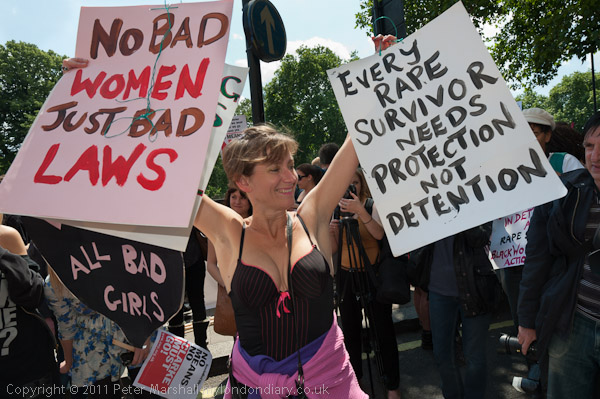
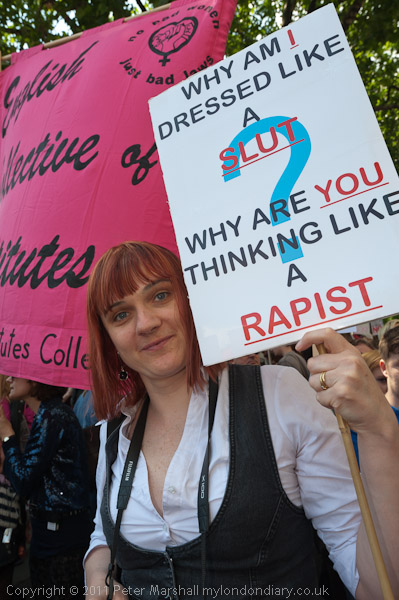
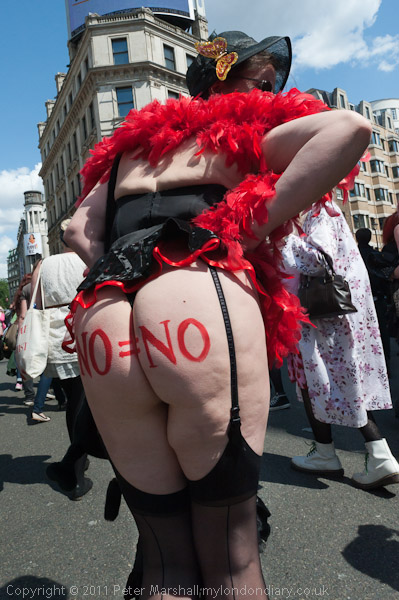
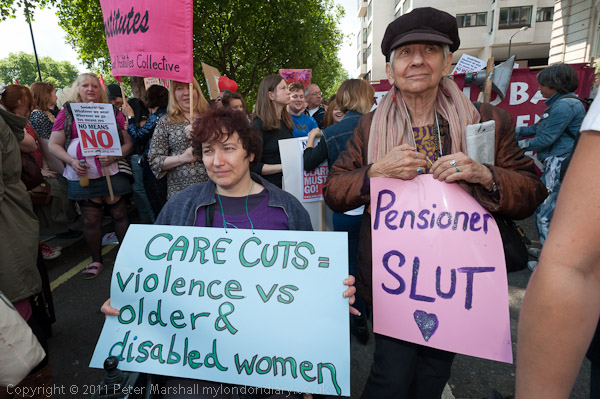
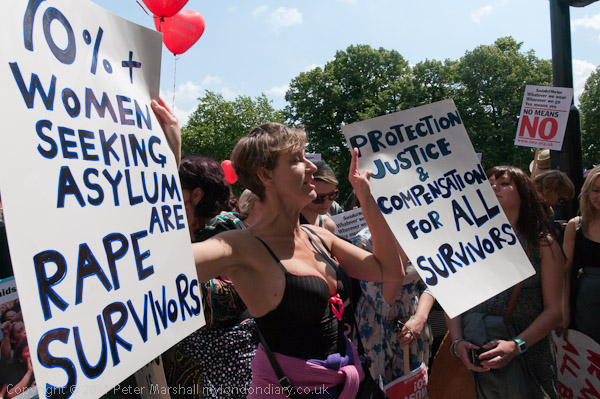
Several thousand people, mainly women, some dressed in deliberately provocative fashions, marched through London to demand the right to wear what they like and to be safe.
The protest came after a police officer in Toronto had told students “women should avoid dressing like sluts in order not to be victimized.”
They were protesting against the use of the word ‘slut’ to describe the innocent victims of crimes and the blaming of the victims for the crimes that were carried out against them. The job of police is to protect people on the street and arrest and get convictions of those who commit crimes, not to blame the victims for the crime.
I wrote then “Women should feel free to go out on the streets dressed how they like – whether burkha or bikini – and be safe. An attractive dress is an attractive dress and not an invitation to rape.”
They were also protesting against male violence against women in general and calling for better education on the facts about rape and called for improvements in the legal, emotional and practical support for the victims of sexual assault, rape and domestic violence.
Government cuts in public services had led to a decrease in support and legal aid, and the failure to provide adequate affordable social housing often makes it impossible for victims of domestic violence to leave the family home.
They also protested the failure of the UK immigration authorities to take seriously the accounts of rape given by many asylum seekers and the use of rape as a military weapon in Libya and elsewhere.
Syrians Protest At Syrian Embassy – Belgrave Square
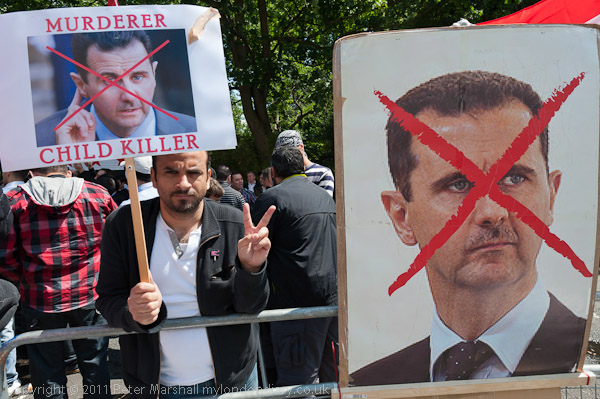
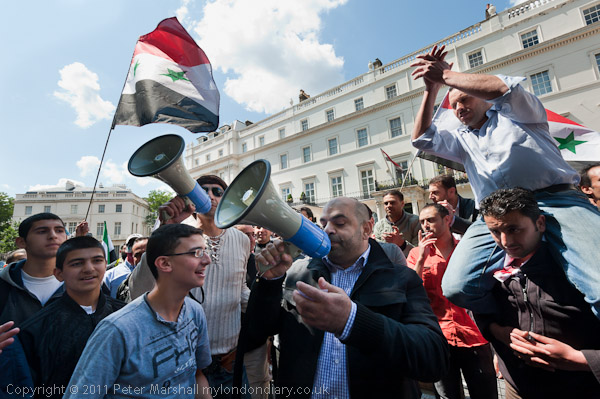
A crowd of over a hundred Syrians protested outside the embassy after news of the government using helicopter gunships against peaceful protesters in Maarat al-Numaab and the ‘revenge’ attacks against villages around Jisr al-Shugour, where crops have been burnt, livestock killed, olive trees uprooted and villages destroyed.
Peaceful protests in Syria have been met by increasing military force in Syria and the protesters called for President Bashar al-Assad and his regime to resign and for democratic changes in their country.
The protest in London remained peaceful but very noisy and the two armed officers guarding the embassy door had nothing to do and other officers remained in their van a short distance away. There were no signs of anyone being inside the embassy during the protest.
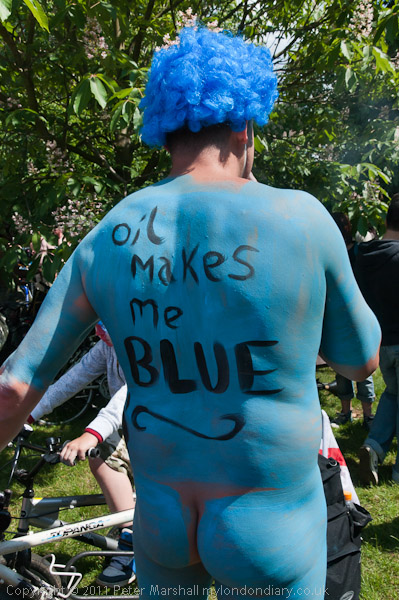
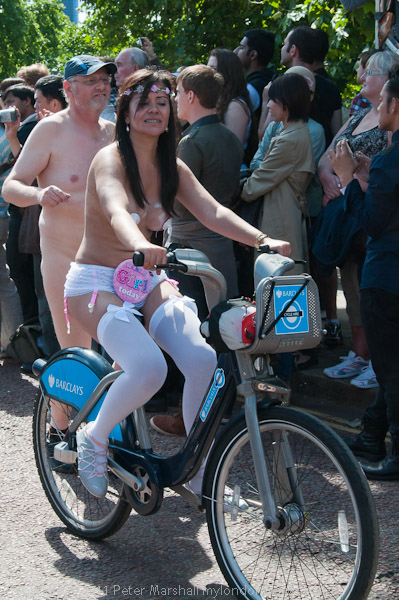
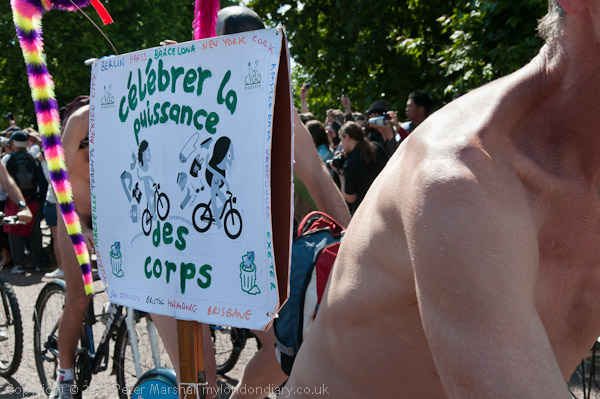
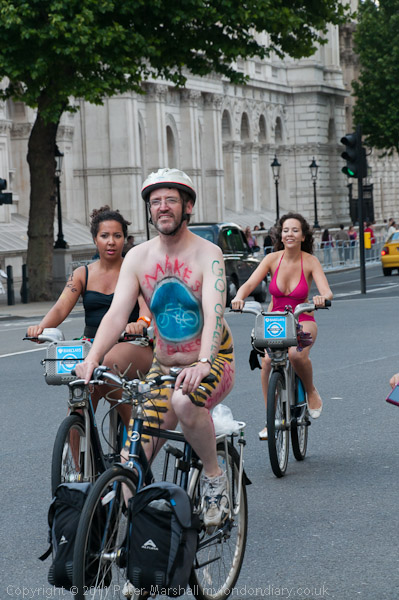
I’ve written several times recently about the annual Naked Bike Rides in London which are an environmental protest against car culture and and oil-based economy, so won’t repeat myself here.
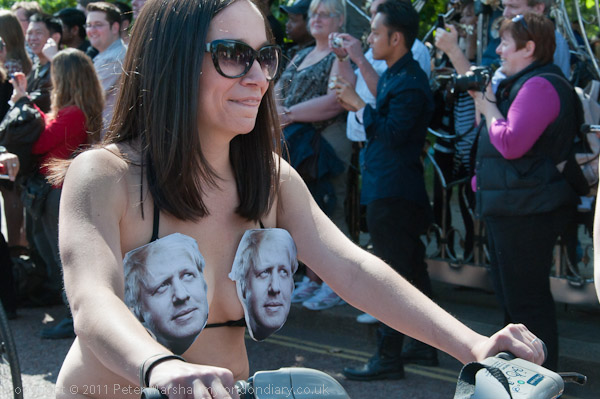
I also wrote at some length on My London Diary about the 2011 ride when I photographed many of the riders as they set off from Hyde Park. As I commented the ride, “Now in its eighth year the event has become a part of the tourist calendar, with listings on the major events sites for visitors and in newspapers and magazines and a large crowd had gathered for the start, making it difficult to photograph sensibly.”
This was the first ride following the introduction of ‘Boris Bikes’, the scheme set up by Ken Livingstone inspired by a similar scheme in Paris, but only launched on 30th July 2010 after Boris Johnson had become Mayor, and many on the ride were taking advantage of these hired bikes.
The mass start was made rather chaotic by the large number of spectators, many wandering onto the route holding up their phone cameras, and in later years the ride was split to start in a number of different parts of London to avoid this.
By the time I met the riders again in Westminster, having taken the tube there, the riders had been split up into a number of small groups and it hardly seemed a mass ride, but I learnt later that they had stopped to regroup and there were pictures on the news of them en mass riding up the Mall and singing ‘Happy Birthday’ to the Queen, although she failed to put in an appearance.
More pictures (which obviously include some nudity) at Naked Bike Ride.
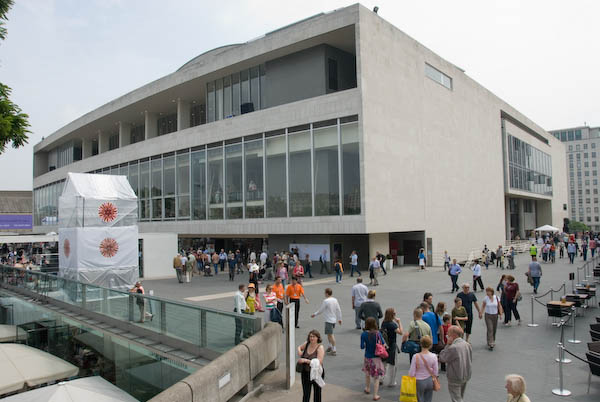
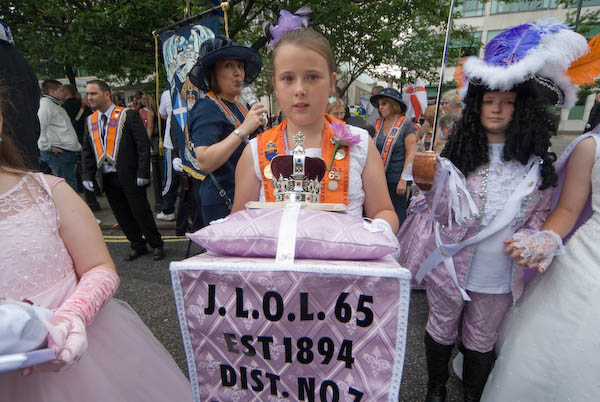
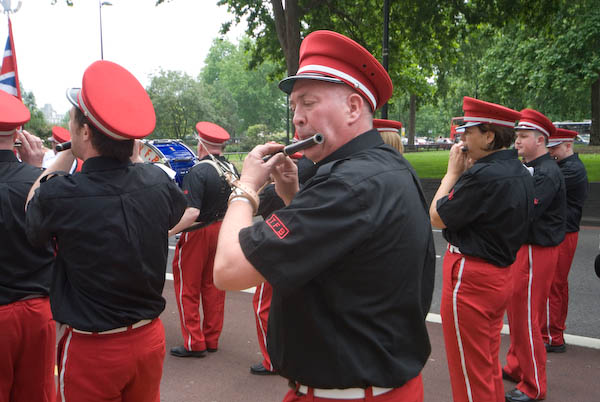
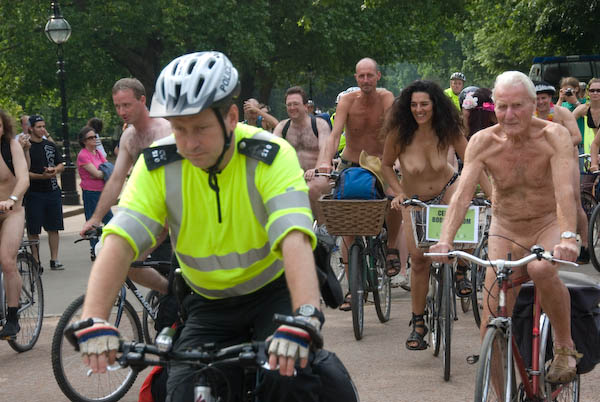
Palestine, Orange Order, Naked Cyclists & RFH: On Saturday 9th June 2007 I photographed a protest against the occupation of Palestine,the Orange Order celebrating 200 years of parades, the London World Naked Bike Ride and the re-opening of the Royal Festival Hall.
End the occupation – Palestine
The largest of these events was part of an international day of action marking the 40th anniversary of the 1967 six day war which had ended in complete and massive military victory for Israel, and a shameful defeat for not just the Arab nations but also the UN and the rest of the world.
And, as I commented then “in the longer term it is proving a disaster for Israel too, chaining them to a policy of brutal oppression of their Palestinian neighbours.” I continued; “Over the past few months, reading and hearing eye-witness reports of life in the occupied areas have shocked me, just as the reports from South Africa under apartheid did. And just as in South Africa, in time these things must come to an end with peace and reconciliation. War doesn’t settle things, it just prolongs the agonies.”
Seventeen years later we are seeing things that are orders of magnitude more shocking still happening in Gaza, witnessing the genocide of the Palestinian people.
Two members of the Palestinian government who had been invited to speak at the event were unable to come as they in jail in Israel. As usual until recently there was little coverage of this event or Israels apartheid policies in the UK media. Now their is considerable international interest in what is happening in Gaza but reporting is severely hampered as the international press are not allowed access other than in a few very limited Israeli army led tours.
Orange Order celebrates 200 Years of Parades – Park Lane
The Grand Lodge 200th Anniversary Parade marked 200 years since the first recorded Orange Parade by the Portadown Lodge of the Orange Order, Loyal Orange Lodge No. 1 (LOL 1), on 1 March 1807.
Although King William III, Prince Of Orange had successfully invaded England in what was later known as the Glorious Revolution in 1688 and the first Orange Association was founded a few days after his landing in Brixham when he reached Exeter, organised parades are only known to have started 119 years later.
This anniversary event was an impressive display with several thousand marching including lodges from all our major cities. The Orange Order still has a strong following in some former protestant working class areas but as I commented, despite “own protestant roots … such sectarian solidarity now seems a relic of ancient enmities, a throwback to a less civilised age.”
I arrived in Hyde Park a little late but was able to photograph the riders setting off on their ride around London and went with them along Piccadilly before taking the tube to wait for them to reach the Houses of Parliament at Westminster.
You can read my thoughts about the ride which I think rather fails to get its message across although causing a great stir on the busy streets it goes through, as few of the riders have anything on their bodies or bikes to state its purpose on My London Diary.
For most who see it, this is simply an unusual spectacle of nudity, and an illustration of the great variety of the human form rather than the very limited body types which we see on advertising hoardings and other images of the fully or partly unclothed om the press or elsewhere.
This was the one event of those I covered that was widely covered in the media, making the national news that evening, though I think there was little attention to why the ride was taking place.
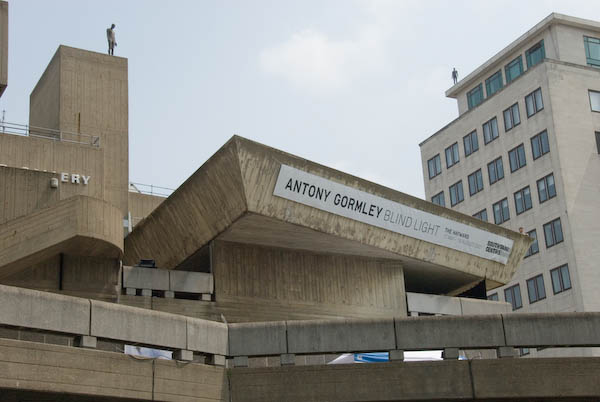
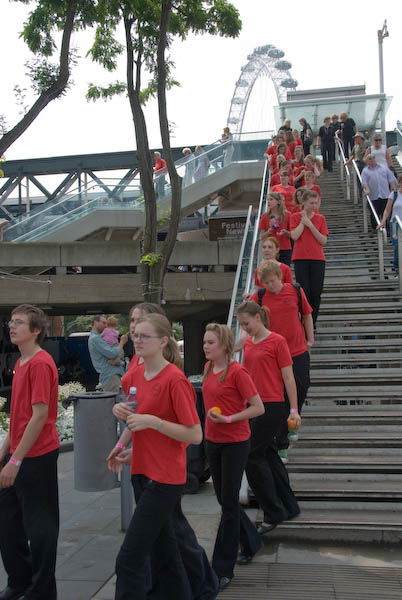
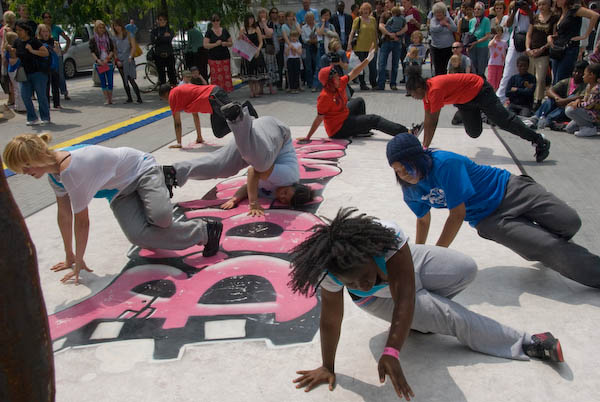
The Southbank centre was staging a weekend of events across its site marking the reopening of the Royal Festival Hall after a considerable refurbishment which began in June 2005 and I managed to take a few photographs of these across the day.
The foyers inside the building were opened up more but I think the main purpose was to provide more commercial space to provide an income for the centre. The Royal Festival Hall was built as part of the Festival of Britain in 1951 and was funded and managed by the London County Council and their successors, the Greater London Council until that was abolished by Thatcher in 1988.
The Southbank Centre states on its web site that it “does not receive any funding from the Government to run and maintain its 11-acre national heritage site. All essential repair and maintenance work to our buildings and site has been funded from our own commercial revenues or from fundraising.“