Church Of The Ñazarene, Grant Rd, Battersea, Wandsworth, 1988 88-5j-54
I returned for another walk in Chelsea, taking the train to Clapham Junction and taking a few pictures on my short walk to the bus stop of the Church Of The Ñazarene close to the north entrance to the station on Grant Road. The church, a twelve-sided building by Green Lloyd Adams was built in 1970 on the edge of the Winstanley Estate, developed by Battersea Council in the 1960s. The lettering on the ramp ‘JESUS SAID I AM THE WAY’ is designed for maximum size rather than typographical nicety.
Currently extensive building work is being carried out to considerably extend the church, though its future may be threatened if Crossrail 2 goes ahead. Of the two pictures I made I preferred a view across the small area with seats to a cleaner architectural view also included in the album.
Falcon Rd, Battersea, Wandsworth, 1988 88-5j-55
On the bus I took advantage of an unusually clean front window on the upper deck to take a photograph of Falcon Road with the Queen Victoria pub. Also apparently known as ‘Spikey Hedghog’ the pub which had been there since the 1860s closed permanently in 1999 and was demolished to build the 8 flats of St Luke’s Court.
The picture also includes a falcon – both image and text on the side of a lorry. Elsewhere you can read a short post Falcon Road – a Memory of Battersea by someone who grew up living in the pub which gives an idea what the area was like, probably in the 1950s.
I got off the bus in Beaufort St in Chelsea and photographed this doorway there before walking along Cheyne Walk. Although the door is on Beaufort St, this is Belle Vue Lodge with the address 91 Cheyne Walk. It gets a lengthy mention in the Survey of London, first published in 1913 which suggests it dates from before 1771. It states that in 1829 it was occupied by “Luke Thomas Flood, who was a great benefactor to the parish. He was evidently a friend of the historian, for he addressed some lines to him, which conclude with the halting line ‘Sweet Chelsea shall ever live in thee.’ Flood Street was named after him, and his benefactions are celebrated at the parish church by a service on January 13th,—’Flood’s Day.'”
Houseboats, River Thames, Chelsea Embankment, Chelsea, Kensington & Chelsea, 1988 88-5j-32
I walked across Cheyne Walk to make a photograph over the roofs of houseboats at the moorings, looking towards Chelsea Harbour and at left the Rank Hovis flour mills at Battersea and the Battersea Rail bridge. Then I think only used by goods trains this now carries frequent services of the London Overground as well as Thameslink trains.
I took a picture of houses in Cheyne Row. That at left is No 104 with two blue plaques, for the artist Walter Greaves (1846-1930) and Anglo-French ‘Poet, essayist and historian’ Hilaire Belloc (1870-1953) whose poem Jim (who ran away from his Nurse and was eaten by a Lion) ends with the famous lines: ‘And always keep ahold of nurse For fear of finding something worse.’
No 104 doesn’t get a mention in the Survey of London, but No 100 at right of the picture is part of Lindsey House which it suggests was “rebuilt much in its present external form by the third Earl of Lindsey in 1674” but then divided into separate houses as 95-100 around 1775. It gets a very long entry.
I walked back up Beaufort St, passing a long row of frontages with identical garden ornaments which I think is Beaufort Mansions, though the gardens now have hedges. I think these mansion flats probably date from around 1890.
I was on my way to take a few more photographs on the King’s Road, including a several shop interiors. I think the name of the shop is on the wall at left, part hidden, Pineapple.
More pictures from this walk in a later post.
Click on any of the images above to go to a larger version in my album 1988 London Photos from where you can browse other images in the album.
Dovehouse Green was the name given to the King’s Road Burial Ground on the corner of Dovehouse St and King’s Road when it was improved by the Chelsea Society and Kensington & Chelsea council to celebrate the the Queen’s Silver Jubilee and the Golden Jubilee of the society in 1977. The area was given to the parish by Sir Hans Sloane in 1727 and opened as a burial ground in 1736. Chelsea soon outgrew this small area and a new burial ground was opened on the east side of Sydney St in 1812 and there were no more interments here other than in existing family tombs.
The Millar Obelisk which became the centrepiece of this small public park was erected in the old burial ground in 1751, by the wealthy leading bookseller and publisher Andrew Millar to mark the family burial place. Buried close to it were three of his children who died before it was erected and Millar himself who died in 1768 and his wife who outlived him by 20 years. You can read more at Millar’s obelisk, a post by Baldwin Hamey on London Details.
The park has been refurbished a couple of times since I made this picture, but its basic layout remains. On the other side of Dovehouse St is Chelsea Fire Station with its tower. If Crossrail 2 is ever built this may be the site of a station on it. Dovehouse street got its name around 1880, having previously been called Arthur St; I think the name was probably ‘borrowed’ from an early Dovehouse Close some distance away on the other side of King’s Rd. Just to the north of the burial ground was the workhouse for St Luke’s Parish, Chelsea, demolished in the 1970s.
Chelsea Square, Chelsea, Kensington & Chelsea, 1988 88-5i-42
Chelsea Square is a couple of hundred metres to the northwest of Dovehouse Green, though a little further to walk. It was developed as Trafalgar Square in 1810, five years after the battle, with houses around a garden designed to encourage wealthier people to move to Chelsea, then something of a slum. The area came to the Cadogan estate when the lease ran out in 1928 and they redeveloped the area replacing the existing houses from 1931 and building on around a quarter of the garden. New houses were according to the Victoria County History, “designed in early Georgian style by Darcy Braddell and Humphrey Deane, and built of pinkish stock brick, with bright red brick dressings and green-glazed tiles.” and “neo-Regency villas in white stucco… designed by Oliver Hill and built in 1930 and 1934.”
Chelsea Square, Chelsea, Kensington & Chelsea, 1988 88-5i-55
Presumably to avoid confusion with the rather better known Trafalgar Square in Westminster it was renamed Chelsea Square in 1938. Many other duplicated London street names were also replace at the time.
Church of Our Most Holy Redeemer and St Thomas More, Cheyne Row, Chelsea, Kensington & Chelsea, 1988 88-5i-61
Designed by Edward Goodie, this Grade II listed Roman Catholic church opened in 1895. It gained the dedication to St Thomas More after he was made a saint in 1935. Damaged by bombing in 1940, it was repaired after the war. Much internal work was carried out in the 1970s.
The Studios, Upper Cheyne Row, Lawrence St, Chelsea, Kensington & Chelsea, 1988 88-5i-62
Upper Cheyne Row is sometimes referred to as Millionaires’ Row, though that would now apply to most London streets. One house here was recently on the market for £22m. The sign ‘The Studios’ on No 27 has now gone.
Chelsea Pottery, plaque, Lawrence St, Chelsea, Kensington & Chelsea, 1988 88-5i-63
The LCC square blue plaque which can just be seen on 16 Lawrence St has the message ‘CHELSEA CHINA WAS MANUFACTURED IN A HOUSE AT THE NORTH END OF LAWRENCE STREET 1745-1784 TOBIAS SMOLLETT NOVELIST ALSO LIVE IN PART OF THE HOUSE 1750 TO 1762′. You can read more about Lawrence St from the article on ‘A London inheritance’ Lawrence Street And Chelsea China.
Click on any of the images above to go to a larger version in my album 1988 London Photos from where you can browse other images in the album.
Glebe Place on the southern side of the King’s Road is a curious street with two right-angle bends and includes a series of artists studios, some grander than others, and its residents over the years have included a huge list of artists and writers – Wikipedia lists around 30 – as well as Paul Robeson, Shirley Williams and Constant Lambert.
I don’t remember outside which house I found this rather fierce sculpture which I think is no longer present.
25 and 25a Glebe Place. The heraldic lions have since left and the roof has been replaced. No 25 was the home of artist George Washington Lambert (1873-1930) who was born in Russia, educated in Somerset and emigrated with his mother and sisters to Australia in 1887. There he began exhibiting paintings and working as a cartoonist and illustrator. In the 1900s he spent a year in Paris, then moved to London; in the First World War he was an official Australian war artist, and he returned to Australia in 1921. His second son, Constant Lambert (1905-51), a notable British composer, was born in London in 1905 and also lived here; he was the Founder Music Director of the Royal Ballet.
The houses at left of the picture are the pair at the north end of the east side, No 27 and 28 and to the right of them are the doors of No 25 and 24 on the north side.
This rather agonised looking sculpture on the balcony was at No 28 but is no longer present.
Carlyle Square was laid out by the Cadogan Estate in the 1830s after Lord Cadogan bought the land on the north side of King’s Road in 1835, quickly clearing it of the existing small houses and cottages and laying out Oakley Square around an ornamental garden. But development of the square was slow. As originally set out, there were entrances for vehicles from both the east and west sides to King’s Road; more recently an area of garden separates the square from King’s Road, allowing only pedestrian entrance, with vehicle entrance being only from Old Church St.
Development began with short terraces of 3 houses on both the east and west sides next to King’s Rd, all now Grade II listed. They were followed in 1855 by a couple of semi-detached villas on the west side and around 1860 the north side of the square was largely completed with some varied houses. The remaining gaps – including most of its east side – were completed not long after, mainly with large identical semi-detached houses with a few feet gap between them.
Among notable residents over the years were Osbert and Sacheverell Sitwell, William Walton, Sybil Thorndike, Edna O’Brien and David Frost (who held an annual summer party for some years in the garden.) No 21 was built for the Duke of Portland around 1860, and a later Duke of Portland who was Chair of the Joint Intelligence Committee during WW2 was still in residence.
No 37-40 have walls and gate posts like this, and this is the entrance of 38. Most of the rest of the houses on the east and west side have plain iron railings.
Click on any of the images above to go to a larger version in my album 1988 London Photos from where you can browse other images in the album.
Sir Thomas More, St Thomas More Gardens, Chelsea Embankment, Chelsea, Kensington & Chelsea, 1988 88-5g-25
My Chelsea walk continued with a little wandering close to the Thames where I found two elderly people contemplating the statue of Sir Thomas More. More (1478-1535) opposed the Reformation and wrote polemics against Luther, Zwingli, Calvin and Tyndale, although he is better known now as the author of ‘Utopia’, published in 1516. But it was his opposition to the politics of a real island, refusing to accept Henry VIII rather than the Pope as supreme head of the Church of England that led to him losing his head at Tower Hill and eventually to his being made a Catholic saint in 1935.
It was the elegant iron work supporting the balcony that particularly attracted me to 48 Cheyne Walk, though I didn’t think it was particularly improved by the lamp post outside, awkwardly in the pavement, which though of relatively elegant design seemed out of place.
Cheyne Row leads north away from the river between no 49 and 50 Cheyne Walk and I get confused between the two similarly named streets. This house, known for obvious reasons as Old Sun House at No 2 is the first on its east side.
Boy with a Dolphin, David Wynne, sculpture, Cheyne Walk, Oakley St, Kensington & Chelsea, 1988 88-5h-62
One of several variations on a theme by Sir David Wynne including his Girl with a Dolphin close to St Katherines Dock, this is perhaps the most interesting. I have to admit of not being a great fan. At least two other casts of this sculpture exist, both in the USA.
The model for the boy was Wynne’s son Roland David Amadeus Wynne, then 11. After Roly committed suicide aged 35 in 1999 a plate was added to the statue dedicating it to him.
Cheyne Walk, Kensington & Chelsea, 1988 88-8h-63
Perhaps the only distinctive later building on Cheyne Walk, this Grade II listed house at 38 was designed by Charles Robert Ashbee (1863-1942) one of the leading figures in the Arts and Crafts movements and built around 1900. C R Ashbee like Moore wrote utopias, though his two, like much of his work was very much inspired by William Morris, whose ‘News from Nowhere’ appeared in 1890. He was a prominent homosexual, but he married in 1898 and some years later the couple had four daughters.
Cheyne Walk, Kensington & Chelsea, 1988 88-5h-64
C R Ashbee, like More, wrote utopias, though his two, like much of his work was very much inspired by William Morris, whose ‘News from Nowhere’ appeared in 1890. He was a prominent homosexual, but he married in 1898 and some years later the couple had four daughters, one of whom wrote a frank ‘novel’ about the family relationships in which only the names are thought to be fictional.
Thomas Carlyle, Chelsea Embankment Gardens, Chelsea, Kensington & Chelsea, 1988 88-5h-55
I took another picture of Thomas Carlyle sitting on his chair as well as the two in a previous post. I think this perhaps better describes both the statue by Sir Edgar Boehm, erected in 1882, the year after his death and also the surroundings.
Click on any of the pictures to go to a larger version in my album 1988 London Photos. They appear in a different order in the album but in this post are in the order I took them on my walk.
All photographs on this and my other sites, unless otherwise stated, are taken by and copyright of Peter Marshall, and are available for reproduction or can be bought as prints.
Sculpture, In Town, John Ravera, Battersea Bridge, Wandsworth, 1988 88-5f-12
My next walk in London on the following Friday started where I had finished the previous Sunday. I think I’d finished my teaching for the week at midday and jumped on a train to Clapham Junction then a bus to Battersea Bridge. I got off on the south side of the bridge to photograph a couple of pieces of sculpture and to enjoy the walk across the river.
Sculpture, In Town, John Ravera, Battersea Bridge, Wandsworth, 1988 88-5f-15
The first piece, just the the west of the bridge was the sculpture In Town by John Ravera (1941-2006), commissioned by Wates Built Homes Ltd who developed the area around it and dates from 1983. Ravera was born in Surrey and went to Camberwell School of Art and created many public sculptures still on display. This one was cast at the Meridian Foundry in Peckham, where two of Britain’s leading art foundries were located in the railway arches between Consort Road and Brayards Road.
Sadly this sculpture is no longer intact, and the dove for which the young child is reaching – the real climax of the piece – has gone.
Two swans, Catherine Marr-Johnson, sculpture, Battersea Bridge, Wandsworth, 1988 88-5g-62
On the Thames Path on the other side of Battersea Bridge Road in front of an office block is Two swans, by Catherine Marr-Johnson, born in Crickhowell in Wales in 1945. The two piece sculpture dates from 1984 and the swans taking flight reflected the formation of the new company in front of which it stood.
Two swans, Catherine Marr-Johnson, sculpture, Battersea Bridge, Wandsworth, 1988 88-5g-65
I think on this visit I didn’t have a lens with a wide enough angle of view to take the picture I wanted with the pair of swans taking off across the river, though I returned at a later date to do so. It was rather easier to show both from the front, but not so satisfying as you can see if you browse the album.
Former Dairy, Old Church St, Kensington & Chelsea, 1988 88-5g-56
I walked across the bridge and began taking pictures in Chelsea, including one of a house decorated with tiles at 46 Old Church St and, between the second floor windows a cows head, with another cows head on the building down the alley by its side, which is dated 1908, though it could be the date a much older building was restored.
Wrights Diary was first set up in 1796 with around 50 cows and a goat, though it moved slightly west to this site in the 1800s. Cows were kept here into the 20th century but eventually milk production moved completely out of London. The company was eventually bought by United Dairies probably in the 1950s. Their properties on Old Church St became shops but the courtyard building was converted into a recording studio, Sound Techniques which was in business from 1964-74, where, according to Metro Girl, “Among the acts to record at Sound Techniques Ltd included Sir Elton John, The Who, Jethro Tull, Judy Collins, Tyrannosaurus Rex and John Cale.” as well as Pink Floyd and Nick Drake.
The picture looks up from Justice Walk into Lawrence St, and was probably named as the home of John Gregory, a Justice of the Peace, who possibly lived in the house which now has the name Judges House. An imposing building on the street, named The Court House has had many stories told about it by estate agents and others about trying highway robbers and other criminals is a former Wesleyan Methodist Chapel built in 1841 and used as a church until 1903.
This corner is the former site from 1750-84 of the Chelsea china works, demolished at the end of the 18th century. It was the first factory outside of Japan and China to produce high quality porcelain. Should you wish to walk around this area I recommend Adam Yamey’s Where A Judge Once Walked In Chelsea from which much of the information above comes. Nothing like this was available to me when I was walking around in 1988 before the days of the World Wide Web.
Lawrence St, Cheyne Walk, Chelsea, Kensington & Chelsea, 1988 88-5g-42
Lawrence St took me back to Cheyne Walk, and on the corner was this side of Carlyle Mansions, No 54 Cheyne Walk, dated 1886 and named after Thomas Carlyle who lived nearby. The white-painted stone relief panels with cranes and flowers date from 1888.
The block is nicknamed the “Writers’ Block” and has been home to authors including Henry James, Somerset Maugham (briefly), Erskine Childers and Ian Fleming who wrote Casino Royal here. Henry James who lived and died in Flat 19 described his flat as his “Chelsea Perch…the haunt of the sage and the seagull“.
Untitled, bas-relief, Jacob Epstein, sculpture, Ropers Gardens, Chelsea Embankment, Chelsea, 88-5g-45
More sculpture close to the riverside in Ropers Gardens – this by Jacob Epstein.
And a rather more realistic nude by Gilbert Ledward in this very artistic area of London. Ledward (1888-1960), born in Chelsea, trained at the Royal College of Art (where he was later a professor) and the Royal Academy Schools and became one of the best-known of British sculptors. His works included many war memorials.
Click on any of the images to go to a larger version in the my album 1988 London photos from where you can browse other images.
All photographs on this and my other sites, unless otherwise stated, are taken by and copyright of Peter Marshall, and are available for reproduction or can be bought as prints.
Railway Bridge, River Thames, Battersea Power Station, Grosvenor Rd, Pimlico, Westminster, 1988 88-5f-62
These seven pictures all come from the same film I took at the end of a fairly long day’s walk around Chelsea on Sunday 8th May 1988 which had taken me down to the Thames on Grosvenor Road. I spent some time wandering around on the road and also where it was possible to get onto the riverbank, though most was fenced off.
Railway Bridge, River Thames, Battersea Power Station, Grosvenor Rd, Pimlico, Westminster, 19888 8-5f-64
The views today are rather different, although the railway bridge carrying the main line to and from Victoria is still much the same. In the pictures you can see some work being carried on in Battersea Power Station, but now new flats hide most of the building apart from the chimneys from here, and the gas works have completely gone.
Railway Bridge, River Thames, Battersea Power Station, Grosvenor Rd, Pimlico, Westminster, 1988 88-5f-51
You may still see lighters moored in the river here, but I think this rather odd structure close to the mouth of the vestigial Grosvenor Canal here has gone. I wasn’t absolutely sure why there was this wooden platform with what looked to me like small dog-kennels on it, but perhaps as the rope shows they were simply for mooring barges waiting to use the canal. Technically I think this is a dolphin, as the picture below shows.
Chelsea Bridge, River Thames,Grosvenor Rd, Westminster, 1988 88-5f-52
The first bridge here was built in 1858 when Chelsea Embankment was being built and was a suspension bridge intended to give the large population of Pimlico access to the new Battersea Park – if they could afford the toll – though it was made free on Sundays. It was then called Victoria Bridge, named like the station after the Queen. It became even less popular after Albert Bridge was built at the other end of the park in 1873. It was bought by the Metropolitan Board of Works in 1877 and they abolished the tolls in 1979. It was a narrow bridge and found to be structurally unsound, so fearing it might embarass the Queen if it collapsed they renamed it Chelsea Bridge. It didn’t collapse and apparently took several years to demolish when they decided to replace it with the current bridge which opened in 1937.
As the picture shows, the main cables are attached to the end of the bridge rather than on solid ground on the banks, and it was the first such ‘self-anchored’ suspension bridge in Britain. The LCC couldn’t afford to fund the entire cost and the Ministry of Transport only agreed to stand 60% oof the cost on the condition that all the materials used came from the British Empire.
When Billy Strayhorn named his most famous composition ‘Chelsea Bridge’ it was not this structure that he had in mind, but something more ethereal, probably Whistler’s Nocturne: Blue and Gold – Old Battersea Bridge.
Grosvenor Canal, entrance, River Thames, Pimlico, Westminster, 1988 88-5f-53
I wrote at some length in a previous post about the Grosvenor Canal, London’s last working canal, still in use when I took this picture. You can see part of one of the barges still in use to carry Westminster’s rubbish downriver through the bridge.
Chelsea Bridge, River Thames, Battersea Power Station, Chelsea Embankment, Kensington & Chelsea, 1988 88-5f-43
The pictures here (and on Flickr) are from around 20 exposures I made on this small area of riverside, though many of the others are very similar. There were very few boats around moving on the river at the time.
Pagoda, Battersea Park, River Thames, Chelsea Embankment, Kensington & Chelsea, 1988 88-5f-34
I walked upriver along Chelsea Embankment on my way to catch a bus across Battersea Bridge to take me to Clapham Junction for the train home. On my way I took a few pictures of the impressive late-Victorian houses – which haven’t made it to my Flickr album – and four pictures across the river of the Battersea Park Peace Pagoda, this one of which has. I’m not sure about the framing and I think it would perhaps be better in a square format but I felt it had a suitably Japanese feel to it.
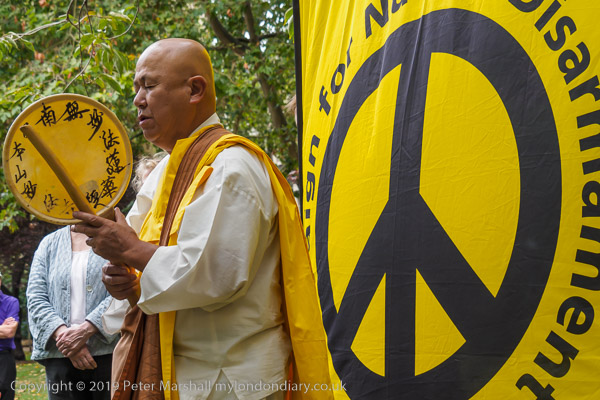
Reverend Gyoro Nagase at Hiroshima Day, Tavistock Square, 2019
After the destruction of Hiroshima and Nagasaki by US atom bombs in August 1945, Nichidatsu Fuji who had in 1917 founded the Japanese Buddhist movement, Nipponzan Myohoji, in 1947 decided they would set up Peace Pagodas around the world to promote peace and non-violence. The first opened in Japan in 1954 and the London Peace Pagoda was built by Nipponzan Myohoji monks and opened in 1985, shortly after Nichidatsu Fuji died aged 100. Since 1978 it has been looked after by Reverend Gyoro Nagase who I have met and photographed at many events calling for peace. There are also Peace Pagodas in Milton Keynes and Birmingham among over 80 around the world.
Click on any of the black and white images to go to a larger version in my album 1988 London Photos from where you can browse to other images.
All photographs on this and my other sites, unless otherwise stated, are taken by and copyright of Peter Marshall, and are available for reproduction or can be bought as prints.
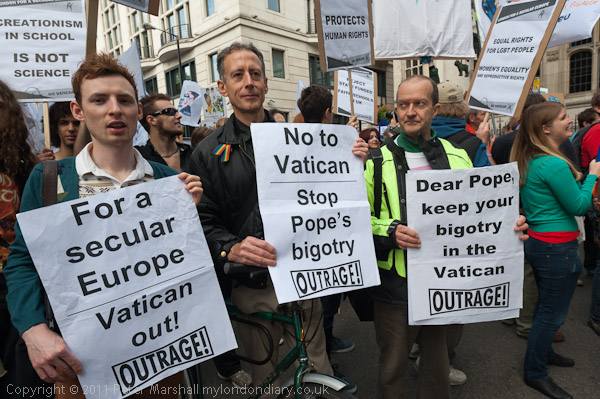
I’d gone up to London mainly to cover the march and rally by the Secular Europe Campaign which was calling for an end to religious privileges and for European institutions to remain secular. Its main focus is the Vatican which still has enormous power and privilege – and a three billion Euro tax exemption.
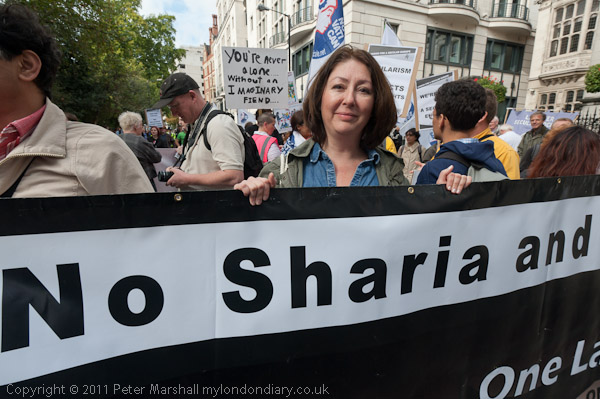
Maryam Namazie holding the ‘One Law For All’ banner
Among the groups on the march was ‘One Law For All’, opposed to all religious laws and in particular to any attempt to impose Sharia law in the UK. It was also supported by humanist and gay rights groups including the British Humanist Association, the Central London Humanist Group, the Gay And Lesbian Humanist Association, the National Secular Society, OutRage! and the Rationalist Association.
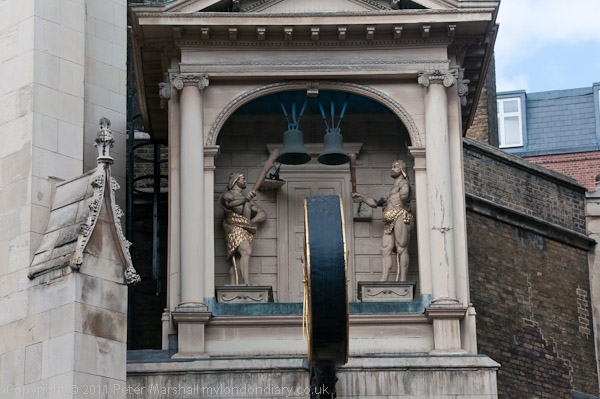
I left the march to go to Bank, where I had expected to cover a protest, but all I found was the group having a picnic, as well as a long queue of people waiting to take a look at the interior on ‘Open House’ day. So I walked back towards Temple, pausing to take a few pictures on the way – such as the legendary giants Gog and Magog on St Dunstan-in-the-West in Fleet Street, who strike the hours and quarters using their clubs on the bells. Traditionally they were simply known at the Giants of St Dunstan, and the ‘real’ Gog and Magog are figures in London’s Guildhall, though these are only replacements installed in 1953, made by David Evans to replace those carved in 1709 and destroyed in the Blitz. These ‘Guardians of London’ are honoured every year in the Lord Mayor’s show – and according to an anonymous commentator are “Symbolic of how The City of London is a Sovereign Satanic Masonic Criminal Bankster Headquarters” and it remains a secretive and undemocratic global centre of money laundering, a criminal cartel “officially outside the authority of parliament“.
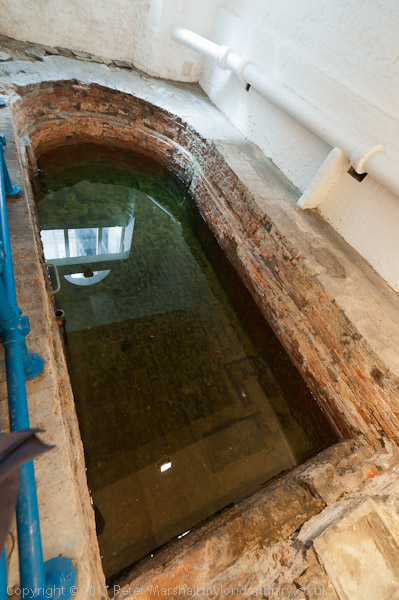
Among other things I also photographed the ‘Roman Bath‘ in Strand Lane, a slightly embarrassing National Trust property, though now managed by Westminster Council. A cistern built in 1612 that once fed a fountain in the gardens of old Somerset House, its reputation as Roman remain was an imaginative invention to promote visitors to pay to bathe in it in the 1820s. Normally visits are by appointment, but it opens on Open House weekend and the queue was short.
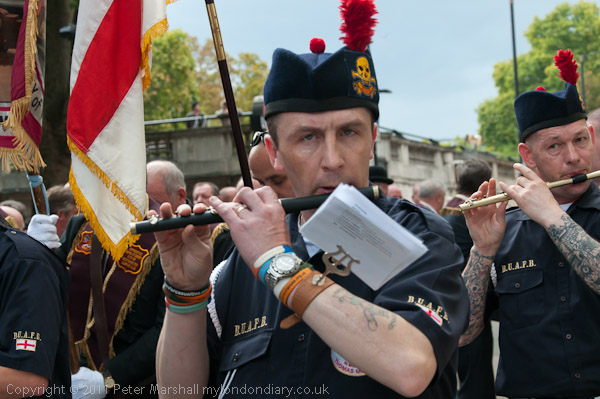
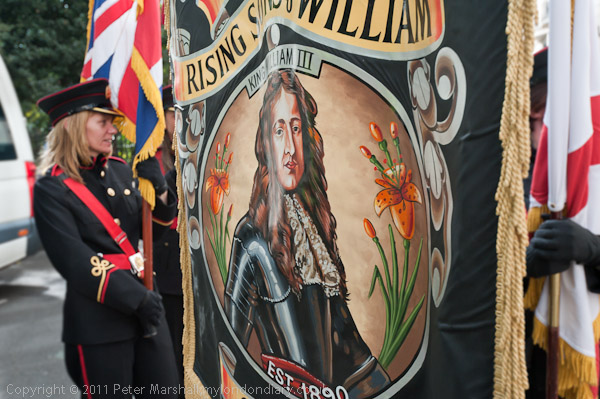
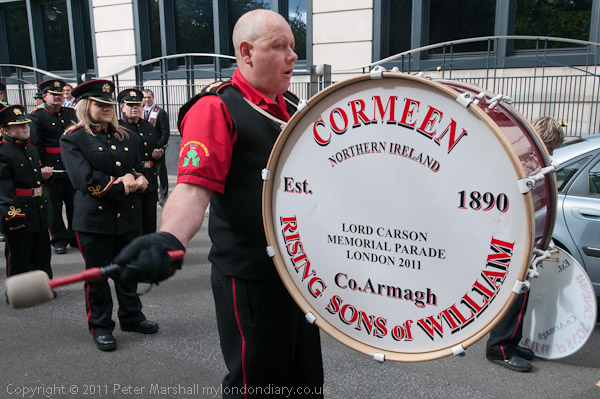
I was on my way to photograph the City of London Campsie Club, a branch of the Apprentice Boys of Derry, who were holding their annual Carson Memorial parade. You can read more about its origins in my post on My London Diary. Unlike the secular rally I had photographed earlier, this was an event at which I was not welcome by a small minority of those taking part.
As I wrote in 2011:
I’ve photographed this and other Orange parades over the years, and many on them have seen my work on the web and appreciated it – and sometimes used my pictures.
But a few of the nastier elements of Northern Ireland remain, and in 2008 and again while photographing this year’s parade I was threatened and pushed away by some of those taking part. It’s a thuggishness that has no place on English streets, and something that the Orange Order should take firm action against. I fully support religious freedom and the freedom to demonstrate on our streets, but there is no place for this kind of conduct. It sullies the memory of one of our great British (and Irish) jurists, and is an insult to the Protestant faith into which I was born and in which I grew up.
I don’t know why my reporting on these events should lead to such animosity from a few of those taking part. I think it has always been accurate and factual and the pictures show a colourful event and a part of the Orange tradition. Perhaps it is because I also photograph other Irish events but I think more likely that they are aware of my pictures of extreme right protests by groups including the EDL where some of them may have also been in attendance.
All photographs on this and my other sites, unless otherwise stated, are taken by and copyright of Peter Marshall, and are available for reproduction or can be bought as prints.
Dawliffe Hall, Chelsea Embankment, Chelsea, Kensington & Chelsea, 1988 88-5e-24
Dawliffe Hall is a Grade II listed building probably built between 1881 and 1885. It became known as Rayleigh House in the 1890s when it was bought by the third son of the Second Baron Rayleigh who engaged architect Georg Campbell Sherrin, better known for his various Metropolitan Railway and other stations and Spitalfields Market, to make external and internal alterations. Sherrin’s plans for a new porch ran into planning problems, but eventually more limited modifications to the existing porch shown here were allowed.
I don’t know when at what date 2 Chelsea Embankment became Dawliffe Hall but in 1967-8 it was bought by the Catholic organisation Opus Dei and converted into a women’s hostel, and now continues its work as a part of the Dawliffe Hall Educational Foundation.
Although the picture shows Embankment Gardens, this building has the address 1 Chelsea Embankment and is usually known as Shelley House. A house on this site was built for the son of Percy Bysshe Shelley and Mary Wollstonecraft Sheely in 1878, and he lived there for around six years before leasing to various wealthy individuals, including Sir Arthur Charles, the judge for Oscar Wilde’s first trial.
In 1912 the house was bought and demolished by Charles Harold St John Hornby, who was a director of W H Smith & Son. In 1894 he had founded the Ashendene Press, a small private press inspired by William Morris’s Kelmscott Press which produced high quality editions with no expense spared, using type-faces by Emery Walker and Sir Sydney Cockerell, particularly the Subiaco font, based on 15th century examples. Hornby had the house demolished, and a new house built. Its architect was Edward Prioleau Warren, well known to Hornby as a prominent member of the Art Worker’s Guild.
It was requisitioned by the Admiralty in 1939 for living quarters for the WRNS and when they relinquished it in 1953 (doubtless by then realising the war had ended) it was leased by W H Smiths as a staff training centre and hospital. After they left in 1974 it was empty and was damaged by squatters, before being purchased and used as a Catholic educational centre. For a couple of years from 2019 it became The Laurels School, a Catholic independent girls school, but since that has moved out to Upper Norwood is now offices. Much of the information here comes from the school web site.
The Carabineers (Les Carabiniers) released in 1963 remains one of my favourite Godard films, as a satire on war, but the spirit which led to this memorial being erected by public subscription organised by the 6th Dragoon Guards in 2005 was very different.
Carabiniers (there are various spellings) were soldiers, usually cavalry, who carried carbines, short barrelled muskets (later rifles) which were lighter and easier to use on horseback than full length guns. This memorial to the men of the 6th Dragoon Guards killed in South Africa and China, designed by Adrian Jones, was erected in 1906. The regiment had its beginnings in 1685 when Richard Lumley raised a troop of horse riders to oppose the 1685 Monmouth Rebellion, though it went through many name changes before becoming the 6th Regiment of Dragoon Guards (Carabineers) in 1826.
The regiment was sent to South Africa for the Second Boer War in 1899 and remained there until the war ended in 1902. Two plaques record the names of those who died there, one of around 30 killed in action and another slightly longer one those who died of wounds or disease.
Dilke Street is a short street running parallel to Chelsea Embankment around 50 yards to its north between Swan Walk and Tite St. This house is part of a block on the north corner with Swan Walk and at its right is the entrance to Clover Mews, and its address is I think 9 Swan Walk.
Swan Walk overlooks the Chelsea Physic Garden and properties here are said to have an average value of £9m, though I think some are now divided into flats. The street gets its name from the Swan Inn, which gets a mention in Pepys diaries and was the finishing post of the Doggett’s Coat and Badge Race. Although the race still takes place, the inn here was demolished around 1780 and it now finishes at Cadogan Pier.
Another riverside inn around 150 yards further west on the other side of the Physic Garden was rebuilt as an inn and brewery at around the same time and confusingly renamed The Old Swan. This was demolished as a part of the site for a run of 18 houses built in the late 1870s, designed by some of the leading architects of the day including Norman Shaw. One of his houses is now called Swan House, and has been describe as London’s finest Queen Anne Revival domestic buildings and it was on sale in 2007 for £32m.
31 Tite St was designed by Robert William Edis (1839-1927), another of the architects who moved from Gothic to Queen Anne revival buildings such as this late 19th century artist’s studio and home. As well as being an architect he became the commanding officer of the Artist’s Rifles in 1883, becoming its honorary colonel in 1909.
The house and studio at 31-33 was built in 1877 for John Abbott McNeill Whistler, and he later persuaded fellow American Sir John Singer Sargent to move into No 31, where he lived until his death in 1925. The plaque above the circular window beside the door, too small to read in this picture, records “JOHN S. SARGEANT, R.A. WHO WAS BORN IN FLORENCE JAN . 12. MDCCCLVI, LIVED AND WORKED 24 YEARS IN THIS HOUSE AND DIED HERE APRIL 15. MCMXXV”.
I think I took this largely for the mysterious circular plaque on the brickwork of the post, which seems to be almost exactly the same side as the ball on the top of the post. It is very hard to make out the lettering on it, which seems to include some symbols not in the alphabet but from around the 8 o’clock to 5 o’clock position appears to have the letters ZOVID, possibly followed by an O.
I can find nothing out about this – so perhaps someone will enlighten me? Otherwise I will go on thinking it was placed there by visiting aliens. It could have some connection with the Chelsea Physic Garden whose curator around 1750, Philip Miller, probably lived here.
The houses in the background are I think part of 68 Royal Hospital Rd, since 1998 the home of Restaurant Gordon Ramsey. This part of the street was once called Paradise Row.
Thomas Carlyle, Chelsea Embankment Gardens, Chelsea, Kensington & Chelsea, 198888-5g-13
Fortunately the story of the statue of Thomas Carlyle, erected in 1882 is more clearly stated in its inscriptions. On the front of the red granite plinth it states:
THOMAS CARLYLE B DEC 4 1795 AT ECCLEFECHAN DUMFRIESSHIRE D FEB 5 1881 AT GREAT CHEYNE ROW CHELSEA
and on its right it records the name of the artist involved in the phrase ‘J.E. BOEHM. FECIT’ though as is says on the read, it was not actually made by Sir Edgar Boehm, sculptor, but cast at ‘H. YOUNG & CO. FOUNDERS. PIMLICO’.
Chelsea Embankment Gardens, Chelsea, Kensington & Chelsea, 1988 88-5g-14
Carlyle sits there facing the Thames and you can just make out Chelsea Bridge through the trees of the Embankment Gardens. Behind him is Cheyne Row where he moved in 1834, living there for the rest of his life.
Click on any of the images above to go to a larger version in the album 1988 London Photos, from where you can browse through many of my black and white images of London made that year.
All photographs on this and my other sites, unless otherwise stated, are taken by and copyright of Peter Marshall, and are available for reproduction or can be bought as prints.
Camera Place, Chelsea, Kensington and Chelsea, 1988 88-5c-64
Having found there was a street in Chelsea named Camera Place I had to photograph it. It’s a short street and my picture shows around half of it, looking roughly west towards Limerston St. Chelsea used to have a Camera Square, Camera Street and Little Camera Street which have since disappeared, but as they were built in the 1820s they almost certainly have little to do with photography. By 1918 Camera Square had become something of a slum and the area was demolished, rebuilt as Chelsea Park Gardens with up-market housing in suburban garden village fashion, though retaining a rigidly square layout without the typical sinously curving streets.
The view in Camera Place has changed little; some new railings and the small tree is now rather large.
Elm Park Mansions, Park Walk, Chelsea, Kensington and Chelsea, 1988 88-5c-62
Elm Park Mansions has five large blocks around a courtyard, with one of the blocks (flats 25-54) occuping half the length of the north side of Camera Place, behind and to my right as I took the previous picture. The mansions with 189 mostly one and two bedroom flats were built by the Metropolitan Industrial Dwellings Company on land leased to them by Major Sloane Stanley in 1900. The Freehold for the property was taken over by the leaseholders in 1986 and since then the state of the properties has been improved. Two bed flats have sold in recent years for around £800,000.
Elm Park Rd, Chelsea, Kensington and Chelsea, 1988 88-5b-15
Elm Park Road dates from 1875 when Chelsea Park House was demolished and the houses, many designed by George Godwin, were built between then and 1882. The central house in this picture, at 76 Elm Park Road for built for Paul Naftel, (1817-91) a Guernsey born watercolour painter and his wife and family who came to London in 1870. He moved here in around 1884 and the adjoining houses were also homes to landscape artists. Naftel later moved out to Strawberry Hill, Twickenham where he died.
The Grosvenor Canal was began by the Chelsea Waterworks Company who had leased the land from Sir Richard Grosvenor in 1722, and enlarged a creek there to supply drinking water and also to create a tide mill used to pump the water. When their lease expired in 1823, the then Earl of Grosvenor decide to put in a lock and turn the creek into a canal, extending it to a basin where Victoria Station now stands, around half a mile from the Thames. It opened in 1824 carrying coal, wood and stone into the centre of a rapidly growing area of London.
Victoria Station was built over the canal basin, and more of the canal closed in 1899 for a station extension. Westminster City Council bought what was left of it in 1905, then filled in more of it in 1927 for the Ebury Bridge estate.
The canal continued in use by the council taking refuse in barges from Westminster and other local authorities downriver to be dumped until 1995, making this vestigial canal the last in London in commercial use. In 2000 it began to be developed as an expensive waterside development, with the lock being retained but a boom across the entrance from the Thames prevents access for boats despite mooring pontoons inside the development.
Western Pumping Station, Grosvenor Rd, Pimlico, Westminster, 1988 88-5e-15
The Chelsea Water Works continued to extract water from the Grosvenor Canal until an Act of Parliament prevented extraction of water from the Thames in London in 1852 and they moved up-river to Surbiton. Sewage was increasingly becoming a problem as London grew and the ‘Great Stink’ of 1858 prompted Parliament into action, passing a bill in 18 days to construct a new sewerage system for London.
The solution by Joseph William Bazalgette was a system of sewers that delivered the sewage around 8 miles downriver to Beckton on the north bank and Crossness on the south, through main high level middle and low level sewers through North London and main and high level sewers in South London. The plans included stone embankments beside the river – the Victoria, Chelsea and Albert embankments which he designed.
Lamp post, Western Pumping Station, Thames Water, Grosvenor Rd, Pimlico, Westminster, 1988 88-5e-16
Bazalgette didn’t do everything himself, but he kept a very close eye on every aspect of his great project, and some of the specifications he laid down – such as the use of Portland Cement – have kept the system running despite increasing demands since it was completed in 1875. Now it is being augmented by the new ‘Super Sewer’ running underneath the river, the Thames Tideway.
As well as engineering considerations, Bazalgette was also a stickler for the aesthetics and there are some fine examples of Victorian design in his works. The Pumping Station which housed the powerful steam engines needed to send the sewage on its way, as well as its chimney (in a picture above) and the Superintendents House here are all Grade II listed.
All photographs on this and my other sites, unless otherwise stated, are taken by and copyright of Peter Marshall, and are available for reproduction or can be bought as prints.
London House, Fulham Rd, Chelsea, Kensington and Chelsea, 1988 88-5c-45
My walk around the streets to the north of the King’s Road took me as far as the Fulham Road where I found London House at No 266 and joined to it a Servite Catholic Church. Our Lady of Dolours was started by two Servite priests, missionaries from Florence who arrived in London in 1864. Building the church here, designed by Joseph Hansom began in 1874 and it was opened the following year by Cardinal Manning. The church is Grade II listed. London House is currently being refurbished and extended, returning the exterior to something more similar to its Victorian original.
Kings Rd, Chelsea, Kensington and Chelsea, 1988 88-5c-44
V K Patel is still listed as having a dental surgery on the King’s Road, and, allowing for the various London number changes has retained the same phone number, but is now in a very different building to this rather run-down looking and overgrown house, which I think has probably been demolished.
Langton St,, Chelsea, Kensington and Chelsea, 1988 88-5c-42
Flavio looks like an Italian restaurant and although my contact sheet suggests it was on the King’s Road, was actually a few yards from it in Langton St. I think it is now an Irish restaurant with a different shopfront.
Kings Rd area, Chelsea, Kensington and Chelsea, 1988 88-5c-54
I’m unable to remember where I took these two decorative bowls on window ledges, but think it might have been on Lamont Road or one of the adjoining roads.
Hobury St, Chelsea, Kensington and Chelsea, 1988 88-5c-56
31 Gertrude St is on the corner with Hobury St and the door is actually in the latter street. It retains the simple elegance that attracted me to photograph it back in 1988. Poet and novelist George Meredith (1828-1909) has a blue plaque on the next house down Hobury St. It was his poem ‘The Lark Ascending’ that inspired the well-known composition by Ralph Vaughan Williams and elsewhere Meredith was the first to publish the word ‘tweets’ as a verb, though his twittering was avian.
Kings Rd, Chelsea, Kensington and Chelsea, 1988 88-5c-52
Chamberlin, Powell & Bon designed 355 Kings R for Kensington and Chelsea council and this 15 storey 152 ft high tower was built in 1968-71. The council sold it off in the 1980s when the brickwork was begining to need repair and it was reclad and converted to private flats. At the right is an office of Roy Brooks, the estate agent who became a legend in the 1960s (he died in 1971) and made a fortune through his adverts in the Sunday Times and Observer desribed the houses he was selling in vivid terms as hardly fit for human habitation, exagerating any defects and making them up where none existed.
Lamont Road Passage, Park Walk, Chelsea, Kensington and Chelsea, 1988 88-5c-53
A handy passage for those living in Lamont Road to get to the shops in Park Walk and the King’s Road. The picture is of its corner with Park Walk and at left you can see Roy Brooks Estate Agents, a tree in the Milman’s Street Moravian Burial Ground and the house on the corner of Milmans St and the King’s Road. There is of course another tree in the shop window.
Clicking on any of the pictures will take you to a larger version in my album 1988 London Photos from where you can browse the other images in the album.
All photographs on this and my other sites, unless otherwise stated, are taken by and copyright of Peter Marshall, and are available for reproduction or can be bought as prints.