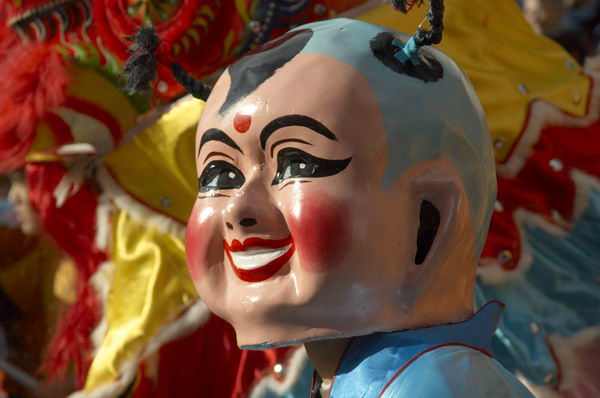
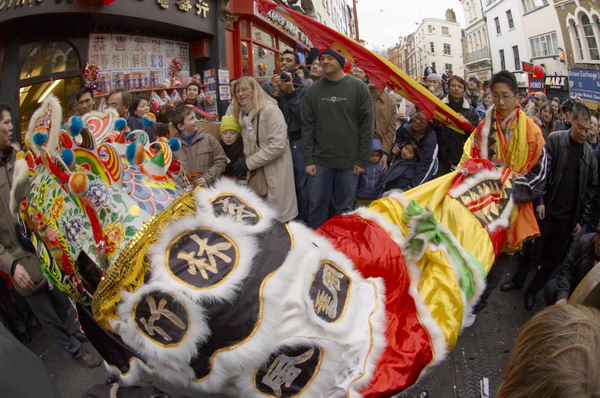
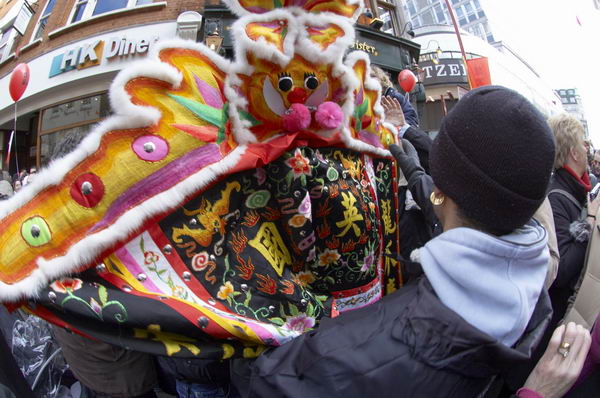
On Sunday 13th 2005, 17 years ago, London was celebrating the Chinese New Year of the Rooster which started the previous Wednesday – it was 4072.
Chinese New Year in Soho is something I’ve avoided in more recent years – as I wrote in 2005: “I used to enjoy the rather anarchic celebrations in Chinatown, but it’s now more of an ordeal, with far too many people coming in to watch and too much organisation.”
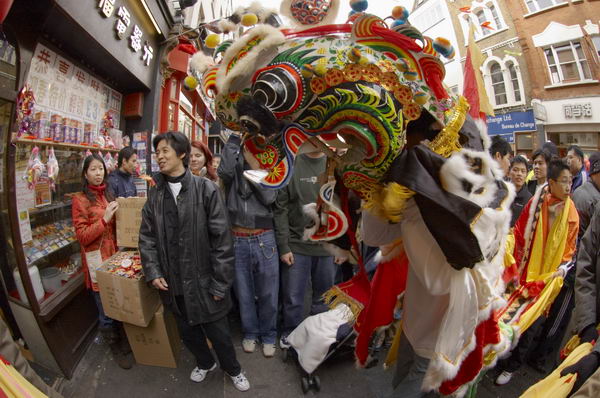
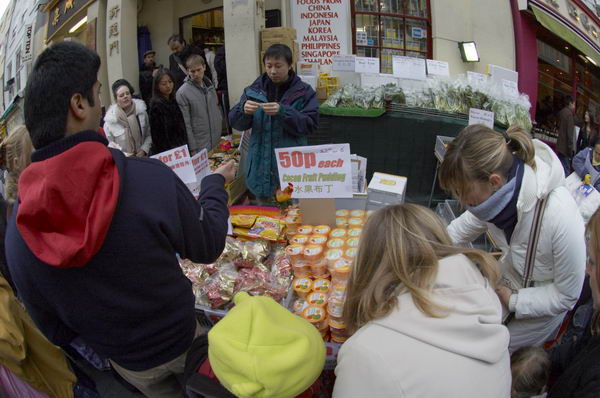
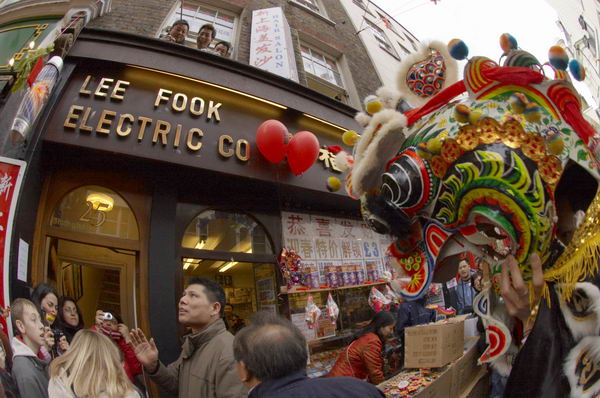
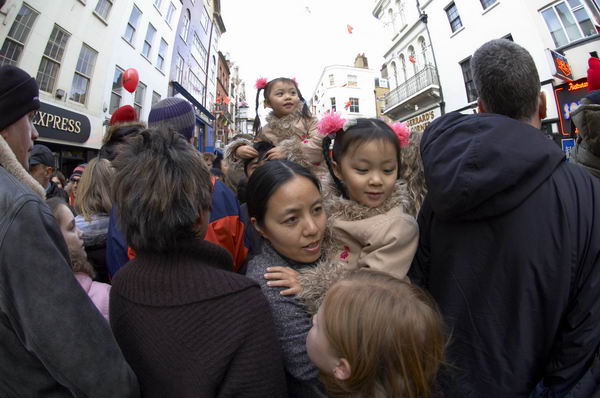
Trying to photograph in such crowded situations was a problem, and one I confronted in two main ways in 2005, something reflected in the two pictures above. At the top is a picture taken standing back some distance with a telephoto lens, while the lower picture is taken with a fisheye lens, both on a Nikon D70 DX camera.
De-fished version
Usually now when I use the a fisheye lens like this, I would convert the perspective to give straight verticals – as in the above image. But back in 2005 I didn’t have a good plug-in to do this conversion, and although it was possible with various programmes I was using for making panoramas it was a rather time-consuming process.
For this particular event I rather liked the fisheye effect, at least in some pictures. Although it does clearly misrepresent those faces close to the edges of the picture, for me it pulls the eye towards the centre of the picture and perhaps gives a greater impression of the crowding I was working in.
A small problem is that the image you see in the viewfinder is the fisheye one, and not that in the ‘de-fished’ version. But as you can see, the fisheye image which you see has the same horizontal limits at the centre of both the horizontal and vertical sides, with just a little of the image towards the four corners being lost. It’s still possible to frame accurately when working.
It’s not I think correct to call the effect of the fisheye lens ‘distortion’. It is simply a different way of recording the subject on a flat rectangle. Most fisheyes I’ve used (and I own four different examples, for DX and full-frame Nikon, for Fuji and for micro 4/3) seem actually to have rather less actual distortion than my ultra-wide rectilinear (i.e. ‘normal’) lenses.
In the de-fished image you can see that as well as the verticals of the building being straight, people at the edges of the picture are also shown naturally, unlike in the fisheye version. I was also taking some pictures with an ultra-wide 12-24mm lens (equivalent to 18-36mm full-frame) and with that at its widest faces at the edge would have been rendered a little stretched out horizontally.
I’m not sure what some major agencies would make of conversions using software like this, whether they would regard it as an unacceptable alteration of the image. For me its just one of many acceptable corrections of the image, but clearly it does alter the image as recorded by the camera. It would be possible to design a specialised wide-angle camera which carried out the correction in firmware but the market for this would probably be small. Rather it could be provided into normal digital cameras as an option – far more useful than all those special effects which clutter the menus on many cameras now.
More pictures on My London Diary – scroll down a little from the top of the page.
Willesden isn’t a part of London I visit very often, though I sometimes change trains on my way elsewhere at Willesden Junction. But even that isn’t in Willesden but in its neighbour Harlesden – just as Clapham Junction isn’t in Clapham but in Battersea, the railway companies choosing a more reputable nearby settlement to name their station.
I hadn’t intended to go for a walk from Kensal Rise to Willesden Green on Sunday 12th February, but the Transport for London web site had misled me, telling me there were no trains running from my station that day, but a much slower rail replacement bus service. But there was a train just about to leave when I bought my ticket, and I jumped on it.
Good though this was, it meant I arrived at Kensal Rise over an hour before anticipated for the short bus ride to my destination. It was a cold winter day with a bitter east wind, far too cold to stand around waiting on the street so I had a decision to make. I could have sat inside a pub or café, but decided I would keep warm enough if I walked around to make my way to my destination.
Willesden Green Library – where the Wassail would later end
A direct route would not have taken me long enough, but the only map I had was Google Maps on my phone as I was outside the small central London atlas that has a permanent place in my camera bag. While paper maps keep north at the top, on my phone at least the map seems to turn around pretty randomly and at one junction I got confused, turning in the opposite direction to that I intended.
But even with getting a little lost and walking over 3 miles I still arrived 20 minutes before the event I was attending began, but the walking had kept me reasonably warm.
Willesden Green Wassail
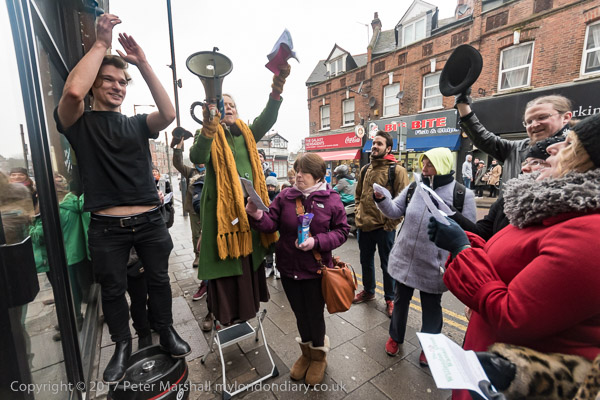
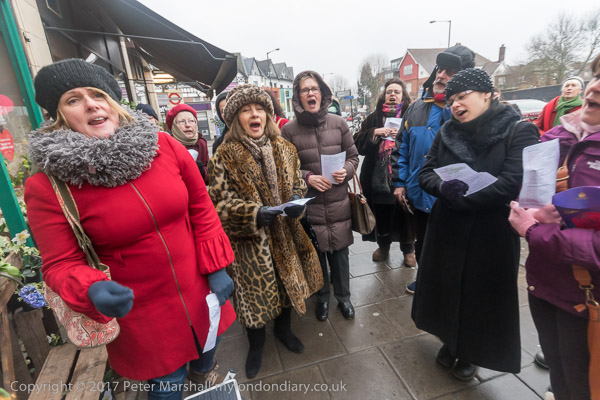
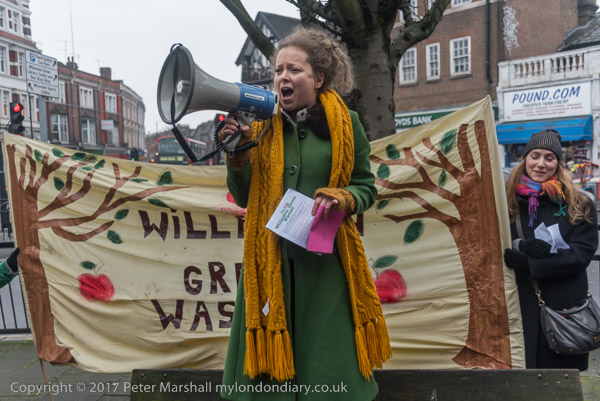
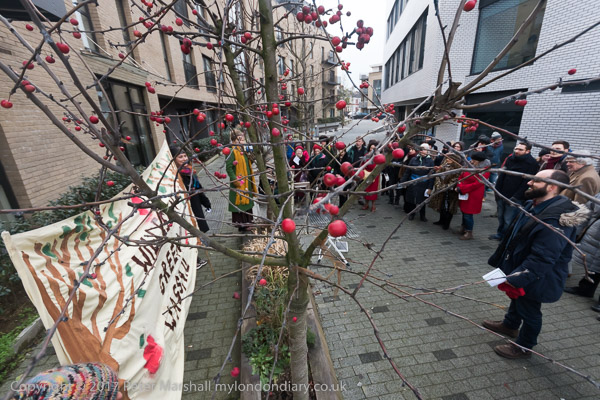
I’d been invited in 2014 to photograph the Willesden Green Wassail by its leader and organiser Rachel Rose Reid, and was returning three years later for the 7th Community Wassail there “to invoke successful growth and resilience in the neighbourhood, celebrating community initiatives and the shopkeepers who contribute to making the neighbourhood a friendly and happy place.”
Cricklewood Community Singers
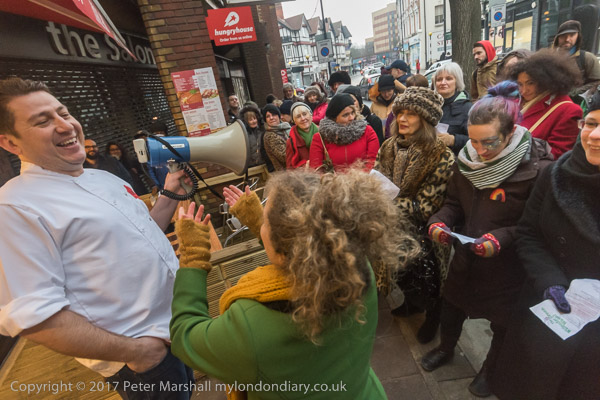
The wassailers, with the Cricklewood Community Singers performed a version of the traditional wassail song, and their were performances by local poets, storytellers and other singers as we called on various shops and other places, slowly making our way to the crab apple trees behind Willesden Green Library.
Rachel Rose Reid
At the shops we stopped at, the shopkeepers came out and told us a little about their businesses and thanked us for the good wishes and our wassailing.
The crab apples having been wassailed, people let off party poppers, which proved to be very difficult to photograph, a reminder to me of the difference between the way the camera and our eyes see things. We can both see the overall scene and concentrate on details, while a still image has to select its angle of view and treats all within that equally. Of course you can take more than one picture, but that doesn’t really deliver with a rapidly changing scene. I would have been better switching to recording a movie of this part of the event.
After this the group walked back to a local coffee shop where there were to be more performances, as well as hot drinks. But by then it was time for me to start my journey home to get back in time for dinner. This time I took the bus back to Kensal Rise.
Many more pictures both from the walk (enough to work out my route in the unlikely event you should wish to do so) and also from the Wassail on My London Diary: Willesden Green Wassail Kensal Rise to Willesden Green
More pictures continuing my walk on 31st July 1988 – the previous post is Bow Common to West India Dock Road, so this returns to close to where that started. Like most of my walks it was more about exploring a neighbourhood than getting anywhere.
East India Dock Rd, Poplar, Tower Hamlets, 1988 88-7s-61
East India Dock Road was built as its name suggests when the East India Docks were opened in 1806 to provide a more direct and less congested route than Poplar High Street to them from the end of the Commercial Road, also then recently built in Limehouse. It is now part of the A13 and this section in Poplar has in turn been largely bypassed by the Limehouse Link and Aspen Way opened in 1993. Traffic was still very heavy along it in 1988.
The picture with rubbish on the pavement and gutters, a small rather derelict shop to let gave a picture of a run-down area which contrasted with the word Wonderful on what seems a rather faded fabric on a restaurant at right. Buddleia is growing in front of the billboard, always a sign of dereliction. Interestingly the the advert is for a low alcohol lager, hardly a thing back then when most drivers on the streets after closing time were drunk, although the breathalyser had come in back in twenty-one years earlier. But even the introduction of Kaliber in 1986 had not really galvanised the market – but low alcohol beers are now a massive growth area, and some are even drinkable.
There is still a Chinese restaurant in the building at the right of this picture, and rather surprisingly that small shack is still in place in front of Amory Place, now a minicab office.
Chun Yee Society, East India Dock Rd, Birchfield St, Poplar, Tower Hamlets, 1988 88-7s-62
There are still traces of London’s first Chinatown in Limehouse, which began in the area around 1900, but the centre of the Chinese community had moved to Soho in the 1950s, partly because of extensive bomb damage in Limehouse, but also because of dirt-cheap rents in an area with a bad reputation where few then wanted to live in central London.
Chun Yee Society, East India Dock Rd, Birchfield St, Poplar, Tower Hamlets, 1988 88-7s-63
The house on the corner of Birchfield St still has the sign for the Chun Yee Society – Chinese School on Sundays over its doorway. not along with a larger and newer version with fewer Chinese characters. Like many similar societies it began as a Tong, variously described as a criminal gang or a semi-masonic bortherhood, and organised various festivals including those commemorating the dead. Founded in 1906 it was a shelter for Chinese sailors as well as providing a Chinese Sunday school for children and is now largely an old peoples centre. Possibly some of the games of dominoes may have got a little out of hand, but the criminality was largely in the mind of Sax Rohmer, his readers and the sensationalist press.
St Mary & St Joseph, Catholic Church, Upper North St, Poplar, Tower Hamlets, 1988 88-7s-51
The Roman Catholic Church of SS Mary and Joseph, Poplar impresses mainly by its scale. Built in 1951-4, its architect Adrian Gilbert Scott (1882-63) was the brother of the better-known Sir Giles Gilbert Scott, both from a distinguished family of architects. I always think of it as an ecclesiastical version of Battersea Power Station, without the chimneys but with a rather odd green pyramid on its roof, but that’s rather unfair as it is a very individual design, sometimes described as Byzantine jazz gothic.
According to the Grade II listing text this is a camel arch, and a similar arch appears at the top of the main windows, supposedly inspired by Persian buildings. The church replaced one on the site behind me as I made the picture which was destroyed by bombing – the site is now a Catholic school. I think I chose an interesting viewpoint, but one that needed a slightly wider lens and a more upright photographer.
The second of these LCC temporary buildings has a sign proclaiming it as ‘LANSBURY WORKS OFFICE’ and giving its address in Brabazon St. The street got its name not from the huge white elephant civil airliner that made a few flights in the 1950s before it and the project was scrapped in 1953, but from the 1882 founder of the Metropolitan Gardens Association, the 12th Earl of Meath, Lord Brabazon.
Work began on the layout of the London County Council’s Lansbury Estate in 1949 on a large area devastated by wartime bombing, and its best-known feature, Chrisp Street Market was built the following year and became an integral part of the 1951 Festival of Britain. But construction of the estate continued for many years and was only said to be completed in 1982, by which time it had been transferred first to the GLC and then Tower Hamlets. Since 1998 it has been owned by Poplar HARCA.
But as this picture shows, this part was still not completed in 1988. The large 11-storey tower block Colebrook House with 42 flats was part of the Barchester Street Scheme by the LCC Architects department and completed in 1957-8, named after a shop built at nearby Blackwall Yard. Brabazon St now has a small park to the left of my picture and a row of neat two-story houses along the right side.
Bow Common Bridge, an iron bridge replacing the earlier bridge here in 1929, is where Upper North Street meets Bow Common Lane across the Limehouse Cut and the factory building here on the north-west side has now been replaced by a block of offices and flats built in 2008-2011, with the 13 storey Ingot Tower at one corner of the largely five storey development. This large site alongside the Limehouse Cut was formerly a chemical works between the Cut and Thomas St (now Thomas Road.)
Phoenix Business Centre, Limehouse Cut, Upper North St, Poplarm Bow, Tower Hamlets, 1988 88-7s-55
Wikipedia recounts that this area had become popular with chemical manufacturers as they could discharge waste into the Cut, and this bridge from at least 1819 was known as Stinkhouse Bridge and the area around became a huge fire risk, culminating in a great fire in 1866. The bridge was also a popular choice for suicides, with a local coroner in 1909 noting he had held over 50 inquests on them there. As Wikipeida comments ‘ In a derisory attempt to enhance its image it was renamed Lavender Bridge.’ But the old name stuck at least until the 1950s.
The Phoenix Business Centre on the north east corner of the bridge has also been demolished and replaced by tower blocks around 2008-2010.
The Sanitas Company Ltd, Council Depot, Watts Grove, Bow, Tower Hamlets, 1988 88-7s-44
The Sanitas Company Limited proudly put their name across the top of their 1914 building in Watts Grove, and it remained written in stone (or at least render) for a hundred years until the building was demolished and replaced by a rather blander building completed in 2017, part of a large development on Watts Grove and the new Pankhurst Avenue.
Previously the site stretching down to Yeo Street annd Glaucus Street had been occupied as it was when I made this photograph as a council depot by various of Tower Hamlet’s Councils municipal services (latterly Veolia.)
The Sanitas Company Limited was a local company which specialised in disinfectant and soap-based products. So far as I’m aware they had no connection with other and now better known companies using the name Sanitas, the Latin for Health.
My walk will continue in a later post.
Clicking on any of the pictures will take you to a larger version in my album 1988 London Photos from where you can browse the album.
Bow Common Lane, Bow Common, Tower Hamlets, 1988 88-7r-35
Although this image is labelled as being on Cantrell Road in my very skeletal notes written small in black ink on the contact sheet, it is actually still there next to the railway on the west side of the gasworks site in Bow Common Lane.
This fairly substantial house is on the edge of the gas works site mentioned in the previous post and I wondered if it might have been a part of this development, perhaps a manager’s house. The gasholder was removed in 2016-7
Bow Common, Tower Hamlets, 1988 88-7r-21
I’m fairly sure that Turnbull & Son Builders were not on Cantrell Road as my notes suggest, but certainly somewhere in Bow Common, possibly on Bow Common Lane, Devons Road or St Paul’s Way which were on my route. Little of the older industry in the area now remains.
Bow Common, Tower Hamlets, 1988 88-7r-23
Again there is a frustrating lack of information on the contact sheet, possibly because I was lost. So I’m unsure of the location of this detached Victorian house, but I think it may have been on Turners Road which I went down on my way to Clemence St.
Finally a location I can be sure of, as the block in the background has two signs on it. ‘No Ball Games’ is on not helpful, but over the entrance way just above the thighs of what looks to me a naked rudimentary female figure I can read ‘Gatwick House’.
Although Trevor Tennant (1900-80) entitled this ‘play sculpture’ Gulliver it still looks female to me. It is described in The Buildings of England London: East as “in Festival of Britain Spirit”, though it looks vaguely Henry Moore to me. Tennant in taught at various art colleges including Camberwell School of Art (1930-4). The sculpture commissioned by the LCC for the Locksley Estatew was probably installed when the block was built in 1954-6 and by the time I photographed it was deteriorating – perhaps due to some rather more robust physical play than anticipated. It was originally at the centre of a large sandpit with the base buried in the sand. I suspect the sand was removed after being too often used as a toilet for dogs, a common fate with sandpits in public places.
A gloomy building by a gloomy canal, close to St Anne’s Church which towers above the tree at right. This building at the rear of a ‘dangerous structure’ on Commercial Road opposite the church is still standing, though the lower structures to the right have been demolished. I think this is 777 Commercial Road, a former sail loft, part of the Grade II listed run of buildings here. According to the listing, 777 dates from 1893-4 and was designed by Marshall & Bradley and built by J.H. Johnson for Caird and Rayner. The site is now ‘Sailmakers’ a mixed-use development which will retain the building frontage.
The Flood barrier on the Limehouse Cut presumably became redundant after the building of the Thames Barrier. On the other side of Commercial Road you can see both St Anne’s Church over a billboard and Limehouse Town Hall.
The Empire Memorial Sailors’ Hostel, now called The Mission Building, was built in 1924 to house some of the many sailors in the city needing lodgings. Money to fund it came from an appeal organised largely by women from across the British Empire to save these men who might otherwise have spent the night and their earnings in the company of the oldest profession. They appealed for the funds to build it as a memorial to the 12,000 merchant seamen who were killed in the Great War.
The Grade II listed building originally had 205 single rooms (cabins) and appears to have been designed to the demands of a committee whose members advocated differing styles. It was enlarged in 1932 along Salmon Lane to meet the huge demand, but as the docks closed became a hostel for the homeless. It closed in 1985, presumably not because of any lack of homeless people but because of the cost of housing them, and in 1994 was sold off to a developer who converted it to a gated and portered residential development.
4-12 West India Dock Road, Limehouse, Tower Hamlets, 1988 88-7r-14
A little of the old West India Dock Road, this row of shops is now long gone. The large Grade II listed building at right is still there, built as the Passmore Edwards Sailors Palace, the Headquarters of the British And Foreigh Sailors Society in 1901, with a grand frontage including a crowned Britannia holding on each shoulder a strangely morphed galleon and child. The side view here is rather more utilitarian.
Sail Makers, Ships Chandlers, 11, West India Dock Rd, Limehouse, Tower Hamlets, 1988 88-7r-16
A sign over the door for Pastel Print shows its use in 1988, when local demand for sails, candles and other marine equipment has shrunk to zero. A plaque near the apex of the facade states ‘ERECTED AD.1860’. I think it has now been made into flats and offices retaining the facade.
The next part of my walk, going back into Bow and on towards Bromley-by-Bow will continue in a later post.
Clicking on any of the pictures will take you to a larger version in my album 1988 London Photos from where you can browse the album.
10 Years Ago – London, Atos & Guantanamo – 3rd Feb 2012
London Walking
I was early for the protest I had come to photograph so I took a little walk around the area just north of the Euston Rd. I’d used Transport for London’s Journey Planner, but forgotten that this sometimes hugely exaggerates the time taken to make changes between trains and between train and bus for those familiar with routes. Walking helped stop me from completely freezing with the temperature around zero and a cutting wind. Some days even thermal underclothing isn’t enough.
Later I walked around Kings Cross looking for a protest outside a place that didn’t seem to exist – I think the organisers had got the address wrong – but in any case I could find nothing happening in the area and then went to get a bus and photographed the St Pancras hotel from near the bus stop. Eventually my bus came.
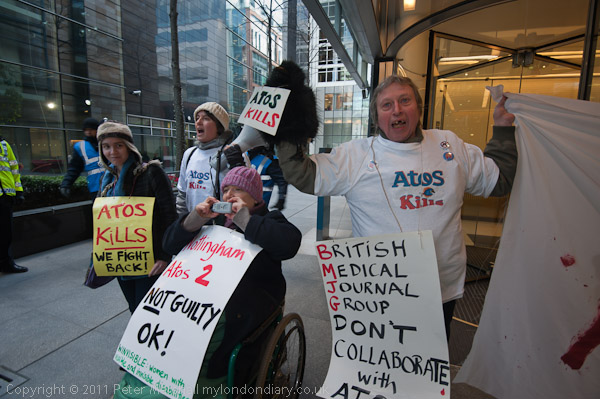
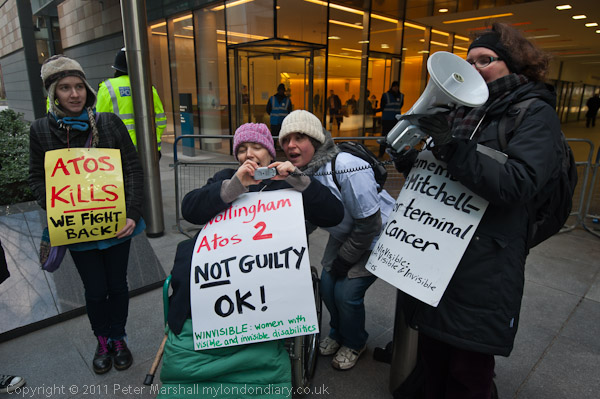
Disabled people and their supporters braved freezing weather to stage an hour-long protest outside the UK offices of Atos, protesting against the unfair testing of fitness to work and benefit cuts and supporting the ‘Atos 2’.
The Atos 2 were a wheelchair user and a pensioner, Notts Uncut activists who were charged with ‘aggravated trespass’ after peacefully entering an Atos assessment centre in Nottingham on a National Day of Action Against Atos and the Benefit Cuts last December. The charges were eventually dropped but the arrest and illegal confiscation of video material marked a new and disturbing attitude by police towards peaceful protest. There was another protest in Nottingham at the same time as that in London.
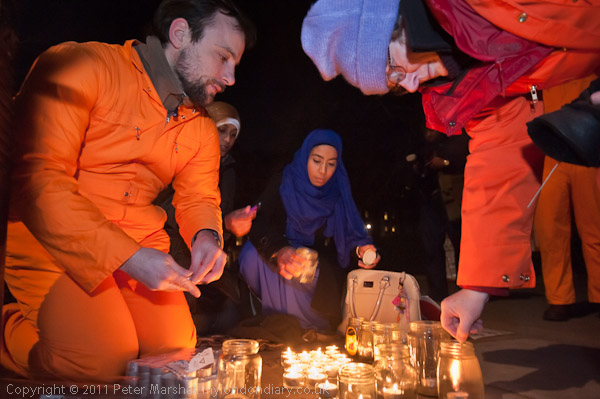
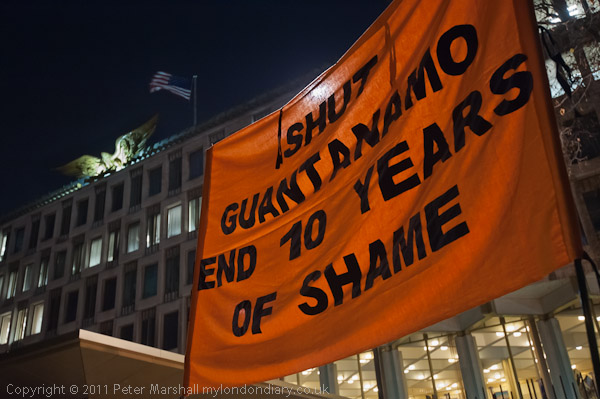
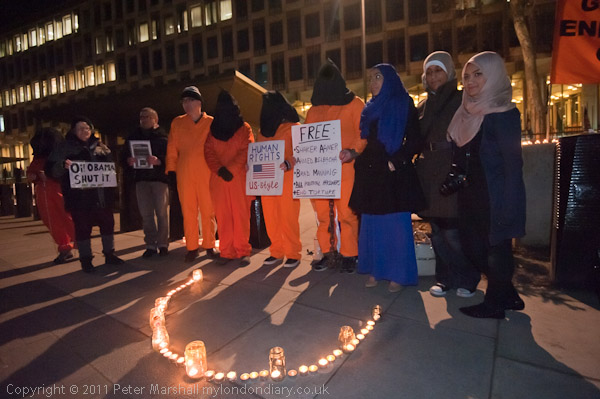
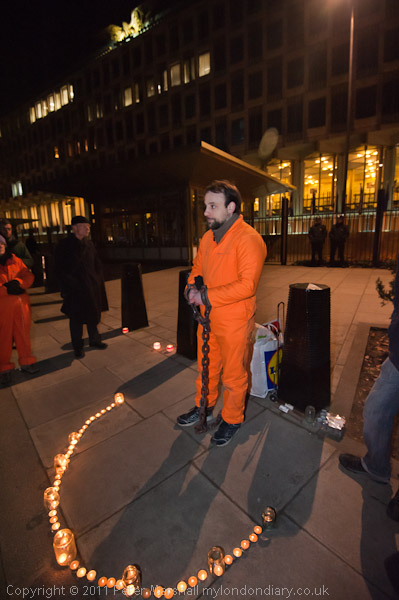
The London Guantánamo Campaign marked 5 years of regular protest at the US Embassy and over 10 years of illegal detention with a candlelit vigil, calling for the shutting down of the camp and the return of UK residents Shaker Aamer and Ahmed Belbacha.
Ahmed Belbacha was eventually released without charge in 2014, having been twice cleared for release in 2007 and 2009. He had come to the UK from Algeria as an asylum seeker and lived and worked here for a couple of years before his claim was rejected, after which he went to Pakistan to study the Koran. He made a visit to Afghanistan and was arrested on his way back to Pakistan.
Shaker Aamer, a Saudi citizen and legal UK resident married to a British woman who was applying for British citizenship went with his family to work for an Islamic charity in Afghanistan in 2001. He was arrested by Afghans and handed to the US in return for a ransom. Again he was cleared for release in 2007 and 2009, but continued to be held until October 2015.
My previous walk came to an end close to Westferry Station, from where I took the Docklands Light Railway to make my way home, but before the train came I made several views from the west-bound platform. The DLR runs through Limehouse on the old viaduct first planned in 1835 by the Commercial Railway Company to take the railway from the City to the West India and East India Docks. The viaduct was a cheap way to take the railway through the built-up area, and won out against a rival scheme involving cuttings. The two companies merged to build the London and Blackwall Railway in 1838-40, though it was later widened.
It was the world’s second elevated railway, opening shortly after the London and Greenwich on the other side of the Thames. The 20 ft high viaduct now gives good views of the surrounding area both from the trains and from the stations. At the left of this view you can see the rear of the West India Dock warehouses on Hertsmere Road, and at right the low structures, now replaced, of Heron Quays.
Isle of Dogs, River Thames, from Westferry Station, Limehouse, Tower Hamlets, 1988 88-7q-25
Turning a little the view from the southern platform shows Westferry Road and the River Thames, with in the distance a view of two of the Barkantine Estate towers at left, closer to the centre a side view of the Cascades Tower and towards the right two towers on the Pepys Estate in Deptford and more distant blocks.
A couple of days later I returned to the area, stopping off in central London on my way and taking a picture of the statue of Isambard Kingdom Brunel by Carlo Marochetti, (1805-1867). The statue was commissioned in 1861 by the Institute of Civil Engineers but was only installed here in 1874 on a Portland stone pedestal by Richard Norman Shaw (1831-1912). Its inscription reads ISAMBARD KINGDOM BRUNEL/ CIVIL ENGINEER/ BORN 1806 DIED 1859″.
The ICE had hoped to install this statue together with that of two other prominent engineers, Robert Stephenson and Joseph Locke who had died within a few months of Brunel, in Parliament Square, close to their offices at 1 Great George St. Permission was initially granted, but then withdrawn when the Office of Works decided only politicians should have statues in Parliament Square. Brunel’s was erected on Temple Place, Stephenson’s outside Euston Station and poor Locke’s was sent to Barnsley, where he had grown up.
Lazdan, Builders Merchants, Bow Common Lane, Bow, Tower Hamlets 88-7q-12
281 Bow Common Lane was until recently Lazan Builders Merchants but they have now moved to Sebert Road, Forest Gate. The house had a facelift in 2020.
Bow Common Lane, Bow, Tower Hamlets 88-7q-14
I think this is somewhere in the Joseph St area, but new building makes it hard to identify the exact position.
S P Brown, Builders Merchants, Lockhart St, Bow, Tower Hamlets, 1988 88-7r-01
This house, 31 Lockhart St, is still there at the corner of Lockhart St and Ropery St, but the large gate now has letter boxes for 33,35 and 37 and the lettering has gone.
Bow Common Gas works were to the west of Knapp Road, the continuation of Cantrell Road south of the railway line which runs across the center of the image. The gasworks were built here in 1850 and at one time there were seven gasholders. Most of the site was demolished in 1982 and the last two gasholders shown here in 2016-7.
The scrapyard is now the Scrapyard Meadow, part of Tower Hamlets Cemetery Park.
Poplar To Limehouse 1988 – my walk continued on the East India Dock Road.
East India Dock Rd, Poplar, Tower Hamlets, 1988 88-7q-51
From the posters in the window this was clearly a video rental store, a relatively new thing back in 1988 – the first Blockbuster Video store only opened in Dallas, Texas in 1985. Home video recording only began to be popular after the introduction of Betamax in 1975, followed in 1977 by VHS (along with other formats.) By 1988 VHS had become the dominant format.
But my attention was caught by the notice on the door, ‘NO DOGS OR BIKES ALLOWED’ with a very small ‘Thankyou’ and the two bikes (I think a BMX and a racer) flung down on the pavement outside unlocked by their two young owners.
Poplar Labour Party, East India Dock Rd, Poplar, Tower Hamlets, 1988 88-7q-53
Poplar Labour Party, led by George Lansbury, gained control of Poplar Borough Council in 1919. Poplar was one of the poorest areas of the country and so rateable values there were low. With councils then being responsible for supporting the unemployed and poor, council rates thus had to be set at a much higher level than in wealthy boroughs, which was clearly unfair on boroughs like Poplar who had so many more people needing support. Their rates were the highest in London, twice as high as in the wealthy borough of Kensington.
Poplar Labour had come into office to make changes, to provide greater support for the poor, to set a higher minimum wage for council workers and to pay women equally to men. When a demand from government came in 1921 to increase contributions for cross-London authorities Poplar council refused to pay, instead voting to use the money for the local poor. The authorities took them to court, and 30 councillors marched there with two thousand supporters. All of the councillors were sentenced to prison, where one of the six women, Minnie Lansbury, died, only 32.
Public outcry with large demonstrations and some riots – and other councils following Poplar’s lead – led to the councillors being released with an Act being rushed through Parliament to make the system more fair, with richer boroughs contributing more and the poorer less.
Their protest had clearly been illegal, but was clearly justified, and it led to a much-needed reform. It’s a lesson which still has relevance, particularly with such current matters as statues and the Government’s Police, Crime, Sentencing and Courts Bill.
Richard Green, statue, Poplar Baths, East India Dock Rd, Poplar, Tower Hamlets, 1988 88-7q-54
The statue of Richard Green still stands outside Poplar Baths, a Grade II listed building from 1933, replacing an earlier baths from 1852. The baths were largely to provide washing facilities when few homes had bathrooms in this poor area of the city. As well as ‘slipper baths’ there were also vapour baths, showers and laundry facilities. The new baths in 1933 was a huge building including these facilities and two swimming pools, the larger of which could be covered over and used as a dance hall, theatre and sports hall.
The baths reopened in 1947 after the war despite considerable damage and was closed and converted into a training centre in 1988. My picture from 1988 shows a board advertising the support of the London Docklands Development Corporation in providing disabled access.
The building later became derelict but after a strong local and national campaign for its restoration work began on its redevelopment in 2014 and it reopened again as Poplar Baths Leisure Centre and Gym, along with 100 new homes, in 2016.
Richard Green (1803-63) was a local shipowner, shipbuilder and philanthropist, supporting a Sailors’ Home, schools, an orphanage and hospitals in the area, some of which had been founded by his father, George Green. His Blackwall Yard built many ships for the East India Company and for trade with Australia and China. His company, R & H Green in 1919 joined with Silley Weir as R. and H. Green and Silley Weir, with large premises at the Royal Albert dry docks and others and continued in business until sold to become a part of the government owned River Thames Shipbuilders in 1977.
George Green School, East India Dock Rd, Sturry St, Poplar, Tower Hamlets, 1988 88-7q-43
George Green (1767-1849) was the father of Richard Green whose statue with his dog still sits outside Poplar Baths. George married the boss’s daughter and made the reputation of the Blackwall Shipbuilding Yard, building many whalers.
As well as this school dating from 1828 on the East India Dock Road the older Green also endowed schools in Chrisp Street and Bow Lane. The current huilding from 1883 is part of Tower Hamlets College. George Green School in new buildings on Manchester Road became the secondary school for the Isle of Dogs with its first comprehensive intake in 1975.
The War memorial to the children of Upper North Street School is https://britishlistedbuildings.co.uk/101065215-war-memorial-to-the-children-of-upper-north-street-school-poplar-ward Grade II* listed and includes the inscription: ‘IN MEMORY OF/ 18 CHILDREN/ WHO WERE KILLED/ BY A BOMB/ DROPPED FROM A/ GERMAN AEROPLANE/ UPON THE L.C.C./ SCHOOL UPPER/ NORTH STREET/ POPLAR ON THE/ 13TH OF JUNE 1917./ ALFRED H. WARREN O.B.E./ MAYOR/ J. BUTEUX SKEGGS,/ TOWN CLERK. ‘
There is a fuller story at the link above about the first mass German raid on London by Gotha bombers on 13 June 1917 which killed 162, including these 18 children mainly aged 5 or 6. At least 37 other children at the school were among the 432 injured by the raid.
St Mathias, church, Woodstock Terrace, Poplar, Tower Hamlets, 1988 88-7q-45
St Mathias Church is also Grade II* listed, with a number of Grade II listed monuments. Poplar’s oldest church, it was built in 1766 as the Chapel of the East India Company, and became St Mathias as a parish church in 1866. You can see the company’s arms in the roof, and allegedly its columns came from wrecks of the Spanish Armada.
The exterior of the church was altered and enlarged by Teulon in 1875. The church closed in 1976 and was restored for community use by the LDDC in 1990.
Built in 1902–3 as an officers’ annexe to the Scandinavian Sailors’ Temperance Home, founded by Swedish Free Church missionary Agnes Hedenstrom (1849–1928) who began her mission in the East End in the 1870s, opening the home here in 1888. The mission was taken over by the Salvation Army in 1930.
This was I think the last picture I took on my way to Westferry station where I returned a couple of days later for another walk – and the subject of a later post.
Click on any image to see a larger version in my album 1988 London Photos from where you can browse other images.
Chaplain’s house, East India Company, Poplar High St, Poplar, Tower Hamlets, 198888-7p-31
The Survey of London has a long story about this house at 115 Poplar High Street, now a private residence oddly called Meridian House and built together with 26 new almshouses by the East India Company in 1801-2. They had first set up almshouses in Poplar for disabled and retired employees and their widows and orphans in1626, built partly using money seized from the estate of Hugh Greete after his death in 1619. Greete had been discovered to have been swindling the company while trading Indian diamonds and they seized his assets.
The old almshouse was demolished in 1802 replaced by the new buildings. After the Crown took direct control of India in 1858 the government took over these buildings as Poplar Marine Hospital, selling all except the chaplain’s house, burial ground and chapel to Poplar District Board of Works in 1866. They demolished the almshouses to become Poplar Recreation Ground.
The chapel became the Church of St Matthias with the Chaplains house as its vicarage – and it was further enlarged in the following years. When St Matthias was closed in 1976 the house was sold to become a private residence.
Former District Board of Works Offices, Poplar High St, Woodstock Terrace, Poplar, Tower Hamlets, 1988 88-7p-32
This Grade II listed building from 1869-70 for the Poplar District Board of Works was the result of a competition for designs which attracted 43 entries and considerable controversy when the prize went to Walter Augustus Hills (c1834–1917) and Thomas Wayland Fletcher (1833–1901) of Bow, both former assistant surveyors to the board. One architectual magazine at the time described it as ‘terribly ugly’. They were obliged to cooperate with the second place pair of Arthur and Christopher Harston over a final design. Once constructed the building was found to have various problems, not least that in the boardroom ‘reverberation was so excessive as to make the speaker almost incomprehensible’.
Various alterations were made and in 1900 the building became the town hall of the new Metropolitan Borough of Poplar, who extended it and then replaced it in 1038 by a new town hall in Bow. It continued in various uses by the council and in 1987 became the Borough of Tower Hamlets’s Directorate of Housing.
Poplar High St, Poplar, Tower Hamlets, 1988 88-7p-34
This small paved area is just off the High St between Norwood House and Holmsdale House and the block in the centre of the picture is Constant House on Harrow Lane, built by Poplar Council in 1936-7designed by the Borough Engineer and Surveyor, Rees J Williams. Both Holmsdale and Constant House were rehabilitated in 1986-7, with more work in recent years. Norwood House was added in the late 1960s and this paved area looks as if it may date from then.
Holmsdale House, Poplar High St, Poplar, Tower Hamlets, 1988 88-7p-36
A similar style block to Constant House, also built for Poplar Council in 1937-8, designed by Rees J Williams.
The Resolute, pub, Harrow Lane, Poplar, Tower Hamlets, 1988 88-7p-21
Built in 1937 on the corner of Poplar High St and Harrow Lane, to replace an earlier pub the Resolute survived until closed and demolished in 2011. The pub on this site was The Harrow from 1797 (or earlier) until renamed the Resolute Tavern around 1881.
The best-known ship of this name was fitted out for arctic service at nearby Blackwall Yard in 1850 and made several trips to the Arctic searching for the lost expedition of Sir John Franklin who had been searching for a North West Passage. Finally the Resolute got stuck in ice and was abandoned in May 1854, the crew escaping across the ice to a relief fleet.
The ship was found drifting by an American whaler over a thousand miles from where she was abandoned in September 1855 in perfect order and was sailed back to New London, Connecticut, arriving on Christmas Eve. Eventually she was bought by the US Congress, refitted and sailed back to be presented to Queen Victoria and rejoining the navy. The Resolute was retired from the Navy in 1879, possibly at the time the pub was renamed. Some of her timbers were then used to create a substantial desk presented by Queen Victoria to US President Rutherford B. Hayes in 1880. Moved out for some years it has been back in use by most presidents in the Oval Office since being replaced there by Jimmy Carter.
East End Snooker and Social Club, East India Dock Rd, Poplar, Tower Hamlets, 1988 88-7q-01
This club was at 253 East India Dock Road and has since been converted into Poplar Central Mosque.
The crunched rear end of D814 VRG presumably had its match on the front end of A506 DMX, but at least it appeared that there were no casualites in the collision at the north end of the Blackwall Tunnel, viewed by me from Poplar High St. A sign a little down the road says ‘Welcome to Tower Hamlets‘ though I think most of the tunnel is in the borough. At left is the unmistakable profile of Erno Goldfinger’s Balfron Tower, built in 1965-6 for the GLC and recently stolen from its residents by Poplar HARCA housing association and sold as luxury housing.
Just on the edge of the elaborate interchange between the East India Dock Road and the Blackwall Tunnel Approach is this small Seamen’s Mission, built in 1898 a Christ Church House and a part of the St Frideswide’s Mission House Conservation Area, but this building only locally listed. The mission here was set up by members of Christ Church College Oxford who in 1881 decided to support missions in the East End. Now converted into six flats.
My 1988 walk in Poplar will continue in a later post.
This post starts where my previous post on the walk left off, on Emmett Street, no longer present, a victim of both the Limehouse Link tunnel and the edge of the Canary Wharf development at Westferry Circus. I think it this was taken just a little further south than the previous picture and the view between buidlings with several cranes is to the luxury flats being built on the Limehouse bank of the Thames.
A little further south on Westferry Road, with the high dock wall at the left and Cascades Tower, designed by the architects Campbell, Zogolovitch, Wilkinson and Gough (CZWG) in the distance ahead. This unusual block of luxury flats built in 1985–88 was the first private high rise block in Docklands. Going down Westferry Road was entering a huge building site – and the graffiti on the bus shelter states WORLDEXIT (though its actually where a bus would take you back into the world.) When built the flats were almost impossible to sell or rent and Tower Hamlets council let them to teachers at £17 a week. Now they are rather more expensive, at around £400 per week for a one bed flat, and selling for around £500,000 and no teachers can afford to live there.
I think the slight rise in the road, which also bends slightly is possibly the former Limehouse Basin entrance and this section of Westferry Road was perhaps what had previously been Bridge Road.
George Baker & Sons (Millwall) Ltd, builders and joiners, were according to the Survey of London only at this site from 1985 until it was cleared in 1987-8. But the name here looks older and this is the remains of a fairly elegant three-storey building, a photograph of which from 1987 is in the Survey of London. It was built on what was then Emmett St in the 1860s for Thomas Dominick James Teighe and Frederick Smith, sailmakers and ship-chandlers, and from 1902 to the early 1980s occupied by Fitch & Son, provision merchants.
Westferry Rd, Isle of Dogs, Tower Hamlets, 1988 88-7p-53
Considerable building work taking place close to Westferry Circus, with Cascades Tower visible in the distance.
South Dock Entrance, Westferry Rd, Isle of Dogs, Tower Hamlets, 1988 88-7p-41
Sand and gravel works on the north side of the former South Dock Entrance, with a view across the River Thames to Columbia Wharf in Rotherhithe.
Westferry Rd, Isle of Dogs, Tower Hamlets, 1988 88-7p-43
A bus stop at left on Westferry Road, the Island Car Service, much needed as the bus service was poor and unreliable and Timber Merchant John Lenanton & Sons Ltd on the corner of Manilla St, with the Anchor & Hope public house part visible at the right edge, and behind one of the towers of the Barkantine Estate. The car service was in the shop at 31 which for many years was Wooding’s newsagents. The Anchor & Hope had been opened since at least the 1820s, and possibly as it until recently stated on its frontage was established 1787. The building is still there though it closed as a pub in 2005. It was extensively refurbished for residential use in 2015 and the ground floor later became a gym.
Ming St, Limehouse, Tower Hamlets, 1988 88-7p-44
I walked back north to Ming St in Poplar, part of London’s first Chinatown, and renamed to reflect this in 1938 when many of London’s streets were renamed to avoid confusion – previously it had been since 1820 one of many King Streets. This was part of the Limehouse of Sax Rohmer‘s racist imaginings of opium dens and crime in his 18 book Dr Fu Manchu series, begun in 1913 and continued after Rohmers death by his biographer and assistant Cay Van Ash.
His work brought wealthy upper-class slum-tourists to the area, where they perhaps enjoyed meals in restaurants such as Wah Ying, but they will have found little evidence of Fu Manchu and his team of assassins, human traffickers and drug traders of the dreaded Sci-Fan secret society. Chinatown was one of the more law-abiding areas of the East End, and the Chinese certainly more law abiding than most.
Ming St, Limehouse, Tower Hamlets, 1988 88-7p-45
The Peking was another remnant of the Chinatown past, mostly now moved away to Soho, though there is still a Chinese restaurant on the East India Dock Road, along with the Chun Yee Society. Dockland Light Railway trains now run across the bridge in the distance. The building at right with a dome was Charlie Brown’s pub on West India Dock Road. All this is now demolished.
The White Horse, pub, Saltwell St, Poplar High St, Poplar, Tower Hamlets, 1988 88-7p-46
Going east along Ming St takes you to Poplar High St, and on the corner of Saltwell St where the High Street begins you can still see a large white horse on top of a wooden post, though it seems rather smaller now than in my picture, and is closer to the street corner. There had been a White Horse pub on this site since 1690 though I think the building in this picture is probably from the 1920s when it was taken over by Truman’s Brewery. They sold it in 2003 and it was demolished and replaced by a block of flats. According to the Lost Pubs Project, “In 1740 it was, scandalously, run by a Mr & Mrs Howes, both of whom were actually female. ”
The horse was Grade II listed in 1973 and has the shortest listing text I’ve come across: “C18 wooden carving of a white horse on post in forecourt.” The lower part of the sign with the pub name fell down and has been removed, but the horse has been repainted since my picture.
Click on any of the images to see a larger version in my album 1988 London Photos from where you can browse the album.
St Anne’s Church, Limehouse, Tower Hamlets, 1988 88-7o-32
Church, Pyramid, Star of the East – More Limehouse My walk around Limehouse came back to the area I think of as its heart, close to St Anne’s Church, one of the Queen Anne Churches built after the 1711 Act of Parliament and consecrated in 1730. St Anne’s is one of the six London churches by Nicholas Hawksmoor along with St Alfege’s Greenwich, St George’ Bloomsbury, Christ Church, Spitalfields, St George in the East Wapping andhis only church in the City of London, St Mary Woolnoth.
St Anne’s Churchyard, St Anne’s Passage, Limehouse, Tower Hamlets, 1988 88-7o-34
I turned my back on the church to photograph the entrance gate to the churchyard.
Limehouse Pyramid, St Anne’s Church, Limehouse, Tower Hamlets, 1988 88-7o-36
The church has featured in many books and publications, including the work of psychogeographers and other more esoteric and mystical writers, and seems to have a special place in the works of believers in ley lines. I’ve not read or seen the film ‘Dark Lines Of London’, but a web page claims to give “Factual Information That Provides the Backdrop to the Story” and includes descriptions and photographs of 10 sites, all from centuries after that in which the story is set, along “a real ley line” one of which is this “Wisdom Of Solomon” Pyramid.
THE 4TH CONFERENCE of the Situationist International was held in London, at a secret address in the East End, 24-28 September 1960, seventeen months after the Munich Conference (April 1959). The situationists assembled in London were: Debord, Jacqueline de Jong, Jorn, Kotányi, Katja Lindell, Jörgen Nash, Prem, Sturm, Maurice Wyckaert and H.P. Zimmer. In fact, to ensure that the proceedings were kept well away from any contact with London journalists or artistic circles, the conference took place at the British Sailors Society hall in Limehouse, “an area famous for its criminals”.
Internationale Situationniste #5
Star of the East, Commercial Rd, Limehouse, Tower Hamlets, 1988 88-7o-23
Built in the early 19th century and Grade II listed the Star of the East was serving beer at least from 1845. More recently the building had deteriorated and closed as a pub around 2010, was reopened a couple of years later but closed again in 2016. The pub was then taken over and refurbished by the Old Spot Pub Co, who run around a dozen pubs re-opening again in 2019.
Star of the East, Commercial Rd, Limehouse, Tower Hamlets, 1988 88-7o-11
You can read more about its recent transformation and see some photographs from London Pub Explorer. I’ve yet to return to see for myself. Back in 1988 part of the building was a separate restaurant, but I think the pub now occupies the whole building. The refurbishment appears to have kept at least some of the original interior features.
Three Colt St, Limehouse, Tower Hamlets, 1988 88-7o-14
Three Colt St, which has St Anne’s Church at its northern end is one of the oldest roads in the area, part of the route from Limehouse to Stepney and first recorded in 1362. In the Victorian era it was flanked by a number of shops and was something of a middle-class enclave surrounded on both sides by extreme poverty. Little remains from those times. The building here is the former London and Blackwall Railway station, probably dating from the opening of the railway in 1840. The station closed in 1926, but the line remained in use for goods traffic until the 1960s. When the line was reused for the Docklands Light Railway in 1987, Westferry station was built around 300 yards to the east.
Not only this building but the street that it was in have disappeared since I made this picture. Emmett St was at the end of Three Colt St, roughly where the Limehouse Link tunnel entrance is now. Construction of the tunnel began in November 1989 and the project was officially opened in May 1993, at £293,000,000 the most expensive per mile road scheme ever built in the UK, a huge public subsidy to the Canary Wharf redevelopment.
When Mucho Macho released ‘The Limehouse Link’ in 1998 it had one of my pictures wrapped around both the CD and the 12″ LP, where it looked rather more impressive. But this image was from Poplar – and this is the full image from the Urban Landscapes web site and doesn’t show the Limehouse Link at all.
Clicking on any of the black and white images above will take you to a larger version in my 1988 London Photos from where you can browse the album.