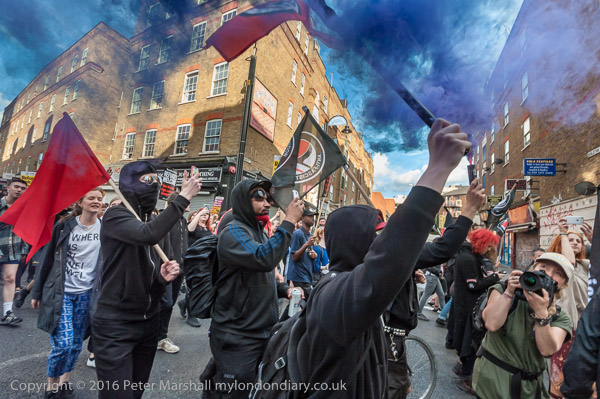
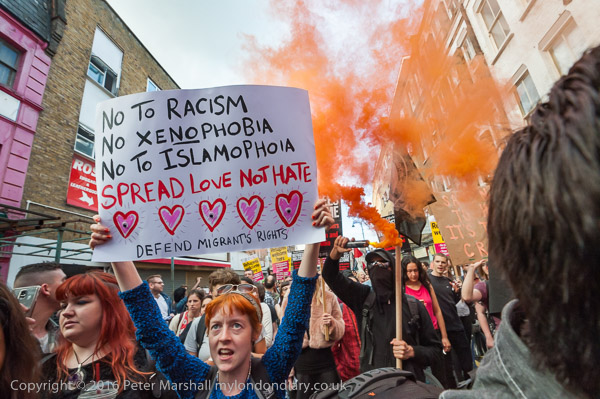
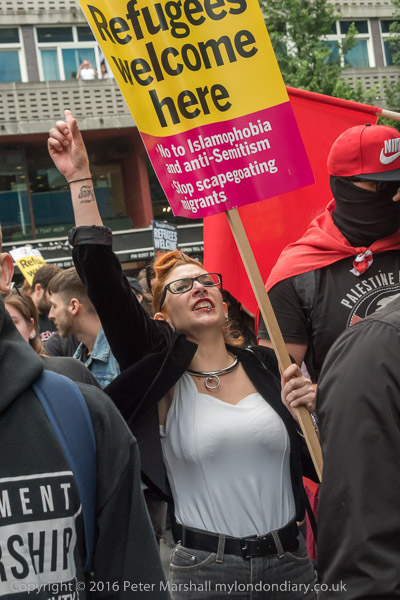
Anti-Racist & Migrant Rights Reclaim Pride – 2017

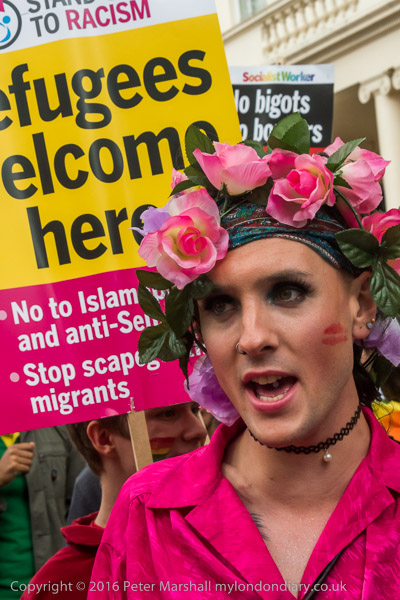
I’ve almost given up on photographing the annual Pride Parade in central London, which has become such a corporate event, though as in this event in 2017 there are sometimes things happening around it which still have some political edge – and even inside it, generally relegated to well behind the corporate razzmatazz.
As I wrote on 8th July 2017:

“Pride over the years has degenerated from the original protest into a corporate glitterfest led by major corporations which use it as ‘pinkwashing’ to enhance their reputation and it includes groups such as the Home Office, arms companies and police whose activities harm gay people in the UK and across the world.”

My London Diary – July 2017
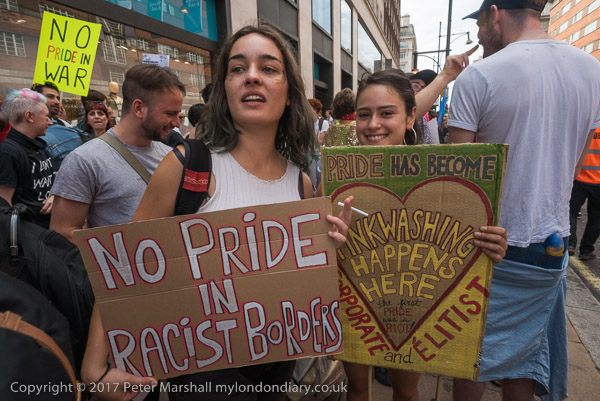
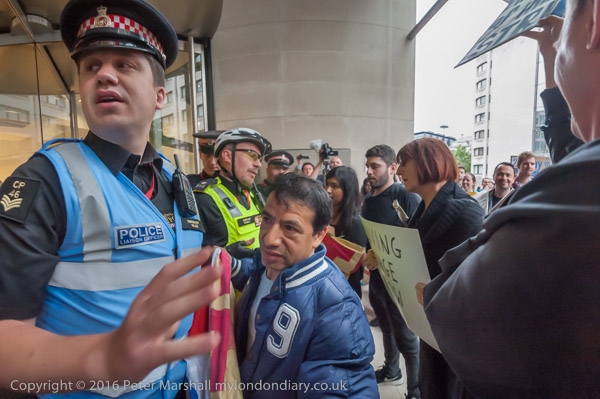
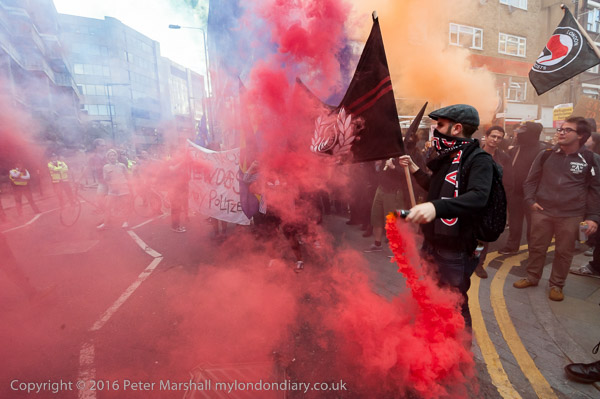
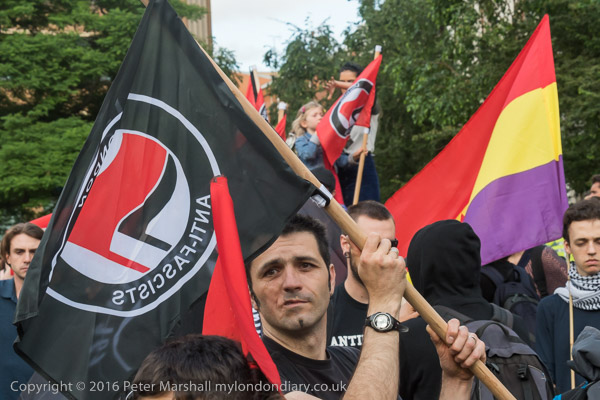
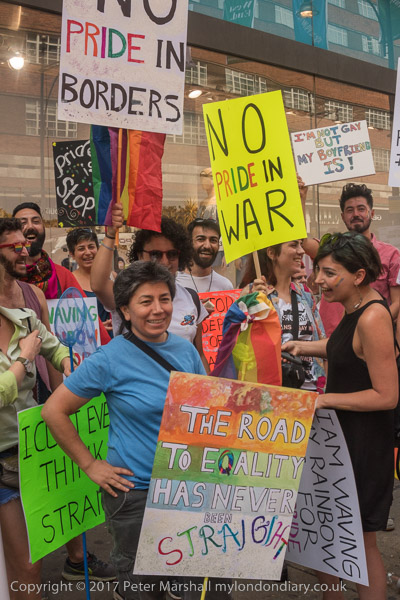
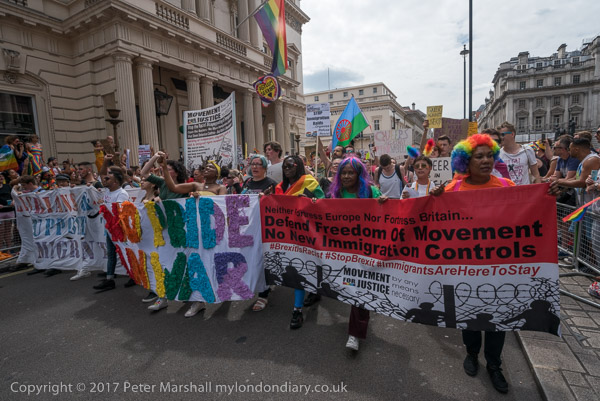
In 2017 the commercialisation of Pride had reached new heights, with participation limited to those groups who had officially applied and got pride armbands being allowed to join the procession. At least in part this seems to have been an attempt to exclude groups such as the Migrants Rights and Anti-Racist Bloc organised and led by Movement for Justice and including Lesbians & Gays Support The Migrants, No Pride in War and London Supports Istanbul Pride who had joined in towards the back of the 2016 parade.
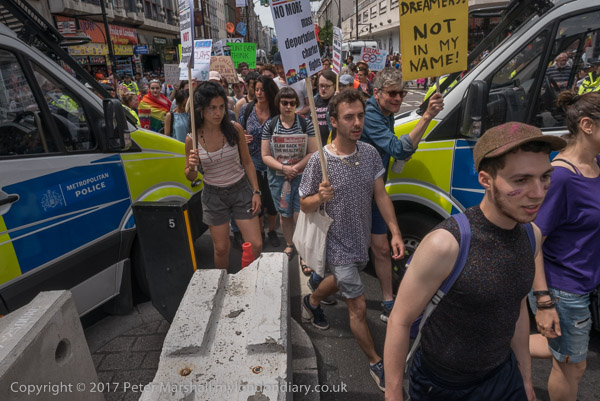
I don’t know if the bloc had made an application, but I think probably not, and they certainly didn’t have the armbands. They marched between police vans that were blocking the entrance to Oxford Circus in front of the march with others lifting up barriers and tried to make their way past the front of the march to join in further back but were stopped by Pride stewards.
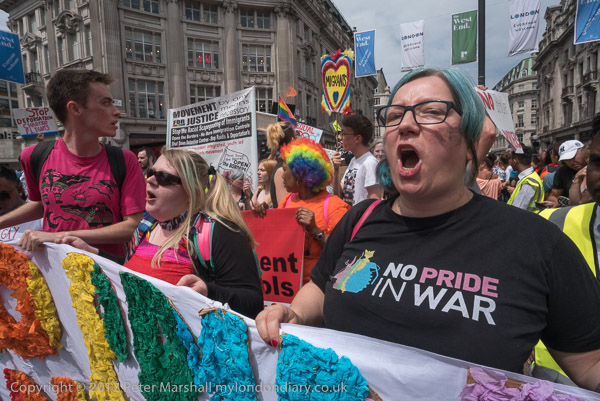
This left them immediately in front of the heavily stewarded front of the official parade, and they refused to move unless they were allowed to make their way into the parade. A stalemate ensued, with Pride stewards insisting that they had to leave the area, and the Migrants Rights and Anti-Racist Bloc refusing to shift. Police tried to get them to move and also tried to get the Pride stewards to let them into the march, but they remained adamant.
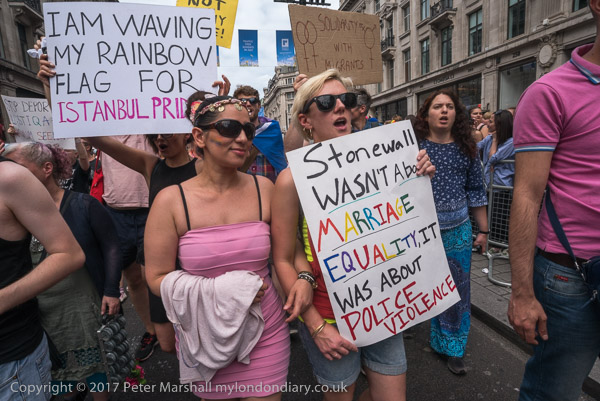
It was time for the parade to start, but it couldn’t. Eventually police sorted out the issue by holding back the official parade while the Migrants Rights and Anti-Racist Bloc marched along the parade route past the large crowds to a great deal of applause and some aggravation from Pride stewards along it.
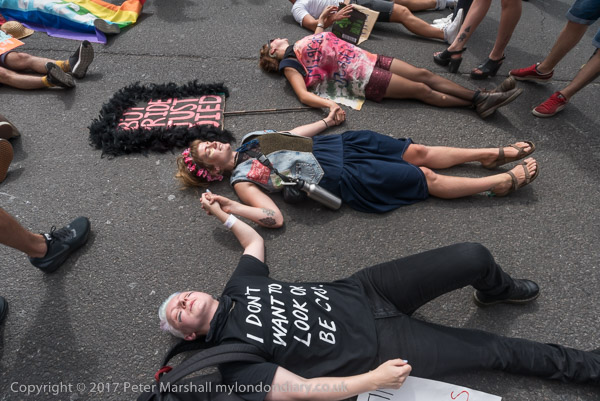
Around a quarter of an hour later, the official parade started, following them along the route. But it was again held up as the front of the procession reached Whitehall, as some of the No Pride in War protesters lay down on the tarmac in front of it. The procession was held up for another 15 minutes as police tried to persuade them to leave – and eventually I think they all got up when finally threatened with arrest.
The Migrants Rights and Anti-Racist Bloc had made a stand and had reclaimed Pride as a protest – with a separate official Pride following behind – and the No Pride In War had also made their point against the inclusion of the military in the official event. But “curiously” for such a high-profile protest in an event covered by huge numbers of press from around the world I think it went totally unreported in the mainstream media. For them, Pride is just a colourful spectacle.
Anti-Racist & Migrant Rights reclaim Pride

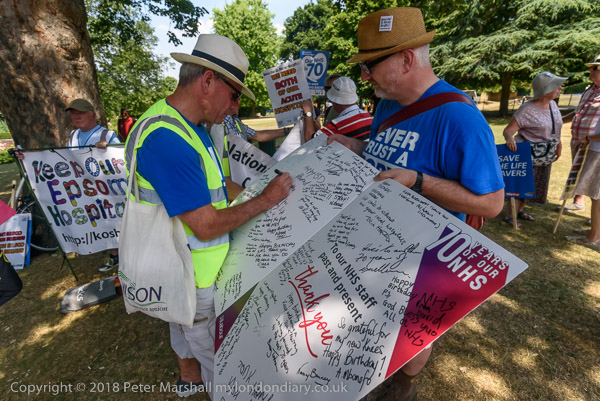
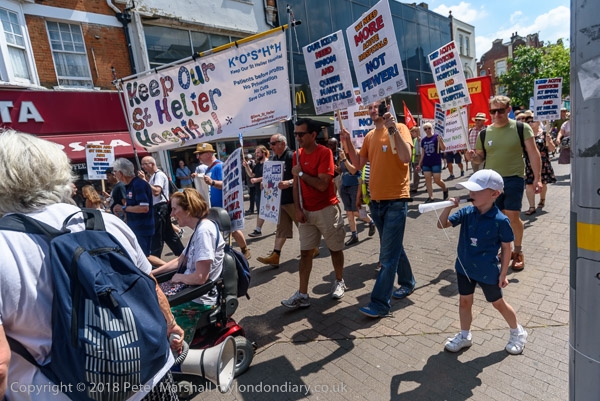
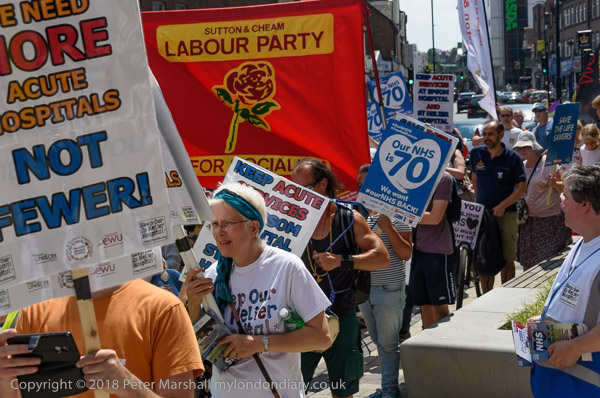
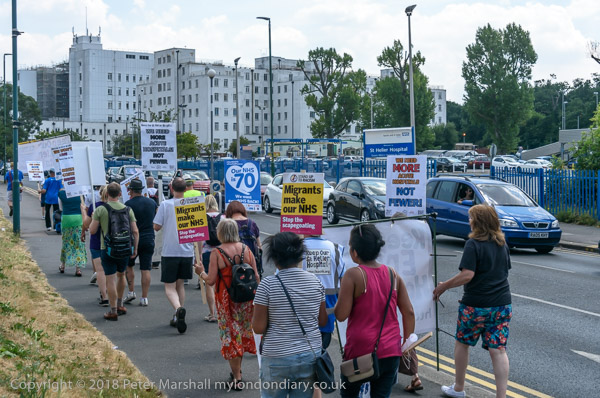
Save St Helier Hospital – 7 July 2018

The battle by local campaigners against the closure of acute facilities at Epsom and St Helier Hospitals in south London has been hard fought and illustrates many of the problems faced by the NHS as the government has called for huge savings from hospital trusts, many made paupers by PFI repayments.

The situation continues to develop after the march which I photographed on Saturday 7th July 2018, and in July 2020 plans were approved to build a new smaller Specialist Emergency Care Hospital in Sutton which will bring together six acute services, A&E, critical care, acute medicine, emergency surgery, inpatient paediatrics and maternity services.

The trust say in the documentation for the first phase of public consultation which closed on 30th June 2021 that “85% of current services will stay at Epsom Hospital and St Helier Hospital. There will be urgent treatment centres open 24 hours a day, 365 days a year at both of these hospitals.”

But health service unions and campaigners are worried by the proposals, which they say will strip acute services including two fully functioning A&E departments. The proposed urgent treatment centres will not have the capacity to treat life threatening illness. They say the downgrading of the two major hospitals will endanger the lives of people living in the area.

The new unit is one of 40 across the country which have been announced several times as a part of the governments increased investment in the NHS. Many see this and other similar schemes as being designed to increase privatisation and make involvement in the health service more attractive to healthcare companies.

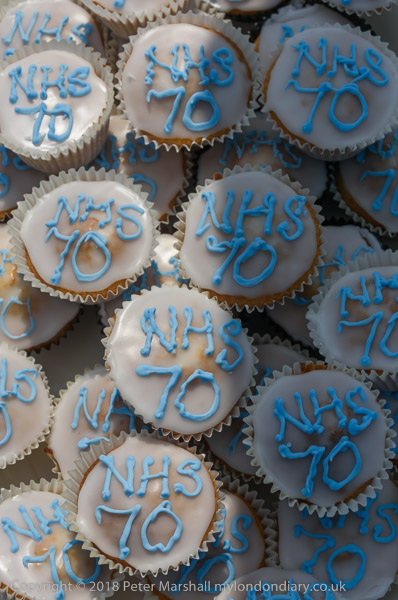
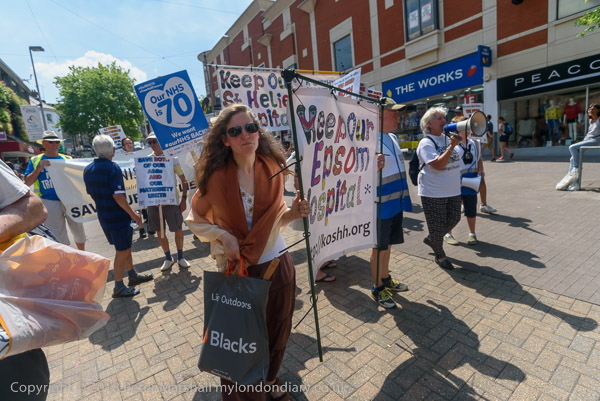
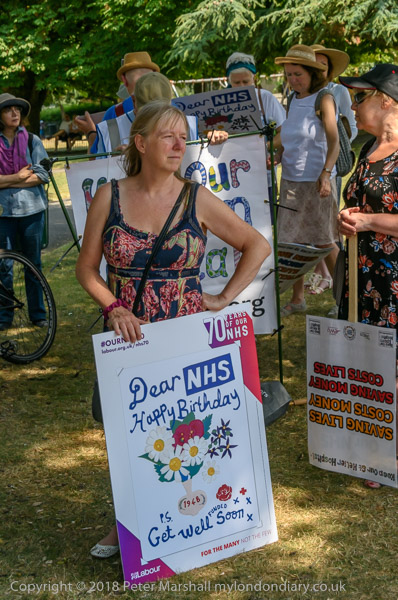
July 7th was a sweltering hot day in London, and the walk from a park in the centre of Sutton to the St Helier Open Space in front of the hospital went through Sutton High St, fairly crowded with shoppers and then along hot, dusty streets with few people around. Walking was tiring, and taking photographs even more so. It was a difficult event to photograph, where I found relatively little to work with. But I was pleased to be there, supporting the campaign to keep the hospitals open and serving the community, part of a National Health Service that was celebrating 70 years of being brought into existence by a Labour Government.

It took a huge and deterimined fight by Nye Bevan to get the National Health Service Act passed, with Tories denouncing it as bringing National Socialism to the country and opposing it in parliament at every opportunity. But on 5th July 1948 we got the NHS, although almost ever since the Conservative party when in power has been looking for and finding ways to convert it from a universal public health care system to a service run for private profit.

NHS at 70 – Save St Helier Hospital

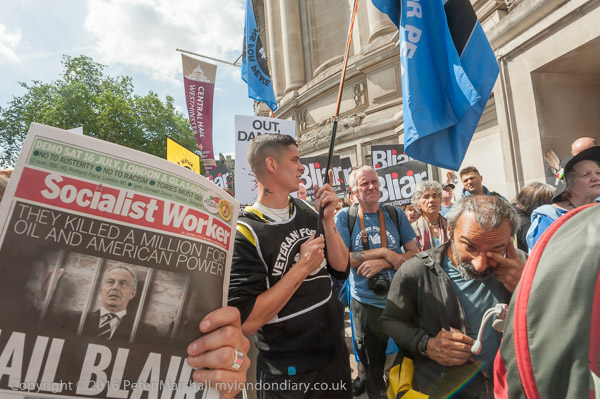
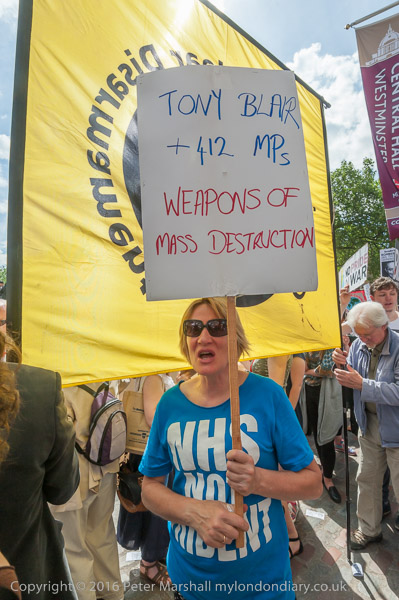
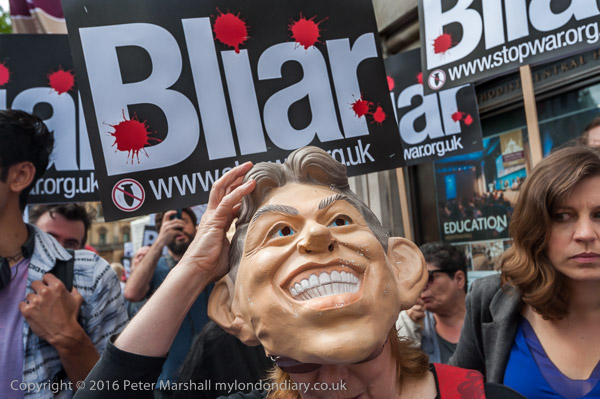
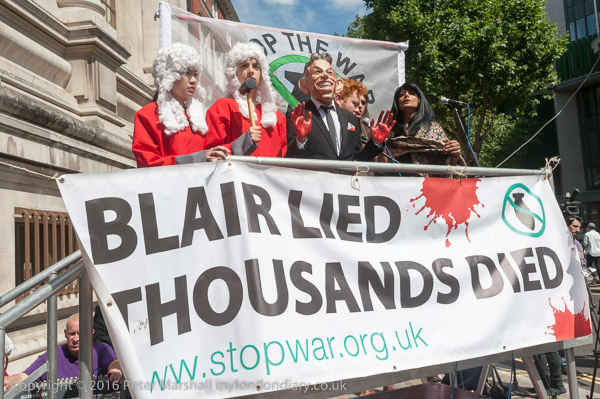
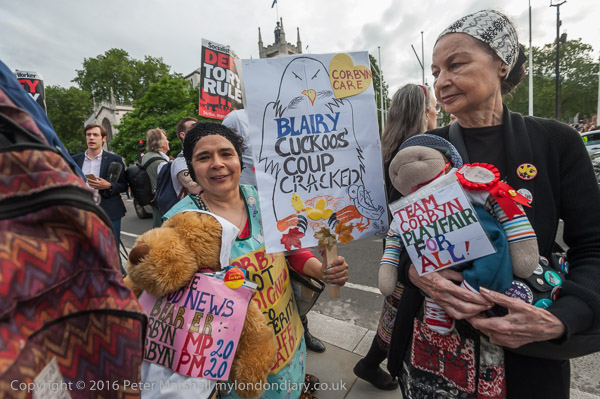
Blair lied, Millions Died – 6th July 2016

Labour scraped in at Batley and Spen by a few hundred votes, which was enough to take the pressure of calls for a replacement for Keir Starmer off the boil for at least a few months. And for the media to call upon some of the more grisly figures from the Labour past to come on and repeat their vilification of Jeremy Corbyn, and call for a return to those policies which had made Labour – New Labour – unelectable.
It had started with a great burst of support and enthusiasm in May 1997, when we really believed that ‘Things Can Only Get Better‘, but soon the disillusion set in. One of the major early problems came with PFI, launched by John Major in 1992, but taken up and expanded greatly under New Labour. Private companies were contracted to build and manage major public projects, enabling some very flashy announcements but failing to say we would be paying through the nose for them for many, many years – and in many cases for another 20 years or more from now.

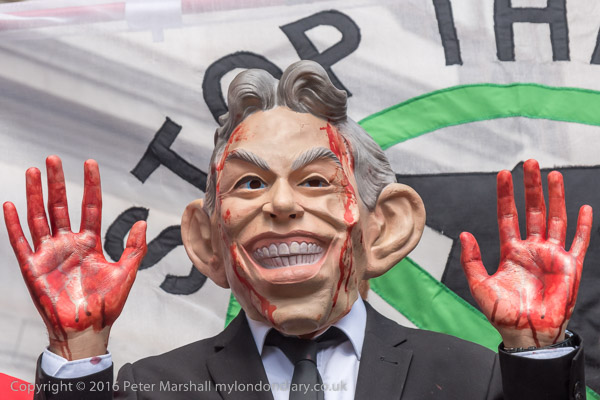
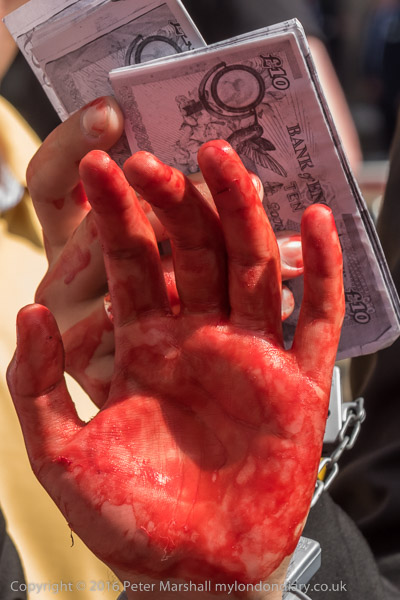
‘Blair’ and ‘Bush’s’ bloody hands – and the cash.

It essentially privatised many public projects, with often poor negotiating skills by civil servants unschooled in such matters resulting in excessive profits for the companies involved. There were many critics of PFI at the time, and in 2011 a critical Treasury report. In 2018 then Chancellor Philip Hammond stopped any new PFI projects.

PFI has been particularly disastrous for the NHS, causing huge financial problems and leading to the cutting down an closures of hospitals. The 127 PFI schemes had a total repayment cost (according to Wikipedia) of £2.1m in 2017 and continuing to rise until 2029. In 2012 seven NHS Trusts had to be given emergency financial support as even with cuts they were unable to meet their PFI repayments.

But, as the recent death of Donald Rumsfield reminded us, the most clear public failure of New Labour was to support what was largely his personal vendetta in the disastrous invasion of Iraq. Richard Wolffe, writing in he Guardian headlined his article ‘Rumsfeld’s much-vaunted ‘courage’ was a smokescreen for lies, crime and death‘ – and Blair colluded whole-heartedly in the deception, with the ‘dodgy dossier’ and various other statements and decisions. His was a special relationship with Bush most politely described as brown-nosing.

This of course is Britain, so instead of taking action we eventually had an inquiry, with Chilcot taking over seven years to allow the long grass to grow. Set up by Gordon Brown in 2009, six years after the invasion, it produced its report on 6 July 2016, when the protest here took place. Wikipedia quotes Richard Norton-Taylor of The Guardian as describing it as “an unprecedented, devastating indictment of how a prime minister was allowed to make decisions by discarding all pretence at cabinet government, subverting the intelligence agencies, and making exaggerated claims about threats to Britain’s national security”.
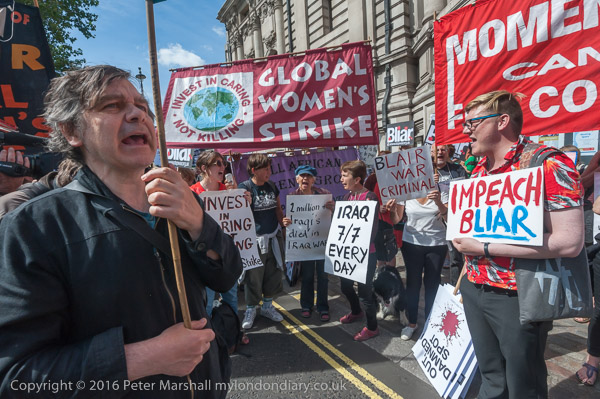
A banner uderestimates Blairs crime – there were millions who died

Clearly Blair was a war criminal. But of course no legal action followed – and that war criminal and proven liar continues to be invited to give his opinions in the media – and there are even those who suggest he should be brought back to lead the Labour Party. Financially he has done well out of his time as Prime Minister – and probably even better from his property investments, with an estimated net worth according to some of £100m. But as the placards say, ‘Blair lied, Millions Died’ and if there was any justice he should have gone to jail.

More at Blair lied, Millions Died – Chilcot


All photographs on this and my other sites, unless otherwise stated, are taken by and copyright of Peter Marshall, and are available for reproduction or can be bought as prints.


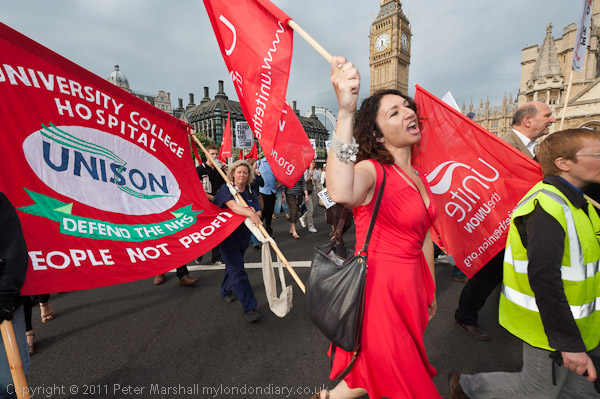
NHS Birthday March – July 5th 2011

The UK’s National Health Service began on 5 July 1948, 73 years ago today. Earlier in 1946 doctors had voted 10:1 against, but compromises were made to bring more of them on side. It had taken the Labour government a fierce battle to get the proposals through parliament, with the Conservative Party under Winston Churchill voting against its formation 21 times when the bill was being passed.

Churchill followed the example of a former chair of the British Medical Association and compared its formation to Nazism, calling it the “first step to turn Britain into a National Socialist economy.”

It was their often unprincipled opposition that lead Aneurin Bevan to make a famous speech two days before the NHS began that included the following:
That is why no amount of cajolery, and no attempts at ethical or social seduction, can eradicate from my heart a deep burning hatred for the Tory Party that inflicted those bitter experiences on me. So far as I am concerned they are lower than vermin.”

In recent years various Tory MPs have claimed that the Conservative Party should be credited for setting up the NHS, when in fact the party fought tooth and nail against it. They also claim that the NHS is ‘safe in their hands’ while increasingly selling off parts of it, largely to US based healthcare companies. Many MPs have financial interests in healthcare and their votes reflect this, in what seems a clear conflict of interest.

One of the compromises needed to get the bill through was that GP surgeries would remain private businesses that could be bought and sold. Doctors in general practice were to remain independent, with the NHS giving them contracts to provide healthcare. What is now happening is that GP surgeries are increasingly becoming owned by large healthcare companies who organise how they are run and employ doctors.

At the moment we still get to see the doctor for free, though it has become more and more difficult for many to do so, in part because of the systems set up by these healthcare companies. But we have now and then heard proposals for charges to be introduced. We do currently have to pay to see a dentist, and even with these charges it has become difficult for many to get dental treatment under the NHS. Many cannot afford the higher charges for private treatment and even the lower rates under the NHS are a huge problem for those on low pay who are not entitled to exemptions.

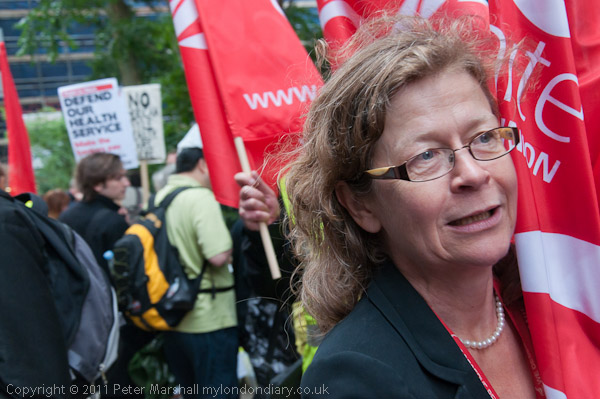
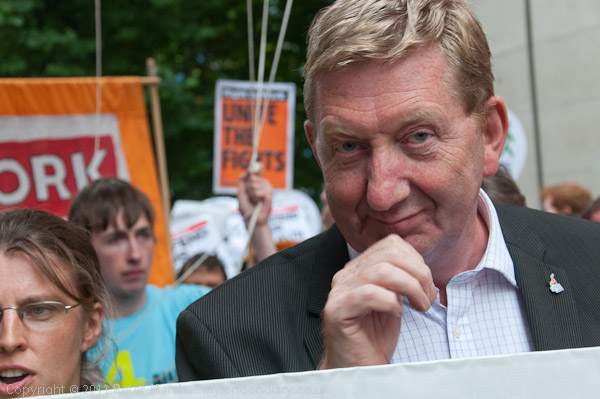
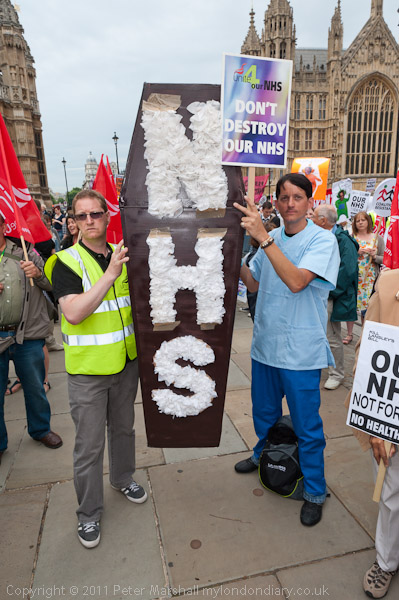
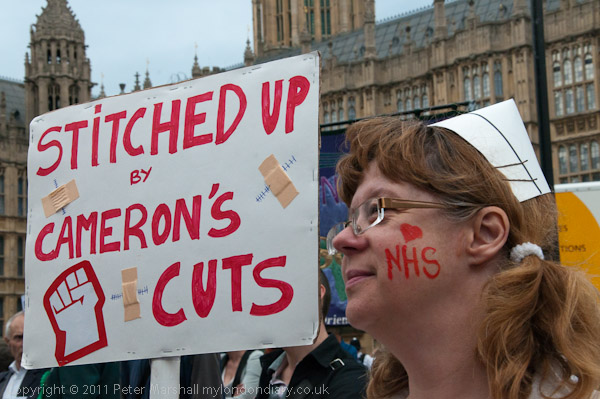
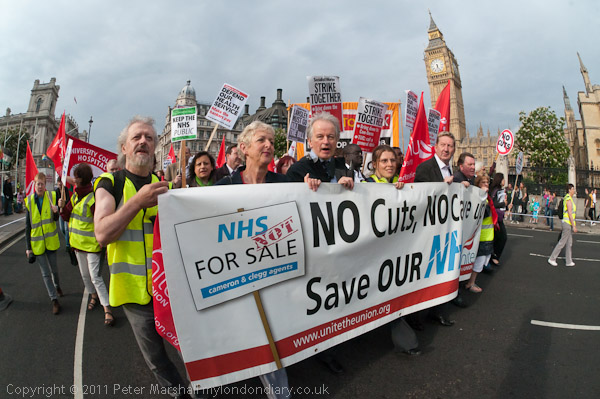
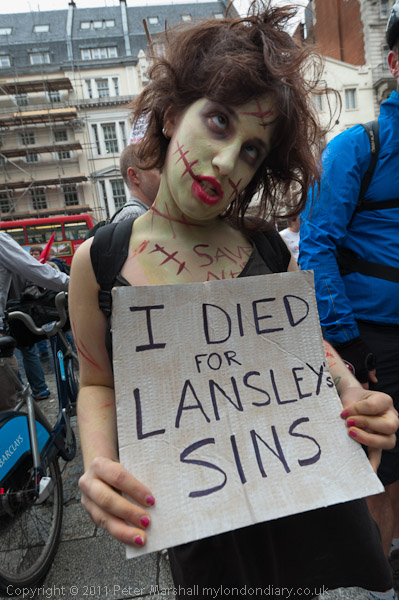
This year there were protests around the country last Saturday, a few days before the NHS’s 73rd anniversary. Ten years ago around a thousand people marched through central London on the actual 63rd anniversary of the foundation of the NHS in a protest to defend the NHS against cuts and privatisation, ending with a rally outside the Houses of Parliament. The changes then being debated under Andrew Lansley’s bill made radical changes which brought in private companies to take over the straightforward and highly profitable areas of NHS services. Now a new bill is under consideration which will make for further back door privatisation of the NHS.

More at NHS 63rd Birthday.


All photographs on this and my other sites, unless otherwise stated, are taken by and copyright of Peter Marshall, and are available for reproduction or can be bought as prints.


Organised Crime – Public & Private Sector

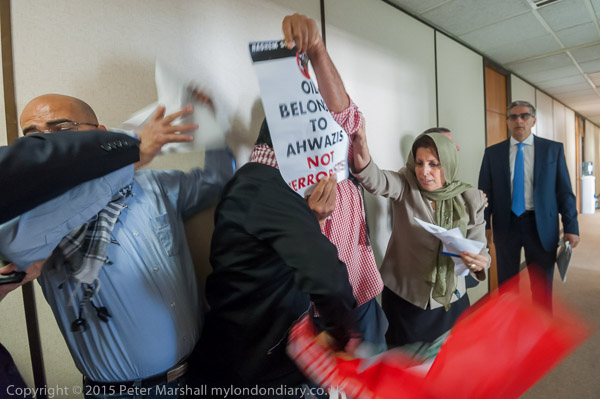
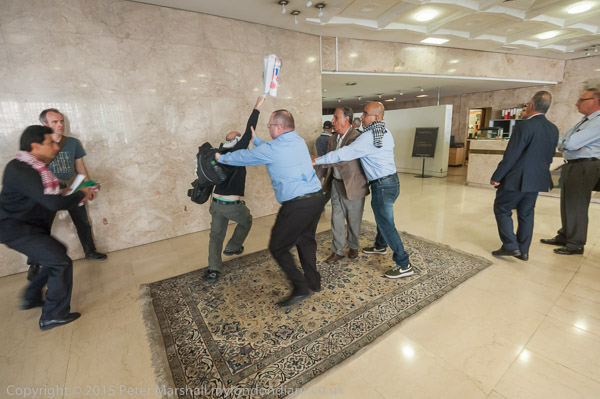
I don’t know who drew the often published cartoon which shows a young boy talking with his father and saying “Dad, I’m considering a career in organised crime” to which his father replies ‘Government or Private Sector”, but it comes to mind when thinking about the secret UK-Iran business meeting which I photographed Ahwazi activists and Peter Tatchell gate-crashing on July 3rd 2015. Though the UK-Iran crimes involve both sectors.

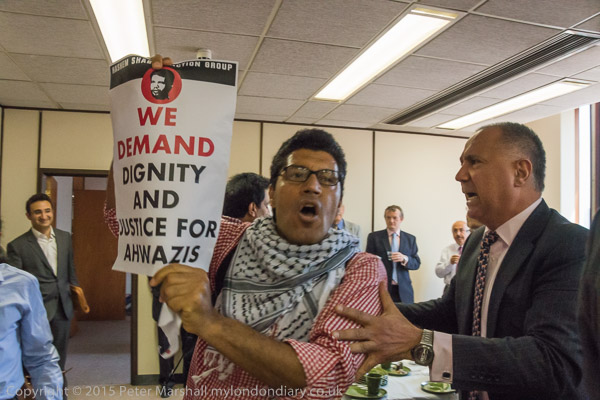
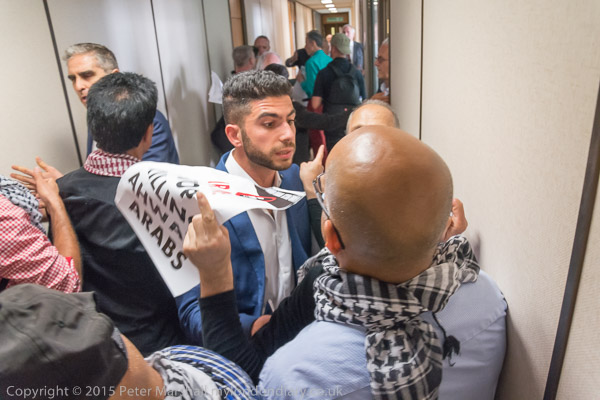
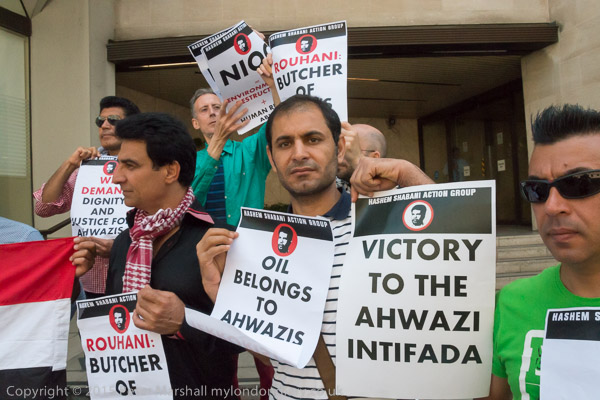
To take pictures I had to rush in with the group of protesters to the National Iranian Oil Company offices in Westminster, which are clearly private property and I Would probably be committing an offence, but I felt there was a clear public interest in covering the protest by the Hashem Shabani Action Group against the exploitation and environmental destruction of their homeland by Iran and the UK and the long history of anti-Arab oppression by the Tehran regime.

Fortunately I was able to enter the building without being personally confronted by the security staff who were busy trying to grab some of the protesters, and along with two other photographers and a couple of videographers was able to run up the six flights of stairs to the floor where the secret meeting was taking place, though I was in a pretty poor state by the time I reached the top landing, worried I might collapse. I was after all probably around 20 years older than most of the others, though only seven older than Peter Tatchell.

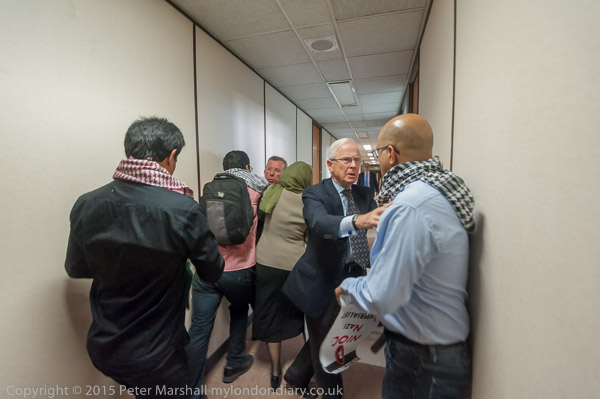
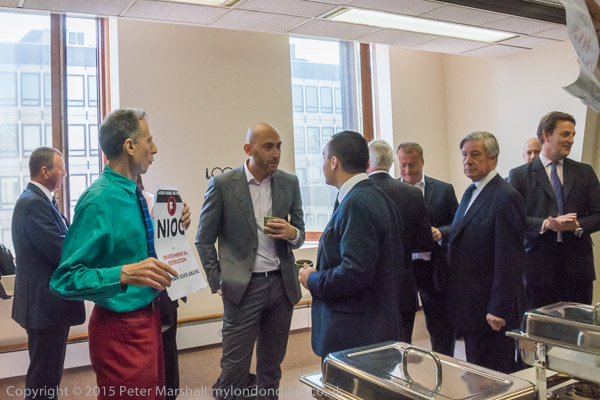
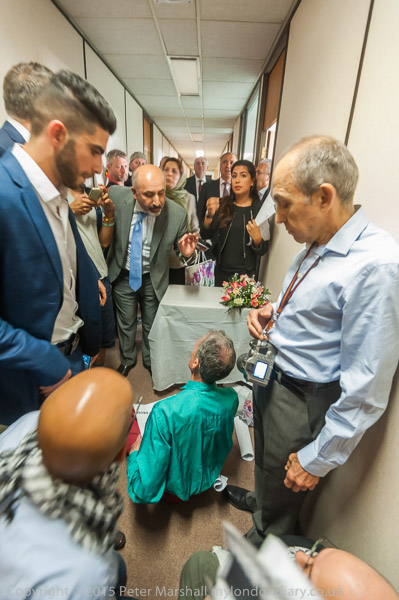
I did manage to photograph the peaceful protest inside the meeting, where most of those present were enjoying a buffet lunch, and to take some pictures of the confrontation in the corridor outside, where one youngish man in a blue suit, thought by the protesters to be an Iranian military officer, became rather violent and assaulted another of the photographers. But the corridor was dimly lit and some of my pictures were less than sharp, mainly blurred by moving subjects with the slowish shutter speed I needed.

I may have mentioned in other posts that I very seldom watch TV. I last lived with a TV back in 1968, when I got married and moved into a flat without one, and since then it’s been something I just don’t have time for in my life. Of course I’ve watched TV elsewhere – and can do so now by computer, but its never become a regular habit. One of the consequences of this is that there are many celebrities and public figures that I don’t easily recognise, only hearing them on radio or seeing the occasional picture in the press. So although Lord Lamont or Tory MP Richard Bacon, leader of the All Party Parliamentary Group on Iran, both leading the call for the peaceful and non-violent Hashem Shabani Action Group, (motto ‘Our weapons are pens. Our bullets are words‘), to be banned as a terrorist group were present, I failed to get newsworthy pictures of them.

Having made their point, the protesters decided to leave and I went with them, only to be stopped by police in the foyer of the building. We were prevented from leaving despite showing our press cards, but told we were not under arrest. The photographer who had been assaulted complained to the police, who went upstairs to ask questions, returning after a few minutes to say that the perpetrator probably had diplomatic immunity, and the photographer decided not to press charges.

Eventually after around 45 minutes – during which the building manager brought us fruit juice – press and protesters were allowed to leave and join those outside who had been unable to get past security for more photographs.

More on My London Diary about the dubious history of Britain and Iranian oil and the protest at Ahwazi crash secret UK-Iran business meeting.


All photographs on this and my other sites, unless otherwise stated, are taken by and copyright of Peter Marshall, and are available for reproduction or can be bought as prints.


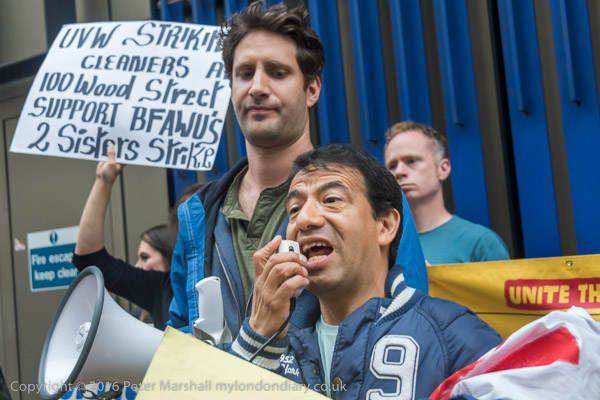
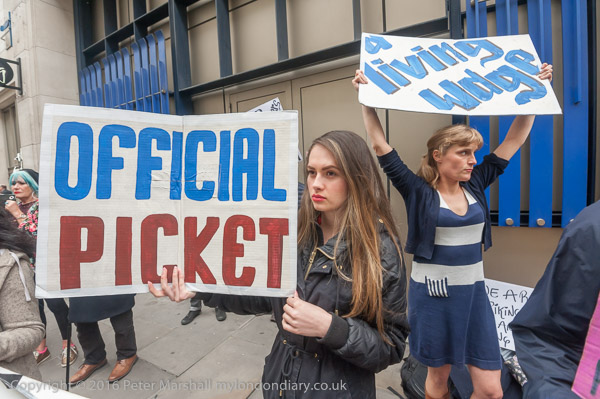
UVW at Wood St – 29 June 2016

The strike and protests organised by the United Voices of the World union against anti-union cleaning contractor Thames Cleaning who employed the cleaners at the 100 Wood St offices in the City of London, managed by CBRE and mainly let to Schroders and J P Morgan is a good example of one of the things the current Police, Crime, Sentencing and Courts Bill is aiming to prevent.

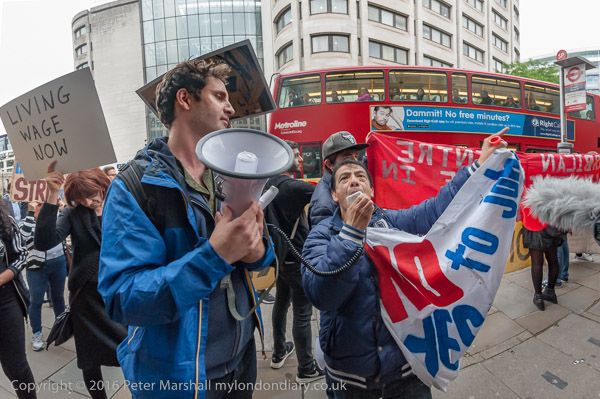
The UVW use loud rallies and protests outside workplaces (and sometimes in their foyers) to shame employers who are exploiting low paid workers, many migrants, into talking to the union. These workers, often employed by small and intensely anti-union companies, are often on minimum legal rates of pay, well below the London Living Wage and usually on the statutory minimum (and minimal) conditions of service – and sometimes even have problems getting these.

Outsourcing of low paid work such as cleaning is widespread, and contractors get the contracts by cutting costs – such as wages and conditions of service – and also by using bullying management to over-work their employees. Often too they cut costs by ignoring safety issues and failing to supply protective clothing and other essential safety material.

The UVW strike at Wood St was the longest industrial dispute in the history of the City of London, and it continued after Thames Cleaning had agreed to pay the London Living Wage for some days until they also agreed to re-instate the two workers who had been sacked. These pictures come from a rally on day 22 of the 58 day strike.

The strike was only successful because of the continuing pressure provided by loud protests such as this one, which made the companies working in the offices very aware of what was happening and made them and the building owners put pressure on the contracting company to meet the union and agree to their demands. Protests such as these, by the UVW and other grass-roots unions including CAIWU, the IWGB and a few branches of major unions have been successful in getting many of London’s lowest paid workers a living wage.

The PCSC bill, if it becomes law, will make these activities illegal. Already under existing laws, the company was able to take legal action to try and get an injunction to stop the strike. Although this failed it did get strict conditions put on the UVW’s actions at Wood St, and landed the union with crippling legal costs. Fortunately many supporters came forward with donations.

I came to take pictures on a number of occasions during the strike, which you can find on My London Diary. These pictures are all from Day 22: UVW Wood St Strike continues.

Occupy Westminster Abbey – save the ILF

Broad Sanctuary, Westminster Abbey. 28th June 2014

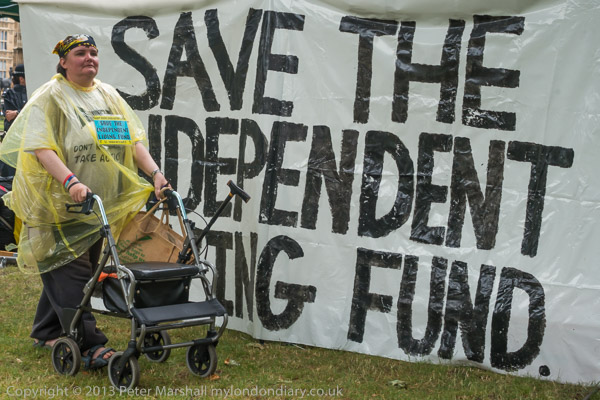
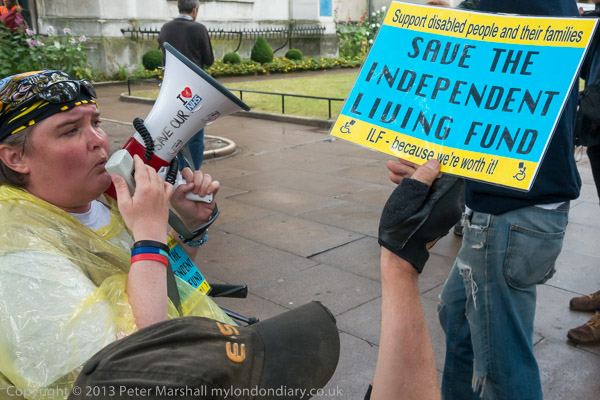
The Independent Living Fund, ILF, was introduced in 1988 to provide financial support to disabled people with high support needs, including those with severe learning difficulties, cerebral palsy, and a variety of other conditions.

Around 18,000 people relied on the ILF, mainly using the average of £300 a week it provided to employ personal assistants or carers to enable them to live independently, enabling some to work and pursue careers. It was administered independently from the Department for Work and Pensions (DWP) who provided the funding.

The ILF scheme was closed to new applicants in 2010 and the responsibility for providing support in England was passed to local authorities with the ILF ending on 30th June 2015.

There were various problems with the ILF, with regional variations, but the primary reason behind the changes was probably to cut costs. Although the government promised to provide funding to the local authorities for a transitional period, this was around 13% less than under the ILF, and the money, given to cash-strapped authorities already subject to swingeing cuts was not ring-fenced, and so likely to be appropriated for other purposes.

Local authorities were also not given any clear instructions or advice on how to proceed and there were great variations between local authorities in the support that was provided. A survey a year after the end of the scheme showed extreme differences, with some authorities providing similar levels of support to the ILF, but others operating at much reduced levels, creating the real hardship that protests such as this on Saturday 28th June 2014 campaigned against. The loss of ILF was indeed a disaster for many disabled people.

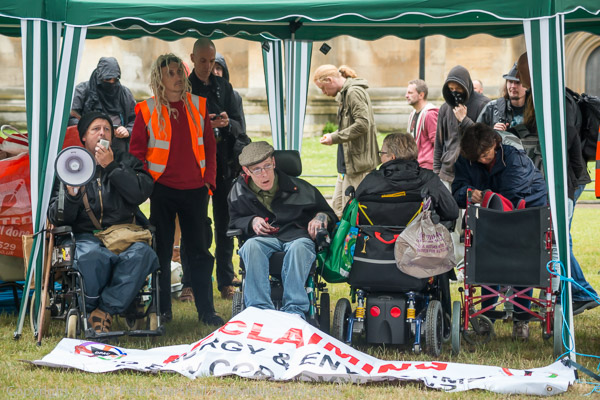
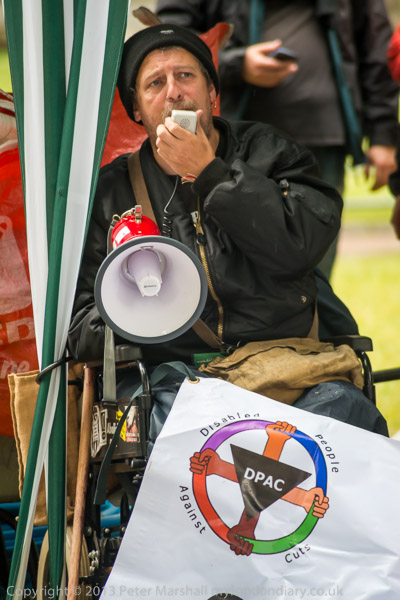
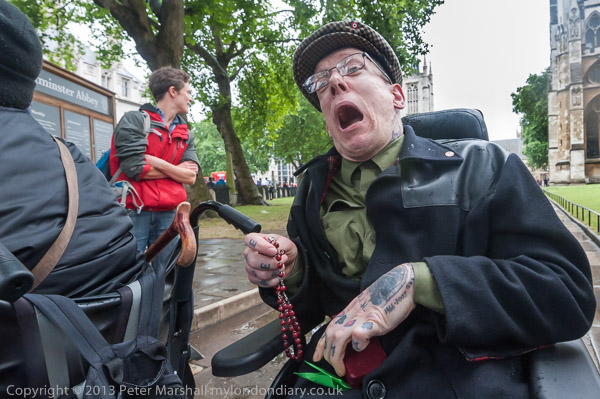
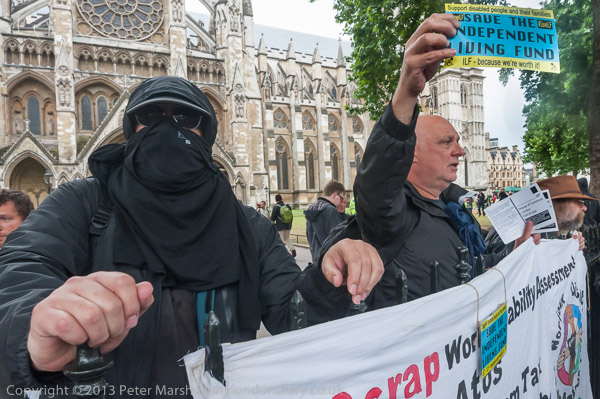
DPAC and others involved in the protest had managed to keep the details hidden from the police, perhaps because it is more difficult for able-bodied police working as undercover officers to infiltrate disabled groups. UK Uncut has provided a diversion with a protest outside Boots on Victoria St when DPAC and Occupy London supporters moved on to the green area in front of Westminster Abbey.

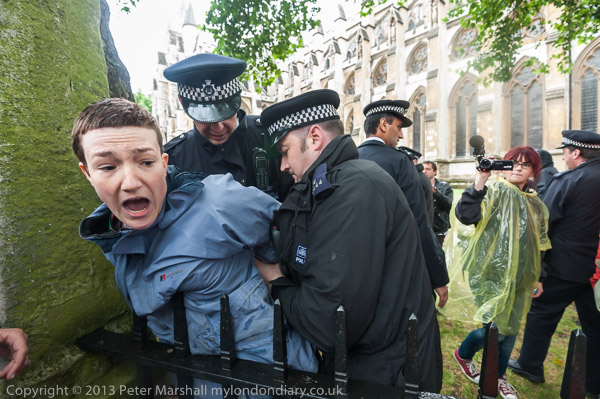
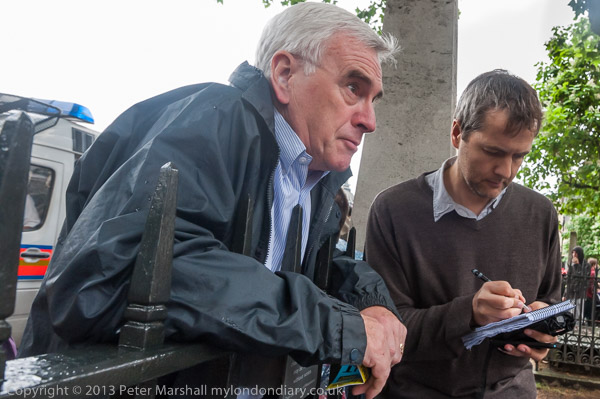
The protesters had hoped for some support from Westminster Abbey authorities as many Christians had called the government’s actions immoral. But they had picked the wrong place, and the Dean of Westminster refused even to talk to the protesters, calling on the police to get rid of them. Labour MP John McDonnell tried without success to phone the Dean who refused to take his call or to phone back.

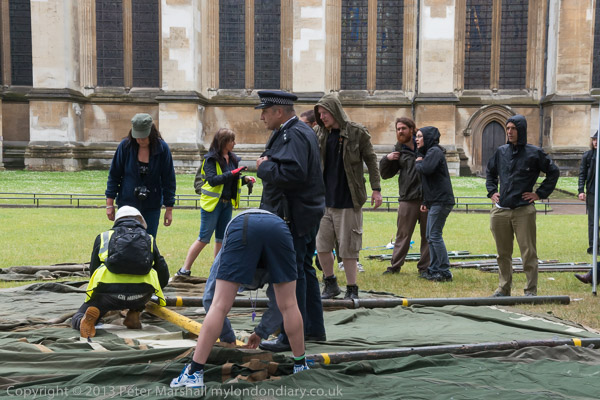
The weather too was against the protesters, with rain falling steadily, and for once a police officer showed some quick thinking, moving to stand in the middle of the main tent the protesters were attempting to erect, without which there was simply not enough shelter for a lengthy occupation.

I was unsure whether I wanted to go inside the area or not when I arrived, and soon police were surrounding the fairly low wall stopping people from climbing over. But I was able to take pictures from outside and move around freely – and to go home when I decided there seemed to be little point in staying.

Occupy Westminster Abbey – save the ILF
UK Uncut ‘Boot Out Boots’

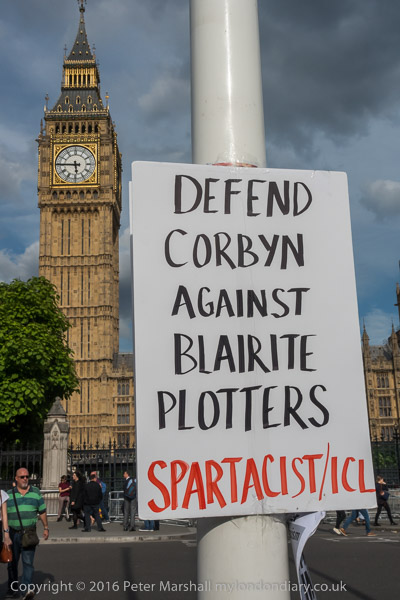
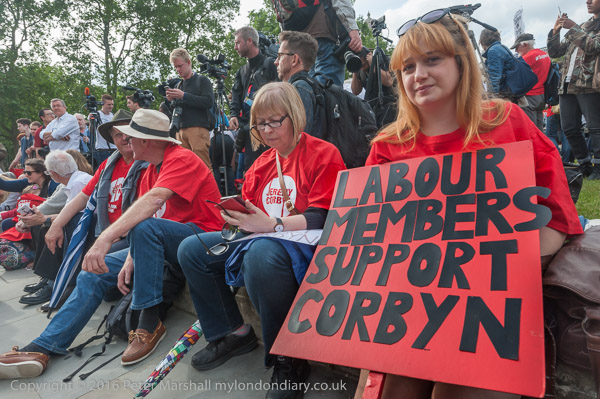
Keep Corbyn – June 2016

Emergency protest on the day of the coup

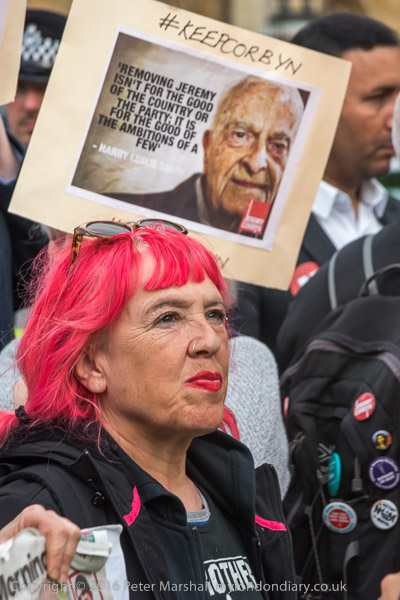
It’s probably never a good idea to say “I told you so”, but it was clear to many of us that that after Jeremy Corbyn became the leader of the Labour Party he represented the party’s only hope of winning a general election in the foreseeable future – and probably within my own lifetime.

And although he lost the 2017 election, it proved the case. It was an election the Labour Party could and should have won. They would have won had not many officials and MPs been actively sabotaging the campaign, diverting resources away from marginal constituencies and failing to give the party their full support. Some even went as far as seeming to celebrate the loss.

Ever since Corbyn won the leadership in September 2015 many officers and MPs had been fighting against him, some openly. Things came to a head in 2016 after the EU referendum when he was accused of only giving lukewarm support to the Remain campaign, though he had certainly spoken against leaving the EU at numerous large rallies. The issue was picked up as a pretext for a coup attempt that had long been in planning.

This began on 25th June when Hilary Benn contacted other shadow cabinet ministers telling them he had lost confidence in Corbyn and was sacked. On 26th June 11 other members of the shadow cabinet resigned with another eight leaving the following day.

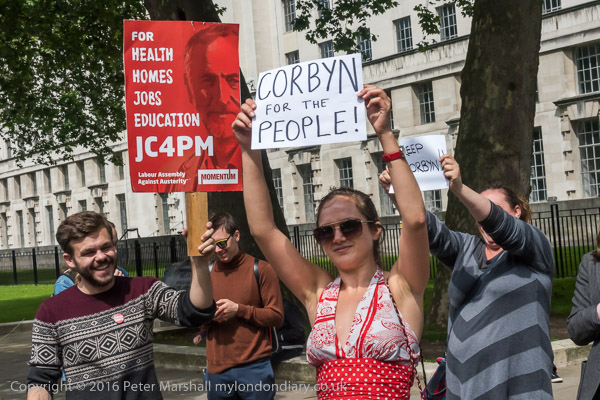
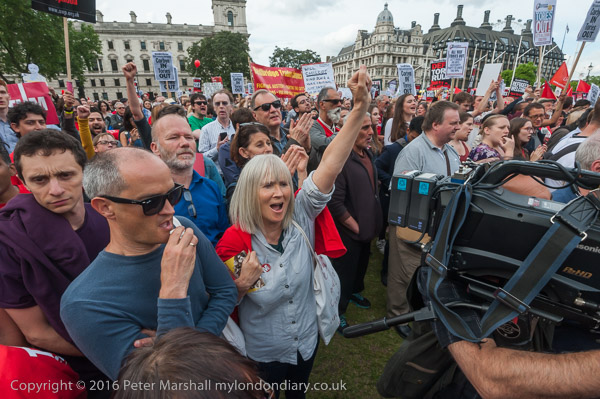
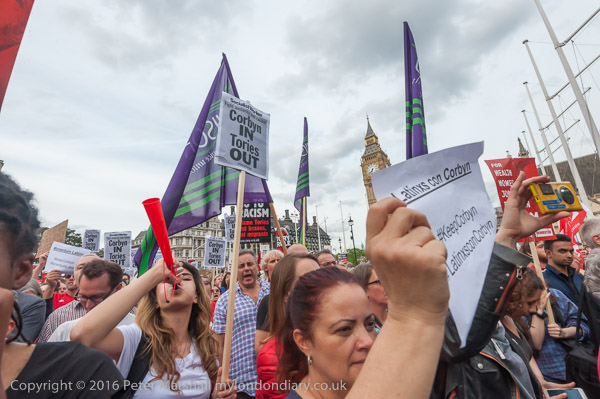
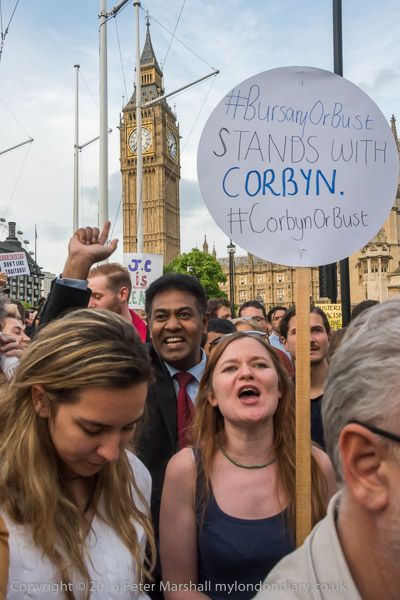
The emergency protest on the day the coup attempt began was small, but two days later more than ten thousand grass-roots Labour supporters filled Parliament Square in a rally organised by Momentum to vigorously oppose the coup. All except the top picture come from the rally on 17th June.

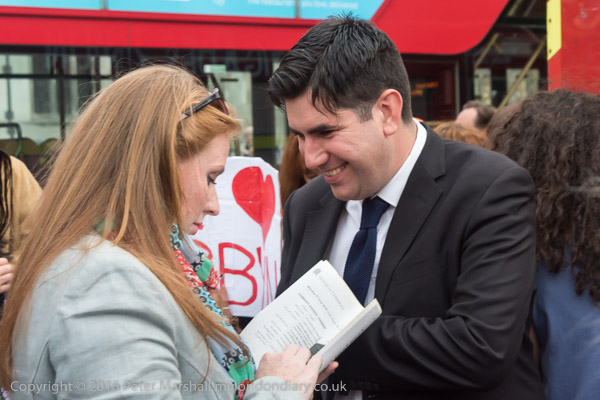
Angela Rayner and Richard Burgon both came to support Corbyn

Corbyn was able to form a new if rather smaller shadow cabinet with a number of joint portfolios, including 13 new members. But on the 28th June the 229 MPs in the Parliamentary Labour Party passed a motion of no confidence in him by 172 votes to 40.

It was hard to find anyone to stand against Corbyn, but finally on 11 July Angela Eagle launched a leadership challenge and was followed by Owen Smith. Opponents of Corbyn tried to get him left off the ballot, but a secret ballot of the Labour National Executive Committee confirmed by a small majority that the incumbent leader should automatically be listed, in line with party rules, and their decision was later confirmed by the High Court. Eagle dropped out as Smith got more nominations, though neither was particularly popular.

In the leadership ballot that followed, Corbyn confirmed his popularity. He was supported by 285 Constituency Labour Parties, with only 53 CLPs supporting Smith, and ended up with 61.8% of the vote to Smith’s 38.2%.

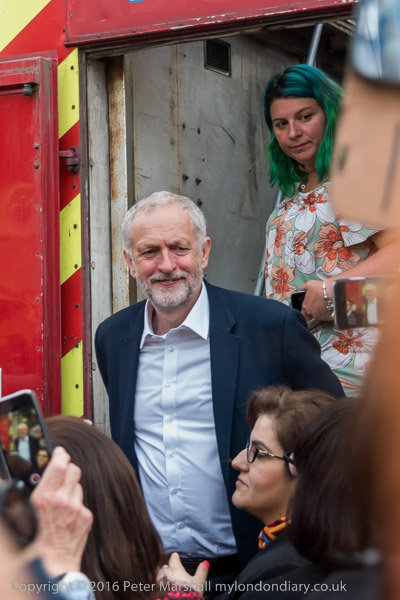
Jeremy Corbyn smiles after speaking at the rall

It should have been a clear message to MPs and party officials to get behind Corbyn and stop undermining his leadership. A united Labour Party could have fought the prejudices of our predominantly right-wing media including a BBC increasingly dominated by right-wing commentators and editors. Their continued opposition to him and some popular manifesto commitments threw away the chance of winning the next election – whenever it was called. Though it was only the weak and disunited state of Labour that convinced Theresa May to gamble on 2017; but even then had the party got fully behind the campaign we would have been saved the shameful Tory governments that have followed since then.

More on My London Diary:
Thousands rally to Keep Corbyn
Keep Corbyn – No Coup


Migrant Pride and Pride 2016

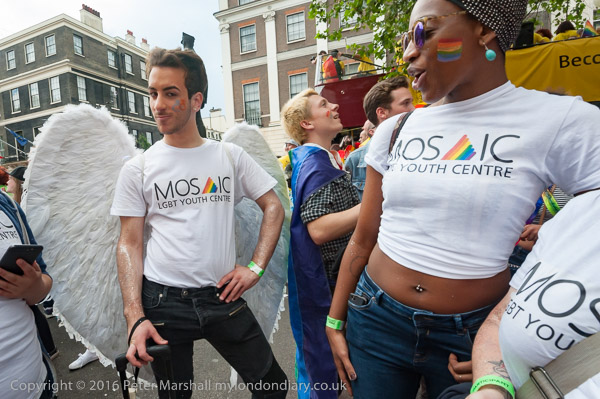
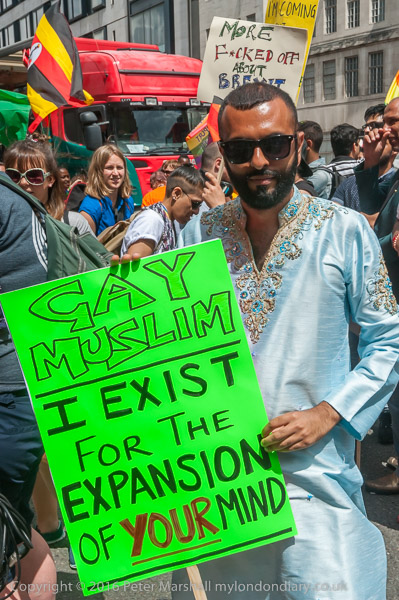
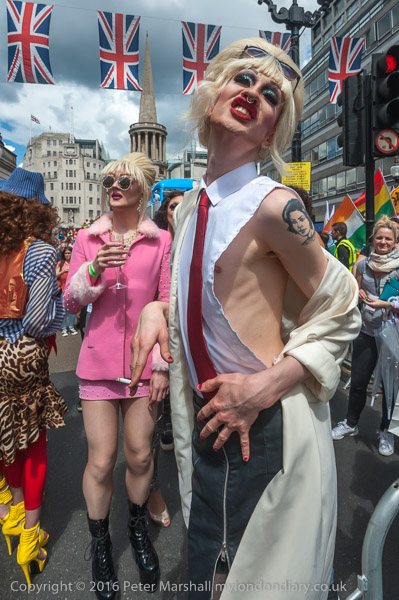
I first photographed London’s annual Pride in 1993, when it was a much smaller and more political event than it has become. Back then it was still a protest an since then it has become a parade, dominated by large corporate floats, from various large companies, armed forces and police.

Of course there is still some of the old spirit, with many groups from the gay community and even some protesters still taking part, but largely hidden at the back of the very long line-up.

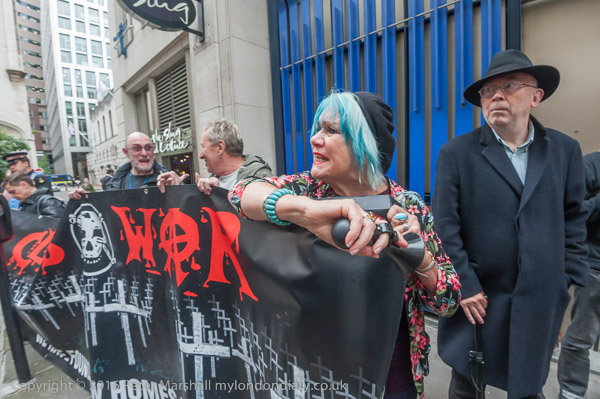
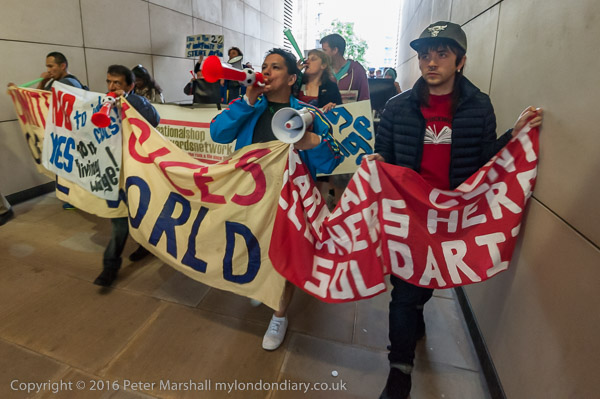
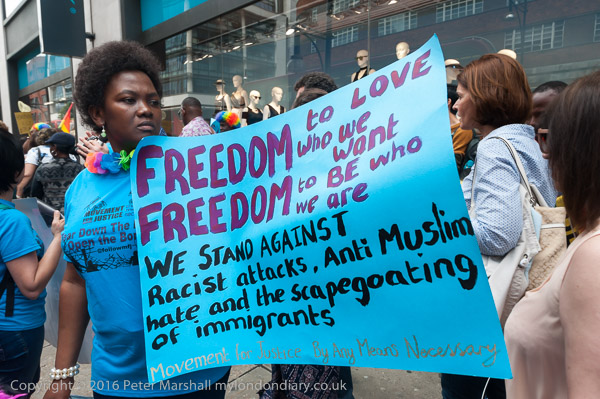
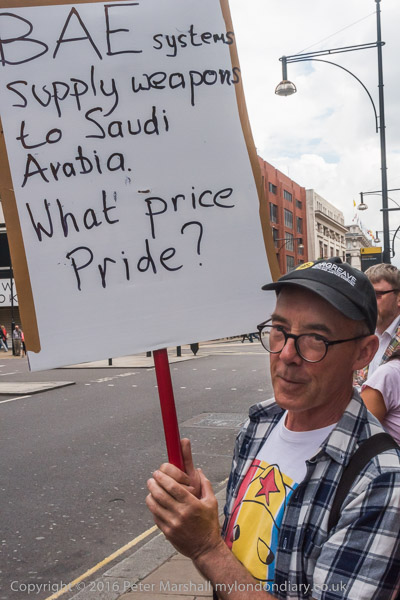
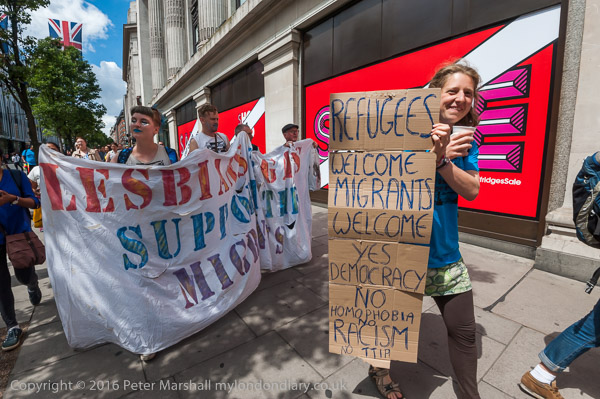
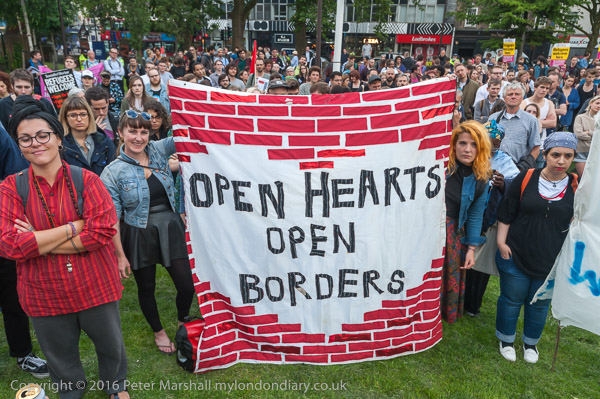
The Migrant Rights & Anti-Racist Pride march to the official Pride London procession organised by Movement for Justice and joined by others, including London in Solidarity with Istanbul LGBTI Pride and Lesbians and Gays Support the Migrants brought back some of the original spirit.

It gathered on Oxford St and then went on to join the main march, along with others behind the corporate floats.

The following year Pride organisers reacted by closing the march to only those who had officially applied to march and had official armbands – and refused entry to the Migrants Rights and Anti-Racist Bloc who then sat down in front of the march before police decided they could march along the route before the main procession.

This year Pride in London has been postponed until 11 September, but Peter Tatchell this May called for an alternative LGBT+ rights march to take place in June, He stated:

“For too long we have been conned by vested interests into believing that it is hugely expensive to hold a Pride march. It is not costly at all if we run the no-frills march that I am proposing.

“It would mirror the informality and spontaneity of the first Pride march in 1972, which I and 40 others helped organise. All we need to do is publicise it and people will turn up.

“Pride in London has become depoliticised. This Pride can change that. As well as being a joyful celebration, it should also profile LGBT+ human rights issues, such as the government stalling on a conversion therapy ban, blocking reform of the Gender Recognition Act and failing to end the detention of LGBT+ asylum seekers.

“It’s time to get back to the original roots of Pride, with everyone encouraged to bring a placard highlighting the LGBT+ issues that concern them. Let’s make this an event where our on-going demands for LGBT+ rights can be seen and heard.

https://www.petertatchellfoundation.org/call-for-alternative-reclaim-pride-london-march-in-late-june/

So far as I’m aware it has not been possible to organise an event like this for June 2010, although the London Trans Pride is still billed to take place on June 26, beginning at 2pm at Hyde Park. Perhaps next year it will be possible to organise such a “no frills” march with “no floats, no stage and no speakers at the end. Totally open, egalitarian and grassroots.” which “would reclaim Pride for the community.”

Pride London 2016
Migrant Rights & Anti-Racist Pride

Defend All Migrants

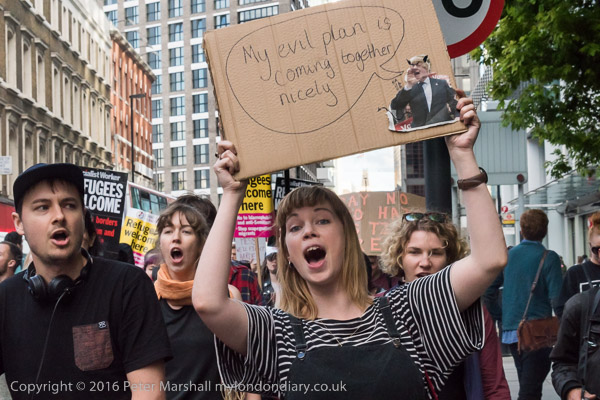
Five years ago on the day after the Brexit vote, Friday 24 Jun 2016, socialists and anarchists marched in London in support of migrant rights and against racism and against the attacks and scapegoating of immigrants not only by right wing extremists but by mainstream parties and media over many years. The pictures in this post are from that march. The most recent of these attacks has come from a Tory peer who has proved herself a serial failure over the years and seems likely to be rewarded for this by being put in charge of the NHS.

One of the most disturbing trends during the last eleven years of Coalition and Tory governments has been the increasing politicisation of public appointments, with jobs in charge of public bodies increasingly being awarded to people on the basis of their political views rather than any relevant experience or competence.

Of course there are many other things to be worried about, not least the many dodgy contracts awarded to family, friends and party donors, particularly those lucrative Covid-related contracts. One major benefactor has been Conservative peer Baroness Dido Harding, married to the Tory MP and United Kingdom Anti-Corruption Champion at the Cabinet Office since 2017. No, you really couldn’t make it up.

In 2015, when Harding was the much criticised CEO of TalkTalk, following a cyber-attack in which the personal and banking details of up to four million customers, many not encrypted, were though to have been stolen, Marketing Magazine ran a story under the headline “TalkTalk boss Dido Harding’s utter ignorance is a lesson to us all”. The Information Commissioner agreed, though the fine of £400,000 seems far too low for a company which she said failed “to implement the most basic cyber security measures.” Harding, who had been made a Tory Life Peer the previous year, stood down from TalkTalk in 2017 to concentrate on her public activities, following the party line on all her Lords votes and joining the board of the Jockey Club.

Her appointment as Chair of NHS Improvement in 2017 was a clearly political one, and Harding rejected the recommendation of Parliament’s Health Select Committee that she should resign as a Conservative peer and become a cross-bencher.

Her appointment to run the track, trace and test programme in 2020 (later misleadingly named NHS Test and Trace) was highly controversial. It had little or no connection with the NHS, simply outsourcing work to private contractors including Serco, Mitie, G4S, Boots and Sodexo and paying several thousand consultants from Deloitte and elsewhere on average £1,100 a day each.

Harding is now expected to be appointed as Chief Executive of the National Health Service (NHS) and has pledged to make the NHS less reliant on foreign doctors and nurses. At the moment about 1 in 7 NHS staff are not British, including many Indian, Filipino and Irish. There are many others too who while themselves British are the sons and daughters of migrants to this country, some of whom came here as health workers.

We currently have over 40,000 nursing vacancies and are heavily reliant on the contribution of foreign healthcare professionals who have made great sacrifices during the Covid pandemic. They already suffer from having to pay an immigration health surcharge fee of £470 per person per year for themselves and their families.

Nursing Notes quotes Andrew Johnson of the grassroots campaign Nurses United UK as saying:

“Dido Harding remains as incompetent as ever as she panders to her political party.”

“The UK has always benefitted from international staff. Whether it was Indian, Pakistani or Caribbean nurses like my grandma in the 50s and 60s, or our colleagues from Europe and the Philippines in more recent times, we needed them to keep our loved ones safe.”

“The NHS would not exist without international staff and if Dido wants to grow homegrown staff, we would need greater investment in our schools, a living bursary, a substantial restorative pay rise and an end to the privatisation she has been a part of.”

Nursing Notes

There are good reasons for the UK to train more doctors, nurses and other medical specialists. We are a wealthy nation and as well as caring for the health of our own population should be sending trained staff to other countries around the world, particularly those less able to train them. But as well as sending people abroad there is also much to be gained from having migrants coming to work here and foreign medical staff should be welcomed, not denigrated.

More about the 24th June 2016 Defend All Migrants rally and march.