Organised Crime – Public & Private Sector

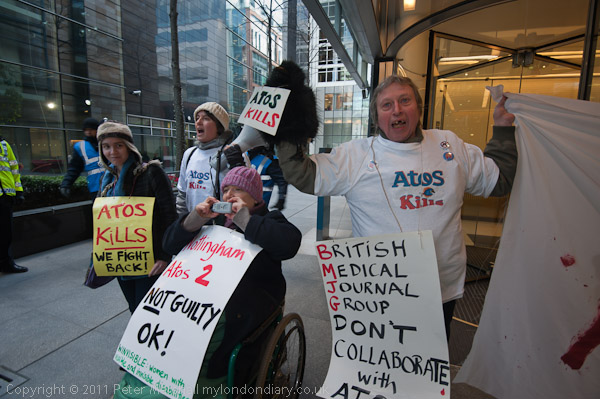
I don’t know who drew the often published cartoon which shows a young boy talking with his father and saying “Dad, I’m considering a career in organised crime” to which his father replies ‘Government or Private Sector”, but it comes to mind when thinking about the secret UK-Iran business meeting which I photographed Ahwazi activists and Peter Tatchell gate-crashing on July 3rd 2015. Though the UK-Iran crimes involve both sectors.

To take pictures I had to rush in with the group of protesters to the National Iranian Oil Company offices in Westminster, which are clearly private property and I Would probably be committing an offence, but I felt there was a clear public interest in covering the protest by the Hashem Shabani Action Group against the exploitation and environmental destruction of their homeland by Iran and the UK and the long history of anti-Arab oppression by the Tehran regime.

Fortunately I was able to enter the building without being personally confronted by the security staff who were busy trying to grab some of the protesters, and along with two other photographers and a couple of videographers was able to run up the six flights of stairs to the floor where the secret meeting was taking place, though I was in a pretty poor state by the time I reached the top landing, worried I might collapse. I was after all probably around 20 years older than most of the others, though only seven older than Peter Tatchell.

I did manage to photograph the peaceful protest inside the meeting, where most of those present were enjoying a buffet lunch, and to take some pictures of the confrontation in the corridor outside, where one youngish man in a blue suit, thought by the protesters to be an Iranian military officer, became rather violent and assaulted another of the photographers. But the corridor was dimly lit and some of my pictures were less than sharp, mainly blurred by moving subjects with the slowish shutter speed I needed.

I may have mentioned in other posts that I very seldom watch TV. I last lived with a TV back in 1968, when I got married and moved into a flat without one, and since then it’s been something I just don’t have time for in my life. Of course I’ve watched TV elsewhere – and can do so now by computer, but its never become a regular habit. One of the consequences of this is that there are many celebrities and public figures that I don’t easily recognise, only hearing them on radio or seeing the occasional picture in the press. So although Lord Lamont or Tory MP Richard Bacon, leader of the All Party Parliamentary Group on Iran, both leading the call for the peaceful and non-violent Hashem Shabani Action Group, (motto ‘Our weapons are pens. Our bullets are words‘), to be banned as a terrorist group were present, I failed to get newsworthy pictures of them.

Having made their point, the protesters decided to leave and I went with them, only to be stopped by police in the foyer of the building. We were prevented from leaving despite showing our press cards, but told we were not under arrest. The photographer who had been assaulted complained to the police, who went upstairs to ask questions, returning after a few minutes to say that the perpetrator probably had diplomatic immunity, and the photographer decided not to press charges.

Eventually after around 45 minutes – during which the building manager brought us fruit juice – press and protesters were allowed to leave and join those outside who had been unable to get past security for more photographs.

More on My London Diary about the dubious history of Britain and Iranian oil and the protest at Ahwazi crash secret UK-Iran business meeting.


All photographs on this and my other sites, unless otherwise stated, are taken by and copyright of Peter Marshall, and are available for reproduction or can be bought as prints.


More Belgravia – 1988

Pantechnicon, Motcomb St, Belgravia, Westminster, 1988 88-3m-14-positive_2400
Pantechnicon, Motcomb St, Belgravia, Westminster, 1988 88-3m-14

Until I photographed this building I had no idea of the origin of the word ‘Pantechnicon’, though I had heard it used to describe the large vans used for house removals. Seth Smith, (1791-1860) a vicar’s son from Wiltshire came to London and became one of the leading property developers of the West End in the 1820s, turning what had been a crime-infested lower-class swamp into the fashionable area with more than its fair share of respectable and immensly wealthy criminals we know now.

He filled an awkward triangular site left over by his other developments with a large building with an impressive Greek style facade of Doric columns for selling carriages and storing furniture for the wealthy residents of his new housing, and included an art gallery, coining a new upmarket name for it from the Greek pan (all) and techne (arts). Only this Grade II listed facade remains of the original building, most of which was destroyed by a fire in 1874.

Large furniture for large houses needed large vans to transport it, and the Pantechnicon company produced what were monsters for the age, up to 18ft long and 7 ft wide with a high roof and a lowered floor for extra height and easier loading – and their name large on the sides. Other removal companies were soon making similar large vans and the name ‘pantechnicon’ moved into general use for large furniture removal vans.

Belgrave Square, Grosvenor Crescent, Belgravia, Westminster, 1988 88-3m-31-positive_2400
Belgrave Square, Grosvenor Crescent, Belgravia, Westminster, 1988 88-3m-31

Smith was responsible for much of the development of Mayfair, though most of his work there has been demolished, and also parts of Belgravia, although Belgrave and Eaton Squares were laid out by Thomas Cubitt, working for the Grosvenor Estate, which still owns much of the area, after an 1826 Act of Parliament allowed Lord Grosvenor to drain the infamous ‘Five Fields’ area and raise its level.

St George's Hospital, Belgravia, Westminster, 1988 88-3m-36-positive_2400
St George’s Hospital, Belgravia, Westminster, 1988 88-3m-36

At the back of St George’s Hospital, probably in either Grosvenor Crescent or Lanesborough Place. You can see the building behind – now a hotel – from Grosvenor Crescent. I’m not sure whether this rather bleak looking structure was simply for taxis or was used by ambulances – which now form long queues outside A&E. But for me it seemed like some infernal processing machine, taking in at the left and vomiting out its results at the right.

Belgrave Square, Belgravia, Westminster, 1988 88-3m-42-positive_2400
Belgrave Square, Belgravia, Westminster, 1988 88-3m-42

Belgrave Square is Embassy Country, and in more recent years I’ve photographed protests outside many of them. Bahrain, Brunei, Germany, Ghana, Malaysia, Norway, Portugal, Serbia, Syria, Trinidad & Tobago and Turkey all have their embassy (or High Commission) in the square and Austria, Italy, Romania, Côte d’Ivoire, Italy, UAE, Spain and probably a few others have embassies, legations or cultural centres within spitting distance. I think there are probably a few more I’ve forgotten too!

Belgrave Square, Halkin St, Belgravia, Westminster, 1988 88-3m-43-positive_2400
Belgrave Square, Halkin St, Belgravia, Westminster, 1988 88-3m-43

Some other houses are also the official residences of ambassadors – this on the corner with Halkin St is that of the Mexican ambassador. The architect of this grand terrace of houses (Grade I listed) and the others around Belgrave Square was George Basevi.

Wilton St, Belgravia, Westminster, 1988 88-3m-54-positive_2400
Wilton St, Belgravia, Westminster, 1988 88-3m-54

It’s something of a relief to turn away from the overpowering and grandiose Belgrave Square and walk down Wilton St, where the houses, though still large are on a less grand scale, with stucco only on the ground floor. This house still stands out, though I think has lost its unusual knotted door, as it seems to have slipped down a few feet from the rest in the street, the only one with a few steps leading down to the door.

Upper Belgrave St, Belgravia, Westminster, 1988 88-3m-64-positive_2400
Upper Belgrave St, Belgravia, Westminster, 1988 88-3m-64

Upper Belgrave St continues the pattern of Belgrave Square, linking it to Eaton Square.

St Peter's, Church, Eaton Square, Upper Belgrave St, Belgravia, Westminster, 1988 88-3m-65-positive_2400
St Peter’s Church, Eaton Square, Upper Belgrave St, Belgravia, Westminster, 1988 88-3m-65

And it leads to St Peter’s Church, built by architect Henry Hakewill in a neoclassical style when the area was being developed in 1824-27. Fortunately his drawings were still available when the building burnt down in 1837 and one of his sons used them to rebuild it. Sir Arthur Blomfield worked his worst on the church, enlarging it in 1875, but fortunately leaving it largely intact on the exterior.

The church was again badly damaged by fire the year before I took this picture and was apparently only a shell, with the interior and roof devastated. The fire was deliberately started by an anti-Catholic arsonist who mistakenly thought it was a Catholic church. I can’t find the details of the case but I think it was started by a 21-year-old man who had also started fires at several other churches, including another London church the previous night. Rebuilding began in 1990 and the church – with a simpler interior – reopened in 1991.

These pictures are from my album 1988 London Photos and clicking on the pictures, which will take you to larger versions in the album from where you can browse other images.


All photographs on this and my other sites, unless otherwise stated, are taken by and copyright of Peter Marshall, and are available for reproduction or can be bought as prints.


Around Pont St, 1988

Pont St, Knightsbridge, Kensington & Chelsea, 1988 88-3i-01-positive_2400
Pont St, Knightsbridge, Kensington & Chelsea, 1988 88-3i-01

Back in 1988 I seem to have sentenced myself to wander extensively along Pont St, in earlier days one of London’s most fashionable streets and still one of its more expensive, linking Knightsbridge and Belgravia.

Pont St, Knightsbridge, Kensington & Chelsea, 1988 88-3i-55-positive_2400
Pont St, Knightsbridge, Kensington & Chelsea, 1988 88-3i-55

Pont Street gets its name from the bridge over the river Westbourne, probably close to where Cadogan Lane now crosses the street close to its east end. Knightsbridge too was named for its bridge over this river, which flows down from Hampstead Heath to the Thames in Chelsea, passing across Sloane Square Underground Station in a very visible 19th century iron aqueduct. The bridge is still marked on maps from 1830 when the east section of Pont St was first developed but by 1840 the river had disappeared underground.

Pont St, Knightsbridge, Kensington & Chelsea, 1988 88-3i-56-positive_2400
Pont St, Knightsbridge, Kensington & Chelsea, 1988 88-3i-56

Pont Street originally was developed to the east of Sloane St and was only developed to the west in the late 1870s, with building continued in the following decade. Cadogan Square was built between 1877 and 1888.

Cadogan Square, Knightsbridge, Kensington & Chelsea, 1988 88-3j-65-positive_2400
Cadogan Square, Knightsbridge, Kensington & Chelsea, 1988 88-3j-65

‘Pont St’ became a synonym for the snobbish posh, and the architectural style of most the area around Pont St west of Sloane St was called by Osbert Lancaster ‘Pont St Dutch’. In Pevsner and Cherry’s London 3 North West, published in 1991 it is described as “tall sparingly decorated red brick mansions for very wealthy occupants, in the semi-Dutch, semi-Queen Anne manner of Shaw or George & Peto”. It is very handy for both Harrods and Sloane Square.

Pont St, Knightsbridge, Kensington & Chelsea, 1988 88-3i-64-positive_2400
Pont St, Knightsbridge, Kensington & Chelsea, 1988 88-3i-64

A welcome departure from this incredible rash of red-brick is St Columba’s Church, designed by Sir Edward Maule for the Church of Scotland. Completed in 1955 it replaced the orginal 1884 St Columba’s Church on the same site which had been destroyed by bombing in 1941. I think it altogether a more attractive building than Maule’s Guildford Cathedral.

St Columba's Church Of Scotland, church, Pont St, Knightsbridge, Kensington & Chelsea, 1988 88-3j-62-positive_2400
St Columba’s Church Of Scotland, church, Pont St, Knightsbridge, Kensington & Chelsea, 1988 88-3j-62

Pont Street has had some famous residents, including Lillie Langtry who lived for five years at No 21. This became a part of the Cadogan Hotel, where famously Oscar Wilde was arrested in 1985.

Hans Place, Knightsbridge, Kensington & Chelsea, 1988 88-3i-66-positive_2400
Hans Place, Knightsbridge, Kensington & Chelsea, 1988 88-3i-66

All pictures (and more) in my album 1988 London Photos – and you can see a larger version of the images and browse through the album by clicking on any of them.

More Around Belgravia 1988

Flats, Ebury St, Belgravia, Westminster, 1988 88-3g-43-positive_2400
Flats, Ebury St, Belgravia, Westminster, 1988 88-3g-43

The Cundy Street flats, architect T P Bennett, were built as low cost housing by the Grosvenor Estate in 1950-52. As Pevsner points out, the blocks have curved balconies typical of the 1930s but with upright columns typical of the 1950s. I think this block is probably Stack House.

Flats, Cundy St, Belgravia, Westminster, 1988  88-3g-55-positive_2400
Flats, Cundy St, Belgravia, Westminster, 1988 88-3g-55

Cundy St gets its name from a family who were for several generations surveryor, builders and architects to the Grosvenor estate, probably from Thomas Cundy (see below). Planning permission has recently been granted for the demolition of Kylestrome House, Lochmore House, Laxford House, Stack House, Walden House and their replacement by a new estate which will include shops and a new playground. It will include affordable homes and care homes and assisted living for the over-65s but looks rather duller. The plans have upset some of the wealthier residents in surrounding areas because of a loss of light.

Coleshill Flats, Peabody Trust, Pimlico Rd,Belgravia, Westminster, 1988  88-3g-45-positive_2400
Coleshill Flats, Peabody Trust, Pimlico Rd,Belgravia, Westminster, 1988 88-3g-45

This Peabody estate close to Sloane Square is made up of two separate blocks, Lumley and Coleshill flats, which were constructed in the 1870s.

National Audit Office, Buckingham Palace Road, Belgravia, Westminster, 1988  88-3g-53-positive_2400
National Audit Office, Buckingham Palace Road, Belgravia, Westminster, 1988 88-3g-53

Built in 1938 as the Empire Air Terminal in a streamlined “moderne” style by architect Albert Lakeman with a sculpture of winged figures above a globe, Wings Over the World by Eric Broadbent. Passengers for Imperial Airways flights could check in here and be taken by special Pullman Trains from a platform on the adjacent Victoria Station to Southampton Water for flying boat services, while those for European destinations were ferried by coach to Croydon Airport. Unfortunately the terminal opened only three months before the war stopped private flights. Imperial Airways became a part of British Overseas Aiways Corportation (BOAC).

National Audit Office, Buckingham Palace Rd, Belgravia, Westminster, 1988 88-3h-55-positive_2400
National Audit Office, Buckingham Palace Rd, Belgravia, Westminster, 1988 88-3h-55

After the war, the building was reasonably placed for coaches along the A4 to Heathrow and was renamed the BOAC Terminal and later the British Airways Terminal. It closed in 1980, but had earlier been made largely redundant by the opening of the West London Air Terminal in a temporary building on the Cromwell Road in 1957, replace by a purpose built building in 1963. Check-ins there ended in 1974 and in 1980 both this and the British Airways Terminal were sold. This was listed in 1981 and became the home of the National Audit Office in 1983, though after extensive restoration in 2009, large parts are now rented out. The West London Air Terminal was demolished and the site became a Sainsbury’s supermarket.

Eaton Square, Belgravia, Westminster, 1988  88-3g-65-positive_2400
Eaton Square, Belgravia, Westminster, 1988 88-3g-65

66 Eaton Square is described in its Grade II listing test as a part of a grand terrace of houses from the mid 19th century, though I’ve chosen to turn away from most of its grander features and look away down the street and across Eaton Gate.

In 1821, Thomas Cundy became surveyor of the Grosvenor Estate and adapted earlier plans for the area before selling building leases from 1825, mainly to Thomas Cubitt (1788-1855). The ground was rather marshy, and Cubitt brought earth he was then digging out at St Katherine’s Dock to raise it. Work began on Eaton Square, named after the Duke of Westminster’s Cheshire Eaton Hall, in 1827, with the planting of the gardens, but it took longer to complete the houses around the square, though these, probably by Cubitt, were apparently completed by 1843. But the whole square was only finished by another builder in the 1850s.

Eaton Square is not a square, but a rather elongated rectangle around 500 metres long. Even including the mews behind the grand houses it is less than 200 m wide.

Cadogan Gate, Knightsbridge, Kensington & Chelsea, 1988 88-3h-22-positive_2400
Cadogan Gate, Knightsbridge, Kensington & Chelsea, 1988 88-3h-22

This house at 6 Cadogan Gate on the corner of Pavilion Rd stands out among the taller red-brick mansions and is more a continuation of the mews buildings in Pavilion Rd, but with a rather less usual architecture, with those circular ground floor windows, rather ecclesiastical tall oval-arched sash window on the first floor and its mansard roof. It probably dates from around 1879.

This is an address mentioned in the Panama Papers, the giant 2016 leak of more than 11.5 million financial and legal records exposing a system that enables crime, corruption and wrongdoing, hidden by secretive offshore companies, though of course the activities with which this address is connected could be entirely legal.

Cadogan Square, Knightsbridge, Kensington & Chelsea, 1988 88-3h-23-positive_2400
Cadogan Square, Knightsbridge, Kensington & Chelsea, 1988 88-3h-23

I think this is 59 Cadogan Square, where a large second floor flat was recently on offer for £7m. Cadogan Square is one of the most expensive residential streets in the United Kingdom, with all but around three houses converted into flats, and these houses are estimated to be worth £25m.

The large tall houses were built between 1877 and 1888 for the Cadogan Estate in Flemish inspired red brick which I find overpowering, but in the centre of the square there is a residents’ only garden where they can sit and, at least in summer the red-brick hell is largely hidden by trees.

More from my Flickr Album 1988 London Photos in later posts.


All photographs on this and my other sites, unless otherwise stated, are taken by and copyright of Peter Marshall, and are available for reproduction or can be bought as prints.


More Belgravia 1988

Chesham House, Lyall St, Chesham Place, Belgravia, Westminster, London, 1988 88-3f-34-positive_2400
Chesham House, Lyall St, Chesham Place, Belgravia, Westminster, London, 1988 88-3e-34

Chesham House was the Russian Embassy in London from 1853 until 1927, when we ceased to have a Russian Embassy after the foundation of the USSR. Now it hides away in Kensington Palace Gardens. The area was developed in the 1830s on land where leases had been obtained a century earlier by the Whig politician William Lowndes (1652–1724) who acquired the manor of Chesham Bury in Hertfordshire in 1687 and rebuilt the original Bury and manor house of Great Chesham in 1712.

Chesham House, Lyall St, Chesham Place, Belgravia, Westminster, London, 1988 88-3e-33-positive_2400
Chesham House, Lyall St, Chesham Place, Belgravia, Westminster, London, 1988 88-3e-33

In 2007 a large family flat occupying the third floor of this building was featured by Forbes in a listing of London’s Most Expensive Flats – at the time it was valued at a mere £17.5 million. Lowndes is said to be the origin of the phrase “Take care of the pence, and the pounds will take care of themselves” and that is an awful number of pence.

Hans Crescent, Knightsbridge, Kensington & Chelsea, 1988 88-3e-36-positive_2400
3 Hans Crescent, Knightsbridge, Kensington & Chelsea, 1988 88-3e-36

You can see the rear of Harrods at the right hand edge of this picture. This area was rebuilt completely between around 1890 and 1910, partly becuase of the huge expansion of Harrods and is in a vaguely Queen Anne style. This building has become very familiar to me in more recent years as the home of the embassies of both Colombia and Ecuador, each with a small suite of rooms in a rather impressive building and sharing the entrance with the other occupants.

It was of course from June 2012 to 11 April 2019 the temporary home of Julian Assange, at first granted asylum by Ecuador and then, after a change of government, handed over to the British police and since kept in solitary confinement by the British establishment who clearly hoped he would die in Belmarsh prison. Keeping a police guard outside this building to prevent Assange’s escape cost us a totally unnecessary £12.6 million.

Chelsea House, Lowndes St, Belgravia, Kensington & Chelsea, 1988 88-3e-42-positive_2400
Chelsea House, Lowndes St, Belgravia, Kensington & Chelsea, 1988 88-3e-42

Chelsea House, a tall, curved block on the corner of Lowndes St and Cadogan Place, has around ten residental floors above this street entrance and the luxury shops of its ground floor. There is a second entrance like this around the corner in Lowndes St, and both look to me rather as posh noses stuck on to a rather more utilitarian facade. Above the 7th floor the upper reaches are set back in a largely unsuccessful attempt to disguise the height of the builsing.

Sloane St, Knightsbridge, Kensington & Chelsea, 1988 88-3e-43-positive_2400
Sloane St, Knightsbridge, Kensington & Chelsea, 1988 88-3e-43

Sloane St is full of shops seliing expensive clothes to those who think labels are more important than utility, and some seem rather ridiculously styled.

Danish, Peruvian, Embassy, Sloane St, Knightsbridge, Kensington & Chelsea, 1988 88-3e-44-positive_2400
Danish & Peruvian Embassies, Sloane St, Knightsbridge, Kensington & Chelsea, 1988 88-3e-44

The Danish embassy at left was one of very few modern buildings of distinction in the area and designed by the famous Danish architect Arne Jacobsen, and completed by his practice after his death. It was commisioned in 1969 and existing buildings were demolishes, but the Danes ran out of cash and for four years the site was a car park. Work began again and the foundation stone was laid in 1975 with the building – with added security measure included after the beginning of the IRA attacks was completed in 1977. To its right is a dental practice and then the Peruvian Embassy and another building with adjacent doors.

The Jeeves Ladies, Kate McGill, Pont St, Belgravia, Kensington & Chelsea, 1988 88-3e-46-positive_2400
The Jeeves Ladies, Kate McGill, Pont St, Belgravia, Kensington & Chelsea, 1988 88-3e-46

There is still a Jeeves Dry Cleaners in Pont St, on the corner of Cadogan Lane, but its facade no longer displays the once well-known logo designed for them by Derrick Holmes. The statue by Irish Sculptor Kate McGill was commissioned by Sydney Jacob, who in 1969 founded Jeeves of Belgravia with David Sandeluss. Seven foot tall and weighing around a ton, it appeared on the street overnight in 1974 and is still there, outside a smaller shop on the opposite side of the road and rather obscured by fenced brick boxes around each of a short row of trees.


Clicking on any of the above images will take you to a larger version in my Flickr Album 1988 London Photos, where you can browse forward or back through the pictures in the album.


All photographs on this and my other sites, unless otherwise stated, are taken by and copyright of Peter Marshall, and are available for reproduction or can be bought as prints.


Hyde Park Corner & Belgravia

St Georges Hospital, Royal Artillery, Memorial, Hyde Park Corner, Westminster, 1988 88-3d-22-positive_2400
St Georges Hospital, Royal Artillery, Memorial, Hyde Park Corner, Westminster, 1988 88-3d-22

I can’t recall why on this particular March Day in 1988 I decided to photograph these major military meorials at Hyde Park Corner. I think I’d probably emerged from the tube there, or perhaps got off a bus from Victoria Station and thought the lighting looked right. Non-photographers often see me going out on bright sunny days with a blue sky and no trace of cloud and say to me “Good weather for it!” and I usually just give a faint smile, while thinking to myself it might have been better to have left the cameras at home. For subjects like these, a bright overcast day with no shadows is generally the best, enabling you to chose your viewpoint to bring out the best in your subject.

Machine Gun Corps, Memorial, Hyde Park Corner, Westminster, 1988 88-3d-43-positive_2400
Machine Gun Corps, Memorial, Hyde Park Corner, Westminster, 1988 88-3d-43

St George’s Hospital is a good backdrop for the . The hospital opened next door in 1733 and was expanded with this building in 1830, to provide 300 beds. Its medical school moved to Tooting in1970 and the hospital finally closed here in 1980. Part had clearly moved much earlier and the Nightingale Ward in which I stayed for a couple of weeks at St George’s in 2003 were clearly from the 19th century and falling to pieces. The Grade I listed Royal Artillery Memorial designed by Charles Sargeant Jagger, with architectural work by Lionel Pearson, was unveiled in 1925, to commemorate the 49,076 soldiers from the Royal Artillery killed in the First World War and to my mind is the finest sculptural piece of the several around.

Wellington Arch, Memorial, Apsley Way, Hyde Park Corner, Westminster, 1988 88-3d-44-positive_2400
Wellington Arch, Memorial, Apsley Way, Hyde Park Corner, Westminster, 1988 88-3d-44

The Machine Gun Corps Memorial was also erected in 1925, but rather further to the south in Grosvenor Place. It was dismantled to enlarge the roudabout in 1945 and only replace in its current position at the north of the isolated square in 1963, By Derwent Wood, it shows David holding Goliath’s sword and at a lower lever are two real Vickers machine guns covered with bronze and with laurel wreathes. The Grade I-listed triumphal arch by Decimus Burton was built nearby in 1826-30 to celebrate the victory over the French and moved to its curent location in 1882-3. At the same time a huge and ugly equestrian statue of Wellington which had been placed on top in 1846 was removed and sent to Aldershot, being replace by the more fitting Quadriga by Captain Adrian Jones. Until 1992 the arch was home to London’s smallest police station but it now houses an exhibition about Waterloo.

Wellington statue, Memorial, Apsley House, Hyde Park Corner, Westminster, 1988 88-3d-46-positive_2400
Wellington statue, Memorial, Apsley House, Hyde Park Corner, Westminster, 1988 88-3d-46

When the eyesore huge Wellington statue was taken from the top of the arch to Aldershot, Joseph Boehm was commisioned to make a replacement, which was installed on a plinth facing the Duke of Wellington’s house, Apsley House, at Hyde Park Corner. Below on the four corners of the plinth stand four foot-soldiers, one from each of the four nations of the united kingdom.

Hans Crescent, Knightsbridge, Westminster, 1988 88-3e-22-positive_2400
Hans Crescent, Knightsbridge, Westminster, 1988 88-3e-22

Hans Crescent in Knightsbridge is a little to the west of Hyde Park Corner, between the back of Harrods and Sloane St. Part of the Cadogan Estate, this building at 2-4 Hans Crscent on the corner of Pavilion Road stands out in the area both for its white finish – and is know at the White House among so much red brick and is home to the Holy Carrot vegan restaurant, described by some as London’s best vegan restuarant and also to Urban Reatreat, “a one stop shop for all things to do with beauty” also with a restuarant but not vegan who are responsible for a large pink and gold plastic creature on its balcony.

Chester Square, Belgravia, Westminster, 1988 88-3e-24-positive_2400
Chester Square, Belgravia, Westminster, 1988 88-3e-24

Edward Walford in his contribution ‘The western suburbs: Belgravia’, to Old and New London: Volume 5 (London, 1878), pp. 1-14. has a lengthy description of Belgravia, much a which is still relevant today. You can read it in full at British History Online but the rest of today’s text come from this volume:

This mine of wealth—the present suburb, or rather city, of Belgravia, for such it has become—passed into the possession of the Grosvenor family in 1656, when the daughter and sole heiress of Alexander Davies, Esq., of Ebury Farm, married Sir Thomas Grosvenor, the ancestor of the present Duke of Westminster. This Mr. Davies died in 1663, three years after the Restoration, little conscious of the future value of his five pasturing fields.

Edward Walford, ‘The western suburbs: Belgravia’, in Old and New London: Volume 5 (London, 1878), pp. 1-14. British History Online http://www.british-history.ac.uk/old-new-london/vol5/pp1-14
Chester Square, Belgravia, Westminster, 1988 88-3e-25-positive_2400
Chester Square, Belgravia, Westminster, 1988 88-3e-25

“In Queen Elizabeth’s time,” observes a writer in the Belgravia magazine, “this sumptuous property was only plain Eabury, or Ebury Farm, a plot of 430 acres, meadow and pasture, let on lease to a troublesome ‘untoward’ person named Wharle; and he, to her farthingaled Majesty’s infinite annoyance, had let out the same to various other scurvy fellows, who insisted on enclosing the arable land, driving out the ploughs, and laying down grass, to the hindrance of all pleasant hawking and coursing parties. Nor was this all the large-hearted queen alone cared about; she had a feeling for the poor, and she saw how these enclosures were just so much sheer stark robbery of the poor man’s right of common after Lammas-tide. In the Regency, when Belgrave Square was a ground for hanging out clothes, all the space between Westminster and Vauxhall Bridge was known as ‘Tothill Fields,’ or ‘The Downs.’ It was a dreary tract of stunted, dusty, trodden grass, beloved by bull-baiters, badger-drawers, and dog-fighters.

Edward Walford, ‘The western suburbs: Belgravia’, in Old and New London: Volume 5 (London, 1878), pp. 1-14. British History Online http://www.british-history.ac.uk/old-new-london/vol5/pp1-14
Chester Square, Belgravia, Westminster, 1988 88-3f-16-positive_2400
Chester Square, Belgravia, Westminster, 1988 88-3f-16

There can be little doubt that, in right of his Manor of Ebury, the Duke of Westminster enjoys one of the largest rent-rolls, if not the very largest, in the kingdom. The current rumour of the day sets it down at £1,000 a day, or £365,000 a year. Other noblemen, especially the Dukes of Sutherland, Buccleuch, and Northumberland, are thought to approach very nearly to a like rental.

Chester Square, which almost abuts upon the north side of Eaton Square, was commenced about the year 1840, and was so called after the City of Chester, near which place Eaton Hall is situated. The picturesque Gothic church of St. Michael, which stands in a commanding position at the western end of the square, was erected in 1844, the foundation-stone being laid by Earl Grosvenor, father of the present Duke of Westminster; and it was built from the designs of Mr. Thomas Cundy in the Decorated style of the fourteenth century. Its principal external feature is the tower, with a lofty spire, which, till some additions to the body of the church were made in 1874, appeared to be somewhat out of proportion to the remainder of the fabric.

Edward Walford, ‘The western suburbs: Belgravia’, in Old and New London: Volume 5 (London, 1878), pp. 1-14. British History Online http://www.british-history.ac.uk/old-new-london/vol5/pp1-14

All photographs on this and my other sites, unless otherwise stated, are taken by and copyright of Peter Marshall, and are available for reproduction or can be bought as prints.


More from Brent 1988

Church of God of Prophecy, High St, Harlesden, Brent, 1988 1988 88-3c-41-positive_2400
Church of God of Prophecy, High St, Harlesden, Brent, 1988 88-3c-41

One of our better selling ‘newpapers’ recently published yet another sensationalist feature about no-go areas in some of our cities, where white men fear to tread. Back in the 1980s it wasn’t Muslim fundamentalists that were alleged to make our sity streets unsafe, but largley Caribbean and African gangs that were supposed to be roaming the streets in certain areas of the city, and one of those that people used to warn me about was Harlesden. But as in other such areas, although I was walking the streets with aroun £10,000 pounds worth of photographic gear in a bag on my shoulder I met with no problems.

High St, Harlesden, Brent, 1988 88-3c-51-positive_2400
High St, Harlesden, Brent, 1988 88-3c-51

Partly of course I had little or no trouble becuase of the time of day I usually worked, seldom in the evenings whe there are more people who might be a threat on many streets. And if I saw people dealing in drugs or other illegal activities I might cross the steer. And I certianly avoided dark alleys. But I can’t recall any such things being necessary in Harlsden. Often people would ask me why I was taking pictures, and I’d make an effort both in general terms and about the specific scene. And while they might not have always appreciated what I was saying it did sometimes make them see the scene at least partly as I did – perhaps with the rather odd game of noughts and cosses iin the picture above.

The Creole Organisation, High St, Harlesden, Brent, 1988 88-3c-52-positive_2400
The Creole Organisation, High St, Harlesden, Brent, 1988 88-3c-52

I don’t know what The Creole Organisation at186 High St Harlesden did, but Harlesden was a leading centre of Creole Music back at this time, and the record label Creole Records used an identical logo on some releases of its ‘Harlesenden Sounds’. It was based at 91-93 High Street, Harlesden. More recently it has been a solicitor’s and estate agents, but I think it is now a private house.

Harlesden Tyres, High St, Harlesden, Brent, 1988 88-3c-53-positive_2400
Harlesden Tyres, High St, Harlesden, Brent, 1988 88-3c-53

Harlesden Tyres on the corner of Nightingale St and the High St caught my attention becuase of its signage, and in particular the two Michelin Men.

Tejal Motors, High St, Harlesden, Brent, 1988 88-3c-54-positive_2400
Tejal Motors, High St, Harlesden, Brent, 1988 88-3c-54

While across Nightingale Rd, Tejal motors had a good selection of arrows in three different styles an a long list of repairs it could do while you wait.

Marshall Bros, Kilburn Lane, West Kilburn, Westminster, 1988 88-3d-02-positive_2400
Marshall Bros, Kilburn Lane, West Kilburn, Westminster, 1988 88-3d-02

Given my name it would have been difficult to walk past Marbro House, home to Marshall Bros, Builders Merchants at 266a Kilburn Lane. It clearly appeared to have been built for some other purpose, and before becoming a Builder’s merchants was a Methodist Chapel. It has now lost these steps and doorway on Kilburn Lane and has been converted into flats with an entrance around the corner in Herries St. I think it is just across the border in the City of Westminster.


All photographs on this and my other sites, unless otherwise stated, are taken by and copyright of Peter Marshall, and are available for reproduction or can be bought as prints.


Around Kensal Green, 1988

Tropical Palace, Chamberlayne Rd, Kensal Green, Brent, 1988 88-3c-13-positive_2400
Tropical Palace, Chamberlayne Rd, Kensal Green, Brent, 1988

The Tropical Palace Theatre in Chamberlayne Road, close to the junction with Kilburn Lane was in the 1980s a major reggae venue. It had begun as The Acme Picture Theatre in October 1913, but with a change of management became Kings Picture Palace three months later. In 1931 a new company greatly enlarged and remodelled the building in an Art Deco style with architects John Stanley Beard and A. Douglas Clare and decorative work by by W.R. Bennett to seat 1600 – over 5 times its original capacity – with the old theatre forming the foyer of the renamed ‘New Palace Theatre’, and the rear of the building stretched to Kilburn Lane. Taken over by ABC in 1935 it became simply the Palace Theatre, and in 1970 it became the ABC and was converted into a bingo hall in 1974, but closed soon after to become a nightclub. It was completely demolished and replaced by housing shortly after I made this picture. The building on the left has also been replaced, but Chamberlayne Mansions at right are still there

Harrow Rd, Brent, 1988 88-3c-21-positive_2400
Advert, Shop, Felixstowe Rd, Harrow Rd, Brent, 1988

The distinctive frontages of the shops at the extreme right of this picture enable me to positively identify this washing machine advert as being on the side of the shop on the corner of Felixstowe Rd and Harrow Road in College Park at the west of Kensal Green, close to St Mary’s Cemetery.

Kensal Green Cemetery Works, 758 Harrow Rd, Brent, 1988 88-3c-22-positive_2400
Kensal Green Cemetery Works, 758 Harrow Rd, Brent, 1988

Kensal Green Cemetery, which is immediately to the east of St Mary’s Cemetery is rather better known and is worth visiting for some of its fine Victorian monuments. There are plenty to choose from, with over 65,000 burials there since the cemetery was opened in 1833 by the The General Cemetery Company, who were inspired by Paris’s Père Lachaise Cemetery. The Grade I listed cemetery is still in use and well worth a visit and there are often guided tours – and on another occasion I visited the catacombs

Gate, Kensal Green Cemetery, Harrow Rd, Kensington & Chelsea, 1988 88-3c-23-positive_2400
Gate, Kensal Green Cemetery, Harrow Rd, Kensington & Chelsea, 1988

Three London Boroughs meet around here, and Kensal Green Cemetery and its gates are in Kensington & Chelsea, while the opposite side of the road is in Brent, and the neighbouring Roman Catholic St Mary’s is in Hammersmith & Fulham. Kensal Green. Kensal Green was the first of London’s ‘Magnificent Seven’ private cemeteries around the city’s then outskirts and was, as Wikipedia points out, ‘immortalised in the lines of G. K. Chesterton’s poem “The Rolling English Road” from his book The Flying Inn: “For there is good news yet to hear and fine things to be seen; Before we go to Paradise by way of Kensal Green.” ‘Paradise by way of Kensal Green’ is now the name of a pub on Kilburn Lane.

J S Farley, Kensal Green Cemetery Works, 758 Harrow Rd, Brent, 1988 88-3c-25-positive_2400
J S Farley, Kensal Green Cemetery Works, 758 Harrow Rd, Brent, 1988

I don’t know what proportion of the monuments in Kensal Green Cemetery were produced in these works opposite the entrance gates, and set up in the same year, but they works now been demolished and replaced. There is still another monumental masons just a short walk away.

Waldo Rd, College Park, Hammersmith & Fulham, 1988 88-3c-31-positive_2400
Waldo Rd, College Park, Hammersmith & Fulham, 1988

Further west along the Harrow Rd just before Scrubs Lane was a small industrial area in Waldo Rd and Trenmar Gardens. Rather to my surprise this small industrial building and its similar neighbour at Waldo Works have survived, though I think some of the area behind is now housing.

Trenmar Gardens, Waldo Rd, College Park, Hammersmith & Fulham, 1988 88-3c-46-positive_2400
Trenmar Gardens, Waldo Rd, College Park, Hammersmith & Fulham, 1988

The large garage at the left of the picture has been demolished and replaced by housing.

Trenmar Gardens, College Park, Hammersmith & Fulham, 1988 v88-3c-33-positive_2400
Trenmar Gardens, College Park, Hammersmith & Fulham, 1988

Trenmar Gardens, College Park, Hammersmith & Fulham, 1988 v88-3c-34-positive_2400
Trenmar Gardens, College Park, Hammersmith & Fulham, 1988

All of these pictures (and a few more) are from my Flickr album 1988 London Photos and were taken in March 1988. Clicking on any of the images will open a larger version in the album from where you can browse forwards or backward in the album.


All photographs on this and my other sites, unless otherwise stated, are taken by and copyright of Peter Marshall, and are available for reproduction or can be bought as prints.


West Kilburn 1988

Droop St, West Kilburn, Westminster, 1988  88-3b-36-positive_2400
Droop St, West Kilburn, Westminster, 1988

William Austin’s first job was apparently as a scarecrow at 1d per day, but he left the farm and came to London to find work as a labourer. Although illiterate, unlike most navvies he prospered and became a drainage contractor at a time when London was rapidly expanding, his success probably in no small part due to his espousal of the temperance movement.

First Ave, West Kilburn, Westminster, 1988  88-3b-41-positive_2400
First Ave, West Kilburn, Westminster, 1988

There is surprisingly little information about Austin on the web other than that he became a philanthropist and founded the Artizans, Labourers and General Dwellings Company in 1867, and that he left the company in 1870. Almost certainly this lack of information reflects his humble origins.

Harrow Rd, West Kilburn, Westminster, 1988  88-3b-42-positive_2400
Harrow Rd, West Kilburn, Westminster, 1988

At first the company built houses in the provinces, but after Austin left turned their attention to London, and between 1872-7 developed the Shaftesbury Park estate in Battersea with around 1,200 working class homes.

Harrow Rd, West Kilburn, Westminster, 1988  88-3b-43-positive_2400
Harrow Rd, West Kilburn, Westminster, 1988

Also in 1973 the company bought 80 acres north of the Grand Union Canal and the Harrow Road in what was then a detached part of the parish of Chelsea. The area was developed on a grid pattern with north-south roads called First Avenue, Second etc up to Sixth Avenue and the east-west streets being simply named with the letters of the alphabet, A-P.

Second Ave, West Kilburn, Westminster, 1988  88-3b-44-positive_2400
Second Ave, West Kilburn, Westminster, 1988

Later these street names were expanded to fuller names starting with these letters, though I have no idea what possessed someone to make D Street into Droop Street, surely one of the more depressing street names in London.

Fourth Ave, West Kilburn, Westminster, 1988  88-3b-45-positive_2400
Fourth Ave, West Kilburn, Westminster, 1988

The architect of the estate with its then fashionable gothic touches was self-taught Robert Austin (perhaps a son of the founder?) with later work by Roland Plumbe. There are 53 properties on the estate which are Grade II listed. During the development in 1877 most of the company managers were charged with mismanagement and corruption, the entire board of directors replaced, the manager and chairman of the board jailed and Austin sacked.

Queens Park Hall, Artizans, Labourers & General Dwellings Company, Harrow Rd, Westminster, 1988 88-3b-54-positive_2400
Queens Park Hall, Artizans, Labourers & General Dwellings Company, Harrow Rd, Westminster, 1988

The company recovered and finished the job, going on to build other estates around London, including Noel Park in Wood Green and Leigham Court in Streatham. The Queen’s Park estate along with most of their other estates was transferred to the respective local authority in 1966. Most is in Westminster with a smaller part in Brent.

Kilburn Spring Co, Kilburn Lane, Kensal Green, Brent, 1988 88-3c-12-positive_2400
Kilburn Spring Co, Kilburn Lane, Kensal Green, Brent, 1988

All photographs on this and my other sites, unless otherwise stated, are taken by and copyright of Peter Marshall, and are available for reproduction or can be bought as prints.


More from around the Harrow Road

Chippenham Rd, Maida Hill, Westminster, 1988 88-3a-45-positive_2400
Chippenham Rd, Maida Hill, Westminster, 1988

These rather plain and solid houses on Chippenham Road, on the edge of the Elgin Estate are fairly typical of the area. Though built on a fairly large scale for families with reasonably substantial incomes, most are now divided into perhaps half a dozen flats, with the smallest one-bed flats costing around £400,000. Unlike the nearby tower blocks which lasted only around 25 years they are still going strong well over a hundred years since they were built.

Aldsworth Close, Maida Hill, Westminster, 1988 88-3a-51-positive_2400
Aldsworth Close, Maida Hill, Westminster, 1988

Aldsworth Close is a fairly short street close to the canal in Maida Hill, close enough for estate agents to call it ‘Little Venice’ which it clearly isn’t. Taken from Aldsworth Close I think the picture shows the front of a long block between Downfield Close and Aldsworth Close, with addresses and garages on Downfield Close but these front entrances on Aldsworth Close. Modern estates like to have such confusion in their addresses, and I think the right hand of the picture may have yet another name, Clearwell Drive.

Aldsworth Close, Maida Hill, Westminster, 1988 88-3a-52-positive_2400
Aldsworth Close, Maida Hill, Westminster, 1988

The Victorian terrace at left (and below) is still present on the north side Amberley Road and its eastern part was demolished to build these new streets. Previously the land between Amberley Rd and the canal was occupied by a number of timber wharves, a saw mill and an engineering works. Until 1867 it was the site of Westbourne Manor House.

88-3a-53-positive_2400
Amberley Rd, Maida Hill, Westminster, 1988

This west part of Amberley Road remains as a long Victorian terrace. I don’t know why the eastern part was demolished, but possibly like many areas of London, particularly industrial areas such as this by the canal were badly damaged by wartime bombing. But little of London’s Victorian housing enjoys any real protection against redevelopment – and even less of more recent building. In particular around 200 council estates are currently under some threat, including a number of particular architectural merit, with some, such as the Heygate Estate in Southwark already lost and others including Lambeth’s Central Hill already marked down for demolition. Many have now realised that it makes much more sense to rehabilitiate rather than demolish Victorian houses and it now seems possible that climate change will cause a rethinking about demolition of more recent buildings, and ensure new buildings are again built to last.

Grand Union Canal, Paddington Arm, Maida Hill, Westminster, 1988  88-3a-64-positive_2400
Grand Union Canal, Paddington Arm, Maida Hill, Westminster, 1988

The view looking east from the Harrow Road bridge across the canal. You can still see this bridge across the canal, carrying pipes or cables, and the building on the left, 324 Harrow Road now stands out in white. There is now an Academy in a new building rather than a school in Amberley Rd, with a new block of flats on the canal side.

Grand Union Canal, Paddington Arm, West Kilburn, Westminster, 1988  88-3b-32-positive_2400
Grand Union Canal, Paddington Arm, West Kilburn, Westminster, 1988

This stretch of canal is from around mile further west along the towpath and at right the unmistakble form of Trellick Tower can be seen. My viewpoint was a small canalside garden on the Harrow Road and in the distance you can see the ‘ha’penny’ bridge from the Harrow Road across to Kensal Town which I had photographed in earlier years. The buildings on the left, 432-487 Harrow Rd, built by the Artizans’, Labourers’, and General Dwellings Co, who developed the area as working class housing fromm 1875, are still there but I think those at the right on Kensal Rd have all been replaced. I think I made it holding out my camera at arm’s length over the canalside fence which resulted in this tilted view.

Library, Harrow Rd, West Kilburn, Westminster, 1988  88-3b-33-positive_2400
Library, Harrow Rd, West Kilburn, Westminster, 1988

On the other side of the Harrow Road to where I made the previous picture is the Queen’s Park public library, one of the amenities provided when the area was developed by the Artizans’, Labourers’, and General Dwellings Co. There were no pubs on the estate, built to strict temperance principles, but they provided this space for the Chelsea vestry to build the Kensal New Town Library which opened in January 1890. This oddly detached part of Chelsea became a part of the Metropolitan Borough of Paddington when this was formed in 1901 and it remained Paddington’s only public library for 30 years. Until around 1920 you had to be a resident of Queen’s Park to use the library – and residents paid an extra amount in their rates for the privilege, whether they took advantage of it or not. In the 1965 local government reorganisation the library and this area became a part of the borough of Westminster, though much of Queen’s Park is in Brent.

All photographs on this and my other sites, unless otherwise stated, are taken by and copyright of Peter Marshall, and are available for reproduction or can be bought as prints.