Art Deco, Houses, Bingo and King of Lee – 1990

Art Deco, Houses, Bingo and King of Lee: The final part of a short walk around Lewisham which took me to Ladywell before returning to catch a train in Lewisham. The previous post on this walk was Ravensbourne, Quaggy & More -Lewisham – 1990.

Tickitape House, Works, Art Deco, 59, Ladywell Rd, Ladywell, Lewisham, 1990, 90-4c-43
Tickitape House, Works, Art Deco, 59, Ladywell Rd, Ladywell, Lewisham, 1990 90-4c-43

This classic Art Deco factory, at one time ‘Tickitape House’, home to Adhesive Specialities has sadly been demolished.

In Lewisham Council’s St Mary’s conservation area supplementary planning document it states:

“This building was built in the 1930s as Neuk Laundry in a simple ‘Moderne’ style by a local builder, Mr Howkins. It was altered in 1988-9 by another local firm, Rainey and Rainey, which added metal windows and a clock and heightened the parapets, giving the building a more Art Deco style.”
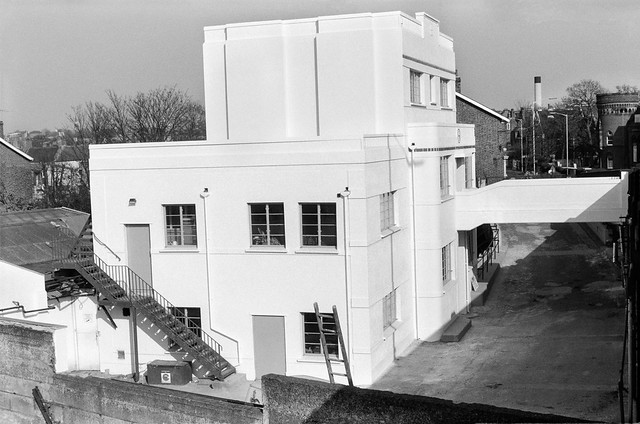
Tickitape House, Works, Art Deco, 59, Ladywell Rd, Ladywell, Lewisham, 1990, 90-4c-45
Tickitape House, Works, Art Deco, 59, Ladywell Rd, Ladywell, Lewisham, 1990 90-4c-45

Unfortunately local listing and being a popular local landmark that, according to the council “makes a positive contribution to the character and appearance of the conservation” area and their comment that “Any development on this site should therefore retain the main body of the Art Deco building” fell on deaf ears of the developers, and despite considerable local opposition it was completely demolished and replaced by undistinguished student housing around 2009.

Tickitape House, Works, Art Deco, 59, Ladywell Rd, Ladywell, Lewisham, 1990, 90-4c-46

Perhaps the building did not fall within the criteria needed for national listing, though many far less interesting buildings have been listed. But the architectural community and particularly as this was represented by such vital figures as Nikolaus Pevsner in the past had a very snooty attitude to Art Deco and Moderne buildings, regarding them as of little merit compared to the true modernism of the age. It doesn’t get even a fleeting mention in London 2:South.

Ladywell Rd, Ladywell, Lewisham, 1990, 90-4c-44

My interest was caught by the rather ramshackle buildings in the centre of the picture and I wondered what their original purpose could have been, with what appear to be doors at first-floor level and ventilators on top. My first thought was pigeon lofts and others have suggested stables. I think they have since been rebuilt in a similar form in Mercy Terrace.

Houses, Ladywell Rd, Ladywell, Lewisham, 1990, 90-4c-33

Breeze blocks fill the windows and doors of the foreground house in this terrace and I think were there to prevent squatting of the property which has since been renovated.

Mecca Leisure, Lewisham High St, Lewisham, 1990, 90-4c-34

The Bingo Hall was built as a Temperance Billiards Hall in 1910, and I wrote more about this in my previous post. Left derelict for some years after the last Bingo session it has been slowly and carefully restored by the Tabernacle Church.

King Of Lee, Motors, Lewisham High St, Lewisham, 1990, 90-4c-35

No trace remains of King of Lee Motors at 256 Lewisham High St, a scrap yard offering a wide range of reconditioned and reclaimed motor spares from stock, immediately south of the railway bridge on Lewisham High Street. They apparently paid “TOP CASH PRICES” for “FAILED MO.O.T., DAMAGED, NON RUNNERS, INSURANCE WRITE-OFFS” and their buyers will call to collect them – evenings and weekends.

Curness Street now runs here,. leading to new flats built between 2003 and 2006

King Of Lee, Motors, Lewisham High St, Lewisham, 1990, 90-4c-36

Finally I took three portrait format near identical images of the gate, fascinated by the remains of a telegraph pole with its various wires and strands of deadplants. Although the yard claimed to be open ‘7 DAYS’ I had managed to find one where it was firmly closed with a car wedged against its frontage.

It was time to make for the station and go home.


Flickr – Facebook – My London Diary – Hull Photos – Lea Valley – Paris
London’s Industrial Heritage – London Photos

All photographs on this page are copyright © Peter Marshall.
Contact me to buy prints or licence to reproduce.


Ravensbourne, Quaggy & More -Lewisham – 1990

Ravensbourne, Quaggy & More -Lewisham: The real end of my walks on April 1st 1990 was a short walk around Lewisham. The previous post from these walks was Monkey Business, Wrecked Cars & Roupell – 1990.

River Ravensbourne, River Quaggy, Lewisham, 1990, 90-4b-11

Arriving at Lewisham Station I crossed to the opposite platform and walked along it away from the exit to photograph this view looking south along the River Ravensbourne which curves away to the west – towards the right of the frame. Just after the river runs down a small slope it is joined by Lewisham’s other river, the smaller flow of the River Quaggy. There is now a small park, Confluence Park, where the two rivers meet, opened in 2021.

The scrap yard and the car sales and Allied Carpets are gone replace and the whole area redeveloped with tall blocks since around 2020. There is now another tall apartment block – around 15 storeys tall – to the left of the river,

Maggie's Cafe, Silk Mills Path, Lewisham, 1990, 90-4b-14
Maggie’s Cafe, Silk Mills Path, Lewisham, 1990, 90-4b-14

Silk Mills Path runs alongside the north platform of the station and Maggie’s is still there now offering Breakfast-Lunch-Dinner. It gets excellent customer reviews for its reasonably priced meals and friendly staff. At right one of the arches leads under the railway to Station Road.

Lewisham did have a number of mills using power from the flow of the Ravensbourne, and the silk mills were a short distance downstream on its east bank at the end of Conington Road, close to Elverson Road DLR station. The site is now occupied by flats, built around 20 years ago. The mill had a large mill pond, part of which is now Tesco’s car park.

Although there are still some mulberry trees in the area, the essential feed for the silk worms, the Lewisham mill apparently relied on imported silk.

Houses, Lewisham High St, Lewisham, 1990, 90-4b-15

The River Quaggy runs in a an open channel in front of this long terrace at 15-31 Lewisham High Street, some way below street level, emerging into this from a tunnel under the central streets of Lewisham. It can next be seen from a bridge on Clarendon Rise just south of Lee High Road – see below.

River Ravensbourne, Riverdale House, Molesworth St, Lewisham, 1990, 90-4c-64

The Ravensbourne runs under recent flats on Molesworth Street and can be seen from the west side of the street where it runs under the railway line there. There is a small park, River Mill Park, with a bridge across the river.

This section of the river was channelled between tall concrete banks I think in the 1960s to alleviate the flood risk. The rather fortress-like Riverdale House was designed by Frederick Gibberd in 1981 as offices. In 2013 planning permission was granted for its conversion into luxury flats.

The site had a mill at the time of the Domesday Book and Riverdale Mill was restored as flats when this new building was erected on the rest of the site. It was built on the site of earlier mills as a leather mill in 1828, later becoming a flour mill and in 1901 was bought and turned into the John Wallis bakery, closing around 1970. It is the only remaining mill building in Lewisham.

Houses, St Stephens Grove, Lewisham, 1990, 90-4c-66

The River Quaggy emerges from a tunnel under the end of St Stephen’s Grove where it meets Lewisham High Street at the south side of Saint Stephen With Saint Mark, Lewisham, a Grade II listed Parish Church by Sir George Gilbert Scott built in 1863. This and St Stephen’s Terrace also date from the mid-1860s.

90-4c-52-Edit
River Quaggy, Clarendon Rise, Lewsiham, 1990, 90-4c-52

The Quaggy apparently got its name for being very muddy – a real quagmire. Here it runs along the backs of the buildings on Lee High Road.

Following pressure from and plans developed by the Quaggy Waters Action Group under the name Operation Kingfisher in 1995, parts of the river have been restored to a more natural state and brought back above ground. Much of the work already completed has been driven by the need to control flooding by the river.

Mecca Leisure, Lewisham High St, Lewisham, 1990, 90-4c-54

Taken from the pavement in front of the building at 233-241 Lewisham High St, this shows some detail of the building, built as a Temperance Billiards Hall in 1910, architect Norman Evans, the company architect for Temperance Billiard Halls Ltd. This Grade II listed building was derelict when bought as new premises for The Tabernacle Church around 2010 and is slowly and carefully being restored – details on their web site.

Later on the walk I photographed the building again from across the road which gives a far better impression of the building when it was in use as a Mecca Bingo Hall – I’ll post this picture in the final post on this walk shortly.


Flickr – Facebook – My London Diary – Hull Photos – Lea Valley – Paris
London’s Industrial Heritage – London Photos

All photographs on this page are copyright © Peter Marshall.
Contact me to buy prints or licence to reproduce.