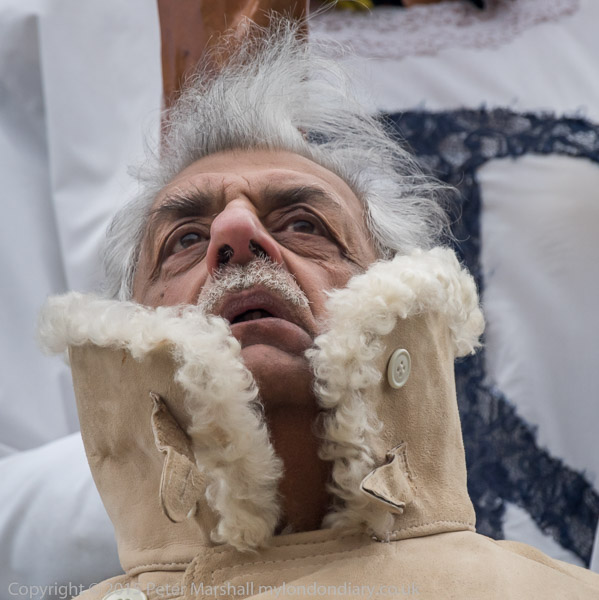
For Refugee Rights and Against Trident

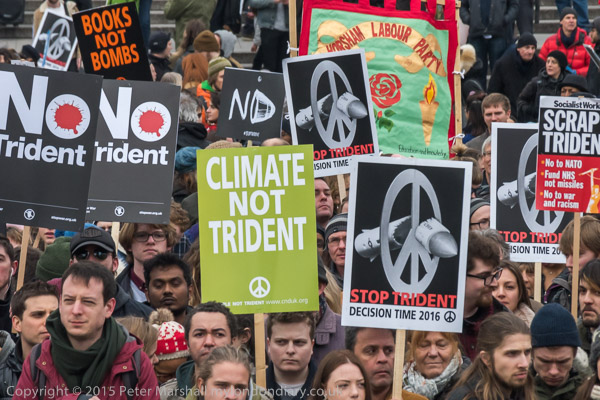
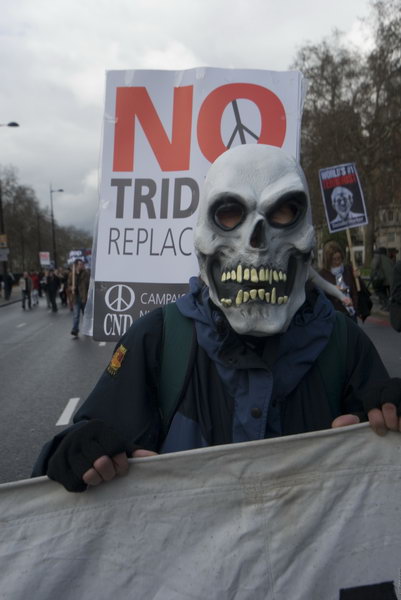
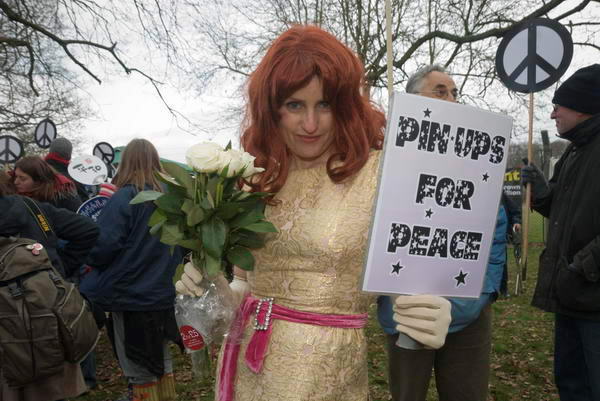
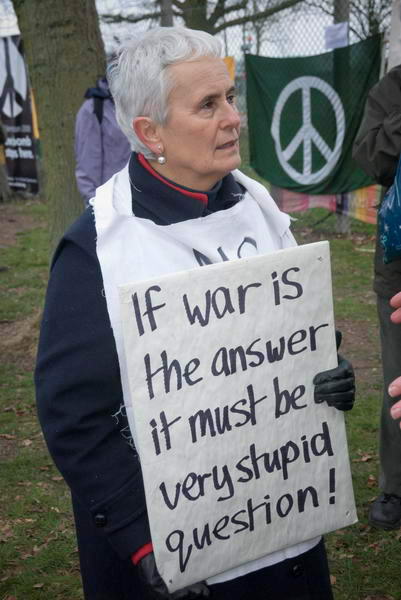
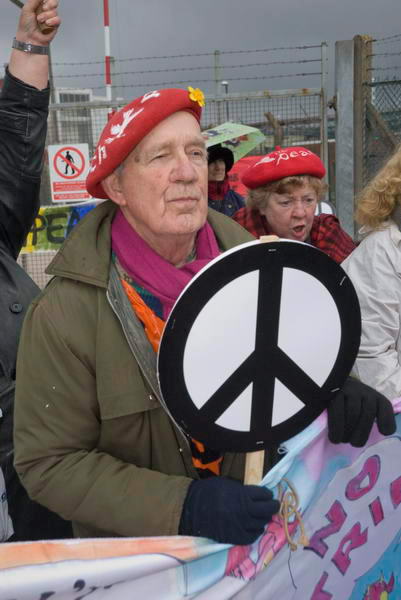
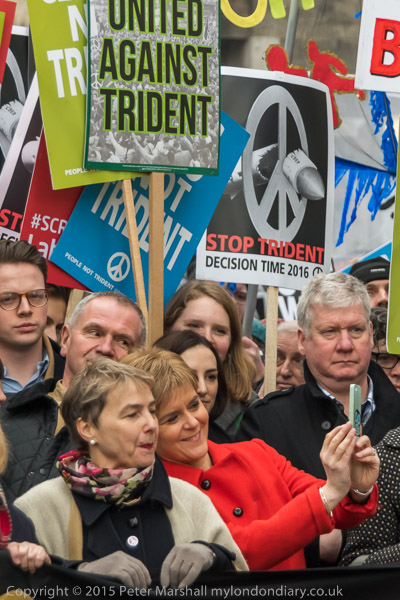
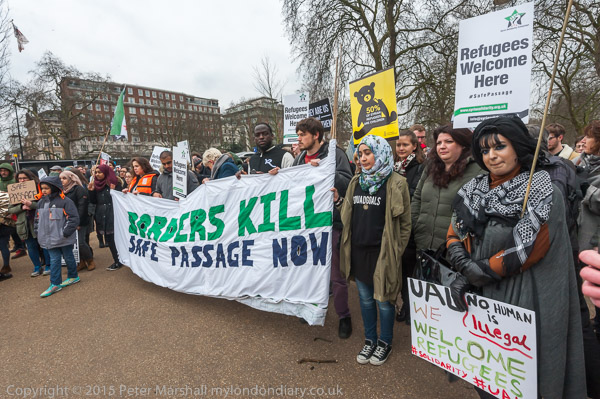
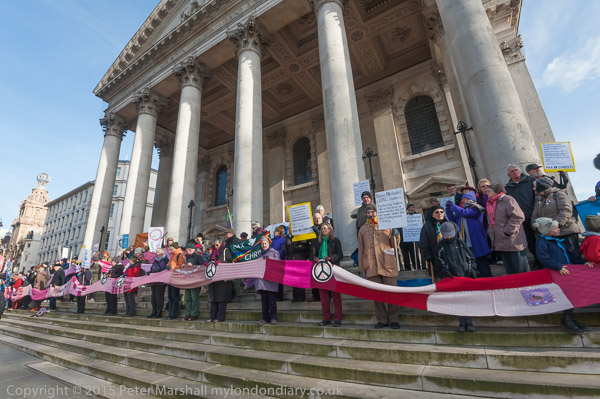
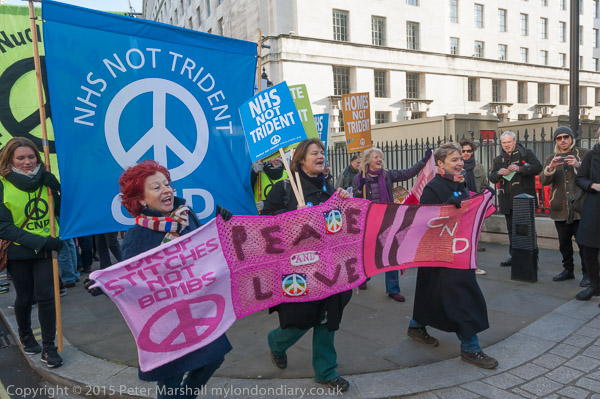
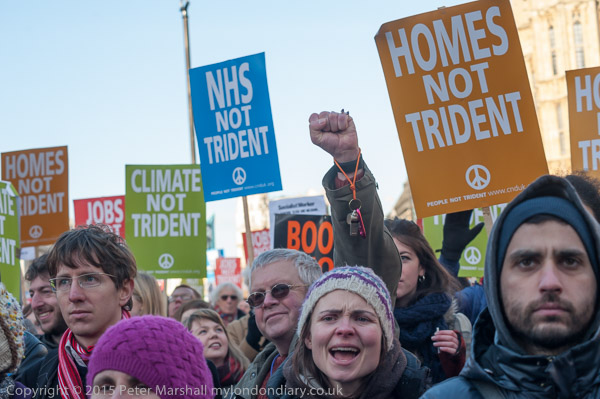
For Refugee Rights and Against Trident. I covered two marches in London on 27th February 2016, the first calling for safe passage for refugees seeking protection in Europe and following this a much larger march against government plans to waste £180 billion or more on replacing the UK’s Trident nuclear weapons.

European March for Refugee Rights
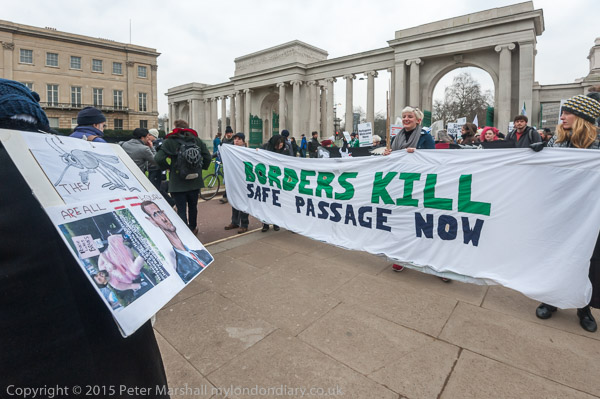
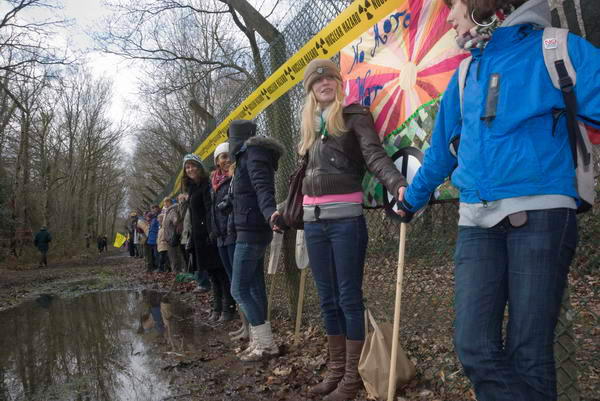
The European March for Refugee Rights was part of a day of protests in cities across Europe demanding action by governments to provide secure safe passage routes for all refugees and asylum seekers seeking protection in Europe. They want an end to deaths at borders and drownings and for refugees to be allowed to keep their possessions and be reunited with their families.
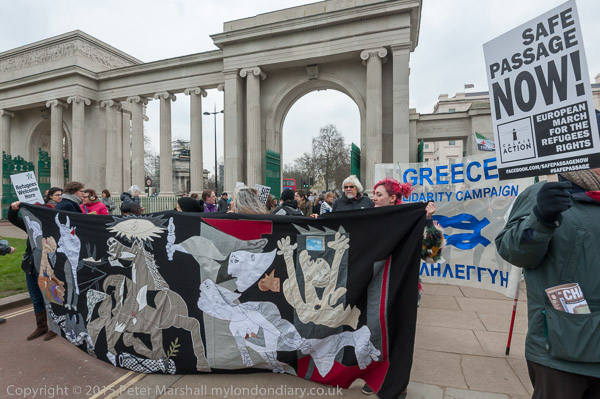
Among those taking part were people who had been to aid refugees in Lesvos and at the Calais camps and others who had volunteered with Medicins Sans Frontiers in Syria. The protest was supported by many groups including the Syria Solidarity Campaign, Solidarity with Refugees, London2Calais, Migrants’ Rights Network, SOAS Solidarity with Refugees & Displaced People Soc, Wonder Foundation, Calais Action, UK Action for Refugees, Refugee Aid Initiative, No Borders and the Greece Solidarity Campaign.

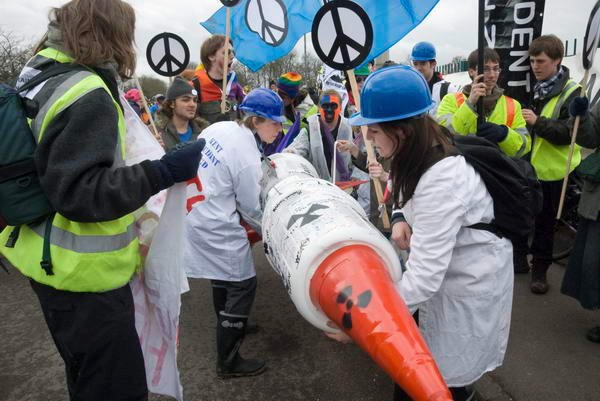
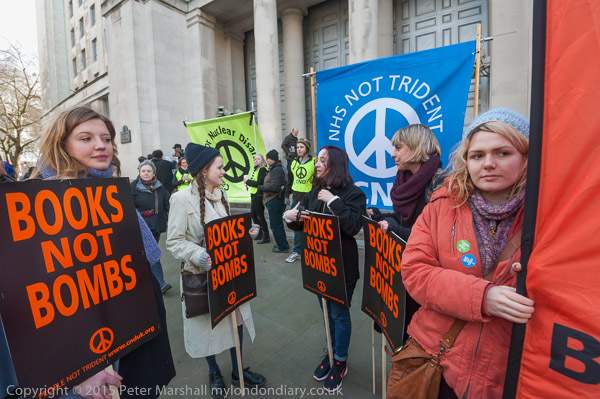
This was a short march taking place unusually inside Hyde Park, gathering at Hyde Park Corner and walking up to Speakers Corner where there was a rally. This made it possible for those taking part to join the Stop Trident Rally which was starting from Marble Arch, and going down Park Lane on its way to Trafalgar Square. Some of the marchers decided to form a block to march in front of the main Stop Trident banner and march on to Trafalgar Square.
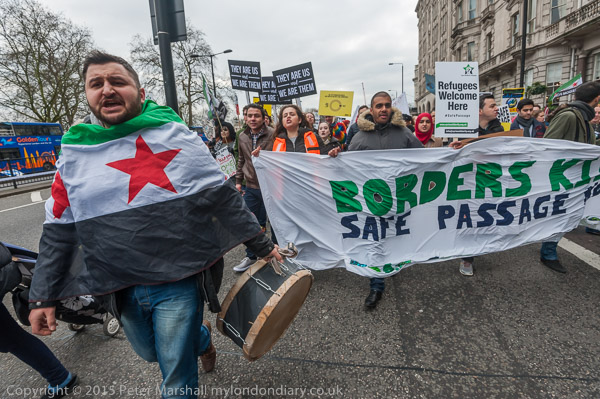
Stop Trident march stewards tried briefly to stop them but then gave up and halted their march for around ten minutes to create a gap between the two groups.

European March for Refugee Rights


Stop Trident March
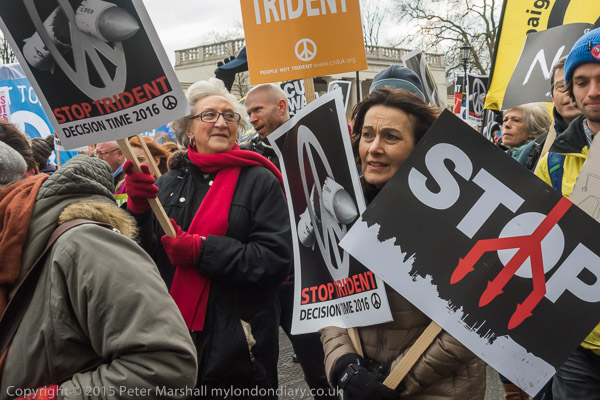
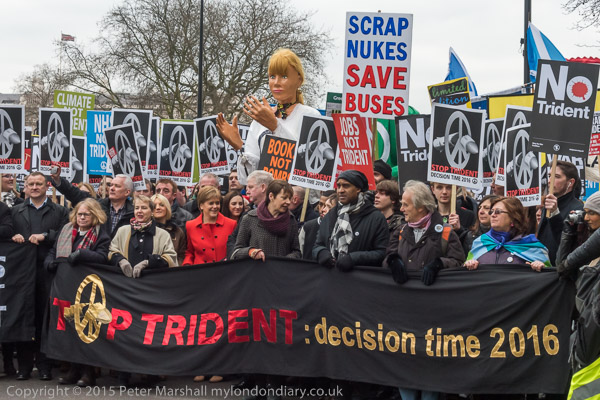
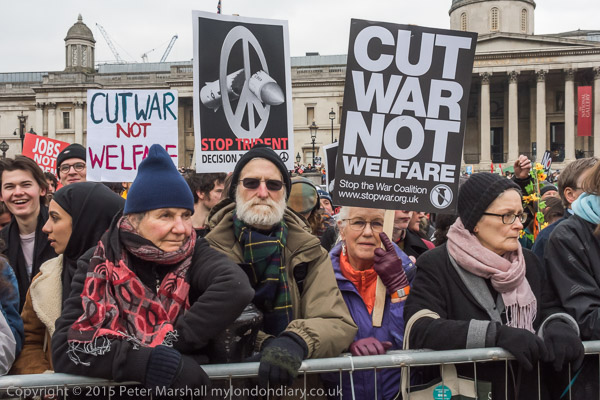
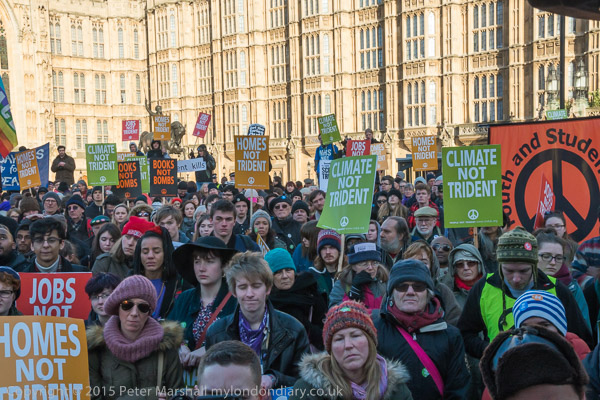
According to CND there were 60,000 people marching from Marble Arch to a mass rally in Trafalgar Square, and although their estimate may have been a little on the high side, this was definitely a very large protest, starting with a densely packed crowd on Park Lane. When the rally began in Trafalgar Square the tail of the march was still around half a mile away, and I think many gave up before reaching the rally as the streets leading to it became blocked.
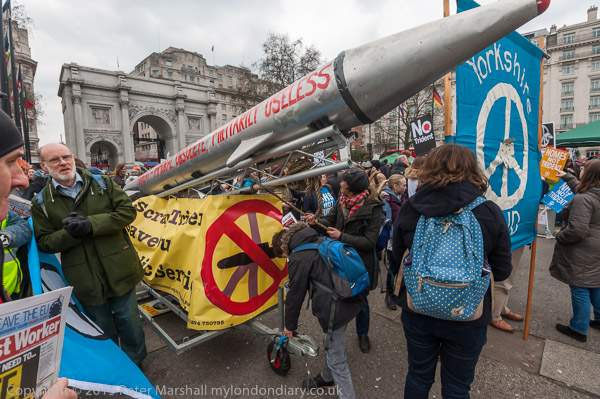
Few people outside the military and arms manufacturers – probably the most powerful of all lobbies in the country can really believe the expenditure of £180 billion or more on replacing the UK’s Trident nuclear weapons is either necessary or cost-effective. The huge majority of nations in the world have no nuclear capability, and by December 2021, 59 states had ratified or acceded to the UN Treaty on the Prohibition of Nuclear Weapons (TPNW) which entered into force on 22 January 2021.
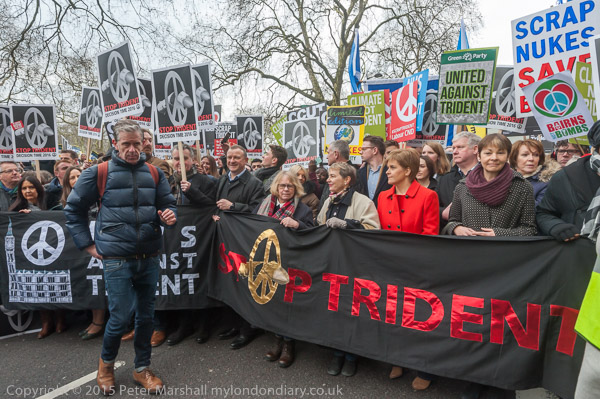
Lindsey German, Stop the War, Kate Hudson, CND General Secretary, Nicola Sturgeon, SNP First Minister, Scotland and Green Party MP Caroline Lucas hold the Stop Trident banner

A national survey by Survation at the start of 2021 for CND showed 59% of the public supported the UK government signing up to the TPNW, including 50% of Conservative voters and 68% of Labour voters. An even higher 77% supported a ‘total ban on all nuclear weapons globally’ with majority support from young and old, in all regions of the country, from Conservative as well as Labour voters, leavers and remainers. The government remains resolutely opposed to the treaty.
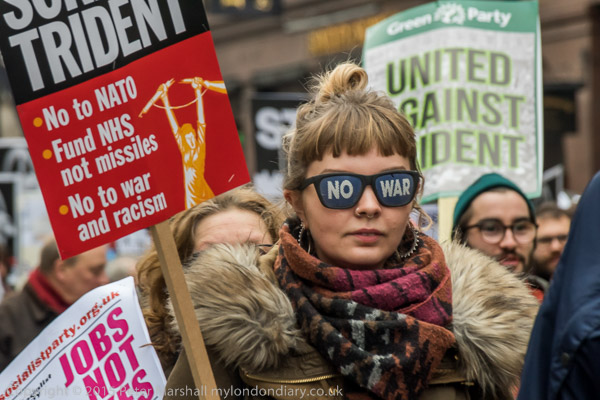
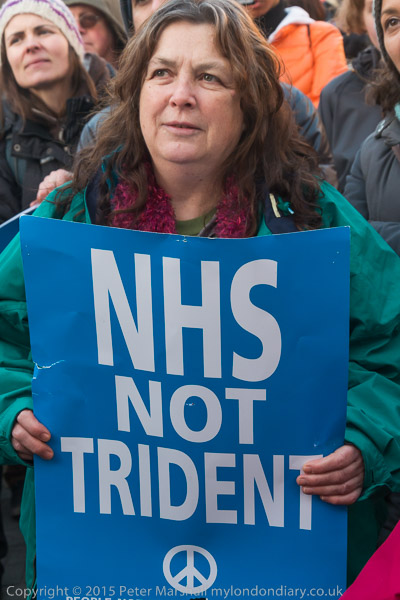
This widespread opposition to nuclear weapons isn’t largely a matter of their cost but on both moral and pragmatic grounds. As CND say, using nuclear weapons would cause catastrophic global damage; these weapons of mass destruction don’t keep us safe and divert resources from essential spending on services like the NHS, schools and housing and “it is clearer than ever that real security for Britain requires addressing the risks posed by the climate emergency and pandemics on a global scale.

Stop Trident March


Stop Trident Rally

Trafalgar square was unusually packed for the long rally that followed the march, with people listening and applauding a long list of speakers, including Nicola Sturgeon, Caroline Lucas, Leanne Wood, Vanessa Redgrave, Bruce Kent, Christine Blower, Mark Serwotka and Tariq Ali, as well as many less well-known names. There were many marchers who found it impossible to get into the square.
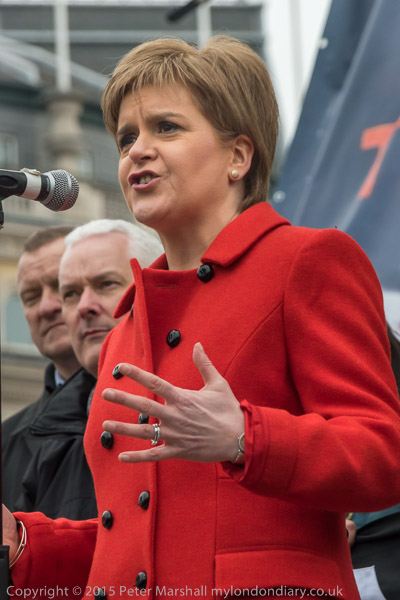
Nicola Sturgeon First Minister Scotland

All the speakers opposed the spending of an estimated £180 billion or more on renewal of Trident which they dismissed as out of date, totally irrelevant to our defence and a complete waste of money which could be put to so much better use providing proper jobs and services.
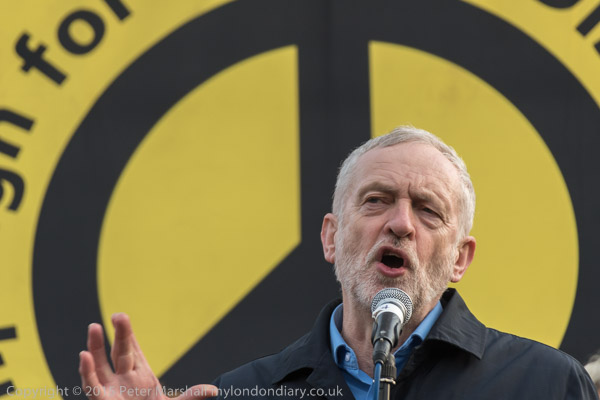
It was a long wait, around two hours standing in the cold for the final speech by Jeremy Corbyn who had earlier in the day been speaking in Sheffield and whose train had been a little delayed. He was greeted by a tremendous response from the crowd, and gave a rousing speech to end the protest on a high note. Despite the dismissive remarks from many political commentators on the media, Corbyn is one of the most powerful political speakers of current years.
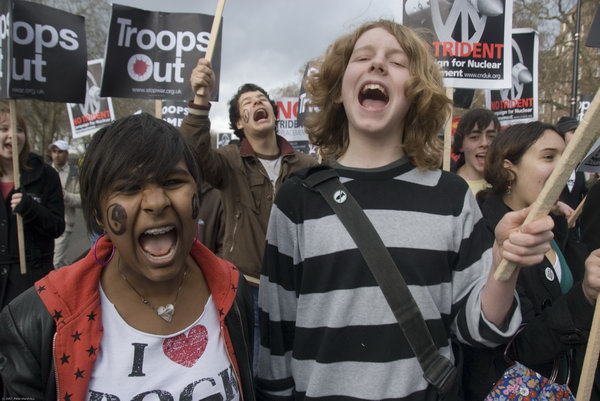
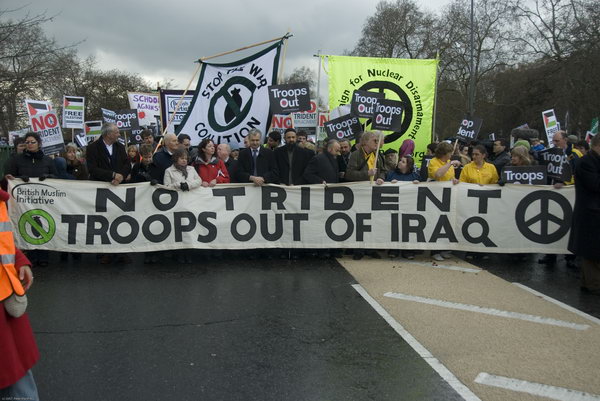
Stop Trident Rally


Stop Trident, Troops out of Iraq – 2007

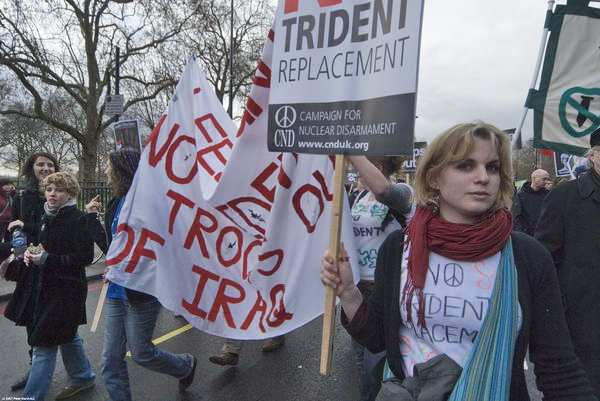
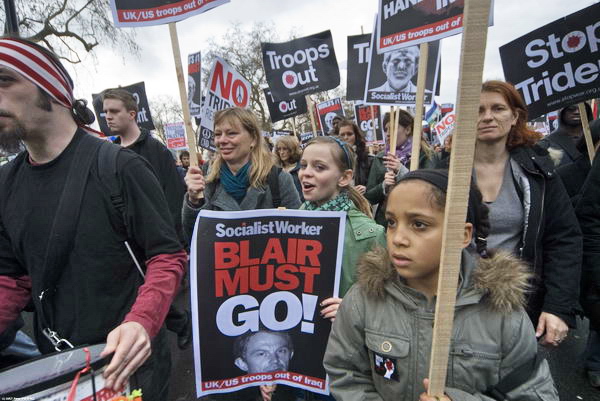
Stop Trident, Troops out of Iraq – 2007. On Saturday 24th February 15 years ago I spent a long afternoon photographing around 50,000 protesters marching through London calling for an end to Britain’s nuclear weapons and for our troops to be withdrawn from Iraq.

The march was organised by Stop The War, the Campaign For Nuclear Disarmament and the British Muslim Initiative, and on My London Diary – back then still only in lower case – I made clear my support for the marchers:

i’ve for many years been opposed to the so-called independent british nuclear weapons. even at the height of the cold war they were never credible as an independent deterrent. if they have ever had any justification it was that they made the usa feel less guilty, although american guilt at its huge nuclear arsenal and at being the only country ever to have used nuclear weapons has always been an incredibly stunted growth.

i was also firmly against the invasion of iraq. it was always clear to those who didn’t want to be deluded that the so-called ‘intelligence’ on weapons of mass destruction was laughable. blair was either a liar or a fool as he misled a minority of the british people and a majority of their mps. or most probably both. (saddam may also have been deluded and certainly was an evil dictator, but we had long failed those who tried to oppose him.) the invasion was criminal, but the lack of planning for the occupation that inevitably followed even more so.

My London Diary – Feb 2007

My account also points out the ridiculously low estimate of the numbers taking part given by the police of 4,000 – though I think they were eventually forced to increase this somewhat – and gives my own method of assessing numbers on such large demonstrations as this. The marchers took 90 minutes to pass me as I photographed them in Park Lane. My usual rule of thumb was to double the police estimate, but on this occasion they surpassed themselves, being an order of magnitude out.

There certainly is always a policy by our establishment, backed up by the BBC and the press, except on rare occasions to minimise dissent, particularly left-wing dissent, in this country while often exaggerating any protests against left-wing governments abroad. It’s a bias which has been very obvious in the coverage of events in Latin-American countries such as Venezuela.

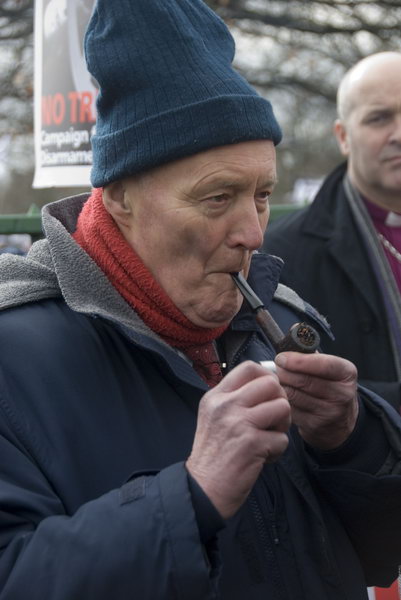
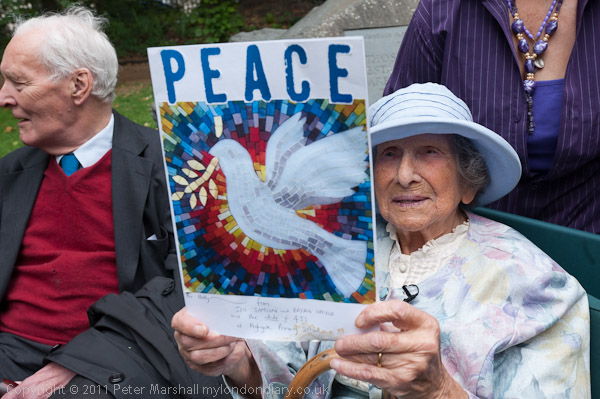
Tony Benn

The BBC and some of our newspapers have some excellent reporters and correspondents, and it is more in the selection of what they are asked to report on and the editing of their reports and the context in which they are placed that the bias occurs. Some things are just not ‘news’, while others, often trivial or flippant, get major attention.

Fortunately there are other sources with different biases, including the almost invisibly small left-wing press in the UK (the two daily papers – the Communist Morning Star and Workers Revolutionary Party’s The News Line together have a circulation probably well under 10,000), but more importantly large news organisations such as the Russian-funded RT International and the Qatari Al Jazeera English – the latter particularly interesting about current events in the Ukraine.

Every journalist has a point of view and while we may strive to be factual I don’t think there is such a thing as objectivity. Our reporting is always subjective, based on what we feel and what we think is of importance. Every photograph I take involves choice – and the rejection of other things I don’t photograph – even at times things I think would make eye-catching images but would misrepresent people or the event. Further choices come in the selection of which images to send to an agency, and also which I choose to put on My London Diary.

On this occasion I chose rather too many to put on-line, with 17 pages of pictures, though this reflects the typical internet speeds of 15 years ago, when pages with more than ten small images were too slow to load even though I compressed the images as lower quality jpegs than I would now. But the number of pictures also reflected my intention to tell the story of the event as fully as possible rather than creating a single image for the event that might appeal to a picture editor.

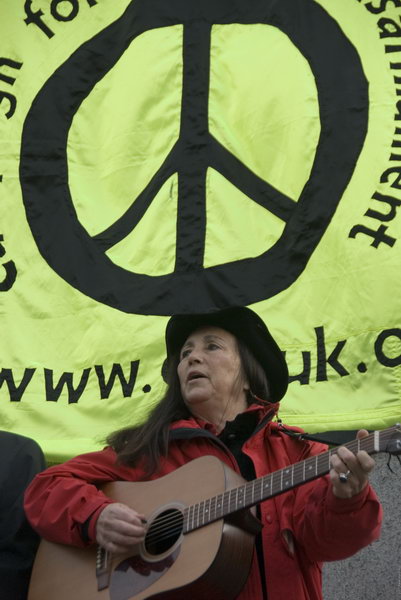
Julie Felix

Looking at the report now I feel there are rather too many images particularly of some of the well-known faces I photographed at the rally. Perhaps also I made too many of the marchers, some of which might be of far more interest to the people shown in them than the general public. But if people make an effort to make an interesting placard or banner I think it deserves a little recognition.

You can read more of my report of the event and see another 160 or so pictures on My London Diary, beginning on the February 2007 page, though you will need to scroll a long way down the page to reach this march and rally.


Wool Against Weapons

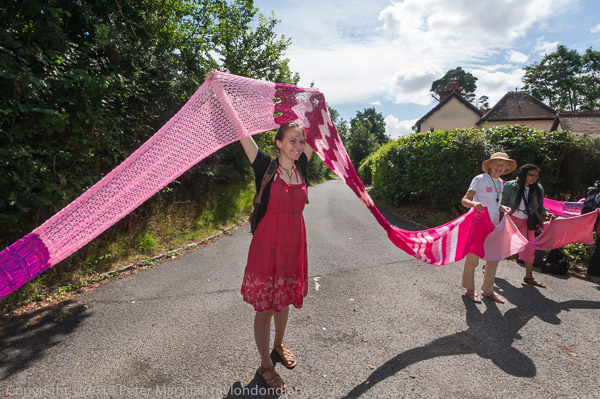
The seven-mile long scarf was joined up at 1pm

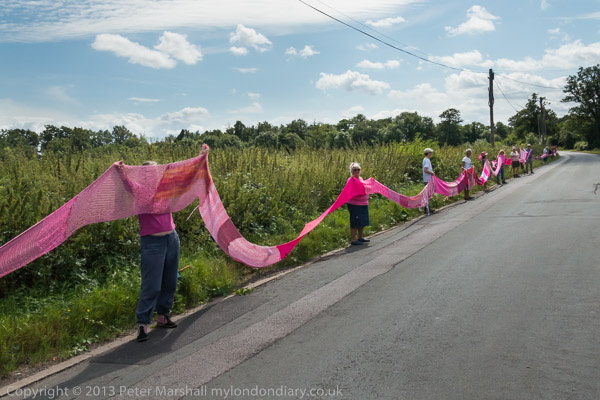
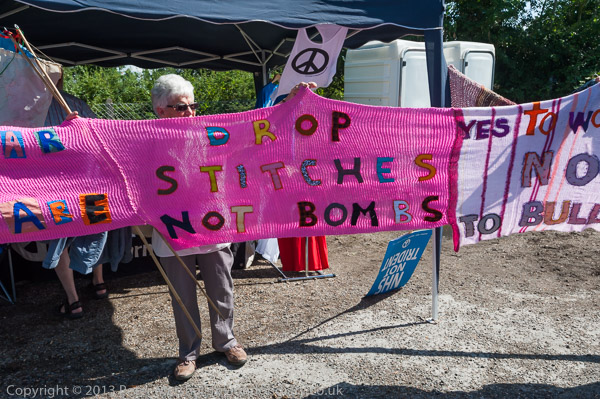
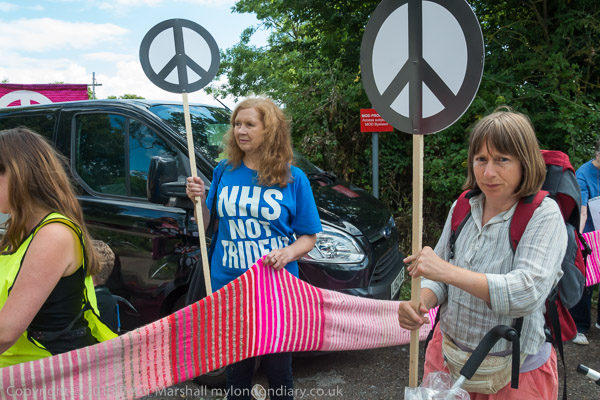
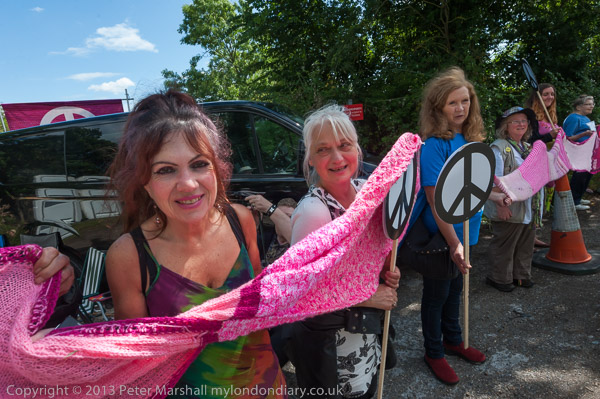
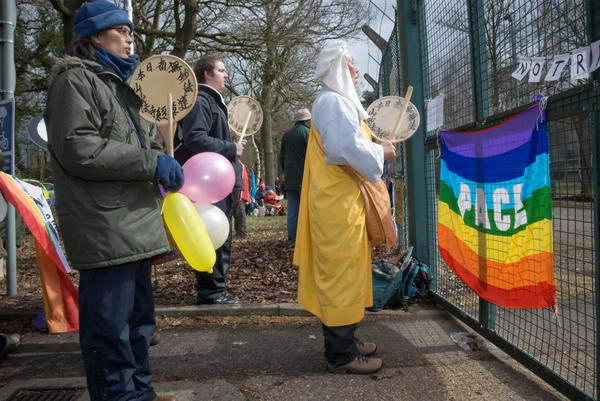
On Saturday 9th August 2014 I took a bike ride outside London, putting my bike on the train to Reading, from where I cycled west to Burghfield and on to Aldermaston. It was Nagasaki Day, remembering August 9th 1945, when the US exploded an atomic bomb at the city of Nagasaki, killing around 80,000 people, and CND were holding an unusual protest, stretching out a seven mile long knitted scarf between the two factories where Britain’s atomic war heads are made. 69 years after the bomb was dropped, the UK government was about to vote on huge spending on a new nuclear weapons system, and CND were calling for Trident and its replacement to be scrapped.

‘Drop Stitches Not Bombs’ at the Burghfield end of the 7-mile scarf

I’d taken my bike, both to get to Burghfield from Reading but also so that I could cycle along the whole seven mile length of the protest and photograph the scarf along the way. A bike was ideal for this, as I could easily cover the whole distance and unlike a car you can jump off anywhere and take pictures. But for the moment when all the lengths of wool were joined up, I jumped off my bike and ran along the first section of the scarf, taking picture after picture.

Joining up the lengths of scarf

Here’s some of what I wrote in my 2014 post Wool Against Weapons along with a few of the pictures I took along the road.

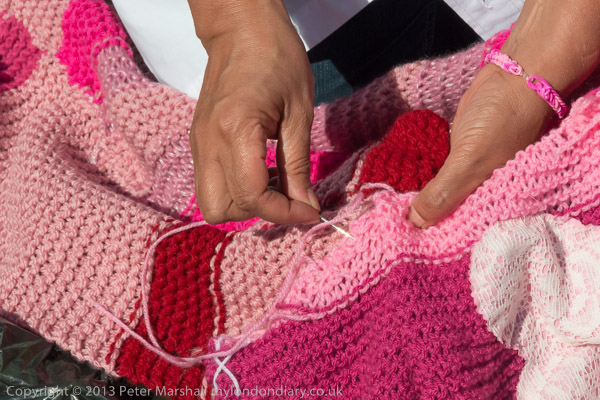
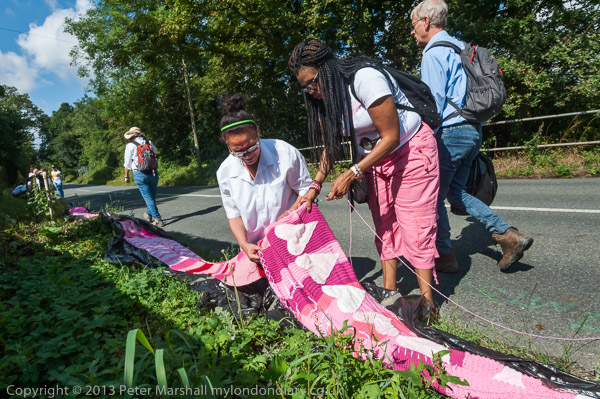
”Groups from all over the country and some from France brought long rolled up lengths of knitted and crocheted scarves, made in individual sections and joined together. A lot of planning was needed to make sure that there were enough rolls and they were taken to the right places to be unrolled and joined together, but it all worked on the day.”

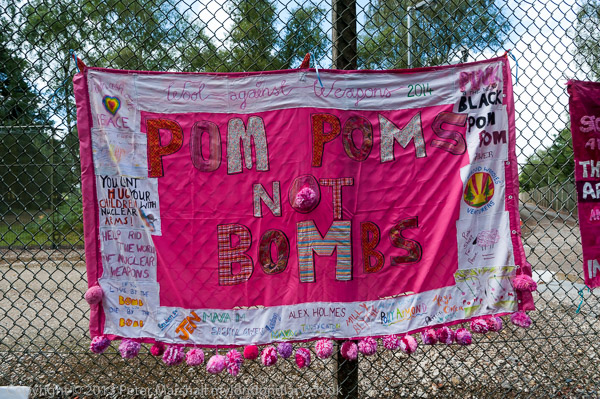
One of many banners on the fence around AWE Aldermaston

“The project involved a very large number of people, many of whom had taken no active part in protests against nuclear weapons before, but who are convinced that we should not waste public money on the Trident replacement – money that could be put to something useful like keeping our NHS running.”

‘NHS Not Trident’

“I cycled to Burghfield from Reading, and arrived just over two and a half hours before the whole scarf was scheduled to be joined up at 1pm. After taking some pictures around the end of the scarf there, I got back on my bike and cycled slowly along the route of the scarf to Aldermaston, stopping at all of the ‘mile points’ which were the bases for the various regional groups (and a ‘faith’ group) and also where people were busy laying out the rolls of scarf and joining them up and taking photographs. It took me around an hour and a quarter to get to the Aldermaston end of the scarf at the fence around the AWE there.”

Protesters at Burghfield

“I made it back to Burghfield – with just a few stops for more pictures – in half an hour. It helped that there is quite a long downhill section and the wind was behind me, but I wanted to be sure to be back well before the planned ‘linking time’ of 1pm.”

At side roads the scarf could be lifted to allow cars through.

“I took pictures at Burghfield of the linking when people rang bells at 1pm, then started running along the scarf, stopping to photograph the people holding it up. After almost a mile I gave up and returned back to Burghfield where a rally was to start at 1.30pm.”

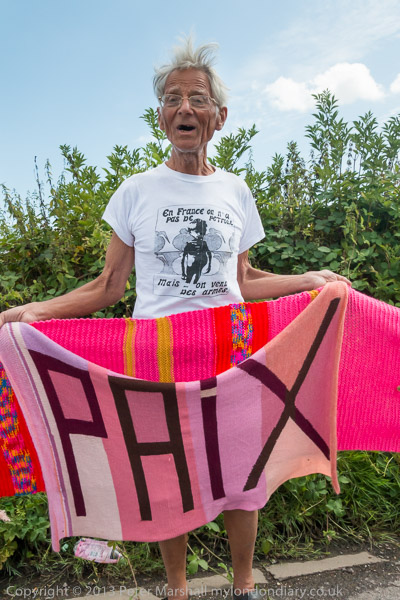
‘PAIX’

More pictures on My London Diary at Wool Against Weapons.


All photographs on this and my other sites, unless otherwise stated, are taken by and copyright of Peter Marshall, and are available for reproduction or can be bought as prints.


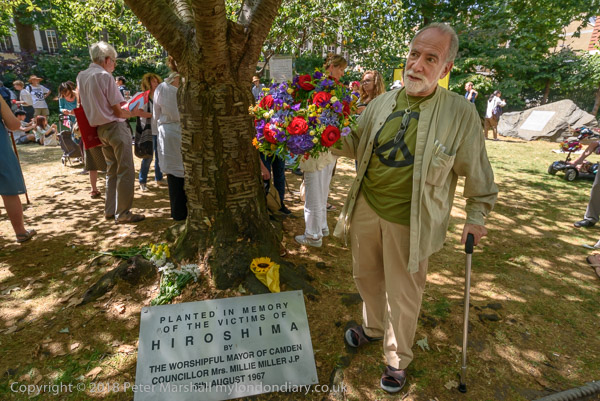
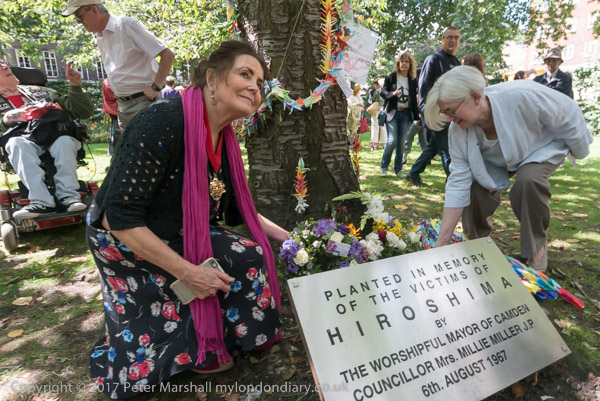
Hiroshima Day – August 6th

2018

On 6th August 1945 a US B-29 bomber dropped a atomic bomb, code name ‘Little Boy’, from a height of 31,000 ft over the Japanese city of Hiroshima. It took almost 45 seconds to fall to a height of 1,900 feet where it detonated, by which time the bomber, Enola Gay was over 11 miles away.

2014

Hiroshima was a large city, a port with many industrial and military sites and a population of around 350,000. Because it had been selected as a target for a nuclear bomb it had not suffered the intensive conventional bombing of most other Japanese cities. The USA wanted to be able to see clearly the damage an atomic weapon could cause.

2019

Around 70,0000 people, 30% of the population were killed by the initial blast and firestorm which was caused, with around the same number badly injured. Around 70% of the city’s buildings were destroyed, an area of almost 5 square miles devastated. Those killed included over 90% of doctors and medical staff who were concentrated in the central area of the city.

2017

Two days later on August 8th the US decided to drop the second atomic bomb, one of a different design using plutonium rather than uranium, code-named ‘Fat Boy’. The intended target was Kokura, an ancient Japanese city with a huge arsenal, but dark clouds obscured the city, and the B-29 ‘Bockscar’ diverted to the city which was the secondary target, Nagasaki.

2016

The black clouds may have come from the the previous days US conventional fire-bombing of nearby Yahata, but workers at the steel works in Kokura had apparently decided to burn coal tar to try to make a smokescreen. Or it could just have been bad weather or some combination of all three than saved Kokura and condemned Nagasaki.

2009

There were clouds over Nagasaki too, but a patch of clear sky allowed the bomb to be dropped. The plutonium bomb was almost one and a half times more powerful than that which devastated Hiroshima but it exploded over a valley which slightly contained its effects. At least 35-40,000 were killed immediately, almost all of them civilians, including many foreign workers. Unlike in Hiroshima there was no firestorm as the area it was dropped on was less intensively developed.

2009

Although it was the US who dropped the bomb, the British government was deeply involved. Under the 1943 Quebec agreement between Roosevelt and Churchill which brought scientific development of atomic weapons by the two countries together, the consent of the UK was needed for these weapons to be used.

2011

Of course deaths continued after the explosions. Acute radiation syndrome killed many who survived the initial attack, mostly within 20-30 days. Radiation induced cancer and leukemia takes longer to emerge, reaching a peak around 6-8 years later. Radiation also causes miscarriages and birth defects.

2014

Around 650,000 people were recognised by the Japanese government as ‘hibakusah’, survivors affected by the bombs, and around 1% of these had illnesses attributed to their radiation exposure.

2015

Ceremonies in the two cities and around the world remember the bombings and call for the outlawing of nuclear weapons, a total of around 13,000 of which are now held by China, North Korea, France, India, Israel, Pakistan, Russia, the United Kingdom and the United States. The Treaty on the Prohibition of Nuclear Weapons (TPNW) was adopted by the UN in 2017 and entered into force on 22 January 2021. Countries voting for its adoption included two former nuclear states, South Africa and Kazakhstan, who gave up their weapons voluntarily and North Korea. So far 55 states have ratified or acceded to the treaty.

2016

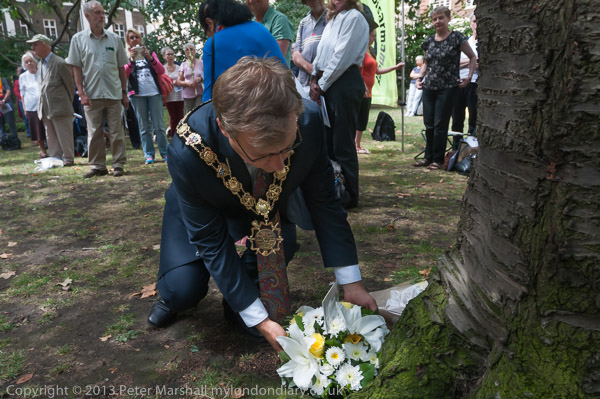
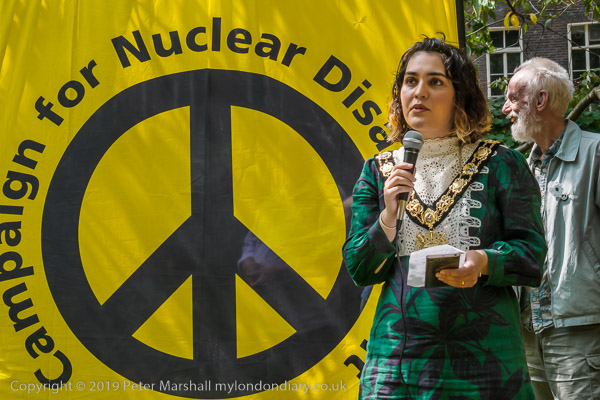
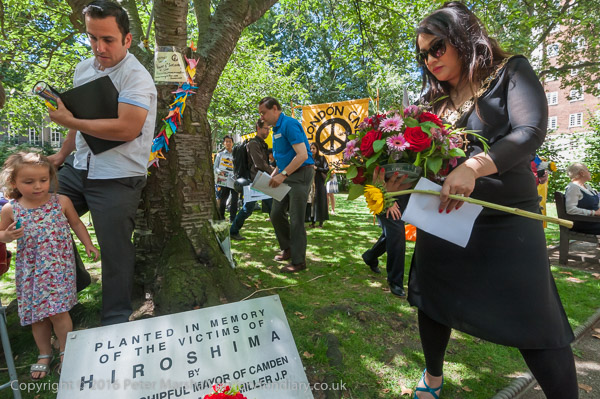
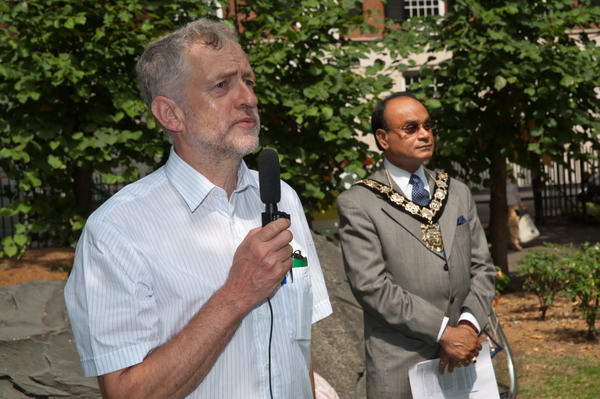
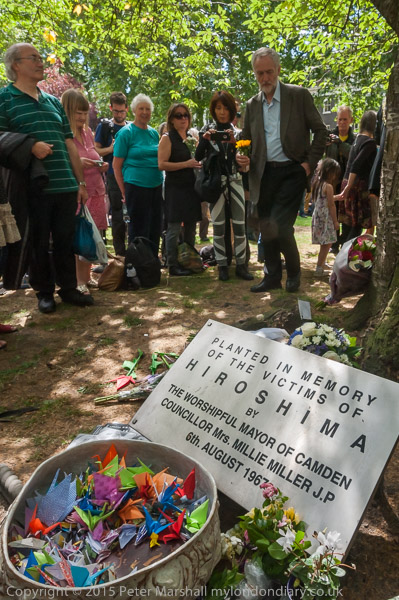
The pictures, taken in various years, come from the annual Hiroshima Day event held every 6th August in Tavistock Square in London organised by London CND. The square is in the London Borough of Camden and take place next to the Hiroshima cherry tree planted there in 1967 by the then Mayor of Camden.


All photographs on this and my other sites, unless otherwise stated, are taken by and copyright of Peter Marshall, and are available for reproduction or can be bought as prints.

All photographs on this and my other sites, unless otherwise stated, are taken by and copyright of Peter Marshall, and are available for reproduction or can be bought as prints.


Five Years Ago – 13th July 2016

Wednesday was a busy day for me on 13th July 2016, photographing five events in London.

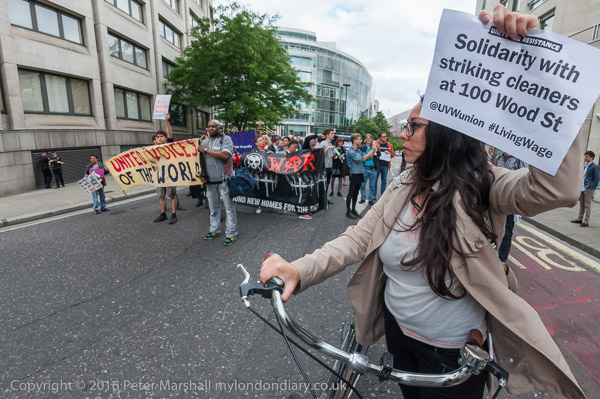
Cleaners at the 100 Wood St offices were still on strike against the anti-union cleaning contractor Thames Cleaning, by then the longest running industrial dispute in the history of the City of London and supporters including Unite the Resistance, the Haldane Society of Socialist Lawyers, Class War and others held a rally in support of the action by the United Voices of the World trade union, beginning on Wood St and then moving on to the street outside CBRE who manage the offices.

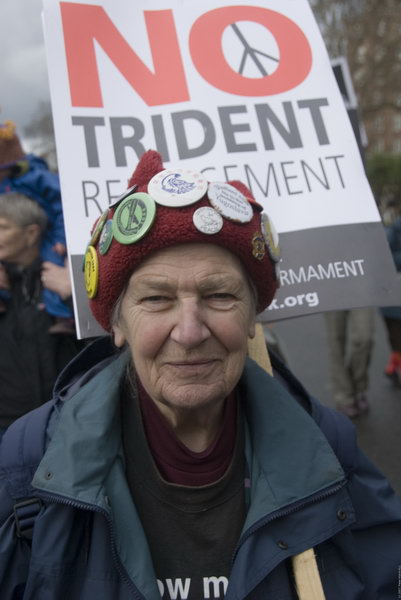
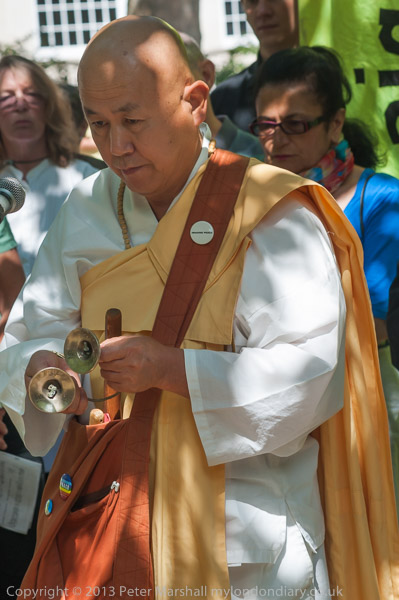
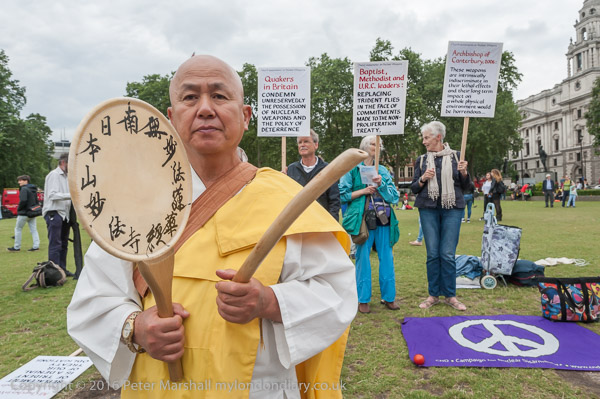
CND members and supporters had come to Parliament to lobby MPs against the plans to replace Trident at a cost of at least £205 billion, and held a ‘Mad Hatters Tea Party’ in Parliament Square where members of Faith groups including both Christians and Buddhists held placards. Church leaders had written to The Times stating ‘The Government must take a lead – cancelling Trident would be a momentous step – Britain can lead the way!’ The government was instead led in its decisions by the lobbyists from those arms companies that profit greatly from these totally redundant weapons.

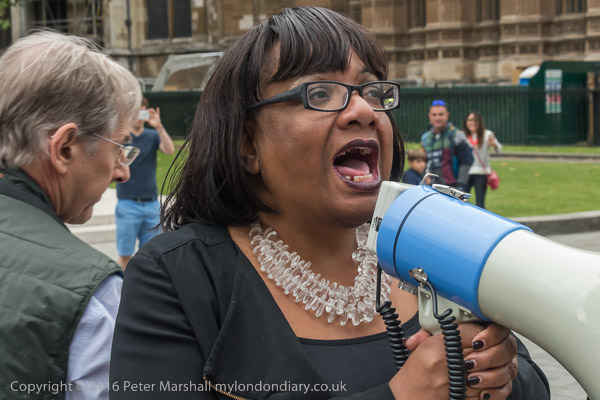
Also on Parliament Square was a protest supporting Labour MP for Wirral West Margaret Greenwood’s ‘Ten Minute Rule Bill’ with cross-party support to stop the privatisation of the NHS and return it to its founding principles. Among those who spoke was Shadow Health Minister Diane Abbot.

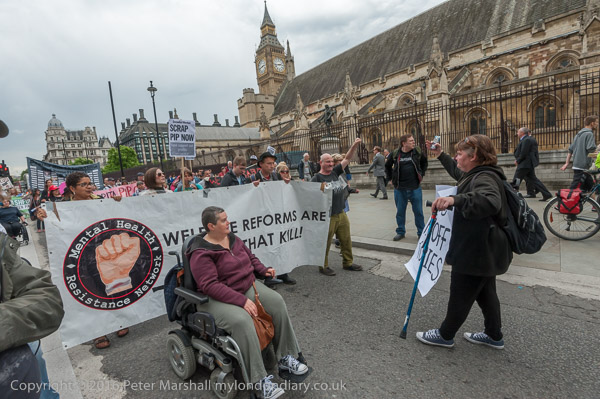
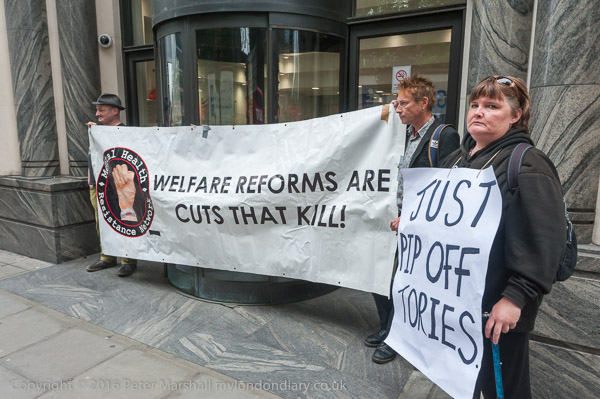
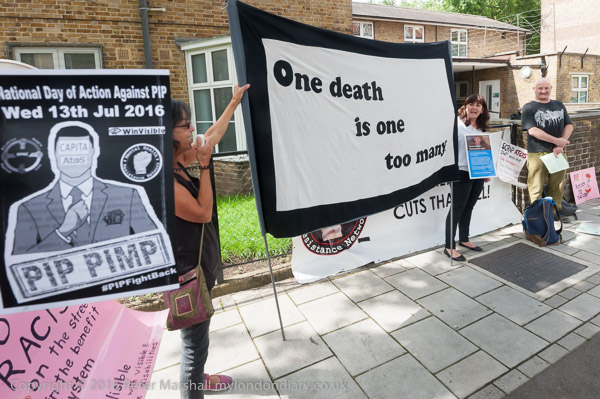
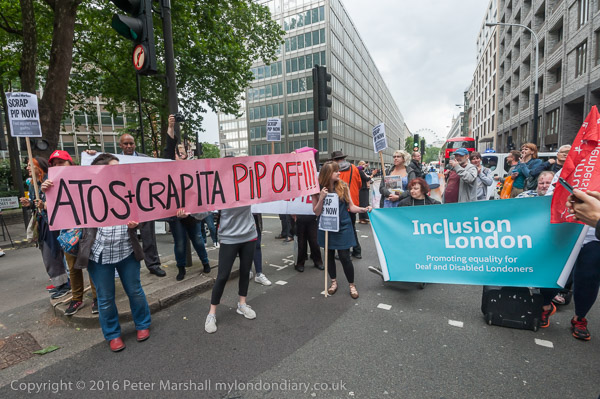
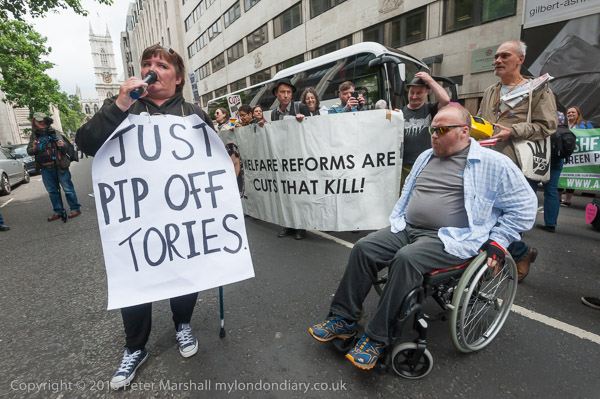
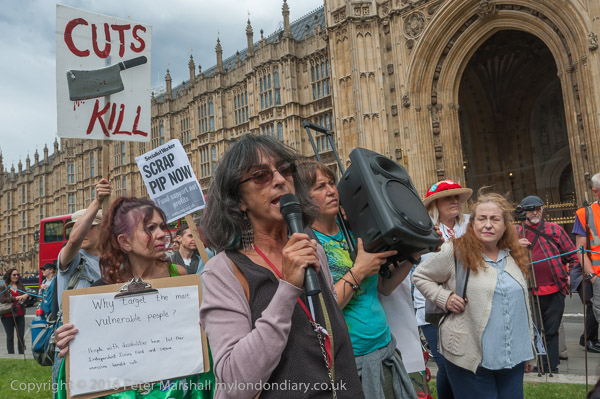
The day was also a ‘#PIPFightback’ National Day of Action against the Personal Independence Payments which disabled people say are a totally inadequate replacement for the Disabled Living Allowance. These rely on systematically flawed assessments carried out by private firms Capita and Atos which make no allowances for many variable conditions and ignore medical evidence. Administered by poorly qualified staff, many are overturned at tribunals after disabled people have suffered for months, sometimes leading to hospitalisation or suicide.

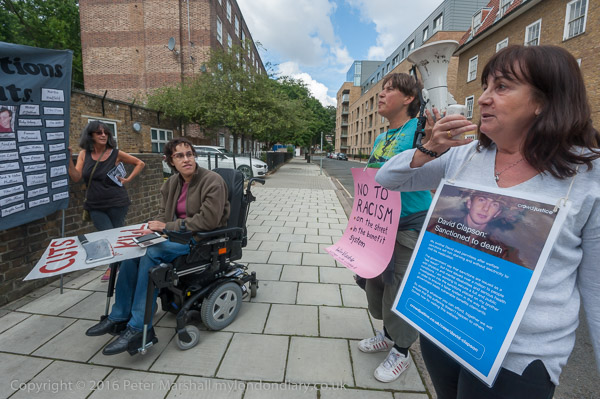
I’d started the day outside the Vauxhall PIP Consultation Centre run by ATOS in a back street with a small group of protesters including Gill Thompson, whose brother David Clapson, a diabetic ex-soldier died in July 2013 after his benefits were ‘sanctioned’. He was left starving without money for food or electricity to keep the fridge containing his insulin running. Like many his benefits had been stopped for trivial reasons and she was calling for a full and public inquiry into cases like those of her brother and to ensure a fairer system for vulnerable claimants.

Later people from the Mental Health Resistance Network (MHRN), Disabled People Against Cuts (DPAC) and Winvisible (Women with Invisible and Visible Disabilities) and other supporters met outside the Victoria St offices of Capita PLC, one of the companies responsible for PIP assessments and held a rally on the busy pavement there.

After some speeches they moved from the narrow pavement to the busy road to continue their protest, holding up traffic for a few minutes, though they quickly moved to one side to allow an ambulance to drive through.

From there the moved to hold a short protest outside the Department of Work & Pensions offices at Caxton House, and then on to Parliament Square for another short rally.

Finally they decided to go to College Green where a media village was present with politicians being interviewed on TV over the appointment of Theresa May as Prime Minister. Police tried to stop them going into the area, but after some moved in eventually allowed them to stand on a path in the middle of the area a few yards away from the TV crews, who almost all totally ignored the protesters. Disabled people suffering and even dying apparently isn’t news.

Solidarity for Wood St cleaners
Trident Mad Hatters Tea Party
Disabled PIP Fightback blocks Westminster
NHS Bill protest at Parliament
PIP Fightback at Vauxhall


All photographs on this and my other sites, unless otherwise stated, are taken by and copyright of Peter Marshall, and are available for reproduction or can be bought as prints.


Aldermaston 2008 – 50 years

Protesters join hands to surround the nuclear weapon factory at Aldermaston

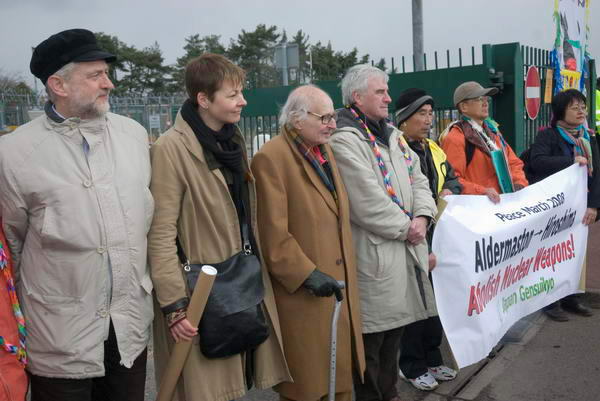
I missed the first major march to Aldermaston organised by the Direct Action Committee Against Nuclear War (DAC) and supported by the newly formed CND at Easter in 1958. I was only thirteen at the time and not that interested in politics at the time, but was very aware it was taking place as my two older brothers (both no longer with us) walked the full distance, coming back tired and rather muddy after four days of marching from Trafalgar Square in the centre of London to the Atomic Weapons Establishment in Berkshire to demonstrate their opposition to nuclear weapons.

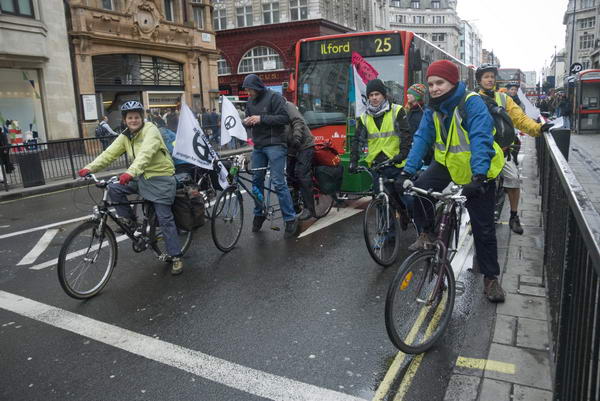
I didn’t go the whole way on the 50th anniversary in 2008, and although I had planned to join the group that were cycling from London I didn’t manage to do so, though I did photograph the cyclists as they rode down Oxford St.

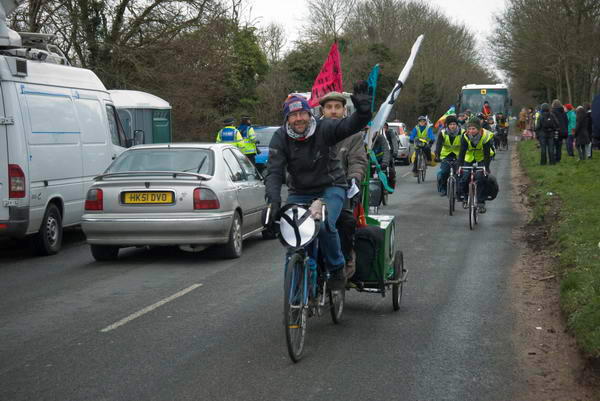
On the Bank Holiday Monday they were cycling from Reading where they had stayed the night along with the walkers, mainly sleeping on the floor in church halls, and I had hoped to join them there for the final stage to Aldermaston. But I got up too late and missed the early train which would have got me there in time – and the next train half an hour later ran late, so I missed their start. Instead I rode on my own along the route that I’d taken on the march there four years previously, finding that on a bike it was rather hillier than on foot.

The Bikes not Bombs group arrive at the Aldermaston bomb factory

Once at Aldermaston, the bike made it easy for me to go to all the gates around the large site of the AWE to take photographs of the protesters there who later moved to surround the perimeter of the base, holding hands around it. And although I’d left Reading later, my more direct route meant I was able to photograph the arrival of the ‘bikes not bombs’ group with their police escort of two cars and several motorbikes.

After making the human chain around the AWE – I think around 4 miles long – and speeches and performances at the main gate it was time to go home, and I got back on my bike for the 12 miles or so to Reading, a slightly easier ride as the wind was behind me and Reading is around 60 metres lower, though the road still had plenty of uphill sections. But I took my time, even stopping to take a few photographs on the way.

Our nuclear weapons programme has never made any sense and the idea of nuclear deterrence has served only to enrich the arms industry. The expense of our nuclear submarines and their warheads diverts money away from more useful areas such as health and education, and the nuclear programme has skewed our power generation to increase electricity costs for us all. It cannot be justified in military or economic terms, but for most of those protesting the most important aspect is that the use of nuclear weapons can never be justified on moral grounds.

The UN Treaty on the Prohibition of Nuclear Weapons which entered into force on 22 January 2021 prohibits the development, testing, production, stockpiling, stationing, transfer, use and threat of use of nuclear weapons, Instead of signing this, the British government have announced an increase in number of nuclear warheads – in contradiction to our previous international agreements about the non-proliferation of nuclear weapons.

Jeremy Corbyn, Caroline Lucas, Walter Wolfgang, John Mc Donnell and Japanese peace campaigners

More pictures at Aldermaston – 50 years


All photographs on this and my other sites, unless otherwise stated, are taken by and copyright of Peter Marshall, and are available for reproduction or can be bought as prints.


Fukushima 10 years on

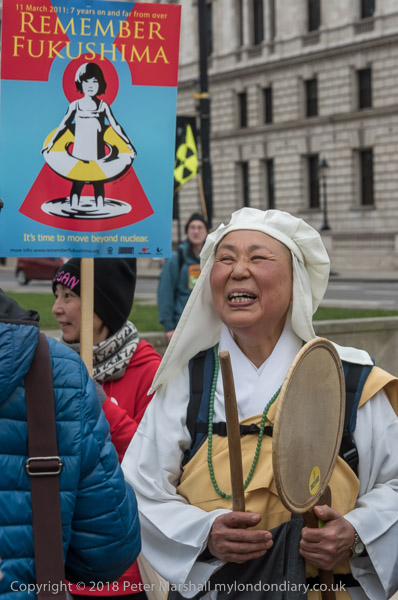
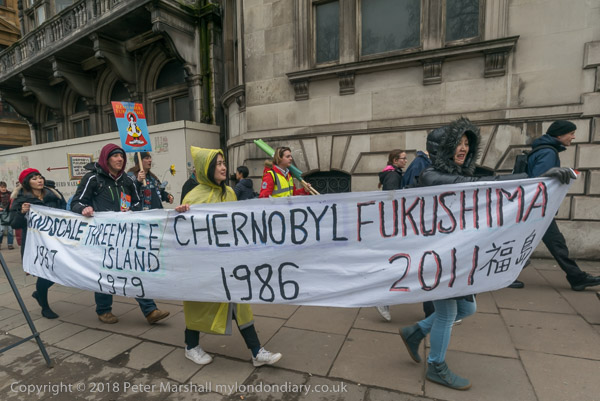
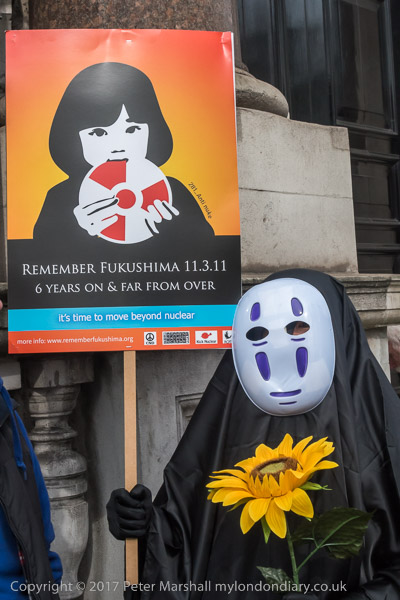
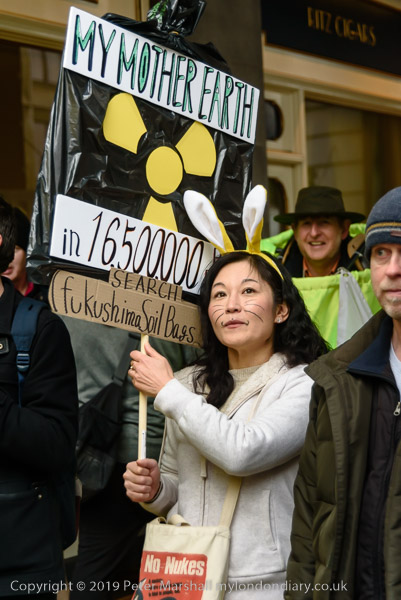
On 11th March 2011 the Fukushima Daiichi Nuclear Power Plant in Japan suffered the worst nuclear disaster since the 1986 Chernobyl meltdown. An earthquake had led to the reactors to automatically shut down their electricity production which led to the plant relying on emergency power generators to run the cooling pumps needed to keep the reactors safe. But the tsunami tidal wave almost 50 ft high caused by the earthquake swept over the plant’s sea wall and flooded the generators, cutting the power supply.

Windscale 1957, Three Mile Island 1979, Chernobyl 1986, Fukushima 2011′ 

Without cooling, three reactors heated up and then melted down and over the following three days there were three explosions of hydrogen gas and the release of huge amounts of radiation from the damaged reactors to the air and the Pacific Ocean. The release of radiation into the ocean was continued at high levels for at least 2 years, and there is still some leakage from the plant.

154,000 people in the area had to be evacuated from their homes in a area of 20km radius from the nuclear plant. The clean-up is expected to continue for another 20-30 years. You can read much more about the disaster in ‘10 Years Since The Fukushima Nuclear Disaster‘ by Philip White.
The possibility of such a disaster had been predicted in studies carried out some years earlier and an internal report by the company running the plant, TEPCO, had in 2000 recommended that there should be improved safety measures, but the management rejected both this and a 2008 internal report calling for better protection against seawater flooding.

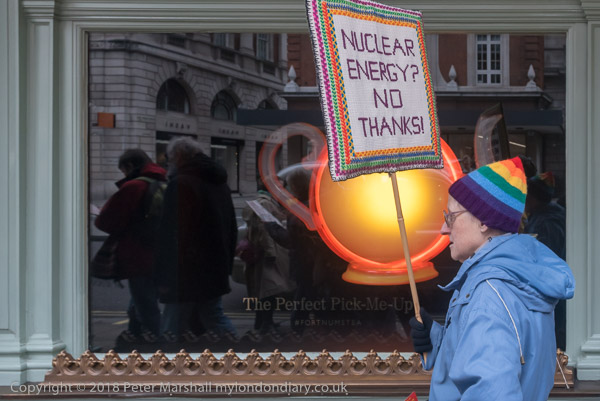
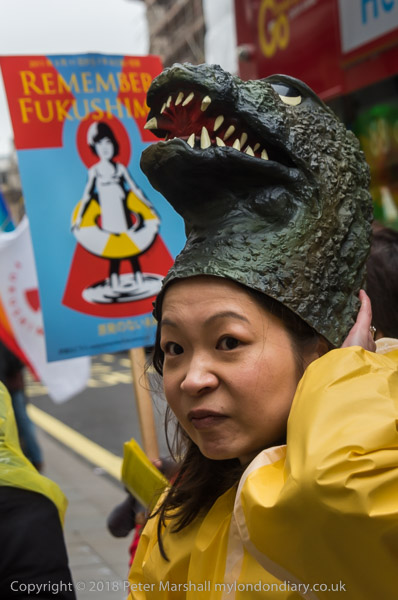
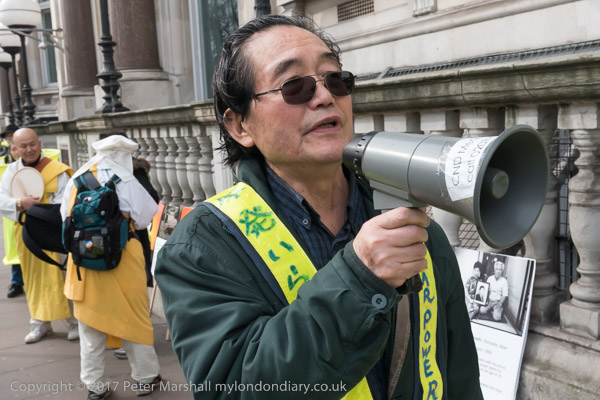
Campaigners in London held regular protests outside the Japanese Embassy and TEPCO’s London offices for some years and have organised larger annual protests on or close to the March 11th. Among the on-line events scheduled for 2021 is the free International Uranium Film Festival with two films online including Fukushima No Daimyo, a 2014 Italian film (in Japanese with Portuguese sub-titles) from March 11-18.

More pictures on My London Diary:

2017: Fukushima anniversary challenges nuclear future
2018: Remember Fukushima, 7th Anniversary
2019: Remember Fukushima 8 years On
and in 2011, 2013 and 2014.


All photographs on this and my other sites, unless otherwise stated, are taken by and copyright of Peter Marshall, and are available for reproduction or can be bought as prints.


Stop Trident, Save Refugees…

Last Tuesday I watched John Pilger’s 2010 film, The War You Don’t See, a film that takes an honest look at wars and the failure of most journalists to report honestly on them – and how those that do find their work fails to get broadcast or printed. It’s an at times harrowing view of war and lays open the whole huge PR web of lies that is used to persuade the public that they are necessary and to support them, based mainly around the propaganda over Iraq and Afghanistan.

It is now a matter of official record that all of the reasons put forward at the time for the invasion of Iraq, notably in the UK by Prime Minister Tony Blair were lies; but not only that, were known at the time to be false. It was simply a war for the control of Iraqi oil, and to keep the military industry growing. Of course many of us outside the
CIA and other agencies also knew that at the time, including the over a million who went to protest in London.

Pilger managed to get interviews with a wide range of people, including journalists and others who admit that they failed for various reasons to inform the public what was really going on. Those from other news sources, including the BBC, make a wholly unconvincing attempt to justify the approach they took, visibly squirming as Pilger asks his questions, trying to defend their toeing the government line rather than examining the evidence and reporting objectively.

We are in an age of perpetual war, not largely because of real disputes that could not be solved by other means, but manufactured and promoted by a huge web of deceptions to feed what is sometimes called the military-industrial complex, a term coined by Eisenhower for his final public speech in 1961 when he warned of the “economic, political, even spiritual” dangers of “the disastrous rise of misplaced power” it it could – and has – produced.

Pilger’s film deals briefly with the bombing of Hiroshima and Nagasaki, which it is now clear served no military purpose as the war with Japan was rapidly drawing to a close when they were dropped. The film includes an interview he made in the 1980s with Australian journalist Wilfred Graham Burchett who managed to evade the military security that kept almost all journalists simply taking down and passing on the military briefings which denied the existence of radiation sickness and went to Hiroshima and reported on the terrible effects of the bomb.

Despite censorship and other attempts to stop his report reaching the outside world, the first 200 words of his 3,000 word report reached the Daily Express who put it on the front page – and the world learnt of how 30 days after the bombing apparently uninjured people were still “dying, mysteriously and horribly” from what Burchett described as “the atomic plague.”

Journalists who step out from the official line can expect to suffer, and many. particularly those who refuse to be led and “embedded” have been killed reporting on wars. Others, such as Julian Assange find themselves the subject of deliberate campaigns to harass and discredit them – and in his case to imprison him in solitary confinement – possibly to be extradited to life in solitary in the USA – despite an extradition treaty that excludes those accused of political crimes.
Our so-called Independent Nuclear Deterrent is wholly a programme to feed that military-industrial complex, with its chilling threat hanging over us all, something that at least one US president has been prepared to consider using and which only the willingness of one Russian soldier to disobey orders saved us from its accidental unleashing.

On Saturday 27th February, around 60,000 came to Marble Arch to march from there to a rally in Trafalgar Square against government plans to replace the UK’s Trident nuclear weapons at a cost of £180 billion or more. They said Trident is immoral and using it would cause catastrophic global damage; these weapons of mass destruction don’t keep us safe and divert resources from essential spending on services like the NHS, schools and housing.

I was a little late to the official photocall because of the dense crowds as I made may way from the European March for Refugee Rights which had finished with a rally a short distance away in Hyde Park. This was taking place in various cities across Europe and demanding that governments take action now to open secure safe passage routes for all refugees and asylum seekers seeking protection in Europe. They called for an end to deaths at borders and for refugees to be allowed to keep their possessions and be reunited with their families.

At the end of this march, many of those taking part went to join the Stop Trident march, some forming up as a group ahead of the official front of the march despite attempts by the Stop the War stewards to move them. Eventually the stewards halted the main march for around ten minutes to create a gap between the two groups.

Stop Trident Rally
Stop Trident March
European March for Refugee Rights


All photographs on this and my other sites, unless otherwise stated, are taken by and copyright of Peter Marshall, and are available for reproduction or can be bought as prints.


End Nuclear Weapons Now

Six years ago on 24 January 2015 I photographed a large protest in London calling on the UK to end its huge and pointless investment in nuclear weapons, calling for Trident to be scrapped and not replaced. We waste many billions on procuring and maintaining nuclear weapons – currently around £3 billion a year according to government estimates – on weapons that hopefully will never be used as the consequences would be too disastrous and also ultimately futile as it would lead to retaliation that inevitably would entirely destroy a small and densely populated country like ours.
Our nuclear weapons take up around 6% of the defence budget but offer no defence but are entirely a matter of prestige, something we use to continue to justify our continuing permanent seat on the UN Security Council as founding members under the 1945 UN Charter – along with China, France, Russia and the United States. And along with direct expenditure on the weapons we have also paid more for our electricity as the military nuclear weapon programme has depended on expensive civil nuclear power to provide materials.
Thanks to a sustained campaign by The International Campaign to Abolish Nuclear Weapons (ICAN) and others, the UN in 2017 adopted the UN Treaty on the Prohibition of Nuclear Weapons (TPNW) and last October this had been signed and ratified by the required 50 nations and so entered into force on 22 January 2021. Ireland and Austria are so far the only major European countries to have signed up, along with Mexico, but the majority of Caribbean and South American countries have ratified it (and most of the others signed but not yet ratified) among with others from around the world. Altogether 137 countries have now signed up, though 86 have yet to ratify. ICAN were awarded the 2017 Nobel Peace Prize for its acheivement.

So far none of the nine states which actually have nuclear weapons – Russia, USA, France, UK, China, Pakistan, India, Israel and North Korea (in order of the number of warheads they hold) – have signed the up to TPNW. Nor have any of the other 27 NATO countries – essentially a part of the US military empire, many with US nuclear weapons on their soil. Only around another 20 states have yet to sign the TPNW.

ICAN has a list ‘What makes nuclear weapons the worst’, which makes the following points.

1 A single nuclear weapon can destroy a city and kill most of its people. Several nuclear explosions over modern cities would kill tens of millions of people. Casualties from a major nuclear war between the US and Russia would reach hundreds of millions.

2 The extreme destruction caused by nuclear weapons cannot be limited to military targets or to combatants.

3 Nuclear weapons produce ionizing radiation, which kills or sickens those exposed, contaminates the environment, and has long-term health consequences, including cancer and genetic damage.

4 Less than one percent of the nuclear weapons in the world could disrupt the global climate and threaten as many as two billion people with starvation in a nuclear famine. The thousands of nuclear weapons possessed by the US and Russia could bring about a nuclear winter, destroying the essential ecosystems on which all life depends.

5 Physicians and first responders would be unable to work in devastated, radioactively contaminated areas. Even a single nuclear detonation in a modern city would strain existing disaster relief resources to the breaking point; a nuclear war would overwhelm any relief system we could build in advance. Displaced populations from a nuclear war will produce a refugee crisis that is orders of magnitude larger than any we have ever experienced.

6 Whether or not they are detonated, nuclear weapons cause widespread harm to health and to the environment.

7 Spending on nuclear weapons detracts limited resources away from vital social services.

ICAN: catastrophic harm

The Treaty on the Prohibition of Nuclear Weapons includes a comprehensive set of prohibitions on participating in any nuclear weapon activities. These include undertakings not to develop, test, produce, acquire, possess, stockpile, deploy, use or threaten to use nuclear weapons. It also has provisions for assistance to individuals affected by nuclear weapons testing and for environmental remediation.

Public opinion in the UK in a recent Survation Poll conducted for https://cnduk.org/tpnw/ CND showed 77% of the UK public support a total global ban on nuclear weapons and 59% want the British government to sign the UN Nuclear Ban Treaty.

CND Scrap Trident rally at Parliament
‘Wrap Up Trident’ surrounds Defence Ministry
Christian CND against Trident Replacement


All photographs on this and my other sites, unless otherwise stated, are taken by and copyright of Peter Marshall, and are available for reproduction or can be bought as prints.


Peace, Slavery & Social Cleansing

Three years ago December 9th was a Saturday and people were out on the streets in at least three protests which I photographed.

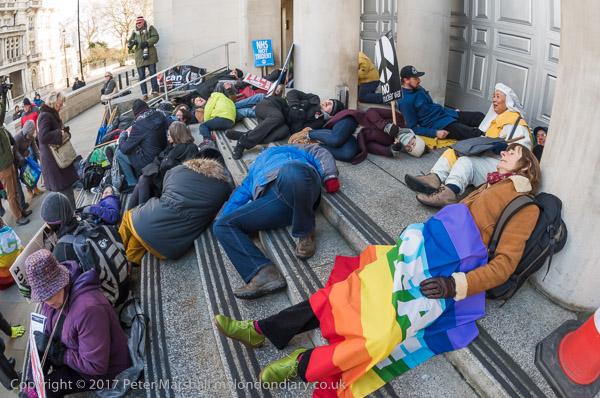
My day’s work began at the Ministry of Defence, where peace campaigners celebrated the award of the 2017 Nobel Peace Prize to ICAN, the International Campaign to Abolish Nuclear Weapons, with a die-in on the steps.

ICAN was awarded the prize for its role in pushing for a United Nations global nuclear ban treaty which was approved by 122 nations at the UN General Assembly in 2017. In October 2020 Honduras became the 50th country to ratify it and will come into force on 22 January 2021. The UK government refused to take and part in the negotiations and has refused to sign the treaty and the award of the Nobel prize hardly got a mention in the UK media.

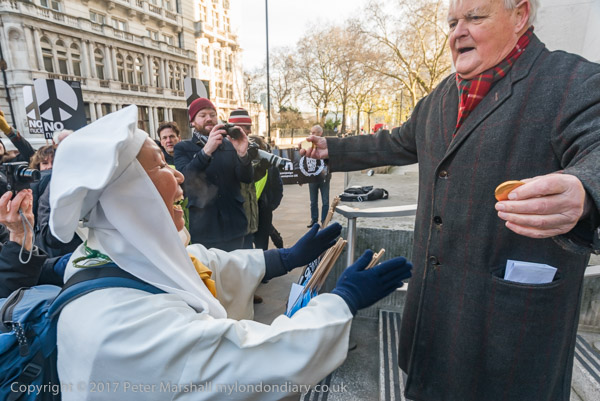
None of the main nuclear powers has signed the accord, and the protesters including members of ICAN UK, CND, Medact and WILPF, the Women’s International League for Peace and Freedom, urged the UK to sign up and scrap Trident replacement. Bruce Kent made a presentation of a large cardboard Nobel Prize to ICAN UK, and handed out small ‘Nobels’ (gold-covered chocolate coins) to all who come up for them. After a few speeches there was then a die-in on the steps of the ministry.


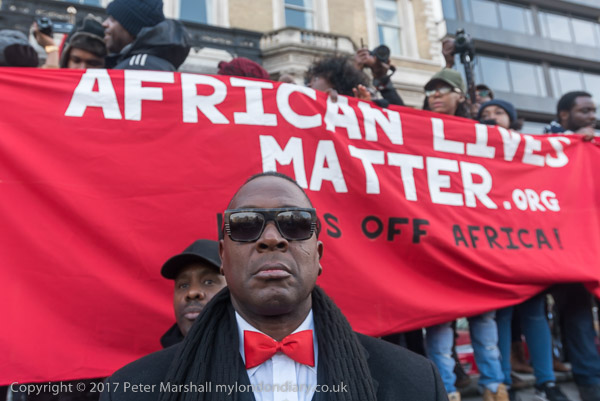
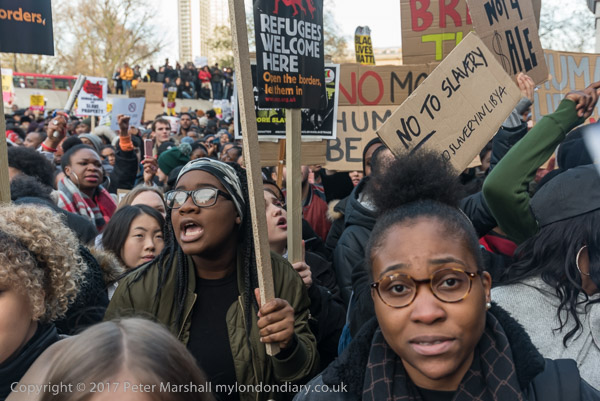
A large crowd had gathered in Belgrave Square for the National Anti-Slavery March, organised by African Lives Matter after the news that African migants detained in Libya were being sold as slaves by Arab slave traders.

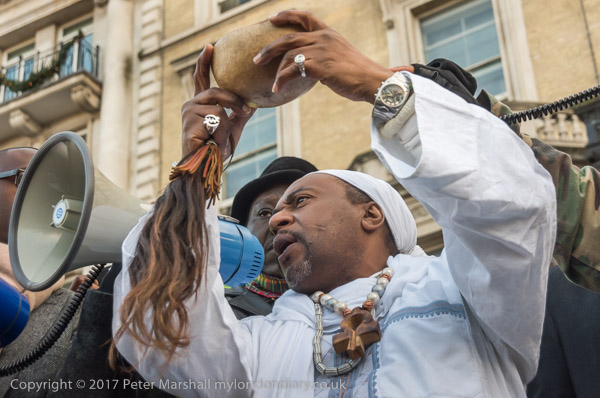
They marched to Knightsbridge and then along to Hyde Park Corner, going around the roundabout and then back along the other carriageway of Knightsbridge to the Libyan Embassy where there was a lengthy rally, including an African priest leading a libation ceremony in memory of the many Africans who have fought for their people against enslavement and colonialism; people in the crowd shouted out names for him to honour with pouring water onto the ground.

As well as demanding the closure of the Libyan detention centres, action by African governments to rescue people detained in the camps and condemnation of the slave trade and murders of migrants by all African leaders and the UN, calling on Libya to make and enforce laws that prevent these crimes against humanity, many also demanded reparations for the historic slave trade and the continuing despoliation of African resources by imperialist nations including the UK.


I had to leave before the rally ended as I was beginning to shake and feel unwell, weak and dizzy, the signs of an diabetic hypo, and I walked a short distance away to sit down eating one of the snacks I carry to give a rapid boost of my blood sugar. Soon I was feeling well enough to eat my lunch and take the tube to my final event of the day, a vigil outside Lambeth Town Hall in Brixton against the heartless policies of Lambeth Council.

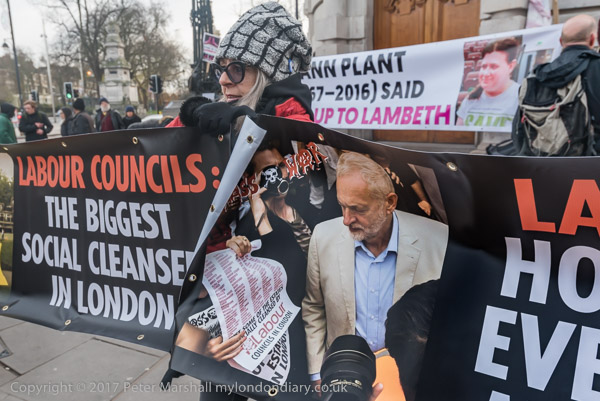
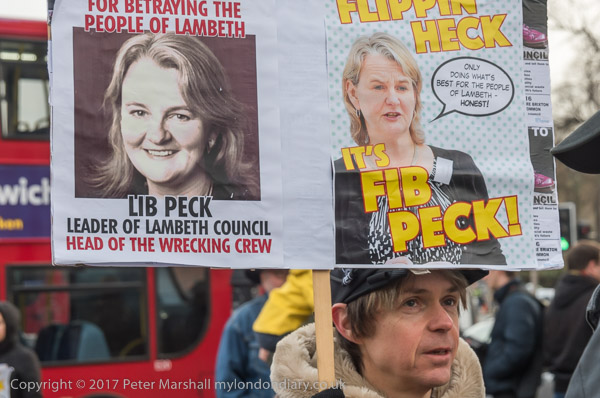
Lambeth are one of the London Labour councils who are pursuing a policy of social cleansing under the guise of regeneration, realising the asset value of council estates by demolition and rebuilding with only small provision of social housing, resulting in many local council tenants and leaseholders being forced to move out of the area.

Lambeth have also made drastic cuts, shutting down community centres, cutting services for the disabled, those with mental health problems, young people and social services generally; although the Council claim these actions have been forced on them by Tory government cuts, the protester point out that Councillors’ expenses and allowances keep on growing and they have spent over £150m on a new Town Hall.

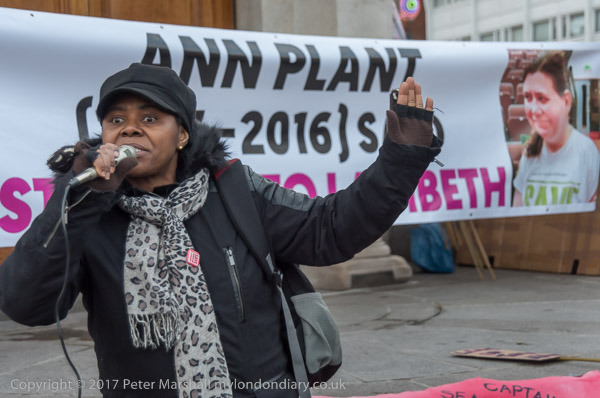
The vigil included a tribute to Cressingham Gardens resident and leading campaigner Ann Plant who died of cancer in December 2016, spending her final months continuing the fight to prevent the demolition of her home and her community by the council.

More from all 3 events on My London Diary:

Stand Up to Lambeth protest and vigil
National Anti-Slavery March
ICAN Nobel Peace Prize Die-In


All photographs on this and my other sites, unless otherwise stated, are taken by and copyright of Peter Marshall, and are available for reproduction or can be bought as prints.