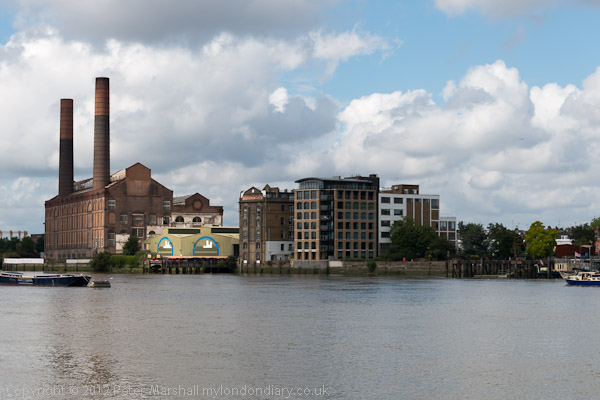
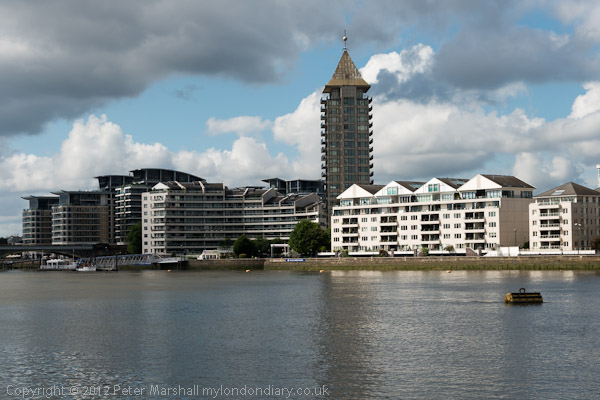
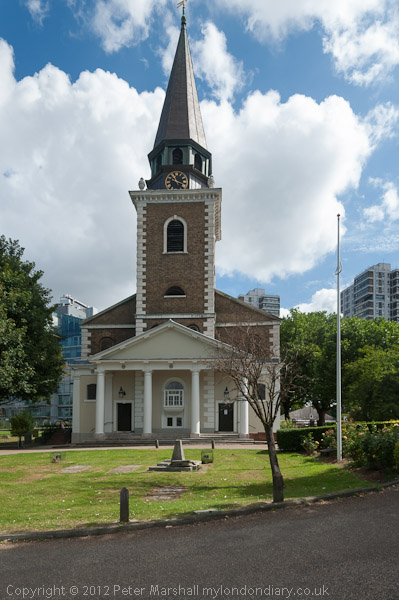
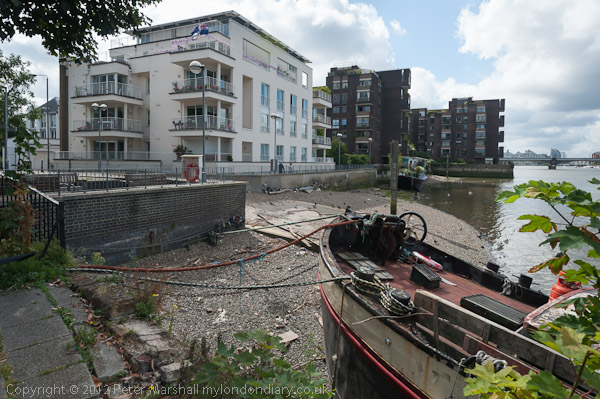
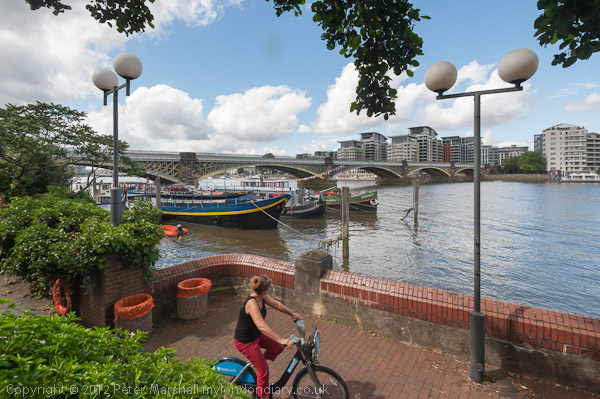
River Thames – Battersea Riverside: Tuesday 14th August 2012 was a nice day with blue sky and some interesting clouds in the sky and I had an hour or two to spare.
So I took a walk from Battersea Bridge to Wandsworth along the Thames Path.
Battersea Bridge crosses the river to Chelsea and I photographed the views over the river towards Lots Road Power Station and Chelsea Harbour.
This is a stretch of the river I’ve walked quite a few times over the years. It’s an easy journey for me to get there but it is also one of the more interesting and varied to walk.
When I first walked this way in the 1970s this was an industrial area, with factories and wharves and limited access to the river. Now the Thames Path takes you along the riverside with just some short diversions.
Most of the riverside is now lined with blocks of expensive flats rather than the flour mills, oil depots and a power station at Fulham I photographed back then.
Silver Belle Flour, mill, Battersea, 1991
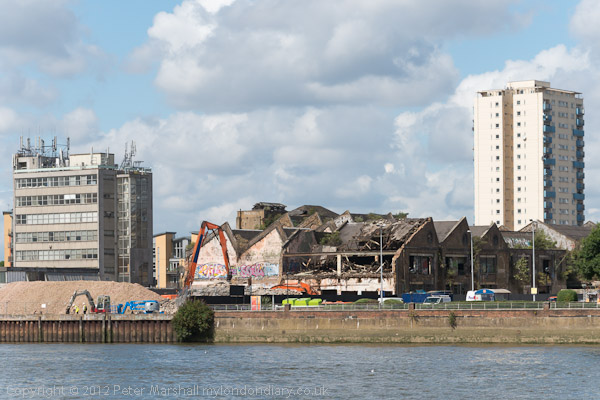
There are still a few traces of that industrial past, though some were being demolished on both sides of the river back in 2012.
Demolition at Fulham Wharf
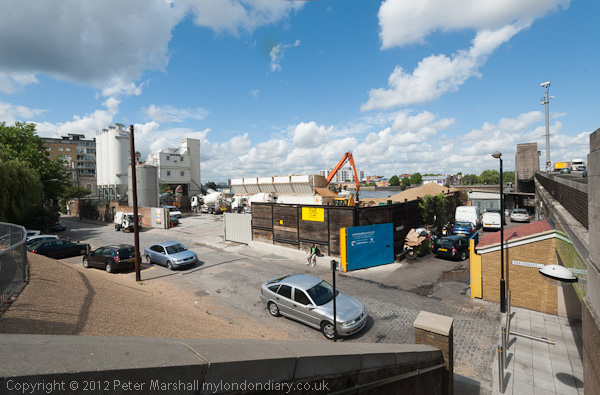
The sand and gravel works immediated upstream from Wandsworth Bridge was still there and still working when I last visited the area a few months ago, although I expect before long it will also be another luxury block of flats.
I think the best images I made that day before catching a train at Wandsworth Town were probably some panoramic images I’ve not included in this post as they don’t fit well in its format. You can see these and others from the walk on My London Diary at Battersea Riverside.
Workfare is a controversial policy first begun in the UK in the 1990s by the Conservative government of John Major, although it developed from earlier schemes which put active pressure on claimants to seek work. Under various different programmes and names workfare continued under New Labour, but it was under the Tory-led coalition in 2011-2 that it came into widespread use.
Workfare is used to describe schemes where in order to receive unemployment benefit people have to undertake unpaid work, either in the commercial or public sector or for charities. In 2011 the coalition government announced that those who had failed to find jobs after being unemployed for some time would have to work unpaid for 30 hours a week for six months, setting up a number of schemes to this end.
THe proponents of ‘workfare’ say that those forced to take part in these schemes benefit from the experience or working and that it will prepare them for paid work and that the experience will make it easier for them to find employment. They say it isn’t unfair to ask people to do something in exchange for the benefits they receive.
Academic studies by the DWP of international workfare schemes had shown that these claims were unsound. There was little evidence that workfare increased the chances of finding work, and that it might even reduce this, firstly because if people were on workfare they had less time to look for jobs, but also because workfare placements seldom provided the kind of skills and experience that potential employers were looking for.
Trade unions and others point out that every person on workfare actually cuts out a job that would otherwise be carried out by a paid employee – so there are fewer jobs for those seeking employment. Workfare is largely a subsidy to employers, supplying them with free labour – essentially a form of slave labour. Workfare schemes – whether in the private sector or public or charity work – fail to provide any of the employment status and protection that employees or workers receive.
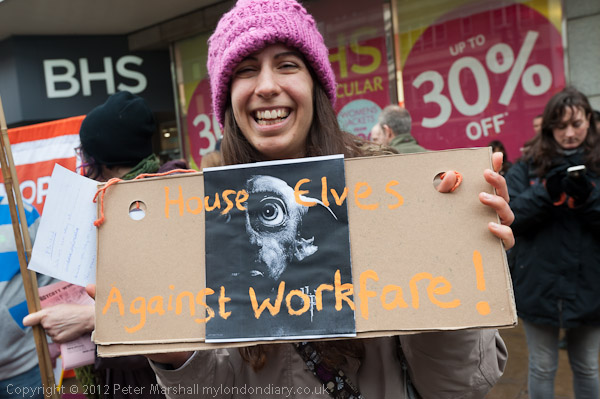
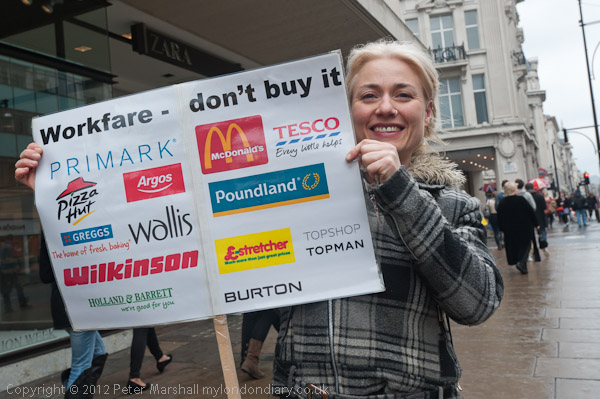
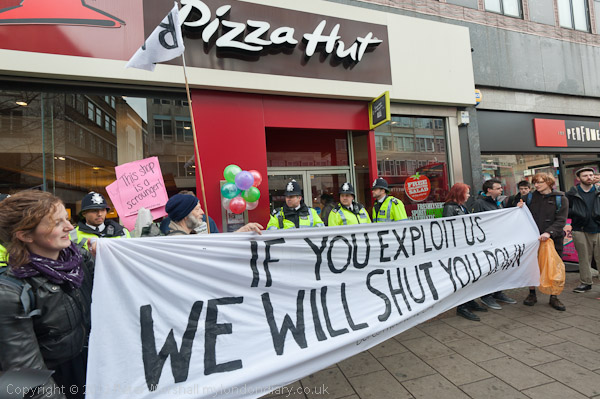
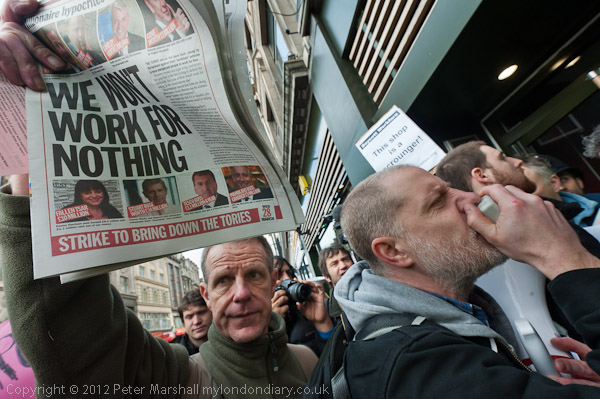
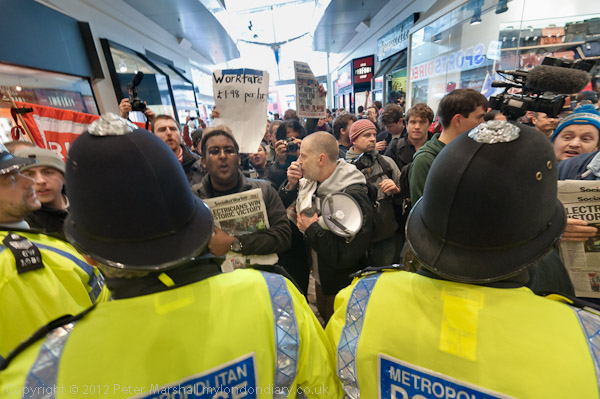
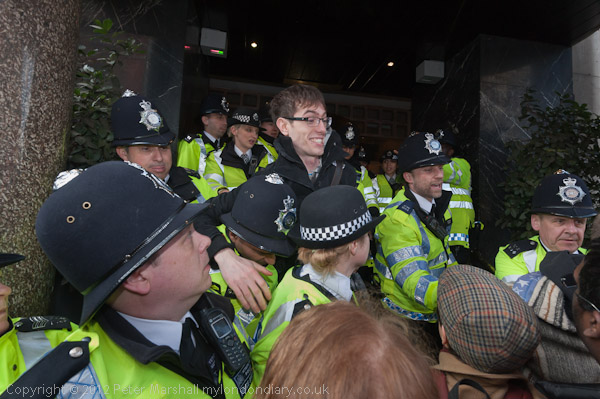
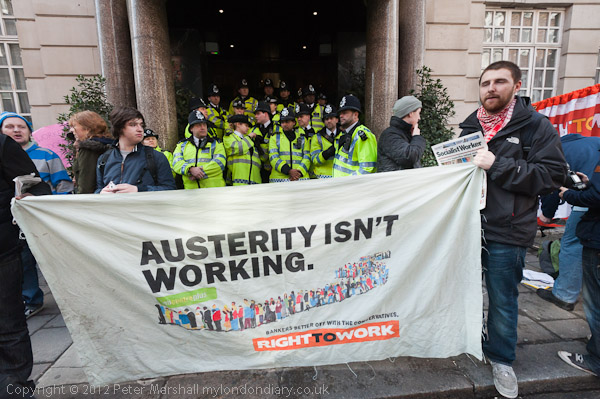
Strong negative reactions to these schemes – such as those demonstrated by the Boycott Welfare protest in Oxford St, London I photographed on Saturday 3rd March 2012 – led to many companies withdrawing from the scheme, and others ending talks with the government about taking part in it. According to Wikipedia, the campaign group ‘Boycott Welfare’ ‘very successful in making companies and charities pull out of “workfare”.’ By August 2016, “more than 50 organisations have ended their involvement in workfare, because of negative publicity.”
But workfare still continues, and as Boycott Welfare write on their web site, “Workfare forms a key tool of ‘compliance’ with the regime of Universal Credit, and is enforced via sanctions.” As well as Universal Credit, workfare also continues under the government’s Sector-Based Work Academies, Work and Health Programme and Youth Obligation schemes.
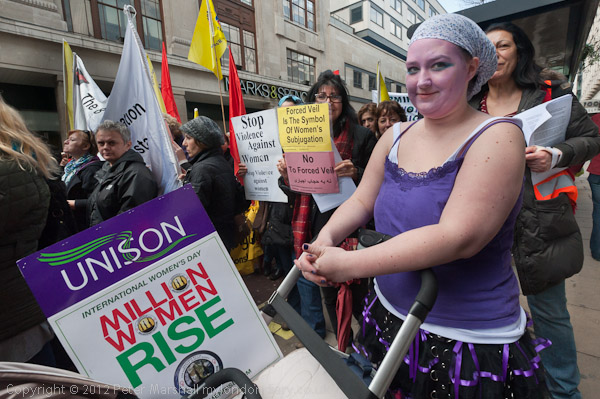
Also on the same day I photographed other events. Firstly the Million Women Rise March, a women-only march through the centre of London against domestic abuse, rape and commercial sexual exploitation and for the prevention of abuse and support and protection for women. I was shocked to learn from a member of one of the more active women campaigning groups that has been the among the leaders in previous celebrations around International Women’s Day and had taken part in previous years that they had been told they were not welcome on the march, though I think they have taken part in more recent years.
I left that march as it went down Oxford St on its way to a rally at Trafalgar Square and took the tube to St Paul’s where Greeks were protesting in solidarity with students and workers in Greece against the austerity measures being imposed as a part of the Eurozone rescue package for the country. They had planned to protest at the Occupy London camp, but that had been cleared a few days previously, but some of the occupiers had returned to hold a general meeting on the St Paul’s Cathedral steps.
All photographs on this and my other sites, unless otherwise stated, are taken by and copyright of Peter Marshall, and are available for reproduction or can be bought as prints.
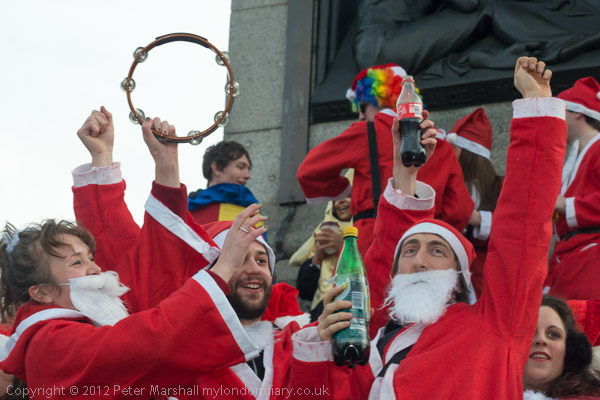
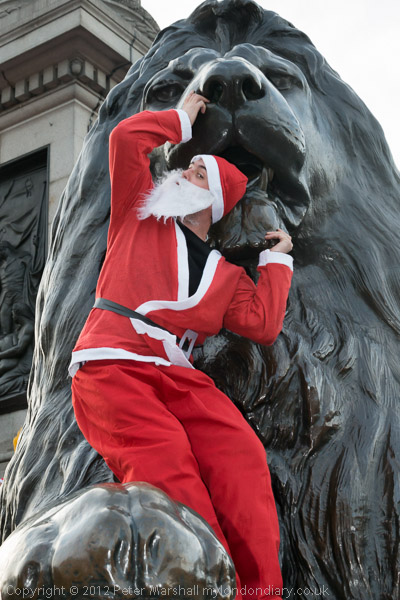
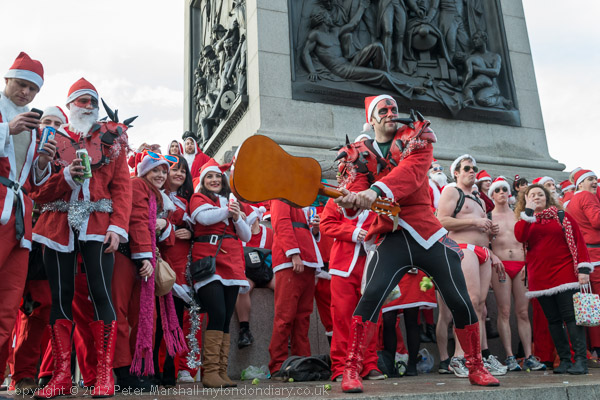
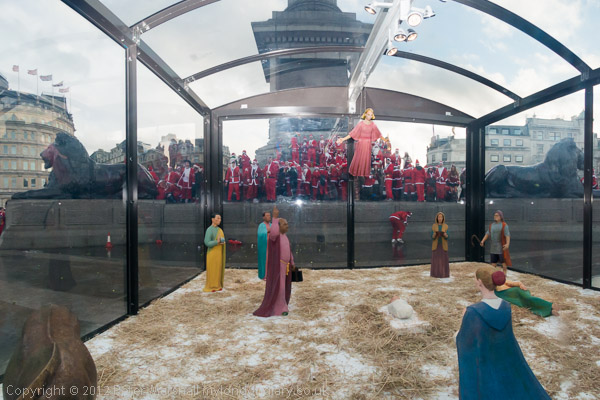
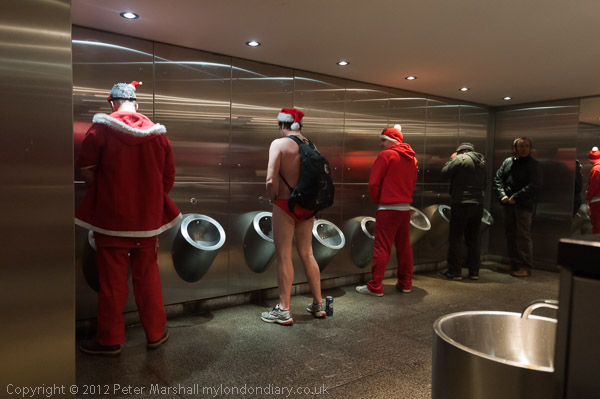
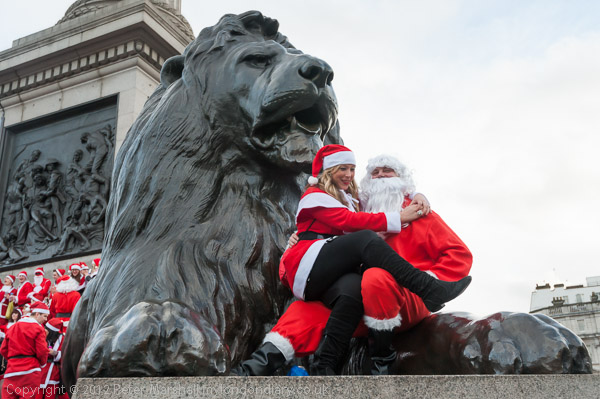
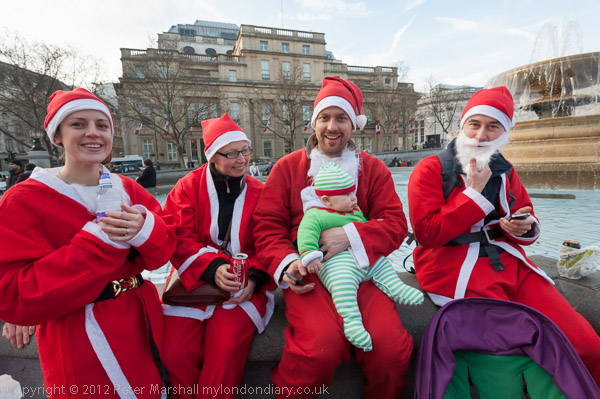
I think this may be my final post this year about Santacon, the “non-profit, non-political, non-religious and non-sensical Christmas parade” which I first photographed in London in 2006, though I think it had been taking place here for some years.
The first Santacon was in Copenhagen in 1974, begun by a street theatre group as a protest against the commercialisation of Christmas, when the Santas went into department stores and handed out presents from the shelves to customers – and were arrested.
A Santa on the plinth of Nelson’s column bats back brussel sprouts thrown by elves.
It became popular in the USA following a 1994 article about the Cophenhagen event which appeared in the magazine Mother Jones leading to a repeat performance in in San Francisco in 1995.
From there Santacon spread to other cities in the US and then to over 40 other countries as a fun day out wearing Santa costumes and roaming the city drinking on the street with friends. The largest Santacon, in New York, by 2012 had an estimated 30,000 people taking part, and it was condemned by most of the media, with the New York Times criticising it (quoted on Wikipedia) for “sexism, drunkenness, xenophobia, homophobia and enough incidents of public vomiting and urination to fill an infinite dunk tank” and saying it contributed nothing to the areas where it takes place. The organisers pointed out that in 2013 it raised $60,000 for New York charities and donated around 3 tons of canned food to a New York food bank.
Since then the city authorities in New York and also in London have clamped down on Santacon in various ways, and what was a largely autonomous and unplanned event has been forced to organise and toe various lines.
The London 2018 Santacon had raised over £15,000 for the charity Christmas for Kids. But there was no official event in London in 2019 bacause the organisers were unable to attract sufficient volunteers to organise the 2019 event and satisfy the requirements for them to police it. They issued a statement on their Facebook page dissociating themselves from those who they encouraged to organise their own celebrations to avoid possible prosecution.
Nothing official will be announced from Santacon London this year, if you see an event called Santacon it’s not us and remember Santacon is meant to be free (with the exception of charity donations) and never includes a Santa costume. Santa makes their own (or put their elves to work).
Santacon London FB page
Despite the lack of any official event, several thousand Santas still took part in 2019, most ending up – as in previous years – in Trafalgar Square, though I had other things to photograph. And although Covid restrictions will certainly mean there is no official event this year, I suspect quite a few Santas may have made their way to Trafalgar Square last Saturday.
All photographs on this and my other sites, unless otherwise stated, are taken by and copyright of Peter Marshall, and are available for reproduction or can be bought as prints.