By 1947 Britain had boxed itself into an impossible position in India (not least by the earlier actions of Lord Curzon as Viceroy in Bengal in 1905) and it was clear that the only option was for a British withdrawal from the whole area. Clement Atlee who had become UK prime minister since the 1945 election had long been a supporter of Indian independence and the question was not whether this should happen, but how it could be managed in a way that satisfied both Muslim and Hindu communities and avoided catastrophic bloodshed.
It was indeed a hugely complex situation. As well as the British Raj, there were also several hundred princely states in a looser arrangement with British rule. And as well as Muslims and Hindus, there were also some areas where Sikhs, Buddhists and Jains were in the majority. The British Government ruled that the area would become independent at the latest by June 1948, but Lord Mountbatten, newly appointed Viceroy announced his plan on June 3 1947 with independence only just over 2 months away on 15 August 1947.
The plan called for various existing Indian legislatures to vote on whether to be a part of India or Pakistan or be partitioned and set up a boundary commission to establish partition, but failed to deal with the princely states, where the decision of which dominion to join would be a matter for the prince alone.
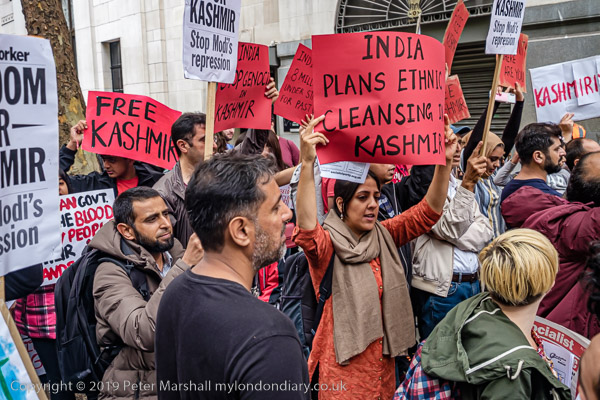
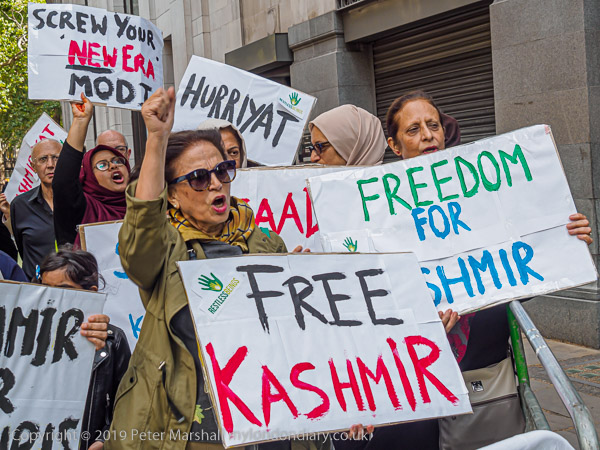
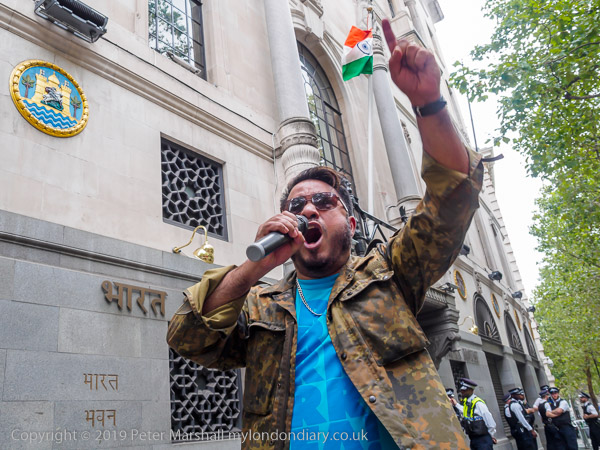
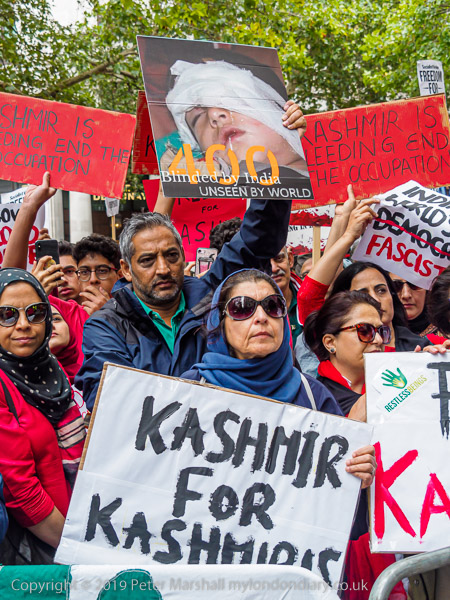
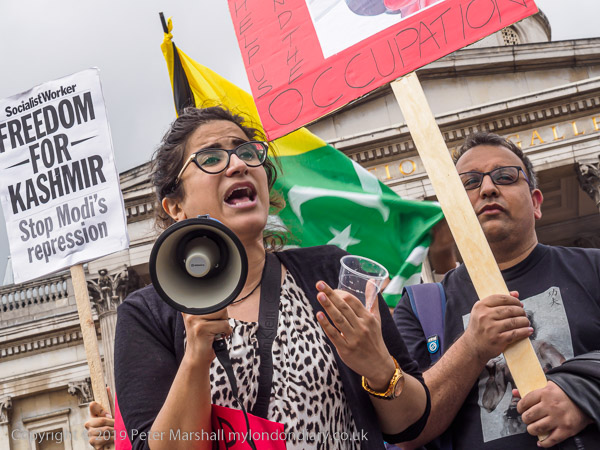
Protesters in Kashmir have been killed and many deliberately blinded bu Indian forces
Mountbatten was clearly poorly advised and was as he said a soldier not a civilian and he assured those who predicted a bloodbath at partition that the army would be able to control the situation: ” I shall see to it that there is no bloodshed and riot.” In the event around 10 million people were displaced and somewhere between 200,000 and 2 million killed, with violence being encouraged by some of the princely rulers, including in Kashmir.
Kashmir had a Muslim majority but a Hindu prince who was hesistant to join Pakistan and went to Mountbatten for military help when Pakistani forces invaded part of the area; Mountbatten agreed to help on condition it would become a part of India. In 1948 the UN intervened and brokered a ceasefire, declaring that a referendum of Kashmiris be held – which never happened. There were further military conflicts between India and Pakistan in Kashmir in 1965 and 1999.
Since then the Indian controlled area named Jammu and Kashmir has been under military occupation by Indian troops. The severity of control by police and army increased following an armed revolt by Kashmiris calling for independence in 1989. Elections in the area are now widely thought to be rigged in favour of pro-India groups.
The special position of the area was recognised in 1954 by Article 370 of the Indian constitution, with separate laws on citizenship, the ownership of property and fundamental rights. In particular these prevented non-citizens of the area buying land and property in the state.
On 5th August 2019 the Indian government cancelled the 1954 provisions, bringing Jammu and Kashmir under the same conditions as other Indian states. Kashmiris protested and there was a further security clampdown, with communications to the country being severed and a further influx of Indian soldiers – there are now around 800,000 there.
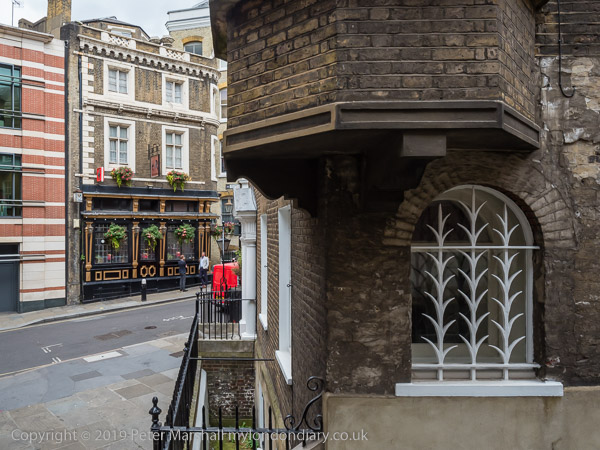
The area by St Andrew-by-the-Wardrobe, an Anglican church a few hundred yards south of St Paul’s Cathedral fascinated me when I first walked by it in the 1970s, and of course I’ve tried to photograph it over the years with various success, though mainly failure.
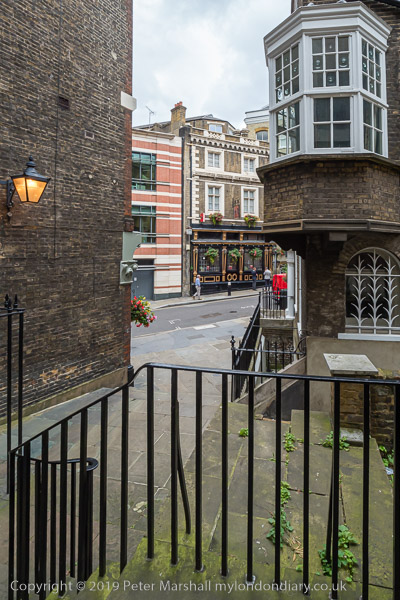
This picture, taken from the steps up to a locked door into the church is one that I found impossible on colour film, with the gloomy alley – with a light on even in the middle of the day when I took this picture contrasting with the more brightly lit street with The Cockpit pub. But the day was overcast, reducing the contrast and the digital camera coped well, though needing some dodging and burning in Lightroom to give the results here.
I didn’t go into the church though I have been inside on at least one previous occasion, just following an Indian Orthodox service there, when the atmosphere was thick with incense. The site has an interesting history, with a church here for perhaps a thousand years or more, though the first written mention is in 1170 or . It became part of an ancient royal residence, Baynard’s Castle, and in 1361 Edward III or Edward IV moved his royal clothes and arms from the Tower of London to a more handy site in a building close by.
Like most of London it was destroyed in the Great Fire of 1666, and was rebuilt in 1695 to one of the simplest and last of Christopher Wren’s many church designs. Although it now looks ancient, it was mostly destroyed again by German bombing in 1940 and rebuilt and reconsecrated in 1961, with most of its internal decor being salvaged from previously demolished Wren churches. Among the memorials on its walls is a modern carved wood one for William Shakespeare, a parishoner for 15 years.
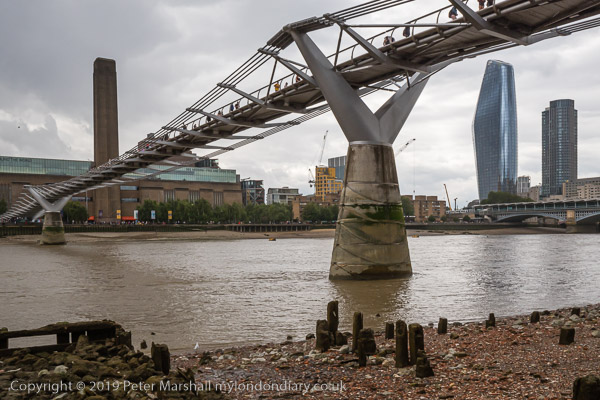
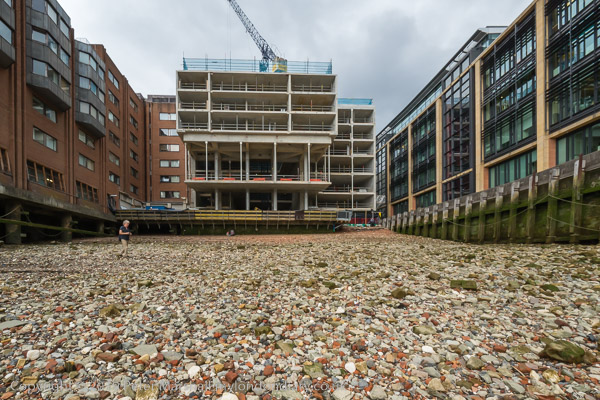
From the church I crossed Queen Victoria St and made my way down to the riverside walkway. There was an extremely low tide and I went down the steps onto the foreshore, which here is sand and shingle with many remains of wooden posts.
I walked the short distance along to Queenhithe, a historic monument as London’s first dock though the Roman and Saxon docks are now all buried beneath the mud and stones or hidden behind the visible more modern river walls and the area is surrounded by rather boring modern offices.
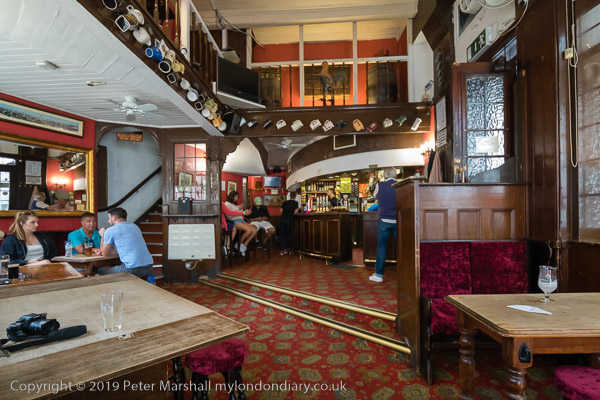
I went back and up onto the riverside walkway and then made my way to meet with friends for a short walk through the city, on which I took a few more photographs. One of the places we visited was where I had begun taking pictures, and this time we went inside The Cockpit on St Andrews Hill opposite the church, one of London’s smaller and more fascinating places.
Although the text for it’s grade II listing states tha the building is ca 1860, but the interior is in part older. The pub claims to have been established in 1787 and to have been rebuilt in 1842 and that it was once Shakespeare’s home – and certainly it is on the corner of Ireland Yard where he is known to have lived.
The interior is literally a ‘cockpit’ and the bar and seating is on the very floor where the pair of gamecocks, equipped with razor-sharp metal spurs would be set to fight to the death while gamblers looked on from the balcony above. Cock-fighting was banned in England and Wales by the Cruelty to Animals Act 1835 and the last fight in this pub was said to have been in 1849. Apparently there are still some illegal fights in the UK.
All photographs on this and my other sites, unless otherwise stated, are taken by and copyright of Peter Marshall, and are available for reproduction or can be bought as prints.
There are no adverts on this site and it receives no sponsorship, and I like to keep it that way. But it does take a considerable amount of my time and thought, and if you enjoy reading it, please share on social media. And small donations via Paypal – perhaps the cost of a beer – would be appreciated.
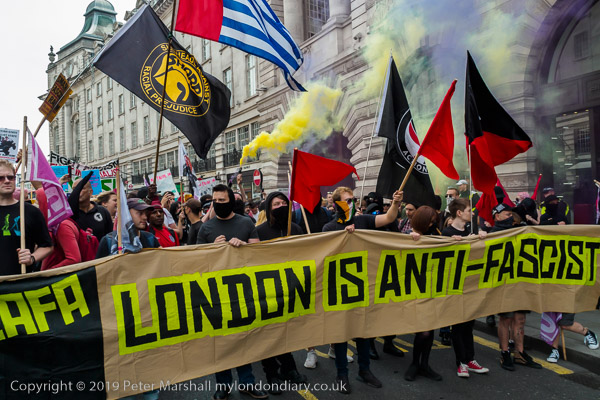
London has a long tradition of standing up to attempts by fascists to march through the city, not least of Cable St in 1936 and the battle of Bermondsey a year later.
Of course it’s also true that many of the supporters of Mosley were Londoners – and Bethnal Green in particular was one of their stronger areas with Mosley claiming 4,000 members there. And many of those who came to Shoreditch in 1978 when the National Front moved its HQ there were also Londoners, as were the 2000 who packed the top of Brick Lane attempting to stop them.
More recently anti-fascists have come out on the streets to stop the marches of the EDL in Walthamstow and Whitechapel and against supporters of Tommy Robinson.
While the crowd were trying to defend Brick Lane in Shoreditch in 1978, the Anti-Nazi League, formed by the Socialist Workers party and others was holding their event in opposition to the NF, a much larger Carnival Against the Nazis miles away in Brockwell Park, Brixton, seen by many in East London as a diversion from the real fight against the fascists.
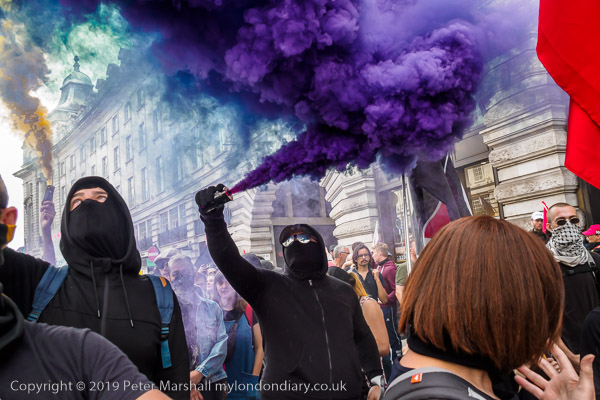
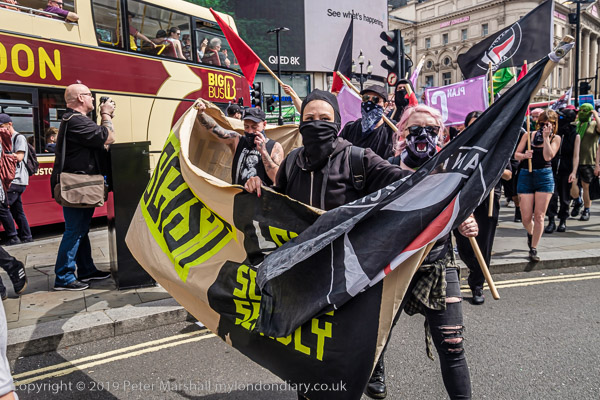
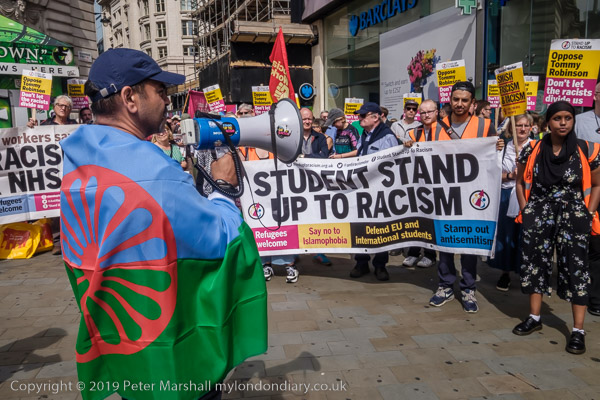
On this occasion there was a similar split of the opposition to the ‘Free Tommy’ protesters, but at least they were roughly in the same place, with London Anti-Fascist Alliance meeting around Eros in Piccadilly Circus and across the street on the wide pavement outside Boots and Barclays was a small rally by Stand Up to Racism.
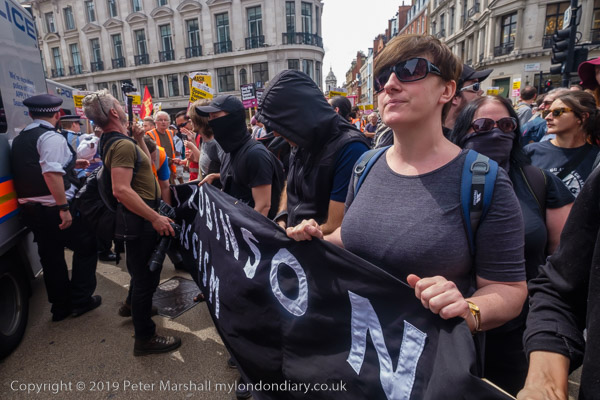
And once the London Antifascists began the march up Regent St towards the Free Tommy protesters who were gathering outside the BBC, most or all of the Stand Up to Racism supporters joined in behind them. Police stopped the combined march at the junction with Hanover St. The anti-fascists made a tentative effort to turn into Great Marlborough St, but were blocked by a police line in front of a row of police vans. They then left as directed by the police who took them down Hanover St, and from Hanover Square turned up to cross Oxford St and go up to Cavendish Square.
Police again blocked an attempt to turn right and return to Regent St and the march came to a halt. I left at this point, first to go and briefly view the ‘Free Tommy’ protesters who were being held by police in front of the BBC, and then to photograph a small protest taking place at Downing St.
I returned to the BBC around an hour later, and the right wing protesters were still there, fed up with the police not allowing them to march. By that time the anti-fascists had apparently come close enough to make their presence felt and after some spending some time shouting appeared to have dispersed. I felt it was time for me to go home as well.
After I got home I heard that finally the police did allow the fascists to march, several hours later than intended. There were apparently a few incidents on their way, and some of them attacked pro-democracy protesters outside the Algerian embassy, presumably because they were foreign.
All photographs on this and my other sites, unless otherwise stated, are taken by and copyright of Peter Marshall, and are available for reproduction or can be bought as prints.
There are no adverts on this site and it receives no sponsorship, and I like to keep it that way. But it does take a considerable amount of my time and thought, and if you enjoy reading it, please share on social media. And small donations via Paypal – perhaps the cost of a beer – would be appreciated.
December is always a fairly light month for protests, but I did even fewer than usual last month. Partly this was because of the lousy weather – I don’t like working in the dark and in the rain and only cover those events that for some reason particularly interest me. Then there was an election, which I made a decision not to cover, and with a result that, though I wasn’t surprised, still left me seriously depressed for a few days.
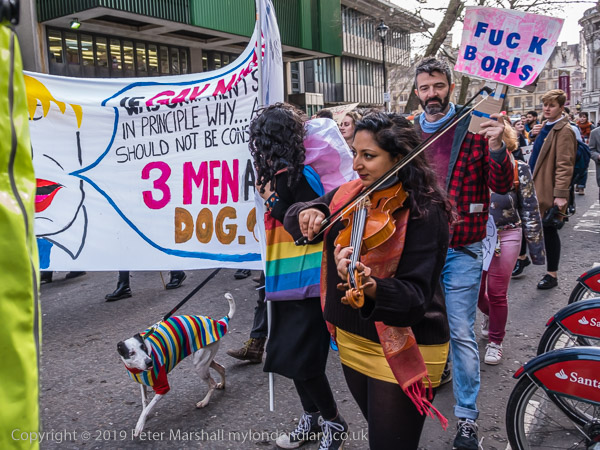
But there were good things too last month. I did enjoy Christmas, and a trip up to Matlock, and a fourth grandchild was born as the election results were being announced. And some protests, like the wedding of three men and a dog were fun to be at.
All photographs on this and my other sites, unless otherwise stated, are taken by and copyright of Peter Marshall, and are available for reproduction or can be bought as prints.
There are no adverts on this site and it receives no sponsorship, and I like to keep it that way. But it does take a considerable amount of my time and thought, and if you enjoy reading it, please share on social media. And small donations via Paypal – perhaps the cost of a beer – would be appreciated.
The 14th and last of the series of posts of selected black and white pictures I made in 1980 with the comments I posted more recently daily on Facebook. Larger versions of the pictures are now available on Flickr.
Apologies for some earlier posts in this series that were titled as London 1990 – and I hope I have now corrected all these. It will be a little while before I have caught up with my work from 1990! This is the final post of pictures that I made in London in 1980.
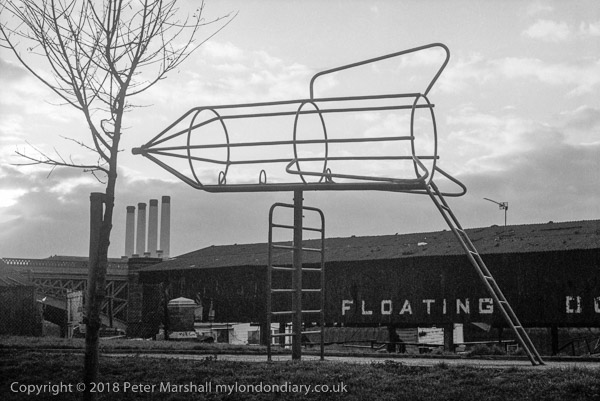
Playground, Battersea. 1980 26r-24: spaceship, playground power station, bridge,
Behind the spaceship in a childrens’ playground are the four in-line chimneys of Fulham Power Station, decommissioned in 1978 and one of the first power stations that the CEGB was made redundant and sold for redevelopment. The demolition in the early 1980s became controversial over the safety of the removal of around 1,000 tons of asbestos by the new owners. Because of this the government announced that the CEGB would strip asbestos before selling power stations in future.
The Regent on the River apartments that replaced the power station in the 1980s supposedly were designed to reflect the architecture of the power station.
I carefully framed the word ‘FLOATING’ underneath the spaceship, thinking of it floating in space. I think this was a floating dry dock. At left you can see a small part of the Battersea Rail Bridge, now used by London Overground services between Clapham Junction and Willesden Junction, then I think solely a goods line. I’m fairly sure the playground where I took this is now underneath a large block of riverside flats, Groveside Court on Lombard Rd, though some open space remains a little further north in Vicarage Gardens.
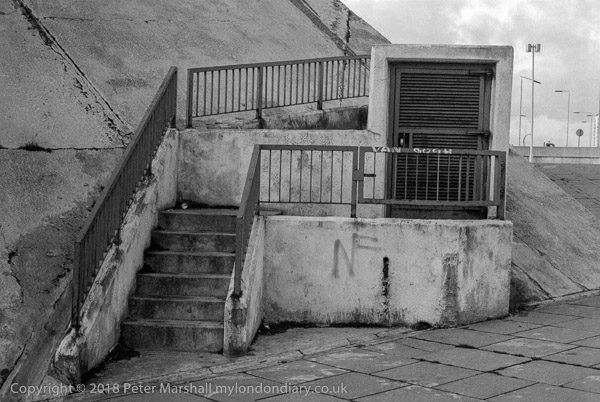
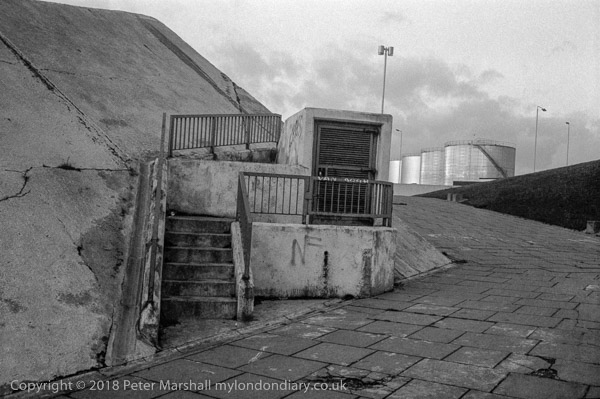
Another picture of the inside of the roundabout which was completed around 1972 and has appeared on record covers as well as being used as a film location – famously where Alex and his droogs beat up a singing drunk in Kubrick’s adaption of A Clockwork Orange. I have no idea why someone has painted Van Gogh on the railings -the Serbian rock group of that name was only founded six years later, but perhaps there may have been an earlier more local manifestation. And the National Front have been here too. There is a sinister look to this structure and doorway, and though I have no idea what is inside this concrete structure, it could well be a torture chamber.
The roundabout now has a rather odd metal structure on it, the ‘Atom’ monument, with two circular metal rings holding up a box with advertising screens for JCDecaux. If – as the firm who erected it claim – the adverts on it attract a great deal of driver attention, then they clearly decrease road safety at this critical junction. I can find no evidence for a local rumour that famed Brazilian architect Oscar Niemeyer had any part in its design. Wandsworth Council includes the structure on its list of works of art in the borough.
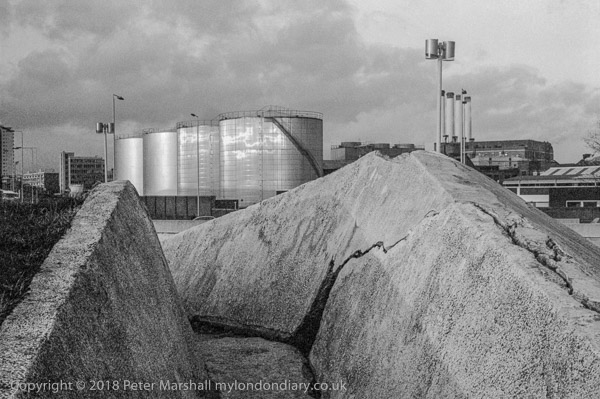
This view from a higher level path inside Wandsworth roundabout shows some of its surroundings more clearly, including the storage tanks which I think were for Charrington’s Fuel Oils next to the river on the south bank immediately downstream of the bridge; incorporated in 1895, the company was dissolved in 1995. Charrington’s began in 1731 and was acquired in 1997 as a part of CPL Distribution Ltd, a company bought out by management from the British Coal Corporation in 1995. Charrington’s were one of the largest UK fuel oil distributors and also had a wharf downstream on Blackwall Way in E14, developed by Ballymore in 2002.
Also visible, on the other side of the river is Fulham Power Station, with its row of four chimneys.
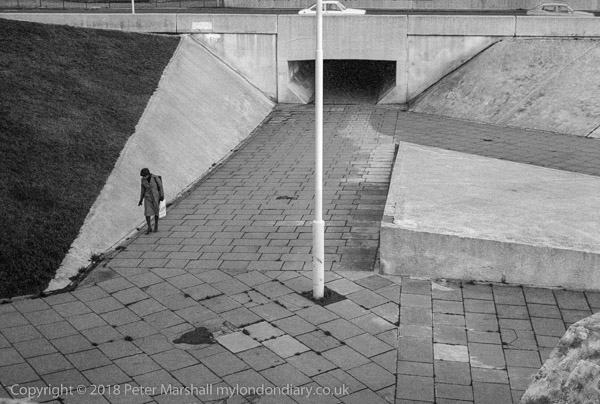
The final picture from the roundabout in 1980 shows a single figure walking in a concrete waste, walking away from one of the four underpasses which led to the central area. It emphasizes the modernist geometry of the construction and the sense of alienation the environment creates, something which has rather softened over the years as more vegetation has grown since it was built in 1969.
More recently it has been considerably tidied up with re-turfing and minor alterations which might prevent the flooding of the underpasses and with the intention of better maintenance, including a contract for the grass to be cut six times a year, though it remains to be seen how long this will last.
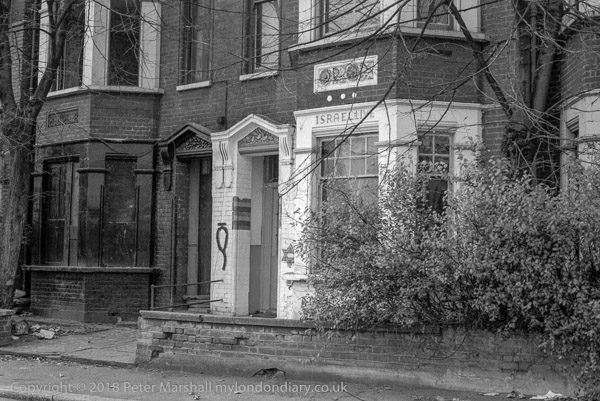
St Agnes Place, Kennington. 1980 26s-31: house, rastafarian
Houses in St Agnes Place were occupied by squatters from 1969 and survived Lambeth Council’s eviction attempt in 1977, which made the national news and eventually led to the fall of the then Conservative council.
Many of the occupants were Rastafari, as in this house, with its painted symbols and the message ‘ISRAEL: LIVE’ above the window. Many of the squatted properties were kept in good order, and the residents paid utility bills etc and for some years were a part of a housing co-op.
Some other properties were derelict and in a poor state, and the house on the left is boarded up.
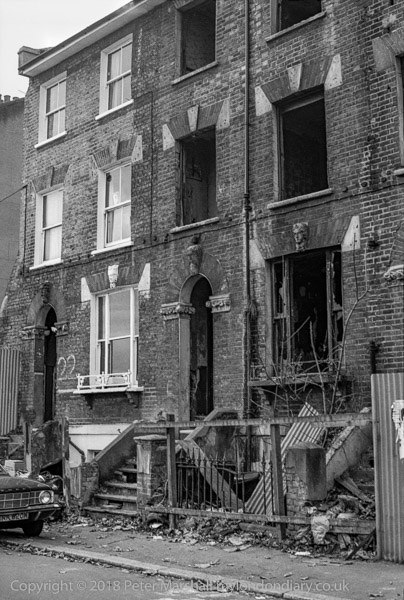
St Agnes Place, Kennington. 1980
26s-32: house, rastafarian, fire damage, derelict,
Although No 22 looks in good condition and occupied, the house at right has been gutted by fire.
We walked through here fairly often when visiting friends who lived in Key House, just across the main road from here on the other side of the park, but I didn’t often stop to take photographs. We came to Kennington Park next to St Agnes Place for our children to play and sometimes took a little walk around.
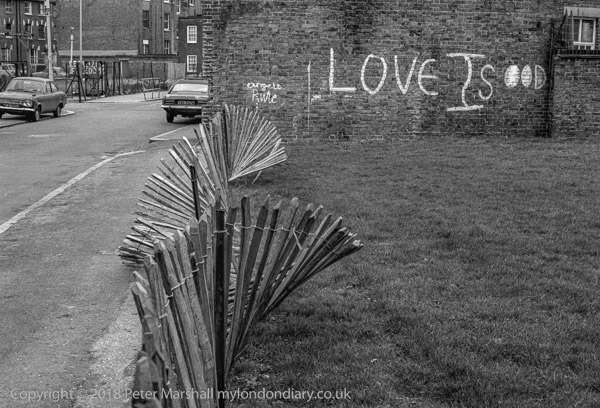
St Agnes Place, Kennington. 1980 26s-42: house, graffiti, fence,
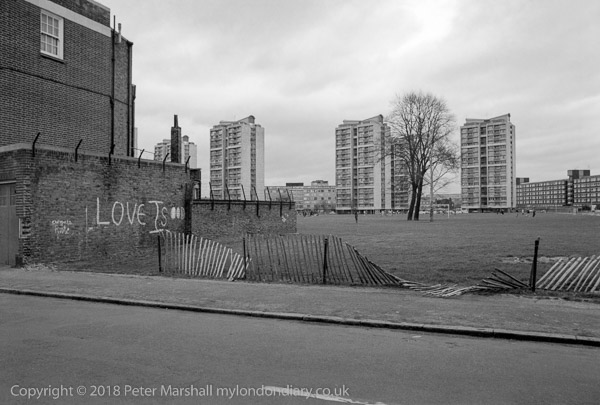
Graffiti on the end of a house I think once read ‘LOVE IS GOD’ but the G has been painted over to convert it to an O. But I don’t think OOD makes any sense. To its left is ‘angelo Rule’.
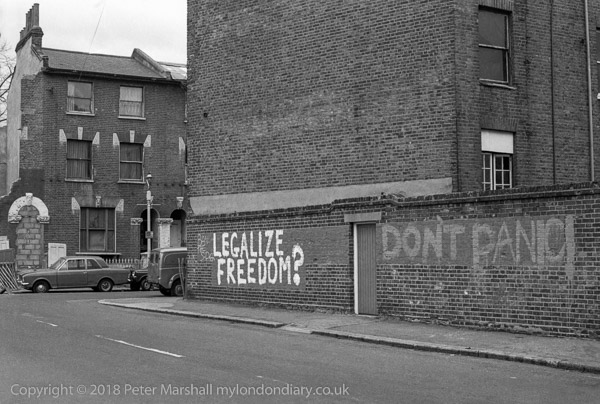
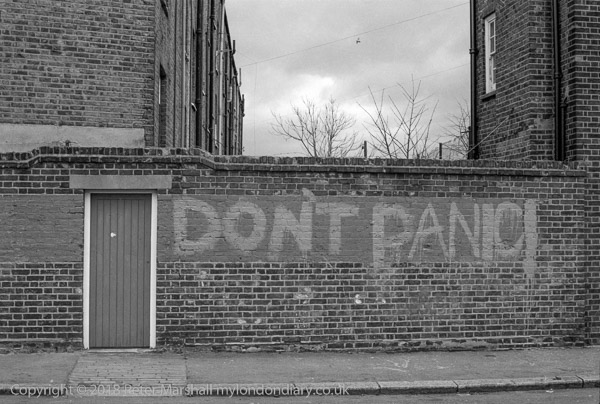
There are more graffiti on a wall across the road, including ‘LEGALISE FREEDOM?’ and a rather faded ‘DON’T PANIC’.
The fence has clearly seen better days.
St Agnes Place, Kennington. 1980 26s-43: house, graffiti
St Agnes Place in 1980 began here, and the previous image was was taken in what was then Bolton Crescent looking towards St Agnes Place, but is now St Agnes Place. I had walked closer to photograph the wall with its graffiti ‘LEGALISE FREEDOM?’ and ‘DON’T PANIC!’.
There had previously been just one more house at the left of the picture which has been demolished, along with another building at an angle on the turn of the street. The doors leaning against the wall on both sides of the blocked up door probably came from this. Next to ‘Legalise Freedom?’ and rather smaller is the message ‘Ban The SPG’. The Special Patrol Group, a Met Police unit for dealing with public disorder and who the previous year had murdered Blair Peach at an Anti-Nazi League protest in Southall. They were found to have been using a number of unauthorised weapons, including a sledge-hammer and a crowbar. They were replaced in 1987 by the Territorial Support Group (TSG), though many think little was changed except the name.
St Agnes Place, Kennington. 1980 26s-44: house, graffiti
Going a little closer still I photographed ‘DON’T PANIC!’ on its own, head on.
I think that some earlier graffiti had been painted out on this wall, and that this and the ‘LEGALISE FREEDOM?’ out of picture at the left had been painted on top of this, with the painter having a little problem squeezing the IC in at the end of the word before adding the oversize exclamation mark with some relief.
St Agnes Place, Kennington. 1980 26s-54: house, graffiti, park, flats
The flats seen across the playing field are on the Brandon Estate in Hillingdon Rd and Meadcroft Rd, and include Prescott House, Cruden House, Bateman House, Walters House and Cornish House, built in 1958 by the London County Council. Many of the early residents were delighted; they had been moved in more or less a whole street at a time and kept their community spirit in flats built to much higher standards than the slums that were demolished, a community-based approach that has been abandoned to allow private developers to profit from estate demolition.
20 Years later the estate had gone down-hill, partly because of bad management and the removal of caretakers, but mainly because council housing became a service for problem families rather than a more general approach to providing rented properties at a fair price.
This part of the street was still Bolton Crescent when I took the picture, but St Agnes Place now extends further south.
This is the final post in the series of selected images that I made in London in 1980. You can now see all the pictures (and a few more) at a larger size and with the descriptions here on Flickr.
All photographs on this and my other sites, unless otherwise stated, are taken by and copyright of Peter Marshall, and are available for reproduction or can be bought as prints.
There are no adverts on this site and it receives no sponsorship, and I like to keep it that way. But it does take a considerable amount of my time and thought, and if you enjoy reading it, please share on social media. And small donations via Paypal – perhaps the cost of a beer – would be appreciated.
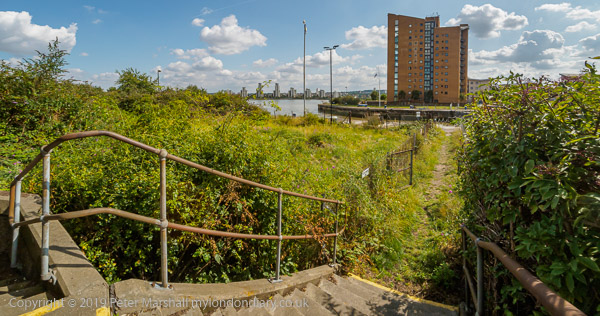
I’d gone to North Woolwich in February for a walk by the Thames and intending to go around Albert Dock Basin, but because of transport problems I had run out of time and had to cut the walk short to go and photograph a protest in central London. Since then I’d been trying without success to find time to complete the walk. It seemed a long way to go just to finish this short walk so I hadn’t wanted to go out just to do this, but on Thursday August 1st I had an event beginning in the morning in Brixton and then another starting around 7pm in Mayfair, and as it was a fine day I thought I would have plenty of time.
I made my way from King George V station as directly as possible to the entrance lock to the Royal Docks where I had cut short the walk on the previous occasion, taking few pictures, and then began a leisurely stroll along a section of the Capital Ring.
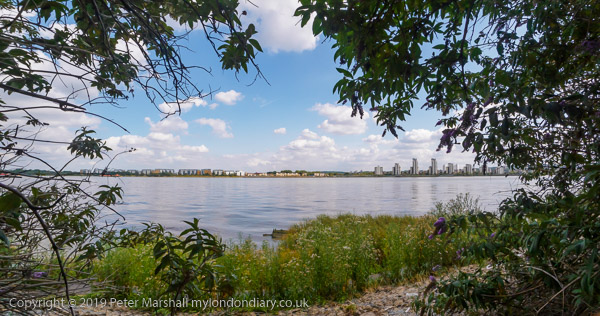
I was mainly interested in making some panoramic images of the area. I was disappointed to find that the riverside path still stops at Armada Green and I hope one day it will be possible to walk aong to Barking Creek. Instead I had to follow the Capital Ring and go down Atlantis Avenue and then turned down Gallions Road to go down past the Gallions Hotel (which I photographed around 40 years ago) and then beside Albert Dock Basin to go up on the Sir Steve Redgrave Bridge, which passes at a high level over the Albert Dock Basin, giving some good views of the dock and the surrounding area.
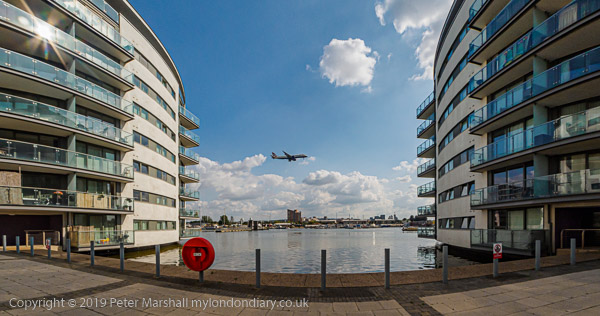
On My London Diary you can see over 60 panoramic images I made on the walk along with a slightly smaller number of less wide views. The panoramas(except for a couple including the example above) are cropped to a 1.9:1 ratio, while the other images have the standard 1.5:1 aspect ratio. The panoramas use a cylindrical perspective, which results in some curvature of any non-vertical straight lines except for the horizon which I place at the centre of the image when making the picture, though the crop may raise or lower it. The curvature is more marked towards the top and bottom edges.
All photographs on this and my other sites, unless otherwise stated, are taken by and copyright of Peter Marshall, and are available for reproduction or can be bought as prints.
There are no adverts on this site and it receives no sponsorship, and I like to keep it that way. But it does take a considerable amount of my time and thought, and if you enjoy reading it, please share on social media. And small donations via Paypal – perhaps the cost of a beer – would be appreciated.
The 13th of the series of posts of selected black and white pictures I made in 1980 with the comments I posted more recently daily on Facebook. Larger versions of the pictures are now available on Flickr.
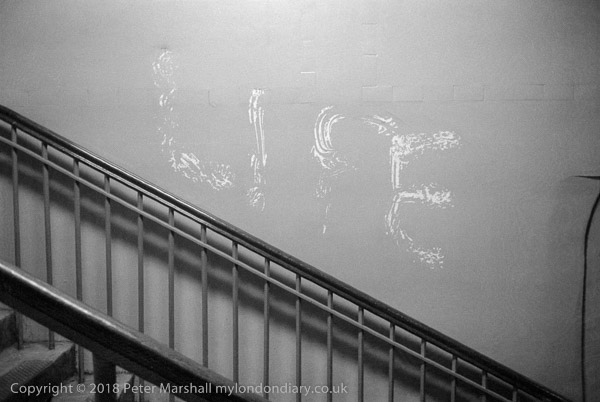
I used often to walk past this scrawled message on my way into Waterloo Station, though I can’t remember exactly where it was, but these stairs are long since demolished or hidden away from the public. The area was dimly lit and I think I photographed it on several occasions before getting a satisfactory result.
There was a certain desperation about the lettering which looked as if it had been made quickly by someone who dipped a hand into white paint to make these marks. And I pondered on what message was intended, as I stopped to photograph it in the rather dim light.
Albert Memorial, Kensington. 1980 26i-62: monument, girls
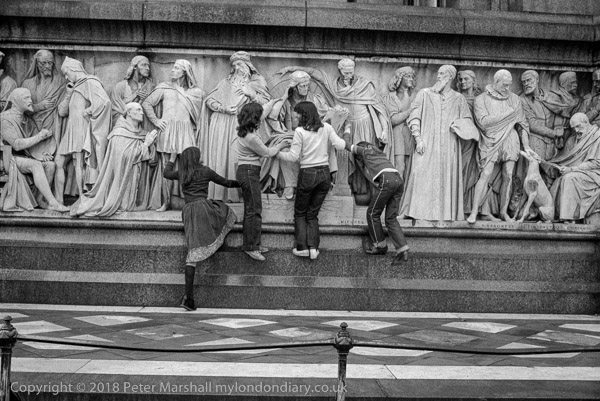
Back in 1980 on my way to the Serpentine Galley I stopped to look at the Albert Memorial, then open to the public in much the same way at Nelson’s column still is, with tourists and their children climbing on the lower levels to have their photographs taken with the sculptures at its four corners and surrounding it.
As I was photographing a group of four girls came and climbed up on the low ledge to put their hands on the figures of the great artists – including Masaccio, Raphael, Michael Angelo and others – along the base of the memorial. This was the second of two frames I took of them.
Chelsea Bridge, Chelsea. 1980 2l-55: power station, bridge, runners, people
In December 1980 it was my turn to organise the month’s photographic outing for the small group of photographers I was involved in. Somehow my plan for a walk from Victoria to Battersea and Wandworth lacked appeal and I was the only person who turned up for it.
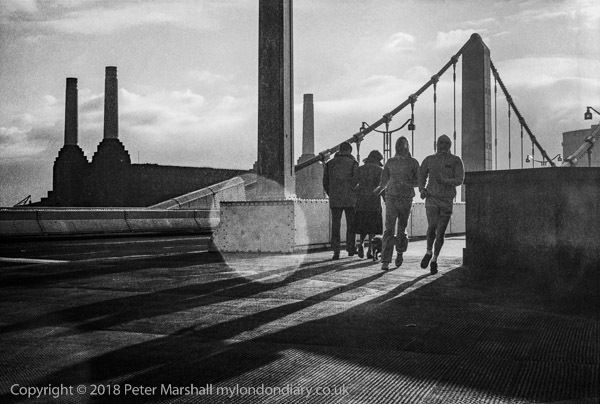
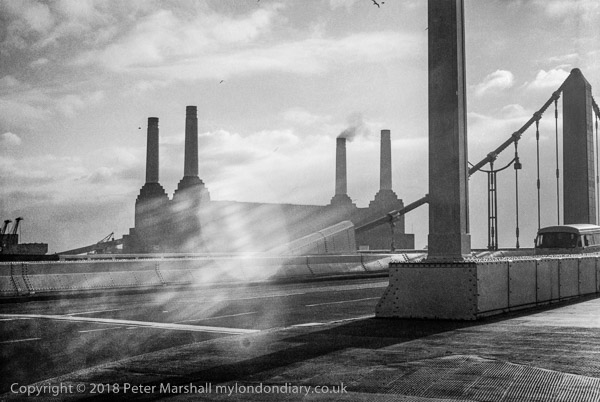
Taken with the Leitz 35mm f1.4 Summilux, the large circular flare patch is something of an enigma. I think it likely that the lens was well-stopped down, since I was working on ISO400 film (Ilford XP1) and the negative is quite underexposed. The low December sun has resulted in long shadows and a dramatic image, with Battersea Power Station and the people in near silhouette.
The sun was just out of picture at top right, and this negative was virtually unprintable in the darkroom
Chelsea Bridge, Chelsea. 1980 26l-56: power station, bridge,
Another picture from almost the same place, but without people and with different flare. As well as a couple of large ellipses there are also some rather vague ‘rays’ and a small black spot… The specks in the sky are birds.
One of Battersea Power Stations four chimneys was hidden behind a part of the bridge in the previous picture, but here we can see it clearly with smoke emerging. The western half of the power station was closed in 1975, but the eastern half, where smoke is emerging from the rear chimney remained in operation until 1983.
Earlier in 1980 the whole power station had been listed Grade II as there were grave concerns for the future of the building. Unfortunately listing failed to save more than the shell of the building and its roof was removed in the late 1980s. Various development schemes fell through and the building was left to rot. The listing was revised to Grade II* in 2007, and the redevelopment of the whole area began in 2012.
The four chimneys were removed by the Malaysian-owned developers in 2014 because they were heavily corroded, but have now been replaced by near identical replicas. The power station development is due for completion in 2019, providing 254 homes along with offices and retail space, with the whole 42 acre redevelopment being completed by 2025. It is part of the huge 561 acres Nine Elms development – almost 0.9 square miles.
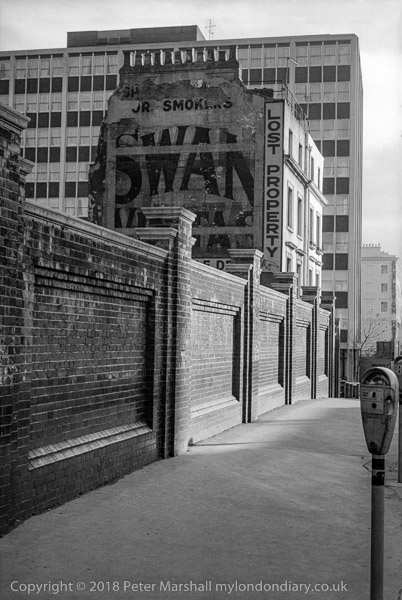
The Lost Property office was on Eccleston Bridge, on the corner of Bridge Place; the building is still there but the Swan Vestas advert has long been painted over and the building passed to other uses.
The foreground wall and the office building in the background are still there though the offices have been slightly updated.
I pass this roundabout every time I take the train into Waterloo. It was the location where Alex and his Droogs attack a tramp in Stanley Kubrick’s A Clockwork Orange. The roundabout links Trinity Road with Wandsworth Bridge.
Back in 1980 all of the riverside around here was industrial. NF graffiti were common over London. I think the tilt in this picture was deliberate, perhaps to increase a sense of unease in the scene.
Fence with NF graffiti, Wandsworth. 1980 26r-21 fence graffiti, worker
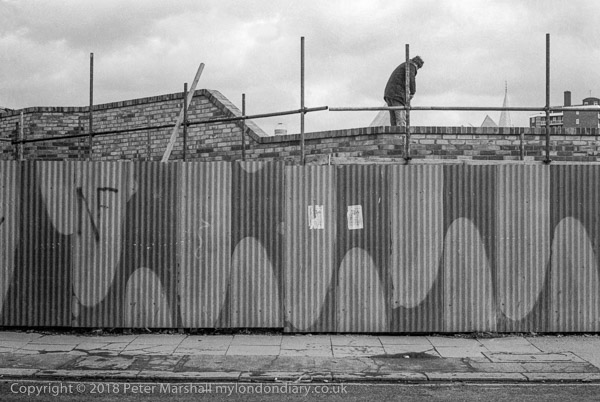
Some effort has been made to make the corrugated iron fencing more attractive by painting it in two colours. I can’t read the flyposted notices, which do appear to have a radioactive hazard symbol on them but the National Front graffiti is clear and was unfortunately common across London at this time.
I’m not sure exactly where this was taken, although the wall behind the fence is fairly distinctive, as are the steeple and flats at right. It was probably on or close to Vicarage Crescent or Lombard Rd.
All photographs on this and my other sites, unless otherwise stated, are taken by and copyright of Peter Marshall, and are available for reproduction or can be bought as prints.
There are no adverts on this site and it receives no sponsorship, and I like to keep it that way. But it does take a considerable amount of my time and thought, and if you enjoy reading it, please share on social media. And small donations via Paypal – perhaps the cost of a beer – would be appreciated.
Continuing the series of post about the black and white pictures I made in 1980, with the pictures and the comments I posted more recently daily on Facebook.
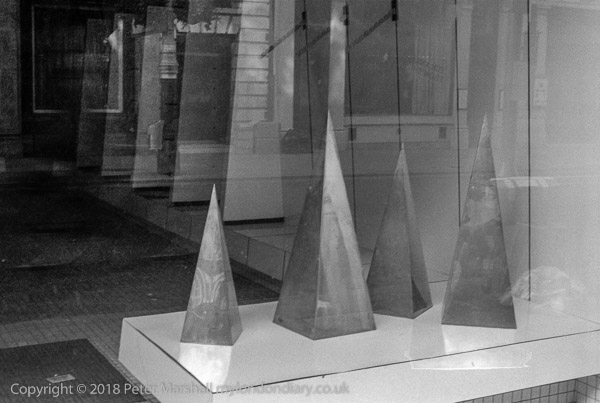
I’m fairly sure this was somewhere in Fitzrovia, where a few frames earlier I had been outside the Northumberland Arms, at the corner of Charlotte St and Goodge St, recently renamed The Queen Charlotte, perhaps to avoid confusion with another Northumberland Arms on Tottenham Court Rd.
Why a shop window should have these four pyramids at its front is now certainly a matter of mystery at least to me, though presumably they were some kind of display stands. Apart from this what drew me to take four very similar frames was clearly the mix of reflections and interior which make the image difficult or impossible to decode.
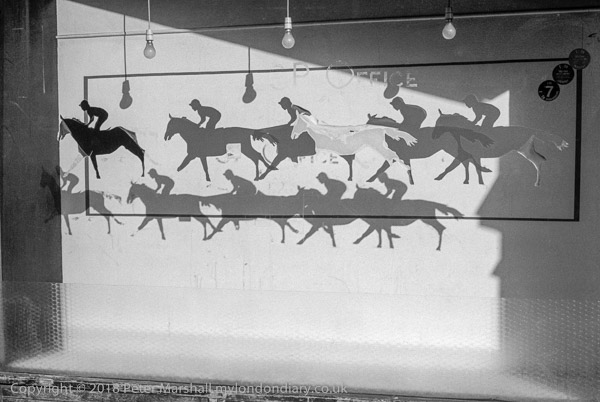
Another shop window in Fitzrovia which again poses something of a conundrum. It is clearly the window of a betting shop, which a fairly small distance between the glass and a screen behind, required then by law to prevent us seeing the inside of the betting shop. And the picture clearly has a mix of actual objects – the light bulbs and some peeling pictures of racing horses on the back of the window glass – and their shadows from late afternoon evening sun ( it was taken in July or August.)
The upper row of horses and riders are on the rear of the glass, with some peeling away more than others, and where they have peeled away slightly they now appear like shadows (though because they are closer to my camera are slightly large than the shadows), and the almost white riderless horse appears to have no shadow at all and nor does the lettering ‘P OFFICE’.
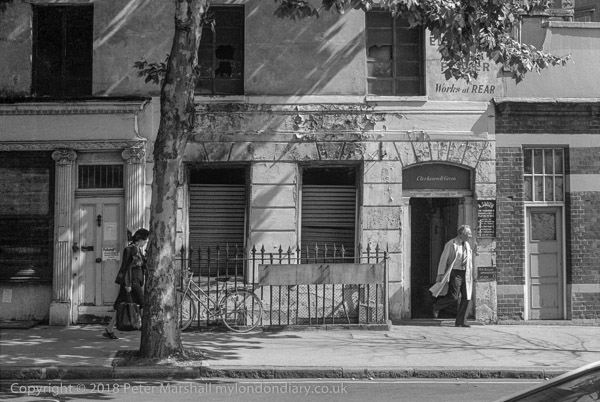
Clerkenwell Green, London. 1980 25f-31: houses, works
The Farringdon Enamelling and Plating Works of A Smith were, along with Upholsterer R H Dillon on Clerkenwell Green as the window above the door helpfully informs us, and another business with a name beginning with ‘EN ‘and ending ‘P…..R’ has its ‘Works at Rear’.
Attracted doubtless both by the signage and the peeling paint, emphasised by the glancing sun, I had already made two frames when this man in a dirty white coat and striped tie walked out.
This little section of the street can still be recognised, but has gone up considerably in the world. One of the windows has been converted to a door, the paint no longer peels and the signage has disappeared. The building at right has been replaced by a modern structure with giant glass windows, The door from which a man is emerging is now for the Hammond Cox Casting Agency, the next window has been converted into a door for the Provision Trade Benevolent Institution and others, while the door at left, then a typesetter, is now for the Royal Philharmonic Orchestra. The tree is still there.
Behind me as I took this picture were public conveniences, which may well have been the reason for my visit, but which have been long closed.
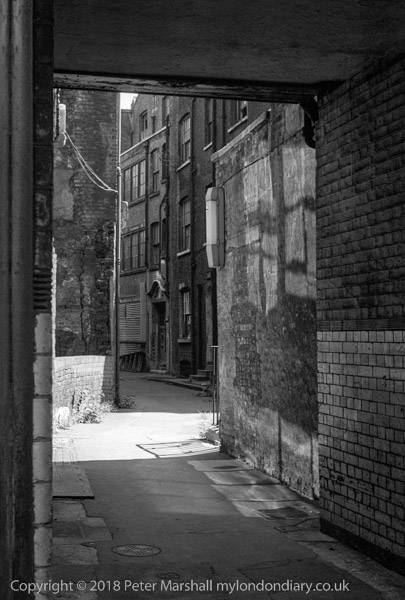
Cross Keys Square, Little Britain, London. 1980
25f-42: passage, houses
Inside ‘Little Britain’, I think this is part of Cross Keys Square, and shows some clearly fairly elderly buildings, one of which, its windows now covered with corrugated iron, had previously been a Hairdressing Salon.
Much of the area was derelict when I took this picture and parts were inaccessible, with demolition or building work being carried out. The reflections on the brickwork at left interested me, and part of one of them rather looks like a shield or coat of arms, not dissimilar to the City of London’s which were on the light fittings.
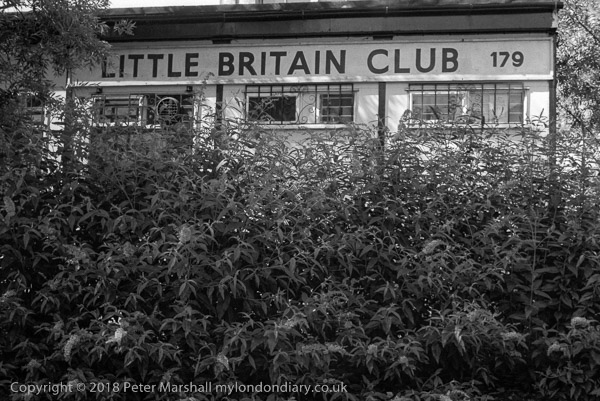
Little Britain Club, City of London. 1980 25f-53: club, waste ground
Somewhere in the middle of ‘Little Britain’ was this club, and a patch of really overgrown waste ground, either formed by wartime bombing or later demolition.
Little Britain a century earlier had been famous for its ‘The Roaring Lads of Little Britain.’ who held weekly sessions at a pub “bearing for insignia a resplendent half-moon, with a most seductive bunch of grapes” run since “time immemorial” by the Wagstaff family and whose current landlord member presided over its singing and story-telling, according to Washington Irving in 1886.
The street number, 179, is almost certainly for Aldersgate St, and this was one of the many addresses listed in the planning application for demolition in January 1982, which was I think approved the following year:
“Demolition of all properties listed below, per dwg. ME/1: 11, 12, 13, 15, 16 Bartholowmew Close, 1 & 2, 7, 8, 4 & 11, 5 & 10, 6 & 9 Albion Buildings, 179 Aldersgate Street, *3 Little Montague Court, 1,2,3, Westmoreland Buildings, 4 Little Britain, 14, 15 Albion Buildings, 2a, 3, 4 Cox’s Court, 2, 2a, 3, Cross Key Square, Crown Buildings, Cox’s Court. The Garage on site of 21 Albion Buildings, 20, 21, 22, 23, 24, Little Britain, part of pedestrian walkway link to Rotunda * also 2 Little Montague Court.”
I think it was on a part of the site now occupied by London House, 172 Aldersgate St. These flats, “high-standard, fully serviced accommodation in London for the international business traveller”, have beside the entrance plaques stating it was the former site of London House. This was built for Henry Pierrepont, 1st Marquess of Dorchester (also the 2nd Earl of Kingston-upon-Hull) 1606-80, apparently a thoroughly unpleasant character, and after 1660 became the home of the Bishops of London.
After the bishops moved out it was let out to various tenants before briefly becoming in 1750–1751 the ‘City of London Lying-in Hospital for married women and sick and lame Outpatients’; it burnt down in the 1760s.
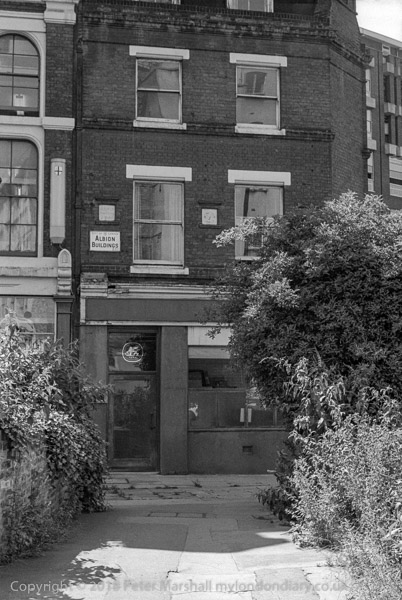
Albion Buildings, City of London. 1980 25f-54: shop, waste ground
Also a part of ‘Little Britain ‘ was Albion Buildings, dating according to a stone in its frontage from 1766 (a second stone to the right is unreadable.) The sign above the door, which shows a stylized animal, a winged lion, with one of its front paws on what I think is an open book, is dated 1903. It perhaps reflects the time when this area was still the centre of the London publishing and secondhand book trade, which had been here since at least the 17th century. Pepys records a visit to Duck Lane (as Little Britain was then called) where he “kissed bookseller’s wife and bought Legend“. As well as going there to see the bookseller’s wife he is also recorded as buying several other books.
Albion Buildings (according to Webb – see comment below) were built in 1764 on the site of a 16th century house and gardens. In 1628 they were occupied by the Earl of Westmoreland and known as Westmorland Buildings, getting their name later from the Albion Tavern. Previous to 1764 the passage they are on was called Porridge Pot Alley.
The building on the left edge still has a fluorescent light on and appears to be still in use.
There is a very detailed account of the buildings and history of the area in E A Webb, ‘The parish: The close precinct and glebe houses‘, in The Records of St. Bartholomew’s Priory and St. Bartholomew the Great, West Smithfield: Volume 2 (Oxford, 1921), pp. 213-231 on British History Online. The map at the National Library of Scotland collection from 1896 is useful in understanding the layout of the area, though much had changed by 1980.
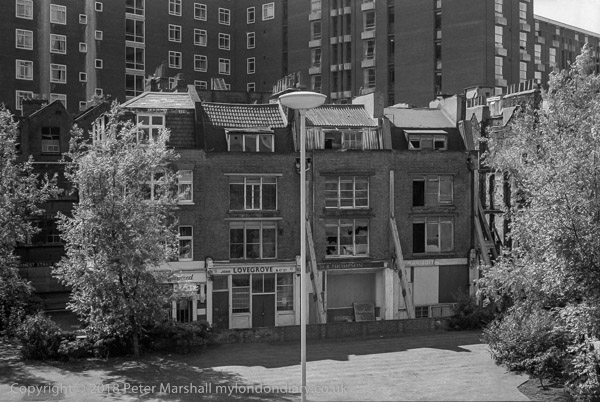
Albion Buildings, City of London. 1980 25f-62: shop, waste ground
This small row of shops and businesses were I think empty – some clearly so, when I made this picture, I think from the elevated walkway along the side of the Barbican estate.
At left was a button maker ‘H R C….’ on the first floor and ‘Ernest Stark’ on the ground, then a business whose name is obscured by a three. At 6 was John Lovegrove & Co Ltd, then H R Thompson (with an unlikely ‘To Let’ sign) and ‘Basinghall Elect…’ presumably Electrics or Electrical… I have been unable to find any information about any of these.
All photographs on this and my other sites, unless otherwise stated, are taken by and copyright of Peter Marshall, and are available for reproduction or can be bought as prints.
There are no adverts on this site and it receives no sponsorship, and I like to keep it that way. But it does take a considerable amount of my time and thought, and if you enjoy reading it, please share on social media. And small donations via Paypal – perhaps the cost of a beer – would be appreciated.
Continuing the series of post about the black and white pictures I made in 1980, with the pictures and the comments I posted more recently daily on Facebook.
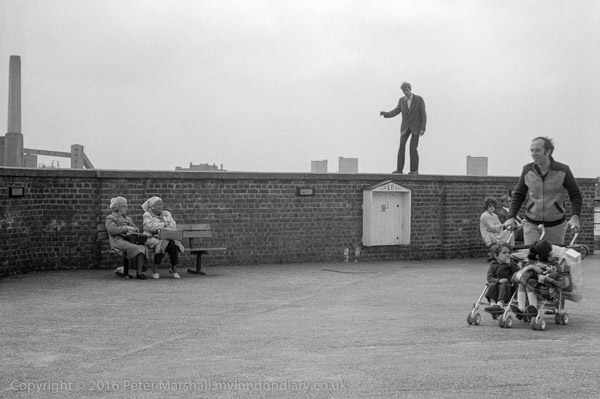
Man walking on Riverside wall, Greenwich. 1980 24n-63: man, woman, children, power station
A man was walking on the riverside wall, to his right perhaps a 20 ft drop, probably not into water but into thick mud. The lifebelt which should have been below him was missing, but it probably would have been of little use.
I’m not sure if he was having some kind of mental health problem, or was drunk, or possibly both, but didn’t feel there was much I could do to help – and trying to do anything might even have made him fall. So I took a picture and walked on. I did keep an eye on him and by the time I was leaving the area he had come down safely.
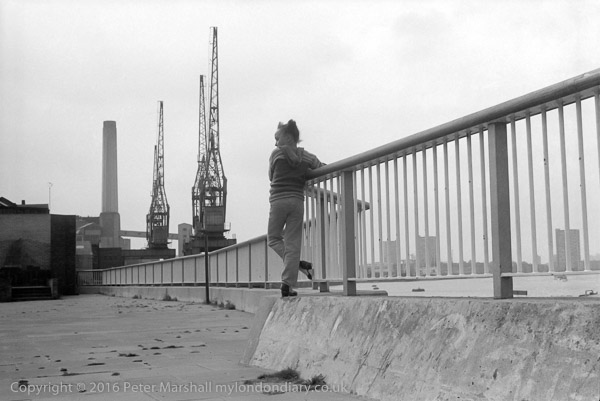
Child posing on riverside fence, Greenwich. 1980 24n-66: child, river, power station, cranes,
Another picture of a girl standing beside the railings but with rather different framing from those in my previous post, with the river visible below the fence, the bottom rail of I’ve carefully aligned along the riverbank.
This was actually taken a few seconds before the previously shown picture of her. My filing and numbering system is based on contact sheets and films were not always developed and filed exactly in the order they were taken. I was using two cameras to take black and white images, an Olympus OM1 with a 35mm shift lens for carefully composed images such as this and most of the urban landscape work, and a Leica M2 with which I was trying to develop a more intuitive approach, reacting without conscious deliberation.
I based my numbering system on a sheet number for each sheet (here 24n) and then a number based on the position on the contact sheet rather than frame numbers. Because I was loading film from 100ft rolls into cassettes of roughly 36 exposures the first frame on the film might be any number from 0 to around 38 and the sequence usually jumps from 38 to 0 somewhere in the middle of the film. And sometimes I would load a strip of film, cut to appropriate length in total darkness, measured between two nails on my darkroom door so that the frame numbers actually went in the opposite direction.
I cut my developed black and white films into strips of 6 frames to put into filing sheets, giving 6 strips and often a shorter length of 2 or 3 frames. The filing sheets I used had 7 pockets so could accomodate a single film, and it was just possible to expose all 6 or 7 strips on a single 8×10″ sheet of photographic paper to produce a contact sheet. But frame numbers were not always visible on these, so I used a simple system to give a unique number to every frame. This negative, 24n-66, is on contact sheet 24n, on the sixth strip of negatives (numbered 1-6 or 0-6 when there was something worth keeping on the film end) and the 6th negative on that strip.
In 1986 I moved to a slightly different system of naming the contact sheets that included the year and month in their name, making it rather easier to find things.
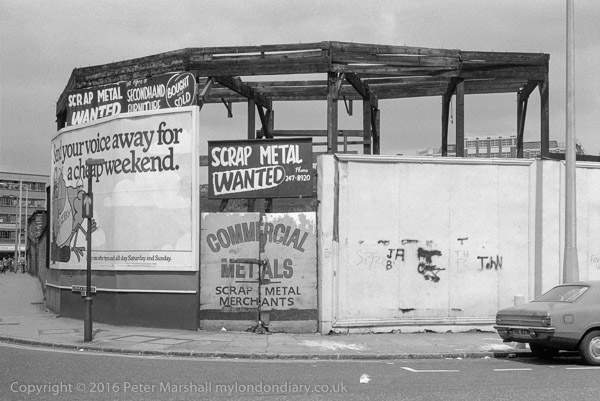
Surprisingly this corner is still easily recognisable, though the advert has changed, with a taller hoarding; the gates, no longer for a scrap metal merchant, are now firmly closed by two iron bars and the skeletal structure behind has disappeared completely. This is on the corner of Quaker St and Commercial St, and the building at the left is still there on the corner of Shoreditch High St and Great Eastern St.
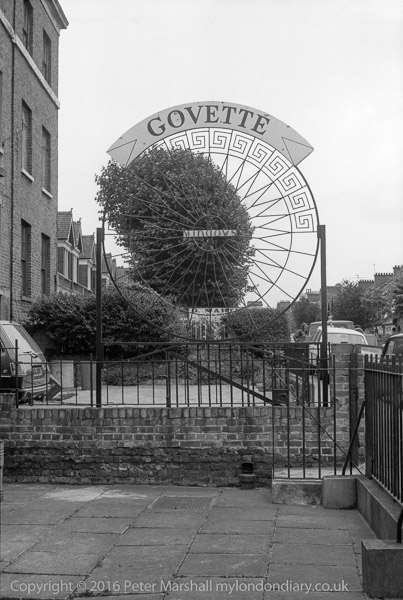
Govette Metal & Glass Works, Park Hill, Clapham, Lambeth. 1980
24y-53: children, swings, dog,
Govette is originally a French name, and a couple of them came over with William the Conqueror back in 1066 and were given land in Somerset. The name was often spelt without the final ‘e’.
Govette Metal & Glass Works, a family firm and was established in 1956 in Clapham, and in the 1970s split up into several divisions, with Govette’s remaining in Clapham. They closed the factory there in the mid-nineties and specialised in the supply, installation and glazing of steel windows and doors, establishing Govette Windows Ltd in 1996, and are now based in Whyteleafe. They also now have a factory in South Godstone.
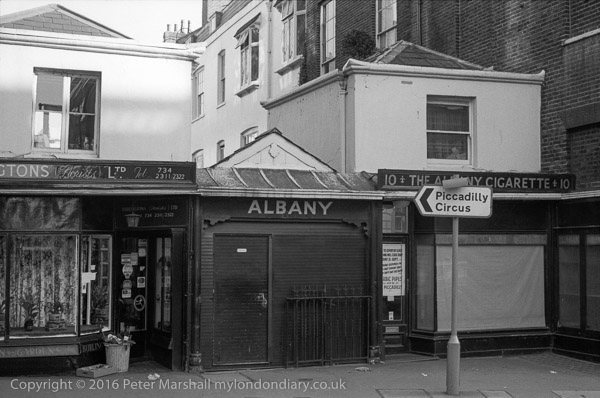
Albany or ‘The Albany’ is a mansion in Mayfair that was extended and converted in 1802 into 69 bachelor flats, with the addition of two long ranges of buildings which ended at the back gate shown in the picture. The flats are rather like the rooms in an Oxbridge college, which are known as ‘sets’. Apparently you no longer have to be a bachelor to live there, though children below 14 are not allowed.
The flats generally have an entrance hall, two main rooms, and a smaller room and are owned freehold but subject to a whole number of rules. In 2007 one sold for around £2m. Around half of them belong to Peterhouse College Cambridge. Most are rented with an annual rent (according to Wikipedia) of up to £50,000. Many famous people have spent some time as tenants here, including someone of particular interest to photographers, W H F Talbot.
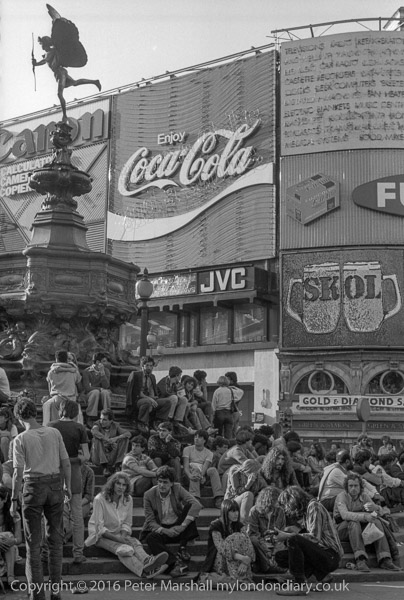
I’ve never understood why people come to sit at Piccadilly Circus. It isn’t a place where there is much to see or much to do, but every tourist has to visit it.
And as most Londoners probably know, the statue on top of its slightly more interesting plinth, put there as a memorial 1892–1893 to commemorate the philanthropic works of Lord Shaftesbury is not Eros but his brother, the Greek god Anteros. Made of aluminium, then a relatively new (and expensive) metal, was called ‘The Angel of Christian Charity’ and the memorial was originally on a roundabout in the centre of the circus where it is now on one side.
‘Eros’ has actually got around quite a bit. Originally in the centre of a mini-roundabout at the centre of the circus, in 1925 he went to Embankment Gardens so they could build an enlarged Underground station, coming back in 1931 to a slightly moved roundabout. During WW2 he took a trip out to Coopers Hill above Egham, while the fountain below (it never really worked as a fountain, and after a single day the drinking cups had been vandalised) was covered up. Eros came back with a great fanfare in 1947, but I think shortly after was moved aside to where he still stands on one leg, though he gets covered up every year for a month or so for Christmas celebrations, as people find him attractive to climb up to or hang things on.
‘Eros’ is not unique as years later several more casts were made from the mould. There are a couple up in Lancashire, one now in storage which used to be in Sefton Park, and another corroding by the seaside at Fleetwood. The most recent, made in the 1980s, in the art Gallery of South Australia in Adelaide.
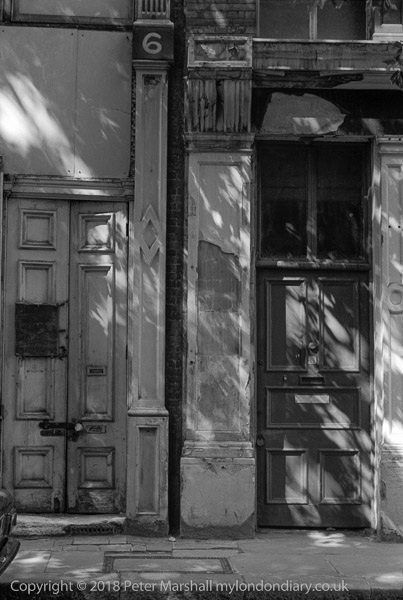
Little Britain, City of London. 1980 25e-42: doors
Little Britain is now simply the street these doors are on, running between Aldersgate and King Edward St, but was earlier the name of the whole area to the north up to St Bartholomew’s Hospital and Smithfield, which was once the residence of the Dukes of Brittany. In the distant past it was the centre of the book trade, which later moved south to Paternoster Row, which was destroyed by bombing in the Second World War.
Parts of the crowded warren of streets and alleys still remained when I took these pictures, though it was difficult to find a way into them, with alleys leading from Little Britain and Aldersgate to what remained of Cross Key Square, Montague Place and Albion Buildings.
Continuing the series of post about the black and white pictures I made in 1980, with the pictures and the comments I posted more recently daily on Facebook.
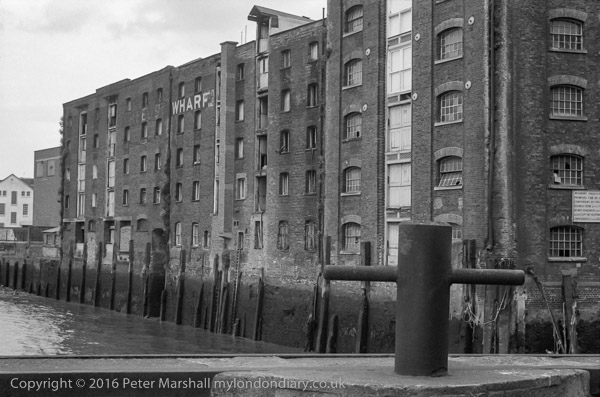
Reeds Wharf, Bermondsey, Southwark. 1980 24m-44: wharf, warehouse,
Looking across the mouth of St Saviour’s Dock, with the New Concordia Wharf having a short frontage to the river, and beyond its three bays are the those of China Wharf and then Reed’s Wharf.
China Wharf was the site of the controversial building by CZWG, completed in 1988, a rather hideous pink and glass frontage jutting out into the river, which destroys this row of warehouses. At best it could perhaps be called playful, but I rather wish architects would keep such playing to their private dreams rather than inflict them on us. I can imagine sites where it might be appropriate, but this was not one.
There is now a footbridge across St Saviour’s Dock taking the path across and along in front of the New Concordia Wharf, and a further bridge leads across to Downings Roads, one of the oldest river moorings, now more often known as Tower Bridge Moorings, home to around 70 people and the floating Garden Barge Square, with the largest single collection of historic trading vessels on the Thames, some over 100 years old.
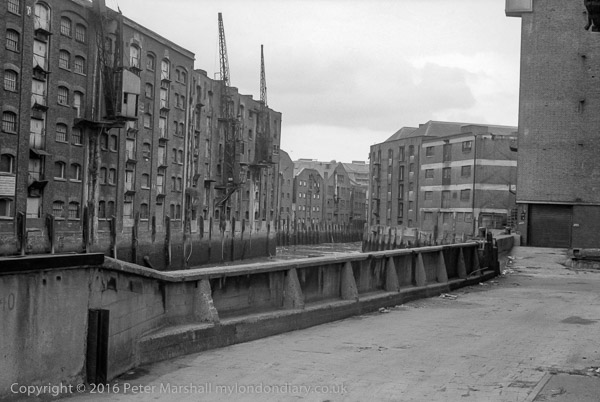
St Saviour’s Dock, Bermondsey, Southwark. 1980 24m-45: dock, warehouse, crane,
Another view of St Saviours Dock. The path here was a dead end in 1980, and walkers had to walk back to the right of where this picture was taken and then down Shad Thames to the head of the dock and then a few yards along Jamaica Road before turning back up Mill St. The foot bridge over St Saviour’s Dock was built 1995 and opened the following year but by 2016 needed to be rebuilt.
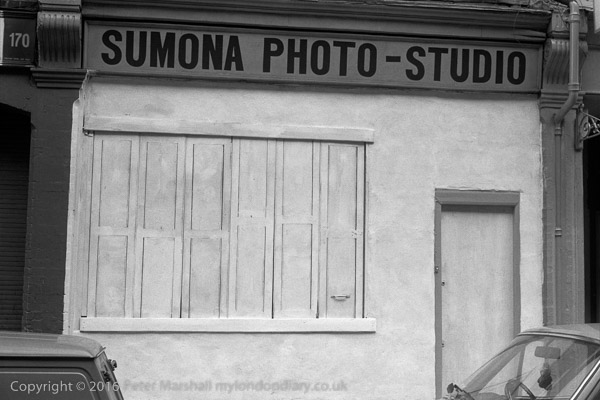
It was I think the neatly shuttered frontage of Sumona Photo-Studio at 168 Brick Lane which attracted me to take this picture, and the feeling that this was a photographer very carefully hiding from the world behind the facade while I was trying hard to look at it.
The building is still there, but converted to a more normal shopfront, for Oceanic Leather Wear.
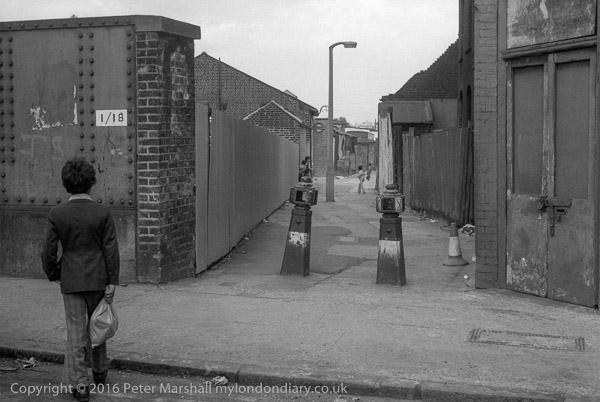
Alley off Bricklane and Shoreditch Underground Station, Shoreditch, Tower Hamlets. 1980 24n-14: street, alley, station
The alley is still there but is now a path and cycle path leading to Pedley St and Spitalfields City Farm. Shoreditch Underground Station had been the terminus of a short underground line leading via Whitechapel to New Cross and New Cross Gate. When I photographed it, the station was closed on Sundays, and in later years only opened at rush hours Monday to Friday and for a few hours on Sundays to serve Brick Lane Market. It finally closed in 2006.
The line is now a part of London Overground, with a station a quarter of a mile away, Shoreditch High St, just off the Bethnal Green Road. Last time I walked past the walls along the alley and the disused station were covered with graffiti, looking rather more colourful than in this picture.
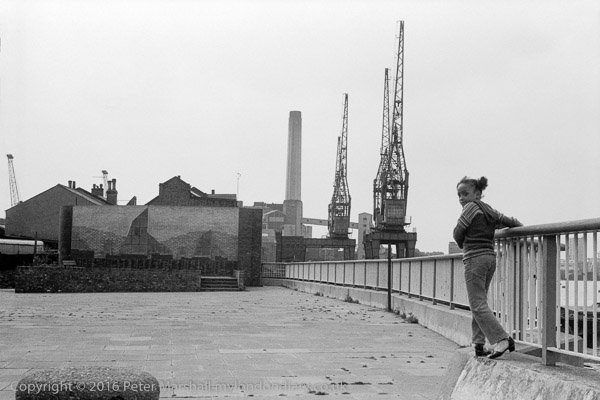
Riverfront walk at Greenwich, Wood Wharf and Deptford Power Station, Greenwich. 1980 24n-51: child, mural, cranes, wharf, power station, river
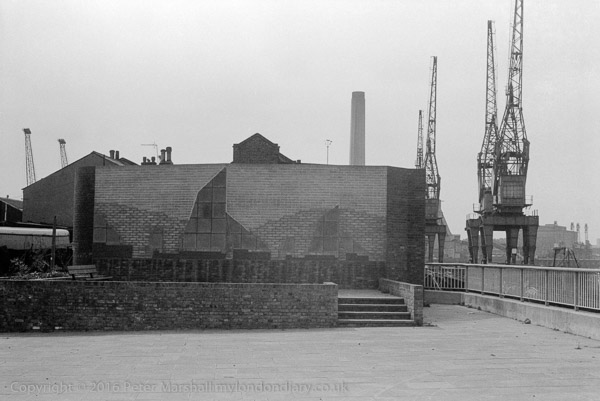
The wall at the end of this rather neglected riverside promenade has a mural with what I think were meant to suggest the tops of boats and sails in front of some hills. It was unimpressive but served as a wind-break. Behind it were a few wharves including Wod Wharf, still in use, and then a jetty with a crane, possibly for the former gas works, and then further on, past Deptford Creek (which is hidden by buildings) the chimney of Deptford Power Station. The two cranes towards the left are on Deptford Creek.
There were mothers with prams, fathers with push chairs, old ladies sitting on seats and a few children playing here, a couple of whom came to ask me why I was taking pictures, and insisted on posing for me (see picture below.)
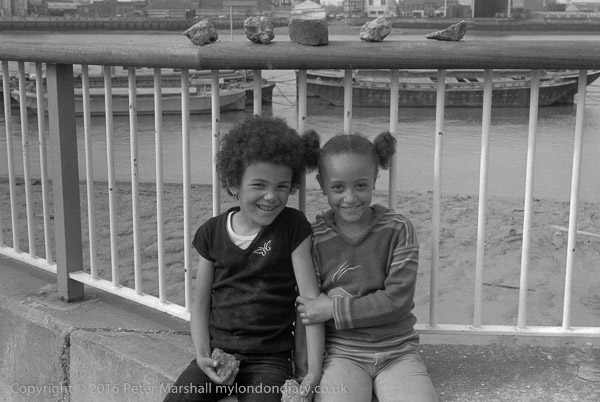
Children with stones, Riverfront walk, Greenwich. 1980 24n-53: child, river, barges
Two children who watched me taking photographs insisted I take their picture underneath a small row of stones they had collected on top of the rail. They are also both holding stones.
They were collecting them to throw in the river mud below where they made a satisfying splat, with mud flying out when they landed.
Riverfront walk at Greenwich, Wood Wharf and Deptford Power Station, Greenwich. 1980 24n-56: mural, cranes, wharf, power station, river
Another view of the wall with the mural. It might have looked better in colour, though I think it wasn’t highly coloured.
The cranes at right are on Wood Wharf, apparently still in use and those at left I think are on Deptford Creek, with the chimney from Deptford Power Station.