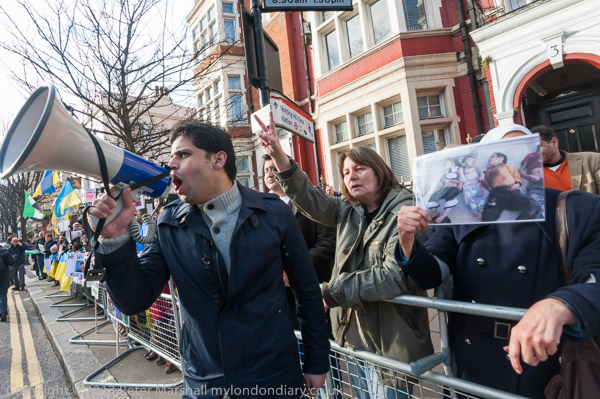
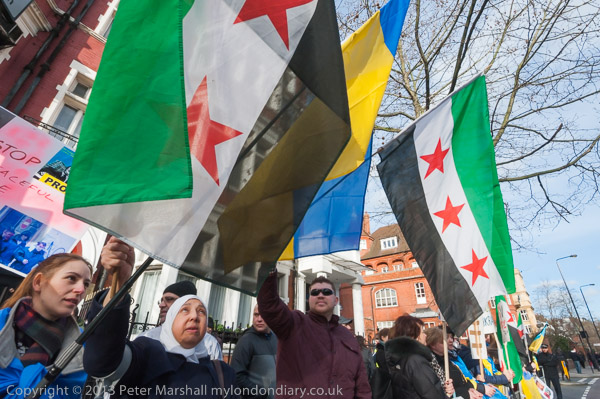
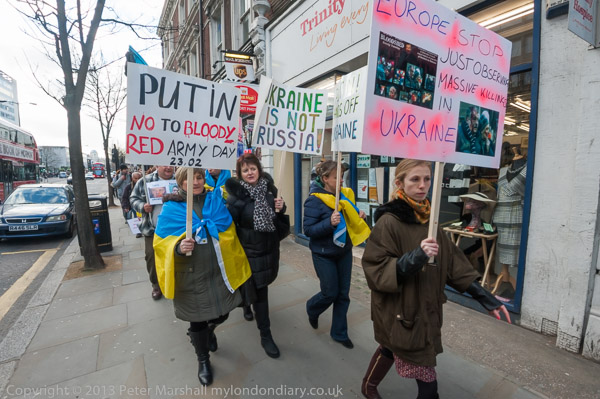
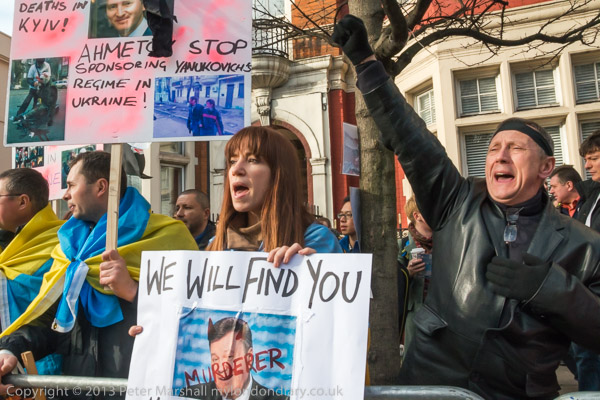
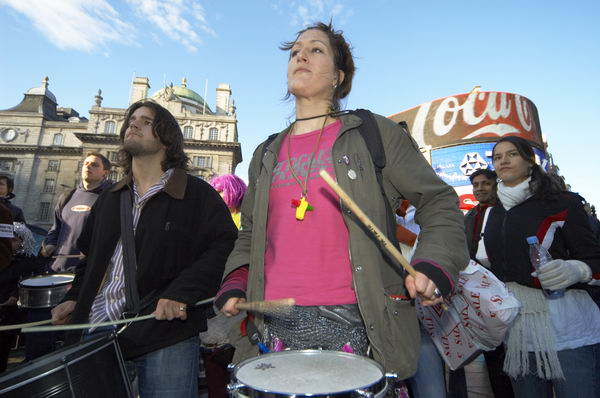
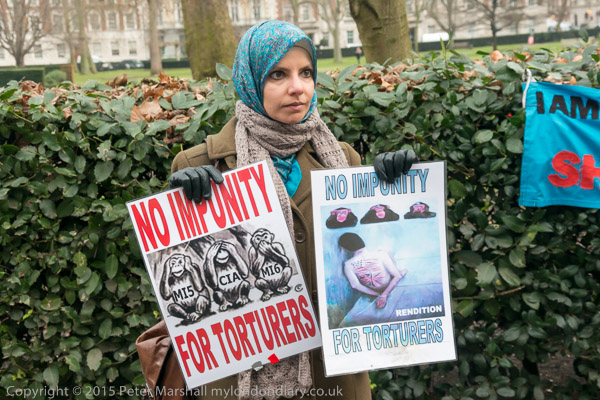
Syria and Ukraine Protests Against Putin: On Saturday 22nd February 2014 Syrians and supporters at one of their regular protests opposite the Russian Embassy were joined by hundreds of Ukrainians also protesting against Putin.
Protests had been taking place in Ukraine since the previous November against Ukraine’s pro-Russian president Viktor Yanukovych and Russian soldiers in unmarked combat gear were already operating in parts of Ukraine and five days after this protest Russian forces seized control of strategic sites in Crimea. In April 2014 militants backed by Russia took control of some towns in the Donbas region in the east of Ukraine and declared two independent states in the area which were then covertly supported by Russia with soldiers, tanks and artillery.
The Syrian Revolution against the brutally dictatorial Assad regime had begun in February 2011, part of the wider Arab Spring. By the middle of 2012 it had become a military civil war, with Assad’s forces being supported by Iran and Russia, and supporters of Free Syria were holding regular protests opposite the Russian Embassy across the main road from the private street where the embassy is.
Several hundred Ukrainians had come to call or an end to Russian interference in the Ukraine, for an end to violence, and for Yanukovych to go.
While there they heard and cheered loudkt the latest news from the Parliament in Kiev, that the speaker of the parliament, attorney general and interior minister had been replaces and jailed opposition leader Yulia Tymoshenko freed.
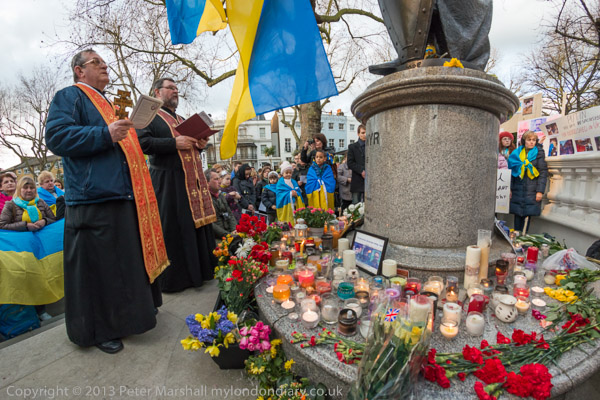
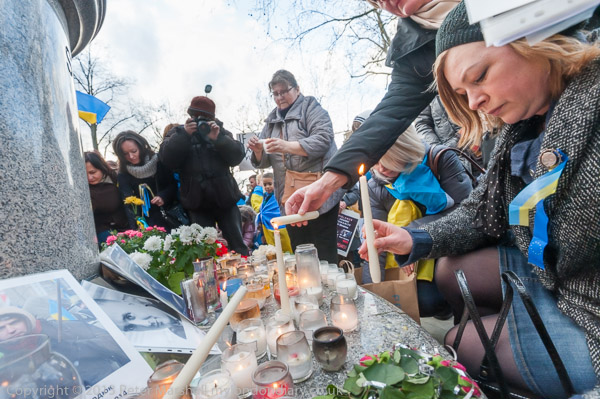
After an hour of protest I went with the Ukrainians as they marched east along Holland Park Avenue to the statue of St Volodymyr, ruler of Ukraine 980-1015, erected by Ukrainians in Great Britain in 1988 to celebrate the establishment of Christianity in Ukraine by St Volodymyr in 988.
Here around the base of the statue were hundreds of lighted candles, along with flowers and other tributes to the many pro-opposition protesters who have been killed in Kiev and elsewhere in the Ukraine and more photographs of them were added.
Two Ukrainian Orthodox priests led a service in memory of those who had died in the protests to establish a free and independent Ukraine and people held up Ukrainian flags.
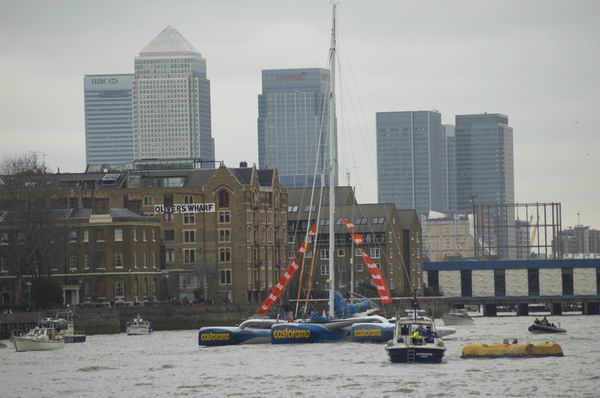
Ellen MacArthur, Brian Haw & Ashura. On 20th February 2005 I froze on the riverside in Bermondsey waiting for Ellen MacArthur’s catamaran to come up-river to Tower Bridge after her 71 day voyage had made her the fastest solo sailor to sail around the world. Five years later “she set up the Foundation in her name to accelerate the transition to a circular economy“. I didn’t get any very good pictures as I was far to far away as she raised here arm to acknowledge the crowd that had gathered to welcome her – I needed a much longer telephoto than I’ve ever had.
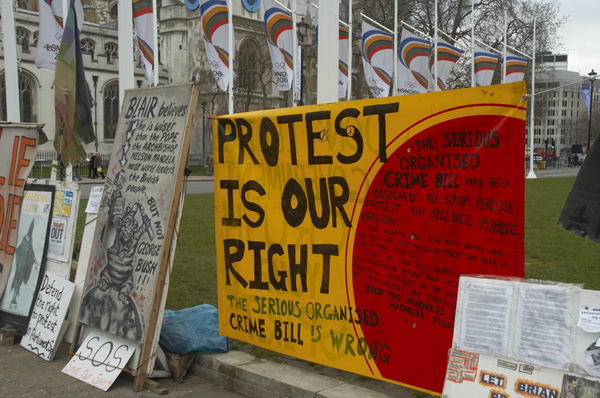
Afterwards I took a little walk around the Bermondsey riverside before making my way back to Parliament Square where I took a pictures of the display there by Brian Haw’s Peace Campaign, now joined by promotional flags for the 2012 Olympic bid. There was more of this in Trafalgar Square too, where I dropped in briefly to see some of our pictures and warm up.
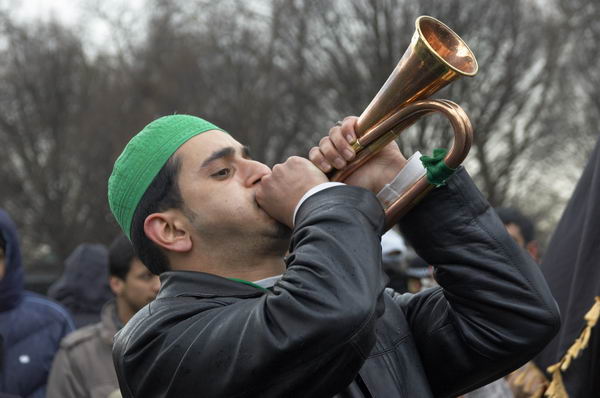
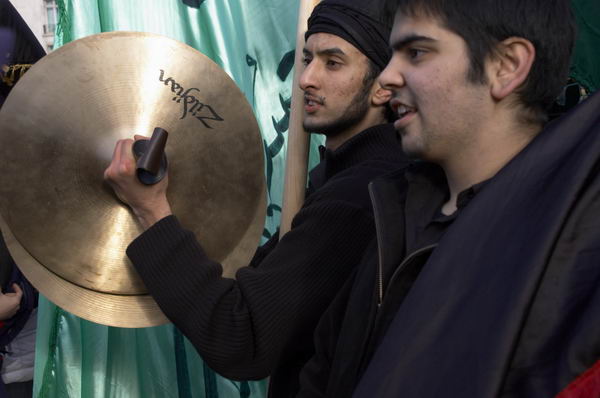
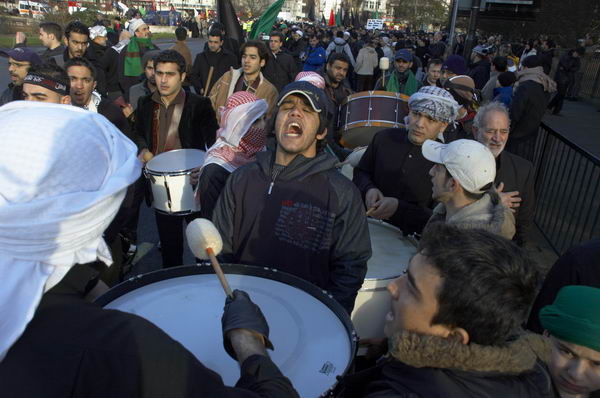
Finally at Marble Arch I photographed the start of the Ashura procession by Shi’ite Muslims. I didn’t stay too long as I was still cold and I was keen to get home and warm.
Here – with the usual minor corrections – is the piece I wrote in 2005 to go with the pictures on My London Diary:
Sunday was another bitter day, and I froze on Butlers Wharf waiting to see Ellen MacArthur aboard her catamaran as it was driven up to Tower Bridge and back from Greenwich, disappointingly not a sail in sight.
Ellen MacArthur is just visible, arm upraised in the centre of the picture
The crowds were not huge, but respectable, but like me, few could be bothered to go to Greenwich. The various press boats buzzing round the catamaran added a little interest, but made me glad I wasn’t on one.
I was more interested in taking some pictures along the riverside, then took the tube to Westminster to call in on Brian Haw, still in Parliament Square since 1st June 2001, with the government now cooking up a personal law against him.
The signs on the square are no augmented by a line of mute London 2012 flags, and along in Trafalgar Square (on my route to the National Gallery) was a giant tent and Olympian figure. Nobody can accuse London 2012 of not spending money on promoting their cause. more pictures
Shi’ite Muslims in London were celebrating the stand of the grandson of the Prophet, Imam Hussain, who died a glorious martyr along with his small band of supporters at Karbala in Iraq, choosing death rather than dishonour, in the year 680. Ashura represents a key point of difference between Sunni and Shi’a traditions and Saddam Hussein rigidly prevented its observance in Iraq during his years in power.
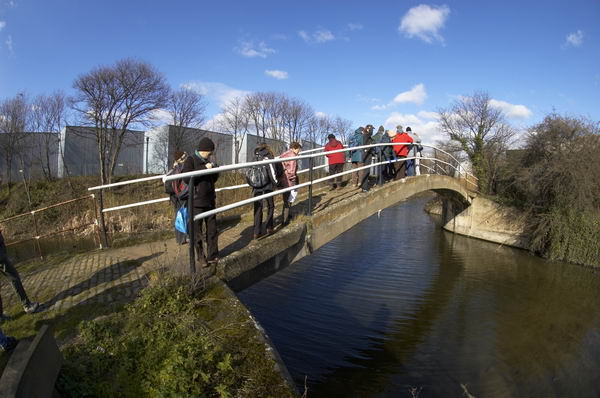
Protesting the London Olympics Bid: On Saturday 19th February 2005 I sent for a guided walk around the proposed Olympic site on Stratford Marsh and then joined others in a protest march through the area to Hackney Marshes which would also be affected.
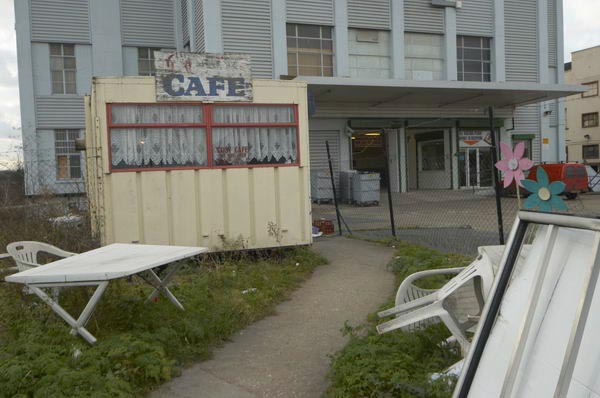
Small industries giving local employment which will disappear
The favourites for the games were Paris, and although public opinion in Britain largely backed the bid, there was rather less support by locals both because of the effects it would have on the area and the high coast which would mean an extra £20 per year on council tax.
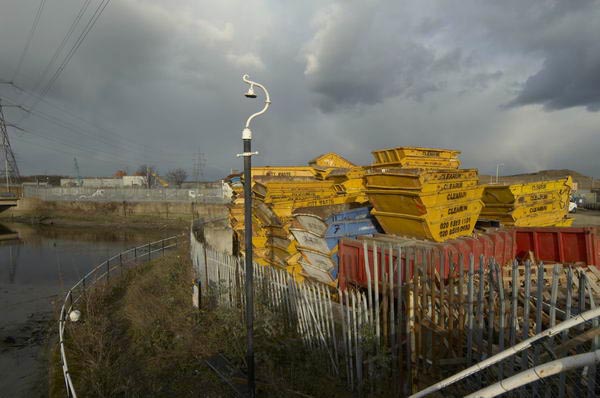
One of the larger industrial sites, and a building in use as artists studios
Paris accused London of violating the rules but the decision was was made by a small majority in London’s favour.
Pudding Mill River and Old River Lee
After the success of the bid in July 2005 there were fears around the rest of the country that the extra spending on the games would mean diverting funds for more necessary work away from the rest of the country – which it did.
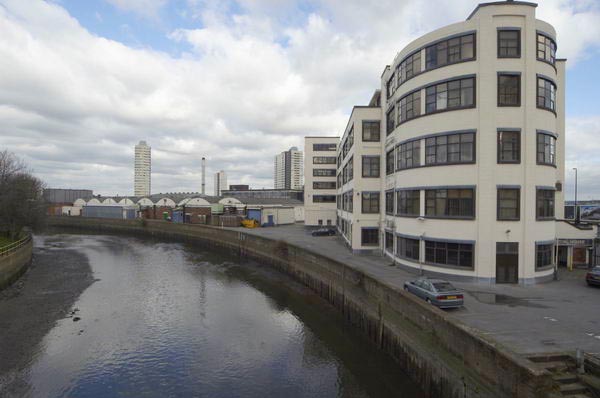
City Mill River and Warton House, formerly the Yardley perfume company’s Box Factory – preserved
And locally many suffered from the disruption of the works over an extensive area – with local businesses and some residents being forced out of the area.
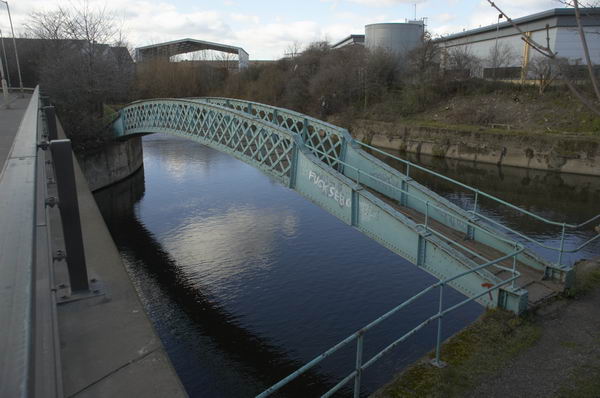
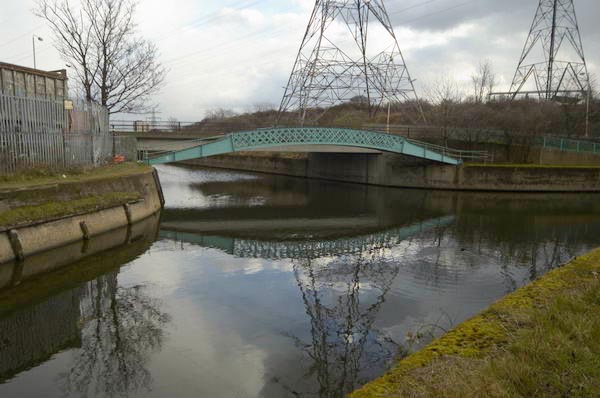
This bridge had a local message for Seb Coe who heads London’s bid for the 2012 Olympic Games
Here I’ll reproduce – with appropriate minor corrections – the article I wrote along with some of the pictures I took on the day.
Site Walk, Bow Back Rivers
Saturday 19th February saw me in the Bow Back Rivers again, on another guided walk looking at the areas threatened by the London 2012 Olympic Bid. We walked along The Northern Outfall Sewer from Stratford High Road to Old Ford, then along the Old River Lea and back down the City Mill River.
Traditionally an area for dirty industries on the east of the city, a health and safety hell-hole, now with plenty of derelict land, but still providing local jobs that will all disappear if the bid goes through.
Much of the area will disappear under concrete, almost all redundant after the big event, with plans for its after use unpublished and unfunded.
At the moment it’s a rich wildlife environment, but all that will go, and the tidal Bow Back Rivers are likely to be lost or severely altered.
If the bid goes ahead it will severely distort a regeneration that needs to be based on local needs and priorities, and the trumpeted increased investment will largely create unwanted facilities that will be future millstones.
Hackney marshes. Football pitches will be concreted car parks for the Olympics
Not to mention the disruption over perhaps 15 years as the site is developed and then (if finances materialise) restored for use.
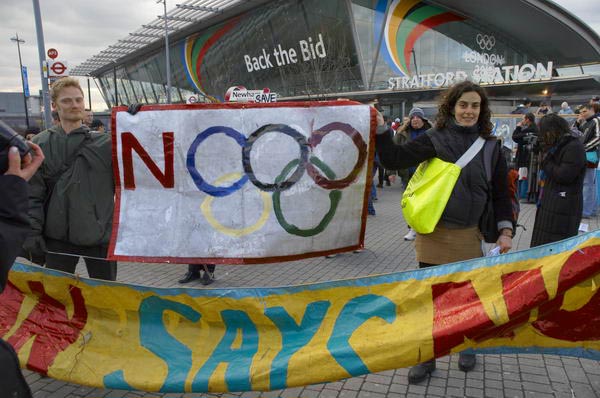
No London 2012 Olympics March
More local businesses that will close on Waterden Rd.
After the walk, we went to join the demonstration and protest march that was forming in Meridian Square outside Stratford Station. It wasn’t a huge event, with just over a hundred marchers, but I was surprised at the positive response from those hurrying by to catch trains or go shopping, many expressing support.
The march, on a bitter, dull afternoon, ended on Hackney Marshes, where considerable local sports facilities are due to be covered by car parks if the bid succeeds, with people playing games and a very spirited sack race.
View from the walkway over Carpenters Lock
I walked back to Stratford, again through the Olympic site, crossing over the Lea at one of the locks and along the side of the Waterworks River, with often dramatic lighting and the occasional light flurry of snow.
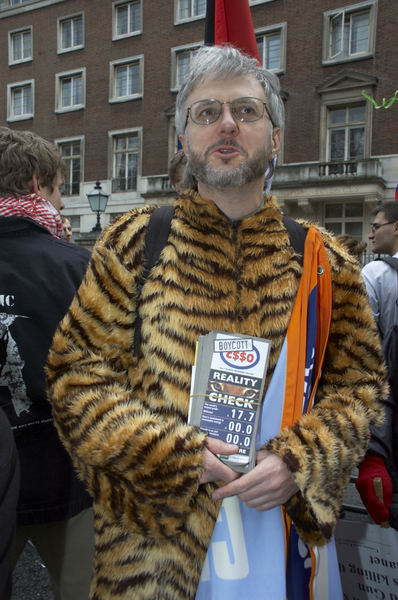
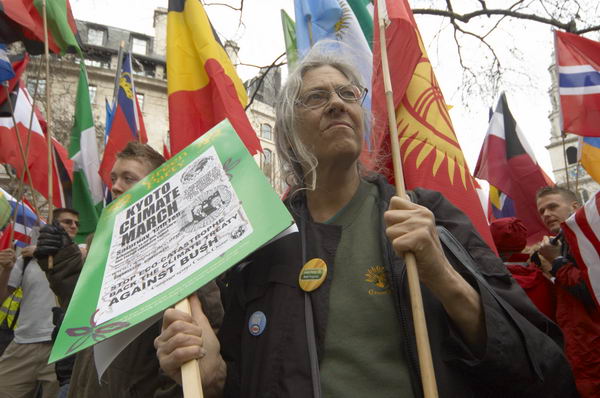
Campaign against Climate Change Kyoto Climate March: Another post from the past – 20 years ago on Saturday 12th February 2005- which has perhaps added resonance now that Trump and President Musk have condemned humanity to death with their climate roasting rejection of our last chances of survival. Though like some of his multi-billionaire friends he perhaps trusts inhumanity will survive in their climate bunkers with their heavily armed guards to keep out the rest of us. And as a small bonus I’ll add the anti-consumerist Valentines Day Reclaim Love which I photographed later the same day around Eros.
So here again is the text from 2005, suitably recapitalised and slightly corrected, along with a few of the pictures and linked to the rest. And the odd link to add context which people may have now forgotten.
Campaign against Climate Change Kyoto Climate March
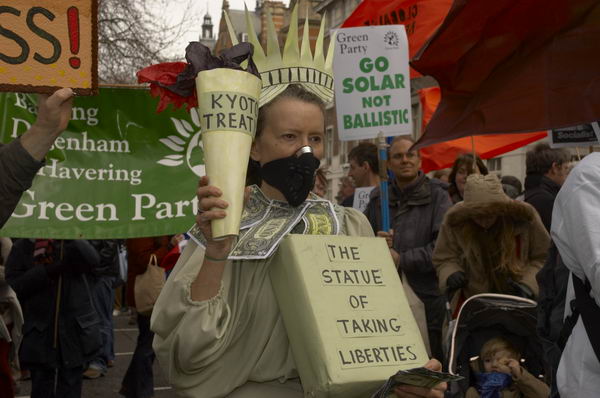
The Statue of Taking Liberties
When I talked about the dangers of increasing CO2 emission and the need to cut down use of fossil fuels 35 years ago, I was a crank. Now everyone except the USA oil lobby and their political poodles recognises that climate change is for real.
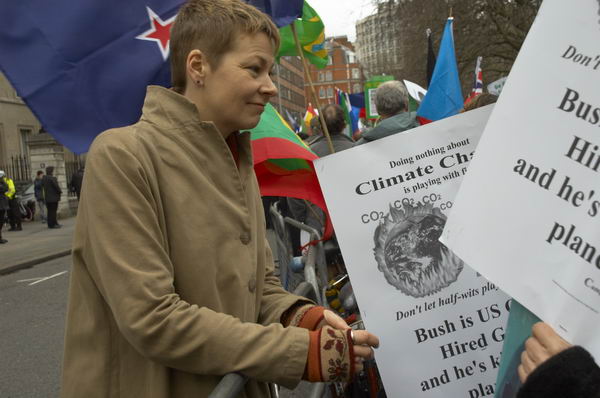
Caroline Lucas, MEP, talking to other marchers
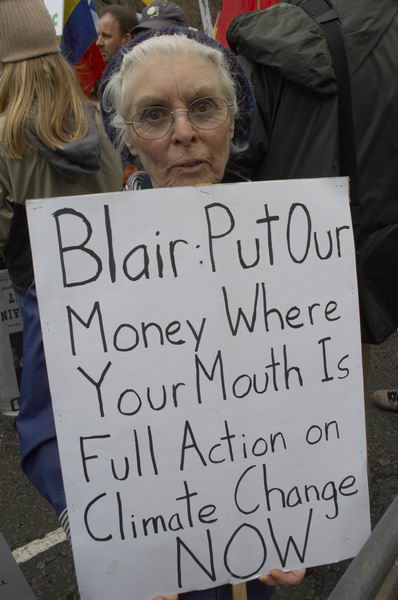
Even Blair has recognised it as the most vital issue facing us, threatening the future of the planet, although actually taking effective action still is a step too far for him. However he did call for a conference to examine the problem, which told him and us that we had perhaps ten years to take action before it would be to late.
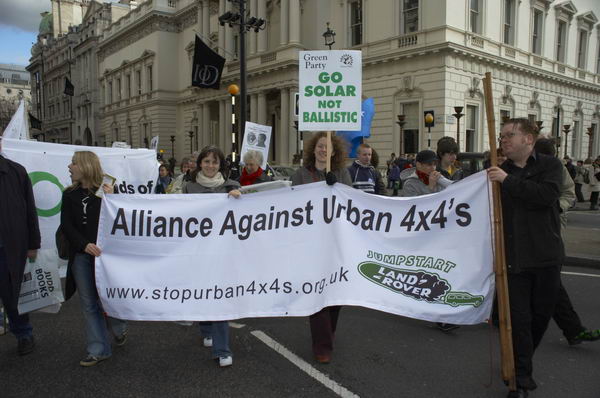
4x4s waste fuel and endanger pedestrians and cyclists
Kyoto is history now thanks to the US boycott, (although it comes into effect this week), but it should have been the first inadequate step on the road to action.
Displaying flags of the 141 countries who have adopted Kyoto
Every journey has to start somehow, and even a half-hearted step is better than none, and would have led the way to others. What got in its way was Texan oil interests, whose political face is George W Bush.
I’ve photographed most of the Campaign Against Climate Change’s Kyoto marches over the past few years. This one was probably the largest, and certainly excited more media interest, truly a sign that the issue has become news.
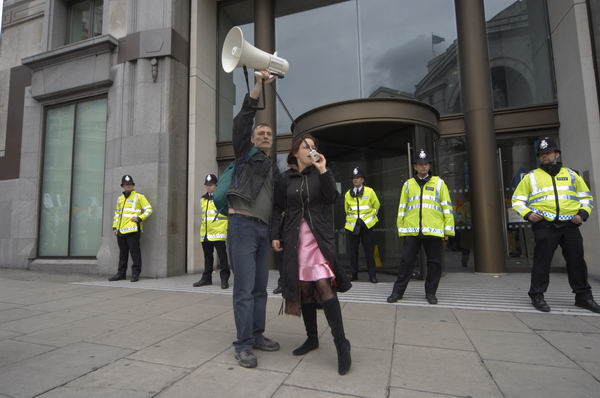
Police stand guard as Lucy Wills berates ExxonMobil for their lies on climate change which drives US policy
Starting in Lincoln’s Inn Fields, the march stopped first outside the UK offices of Exxonmobil, on the corner of Kingsway for a brief declaration,
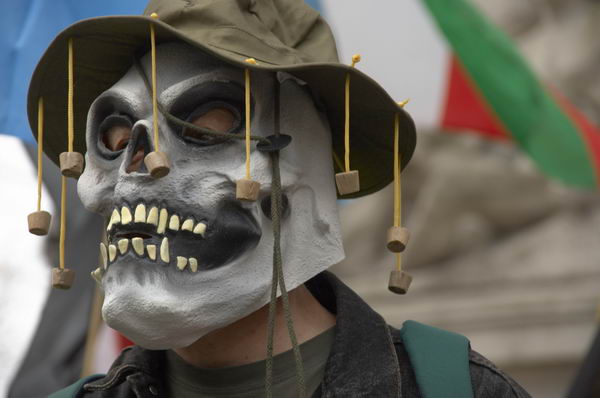
then for a longer demonstration outside the Australian High Commission in Aldwych (with guest appearances by its PM ‘John Howard‘ and an Australian ‘Grim Reaper’ with cork decorated hat),
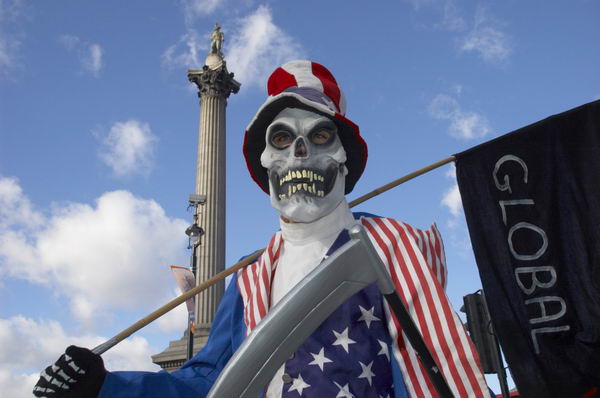
Uncle Sam as the Grim Reaper in Trafalgar Square
before making its way past Trafalgar Square and Piccadilly Circus to the Us Embassy. more pictures
O-I-L One in Love – Reclaim Love, Eros, Piccadilly Circus
I left the climate march in Picadilly and returned to Eros, where O-I-L, One In Love, were organising a small gathering to “reclaim love” and “send love and healing to all the beings in the world” on the eve of Valentine’s day. It’s something we could all do with, and it was good to see people enjoying themselves around the statue of Eros (Anteros for pedants) in what is usually one of the most depressing spots on London’s tourist circuit.
Irish poet Venus CuMara who founded and organised these free street party
There was the samba band again, Rhythms Of Resistance, (hi guys) and dancing and people generally being happy and friendly and free Reclaim Love t shirts and apart from the occasional showers it was harmless fun.
The circle to send love and healing to all the beings in this world
Rather to my surprise, the police either didn’t notice it or decided to ignore it, an unusually sensible strategy
Guantanamo, National Gallery, Elephant, Aylesbury & Lisa; Ten years ago Thursday 5th February 2015 was a long and interesting day for me, with a couple of protests, a short walk around London, an estate occupation and a memorable book launch.
Close Guantanamo – 8 Years of protest – US Embassy
A small group from the London Guantánamo Campaign was celebrating 8 years of holding monthly protests at the US Embassy in Grosvenor Square.
Among those protesting were four people who had been taking part in the protests there for 8 years.
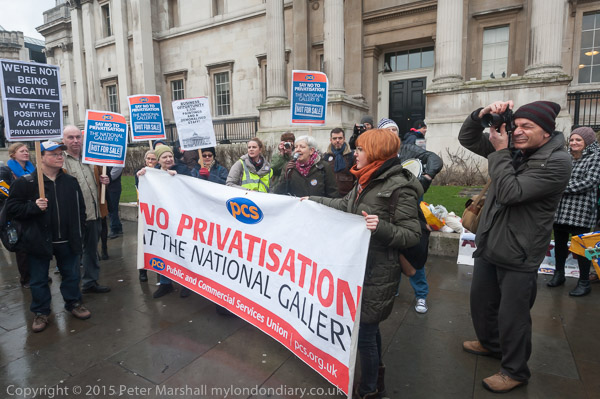
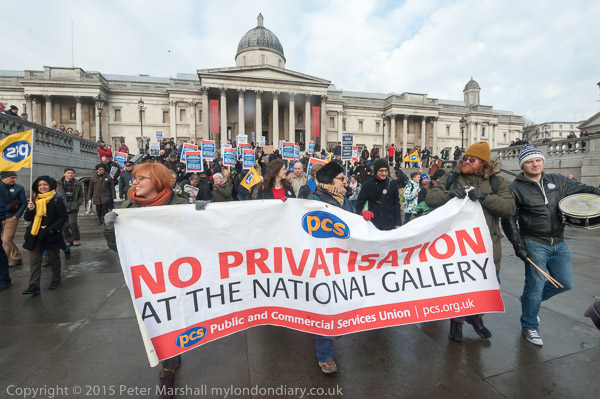
No Privatisation At National Gallery – Trafalgar Square and DCMS, Whitehall
The National Gallery had told 400 of its 600 staff who are responsible for the security of the paintings and the public, provide information about the collection, organise school bookings and look after the millions of visitors each year that they are no longer to be employed by the gallery and will instead become employes of a private company.
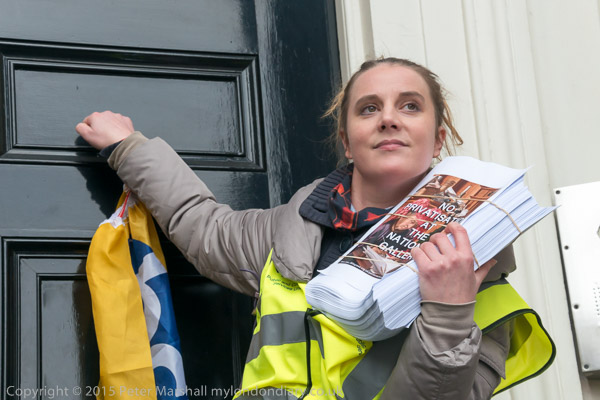
They knocked at the door but management did not answer
A private company had already taken over “temporarily” to run services in a third of the gallery.
Workers at the gallery had staged a 5 day strike against the privatisation and were incensed when Candy Udwin, one of the senior PCS union reps and a member of the team taking part in negotiations with management at ACAS, was suspended, accused of breaching commercial confidentiality, and they demanded her re-instatement.
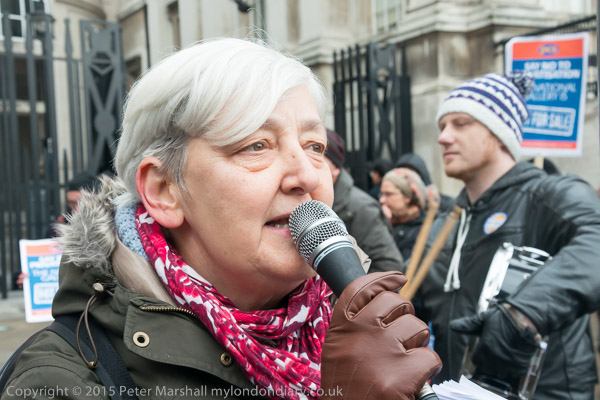
Candy Udwin
The National Gallery was then the only major museum or gallery in London still not paying the London Living Wage. Staff were already living on poverty pay and the privatisation would threaten pay and worsen the conditions – sick pay, holiday pay, pensions, hours of work etc – of these loyal and knowledgeable staff.
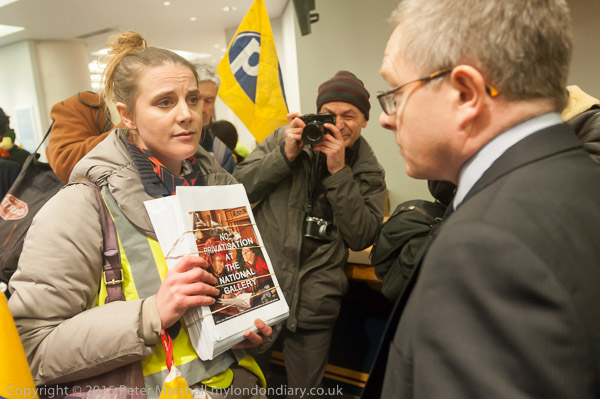
When nobody came to the door as they tried to deliver their 40,000 signature petition against privatisation a group went into the Sainsbury Wing to tray and deliver it. Security tried to get them to leave. Nobody from the gallery would come down to recieve the petition and eventually the strikers handed it over to the Head of Security who promised to deliver it to management personally.
Jeremy Corbyn joins the marchers
The strikers and their supporters then marched through Trafalgar Square and Whitehall to the Dept of Culture, Media and Sport, then in Parliament Street, where the minister concerned had agreed to receive a copy of the petition and three of them were allowed to take it in. Here there was a short rally with speakers including Jeremy Corbyn MP.
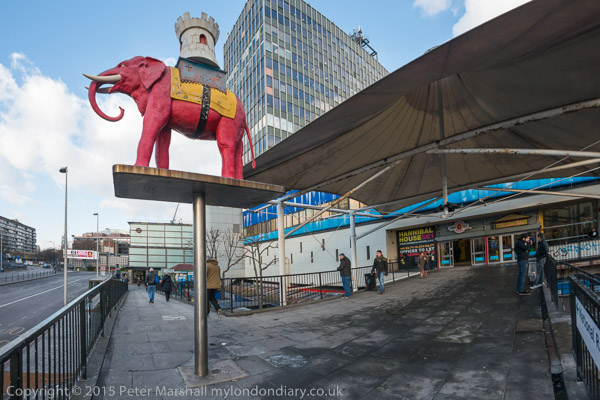
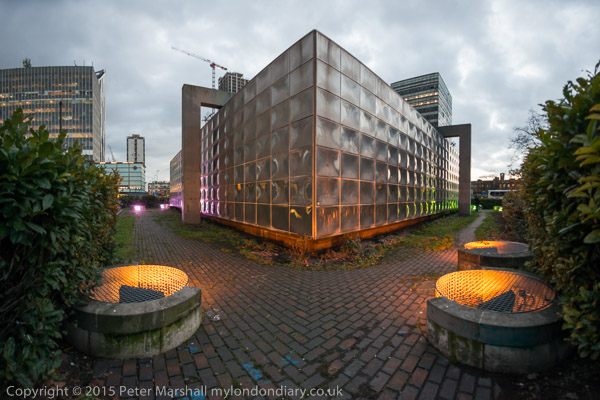
I made a few pictures as I walked from the Bakerloo Line station at Elephant & Castle to the Aylesbury Estate and afterwards on my way back to the station. The shopping centre has now been demolished and new buildings have sprung up on its site,
This strange building is an electricity substation which is still there, although there is no longer a roundabout around it. It was built as a memorial to Michael Faraday, ‘The Father of Electricity’ who was born a few hundred yards away in 1791.
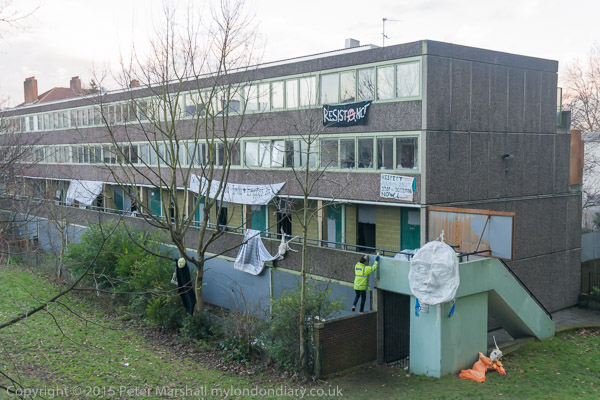
Chartridge occupied since the previous Saturday in a protest for housing in London
Southwark Council’s Aylesbury Estate was one of the UK’s largest council estates, built between 1963 and 1977 with over 2,700 homes. Lack of proper maintenance by the council and its use by them as a sink estate had led to it getting a reputation for crime, exaggerated by its use in filming TV crime series and films there not least because of its convenient location.
Access to the occupied block – I didn’t attempt it
It was on the Aylesbury Estate that Tony Blair got in on the act making his first speech as Prime Minister promising to fix estates like this and improve conditions for the urban poor through regeneration of council estates.
‘Respect Aylesbury Ballot – Stop the Demolition Now!’ Residents voted overwhelming for refurbishment not redevelopment
The buildings were actually well-designed and structurally sound on a well-planned estate with plenty of green space, but having been built in the sixties and 70s needed bringing up to date particularly in terms of insulation and double glazing. Southwark Council had also repeatedly failed to carry out necessary maintenance, particularly on the district heating system which they had allowed to become unreliable. But many residents liked living on the estate and when given the choice voted by a large majority for refurbishment rather than redevelopment. I visited several homes on other occasions and was quite envious, and the residents clearly loved living there.
Southwark Council responded by claiming the refurbishment would cost several times more than independent estimates suggested and went ahead with plans to eventually demolish the lot. Given the large number of homes involved the process was expected to last 20 years (later increased to 25 and likely to take even longer.) The first fairly small phase was completed in 2013, and the homes that were occupied in 2015 were in Phase 2.
I wasn’t able to access the flats that were occupied as it would have meant a rather dangerous climb to the first floor which I decided was beyond me, but I did meet some of the occupiers and went with them and some local residents to distribute leaflets about a public meeting to other flats in the estate.
Many residents support the occupiers and knew that they would lose their comfortable homes in a good location when they are finally forced to move. Some will be rehoused by Southwark, though mainly in less convienient locations and smaller properties, but many are on short term tenancies which do not qualify them for rehousing and will have to find private rented accommodation elsewhere. Those who have acquired their flats will only be offered compensation at far less than the cost of any similar accommodation in the area and will have to move much further from the centre of London.
While the volunteers were posting leaflets on one of the upper floors of the largest block on the estate, Wendover, I took some pictures to show the extensive views residents enjoyed. This was hindered by the fact that the windows on the walkways were thick with dust, possibly not cleaned since the block was built and not opening enough to put a camera through. Then fortunately I found a broken window that give me a clear view.
Getting By – Lisa’s Book Launch – Young Foundation, Bethnal Green
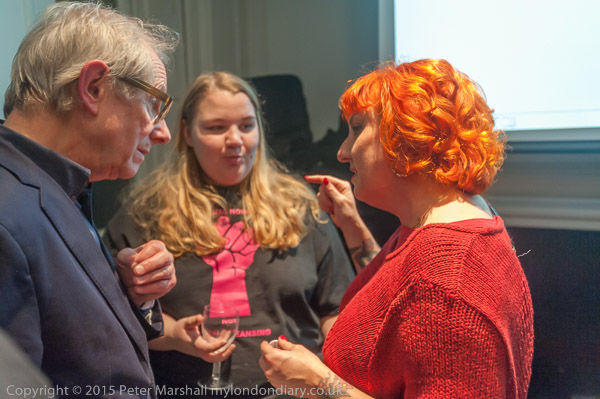
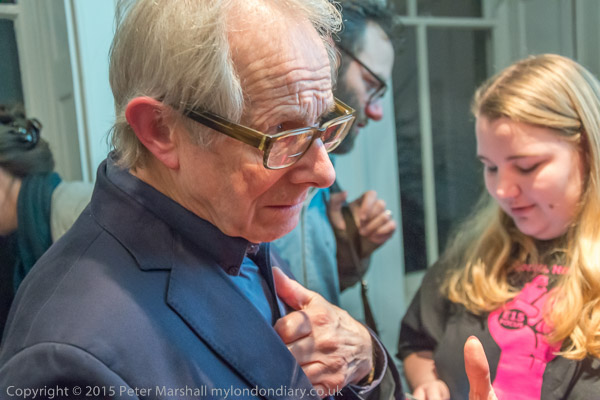
Ken Loach, Jasmine Stone and Lisa McKenzie, author of ‘Getting By’ talk at the book launch
Lisa McKenzie’s book ‘Getting By‘ is the result of her years of study from the inside of the working class district of Nottingham where she lived and worked for 22 years, enabling her to view the area from the inside and to gather, appreciate and understand the feelings and motivations of those who live there in a way impossible for others who have researched this and similar areas.
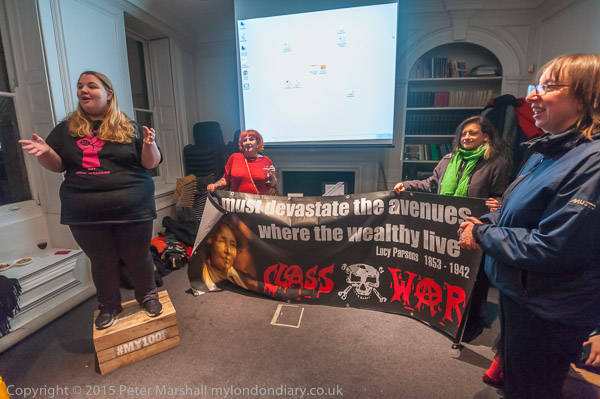
Jasmine Stone speaks about Focus E15 and Lisa and others hold a Class War banner
On the post in My London Diary I write much more about the opening – and of course there are many more pictures as well as a little of my personal history.
Anti-Fascists Oppose the Far Right: Last Saturday, 1st February 2025, I photographed one of two marches taking place in London, kept well separate by a large force of police who had restricted the protests to widely separated routes though ending close to each other.
The march says fascists are not welcome on our streets and is against all forms of racism including antisemitism and Islamophobia
Supporters of “Tommy Robinson” (Stephen Yaxley Lennon) currently in jail after pleading guilty to contempt of court had called a protest to demand his release, in a march they described as ‘Unite The Kingdom’ and ‘Stop the Isolation’. Robinson is apparently in solitary confinement in HMP Woodhill for his own safety, and has refused to remove the video he was sentenced for sharing which is pinned to the top of his ‘X’ account. They began their march at Waterloo Station, marching across Westminster Bridge to Parliament Square.
In response Stand Up to Racism had called a counter-demonstration to oppose this march and more generally the rise of the far-right in Britain. This met in St James’s Street just off Piccadilly and marched to a rally in Whitehall.
According to press reports both marches were of a similar size, perhaps between five and ten thousand marchers, though some at the extreme right event claimed a hundred thousand had marched.
Weyman Bennett, Stand Up to Racism.
During the Covid lockdown there were no protests for me to photograph and I began to post here on >Re:PHOTO much more frequently about my older work, both protests I had covered in earlier years and also my walks in and around London photographing buildings and urban landscape in the previous century.
So for some months there was nothing for me to add to my posts in My London Diary web site. Which was just as well as I was getting uncomfortably close to the limit of the number of files and folders I could host on the web space I have – which hosts this blog and a number of other small web sites. That limit is 262,144 and currently My London Diary has 194,257 Files and 2,938 Folders, with >Re:PHOTO taking up most of the rest. So even when I was able to cover protests again I had to change my ways, posting the images in Facebook albums with just a link and one or two pictures on my own web space. Finally I gave up new postings on My London Diary in January 2022, though the site remains in place and I think is an important archive.
Jewish Socialist Group
Time moves on and although I’m still photographing protests I am attending rather fewer than in earlier years and taking things easier. While ten years ago I might sometimes work on my feet for five or six hours, now after around three I’m often feeling too tired to continue, pack up and go home. And while back then I might go our five days a week, now its generally one or two, mainly on Saturdays. And while in past years I would certainly have tried to cover both marches, this year I chose just one, the counter-protest by Stand Up To Racism.
Over the years I have covered quite a few extreme right events, but I decided to leave this one to younger photographers. At many previous events I’ve been threatened, pointed out as someone who should be attacked, spat at and more, despite trying to cover them and report them fairly even though I disagree with their views. People have tried to stop me photographing and have tried to grab my equipment and police haven’t always been ready to help.
At the Stand Up To Racism event there was a far more positive atmosphere. Generally people were happy, sometimes even eager, to be photographed and I was able to walk freely through a packed crowd before the march began making pictures, as well as inside the march itself.
Of course the people at the protest were angry at the way the country (and the world) seems to be drifting towards the right, with more draconian legislation restricting our right to protest, long sentences for peaceful protesters and the kind of political policing we have seen over demonstrations calling for an end to the killing in Palestine. And some at least would be ready to fight the fascists on the streets as people did in the 1930s at Cable Street and elsewhere – and Jewish groups did after the end of the war.
Anti-fascists from the IWW – Industrial Workers of the World were being watched closely by a squad of police
But while being determined to stop the drift to the right in Britain – which appears to have been accelerated by the coming to power of Labour with a large majority – this was a march of the reasonable, the kind of people who will look at evidence rather than believe the lies and manipulations of the right wing media, people who embody the kind of values which I feel are important and which gave Britain hope after defeating the Nazis and led to the setting up of the welfare state, with the NHS and an Education Act that tried to provide a free and fair education. The kind of British values which I think the majority of us still believe in although they have been seriously eroded by successive governments for the benefit of that small minority – the 1% in what is becoming an increasingly unequal society.
Police arrest a man after several flares were set off.
My pictures tell something of the story of the march. It was entirely peaceful. I missed seeing the handful of the extreme right who had come to try to disrupt it and were arrested for breaching the restrictions that police had laid down. I saw only one person arrested, for setting off a smoke flare. I saw the smoke from several flares around a hundred yards away and rushed towards it, but the crowd of marchers across the whole of Piccadilly made this difficult and by the time I arrived a young man was being held by police surrounded by a crowd yelling for them to release him.
NEU marchers. Many trade unions supported the march
I stayed with the march until the end of it went into Whitehall where there was to be a longer rally than that before the start. Suddenly I felt rather tired it decided it was time to go home.
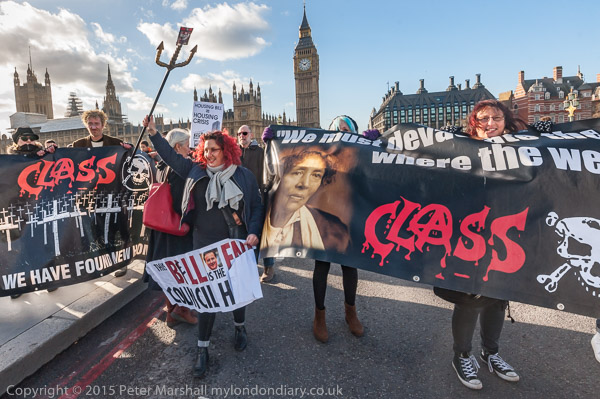
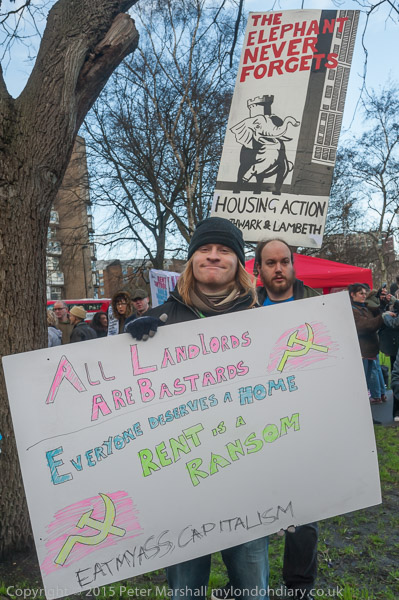
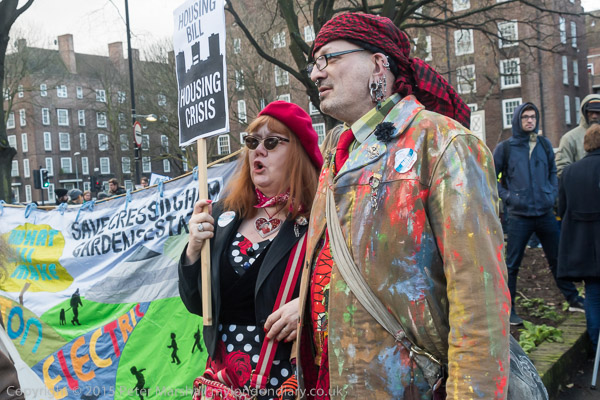
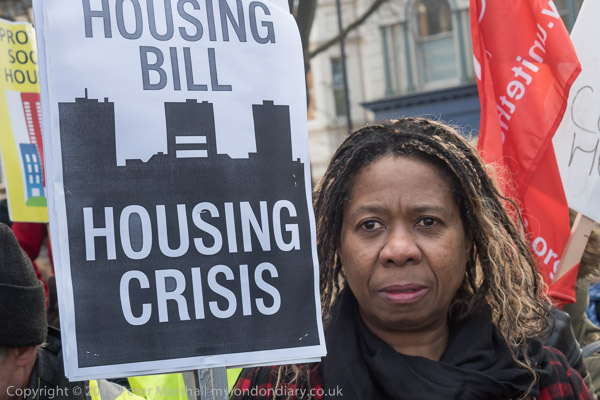
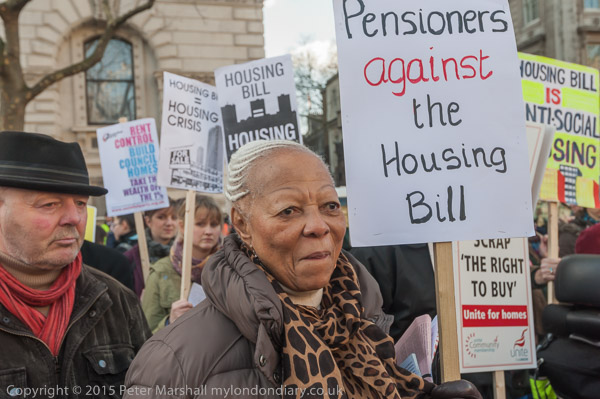
Housing and Planning Bill March: On Saturday 30th January 2016 housing activists including some local councillors and housing activist groups mainly from South London including Class War marched from the Imperial War Museum to Downing St in a protest organised by Lambeth Housing Activists against the Housing and Planning Bill.
They say the bill will have a particularly large impact in London and greatly worsen the already acute housing crisis here.
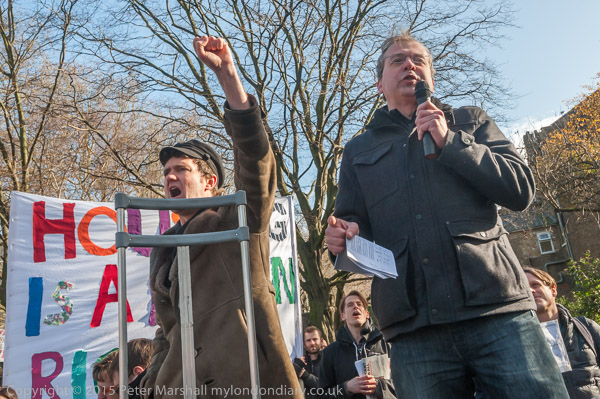
Speeches at the rally before the march in Geraldine Mary Harmsworth Park at the side of the Imperial War Museum by Green Party Leader Natalie Bennett and an number of housing activists including Simon Elmer of Architects for Social Housing were warmly applauded.
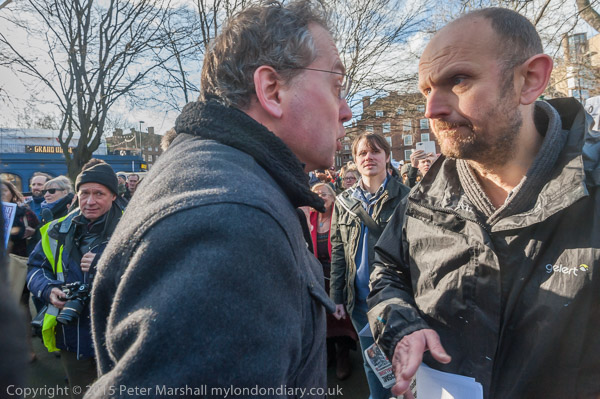
But there was one exception; when Southwark Council Cabinet Member for Housing Richard Livingstone the atmosphere changed, with boos and loud heckling from several people in the crowd including Elmer.
Simon Elmer shouts as Richard Livingstone speaks
The arguments continued in the crowd after Livingstone had left the platform with Elmer pointing out the scandal over the demolition of the Heygate Estate and now the Aylesbury estate, where thousands of council homes have been demolished and few of the promises made by Southwark Council have been kept.
Financially and morally Heygate was a scandal, with the council making derisory offers of compensation to leaseholders, far less than the value of comparable properties in the area and a huge loss of social housing, while getting rid of a huge public asset at a fraction of its true value. And since it was something the council seemed determined to repeat, and it is not surprising that feelings ran high.
Rather to the surprise of many the march set off walking in the opposite direction to its final destination of Downing Street, and it soon became clear that we were on a tour of Lambeth rather than taking a direct route.
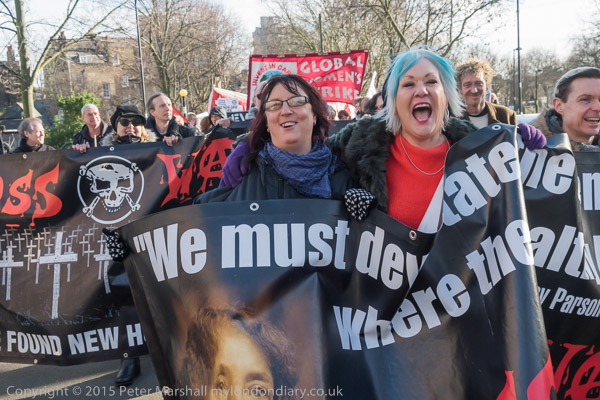
“Class War decided to liven things up a little, first by dancing along the street singing the ‘Lambeth Walk’ and then by rushing across the pavement towards a large estate agency.
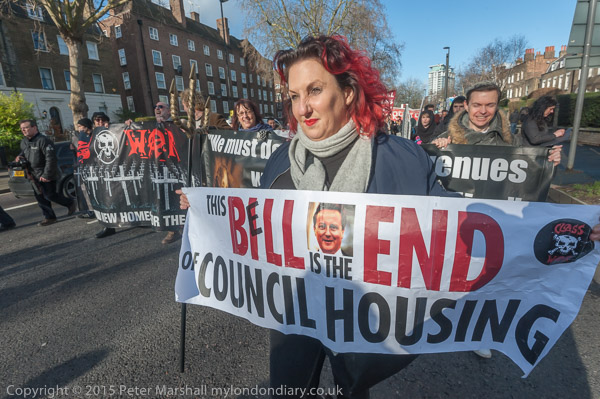
Police formed a line to stop them entering and they stood outside for some minutes with their banners – the field of crosses with the message ‘We have found new homes of for the rich’ and the Lucy Parsons banner with its quotation “We must devastate the avenues where the wealthy live” before rejoining the march.”
For much of the march Lisa Mackenzie who had stood at Class War’s candidate in the 2015 General Election against Iain Duncan Smith in Chingford stood in front of the banners waving a plastic trident with a small banner ‘This Bill is the end of Council Housing’ with its second message an image of David Cameron and the alternative text ‘Bell End’. At times she donned a face mask of Smith.
Eventually the march reached Downing Street where police tried to direct them to the opposite side of Whitehall, but the marchers walked past them and crossed back to protest outside the gates, blocking traffic on Whitehall.
Here there were several groups listening to speakers and a samba band playing. Eventually police persuaded most of them to leave the road and I left for home.
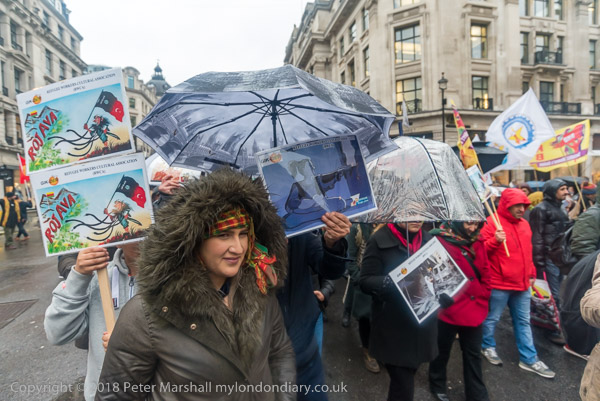
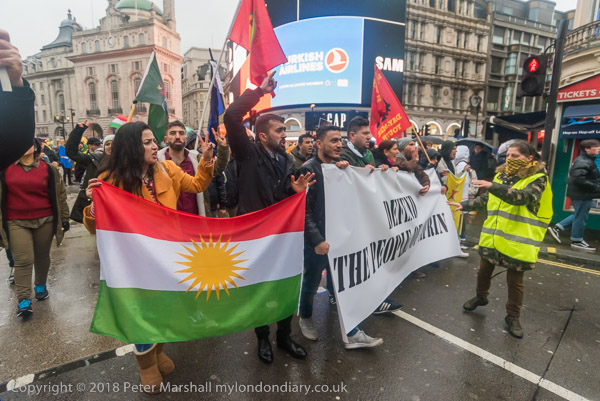
Slavery, Aninal Cruelty & Turkey Attacks Rojova: Protests in London on Saturday 27th January 2018 against migrants being sold as slaves in Libya, the continuing cruel trapping of animals to use in clothing sold by Canada Goose and the attacks by the Turkish army on Kurdish areas of North Syria.
End UAE support for slavery in Libya – UAE Embassy
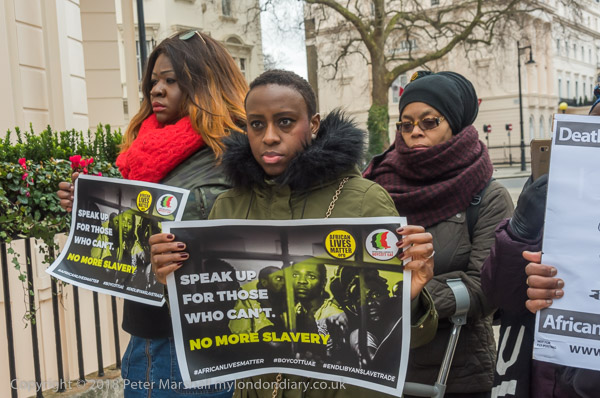
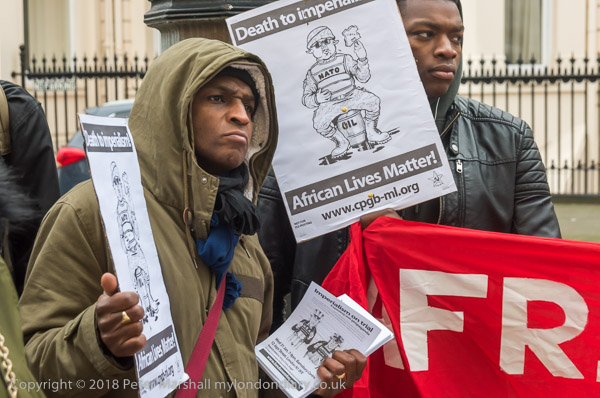
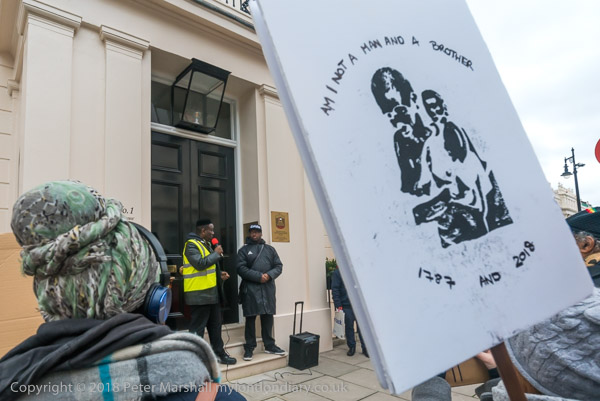
African Lives Matter and the International Campaign to Boycott UAE protest at the UAE Embassy in London against the funding by the the United Arab Emirates of armed Groups in Libya which imprison, torture and kill African migrants and sell them as slaves.
The protest also called for an end of the human trafficking of African migrants to and from Dubai and for help to be given for slavery victims in Dubai to return to their families in Africa.
This turned out to be a fairly small protest, although the police had obviously planned for something much larger and I had expected more after earlier protests over the issue.
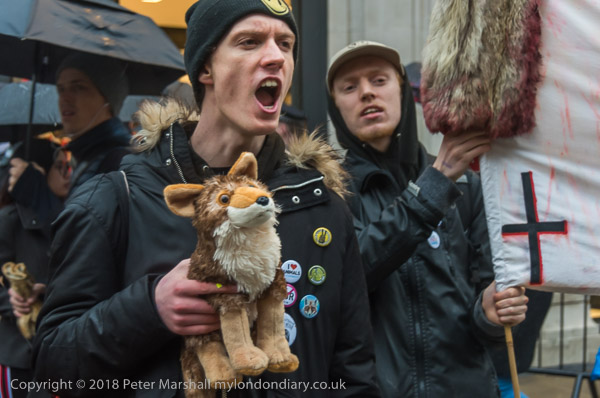
Protesters were again outside the Canada Goose flagship store in Regent St asking shoppers to boycott the store because of the horrific cruelty involved in trapping dogs for fur and raising birds for down used in the company’s clothing.
The company had obtained an injunction to try to prevent protests, but this had been amended in the previous month to allow more protesters and to enable them to use loud hailers between 2pm and 8pm. They were now carrying out weekly protests on Saturdays as well as occasional protests during the week.
Finally in 2022 Canada Goose announced it would stop purchasing new fur from trappers and transition to using reclaimed fur, though it seems unclear whether they have achieved their goal. The company is apparently still selling garments made with its large stocks of trapped fur and continuing to use feathers from geese and ducks which campaigners allege are plucked from live birds.
Defend Afrin, stop Turkish Attack – BBC to Downing St
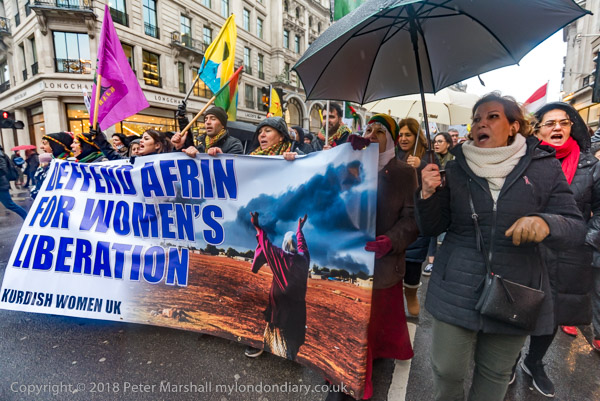
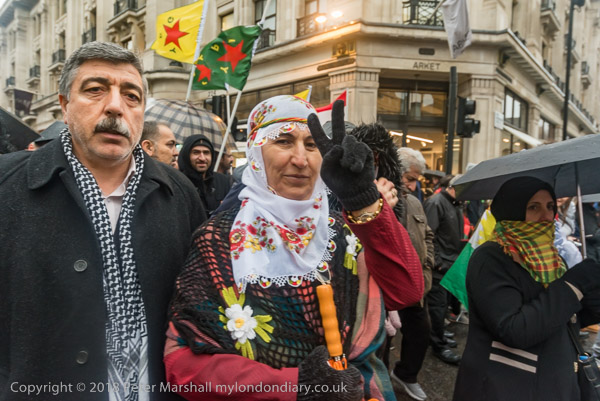
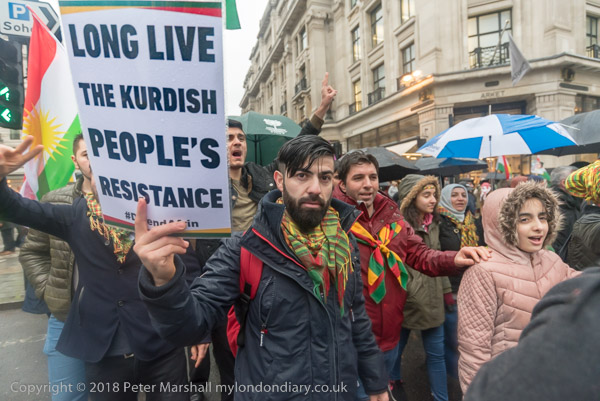
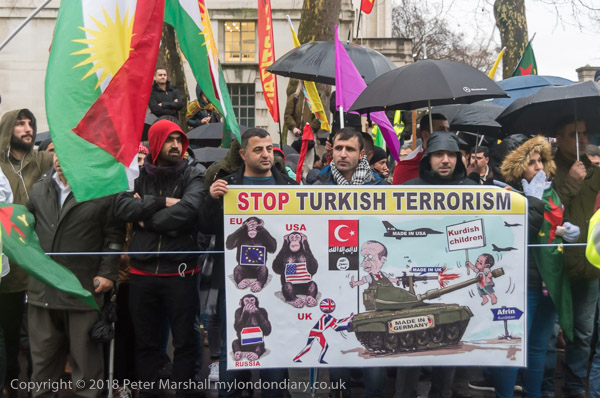
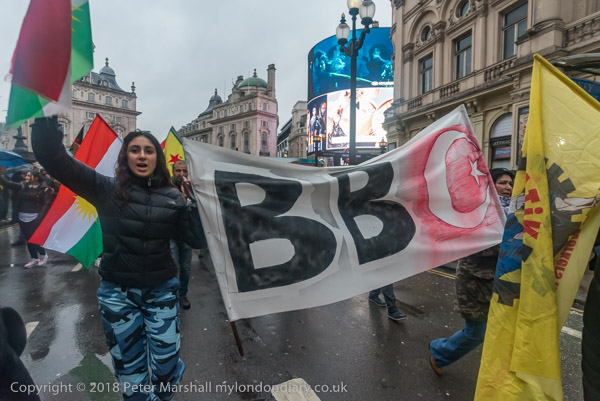
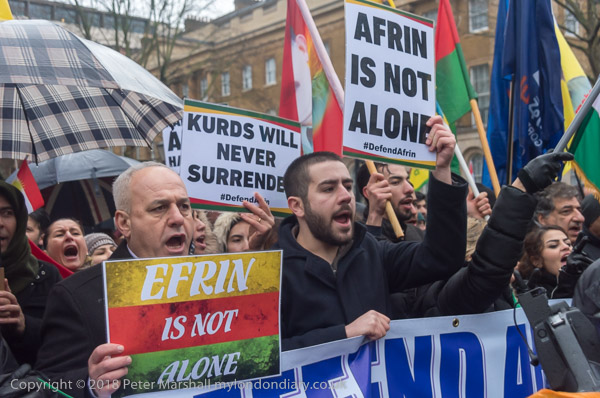
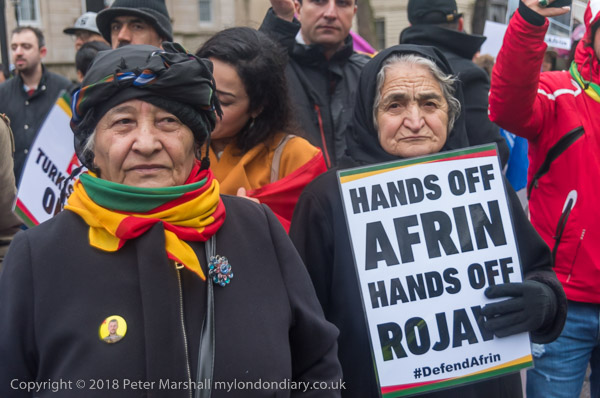
Several thousand people, mainly Kurds, marched through London from outside the BBC to a rally opposite Downing St, calling for an end to the attacks by Turkish forces on the Afrin Canton of Northern Syria, now a part of the Democratic Federation of Northern Syria (DFNS) or Rojava, a de facto autonomous region in northern Syria.
Many see Rojava with a constitution based on a democratic socialism which treats all ethnic groups as equal and women as equal to men as a model for a future federal Syria, although it seems unlikely to find favour with Hay’at Tahrir al-Sham.
Turkey is the second largest military force in NATO, second only to the USA and appeared to be using its position in NATO and the threat of closer relationships with Russia to eliminate the Kurds on its borders, who it alleges are a part of the PKK, the Kurdistan Workers’ Party, a Kurdish nationalist organisation regarded by Turkey and its allies as a terrorist organisation which was proscribed by the UK in 2001.
Kurds are around 15-20% if the population of Turkey, its largest ethnic minority and were violently suppressed following the establishment of the Republic of Turkey in 1923, with a number of massacres and a continuing attempt to erase their language and culture. Even the words “Kurds” or “Kurdistan” were banned and in 1980 their languages were banned, with those found using them arrested and imprisoned. It remains illegal to teach using Kurdish in schools in Turkey.
Kurdish forces,aided by US air support played a major role in the defeat of ISIS in Syria. Eventually the Turkish attacks on Afrin were halted after the Kurds in Rojava reached an agreement with the Syrian army to aid them in the defence of Syria. Further Turkish encroachment into Syria was prevented by the setting up of the Second Northern Syria Buffer Zone, part of the Sochi Agreement, in 2019.
Turkey encouraged ISIS in Syria as a part of their attempts to remove Kurdish influence in the areas close to their borders. Sales of oil smuggled through Turkey with the connivance of leading figures in the Turkish government provided most of the funding for ISIS.
The marchers met at the BBC who they say has failed to report over many years on Turkish atrocities and their genocidal attacks on the Kurds before marching to Downing Street.
Police apparently seized a number of PKK flags before the start of the march, though I did still spot one when the marchers reached Downing St. Kurds largely view the PKK as a nationalist rather than terrorist organisation and there were many flags with the image of the PKK’s long imprisoned leader Abdullah Öcalan. His nickname ‘Apo’ means uncle in Kurdish. It was his reading and thinking during long years of solitary confinement that led to the new thinking in the constitution of Rojava.
I listened to a few of the speeches at Downing Street before leaving for home and you can see many more pictures of the march and some of the speakers on My London Diary.
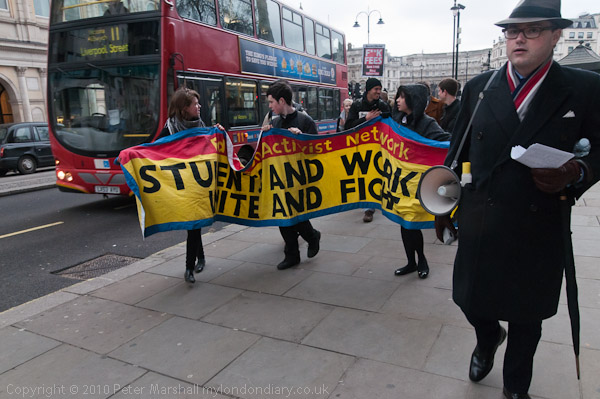
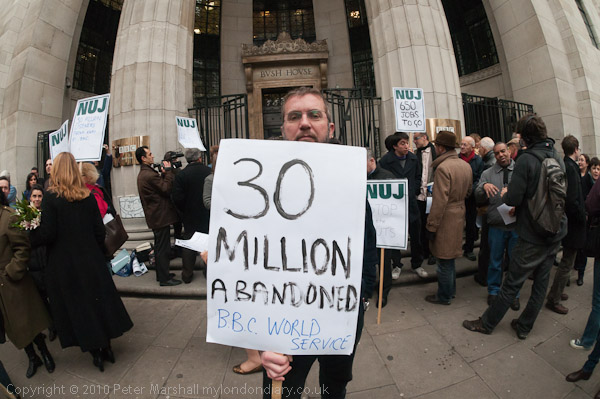
Students, World Service, Kashmir & Dr Sen – 2011: On Wednesday 26th January 2011 the Education Activist Network had called for students to come to a protest in Trafalgar Square against education cuts. But it wasn’t clear what they intended to do and few had bothered to come. In the end most of them decided to go to join the NUJ protest against cuts in the BBC World Service at Bush House which I had also been intending to go to. And since it was India’s Republic Day there were also a couple of protests outside the Indian High Commission a few yards down the road from there.
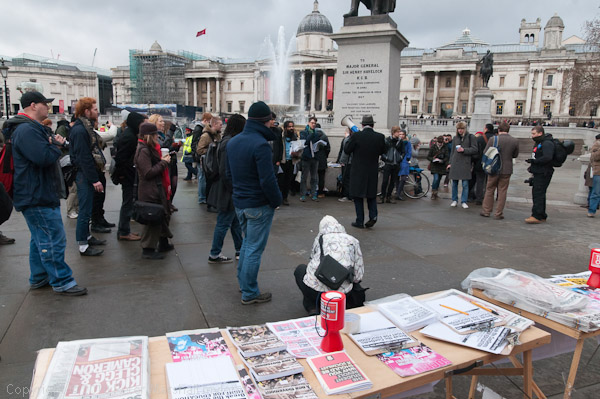
Student Day of Action – Trafalgar Square
The event organisers, the Education Activist Network who describe themselves as “group of educationalists, lecturers, and students who campaign against cuts in adult, further and higher education” had called on students to walk out of their schools and colleges and come to a protest in Trafalgar Square, but there appeared to have been little planning about what would then happen.
Fewer than a hundred had turned up and there were a couple of literature stalls collecting petition signatures and selling the Socialist Worker etc there appeared to be just one man with a megaphone. Several others came up and made short speeches against the cuts and a Heritage Warden and myself took some photographs but nobody knew what to do next.
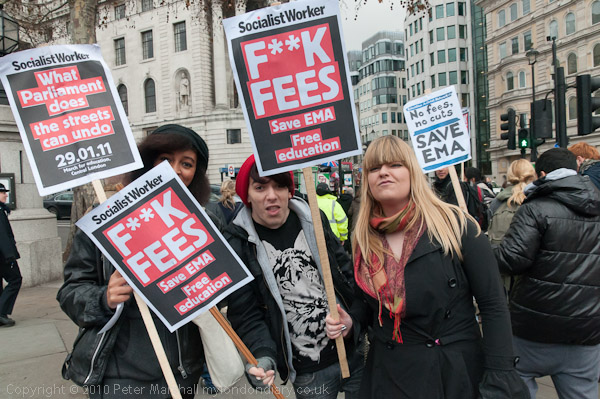
A few people stood around holding Socialist Worker placards with the message F**K FEES – Save EMA – Free Education and others. After some discussion most decided to march to Aldwych where the NUJ were holding a protest I had planned to photograph against cuts in the BBC World Service’.
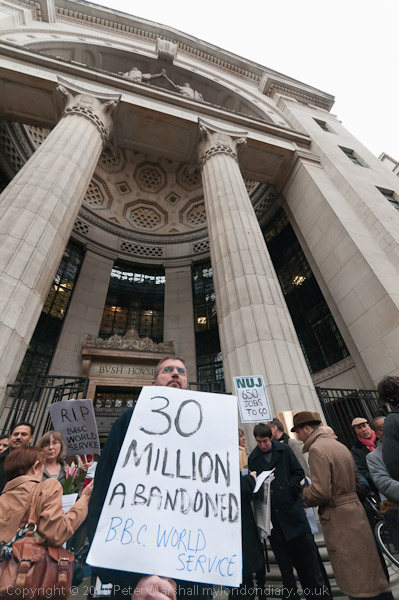
Bush House was built overlooking Kingsway as a major new trade centre for American industrialist Irving T. Bush, who approved its designs in 1919 but this imposing Portland Stone Grade II listed “most expensive building in the world” was only finally completed in 1935. A few years later in 1941 it became used by the BBC and became the headquarters of the BBC World Service. The BBC’s lease expired around a year after this protest and they did not renew it, with the building being taken over in 2015 by King’s College.
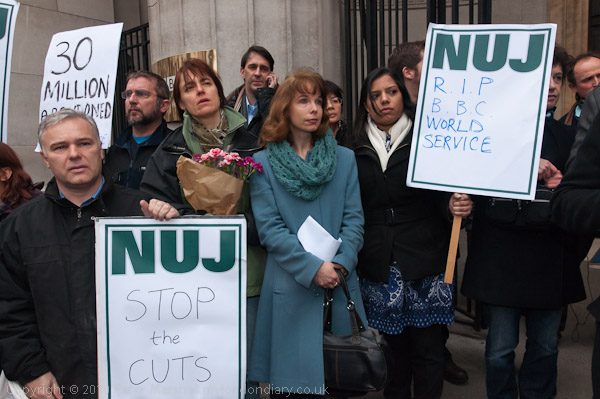
The BBC World Service has a well-deserved reputation as the best in the world and is an important part of the UK’s ‘soft power’. NUT General Secretary jeremy Dear who spoke at the protest put it well: “The diversity of staff and their presence in so many key locations around the world contributes to making the BBC World Service the leading voice in international broadcasting. At its best the World Service can challenge corruption, expose human rights abuses and promote democratic values. By cutting the service the government will cut British influence in the rest of the world, and cuts will also be deeply damaging for objective quality news services around the globe.“
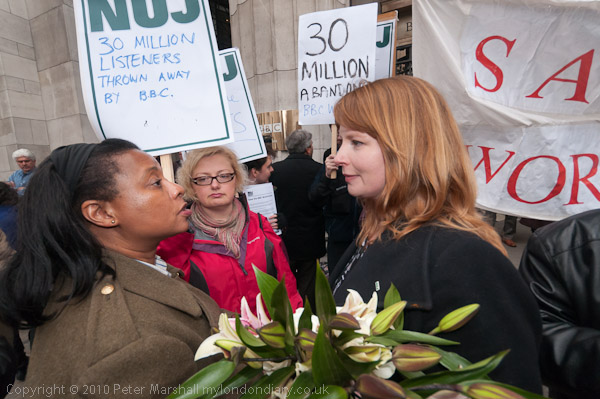
Government cuts in the grant from the UK’s Foreign & Commonwealth Office for the World Service announced in October 2010 and the transfer of the service in 2014 completely to the license fees led the BBC in January 2011 to announce swingeing cuts, axing Portuguese for Africa, Caribbean English, Macedonian, Serbian and Albanian services, the end of all shortwave radio services and more. These cuts were estimated by the BBC to result in a loss of more than 30 million listeners across the world, including in India, China and Russia.
The cuts were also expected to result in 480 BBC employees losing their jobs in 2011 and a further 170 by the time the service became entirely licence fee funded in 2014. Many of the NUJ members taking part in the protest would be among those made redundant.
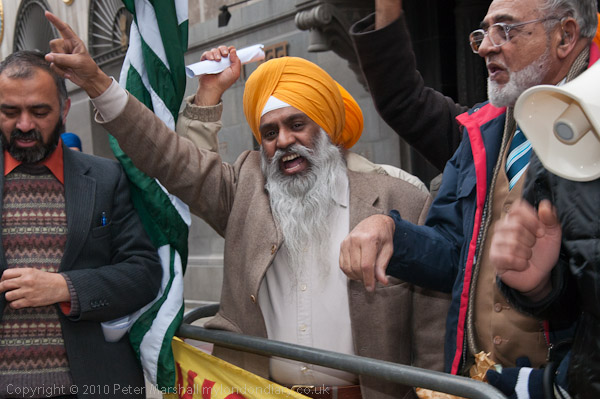
Free Kashmir & Khalistan – Indian High Commission, Aldwych
Kashmiris and Sikhs held a protest together outside the Indian High Commision on Republic Day, the 61st anniversary of the Indian Constitution, calling for the freedom that their nations have been denied by Indian military repression.
Kashmir was an ancient kingdom, becoming a Muslim monarchy in 1439, later a part of the Sikh empire but again becoming a monarchy under British guidance in the 19th century. But Kashmir – as well as the Sikhs – were unfairly mistreated in the negotiations for Indian independence and the 1947 partition.
Although Kashmir has am 80% Muslim population its then Maharajah ceded the kingdom to India as a way to protect his privilege and rule against an invasion by Pakistan. In return Kashmir was granted some limited autonomy by the Indian Constitution (revoked in 2019.)
Kashmiris campaigning for freedom from Indian rule have been savagely repressed and the country has a huge occupying force of Indian troops and police, with widespread human rights abuses, many continuing to be imprisoned, tortured and murdered.
Both India and Pakistan have been found by UN bodies and other investigations to be guilty of widespread human rights abuses in the areas of Kashmir they administer. The UN in 1948 called for the people of Kashmir to be allowed to determine their future by a free and fair vote, but this has never been possible due to the opposition of both India and Pakistan. A small part of the country is also occupied by China, doubtless also abusing human rights.
Protesting with the Kashmiris were Sikhs, also neglected at Partition which divided the Punjab between India and Pakistan. Widespread agitation for their own independent state of Khalistan was accelerated by the 1984 attack by the Indian Army on the Golden temple at Amritsar, and the widespread anti-Sikh riots and killing which after the assassination of Prime Minister Indira Gandhi by her Sikh bodyguards which followed. As in Kashmir, Sikhs in India have suffered widespread and continuing human rights abuses.
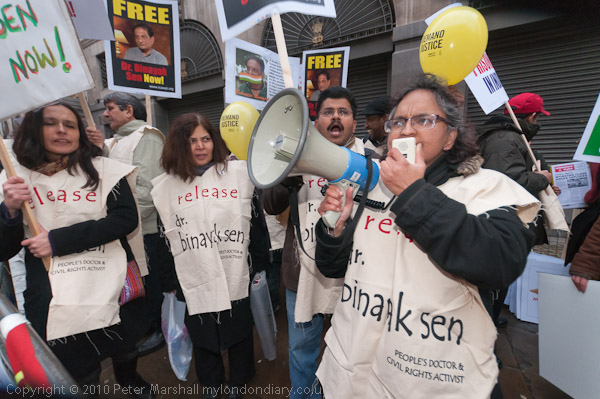
Dr Binayak Sen is a highly regarded Indian doctor, internationally recognised for his work with indigenous and marginalised people with a lifetime of service of the rural poor.
He helped establish a hospital serving poor mine workers in Chhattisgarh and founded a health and human rights organisation that supports community health workers in 20 villages, and was an officer of the People’s Union for Civil Liberties (PUCL).
Dr Sen criticised the state Government’s atrocities against indigenous people who were fighting the handover of their lands for mining, and their establishment of an armed militia, the Salwa Judum, to fight against the Naxalite (Maoist) rebels in the area.
In 2007 he was arrested and charged with having links with the Naxalities and was held in prison until granted bail two years later in May 2009. But in December 2010, Dr Sen was found guilty of sedition and conspiracy and sentenced to life imprisonment. At the time of the protest his appeal was continuing. He was granted bail in April 2011 and the case against him has not been pursued.
Political Policing & Shocking Lies: Last Saturday, 19th January 2025 I was witness to a shameful display of aggressive and politically motivated policing in the centre of London.
Politics had come into the event days earlier when police had banned the National Protest for Palestine from gathering at the BBC to march to Whitehall on the less than flimsy pretext that there is a synagogue around three hundred yards away.
The synagogue in question is down a side street and in the opposite direction that the march would travel, and none of the previous over 20 national marches for Palestine has involved any violence or intimidation of Jews.
Anti-Zionist ulltra-orthodox Neturei Karta Jews
Police harass a group of holocaust survivors and families, telling them they must move further up Whitehall.
Many Jews have taken part in all of these marches and other protests against the killing in Gaza and the continuing repression in the occupied West Bank, calling for freedom for Palestinians. And all of the marches since the Hamas attack on Israel have called for the release of the hostages held in Gaza as well as for a solution to bring peace and justice to Palestine.
To meet the police objections the march organisers had offered to march in the opposite direction, meaning they would arrive at the BBC several hours after any of those attending the synagogue would have left. Police rejected this offer and instead proposed that the march would start in Russell Square. Since the march was in large part a protest against the biased coverage of events by the BBC.
In their thoroughly researched report published in March 2004, the Centre for Media Monitoring clearly showed the extent of pro-Israel bias in BBC reporting, for example in giving considerable publicity to unverified statements by Israeli official sources, many of which have later been found to be false, as well as deliberately calling into question statements from Palestinian sources.
The report is a long and careful study and should at least have meant considerable changes in the way that the BBC covers events if it values its claim to be impartial, but any changes have been minor. The organisation continues to heap doubt on the claims over the number of deaths of Palestinians despite these largely being confirmed as accurate by UN and other observers – and a recent peer-reviewed statistical analysis in The Lancet suggesting that the actual number of deaths are 40% higher than the official Gaza health ministry figures.
Peter Tatchell calls for the release of all Palestine political prisoners.
When their reasonable suggestion was turned down by the police, the march organisers announced they would instead hold a rally in Whitehall. Clearly the police were not happy at this but it would have been difficult for them to raise any legally sustainable reason to ban it.
So the rally went ahead, and I went to photograph it. Entering Whitehall I was stopped for a short time as policed parked a van to make access more difficult but managed to walk past. Others coming to the protest were actually stopped by police and had to walk around to enter Whitehall by side streets.
‘BBC Complicity’ is Orwellian.
Inside Whitehall there seemed to be a number of lines of police giving contradictory orders to people to move up or down the street. I watched with incredulity as a group of officers came to tell a small group of Jewish holocuast survivors and sons and duaghters of survivors they could not stand at the side of the road in front of the stage but had to move further away up Whitehall.
Then I hear shouting from a crowd by the side of the stage. A particularly aggesive squad of police was forcing them to move and had arrested one woman who had not obeyed there orders, thowing her to the ground. The protesters were shouting ‘Let Her Go, Let Her Go‘ but they didn’t, simply facing the crowd aggressively and promising further arrests. A second slightly less aggressive squad was similarly forcing people along past the other side of the compound around the stage.
There seemed no point to either of these squads other than to stage a little police aggession. A few minutes later they left the area and people were free to wander into the areas they had cleared – and a group set up a large display with children’s clothing hung on washing lines.
At the end of the rally the speakers including one of the holocaust survivors, MPs John McDonnell and Jeremy Corbyn and representatives of other groups involved in the protest came to stand on the stage holding bunches of flowers for two minutes of silence.
It was then announced that this small group of delegates would attempt to march to lay flowers at the BBC, but if stopped by police they would lay down the flowers where they were stopped in front of the police line and accuse them of being complicit in the lies told by the BBC and our government in support of the genocide taking place in Gaza.
The protesters in the huge crowd in Whitehall were asked to move to the side to make way for this group, and people did until they had almost reached Trafalgar Square. Here police stopped them and they waited patiently to see if they would be allowed through.
But thousands of protesters had moved up Whitehall with them, and those of us at the front were in danger of being crushed, slowly being pushed forwards by the crowd behind, but held back by police. The police withdrew and I managed to find some space inside the box of stewards where they had been in front of the marchers. Then in the only sensible action by police I saw that day, some officers returned to force a path and urge the marchers to go through into Trafalgar Square, and I went with them.
Marchers stop in front of the line of police and wait
I was rather shaken after being crushed and after taking a final picture of the march moving freely on towards Pall Mall I turned and walked slowly away towards Charing Cross station. Later I heard that the small delegation of marchers had decided to lay their flowers in Trafalgar Square when a snatch squad of ten police approached the head steward Chris Nineham and brutally threw him to the ground and arrested him. Their violence was totally unnecessary.
Police make way and tell the marchers to go through
Nineham was held for around 20 hours before being arrested on police bail which prevents him from taking part in any protest. His was one of 77 arrests made, many after the end of the protest when police kettled those still in Trafalgar Square. So far at least 13 have been charged, including Nineham and Ben Jamal, head of the Palestine Solidarity Campaign and both Jeremy Corbyn and John McDonnel have been interviewed under criminal caution.
and they march into Trafalgar Square unhindered.
Police were very quick to publish the lie that the marchers forced their way through the police line, and it was quickly picked up and amplified by the media despite video and eye-witnesses showing that they were urged and escorted though by officers.
Police told many other lies on the day, acted throughout aggressively and were clearly under pressure from members of the government and some Jewish leaders to do so. Many British Jews support Palestine and there were hundreds if not thousands of them taking part in the protest, far outnumbering a small group that came to oppose it.