Around Kensal Green, 1988

Tropical Palace, Chamberlayne Rd, Kensal Green, Brent, 1988 88-3c-13-positive_2400
Tropical Palace, Chamberlayne Rd, Kensal Green, Brent, 1988

The Tropical Palace Theatre in Chamberlayne Road, close to the junction with Kilburn Lane was in the 1980s a major reggae venue. It had begun as The Acme Picture Theatre in October 1913, but with a change of management became Kings Picture Palace three months later. In 1931 a new company greatly enlarged and remodelled the building in an Art Deco style with architects John Stanley Beard and A. Douglas Clare and decorative work by by W.R. Bennett to seat 1600 – over 5 times its original capacity – with the old theatre forming the foyer of the renamed ‘New Palace Theatre’, and the rear of the building stretched to Kilburn Lane. Taken over by ABC in 1935 it became simply the Palace Theatre, and in 1970 it became the ABC and was converted into a bingo hall in 1974, but closed soon after to become a nightclub. It was completely demolished and replaced by housing shortly after I made this picture. The building on the left has also been replaced, but Chamberlayne Mansions at right are still there

Harrow Rd, Brent, 1988 88-3c-21-positive_2400
Advert, Shop, Felixstowe Rd, Harrow Rd, Brent, 1988

The distinctive frontages of the shops at the extreme right of this picture enable me to positively identify this washing machine advert as being on the side of the shop on the corner of Felixstowe Rd and Harrow Road in College Park at the west of Kensal Green, close to St Mary’s Cemetery.

Kensal Green Cemetery Works, 758 Harrow Rd, Brent, 1988 88-3c-22-positive_2400
Kensal Green Cemetery Works, 758 Harrow Rd, Brent, 1988

Kensal Green Cemetery, which is immediately to the east of St Mary’s Cemetery is rather better known and is worth visiting for some of its fine Victorian monuments. There are plenty to choose from, with over 65,000 burials there since the cemetery was opened in 1833 by the The General Cemetery Company, who were inspired by Paris’s Père Lachaise Cemetery. The Grade I listed cemetery is still in use and well worth a visit and there are often guided tours – and on another occasion I visited the catacombs

Gate, Kensal Green Cemetery, Harrow Rd, Kensington & Chelsea, 1988 88-3c-23-positive_2400
Gate, Kensal Green Cemetery, Harrow Rd, Kensington & Chelsea, 1988

Three London Boroughs meet around here, and Kensal Green Cemetery and its gates are in Kensington & Chelsea, while the opposite side of the road is in Brent, and the neighbouring Roman Catholic St Mary’s is in Hammersmith & Fulham. Kensal Green. Kensal Green was the first of London’s ‘Magnificent Seven’ private cemeteries around the city’s then outskirts and was, as Wikipedia points out, ‘immortalised in the lines of G. K. Chesterton’s poem “The Rolling English Road” from his book The Flying Inn: “For there is good news yet to hear and fine things to be seen; Before we go to Paradise by way of Kensal Green.” ‘Paradise by way of Kensal Green’ is now the name of a pub on Kilburn Lane.

J S Farley, Kensal Green Cemetery Works, 758 Harrow Rd, Brent, 1988 88-3c-25-positive_2400
J S Farley, Kensal Green Cemetery Works, 758 Harrow Rd, Brent, 1988

I don’t know what proportion of the monuments in Kensal Green Cemetery were produced in these works opposite the entrance gates, and set up in the same year, but they works now been demolished and replaced. There is still another monumental masons just a short walk away.

Waldo Rd, College Park, Hammersmith & Fulham, 1988 88-3c-31-positive_2400
Waldo Rd, College Park, Hammersmith & Fulham, 1988

Further west along the Harrow Rd just before Scrubs Lane was a small industrial area in Waldo Rd and Trenmar Gardens. Rather to my surprise this small industrial building and its similar neighbour at Waldo Works have survived, though I think some of the area behind is now housing.

Trenmar Gardens, Waldo Rd, College Park, Hammersmith & Fulham, 1988 88-3c-46-positive_2400
Trenmar Gardens, Waldo Rd, College Park, Hammersmith & Fulham, 1988

The large garage at the left of the picture has been demolished and replaced by housing.

Trenmar Gardens, College Park, Hammersmith & Fulham, 1988 v88-3c-33-positive_2400
Trenmar Gardens, College Park, Hammersmith & Fulham, 1988

Trenmar Gardens, College Park, Hammersmith & Fulham, 1988 v88-3c-34-positive_2400
Trenmar Gardens, College Park, Hammersmith & Fulham, 1988

All of these pictures (and a few more) are from my Flickr album 1988 London Photos and were taken in March 1988. Clicking on any of the images will open a larger version in the album from where you can browse forwards or backward in the album.


All photographs on this and my other sites, unless otherwise stated, are taken by and copyright of Peter Marshall, and are available for reproduction or can be bought as prints.


West Kilburn 1988

Droop St, West Kilburn, Westminster, 1988  88-3b-36-positive_2400
Droop St, West Kilburn, Westminster, 1988

William Austin’s first job was apparently as a scarecrow at 1d per day, but he left the farm and came to London to find work as a labourer. Although illiterate, unlike most navvies he prospered and became a drainage contractor at a time when London was rapidly expanding, his success probably in no small part due to his espousal of the temperance movement.

First Ave, West Kilburn, Westminster, 1988  88-3b-41-positive_2400
First Ave, West Kilburn, Westminster, 1988

There is surprisingly little information about Austin on the web other than that he became a philanthropist and founded the Artizans, Labourers and General Dwellings Company in 1867, and that he left the company in 1870. Almost certainly this lack of information reflects his humble origins.

Harrow Rd, West Kilburn, Westminster, 1988  88-3b-42-positive_2400
Harrow Rd, West Kilburn, Westminster, 1988

At first the company built houses in the provinces, but after Austin left turned their attention to London, and between 1872-7 developed the Shaftesbury Park estate in Battersea with around 1,200 working class homes.

Harrow Rd, West Kilburn, Westminster, 1988  88-3b-43-positive_2400
Harrow Rd, West Kilburn, Westminster, 1988

Also in 1973 the company bought 80 acres north of the Grand Union Canal and the Harrow Road in what was then a detached part of the parish of Chelsea. The area was developed on a grid pattern with north-south roads called First Avenue, Second etc up to Sixth Avenue and the east-west streets being simply named with the letters of the alphabet, A-P.

Second Ave, West Kilburn, Westminster, 1988  88-3b-44-positive_2400
Second Ave, West Kilburn, Westminster, 1988

Later these street names were expanded to fuller names starting with these letters, though I have no idea what possessed someone to make D Street into Droop Street, surely one of the more depressing street names in London.

Fourth Ave, West Kilburn, Westminster, 1988  88-3b-45-positive_2400
Fourth Ave, West Kilburn, Westminster, 1988

The architect of the estate with its then fashionable gothic touches was self-taught Robert Austin (perhaps a son of the founder?) with later work by Roland Plumbe. There are 53 properties on the estate which are Grade II listed. During the development in 1877 most of the company managers were charged with mismanagement and corruption, the entire board of directors replaced, the manager and chairman of the board jailed and Austin sacked.

Queens Park Hall, Artizans, Labourers & General Dwellings Company, Harrow Rd, Westminster, 1988 88-3b-54-positive_2400
Queens Park Hall, Artizans, Labourers & General Dwellings Company, Harrow Rd, Westminster, 1988

The company recovered and finished the job, going on to build other estates around London, including Noel Park in Wood Green and Leigham Court in Streatham. The Queen’s Park estate along with most of their other estates was transferred to the respective local authority in 1966. Most is in Westminster with a smaller part in Brent.

Kilburn Spring Co, Kilburn Lane, Kensal Green, Brent, 1988 88-3c-12-positive_2400
Kilburn Spring Co, Kilburn Lane, Kensal Green, Brent, 1988

All photographs on this and my other sites, unless otherwise stated, are taken by and copyright of Peter Marshall, and are available for reproduction or can be bought as prints.


Eight Years Ago… 1 June 2013

Eight years ago I was standing in a crowd of around a thousand Turkish people close to Speakers Corner in Hyde Park, where they had gathered to march to the Turkish Embassy to show solidarity with the growing protests in Istanbul’s Gezi Park and across Turkey against the Erdogan regime which has been called the ‘Turkish Spring’. It was a vibrant crowd, including a number of groups of football fans. I left as the march was about to start, and heard later than numbers had grown to around 4,000 by the time they reached the Embassy.

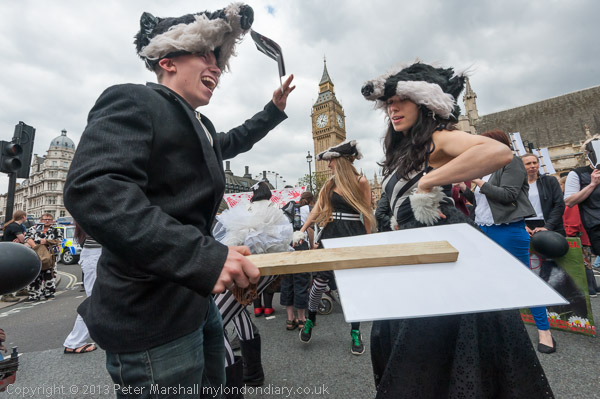
I was off to a protest march from Tate Britain to Parliament against the cull of badgers which began in the two pilot areas of Somerset and Gloucestershire on that day. The protesters say that the cull flies in the face of most scientific opinion and that it will involve considerable animal cruelty as those carrying out the shooting are largely untrained and many badgers will be only wounded and will then suffer a lingering death. Among those who travelled to London for the protest were many who will try to physically prevent the cull being carried out.

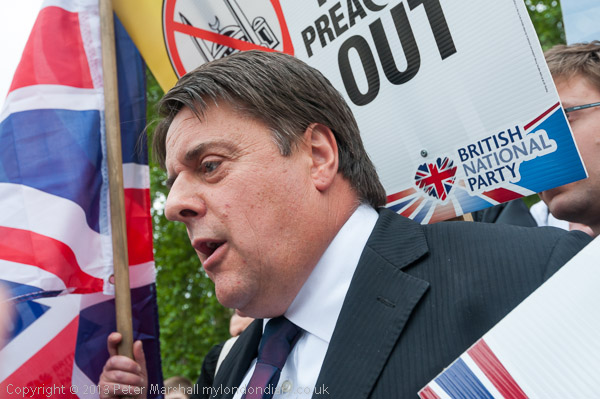
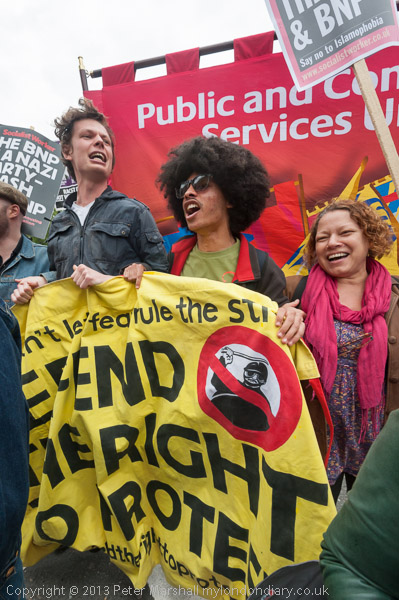
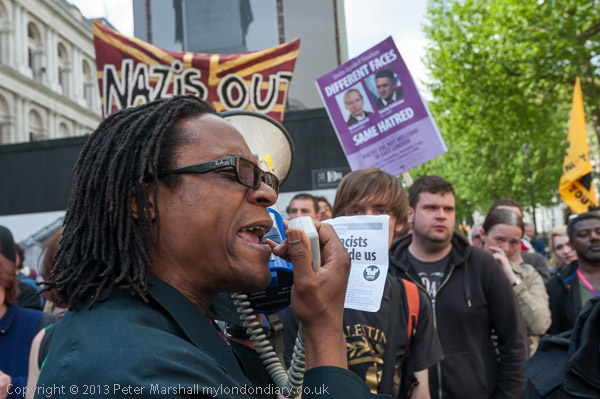
I also left this protest before it was over, and went to Southwark Cathedral to attend a memorial service for an old friend who died recently. After this I returned to Westminster to photograph Nick Griffin and a small group of BNP protesters who intended to gain publicity by exploiting the killing of Lee Rigby by laying flowers at the Cenotaph. There were several times as many media as BNP around the statue in Old Palace Yard.

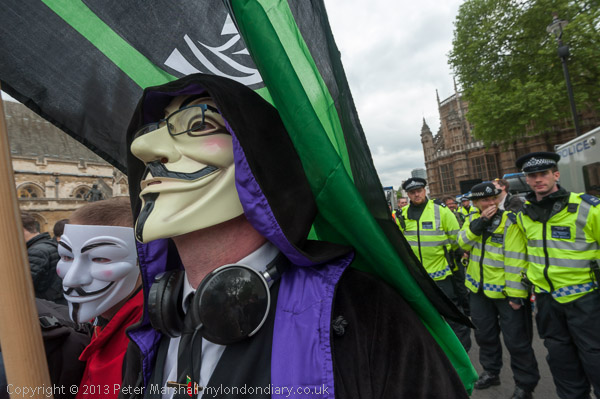
The BNP were prevented from reaching the Cenotaph by a large anti-fascist protest. They hung around for well over 3 hours protected by hundreds of police.

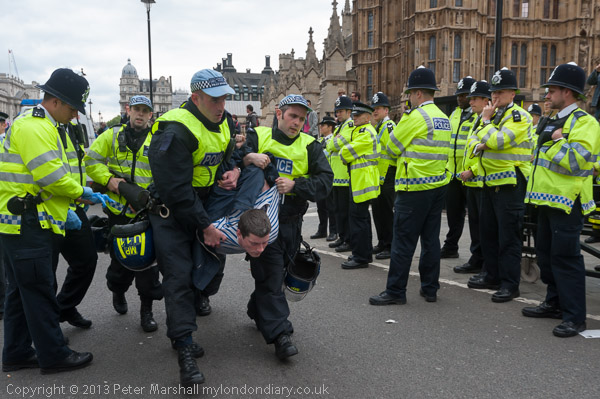
The police made several batches of arrests to fill a couple of double-decker buses they had brought along, but then appeared to decide it was impossible to arrest all of the several thousand anti-fascists who had turned up determined to stop the BNP.

When the BNP finally gave up and left, the anti-fascists began to disperse, with some marching up Whitehall and there were a few short speeches. Quite a few people had been let through the lines of the police and protesters to lay wreaths, but the organised exploitation of the Woolwich killing by the BNP had been prevented.

Anti-Fascists Stop BNP Wreath Laying
BNP Exploiting Woolwich Killing Stopped
Cull Politicians, Not Badgers
London Supports Turkish Spring

Six years ago: 30 May 2015

May 30th, 2015 was one of those days where I travelled around London stopping off for various reasons en-route. As always on such occasions I give thanks to the GLC for their efforts which resulted in the London-wide travel card before they were sadly eliminated by Mrs Thatcher, leaving the city largely rudderless for a crucial 15 years when it fell behind other cities in the world – except of course for the financial City of London which further cemented its reputation as the corruption capital of the world.

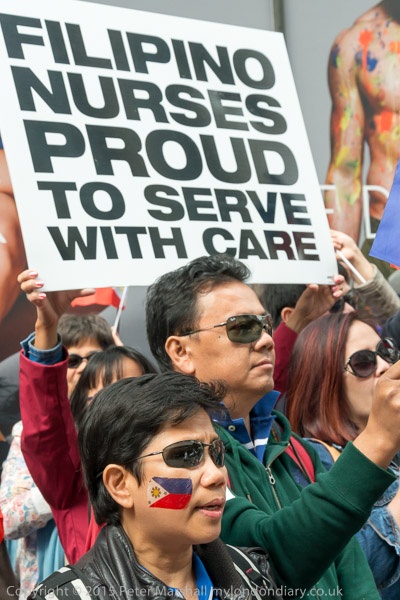
London is very much a world city, and my first event, outside the Daily Mail offices in Kensington reflected this, with protest by Filipino health workers over their coverage of the case of Victorino Chua, a nurse found guilty of murdering two patients and injuring others. The newspaper used the case to insult Filipino NHS workers who have for years formed a vital part of the NHS. When I came round in intensive care in 2003 it was to see a Filipino nurse who greatly impressed me with his care and attentiveness over the next few days.

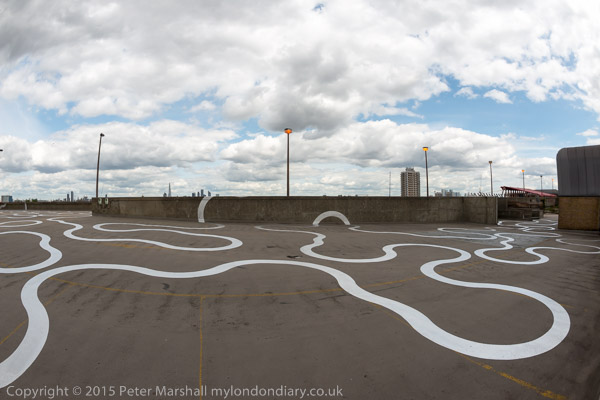
It had taken around an hour for me to get to Kensington, and the journey across London to Peckham Rye was around another 50 minutes. I was there not for a protest but for the proposed Peckham Coal Line, an elevated linear urban park whose proponents compared in extremely misleading publicity to New York’s ‘High Line’ walk. And while the public were invited to walk the Coal Line, we were largely unable to do so as it is still an active part of the railway network – and one I took a train along after following around its length and back on existing local roads and paths.

Despite that it was an interesting walk, including a visit to the roof of the multi-storey car park and the Derek Jarman memorial garden. Part of the proposed walk is already open to the public as a small nature reserve, cleared beside the railway line for a massive inner-ring road – part of the proposed London Ringways motorway scheme which was fortunately abandoned after the terrible impact of building its earliest sections including the A40(M) Westway in Notting Hill became clear.

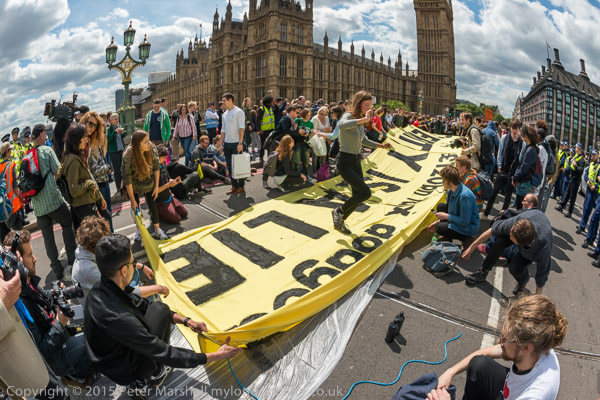
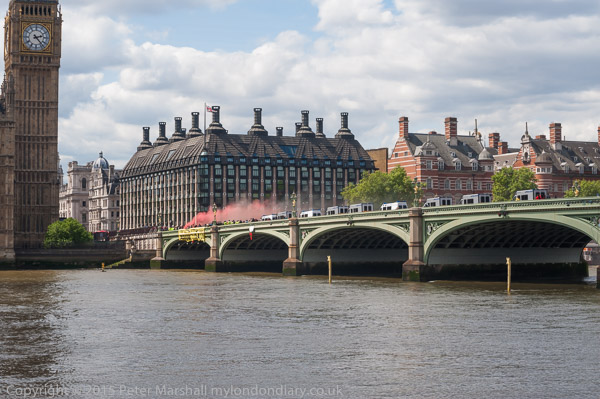
A train from Peckham Rye station took me along the route of the Coal Line to Queen’s Road Peckham and then on to London Bridge, and the Underground to Waterloo where I met with UK Uncut who were to go to an undisclosed location for some direct action. This turned out to be Westminster Bridge, where the protesters blocked the road.

The then unrolled a large yellow banner and began to fill in the slogan that had been marked out on it with black paint. After some parading around on the bridge with it, they then lowered it over the upstream side of the bridge and lit a couple of smoke flares. I’d run down across the bridge and a little along the embankment in front of St Thomas’s Hospital to take pictures of the banner drop.

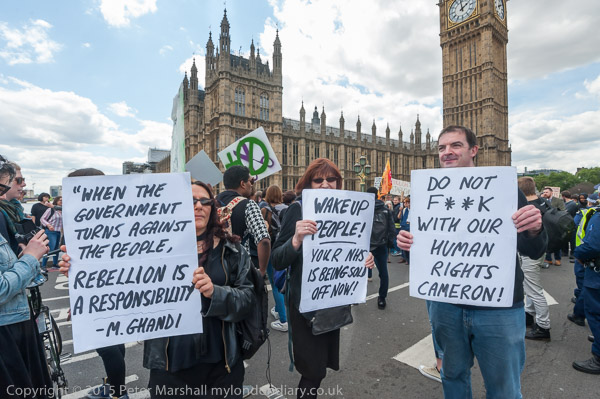
The banner drop was really on the wrong side of the bridge for photographs and it seemed something of an anti-climax. It was hard to read the banner and its message ‘£12 bn more cuts £120 bn tax dodged – Austerity is a lie’ ” was perhaps a little understated. I think may of those present had expected something rather more direct, both in message and action. I went on with many of them to join another protest in Parliament Square which was just coming to an end, against government plans to get rid of the Human Rights Act.

It was then a short walk to Trafalgar Square, where on the anniversary of the 1967 declaration of Biafran independence, Biafrans were calling on the UK government for support in getting back the country which they claim was taken away from them by the Berlin Conference in 1884 and incorporated into Southern Nigeria. They say Biafra was successor of the Kingdom of Nri of the Igbo people, which lasted from the 10th century to 1911 and was one of Africa’s great civilisations before the European colonisation. As well as backing the call for independence the protest also remembered those who died in the Nigerian-Biafran War.

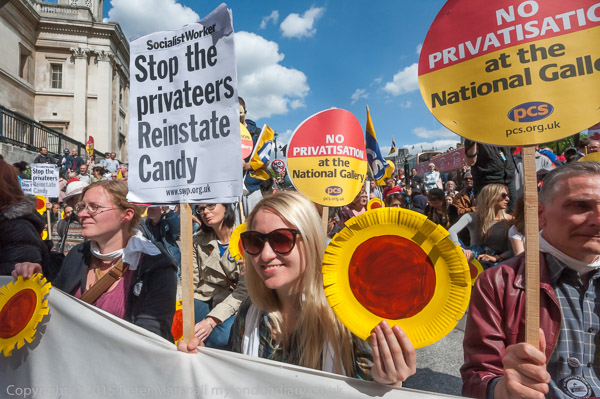
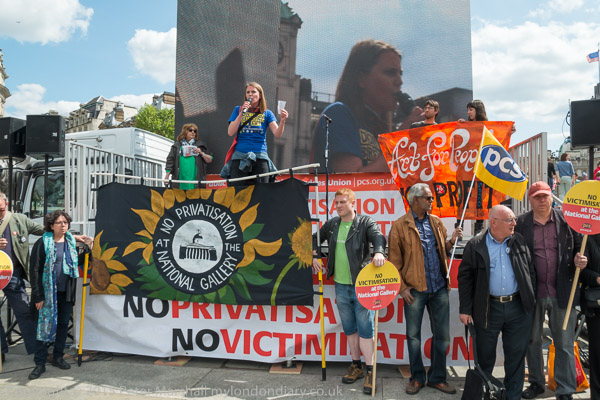
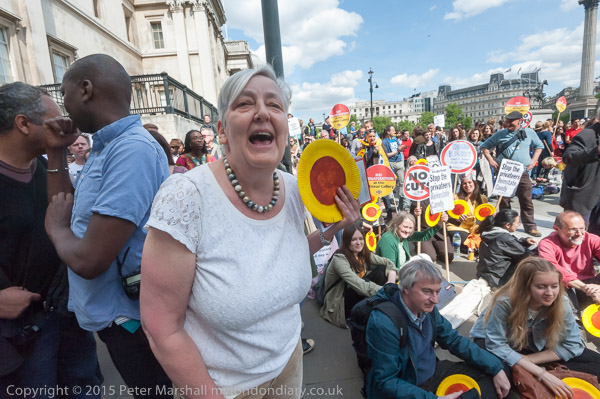
In the main body of the square, striking National Gallery staff and supporters were holding a rally after PCS rep Candy Udwin was sacked for her trade union activities against the plans to privatise gallery staff.

At the end of the rally, people moved towards the Sainsbury Wing, where security is already run by a private company and exhibitions guarded by outsourced staff. Police blocked the doors to stop them entering, and they sat down to hold a further rally blocking the gallery.

Mass rally Supports National Gallery strikers
Biafrans demand independence
UK Uncut Art Protest
Walking the Coal Line
Filipino Nurses tell Daily Mail apologise

Free Palestine and My London Diary

National Demonstration for Palestine, London, UK

London, UK. 22nd May 2021. Thousands march through London in support of Palestine calling for freedom for Palestine and end to the ethnic cleansing of Palestinian communities, the occupation of Palestine and apartheid laws. After Israeli attacks on Gaza that have killed around 250 and wrecked much of it they call for a huge international effort to rebuild Gaza and to bring a peaceful solution that will enable Palestine and Israel to live in peace and avoid future attacks. Peter Marshall

National Demonstration for Palestine, London, UK

I still can’t get around to deciding whether to resurrect ‘My London Diary’ which I brought to a halt when I went into personal lock-down early in March last year, when I was ill and cases of Covid were rising dramatically, although the government was still dithering, still pursuing a ‘herd immunity’ scenario.

National Demonstration for Palestine, London, UK

I reached for a piece of scrap paper and began a quick calculation based on the then available facts – herd immunity would require around 70% or more of the population to get Covid, the death rate was thought to be around 1% and Google told me that the UK population was around 68 million. It would mean around 48 million or more becoming infected – and that would mean around 480,000 deaths. And given that we knew it was much more likely to kill older people, I stood a very high risk of being among those deaths, particularly as I also suffer from diabetes, another risk factor.

National Demonstration for Palestine, London, UK

I’d been getting advice from one of my two sons for several weeks urging me to isolate. One of his wife’s sisters was involved with the medical group giving advice to the government about the virus and had passed on what they knew about Covid. I ordered a re-useable mask but continued working without one. I became ill, but when I put my symptoms into the checker on the NHS web page it told me it wasn’t Covid. A few weeks later they added more possible symptoms and my result might have been different. I’m still unsure as to whether what I suffered from back then was Covid, though if so it was a very mild case.

National Demonstration for Palestine, London, UK

Now my two injections should have had their effect (although I did take an antibody flow test several weeks after the first of them which found none) and on May 1st this year I went up to London to photograph the May Day events. Since then I’ve returned a couple of times to photograph protests, mainly those against the Israeli evictions in Sheik Jarrah, attacks on worshippers inside Al Aqsa mosque and the air attacks on Gaza which have killed around 250 Palestinians, including many children, and shocked the world by their intensity.

National Demonstration for Palestine, London, UK

The pictures here come from last Saturday’s National Demonstration for Palestine in London, attended by an estimated 180-250,000, but which received very little media coverage – I didn’t hear anything about it from the BBC, despite it being about an issue very much in the news. Our official broadcaster seems to have an incredible reluctance to report on protests in the UK, and relatively little has made other media. My pictures were at the agency in time to meet deadlines, but so were those by hundreds or thousands of other photographers, and so far as I’m aware none of these has sold, though several have been shared quite widely on Facebook where I also posted them.

National Demonstration for Palestine, London, UK

I haven’t yet put any pictures taken after March 8, 2020 onto My London Diary. It didn’t seem worth sharing the pictures from my walks and bike rides around my home, though perhaps sometime I might persuade myself to look through them and publish something. And so far I’ve not reopened the site to add anything I’ve taken since getting back to work. There isn’t as much happening in London as there was pre-Covid and I’m also deliberately doing less.

National Demonstration for Palestine, London, UK

I also have some minor technical problems. I haven’t yet got the software I been using for over 20 years to write ‘My London Diary’ and other sites onto my new computer and I think it unlikely to work under Windows 10 which I’m now using. I have problems with web space, not with the actual size, but with the number of separate files and am now fairly close to the limit of my contract. Continuing for any length of time with ‘My London Diary’ would mean an expensive upgrade.

National Demonstration for Palestine, London, UK

Before I stopped posting new work on My London Diary it had already a relatively low level of site visits – in the hundreds per day. Several times as many of you come to read Re-PHOTO, and to look my work on Flickr. I had hoped to transfer the site to a major institution but that fell through.

Click on any of the pictures to go to my Flickr album on the protest. It currently has 25 pictures but I may add some others later.

More from around the Harrow Road

Chippenham Rd, Maida Hill, Westminster, 1988 88-3a-45-positive_2400
Chippenham Rd, Maida Hill, Westminster, 1988

These rather plain and solid houses on Chippenham Road, on the edge of the Elgin Estate are fairly typical of the area. Though built on a fairly large scale for families with reasonably substantial incomes, most are now divided into perhaps half a dozen flats, with the smallest one-bed flats costing around £400,000. Unlike the nearby tower blocks which lasted only around 25 years they are still going strong well over a hundred years since they were built.

Aldsworth Close, Maida Hill, Westminster, 1988 88-3a-51-positive_2400
Aldsworth Close, Maida Hill, Westminster, 1988

Aldsworth Close is a fairly short street close to the canal in Maida Hill, close enough for estate agents to call it ‘Little Venice’ which it clearly isn’t. Taken from Aldsworth Close I think the picture shows the front of a long block between Downfield Close and Aldsworth Close, with addresses and garages on Downfield Close but these front entrances on Aldsworth Close. Modern estates like to have such confusion in their addresses, and I think the right hand of the picture may have yet another name, Clearwell Drive.

Aldsworth Close, Maida Hill, Westminster, 1988 88-3a-52-positive_2400
Aldsworth Close, Maida Hill, Westminster, 1988

The Victorian terrace at left (and below) is still present on the north side Amberley Road and its eastern part was demolished to build these new streets. Previously the land between Amberley Rd and the canal was occupied by a number of timber wharves, a saw mill and an engineering works. Until 1867 it was the site of Westbourne Manor House.

88-3a-53-positive_2400
Amberley Rd, Maida Hill, Westminster, 1988

This west part of Amberley Road remains as a long Victorian terrace. I don’t know why the eastern part was demolished, but possibly like many areas of London, particularly industrial areas such as this by the canal were badly damaged by wartime bombing. But little of London’s Victorian housing enjoys any real protection against redevelopment – and even less of more recent building. In particular around 200 council estates are currently under some threat, including a number of particular architectural merit, with some, such as the Heygate Estate in Southwark already lost and others including Lambeth’s Central Hill already marked down for demolition. Many have now realised that it makes much more sense to rehabilitiate rather than demolish Victorian houses and it now seems possible that climate change will cause a rethinking about demolition of more recent buildings, and ensure new buildings are again built to last.

Grand Union Canal, Paddington Arm, Maida Hill, Westminster, 1988  88-3a-64-positive_2400
Grand Union Canal, Paddington Arm, Maida Hill, Westminster, 1988

The view looking east from the Harrow Road bridge across the canal. You can still see this bridge across the canal, carrying pipes or cables, and the building on the left, 324 Harrow Road now stands out in white. There is now an Academy in a new building rather than a school in Amberley Rd, with a new block of flats on the canal side.

Grand Union Canal, Paddington Arm, West Kilburn, Westminster, 1988  88-3b-32-positive_2400
Grand Union Canal, Paddington Arm, West Kilburn, Westminster, 1988

This stretch of canal is from around mile further west along the towpath and at right the unmistakble form of Trellick Tower can be seen. My viewpoint was a small canalside garden on the Harrow Road and in the distance you can see the ‘ha’penny’ bridge from the Harrow Road across to Kensal Town which I had photographed in earlier years. The buildings on the left, 432-487 Harrow Rd, built by the Artizans’, Labourers’, and General Dwellings Co, who developed the area as working class housing fromm 1875, are still there but I think those at the right on Kensal Rd have all been replaced. I think I made it holding out my camera at arm’s length over the canalside fence which resulted in this tilted view.

Library, Harrow Rd, West Kilburn, Westminster, 1988  88-3b-33-positive_2400
Library, Harrow Rd, West Kilburn, Westminster, 1988

On the other side of the Harrow Road to where I made the previous picture is the Queen’s Park public library, one of the amenities provided when the area was developed by the Artizans’, Labourers’, and General Dwellings Co. There were no pubs on the estate, built to strict temperance principles, but they provided this space for the Chelsea vestry to build the Kensal New Town Library which opened in January 1890. This oddly detached part of Chelsea became a part of the Metropolitan Borough of Paddington when this was formed in 1901 and it remained Paddington’s only public library for 30 years. Until around 1920 you had to be a resident of Queen’s Park to use the library – and residents paid an extra amount in their rates for the privilege, whether they took advantage of it or not. In the 1965 local government reorganisation the library and this area became a part of the borough of Westminster, though much of Queen’s Park is in Brent.


All photographs on this and my other sites, unless otherwise stated, are taken by and copyright of Peter Marshall, and are available for reproduction or can be bought as prints.


Maida Hill & Elgin, 1988

Prince of Wales Cinema, Bingo Hall, 331 Harrow Rd,  Westbourne Park, Westminster, 1988  88-3a-12-positive_2400
Prince of Wales Cinema, Bingo Hall, 331 Harrow Rd, Westbourne Green, Westminster, 1988

Although most Londoners will have heard of Maida Vale, few will have heard of Maida Hill, and those that have will probably – like me – be very unsure of where it changes to Westbourne Green or West Kilburn. Many of the old London district names have more or less disappeared, and estate agents take remarkable liberties with the boundaries of areas they feel are currently more upmarket.

Harrow Rd,  Westbourne Park, Westminster, 1988  88-3a-13-positive_2400
Harrow Rd, Westbourne Green, Westminster, 1988

Part of the reason for this is increased mobililty, particularly in those areas of London were many live in private rented accomodation, often with short-term leases or where for various reasons tenants often move very frequently. Most of the inner London boroughs were developed by before the First World War, and grew up first around the old named village centres – and later around the railway stations, underground stations and tram routes.

Shops, Harrow Rd, Maida Hill, Westminster, 1988 88-3a-43-positive_2400
Shops, Harrow Rd, Maida Hill, Westminster, 1988

People know Maida Vale mainly because it has an Underground Station – something Maida Hill lacks. And most – including myself – tend to forget that the area is Westbourne Green and call it after its station, Westbourne Park. The ease of travel – by rail, bus and bike, and later by car loosened the links of people to their native villages and of course many more came into the new houses in London from other parts of the country, and later the world.

Walterton Rd, Elgin Ave, Maida Hill, Westminster, 1988 88-3b-66-positive_2400
Walterton Rd, Elgin Ave, Maida Hill, Westminster, 1988

I grew up in the town on the edge of London where my father had been born in 1899. He’d worked elsewhere – including a couple of years when the army and air force took him to France and Germany, but had also commuted to various jobs in towns and areas around, including Kew, Guildford and Harrow thanks to buses or a motorbike. But back in the 1950s when I walked down the main road with him he would still be greeting almost everyone we met by name.

Walterton Rd, Elgin Ave, Maida Hill, Westminster, 1988 88-3a-16-positive_2400
Walterton Rd, Elgin Ave, Maida Hill, Westminster, 1988

Captioning my photographs, even those where I know exactly where they were taken, I often have difficulty in deciding the name of the district in which they were taken. Sometimes I come back to one later and change my mind. Deciding which London Borough they are in is generally easier – the borough boundaries are marked by lines on maps, although sometimes, particularly where the boundary runs down the centre of a road I give both if I’m unsure what side of the road it is on. A minor confusion is that some London boroughs share a name with a district which is a part of them. I could write things like Camden, Camden, but it seems redundant to repeat it.

The Elgin Estate is possibly in Paddington, North Paddington or in Maida Hill, though the area is also sometimes simply referred to by the major road it is close to, the Harrow Road. When I put these pictures on-line I chose Maida Hill, simply because this was printed closer on the street map I was using.

Elgin Estate, Elgin Ave, Harrow Rd, Maida Hill, Westminster, 1988 88-3a-21-positive_2400
Elgin Estate, Elgin Ave, Harrow Rd, Maida Hill, Westminster, 1988

The triangle between Harrow Road, Elgin Avenue, and Chippenham Road contained some of the areas worst housing and the Greater London Council demolished these and built 300 maisonettes and flats in what was originally called the Walterton Road estate but later renamed the Elgin Estate. Started in 1966, the first tenants moved in in 1968.

It included two 22-storey tower blocks, Chantry Point and Hermes Point. A survey in 1983 found them and the rest of the estate in very poor condition and the GLC began a full-scale process of repairs. Unfortunately once work began it was brought to a halt when dangerous asbestos was found in the two tower blocks, which by then had been transferred to Westminster Council, though the GLC was still responsible for major works.

Elgin Estate, Elgin Ave, Harrow Rd, Maida Hill, Westminster, 1988 88-3a-11-positive_2400
Elgin Estate, Elgin Ave, Harrow Rd, Maida Hill, Westminster, 1988

Westminster stopped letting the blocks to new tenants though some lettings continued on short-term licences and other flats were squatted and the properties rapidly deteriorated. When the GLC was abolished in 1986 full responsibility passed to Westminster Council who secretly decided to sell the whole estate to private developers who intended to demolish the lot and rebuild at twice the density with one of the towers becoming a hotel.

Elgin Estate, Elgin Ave, Harrow Rd, Maida Hill, Westminster, 1988 88-3a-24-positive_2400
Elgin Estate, Elgin Ave, Harrow Rd, Maida Hill, Westminster, 1988

When the plans leaked, residents formed an action group demanding the council drop the plans and setting up their own proposals to save the homes. The council wanted to get rid of social tenants and replace them by wealthier home owners, to increase the Tory vote in the area, part of a process of exporting Westminster homeless families to boroughs on the edge of London and outside to places such as Staines. The Elgin estate – despite being known as having an asbestos health risk – was also used as a dumping ground for council tenants who were moved out of marginal wards. It was a policy that in 1997 was found by the High Court to be unlawful. The council appealed and won, but then lost in the House of Lords in 2001 when Lady Porter, leader of the council from 1983 to 1991 was ordered to pay a surcharge (including interest) of £43.3 million. She moved most of her money to Israel and to other family members and pleaded poverty, but eventually settled with a payment of £12.3 millioon.

Elgin Estate, Elgin Ave, Harrow Rd, Maida Hill, Westminster, 1988 88-3a-44-positive_2400
Elgin Estate, Elgin Ave, Harrow Rd, Maida Hill, Westminster, 1988

By 1988 when I made these pictures around a third of properties on the estate were empty with doors and windows blocked by steel sheets to keep out squatters who already occupied many of the flats in the two towers. But the 1988 Housing Act gave the remaining residents the chance to form a housing association, Walterton and Elgin Community Homes, which was then able to hold a ballot and acquire the homes from Westminster Council. In March 1989 WECH became the first ‘Tenants’ Choice’ landlord to be approved by the Housing Corporation, and despite various dirty tricks by the council, in 1991 was not only given the properties free of charge, but also awarded the maximum possible amount from the council of £77.5 million to cover the cost of repair (though this was only around a half of what was thought to be needed.

A vote by residents was 72% in favour of the transfer to WECH which was made in April 1992. Redevelopment of the area was carried out with extensive consultation with them, and involved an expensive demolition of the two towers in 1994, replaced by low rise housing.


All photographs on this and my other sites, unless otherwise stated, are taken by and copyright of Peter Marshall, and are available for reproduction or can be bought as prints.


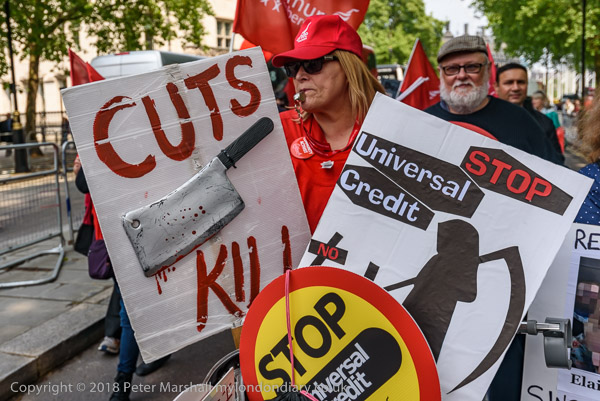
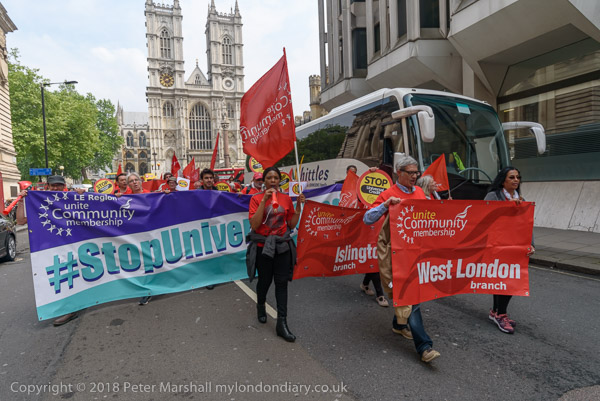
Universal Discredit

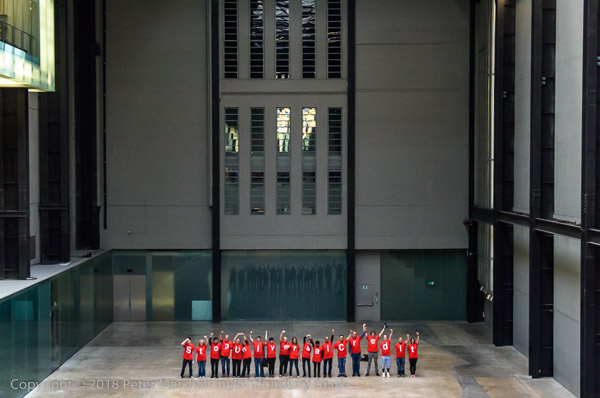
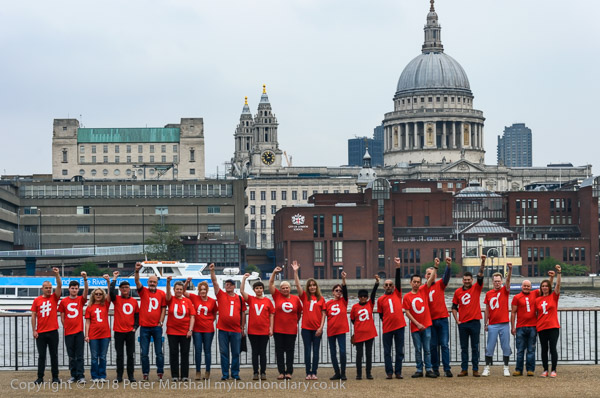
T-shirts spell out StopUniversalCredit’ in Tate Modern Turbine Hall on the Unite Day of Action against Universal Credit, 24 May 2018

There were some positive ideas behind the introduction of Universal Credit, a new social security payment system first announced by the then Work and Pensions Secretary, Iain Duncan Smith, in 2010, claiming it would make the social security system fairer to claimants and taxpayers. It aimed to simplify the system by replacing six existing benefits for working-age people who have a low household income: income-based Employment and Support Allowance, income-based Jobseeker’s Allowance, Income Support, Child Tax Credit, Working Tax Credit and Housing Benefit. It would also taper off gradually as people moved into employment, removing the ‘cliff edge’ of losing benefits when going back into work.

But both Duncan Smith and Welfare Reform Minister David Freud, had failed to grasp the complexity of the varied and often varying circumstances of those in low paid and often insecure employment, particularly those on zero hours contracts or other sporadic or seasonal work, or with fluid family arrangements. Nor did they make clear that the main driver behind their changes was to simply cut the cost of benefits. And it now seems likely it will end up being more expensive than the benefits it replaced.

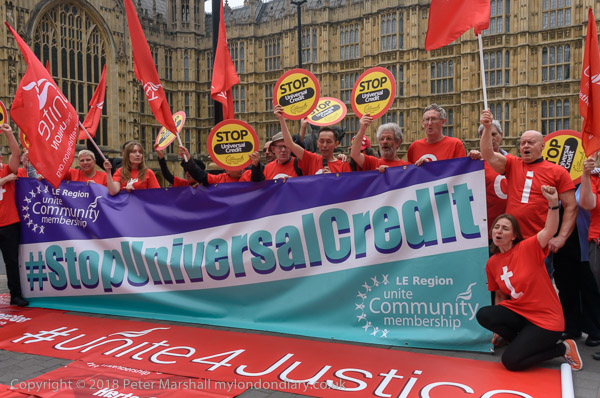
Outside Parliament

Following the Welfare Reform Act 2012, UC roll-out began to selected claimants at pilot job centres in 2013, and problems rapidly became apparent. There were entirely predictable problems with the IT system and the implementation costs were six times the initial forecast at £12 billion. The roll-out was intended to be more or less complete by 2017, but is now expected to take until 2024. Cuts were made to the initial system by George Osborne in 2015, making the transition to work less generous and removing some of the payments for child support, though these were partly restored in 2018 by Philip Hammond. And in 2020 there was a temporary £20 increase as a response to Covid.

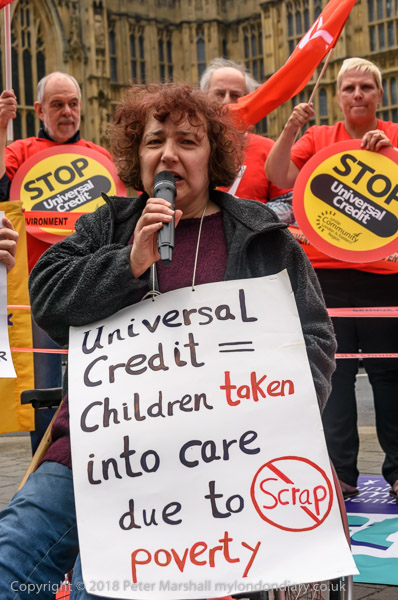
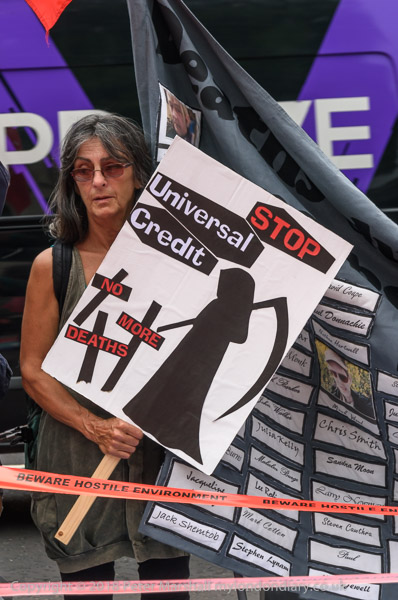
What is clear is that the introduction of UC has caused a great deal of hardship to claimants, some temporary, some permanent. It has led to many being unable to keep up rent payments with a great increase in evictions and homelessness. UC has been the main driver of the huge increase in the need for foodbanks. It has forced some women into prostitution and made some claimants turn to crime to keep alive – while some have starved to death.

UC has had a particularly hard effect on families with children, particularly those with more than two children since 2017, and also on self-employed claimants and others with fluctuating incomes. Overall there have been both winners and losers, with around half losing out and a little over a third gaining compared to the replaced benefits.

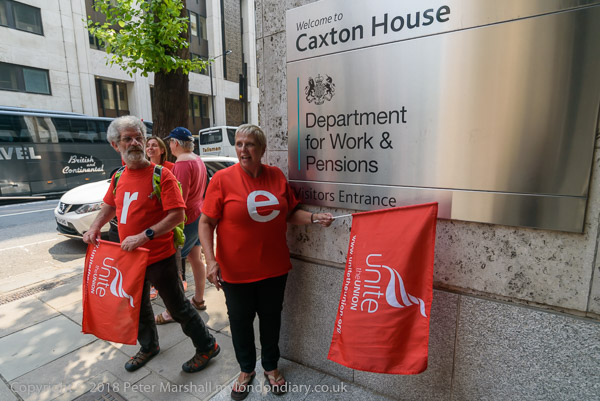
Marching to the DWP

One of the major problems for everyone has been the long wait before any UC is paid, partly because of the change from a weekly to a monthly benefit. Even where the process works smoothly, the delay between making the claim and receiving money is six weeks, and around a fifth of claimants have had to wait around 5 months or more. There are now emergency loans available – but these mean that when people do get their payments they are reduced to repay these advances. There are also many whose benefit has been cut or stopped for largely trivial reasons through a savage system of benefit sanctions imposed by job centres.

Many other problems have also been caused by UC – you can read a long list of criticisms in the Wikipedia article. As well as evictions and homelessness it has resulted in an increase in domestic violence and a steep rise in mental-health problems. And, as the National Audit Office reported, there is no evidence Universal Credit has met its aim of helping people into work and they say it is in many ways unwieldy and inefficient and is unlikely to provide value for money.

It is clear that UC is in need of a complete replacement, and that it’s monumental failure should have led to the resignation of Iain Duncan Smith in 2015 after the DWP admitted publishing fake testimonies of claimants enjoying their benefits cuts and statistics showed 2,380 people died in a 3-year period shortly after a work capability assessment declared them fit for work, but instead he was knighted in 2020. Under the present government we are unlikely to get more than very minor tinkering that will quite likely create more problems that it solves. One of the proposals under debate is that of a Universal Basic Income, along with targeted welfare payments (some of which are still in existence) to cover those with additional needs. Earlier this month the Welsh First Minister Mark Drakeford announced that this would be trialled in a pilot scheme in Wales.

Universal Credit rally & march
Universal Credit protest at Tate Modern


Cuts, Yemen, Shopping Problem & Police Violence

Back in 2009 we had a Labour government, but public services were still under threat and public sector jobs being cut. The euphoria with which many had greeted the Labour victory in 1997 to the theme music of “Things Can Only Get Better” had long evaporated, thanks to the country being dragged against its will into a illegal war which had ended with Iraq in chaos and the failure to reverse or ameliorate disastrous privatisations and the attack on social housing.

New Labour had also proved themselves inept in the huge expansion of the Private Finance Initiative, PFI, which gave a continuing huge windfall to the private sector and left public bodies, particularly parts of the NHS, with huge debts. The financial crisis in which hit stock markets around the world in September and October 2008 was a final straw, and while the actions of prime minister Gordon Brown may have helped saved the banks this came at enormous cost.

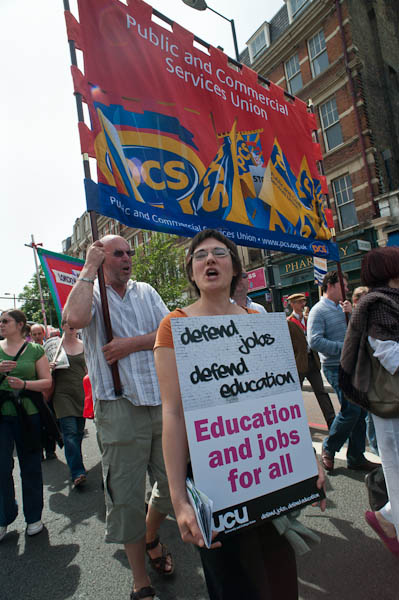
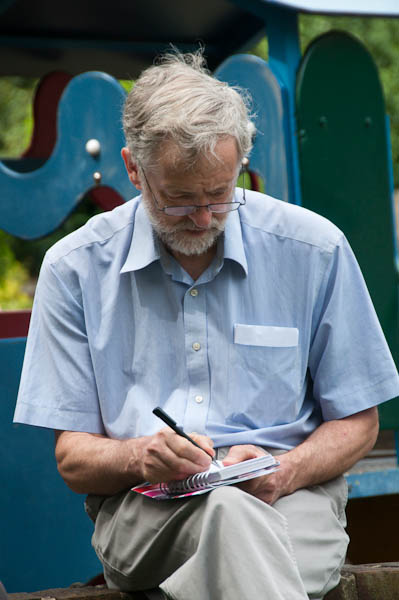
Government cuts were felt keenly in North London, where there were massive job losses including those of 550 mainly support workers from London Metropolitan University, 500 civil servants from Archway tower and more at City University, where adult education is under threat. On Saturday 23 May, 2009 around 500 met in Higbbury Fields for a march to a rally at Archway to defend jobs, services and education Among the mainly trade union speakers at the rally was just one local MP, Jeremy Corbyn.

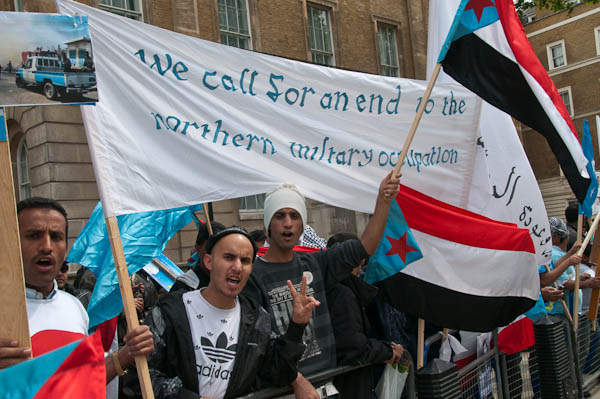
From the rally I took the Northern line to Charing Cross and walked down Whitehall to Downing St. Protesting on the pavement opposite were Yemenis from the Southern Democratic Assembly. Yemen has been a split country for years, with two civil wars in the 1980s as well as the current ongoing war. Southern Yemen and North Yemen had agreed in principle to unite in 1972, and did so in 1990, but the Southern Yemenis revolted in 1994, accusing the government of grabbing land and property and of human rights abuses. Their protest in 2009 was calling for an end to the repression and military occupation by the North and for the release of jailed Southern leaders. In 1994 and now, the situation is complicated both by religious differences – Sunni and Shia – and by the interventions of a wide range of foreign powers – with often some strange bedfellows. The current was is of course led by Saudi Arabia, whose see it as a fight against the regional Shia power, Iran.

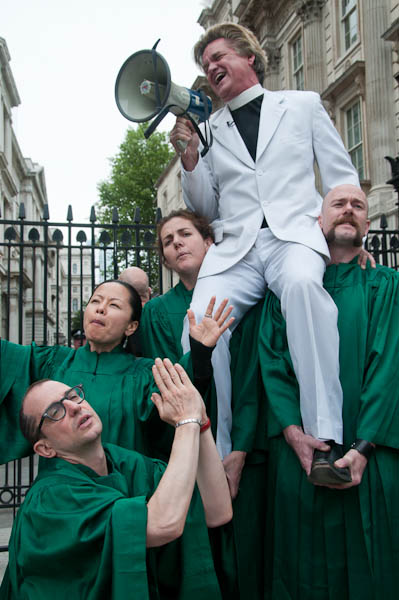
Opposite, on the pavement in front of the security gates to Downing St, I photographed a performance by the Reverend Billy and his ‘Life After Shopping’ Gospel choir from New York who were in London on their 2009 UK Shopocalypse Tour. Clearly the police didn’t quite now how to handle the holy activists, and the officer who stopped the Reverend to question him failed to make much progress – other than being diagnosed by Billy as having a “shopping problem.”

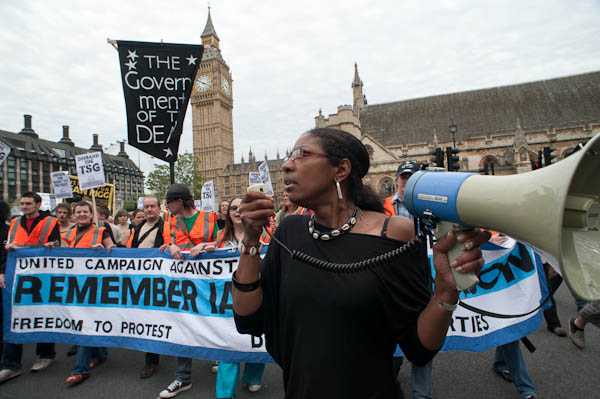
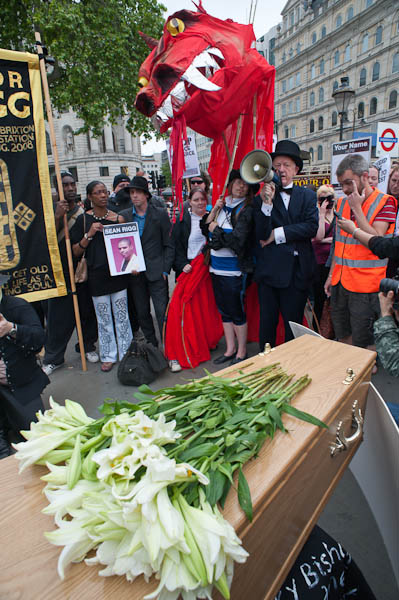
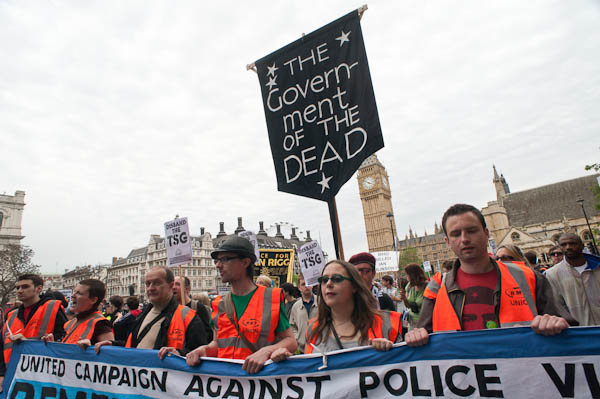
Like me, the Rev Billy and his team from the Church of Life After Shopping were on their way to the National Demonstration against Police Violence in London organised by the United Campaign Against Police Violence, set up following the G20 demonstration in London in which Ian Tomlinson, a man not taking part in the demonstration, was assaulted by and killed by a police officer.

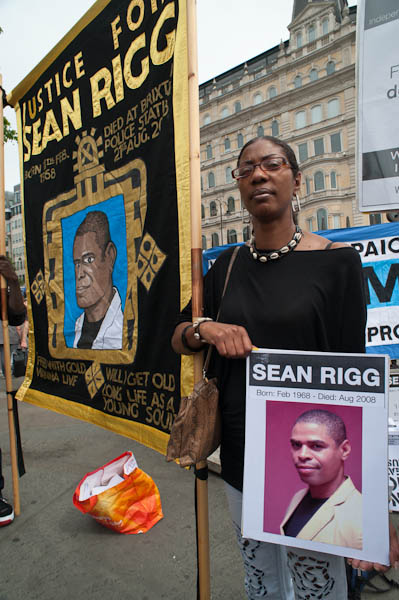
Prominent among those taking part were members of two families of men who were killed in Brixton Police Station, Ricky Bishop and Sean Rigg. Ricky Bishop, a 25 year old black man died after being detained and brought into the police station in 2001. Sean Rigg, also black – like the majority of those who have died in custody – was taken into Brixton police station in August 2008 and within hours this fit 40 year old was dead. Police issued a number of misleading statements – as they did around the death of Ian Tomlinson, and failed to make a timely investigation.

Gradually over the years, dedicated work, led by his sister Marcia led to an inquest verdict ‘that the police had used “unsuitable and unnecessary force” on Rigg, that officers failed to uphold his basic rights and that the failings of the police “more than minimally” contributed to his death’. Further pressure by the campaign resulted in an IPCC report and eventual request of three officers. The CPS decided to drop the all charges against two of them, while the third was charged with perjury, though only after the Rigg family had forced a review. Despite the officer accepting he had given false evidence, a jury acquitted him. Further pressure led to an independent review of the IPCC investigation which ‘concluded that the IPCC committed a series of major blunders and that there had been “inappropriate conduct” by the Police Federation of England and Wales.’ (More details on Wikipedia). There have been several thousand deaths in police custody, prisons or other secure institutions in the last 50 years but only one officer brought to justice for the killings – convicted of manslaughter in 1986.

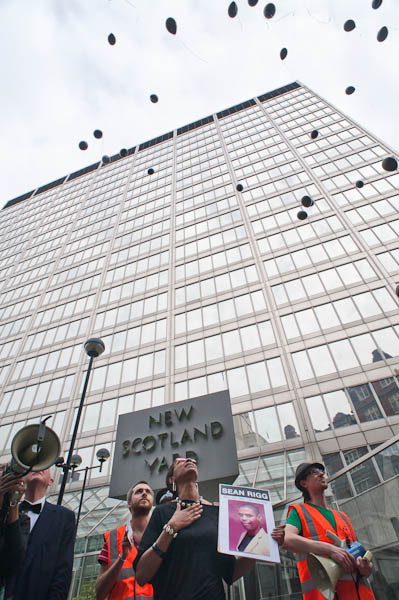
Police kept a close eye on the protesters and formed a line to protect Downing St, but otherwise acted reasonably until the protest held a solemn ceremony outside the police headquarters at New Scotland Yard on Victoria St, linking hands and holding a silence in memory of those who have died. This was rudely and provocatively interrupted by an woman officer sitting inside a police van blasting out a warning from her chief over the loudspeakers. Presumably as intended this produced an angry reaction from the crowd, and for a few seconds it seemed likely would provoke violence and lead to arrests, but those leading the event quietened the crowd and the ceremony continued, ending with the release of a large cloud of black balloons in memory of the dead.

Demonstration against Police Violence
Rev Billy Performs at Downing St
Southern Yemenis Demonstrate
March to Defend Jobs, Services & Education


All photographs on this and my other sites, unless otherwise stated, are taken by and copyright of Peter Marshall, and are available for reproduction or can be bought as prints.


Hammersmith to Holland Park

Brook Green, Hammersmith, Hammersmith & Fulham, 1988 88-1a-56-positive_2400
Brook Green, Hammersmith, Hammersmith & Fulham, 1988

Helpfully a street sign and a number inform me that this is 180 Shepherds Bush Rd, at the western edge of Brook Green. The road at one time used to wander around here but long ago traffic was routed straight through the grassy space, with both new and old road remaining as Shepherds Bush Road. There are no properties on the new section of the road, just a bus stop, traffic signs and traffic lights.

Without the information on the photo it would be hard to place this picture, as nothing visible remains of this part of the factory which housed Express Lifts and was I think part of the large Osram works which had began making carbon lamps here in 1881. It went on to produce many other types of lamps until around 1955, continuing only to produce argon and electronic valves until 1988 and was demolished the same year, with only its tower with the famous Osram Dome elsewhere on the site being saved, incorporated into the Tesco Superstore that took its place

Sinclair Rd, Hammersmith, Hammersmith & Fulham, 1988 88-1a-43-positive_2400
Sinclair Rd, Hammersmith, Hammersmith & Fulham, 1988

You can still find this pair of houses on Sinclair Rd, part of one of many conservation areas in Hammersmith & Fulham. There are a number of houses with impressive paired porches on the street, substantial four storey houses dating from around 1880. This pair is one of relatively few to have retained the stucco urns under the porticos, and this is a particularly impressive example with slender columns and capitals, but I think the real attraction for me was the incredibly morose bearded and moustached crowned head at the base of a finial.

Springvale Terrace, Hammersmith, Hammersmith & Fulham, 1988 88-1a-32-positive_2400
Springvale Terrace, Hammersmith, Hammersmith & Fulham, 1988

In the same conservation area as Sinclair Rd is a small section of very different housing. This small block which contained around 24 late Victorian terraced houses with a small Radiator Factory at its north end had been replaced by these modern buildings by 1988. The picture is taken from the road at the south side of this small estate.

St John the Baptist, Church, Holland Rd, Holland Park, Kensington & Chelsea, 1988 88-1a-26-positive_2400
St John the Baptist, Church, Holland Rd, Holland Park, Kensington & Chelsea, 1988

Crossing the railway at the bridge on Addison Gardens took me from Hammersmith & Fulham into the Holland Park area of Kensington & Chelsea and St John the Baptist Church in Holland Rd, a remarkably exuberant Grade I listed building by the distinguished Victorian church architect James Brook, “cathedral-like in scale and ambition, combining Brooks’s devotion to severe early Gothic models with a degree of material opulence not seen in his better-known East End churches”. Begun in 1872 it was completed in stages when the parish had the money and only finished after Brook’s death with finishing touches (perhaps unfortunate) by his successor John Standen Adkins in 1910.

The well-illustrated feature on the history of the church on the church web site states “St John’s is a distinguished and integrated time-capsule of the Anglo-Catholic movement. It is regularly in use for that traditional form of worship today.”

Holland Park Gardens Holland Park, Kensington & Chelsea, 1988 88-1a-15-positive_2400
15 Holland Park Gardens, Holland Park, Kensington & Chelsea, 1988

The London School of English is still in this imposing building in Holland Park Gardens. Perhaps surprising I avoided the wide sweep of steps leading up to its door, probably in order to emphasise the nest of balloons tied to its railings.

Addisland Court, Holland Villas Road, Holland Park, Kensington & Chelsea, 1988 88-1a-11

Addisland Court is a prestigious block of flats that screams 1930s Art Deco and its site design also very much reflects the golden age of motoring (when it was only for the rich.) A three bedroom flat here has an estimated value of around £2million. It was apparently used as a location in a couple of episodes of a TV series of Agatha Christie’s Poirot. It was built in 1936, designed by William Bryce Binnie whose other works include the East Stand at Arsenal’s old Highbury ground and who after distinguished war service had been assistant architect at the Imperial War Graves Commission for which he designed a number of memorials in France and Belgium.


All photographs on this and my other sites, unless otherwise stated, are taken by and copyright of Peter Marshall, and are available for reproduction or can be bought as prints.