Lockdown, Legend and Value

I have to admit that during the lockdown I have become very much centred around my own work and interests. Not feeling able to get out an meet other people and not being able to travel to my favourite areas have cut me off not just physically but also mentally from much of my outside involvements.

Because of my age and medical condition I don’t yet feel able to re-engage with the world in anything like the old ways, though I have made three short trips on public transport and visited when necessary several shops, of course suitably masked. And I am still in daily contact with many friends on Facebook as well as rather fewer through phone calls and online events,

But I still feel very withdrawn from many areas, and in particular from the world of photography. With very few exceptions I just can’t get interested in the various lockdown projects and online magazines and shows that have sprung onto the web. This morning I realised that it’s almost three weeks since I last went through the long list of web sites and blogs, many photographic, that I usually skim through every few days for items of interest or controversy and that in the past have often led me to express my thoughts on this blog.

It took quite a while to skim through hundreds if not thousands of articles and posts, though for most a quick glimpse or even the headline was enough for me to move on. There were just a few that interested me enough to stop and read more, and just a few to the very end. Military historian Charles Herrick in a 3 part post on A D Coleman’s Photocritic International comprehensively demolishes another of the confabulations about D-Day photographs, the legend of the duffel bag full of film from the beaches being dropped and lost at sea during transfer to a ship. As usual there are also other posts on the site of interest.

Joerg Colberg too almost always has something worth reading, and in normal times I would probably have wanted to add my pennyworth to his piece The Print, the book, the screen. I can’t bring my mind to it, but here is one sentence which might encourage you to read and think about it and the value of any photograph:

“In the world of photography, the value is almost entirely based on commerce and on a generally unspoken and widely shared sense of elitism.”

As someone who has never been a part of that elite I can only agree, though I think there are other communities outside that of commercial art dealers and the associated museums of the art photography world that value photographs. But as Colberg makes clear, he is focusing on art photography ‘When you see the word “photography”, you will always want to add “art” in front of it.’

Perhaps it isn’t surprising that there were so many of the other photographs and articles I looked at briefly and felt entirely superfluous; ephemeral, inconsequential and with little to say.

But one particular feature from the British Journal of Photography, published around a week ago did attract me, Marigold Warner‘s article ‘Hackney in the 80s: Recovering a forgotten archive of working-class life’ about the 2016 rediscover in the basement of the Rio Cinema in Dalston, established as a community non-profit arts centre in 1979, which in 1982 set up a radical photography project for local unemployed people, teaching them to use a camera and sending them out to photograph the local communities. Their pictures were put together as newsreels and screened as a part of the cinema programmes, before the commercial ads.

Unfortunately the Kickstarter fund-raising for the production of a book of these pictures finished on the same day as the BJP published the story, but by then over £32,000 had been donated to finance it and it will appear in November – you can pre-order ‘The Rio Cinema Archive‘ now from Isola Press for £25.

It seems good value; in my scale of things, the value of these pictures is rather greater than at least most of what sells for high prices in expensive galleries.

All photographs on this and my other sites, unless otherwise stated, are taken by and copyright of Peter Marshall, and are available for reproduction or can be bought as prints.


Reclaim the Streets – 1996

Broadgate 96-719-35-positive
Protesters including groups of drummers meet at Broadgate

I read a reminder a couple of days ago that this was the 24th anniversary of the 1996 Reclaim the Streets protest in West London, which began at Broadgate, then took the Central Line to Shepherd’s Bush, where line of police held up the protesters and the partying began while we waited for everyone to arrive.

Shepherds Bush 96-721-61-positive
Police manhandle a protester at Shepherds Bush

It wasn’t too long before some of the protesters had outflanked the police and the rest surged through to take over the A41M spur which leads from Shepherds Bush to Westway and to party across both carriageways.

Shepherds Bush 96-720-12-positive
Let London Breathe

There was a stage with music and dancing, and some people turned up with carpets and old sofas and made up living rooms on the tarmac.

Shepherds Bush 96-721-25-positive
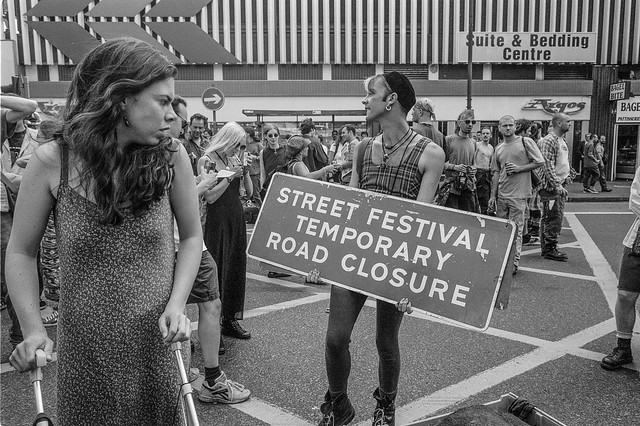
A woman looks at the notice ‘Street Festival – Temporary Road Closure

It was difficult to know exactly what was happening, particularly at Shepherds Bush, but also once we were partying on the motorway, and harder still to know how to photograph the event. Looking back I don’t think I did a very good job of it, though there are some pictures I quite like. But though I think they convey something of the spirit of the event, perhaps they don’t tell the story as well as I would like. There is also a certain sameness which results from them all being taken on 28mm or 35mm lenses, probably on a Minolta CLE or Leica M2.

RTS Party on A41M Motorway 96-724-55-positive
Partying on the A41M

You can read several stories with people’s own recollections of the day online which provide some of the background to these pictures on the Past Tense radical histories blog.

After I’d been photographing the partying on the motorway for some time I decided that nothing new seemed to be happening and it was time to go home and have a meal. I saw some others climbing over a low wall and followed them, making my way to Latimer Road tube.

RTS Party on A41M Motorway 96-725-11-positive
A living room with sofa and carpet on the A41M

The pictures were of course taken on film, and I seem to have only worked in black and white. I probably developed the films I had taken a few days later, and will have then printed perhaps half a dozen and probably a few weeks later taken them in to Photofusion’s picture library. Over the years a handful may have been printed in magazines and books, and I think I probably shared a few on various web sites, but many are now being seen for the first time outside the small group of friends with whom I met to share and criticise work. The images were digitised using the Nikon ES-2 adapter and a Nikon 60mm f2.8 macro lens on a Nikon D810.

You can see more of the pictures I took that day in my Flickr album Reclaim the Streets: London 13 July 1996.


All photographs on this and my other sites, unless otherwise stated, are taken by and copyright of Peter Marshall, and are available for reproduction or can be bought as prints.

Bill of Rights

If you’ve not yet seen it, you might like to look at the ‘Photo Bill of Rights‘ which has been written by people from a number of US based groups involved in visual journalism and editorial media, “the Authority Collective, Color Positive, Diversify Photo, The Everyday Projects, Juntos, the National Press Photographers Association, Natives Photograph, & Women Photograph.

There is little in it that I have any problem with, and much that has long been policy among groups such as the NPPA who contributed to it and have long had a code of ethics, or my own union, the NUJ.

It’s perhaps useful to restate the principles, but only if action follows, and although there are some well-known and well-regarded photographic organisations who have added their support to the over two thousand individual signatories I cannot find a single organisation that I or other photographers I know have actually worked for. And it is largely these organisations and the editors and buyers they employ who are responsible for unfair and discriminatory practices that still exist in the industry despite many years of work by photographers and photographers’ organisations.

It’s interesting to read the response to the NPPA by self-confessed “aging white male” photojournalist and long-term NPPA member David Burnett, who vehemently takes issue with the suggestion ‘that I, and the photojournalists of my generation, both women and men, set out to “colonize, disenfranchise, and dehumanize” either our photographic subjects, or other photographers, especially newcomers‘ and points out the the NPPA has through “virtually its entire existence” had in its Code of Ethics substantially similar underlying principles.

Burnett, a highly respected photographer and one of the co-founders of Contact Press Images, also points to the remarkable Trailblazers of Light web site which set out to put the record straight about the many hundreds of “professional women working in photojournalism for decades, both as editors and photographers“, created as a response to a not dissimilar ahistorical claim to this latest initiative.

He is “dismayed by the attitude of those who created this BoR, since it does little to honestly address many of the hiring inequities, and seems filled with triggering language which focuses instead on people in the field who have been working for decades. We do not, unfortunately, hire ourselves. As freelancers, we rely on editors and researchers, most of whom work for large companies (or the shell of those companies) and over which our power of persuasion is, more often than we’d like to admit, rather limited.”


Lucy Parsons

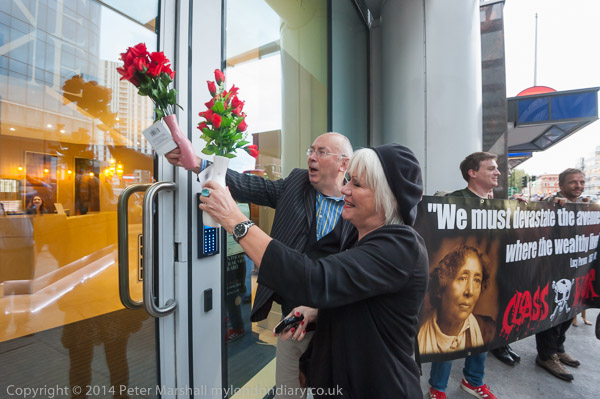
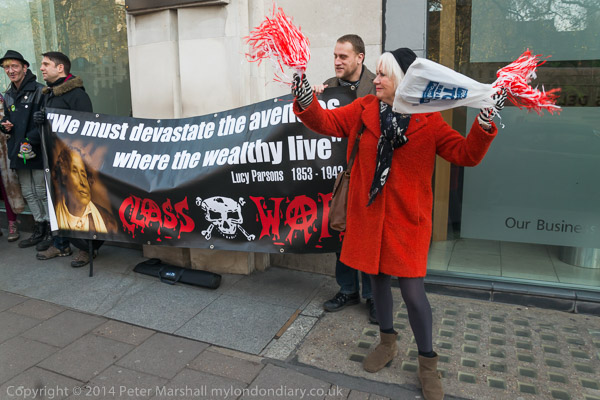
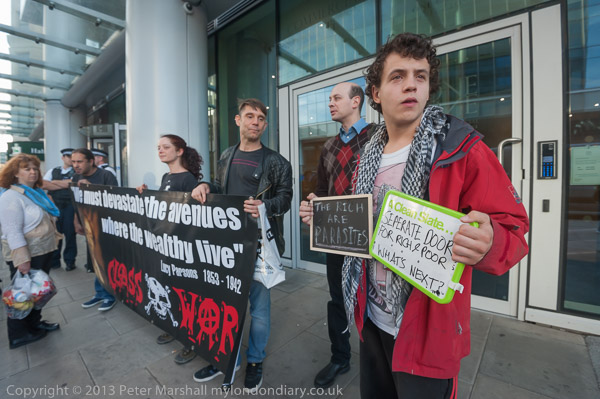
Poor Doors protest, Aldgate 30 Jul 2014

I’ve just been reading a guest post on A D Coleman’s Photocritic International by Colleen Thornton on Paul Grottkau and Lucy Parsons, the first in a series of posts in what Coleman describes as her “painstaking inquiry” which “introduces to the medium’s history two extraordinary figures: a German-born 19th-century U.S.-based anarcho-socialist photographer, Paul Grottkau, and his subject, the African-American anarcho-socialist Lucy Parsons, widow of one of the men railroaded to public hanging in the prosecution of the suspects of the Chicago Haymarket Riot.”

Her research was prompted by finding a cabinet portrait of Parsons on eBay with the photographer’s details on the card below the picture. It is to be published on Photocritic International in three parts of three instalments each. As I write the first two of Part I are online, introducing the photograph of ‘an attractive, well-attired “woman of color”’ for which surprisingly Thornton was the only bidder, and with the photographer, who was previously unknown to me.

I’ve long known a little about Lucy Parsons, a remarkable figure in the history of the USA, and about the Haymarket massacre which led to May 1st being celebrated by socialists as May Day – here’s a brief paragraph I wrote on this site in 2018:

Since around 1891, May 1st has also been celebrated as a socialist festival, usually called May Day, but often also referred to as International Workers’ Day, Labour Day or Workers’ Day, the date chosen in memory of the Haymarket massacre in Chicago in 1886, where a bomb was thrown at police as they attempted to disperse what had been a peaceful rally of trade unionists. Eight anarchists – none of whom had actually thrown the bomb – were convicted of conspiracy, and seven were sentenced to death, though the sentences on two were commuted to life imprisonment. The trial was widely criticised as a miscarriage of justice and the three men still alive were pardoned and freed in 1893. The massacre was on May 4th, and the date of May 1st was almost certainly chosen because it was by tradition May Day.

Lucy Parson’s husband, Albert Parsons, was one of the “Haymarket Martrys”, a union leader with no connection to the actual bombing who was executed on November 11, 1887. She had been born a slave on a plantation in Virginia in 1851 and had married Parsons in Texas in 1871, the couple having to move to the north because of racist hostility to their marriage. She became one of the USA’s leading anarchists, a labour organiser and journalist with an international reputation, one of the founders of the  Industrial Workers of the World (IWW). Famously described by Chicago police as “more dangerous than a thousand rioters” she continued her political activities until shortly before her death in 1942.

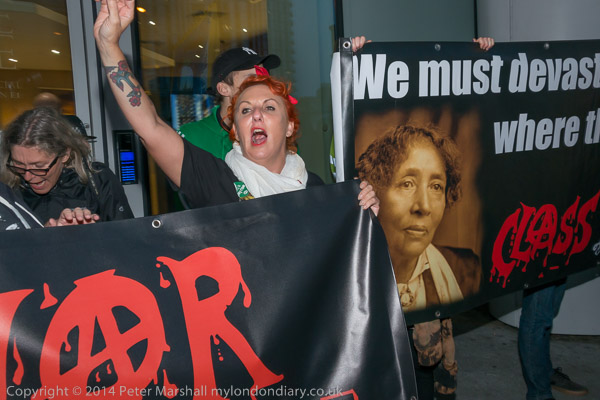
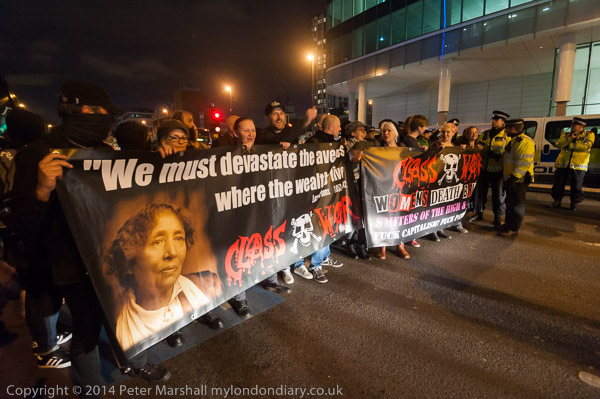
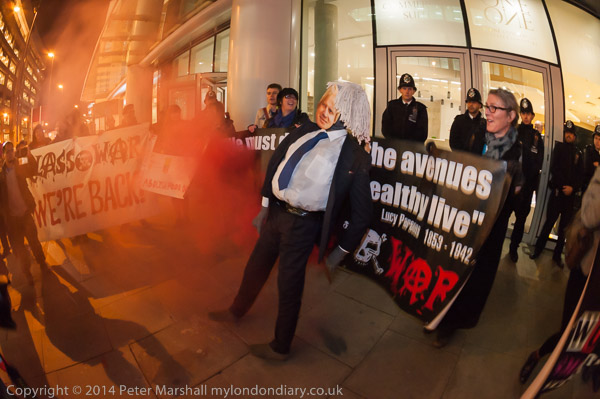
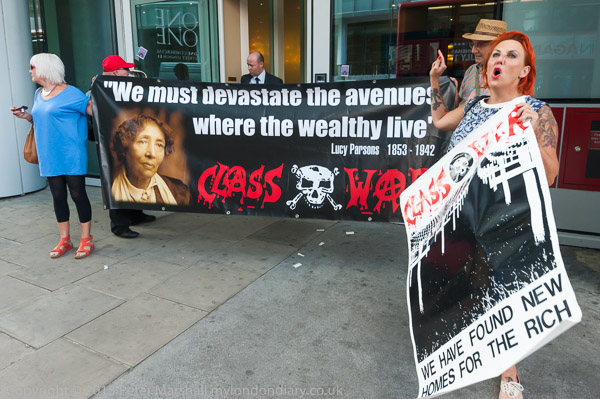
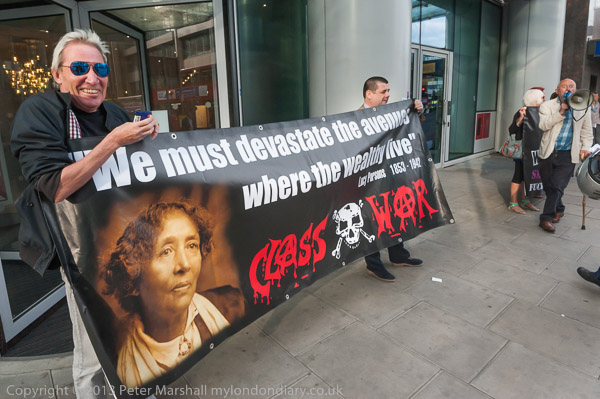
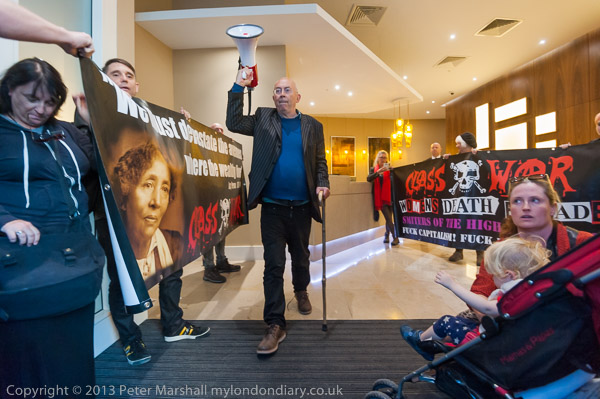
I think Lucy Parsons first came to my attention through Class War, one of whose banners carries the text “We must devastate the avenues where the wealthy live” Lucy Parson 1853-1942 CLASS WAR“. It has on it another portrait of her, a far less formal image – and one that appeals to me rather more than the younger and slightly dreamy vignetted pose in the image that attracted the attention of Thornton. The photographer of this picture, made in the 1920s, is unknown.

The ‘Lucy Parsons banner’ was one they used in the long series of ‘Poor Door’ protests – around 30 in all – that I photographed outside 1 Commercial St, Aldgate, calling attention to the socially divisive separate entrances being provided for wealthy private residents and social housing tenants in this and other blocks.

It has also been carried by them at many other events. In December 2014 Class War used the banner outside the Mayfair offices of US property developers Westbrook Partners who were intending to evict tenants from the New Era Estate in Hackney before Christmass so they could refurbish these low rent social properties and re-let them at market rents – roughly four times as much.


Class War: ‘Evict Westbrook, Not New Era

It’s a banner I’ve made so many picture of, both at protests about various housing issues and at other events. So I thought I’d share just a few here, and an hour later I was still finding more and more to share from My London Diary. So perhaps as more of Thornton’s research is published I may share another set. Those in this post are all from 2014.


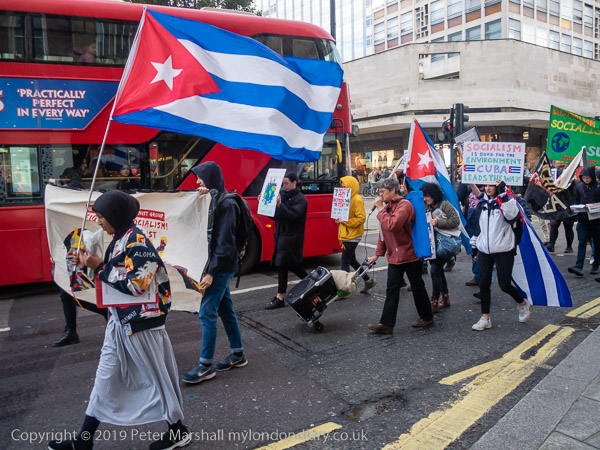
Socialism is Survival

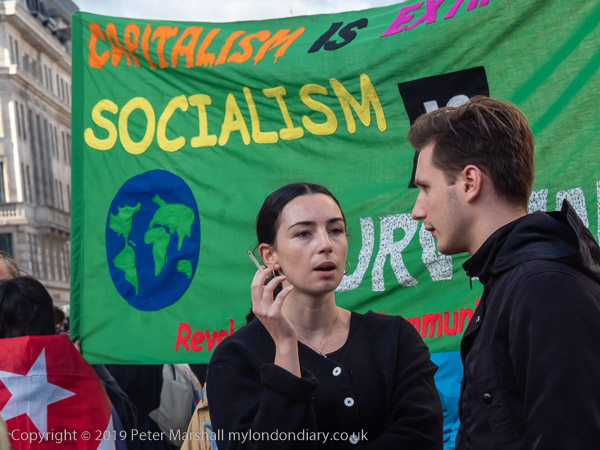
Capitalism is Extinction – Socialism is Survival’

In 2008 Richard Wilkinson wrote an opinion in The Guardian, ‘Follow Cuba’s emissions standard‘ in which he states:

“According to the WWF, Cuba is the only country that has managed to combine an environmentally sustainable footprint per head of population with an acceptably high quality of life as measured by the UN Human Development Index. And if Cuba can do that without the latest and most economical technology, how much easier should it be for us?”

Follow Cuba’s emissions standard

Part of the reason for this is, as he also states, that resources in Cuba, though relatively limited are shared much more equally than in market-led democracies such as the UK and the US. He makes the point that material differences between people are destructive, reducing well-being and quality of life and leading to many social problems, and that wealthy societies such as our should be concentrating on reducing inequalities rather than pursuing economic growth.

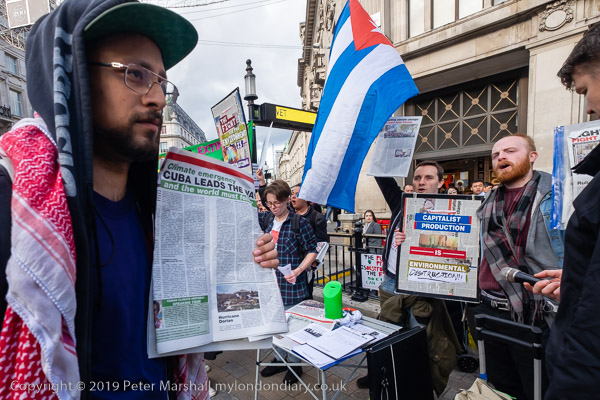
Cuba Leads the Way

To put it simply, we already have enough, and the important thing is now that everyone gets a decent share. We don’t need exact equality, but we do need to avoid the kind of indecent excess we now see, with the rich with more money than they can ever sensibly spend and the poor unable to afford decent food and safe housing, with too many sleeping on the streets or in overcrowded properties, often with little or no security of tenure and too many in jobs on less than a living wage and often zero hours contracts.

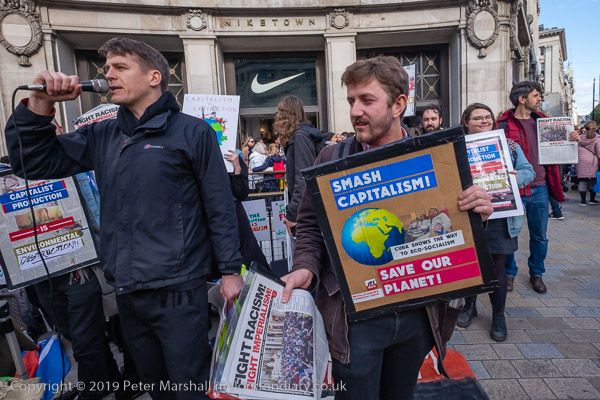
Smach Capitalism! Save Our Planet!

The biggest challenge we face as a world and as a nation is of course not the largely irrelevant matter of Brexit but climate change, and inequality also drives that – both directly by the senseless consumption of the ultra-rich and the poor quality environment of the poor, and indirectly by the encouragement to consume of living in the same society as those who feature most largely in our advertising and media coverage. We are going to have to make huge changes to survive, cutting down our footprint on the world’s resources to perhaps a quarter of the current UK levels, a change that it is hard to see a market-led capitalist system adapting to. And while Wilkinson suggests it should be easier for us, I think our current wealth and political system probably make it impossible. At least without a real revolution.

The Solution is Socialism

The Revolutionary Communist Group put it more starkly and simply than Wilkinson: “Capitalism is Extinction – Socialism is Survival’ but also base their conclusion on the closest we have in the world to a socialist state, Cuba. Despite punitive economic sanctions imposed by the USA (and perhaps sometimes as a result of them) Cuba under communism has made enormous strides in some areas, producing universal literacy and one of the leading health services in the world – and its medical services are one of the country’s main sources of foreign income. Increased life expectancy – to values similar to much rich countries such as the USA and UK – in a roughly static population is now presenting familiar problems. Energy use has remained relatively low with per-capita consumption only around a quarter of that in the UK.

Of course that isn’t the whole story, though it is perhaps difficult to know exactly what is, as all sources of information about the country reflect considerable bias. Many in the RCG have been to Cuba and seen the country at first hand, but what and who they saw will to some extent be affected by their own political affiliations and those of their hosts. Much of the more commonly spread information in the media comes from émigrés who left the country because of their dissatisfaction with the situation and the regime, or from anti-communist individuals and and capitalist organisations.

‘Practically Perfect In Every Way’

Castro and his guerrilla band took the country back from one of the worst and most corrupt governments in history, a dictator who had seized power in a military coup in 1952, but haven’t managed to eliminate corruption – though it is now said to be is the 60 least corrupt nation out of 180 countries by Transparency International. It would be hard not to admire a country which has withstood the sanctions and intrigues of the USA for so many years. Castro himself was apparently the target of over 600 assassination attempts by the United States’ Central Intelligence Agency but died of natural causes in 2016.

You can read more about the protest and rolling picket outside various temples of consumerism on Oxford St at Cuba leads on climate say RCG.


All photographs on this and my other sites, unless otherwise stated, are taken by and copyright of Peter Marshall, and are available for reproduction or can be bought as prints.


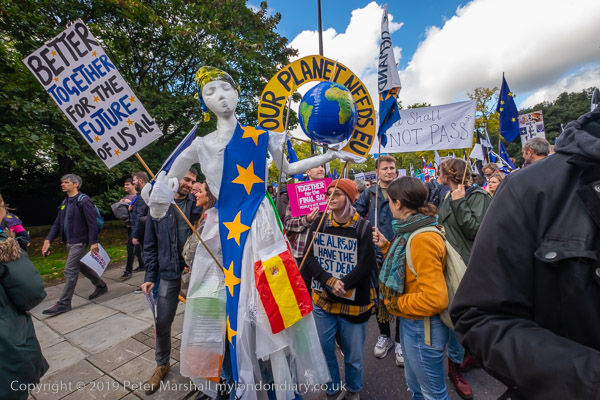
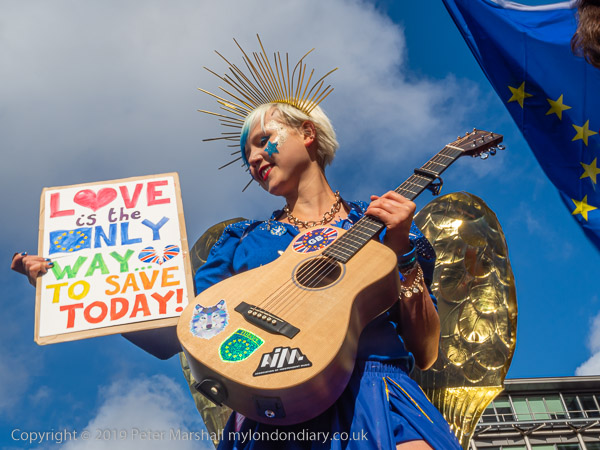
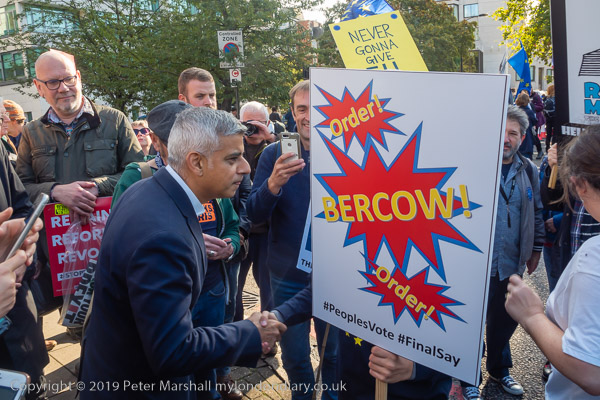
A People’s Vote

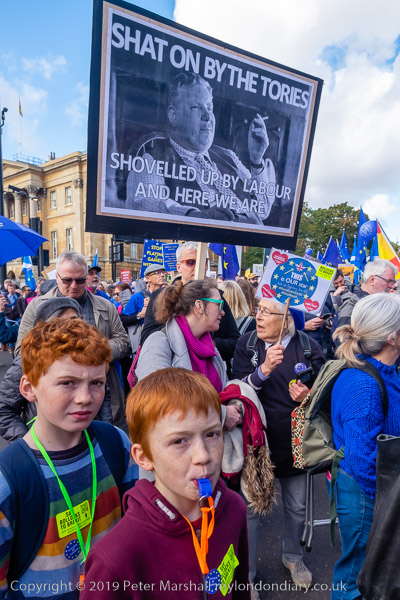
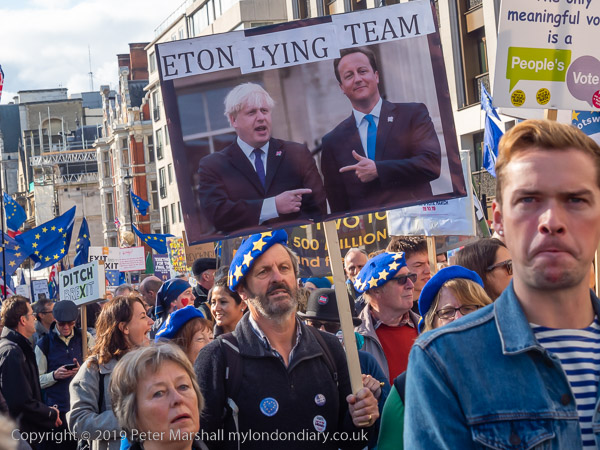
Around a million people came to the start of a march from Hyde Park last October to call for a referendum on the Brexit deal negotiated by Boris Johnson. Although when we held the referendum in 2016 a small majority won the vote to leave Europe, by the time it had actually become clear what this would really mean many had changed their minds.

But we had a government driven by a small group of people determined we should leave whatever, and whose whole existence was predicated on getting Brexit done and prepared to lie and lie again to do so. Some at least of them stood to make millions or billions out of leaving, and others feared that European legislation might soon force them to pay the large amounts of tax they are avoiding.

Facing them was an opposition which was divided over Europe and with a large group of MPs and officers whose main aim wasn’t to provide meaningful opposition to the government but to undermine and replace their leader. Their activities had already lost enough seats in the 2017 election to deny Labour a chance of leading a government and they were hell-bent on making sure of a disastrous result in the next which was expected before long and took place in December.

The Lib-Dems had shot themselves in the foot in July’s leadership election and that left only the 35 SNP members and the Green Party’s Caroline Lucas as an effective opposition.

So while this huge protest was an outpouring of feeling representing a large proportion of the public who feel that now we knew more about what Brexit we should be asked to make an informed choice on whether to leave Europe, it stood little or no chance of success.

Although it is now clear that staying in the EU is far better than any deal that Johnson can negotiate – and that the Tories will do their utmost to reach a ‘no deal’ exit – nothing short of the kind of huge-scale popular revolt that would bring the government down can stop it. The people I was photographing on the streets of London were certainly not the kind of popular mob that would need, and it is difficult in these times to see how that could be achieved – except perhaps by a government ban on Strictly, that Bake Off and the Archers.

More pictures at March for a People’s Vote.


All photographs on this and my other sites, unless otherwise stated, are taken by and copyright of Peter Marshall, and are available for reproduction or can be bought as prints.


More From May Days: 2019

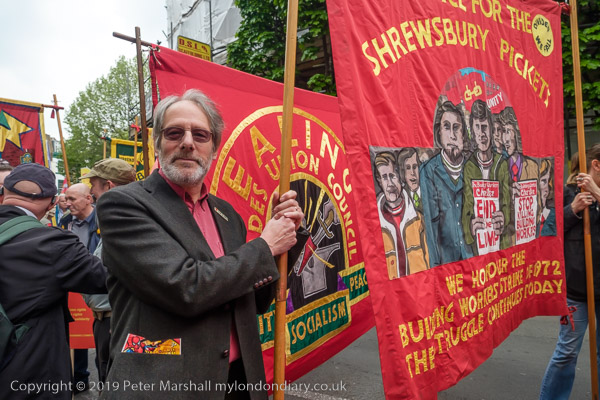
2019 was a rather disappointing May Day for me in terms of the number of events I photographed, and I only covered the annual May Day March from Clerkenwell Green.

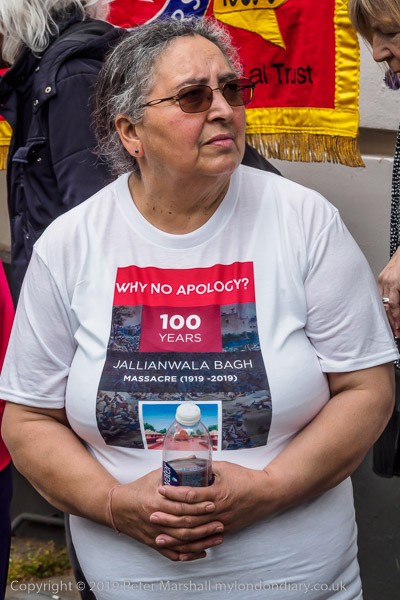
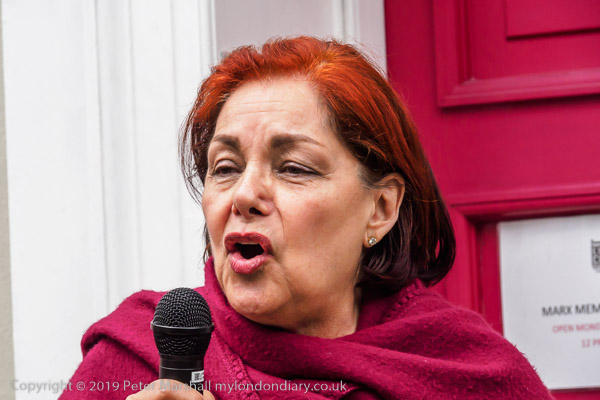
Before the march began there were several speeches outside the Marx Memorial Library. This year was the 100th anniversary of the 1919 Jallianwala Bagh massacre in Amritsar when British troops opened fire on a peaceful protest, killing at least 379 people and injuring many others. A speaker from the Indian Workers Association talked about the massacre and called for the UK to fully apologise. It seems to me surprising that Labour governments have never made an apology for this appalling incident, but it seemed rather unlikely that our current Conservative government would have any thought of doing so.

Our government too was heavily involved in the seizure of power in Venezuela by Juan Guaidó, actively supporting his coup attempt and siding with the USA in forcing companies to impose sanctions and preventing the Bank of England releasing Venezuelan gold to the legitimate government, while urging it to grant Guaidó access to the £1.2bn of Venezuelan gold reserves. He came to London for talks in January this year and it has now emerged that the Foreign & Commonwealth office has a specialist unit dedicated to the ‘reconstruction’ of Venezuela, and that the Department for International Development has also pledged some £40m of ‘humanitarian assistance’ for undisclosed activities – perhaps including the recent failed US-backed landing by mercenaries on May 3rd intending to kidnap President Maduro. May Day 2019 saw a defiant speech by the Venezuelan ambassador to the UK defending Maduro and calling on the UK government to defend the legitimate government of Venezuela rather than attempt to undermine it.

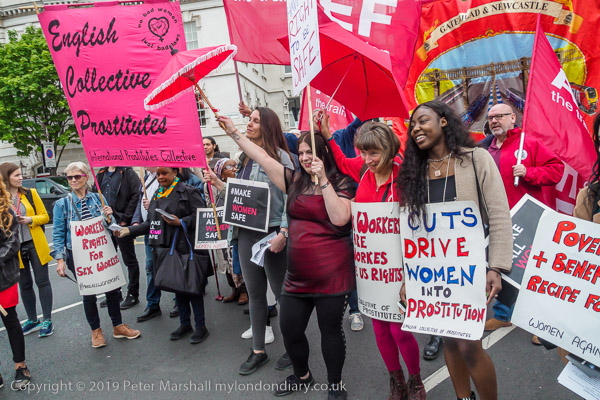
As usual I photographed the marchers on their way to Traflagar Square, including a lively group representing the English Collective of Prostitutes calling for changes in the law to keep all women safe and for workers rights for sex workers.

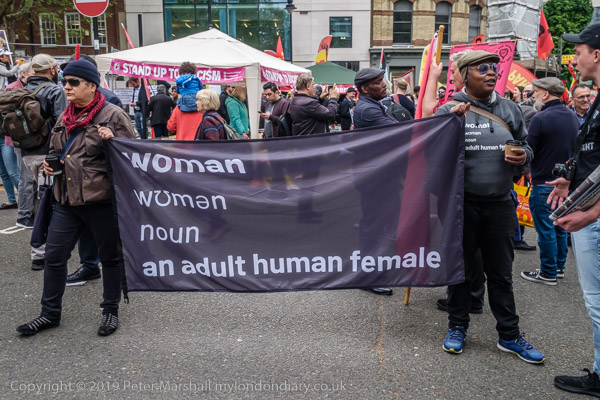
Unwelcome on the march were a pair of women holding a banner against trans women, and I understand they were later forced to leave.

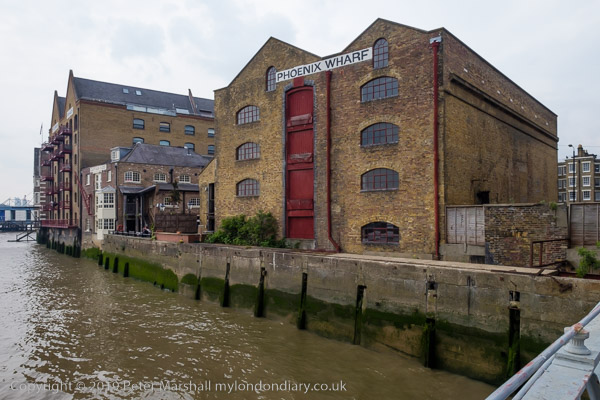
I decided I couldn’t face another Trafalgar Square May Day rally and left. The weather was fine and I went for a walk and to eat my sandwiches by the river in Wapping, where I was to meet with some friends for a May Day celebratory drink later.

Wapping and the Thames
London May Day Banners
London May Day


All photographs on this and my other sites, unless otherwise stated, are taken by and copyright of Peter Marshall, and are available for reproduction or can be bought as prints.

More From May Days: 2018

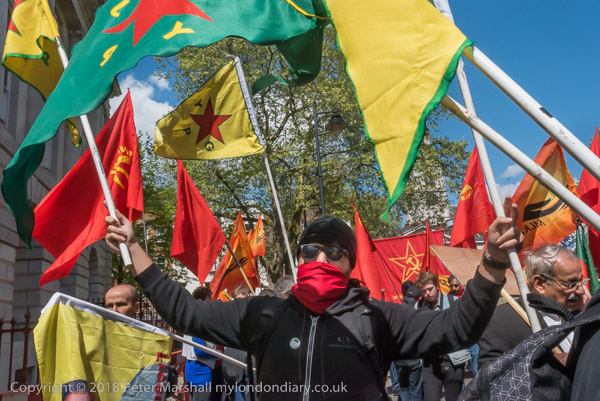
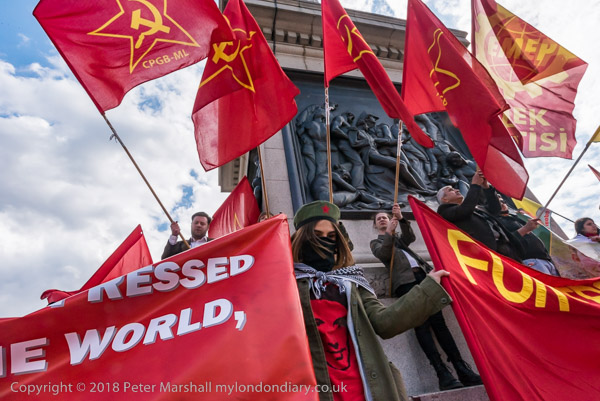
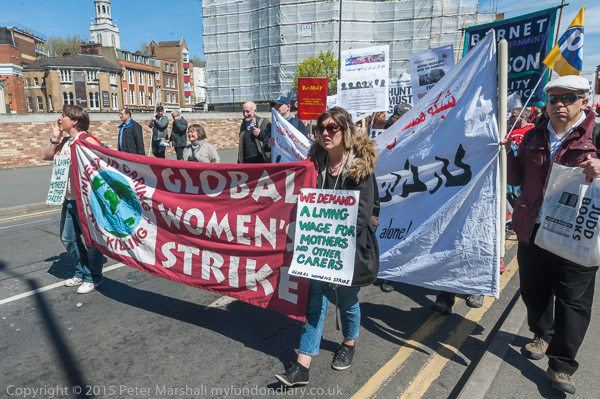
My May Day in 2018 was rather more varied than usual, taking in several other events as well as the traditional May Day march and rally where I started as usual at Clerkenwell Green, along with the Kurdish and Turkish communists and others. Without our various migrant communities it would have been a very much smaller and less colourful event.

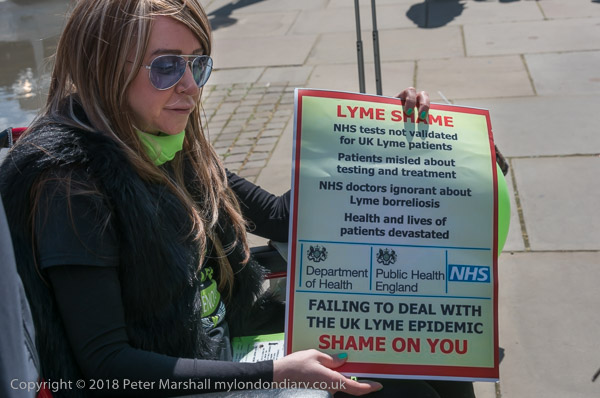
Rather than photograph the actual march I left a few minutes before it started to take the underground to Westminster, where the Chronic Lyme Disease Support Group UK was holding a protest to raise awareness of the hidden epidemic of the disease here. Carried by ticks, the disease is hard to diagnose and the NHS has failed to introduce proper tests and make doctors aware of its prevalence and proper treatment.

The general public need to know about the dangers and in particular to take precautions against tick bites and to be ready to remove ticks promptly and safely from their skin. I was fortunate to have met this group shortly before a holiday with friends a couple of years earlier so carried a small bent plastic tick remover for when we got bitten. If you ever walk through tall grass or woods you should have one ready.

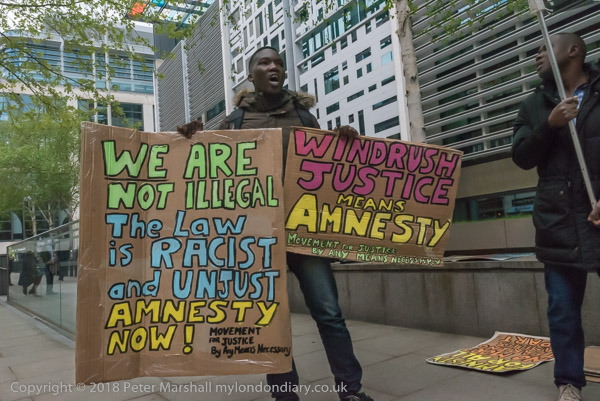
From outside Parliament it was a short walk to the Home Office, where Movement for Justice were protesting against a planned charter flight later in the week for a mass deportation to Jamaica. This was in the middle of the Windrush scandal and the flight would include members of the Windrush generation. The Home Office, particularly under Theresa May, has been guilty of enforcing an unjust, scandalous and racist immigration policy which is still continuing.

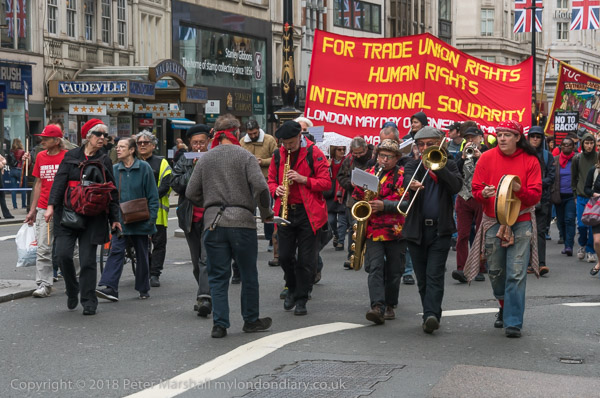
I rushed away from the Home Office and up Whitehall to the Strand, where I was just in time to meet the May Day march from Clerkenwell Green. I was almost certainly more out of breath than the members of the Musician’s Union whose band were leading it.

The rally was, as I noted, a rather humdrum event dominated by trade union speakers which failed to represent the make-up of the march, dominated by our migrant communities.

It seemed rather curious that speakers apparently were supposed to be ‘non-political’ in their speeches because of the elections later in the week. If you can’t be political at a May Day Rally why bother?

May Day Rally

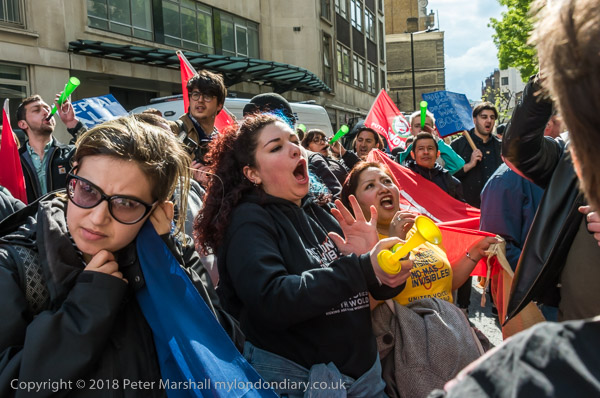
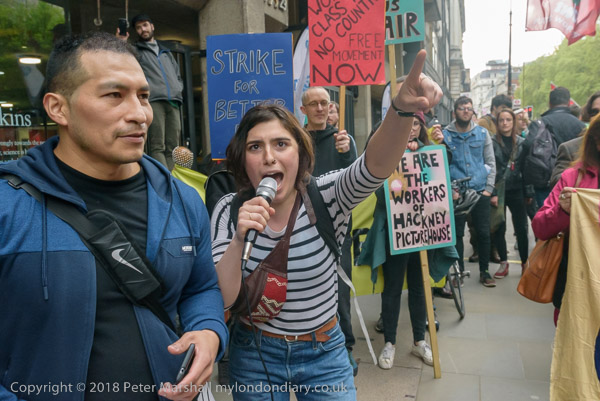
The rally was enlivened a little by the final contribution which was from a victimised union rep from the Brixton Ritzy, but by the time she spoke most had left either to go home or to the local pubs. Those left were getting ready to continue the day with a protest organised by the IWGB (Independent Workers Union of Great Britain), United Voices of the World the union, staff from Picturehouse Cinemas, the Women’s Strike Assembly – UK, London Wobblies, Another Europe Is Possible, Plan C London, Labour Campaign for Free Movement and the Precarious Workers Brigade representing precarious workers, people on poverty pay and exploitative contracts whose largely unskilled work is essential to keeping society running.

They marched to protest outside a number of exploitative workplaces where disputes were currently taking place, demanding guaranteed hours of work, a living wage, the decriminalisation of sex work, an end to trade union victimisation and repeal of the anti-union laws.

After their first protest at the Ministry of Justice where cleaners are demanding a living wage, they went on to further protests at King’s College, where cleaners demand to be directly employed with proper terms of employment and a living wage.

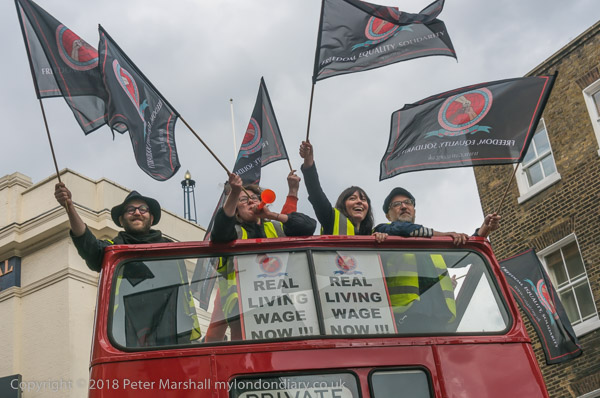
I left the protest at King’s to join the Cleaners and Allied Independent Workers Union CAIWU who had been celebratingd International Workers’ Day with an open-topped bus tour stopping to protest outside some of London’s most notorious employers. Their final protest of the day was at the Royal Opera House, where they were in dispute over the victimisation of five members for their trade union activities.

By now I was getting rather tired, but made a short detour on my way home taking the tube to Brixton, where an emergency demonstration outside Lambeth Town Hall before Thursday’s council elections was calling for a public inquiry into Lambeth Labour’s housing policy, an immediate halt to estate demolitions and a call to stop the privatisation via Homes for Lambeth which is leading to social cleansing.  

Lambeth Labour’s election manifesto had a proud claim that it was well on the way to “complete our ambitious programme of building 1,000 extra homes at council rent for local families“, while the actual number of council homes with with secure council tenancies built was – according to a Freedom of Information request – only 17. The protesters say that even than figure was around double the actual number.

Lambeth Housing Tell Us the Truth
CAIWU Mayday Mayhem at Royal Opera
Precarious Workers – King’s College
Precarious Workers – Ministry of Justice
May Day Rally
May Day March on the Strand
Against Deportation Charter Flights
Lyme Disease epidemic
London May Day March meets


All photographs on this and my other sites, unless otherwise stated, are taken by and copyright of Peter Marshall, and are available for reproduction or can be bought as prints.
There are no adverts on this site and it receives no sponsorship, and I like to keep it that way. But it does take a considerable amount of my time and thought, and if you enjoy reading it, please share on social media.
And small donations via Paypal – perhaps the cost of a beer – would be appreciated.


More From May Days: 2017

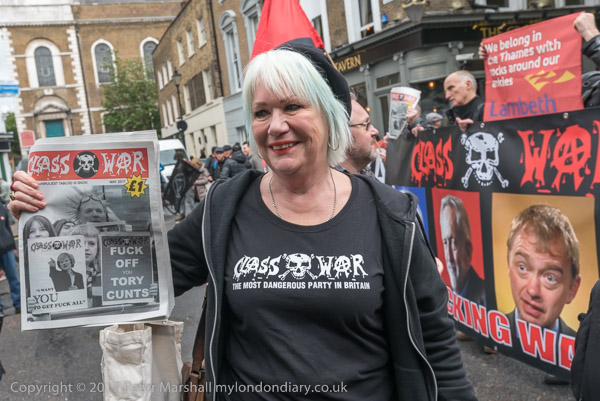
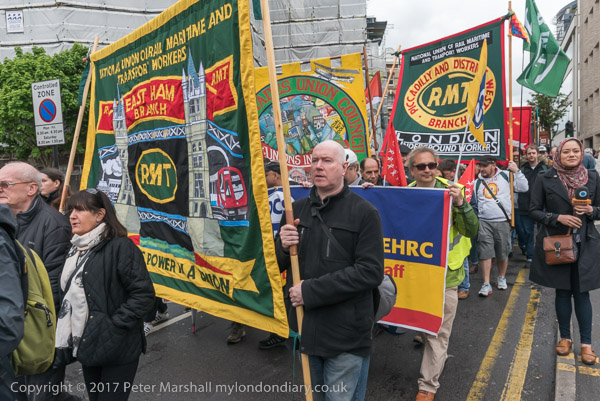
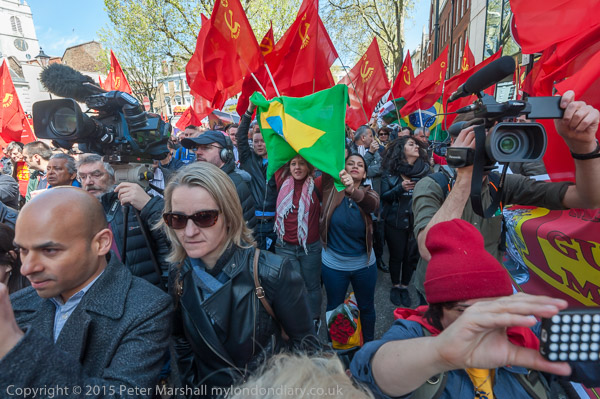
Class War put in a strong presence at Clerkenwell Green both with banners and with a newspaper, rather more interesting than many left-wing publications. Numbers of marchers were down after the previous year’s Corbyn-inspired peak, with the usual representation of communist groups from London’s immigrant communities, various left groups and trade unionists with banners. There were perhaps rather more from the trade unions and left as this march was also celebrating the 100th anniversary of the Russian revolution.

As usual when the march began I tried to photograph as many of the banners as I could as they came down the road, and there is a large selection of them on My London Diary. Although there were a few anarchist groups on the march I wasn’t surprised that Class War, always dismissive of A to B marches, had stayed behind and were now in the pub, where I joined them.

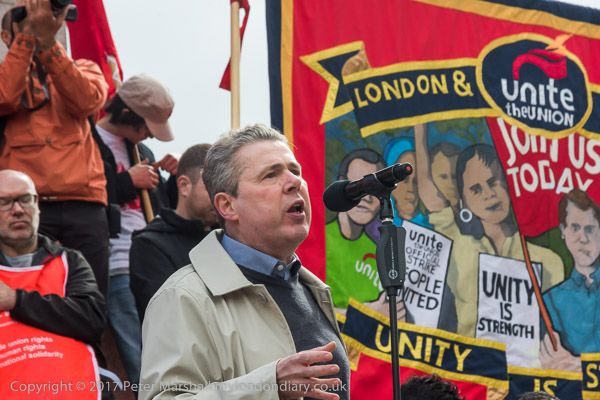
The plan had been for them to make their way by tube to Trafalgar Square, but it’s always difficult to leave a good pub, and by the time a small group had dragged themselves out carrying a rolled up banner they were running rather late. The journey took rather longer than I expected, as having been in the pub they decided on a route via Baker St, one of the few Underground stations with a public toilet, and by the time we arrived in Trafalgar Square the rally was rather past its peak, though I was pleased to be able to photograph Mark Serwotka speaking.

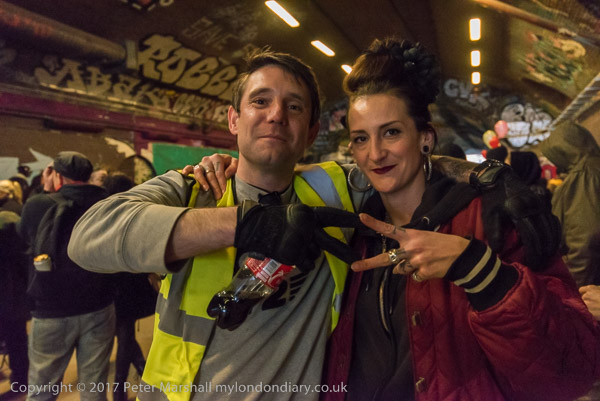
People were meeting in the Leake Street graffiti tunnel under Waterloo Station for the May Day F**k Parade, and I was pleased to find some familiar faces among the crowd. There isn’t a huge amount of light in the tunnel, and I was mainly working at shutter speeds of around 1/25s or a little faster, and quite a few pictures were blurred by people moving. I took a few using flash, but couldn’t really get what I wanted with it.

I was pleased when the parade moved off and there was more light. People were celebrating and there was a good atmosphere, at least until it got to Waterloo Bridge. Here’s my description from My London Diary for what happened there:

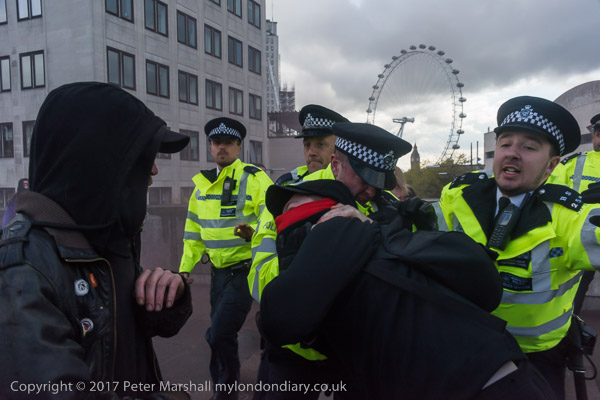
“On the bridge a black-clad protester set off another flare, and I heard a police officer shout ‘Let’s go and get him’ or something similar. I was pushed to one side as police rushed past me and a crowd of them surrounded a protester and grabbed him, throwing him to the ground.

The mood of the crowd changed instantly and some tried to grab their friend back, but police piled into them, some clearly enjoying the opportunity of a little rough handling of the public. Fortunately no one seemed badly injured.

As usual police tried to hide what they were doing to the man on the floor, standing around him to try to stop people seeing and photographing. There did seem to be some excessive use of force and the usual unnecessary painful forcing of his arms up behind his back as he was led away.

I was surprised by this sudden use of force against people who had really been causing no harm. There seemed to be no good reason for it, and it rather seemed as if the police simply wanted a bit of action and perhaps to intimidate the protesters who included a number of young children. And perhaps the fact that there were few if any other people on the bridge meant they felt they could get tough with the parade.

May Day F**k Parade

There had been a number of flares set off earlier – and more later in the event – which police seemed to ignore, so it was hard to see why they decided to act on this occasion.

Eventually the parade moved on across the bridge and then up through Covent Garden Market (with more flares) and then on to Leicester Square. By now the light was fading and so were my legs, and I left for home.

May Day F**k Parade
May Day F**k Parade Meets
May Day Rally
May Day March
May Day March Gathers


All photographs on this and my other sites, unless otherwise stated, are taken by and copyright of Peter Marshall, and are available for reproduction or can be bought as prints.

More from May Days: 2016

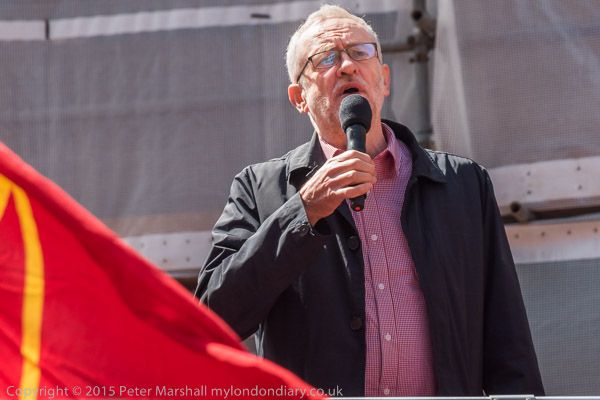
Clerkenwell Green was more packed than ever for May Day 2016, with the big attraction being a rally before the start of the march with Jeremy Corbyn as the main speaker, along with TUC General Secretary Frances O’Grady.

While the event usually attracts little media attention, TV crews and photographers were out in force, with a crowd of photographers around the open-top bus from which he was speaking, and mobbing him as he arrived and left. The stewards became rather heated and there were some who threatened the photographers and a considerable amount of pushing from both them and the photographers. I was glad I had decided to keep well clear.

The march was much as usual, and I tried to photograph all the banners – and most of them are on My London Diary.

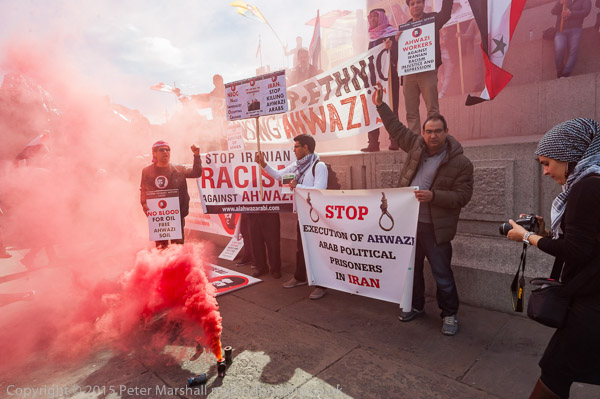
Having had the main speakers before the march started, the rally which followed was perhaps something of an anticlimax, though there was perhaps a wider range of speakers than usual having got the political big guns out of the way earlier. The event was enlivened by a colourful protest by Ahwazi Arabs against their repression over many years by the Iranian regime which has stolen their land and is trying to eradicate their culture.

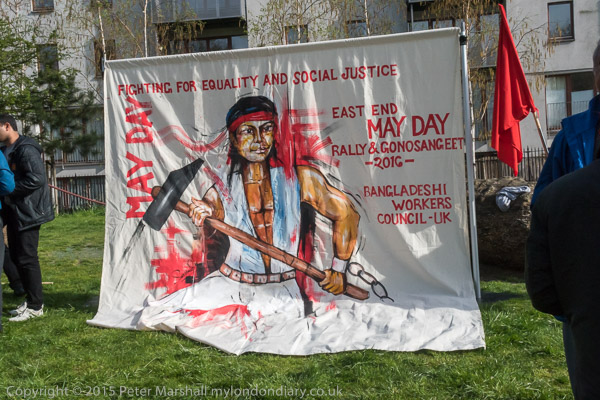
I left for Altab Ali Park in Whitechapel, where the Bangladeshi Workers Council along with Red London, trade unionists, labour movement, political and community activists had organised a rally to commemorate and celebrate May Day.

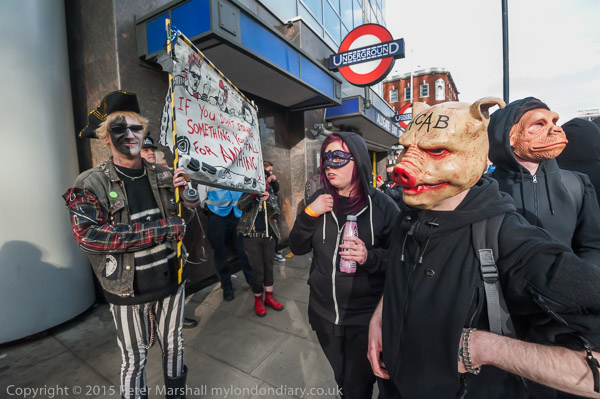
 I met up with a small group from Class War at a pub in Aldgate and walked down with them to 1 Commercial St, the ‘Poor Doors’ tower block where the fourth in a series of anti-capitalist street parties organised by anarchists in East London was to start.

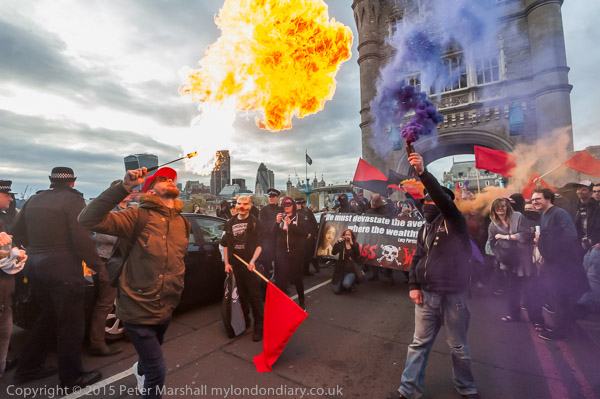
Several hundred turned up, some in fancy dress and others in black and the party got started. After partying and blocking Whitechapel High St the set off to protest elsewhere, first outside the sleazy misogynistic Jack the Ripper tourist attraction in Cable St, and then on to block Tower Bridge for a few minutes, where as well as the usual smoke flares we also get a show of fire breathing.

As they paused by the Southwark Council Offices in Tooley St I kept walking. I’d been on my feet for far too long and needed to rest on a train home. I had to take several days off before getting back to taking pictures.

F**k Parade 4: Ripper & Tower Bridge
Anti-Capitalist May Day Street Party
May Day Rally & Gonosangeet
May Day Rally
Ahwazi Protest at May Day Rally
May Day March
Day at Clerkenwell Green


All photographs on this and my other sites, unless otherwise stated, are taken by and copyright of Peter Marshall, and are available for reproduction or can be bought as prints.
There are no adverts on this site and it receives no sponsorship, and I like to keep it that way. But it does take a considerable amount of my time and thought, and if you enjoy reading it, please share on social media.
And small donations via Paypal – perhaps the cost of a beer – would be appreciated.