Around Gloucester Rd – 1988

Cornwall Gardens area, Kensington, Kensington & Chelsea, 1988 88-4f-02-positive_2400
Cornwall Gardens, Kensington, Kensington & Chelsea, 1988 88-4f-02

I never felt quite at ease when photographing the plusher areas of Kensington, but it was something I felt I had to do if my work was to reflect the whole of London. And certainly these streets showed an enormous diversity and and incredible amount of craftsmanship made possible by the wealth of London, particularly in the Victorian era, largely dependent on our exploitation of the British Empire as well as the working class of this country.

Cornwall Gardens was built between 1862, when Queen Victoria’s eldest son who was the Duke of Cornwall had the title Prince of Wales added to his portfolio and 1879 and is a series of three linked rectangular garden squares to the west of Gloucester Rd. This building is later and I think not actually in Cornwall Gardens (as my contact sheet says) but close to it, though I can’t actually find it.

Queen's Gate Terrace, South Kensington, Kensington & Chelsea, 1988 88-4f-12-positive_2400
Queen’s Gate Terrace, South Kensington, Kensington & Chelsea, 1988 88-4f-12

Helpfully 56 Queens Gate Terrace has its address on it. It is part of a Grade II listed pair at 56-58 on the corner of Gloucester Rd built by architect Charles Gray in 1863–65.

Queen's Gate Terrace, South Kensington, Kensington & Chelsea, 1988 88-4f-16-positive_2400
Queen’s Gate Terrace, South Kensington, Kensington & Chelsea, 1988 88-4f-16

This is the side of 58 Queen’s Gate Terrace which adjoins the Gloucester Rd, which has been occupied since 1972 by Da Mario Kensington, described on Google as “Family friendly trattoria in Venetian-Gothic building, serving thin-crust pizza and other classics.”

Elvaston Place, South Kensington, Kensington & Chelsea, 1988 88-4f-33-positive_2400
Elvaston Place, South Kensington, Kensington & Chelsea, 1988 88-4f-33

The out-of-focus posts at left and extreme right lend this fenced yard in front of a Queen’s Gate Lodge on Elvaston Place a rather sinister feel, quite different from the next picture in the album (not in this post) which you can see if you click on the above and then to the right.

The house is on the corner of Elvaston Mews, entered through a rather grand arch like many in the area.

Launceston Place, Kynance Mews, Kensington, Kensington & Chelsea, 1988 88-4f-42a-positive_2400
Launceston Place, Kynance Mews, Kensington, Kensington & Chelsea, 1988 88-4f-42

Kynance Mews also has its entrance arch, in this case from Launceston Place, though rather more rugged and business-like, and it faces a similar arch across Launceston Place into the east section of the mews.

Back in 1988 the house to its right was occupied by Hairdressers Simon and Peter St John but now appears to be residential.

Launceston Place, Kynance Mews, Kensington, Kensington & Chelsea, 1988 88-4f-62-positive_2400
Launceston Place, Kynance Mews, Kensington, Kensington & Chelsea, 1988

And this is the facing archway on the east side of Launceston Place.

88-4f-63-positive_2400
Launceston Place, Kensington, Kensington & Chelsea, 1988 88-4f-63

Next to the hairdressers on Launceston Place is this rather fine villa. Along with its neighbours it is Grade II listed and described as a semi-detached stucco house, circa 1830, distinguished from the others in the row by its circular tower and dome

Kynance Place, Kensington, Kensington & Chelsea, 1988 88-4f-65-positive_2400
Kynance Place, Kensington, Kensington & Chelsea, 1988 88-4f-65

There are several shops in Kynance Place which is off Gloucester Road immediately north of Kynance Mews, but I can’t remember which of them had this window display. It appears to feature a number of brushes, some things I think might be small genuine sponges, a tortoise (or turtle?) and an advert for eyelash dye, something I never knew existed, but apparently in demand in Kensington.

There are quite a few more pictures around the area in my album 1988 London Photos which you can access by clicking on any of the above images to get a larger version from where you can browse the album.


All photographs on this and my other sites, unless otherwise stated, are taken by and copyright of Peter Marshall, and are available for reproduction or can be bought as prints.

Clean Air – 1990 cyclists and 2019 XR East London

Cyclists protest, Whitehall, Westminster, 1990, 90-11c-14
‘Let London Breathe’ – Cyclists ride down Whitehall to a Trafalgar Square rally – November 1990

Back in 1990, I rode with hundreds of cyclists from the London Cycling Campaign and others protesting about the terrible air quality in London from Battersea Park to a well-attended rally in Trafalgar Square. Following the rally, some MPs raised the issue in Parliament.

XR East London marches for clean air – 12 July 2019

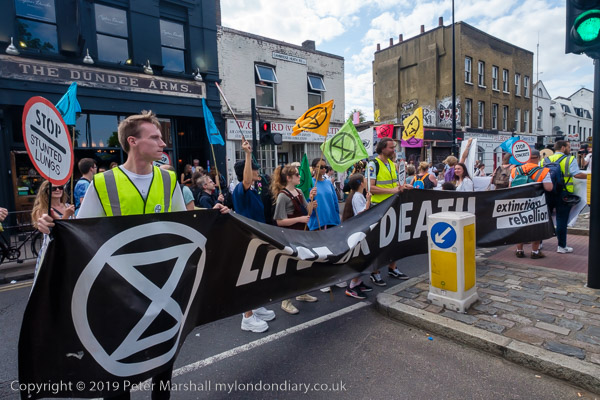
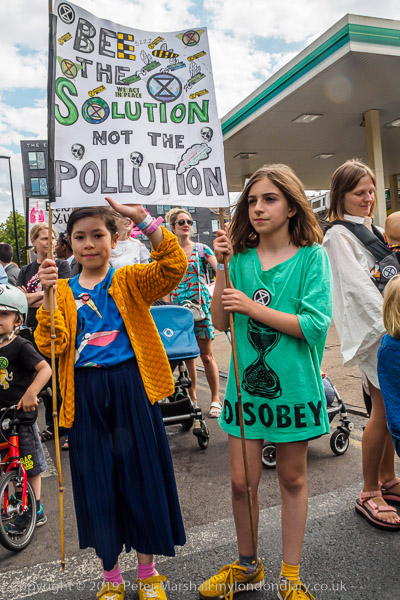
Almost 30 years on there has not been a great deal of progress – and the statistics now show almost 10,000 excess deaths per year in the city due to air pollution, and untold misery from various respiratory conditions, some crippling. In 2019 XR East London met at Bethnal Green on Friday 12 July to march to Hackney behind a banner ‘The Air That We Grieve’, calling for a rapid end to the use of fossil fuels.

Much of the pollution comes from road traffic, and the already announced end to the sale of new trucks, vans and any other combustion-powered vehicle from 2030 onwards will do a little to improve air quality, but existing petrol and diesel vehicles will continue to be used for many years, though we may see more stringent ultra-low emission zones to restrict their use in cities.

But although the switch to electric will cut down pollutants such as nitrogen oxides as well as reducing climate changing carbon dioxide, it will still leave other harmful substances such as particulates from tyres and brakes in the air. And the carbon footprint is only lowered so long as the electricity used to charge those car batteries comes from truly renewable generation.

Cleaner air in cities also needs us to move away from the car to more eco-friendly means of transport – such as public transport and bicycles. Even electric scooters and electric bikes also have a part to play.

Better public transport means more trains, light rail, trams and buses. The simplest and most cost-effective solutions are probably more dedicated bus lanes and bus-only routes, and giving buses greater priority in traffic. Many years ago I cycled in French cities where buses had priority and motorists (and cyclists) had to give way whenever they wanted to pull out from a stop, and changes like this to our Highway Code and traffic rules would make a difference.

In 1990 cyclists were calling for 1000 miles of dedicated cycle routes through London. We do now have some ‘cycle superhighways’ and ‘quietways’, although many of these – we are now supposed to call them ‘cycleways’ – still involve sharing with often dangerous traffic. Progress is still slow, and there is bitter opposition from some interest groups, particularly black cab drivers.

We need too an overhaul of London’s taxi system, with rules still made in the days of horse-drawn Hackney cabs. I’ve often stood at bus stops in the City waiting for my bus, held up by traffic while 20 or 30 or more black cabs drive by, the great majority of them empty. A move away from ‘ply for hire’ to smartphone based systems summoning a cab from a nearby taxi rank would hugely cut both congestion and pollution in the centre of London.

More at XR East London marches for clean air. You can click on the black and white image above to go to the album with more pictures from the 1990 cyclists protest.


As always I was travelling around London on public transport (I sometimes bring up a folding bike on the train) and as the march neared its end I boarded a bus in the opposite direction back to Bethnal Green where I took the tube back to Holborn, then took the short walk to the University of London’s Senate House, where exploited outsourced workers were holding a noisy protest after the newly appointed Vice-Chancellor Wendy Thomson had failed to reply to a request to meet them and discuss their grievances. You can see more about this at IWGB welcome new Vice Chancellor.


All photographs on this and my other sites, unless otherwise stated, are taken by and copyright of Peter Marshall, and are available for reproduction or can be bought as prints.

Knightsbridge – Around Hyde Park

Rutland Gate, Westminster, 198888-4c-55-positive_2400
Rutland Gate, Westminster, 1988 88-4c-55

The Rutland Gate to Hyde Park from Knightsbridge is just to the west of Hyde Park Barracks, and Rutland Gate is a rather strange double square with bits that extends south from there. These houses are at its south-west extremity, and that in the right is called Clock House, though I think you have to imagine the clock in the circular window above the door. It does have a statue on its roof, or possibly on that of an adjoining building, which appears to be some kind of classical figure. The frontage dates from its conversion to a ‘bijou residence’ between the wars, and the statuary arrived in the 1960s when Austin Blomfield remodelled the house for a former Lord Mayor of London, Sir Henry Aylwen.

Asia, John Henry Foley, Albert Memorial, Hyde Park,Westminster, 1988 88-4d-02-positive_2400
Asia, John Henry Foley, Albert Memorial, Hyde Park,Westminster, 1988 88-4d-02

Down the road at the Albert Memorial there is no shortage of sculptures, although I’m unsure why this rather large and half-dressed woman seated on an elephant should have been chosen to represent Asia. I suspect she more represents the fantasies of the sculptor than anything else.

Victoria Grove, Kensington, Kensington & Chelsea, 1988 88-4d-12-positive_2400
Victoria Grove, Kensington, Kensington & Chelsea, 1988 88-4d-12

Albert is also remembered in Albert Mews, through the archway on this picture of Victoria Grove. Victoria Grove runs from Gloucester Road to Victoria Road.

Kensington Court Place, Kensington & Chelsea, 1988 88-4d-16-positive_2400
Kensington Court Place, Kensington & Chelsea, 1988 88-4d-16

Kensington Court Gardens is a large mansion block built on the site of the Kensington Lawn Tennis Club in 1887-9 which was bought by Albert Barker. The block was designed by Henry Peck and built by Frederick Moir of Moir, Wallis and Company who moved into a flat there. The street, then Charles St, was renamed to Kensington Court Place in 1908. Flats then were advertised at between £195-£250 per year – equivalent allowing for inflation to £25,000 to £33,000. Some are quite large – one recent advertised had 4 bedrooms, 2 reception rooms, a large study, large kitchen/breakfast room and 3 bathrooms.

The flats have a blue plaque for T S Elliot who moved to flat 3 after his secret marriage to his secretary and editor Valerie in 1957 when he was 68 and she was 30. He died in 1965 but she continued to live her until her death in 2012

Hyde Park Gate,Kensington & Chelsea, 1988 88-4d-21-positive_2400
Hyde Park Gate,Kensington & Chelsea, 1988 88-4d-21

The blue plaque to sculptor Jacob Epstein is on a tall house at 18 Hyde Park Gate where he lived from 1929 until his death in 1959. Almost opposite is another blue plaque for novelist and playwright Enid Bagnold, and a little further down the road one for Winston Churchill who bought the house as his London base after his election defeat in 1945. Widely regarded as a hero for leading the country through the war, he is also vilified for his attacks on miners in Tonypandy, the deaths of millions of Indians in the Bengal famine, his approval of area bombing of German cities – surely a war crime – and many other actions.

Hyde Park Gate,Kensington & Chelsea, 1988 88-4d-22-positive_2400
Hyde Park Gate,Kensington & Chelsea, 1988 88-4d-22

The flag outside 45 Hyde Park Gate is the Australian flag as this is the Australian High Commissioners official residence. The house has been greatly altered and enlarged since it was built in 1838 as Stoke Lodge by Robert Thew, a major in the East India Company’s artillery.

Hyde Park Gate,Kensington & Chelsea, 1988 88-4d-31-positive_2400
Hyde Park Gate,Kensington & Chelsea, 1988 88-4d-31

Hyde Park Gate also includes sections running along the south side of Kensington Road as well as a road leading south. These modern flats are on the north east corner I think date from around 1972 when I think the houses on both sides of the entrance to the street were demolished.

Hyde Park Gate,Kensington & Chelsea, 198888-4d-32-positive_2400
Hyde Park Gate,Kensington & Chelsea, 1988 88-4d-32

Reading the list of well-known people who have lived in Hyde Park Gate in the Survey of London and on Wikipedia it seems almost every house could have a blue plaque. This one is for Lieutenant General Robert Stephenson Smyth Baden-Powell, 1st Baron Baden-Powell, OM, GCMG, GCVO, KCB, KStJ, DL though there isn’t room for all that on the plaque at 9 Hyde Park Gate, which simply records “Robert Baden-Powell 1857-1941 Chief Scout of the World lived here”.

All pictures are from my album 1988 London Photos. Clicking on any of the images will take you to a larger versinon in the album from where you can navigate forward or backward through all the images.


All photographs on this and my other sites, unless otherwise stated, are taken by and copyright of Peter Marshall, and are available for reproduction or can be bought as prints.

Knightsbridge and Brompton, 1988

Brompton Square, Knightsbridge, Kensington & Chelsea, 1988 88-4b-13-positive_2400
Brompton Square, Knightsbridge, Kensington & Chelsea, 1988 88-4b-13

I can’t look at the picture without thinking there should be people on folding bicycles cycling around this small oval island.

Brompton Square isn’t a square, but a long thin rectangle with a garden at its centre off the Brompton Rd, and at its far end is this rounded terrace with its own small oval of private garden in front of it. The square was developed by James Bonnin in 1821 and appears to have changed little with most of the houses now Grade II listed. Three houses sport blue plaques, including one for Stéphane Mallarmé who lived at No 6 in 1863, but the street had and has other famous residents, including “Britain’s most successful serial confidence trickster”, Achilleas Kallakis who bought No 31 at centre-right in this picture in the 2000s for £28 million, proceeding to have the garden dug out for a three-storey basement.

Andrew Ritchie, the inventor of the Brompton Bicycle company was working as a gardener in the area while working on the prototypes for his folding bike and took the name from the Brompton Oratory, whose dome was visible from his bedroom workshop. I’ve ridden a Brompton since 2002, though still prefer my 1980s road bike.

Fairholt St, Knightsbridge, Kensington & Chelsea, 1988 88-4b-21-positive_2400
Fairholt St, Knightsbridge, Kensington & Chelsea, 1988 88-4b-21

You will search in vain for the Prince of Wales pub in Fairholt St, replaced in 2015-7 by a “Luxury infill development” featuring something like the retained pub front, a “hi-end single family dwelling, a stone throw from Harrods” which ” boasts a two-level basement, 5 bedrooms, a lift, a spa and a home cinema”, designed by AR Architecture with a construction budget of £3m. The development gained the architects the “Best Architecture Single Residence” award by the United Kingdom Property Awards 2019-20.

The pub was established in 1831 in what was then Middle Street, Montpelier Row. In 1989 it was renamed ‘The Swag & Tails’, and changed from a friendly local to a gastro-pub. According to the Closed Pubs UK web site it was bought and closed in 2009, reportedly “by Tamara Ecclestone (daughter of F1 supremo Bernie) with a view to either rebuilding or expanding the premises considerably and turn it into a late night venue.”

Montpelier Terrace, Knightsbridge, Kensington & Chelsea, 1988 88-4b-33-positive_2400
Montpelier Terrace, Knightsbridge, Kensington & Chelsea, 1988 88-4b-33

This gatepost in Montpelier Terrace has lost the small and rather delicate urn which surmounted it in 1988, and the gardens here are now rather better kept and the houses in a much smarter condition. There is now very little of the small pockets of attractive dereliction that relieved the area then.

Sculpture, Knightsbridge, Kensington & Chelsea, 1988 88-4b-52-positive_2400
The Seer, Sculpture, Knightsbridge, Kensington & Chelsea, 1988 88-4b-52

Gilbert Ledward (1888-1960) produced many war memorials and other monumental architecture with a number of examples still visible around London – including the Venus Fountain in Sloane Square and the bronze sculptures on the Guards Memorial in Horseguards Parade. The Seer was produced around 1957 for the forecourt of Mercury House, 195-199 Knightsbridge, built in 1956–9.

Mercury House was demolished in 2002, replaced by The Knightsbridge Apartments, completed in 2005. I don’t know what has become of ‘The Seer’. Feel free to comment if you do.

Sculpture, Edinburgh Gate,  Knightsbridge, Kensington & Chelsea, 1988 88-4b-62-positive_2400
Sculpture, Edinburgh Gate, Knightsbridge, Kensington & Chelsea, 1988 88-4b-62

This was the last sculpture completed by Jacob Epstein (1880-1959) shortly before his death and depicts a father, mother, son and dog rushing forwards off from the plinth, encouraged by Pan, the Greek God of the Wild, playing his pipes. Variously known as The Rush of Green, Pan or The Bowater House Group, it was commissioned by the chairman of the Land Securities Investment Trust to stand in front of their newly built offices at Bowater House. When this was demolished in 2006 to be replaced by a yet more hideous new development the sculpture was removed and in 2010 re-installed some distance west in the re-located Edinburgh Gate, its figures again rushing into the green of Hyde Park.

Russian Orthodox Cathedral of the Dormition, Ennismore Gardens, Knightsbridge, Westminster, 1988 88-4c-46-positive_2400
Russian Orthodox Cathedral of the Dormition, Ennismore Gardens, Knightsbridge, Westminster, 1988 88-4c-46

Originally built as All Saints, an Anglican Church, in 1849, desinged by Lewis Vulliamy in a Lombard style rather than the prevailing Gothic, the church ran out of cash and was only completed in 1860. Then it was given a facelift in 1891-2, with a new west front based on the Basilica of St Zeno of Verona in Verona, Italy. A parish merger made the church redundant in 1955 and it was leased to a Russian Orthodox congregation, who consecrated it in the name of one of their great feasts, the Dormition of the Mother of God. It was later bought by the Russian Orthodox Church.

Ennismore Mews, Knightsbridge, Westminster, Kensington & Chelsea,1988 88-4c-34-positive_2400
Ennismore Mews, Knightsbridge, Westminster, Kensington & Chelsea,1988 88-4c-34

These mews were built for the coaches for the large houses in Ennismore Gardens and Rutland Gate with stabling for the horses and rough accomodation for the servants who looked after the horses and drove the carriages. Ennismore Mews were rather grander than most, reflecting the quality of the houses in Ennismore Gardens which were developed in the 1868-74 by Peter and Alexander Thorn. Their company also built a new Blackfriars Bridge, and used some of the stone salvaged from the old bridge to face the Ennismore Gardens houses. The mews buildings were rather more basic structures, and have been converted to residential use, now selling for around £3.75m.

Ennismore Gardens, Knightsbridge, Westminster, 1988 88-4c-52-positive_2400
Ennismore Gardens, Knightsbridge, Westminster, 1988 88-4c-52

I was amused by the range of rather unusual structures, including the tower of Holy Trinity Brompton and the dome of the London Oratory along with some lesser features. The gateway at left is the entrance to Ennismore Garden Mews.

Click on any of the pictures to go to a larger version in my album 1988 London Photos from where you can browse these and other pictures.


All photographs on this and my other sites, unless otherwise stated, are taken by and copyright of Peter Marshall, and are available for reproduction or can be bought as prints.

Organised Crime – Public & Private Sector

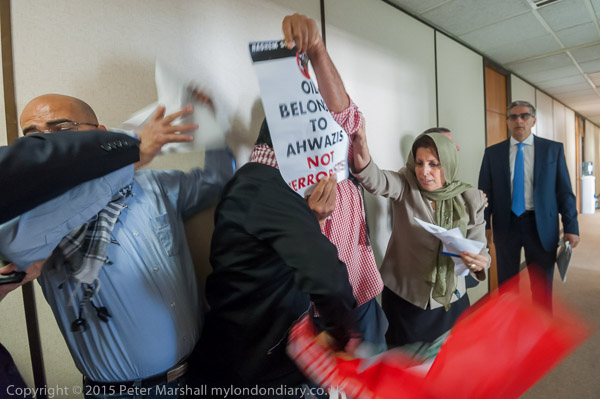
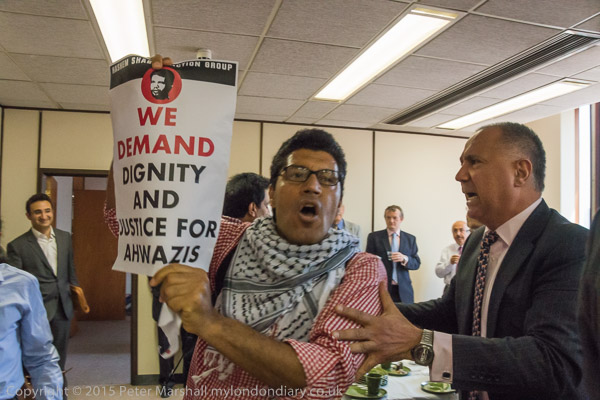
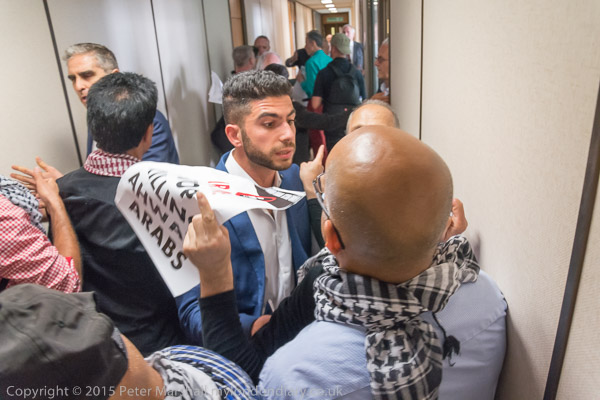
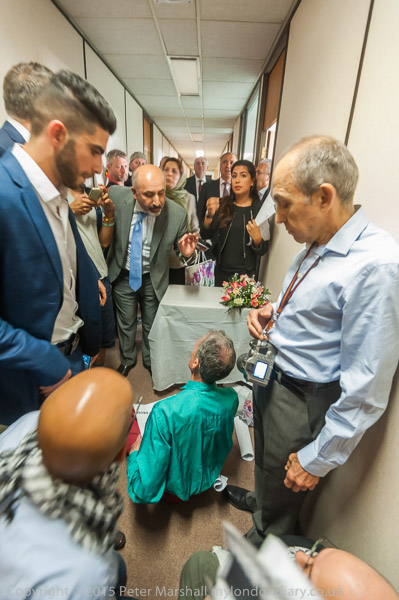
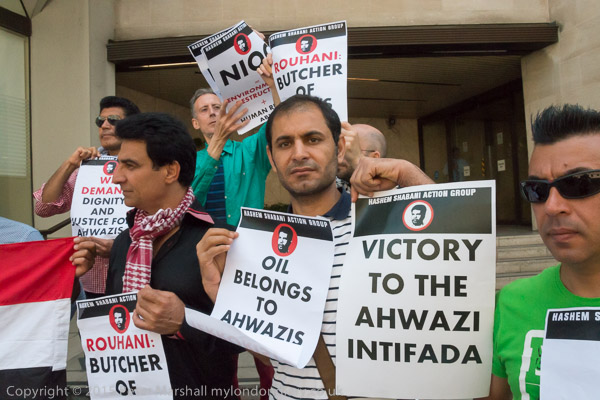
I don’t know who drew the often published cartoon which shows a young boy talking with his father and saying “Dad, I’m considering a career in organised crime” to which his father replies ‘Government or Private Sector”, but it comes to mind when thinking about the secret UK-Iran business meeting which I photographed Ahwazi activists and Peter Tatchell gate-crashing on July 3rd 2015. Though the UK-Iran crimes involve both sectors.

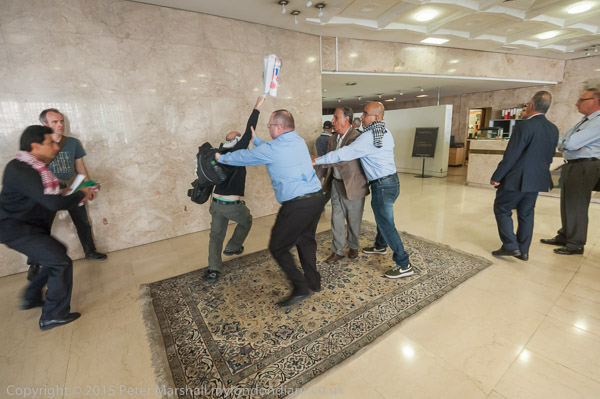
To take pictures I had to rush in with the group of protesters to the National Iranian Oil Company offices in Westminster, which are clearly private property and I Would probably be committing an offence, but I felt there was a clear public interest in covering the protest by the Hashem Shabani Action Group against the exploitation and environmental destruction of their homeland by Iran and the UK and the long history of anti-Arab oppression by the Tehran regime.

Fortunately I was able to enter the building without being personally confronted by the security staff who were busy trying to grab some of the protesters, and along with two other photographers and a couple of videographers was able to run up the six flights of stairs to the floor where the secret meeting was taking place, though I was in a pretty poor state by the time I reached the top landing, worried I might collapse. I was after all probably around 20 years older than most of the others, though only seven older than Peter Tatchell.

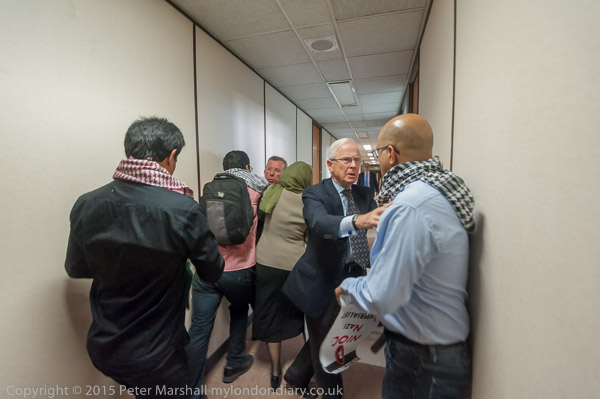
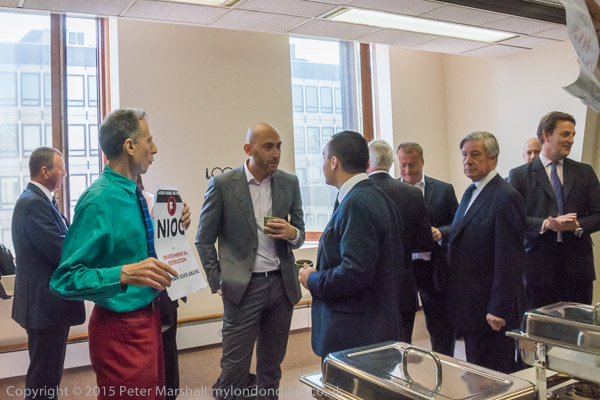
I did manage to photograph the peaceful protest inside the meeting, where most of those present were enjoying a buffet lunch, and to take some pictures of the confrontation in the corridor outside, where one youngish man in a blue suit, thought by the protesters to be an Iranian military officer, became rather violent and assaulted another of the photographers. But the corridor was dimly lit and some of my pictures were less than sharp, mainly blurred by moving subjects with the slowish shutter speed I needed.

I may have mentioned in other posts that I very seldom watch TV. I last lived with a TV back in 1968, when I got married and moved into a flat without one, and since then it’s been something I just don’t have time for in my life. Of course I’ve watched TV elsewhere – and can do so now by computer, but its never become a regular habit. One of the consequences of this is that there are many celebrities and public figures that I don’t easily recognise, only hearing them on radio or seeing the occasional picture in the press. So although Lord Lamont or Tory MP Richard Bacon, leader of the All Party Parliamentary Group on Iran, both leading the call for the peaceful and non-violent Hashem Shabani Action Group, (motto ‘Our weapons are pens. Our bullets are words‘), to be banned as a terrorist group were present, I failed to get newsworthy pictures of them.

Having made their point, the protesters decided to leave and I went with them, only to be stopped by police in the foyer of the building. We were prevented from leaving despite showing our press cards, but told we were not under arrest. The photographer who had been assaulted complained to the police, who went upstairs to ask questions, returning after a few minutes to say that the perpetrator probably had diplomatic immunity, and the photographer decided not to press charges.

Eventually after around 45 minutes – during which the building manager brought us fruit juice – press and protesters were allowed to leave and join those outside who had been unable to get past security for more photographs.

More on My London Diary about the dubious history of Britain and Iranian oil and the protest at Ahwazi crash secret UK-Iran business meeting.


All photographs on this and my other sites, unless otherwise stated, are taken by and copyright of Peter Marshall, and are available for reproduction or can be bought as prints.

More Belgravia – 1988

Pantechnicon, Motcomb St, Belgravia, Westminster, 1988 88-3m-14-positive_2400
Pantechnicon, Motcomb St, Belgravia, Westminster, 1988 88-3m-14

Until I photographed this building I had no idea of the origin of the word ‘Pantechnicon’, though I had heard it used to describe the large vans used for house removals. Seth Smith, (1791-1860) a vicar’s son from Wiltshire came to London and became one of the leading property developers of the West End in the 1820s, turning what had been a crime-infested lower-class swamp into the fashionable area with more than its fair share of respectable and immensly wealthy criminals we know now.

He filled an awkward triangular site left over by his other developments with a large building with an impressive Greek style facade of Doric columns for selling carriages and storing furniture for the wealthy residents of his new housing, and included an art gallery, coining a new upmarket name for it from the Greek pan (all) and techne (arts). Only this Grade II listed facade remains of the original building, most of which was destroyed by a fire in 1874.

Large furniture for large houses needed large vans to transport it, and the Pantechnicon company produced what were monsters for the age, up to 18ft long and 7 ft wide with a high roof and a lowered floor for extra height and easier loading – and their name large on the sides. Other removal companies were soon making similar large vans and the name ‘pantechnicon’ moved into general use for large furniture removal vans.

Belgrave Square, Grosvenor Crescent, Belgravia, Westminster, 1988 88-3m-31-positive_2400
Belgrave Square, Grosvenor Crescent, Belgravia, Westminster, 1988 88-3m-31

Smith was responsible for much of the development of Mayfair, though most of his work there has been demolished, and also parts of Belgravia, although Belgrave and Eaton Squares were laid out by Thomas Cubitt, working for the Grosvenor Estate, which still owns much of the area, after an 1826 Act of Parliament allowed Lord Grosvenor to drain the infamous ‘Five Fields’ area and raise its level.

St George's Hospital, Belgravia, Westminster, 1988 88-3m-36-positive_2400
St George’s Hospital, Belgravia, Westminster, 1988 88-3m-36

At the back of St George’s Hospital, probably in either Grosvenor Crescent or Lanesborough Place. You can see the building behind – now a hotel – from Grosvenor Crescent. I’m not sure whether this rather bleak looking structure was simply for taxis or was used by ambulances – which now form long queues outside A&E. But for me it seemed like some infernal processing machine, taking in at the left and vomiting out its results at the right.

Belgrave Square, Belgravia, Westminster, 1988 88-3m-42-positive_2400
Belgrave Square, Belgravia, Westminster, 1988 88-3m-42

Belgrave Square is Embassy Country, and in more recent years I’ve photographed protests outside many of them. Bahrain, Brunei, Germany, Ghana, Malaysia, Norway, Portugal, Serbia, Syria, Trinidad & Tobago and Turkey all have their embassy (or High Commission) in the square and Austria, Italy, Romania, Côte d’Ivoire, Italy, UAE, Spain and probably a few others have embassies, legations or cultural centres within spitting distance. I think there are probably a few more I’ve forgotten too!

Belgrave Square, Halkin St, Belgravia, Westminster, 1988 88-3m-43-positive_2400
Belgrave Square, Halkin St, Belgravia, Westminster, 1988 88-3m-43

Some other houses are also the official residences of ambassadors – this on the corner with Halkin St is that of the Mexican ambassador. The architect of this grand terrace of houses (Grade I listed) and the others around Belgrave Square was George Basevi.

Wilton St, Belgravia, Westminster, 1988 88-3m-54-positive_2400
Wilton St, Belgravia, Westminster, 1988 88-3m-54

It’s something of a relief to turn away from the overpowering and grandiose Belgrave Square and walk down Wilton St, where the houses, though still large are on a less grand scale, with stucco only on the ground floor. This house still stands out, though I think has lost its unusual knotted door, as it seems to have slipped down a few feet from the rest in the street, the only one with a few steps leading down to the door.

Upper Belgrave St, Belgravia, Westminster, 1988 88-3m-64-positive_2400
Upper Belgrave St, Belgravia, Westminster, 1988 88-3m-64

Upper Belgrave St continues the pattern of Belgrave Square, linking it to Eaton Square.

St Peter's, Church, Eaton Square, Upper Belgrave St, Belgravia, Westminster, 1988 88-3m-65-positive_2400
St Peter’s Church, Eaton Square, Upper Belgrave St, Belgravia, Westminster, 1988 88-3m-65

And it leads to St Peter’s Church, built by architect Henry Hakewill in a neoclassical style when the area was being developed in 1824-27. Fortunately his drawings were still available when the building burnt down in 1837 and one of his sons used them to rebuild it. Sir Arthur Blomfield worked his worst on the church, enlarging it in 1875, but fortunately leaving it largely intact on the exterior.

The church was again badly damaged by fire the year before I took this picture and was apparently only a shell, with the interior and roof devastated. The fire was deliberately started by an anti-Catholic arsonist who mistakenly thought it was a Catholic church. I can’t find the details of the case but I think it was started by a 21-year-old man who had also started fires at several other churches, including another London church the previous night. Rebuilding began in 1990 and the church – with a simpler interior – reopened in 1991.

These pictures are from my album 1988 London Photos and clicking on the pictures, which will take you to larger versions in the album from where you can browse other images.


All photographs on this and my other sites, unless otherwise stated, are taken by and copyright of Peter Marshall, and are available for reproduction or can be bought as prints.

Around Pont St, 1988

Pont St, Knightsbridge, Kensington & Chelsea, 1988 88-3i-01-positive_2400
Pont St, Knightsbridge, Kensington & Chelsea, 1988 88-3i-01

Back in 1988 I seem to have sentenced myself to wander extensively along Pont St, in earlier days one of London’s most fashionable streets and still one of its more expensive, linking Knightsbridge and Belgravia.

Pont St, Knightsbridge, Kensington & Chelsea, 1988 88-3i-55-positive_2400
Pont St, Knightsbridge, Kensington & Chelsea, 1988 88-3i-55

Pont Street gets its name from the bridge over the river Westbourne, probably close to where Cadogan Lane now crosses the street close to its east end. Knightsbridge too was named for its bridge over this river, which flows down from Hampstead Heath to the Thames in Chelsea, passing across Sloane Square Underground Station in a very visible 19th century iron aqueduct. The bridge is still marked on maps from 1830 when the east section of Pont St was first developed but by 1840 the river had disappeared underground.

Pont St, Knightsbridge, Kensington & Chelsea, 1988 88-3i-56-positive_2400
Pont St, Knightsbridge, Kensington & Chelsea, 1988 88-3i-56

Pont Street originally was developed to the east of Sloane St and was only developed to the west in the late 1870s, with building continued in the following decade. Cadogan Square was built between 1877 and 1888.

Cadogan Square, Knightsbridge, Kensington & Chelsea, 1988 88-3j-65-positive_2400
Cadogan Square, Knightsbridge, Kensington & Chelsea, 1988 88-3j-65

‘Pont St’ became a synonym for the snobbish posh, and the architectural style of most the area around Pont St west of Sloane St was called by Osbert Lancaster ‘Pont St Dutch’. In Pevsner and Cherry’s London 3 North West, published in 1991 it is described as “tall sparingly decorated red brick mansions for very wealthy occupants, in the semi-Dutch, semi-Queen Anne manner of Shaw or George & Peto”. It is very handy for both Harrods and Sloane Square.

Pont St, Knightsbridge, Kensington & Chelsea, 1988 88-3i-64-positive_2400
Pont St, Knightsbridge, Kensington & Chelsea, 1988 88-3i-64

A welcome departure from this incredible rash of red-brick is St Columba’s Church, designed by Sir Edward Maule for the Church of Scotland. Completed in 1955 it replaced the orginal 1884 St Columba’s Church on the same site which had been destroyed by bombing in 1941. I think it altogether a more attractive building than Maule’s Guildford Cathedral.

St Columba's Church Of Scotland, church, Pont St, Knightsbridge, Kensington & Chelsea, 1988 88-3j-62-positive_2400
St Columba’s Church Of Scotland, church, Pont St, Knightsbridge, Kensington & Chelsea, 1988 88-3j-62

Pont Street has had some famous residents, including Lillie Langtry who lived for five years at No 21. This became a part of the Cadogan Hotel, where famously Oscar Wilde was arrested in 1985.

Hans Place, Knightsbridge, Kensington & Chelsea, 1988 88-3i-66-positive_2400
Hans Place, Knightsbridge, Kensington & Chelsea, 1988 88-3i-66

All pictures (and more) in my album 1988 London Photos – and you can see a larger version of the images and browse through the album by clicking on any of them.

More Around Belgravia 1988

Flats, Ebury St, Belgravia, Westminster, 1988 88-3g-43-positive_2400
Flats, Ebury St, Belgravia, Westminster, 1988 88-3g-43

The Cundy Street flats, architect T P Bennett, were built as low cost housing by the Grosvenor Estate in 1950-52. As Pevsner points out, the blocks have curved balconies typical of the 1930s but with upright columns typical of the 1950s. I think this block is probably Stack House.

Flats, Cundy St, Belgravia, Westminster, 1988  88-3g-55-positive_2400
Flats, Cundy St, Belgravia, Westminster, 1988 88-3g-55

Cundy St gets its name from a family who were for several generations surveryor, builders and architects to the Grosvenor estate, probably from Thomas Cundy (see below). Planning permission has recently been granted for the demolition of Kylestrome House, Lochmore House, Laxford House, Stack House, Walden House and their replacement by a new estate which will include shops and a new playground. It will include affordable homes and care homes and assisted living for the over-65s but looks rather duller. The plans have upset some of the wealthier residents in surrounding areas because of a loss of light.

Coleshill Flats, Peabody Trust, Pimlico Rd,Belgravia, Westminster, 1988  88-3g-45-positive_2400
Coleshill Flats, Peabody Trust, Pimlico Rd,Belgravia, Westminster, 1988 88-3g-45

This Peabody estate close to Sloane Square is made up of two separate blocks, Lumley and Coleshill flats, which were constructed in the 1870s.

National Audit Office, Buckingham Palace Road, Belgravia, Westminster, 1988  88-3g-53-positive_2400
National Audit Office, Buckingham Palace Road, Belgravia, Westminster, 1988 88-3g-53

Built in 1938 as the Empire Air Terminal in a streamlined “moderne” style by architect Albert Lakeman with a sculpture of winged figures above a globe, Wings Over the World by Eric Broadbent. Passengers for Imperial Airways flights could check in here and be taken by special Pullman Trains from a platform on the adjacent Victoria Station to Southampton Water for flying boat services, while those for European destinations were ferried by coach to Croydon Airport. Unfortunately the terminal opened only three months before the war stopped private flights. Imperial Airways became a part of British Overseas Aiways Corportation (BOAC).

National Audit Office, Buckingham Palace Rd, Belgravia, Westminster, 1988 88-3h-55-positive_2400
National Audit Office, Buckingham Palace Rd, Belgravia, Westminster, 1988 88-3h-55

After the war, the building was reasonably placed for coaches along the A4 to Heathrow and was renamed the BOAC Terminal and later the British Airways Terminal. It closed in 1980, but had earlier been made largely redundant by the opening of the West London Air Terminal in a temporary building on the Cromwell Road in 1957, replace by a purpose built building in 1963. Check-ins there ended in 1974 and in 1980 both this and the British Airways Terminal were sold. This was listed in 1981 and became the home of the National Audit Office in 1983, though after extensive restoration in 2009, large parts are now rented out. The West London Air Terminal was demolished and the site became a Sainsbury’s supermarket.

Eaton Square, Belgravia, Westminster, 1988  88-3g-65-positive_2400
Eaton Square, Belgravia, Westminster, 1988 88-3g-65

66 Eaton Square is described in its Grade II listing test as a part of a grand terrace of houses from the mid 19th century, though I’ve chosen to turn away from most of its grander features and look away down the street and across Eaton Gate.

In 1821, Thomas Cundy became surveyor of the Grosvenor Estate and adapted earlier plans for the area before selling building leases from 1825, mainly to Thomas Cubitt (1788-1855). The ground was rather marshy, and Cubitt brought earth he was then digging out at St Katherine’s Dock to raise it. Work began on Eaton Square, named after the Duke of Westminster’s Cheshire Eaton Hall, in 1827, with the planting of the gardens, but it took longer to complete the houses around the square, though these, probably by Cubitt, were apparently completed by 1843. But the whole square was only finished by another builder in the 1850s.

Eaton Square is not a square, but a rather elongated rectangle around 500 metres long. Even including the mews behind the grand houses it is less than 200 m wide.

Cadogan Gate, Knightsbridge, Kensington & Chelsea, 1988 88-3h-22-positive_2400
Cadogan Gate, Knightsbridge, Kensington & Chelsea, 1988 88-3h-22

This house at 6 Cadogan Gate on the corner of Pavilion Rd stands out among the taller red-brick mansions and is more a continuation of the mews buildings in Pavilion Rd, but with a rather less usual architecture, with those circular ground floor windows, rather ecclesiastical tall oval-arched sash window on the first floor and its mansard roof. It probably dates from around 1879.

This is an address mentioned in the Panama Papers, the giant 2016 leak of more than 11.5 million financial and legal records exposing a system that enables crime, corruption and wrongdoing, hidden by secretive offshore companies, though of course the activities with which this address is connected could be entirely legal.

Cadogan Square, Knightsbridge, Kensington & Chelsea, 1988 88-3h-23-positive_2400
Cadogan Square, Knightsbridge, Kensington & Chelsea, 1988 88-3h-23

I think this is 59 Cadogan Square, where a large second floor flat was recently on offer for £7m. Cadogan Square is one of the most expensive residential streets in the United Kingdom, with all but around three houses converted into flats, and these houses are estimated to be worth £25m.

The large tall houses were built between 1877 and 1888 for the Cadogan Estate in Flemish inspired red brick which I find overpowering, but in the centre of the square there is a residents’ only garden where they can sit and, at least in summer the red-brick hell is largely hidden by trees.

More from my Flickr Album 1988 London Photos in later posts.


All photographs on this and my other sites, unless otherwise stated, are taken by and copyright of Peter Marshall, and are available for reproduction or can be bought as prints.


More Belgravia 1988

Chesham House, Lyall St, Chesham Place, Belgravia, Westminster, London, 1988 88-3f-34-positive_2400
Chesham House, Lyall St, Chesham Place, Belgravia, Westminster, London, 1988 88-3e-34

Chesham House was the Russian Embassy in London from 1853 until 1927, when we ceased to have a Russian Embassy after the foundation of the USSR. Now it hides away in Kensington Palace Gardens. The area was developed in the 1830s on land where leases had been obtained a century earlier by the Whig politician William Lowndes (1652–1724) who acquired the manor of Chesham Bury in Hertfordshire in 1687 and rebuilt the original Bury and manor house of Great Chesham in 1712.

Chesham House, Lyall St, Chesham Place, Belgravia, Westminster, London, 1988 88-3e-33-positive_2400
Chesham House, Lyall St, Chesham Place, Belgravia, Westminster, London, 1988 88-3e-33

In 2007 a large family flat occupying the third floor of this building was featured by Forbes in a listing of London’s Most Expensive Flats – at the time it was valued at a mere £17.5 million. Lowndes is said to be the origin of the phrase “Take care of the pence, and the pounds will take care of themselves” and that is an awful number of pence.

Hans Crescent, Knightsbridge, Kensington & Chelsea, 1988 88-3e-36-positive_2400
3 Hans Crescent, Knightsbridge, Kensington & Chelsea, 1988 88-3e-36

You can see the rear of Harrods at the right hand edge of this picture. This area was rebuilt completely between around 1890 and 1910, partly becuase of the huge expansion of Harrods and is in a vaguely Queen Anne style. This building has become very familiar to me in more recent years as the home of the embassies of both Colombia and Ecuador, each with a small suite of rooms in a rather impressive building and sharing the entrance with the other occupants.

It was of course from June 2012 to 11 April 2019 the temporary home of Julian Assange, at first granted asylum by Ecuador and then, after a change of government, handed over to the British police and since kept in solitary confinement by the British establishment who clearly hoped he would die in Belmarsh prison. Keeping a police guard outside this building to prevent Assange’s escape cost us a totally unnecessary £12.6 million.

Chelsea House, Lowndes St, Belgravia, Kensington & Chelsea, 1988 88-3e-42-positive_2400
Chelsea House, Lowndes St, Belgravia, Kensington & Chelsea, 1988 88-3e-42

Chelsea House, a tall, curved block on the corner of Lowndes St and Cadogan Place, has around ten residental floors above this street entrance and the luxury shops of its ground floor. There is a second entrance like this around the corner in Lowndes St, and both look to me rather as posh noses stuck on to a rather more utilitarian facade. Above the 7th floor the upper reaches are set back in a largely unsuccessful attempt to disguise the height of the builsing.

Sloane St, Knightsbridge, Kensington & Chelsea, 1988 88-3e-43-positive_2400
Sloane St, Knightsbridge, Kensington & Chelsea, 1988 88-3e-43

Sloane St is full of shops seliing expensive clothes to those who think labels are more important than utility, and some seem rather ridiculously styled.

Danish, Peruvian, Embassy, Sloane St, Knightsbridge, Kensington & Chelsea, 1988 88-3e-44-positive_2400
Danish & Peruvian Embassies, Sloane St, Knightsbridge, Kensington & Chelsea, 1988 88-3e-44

The Danish embassy at left was one of very few modern buildings of distinction in the area and designed by the famous Danish architect Arne Jacobsen, and completed by his practice after his death. It was commisioned in 1969 and existing buildings were demolishes, but the Danes ran out of cash and for four years the site was a car park. Work began again and the foundation stone was laid in 1975 with the building – with added security measure included after the beginning of the IRA attacks was completed in 1977. To its right is a dental practice and then the Peruvian Embassy and another building with adjacent doors.

The Jeeves Ladies, Kate McGill, Pont St, Belgravia, Kensington & Chelsea, 1988 88-3e-46-positive_2400
The Jeeves Ladies, Kate McGill, Pont St, Belgravia, Kensington & Chelsea, 1988 88-3e-46

There is still a Jeeves Dry Cleaners in Pont St, on the corner of Cadogan Lane, but its facade no longer displays the once well-known logo designed for them by Derrick Holmes. The statue by Irish Sculptor Kate McGill was commissioned by Sydney Jacob, who in 1969 founded Jeeves of Belgravia with David Sandeluss. Seven foot tall and weighing around a ton, it appeared on the street overnight in 1974 and is still there, outside a smaller shop on the opposite side of the road and rather obscured by fenced brick boxes around each of a short row of trees.


Clicking on any of the above images will take you to a larger version in my Flickr Album 1988 London Photos, where you can browse forward or back through the pictures in the album.


All photographs on this and my other sites, unless otherwise stated, are taken by and copyright of Peter Marshall, and are available for reproduction or can be bought as prints.


Hyde Park Corner & Belgravia

St Georges Hospital, Royal Artillery, Memorial, Hyde Park Corner, Westminster, 1988 88-3d-22-positive_2400
St Georges Hospital, Royal Artillery, Memorial, Hyde Park Corner, Westminster, 1988 88-3d-22

I can’t recall why on this particular March Day in 1988 I decided to photograph these major military meorials at Hyde Park Corner. I think I’d probably emerged from the tube there, or perhaps got off a bus from Victoria Station and thought the lighting looked right. Non-photographers often see me going out on bright sunny days with a blue sky and no trace of cloud and say to me “Good weather for it!” and I usually just give a faint smile, while thinking to myself it might have been better to have left the cameras at home. For subjects like these, a bright overcast day with no shadows is generally the best, enabling you to chose your viewpoint to bring out the best in your subject.

Machine Gun Corps, Memorial, Hyde Park Corner, Westminster, 1988 88-3d-43-positive_2400
Machine Gun Corps, Memorial, Hyde Park Corner, Westminster, 1988 88-3d-43

St George’s Hospital is a good backdrop for the . The hospital opened next door in 1733 and was expanded with this building in 1830, to provide 300 beds. Its medical school moved to Tooting in1970 and the hospital finally closed here in 1980. Part had clearly moved much earlier and the Nightingale Ward in which I stayed for a couple of weeks at St George’s in 2003 were clearly from the 19th century and falling to pieces. The Grade I listed Royal Artillery Memorial designed by Charles Sargeant Jagger, with architectural work by Lionel Pearson, was unveiled in 1925, to commemorate the 49,076 soldiers from the Royal Artillery killed in the First World War and to my mind is the finest sculptural piece of the several around.

Wellington Arch, Memorial, Apsley Way, Hyde Park Corner, Westminster, 1988 88-3d-44-positive_2400
Wellington Arch, Memorial, Apsley Way, Hyde Park Corner, Westminster, 1988 88-3d-44

The Machine Gun Corps Memorial was also erected in 1925, but rather further to the south in Grosvenor Place. It was dismantled to enlarge the roudabout in 1945 and only replace in its current position at the north of the isolated square in 1963, By Derwent Wood, it shows David holding Goliath’s sword and at a lower lever are two real Vickers machine guns covered with bronze and with laurel wreathes. The Grade I-listed triumphal arch by Decimus Burton was built nearby in 1826-30 to celebrate the victory over the French and moved to its curent location in 1882-3. At the same time a huge and ugly equestrian statue of Wellington which had been placed on top in 1846 was removed and sent to Aldershot, being replace by the more fitting Quadriga by Captain Adrian Jones. Until 1992 the arch was home to London’s smallest police station but it now houses an exhibition about Waterloo.

Wellington statue, Memorial, Apsley House, Hyde Park Corner, Westminster, 1988 88-3d-46-positive_2400
Wellington statue, Memorial, Apsley House, Hyde Park Corner, Westminster, 1988 88-3d-46

When the eyesore huge Wellington statue was taken from the top of the arch to Aldershot, Joseph Boehm was commisioned to make a replacement, which was installed on a plinth facing the Duke of Wellington’s house, Apsley House, at Hyde Park Corner. Below on the four corners of the plinth stand four foot-soldiers, one from each of the four nations of the united kingdom.

Hans Crescent, Knightsbridge, Westminster, 1988 88-3e-22-positive_2400
Hans Crescent, Knightsbridge, Westminster, 1988 88-3e-22

Hans Crescent in Knightsbridge is a little to the west of Hyde Park Corner, between the back of Harrods and Sloane St. Part of the Cadogan Estate, this building at 2-4 Hans Crscent on the corner of Pavilion Road stands out in the area both for its white finish – and is know at the White House among so much red brick and is home to the Holy Carrot vegan restaurant, described by some as London’s best vegan restuarant and also to Urban Reatreat, “a one stop shop for all things to do with beauty” also with a restuarant but not vegan who are responsible for a large pink and gold plastic creature on its balcony.

Chester Square, Belgravia, Westminster, 1988 88-3e-24-positive_2400
Chester Square, Belgravia, Westminster, 1988 88-3e-24

Edward Walford in his contribution ‘The western suburbs: Belgravia’, to Old and New London: Volume 5 (London, 1878), pp. 1-14. has a lengthy description of Belgravia, much a which is still relevant today. You can read it in full at British History Online but the rest of today’s text come from this volume:

This mine of wealth—the present suburb, or rather city, of Belgravia, for such it has become—passed into the possession of the Grosvenor family in 1656, when the daughter and sole heiress of Alexander Davies, Esq., of Ebury Farm, married Sir Thomas Grosvenor, the ancestor of the present Duke of Westminster. This Mr. Davies died in 1663, three years after the Restoration, little conscious of the future value of his five pasturing fields.

Edward Walford, ‘The western suburbs: Belgravia’, in Old and New London: Volume 5 (London, 1878), pp. 1-14. British History Online http://www.british-history.ac.uk/old-new-london/vol5/pp1-14
Chester Square, Belgravia, Westminster, 1988 88-3e-25-positive_2400
Chester Square, Belgravia, Westminster, 1988 88-3e-25

“In Queen Elizabeth’s time,” observes a writer in the Belgravia magazine, “this sumptuous property was only plain Eabury, or Ebury Farm, a plot of 430 acres, meadow and pasture, let on lease to a troublesome ‘untoward’ person named Wharle; and he, to her farthingaled Majesty’s infinite annoyance, had let out the same to various other scurvy fellows, who insisted on enclosing the arable land, driving out the ploughs, and laying down grass, to the hindrance of all pleasant hawking and coursing parties. Nor was this all the large-hearted queen alone cared about; she had a feeling for the poor, and she saw how these enclosures were just so much sheer stark robbery of the poor man’s right of common after Lammas-tide. In the Regency, when Belgrave Square was a ground for hanging out clothes, all the space between Westminster and Vauxhall Bridge was known as ‘Tothill Fields,’ or ‘The Downs.’ It was a dreary tract of stunted, dusty, trodden grass, beloved by bull-baiters, badger-drawers, and dog-fighters.

Edward Walford, ‘The western suburbs: Belgravia’, in Old and New London: Volume 5 (London, 1878), pp. 1-14. British History Online http://www.british-history.ac.uk/old-new-london/vol5/pp1-14
Chester Square, Belgravia, Westminster, 1988 88-3f-16-positive_2400
Chester Square, Belgravia, Westminster, 1988 88-3f-16

There can be little doubt that, in right of his Manor of Ebury, the Duke of Westminster enjoys one of the largest rent-rolls, if not the very largest, in the kingdom. The current rumour of the day sets it down at £1,000 a day, or £365,000 a year. Other noblemen, especially the Dukes of Sutherland, Buccleuch, and Northumberland, are thought to approach very nearly to a like rental.

Chester Square, which almost abuts upon the north side of Eaton Square, was commenced about the year 1840, and was so called after the City of Chester, near which place Eaton Hall is situated. The picturesque Gothic church of St. Michael, which stands in a commanding position at the western end of the square, was erected in 1844, the foundation-stone being laid by Earl Grosvenor, father of the present Duke of Westminster; and it was built from the designs of Mr. Thomas Cundy in the Decorated style of the fourteenth century. Its principal external feature is the tower, with a lofty spire, which, till some additions to the body of the church were made in 1874, appeared to be somewhat out of proportion to the remainder of the fabric.

Edward Walford, ‘The western suburbs: Belgravia’, in Old and New London: Volume 5 (London, 1878), pp. 1-14. British History Online http://www.british-history.ac.uk/old-new-london/vol5/pp1-14

All photographs on this and my other sites, unless otherwise stated, are taken by and copyright of Peter Marshall, and are available for reproduction or can be bought as prints.