XR Floods Are Here – Don’t Insure Fossil Fuels – 2024

XR Floods Are Here – Don’t Insure Fossil Fuels: On Monday 28th Oct 2024 Extinction Rebellion began three days of action in London demanding that insurers end supplying insurance to fossil fuel projects. This was a part of a week of action with protests taking place around the country and of a global campaign, ‘Insure Our Future‘.

XR Floods Are Here - Don't Insure Fossil Fuels
Gail Bradbrook is interviewed.

On October 14th XR sent an ultimatum to senior executives at all the UK-based insurance companies who insure climate breakdown telling them that unless they made “a pledge to get out of new oil, coal and gas” they would face non-violent direct action and protests.

XR Floods Are Here - Don't Insure Fossil Fuels

Insure Our Survival spokesperson Steve Tooze said: “The insurance industry has the power to stop the fossil fuel industry in its tracks by withdrawing the insurance that protects them from huge financial losses when things go wrong in a high-risk industry.

“Currently, insurers are refusing to use that power. Instead, they are choosing to bet on profits from underwriting oil, gas and coal projects that are accelerating the climate crisis to levels that could destroy our civilisation in our lifetimes.

“In effect, Insurers are insuring the worst people in the world to dig up more fossil fuels that cause extreme weather and flood our homes. Then they are charging us more and more to insure our homes against the increasing risk of flooding. “

XR Floods Are Here - Don't Insure Fossil Fuels

The letter, also published online, pointed out that one of the most respected climate research institutions in the world the Potsdam Institute had just issued a damning report which made clear we were facing a global emergency and “very fabric of life on Earth is imperilled.” They point out that global fossil fuel combustion and industrial processes account for approximately 90% of the carbon dioxide and “and other greenhouse gases are the primary drivers of climate change.”

XR Floods Are Here - Don't Insure Fossil Fuels

Without insurance, new fossil fuel projects could not go ahead. At least one insurance company, Zurich Insurance, immediately announced that hey would no longer insure new oil and gas projects.

Monday’s protest theme was ‘The floods are here!‘ and this protest came the day before it was sadly demonstrated how true this was when “torrential rain … brought over a year’s worth of precipitation to several areas in southeastern Spain, including the Valencian Community, Castilla–La Mancha, and Andalusia.”

Several hundred XR protesters met at Tower Hill at 11am and set off to march around the City of London to stage protests outside insurance offices. Some wore southwesters and were carrying a pink inflatable boat, with others wore white hazard suits and held ‘CLIMATE CRIME SCENE’ police tapes.

Among the insurers the march targeted were Allianz and Lloyds and there were smaller groups picketing Hiscox which is supporting the the EACOP East Africa Crude Oil ‘carbon bomb’ pipeline and AXA.

Away from the march supporters Scientists for XR entered the lobby of the insurance industry’s regulatory body, the Prudential Regulation Authority. The march ended with a die-in in the open area next to St Mary Axe, facing Lloyds and next to the Leadenhall Building.

More pictures at XR The Floods Are Here action.


FlickrFacebookMy London DiaryHull PhotosLea ValleyParis
London’s Industrial HeritageLondon Photos

All photographs on this page are copyright © Peter Marshall.
Contact me to buy prints or licence to reproduce.
Stop Fossil Fuel Dirty Money takeover of US

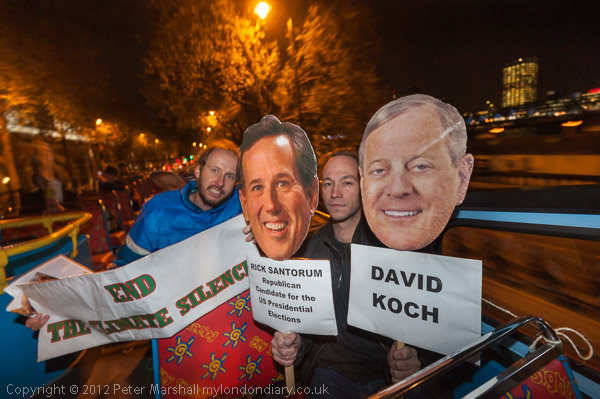
Stop Fossil Fuel Dirty Money takeover of US: The headline I wrote for the events of Wednesday 7th November 2012 could well have been written for this year’s US elections where Trump’s whole career in politics has been supported by fossil fuel companies.

Stop Fossil Fuel Dirty Money takeover of US - 2012

Huge lobbying by these companies and a deliberate campaign of misinformation and pseudoscience, financing studies which cast doubt or contradict the scientific consensus of global warming happening because of fossil fuel use has resulted in US governments not taking effective action against these polluters.

Stop Fossil Fuel Dirty Money takeover of US - 2012

According to the chairman of the U.S. Senate Budget Committee, the Republican Party is controlled by the fossil fuel industry and as well as huge subsidies also gets “the license to pollute for free.”

Stop Fossil Fuel Dirty Money takeover of US - 2012

Under the Democrats the US has finally taken some limited action with promises to phase out fossil fuel use but the government in 2022 still supplied around $15 billion a year in subsidies to the industry.

Stop Fossil Fuel Dirty Money takeover of US - 2012

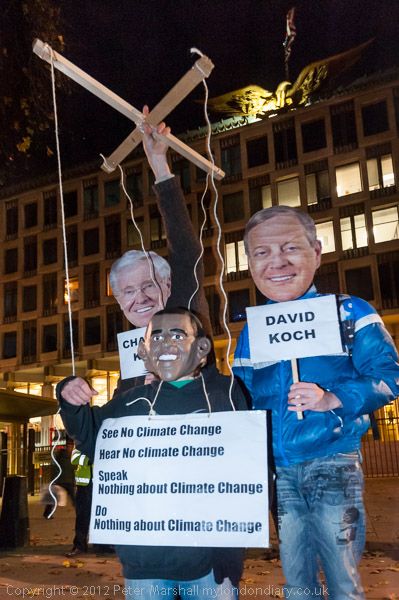
The protest in 2012 was calling on President Obama “to stand up against the lobbying, dirty money and media lies funded by the Koch brothers and other fossil fuel companies.” He didn’t.

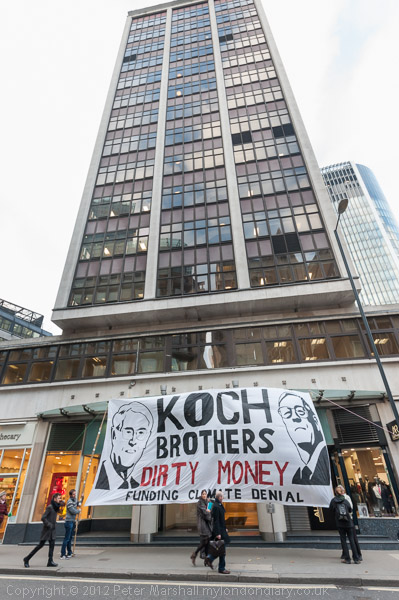
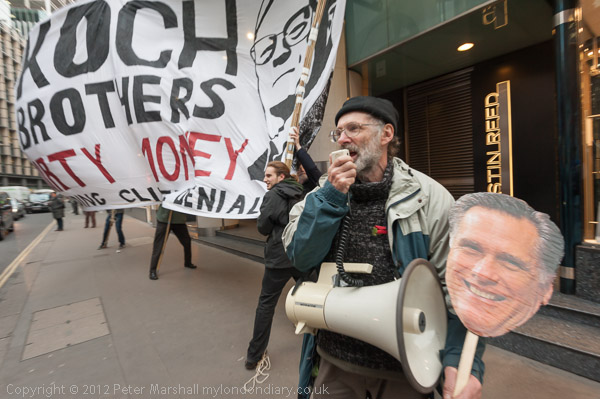
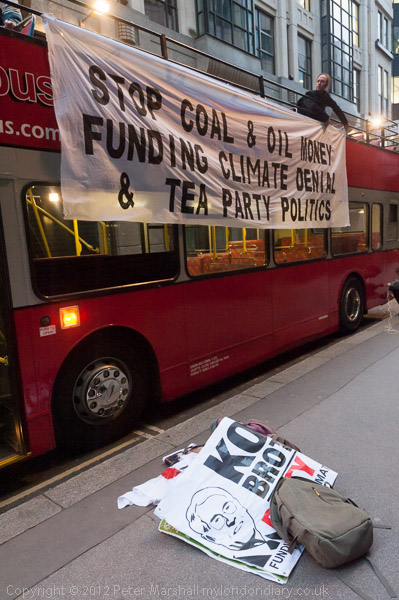
You can read more about the protest, which began outside the London offices of the Koch Brothers, Koch International in Fenchurch St at the heart of the City of London with a huge banner ‘KOCH BROTHERS – DIRTY MONEY – FUNDING CLIMATE DENIAL’ on My London Diary.

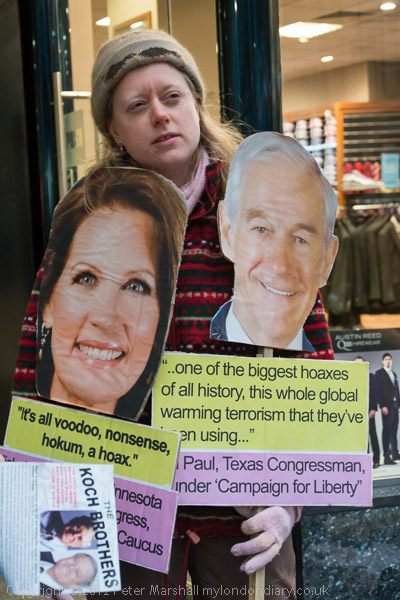
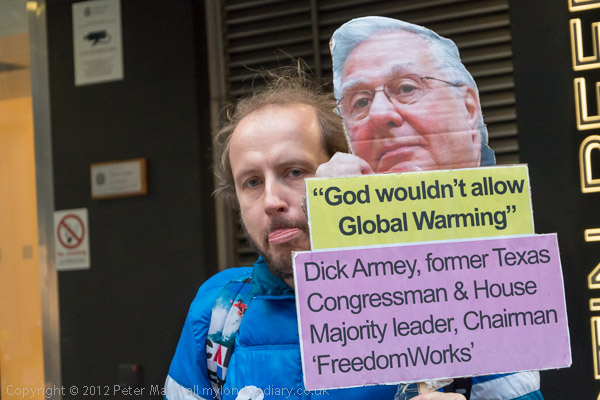
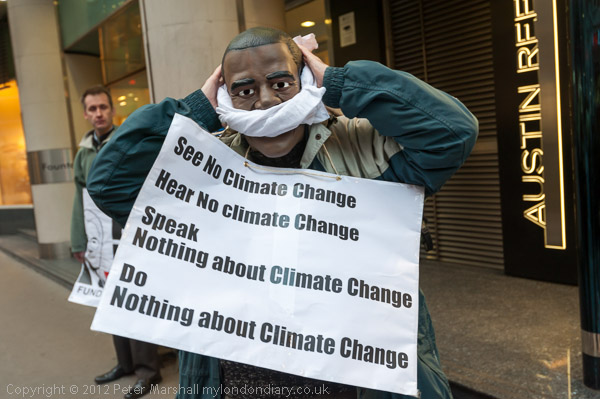
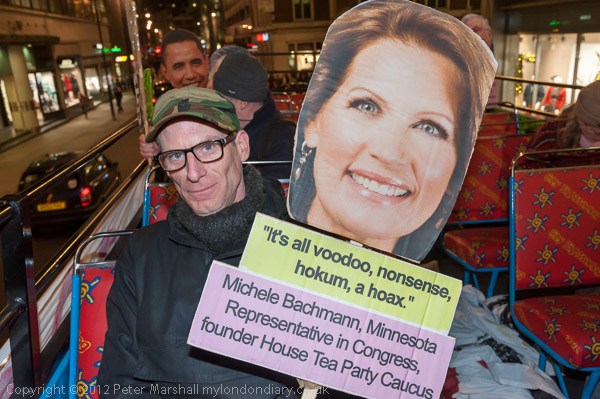
A high wind made it difficult to hold up the banner while the protest continued with speeches. But the big banner certainly attracted a great deal of attention, though soon they had to take it down as it became impossible to hold. But there were plenty of placards showing heads of prominent US right wing politicians and media commentators, each with their names and some ridiculous quotations related to climate change, as well as those of Obama and Romney and the two Koch brothers, along with some smaller banners.

There was another big banner of the side of the open-top bus which the Campaign Against Climate Change had hired to take the protesters to the US Embassy.

I went with them for what was probably the most uncomfortable bus journey of my life. It was cold in the strong icy wind and the bus bumped and lurched ridiculously.

It was hard to keep standing as I took pictures and I had to hold on with one hand all the time, using the other to take pictures. There wasn’t a great deal of light and getting sharp pictures at 1/30 f4 (full aperture for my wideangle zoom) was difficult with the bouncing and vibration of the bus.

Somehow I managed, and Phil Thornhill managed to to use the megaphone, at least during some of the halts in traffic. But I was very pleased (and very frozen) when we arrived and got off the bus in Grosvenor Square.

Police at Grosvenor Square tried to herd the protesters into a small pen in a dark corner, but they refused and were finally allowed to go in front of the locked main entrance gates, with those faces and their quotations peering over the hedge from the gardens behind the main actors and speakers.

More on My London Diary at Stop Fossil Fuel Dirty Money takeover of US.


FlickrFacebookMy London DiaryHull PhotosLea ValleyParis
London’s Industrial HeritageLondon Photos

All photographs on this page are copyright © Peter Marshall.
Contact me to buy prints or licence to reproduce.


Westminster & Waterloo November 1989

Westminster & Waterloo: I’m not sure now why I was in London on Wednesday November 1st 1989, but probably I had been to see an exhibition at the Photographers Gallery during my half-term holiday. I took a slightly longer walk than usual to get back to Waterloo from Soho through Trafalgar Square and then along to Waterloo Bridge and across it to get back to the station.

Trafalgar Square, Westminster, 1989 89-10j-65

Back in 1989 there were still people feeding the pigeons in Trafalgar Square and I made this rather atmospheric “contro-jour” image – not my usual kind of thing – I generally try to make pictures about substance rather than effect.

Trafalgar Square, Westminster, 1989 89-10j-66

My next frame was a little more like my normal work, though still making use of the backlit water in the fountains.

Royal Society of the Arts, John Adam St, Westminster, 1989 89-10j-56

Adelphi, the district south of Strand was developed by the Adams brothers (Robert and James), and the name is the Greek for brothers. The area here had been the London palace for the Bishop of Durham which had gardens going down the the River Thames and this was demolished for the new buildings. Financially the project was a disaster and they were only saved from bankruptcy by the Adam Buildings Act 1772 which enabled a public lottery to be run to save them.

The headquarters of the Royal Society of the Arts, then the Society for the Encouragement of Arts, Manufactures and Commerce, was built by the brothers between 1768 and 1772 and is said to be London’s first neoclassical building.

Adelphi Building, Robert St, Savoy Place, Westminster, 1989 89-10j-44

Parts of the area were demolished in the early 1930s for the building of the massive Art Deco New Adelphi Building by Collcutt & Hamp finished in 1938. A speculative office building it has since been occupied by a number of well-known companies. The Grade II listed building with sculptures by Gilbert Ledwood has been internally refurbished since I made this picture. There is a public right of way, Lower Robert Street, beneath the building.

Outpatients, Royal Waterloo Hospital for Children and Women, Waterloo Bridge, Stamford St, Waterloo, Lambeth, 1989 89-10j-35

I took a few more pictures in the area (not online) before making my way across Waterloo Bridge and onto Waterloo Road where I photographed the decoration on the former Outpatients Department of the Royal Waterloo Hospital for Children and Women.

This had been set up in the City of London in 1816 and was at the time one of very few hospitals that would treat children, though still only as outpatients. It gained the Royal in its title in 1821 when the Duke of York became a patron and moved to this new larger site three years later in 1824. The hospital was rebuilt to designs by Charles Nicholdson in 1903-5. It became part of the NHS in 1948 and closed in 1976.

In its later years it had a notorious psychiatric ‘Ward 5’ which carried out a number of highly dangerous treatments on its patients which led to deaths and other deleterious effects. On my 1990s map it is a part of King’s College.

St John's Waterloo, Waterloo Rd, Waterloo, Lambeth, 1989 89-10j-21
St John’s Waterloo, Waterloo Rd, Waterloo, Lambeth, 1989 89-10j-21

This fine building was built in the aftermath of the Napoleonic Wars when the population of London was expanding rapidly and the Houses of Parliament voted a sum not exceeding a million pounds for the building of new churches to serve areas with large populations “more particularly in the Metropolis and its Vicinity.”

It was one of three churches designed by Francis Octavius Bedford in this project, and they were all built in what was then becoming an unfashionable Greek Revival style, completed in 1824.

St John's Waterloo, Waterloo Rd, Waterloo, Lambeth, 1989 89-10j-23
St John’s Waterloo, Waterloo Rd, Waterloo, Lambeth, 1989 89-10j-23

The church was badly damaged in the Second World War in 1940, and stood without a roof and with much of the interior destroyed for almost ten years, with services taking place in the crypt. It was restored in 1950 with its interior in a ‘Festival of Britain’ style though some original parts remain, and was rededicated as the Festival of Britain Church. It is Grade II* listed.

I went across the road to Waterloo Station in time to catch my train home.


FlickrFacebookMy London DiaryHull PhotosLea ValleyParis
London’s Industrial HeritageLondon Photos

All photographs on this page are copyright © Peter Marshall.
Contact me to buy prints or licence to reproduce.


HP, Poor Doors & Anonymous 2014

HP, Poor Doors & Anonymous: On Wednesday 5th November 2014 Guy Fawkes was obviously on our minds, and from a protest against HP’s support of the Israeli army and prisons I went on to a protest where a guy with a Boris Johnson mask was burnt and then joined Anonymous with their march on Parliament.


Boycott Hewlett Packard – Sustainable Brands – Lancaster London Hotel

HP, Poor Doors & Anonymous

Hewlett Packard, now known as HP, though that’s still a name that makes me think of brown sauce in bottles with a picture of the Houses of Parliament, were the sponsors of the Sustainable Brands conference taking place at the Lancaster London Hotel at Lancaster Gate.

Protesters from Inminds came there to protest against the company’s role in IT support for Israeli forces who had killed 521 Palestinian children in the then recent attack on Gaza, as well as in running the Israeli prison system. They handed out fliers to those going in and out of the hotel and others spoke about the HP’s deep involvement in Israeli war crimes and persecution of Palestinians.

They point out that young Palestinian boys as well as other prisoners have been kept for long periods in solitary confinement and tortured in Israeli prisons supported by HP. Many older Palestinian men and women are also locked up in ‘administrative confinement’ without any proper charges or trial, often being released and then immediately being confined again in what amounts to infinite imprisonment.

More at Boycott Hewlett Packard – Sustainable Brands.

[HP Sauce is definitely a long-lived brand, having got its name in 1895, five years after it was first produced in Nottingham as ‘The Banquet Sauce’, though in 1988 like most things British it was sold off to foreigners. Currently it is owned by Heinz and made in the Netherlands and still tastes much the same. ]


Poor Doors Guy Fawkes Burn Boris – One Commercial St, Aldgate

HP, Poor Doors & Anonymous

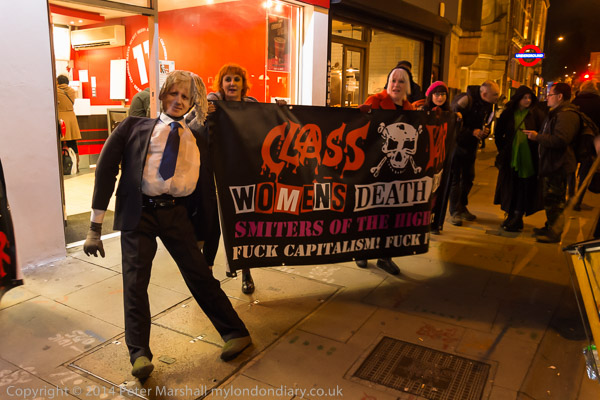
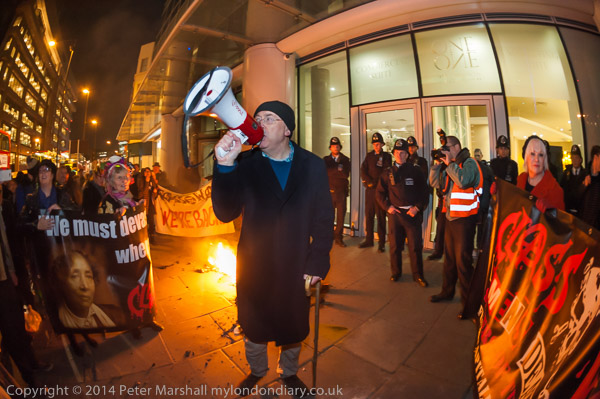
I met Class War in a nearby pub before they marched to yet another of their weekly protests against the ‘social apartheid’ in this large block with a plush foyer and concierge for the ‘luxury’ flats for the wealthy and a bleak side entrance down an alley for the poor in social housing in the same building.

HP, Poor Doors & Anonymous

They had with them two effigies of Boris Johnson, one a BJ placard, one hand holding a bottle of ‘Boris Bolly’ and the other fanning out a wad of notes, and a life-size ‘guy’ in a suit and tie with a Boris facemask and a mop as hair, who was dragged along the the protest holding one end of the Class War Womens Death Squad banner.

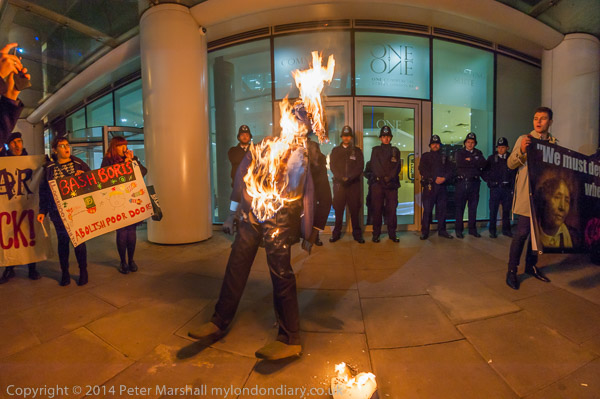
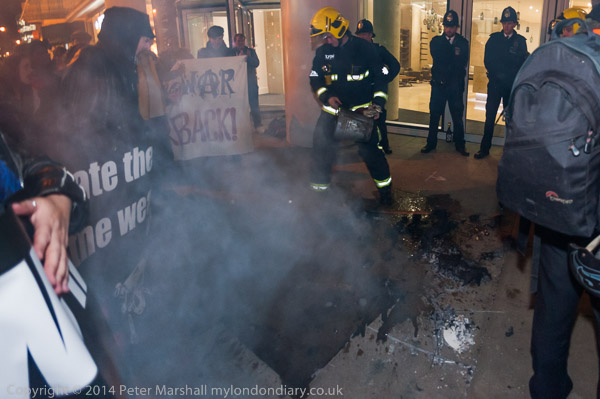
Class War had brought along sparklers for the protest, and at some point the inevitable happened and ‘Boris’ was set alight, eventually burning to a small heap of burning material in the middle of the wide pavement. As you can see in the picture there was plenty of space around so no-one was in any danger.

The police called the Fire Brigade, who when they arrived, looked, laughed and walked away. But police insisted they deal with the fire. It took one fireman and one bucket of water.

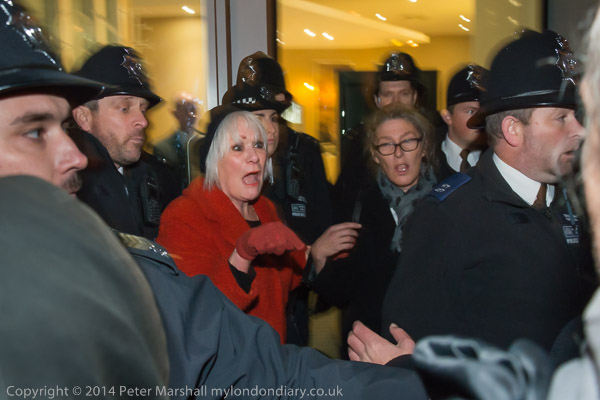
After the fire was put out, police grabbed Jane Nicholl and told her she was being arrested for having set light to the guy.

A large crowd surrounded her and the police, calling on them to release her, but eventually they managed to take her and put her in the back of a van, which was then surrounded by people.

More police arrived and there were flashing blue lights everywhere, as police tried to clear a path for the van. Eventually police managed to drive away.

They then grabbed another of the protesters, handcuffed him and carried him away, though I think he was later released without charge. The CPS had agreed that burning the effigy was legitimate freedom of expression but Jane was charged with lighting a fire on or over a highway so a person using the highway was injured or endangered. But the CPS were unable to produce any evidence that burning Boris ‘injured, interrupted or endangered’ any passerby – it clearly hadn’t – and the case was dismissed.

Many more pictures at Poor Doors Guy Fawkes burn Boris


Guy Fawkes ‘Anonymous’ Million Mask March – Parliament Square

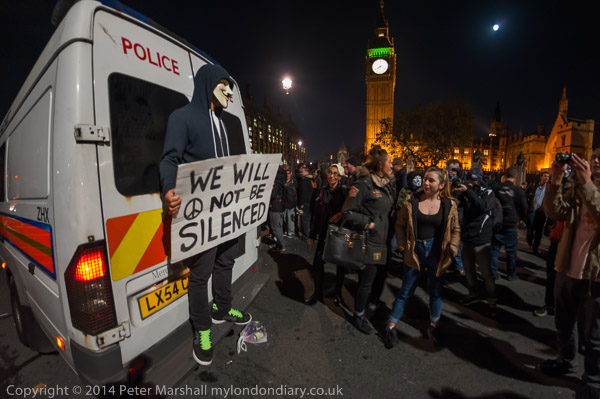
Hundreds had met in Trafalgar Square for the world wide Million Mask March against austerity, the corporate takeover of government and the abuse of power, but by the time I arrived from Aldgate had marched down to Parliament Square. Some were on the ground under a police van with another standing on its read bumper with a placard.

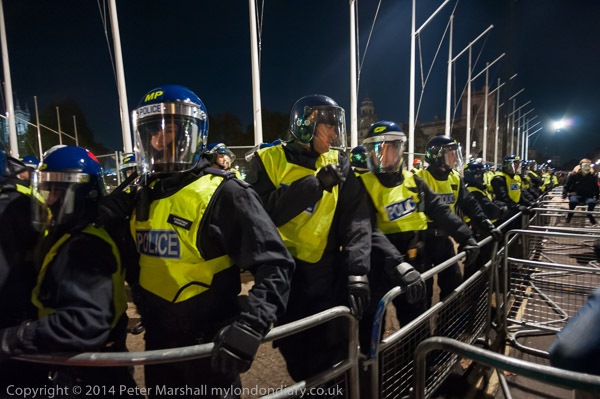
Here there were a mass of barriers and large groups of riot police threatening the protesters, who called on them to put their batons away and join their Guy Fawkes party without success.

Many of the protesters wore ‘Anonymous’ masks but there were relatively few with placards and nobody seemed to have much idea about what they should do. They stood around, then marched around the square a bit before some decided to march to Buckingham Palace where I learned later that things did get a bit more lively. But I’d had enough by then and had gone home.

Guy Fawkes ‘Anonymous’ Million Mask March


FlickrFacebookMy London DiaryHull PhotosLea ValleyParis
London’s Industrial HeritageLondon Photos

All photographs on this page are copyright © Peter Marshall.
Contact me to buy prints or licence to reproduce.


Students March for Free Education – 2015

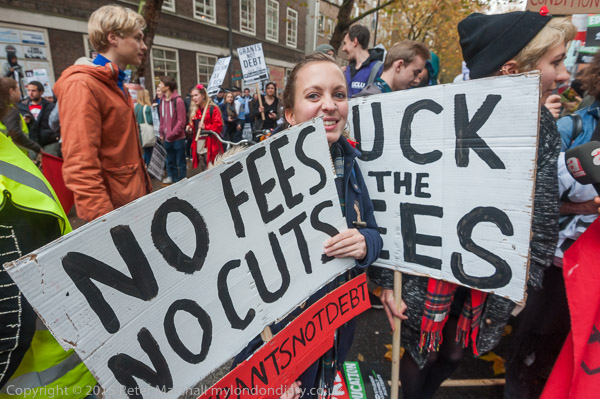
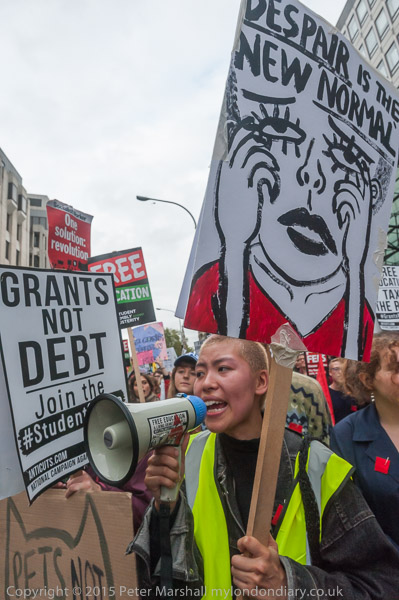
Students March for Free Education. On Wednesday 4th November 2015 students, led by the National Campaign Against Fees and Cuts (NCAFC) marched through central London against the abolition of maintenance grants calling for free education without fees and huge student debts and an end to turning higher education into a market system impoverishing staff and students.

Students March for Free Education - 2015

Back in the distant past when I was a student, UK students paid no tuition fees at UK universities and I got a grant of around £300 a year which was then just about enough to pay my living expenses, at least for the three terms I was away from each year, paid by my local authority.

Students March for Free Education - 2015

Because my family income was low, I got a full grant, while some of my friends from wealthier families got lower grants and had to rely on their parents to give them a ‘parental contribution’ – and not all did, though some others were more than generous.

Students March for Free Education - 2015

More recently, my two sons also benefited from maintenance grants and no fees, my younger son just squeezing into the final year before student fees came in. By then my salary as a teacher – our sole household income at the time – meant we were assessed to make a small parental contribution to his maintenance.

Students March for Free Education - 2015

Since then things have got a lot tougher for students, with loans for both tuition fees and their living expenses. New Labour brought in tuition fees in 1998, means-tested at £1000 per year, then tightened the screw in 2004 when they tripled to £3000 and poorer families now had to pay the full amount.

In 2012 the Tory-led coalition tripled the fee yet again, setting a maximum of £9000 – and I think all universities charged more or less that maximum. Currently they are frozen after being rasied to £9250 in 2017, but are expected to rise with inflation from 2025 if no further changes are made. For a few years in opposition Labour promised to remove tuition fees, but that promise seems to have been quickly forgotten after Starmer became leader.

It was Thatcher who first introduced student loans for maintenance but these were in addition to maintenance grants for those who did not get full grants. It was again New Labour in 1998 that abolished maintenance grants for all but the poorest students – and these went in 2016.

Student loans have operated under several systems since 1990, with the first major change taking place in 1998 and the next in 2012, when the first Income-Contingent Repayment Plan 1 was introduced. Students this year are on the 5th version of this, with a new version for those starting in 2023.

Martin Lewis summarises the 1923 changes in a clear graphic. Students who started in 2023 pay 9% of their income when they earn over £25,000 a year and keep paying for 40 years after they left university. Inflation-linked interest is added to the amount on loan, typically now around £60,000 for a three-year course.

Most students now also have to supplement their income with part time jobs, as estimates for the income needed to take a full part in three years of university life together with tuition fees come to more than £80,000. It’s a far cry from back when I was at university when students taking paid work during term-time was frowned upon or prohibited by the university authorities.

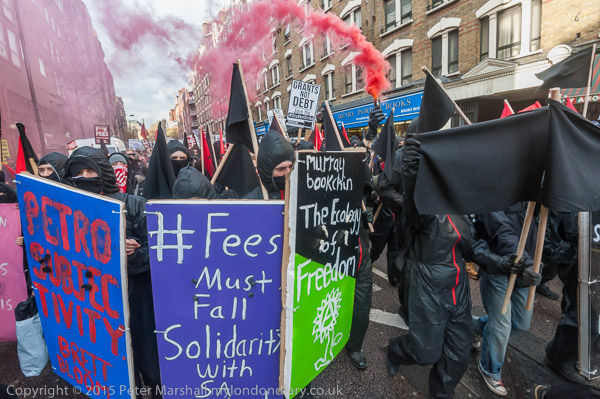
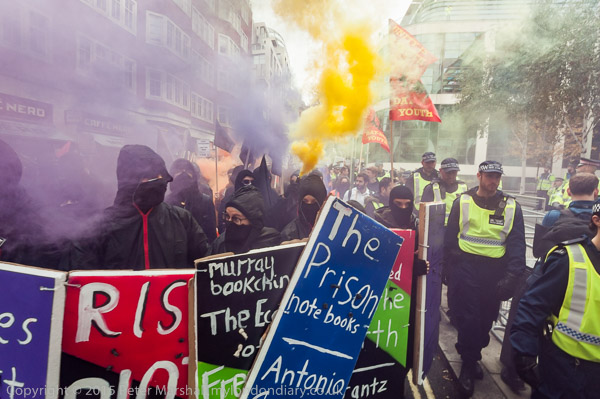
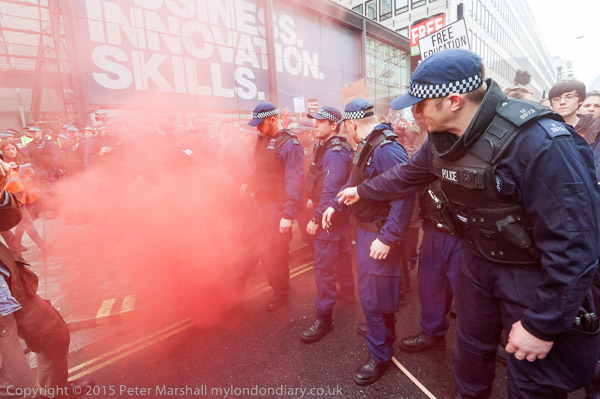
The 2015 protest formed up at Malet Street outside what had until 2013 been the University of London Union where there were speeched, then marched to Parliament Square . From there it went on the Home Office and Dept of Business, Innovation & Skills and became more chaotic, with a black bloc of students took over and police rather fragmented the march.

You can read about it and see many more pictures – and also of the celebration going on in Parliament Square following the release of the last British resident, Shaker Aamer from Guantanamo on My London Diary.

Free Education – No Barriers, Borders or Business
Students at Home Office and BIS
‘Welcome Home Shaker’ celebration


FlickrFacebookMy London DiaryHull PhotosLea ValleyParis
London’s Industrial HeritageLondon Photos

All photographs on this page are copyright © Peter Marshall.
Contact me to buy prints or licence to reproduce.


Bash The Rich & Diwali – 2007

Bash The Rich & Diwali: On Saturday 3rd November 2007 I photographed Class War attempting to march to David Cameron’s house in Notting Hill before going to Alperton for the Brent Diwali Parade. Here I’ll use – with some slight changes and some comments – what I wrote in 2007 about these events on My London Diary.


Bash The Rich – Class War – Notting Hill

Bash The Rich & Diwali - 2007
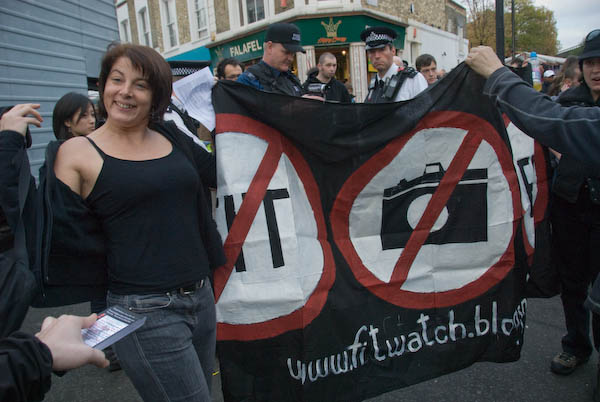
Fitwatch get between the police FIT team photographer and the event

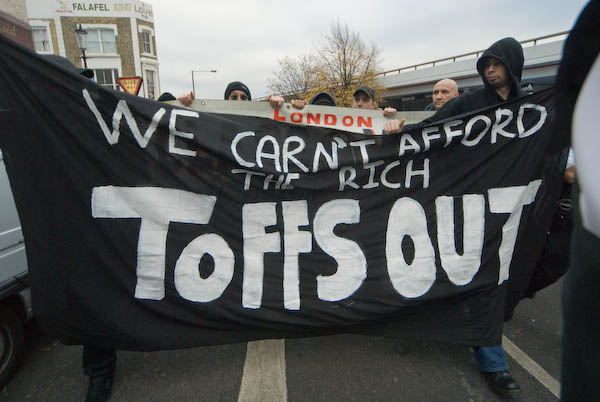
Bash the Rich‘ is probably still a popular slogan [and the title of a highly readable memoir by Ian Bone, subtitled ‘The true-life confessions of an anarchist’ still available], but the anarchist demonstration in Notting Hill which marched to Tory leader David Cameron’s house on Saturday attracted only around a hundred supporters (I think quite a few decided they would rather stay in the pub.)

Bash The Rich & Diwali - 2007

The were watched, harassed and escorted by a similar number of police, with the inevitable police photographer to goad FitWatch into action.

Bash The Rich & Diwali - 2007
Ian Bone

The police did allow the march to take place, if with a number of fits and starts, holding it for no apparent reason at various places, and it went along Oxford Gardens until it reached the junction with Wallingford Avenue, apparently withing shouting distance of Cameron’s home, although the Tory leader was sensibly miles away for the weekend.

Bash The Rich & Diwali - 2007

There were a number of minor clashes between demonstrators and police, with three arrests being made, although I understand all were later released without charge.

Some of the friction was caused by a little over-keen encouragement of the marchers to move when the police wanted them to move – and I too was pushed on numerous occasions, and stopped from leaving the march for some time after I went inside the cordon.

Some of the police were also treated to considerable abuse, but most retained their good humour – as did most of the marchers.

Earlier, some had taken a walk around the area following Tom Vague‘s truly fascinating ‘Bash the Rich Class War Radical History Tour of Notting Hill‘ which had been published online by Indymedia UK as the souvenir programme for the event.

[Tom Vague is “writer and editor of the post-punk fanzine Vague as well as numerous publications on situationists, psychogeography and West London radical history.” Among these is ‘LondonPsychogeography – Rachman Riots and Rillington Place‘, described “almost as the autobiography of Nothing Hill with him as the inspired mouthpiece, his own biography mixed with that of the subject. He is the place.”

Somewhere I still have my copy of the programme, but it is still online if you sign up for 30 days free to ‘Your Media Publisher’publisher Yumpu where a number of Indymedia ePapers including this can be downloaded. It is no longer available in the Indymedia UK archive.

I left before a final rally at the end of the march to go to Alperton. ]

More pictures at Bash the Rich.


Brent Diwali Parade – Alperton

Diwali. the festival of lights, is one of the main events in the Hindu calendar and thousands of people come to watch and take part in the parade and festivities in Brent.

I arrived in time to watch some of the preparations and stayed for the start of the parade,

But then went home to watch the fireworks rather than waiting to see those in Barham Park.

[Brent is the UK’s most diverse borough by country of birth, with just over half of its residents born abroad, including many in India and other Asian countries, the Caribbean, Africa, Ireland and Eastern European countries. Until cuts in local government funding by the Tory-led government after 2010 the council funded a number of festivals including Diwali to bring communities together.

In the 2011 census almost 18% of the population of Brent identified themselves as Hindu, but many from the other communites came to join in and watch the Diwali events.]

More pictures at Brent Diwali Parade


FlickrFacebookMy London DiaryHull PhotosLea ValleyParis
London’s Industrial HeritageLondon Photos

All photographs on this page are copyright © Peter Marshall.
Contact me to buy prints or licence to reproduce.

March & Rally Against Custody Deaths – 2024

March & Rally Against Custody Deaths: The march in London on Saturday 26th October 2024 by the United Families and Friends Campaign (UFFC) was the 25th annual remembrance of the thousands who have died after being arrested by police or held in prisons, secure mental health and immigration detention in suspicious circumstances.

UFFC March & Rally Against Custody Deaths - 2024

The exact number of these deaths is not known, but is clearly very much larger than any official statistics. At some earlier of these events people have carried a list with well over 2000 names from the last 40 or so years.

Just a few of these cases have become well-known, both through continuing protests by the families and friends of those who have been killed and in a few cases also through inquests and prosecutions. But prosecutions have been rare and convictions non-existent even where the evidence has seemed clear.

UFFC March & Rally Against Custody Deaths - 2024
Marcia Rigg holds Keir Starmer’s 1988 booklet ‘The right to life’.

Most have involved physically fit young men, usually in their 20s, who have been arrested by police. People from all communities but with young black men being over-represented, but there are also those of Asian heritage, white British and all others, women, older people. Almost all from the poorer parts of our society.

UFFC March & Rally Against Custody Deaths - 2024

Attempts by the families to get information about the deaths have often been obstructed by police and official investigations into what happened have often been at best cursory, often more concerned with covering up than investigating. Despite the huge number of deaths there have been no convictions, no cases where families have felt they have received justice. And one of the most common chants is ‘No Justice, No Peace!’

UFFC March & Rally Against Custody Deaths - 2024

Few of these cases receive more than a short paragraph in a local newspaper, and where they do get more coverage it is largely due to the persistence of the families in finding the evidence, campaigning and presentations to inquests – often deliberately delayed for many years by the authorities.

One of these is of course the case of Sean Rigg, killed by Brixton Police in 2008. At his inquest four years later, despite several police officers committing perjury, the jury concluded the police “more than minimally” contributed to his death – and were highly critical of the restraint that killed him. Eventually one officer was charged with perjury but acquitted by the jury despite the evidence. His family, particularly his sister Marcia Rigg, continue to fight for justice.

This annual march and rally has usually been completely ignored by the mainstream press – though journalists including myself have covered it. This year there was rather more interest than usual following the ‘not-guilty’ verdict on the police officer who shot Chris Kaba in the head at close range.

On Saturday The Guardian misreported this event in a single sentence in an article on page 6 about Robinson’s arrest: “the United Families and Friends Campaign is planning a protest in Trafalgar Square against the acquittal this week of the firearms officer who shot Chris Kaba dead.”

Justice for Chris Kaba campaigner.

The UFFC wasn’t. It had planned its usual annual commemoration and protest over the many thousands of custody deaths, though supporters of Chris Kaba’s family took part in it, and one of them spoke breifly at the start and at the rally in Whitehall where there were also a number of speakers from other family campaigns.

Trafalgar Square – or rather its southern edge – was only the start of the march, which was to a rally in Whitehall. Normally this would have taken place at the entrance to Downing Street, but this year there was a police barricade some distance before this, and instead the rally took place in front of the Cabinet Office.

The interest aroused by the Kaba shooting did make for a larger protest than in previous years and it was augmented too by some people who had arrived early for the Stand Up to Racism rally. Several thousand filled out across the street to listen to the families speaking.

As usual a small delegation from the event were to deliver a letter to the Prime Minister at Downing Street, though in some years they have been refused entry by the police. They too were prevented by the police barricade, but later I heard that police had helped them deliver it. But as well as the letter, the envelope contained a copy of the 1998 booklet by Keir Starmer, ‘The Right To Life’ in which he had written “When citizens die at the hands of the police, or make serious allegation of torture in police custody, the reaction of the state raises very serious questions about the protection of human rights.”

Justice for Chris Kaba campaigners and Qian Zheng, partner of late Benjamin Zephaniah raise fists,

You can listen to one of the speeches from the rally, by Temi Mwale, founder of the 4Front Project, in which she quotes from that booklet in a video on the Real Media site.

The letter which was delivered to Keir Starmer also contains that quote from the his booklet, before some details of some cases and a listing of the five demands of the UFFC campaign:

As bereaved families, we demand:

  1. An end to all killings at the hands of the state.
    An end to all racist police practice and an end to fatal use of force.
  2. A radical reduction in the use of prisons. People are unnecessarily dying, as prisons
    do not address underlying causes of social harm.
  3. The individuals and state bodies responsible for deaths are pro-accountability for
    their wrong-doings, and an end to all cover ups.
  4. Legal Aid is made available to all families, automatically.

More pictures from the 2024 UFFC Annual March & Rally Against Custody Deaths


FlickrFacebookMy London DiaryHull PhotosLea ValleyParis
London’s Industrial HeritageLondon Photos

All photographs on this page are copyright © Peter Marshall.
Contact me to buy prints or licence to reproduce.

March Against Far Right Hate, London, 26 Oct 2024

March Against Far Right Hate: Last Saturday, 26th October 2024 I joined thousands of others marching ine London in response to a far-right march called by ‘Tommy Robinson’ under the title ‘Unite the Kingdom’.

March Against Far Right Hate

Police had imposed conditions on both marches, ensuring that they kept a long way apart and there was very little trouble, with only four arrests at the Robinson march and two at the Stand Up to Racism event.

Organisers of the counter-protest say that 20,000 came to march and the Robinson march was reported to be a little smaller. But certainly the large turnout for the Stand Up to Racism event showed that the kingdom was not united behind the far-right racists.

March Against Far Right Hate

One person significantly not present at the racist march was the anti-immigrant and anti-Muslim activist Stephen Yaxley-Lennon, generally known as ‘Tommy Robinson’, who was remanded in custody the previous day to attend Woolwich crown court on Monday for his alleged breach of a 2021 high court order barring him from repeating libellous allegations against a Syrian refugee. He was also separately charged for a mobile phone offence under schedule 7 of the Terrorism Act 2000.

March Against Far Right Hate

Police restricted Stand Up to Racism for meeting on Regent Street and Piccadilly Circus, while Robinson’s protest had to muster at Victoria around a mile and a quarter to the south though rather more on the ground.

March Against Far Right Hate

The far right were marching to a rally in Parliament Square, while Stand Up to Racism’s rally was at the north end of Whitehall, with around 400 metres of blocked off road between the two.

I spent around 45 minutes photographing at Piccadilly Circus before walking down to Trafalgar Square for another event, catching up with the march later on Cockspur Street roughly halfway on its short march to the rally.

As the band of logos along the bottom of the main banner indicate the the Stand Up to Racism protest was supported by a huge range of organisation is including almost every trade union as well as groups who work with refugees and asylum seekers and there were many trade union banners carried on the march.

As well as the mass-produced placards from the organisers, many on the march had come with their own, and my photographs include some of those I fondud more interesting.

Some of the banners including those from the Latin-American and Jewish Bloc also indicated their support for Palestine, and there were quite a few others on the march with Palestinian flags. Tommy Robinson has also made clear his support for the genocidal actions of the Israeli State as a part of his anti-Muslim stance.

I stayed in Trafalgar Square as the march went by, mainly to see all of the marchers, or at least a good proportion of them in the crowds going past so I could pick out those who seemed more interesting to photograph, either from the side or by rushing into the crowd. But also because this seemed the most likely place where some might try to divert from the approved route and try to reach the racist rally.

And at the very end of the march a large group behind a black banner ‘NO TO TOMMY ROBINSON – NO TO FASCISM’ paused and then made what seemed to be a rather half-hearted attempt to do just that, but were easily held by a thin line of police at the entrance to The Mall. Only a small group at the centre of the banner seemed to be making any real effort to push through the police and those at the end where I was standing just stood holding the banner – and the crowd behind was standing watching and not joining in.

A stand-off ensued, but after some minutes a small police snatch squad came and pushed one of the protesters past or rather through where I was standing, pushing me forcefully to the side. I managed to recover and take a few pictures as he was thrown to the ground and handcuffed. But I don’t know why they had decided to arrest this man.

I took a few pictures after this, but decided not to go through the packed crowds towards the stage and photograph the rally now taking place but took the tube from Charing Cross to begin my journey home.

These pictures are some of those I filed with Alamy and you can see my set of over 40 pictures their or at Stand Up To Racism March Against Far Right Hate on Facebook.


FlickrFacebookMy London DiaryHull PhotosLea ValleyParis
London’s Industrial HeritageLondon Photos

All photographs on this page are copyright © Peter Marshall.
Contact me to buy prints or licence to reproduce.

Defend Our Juries – 24 Oct 2024

Defend Our Juries Free Political Prisoners: A week ago I went to photograph an unusual protest which took the form of an exhibition, the Free Political Prisoners Exhibition.

Defend Our Juries Free Political Prisoners
London, UK. 24 Oct 24. Marchers with pictures of political prisoners and other banners and posters arrive at the Attorney General’s office at the Ministry of Justice to call on him to free the 40 UK political prisoners jailed for protesting peacefully against fossil fuel and Israeli arms companies. They demand an end to judges stopping defendants explaining the motive for their protests and uphold the right of jurors to make decisions based on their conscience. Peter Marshall

https://www.facebook.com/media/set/?set=a.10169134705895467&type=3

The protest was organised by Defend Our Juries, a group set up following recent trials in which juries have been prevented from hearing the defences of those on trial and have been directed by judges that they cannot follow their consciences in coming to their verdict.

Defend Our Juries Free Political Prisoners

Here is a part of what was on the leaflet that they handed out during the exhibition. You can find more about the campaign on their web site.


Why do juries need defending

Juries put the moral sense of ordinary people into the heart of the criminal justice system. In recent years, juries have repeatedly acquitted those taking nonviolent direct action to advance climate, racial, and animal justice. These verdicts are deeply embarassing to the goverment and the arms and oil industries, industry lobbyists such as Lord Walney have promoted extraordinary measures to try and stop them.

People on trial have been banned from using the words ‘climate change’ or ‘fuel poverty’ in court and have even been jailed just for defying that ban,

Usual legal defences have been removed by seemingly biased jusges. People have been arrested and prosecuted for displaying the centuries-old principle of jury equite – juries can find a person on trial not guilty as a matter of conscience, regardless of what the judge directs.


Defend Our Juries Free Political Prisoners

They had come to the Justice Ministry to protest outside the office of Attorney General Richard Hermer KC to ask him to agree to Chris Packham’s and Dale Vince’s request for an open and transparent public meeting to discuss the measures necessary to restore the fundamental rights to protest and fair trial essential to a functioning democracy, as called for by the United Nations.

Defend Our Juries Free Political Prisoners
A marcher holds a picture of Roger Hallam in the exhibition outside the Attorney General’s office

As well as some of the UK’s current political prisons including those from Just Stop Oil and Palestine Action currently serving long prison sentences for non-violent direct action the posters in the show featured many other political prisoner from around the world and throughout history such as Emmeline Pankhurst and Martin Luther King Jr “peaceful change-makers [who] should be celebrated as essential to upholding democracy.”

Reverend Billy of the NY Church of Earthalujah sits with pictures of political prisoners.

Among those taking part in the protest were William Talen, better known as the Reverend Billy, and members of his Stop Shopping Choir from New York, currently on a UK tour who I was pleased to meet again having photographed him at various protests in London in earlier years.

More pictures on Facebook


FlickrFacebookMy London DiaryHull PhotosLea ValleyParis
London’s Industrial HeritageLondon Photos

All photographs on this page are copyright © Peter Marshall.
Contact me to buy prints or licence to reproduce.

A Short Walk in Tottenham

A Short Walk in Tottenham: My next London walk came on Friday October 27th 1989 when I rushed to jump on a train after finishing a morning of teaching and then took the Victoria Line to Tottenham Hale, arriving around 2pm. I’d managed to arrange my teaching timetable by including an evening class so that I finished on Fridays at noon but this was the last time it would be worth travelling to London to take photographs before the clocks went back to GMT at the weekend.

The Hale, Tottenham Hale, Haringey, 1989 89-10i-42

The first two pictures I made were both of this scene, a strangely blank building with signs on it which informed it it was the home of ‘Garbi Ltd‘ and ‘Short Stories of London‘, both manufacturers of men’s wear. Perhaps ‘Short Stories of London’ might be a good title for a book of my pictures one day.

Despite considerably redevelopment in the area I think this building is still there at No 33, thought with a rebuilt frontage and still in the clothing trade though now wholesale and retail sales, open to the public. It became Soniez House and more recently since around 2011 Morelli with two large ground floor windows and a wide glass door, but retaining the first floor windows in my picture.

I think the traffic flow in this area has altered and there are no longer the traffic signs I made use of – although the tree which it amused me to use with them as a framing device is I think still in place.

Mountford House, Tottenham Green East, Tottenham, Haringey, 1989 89-10i-43

I walked west from The Hale to Tottenham Green East, just off the High Road, opposite the Council Offices. Mountford House, a late 18th or early 19th century Grade II listed pair of houses, was then in use as offices for Haringey Health Authority, but is now private flats on the road at the edge of the small open space.
Mountford House, Tottenham Green East, Tottenham, Haringey, 1989 89-10i-45

This is a later extension to Mountford House and it doesn’t appear to be included in the rather strange listing text which calls this “Pair of houses in north east part of Prince of Wales’s General Hospital grounds.” Whatever its date I think it was nicely done an complements the simpler porch to the northern of the two houses.

Main Entrance, Prince of Wales Hospital, Tottenham Green East, Tottenham, Haringey, 1989 89-10i-44

And this is that Prince of Wales Hospital, then surrounded by a solid fence over which I could see some broken windows and its Fleur-de-Lys symbol with the motto ‘Ich Dien’ around the crown, the Prince of Wales’s badge and coat of arms. The motto, ‘I serve’, was perhaps more suitable for a hospital than for many of the Princes, who got up to some very odd things.

According to the Lost Hospitals of London, the hospital had started in 1867 as the Evangelical Protestant Deaconesses’ Institution and Training Hospital in a converted cottage and moved into a house on this site in 1861. It got a new building in 1881 and was extended in 1887, becoming Tottenham Hospital in 1899 and after another extension the Prince of Wales General Hospital in 1907. It closed in 1983 and was converted to flats in 1993 as Deaconess Court.

Tottenham High Cross, High Rd, Tottenham, Haringey 1989 89-10i-31

This brick cross erected around 1600 replaced a wooden cross first recorded in 1409. In 1809 the plain brick cross was covered in stucco and the Gothic style ornamentation in my picture. The Grade II listed cross is still present but has been moved a little to fit in with new road layout since I photographed it.

Behind it is the fine Estate Office of George Ellis on the corner of Rawlinson Terrace, sadly rather defaced around ten years ago. The terrace itself with its crenellated parapet replaced ‘Turner’s House’ lived in by a vet called Turner with his brother, a farrier in the yard next door. When a horse ridden by a ‘gentleman from Stamford Hill‘ slipped and broke its leg outside the vet set it and the horse’s owner was so impressed he gave the horse to the vet on condition that he did not part with it. And he didn’t, even after its death, when he “fixed the skeleton by means of iron supports, and placed it over the farrier’s shop, where it served the purpose of an advertisement for the veterinary surgeon as well as for the farrier.”

The house was demolished and replaced by Rawlinson Terrace in 1881, named after Emma Rawlinson, the wife of the builder James Stringfellow. The horse’s skeleton was then for some years displayed on top of an undertakers on the opposite side of the road.

Ritzy, Venue, High Rd, Tottenham, Haringey  1989 89-10i-22
Ritzy, Venue, High Rd, Tottenham, Haringey 1989 89-10i-22

Built as a roller skating rink designed by architect Ewen S. Barr in 1910, it included an electric theatre, but the roller skating craze slumped quickly and the whole building opened as the Canadian Rink Cinema in 1911. It was converted into a dance hall, the Tottenham Palais, and later when owned by Mecca Dancing Ltd, The Tottenham Royal.

When I took this picture it was the Ritzy, ‘A Perfect Place for a Great Night Out’, but it had a whole string of names including the Mayfair Suite, the Aztec Temple, Club U N, and the Zone before being demolished around 2004.

The Old Well, Philip Lane, High Rd, Tottenham, Haringey  1989 89-10i-24
The Old Well, Philip Lane, High Rd, Tottenham, Haringey 1989 89-10i-24

The Lord of the Manor who lived in Bruce Castle had this well dug in 1791 and it was used by locals until 1883 when it was found to be polluted, which was rather a shame as they had added the current structure over it only seven years earlier. It was restored in 1953 to commemorate the coronation of Elizabeth II.

Behind the well the High Cross Infants School, later called Holy Trinity School, dates from 1847, one of the schools linked to the National Society for Promoting Religious Education established to provide a Church of England elementary education for poor children who paid two pence a week (later raised to three) ‘School Pence’ to attend. Condemned in 1924 it survived to be Grade II listed in 1974 and so remains there to this day.

Time was getting on and I walked the short distance down the High Road to Seven Sisters Underground Station to start my journey and get home in time for dinner.


FlickrFacebookMy London DiaryHull PhotosLea ValleyParis
London’s Industrial HeritageLondon Photos

All photographs on this page are copyright © Peter Marshall.
Contact me to buy prints or licence to reproduce.