Central Hill and more

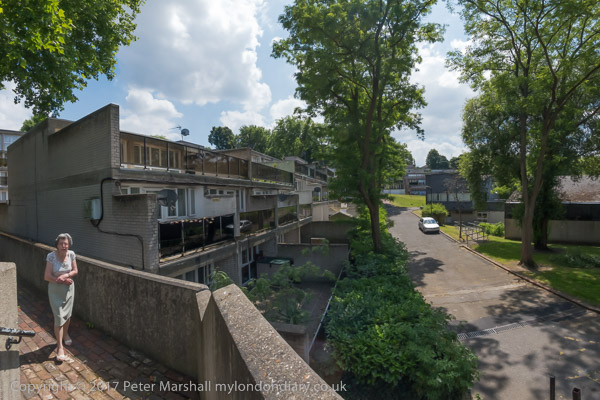
One of the original tenants comes to talk with me She tells me she dreads having to move

I began work on Sunday 18th June 2017 on the Central Hill Estate at the south-east tip of Lambeth, built on a hill with splendid views towards central London. Across the road (also Central Hill) at the top is Norwood in LB Croydon, a few yards down from the estate takes you in to the LB of Southwark, while 5 minutes walk east brings you to Crystal Palace in the LB of Bromley.
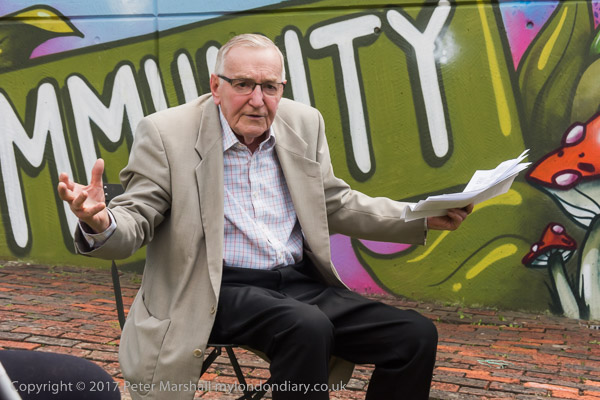
As Ted Knight, the leader of Lambeth Council from 1978 until disqualified for refusing to cap rates in 1985 and demonised by the press as ‘Red Ted’, told us later in the morning when he came to express his support, the estate was designed and built in 1967-74 when Labour believed that “nothing was too good for the working people” and the estate was built to high specifications and is still in sound condition. Borough Architect Ted Hollamby had earlier brought in Rosemary Stjernstedt from the LCC where she was their first senior woman architect, and she was the team leader, working with structural engineer Ted Happold from Arup & Partners and architect Roger Westman.
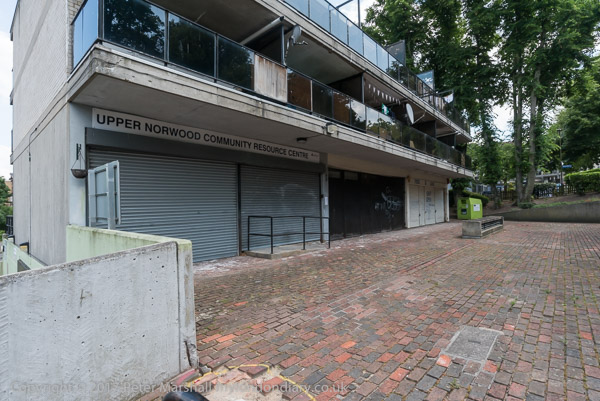
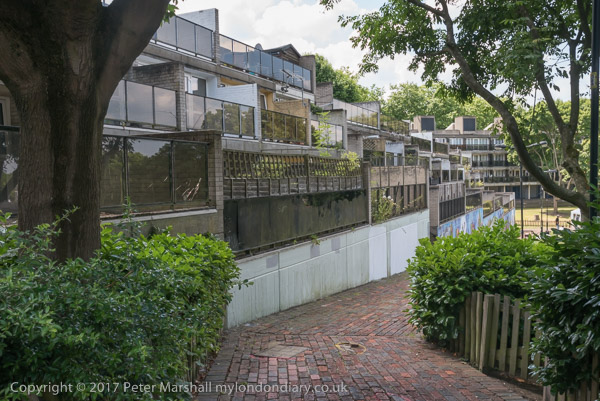
The scheme was seen from the start as a living community, and included a burses’s hostel, a day card centre and a doctor’s surgery as well as a small row of shops, a club centre and community hall. It also had a district heating system, though this is no longer in use. The plans made great use of the sloping site and the estate is certainly one of the finest of that era. It has remained a popular estate, with relatively low crime rates, and quite a few of the original residents still live there and wish to stay.
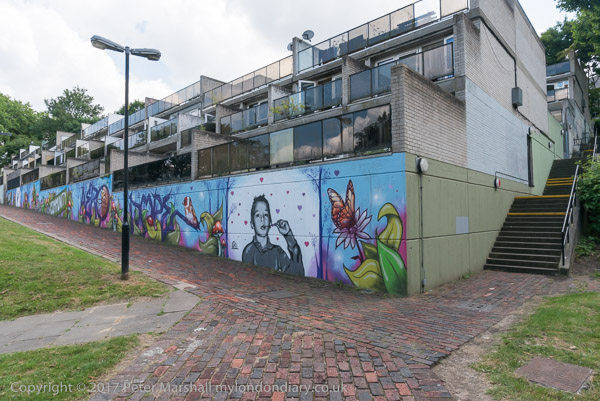
It’s an estate that clearly should be listed, but Historic England decided not to do so in 2016, probably under pressure from politicians, particularly because of the scale of the site and the very attractive possibilities it presents for developers. The Twentieth Century Society were dismayed that their application was dismissed – and you can read their application on-line.
In 2017 Lambeth decided to completely demolish the estate and develop it with an extra 400 homes, roughly doubling the size, most of which will be for private sale. Many residents objected and Architects for Social Housing have developed alternative plans showing how the extra capacity could be achieved at lower cost retaining the existing housing and the main features of the estate.
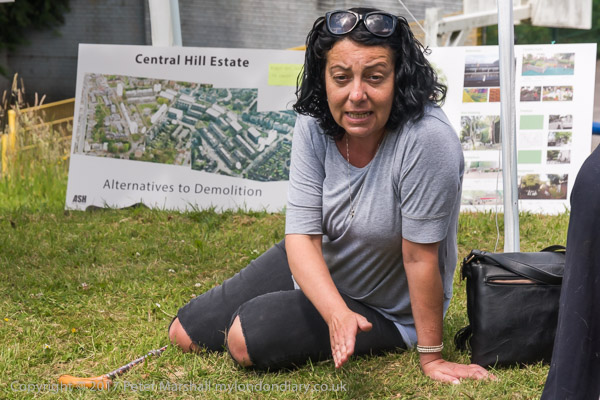
Nicola Curtis, one of the elected representatives the council refuses to talk with

The council seem to have little concern for the current residents of the estate or their wishes. They have been banned from using the community resource centre on the estate, which was locked. A large mural was painted with council agreement on one of the walls in the estate – but the council then insisted that they remove the name ‘Central Hill’ from it. The council refused to talk with the two representatives of the residents elected to the Resident Engagement Panel. Normal maintenance of the paths and other aspects of the estate appears to have been stopped, and I found examples of very shoddy work by the council on the estate.


I took the train back into central London and to Parliament Square, wherre Veterans for Peace had organised a remembrace of Brian Haw on the 6th anniversary of his death. They held a small banner with the message ‘War is is not the solution to the problems we face in the 21st century’
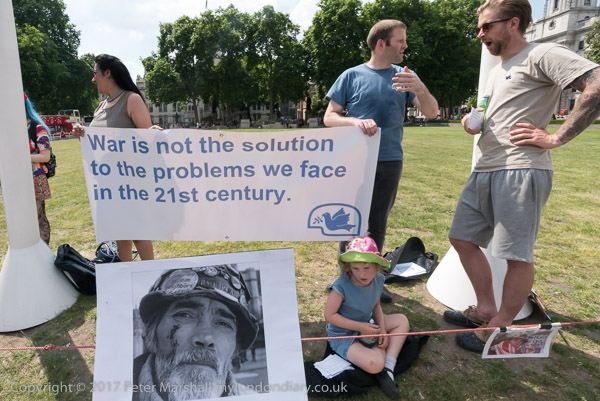
Brian Haw began his camp here on 2 June 2001, and remained in place despite many attempts, legal and otherwise to remove him for almost 10 years, leaving only when arrested, for court appearances and to speak at protests at Trafalgar Square and Downing St until 1 January 2011 when he left England to receive treatment for his lung cancer in Berlin. He died in Germany in the early hours of 18 June 2011.

His ten years of protest and the frequent and repeated harassment undoubtedly hastened his decline and death. His protest in Parliament square was continued by Barbara Tucker who had joined him in 2005 and had been imprisoned twice for her role in the protest and arrested 48 times. The level of harassment increased and she went on hunger strike on 31st December 2012. Late in January 2013 she was taken into hospital close to death, and was treated for frostbite and exposure. Her protests continued on-line.
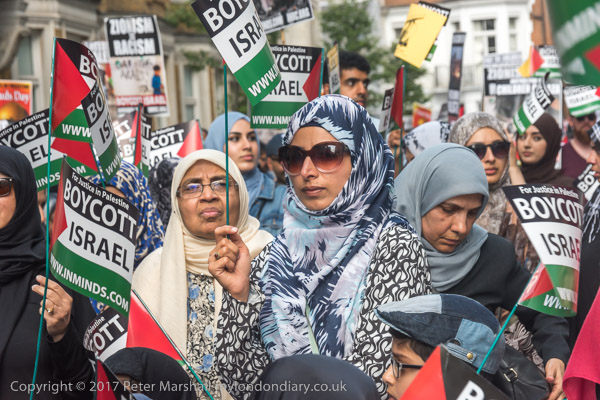
It was also the day of the annual Al Quds (Jerusalem) Day march in London, attended by several thousand from all over the country. Led by Imams and Neturei Karta anti-Zionist Jews, it called for ‘Freedom for Palestine’, and for all oppressed people’s across the world, and for a boycott of Israel.

As usual the march met with opposition from a small group of Zionists with Israeli flags and they were better organised than in previous years, with around 20 of them managing to block the route for around a quarter of an hour before police managed to move them on and allow the march to continue, though rather more slowly than usual.

Al Quds Day was inaugurated by Ayatollah Khomeini and some of the groups which support it may still receive support from the Iranian regime. Some of the protesters carried a small flag with both the Palestinian flag and that of Hezbollah and the message ‘Boycott Israel’. Hezbollah, a Lebanese Shia Islamist political party and militant group uses the same flag for both, and the militant wing is a proscribed group in the UK. The flag carried by some on the protest made clear in the small print it was in support of the political party.

Al Quds march
Zionists protest Al Quds Day March
Brian Haw remembered
Ted Knight speaks for Central Hill


All photographs on this and my other sites, unless otherwise stated, are taken by and copyright of Peter Marshall, and are available for reproduction or can be bought as prints.
Housing Awards – 2016

A resident of the Aylesbury Estate in Southwark speaks about the council’s terrible record

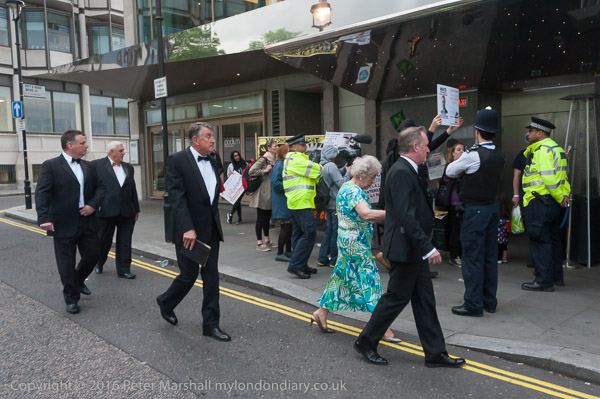
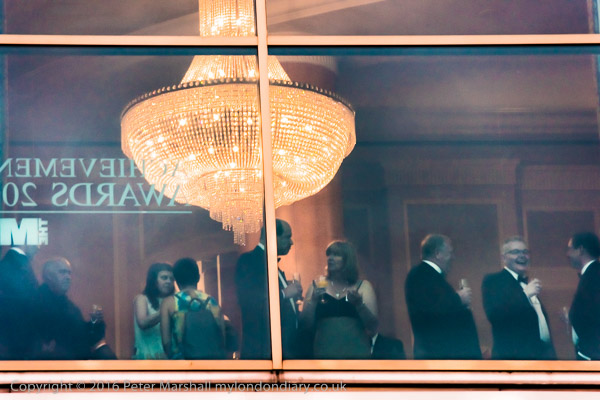
Most people have never heard of the annual Municipal Journal Local Authority Awards, a kind of self-congratulatory back-slapping beanfeast for local authorities on the lines of the Oscars and a dinner at the Hilton, doubtless on our council tax.

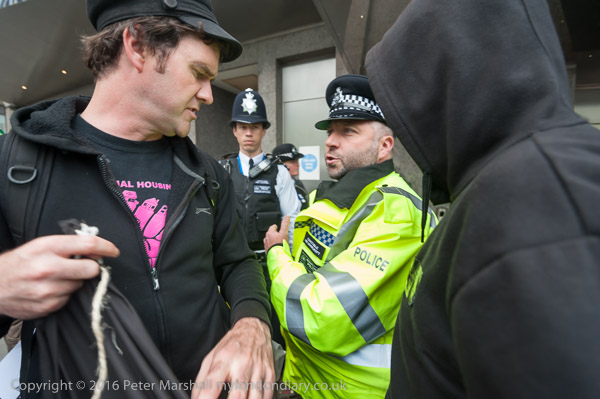
Protesters ignore hotel staff and police who tell them they must move

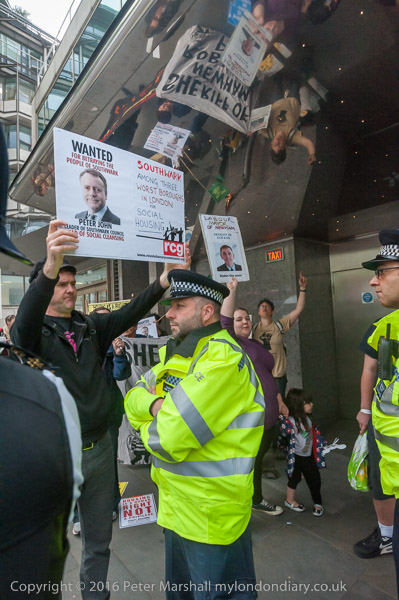
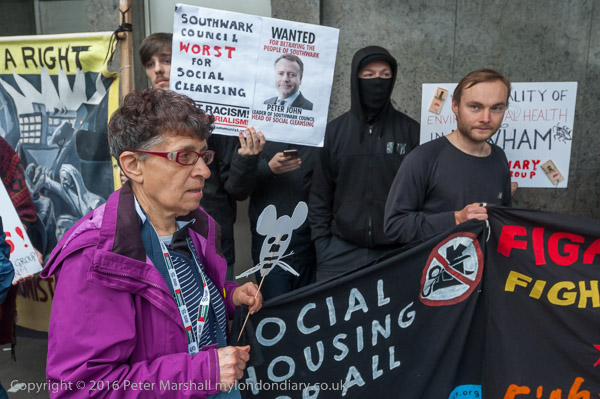
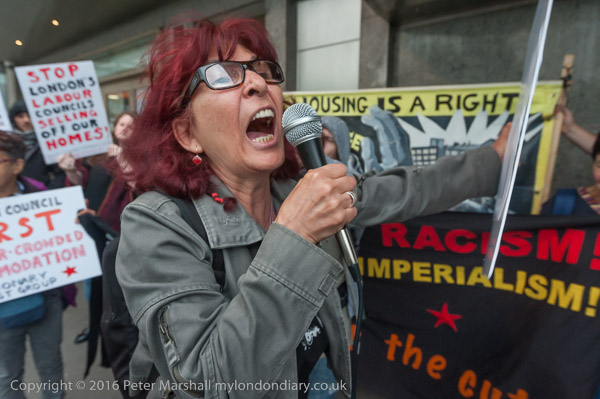
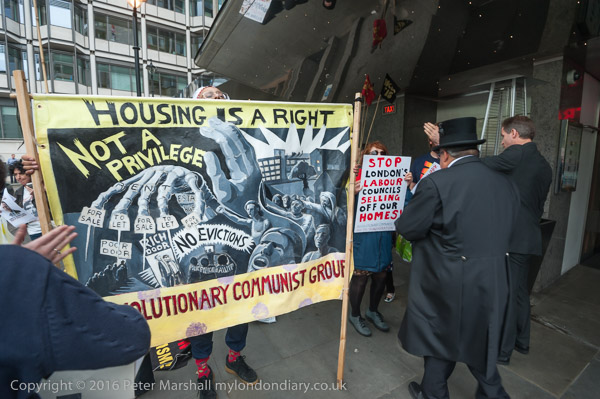
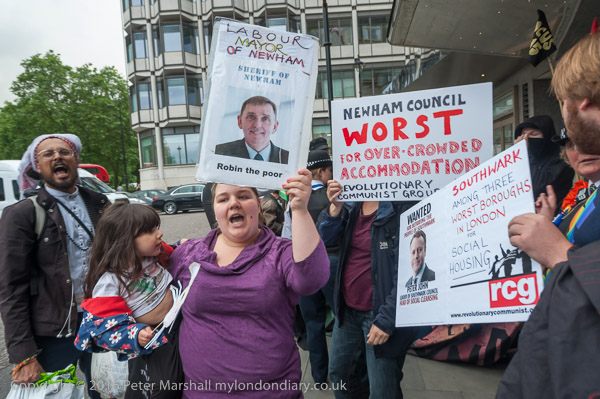
The news in 2016 that two of London’s councils with the worst records for housing were nominated for awards angered London housing protesters and Focus E15, the Revolutionary Communist Group, Class War, Architects 4 Social Housing and others organised a protest outside the Park Lane Hilton including a rather different awards ceremony.

Protesters from Newham blame Labour Mayor Robin Wales ‘Robin the poor’

They pointed out that Southwark had by 2016 demolished 7,639 units of social housing, sold off public land to developers, and evicted people unlawfully and accuse Newham of social cleansing, rehousing people in distant parts of the country while council properties remain empty, and of causing mental health problems through evictions, homelessness and failure to maintain properties.

Simon Elmer of Architects for Social Housing objects to being assaulted by a police officer.

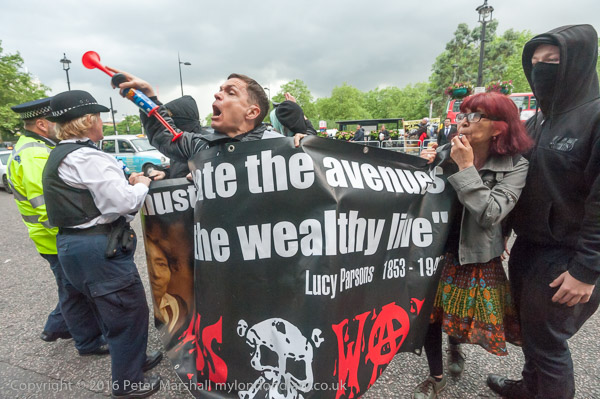
Police tried to move the protesters away from the hotel entrance and across the service road, but most resisted and held their ground, with police keeping the entrance clear, A few did move across the road were they could hand out flyers people arriving by taxi. There were a a few minor incidents when police pushed a protester holding a banner and again when several protesters held banners and placards in front of the restaurant windows.

Class War had brought their banner with a quote from US anarchist Lucy Parsons “We must devastate the avenues where the wealthy live” particularly appropriate for a protest in Mayfair and outside the Hilton. Police made a rather unwise and ineffectual attempt grab this from them but soon gave up.

People continued to arrive for the event and to walk past the protesters. Many had come from towns and cities across the UK for the event and where probably not particularly away of the situation in London boroughs.

I played around a little with the reflections in the polished metal canopy above the Hilton entrance, which was doing a good job in keeping the light rain off most of the protesters, though I was getting a little wet.

Looking up from the service road we could see those attending the awards ceremony talking and drinking before the dinner, while outside the protesters were beginning their own awards.

There were quite a few speeches from various of the activists, and Southwark won the award as London’s worst council, with Newham a close second.

More From May Days: 2018

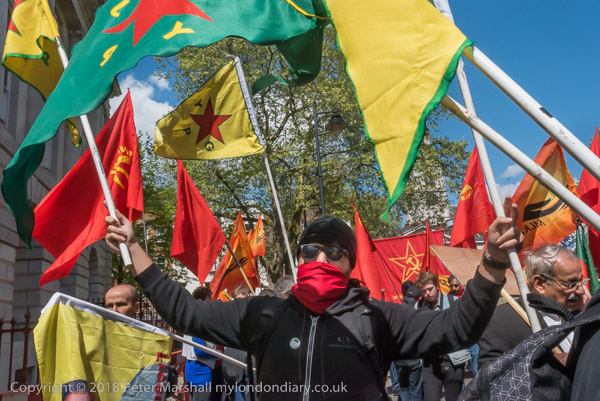
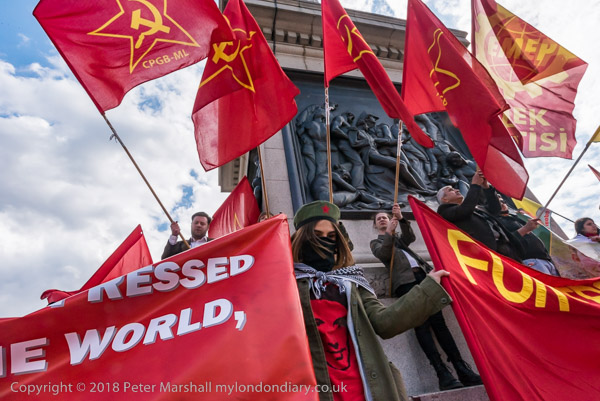
My May Day in 2018 was rather more varied than usual, taking in several other events as well as the traditional May Day march and rally where I started as usual at Clerkenwell Green, along with the Kurdish and Turkish communists and others. Without our various migrant communities it would have been a very much smaller and less colourful event.

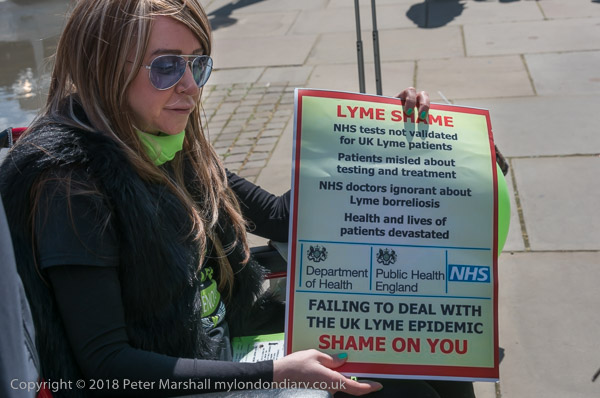
Rather than photograph the actual march I left a few minutes before it started to take the underground to Westminster, where the Chronic Lyme Disease Support Group UK was holding a protest to raise awareness of the hidden epidemic of the disease here. Carried by ticks, the disease is hard to diagnose and the NHS has failed to introduce proper tests and make doctors aware of its prevalence and proper treatment.

The general public need to know about the dangers and in particular to take precautions against tick bites and to be ready to remove ticks promptly and safely from their skin. I was fortunate to have met this group shortly before a holiday with friends a couple of years earlier so carried a small bent plastic tick remover for when we got bitten. If you ever walk through tall grass or woods you should have one ready.

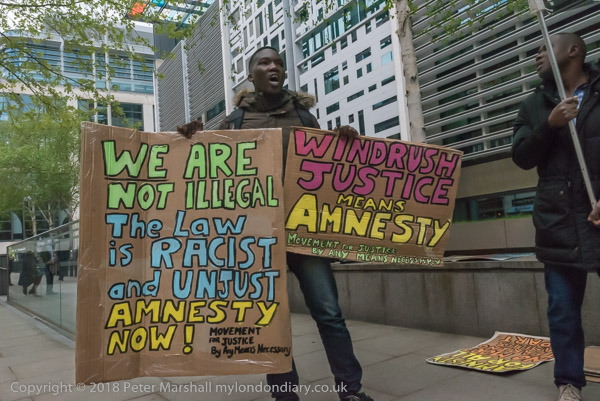
From outside Parliament it was a short walk to the Home Office, where Movement for Justice were protesting against a planned charter flight later in the week for a mass deportation to Jamaica. This was in the middle of the Windrush scandal and the flight would include members of the Windrush generation. The Home Office, particularly under Theresa May, has been guilty of enforcing an unjust, scandalous and racist immigration policy which is still continuing.

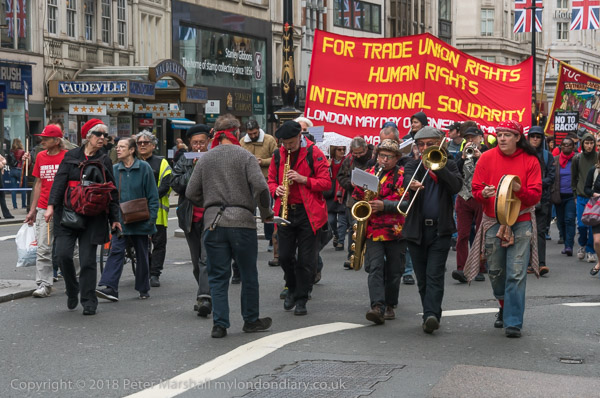
I rushed away from the Home Office and up Whitehall to the Strand, where I was just in time to meet the May Day march from Clerkenwell Green. I was almost certainly more out of breath than the members of the Musician’s Union whose band were leading it.

The rally was, as I noted, a rather humdrum event dominated by trade union speakers which failed to represent the make-up of the march, dominated by our migrant communities.

It seemed rather curious that speakers apparently were supposed to be ‘non-political’ in their speeches because of the elections later in the week. If you can’t be political at a May Day Rally why bother?

May Day Rally

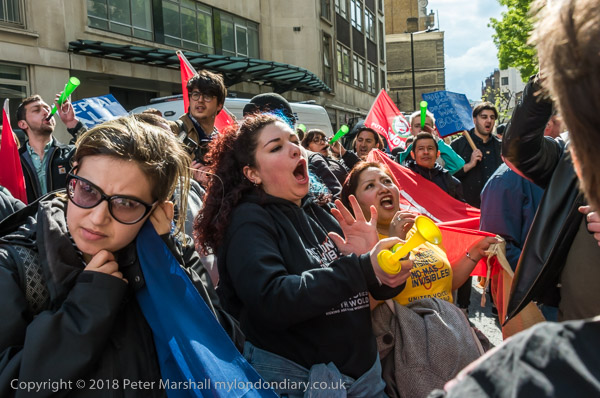
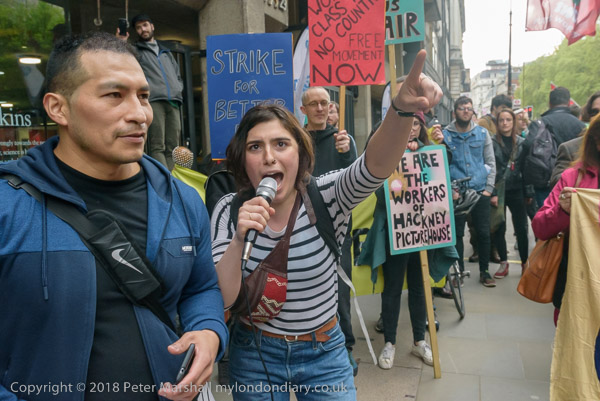
The rally was enlivened a little by the final contribution which was from a victimised union rep from the Brixton Ritzy, but by the time she spoke most had left either to go home or to the local pubs. Those left were getting ready to continue the day with a protest organised by the IWGB (Independent Workers Union of Great Britain), United Voices of the World the union, staff from Picturehouse Cinemas, the Women’s Strike Assembly – UK, London Wobblies, Another Europe Is Possible, Plan C London, Labour Campaign for Free Movement and the Precarious Workers Brigade representing precarious workers, people on poverty pay and exploitative contracts whose largely unskilled work is essential to keeping society running.

They marched to protest outside a number of exploitative workplaces where disputes were currently taking place, demanding guaranteed hours of work, a living wage, the decriminalisation of sex work, an end to trade union victimisation and repeal of the anti-union laws.

After their first protest at the Ministry of Justice where cleaners are demanding a living wage, they went on to further protests at King’s College, where cleaners demand to be directly employed with proper terms of employment and a living wage.

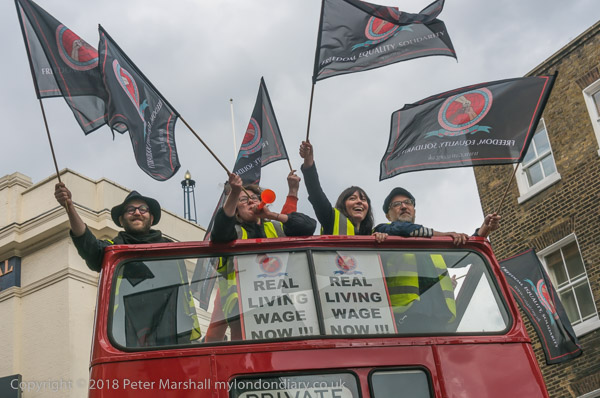
I left the protest at King’s to join the Cleaners and Allied Independent Workers Union CAIWU who had been celebratingd International Workers’ Day with an open-topped bus tour stopping to protest outside some of London’s most notorious employers. Their final protest of the day was at the Royal Opera House, where they were in dispute over the victimisation of five members for their trade union activities.

By now I was getting rather tired, but made a short detour on my way home taking the tube to Brixton, where an emergency demonstration outside Lambeth Town Hall before Thursday’s council elections was calling for a public inquiry into Lambeth Labour’s housing policy, an immediate halt to estate demolitions and a call to stop the privatisation via Homes for Lambeth which is leading to social cleansing.  

Lambeth Labour’s election manifesto had a proud claim that it was well on the way to “complete our ambitious programme of building 1,000 extra homes at council rent for local families“, while the actual number of council homes with with secure council tenancies built was – according to a Freedom of Information request – only 17. The protesters say that even than figure was around double the actual number.

Lambeth Housing Tell Us the Truth
CAIWU Mayday Mayhem at Royal Opera
Precarious Workers – King’s College
Precarious Workers – Ministry of Justice
May Day Rally
May Day March on the Strand
Against Deportation Charter Flights
Lyme Disease epidemic
London May Day March meets


All photographs on this and my other sites, unless otherwise stated, are taken by and copyright of Peter Marshall, and are available for reproduction or can be bought as prints.
There are no adverts on this site and it receives no sponsorship, and I like to keep it that way. But it does take a considerable amount of my time and thought, and if you enjoy reading it, please share on social media.
And small donations via Paypal – perhaps the cost of a beer – would be appreciated.


Haddo

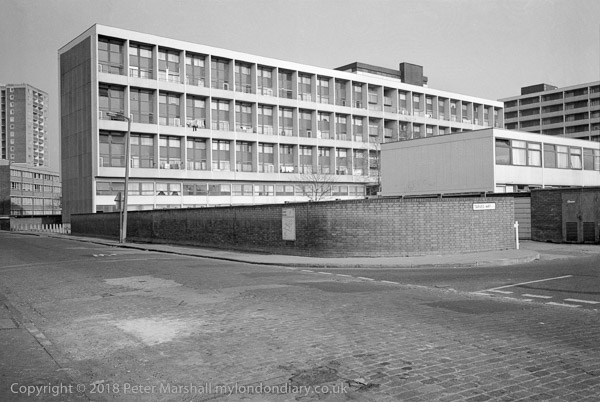
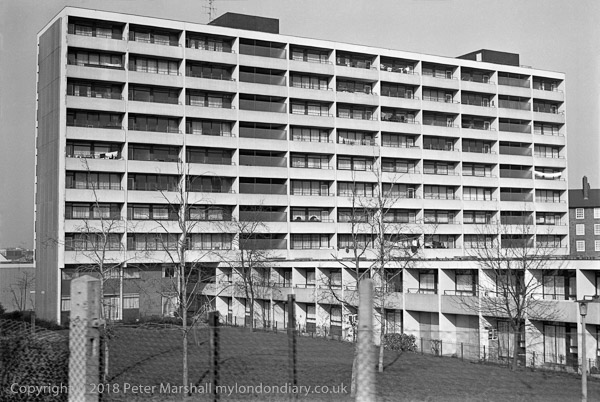
I woke up early this morning worrying about this picture, and that below of the Haddo estate in Greenwich, around Tarves Way off Norman Road close to Deptford Creek and Greenwich Station.

How is it that an estate which seems so neat and tidy and so well-loved both by the council and the residents behind their trim net curtains some 15 or 20 years after it was built in the 1960s (I can’t find the exact building date) had deteriorated to such an extent that the Haddo Estate around Tarves Way was one of the first to be ‘regenerated’ under New Labour with the homes emptied and demolished only 20 years later around 2003 at a cost of £90m?

Back around 2000, and to some extent now, politicians indulged themselves blaming the architect of these and other schemes, though more often it was perhaps the builders or system developers who were at fault for disasters such as Ronan Point, a short distance across the river. But many of the estates that have been or are being demolished were well designed, decently constructed and basically sound, perhaps good for at least another 50 years.

Many of the faults were faults of their time, which could have been prevented by proper maintenance or corrected with relatively inexpensive melioration – new windows, insulation etc. Resident caretakers and appropriate security systems – like those that turned Trellick Tower from sink to highly des res could perhaps have saved Haddo. Instead even many estates that were built with resident caretakers lost them, replaced by the occasional quick drive-by visit from a man in a council van – and the occasional heavy-handed police raid.

More fundamentally we have to ask how it happened that a housing policy once driven by social justice and civic pride that built many fine estates changed over that period to one led by estate agents, developers and profit. It happened under a regime that sought to remove all power from local authorities by a process of pauperisation and emasculation, forcing them to sell off properties at cut price and preventing them from using the proceeds to replace them.

And of course it goes wider than housing. Under Thatcher and Thatcherlite New Labour, greed and personal ambition at the expense of others became the order of the day. Our ideas about community, strong after the war and the era of the welfare state which followed it where whittled away by a leader who stressed self-reliance and the individual (or at best the nuclear family) and told us there was no such thing as society. Back in the early 80s I could walk around estates like this carrying a large bag of expensive camera gear and never feel any danger, but fifteen years later things had changed.

Part of the equation was certainly the relatively high standards, both of internal space in the dwellings and the green spaces around the buildings which make them such delectable targets for demolition and replacement with properties at high market or near market (the unaffordable “affordable”) returns.

I don’t know much of the details of the Haddo estate, either before or after its replacement, but have seen what has happened and is if anything now accelerating at other council estates in London, the majority in Labour-run boroughs.

Plans outlined in the building press showed ‘New Haddo’ was to have 510 homes, around half built for market rate sale, a third for some kind of so-called “affordable” rent and 85 for shared ownership. In most such regenerations by the time they come to completion, ways have been found to increase the proportion at market rates, by claiming that the developer cannot make sufficient profit – a figure set ludicrously high.

There appear to have been no homes in the new development at real social rents which most of those in the properties in my pictures will have been paying, and which will almost certainly have been sufficient to have paid off the council’s investment in building the estate.


There are no adverts on this site and it receives no sponsorship, and I like to keep it that way. But it does take a considerable amount of my time and thought, and if you enjoy reading it, please share on social media.
And small donations via Paypal – perhaps the cost of a beer – would be appreciated.

All photographs on this and my other sites, unless otherwise stated, are taken by and copyright of Peter Marshall, and are available for reproduction or can be bought as prints.
To order prints or reproduce images