Tower Hamlets Against the EDL

On Saturday 7th September 2013 the English Defence League led by Tommy Robinson tried to march into Tower Hamlets. Police had laid down strict conditions for their protest which included an exact route for their march, a limit on length of the rally in Aldgate and a prohibition on going across the border of the CIty of London into Tower Hamlets.
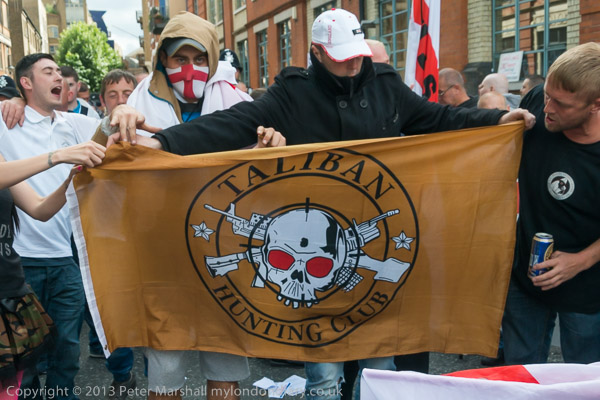
When I arrived well before their march was due to start those EDL supporters present were generally in a good mood and happy to pose for the press and we were able to move and photograph freely. Gradually things got a little edgier, though I was still able to photograph standing next to Tommy and the other leaders when they arrived.
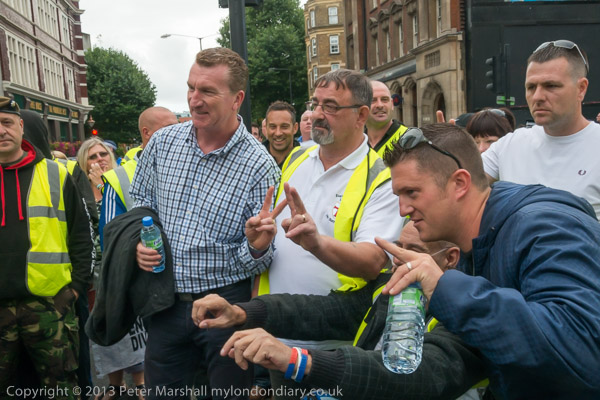
Then the police arrived in large numbers, surrounding the marchers and moving the press away from them. Photography of the march when it began was difficult, with police stopping us going close to it. I was able to take some pictures with a longer lens than I like to use, but police kept moving us further and further away, preventing us from doing our job.
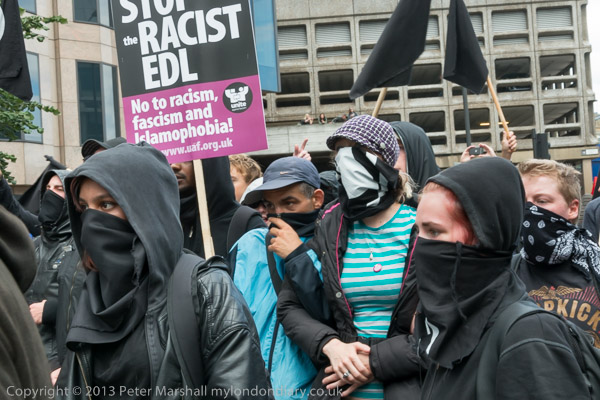
I gave up, and went away in search of the anti-fascists who I knew would be trying to disrupt the march, and had set off some smoke flares in the distance. Police had blocked their route with police vans and were keeping them kettled several hundred yards from the march route. The EDL were still some distance away when I walked out past the police at the north end of the group of protesters to go down a side street and join the EDL. I wasn’t stopped there but did have to show my press card to go through two other police lines before getting fairly close to the march.
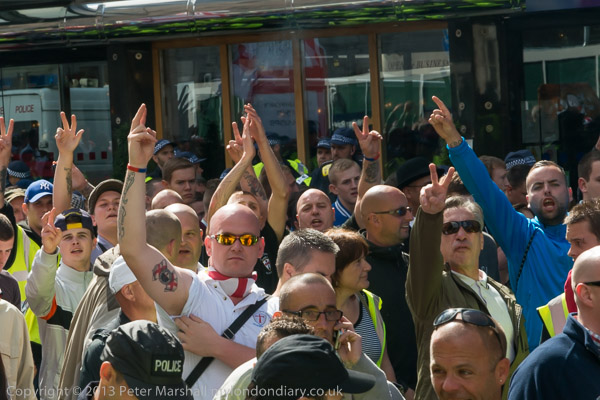
I joined on to a small TV crew and we found a raised position from where we could photograph the marchers as they came up to Aldgate, and was then able to move to where I could see the rally beginning. Fortunately I managed to get close enough to make some decent pictures with my short telephoto zoom, working on DX format to get a longer equivalent focal length of arond 158mm. I liked using DX format on the full-frame Nikon D800E as it allowed me to see what was happening outside the image frame and still gave an entirely usable 15Mp image.
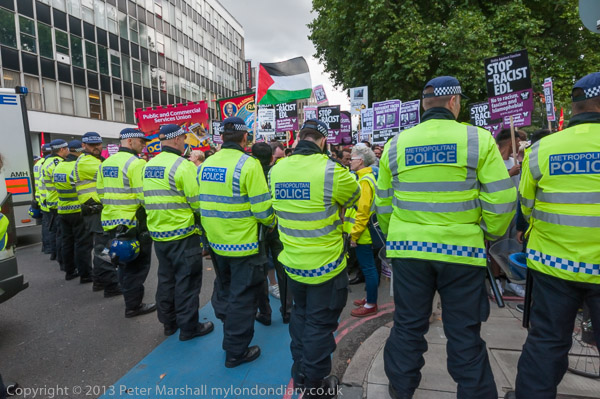
I soon tired of hearing the angry and ill-informed Islamophobic speech by Robinson (and the racist comments from the crowd) and moved away. It wasn’t easy to get past the half a dozen police lines between the rally and the people who had come to Whitechapel to oppose the march, even with a UK Press Card and I had to find a senior officer or try again on the other side of the road in some places to get through.
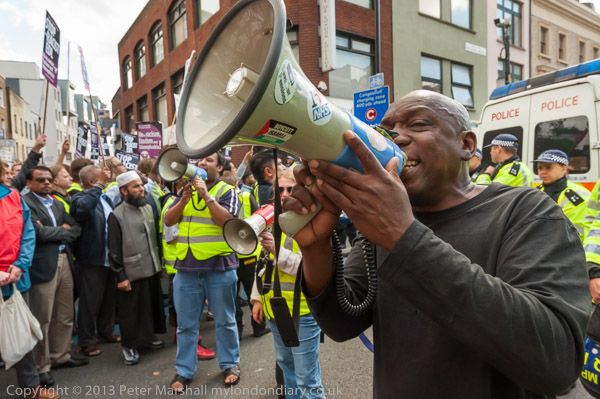
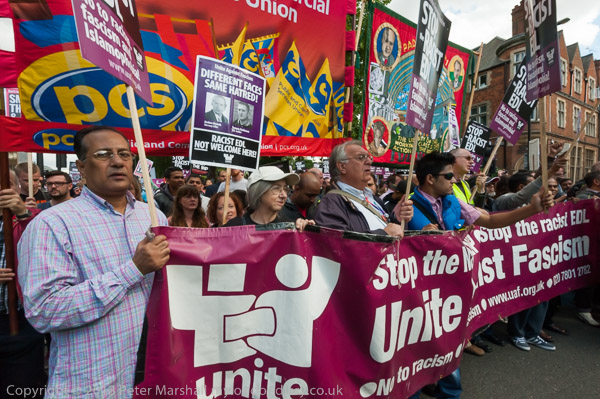
Here a large crowd had gathered including many from Tower Hamlets including the then mayor and many councillors as well as religious leaders, and they were supported by trade unionists and others from across London. The atmosphere here was so different from the hate a block to the west with people defiant but in good spirits and happy to be photographed.
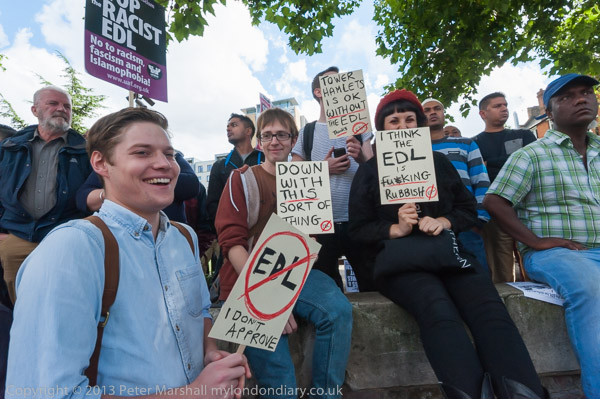
The huge police presence kept the groups apart, and prevented all but a very few minor incidents, and without them there would certainly have been a great deal of violence on the streets with the EDL being heavily outnumbered and forced to flee. It would have been something like a repeat of the humiliating defeat of Mosley and his fascists in 1936 when the police tried to force the march through, but failed. Although this time the police did make the EDL march possible, they also very sensibly stopped it on the edge of the City before it could reach Tower Hamlets.

More text and pictures on My London Diary:

EDL March returns to Tower Hamlets (or rather it tried to but didn’t quite make it)
Anti-Fascists Oppose EDL
Tower Hamlets United Against the EDL
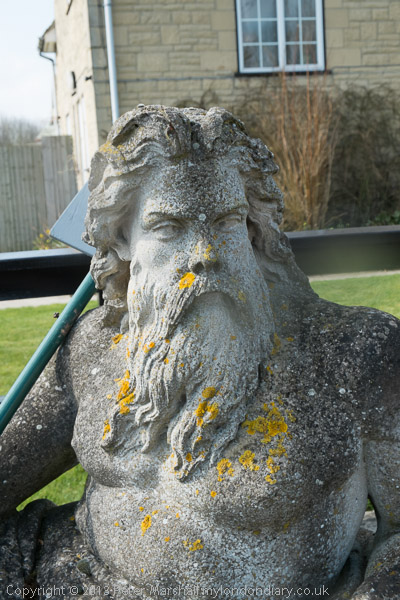
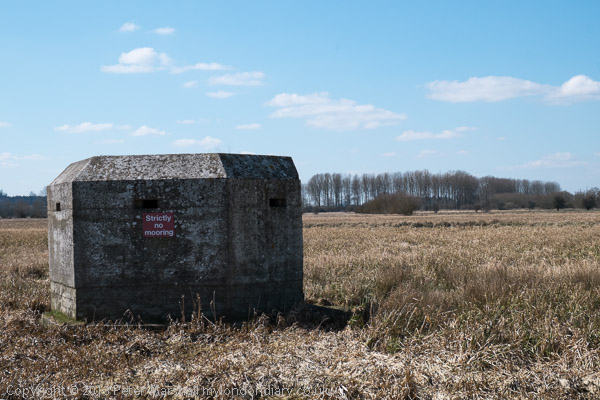
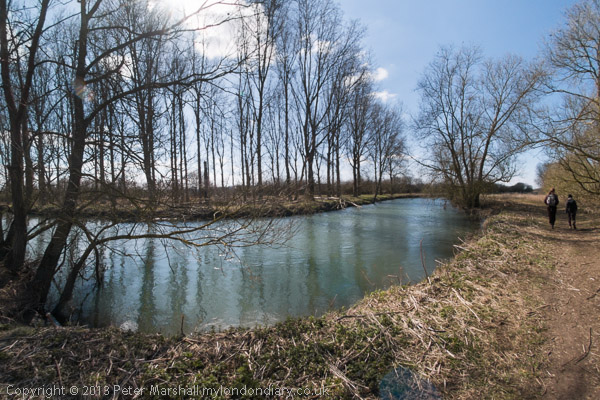
Thames Path

One of the many things I ought really to do is to put together a book of my pictures of the Thames Path. Of course quite a few others have done so, but I think mine would provide a slightly different view.

I think I’ve walked every section of it over the years, parts of it many times, though there may possibly be a few yards I’ve missed actually in London where there are routes on both sides of the river. I’ve also gone rather further east on both banks, as the Thames Path stops rather prematurely at the Thamea Barrier while the paths continue.

I’ve never quite been to the mouth of the Thames, traditionally marked at various places including the the Nore sandbank, Yantlet Creek – where the City put up the London Stone, and though I cycled to Leigh-on-Sea in 2005 I think I missed the Crow Stone.

Most of the sections of path upstream from Windsor I’ve walked on various days with my family. As far as a little above Oxford it’s fairly easy to travel by public transport to the start of a day’s walk and back from the end, but above that there are few buses and no stations until you get close to the source. So the final (or initial) 60-70 km had eluded us.

In 2013, my elder son planned the expedition to complete the route, booking bed and breakfast for the three of us at Buscot and Cricklade so we had three days to walk. On the Tuesday following Easter, two trains (both running late) took us to Oxford, despite Easter Holiday engineering works still in operation and we took the bus to Hinton Waldrist. For the last five miles we were the only passengers and the bus had a problem in the village squeezing past a parked tractor.

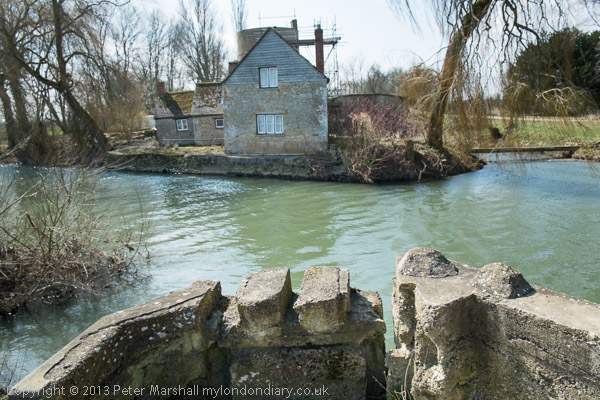
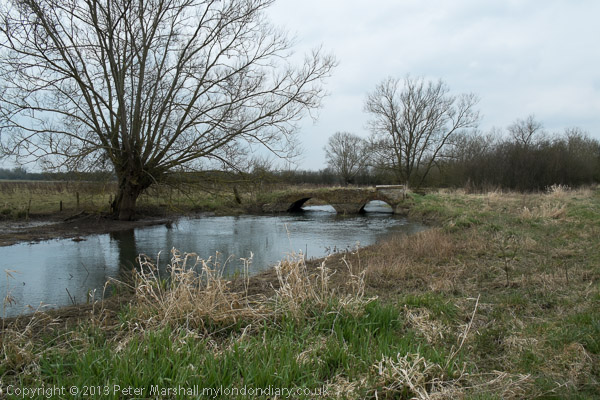
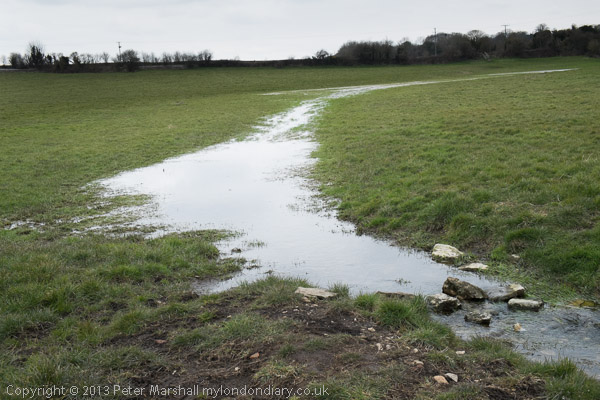
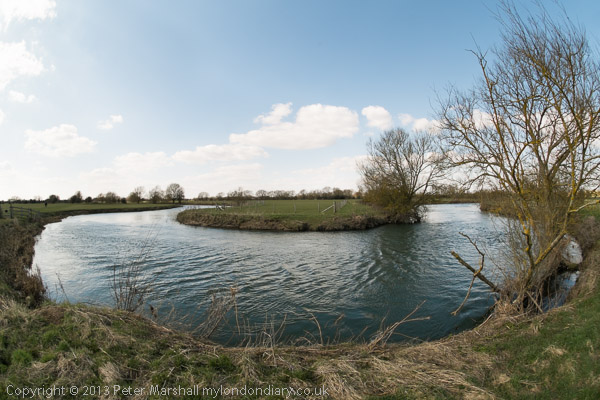
We were still a couple of km away from the Thames Path, but the sun was out and despite being rather close to zero it was good walking weather. The map and guide book said there was still a ford across an old stream of the river at Duxford which would have saved us some walking, but there had been considerable rain in previous weeks and it was clearly impassable; even on the longer way round we occasionally needed to detour around flooded sections of path.

We just made it for a late lunch before the pub at Tadpole Bridge stopped serving, having seen only one other person on the first five miles or so of our walk. It was good to have a pint, though the food suffered from the restaurant’s aspirations, and service was fast. The river winds considerably around here and I think we walked at least twice as far as a crow might fly to get to Radcot and from there on to Kelmscott where we again paused. We were a day early for the first opening of the Manor there, perhaps as well as we didn’t have time to appreciate it, but we did visit William Morris’s grave and the local pub before continuing our slog to Buscot Manor, an interesting and welcoming place to spend the night.

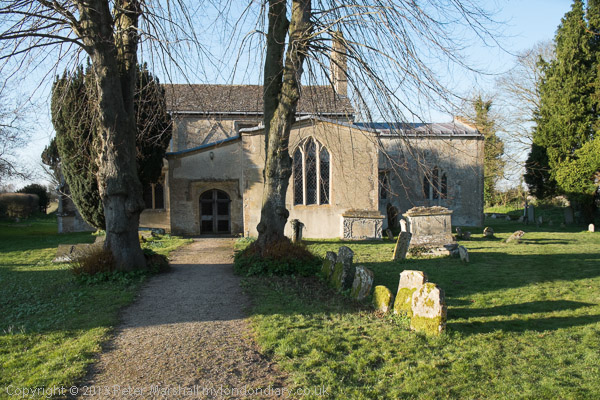
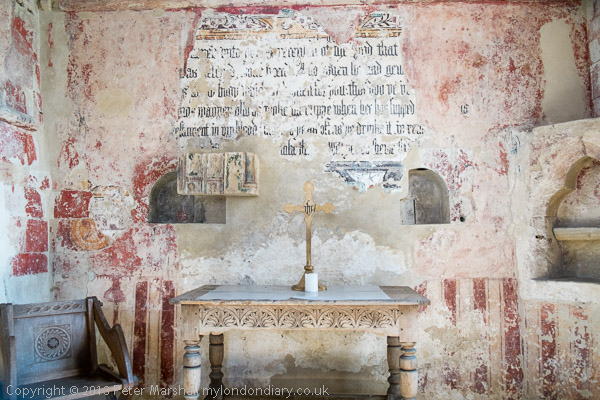
The following morning after a very large breakfast with other guests we made a short tour of the village before continuing along the Thames Path towards Lechlade, where I was forced to waste time snared into a tea shop by my companions. Eventually we made it and walked on past the start of the Thames and Severn canal to the Church of St John the Baptist at Inglesham, a splendid medieval survival thanks to the efforts of William Morris, who along with his pre-Raphaelite friends founded the Society for the Protection of Ancient Buildings (SPAB) or ‘Anti-Scrape’ to oppose the gothicisation of buildings such as these.

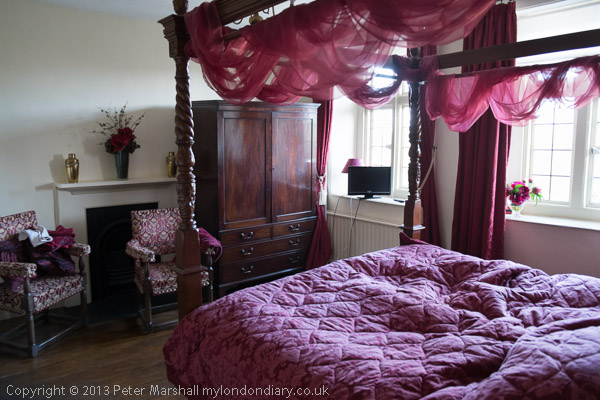
Then came the worst section of the Thames Path, a mile or so on the verge of the busy A361 followed by another couple along a bridle path and country lanes out of sight of the river. Between Inglesham and Castle Eaton there is no real Thames Path – except for a couple of hundred yards beside the river in the 4 or 5 mile stretch. Though except for the A361 it is a decent country walk. The route does run beside the river from Castle Eaton to Cricklade where we made for the oldest and poshest pub, the White Hart where we were booked. And after finding our room found a good Indian restaurant not far away.

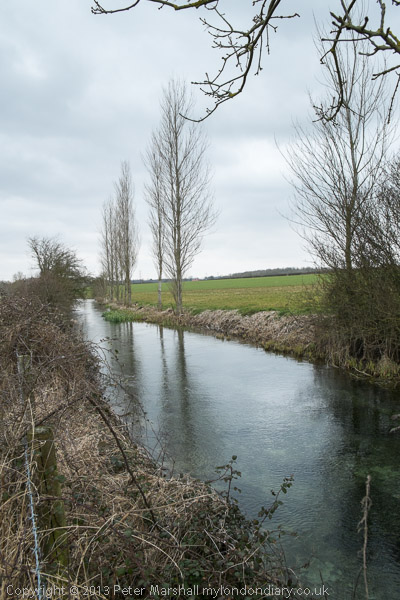
After a disappointing breakfast we took a short walk around Cricklade before continuing our journey. Flooding in the area meant the path had been diverted but it wasn’t a bad diversion and we were soon walking with the river through a land almost entirely covered by unfilled gravel pits, something there is no shortage of close to home. These cover the land east and west of the charming village of Ashton Keynes, west of which it’s hard to decide where the river actually flows. According to the Thames Path Guide, the Thames follows several coursed through Ashton Keynes, though some distance further up you do walk beside a decent small river.

Past the A 329 the river rather peters out, and by the time we reached Thames Head on the A 433 Fosse Way all that was left was damp grass. Across the road we struggled up a small hill to the official source, a dry spring that is marked by a stone placed here by the Thames Conservators. From here it was downhill to Kemble Station and a long wait for a train to Swindon, where we changed for Reading and then another train home.

More details and many more pictures on My London Diary.
Thames Path: Cricklade to the Source
Thames Path: Buscot to Cricklade
Thames Path: Shifford to Buscot

More from May Days: 2013

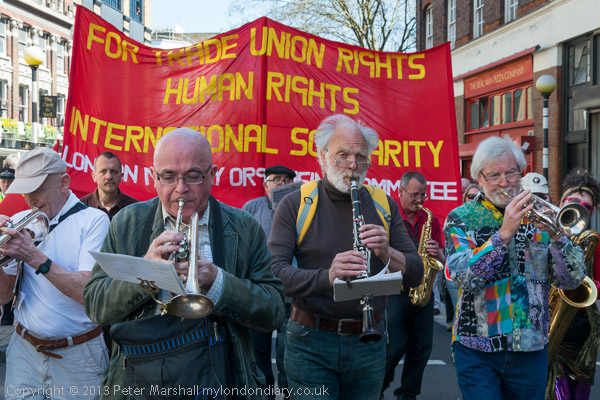
Another London May Day March and rally – and I went into some details on My London Dairy:

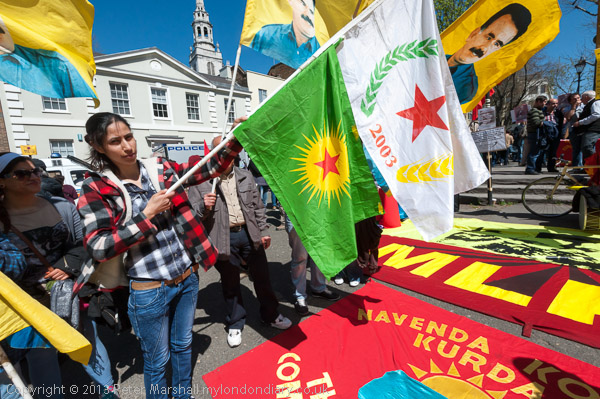
The march, organised by The London May Day Organising Committee, was supported by the Greater London and South East TUC ( GLATUC & S&ERTUC), UNITE London & Eastern Region, CWU London Region, PCS London & South East Region, ASLEF, RMT, TSSA, MU London, FBU London & Southern Regions, GMB London & Southern Regions, UNISON Greater London Region, NPC, GLPA and other Pensioners’ organisations and organisations representing Turkish, Kurdish, Chilean, Colombian, Peruvian, Portuguese, West Indian, Sri Lankan, Cypriot, Tamil, Iraqi, Iranian, Irish, Nigerian migrant workers & communities plus many other trade union & community organisations.

London May Day March

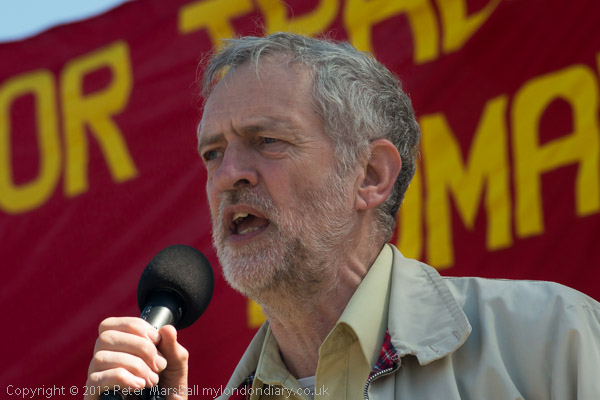
As in previous years the rally, although it had some rousing speeches from some leading figures on the left, including Len McCluskey, Jeremy Corbyn and John McDonnell, didn’t really reflect the diversity of the march – which was emphasised by the many young protesters who had climbed up onto the plinth and continued their protest there.

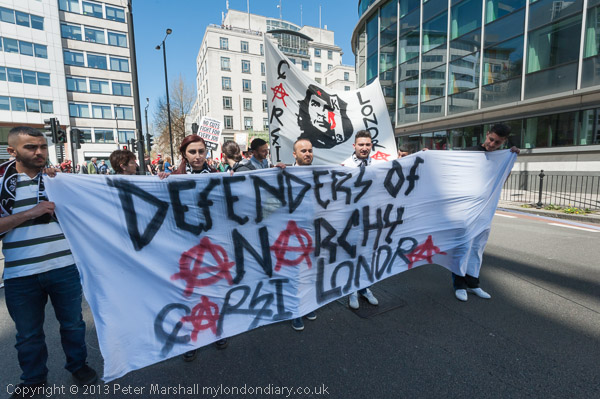
There were relatively few anti-capitalist and anarchist groups present this year, and I wasn’t aware of any separate events organised by them, so it was perhaps a rather less interesting May Day than some.

It was a large march and rally, though not massive, and it brought much of central London to a standstill for an hour or two, with strikes on the day at closing some government offices. But as usual,, although many newspapers and broadcasters reported May Day events around the world, and some of the odder events in towns and villages in the UK, there appeared to be a total media blackout on what was happening in London.

As so often, if you want to know what is happening you can’t rely on the mainstream media to tell you. Reports on Facebook and elsewhere by independent media organisations as well as some foreign-based news sources had reports on London’s May Day – and of course my own pictures and short description were online within a few hours of my arriving home, and shortly after on Facebook, with a larger selection of images appearing a few days later on My London Diary.

TUC May Day Rally
London May Day March


All photographs on this and my other sites, unless otherwise stated, are taken by and copyright of Peter Marshall, and are available for reproduction or can be bought as prints.