Westferry Station, Brunel and Bow Common

Westferry Station, Brunel and Bow Common, July 1988

Westferry Rd, , from Westferry Station, Limehouse, Tower Hamlets, 1988 88-7q-23-positive_2400
Westferry Rd, , from Westferry Station, Limehouse, Tower Hamlets, 1988 88-7q-23

My previous walk came to an end close to Westferry Station, from where I took the Docklands Light Railway to make my way home, but before the train came I made several views from the west-bound platform. The DLR runs through Limehouse on the old viaduct first planned in 1835 by the Commercial Railway Company to take the railway from the City to the West India and East India Docks. The viaduct was a cheap way to take the railway through the built-up area, and won out against a rival scheme involving cuttings. The two companies merged to build the London and Blackwall Railway in 1838-40, though it was later widened.

It was the world’s second elevated railway, opening shortly after the London and Greenwich on the other side of the Thames. The 20 ft high viaduct now gives good views of the surrounding area both from the trains and from the stations. At the left of this view you can see the rear of the West India Dock warehouses on Hertsmere Road, and at right the low structures, now replaced, of Heron Quays.

Isle of Dogs, River Thames, from Westferry Station, Limehouse, Tower Hamlets, 1988 88-7q-25-positive_2400
Isle of Dogs, River Thames, from Westferry Station, Limehouse, Tower Hamlets, 1988 88-7q-25

Turning a little the view from the southern platform shows Westferry Road and the River Thames, with in the distance a view of two of the Barkantine Estate towers at left, closer to the centre a side view of the Cascades Tower and towards the right two towers on the Pepys Estate in Deptford and more distant blocks.

Isambard Kingdom Brunel, statue, Temple Place, Victoria Embankment, Westminster, 1988 88-7q-11-positive_2400
Isambard Kingdom Brunel, statue, Temple Place, Victoria Embankment, Westminster, 1988 88-7q-11

A couple of days later I returned to the area, stopping off in central London on my way and taking a picture of the statue of Isambard Kingdom Brunel by Carlo Marochetti, (1805-1867). The statue was commissioned in 1861 by the Institute of Civil Engineers but was only installed here in 1874 on a Portland stone pedestal by Richard Norman Shaw (1831-1912). Its inscription reads ISAMBARD KINGDOM BRUNEL/ CIVIL ENGINEER/ BORN 1806 DIED 1859″.

The ICE had hoped to install this statue together with that of two other prominent engineers, Robert Stephenson and Joseph Locke who had died within a few months of Brunel, in Parliament Square, close to their offices at 1 Great George St. Permission was initially granted, but then withdrawn when the Office of Works decided only politicians should have statues in Parliament Square. Brunel’s was erected on Temple Place, Stephenson’s outside Euston Station and poor Locke’s was sent to Barnsley, where he had grown up.

Lazdan, Builders Merchants, Bow Common Lane, Bow, Tower Hamlets  88-7q-12-positive_2400
Lazdan, Builders Merchants, Bow Common Lane, Bow, Tower Hamlets 88-7q-12

281 Bow Common Lane was until recently Lazan Builders Merchants but they have now moved to Sebert Road, Forest Gate. The house had a facelift in 2020.

Bow Common Lane, Bow, Tower Hamlets  88-7q-14-positive_2400
Bow Common Lane, Bow, Tower Hamlets 88-7q-14

I think this is somewhere in the Joseph St area, but new building makes it hard to identify the exact position.

S P Brown, Builders Merchants, Lockhart St, Bow, Tower Hamlets, 1988 88-7r-01-positive_2400
S P Brown, Builders Merchants, Lockhart St, Bow, Tower Hamlets, 1988 88-7r-01

This house, 31 Lockhart St, is still there at the corner of Lockhart St and Ropery St, but the large gate now has letter boxes for 33,35 and 37 and the lettering has gone.

Cantrell Rd, Bow Common, Tower Hamlets, 1988 88-7r-46-positive_2400
Cantrell Rd, Bow Common, Tower Hamlets, 1988 88-7r-46

Bow Common Gas works were to the west of Knapp Road, the continuation of Cantrell Road south of the railway line which runs across the center of the image. The gasworks were built here in 1850 and at one time there were seven gasholders. Most of the site was demolished in 1982 and the last two gasholders shown here in 2016-7.

The scrapyard is now the Scrapyard Meadow, part of Tower Hamlets Cemetery Park.

Cantrell Rd, Bow Common, Tower Hamlets, 1988 88-7r-34-positive_2400
Cantrell Rd, Bow Common, Tower Hamlets, 1988 88-7r-34

The tower block between the gasholders is Sleaford House on Fern St, 19 storeys and 183ft tall, part of the Lincoln Estate completed in 1964.

This walk will continue in a later post.


Clicking on any of the pictures will take you to a larger version in my album 1988 London Photos from where you can browse the album.


South of the River 1985

Container ship, biker, Shornemead Fort, Shorne, Gravesend, Gravesham 85-6c-43_2400

In 1984, I more or less came to an end of my work on the River Lea (though I returned to it later) and the major focus of my photography shifted to London’s Docklands, and I’d photographed the West India and Millwall Docks as well as the Royal Docks, pictures from which I’m currently posting daily on Facebook. And later in that year I also went to the Surrey Docks, where work by the London Docklands Development Corporation was well advanced.

I was very aware of the political dimensions of the redevelopment, with the LDDC taking over from the elected local authorities and imposing its own largely business-led priorities which although accelerating the development distorted it away from the needs of the local area, and particularly away from the still pressing need for more social housing and for better employment opportunities for local people.

Northfleet, Gravesham 85-8e-35_2400

In those years I read every book in my local library on the history and geography of London, and began to build up my own collection of older works bought from secondhand bookshops and by post. Before the days of on-line listings I used to receive a monthly duplicated list of books on offer from a dealer I think in Brighton, and found many topographic and photographic items of interest, often very cheaply, and would look forward to receiving heavy parcels wrapped in several layers of newspaper. Yes, there was mail order before Amazon, and it was rather more exciting.

Cement Works, Northfleet, Gravesham 85-8e-53_2400

It was reading one of the books, Donald Maxwells ‘A pilgrimage of The Thames’, published in 1932 with his imaginative text and evocative drawings (some originally printed in the Church Times) that prompted me to walk in 1985 as he did from Gravesend west through Northfleet and Greenhithe exploring what he christened ‘the Switzerland of England’. As a rather more down-to-earth guide I also had the more academic ‘Lower Thameside’ picked up for pennies in a secondhand bookshop, which included a chapter on its 1971 cement industry by geographers Roy Millward and Adrian Robinson.

Crossness Marshes, Belvedere Power Station, Belvedere, Erith 85-9j-53_2400

My series of walks traversed what was an incredible industrial and post-industrial landscape, altered on a huge scale by quarrying and industry, continuing past Gravesend along the riverside path past Erith and Woolwich to Greenwich and Deptford (areas also covered in my 1985 London Pictures), as well as walking further east to Cliffe and Cooling.

Cement Works, Manor Way, Swanscombe, Dartford 85-9g-36_2400

It was a project that I returned to for several years – and I went back to the area more recently when the Channel Tunnel Rail Link was being built as will as the occasional walk or bike ride over the years.

You can see 280 of my pictures from 1984 now on Flickr in the album
1985: South of the River: Deptford to Cliffe


All photographs on this and my other sites, unless otherwise stated, are taken by and copyright of Peter Marshall, and are available for reproduction or can be bought as prints.

There are no adverts on this site and it receives no sponsorship, and I like to keep it that way. But it does take a considerable amount of my time and thought, and if you enjoy reading it, please share on social media.
And small donations via Paypal – perhaps the cost of a beer – would be appreciated.


Train windows and London’s best view

Back in the old days of British Rail (and at times after privatisation) I often used to enjoy taking pictures out of train windows. Then many carriages on suburban routes had doors between every pair of seats, and the doors had windows that you could slide down to around waist level and so take pictures unobstructed, though it might make it rather draughty for your fellow passengers. There were stern warnings about not leaning out of windows, and unless you braced yourself against the door frame it might have been possible to fall out, but you could photograph in any direction.

Some of the older rolling stock you needed to open the window to actually open the door at stations, as the doors only had handles on the outside, a useful safety precuation which made the carriages childproof and avoided any accidental opening, but sometimes meant infrequent travellers were trapped inside, unable to work out how to open them. Older readers too may remember the thick leather straps with holes to fit around a pin to hold the windows open at various levels.

Slightly more recent carriages came with a stiff handle you had to move sideways, protected by a raised surround, which only trapped mainly elderly ladies whose hands were no longer strong enough to move them and relied on other passengers to allow them to alight.

Now we have automatic opening doors and fixed windows with air conditioning on almost all services (though some still have narrow windows that don’t open enough to be useful) and can be sweat boxes when the air conditioning fails in summer or chill you if it can’t be switched off in winter. But more importantly for photographers, they have windows that are often scratched inside by bored travellers and almost always filthy outside. I have at times travelled with a cloth so when joining a train at the start of its journey I could select my seat and then step off the train to clean the window I was going to sit at so as to get a clearer view.

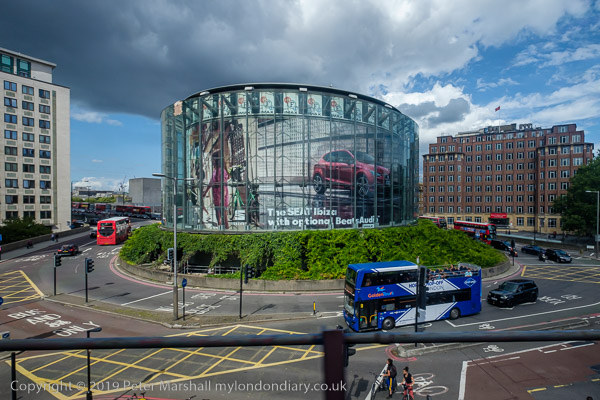
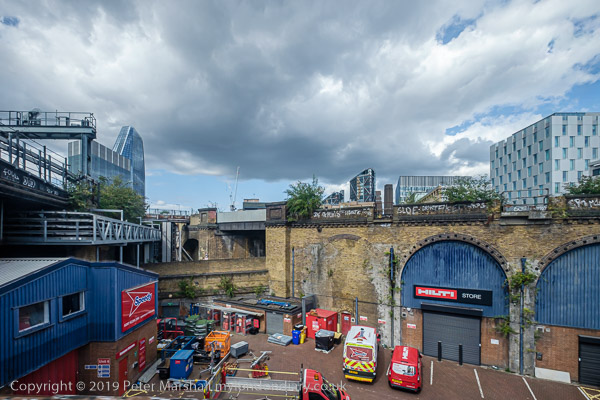
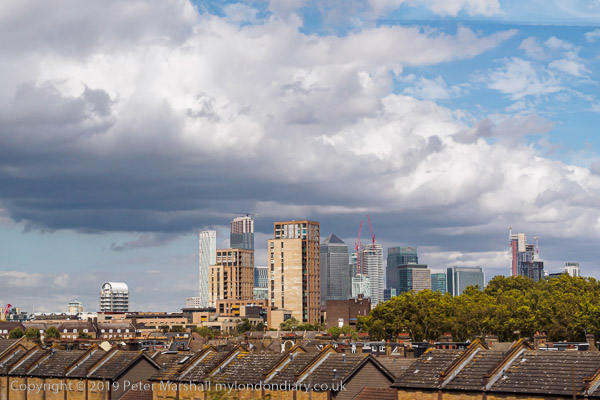
But either the train I joined at Charing Cross was new (and it did have that toxic smell of plasticiser) or had been recently cleaned, and for once I had a clear view. I hadn’t got onto the train to take pictures, just to get me to Blackheath, but it seemed to be too good a chance to miss, so I made a number of exposures.

The problem with photographing through glass is of course reflections. You can cut these down by removing any lens hood that would interfere and holding the front of the lens (or lens filter) directly against the glass. However this can cause vibration, so a small gap is a good idea, particularly while the train is in motion. Modern train windows are double glazed and while this close approach can avoid reflections from the pane you are in contact with, you still get them from the outer pane.

It also only works when the edge of the lens is in contact with the window all around, meaning you are restricted to views directly opposite the window and cannot aim the camera to left or right.

There is a solution to these problems, and it is in the form of a giant floppy lens hood with a hole at the centre which stretches to fit on the body of any lens. It’s called ‘The Ultimate Lens Hood‘ and is around 25cm across, and I have one sitting on my desk. The main problem with it (apart from looking rather eccentric) is that although it is a silicone rubbery thing that can squeeze down considerably, it is still too large to easily fit in my normal camera bag, at least without leaving out something essential like my sandwiches. So it was sitting there on my desk while I made these pictures 25 miles away. Slightly smaller versions are available and I think I might get one. Even a normal cheap rubber hood as I’ve used in the past can help a lot.

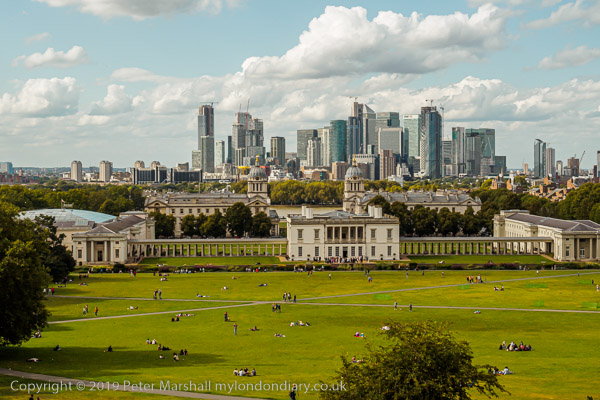
I was on my way to Blackheath to photograph an event that ended at the Royal Observatory at Greenwich, and my final pictures in this set were taken without benefit of any windows of the incredible view from the terrace in Greenwich Park north across the River Thames. It’s a view I first saw and photographed many years ago, and though rather changed since the building of Canary Wharf remains London’s most splendid.

I did try to take more pictures from the train on my return from Maze Hill to Waterloo, but the windows were not so clean, and only a few were usable – and then required considerable retouching.

More pictures at Charing Cross to Greenwich


All photographs on this and my other sites, unless otherwise stated, are taken by and copyright of Peter Marshall, and are available for reproduction or can be bought as prints.