November 2014 (4)

One of the more disturbing trends in Britain over the past ten years has been the rise of fascism, both in mainstream politics and also in the rise of various extreme right groups. We have a government which is increasingly prepared to act outside the law – prime examples including the Home Office’s ‘hostile environment’ set up by Theresa May, Boris Johnson’s attempt to close down Parliament and more recently to renege on parts of our agreement with the UK – and whose actions have encouraged extremist overtly racist and Islamophobic groups. But it isn’t just in the UK, and Germany, Poland and Greece are among other countries to have seen similar movements on a larger scale.
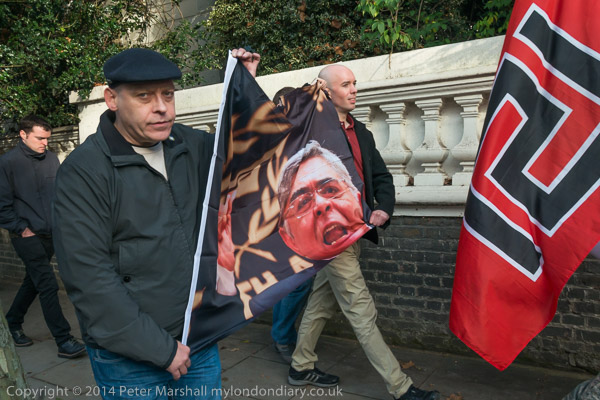
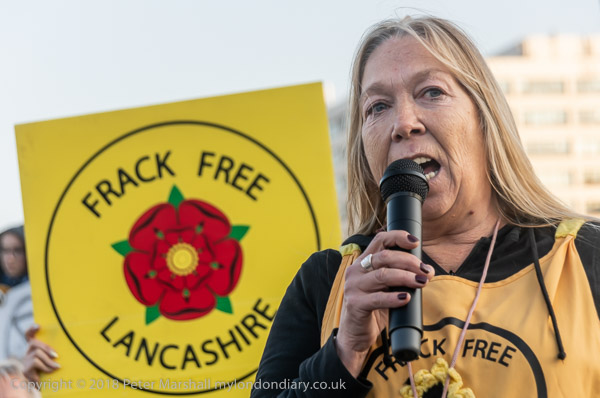
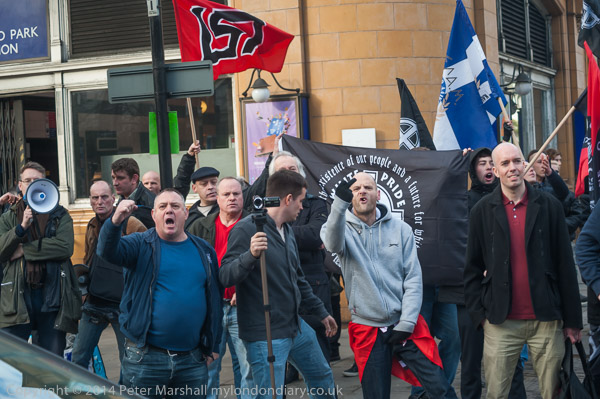
One of the nastier to crawl out from under the stones is the neo-Nazi Golden Dawn in Greece, where 50 leading members were then on trial in Athens for violent attacks, firearms and other offences. In the UK, New Dawn was set up in 2013 in support of the Greek organisation and, together with Polish neo-Nazis in the UK and British ‘White Pride’ supporters they had planned to march in London to the Greek Embassy to call on the Greek government calling on them to drop the charges and release the Golden Dawn leaders.
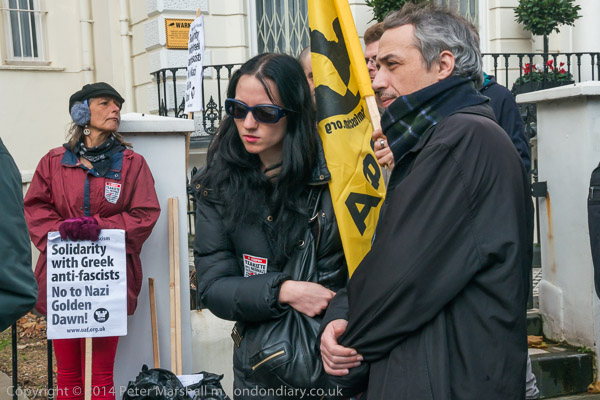
Their march was facilitated by the police and opposed by UK anti-fascist activists including Antifascist Action for Greece, Unite Against Fascism and many trade unionists, who gathered opposite the Greek Embassy an hour before the Golden Dawn supporters were due to arrive.
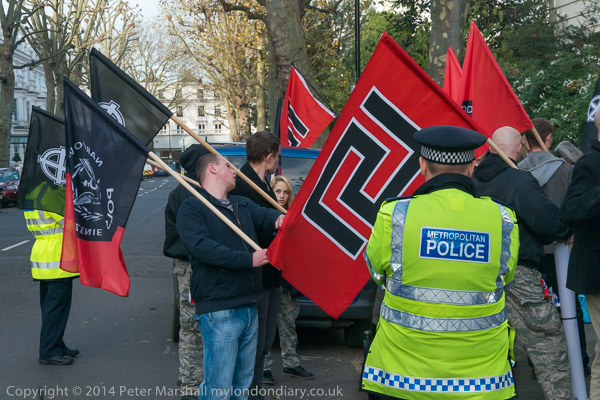
I don’t enjoy photographing extreme right groups, who tend to be hostile, and as usual I was threatened and spat at, though the police presence prevented any physical violence and stopped the press getting really close to the protesters. As a journalist I would have liked to have been able to talk to some of them, but this wasn’t possible, and their approach to the press generally is to shout insults and complain the press treat them badly by reporting their actions. I think we generally report accurately and if reports are bad it is because their actions are reprehensible.
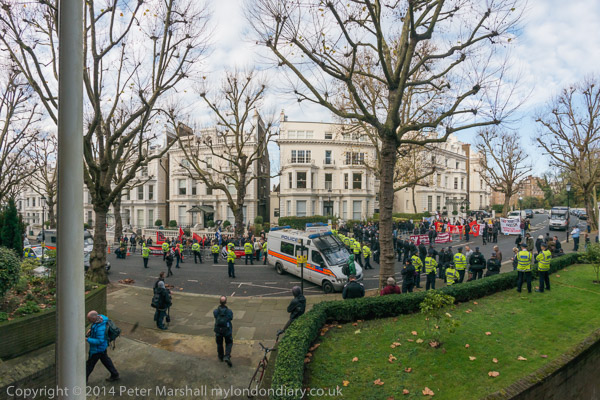
Both police and protesters tried to prevent me and the other photographers taking pictures and, not unusually, I and others were threatened with arrest. A videographer with the protesters made a point of recording those of us who were taking photographs. Those of us who report on right-wing protests have become used to having our pictures posted on the web with the intention of provoking violence against us.
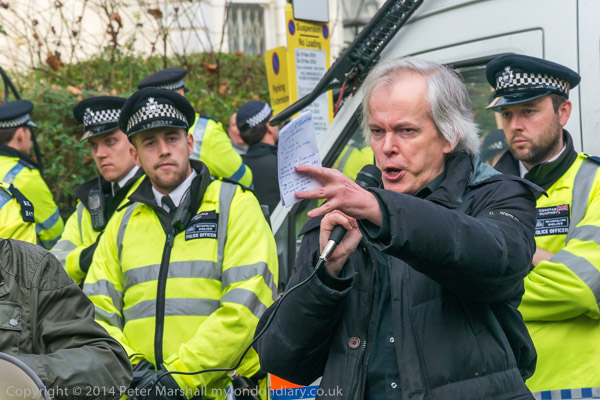
The main speaker at the event was Peter Rushton of the England First Party, associate editor of its magazine, Heritage and Destiny. According to Hope Not Hate he was expelled from the BNP in 2002, joining the more extreme White Nationalist Party, and later the British People’s Party. Reputed to be one of Britain’s leading Holocaust deniers they say he was a close friend of the banned terror group National Action.

I left after photographing Rushton speaking, walking through the police lines to make my way to Holland Park underground station. I thought it wise to leave the area before police allowed the New Dawn protesters to leave.

More at Neo-Nazi ‘Free the Golden Dawn’ Opposed.

Victoria & Kensington

Victoria Palace, theatre, Victoria St, Victoria, Westminster, 1987 87-9g-25-positive_2400

The car in the foreground seemed appropriate for ‘High Society’ at the Victoria Palace, but I would have preferred it without the foreground post. But this wasn’t a planned photoshoot, just a car that happened to stop at the traffic lights while I was looking at the threatre, and it moved off before I could change my position.

Morpeth Terrace, Victoria, Westminster, 1987 87-9g-31-positive_2400

Morpeth Terrace runs along the west side of Westminster Cathedral, and its mansion flats have over the years housed some notable residents. A few doors down the street a black plaque records that Winston and Clementine Churchill lived here from 1930-39.

They had apparently bought the flat on the fifth and sixth floor from Lloyd George, who reportedly had housed his mistress there. It was in the study of the flat that Churchill held a meeting with other MPs and wrote a letter to Prime Minister Neville Chamberlain urging him to send Hitler an ultimatum the day before war was declared in 1919.

Later the same flat is said to have been home to Stalin’s daughter, Svetlana Alliluyeva. But if so, her stay there was probably brief as she defected while on a trip to India, going to the US embassy in New Delhi and became a US citizen, though later moved for a short while to Cambridge before returning to Russia and then back to the USA.

I photographed this end of building rather than the part of the block with the Churchill plaque as it seemed more interesting. You can also see it was in rather poor external condition at the time – it has since been refurbished.

Baxendale & Sadler, Hatherley St, Victoria, Westminster, 1987 87-9g-52-positive_2400

It looked as if Baxendale & Sadler, Electrical Engineers and Contractors might still have been in business, though their shop front was rather the worse for wear. I think it had once said they were established in 1956.

The shop, a few yards from Vauxhall Bridge Road, is now residential.

Empire Hospital, for Paying Patients, Vane St, Westminster, 1987 87-9g-54-positive_2400

The Empire Hospital for Paying Patients in Vane St, Westminster obviously rather predated the National Health Service, and according to the Lost Hospitals of London web site was “opened in December 1913, intended to receive paying patients, primarily visitors from overseas” and was a nursing home with no doctors or surgical staff. Taken over as a military hospital it became the “Empire Hospital for Officers (for Injuries to the Nervous System)” and closed in 1919.

Later it became the Grange Rochester Hotel and is now the the Rochester Hotel by Blue Orchid, and looks rather more welcoming, with the text above the door covered by a hotel sign.

Palace Garden Terrace, Kensington, Kensington & Chelsea 87-10d-56-positive_2400

Wyndham Lewis (1882-57) disliked the name ‘Percy’ and dropped it, but others continued to use it and it appears on the GLC plaque in Palace Garden Terrace, Kensington which does not record when he lived here.

Born on a yacht, Lewis went to Rugby School and the Slade before studying in Paris before settling in London. A founder member of the ‘Camden Town Group’ he became one of Britains leading painters, best known for what Ezra Pound named as ‘vorticism’. After serving as an officer in the Great War he was made a war artist. In the late 1920s he turned mainly to writing and had produced over 40 books before his death.

Between the houses you can see Courtlands, described as a former coach house, though it looks rather more grand than that. The terrace seemed overpowering with long and largely unbroken stretches of largely white stucco, and these brick houses with a vista of a white villa attracted me.

Mall Chambers, Kensington Mall,  Kensington, Kensington & Chelsea 87-10d-55-positive_2400

The Grade II listing for Mall Chambers on Kensington Mall is unusually concise, at least at its start: “Improved industrial dwellings. 1865-8. J Murray. Yellow brick, stone dressings. Five storeys. Corner site, with corner entrance.” Towards the end it quotes Building News from 1868 “”intended for a class somewhat above ordinary mechanics and labourers”.

That is of course even more true now. A three bed flat here sold for £741,000 in 2014.

Kensington Church St, Kensington, Kensington & Chelsea 87-10d-52-positive_2400

Joseph Yates Timber Merchants were suprisingly still in business here until fairly recently and its timber yard now houses a luxurious four bedroom town house. Yates’ shop on the left of its carriage entrance is now The Kensington Cigar Shop.

The planning permission granted in 2004 required the retention of the lettering on the front of the building.

You can click on any of the images to see the larger version on Flickr and to browse more of the album 1987 London Photos.


London Protests: 17 November 2018

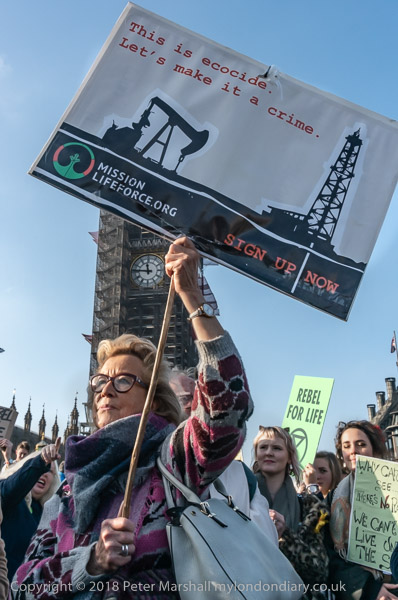
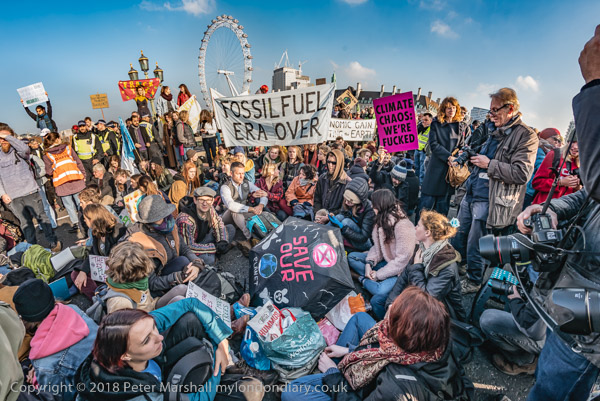
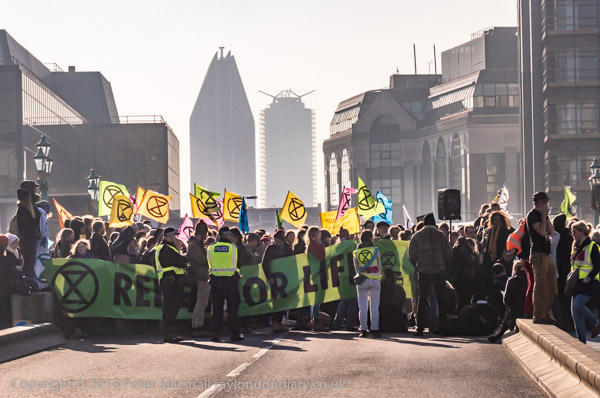
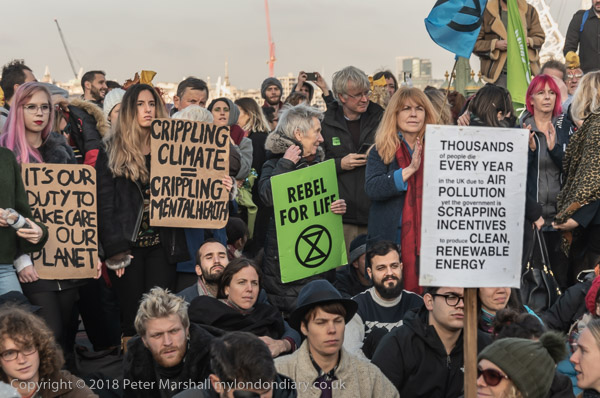
Saturday November 17th 2018 saw the start of Extinction Rebellion’s beidge blocade in central London, bringing the city to a standstill by blocking Lambeth, Westminster, Waterloo, Blackfriars and Southwark bridges. I joined them for the first couple of hours on Westminster Bridge.

From there I went to pay brief visits to three of the other four bridges that XR had blocked, choosing those downstream which were relatively easy to reach on foot.

I didn’t go to Lambeth Bridge, upstream from Westminster, as I ran out of time before another event I wanted to cover. It would have meant too long a walk as the nearest tube station is some distance away and there were no buses able to run. Later I found that it was at Lambeth that the police had been more active in making arrests and attempting to clear the bridge.

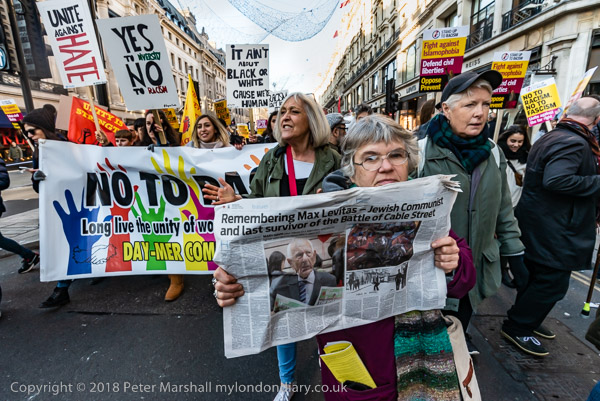
I arrived too late for the start of the march organised by Stand Up To Racism, co-sponsored by Unite Against Fascism and Love Music Hate Racism, and supported by many other groups and individuals including Diane Abbott MP and John McDonnell MP against the against the rising threat of Islamophobia and Antisemitism by far-right groups in the UK.

It was a large march and had gathered outside the BBC in Portland Place because the organisers wanted to point to the failure of the BBC to recognise the threat of these extremist groups with a level of support for fascism not seen since the 1930s.

The BBC does appear to have a policy limiting reporting on issues such as this, and of ignoring or minimising protests in the UK against failures of government. When they have reported, they have often talked of ‘hundreds’ of protesters when a more objective view would have said ‘thousands’ or perhaps even ‘tens of thousands.’ They do a far better job in reporting protests in foreign cities than in London.

Half an hour after I began taking pictures the marchers were still walking past me, but I thought that it was nearing the end and I left, not to go to the rally in Whitehall but to return to Westminster Bridge for the Exctinction Rebellion protest where there were speakers from around the country and around the world, some of whom travelled to speak on several of the five blocked bridges. After the speeches there was a Citizen’s Assembly but by then I was tired and left to go home, edit and file my pictures – more hours of work.

Protests by XR have done a little to shake the complacency of our government and others around the world and move them to action to avoid the rapidly approaching climate disaster, but it remains a case of too little, too late. Certainly so for many countries in the global South already suffering dire consequences, but probably also for us in the wealthier countries. Covid-19 has shown that governments can take drastic actions, (if ours cost many thousands of lives by making decisions too late and avoiding basic precautions) but it will need a similar upending of priorities and changes in our way of life to avoid the worst effects of climate change – and there can be no vaccine to end climate change.

More about the events and more pictures on My London Diary:

Extinction Rebellion Bridge blockade starts
Extinction Rebellion: Southwark, Blackfriars, Waterloo
Unity Against Fascism and Racism
Extinction Rebellion form Citizens’ Assembly


All photographs on this and my other sites, unless otherwise stated, are taken by and copyright of Peter Marshall, and are available for reproduction or can be bought as prints.


Mainly Westminster

Archibishop Tenison School,  Lambeth High St, Lambeth, 1987 87-9e-63-positive_2400

Thomas Tenison (1636- 1715) was Archbishop of Canterbury from 1694 until his death. Archibishop Tenison School, Lambeth High St, and according to Wikipedia founded boys schools in Lambeth in 1685 and Croydon in 1714. A school for 12 girls began in Lambeth in 1706, and this was built as a new girls’ school in 1863. In 1961 the school amalgamated with a nearby Church of England boys school and this building went out of use, though it was later used as an annexe to the combined school until this closed in 1974. It has since been demolished and replaced by a hostel.

Bennett House, Page St, Westminster, 1987 87-9f-11-positive_2400

Bennett House in Page St, Wesminster is a Grade II listed tenement courtyard block of flats built in 1928-30. It was a part of the Westminster Housing Scheme for the Grosvenor Estate and Sir Edwin Lutyens acted as consultant; the listing text calls it “An imaginative Lutyens treatment of a standard LCC type of housing block.”

Unemployment Benefit Office, Chadwick St, Westminster, 1987 87-9f-55-positive_2400

I admired the stark simplicity of the Unemployment Benefit Office on Chadwick St, Westminster. It remained in use – with changes in name – closing as a Job Centre Plus in 2017.

Old Pye St, Westminster, 198787-9f-65-positive_2400

New office buildings seen from Old Pye Street in 1987. Parts of this still remain though rather more difficult to see.

Salvation Army, Great Peter St, Westminster, 1987 87-9f-66-positive_2400

The building on this corner still has the foundation stone laid by James S Burroughes in 1893, though it has moved a few yards around the corner and I think the site is now occupied by “modern purpose-built flats for single people and couples set in a city centre location” built by SAHA, the Salvation Army Housing Association and allocated through Westminster Borough Council’s housing register.

Vauxhall Bridge Rd, Westminster, 1987 87-9g-02-positive_2400

Avocet House at 92-96 Vauxhall Bridge Road was the home of Avo Ltd, a company founded by Post Office engineer Donald Macadie who was fed up with having to carry separate meters for different measurements and in 1923 designed a meter than would measure Amperes, Volts and Ohms. The Avometer was the leading electical test equipment for many years. The company became too large for this site and bought land for a new factory at Dover in 1962. The company is now called Megger, and its testers are still made and in use around the world.

Francis St, Westminster, 1987 87-9g-14-positive_2400

This 1865 Grade II listed building in a free version of Italian Renaissance style by H A Darbishire was an orphanage for children of Crimean War guardsmen. Later it became a Franciscan friary, and they added the statue of St Francis just visible at the far corner around 1960. When they moved on it became offices. Close to Westminster Cathedral, in 2017 it was bought by the cash-strapped Roman Catholic Diocese of Westminster to be refurbished as a pre-prep for Westminster Cathedral Choir School, at a cost thought to be around £10million. The school is said to be the most expensive prep school in London, and sends pupils on to public schools including Eton and Winchester.

Shop window, Upper Tachbrook St, Westminster, 1987 87-9g-22-positive_2400

I don’t know which shop this was in Upper Tachbrook Street, but it appeared to be selling clothing, jewellery and similar items. From the few details of the shop front which can be seen it looks rather like that now occupied by ‘Mr CAD – For Everything Photographic’. This began around 1960 in Croydon, and although it at one time had nine branches at various sites from Colindale in north London to Brighton became just a giant Aladdin’s cave in Windmill Rd full of secondhand gear, moving to these rather smaller premises in Pimlico but also supplying mail order around the world as “the largest independent photographic dealer in the UKW with “the biggest stock of used analogue photographic equipment worldwide specialising in film, cameras, lenses, enlargers, chemicals, paper, all manner of studio & darkroom hardware & software.”

Clicking on any of the images above will take you to my Flickr album of over 750 images of London in 1987 selected from several thousand exposures I made that year


All photographs on this and my other sites, unless otherwise stated, are taken by and copyright of Peter Marshall, and are available for reproduction or can be bought as prints.


More West London 1987

Campden Hill Rd, Kensington, Kensington & Chelsea, 1987 87-9b-32-positive_2400

Although my caption states than this modern house is in Campden Hill Rd, its address is in Campden Street which leads off at the left of the picture. The building by architect Douglas Stephen is said to be in the style of pioneering Italian modernist architect Giuseppe Terragni, (1904-43), something perhaps best seen in his 1937 Villa Bianca in Seveso. I think like a similar larger block by Stephen in Bedford Gardens it was probably built in the mid-60s.

Gourmet Gascon, Hillgate St, , Kensington, Kensington & Chelsea, 1987 87-9b-51-positive_2400

Le Gourmet Gascon gives I think a fairly clear idea of the population of this area of Kensington, where there is a takeaway service offering Quenelles au Brochet. The shop is no longer there and a short walk away you can now get rather more plebian food for tourists at Notting Hill Gate, though I think there is still no shortage of over-priced restaurants in the area and of course Fortnum & Mason still deliver.

Doulton, Southbank House, Black Prince Rd, Lambeth High St, Lambeth, 1987 87-9d-12-positive_2400

Later in September I was back south of the river in Lambeth, and photographing in Lambeth. The terracotta carving above the doorway on the corner of Black Prince Rd and Lambeth High St is of Mr Doulton in his studio, and seated at left Hannah Bolton Barlow paints on one of the vases from his pottery, her pet cat under her chair.

Doulton, Southbank House, Black Prince Rd, Lambeth High St, Lambeth, 1987 87-9d-13-positive_2400

Pottery was produced not far from this site in Vauxhall Walk by  Jones, Watts & Doulton from 1815 and they moved to Lambeth High St in 1826. In the early years their most successful product was ceramic sewage pipes, for which their was a surge in demand driven by the 1846-60 cholera pandemic.

The company had several parts and a complex history but by the time this building was erected as their museum, school and design studio in 1871, with close links to Lambeth School of Art. The Lambeth studio pottery was producing signed works of art as well as more mundane items in the rest of the factory – and they later bought a factory in Burslem for making bone china tableware. The company only became Royal Doulton when it obtained a Royal Warrant in 1902. Production at Lambeth was forced to end in 1956 with the Clean Air Act which prohibited their salt glazing in this urban area, and all work went to the Potteries.

Doultons were major producers of the architectural terracotta or stoneware which adorns many Victorian buildings, and their building acted as a real life catalogue for their wares, though they also produced many specifically commissioned pieces as well as the more general stock.

London Fire Brigade, obelisk, snorkel tower, Albert Embankment, Lambeth, 1987 87-9e-03-positive_2400

A few yards up Lambeth High St is a view of this rather strange obelisk in the yard beside the (now former) headquarters of the London Fire Brigade, which moved to a new building here on a part of the former Doulton pottery factory site in 1937. This obelisk or ‘snorkel tower’ was built to provide ventilation for the war-time underground control room, according to the listing text “constructed to withstand a direct hit and a gas attack, with its own reserve electric light installation and forced ventilation.”

Ventilator, Metropolitan Police Central Communications Command Centre, Lambeth Rd, Lambeth, 1987 87-9e-45-positive_2400

A short distance away in Lambeth Rd is another rather bulkier structure, also a ventilator, for the underground Metropolitan Police Central Communications Command Centre. A new special operations room was opened there in 2008, but there are also other communications centres in Bow and Hendon.

Works, Old Paradise St, Lambeth, 1987 87-9e-56-positive_2400

As this and other pictures in the Flickr album 1987 London Photos show, there was rather more evidence of the area’s industrial past then. This chimney and works was a former soap factory.


All photographs on this and my other sites, unless otherwise stated, are taken by and copyright of Peter Marshall, and are available for reproduction or can be bought as prints.


Notting Hill in colour – 1997 Part 4

A final selection of my pictures from 1997 when I mainly worked with colour.

Notting Hill Carnival, 1997 97c8-nh-135_2400
Notting Hill Carnival, 1997 97c8-nh-145_2400
Notting Hill Carnival, 1997 97c8-nh-158_2400
Notting Hill Carnival, 1997 97c8-nh-163_2400
Notting Hill Carnival, 1997 97c8-nh-174_2400
Notting Hill Carnival, 1997 97c8-nh-182_2400
Notting Hill Carnival, 1997 97c8-nh-184_2400
Notting Hill Carnival, 1997 97c8-nh-191_2400
Notting Hill Carnival, 1997 97c8-nh-196_2400
Notting Hill Carnival, 1997 98c8-nh-221_2400

I hope you have enjoyed my pictures which I think show something of the spirit of carnival, something sadly missing at the moment.

You can see more of my pictures from carnival in Notting Hill Carnival – the 1990s on Flickr.


All photographs on this and my other sites, unless otherwise stated, are taken by and copyright of Peter Marshall, and are available for reproduction or can be bought as prints.


Remember, Remember – Nov 5th

Nov 5th 2014

As England begins four weeks of partial lockdown I ponder briefly on the significance of the date and the incompetence of our government before looking at some protests in recent years on November 5th.

Nov 5th 2014

Guy Fawkes was it is often said, the only person to enter Parliament with honest intentions, perhaps a slightly harsh judgement on our politicians, but events over the past few years have certainly shown that being honest has not served Jeremy Corbyn well. Although we no longer openly torture prisoners and Corbyn, though clearly put on the rack by the media is unlikely to be actually hung, drawn and quartered – much though some might revel in it – and he is unlikely to have to jump from the scaffold like Fawkes to avoid this excruciatingly gory fate. But the establishment have become no less weak, simply more devious and discrete in protecting their enormous wealth and privileges against all-comers.

And Covid has given the government an excuse to clamp down on protests across the board, though some have still continued. But with various police actions and Acts of Parliament we are clearly moving closer to a police state, with the active support of a failing opposition in Parliament.

Nov 5th 2013

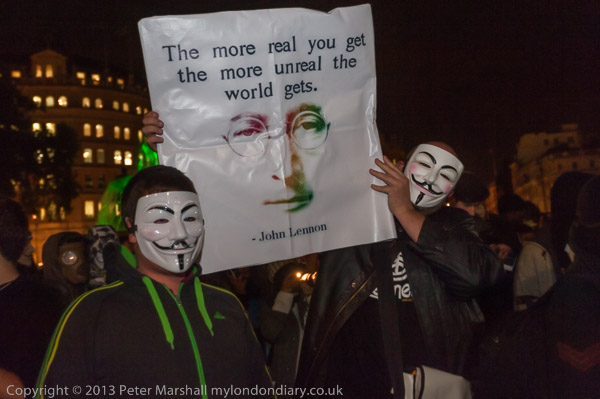
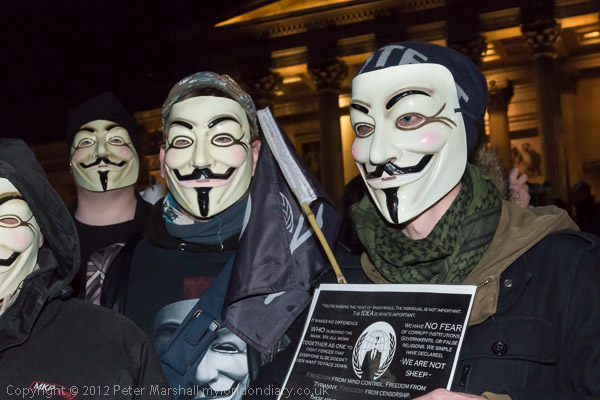
Fawkes was the inspiration behind  the anonymous anti-hero of the graphic novel ‘V For Vendetta’ written by Alan Moore and illustrated by David Lloyd later made into a film. It shows an England without political or personal freedom caused not by a pandemic but after a devasting war.

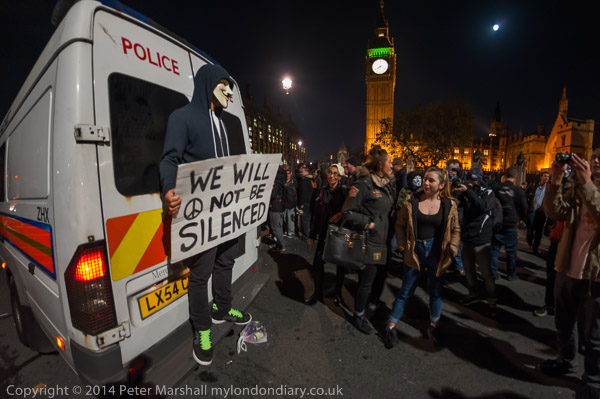
Anonymous, a loose internet based movement of hacker activists took on the Guy Fawkes mask from the film as a symbol, uniform and disguise for their activities, in online videos and street protests – ironically greatly benefiting the mask copyright owners Time Warner who get a royalty from every official sale. And one of their main protests in ‘meat life’ is the ‘Million Mask March’ taking place on November 5th every year.

Nov 5th 2014

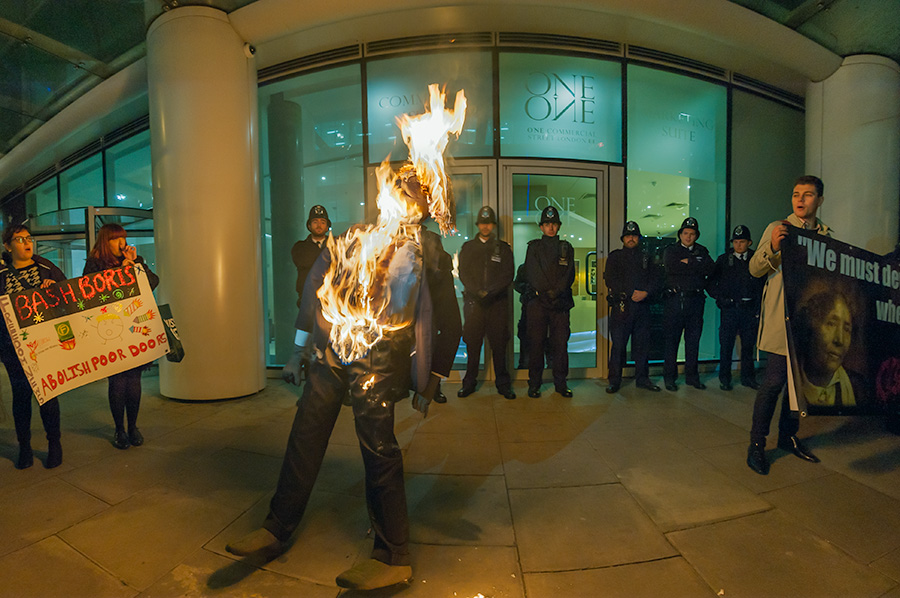
But Anonymous is not the only Nov 5th game in town. Guy Fawkes celebrations traditionally include bonfires, and in 2014 Class War took their own guy, an effigy of then London Mayor Boris Johnson to their ‘Poor Doors’ protest at One Commercial St in Aldgate. 

Class War’s guy dressed as London Mayor Boris Johnson burns vigorously at the protest at One Commercial St, Aldgate against separate doors for rich and poor residents. Nov 5th 2014

I wasn’t quite clear how Boris got set on fire (my back was possibly deliberately turned at the time as I don’t seem to have any pictures), though it was always inevitable, and he burned merrily but safely in the middle of the wide pavement.

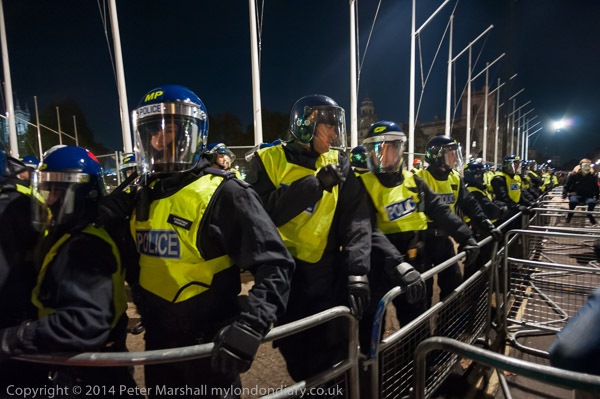
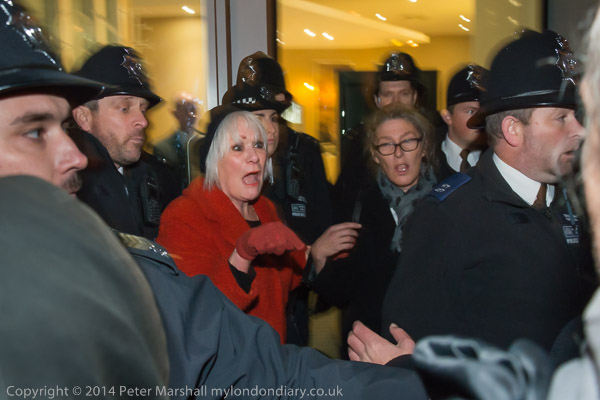
For reasons best known to them, the police went ballistic, calling in first the Fire Brigade, who were clearly not pleased to have been troubled and arrived some time later with just a bucket of water when the fire was already more or less burnt out, and then making the scene a major emergency with police vans, cars and blue flashing lights, before surrounding and arresting Class War’s Jane Nicholl.

Jane is arrested – Nov 5th 2014

The crowd surrounded them and tried to prevent her being taken to the police van, but there were now probably more police then protesters and they managed to force their way through. Another protester was also arrested and taken to a van, I think for being one of the fifty or more who had tried to stop Jane’s arrest.

Surprisingly Jane Nicholl’s case was actually taken to court, but the police were unable to produced any evidence that anyone had been ‘injured, interrupted or endangered’ by the burning Boris – with the prosecution having already admitted that burning effigies on Bonfire night was perfectly lawful and the case – which had already been altered three times to try to find different offences – collapsed. Clearly the police and Crown Prosecution Service were using the arrest and trial simply to harass and intimidate Class War into ending their ‘Poor Doors’ protests. As they did with other arrests on other occasions, none of which led to a conviction.

I don’t know if there will be people trying to take part in a ‘Million Mask March’ in London this year despite the lock-down; the Facebook pages have only small numbers signed up though already well over 6,000 have expressed an interest for Nov 5th 2021. I suspect police will be out in force as in previous years to stop the event taking place. But I’ll certainly be staying at home.


All photographs on this and my other sites, unless otherwise stated, are taken by and copyright of Peter Marshall, and are available for reproduction or can be bought as prints.


Notting Hill in colour – 1997 Part 3

Another set of pictures from the 1997 Notting Hill Carnival.

Notting Hill Carnival, 1997 97c8-nh-075_2400

Various organisations take part in carnival, including religious groups, notably The Nation of Islam,

Notting Hill Carnival, 1997 97c8-nh-091_2400

and some trade unions who show a little more of the carnival spirit.

Notting Hill Carnival, 1997 97c8-nh-099_2400

It’s a time for dancing on the streets, and at times its difficult to hold the camera steady, with music you don’t just hear but which sets your internal organs vibrating and even the tarmac under your feet.

Notting Hill Carnival, 1997 97c8-nh-101_2400
Notting Hill Carnival, 1997 97c8-nh-109_2400

It’s hard to capture the intensity of the event, and a kind of glorious disorder on the streets.

Notting Hill Carnival, 1997 97c8-nh-113_2400
Notting Hill Carnival, 1997 97c8-nh-126_2400

Some people are insistent that I take their picture – and of course I oblige.

Notting Hill Carnival, 1997 97c8-nh-131_2400

But it all gets a bit too much for some. And after some hours I get to feel rather like this and decide to go home and rest. Because after the Children’s Day on the Sunday comes the main day on Monday when the streets are more crowded and the dancing more frenetic.

More carnival pictures:

Notting Hill Carnival – the 1990s
Notting Hill Panoramas – 1992


All photographs on this and my other sites, unless otherwise stated, are taken by and copyright of Peter Marshall, and are available for reproduction or can be bought as prints.


Trump

Although I’ve photographed many politicians, most of them have been from opposition parties, and I’ve tried to ignore and avoid those whose views I disagree with. There have been a few exceptions – and I think I have at least once photographed people like David Cameron, Boris Johnson, and people on the more extreme right like Nigel Farage, Nick Griffin et al.

There are politicians I’ve liked, and examples that spring to mind include Tony Benn, John McDonnell and of course Jeremy Corbyn, though I’m certainly not going to burst into song over him. But I have met and listened to him speaking and occasionally talked with him over the years and have always been positively impressed.

The only problem I have with Corbyn is that he belongs to a party which also includes many MPs and staff who support colonialist and capitalist policies which favour the rich and wealthy in our world over the interests of the poor both in this country and overseas, and schemed against him both when he was leader. He is perhaps unfortunately not a politician, but an honest and sincere man – and one who has fought against injustice and racism in all its manifestations.

But back to Trump. Although I’ve never really had the opportunity to photograph him, if I put his name into the search box on ‘My London Diary’ it comes up with 30 results – pages of protests or protesters against him. And although I don’t know when we will find out the results of today’s US elections – probably not for some days or even weeks – I shall be rather sorry and rather worried if it results in a Trump victory. Not that I will be that pleased if Biden wins. It’s a choice between a major and a minor disaster for the world; the only possible positive result would be an overwhelming write-in vote for “neither of the above”. Though of course such a democratic decision would be surely ignored.

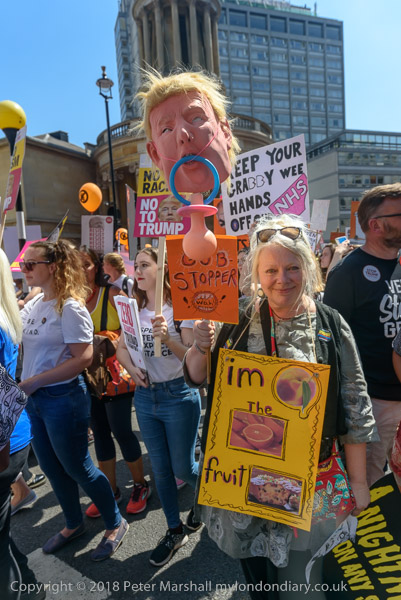
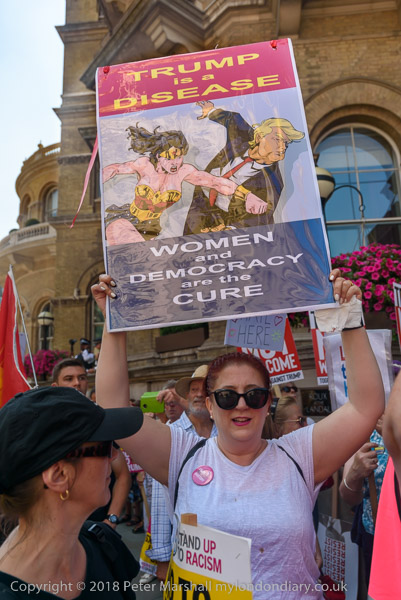
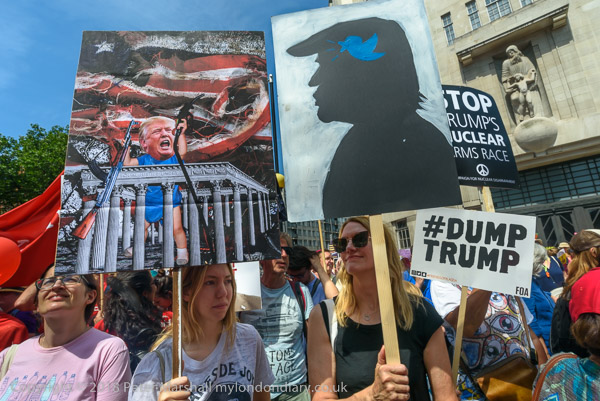
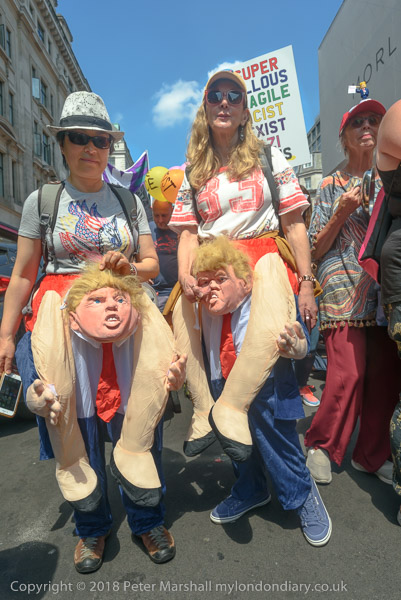
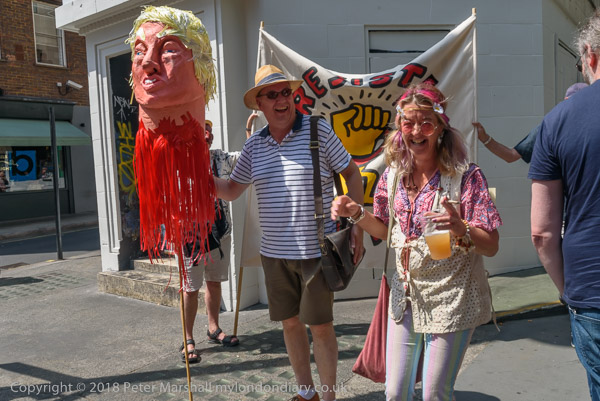
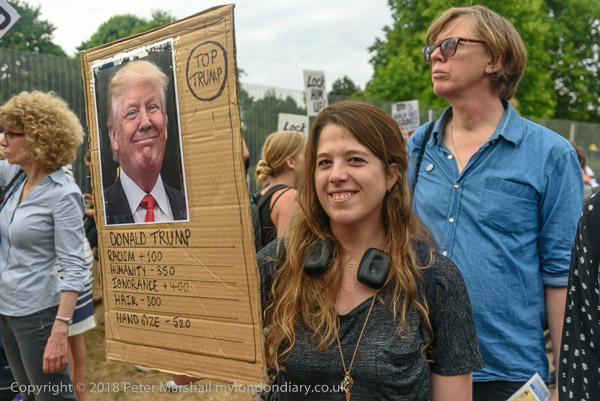
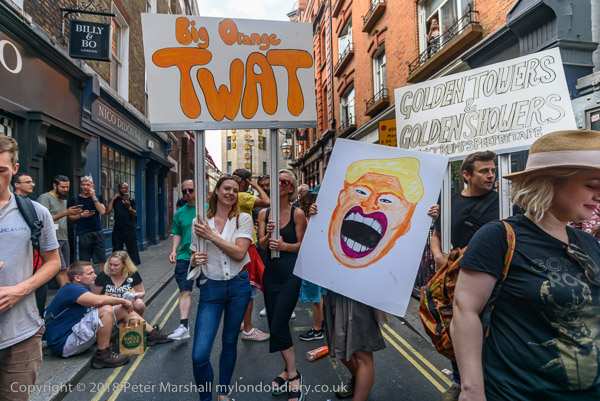
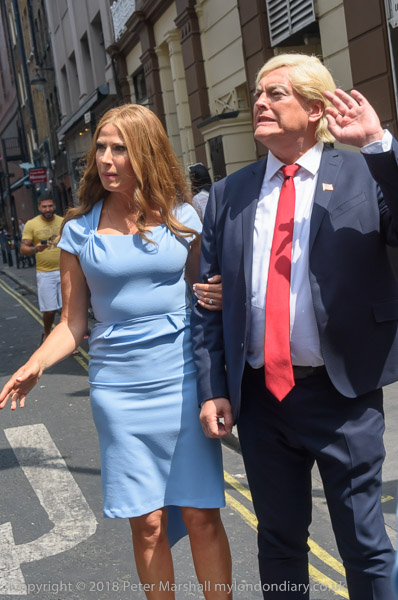
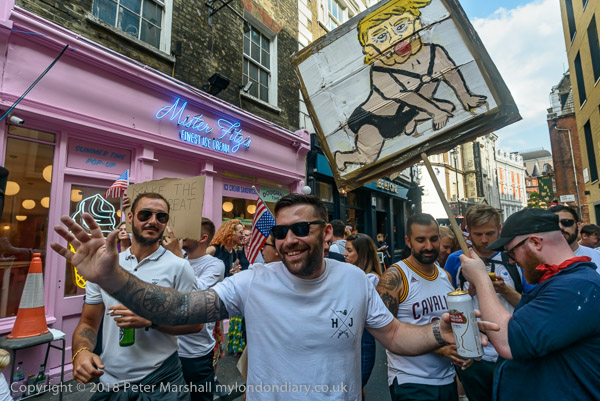
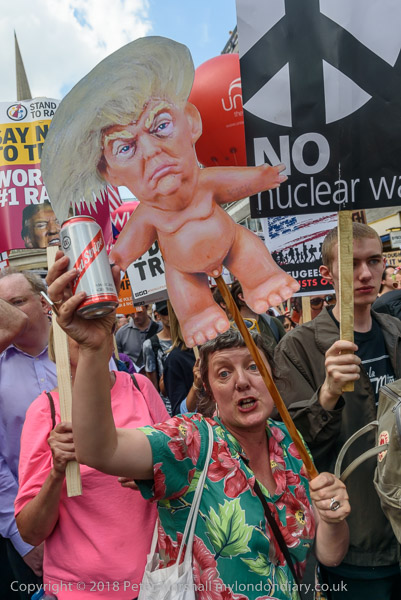
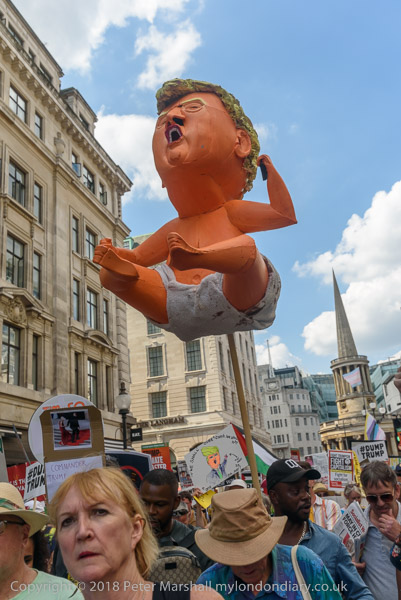
Anyway, here on election day, a few images of ‘Trump’ for you from the protests against his visit to London in July 2018. I’ve chosen only those that represent him visually, but there are many others of protesters with banners and placards about him in the links at the bottom of the post.

July 2018 protests against Trump’s UK visit:

US Embassy protest says NO to Trump
Noise protest against Trump
‘Trump: Climate Genocide’ Giant banner
‘Bring The Noise’ Women march against Trump
Soho parties to protest Trump’s visit
Massive protest against Trump’s Visit
Against Tommy Robinson & Trump


All photographs on this and my other sites, unless otherwise stated, are taken by and copyright of Peter Marshall, and are available for reproduction or can be bought as prints.


Notting Hill in colour – 1997 Part 2

Here are a few more from Ladbroke Grove in 1997, I think all from the first day of the event, the Children’s Day on the Sunday.

Notting Hill Carnival, 1997 97c8-nh-040_2400

I think all of these pictures were taken with a 28mm or 35mm lens, probably on a Minolta CLE (the improved successor to the Leica CL) using Fuji Super G 400 colour negative film.

Notting Hill Carnival, 1997 97c8-nh-047_2400
Notting Hill Carnival, 1997 97c8-nh-056_2400

I did take more photographs of the children, but while the costumes may be cute and sometimes very colourful (though not in this example) they generally lack the exhuberance of older revellers and I found them of less interest. There are more of the children in the album on Flickr.

Notting Hill Carnival, 1997 97c8-nh-058_2400
Notting Hill Carnival, 1997 97c8-nh-066_2400
Notting Hill Carnival, 1997 97c8-nh-072_2400

I took several pictures of this young woman holding a child as she danced beside one of the floats pumping out fairly deafening music, and this one I think shows her and the child both enjoying the moment.

Notting Hill Carnival, 1997 97c8-nh-073_2400

But the second frame puts her better into the whole siuation, part of the crowd moving down the street with the lorry.

All these pictures were taken within a few minutes of each other, and I made many more during the two days of carnival – and will post more another day. As usual you can see any of them larger in the album by clicking on them – and can then continue to view more if you wish.


All photographs on this and my other sites, unless otherwise stated, are taken by and copyright of Peter Marshall, and are available for reproduction or can be bought as prints.