Dance Against Cuts & Solidarity With the Thessalonaki 4 – 2011

Dance Against Cuts & Solidarity With the Thessalonaki 4: Two protests on Friday 14th January 2011 had little in common except that both were in part against the violence, lies and deception of the authorities, both here in the UK and in Greece.


Dance Against The Deficit Lies

Royal Exchange, Bank

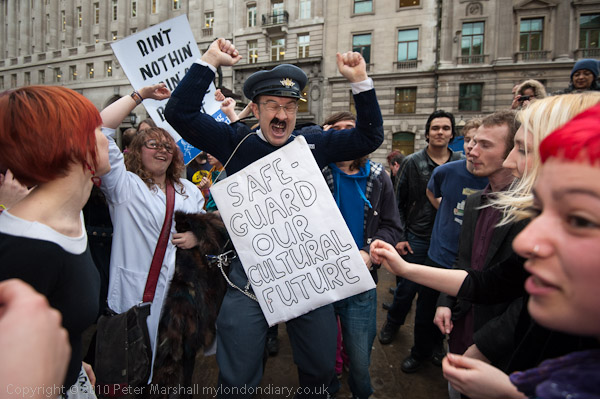
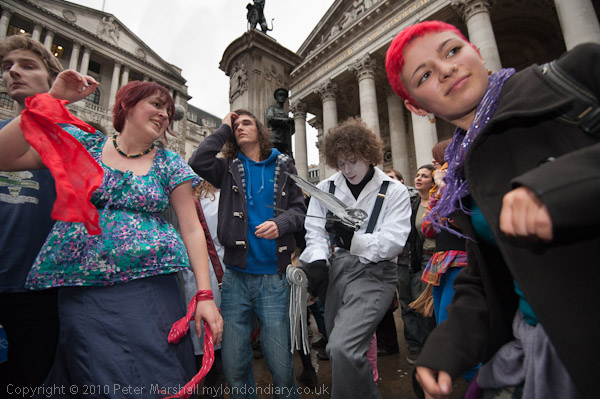
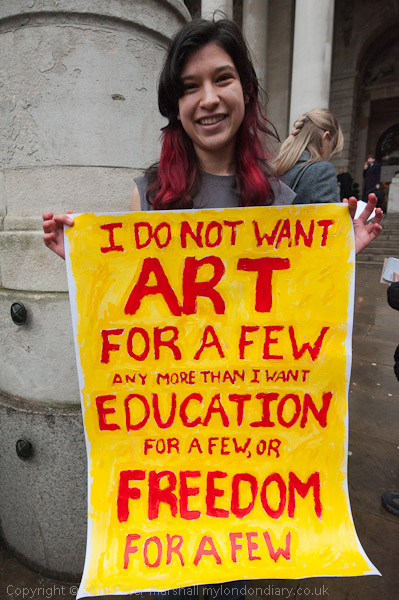
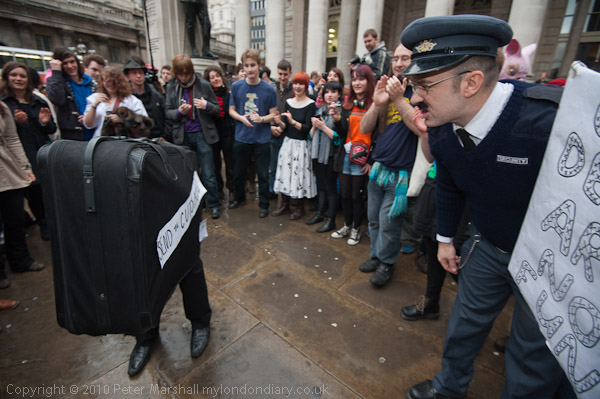
Campaigners against the savage cuts in arts and community funding by the Tory-led coalition government in the UK came to perform outside the Royal Exchange and Bank of England in a way deliberately planned to avoid confrontation with police, limiting their protest to exactly and hour and making it “playful with purpose, (so) that any aggression whatsoever (police kettles or the tiny few protesters who throw stuff) will simply look preposterous.”

The location was one “with resonances for many protesters, where some of the worst excesses of police violence and over-reaction took place at the protests against the G20, and close to where Ian Tomlinson was attacked by a police officer and died.”

At the centre of the City of London it was also appropriate for cuts that reflected the huge rescue package given to bail out the banks after their irresponsible behaviour, and to protest about their continuing excessive salaries and indecent bonuses.

It was a relatively small protest, with almost as many spectators and photographers as the hundred or so taking part, and enlivened by performances and dance rather than angry chanting. And the police for once simply stood back and watched.

The organisers pointed out that Britain is still revered for around the world, and that it brings in money to the country. “Cuts to the arts are idiotic and short sighted.” They questioned why the levy on banks was “being reduced, and why the government is not imposing measures such as the Tobin or Robin Hood tax on financial transactions that would not only being in much-needed income to reduce the deficit but would provide a beneficial stability by dampening speculation.”

Dance Against The Deficit Lies


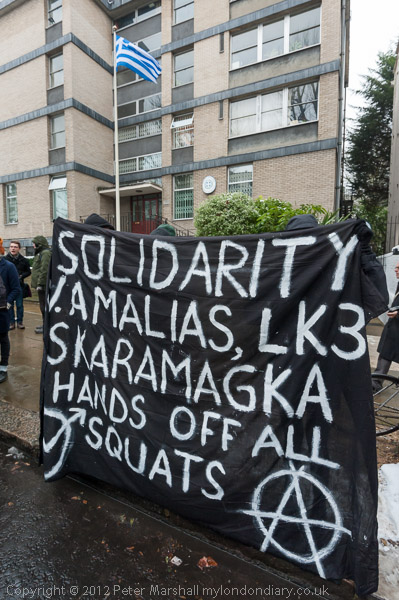
Solidarity With the Thessalonaki 4

Greek Embassy, Holland Park

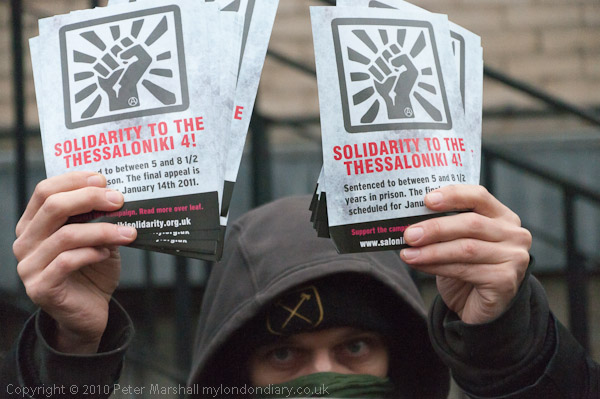
Back in June 2003, a number of protesters were arrested in a violent police attack on an anti-capitalist protest against an EU summit in Thessaloniki, Greece. They included the English anarchist, Simon Chapman, a supporter of various anarchist groups including Class War.

Seven of them, including Chapman, had later gone on hunger strike against their arrests and were finally released at the end of November 2023, following a huge solidarity campaign across Europe. Among those calling for their release were 28 EU MPs and Amnesty International. All charges against the prisoners were dropped and Simon came home to England.

Photographic and film evidence proved beyond and doubt that Chapman had been framed, charged with having three black bags containing Molotoff cocktails and dangerous weapons (a hammer and a pickaxe handle.) Photographs showed that when arrested he was carrying a blue bag, and a film clearly showed Greek police planting these black bags on him after his arrest.

But despite this the Greek state was not prepared to drop the cases, and after “repeated appeals from the Greek state prosecutor the charges against four of the original seven were re-instated.” And despite the evidence in 2008 all of these four were found guilty.

Under the threat of a European Police Warrant … Simon was forced to return to Thessaloniki in 2010 to appeal the conviction.” But this time the evidence resulted in all the major charges being thrown out, with all four instead being found guilty of a “minor defiance of authority” to justify the time they had previously spent in jail. And Chapman came back to England and Class War.

But the Greek experience had scarred Chapman and he never really recovered from being arrested and his treatment in prison, and the health effects of the lengthy hunger strike, dying at only 40 in 2017.

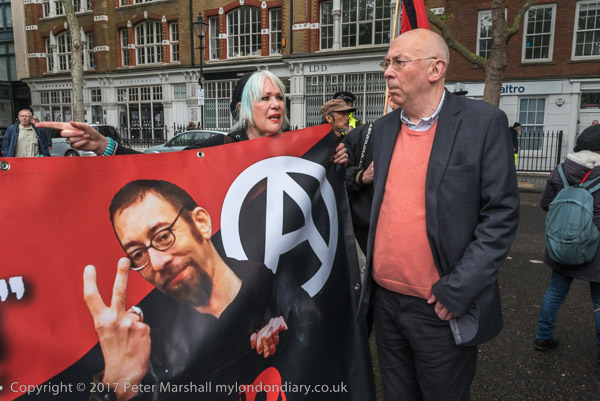
Class War with their banner in memory of Simon Chapman – May 1 2017

Class War came to the May Day march that year at Clerkenwell Green with a new banner in his memory, and also copies of a new Class War newspaper to sell. When the march set off for Trafalgar Square they “marched only the few yards back to the pub, where I joined them later” to celebrate Simon’s life.

Solidarity With the Thessalonaki 4


FlickrFacebookMy London DiaryHull PhotosLea ValleyParis
London’s Industrial HeritageLondon Photos

All photographs on this page are copyright © Peter Marshall.
Contact me to buy prints or licence to reproduce.
November 2014 (4)

One of the more disturbing trends in Britain over the past ten years has been the rise of fascism, both in mainstream politics and also in the rise of various extreme right groups. We have a government which is increasingly prepared to act outside the law – prime examples including the Home Office’s ‘hostile environment’ set up by Theresa May, Boris Johnson’s attempt to close down Parliament and more recently to renege on parts of our agreement with the UK – and whose actions have encouraged extremist overtly racist and Islamophobic groups. But it isn’t just in the UK, and Germany, Poland and Greece are among other countries to have seen similar movements on a larger scale.

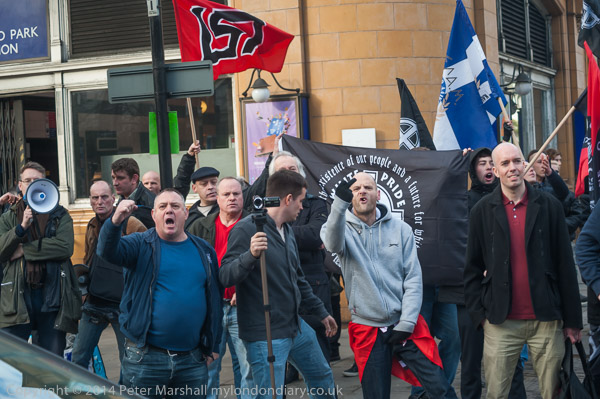
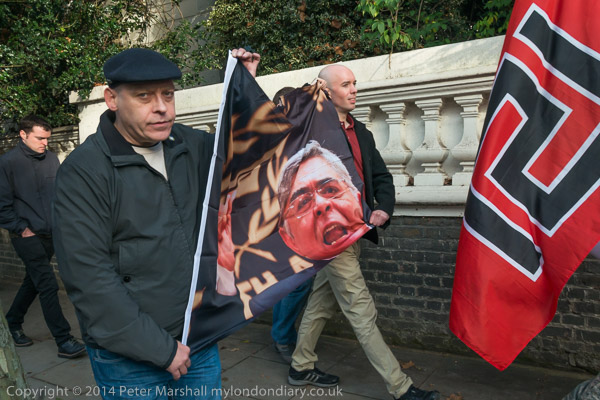
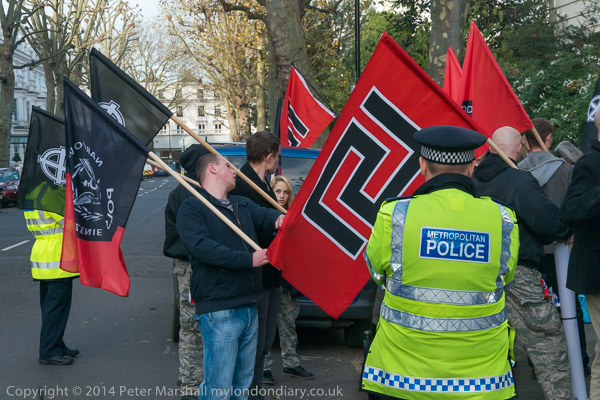
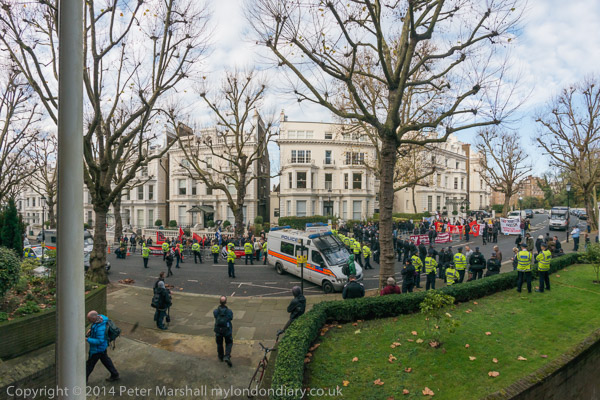
One of the nastier to crawl out from under the stones is the neo-Nazi Golden Dawn in Greece, where 50 leading members were then on trial in Athens for violent attacks, firearms and other offences. In the UK, New Dawn was set up in 2013 in support of the Greek organisation and, together with Polish neo-Nazis in the UK and British ‘White Pride’ supporters they had planned to march in London to the Greek Embassy to call on the Greek government calling on them to drop the charges and release the Golden Dawn leaders.

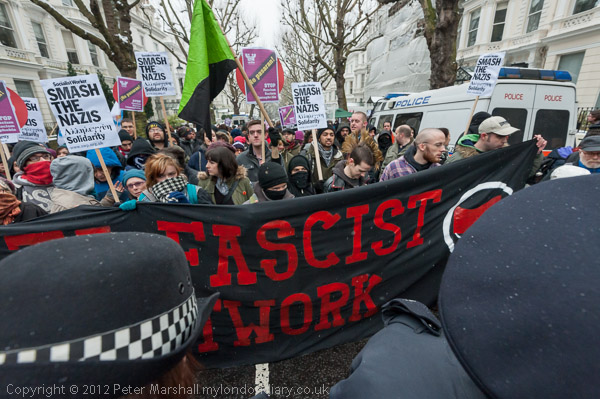
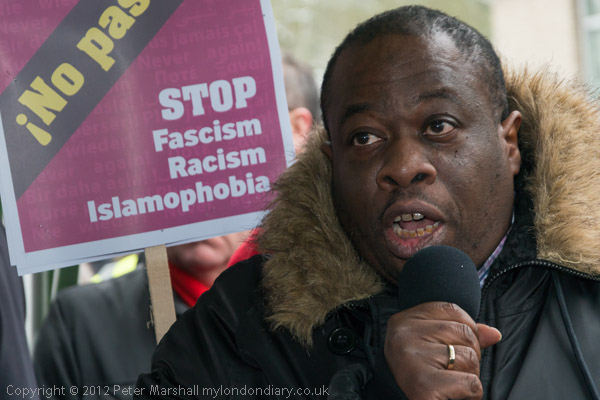
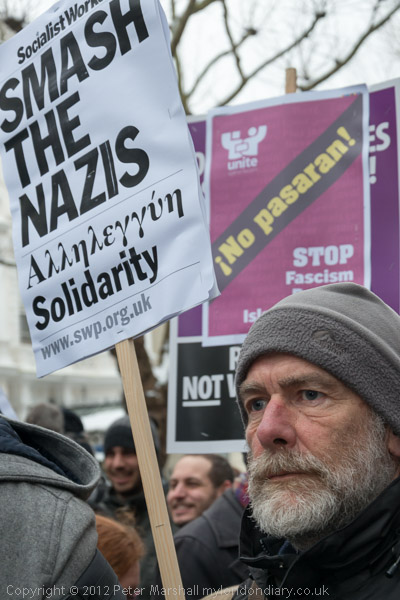
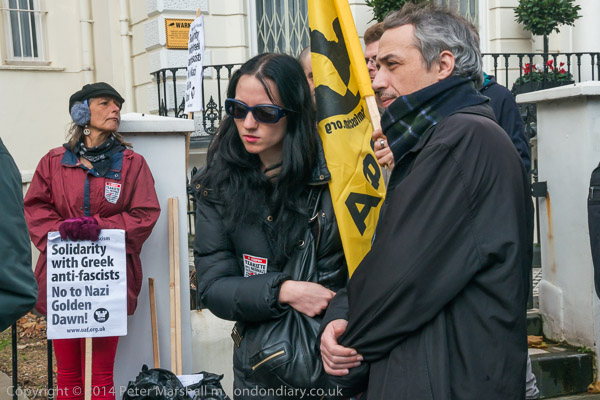
Their march was facilitated by the police and opposed by UK anti-fascist activists including Antifascist Action for Greece, Unite Against Fascism and many trade unionists, who gathered opposite the Greek Embassy an hour before the Golden Dawn supporters were due to arrive.

I don’t enjoy photographing extreme right groups, who tend to be hostile, and as usual I was threatened and spat at, though the police presence prevented any physical violence and stopped the press getting really close to the protesters. As a journalist I would have liked to have been able to talk to some of them, but this wasn’t possible, and their approach to the press generally is to shout insults and complain the press treat them badly by reporting their actions. I think we generally report accurately and if reports are bad it is because their actions are reprehensible.

Both police and protesters tried to prevent me and the other photographers taking pictures and, not unusually, I and others were threatened with arrest. A videographer with the protesters made a point of recording those of us who were taking photographs. Those of us who report on right-wing protests have become used to having our pictures posted on the web with the intention of provoking violence against us.

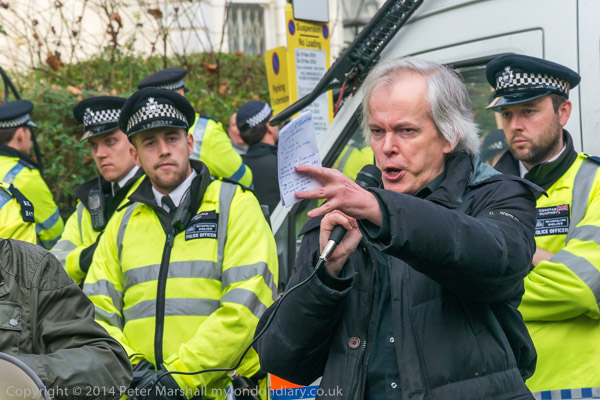
The main speaker at the event was Peter Rushton of the England First Party, associate editor of its magazine, Heritage and Destiny. According to Hope Not Hate he was expelled from the BNP in 2002, joining the more extreme White Nationalist Party, and later the British People’s Party. Reputed to be one of Britain’s leading Holocaust deniers they say he was a close friend of the banned terror group National Action.

I left after photographing Rushton speaking, walking through the police lines to make my way to Holland Park underground station. I thought it wise to leave the area before police allowed the New Dawn protesters to leave.

More at Neo-Nazi ‘Free the Golden Dawn’ Opposed.