State Opening, Class War and Student Protests

I usually make a point of keeping away from the big occasions such as the State Opening of Parliament, but made an exception on Wednesday May 27th 2015, partly because I had been told that Class War were planning to come and protest, but mainly as there were other events I was intending to photograph later in the day.
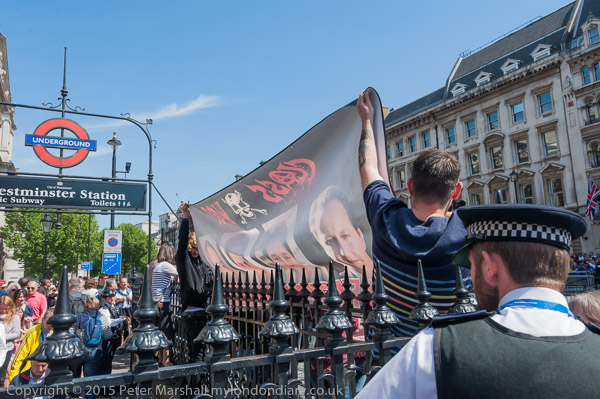
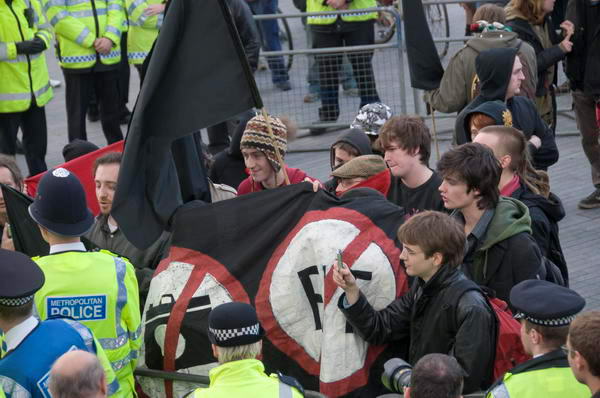
Class War arrived too late to reach the centre of Parliament Square where they had hoped to display their banner and the area was already tightly sealed off by police. Police security for royal events is always very tight and as on this occasion often goes well beyond what is legal. So although they managed to briefly display their banner well before the Queen’s coach arrived they were quickly forced to take it down and pushed away. Around 50 police then followed the dozen or so as they made their way to a nearby pub and a few more supporters, and stood around for an hour or so looking as if arrests were imminent before most of them moved off, but police continued to follow the group until they left Westminster. Two other people who had been showing posters against austerity in Parliament Square were arrested despite their actions being perfectly within the law; they were released without charge a couple of hours late.
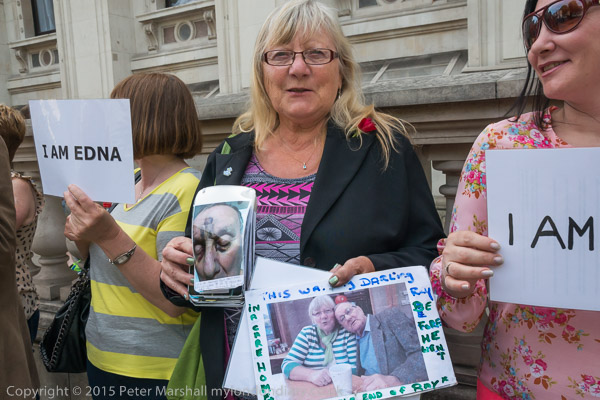
I walked from the pub up to Downing St, where a line of people from Compassion in Care where holding up posters and calling for ‘Edna’s Law’ which would make it a criminal offence to fail to act on the genuine concerns of a whistle-blower, and would make the state protect whistleblowers rather than them having to spend thousands of pounds on taking their cases for unfair dismissals to industrial tribunals. They say current law, the Public Interest Disclosure Act 1998 which has failed to protect the public, the victims or the whistle-blowers. So far nothing has changed.
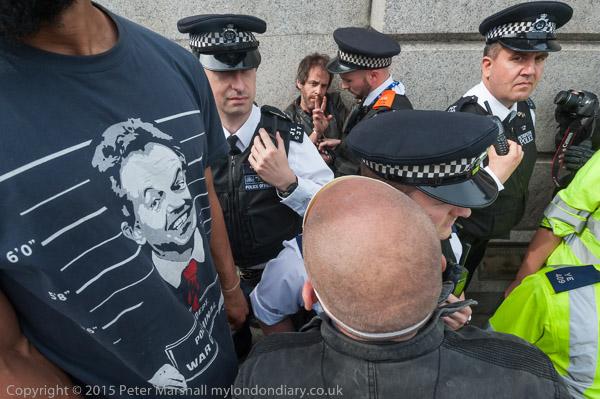
As I arrived in Trafalgar Square where people were gathering for a protest against education fees and cuts there was an angry scene when a squad of police surrounded and arrested a man, refusing to talk with any of those in the crowd around about their actions. Had they explained at the time that the man being arrested had been identified as someone who was wanted for an earlier unspecified offence and was being taken in for questioning, it would have defused the incident, but this was only revealed after the man – and one of the protesters who had questioned the police about their action – had been put into a police van a short distance away and driven off.
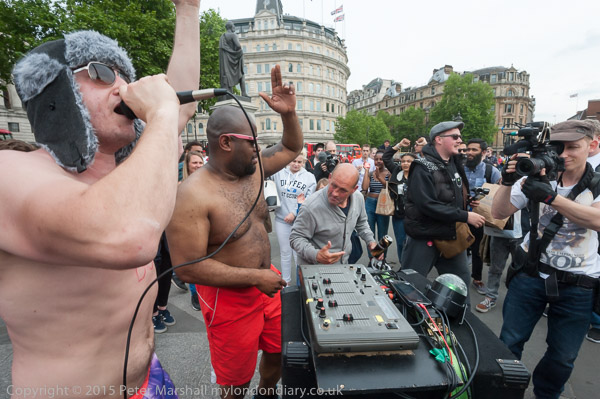
Back in Trafalgar Square there was music as we were waiting for the National Campaign Against Fees and Cuts protest to begin, provided by ‘Disco Boy’ Lee Marshall from Kent who had brought a mobile rig to Trafalgar Square. Apparently as well as running local discos he has a huge social media following.
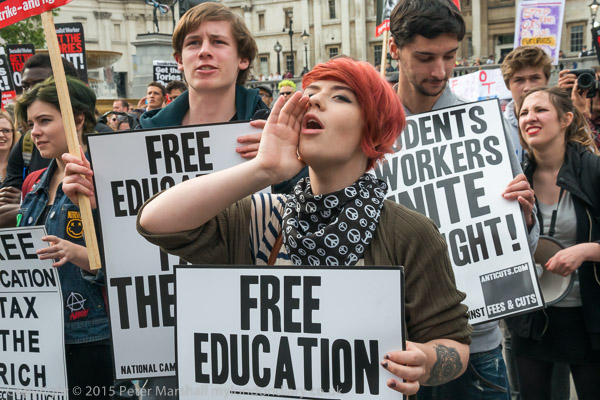
Finally the NCAFC protest got under way, with a good crowd of mainly students in Trafalgar Square and speakers on the plinth of Nelson’s Column.
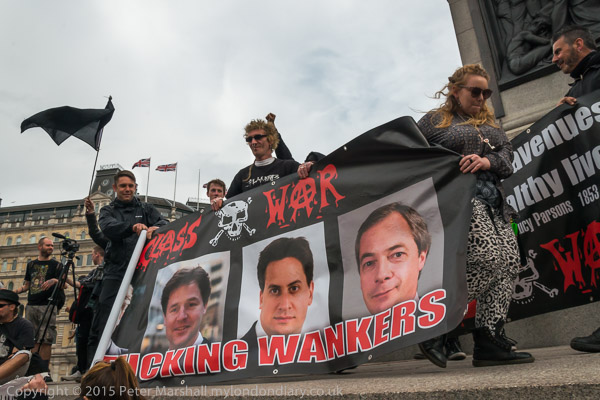
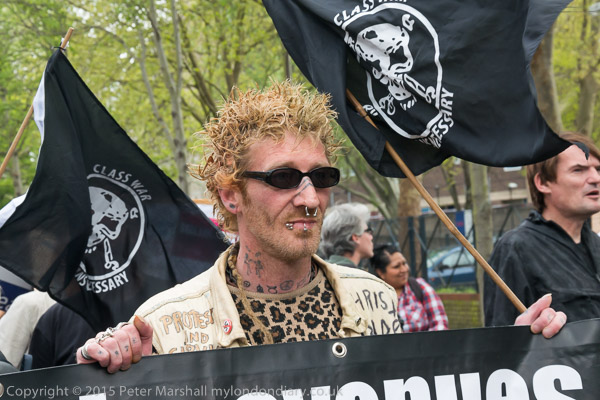
Class War came along (still followed by police) and there were cheers as they displayed their several banners; also taking the stage and marching with the students were the Hashem Shabani group of Ahwazi Arabs, who later held their own protest.
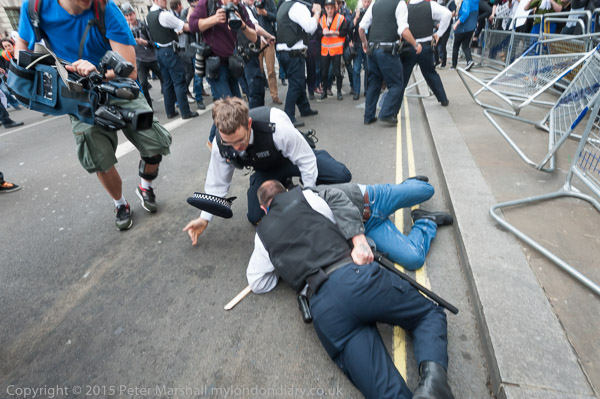
After the speeches in Trafalgar Square the NCAFC protesters set off to march to Parliament. Police tried to stop them with a line of officers and barriers at Downing St, but there were too few officers and many of the protesters walked around them and the barriers. Police apparently randomly picked on a few of the demonstrators and tackled them with unnecessary force making several arrests. The protesters continued marching around Westminster for some hours, but I left them at Parliament Square.
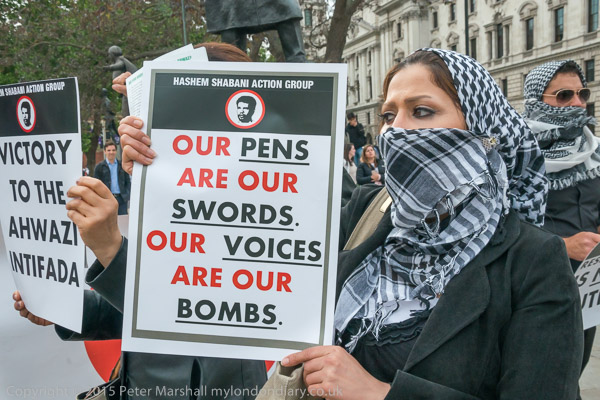
I finished my day’s work in Parliament Square with the Ahwazi Arabs who protested there against the continuing Iranian attacks on their heritage and identity since their homeland, which includes most of Iran’s oil was occupied by Iran in 1925. The occupation was important in protecting the interests of the Anglo-Persian Oil Company, effectively nationalised by the UK government in 1914 (later it became the Anglo-Iranian Oil Company and then in 1954, BP) and even after the nationalisation of Iran’s oil, BP remained a leading player in the consortium marketing Iranian oil.
London 14 May 2016

Class War at UVW protest against Topshop sacking and suspensions of cleaners

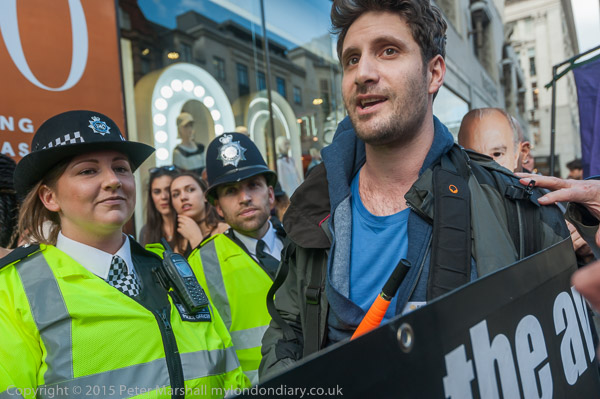
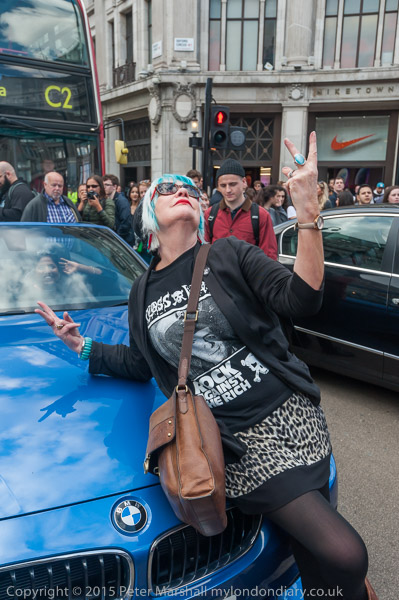
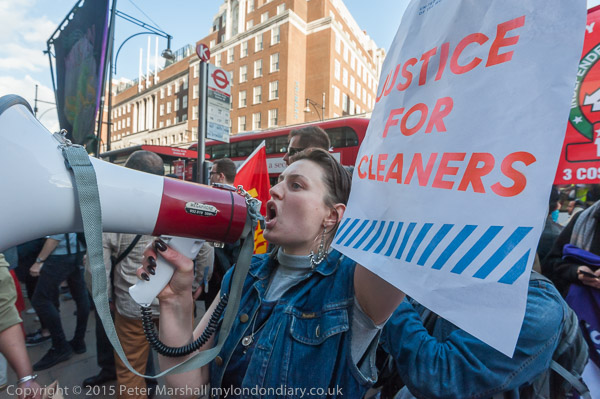
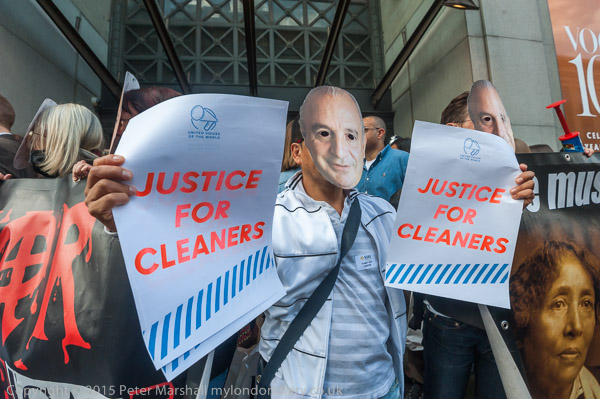
May 14 has always been a special day for me, and five years ago I celebrated my birthday on the streets of London photographing various protests around town before going home to a more private event. The day’s work ended for me on Oxford St, where the United Voices of the World union were protesting against Philip Green’s Topshop after members who work as cleaners were suspended and one sacked for their union activities – demanding the London Living Wage. The protest was supported by other groups including Class War, cleaners from the CAIWU and other trade unionists including Ian Hodson, General Secretary of the BWAFU and Shadow Chancellor John McDonnell. Although Philip Green makes millions, the cleaners were on the national minimum of £6.70 per hour, nothing like a enough to live on in London.

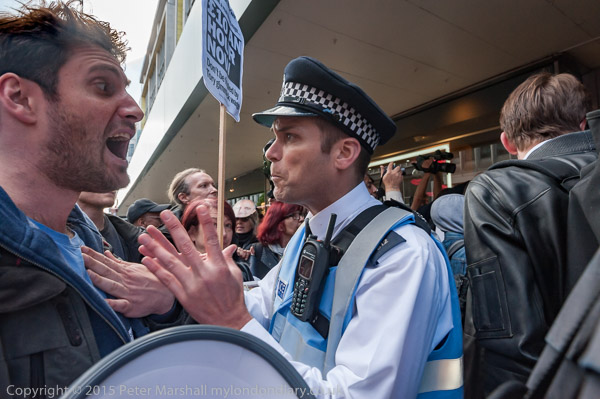
Police were out in force to prevent the protesters entering the Topshop store and there was a noisy protest on the pavement for some time facing the line of police before Class War led the protesters into the centre of the road to block Oxford St.

Police tried to clear the road, and began threatening arrests and the protesters decided to march west down Oxford St, briefly blocking Oxford Circus

before stopping to protest outside John Lewis, where the UVW have been campaigning for several years to get the cleaners recognised as a part of the workforce with similar respect and conditions of service to other John Lewis staff.

There were heated arguments as police manhandled some of the protesters there, but things calmed down a little and the campaigners moved on for a final protest outside the Marble Arch Topshop.

Things seemed to be coming to an end and I was late for dinner so I hurried away.

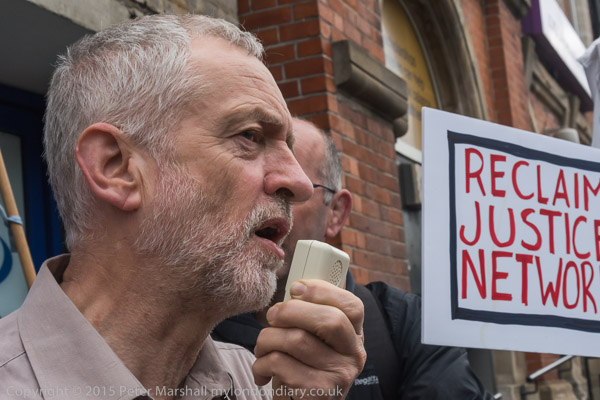
My day’s work had begun in Holloway, where Islington Hands Off Our Public Services, Islington Kill the Housing Bill and the Reclaim Justice Network were holding a rally and march to HMP Holloway, demanding that when the prison closed the site be used for much-needed social housing and community facilities, rather than for expensive private flats. Local MP and Labour Party leader Jeremy Corbyn rode up on his bike to speak at the rally.

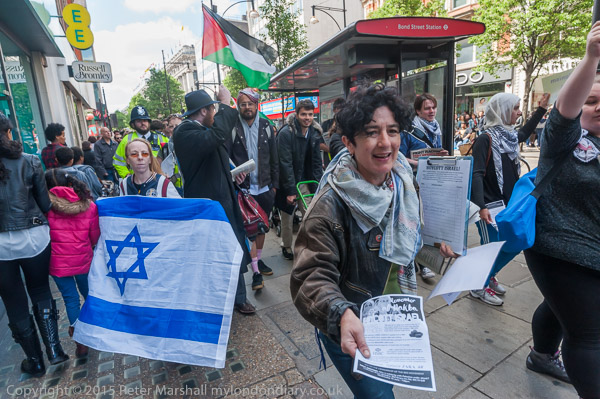
I moved on from the rally at the end of the march outside Holloway Prison to Oxford St, where the Revolutionary Communist Group and friends were reminding shoppers of the continuing oppression of the Palestinian people, and opposing attempts to criminalise and censor the anti-Zionist boycott, divestment and sanctions (BDS) movement. The rolling picket urged shoppers to boycott stores which support and fund Israel, including Marks and Spencer, and stopped for brief speeches in front of some of them for short speeches.

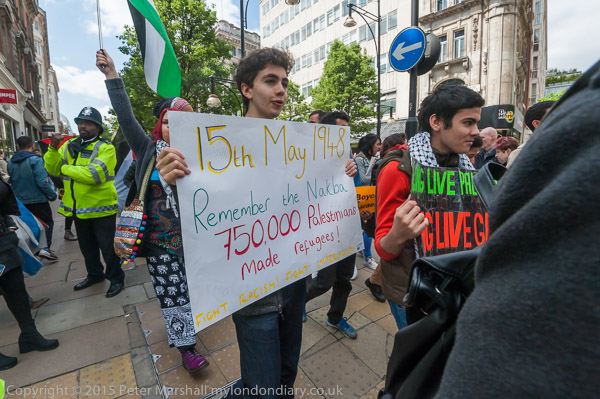
A small group of militant Zionists had come along to wave Israeli flags and shout insults at them. The protesters (who included several Jews and some Palestinians) made clear that this was not an anti-Semitic protest but against some actions of the Israeli government and it took place the day before Nabka Day, the ‘day of the catastrophe’, remembering when roughly 80% of the Palestinian population were forced to leave their homes between December 1947 and January 1949, and later prevented by Israeli law from returning to their homes, or claiming their property. This year the attacks on Palestinians in Jerusalem have largely been precipitated by the continuing attempts by Jewish settlers to displace the Palestinian population of Sheikh Jarrah in East Jerusalem. Founded in 1865, the area became home to Jerusalem’s Muslim elite, but in 1948 became home to Palestinian refugees from Jerusalem.

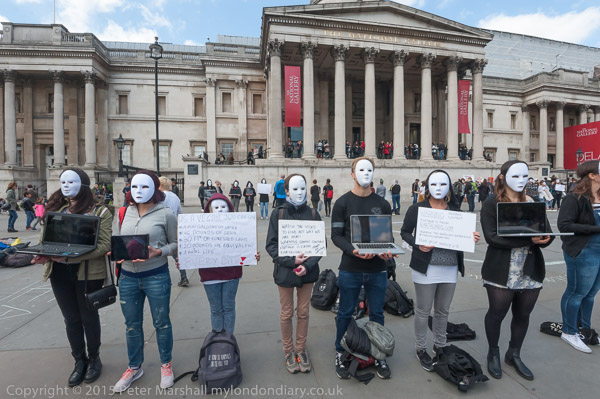
Vegans had come to Trafalgar Square holding laptops and tablets and wearing masks to show the film ‘Earthlings’ which includes scenes of horrific cruelty to animals and calling for an end to the farming and eating of animals. Some also pointed out the contribution that becoming vegan could make towards solving the climate crisis as Vegan dietts use less water, land and grain and produce less CO2.

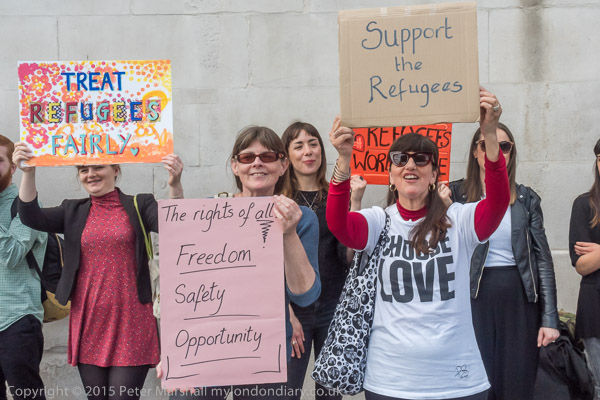
Also on the North Terrace of Trafalgar Square were a small group of protesters standing in front of the National Gallery who held posters calling for human rights, fair treatment and support for refugees. Some held a banner with the message ‘free movement for People Not Weapons’.

More about all these protests on My London Diary:

Topshop protest after cleaners sacked
Refugees Welcome say protesters
Vegan Earthlings masked video protest
68th Anniversary Nabka Day
Reclaim Holloway

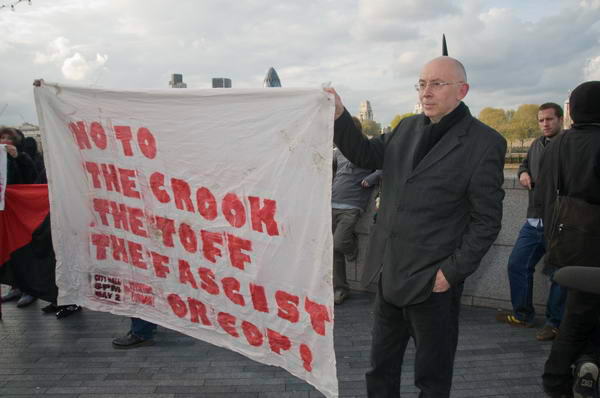
No to the Crook, the Toff, The Fascist or Cop

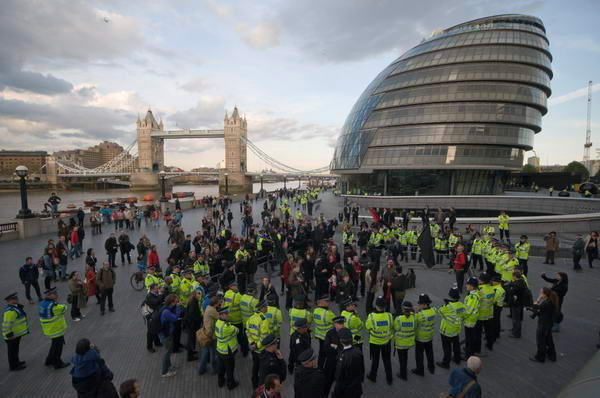
Protesters kettled outside City Hall as the Mayoral election results announced in 2008


London’s electors in a few days time will be faced with a rather bewildering array of candidates, with 20 names appearing on the ballot paper.

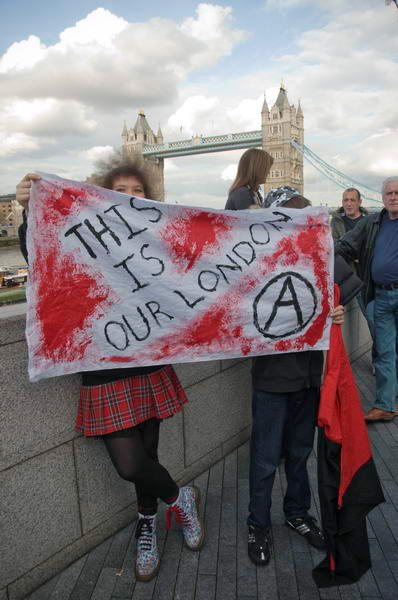
Ian Bone of Class War and banner ‘No to the Crook, the Toff, The Fascist or Cop’ 2008

Current mayor Sadiq Khan is hoping for re-election and his chances are probably good and he has enjoyed a good lead in opinion polls with a roughly 20-25% lead over his nearest rival, the Conservative Shaun Bailey. He could even get the 50% needed to win on the first preference votes and is likely to end up with over 60% when second preferences are included.

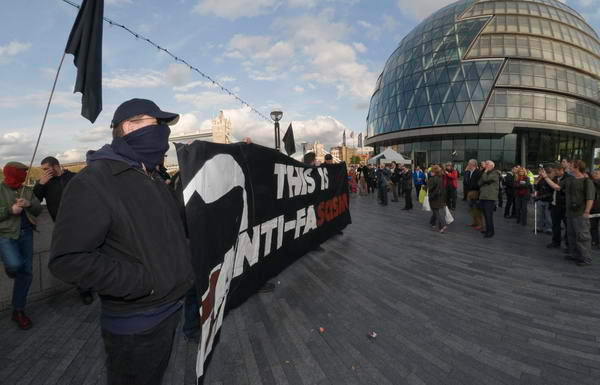
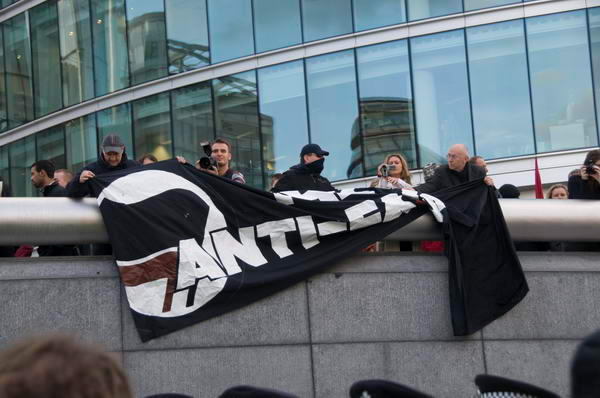
Anarchists raise the anti-fascist banner at City Hall 2008

Bailey, like Conservatives standing in the various elections around the country, is rather likely to pick up votes because of the success of the Covid vaccination rollout, a rather unfair consequence as it was Tory incompetence that really got us into the huge mess – with bodies piling up in mortuaries if not on the streets, and the NHS, which they have been doing their best to privatise out of existence over the years, which got ahead and got on with the jabs – and fortunately the government, having perhaps learnt a little from the test and trace debacle, let them get on with it rather than giving jobs to their mates.

It’s a slightly unusual voting system, with the second round of counting including only the two leading candidates. But it does mean that if you are a Khan supporter you could safely vote for any other candidate than Bailey as first preference, knowing that you second preference for Khan would count for him in the end.

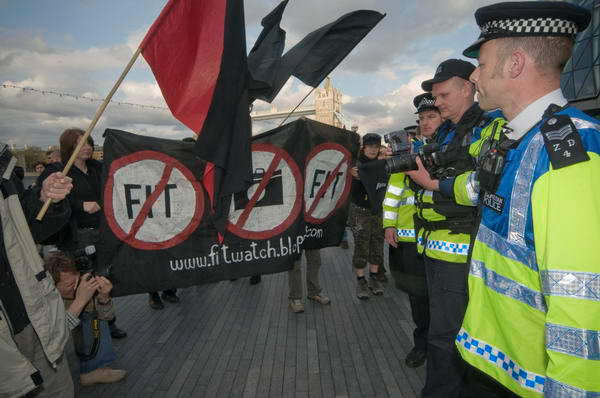
Fitwatch hold their banner in front of the police photographer 2008

Opinion polls suggest that on this basis YouTuber Niko Omilana might come out third on the first preference votes, well above either the Green Party’s Sian Berry or Lib Dem Luisa Porritt, either of whom would clearly make rather better mayors than him.

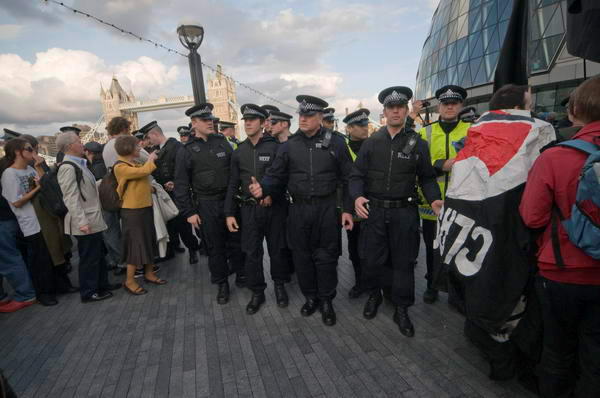
Police TSG arrive to clear the area. 2008

The 15 other candidates seem unlikely to gain much benefit from the voting system and will almost certainly all lose their £10,000 deposit. They cover a wide range from various fringe parties, serious single-issue candidates to various more or less entertaining idiots such as Count Binface. Even at odds of 800 to 1 it isn’t worth betting on him.

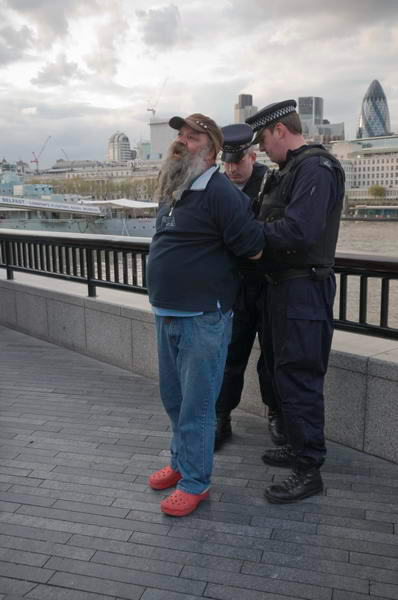
Police arrest a man who had been sitting quietly by the river

Back in 2008 there were fewer candidates, but it was sadder times as London was announcing the election of its worst mayor yet, though at least he did continue some of the previous incumbent’s policies, and some of the advisers he employed were competent. But the years Johnson was mayor were something of a disaster for Greater London – which he has gone on to repeat for the country as a whole.

Some of the protesters were surrounded and held for several hours

The ‘No to the Crook, the Toff, The Fascist or Cop’ protest by anarchists had its moments of farce, beginning with the police photographer taking an unusual interest in me as I sat reading a paperback. I just happened to be in the middle of John Updike’s ‘Terrorist’ at the time. Although I clearly watched him taking pictures, when I later made a freedom of information request about this an other occasions I’ve been photographed, the answer came back that there were no pictures of me.

Others had escaped as police moved in and showed the banner from a balcony before going to the pub

You can read more about what happened and see more pictures on My London Diary:
No to the Crook, the Toff, The Fascist or Cop


All photographs on this and my other sites, unless otherwise stated, are taken by and copyright of Peter Marshall, and are available for reproduction or can be bought as prints.


Reclaim Brixton 2015

Brixton has been in the news again recently, with various analyses published on the 40th anniversary of the 1981 Brixton uprising (aka Brixton riots) which began on 10th April. Official reports put the 3 days of unrest which caused £7.5m of damage and left almost three hundred police (and an impossible to estimate number of the local community) injured down to poor housing, unemployment, and police harassment.

It was largely the actions of the police that led to the events. Their failure to effectively investigate the arson attack on a party in New Cross which killed 13 young black people in January 1981 scandalised much of the nation and the racist reaction of the mass media to a protest march about this raised tension, exacerbated by the police arrests of the march organisers who were charged with riot – and later acquitted. But the final straw was when police at the beginning of April began ‘Operation Swamp 81’ with large numbers of officers coming into Brixton and stopping an searching almost a thousand people – almost entirely African-Caribbean – under the ‘Sus law’, the 1824 Vagrancy Act which allowed police to stop and search anyone they believed was acting suspiciously.

Little changed after the official reports came out, and it was only 19 years later, following another scandalous police failure to properly investigate the murder of Stephen Lawrence in April 1993 that the Macpherson report found that the Metropolitan Police was institutionally racist. Although some changes have been made, there are still plenty of signs that this continues to be deeply embedded in the ethos of the force.

The publication of ‘The report of the Commission on Race and Ethnic Disparities’ on 31st March this year (2021) came at perhaps a particularly insensitive time for a report that is widely seen as a whitewash by a commission set up to reflect particular views. Set up in opposition to the protests by the Black Lives Matter movement over the death of George Floyd (and three weeks before the trial of his killer ended in three guilty verdicts) it evoked fury from many experts in the field as well as the millions who still experience discrimination.

More recently is has been condemned in remarkably forthright terms by the independent experts of the Special Procedures of the United Nations Human Rights Council who state “In 2021, it is stunning to read a report on race and ethnicity that repackages racist tropes and stereotypes into fact, twisting data and misapplying statistics and studies into conclusory findings and ad hominem attacks on people of African descent” and call on the British government to categorically reject its findings.

Brixton has changed since 1981 and some of those changes are very much for the worse for the local population. There were further riots, and there have been deaths at the hands of police – such as those of Ricky Bishop in 2001 and Sean Rigg in 2008 – but the main threat facing the local communities is gentrification as Brixton is changing from a working class area home particularly to migrant communities to a trendy up-market suburb. Its a change which is in part inspired by the vibrant communities which it is displacing, but also driven by the excellent transport links the area enjoys.

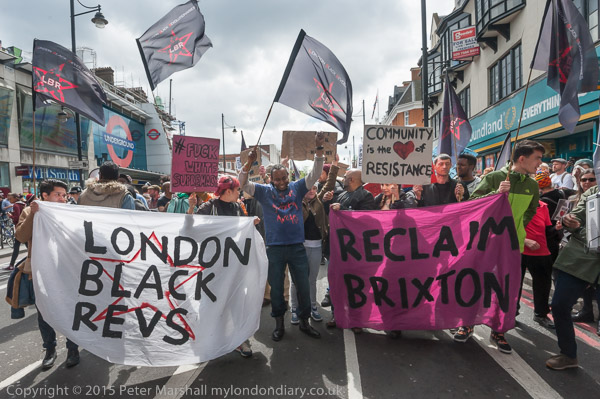
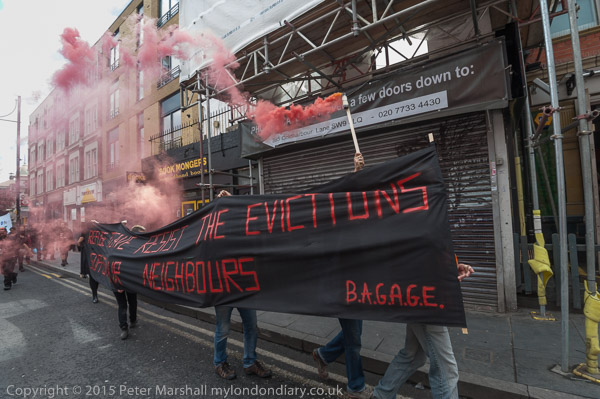
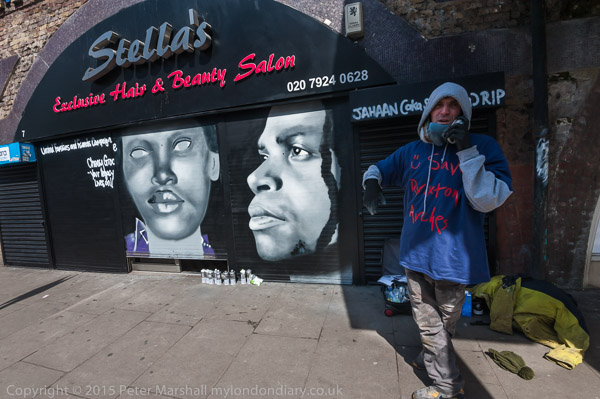
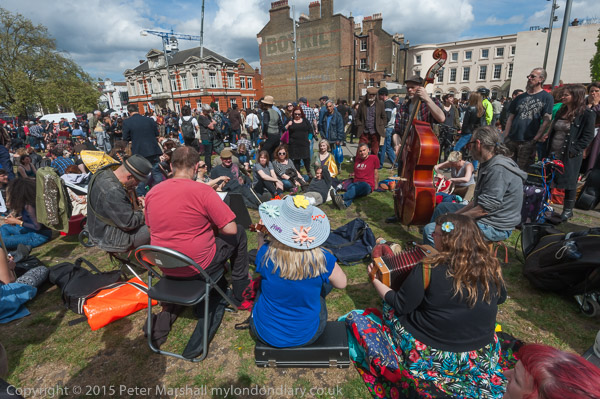
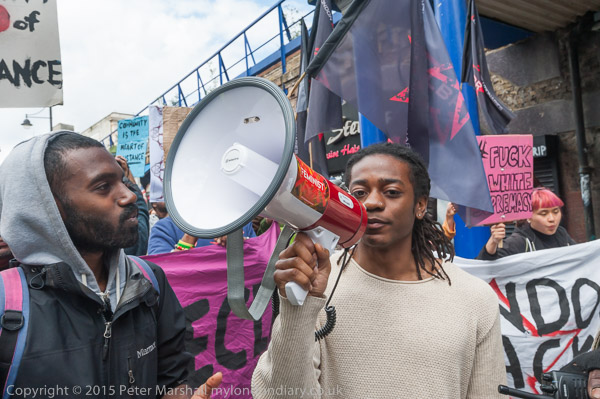
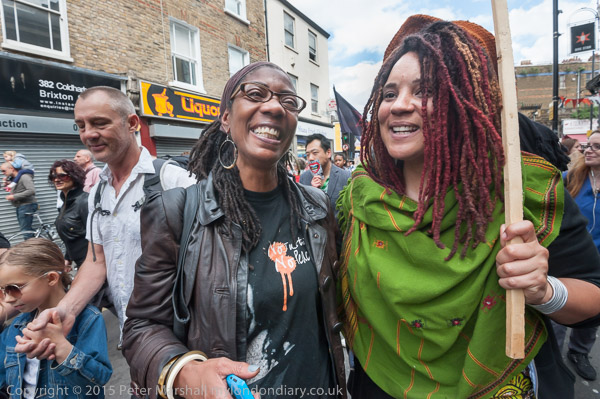
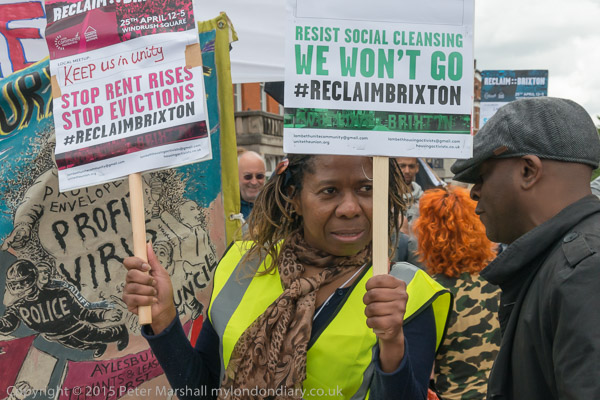
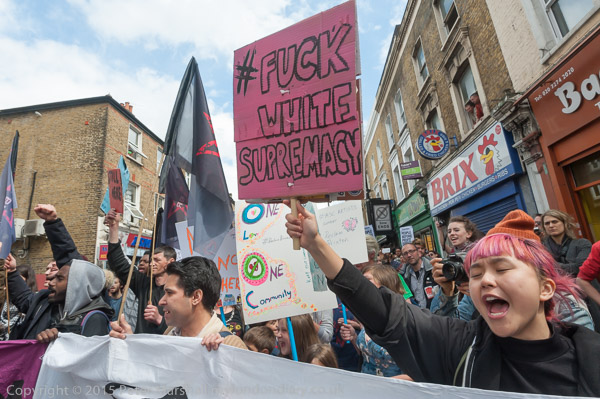
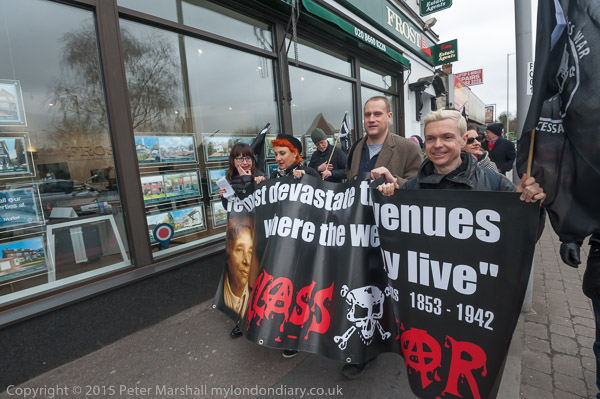
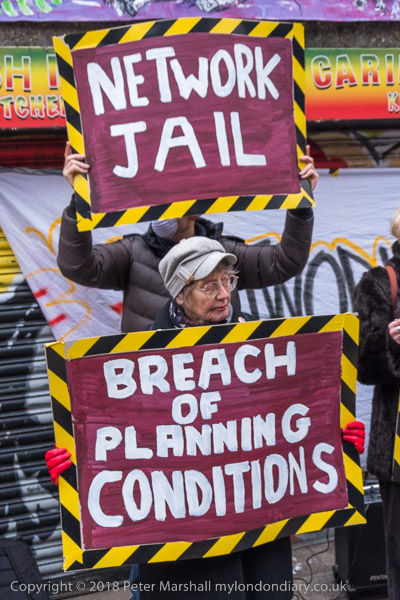
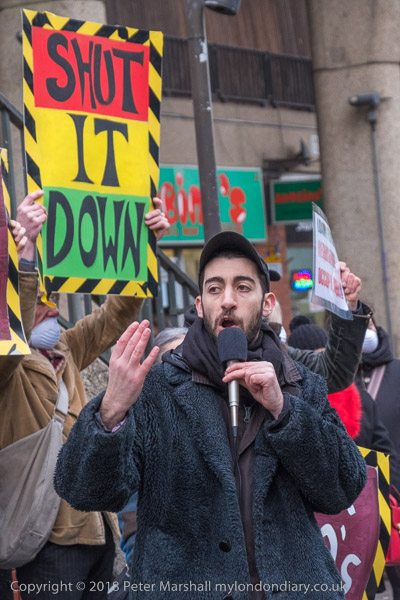
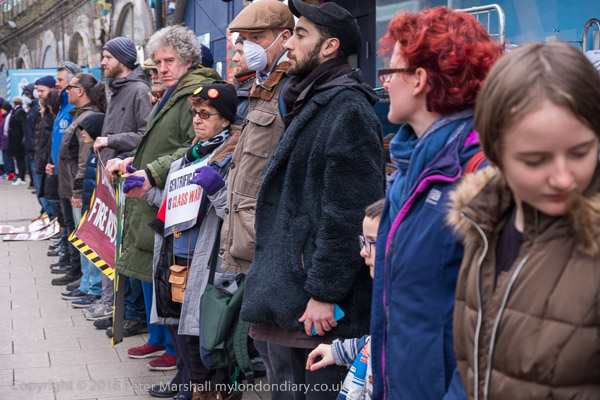
25 April 2015 saw Reclaim Brixton, a day long protest against gentrification which saw several thousands gathering at various events in what is still so far as I’m aware the largest protest of its kind. One major blow to local people has been the decision by Network Rail, backed by Lambeth Council to redevelop the railway arches in the centre of the town, home for many years to some of Brixton’s best loved – and cheapest – businesses. The current tenants, one of which came here in 1932 – are being evicted and after renovation the rents will be triple and their places largely taken by the same chains and franchises that we see in so many other high streets.

Soon after I left Brixton – in what seemed like a quiet period and I thought things had probably ended, activists took direct action against some of the major players they hold responsible for gentrification, breaking a large window Soon after I left Brixton – in what seemed like a quiet period and I thought things had probably ended, activists took direct action against some of the major players they hold responsible for gentrification, breaking a large window at Foxton’s estate agents, going into Brixton Village with their banners and briefly occupying Lambeth Town Hall.
More at:
London Black Revs ‘Reclaim Brixton ‘march
Reclaim Brixton celebrates Brixton
Take Back Brixton against gentrification
Brixton Arches tenants protest eviction

April 2nd 2015

April 2nd in 2015 was Maundy Thursday and a rather busy day for me, though only one of the events was related to Holy Week.
My working day started around noon outside the US Embassy, still then in Grosvenor Square, where the monthly protests by the London Guantánamo Campaign were continuing, handing out leaflets and talking with passers by calling for justice and freedom for the remaining 122 prisoners at Guantánamo Bay.

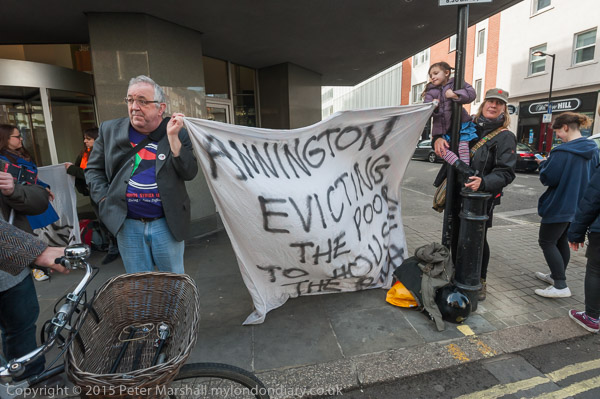
From there is was a short walk to a lunchtime protest by residents from Sweets Way in north London outside the offices of the estates owners who I described as “the tax-dodging equity investor owned company” Annington Homes, calling for an end to evictions and the right to return for all decanted residents.

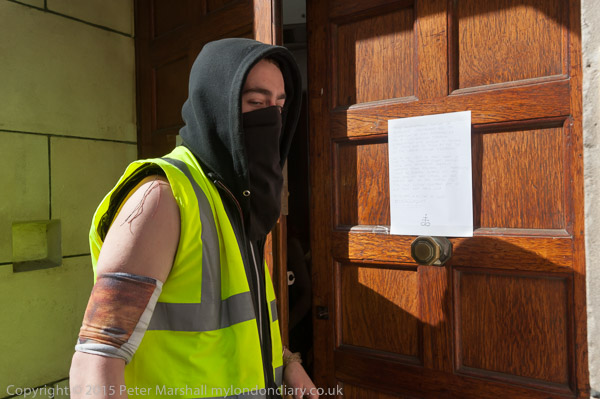
I’d heard that the previous night activists from the Autonymous Nation of Anarchist Libertarians had entered Admiralty Arch through the roof and were occupying the building and went along to investigate, along with a couple of other journalists. We were offered entry if we brought tobacco or alcohol but felt it wise to refuse and left, having taken a few pictures of the banners and notices on the outside of the building.

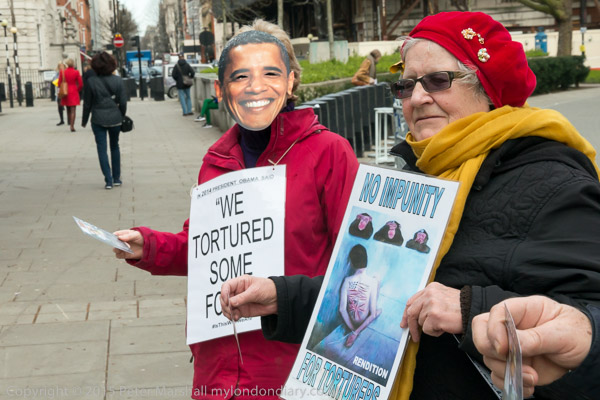
I hadn’t wanted to spend too much time at the Admiralty Arch as I was on my way to a protest outside the offices of G4S on Victoria St calling for the release of the 300 Palestinian children then held in G4S secured Israeli jails to be released. In 2014 Israel held 1266 Palestinian children for interrogation; 75% of them were physically tortured and many sexually abused. One of the speakers was a woman who was forced to undress and stand naked in public by Israeli security on a visit to Israel to visit Palestinians in jail.

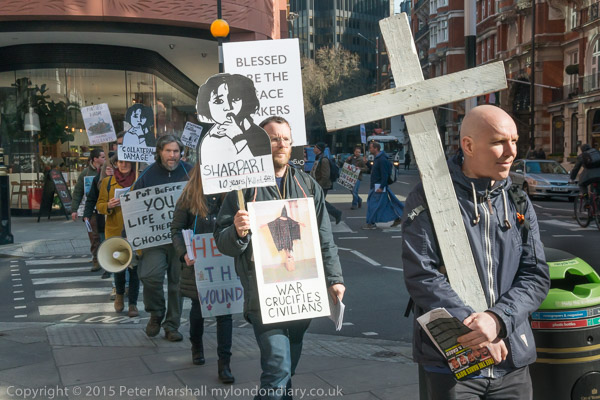
I left the protest to catch up with Catholic Workers on a Holy Week procession around the “geography of suffering” in London, stopping outside the offices of companies in the arms trade for prayers against the arms trade, war, torture, nuclear weapons, international debt, homelessness, immigration policy and climate change.

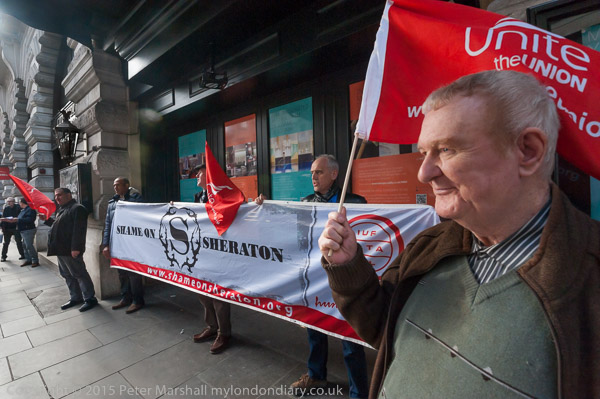
Next came a visit to the Meridien and Park Lane Hotels on Piccadilly in Mayfair where the Unite Hotel Workers Branch protested in solidarity with fellow workers for Sheraton hotels in Ethiopia and the Maldives who have been sacked for union organising.

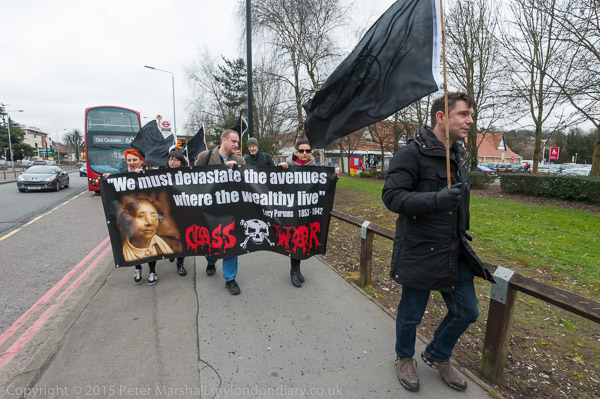
And finally I made the trip to Aldgate East, where Class War were holding the 26th of their series of weekly protests against ‘Poor Doors’, the separate entrance down a side alley for social housing tenants at One Commercial St.

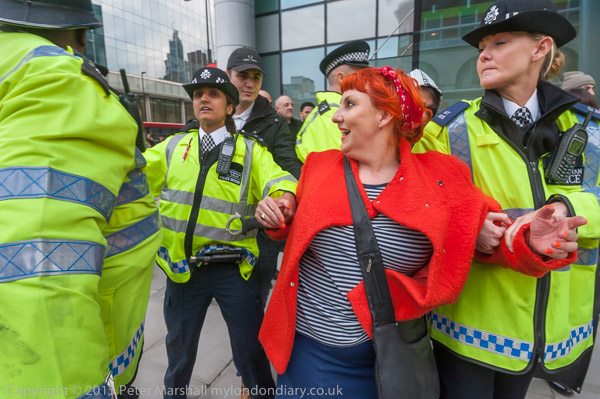
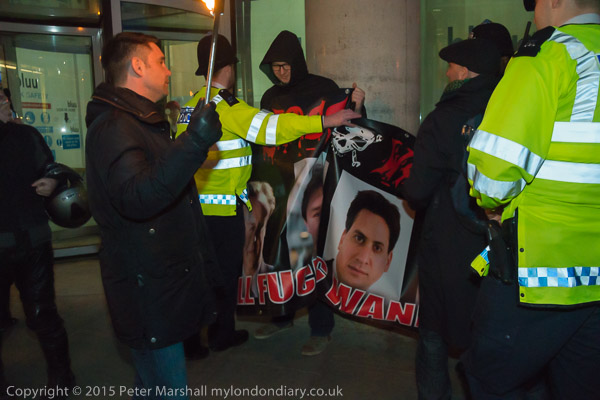
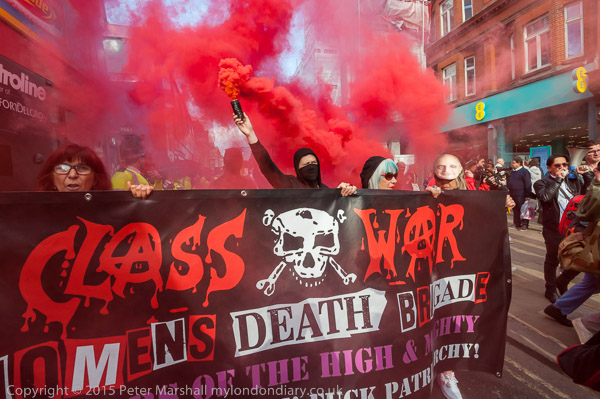
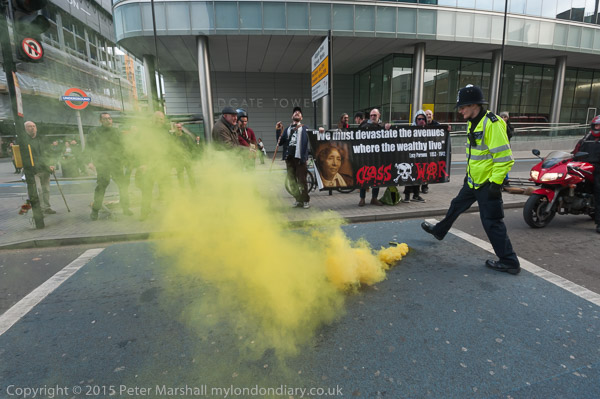
It had been getting increasingly difficult to keep up photographing these protests without taking the same pictures again and again, but this evening the police made my job easier first by putting on a little light entertainment as an officer tackled a smoke flare thrown onto the highway and later, considerably more seriously sending in a squad to snatch and arrest Lisa McKenzie, who was at the time standing as Class War candidate against Iain Duncan Smith in Chingford – see the picture at the top of this post. Fortunately when the case came to court the police had no credible case against her and her barrister was not even required to speak in her defence – or call witnesses (much to my relief as I was one of them) – and the case was dismissed. Clearly the police had been leaned on – perhaps by IDS or his colleague the Home Secretary- to harass Lisa for her impertinent electoral challenge.

More on all of these events:

Chingford candidate arrested at Poor Doors
Shame on Sheraton – Hotel Workers
Stations of the Cross Pilgrimage
Free the Palestinian Children
Admiralty Arch Occupied by A.N.A.L.
Sweets Way at Annington Homes
Shut Guantánamo!


All photographs on this and my other sites, unless otherwise stated, are taken by and copyright of Peter Marshall, and are available for reproduction or can be bought as prints.


Class War, Murdoch & Cross Bones

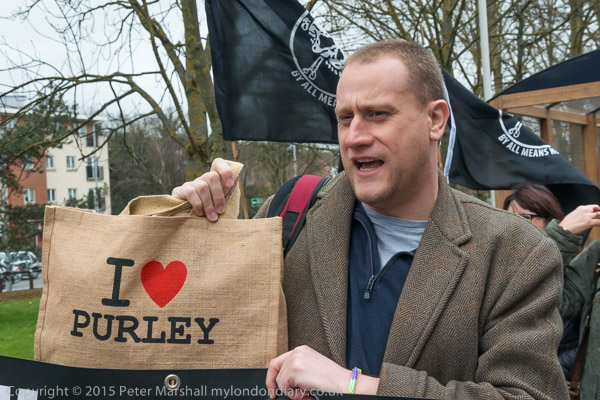
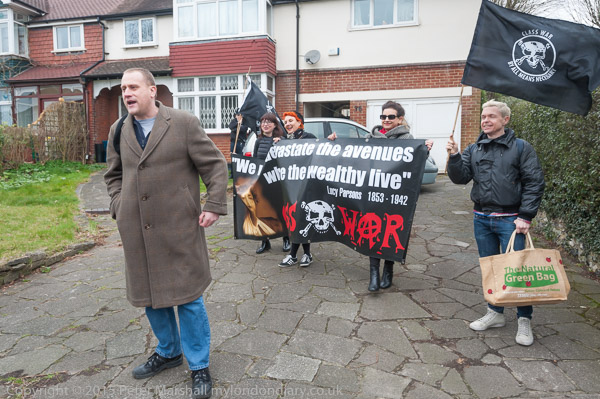
I began my work on Saturday 28th March 2015 meeting with a small group from Class War in Purley, a Surrey suburb south of Croydon, who had gone there to launch the general election campaign of Class War’s candidate Jon Bigger.

Jon is now Dr Jon Bigger, and his PhD thesis at Loughborough University was on “British anarchist group Class War with a specific focus on their approach to the general election of 2015. As anarchists tend to shun concepts like representation, even within their own ranks, as well as working towards the ending of the state, the groups’ electoral behaviour is worthy of close investigation. The study is ethnographic in nature providing a detailed account of how the group operates, its norms, values, structure and methods of organising.”

His work was very much as an insider, one of seven candidates the group backed at the 2015 election, all of whom lost their £500 deposits. The election campaigns were a form of direct action rather than an attempt to actually be elected, “one that ruptures the norms of electoral campaigning, providing the group with new avenues for activity.”

You can read more of Bigger’s views on his web site Jon Bigger: A Journal of Anarchy and in regular features elsewhere. South Croydon was always going to be a tough constituency for anarchist views and the 65 votes he got were probably more than expected – and recorded on the parliament web site as a 0.1% increase which perhaps compares well with the -16.9% of the Lib Dem candidate.

Jon Bigger makes his election address outside the Tory Pary HQ

My main surprise about the event was the almost complete emptiness of central Purley on a Saturday morning – avery windy desert where Class War found it difficult to find anyone to talk to other than the group of police – roughly the same number as them – who doggedly followed them around happily earning their overtime. Purley man (and woman) appears to have lost the use of their legs, only managing the short distance from supermarket car park to supermarket.

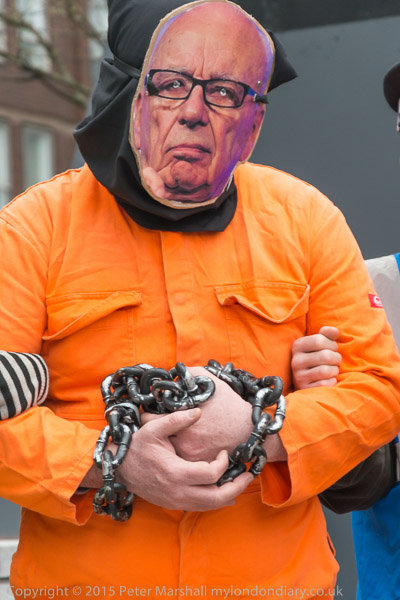
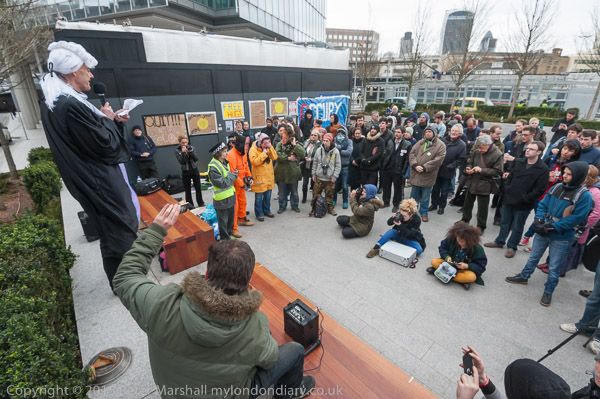
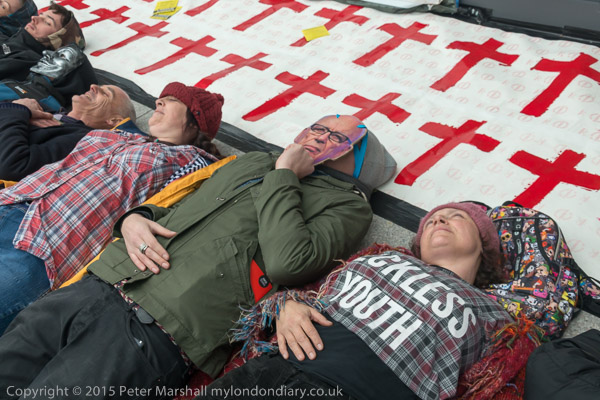
I was sorry not to be able to relax with Class War in the pub after their strenuous campaigning, but had to get back to London Bridge where Occupy Rupert Murdoch week was continuing outside the News International building at London Bridge with the People’s Trial of Rupert Murdoch.

Inevitably he was found guilty, but the sentence seemed extremely mild. My account continues:

Max Keiser then spoke about the economic fraud and the basis of our economic system. London is the the world’s largest tax haven, and the whole basis of the City is corrupt, allowing people to borrow money on the basis of their earlier borrowing in a system that seems rather too much like the Emperor’s new clothes which began to crash in 2008. He ended by handing out StartCOIN scratch cards with free money on them (“The currency of the revolution”) but I think I lost mine. Always been hopeless with money.

Occupy Rupert Murdoch

I decided not to stay on for the attempt to occupy the News International building at 7pm, but was tired and decided to leave it to my colleagues to cover. Rather to my surprise it was successful, with protesters managing to stay in the building for around 20 hours, but it got little or no media coverage. Even Murdoch’s competitors didn’t want to get on his wrong side by covering the event – as I commented “Those 5 billionaires obviously stick together and the BBC always seeks to marginalise any UK protest. Probably there was some important news about a minor celebrity hiccoughing.“

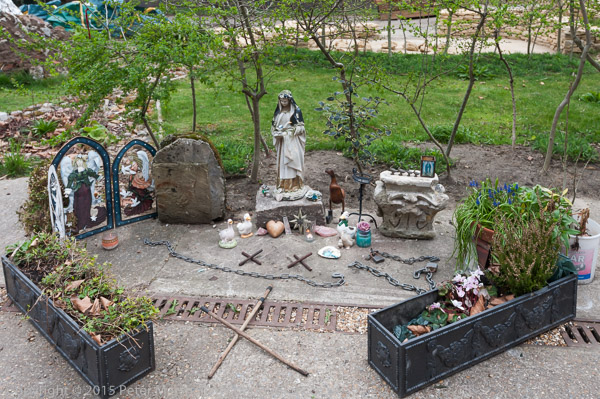
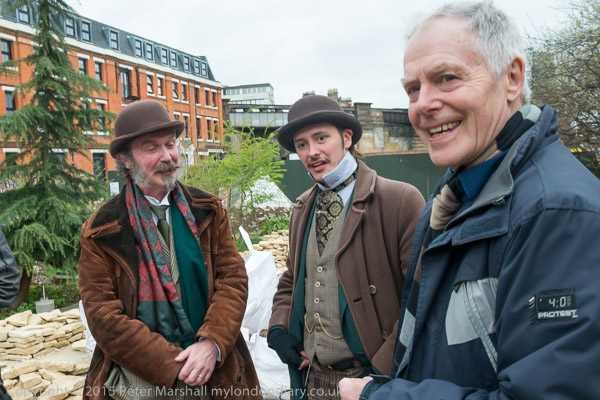
I’d earlier seen two men in what looked like Victorian dress on the pavement outside a pub close to News International and had gone over to talk with them. The told me that they were attending an Open Day at the nearby Cross Bones Graveyard. It’s a place I’d visited before, where outcasts who were refused burial in churchyards had been buried until it was closed as overcrowded in 1853. Among them were many ‘Winchester Geese’ prostitutes licenced by the Lord Bishop of Winchester from 1142 on, whose taxes and fines provided a considerable income for the clergy, and their young children. Museum of London excavations of part of the site carried out for the Jubilee Line extension suggest that half of the around 15,000 burials there were of children.

Local writer John Constable (right, above) revived the story of Cross Bones through his cycle of poems and mystery plays, ‘The Southwark Mysteries’, and regular ceremonies and vigils now take place there. In 2020 Southwark Council granted a 20 year lease to Bankside Open Spaces to protect and maintain the graveyard as a public garden of remembrance.

More at:
Cross Bones Open Day
Murdoch on Trial – Guilty as charged
Jon Bigger Class War South Croydon


All photographs on this and my other sites, unless otherwise stated, are taken by and copyright of Peter Marshall, and are available for reproduction or can be bought as prints.


A Day Out with Class War

Lisa McKenzie’s election address in Chingford

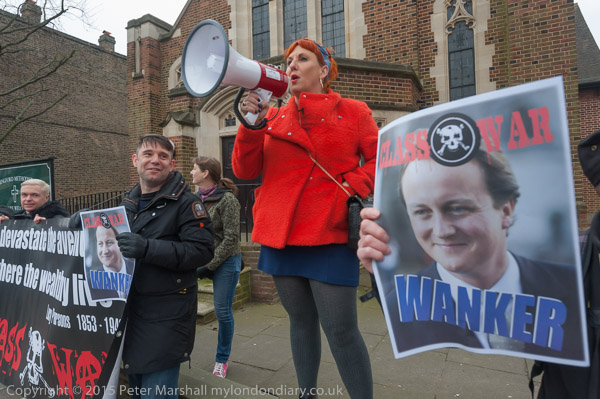
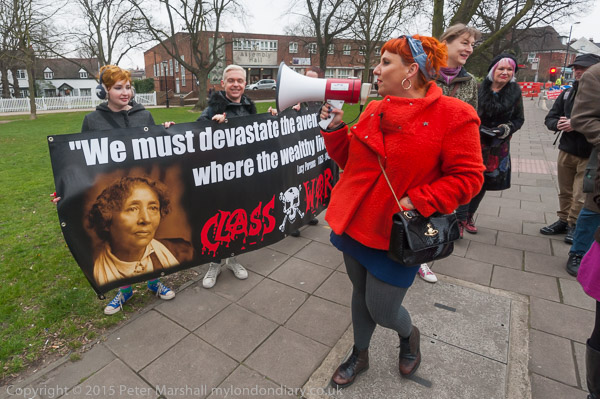
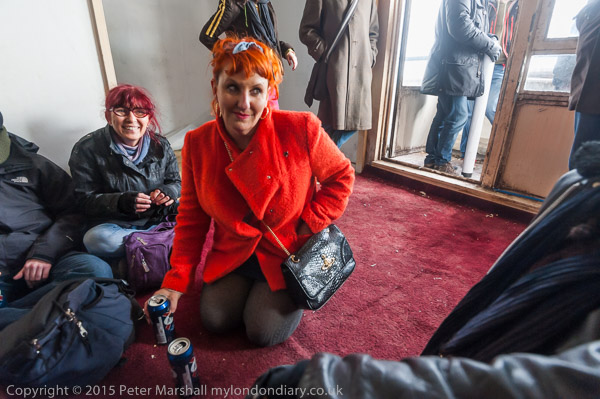
Class War had decided to stand candidates in the 2015 General Election, and a handful of people had volunteered to stand under their banner including in three constituences around London. These included Lisa McKensie, then a research fellow at the LSE who was standing against Tory minister Iain Duncan Smith in his Chingford constituency on the north-east border of London. An on Saturday 14th Mar 2015 I went with Class War for the launch in Chingford of her election campaign to give his constiutents a chance to kick out him and the evil policies he represents, which inflict misery on the poor and disabled. Unfortunately few in Chingford seem to care much about the poor or the disabled and although there was an almost 5% swing away from the Tory in the election only 53 votes went to Class War.

Police take away Class War’s election banner

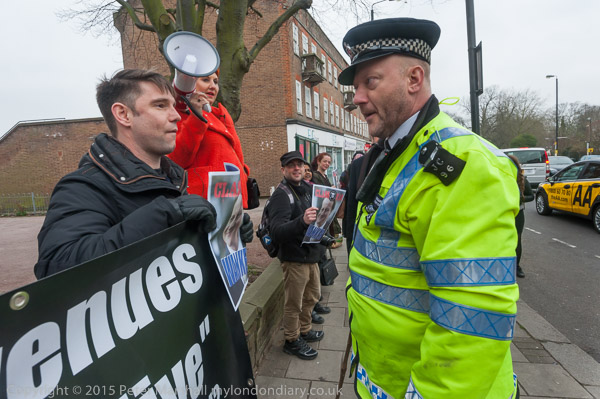
What Class War didn’t have with them for the launch of their campaign in the constituency was their banner showing pictures of their banner stating clearly their opinion of leading politicians, which controversially police had ripped from their hands at a protest earlier in the week because of its large text ‘ALL FUCKING WANKERS’ rather than the disturbing faces of party leaders. Some months later they were directed to return it, but somehow had managed to lose it – I hope Class War were re-imbursed.

Police had turned up in some force at Chingford station to welcome the group of around 20 supporters who had turned up for the launch, and continued to harass the group as it made its way along the street, stopping occasionally for speeches.

A police officer threatens a man with arrest for holding a poster

There were remarkably few people on the streets of Chingford and none of them made complaints about the posters that were being held up, though there were one or two who made ‘V’ signs and shouted obscenities, largely from passing vehicles. But most of the few who walked by either failed to notice the protest or pretended to, with others expressing similar views to Class War of their MP, in seat since 1992.

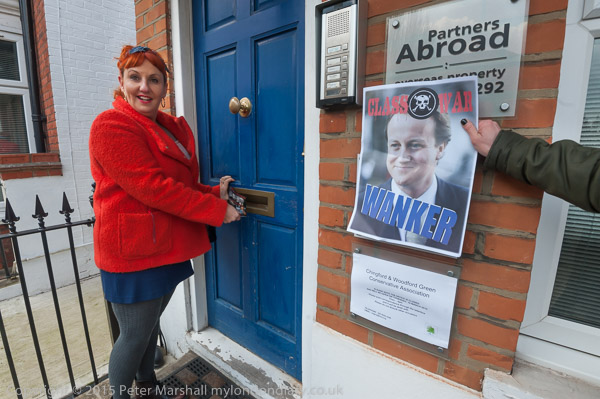
Lisa puts a leaflet in the door at the Chingford & Woodford Green Conservative Party office

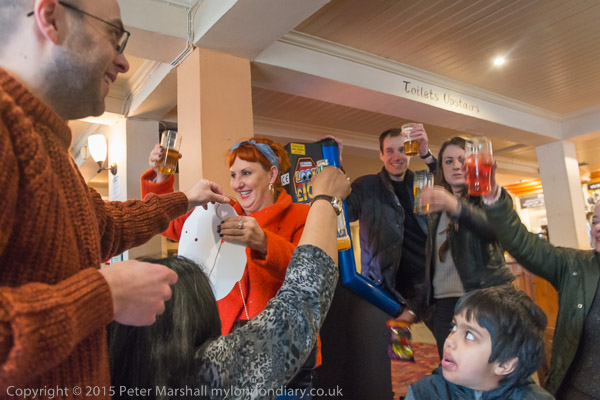
There was a convenient space in front of the Methodist Church for Lisa to give her election address, and there were other speakers, including Class War’s candidate for South Croydon Jon Bigger, all watched intently from across the road by a police officer, though there were now fewer following the event. After the speeches the group wandered back up the road towards the station, with Lisa stopping to put a leaflet through the door of the local Conservative Association office before most of us made our way into a local pub to celebrate the election launch.

After a drink or two we made our way across the road for the train back to central London, with police still following us until the train pulled out of the station. Some of those present including the two candidates were on their way to the Aylesbury Estate in Southwark to show solidarity with occupiers who continue to highlight the shameful treatment of residents whose homes there are being demolished, and I went along with them on what was a rather hilarious journey.

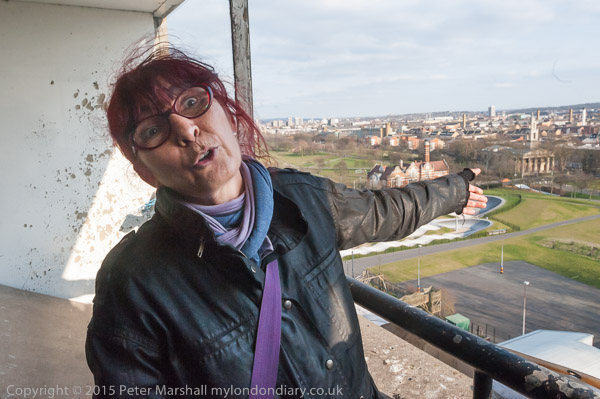
It was a little tricky to get into the estate as Southwark Council had tried to block all the entrances, but fortunately we met some activists who were able to show us a rather lengthy detour to gain access. It did at one stage involve swinging across a small gap, made a little more difficult by the heavy camera bag I was carrying, but eventually we were there and something of a party was taking place. The occupied flat was on the top floor and had splendid views of south London.

I didn’t take many pictures, as undertandably many of the activists did not want to be photographed. It was the kind of curious situation where many were taking pictures on their phones, but I was shouted at for using a camera – though carefully framing so only those who I had permission to photograph have their faces shown.

Much more about an interesting day out on My London Diary:
Class War go to Aylesbury Estate
Class War celebrate Election Launch
Class War Chingford Election Launch


All photographs on this and my other sites, unless otherwise stated, are taken by and copyright of Peter Marshall, and are available for reproduction or can be bought as prints.


Two years ago – 26 Feb 2019

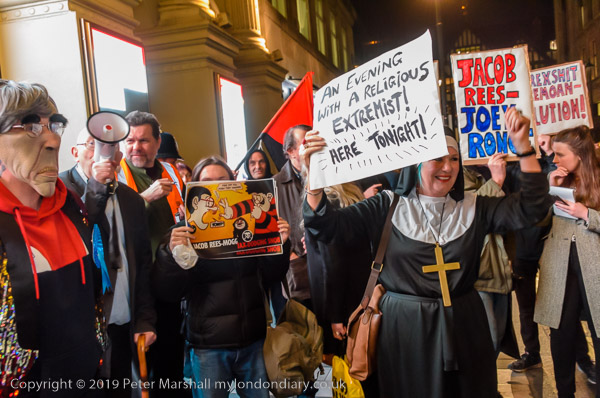
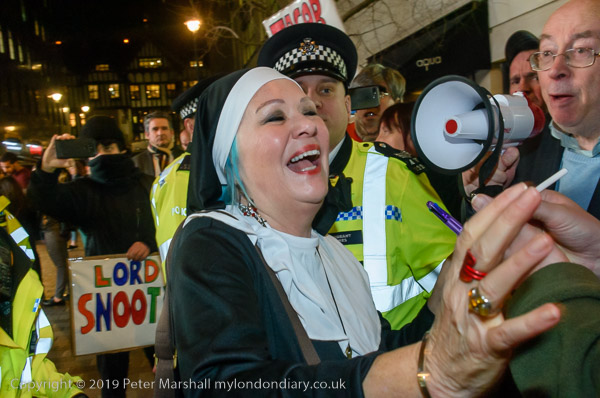
Class War protest Rees-Mogg freak show

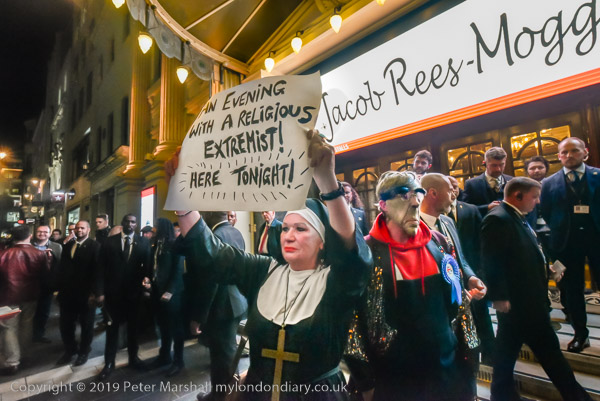
Two years ago today Class War protested outside the London Palladium against Jacob Rees-Mogg, who they accused of spouting “homophobic, transphobic, racist, pro-hunting, misogynist, classist, privileged” nonsense. Rees-Mogg had booked London’s best known venue to preach more of this to his fans, who had paid £38 for a ticket to this freak show.

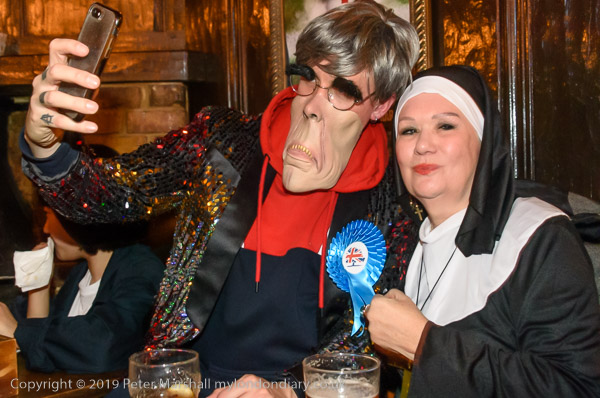
I met up with Class War at a pub a short walk from the Palladium and found a small group there with Jane Nicholl dressed as a nun, Mother Hysteria, and Adam Clifford as Jacob Rees Mogg and there was time for them to take a selfie and everyone to finish their drinks before the small group moved off to the entrance to the Palladium where a few more of there supporters were waiting and long queues were waiting to enter for the performance inside.

As well as the fans there were of course a large group of security men and police in attendance (all probably thanking Class War for the overtime.) And when Class War held up posters and banners the waiting crowd had their hopes for what they had paid to come and see confirmed. One or two did come across to insult the protesters, and a few others passing by came to share their similar views of Mogg with Class War.

Police did their best to render the protest less effective and moved the group to the opposite side of the pedestrianised street and issued various warnings to harass them. Eventually they stopped and searched Jane Nicholl, threatening her with arrest as they found stink bombs in her handbag which they claimed were offensive weapons. I stood for almost 20 minutes watching the officer writing out “her notice of stop and search, perhaps because he is at a loss trying to find some way that doesn’t make the police action sound stupid” before deciding I had to go home and file my pictures.


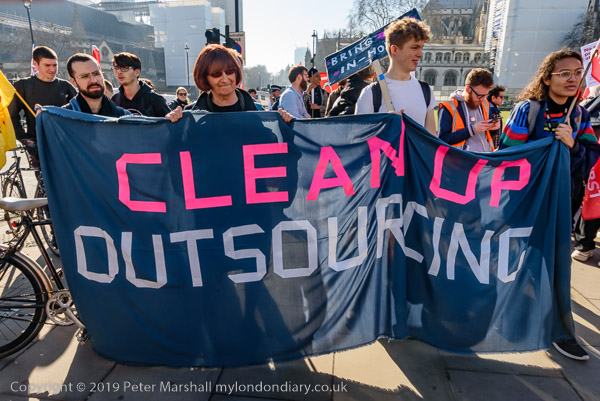
Rally for an end to Outsourcing

This protest had come at the end of a long and varied day for me, which had begun with a coordinated action by the UVW, IWGB, and the BEIS PCS branch demanding an end to outsourcing and the insecurity, discrimination and low pay it causes. A legal challenge was demanding better rights for the 3.3 million outsourced workers in the UK, and protesters had met at the University of London at 8am to march to a protest outside the High Court before moving on to a rally in Parliament Square where I joined them a couple of hours later.


Outsourced Workers protest at BEIS

From Parliament Square it was a short walk to the Dept for Business, Energy & Industrial Strategy in Victoria St where outsourced workers including catering and security staff in the PCS were striking in support of their demand for the London Living Wage as well as end to outsourcing and the insecurity, discrimination and low pay it causes.


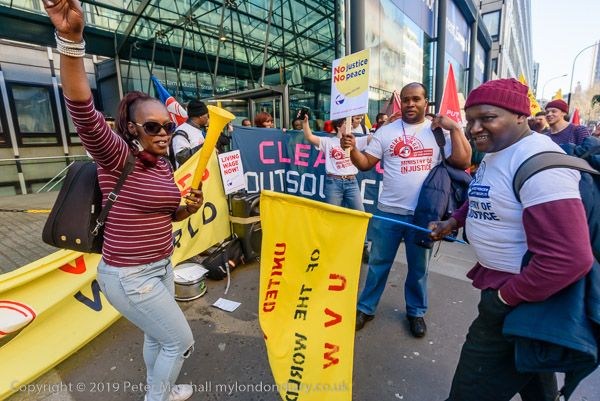
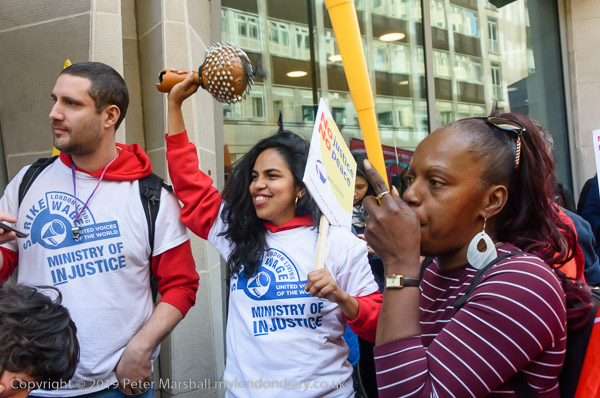
Outsourced Workers at Justice ministry

After a rally and speeches at the BEIS, the protest by outsourced workers moved on to the Ministry of Justice (though they call in the Ministry of Injustice) where low paid workers belonging the the United Voices of the World union who had been on strike for 24 hours were going back to work. They also want the London Living Wage and fair conditions of service rather than the poverty and insecurity of outsourcing.


North Woolwich

When the protest at the Justice Ministry came to an end I went to have a quick lunch and, as I had several hours to spare before the Class War action, went to take some photographs at North Woolwich. Unfortunately I arrived at Bank station for the DLR only to find there were no trains running – and no information as to when they might resume service.

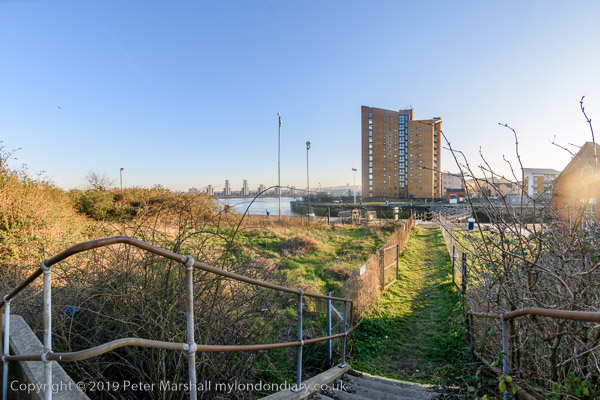
It took me rather longer than anticipated to get there, taking the Northern Line to London Bridge and a train to Woolwich Arsenal. Fortunately by then services were running from there to North Woolwich, saving me a walk across the river but I still had rather less time than I needed and had to rush away before finishing my planned route, mainly beside the River Thames. It was a pleasant day for a walk, but a clear blue sky is not good for panoramic views.

As usual, more about all these on My London Diary:
Class War protest Rees-Mogg freak show
North Woolwich
Outsourced Workers at Justice ministry
Outsourced Workers protest at BEIS
Rally for an end to Outsourcing


All photographs on this and my other sites, unless otherwise stated, are taken by and copyright of Peter Marshall, and are available for reproduction or can be bought as prints.


Class War v. Qatari Royals

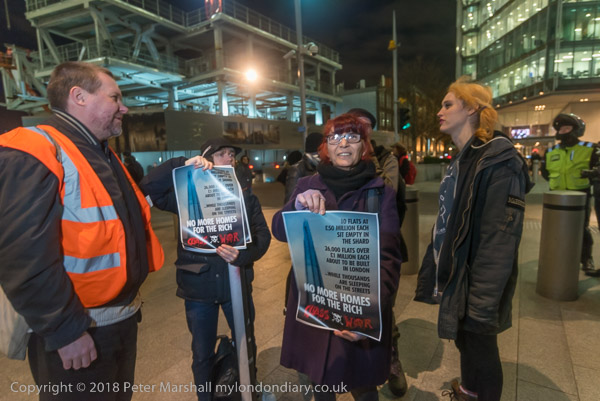
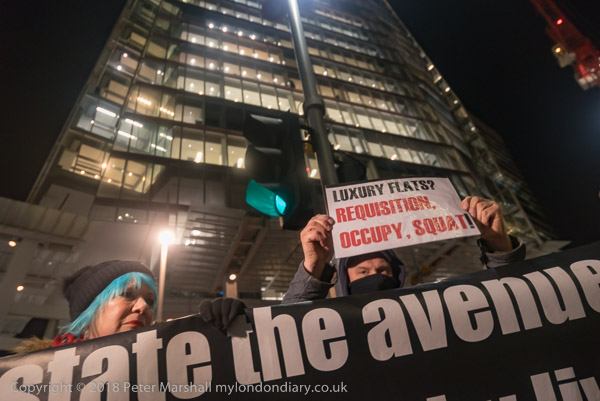
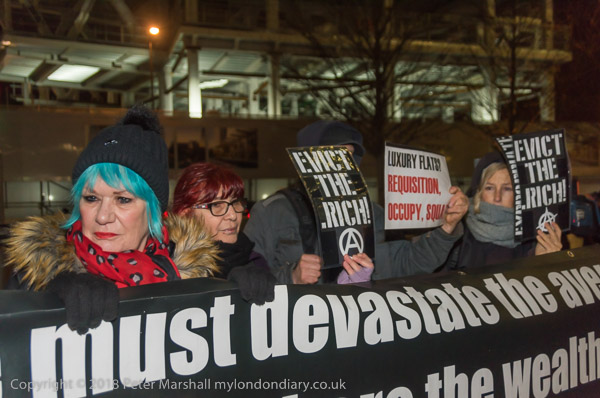
Three years ago today, on 8 Feb 2018, Class War had planned a protest outside London’s tallest building, the Shard, to point out the housing crisis, which is currently affecting many in London. They chose to protest at the Shard, because there are ten £50m apartments there which have remained empty since the building was completed.

We don’t actually have a housing shortage as there are more than enough properties for everyone to have a decent home. The problem is that current policies allow property to be left empty and encourage developers to build high priced flats which either remain unsold or are bought as investments and largely left empty for all or most of the time. There were then plans to build a further 26,000 flats in London costing more than a million pounds each, many on former council estates where social housing has been demolished at a time when London has a huge housing crisis with thousands sleeping on the street, and over 100 families from Grenfell were still in temporary accommodation.

The owners of The Shard, the Qatari royal family, went to court to seek an injunction against the Class War protest, seeking an injunction against Ian Bone and “persons unknown” and, despite their fortune estimated at over £250 million pounds, seeking legal costs of over £500 from the 70 year-old south London pensioner.

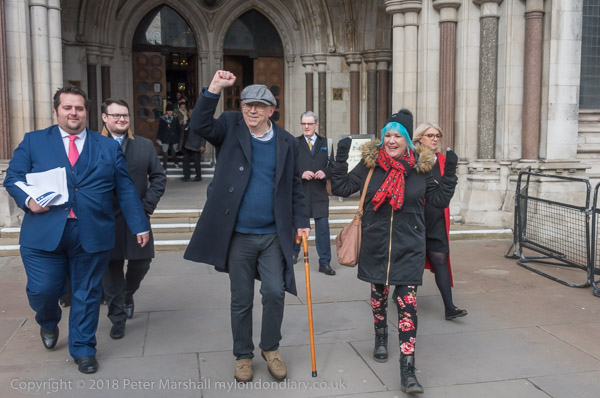
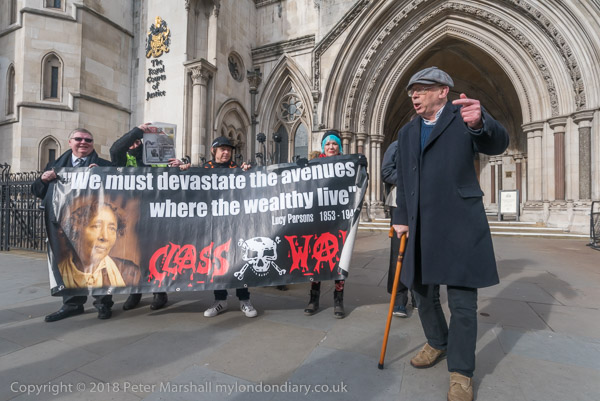
Fortunately barrister Ian Brownhill offered to conduct Bone’s defence pro bono and in the High Court hearing the Qatari royals were forced to drop the attempt to ban protests and the demand for fees but Bone accepted a legal restriction on him going inside the Shard and its immediate vicinity. But that meant the planned protest that evening could still go ahead, and Bone and his team emerged from the court victorious. His health issues meant that he was himself in any case unable to attend the protest.

At the protest there were large numbers of police and security, along with many in plain clothes and two officers with search dogs. The protest was always intended to be a peaceful one and the protesters were careful to remain outside the boundary of The Shard, marked with a metal line in the pavement. The police nonetheless harassed them, making a patently spurious claim that they were causing an obstruction to commuters attempting to enter London Bridge station and trying to move them further away from The Shard. Although the protest clearly wasn’t causing any serious problems to those entering or leaving the station, the larger numbers of police and security were.

Three years on, London still has a huge problem, with huge numbers of unaffordable flats still being built, particularly in the huge development area in Vauxhall and Nine Elms, including the developments around the US Embassy and the former Battersea Power Station. Some developments here include small areas of social housing, with ‘poor door’ entrances hidden away around the backs of some of the towers, the residents or which are excluded from the many facilities which are provided for the wealthy.

While blocks have large and well-furnished foyers with a concierge service for the rich, as well as some recreational facilities, social housing tenants typically enter a narrow bleak corridor with no space even for parcel deliveries. Just like the block in Aldgate where Class War’s long series of protests put the issue of ‘poor doors’, where poorer tenants are segregated from their wealthy neighbours on the national agenda back in 2014.

In July 2019, Communities Secretary James Brokenshire was “appalled” by the examples of segregation he had seen and promised to put an end to the use of “poor doors” in housing developments in England. It appears to have been a Broken promise, and Class War are thinking it is time for more action.

Class War protest at Shard
Class War victory against Qatari Royals


All photographs on this and my other sites, unless otherwise stated, are taken by and copyright of Peter Marshall, and are available for reproduction or can be bought as prints.


Gentrification is Class War: 4 Feb 2018

Back when I began taking pictures of London in the 1970s London still had many largely working class areas, many the kind of places where some photographer friends would raise an eyebrow when I said I had been taking pictures there, or even send me dire warnings about the dangers of walking the streets there with a camera around my neck.

They were areas where people in the basic jobs that keep the city running could afford to live – both those whose families had moved to these areas several generations back and those including migrants and refugees who had come more recently. Some were certainly beginning to see a new more affluent population moving in, and many of my pictures featured skips in front of housing that was being renovated, both by developers who were buying up many older properties and young professional couples who were often ‘knocking through’, and pub conversations began to be riddled with terms such as ‘RSJ’.

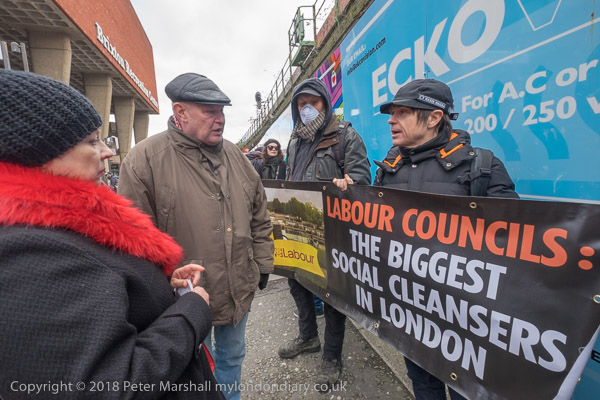
Since then more and more areas across London have been subject to ‘gentrification’, their character being changed and new businesses coming in to cater for the new wealthier population, while increasingly the low-income inhabitants are forced out to cheaper areas further from central London as house prices and flat rents soar – and as council estates are demolished and replaced by higher density largely private flats at high market rents.

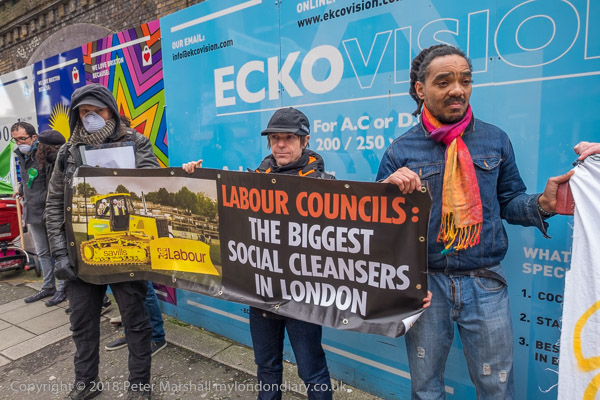
This process of ‘social cleansing’ has been taking place across London, and has been accelerated by many Labour councils since Tony Blair began New Labour’s regeneration programme with a press photo-opportunity on the Aylesbury Estate in Southwark in his first speech as Prime Minister in 1977.

Many of the shops that I photographed back in the 70s and 80s, small local shops – corner stores, cobblers, hairdressers, greengrocers, butchers, etc – and other small local businesses have now disappeared, their premises now often estate agents, and cafés have changed their nature from ‘greasy spoons’ where you could get a filling cheap lunch to serving coffee and cakes, vegetarian food or rather more expensive restaurants catering for the new and wealthier clientèle. Of course tastes generally have changed and so have shopping habits, and some of the new is certainly welcome. But so much of those shops and pubs that were a part of these neighbourhoods have been lost.

Brixton perhaps stood out against gentrification longer than most – with the reputation it had from the disturbances in 1981, 1985 and 1995 deterring many newcomers. All took place following heavy-handed police action; Operation Swamp 81, when over 900 people were stopped and searched in 5 days, with 82 arrested, the shooting of Cherry Groce in 1985, and the death in police custody of Wayne Douglas in 1995. But many young people were attracted to the area by the vibrant atmosphere and Caribbean culture, by music venues, the Roxy, markets, food and pubs, and with its good transport links and closeness to central London it has attracted many young professionals in more recent years.

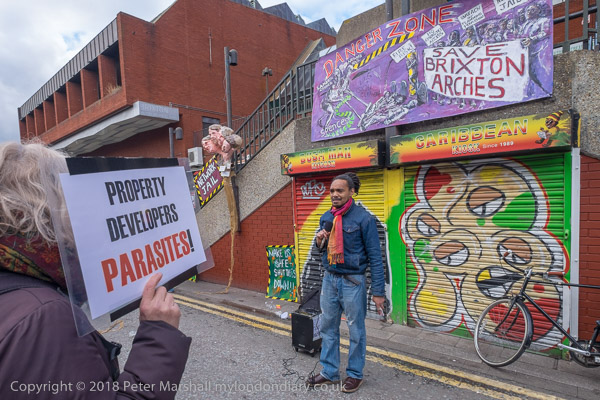
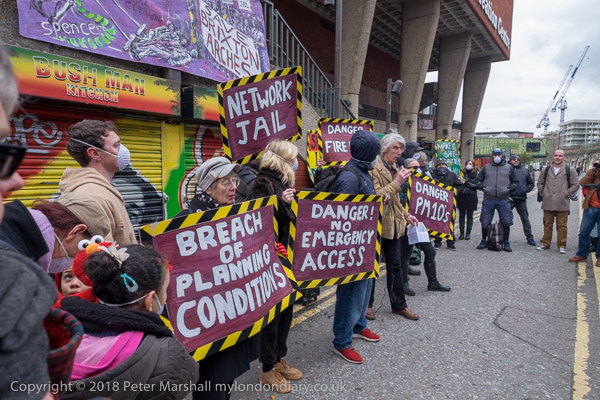
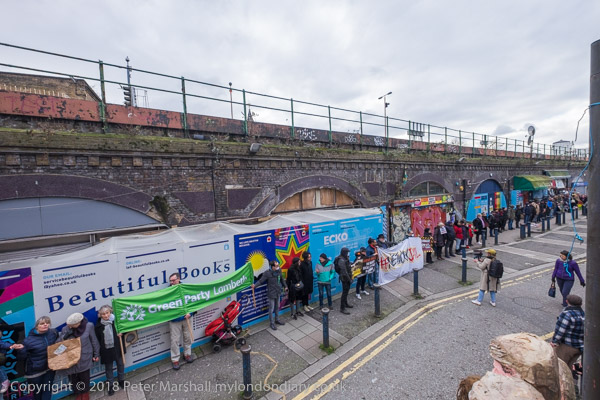
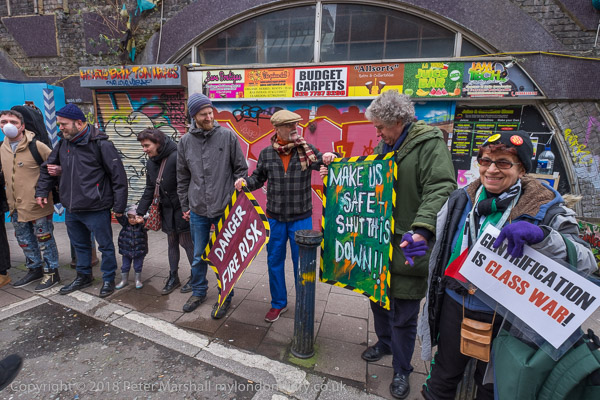
Railway lines run through the centre of Brixton, and the arches underneath them have been an important part of its life, providing low cost premises for businesses and, particularly in Atlantic Road and Brixton Market Road, for shops. They provided what has been called “the heart of Brixton”. But as I wrote in my text for Save Brixton Arches: 3rd Anniversary Action on Sunday 4th February 2018:

Network Rail have colluded with Lambeth Council to get rid of something that gave Brixton its unique character and replace it by trendier shops catering for the new wealthy young population – part of Lambeth Labour’s programme of social cleansing which includes demolishing council estates and replacing them with high cost private accommodation (with a token amount of so-called affordable properties.) The Council ignored the public outcry and large demonstrations to keep the arches.

The plans were accompanied by a great deal of lies and mismanagement by Network Rail and work was supposed to be completed by 2016 but is only scheduled to start tomorrow, and the Save Brixton Arches campaign are calling for it to be abandoned as the plans for the work fail to include proper fire safety precautions and will severely restrict access by emergency services to local businesses and the railway and station.

Save Brixton Arches: 3rd Anniversary Action

Despite the campaign both by the traders and many of the local population the refurbishment of the arches went ahead, though over a year later many had not been re-let. Allies and Morrison, the architecture and urban planning practice which recommended the scheme in 2013 has been involved in many contentious ‘regeneration’ schemes with developers and councils across London which opponents describe as social cleansing. Local Labour MP Helen Hayes was a senior partner in this firm until she left shortly before being elected in 2015, although she has denied any involvement in this particular scheme.

More at Save Brixton Arches: 3rd Anniversary Action.


All photographs on this and my other sites, unless otherwise stated, are taken by and copyright of Peter Marshall, and are available for reproduction or can be bought as prints.