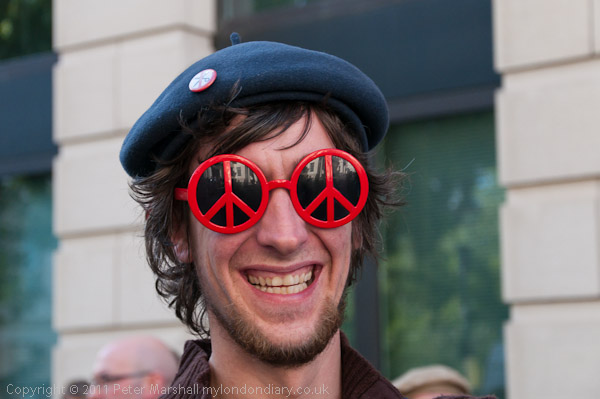
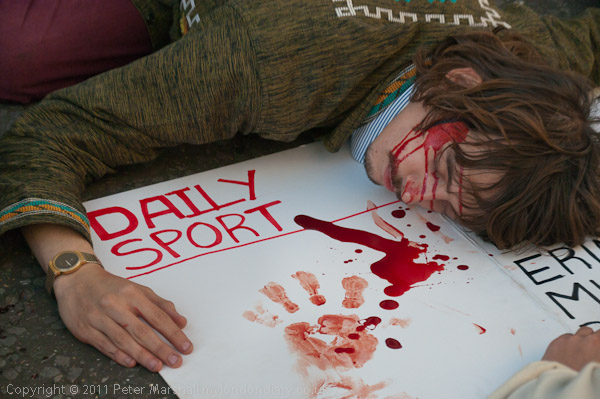
Protests in London three years ago today on Saturday 14th September 2019 all with some connection to human rights violations.
Criminal Abuse of Women in South Africa – Trafalgar Square
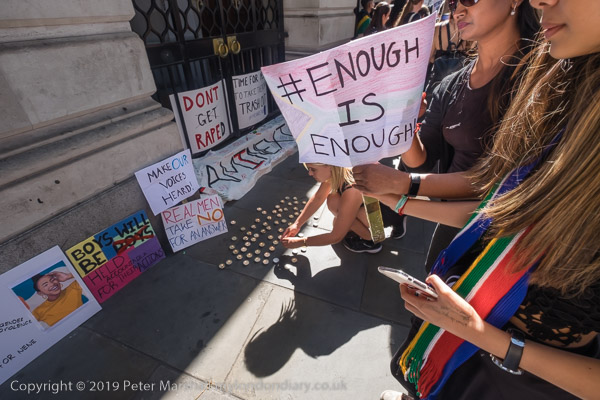
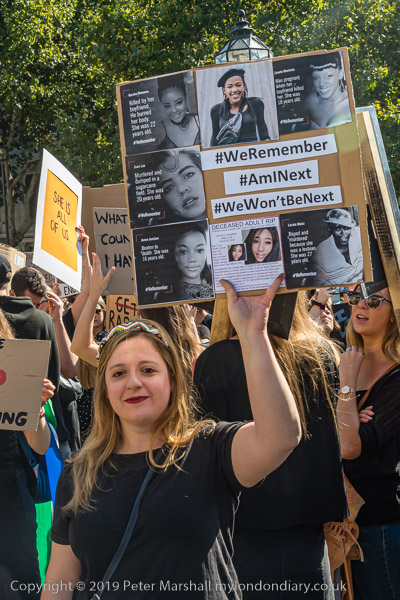
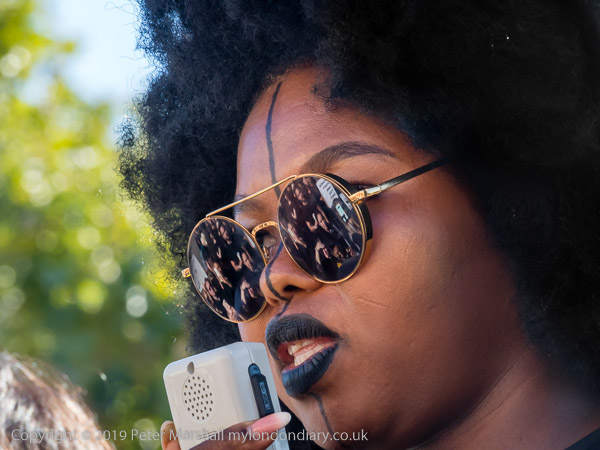
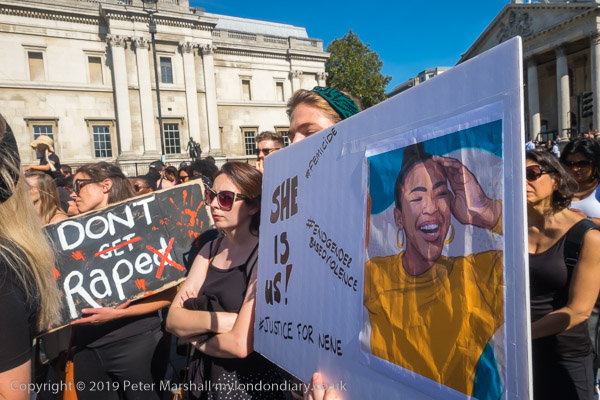
People, mainly women and including many South Africans, dressed in black to protest in Trafalgar Square following the rape and murder of Uyinene Mrwetyana and many other women in South Africa.
Protests were taking place across South Africa calling for the government to declare a state of emergency over gender based violence, and to protest against gender-based violence across the world.
After speeches and silences on the North Terrace they moved to light candles for the victims at the entrance to South Africa House.
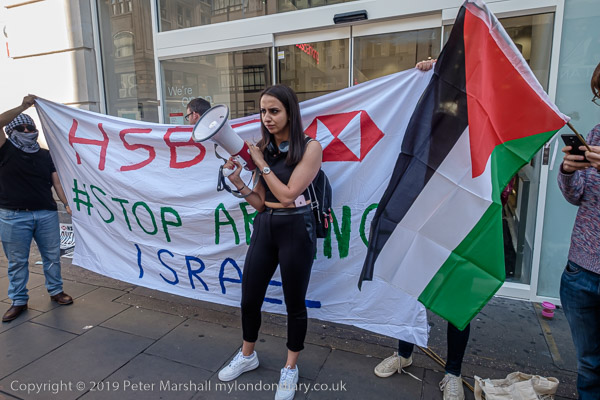
Protesters led by Young London Palestine Solidarity Campaign took part in a National Day of Action outside the Oxford St branch of the HSBC Bank calling on it to stop its support of military and technology companies that sell weapons and equipment to Israel to be used against Palestinians. The bank had closed for the protest.
Although HSBC had divested from Israel’s largest private weapons company, it still owned shares in Caterpillar whose bulldozers are used to destroy Palestinian homes and construct illegal apartheid settlements, BAE Systems whose fighter jets attack Gaza and Raytheon which suppliers the ‘bunker buster’ bombs used to target Palestinian civilians in Gaza.
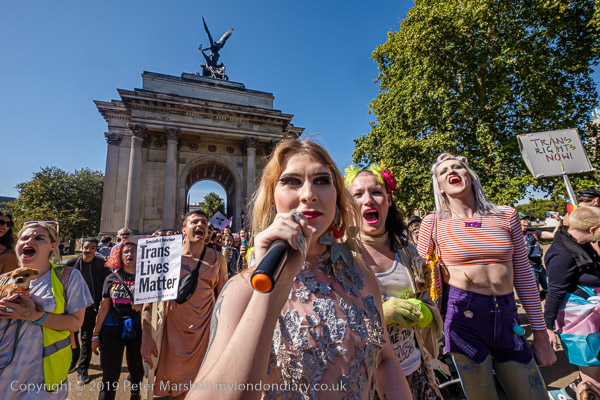
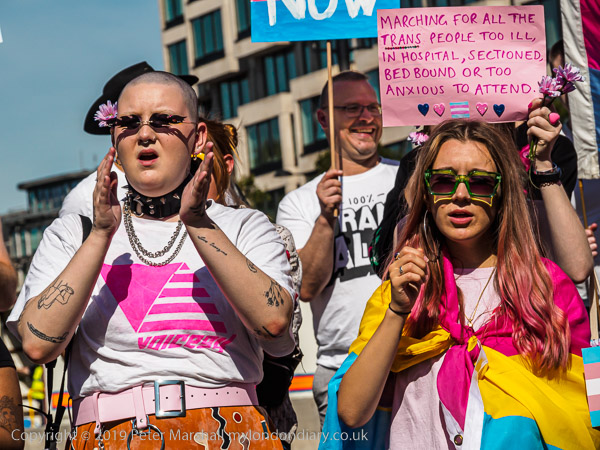
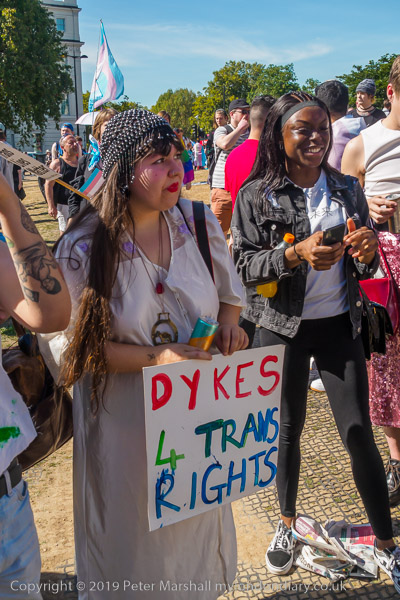
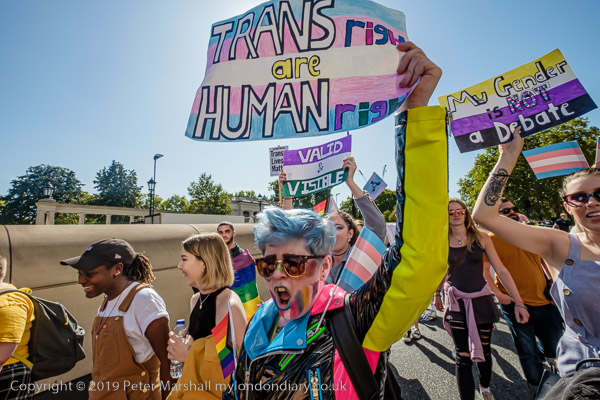
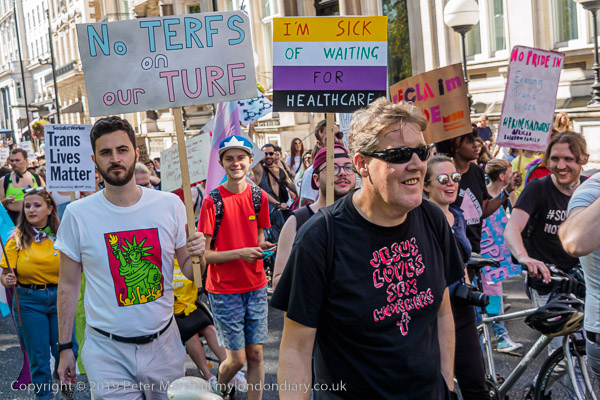
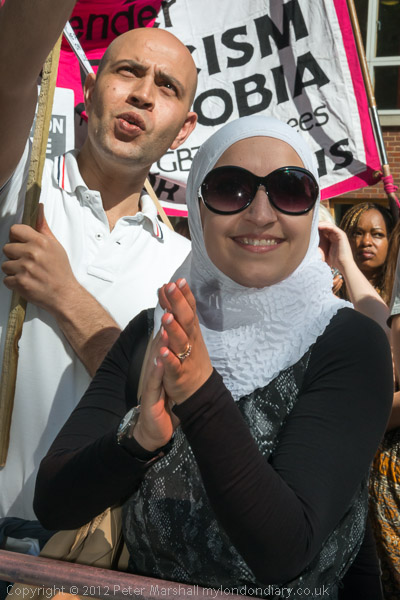
People met at Hyde Park Corner for this first march in the city to celebrate trans, non-binary, intersex, and gender non-conforming individuals and to protest against the continuing discrimination here and around the world against them.
As well as many from the trans+ community there were family, friends and other supporters taking part in an event which aimed to increase the visibility of trans+ people.
Recent years have seen an increasing transphobia in the British media with considerably publicity being given to the views of anti-trans activists. There has been an increase in attacks attacks on trans people on the streets, hate speech by trans-exclusionary feminists, and by right-wing national and state governments around the world.
Too often trans+ people around the world are subject to human rights abuses. They have always been an integral part of the gay community and at the forefront of the fight for gay rights – from the Stonewall rebellion on.
There were a few short speeches before the march set off, going along Piccadilly to a rally in Soho Square. I marched with them as far as Green Park where I caught the Underground for a protest in Brixton.
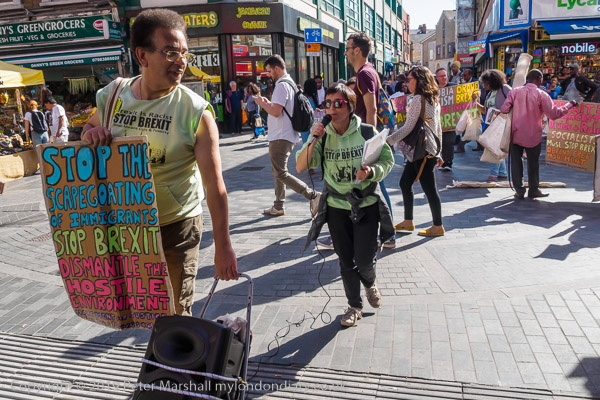
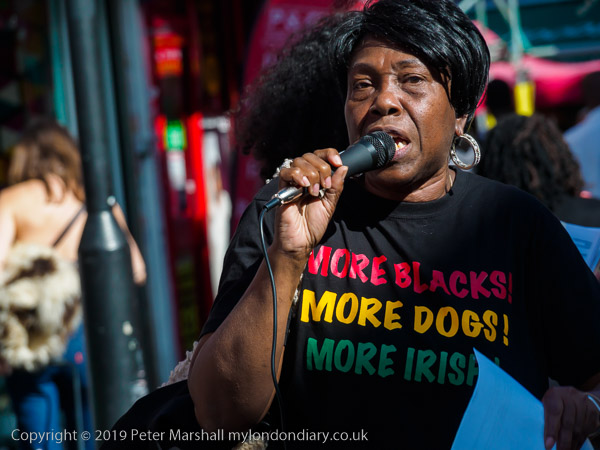
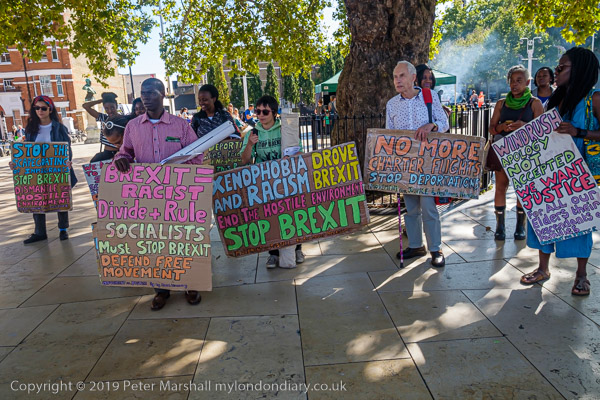
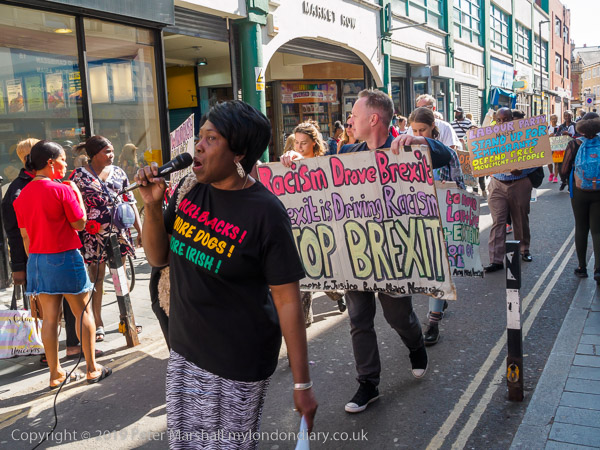
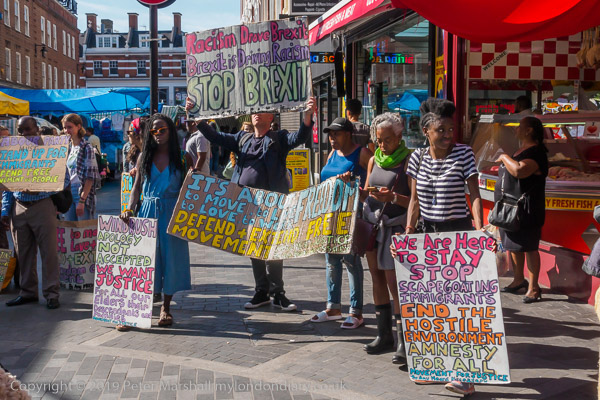
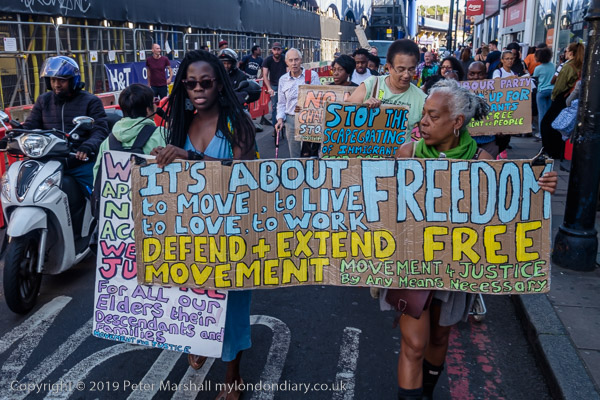
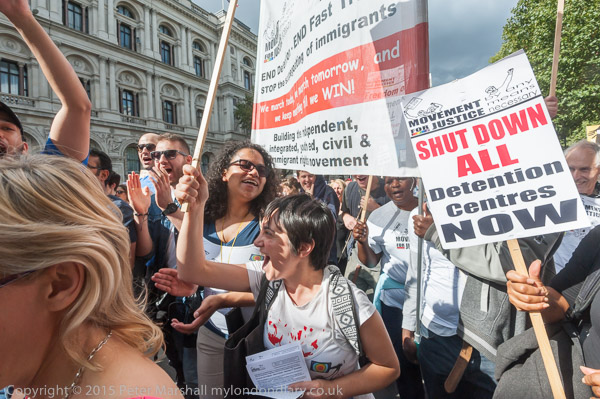
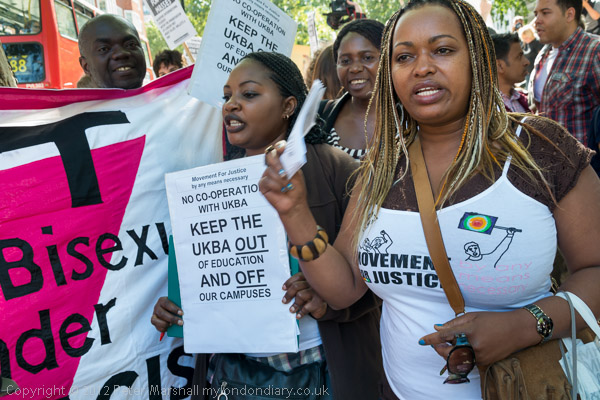
Movement for Justice and Lambeth Unison Black Workers’ Group were protesting in Brixton against the continuing persecution of Windrush family members and other migrants, calling for freedom of movement, the closure of immigration detention prisons, and an end to Brexit which they see being used to whip up immigrant-bashing and nationalism by Boris Johnson.
The event began in Windrush Square, where one of the speakers was Eulalee Pennant, a Jamaican great-grandmother who has been fighting the Home Office for 16 years against deportation. Here uncle was one of the Windrush generation, her grandfather had served in the UK armed forces for his working life, and her cousins, daughter, grandchildren and great-grandson were British. She had worked and paid tax here for many years but was detained days before her 60th birthday and locked up in Yarls Wood, where she contracted a serious stomach infection. She was still vomiting blood when the Home Office tried to put her on a deportation flight.
Eulalee had tried to regularise her and her son’s immigration status with the Home Office in 2003, and among the documents she sent was her passport. The Home Office kept claiming they did not have it, and it was only in court 15 years later they finally admitted they had failed to send in back. Her son spent five years fighting his case to stay in the UK but was deported to Jamaica in 2008, and was murdered there the following June. Her fight against deportation has cost many thousands in legal fees and she has been unable to work since 2003.
There had been relatively few at the gathering in Windrush Square but there was a larger audience when the group marched to Brixton Market to continue the protest there and Green MEP for London Scott Ainslie also came to speak about his LDNlovesEU campaign.
The group then set off to march noisily around central Brixton, returning to Windrush Square for some final speeches.
On Tuesday 13th September 2011, protesters against the worlds largest arms fair being held at the Exel Centre in East London brought their protests to some of the companies selling arms and to key sites including Parliament Square and th National Gallery which was hosting a dinner for the arms traders and their customers, including representatives of many of the most repressive regimes around the world.
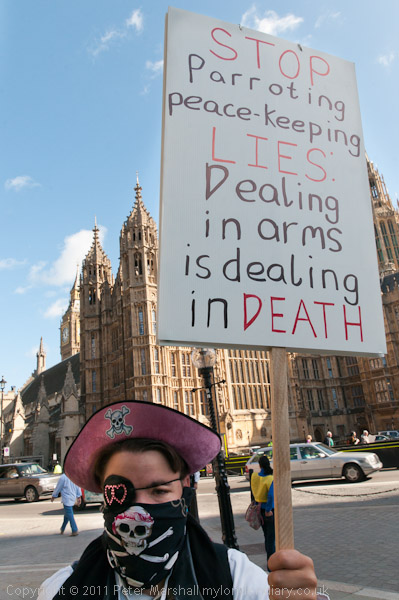
Arms Fair Protest At Parliament, Old Palace Yard, Westminster
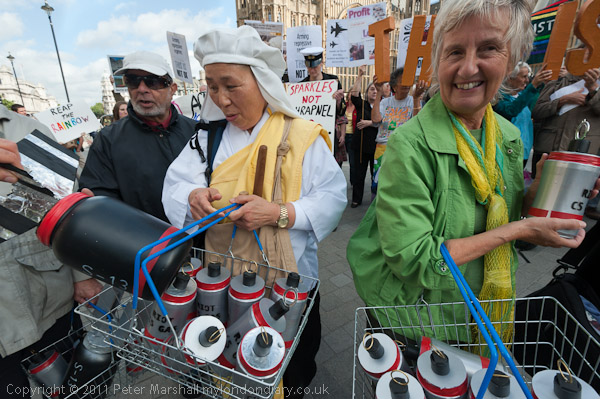
A queue with loaded baskets waits to pay at the arms fair supermarket opposite Parliament
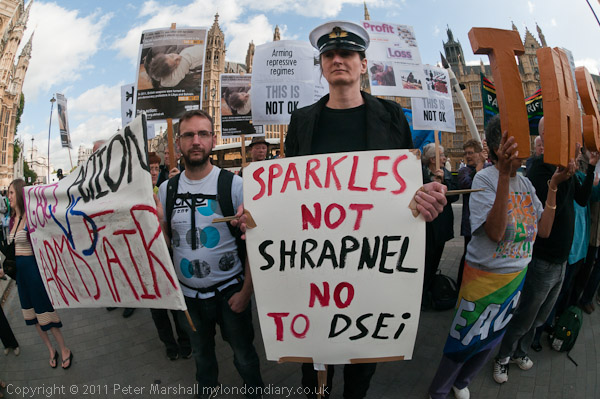
Around 250 people came to protest against the DSEI arms fair which was opening that day in East London. Many were people who had been protesting at the site of the fair during the previous week. The fair is the largest in the world, a private event supported by the UK government, and despite government denials, many deals are made there for illegal arms and arms are sold to some of the worlds most repressive regimes who use them against their own civilians.
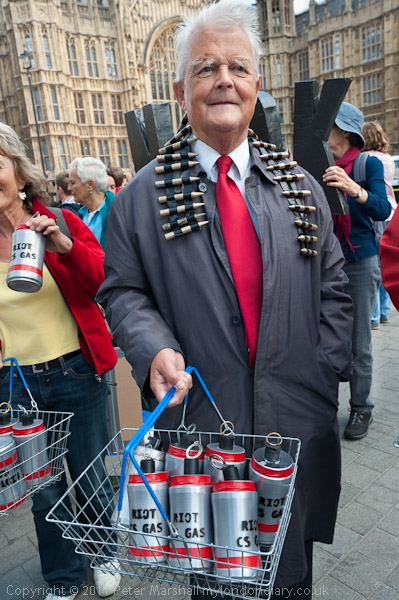
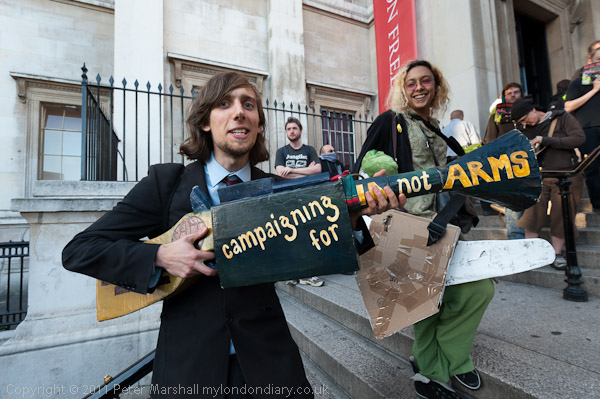
Many had come with posters and placards, but organisers CAAT (Campaign Against Arms Trade) came with fake arms to set up a supermarket where people could queue to buy riot gas, guided missiles, ammunition and other essentiaql supplies to keep their population down.
Bruce Kent with Riot Gas
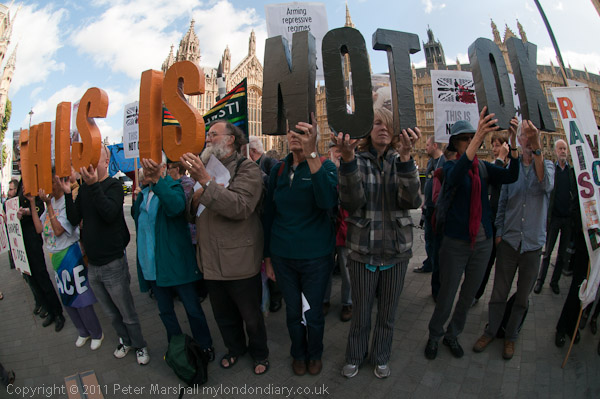
People held up letters spelling out ‘THIS IS NOT OK’ and then other posters and banners.
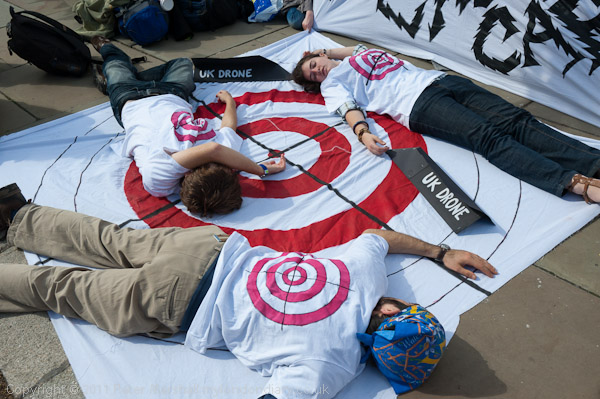
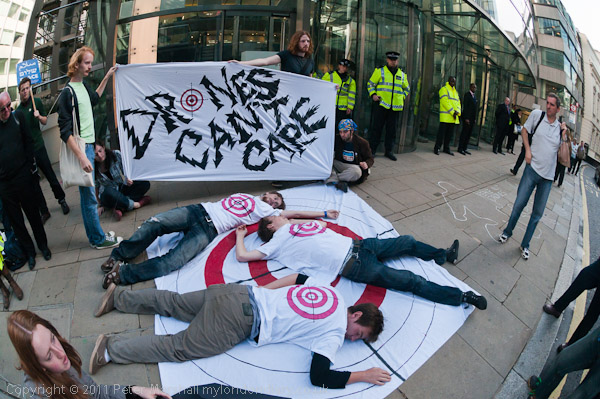
There were some songs, and anti-drone protesters staged a die-in as targets.
The country’s only Green MP (and one of the most sensible in the House of Commons) came to speak.
Dr Zig’s ‘Bubbles Not Bombs’ -Thames Embankment, Tate Modern.
‘Kids need human rights NOT cluster bombs’
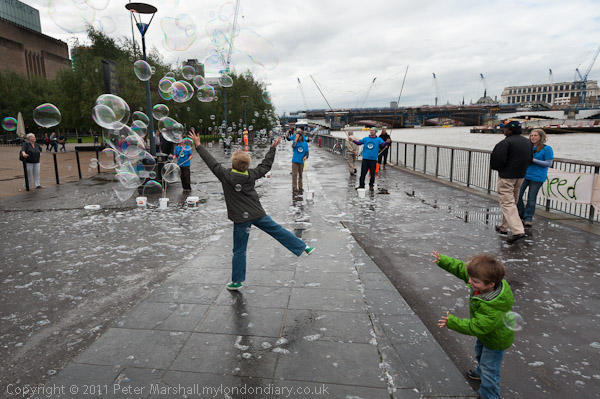
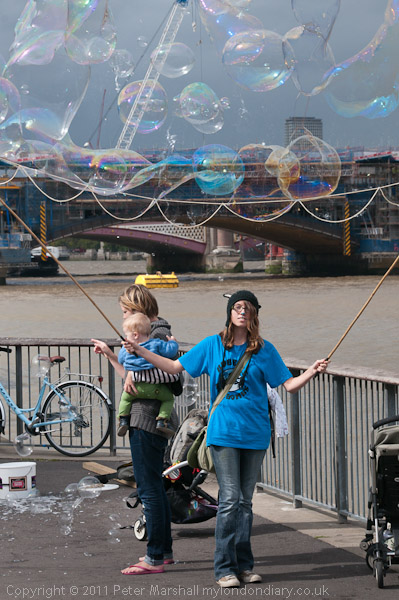
Those remarkable bubbers from Dr Zigs in Wales and made their “seriously HUGE bubbles” on the riverside walk outside Tate Modern, shouting “Bubbles not Bombs” as a child-friendly protest against the DSEi Arms Fair.
They say the DSEI fair is “where bad people the world over can come and buy the latest in guns, drones, warships etc.” and call for it to stop.
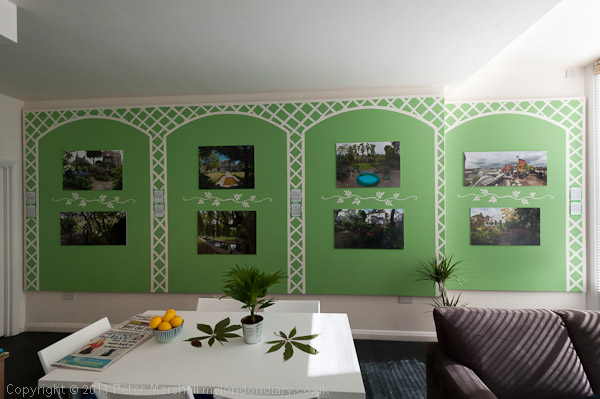
I just had time between protests to pop up to St John’s Wood and the Queens’s Terrace Café, where my show ‘Secret Gardens of St John’s Wood’ had been hung at the weekend when I had been too busy to be there. Jiro Osuga who had done the design and decoration and owner Mireille Galinou whose idea it had been had done a great job and it was ready for the opening.
Down the Drones Arms Fair Protest – Tower 42, Old Broad St
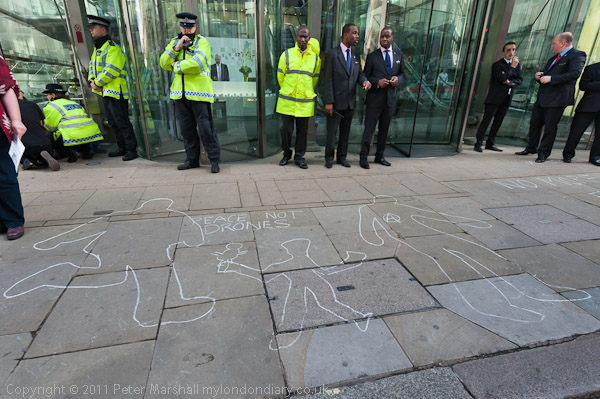
General Atomics ,makers of Predator and Reaper drones had their London office in Tower 42, still better known to many of us as the Nat West Tower, on Old Broad St Although there are wide areas of empty pavement most is land owned by Tower 42 and City police harassed protesters by ensuring they keep to the small area of public highway and then clearing them from most of it as they were then causing an obstruction.
There seemed to me to be no good reason why the police shold enforce the civil property rights of the estate owner which would not be harmed by a small incursion, nor harass the protesters on the public highway when others could easily walk by – as many always do – on the private land.
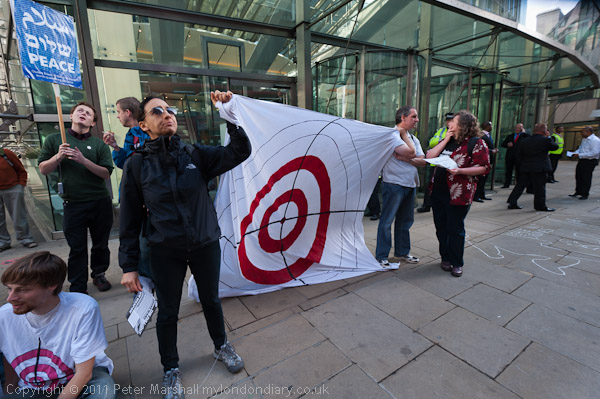
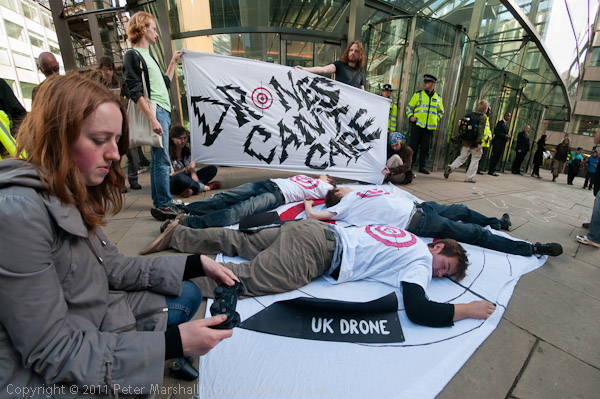
The protesters managed to chalk slogans and body outlines on the pavement, displayed banners, sang and handed out leaflets to passers by about the dangers of militarism but were not allowed to lie down on their target and invite passers by to ‘zap’ them with a Playstation controller in their game of ‘Remote Control Killer Robots’.
The US was then using around 48 Predator and Reaper drones in Iraq and Afghanistan, and the UK around 10 MQ-9 Reapers in Afghanistan, all controlled by pilots in an airforce base in Nevada. Various documents released by whistleblowers show that drone strike often take place on the basis of very limited and often unreliable evidence often killing innocent victims and any males in these countries who appear to be of military age and likely to be targets.
Using drones turns warfare for those ‘piloting’ them from a centre perhaps several thousands of miles from the battlefield into something very much like a computer game, removing any normal human inhibitions about the indiscriminate killing of others.
In the final few minutes police allowed three protesters to lie down on the pavement for a few seconds to enable photographers to take pictures.
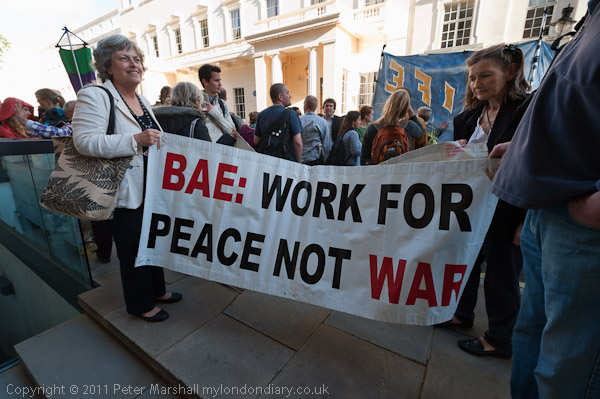
I’m not sure if there were any police for the protest outside BAE Systems in Carlton House Terrace which was the final advertised protest of the day. Perhaps the police were acting on advice from one of their plain clothes operatives who had told them there would be no trouble at this event.
BAE Systems is Britain’s largest manufacturing companies, formed in 1999 by the merger of British Aerospace with parts of Marconi Electronics and traces its history back to 1560 and the Royal Gunpowder Mills at Waltham Abbey, over the years having incorporated many of the famous names in UK industry, particular those involved in aviation and arms manufacture. It also has a US subsidiary, BAE Systems, Inc. The company was a nationalised industry from 1977 to 1981, with the UK government in 1985 selling its remaining shares except for one very special £1 share which it can use to prevent it becoming foreign-owned.
The company has been involved in a number of trade scandals, particularly over its deals with Saudi Arabia. Most recently in 2006 the Serious Fraud Office was forced by the Labour government to drop enquiries into bribery over an arms deal by BAE Systems with Saudi Arabia after a Saudi royal prince threatened cancellation of the order in 2006. The Campaign Against Arms Trade (CAAT) obtained a High Court decision that this government action breached the OECD Anti-Bribery Convention, but the government appealed and the law lords decided that national security should be an overriding principle and overturned the decision. So bribery, as well presumably as any other crime, is OK when it is in the national security interest.
The government’s decision to cancel the investigation was seen by most as an admission of BAE’s guilt in the matter, and they have also been under investigation for bribery in Chile, Romania, South Africa, Tanzania, the Czech Republic and Qatar and possibly elsewhere.
BAE systems are one of the world’s largest arms companies, producing fighter aircraft, warships, missiles and tanks along with other weapons. They are also one of the companies that will profit hugely from the replacement of Trident nuclear missiles, a high-spending and potentially dangerous project with no military significance.
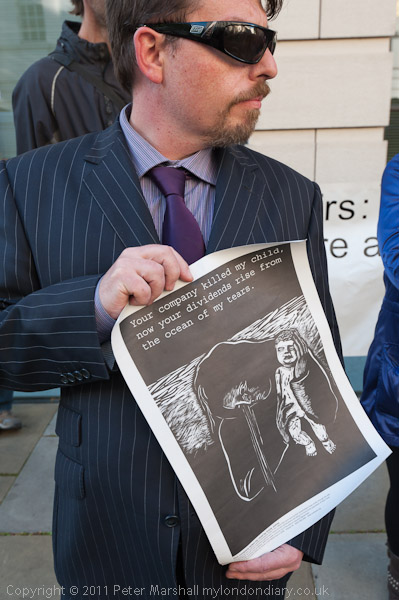
After some short speeches about BAE, almost all of those present laid flat on the pavement for a die-in before getting up and leaving. Although this was the last advertised protest for the day, a message bad been passed around that there would be an action at the National Gallery, which was hosting a dinner for those attending the DSEi arms fair.
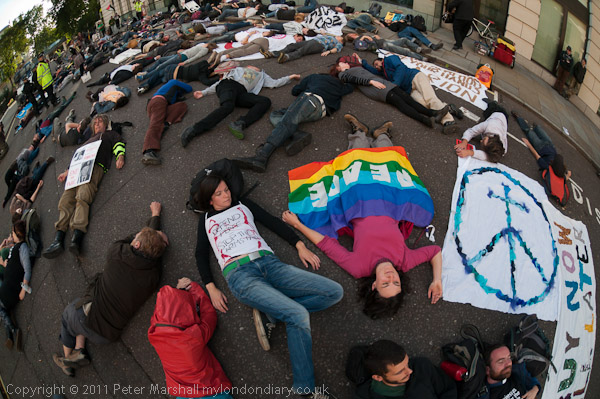
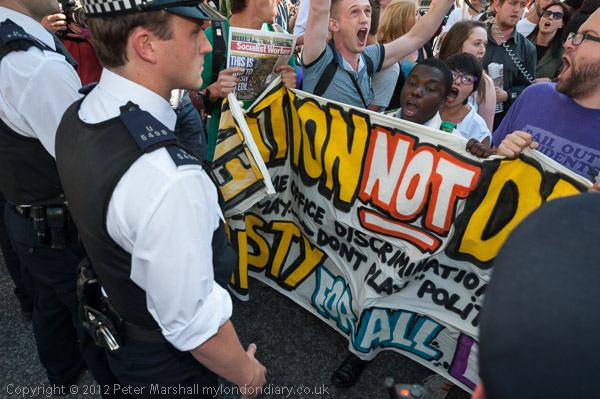
After a day of peaceful demonstrations against the DSEi Arms Fair in London, a fracas developed as police attempted to clear the National Gallery steps while a peaceful protest continued below in the North Terrace of Trafalgar Square. Well over a hundred protesters had come to the National Gallery as it was closing to protest at a dinner being given there for those attending the DSEi arms fair, including representatives of many of the most repressive regimes around the world.
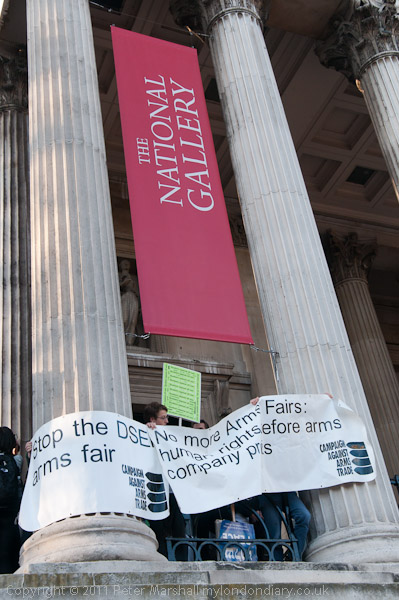
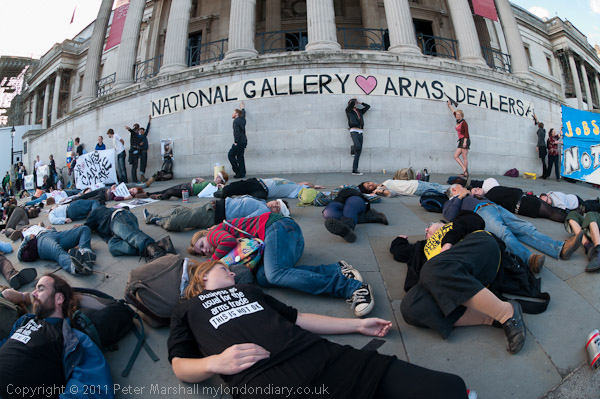
The protesters attempted to enter the Gallery as it was closing but were ushered out by security staff, and then began a peaceful protest on the steps of the gallery. Gallery staff asked protesters to leave the steps but some decided to stay and display banners there, while others continued to protest peacefully on the North Terrace in front of the gallery, displaying banners and holding a ‘die-in.
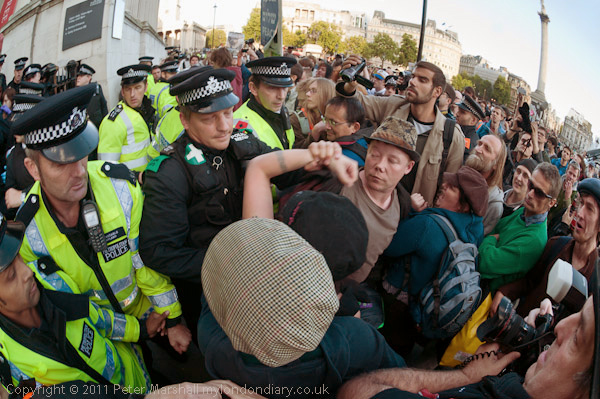
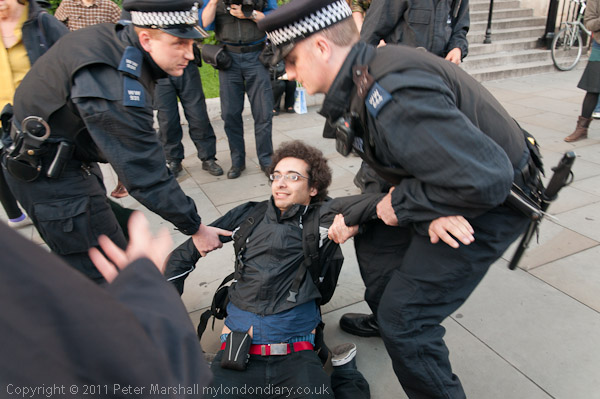
Eventually police got most of them moving slowly down the steps, though a few were still refusing to move. There was quite a lot of joking between some of the police and protesters and the atmosphere was generally friendly, although the protesters were not being very cooperative. Suddenly one of the protesters was seized and roughly carried away by police towards a nearby van. He did not appear to be formally arrested, and police would give no reason for his detention either to press, legal observers or protesters.
This changed the mood completely. Police reinforcements arrived and were able to force the protesters from the steps. There were a few incidents of what seemed thuggish violence towards both men and women. Some were arrested and dragged off to waiting vans; it was hard to be sure but their offence appeared to have been arguing and trying to protect themselves against police violence.
Meanwhile the protest continued peacefully on the North Terrace with a die-in and speakers explaining to the crowd that had gathered that the protest was calling for an end to UK arms sales to authoritarian regimes including Kuwait and Saudi Arabia, both responsible for the ruthless suppression of people in the ‘Arab Spring’ as well as countries involved in major armed conflicts and human rights abuses. I think many were shocked to learn that the UK was playing such a major part in this killing of people around the world – not something our media often dwell on.
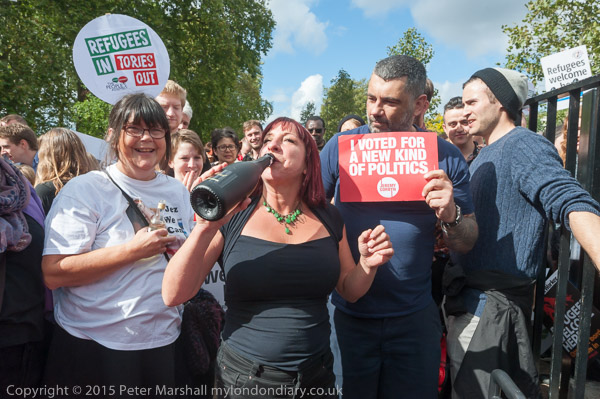
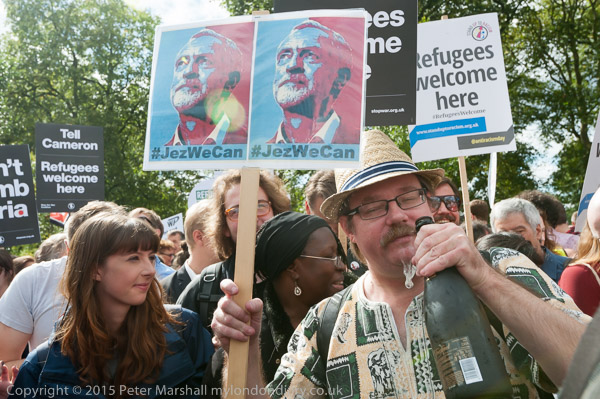
Saturday 12th September was an incredible day for British politics, as the result of the Labour leadership election was announced. Jeremy Corbyn had won what had seemed only a short time before an impossible victory, and one the could have been the start of a campaign which would have made great changes in British politics.
Instead it led to years of unrest in the Labour Party, with the right fighting against their own party leader who was enjoying huge popular support, both inside the party giving new hope to party members but also promoting policies that while enraging the establishment enjoyed a great deal of popular support in the country.
Of course they didn’t suit the powerful oligarchs who have actually run the UK for the last roughly 400 years and their representative who own and run almost all of our media went into full attack mode against Corbyn with lies and exaggerations and words taken out of context.
Had Corbyn been supported by the MPs and others in his party he might have weathered the storm and the result of the next general election could have been different. Of course Theresa May would not then have called an early general election in 2017 as she would have had far less chance of winning – and would not have had the support of Labour to do so.
People repose their rejoicing for the cameras who missed the real thing
But instead Labour MPs and party officers set out on a campaign of dirty tricks and lies against Corbyn, including a carefully choreographed series of resignations from his shadow cabinet which severely weakened but failed to remove him. Labour threw away the 2017 election becase money was diverted from key marginals into safe seats, but in the end it was still a close thing – and you could see the relief on some Labour MPs faces after the result that they had lost became clear.
Parts of the anti-Corbyn campaign became clear in the leaked private report from the party to the Equality and Human Rights Commission, which was leaked shortly after Kier Starmer became leader. In particular this made clear the role of senior party officers trying to prevent Corbyn’s election as party leader and then their sabotaging his efforts to deal with antisemitism so as to continue attacks against him on this issue. Having read all 860 pages, which include 10,000 emails, thousands of messages from party’s internal messaging service, and 400,000 words from two WhatsApp groups used by senior party staff, while it may be selective and possibly inaccurate in some areas, its overall conclusions were unassailable. As the final publication of the Forde Report, though trying desperately to make it more palatable and removing much for legal reasons also makes clear on a detailed reading.
But in 2015 it was clear that the public wanted change and saw Corbyn as the man to deliver it. But most Labour MPs were unable to drag themselves out of their own old right-wing ways. It was a disaster for the nation and I think also the party, which show little sign of having learnt its lesson.
But had Corbyn won I think he would have disappointed many of his supporters by diluting policies under pressure from those rich and powerful oligarchs and revolts by Labour MPs who server their interests. And if he had tried to push them through and looked as if he would succeed we might have seen the democratic surface stretched to breaking point and a military government take over. This was the start of a was that Corbyn was destined to lose, and had his own party not stopped him others would have done so with all means necessary.
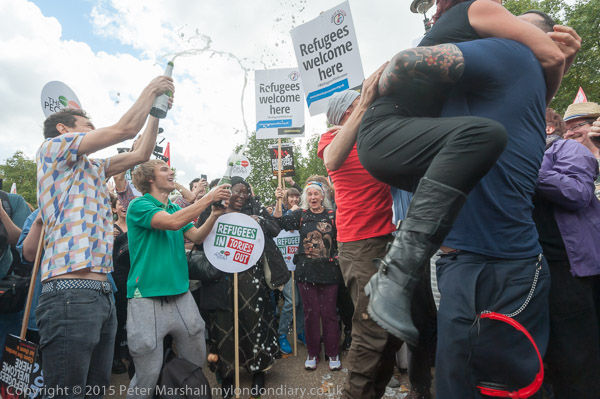
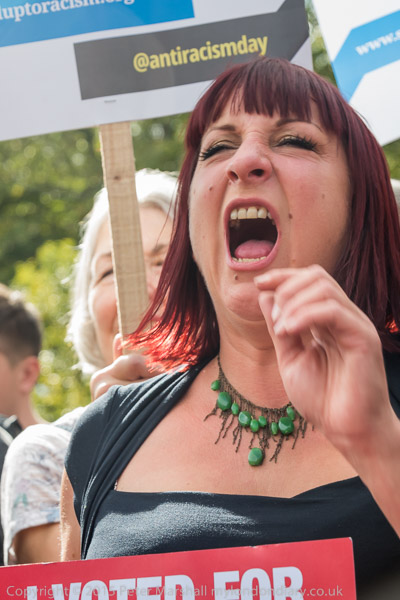
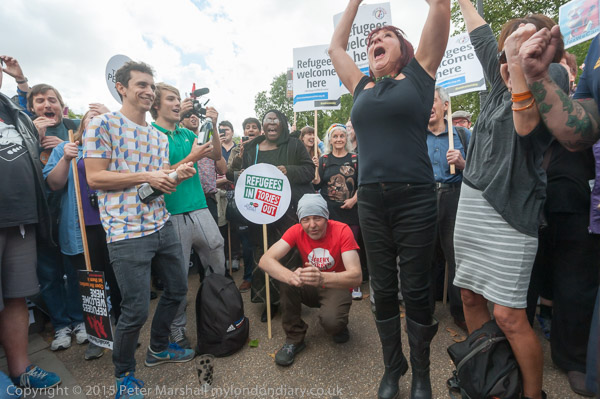
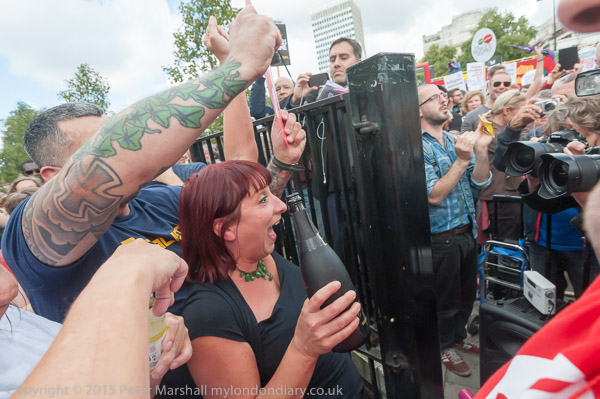
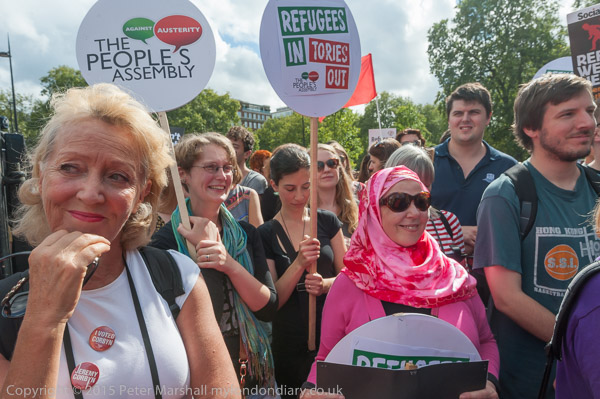
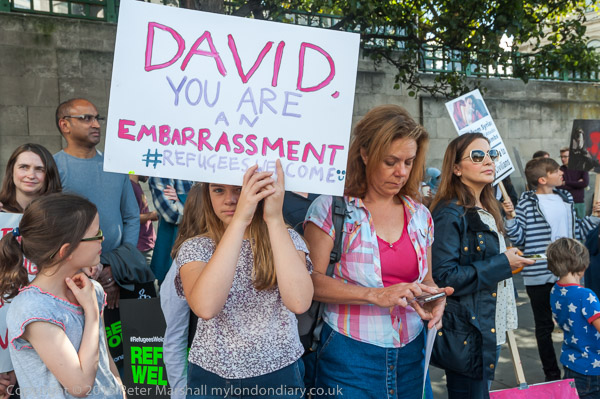
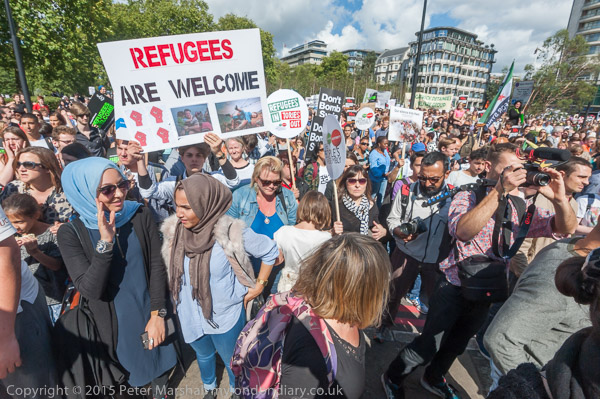
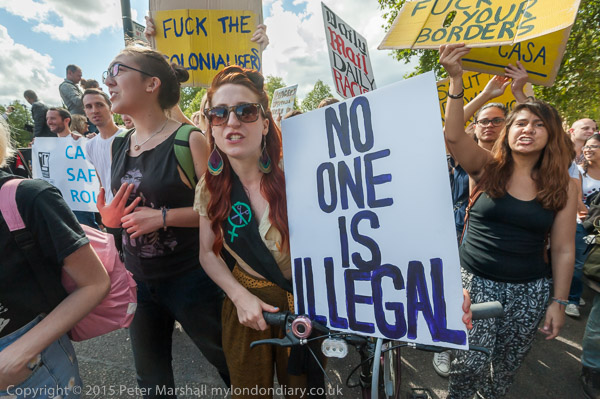
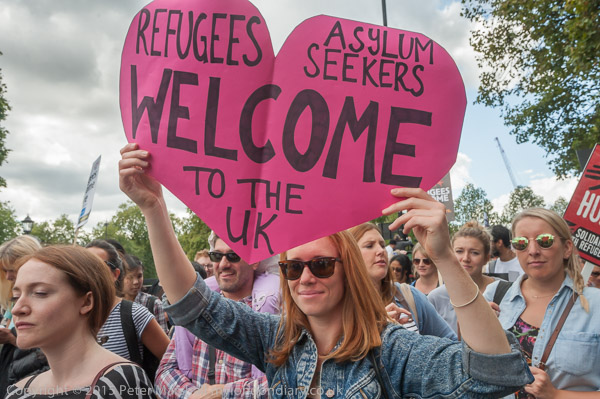
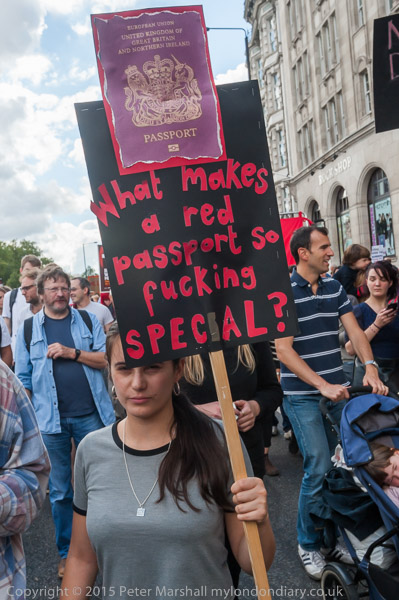
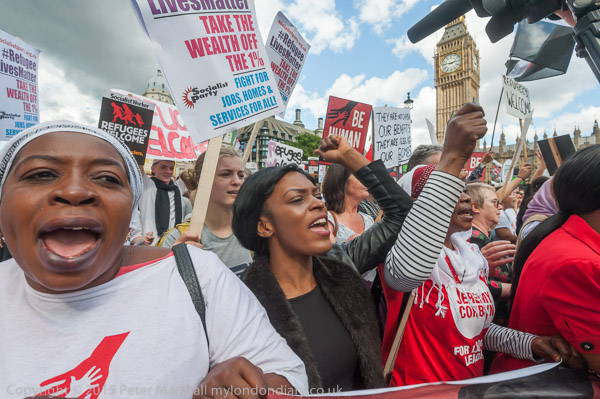
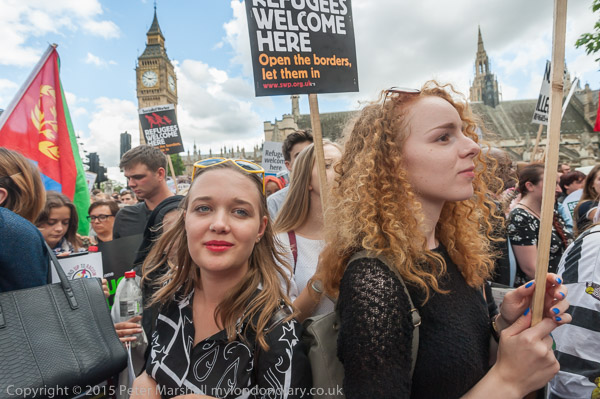
A short distance away from the Corbyn Victory party people were crowding into Park Lane for the Refugees Welcome Here national march against the many reports of refugees fleeing war and persecution, suffering or dying because of the paltry response by ours and other Governments.
The UK has been particularly poor in in its response to the crisis, making it almost impossible for asylum seekers to arrive legally in the UK – and locking up many who do get here indefinitely in our immigration detention centres. Its policy appears to be based on the same racist principles as Theresa May’s ‘hostile’ environment and playing to the racist views of the Tory right.
Before the march began there were a long list of speeches, though many of the crowd would have been too far away to hear them, even with the powerful amplication systems in place. You can see pictures of many of them as well as people in the crowd on My London Diary
Eventually the march set of, with over 50,000 having come from across the UK to show their support for refugees facing death and hardship and their disgust at the lack of compassion and inadequate response of the British government.
I started at the front of the march, then worked slowly with stream after stream of marchers on Piccadilly, eventually giving up at Green Park station, though there there were still marchers coming on as far as I could seen down the road. But I took the tube to Westminster to try and catch the head of the march as it arrived at Parliament Square.
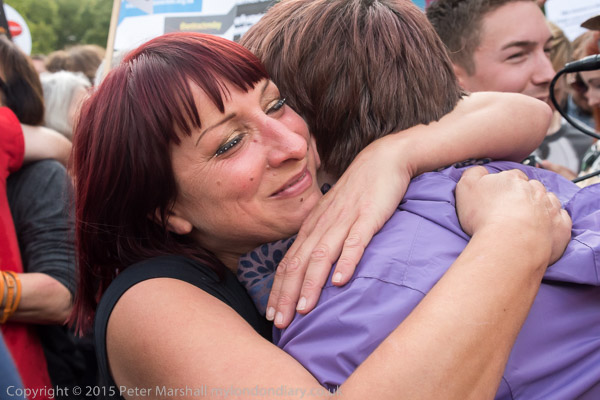
People were exultant as they reached Parliament Square at the end of the march.
Alhough there was still a ring of stewards protecting the front of the march some were friendly and allowed me to go through and photograph the people as they arrived in front of the Houses of Parliament. Many had marched in the white ‘I’m a Refugee’ t-shirts.
People were still flooding in to Parliament Square which was begining to look full, but by now I was feeling very tired, and despite the promise that Jeremy Corbyn would be among the speakers I decided it was time to have a very late lunch and go home. Others could listen to the speeches and photograph the rally which was now taking place.
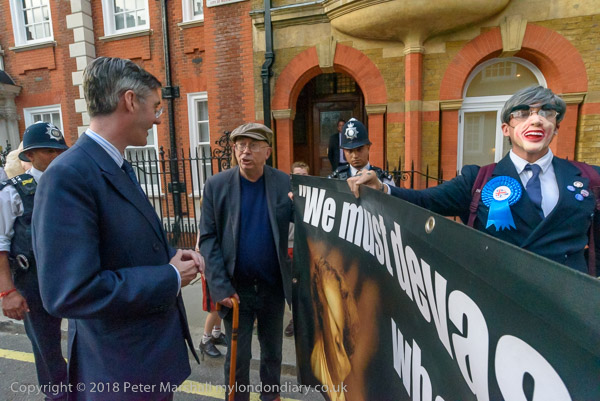
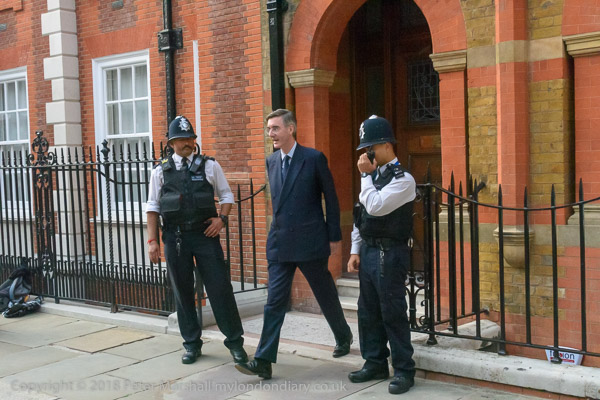
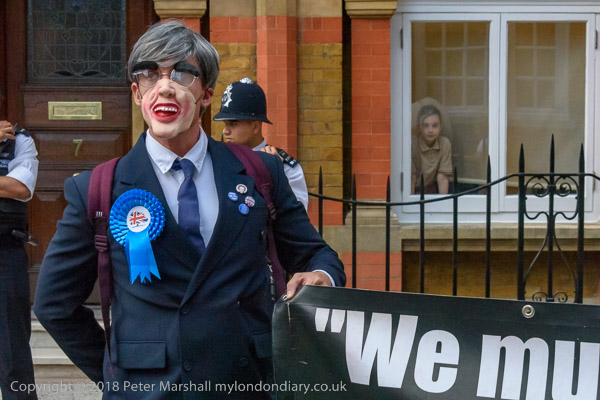
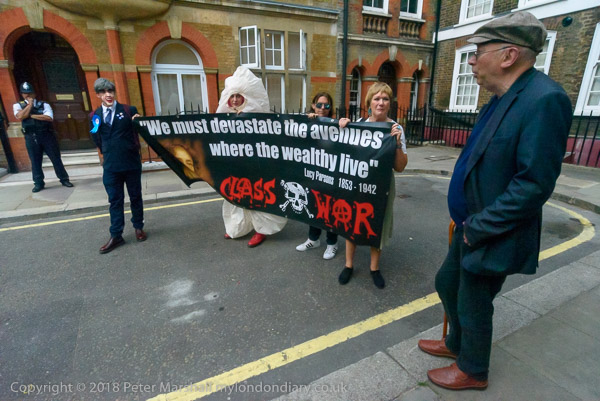
On Tuesday 11th September 2018 I accompanied Class War as they enacted a short theatrical protest outside the Westminster home of Jacob Rees-Mogg. I think it rather amused Rees-Mogg, who deliberately brought out his family and nurse to take part in it, later milking the event for every last ounce of publicity he could. I was impressed by his performance.
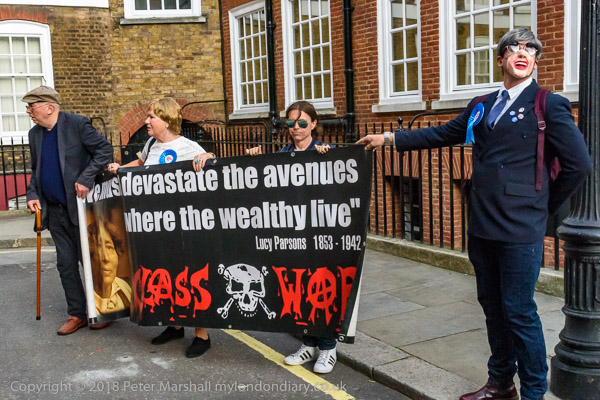
Class War had come to call for the release of Rees-Mogg’s nanny, Veronica Cook, who they say ceased to exist as an independent human 50 years ago and has been subsumed into the Mogg family as if she was being confined in the tower of a gothic mansion.
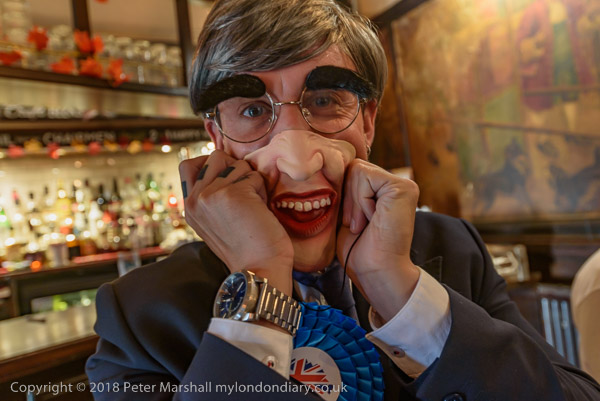
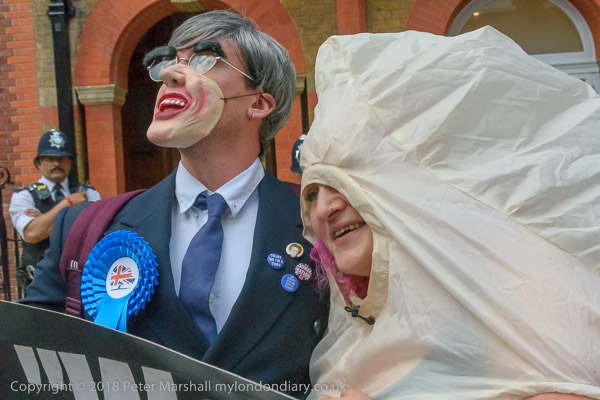
The playlet involved only six protesters, with Ian Bone as himself wearing a cloth cap, former Class War Westminster candidate Adam Clifford as an impressive Jacob Rees-Mogg, Jane Nicholl as a more fetching Nanny Crook and a giant penis, though this had problems in getting inflated and missed much of the action.
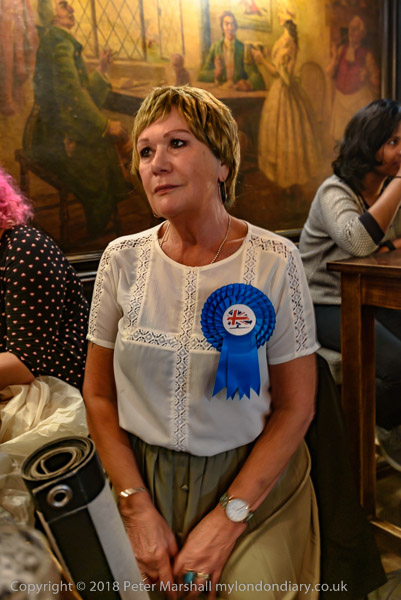
I’d met Class War in a nearby pub, where the performers put on their costumes and then walked along the street to the Mogg house. The performance had been advertised in advance, and family and security were waiting when they arrived and police had a short converstation with Class War who assured them that this would be an entirely peaceful event and there was no intention to cause any damage.
Jacob Rees-Mogg then strode out to meet the protesters, who were not really ready, just finishing unrolling their banner. A loud discussion started, with him being questioned about his nanny and how much she was paid but with him simply welcoming the protesters and refusing to answer. And in the background behind me the woman wearing the inflatable giant penis costume was struggling to get it erected.
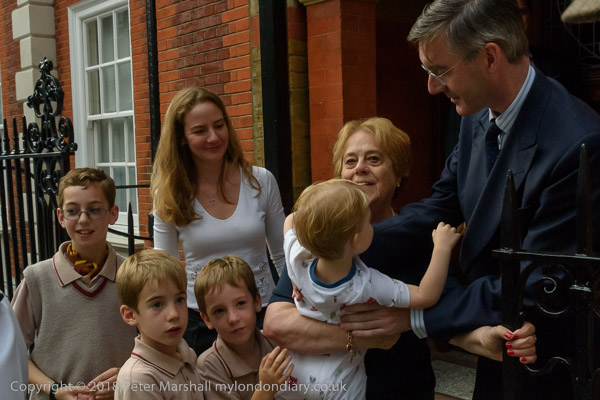
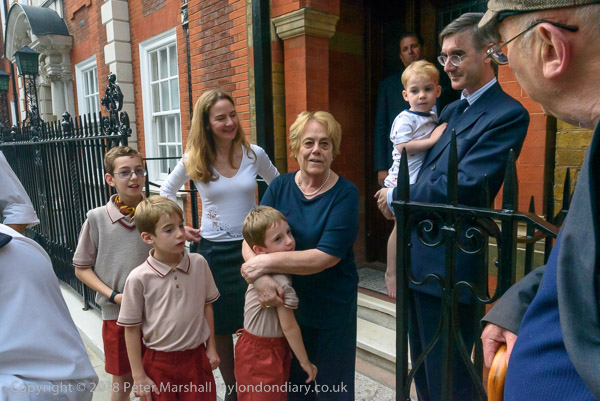
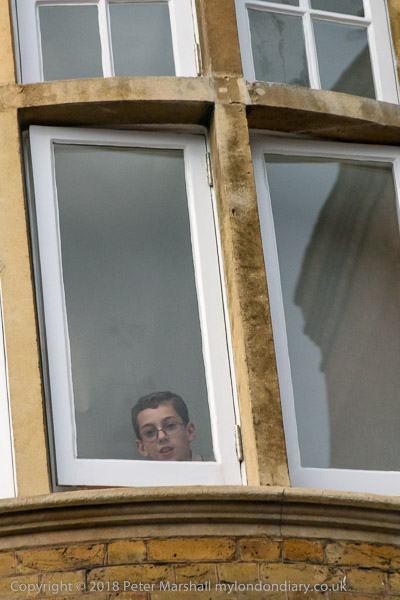
After a minute or two, Rees-Mogg was joined by his wife and eldest son, and shortly after the whole family was there with Nanny Crook carrying the baby which she handed to his father. The two elder boys in particular were clearly very interested in what was going on, and at no point in the event did they seem particularly upset in any way.
Ian Bone continued to loudly question Mr Rees-Mogg about the pay and conditions of Nanny Crook, repeating his questions as he failed to answer. After some time he invited Nanny Crook to speak and she told the protesters that she was very happy with the arrangements, though she did not answer about what these were.
They made Nanny an offer of escape, telling her she is paid at below the minimum wage, calling Rees-Mogg a “Slave Owner – The Leopold of the Mendips” and also suggested that she joined a trade union, offering her membership of the UVW. She only smiled, and her employer made clear that she had no interest in the offer of trade union membership.
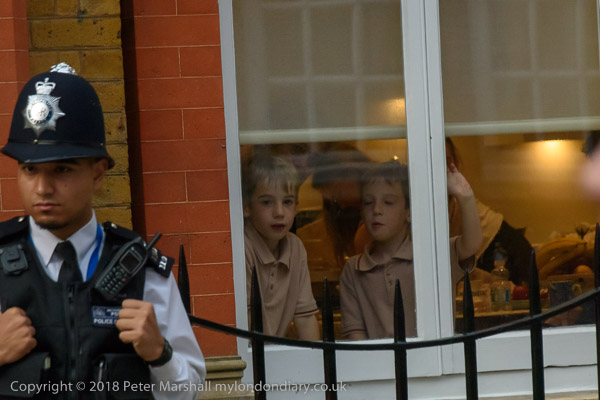
When nanny pulled down the blind the oldest son went upstairs to watch
At one point Bone turned towards the elder of the boys watching the performance, telling him loudly that a lot of people didn’t like his daddy and giving some reasons for this at some length. One of the protesters captured this on a video which was posted on social media and led to a national outcry from press and TV channels.
While another squeezed in front of the blind
One other journalist had arrived to photograph the event alongside me, and he rushed off to file his pictures which were widely used. I accompanied Class War back to the pub and only filed work later. One picture editor of a major national newspaper later told me he had failed to find my pictures as he searched for “Mogg” but I had used the keyword “Rees-Mogg” among those on my pictures.
Finally the giant penis joins the other protesters
I’d also filed a report of the event, but that was never even quoted, and I was never contacted by the media for my comments, nor I think was the other journalist. Our accounts would have totally contradicted the headlines used about Class War “ambushing” the family, which was simply a media smear.
As I comment on My London Diary:
“Jacob Rees-Mogg and his family were willing participants in what happened in front of their home. Their children did not seem upset, more fascinated with what was happening – and after they had been taken inside and the protest continued had to be dragged away from the windows. One made his way upstairs to continue to watch without being prevented from doing so. Almost all of the media commentary was a deliberate total misrepresentation of what had taken place.”
Class War watch their video in the pub before they upload it
Both Rees-Mogg and Class War revelled in the publicity they got from the event, with Ian Bone being labelled by one opinated right-wing radio show host as “foul-mouthed” for telling the interviewer he was talking “bollocks” when he raved and blustered at the remarkably level-headed, clear and accurate acount Bone gave of the event. I felt he should have added the word ‘absoute’ in front of it but otherwise it was hard to fault.
GH Metals is I think still operating in Evelina Rd, although its premises are now covered by graffiti and there are no prices on the list of metals still above the shopfront. Their web site states the family have run successful scrap metal yards all over South London and in Peckham since 1968.
Evelina, or the History of a Young Lady’s Entrance into the World was the title of a novel by Fanny Burney published in 1778 but I suspect the road like the Evelina London Children’s Hospital was named after the English wife of the wealthy Austrian Baron, Ferdinand de Rothschild – she died in 1866, probably around the time the street began to be built up.
R E Sassoon House, St Mary’s Rd, Peckham. Southwark, 1988 88-12e-44
From Evelina Road I went up St Mary’s Road, photographing the strangely squat St Mary Magdalene Church (not digitised) , described on the Twentieth Century Society’s web site as “a bold and innovative 1960s landmark” but sadly demolished by the Church of England and replaced by a building “of no architectural merit”. Designed by Potter and Hare it was built in 1961-2 and demolished in 2010.
Sassoon House designed in an International Modernist style by Maxwell Fry is Grade II listed and was built as a part of the Peckham project around the neighbouring Pioneer Health Centre in 1934 to provide high quality social housing. The Sassoon family were one of the wealthiest in the world, known as the “Rothschilds of the East“ amd when R E Sassoon, the amateur jockey son of the philanthropist Mozelle Sassoon, was killed steeplechasing in 1933 his mother commissioned this block in his memory.
Queens Road, Peckham, Southwark, 1988 88-12e-32
I’ve only digitised one of the six frames I exposed on Queens Road, where there are several listed buildings on the corner and just to the west of St Mary’s Rd. This is Grade II listed as ‘QUEEN’S ROAD (South side) Nos.156 and St Mary’s Court (No.158)’ and the houses date from around 1845.
Montpelier Rd, Peckham. Southwark, 1988 88-12e-21
Montpelier Road (single L) was apparently named in 1875 after Montpellier in France (2Ls) which was a fashionable resort at the time and is now the seventh or eighth largest city in France. As well as one of the oldest universities in the world with an historic centre and the famous the Promenade du Peyrou from which you can on a clear day see the Meditteranean, Montpellier was also well-known for its wine. Montpelier Road has none of these and previously the road had been called Wellington Villas. It may have taken the name from the nearby Montpelier Tavern in Choumert Road, which although in a more modern building probably dates back earlier.
This unusual terrace of houses is fairly typical of most of the west side of the street which ends at Meeting House Lane.Those further up the street are a little more decorated.
London Customs, Hart Lane, New Cross, Lewisham, 1988 88-12e-25
I walked back along Queen’s Road towards New Cross where there is now no trace of the building at No 3, though these is still a garage workshop, now 3a. But the name that had attracted my attention has gone. I imagine it offered the service of customising cars rather than any interest in the customs and traditions of the city. I thought it might make a good title picture.
Cold Blow Lane, New Cross, Lewisham, 1988 88-12e-13
I made a single exposure while walking north up Brocklehurst Street (not digitised) showing the window detailon this long street of identical houses, probably pressing the shutter out of boredom, and then turned into Cold Blow Lane, where there are the solid brick piers of a dismantled railway bridge leading to a narrow tunnel still takes the road under the railway, followed by a newer brodge under more lines with a slightly wider roadway underneath.
It was a rather scary walk underneath, though not as scary as it might be had it been a match day at the Millwall stadium nearby – still then at the Old Den in Cold Blow Lane.
Elizabeth Industrial Estate, Juno Way, Cold Blow Lane, New Cross, Lewisham, 1988 88-12e-15
Juno Way was between the railway bridges over Coldblow Lane, but is now closed off at this southern end by a continuous fence between the bridges and can only be entered from Surrey Canal Road.
The building with the tower carrying the estate name was once the Mazawatee Tea factory, purpose built for them in 1901 when they were the largest tea company in the world. As well as tea they also processed coffee, cocoa, cakes, sweets and chocolates here and doubtless some raw materials would have come here on the Surrey canal from the London docks. It employed up to 2000 people but was heavily damaged by wartime bombing. The name is from the Hindi ‘Maza’ – pleasure – and the Sinhalese ‘Wattee’ – garden – and thus reflects two of the areas from which they brought tea. It was the most advertised brand in the UK until the Second World War.
The tower building was renovated from a complete shell in 2011 and ‘Unit 13’ now houses 12 self-contained studios with high ceilings and good natural light, including the 2300 square foot Tea Room Studio and a number of smaller spaces on the top floor.
I still had a little way to go on my walk and a few more pictures – I’ll post the final instalment of this walk later.
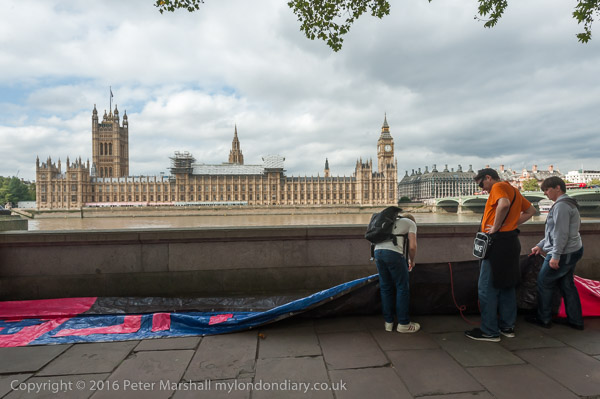
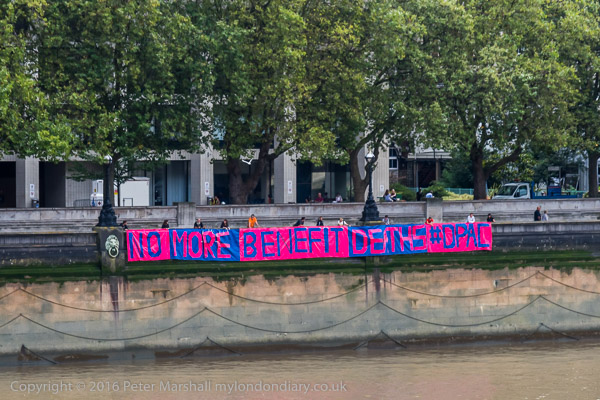
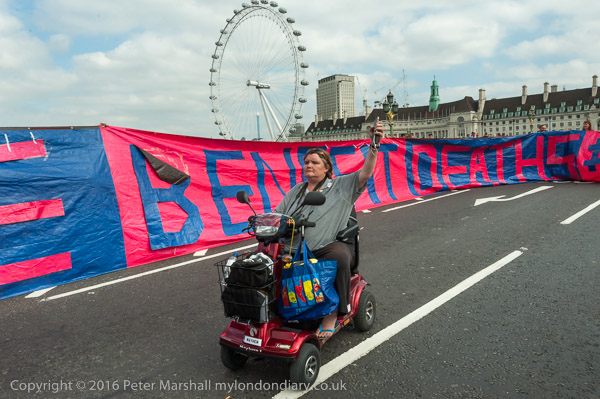
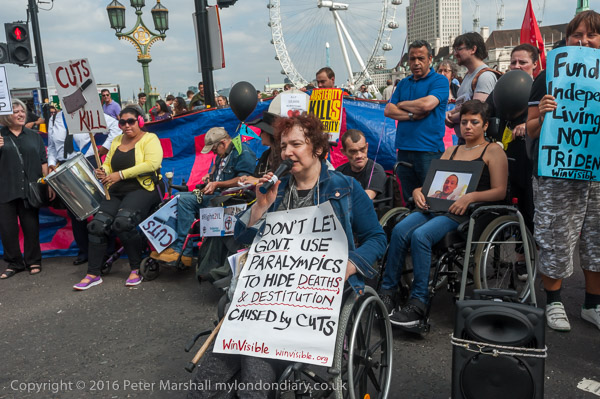
No More Benefit Deaths – 2016 The action on Wednesday 7th September 2016 began with a huge banner being displayed over the river wall on the Albert Embankment so it could be seen clearly be any MPs and others on the river terrace outside the houses of Parliament with the message ‘NO MORE BENEFIT DEATHS #DPAC’
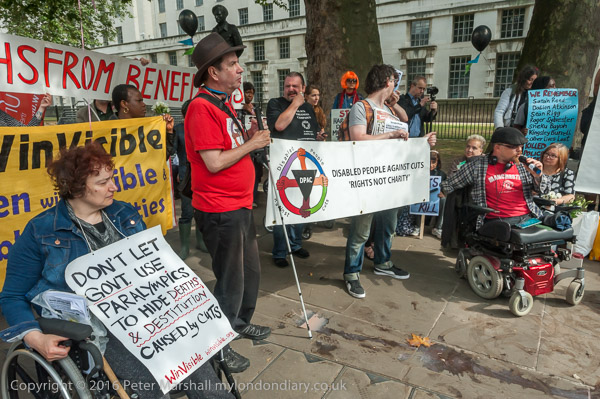
The date was the opening day for the Paralympics in Rio, and protesters held a rally outside Downing Street to call on Theresa May to pay attention to human rights and to make public the findings of the UN investigation into the UK for violations of Deaf and Disabled people’s rights, to scrap the Work Capability Assessment and commit to preventing future benefit-related deaths.
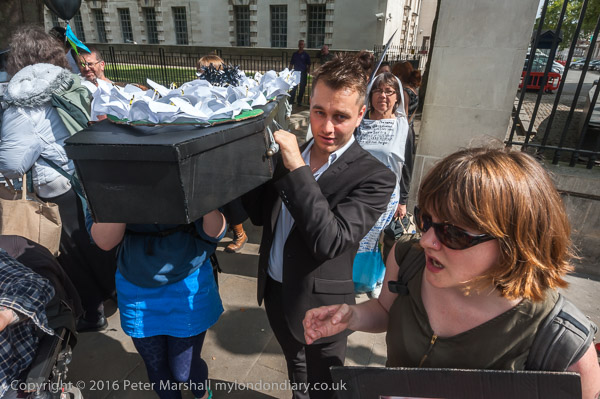
From Downing Street they marched behind a coffin towards Parliament Square.
But on reaching Bridge Street they surprised police by turning on to Westminster Bridge
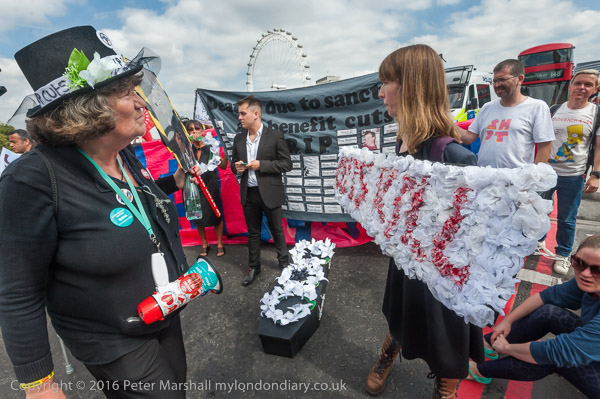
where they blocked the road on both carriageways with banners, a floral sign and the coffin.
The giant banner that had previously been displayed on the embankment was now stretched across the road.
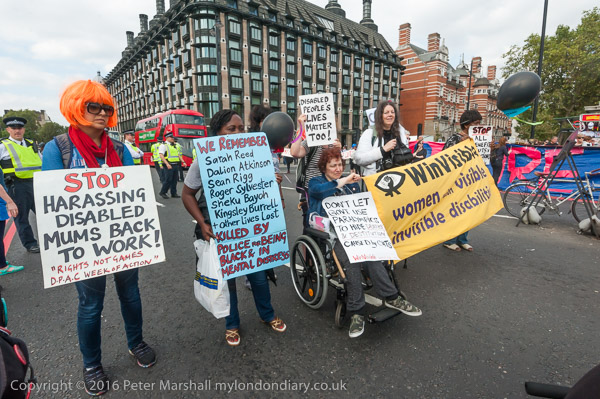
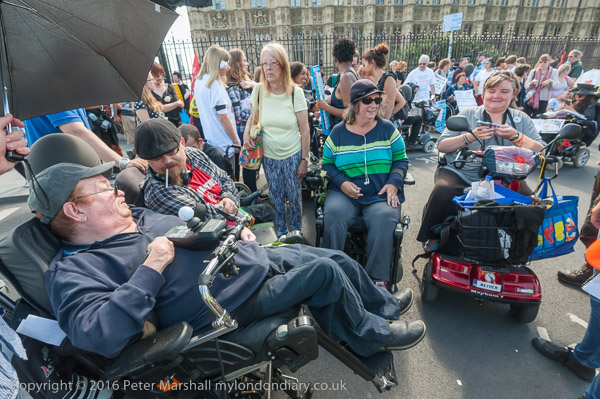
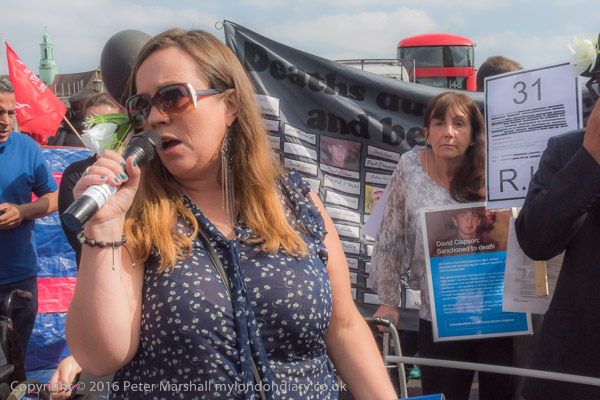
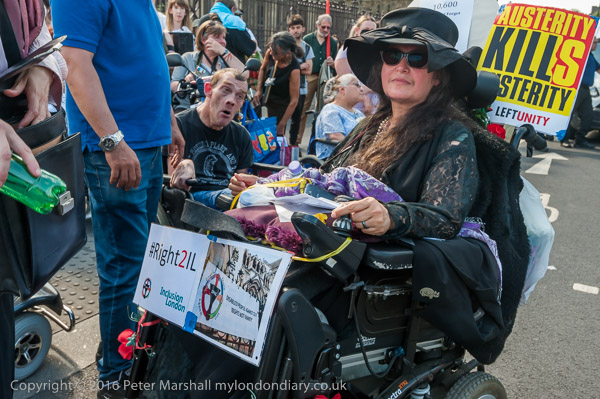
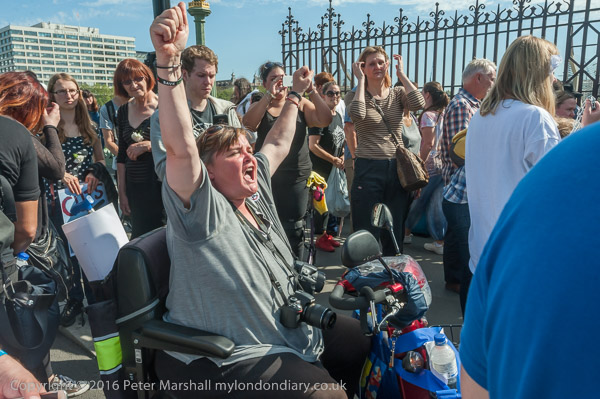
Protesters sat in wheelchairs or stood holding posters and banners and there were some speeches about why the protest was taking place.
Police at first asked them politely to leave, then began to threaten protesters and journalists covering the event with arrest if they remained on the highway.
Most of those in wheelchairs refused to move. One carer who was looking after a disabled person was arrested and taken to a police van.
I think those arrested were later released without charge – arrest was being used in an abuse of process to harass protesters
Many of DPAC’s disabled protesters refused to move and a few remained blocking the roadway almost two hours after the protest began.
Eventually Paula Peters decided that the protest had gone on for long enough and triumphantly called a halt to the protest.
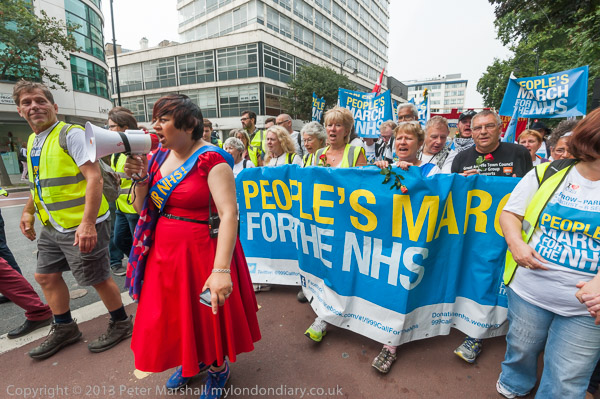
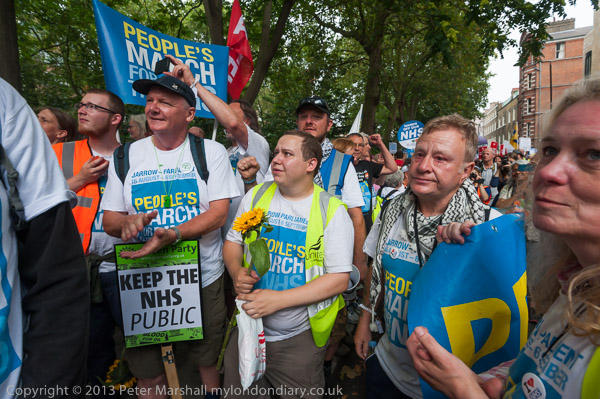
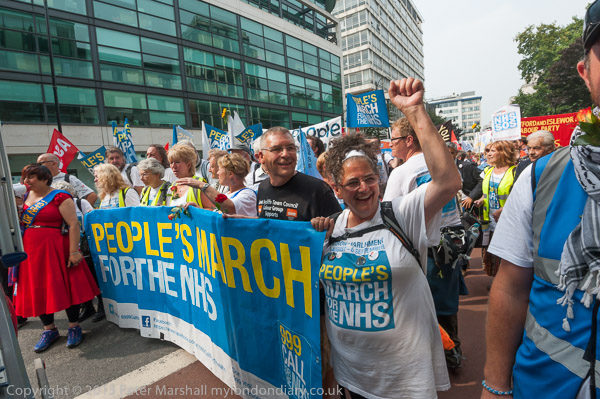
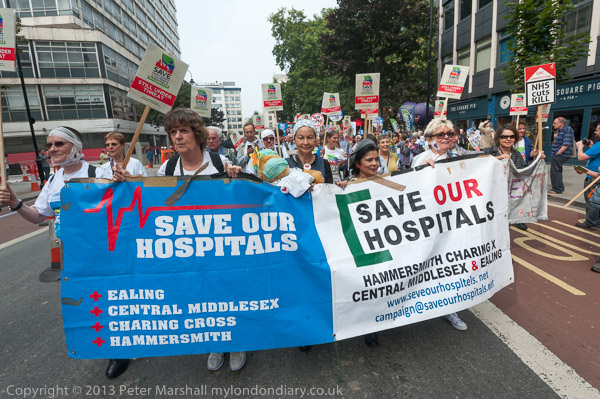
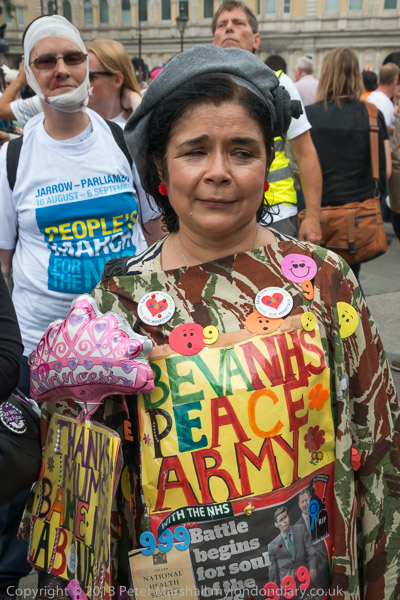
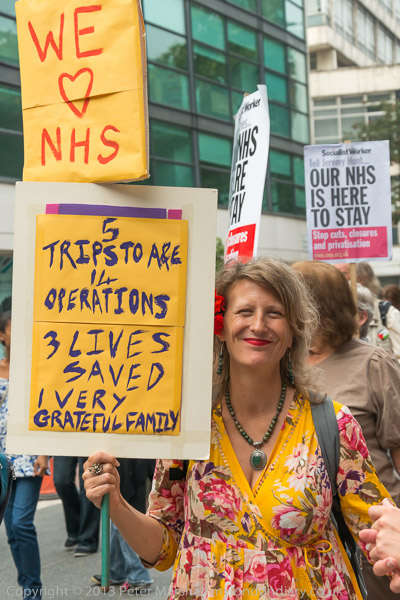
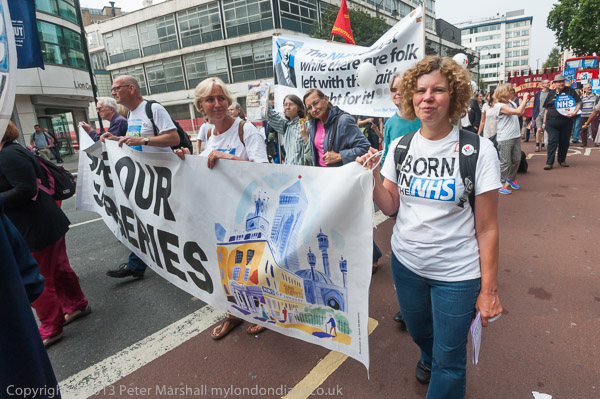
On Saturday 6th September I was in London mainly to cover the final stage of the People’s March for the NHS which had begun in mid August in Jarrow, but also photographed Mourning Mothers of Iran, people on a Rolling Picket against Israeli violence and a protest against children being taken for families by social workers and family courts.
People’s March from Jarrow for NHS
When the NHS was founded back in 1948 it was an integral part of the welfare state, a social welfare policy to provide free and universal benefits. It was opposed at its start by the Conservative Party, and met with opposition from some doctors and other medical professionals worried that it would cut their earnings from private practice.
Particularly because of the opposition from doctors, the initial scheme had to be fairly drastically changed, with compromises being made by Minister for Health Aneurin Bevan. And dentistry was never really properly and fully brought withing the system.
Since 1948 much has changed. We’ve seen a huge growth in private hospitals, partly driven by many employers providing private healthcare schemes as a perk for their better paid employees, but also by public funding being used to pay for NHS services provided by the private sector.
We’ve also seen the introduction of charges for NHS prescriptions and more recently the NHS has decided on a fairly wide range of common conditions for which it will no longer provide treatment or prescriptions, sending people to the chemist for both advice and over the counter medicines.
There have been huge advances in medical science too, and more of us are living to a greater age than ever before, making more demands on the NHS. Our NHS is costing more, though still the total spending on health in the UK is significantly less than in many other countries as an OECD chart on Wikipedia shows – less than Japan, Ireland, Australia, France, Canada, Belgium, Luxembourg, Denmark, Sweden, Austria, Netherlands, Germany, Norway and Switzerland – and well under half of that in the USA.
Yet for some years many leading Conservatives have advocated the UK moving to a system based on the US model. It would not make our health any better, but would make it much more expensive. And lead to huge profits for healthcare companies – many of them US-based – which are already beginning to take large bites of our own NHS spending. Involving private companies in providing NHS services has not generally led to better services – and in some cases has certainly made them worse, unsurprisingly as it diverts money to shareholders rather than using it for patients. Some services have become more difficult to access.
GP surgeries have always been private businesses, but when these were run by the doctors they provided more personal services than those run by some private companies where patients are unlikely to see a ‘family doctor’ and far more likely to see a locum – if they can still get an appointment. The NHS also spends over £6bn a year on agency and bank staff which would be unnecessary if we were training enough staff.
The need to put services out to tender is time-consuming and wastes NHS resources, one of several things which has produced a top-heavy management. And accepting low tenders often leads to poorly performing services such as cleaning, as I found when I was in my local hospital and found staff simply were not allowed time to do the job properly.
The Health and Social Care Act 2012 was the most extensive reorganisation of the NHS to that date and Lansley has been widely seen as getting things wrong, and it replaced the duty on the NHS to provide services with one to promote them, with delivery possibly by others, opening up the entire health service to privatisation.
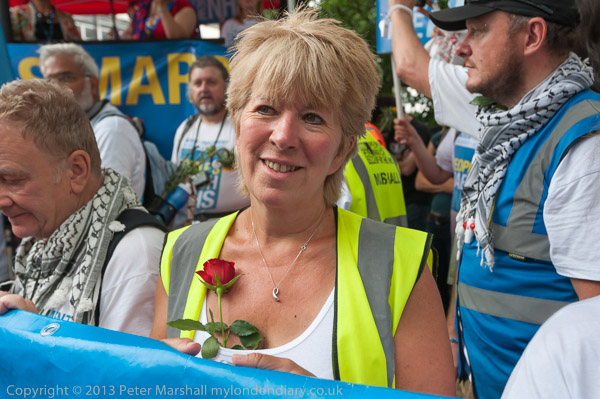
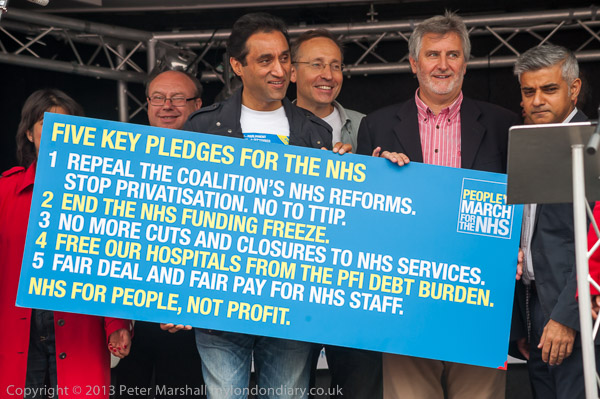
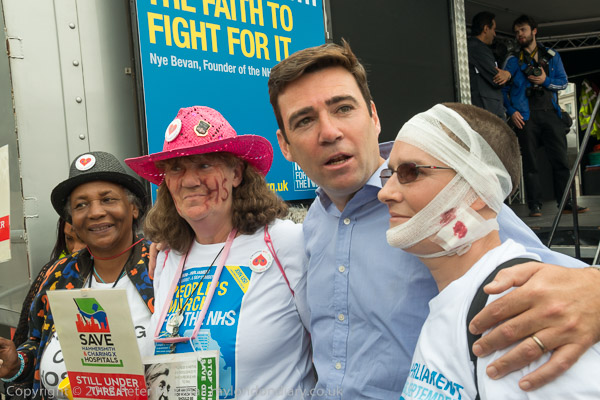
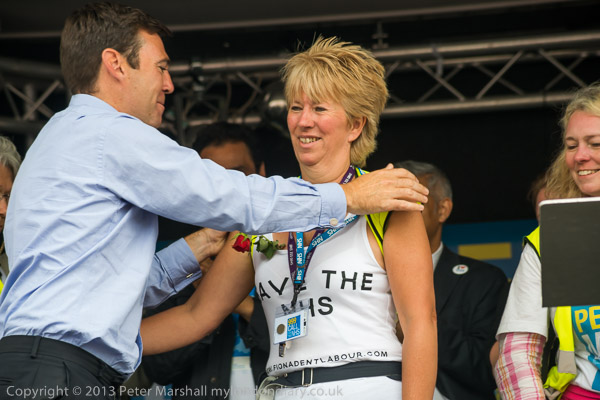
I walked with the marchers from a rally in Red Lion Square to Trafalgar Square where there was a final rally with speakers including Shadow Secretary of State for Health Andy Burnham and London Mayor Sadiq Kahn. In 1936 the Jarrow Crusade marchers in 1936 – who were shunned by the Labour Party but captured the hears of the British population – had been given a pound, along with a train ticket back to Jarrow, but failed to get any significant action from the government and Jarrow was left without jobs. Those marchers who had walked the whole 300 miles from Jarrow were presented with medals incorporating a pound coin.
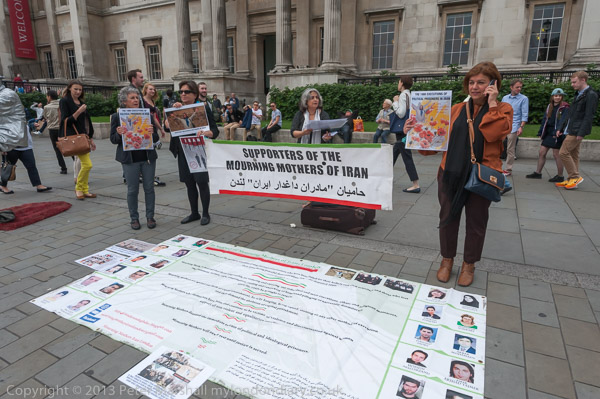
On the North Terrace of Trafalgar Square I found a group of mainly Iranian women standing in a silent vigil to support the Mourning Mothers of Iran.
Now renamed The Mothers of Laleh Park, these are women who hold vigils in the park in the centre of Tehran after their children were killed or imprisoned following a crackdown on members of the opposition after the 2009 Iranian election, and call for the release of political prisoners. Many of the women in Iran have been arrested for protesting and for talking to foreign journalists.
Rolling Picket against Israeli violence – Downing St
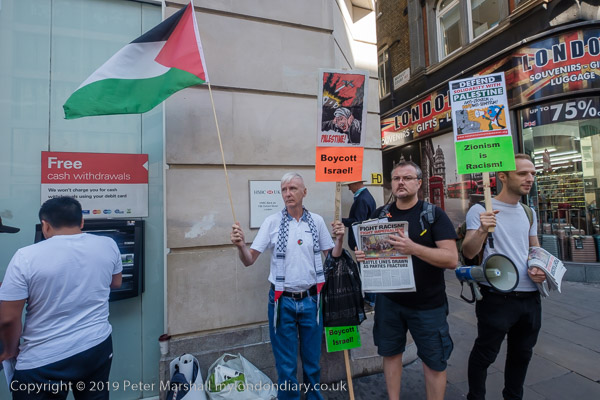
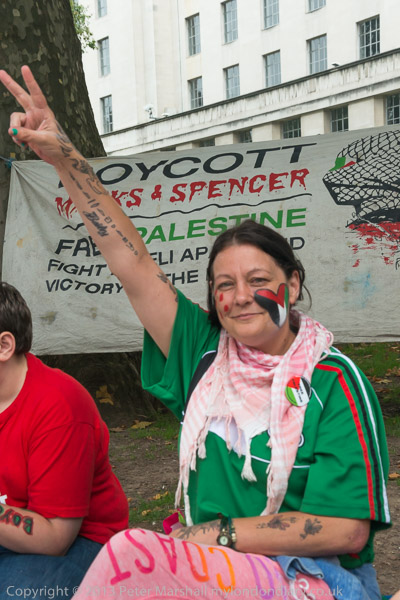
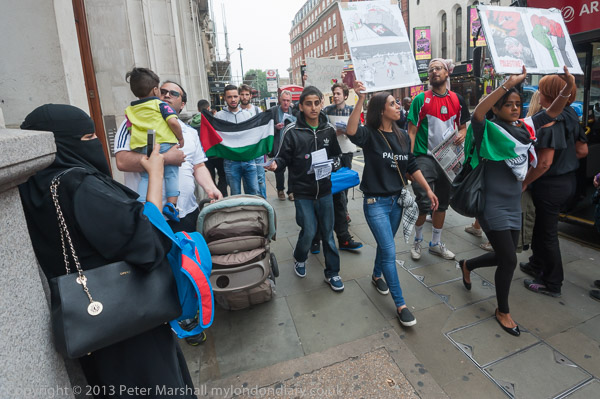
At Downing Street I photographed a group protesting against Israeli violence towards Palestinians and clalling for a boycott of Israeli good.
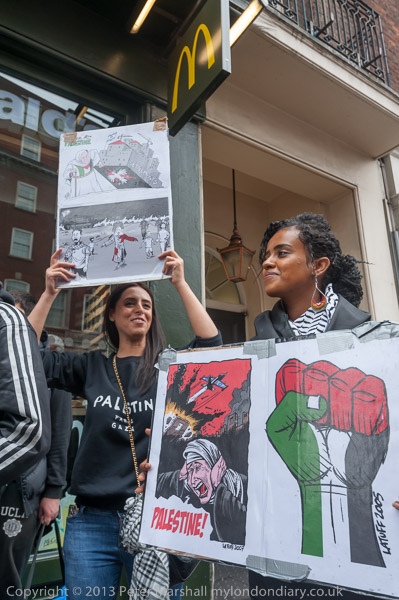
After a brief protest at Downing St they marched up Whitehall and protested outside McDonalds before going for another short protest outside the Tesco facing Trafalgar Square. Police intervened to move them away when they tried to block the doorway there. I left them on their way to make further protests outside shops supporting Israel on their way to Tony Blair’s house off the Edgware Rd.
This group say that many children in the UK are removed from families by social workers and family courts for no good reason. They allege that there is systematic, systemic institutional abuse of around a thousand children a month being removed in this way and then abused by paedophile rings. Although there may be children wrongly taken from families there appears to be no firm evidence for such abuse.
These conspiracy theories are a world-wide phenomenon and in 2017 became the core belief of QAnon, the US extreme right wing conspiracy theory political movement.
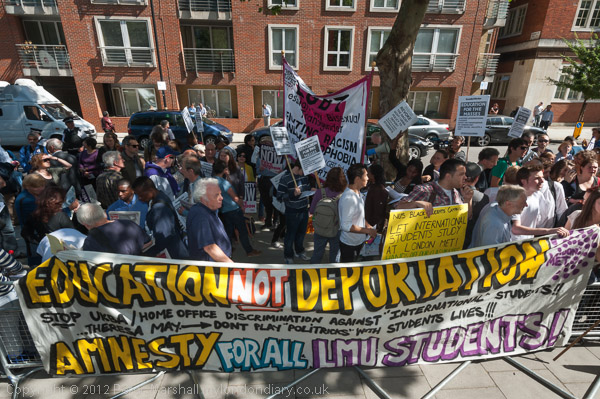
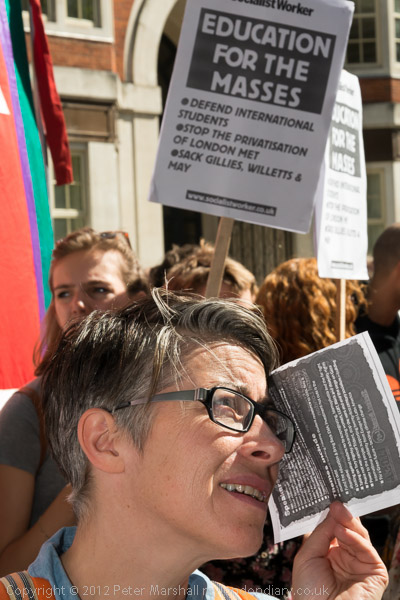
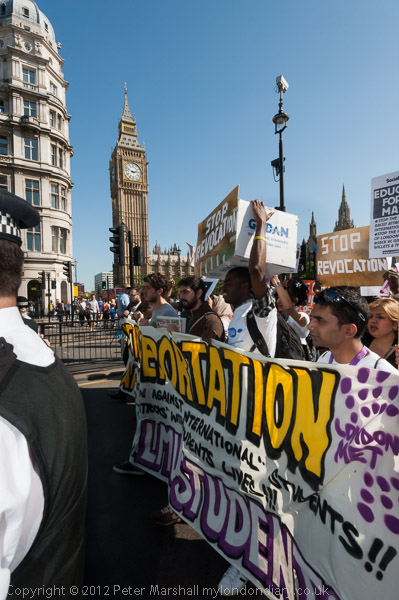
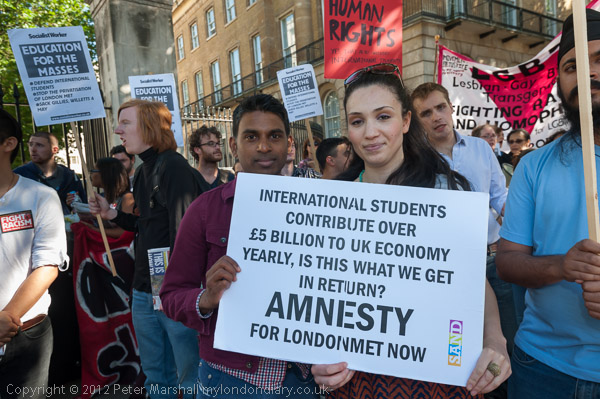
A protest at the Home Office on Wednesday 5th September 2012 called for international students at London Met University to be allowed to complete their studies and not face deportation after having invested heavily in getting a degree in the UK. Some then marched to Downing St.
The decision to revoke London Met University’s licence to sponsor non-EU students taken on 29 August 2012 taken by the UK Border Agency was an example of petty-minded racism by the Home Office at its worst. It was made after a limited investigation had found that some students studying there had no leave to remain in the UK.
It was a totally disproportionate reaction to the findings, which should have been dealt with on an individual basis and with discussions over the procedures in place at the university tightening them where necessary. But Home Secretary Theresa May had declared a ‘hostile environment’ three months earlier and this was something to show the public that she meant business.
It was a decision which caused unnecessary disruption and costs to the majority of international students who were legitimately pursuing their studies at the university and which seriously damaged the UK’s reputation as a country for students to come from abroad to study.
The licence was reinstated the following April, following further discussions and inspections at London Met, though they were only allowed to admit new students from abroad on a limited scale for the next 12 months. The actions taken by the Home Office could clearly have been taken without penalising students who were studying on courses at the university, and served to emphasise the callous disregard of the revocation.
Universities Minister David Willis had clearly also been embarrassed by the Home Office decision, setting up a task force to provide a clearing house for the displaced London Met students, and two weeks after the revocation the government launched a £2 million fund to “help legitimate students to meet additional costs they may incur by moving to another institution to finish their studies. These include: covering the cost of any fee for a repeat visa application and discretionary payments to cover, for example, lost deposits on accommodation due to having to move somewhere else to study.”
I’m not sure how adequately this fund recompensed students for their extra costs, but clearly they were subjected to considerable disruption in their studies and also in their personal lives, breaking the many relationships they will have had with fellow students and tutors, and being transferred onto courses with different approaches and areas of study. Even courses with the same titles will have significant differences and students may well find they were repeating some studies already made while missing out on others.
Students march to Downing St
The UK Border Agency had long been criticised for its actions and poor service, with an increasing number of complaints to the Parliamentary Ombudsman over asylum, residence status and immigration issue – and in 2009-10 all but 3% were decided in favour of the complainants. In 2013 a report by the Home Affairs Select Committee was so damning about its incompetence that Home Secretary Theresa May was forced to abolish it, replacing the agency by three new organisations, UK Visas and Immigration, Immigration Enforcement and Border Force.
Pepys Rd, New Cross, Lewisham, 1988 88-12d-64_2400
Pepys Road and Nunhead Cemetery
Pepys Road is a part of the large Telegraph Hill conservation area designated a couple of years after I made this picture. It is a late Victorian planned residential estate in what was then known as Hatcham and mostly consists of rather similar houses built by two local builders on a fairly steep hillside owned by the Haberdashers’ Company between 1870 and 1899. I don’t think there is any particular connection between Samuel Pepys and Pepys Road, but certainly he was frequently in the area both for his work as Secretary to the Admiralty very much involved in Deptford’s Royal Dockyard and visiting John Evelyn at Sayes Court. The semaphore telegraph at the top of the hill which gives the area its name arrived later in 1795.
These two houses, Silverdale and Thornhill are on the west side of the street at 62 and 64, and are part of a long succession of more or less identical properties on both sides of the street. But these were the only pair with an ice-cream van outside when I made this picture.
Probably because of its uniformity I took few pictures on my long walk up the hill on Pepys Rd, just a couple of pictures at the top of the hill of Hatcham College, one of which (not digitised) includes the statue of Robert Aske, one of only five listed buildings in the conservation area, the others all being telephone kiosks!
I was on my way to Nunhead Cemetery, one of the ‘Magnificent Seven’ great cemeteries set up around the then outskirts of London as its population was growing rapidly and the small parish cemeteries in the city were becoming dangerously overcrowded.
Anglican Chapel and monuments, Nunhead Cemetery, Nunhead, Southwark, 1988 88-12d-16
Parliament passed an act promoting the establishment of private cemeteries outside central London in 1832 and in the following decade seven were established – in date order Kensal Green, West Norwood, Highgate (West), Abney Park, Brompton, Nunhead and Tower Hamlets.
Allen tomb, Nunhead Cemetery, Nunhead, Southwark, 1988 88-12d-22
Nunhead, originally known as All Saints’ Cemetery, was established by the London Cemetery Company in 1840 and is one of the least well known of the seven though it is the second largest at 52 acres.
Financial difficulties caused its closure in 1969 and it was bought for £1 by Southwark Borough in 1975. In 1981 the Friends of Nunhead Cemetery was formed and together with the council began the restoration of the cemetery which was reopened to the public in 2001.
I think my pictures were taken on a Sunday afternoon tour led by the Friends. The include some of the more notable monuments in the cemetery which you can find out much more about on the Friends web site and they offer regular guided tours, but you can wander freely on your own as the cemetery is open to the public daily and you can find a useful map on the web.
The Wikipedia entry on Nunhead Cemetery lists a number of notable people whose graves are in the cemetery, but few were familiar names to me. One who very much made an impact on London was Sir George Thomas Livesey (1834 – 1908), engineer, industrialist and philanthropist and chairman of the South Metropolitan Gas Company. Another was Thomas Tilling, who gave London its first double-decker buses and was for many years England’s major bus operator. Allegedly ‘Tom Tilling’ became Cockney rhyming slang for a shilling coin, though I never heard it used.
The Brockley footpath runs along the southwest edge of Nunhead Cemetery and I was able to leave the cemetery and walk down it back towards Nunhead. You can exit the cemetery on Limesford Road and walk along this to the path.
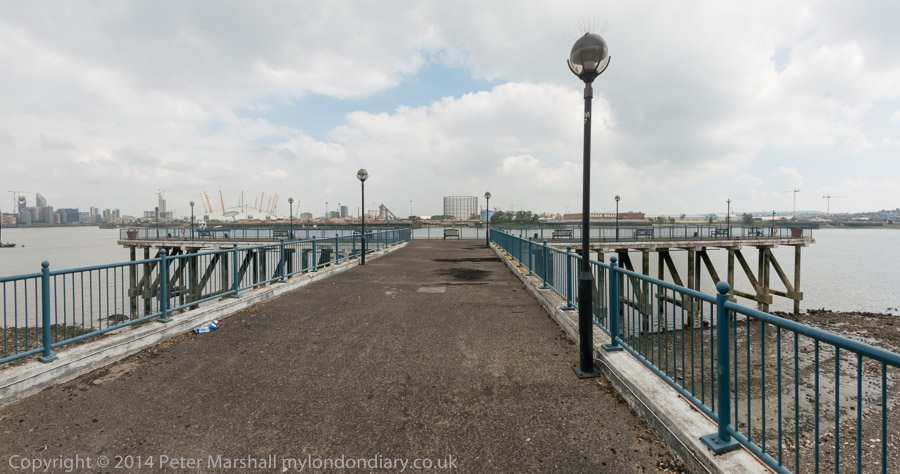
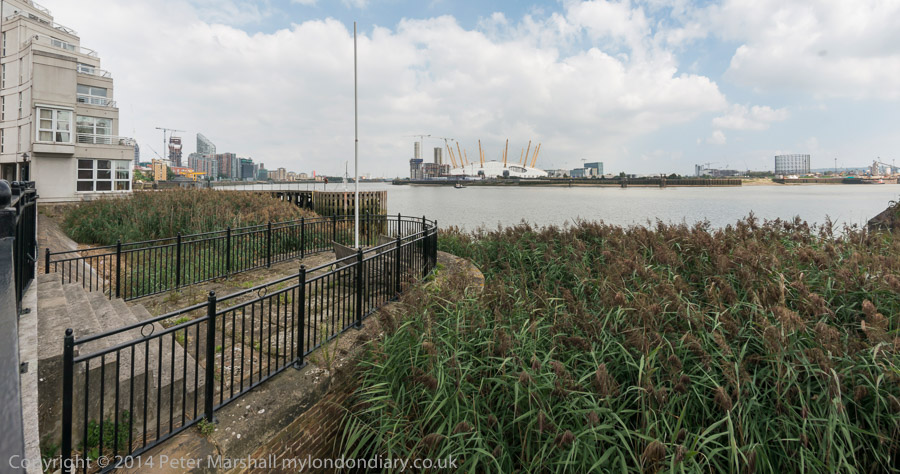
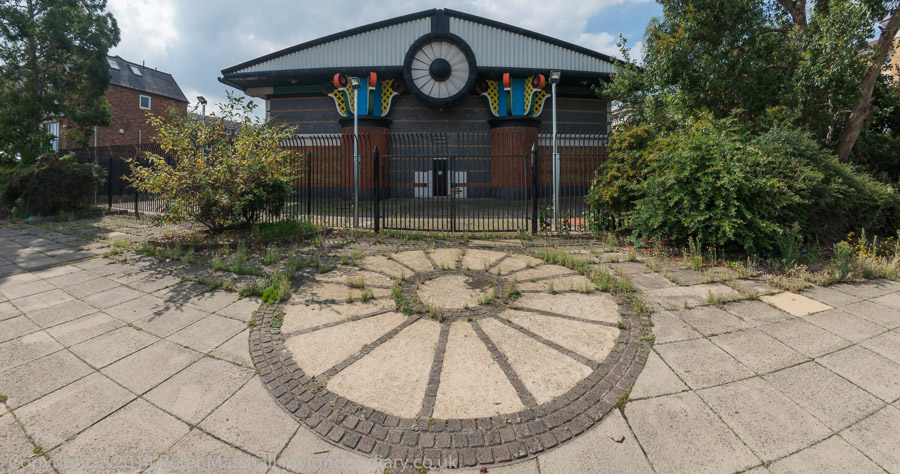
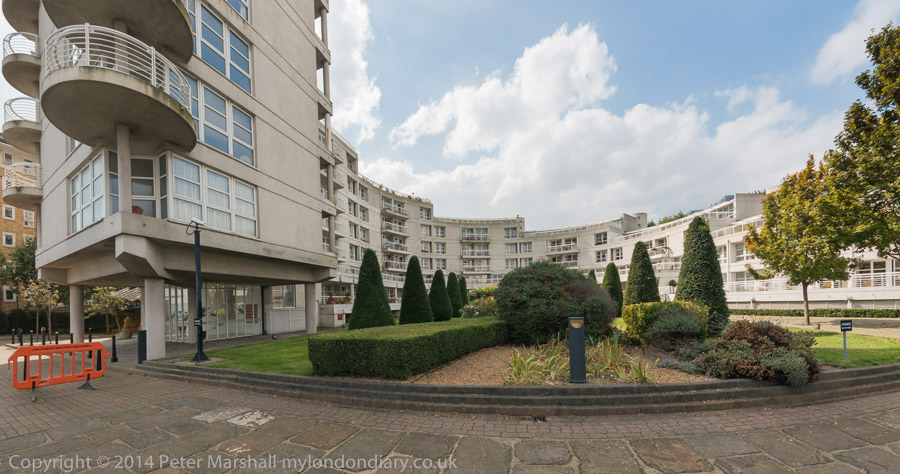
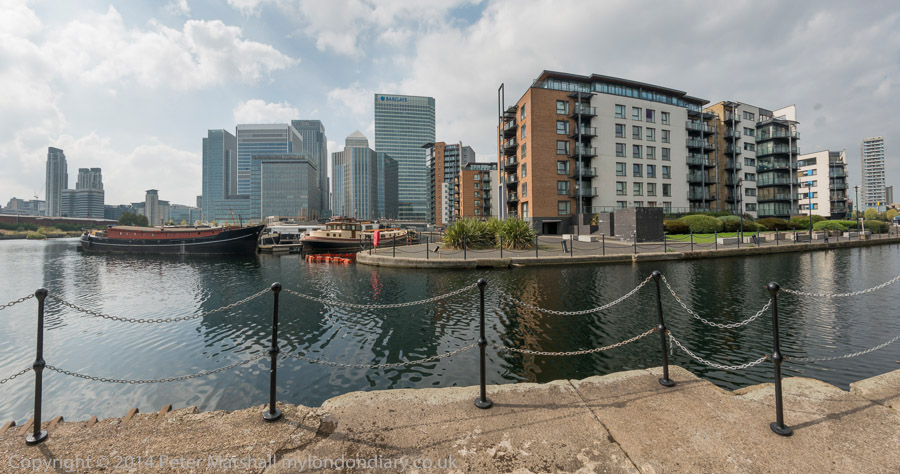
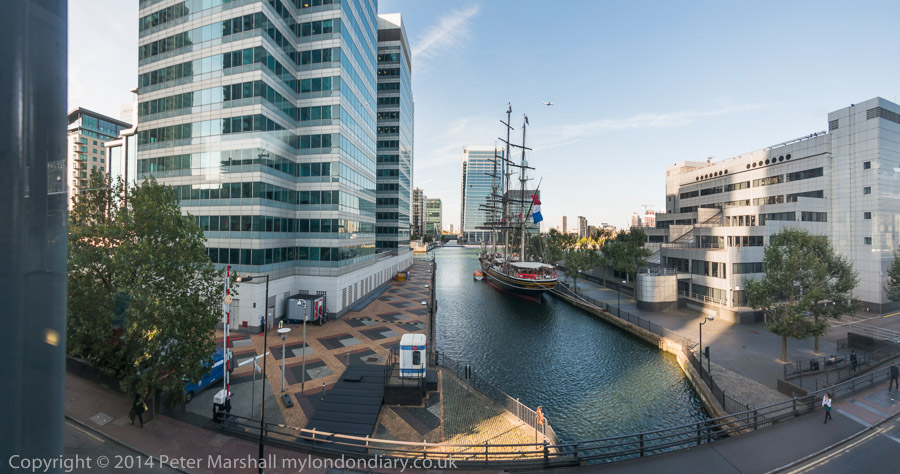
Isle of Dogs and Class War: The weather was fine on Wednesday September 3rd 2014, with some nice clouds which made it a good day for some more panoramic photographs, and I went up earlier in the day to continue my pictures around the Isle of Dogs before covering an evening protest by Class War in Aldgate.
Isle of Dogs – Island Gardens to South Quay
Back in the 1980s I set out to photographed extensively in London’s docklands, part of a wider project on the de-industrialisation of the city, partly a response to changes in technology and globalisation, but greatly accelerated by the Thatcher government which saw great opportunities for their supporters profiting by a switch from manufacturing to service industries.
The government policies perhaps made some sense at the time – and certainly made some large profits for the friends and supporters of the Tories, but in many ways we are paying for them now, particularly for their ‘selling off the family silver’ by privatising utilities and other publicly owned activities.
In the docks the main changes were due to containerisation and other efficient ways of handling cargo. Much larger vessels came into service and the long journey up the River Thames to London’s Docks was difficult or impossible, as well as adding significantly to turn-around times. Only Tilbury, miles closer to the sea remained viable.
The changes to Docklands could have been managed for the benefit of the existing populations to the area, with development being carefully planned and managed locally. Instead we got the London Docklands Development Corporation which overrode local interests to benefit those of corporations but did produced a more rapid development than would otherwise have taken place. But it was a huge give-away to private developers, resulting in dramatic changes, and one that the area will continue to suffer from for generations.
Many of my pictures from the 1980s in colour as well as black and white are now available on Flickr in a https://www.flickr.com/photos/petermarshall/albums number of albums and there are also a number of books available on Blurb (in print and as PDF) with the Isle of Dogs being included in City to Blackwall ISBN: 978-1-909363-09-0 which has a working preview.
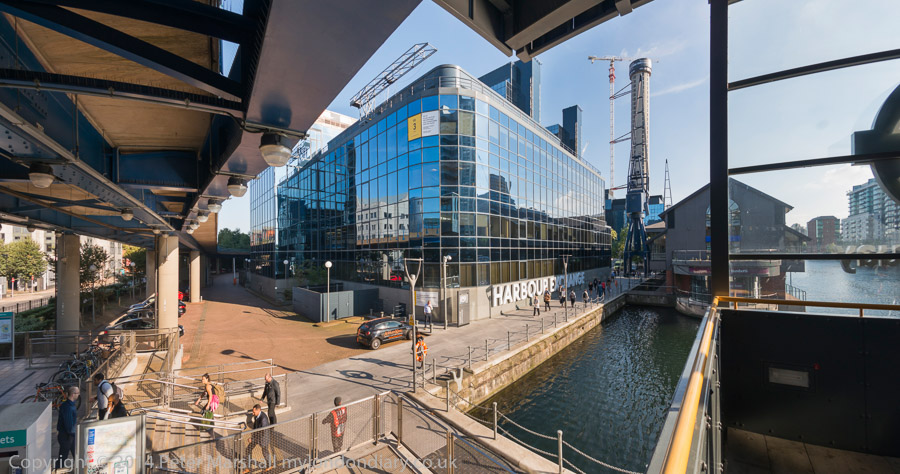
My walk in 2014 began at Island Gardens DLR station, where I had finished a previous walk, and I continued along the riverside path to the Blackwall Entrance, across to Poplar Dock and Blackwall Basin, down Prestons Rd and Manchester Road to East Ferry Road, and then up and around a little on my way to South Quay Station.
In 2014 I was mainly making digital panoramic photographs, with a horizontal angle of view of around 145 degrees – much greater than can be achieved with a normal rectilinear perspective. These pictures use a projection which keeps vertical edges straight and also gives a straight horizon line (so long as the camera is kept level) but other lines and objects away from the centre of the image curve. Similar projections were used by artists such as Canaletto. These images here have a aspect ratio of 1.9 to 1.
There are two posts on My London Diary with many more panoramas and a few ‘normal’ views from this walk: Isle of Dogs Isle of Dogs Panoramas
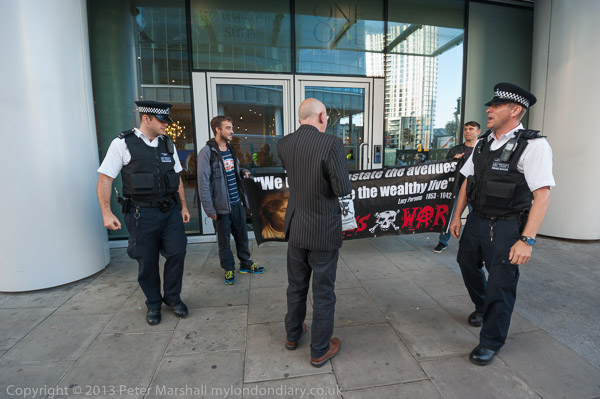
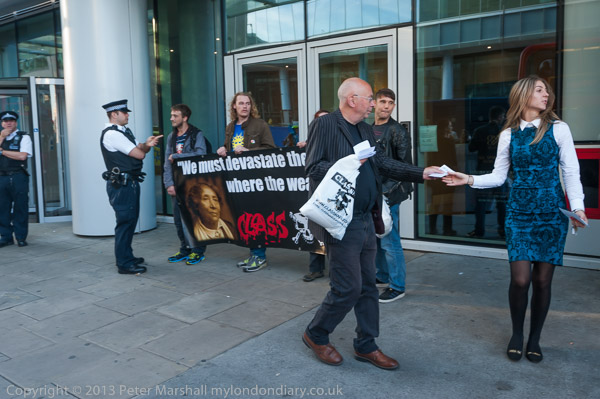
Class War ‘Poor Doors’ picket Week 6 – Aldgate
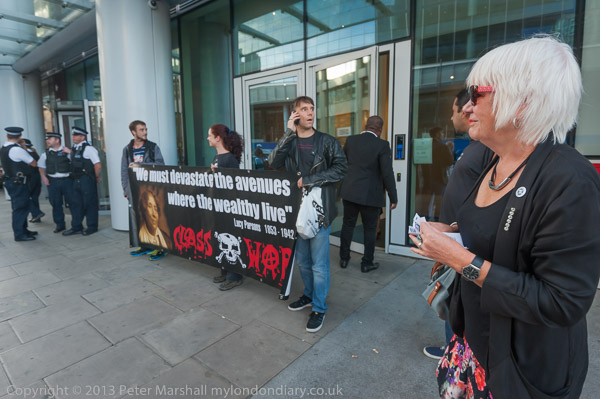
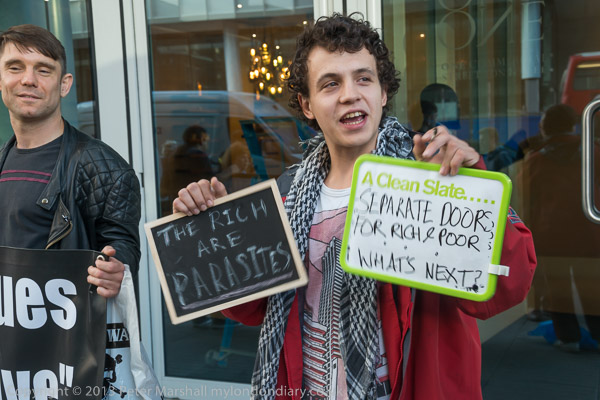
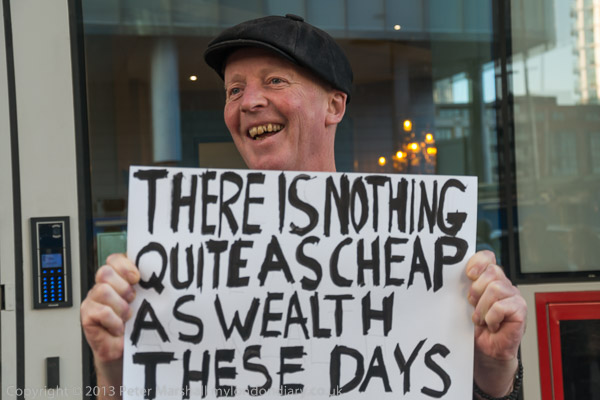
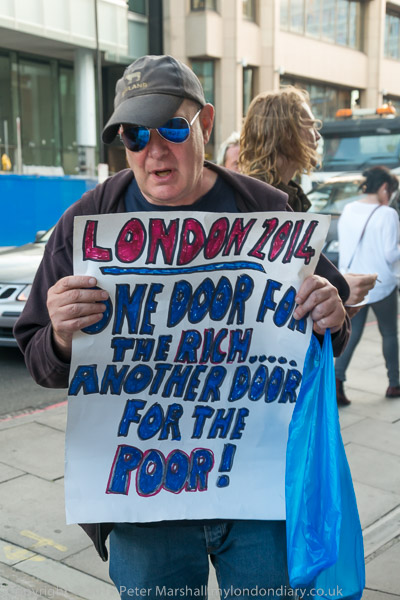
I got back a few minutes early to where Class War were to stage their sixth weekly protest against the separate doors for the wealthy residents and social housing tenants in the block ‘One Commerical St’. The entrance for the rich is on Whitechapel High St next to Aldgate East station while the poor door is down an alley on the west side of the building.
Unlike in previous weeks there were police already there and waiting for the protesters, a sign that the police were taking a firmer stance against the protests here. Almost certainly they were responding to pressure from the owners of the building, and their activities against the protesters were to heighten further in later weeks.
When the protesters arrived, officers immediately came and talked to them, making it clear that they were not to block the doorway for people entering or leaving the building.
More police arrived, outnumbering the small group of little more than a dozen protesters who had come to hand out leaflets to people on the street outside. Many passing expressed surprise that this kind of segregation of rich and poor was allowed to happen in London and showed support for the protest.
It was perhaps the smallest of the series of thirty or so ‘Poor Doors’ protests outside this building. There were quite a few arguments with police officers but no arrests on this occasion.