We need an Ecocide Law

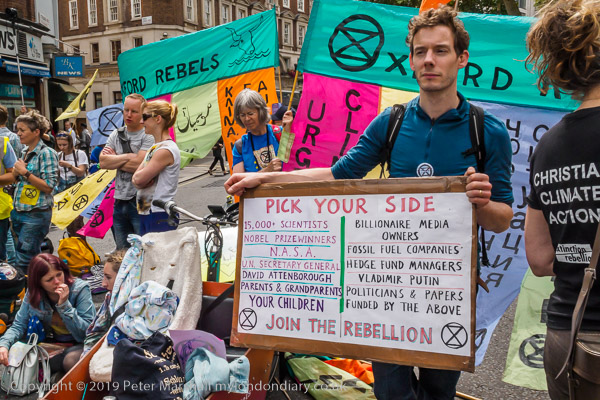
Though I fully support the aims of Extinction Rebellion I do have some issues about the way they go about things. I’ve mentioned before some of the odder ‘New Age’ baggage, and that was very much to the fore when I arrived at the Royal Courts of Justice with some kind of druid presiding over a ceremony with people bringing water from rivers around the country (and some overseas) to tip into a large cauldron.
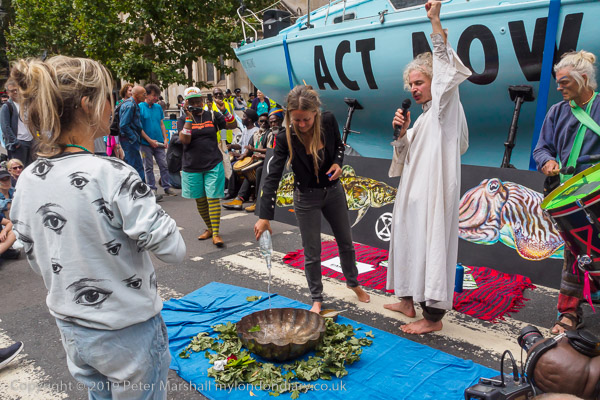
And then there’s the yachts. I just don’t inhabit the kind of milieu where people have yachts, though I did once own a canoe, or rather a kayak. I built it myself as a teenager in the pre-glass fibre era, a wooden framework over which some kind of rubberised canvas was fixed. It’s construction took several years,mainly because I had to save up the cash to buy every next step of the construction, first the plans, then the wood and ply and the canvas.
I was proud when I had it finished, built in my father’s large shed – where he and his father had made carts and other horse-drawn vehicles. But I’d run out of money and couldn’t afford a paddle and it was a long way to any water and I had no means to transport the canoe even to the nearest stream where it could be floated.

It was I think around 18 months later that a relative kindly strapped it to the roof of his car and we made our way the the Thames at Runnymede, along with single paddle handmade from a couple of pieces of wood (again from my father’s shed.) Although I’d been in rowing boats and possibly larger Canadian canoes as a Sea Scout, I’d never been in a kayak before, and it wasn’t longer before I wasn’t in it any more, but looking up at it through perhaps ten feet of murky Thames water from the bottom of the river. I think that was the end of my canoeing project, and after that I stayed on dry land and rode my bike.
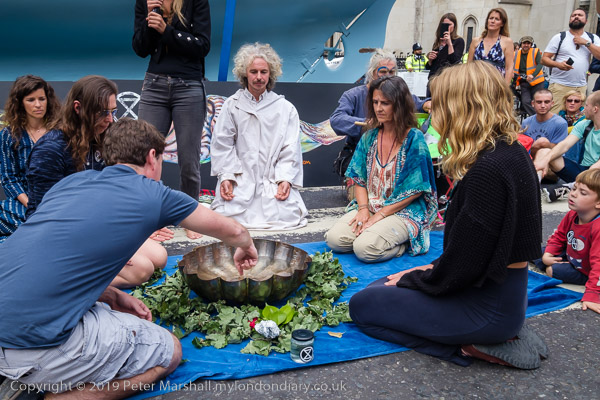
So my relationship to water was not perhaps the most sympathetic as I watched those people coming towards the cauldron to add their half pint, and things got worse when people were invited to stir the water and make wishes and then to add flowers and other stuff before the cauldron was carried towards the court and then a token libation poured on the ground.

Of course there were other things going on, including speeches (some very sensible and to the point), music etc. But when a man came to speak about how uplifting his experience of being arrested had been and to encourage us all to do it, again I was rather turned off. Too many of my friends over the years have been harassed by police, fitted up and assaulted; arrest isn’t generally a very positive experience, particularly if you are poor and or from an ethnic minority. Like much about XR I think it is very much a class thing.
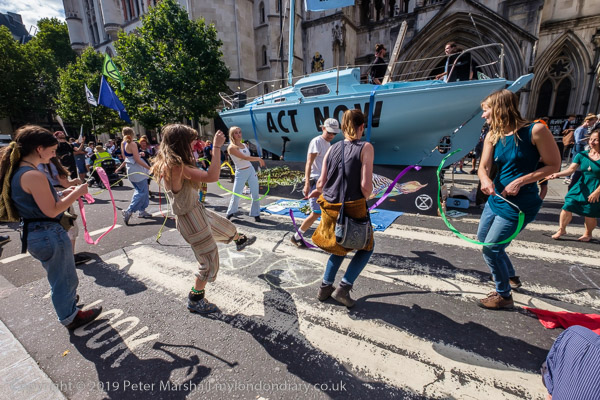
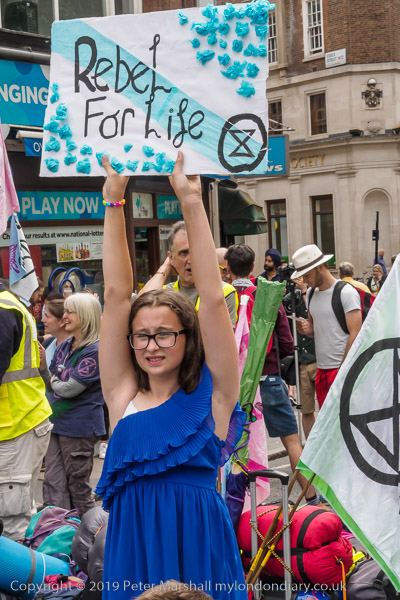
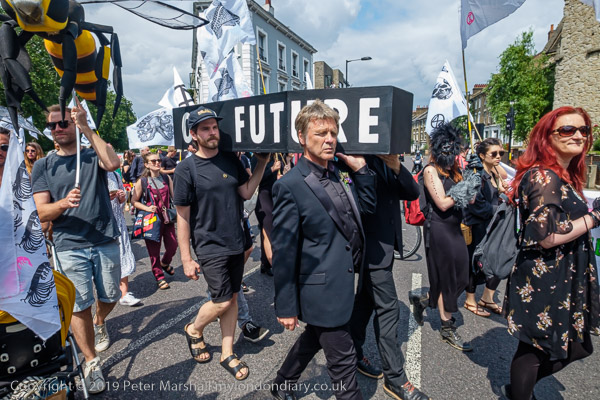
But of course we should have strong laws that protect the environment – including the Ecocide Law that Polly Higgins, after whom the pink yacht here was name, fought to get accepted for many years. More generally we need laws that get away from the idea of the land as private property and recognise it as a community resource with which we are entrusted rather than we own.

XR call for Ecocide Law


All photographs on this and my other sites, unless otherwise stated, are taken by and copyright of Peter Marshall, and are available for reproduction or can be bought as prints.

There are no adverts on this site and it receives no sponsorship, and I like to keep it that way. But it does take a considerable amount of my time and thought, and if you enjoy reading it, please share on social media.
And small donations via Paypal – perhaps the cost of a beer – would be appreciated.
3 Years of BEIS poverty pay

The PCS has many low-paid members working in government departments, including the BEIS, or to give it the full and perhaps deliberately unwieldy name, the Department for Business, Energy and Industrial Strategy. It was created by Theresa May on 14 July 2016 when she amalgamated the  Department for Business, Innovation and Skills (BIS) and Department of Energy and Climate Change (DECC) probably in part as a way of downplaying the government response to climate change. It appears to have become something of a parking place for some of the least able of our politicians, and at the time of its third birthday the minister in charge was Greg Clark, then Member of Parliament for Tunbridge Wells, since replaced by Andrea Leadsom.

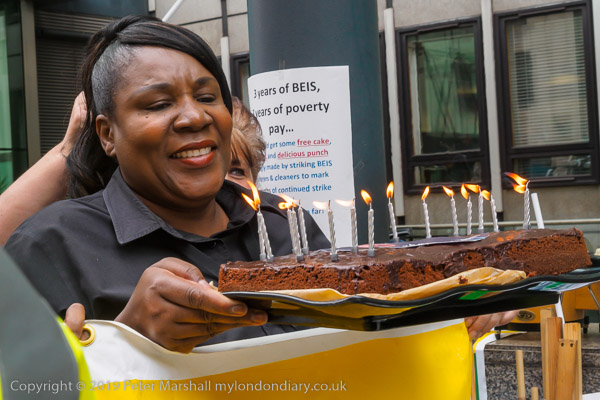
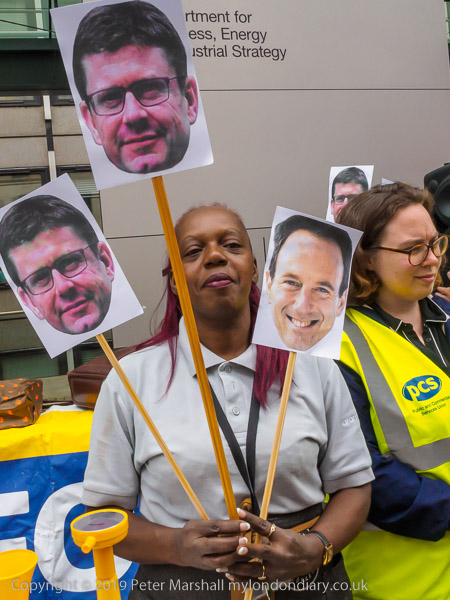
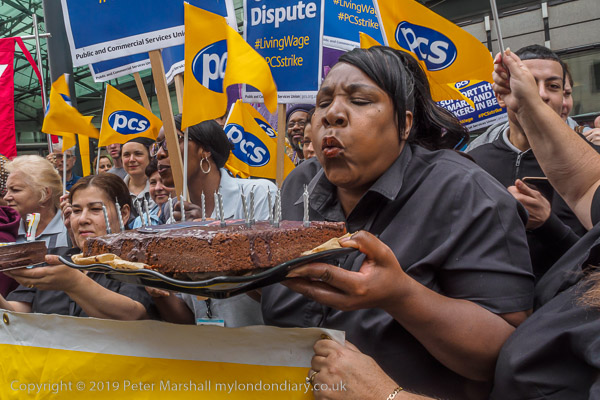
Clark’s picture appears on some of the placards and on the birthday cake which had rather more then 3 candles on it as the picture at the top of the page shows and which many of us present had a piece at the end of the protest.

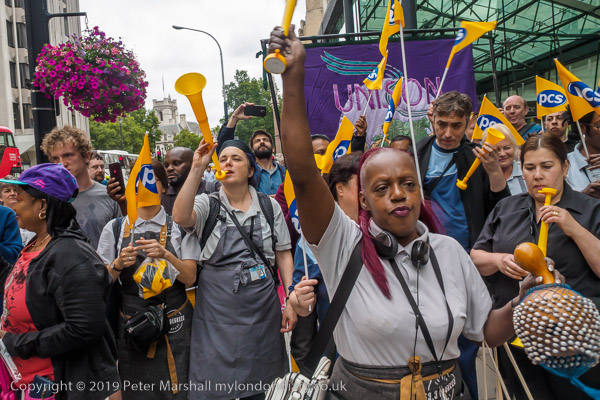
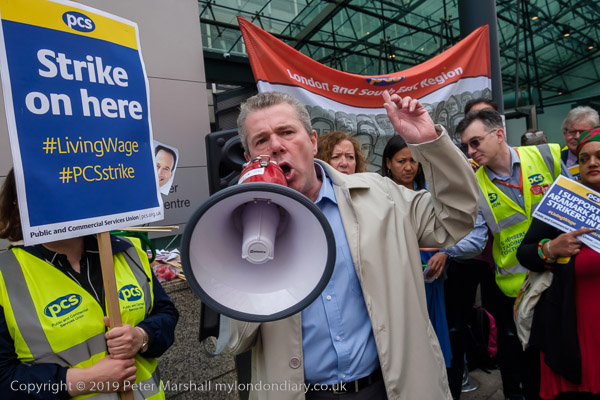
This was the start of the first ever indefinite strike at a government ministry, with cleaners and catering workers coming out on strike to demand the London Living Wage and to be directly employed by the BEIS rather than outsourcing companies ISS and Aramark.

Given this it was perhaps hardly surprising that there were an unusual number of Labour party and trade union speakers at the event, with the PCS president, general secretary and national vice-president joined by the general secretaries of two other unions, a Labour MP and Shadow Chancellor John McDonnell as well as several other leading trade unionists, all of whom appear in my pictures on My London Diary.

But the stars of the show were the workers. I was standing in the right place to capture the picture with all the candles on the cake lit, but most of the press photographers were to one side, and some of them decided to get the workers to turn around towards them. Unfortunately while they moved, the wind blew out all the candles before they could be blown out. So the image apparently showing the candles being blown out is a little piece of fake news staged for the press – as my caption for it made clear, as does the absence of any smoke from the candles that had been extinguished some seconds earlier, allowing it to clear.

More at BEIS workers begin indefinite strike.


All photographs on this and my other sites, unless otherwise stated, are taken by and copyright of Peter Marshall, and are available for reproduction or can be bought as prints.

There are no adverts on this site and it receives no sponsorship, and I like to keep it that way. But it does take a considerable amount of my time and thought, and if you enjoy reading it, please share on social media.
And small donations via Paypal – perhaps the cost of a beer – would be appreciated.
Hackney XR March

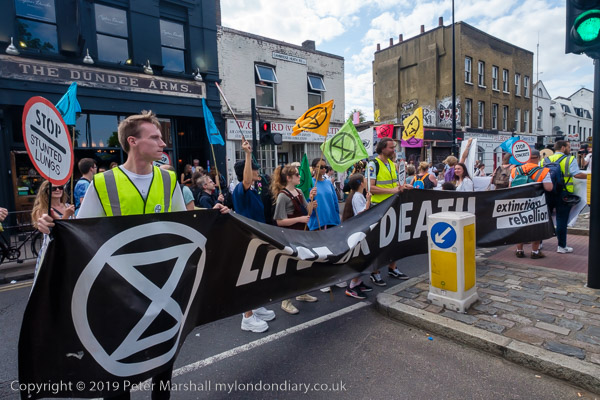
On Friday I’d had to leave the Extinction Rebellion ‘The Air That We Grieve’ march as it reached the Hackney border to go to a protest at Senate House, but on Saturday afternoon there was another march as a part of the ‘East London Uprising weekend, walking through the centre of Hackney from Hackney Fields and on to the centre of the event in London Fields.

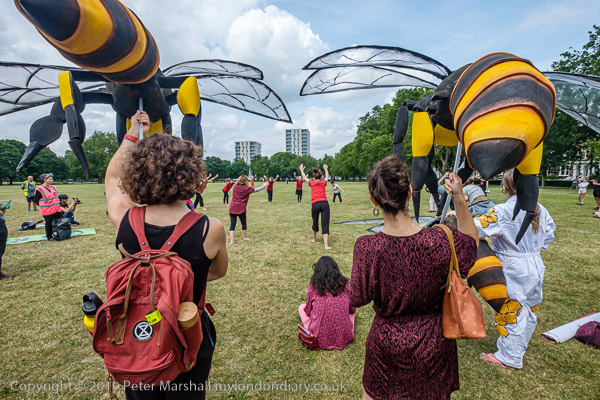
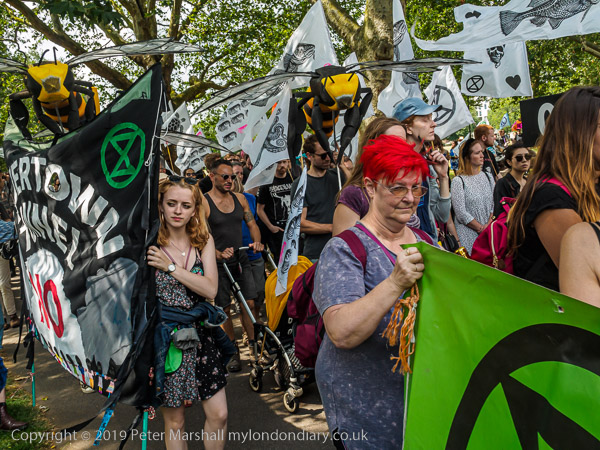
Before the march in Hackney Fields there were a couple of things taking place, a dance performance which I found less than exciting visually and some kind of meditation thing which was frankly off-putting. There is an odd-ball new age side to XR that I think works very strongly against it appealing to the great majority of people and which certainly turns me off.

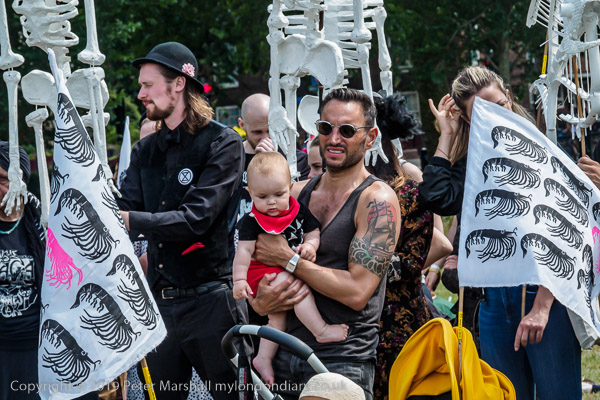
But there were the people, the giant bees and the skeletons to photograph, so I stayed and took pictures, and of course I wanted to photograph the march. But it did make me think that perhaps this was a part of the reason why of the several million East Londoners only a couple of hundred were with us for this march. XR has had a remarkable success, but only with some sections of the community and I think rather more in small towns and rural areas than in working class urban communities.

Looking through the many pictures I made on the march it doesn’t really look like a Hackney event, though I’m sure many or most of those taking part were from the area. Official figures show that “around 40% of the population come from Black and Minority Ethnic groups” but these were severely under-represented.

This isn’t a criticism of those that did take part, and I think the XR has been important in raising awareness of the urgency of the enviromental crisis we are now facing. It has performed a vital service and we see its efforts represented to some extent in the manifestos of all the political parties in the current general election – though so far there has been little real commitment by our government – or those of most other countries.

It was a hot day and I’d been on my feet for several hours and I needed a rest by the time the protest passed Hackney Town Hall. I had intended to continue to the festival taking place on London Fields, but couldn’t bring myself to walk any further, and after a brief rest made my way to Hackney Central to begin my journey home.

More pictures at East London Extinction Rebellion March.


All photographs on this and my other sites, unless otherwise stated, are taken by and copyright of Peter Marshall, and are available for reproduction or can be bought as prints.

There are no adverts on this site and it receives no sponsorship, and I like to keep it that way. But it does take a considerable amount of my time and thought, and if you enjoy reading it, please share on social media.
And small donations via Paypal – perhaps the cost of a beer – would be appreciated.

Two Parades

I can’t now remember why I was walking up Whitehall on a Saturday morning in July, but I think I must have gone to photograph a protest that had been advertised to take place in Parliament Square that didn’t happen. That would not be too unusual, as it is very easy to create an event on Facebook, but actually getting people to turn up is often harder. And although quite a few people may click to say they are interested or going they may well not actually turn up.

Fortunately in London though some things may not happen, there are others that take place which I’ve not known about beforehand, and if I have any interest in them I will stop and take a few pictures.

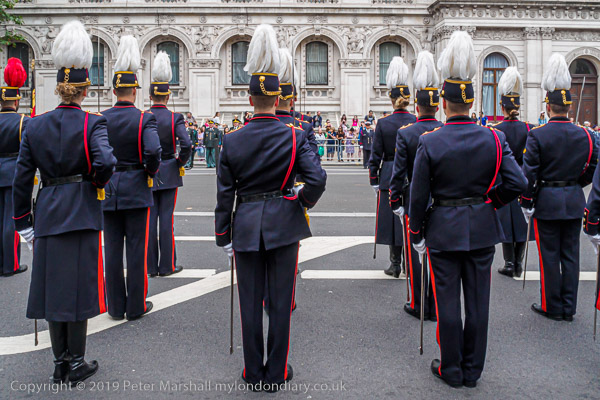
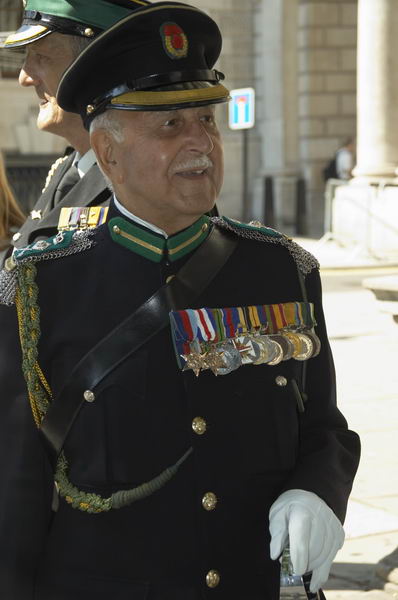
Fourteen years earlier, I’d photographed a Belgian commemoration of victims of the Second World War at the Cenotaph, with some veterans and their widows in attendance. Apparently this annual celebration had started before that war, following the death of King Albert I of Belgium, a keen climber who died after falling down a Belgian mountain in February 1934. Albert’s uncle, King George V, decided to grant them the annual ceremony to honour him and the Belgian contribution to the Great War.

Judging from my photographs the event back in 2005 was very much less formal than this year’s more military event, where barriers kept me off the road and behind the curious tourists lining them. This year I hardly stopped to take pictures as I was on my way along the street, a little annoyed that I couldn’t catch a bus instead of walking to Leicester Square.

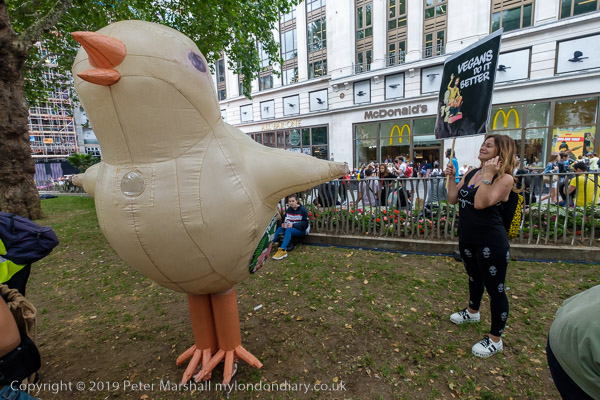
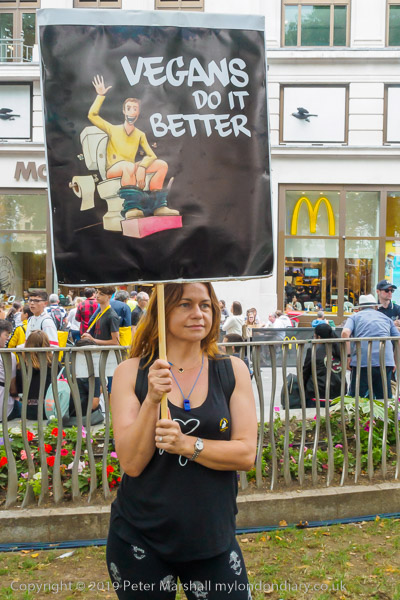
The parade from Leicester Square that I was hurrying to, the The Vegan For Life Parade, was described as a fun parade through central London to promote a vegan lifestyle. While not wishing to be anti-vegan – and I certainly think eating less meat and other animal products is a good thing – fun is not a word I associate with vegans, who usually seem to be in hectoring mode, so a ‘fun’ protest seemed a good idea, and probably more effective at converting people to the cause.

And while there was just a little of that self-righteous vegan evangelistic zeal many of the posters and placards were rather more humourous and less confrontational than at other vegan events I’ve photographed.

I couldn’t stay for the march, which started late, as I wanted to go back to Extinction Rebellion’s East London Uprising where an event was about to start on Hackney Fields.

Belgians commemorate Second World War victims (scroll down the page)
Belgian Army Cenotaph Parade

Vegan for Life Parade


All photographs on this and my other sites, unless otherwise stated, are taken by and copyright of Peter Marshall, and are available for reproduction or can be bought as prints.

There are no adverts on this site and it receives no sponsorship, and I like to keep it that way. But it does take a considerable amount of my time and thought, and if you enjoy reading it, please share on social media.
And small donations via Paypal – perhaps the cost of a beer – would be appreciated.

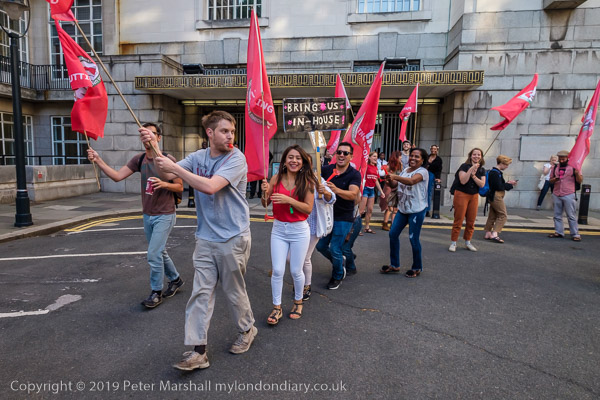
IWGB welcomes new Vice Chancellor

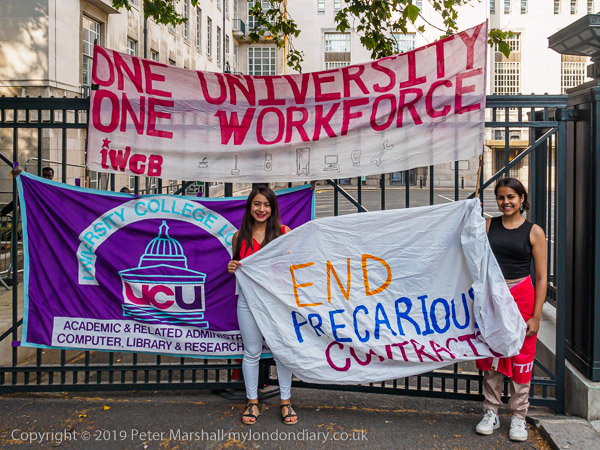
Although Universities like to present themselves as centres of enlightenment, when it comes to their relationship with workers who provide vital services to them, things are rather different. Unions including the IWGB have a long record of fighting and eventually winning battles against intransigent university managements for the London Living Wage and for better terms and conditions of service.

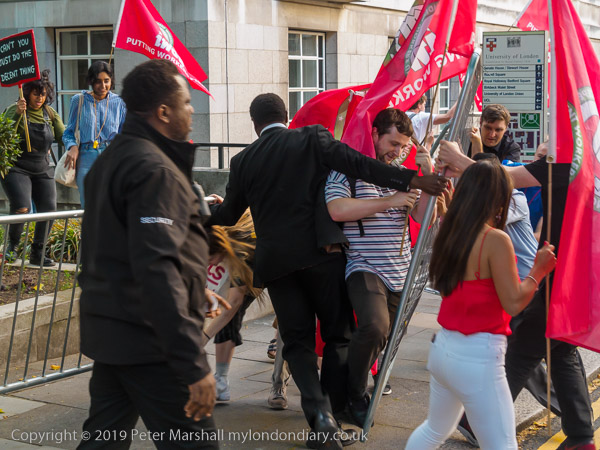
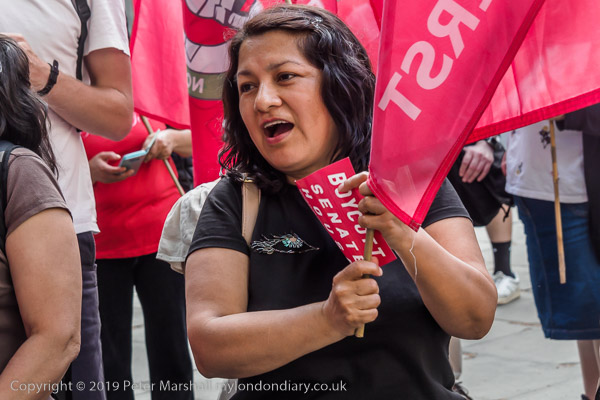
The IWGB, supported by other unions, after a series of protests and strikes in the ‘3 Cosas’ campaign won improved sick pay and holiday pay for outsourced workers at the University of London (Central Administration). But outsourced workers employed by contracting companies to work for the university are still under far worse conditions than those directly employed by the university, and often subject to poor and bullying managers, and a new campaign began in 2017 to bring them into direct employment.

Actions by IWGB members and its supporters – including many university students and staff – forced to the University to make a committment to bring the workers in-house, but a year later this promise was still to be kept, with only 12 receptionists having been brought back to direct employment

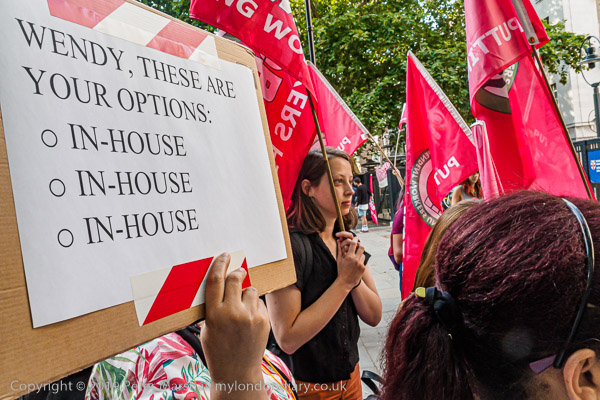
This action followed a failure of the newly appointed University Vice-Chancellor Wendy Thomson to reply to the IWGB’s request for a meeting to discuss the issue. Instead of talking with the IWGB union about their demand for all the workers to be taken into direct employment without delay the University has been spending large amounts on buying in extra security staff.

Although the great majority of the staff involved are now IWGB members, the University continues to take advantage of our immoral trade union laws which enable them to ignore the union and instead only officially talk and negotiate with a union which has no or very few members among the workers involved.

To their great shame our larger established trade unions collude with this practice – and even often claim the credit for concessions which have only been won because of the work of the IWGB and other grass roots unions who similarly remain unrecognised by the employers. Workers have a right to choose who should recognise them, and this is something that the unions once fought for but now too often refuse to support.

The 12 receptionists were given new contracts in May 2019, but these were negotiated with another union “behind their backs and behind the back of their chosen trade union, the IWGB“, and 7 of the 12 have brought grievances against the university, some of which involve a breach of transfer of employment (TUPE) regulations.

Since this protest, the University have also set a timetable to bring the  security officers in-house in May 2020 and cleaners in-house in November 2020, but have refused to bring the gardeners also involved back in house.

The IWGB are continuing to demand that the gardeners are also brought back in house and that any new contracts should be made in consultation with the union to which the workers belong and be approved by them.

More about the protest and more pictures at  IWGB welcome new Vice Chancellor


All photographs on this and my other sites, unless otherwise stated, are taken by and copyright of Peter Marshall, and are available for reproduction or can be bought as prints.

There are no adverts on this site and it receives no sponsorship, and I like to keep it that way. But it does take a considerable amount of my time and thought, and if you enjoy reading it, please share on social media.
And small donations via Paypal – perhaps the cost of a beer – would be appreciated.

March for Clean Air

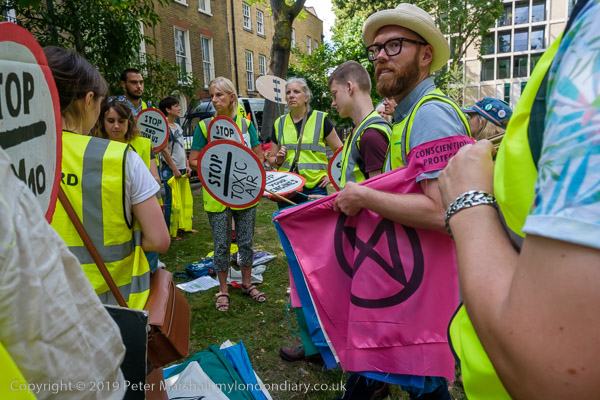
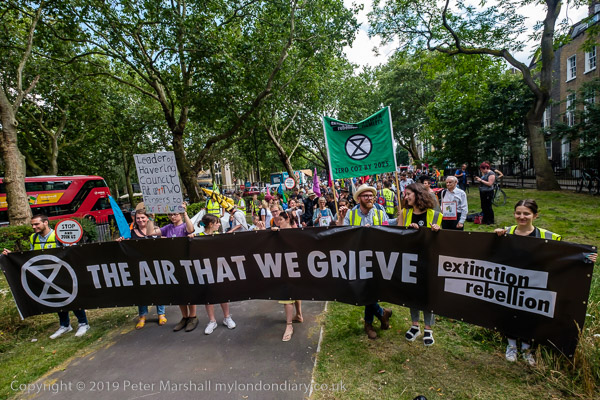
Extinction Rebellion East London had organised a whole weekend of event , a festival of play, protest and education, the East London Uprising calling for a rapid end to the use of fossil fuels.

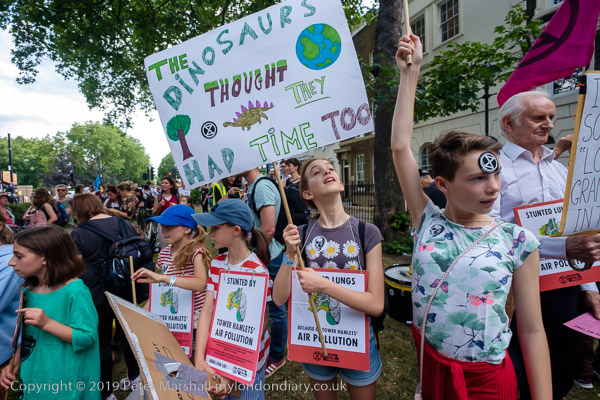
Apart from their huge contribution to our increasing carbon dioxide levels which are leading to unprecedented man-made global heating the will put the future of humanity at risk, the pollution levels already present in London and other cities from coal, petrol and fuel oils which pollute the air with toxic chemicals and particulates is already causing many thousands to suffer from various often serious lung diseases and is estimated to lead to almost 10,000 early deaths in London alone.

The marchers met in a small open space called Paradise Gardens, between the busy Cambridge Heath Road and houses in Paradise Row. It may have seemed like paradise when these houses were built in the late 18th and early 19th century, and doubtless they are now horrifically expensive, but this paradise is now highly polluted.

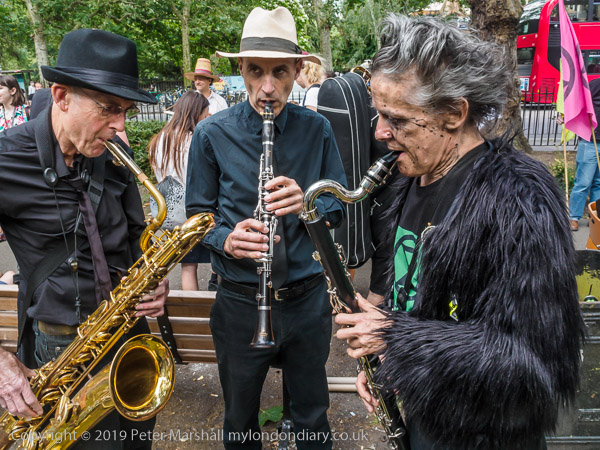
The march set off from Bethnal Green to Hackney behind a banner ‘The Air That We Grieve’, and included a marching jazz band, and of course plenty of families with children. As well as the jazz band there were samba drummers, and the ‘king of the bottle tops’ and others.

The march attracted considerable interest as it went up the Cambridge Heath Road, with many expressing support. But there was no general uprising and perhaps there are releatively few who are actually changing the way they behave, changing to lower carbon lifestyles as we all need to do. It requires a much greater urgency from a government which is prepared to make statements but not to take on the vested short-term interests of many of its backers by significant green investments and policies that will really impact on personal choices.

More pictures from the event at XR East London marches for clean air


All photographs on this and my other sites, unless otherwise stated, are taken by and copyright of Peter Marshall, and are available for reproduction or can be bought as prints.

There are no adverts on this site and it receives no sponsorship, and I like to keep it that way. But it does take a considerable amount of my time and thought, and if you enjoy reading it, please share on social media.
And small donations via Paypal – perhaps the cost of a beer – would be appreciated.

Mayfair Mayhem

I don’t like going to Mayfair. Too much conspicuous consumption on display, too much affluence and waste. It isn’t envy – mostly I wouldn’t want those excessively expensive things you see in shops and through windows, nor the expensive menus etc. I’m largely a man of simple tastes, and happier to share expensive works of art in the National Gallery rather than hang them on my own private wall.

In part its the people. Though I’ve known and liked some who are wealthy there are too many who are obnoxious, who look on the people who work for them as dirt, or just couldn’t give a jot about others. Of course there are poor people who are obnoxious too, but generally in ways that are less obtrusive.

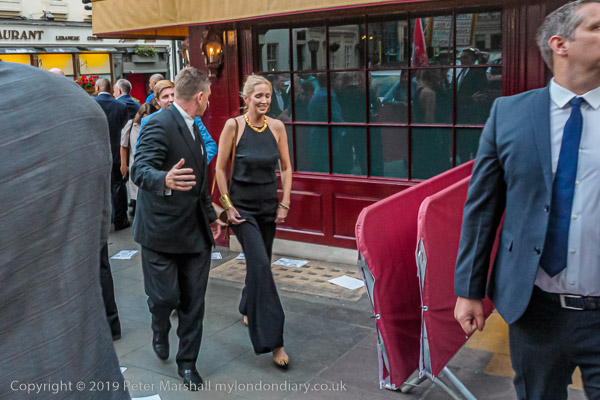
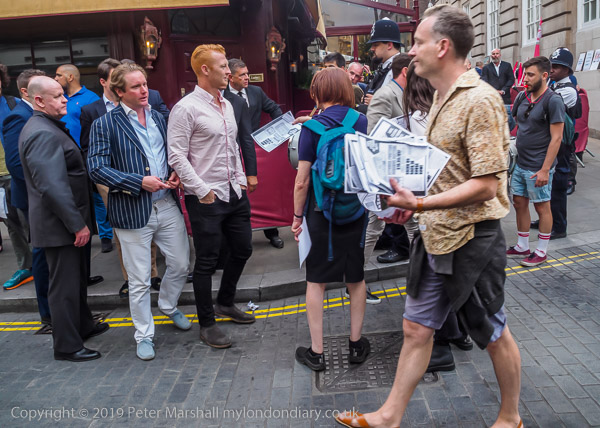
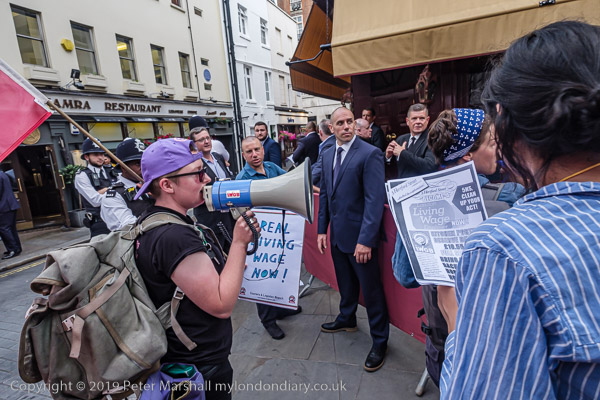
Clubs like LouLou’s with a ‘exclusive’ tag and a membership (in 2017) of £1,800 and described by a fawning article on the Observer website as “the place to be for royals, billionaires, A-list celebrities and socialites” seems to be a magnet for the uncaring and obnoxious, run by the son of Lady Annabel Goldsmith who has given more than £268,000 to Nigel Farage’s UKIP and donated £20,000 to Boris Johnson’s leadership campaign.

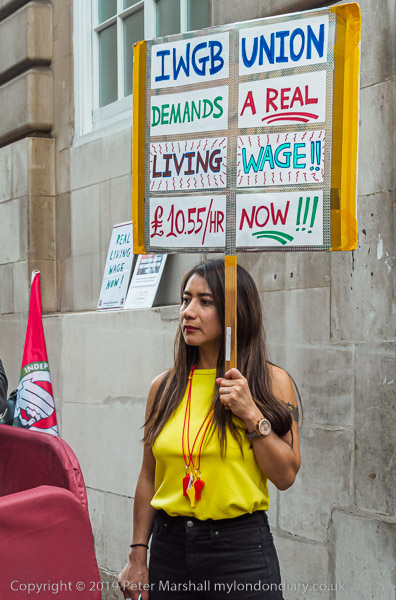
But despite this huge wealth, LouLou’s pays its kitchen porters a pittance, and the IWGB has been supporting their claim for the London Living Wage of £10.55 per hour and for decent terms and conditions of service such as sick pay. Currenly the porters who are mainly migrant workers get only £9 per hour. This was I think their second protest outside the club.

Henry Chango-Lopez, President of the IWGB, said:
“It is unfair that the porters who allow billionaires to wine and dine in luxury and secrecy are left hung out to dry. The porters can see straight through 5 Hertford Street’s bribes and know that outsourcing will only lead to further exploitation. The restaurant needs to give justice to its workers and put them all under the same banner.”

https://iwgb.org.uk/en/post/5cf8f67de9521/iwgb-demands-end-to-poverty

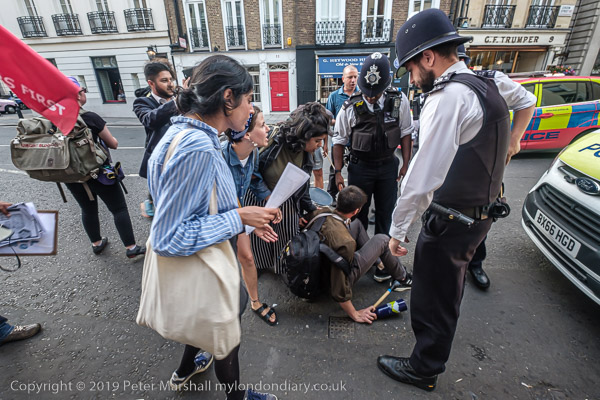
I think it was a genuine accident when police knocked one of the protesters to the ground, an officer walking backward into him. But the whole attitude of the police was deferential to the club owners, their security men and guests but hostile towards the protesters, two of whom were arrested.

More at IWGB demand living wage at LouLou’s .


All photographs on this and my other sites, unless otherwise stated, are taken by and copyright of Peter Marshall, and are available for reproduction or can be bought as prints.

There are no adverts on this site and it receives no sponsorship, and I like to keep it that way. But it does take a considerable amount of my time and thought, and if you enjoy reading it, please share on social media.
And small donations via Paypal – perhaps the cost of a beer – would be appreciated.

Robert Frank’s London

I’ve long been an admirer of Robert Frank’s pictures taken in London, and you can see a fine selection of these in the feature Extraordinary Black And White Photographs Of London In The Early 1950s.

There are at least two videos paging through the book London Wales on You Tube, and I recommend that by Алексей Гуменюк only because I think he is a better page-turner, though his commentary and the sound track perhaps add a certain charm – but you can turn the sound off if it annoys you. Of course if you have read my earlier thoughts on the book or otherwise bought it you can turn the pages yourself. It’s better.

Frank’s London is a city (and City) long lost, with men in bowler hats and men carrying sacks of coal, both enshrouded by the pea-soupers which the coal produced (and in the second part of the book, he goes to photograph the men who mined it.)

Thankfully those days of almost solid air in London are long gone, though I can just remember them. But appearances are deceptive and London’s air is still toxic, leading to huge amounts of miserable illness and an estimated almost 10,000 early deaths each year, with levels of pollutants typically well above the EU legal limits in many streets and schoolyards.

The City too has changed, though still equally toxic. We no longer have an Empire – it had already begun to disappear when Frank coughed his way through those streets, but neo-colonialism has replaced colonialism, and many of the world’s most toxic companies – for example in mining – are still London based, and the City is the money laundering capital of the world.

Merchants of Death

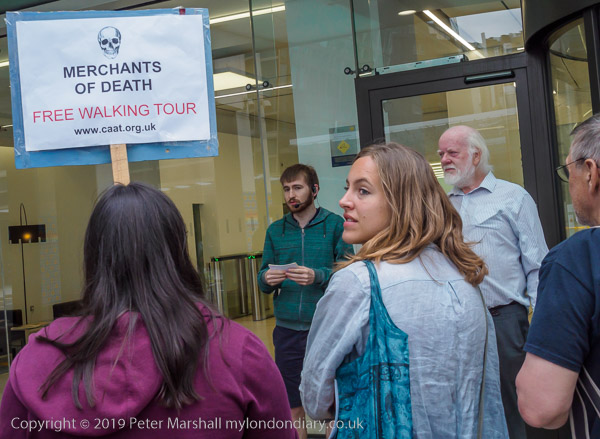
At the end of the month that this protest tour took place, the UK government issued its UK Defence & Security Export Statistics for 2018. These revealed that UK arms sales in 2018 amounted to £14bn, making the UK the world’s second biggest arms exporters, with around half the sales of the USA. Britain had 19% – almost a fifth of global arms sales – well ahead in 2018 of competitors Russia at 14% and France with 9%.

Most UK sales are to the Middle East, with Saudi Arabia, Qatar and the UAE in particular purchasing large quantities of UK arms. Over the 10 year period covered by the report, the Middle East accounted for 60% of UK arms sales, though in 2018 it was around 77%. One factor in that increase was the war in Yemen.

According to CAAT (Campaign Against Arms Trade),

The UK has licensed over £4.7 billion worth of arms to Saudi Arabia since the bombing began in March 2015.

The weapon categories include approximately:
£2.7 billion worth of ML10 licences (Aircraft, helicopters, drones)
£1.9 billion worth of ML4 licences (Grenades, bombs, missiles, countermeasures)

https://www.caat.org.uk/campaigns/stop-arming-saudi/arms-sales

UK weapons used in Yemen include Typhoon and Tornado aircraft and ALARM missiles from BAE systems, Paveway bombs from Raytheon, PGM500 bombs and Brimstone and Storm Shadow missiles from MBDA as well as UK-made cluster bombs which were exported from the UK in the 1980s. There are more details about the companies currently exporting arms to Saudi Arabia on the CAAT site.

As well as protesting, CAAT took the government to court over British-made arms being used in Yemen, and on 20th June 2019 the Court of Appeal ruled that UK arms sales to Saudi Arabia for use in Yemen was unlawful. The government are fighting this decision, taking it to the Supreme Court but had to apologise in September for “inadvertantly” breaking the ban over two export licences.

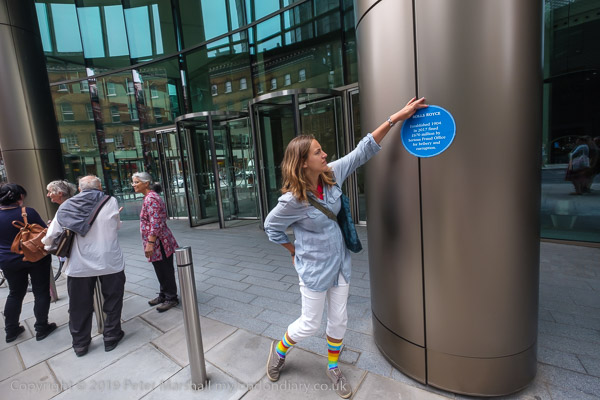
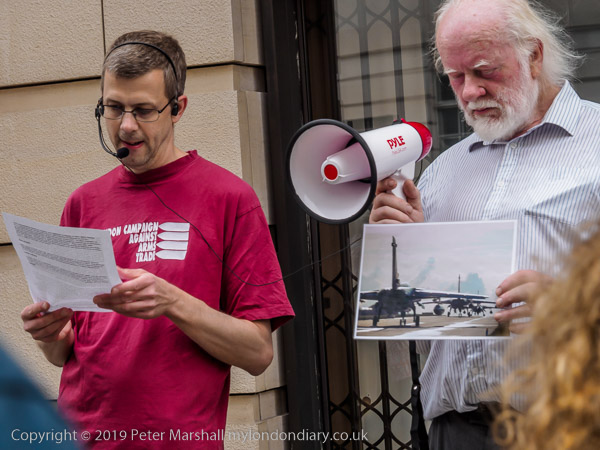
I joined the tour late after being held up by overcrowding led to a slow queue to get into the tube station and then down to the platforms due to Pride, and the crowds around Lower Regent Street made it impossible for the tour to visit the offices of Lockheed Martin. But I was present for the visits to G4S, Rolls-Royce and BAE Systems, as well as for the speeches about Lockheed Martin – with each company being presented with a ‘blue plaque’ for their sins.

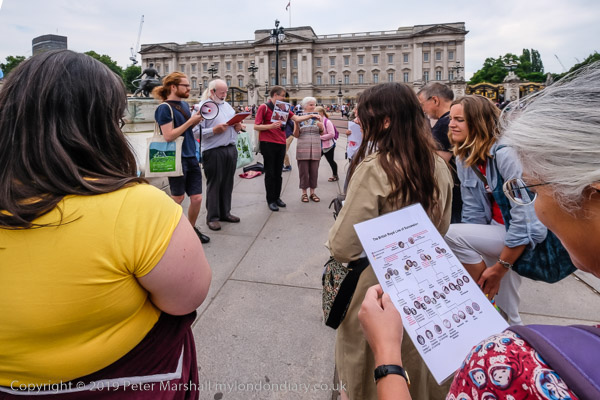
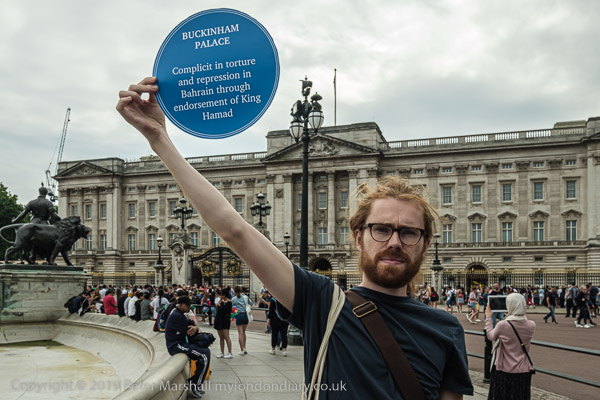
The highlight of the tour was the stop outside Buckingham Palace, where the plaque (complete with spelling mistake) was simply for their support of King Hamad in his violent repression of the people of Bahrain. But in the speeches we heard how the Royal Family played an important role with their visits backing arms sales around the world. Prince Andrew has been in the news recently for other reasons, but here was singled out for his services, in arms sales to corrupt regimes. Since it wasn’t possible to approach Buckingham Palace more closely, the blue plaque for the palace was left on the Victoria Monument facing it.

More from the tour at London’s Sinister Arms Trade


All photographs on this and my other sites, unless otherwise stated, are taken by and copyright of Peter Marshall, and are available for reproduction or can be bought as prints.

There are no adverts on this site and it receives no sponsorship, and I like to keep it that way. But it does take a considerable amount of my time and thought, and if you enjoy reading it, please share on social media.
And small donations via Paypal – perhaps the cost of a beer – would be appreciated.

Pride should be a Protest

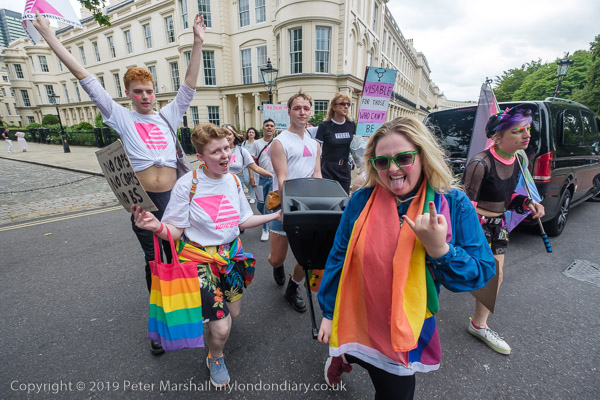
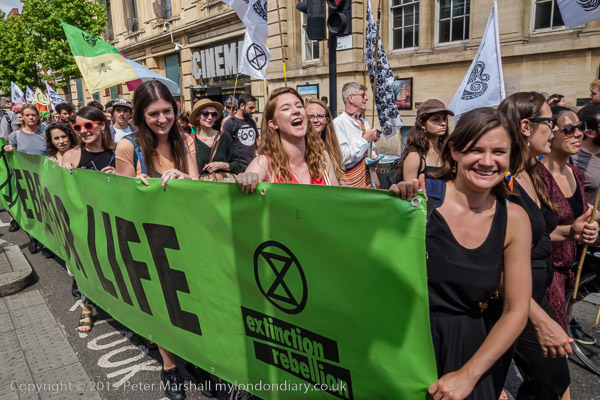
After around 20 years of photographing the annual Pride in London I decided I had had enough. As I’ve written often before, Pride has moved from being a protest for gay rights to becoming a corporate jolly, and this year charging entry fees that have prevented many of the more radical groups from taking part officially.
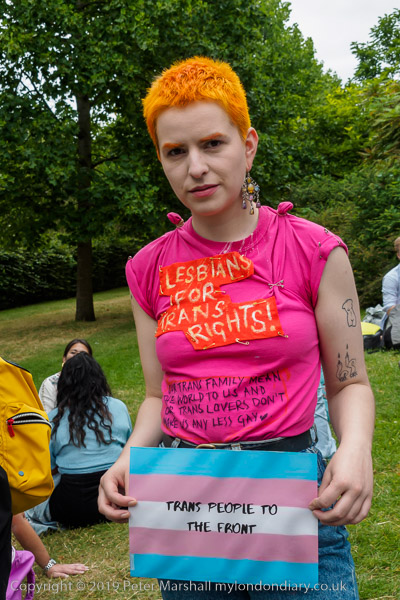
So this year I didn’t bother to apply for accreditation to cover Pride, something which has become more or less essential in recent years. And later I heard that Pride had tried to refuse accreditation to many press photographers as well as more or less banning those they did accredit from where they would be able to make decent pictures. After a great deal of aggravation and complaints from the NUJ and BPPA there were some compromises, but many colleagues decided to have a day off this year.

Two years ago instead of covering the official march I’d gone with the Migrants Rights and Anti-Racist Bloc who had tried to join in the event and when they were refused had held up Pride and then marched along the route ahead of the official event. And last year I’d gone into the suburbs while Pride was taking place for a march celebrating the 70th anniversary of the NHS and against plans to close acute facilities at Epsom and St Helier Hospitals in south London.

For 2019 I decided that there were two events I wanted to cover, one completely unrelated to Pride, but the other the Queer Liberation March in protest against the increasing corporate nature of Pride which was planning to march at the end of the official parade.

This was meeting in Regent’s Park, where some of those taking part in the official event were also gathering, and at first it was difficult to tell the two groups apart. Gradually as some left to take up their place in Pride things became clearer, and it also became clear that I was in for a very long wait before anything was going to happen as Pride was moving only very slowly.

I’m not good at waiting, and decided to go and join the unrelated event, intending to return later. My journey took me much longer than expected because of the crowds for Pride, and by the time I had finished photographic the second event I was feeling tired and could not be bothered to return to find the group from Regent’s Park.

It was a poor decision, as the Queer Liberation March turned out to be rather interesting. Pride stewards tried to stop them marching along the parade route and there were scuffles with stewards and police, before police decided that they must be allowed to continue. My colleague who had stayed and waited with them got some really interesting pictures and I had missed the fun.

More at Pride is a Protest


All photographs on this and my other sites, unless otherwise stated, are taken by and copyright of Peter Marshall, and are available for reproduction or can be bought as prints.

There are no adverts on this site and it receives no sponsorship, and I like to keep it that way. But it does take a considerable amount of my time and thought, and if you enjoy reading it, please share on social media.
And small donations via Paypal – perhaps the cost of a beer – would be appreciated.