Atos & more – 19 Feb 2014

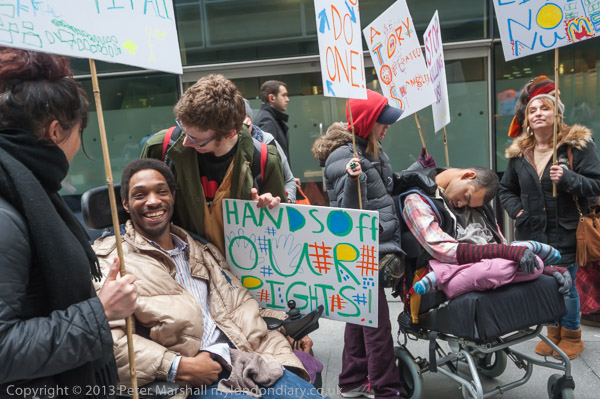
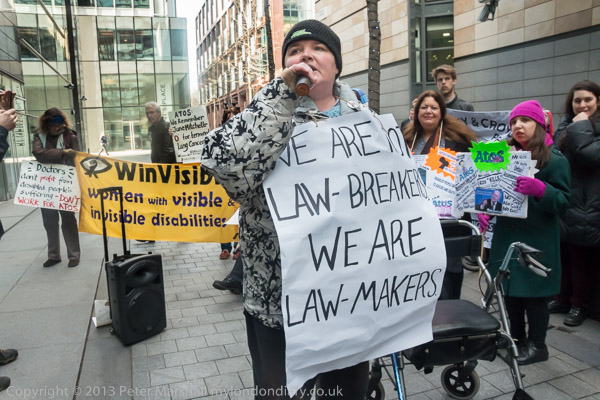
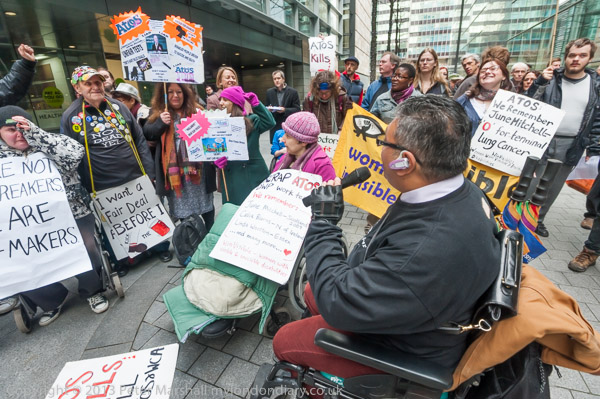
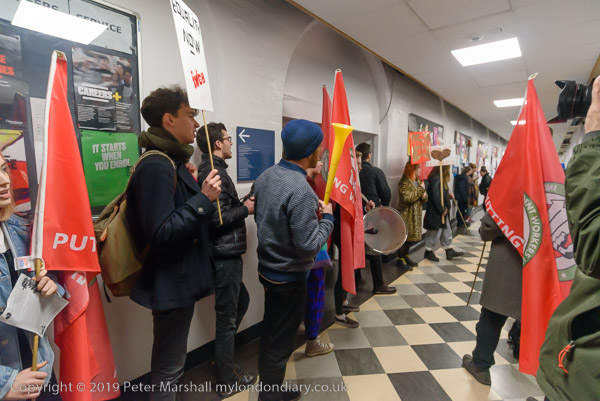
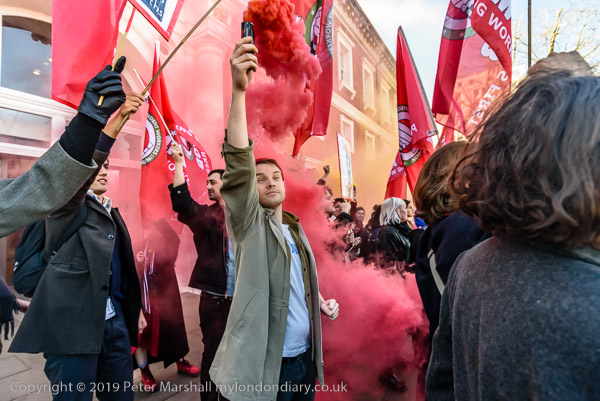
Seven years ago, 19 Feb 2014 was a big day for protests, particularly as campaign groups Disabled people Against Cuts (DPAC), Black Triangle, Atos Miracles, the Green Party, NUS, Occupy New Network, PCS, Unite and many others were taking part in a National Day of Action against Atos for its institutionally incompetent Work Capability Assessment testing of disabled people which has resulted in many disabled people being unfairly refused benefits.
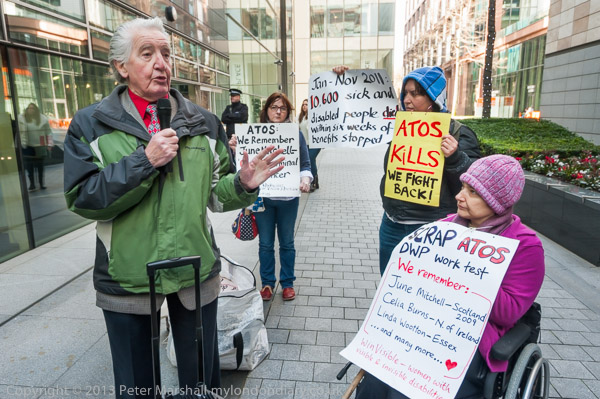
There were protests at each of the 144 Atos testing centres around the country, including those at Wimbledon, Neasden, Marylebone, Highgate, Ealing, Balham and Croydon in London, but I only photographed them at the Atos offices in Triton Square, just north of the Euston Rd.
Even a report commissioned for the government pointed out serious flaws, and over 40% of appeals after people have had their benefits cut by Atos assessments have been allowed a figure rising to over 70% where the appellants have been assisted in their appeals by benefits experts. These appeals take months, during which people are thrown into abject poverty, and often having won on appeal claimants are within a few weeks again penalised by a new Atos assessment.
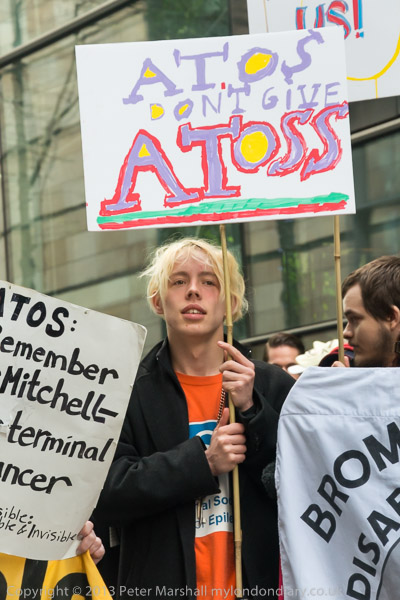
Atos apparently get paid more for finding people fit to work, and use simplistic tests and often tricks to do so, with no quality control or penalty for those tests which are overturned on appeal. The protesters called for the company to lose its contracts and be prosecuted for its mishandling of the tests, and for these tests to be abandoned and the Minister responsible, Ian Duncan Smith to be sacked.
Many disabled people have been driven to suicide by these failed tests and the stressful appeals procedures. The government figures for January to November 2011 showed that 10,600 people, an average of 223 a week, died withing six weeks of having been found fit for work by ATOS. The Department of Work and Pensions scandalous response to the public outcry when these figures were released was not to take action to make the improvements that were clearly needed, but simply to refuse to respond to requests for similar information for later years. The campaigners say that assessments of fitness to work should be made by qualified medical doctors, ideally by “the GP who regularly sees and treats the sick or disabled individual in question” who they say “is the only person able to decide if an individual is fit for work.”
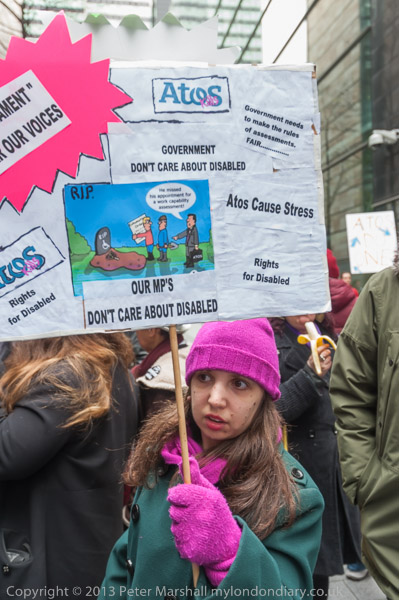
Among those I heard speaking outside Atos HQ were MP Dennis Skinner, Paula Peters of DPAC, Among those I heard speaking outside Atos HQ were MP Dennis Skinner, Paula Peters of DPAC, Green Party leader Natalie Bennett, journalist Sonia Poulton and the Rev Paul Nicolson of Taxpayers Against Poverty. You can read more about the protest and see more pictures at Atos National Day of Action.
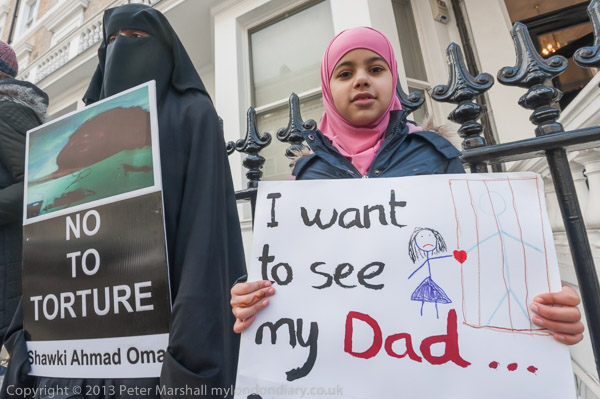

I left the Atos protest briefly to cover three further events. The first at the Iraqi consultate in Kensington was a solidarity vigil by the wife and daughter of Shawki Ahmed Omar, an American citizen held and tortured in Iraq by US and Iraqis since his arrest in 2004, and now in Abu Ghraib. They were accompanied by two supporters at one of their regular vigils calling for his release. You can read more about the vigil and the case at Solidarity vigil for Shawki Ahmed Omar.
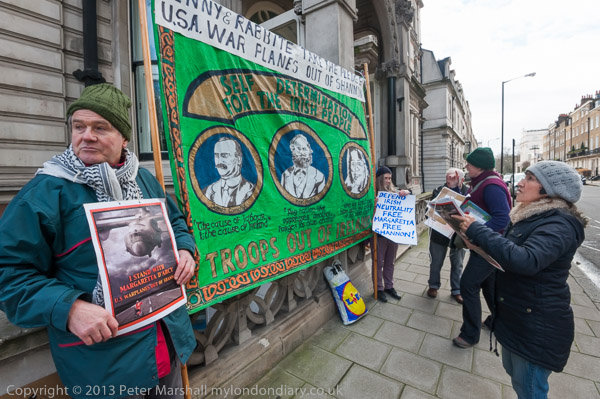


Next was a picket at the Irish Embassy close to Marble Arch to demand the immediate release of Margaretta D’Arcy, imprisoned for protesting against illegal US flights from Shannon Airport, and now in Mountjoy Women’s Prison, Dublin. More about this at Free Margaretta D’Arcy picket.
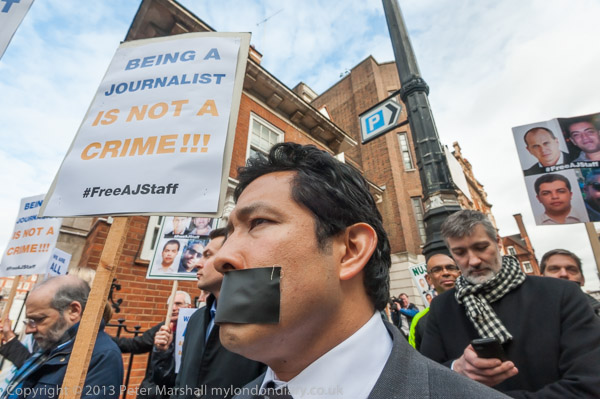


Third was a protest called by my own union the NUJ at the Egyptian Embassy in Mayfair, for press freedom in the country and calling for the release of all jailed journalists, including the four Al Jazeera journalists. More at NUJ demands Egypt release jailed journalists.


All photographs on this and my other sites, unless otherwise stated, are taken by and copyright of Peter Marshall, and are available for reproduction or can be bought as prints.
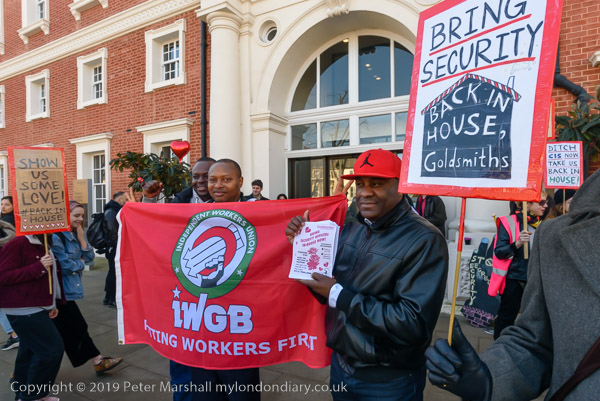
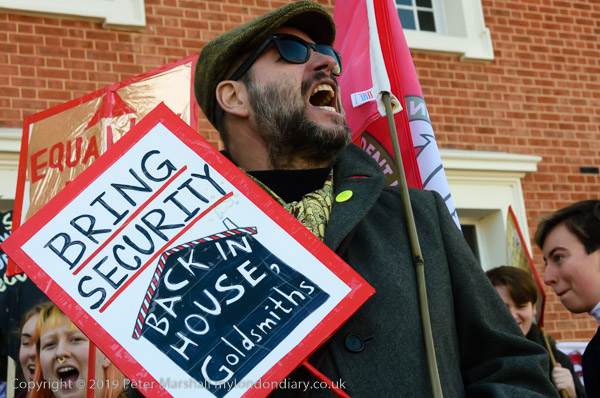
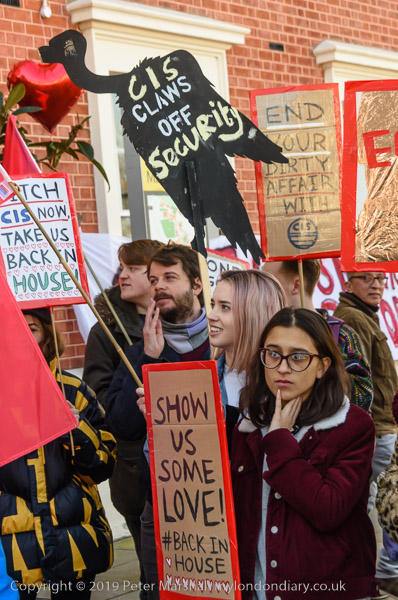
Show Workers Some Love

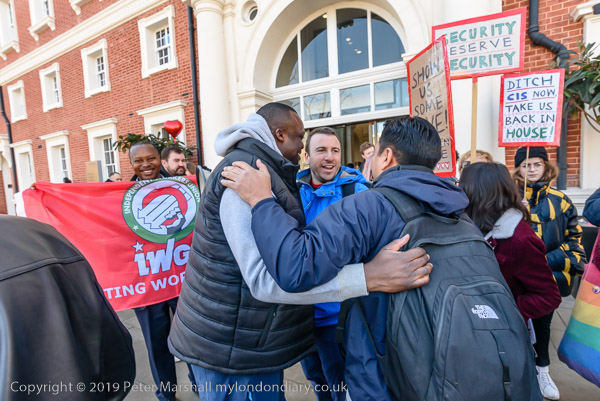
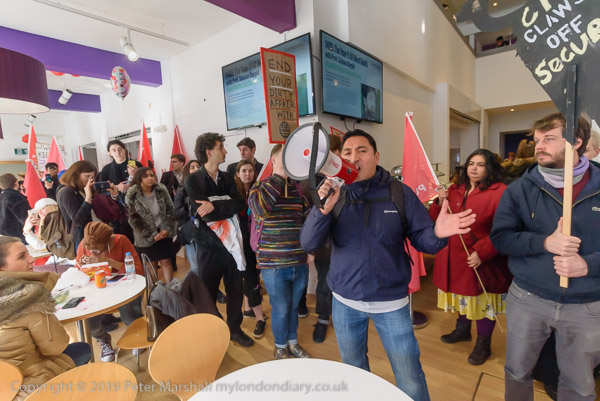
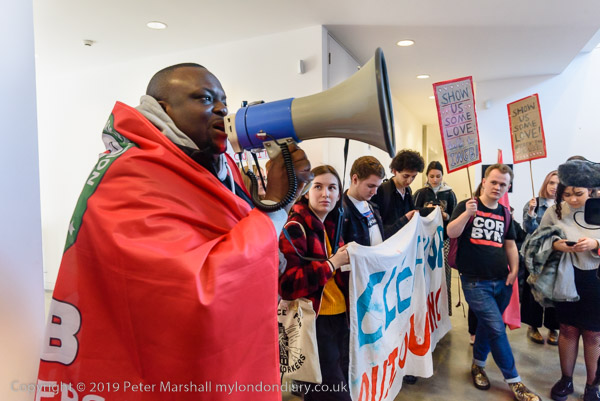
On St Valentine’s Day, Feb 14 2019, the Security and Receptionists Branch of the IWGB union and students launched their campaign for Goldsmiths University of London to directly employ its security officers, with a protest outside and inside the university buildings. The protest, on St Valentines Day, called on the university to show its workers some love.

I was pleased to be invited to go to photograph the event, and thankful that unlike many union pickets it was to take place at lunchtime rather than at the kind of ungodly hour of the morning that many of our worst paid have to clock in. I’m afraid I decline all requests that would involve me getting out of bed well before dawn and leave those to younger photographers who live closer, in part because travel until after the morning peak into London costs more than any likely return from reproduction fees.

Goldsmiths is in New Cross, a rather run-down area of South London that I’ve known for years and is rapidly sprawling over the whole area. Long ago, before I started taking photographs I made the pilgrimage to Chris Wellard’s Jazz & Blues Record Shop on Lewisham Way, probably the finest in the world until its closure in the mid-70s, later demolished for a new block for the college just a few yards further down the road. Goldsmiths has never quite gained the same reputation, though I have been there for the odd (sometimes very odd) meeting and event since. And more often to visit a late artist and photographer friend whose studios were just a little further on down the road at Lewisham Arthouse.

A group of students stood outside the old college building, waiting for the event to start, and eventually members of the IWGB arrived. Chris Wellard’s advertising always use to contain strict instructions to take the BR Southern trains from London Bridge rather than use the Underground (now the Overground) and perhaps they hadn’t observed these.

But things soon warmed up, and after some short speeches, including a warning from IWGB General Secretary Jason Moyer-Lee that this was a peaceful protest and we should be careful not to cause any damage a show of hands was voted to protest inside the building. We walked inside and made our way through the campus, stopping at various areas where people were eating lunch to for the union leaders to speak briefly – and to considerable applause from most – about the campaign.

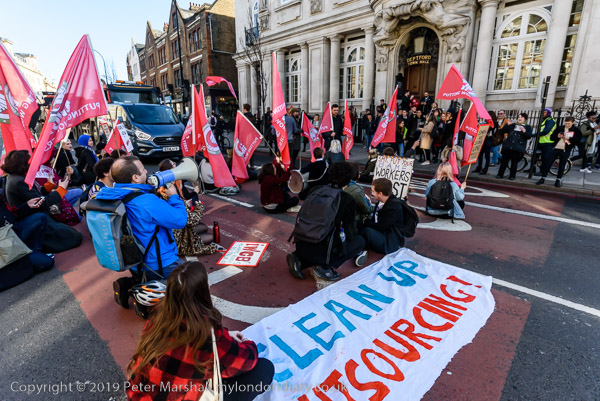
The protesters then walked down to New Cross Road, where the university management no has its offices in the former Deptford Town Hall, and sat down in the busy road outside for a few minutes blocking all traffic.

Walking back into the university campus, they group briefly occupied the foyer of the Ben Pimlott Building, before walking back to the front of the main building for a final rally.

It had been a lively and highly noticeable protest, bringing the claim for security staff to be directly employed by the university with similar terms and benefits to others at Goldsmiths to the attention of a large number of students, staff and management.

Exactly a year later, on Valentines Day 2020, the IWGB Security Guards & Receptionists Branch tweeted (with a short video):

More pictures at Bring Goldsmith’s Security In-House.


All photographs on this and my other sites, unless otherwise stated, are taken by and copyright of Peter Marshall, and are available for reproduction or can be bought as prints.


Kyoto & One In Love – 2005

The texts from two posts from My London Diary for Saturday 12 Feb 2005, sixteen years ago. I’ve had to change the formatting a little to fit this site, but otherwise the text is identical. There are more pictures from each event on My London Diary.

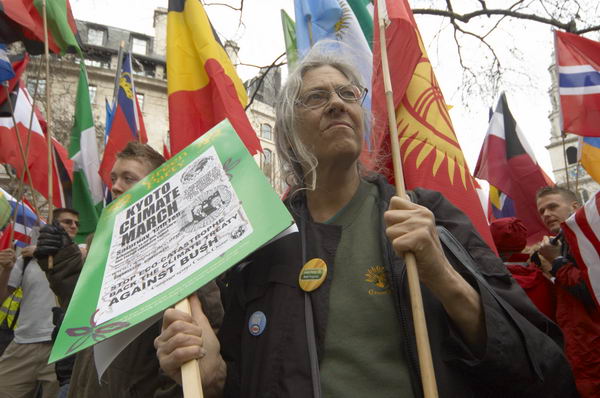
Campaign against Climate Change Kyoto Climate March

London, 12 Feb, 2005

When i talked about the dangers of increasing co2 emission and the need to cut down use of fossil fuels 35 years ago, i was a crank. now everyone except the usa oil lobby and their political poodles recognises that climate change is for real. even blair has recognised it as the most vital issue facing us, threatening the future of the planet, although actually taking effective action still is a step too far for him. however he did call for a conference to examine the problem, which told him and us that we had perhaps ten years to take action before it would be to late.

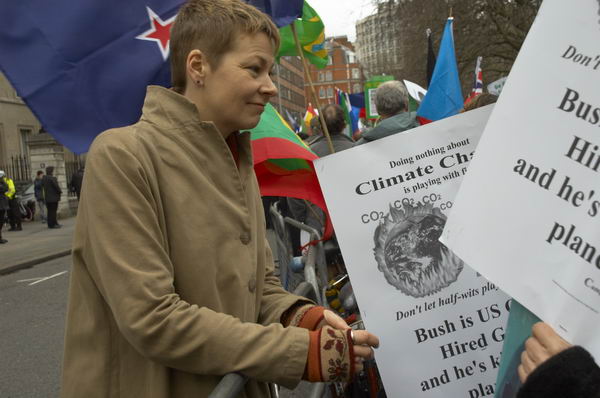
Caroline Lucas

kyoto is history now thanks to the US boycott, (although it comes into effect this week), but it should have been the first inadequate step on the road to action. every journey has to start somehow, and even a half-hearted step is better than none, and would have led the way to others. what got in its way was texan oil interests, whose political face is george w bush.

i’ve photographed most of the campaign against climate change’s kyoto marches over the past few years. this one was probably the largest, and certainly excited more media interest, truly a sign that the issue has become news.

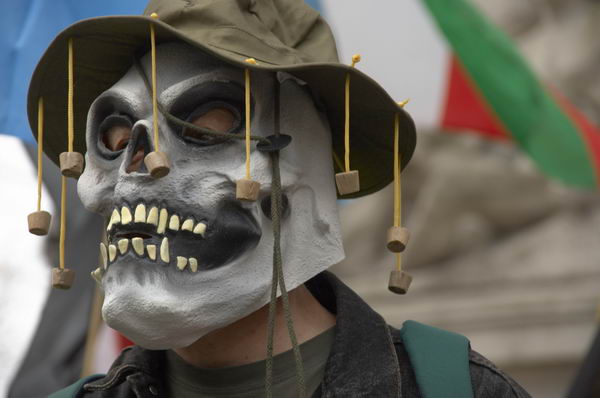
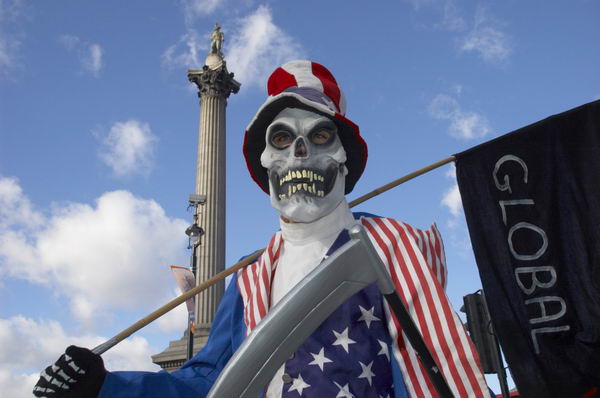
starting in lincoln’s inn fields, the march stopped first outside the uk offices of exxonmobil, on the corner of kingsway, for a brief declaration, then for a longer demonstration outside the australian high commission in aldwych (with guest appearances by ‘john howard’ and an australian ‘grim reaper’ with cork decorated hat), before making its way past trafalgar square and picadilly circus to the us embassy.


O-I-L One in Love

Reclaim Love, Eros, Picadilly Circus, London, London, 12 Feb, 2005

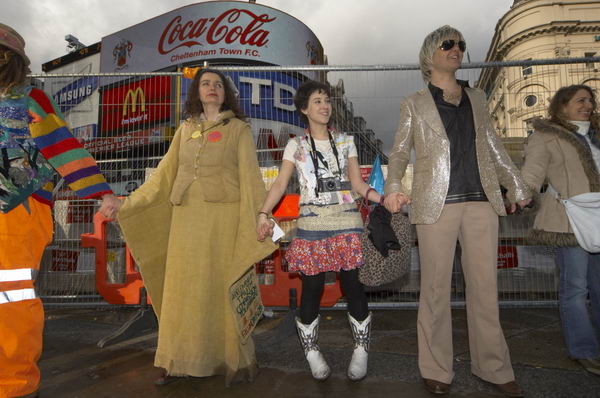
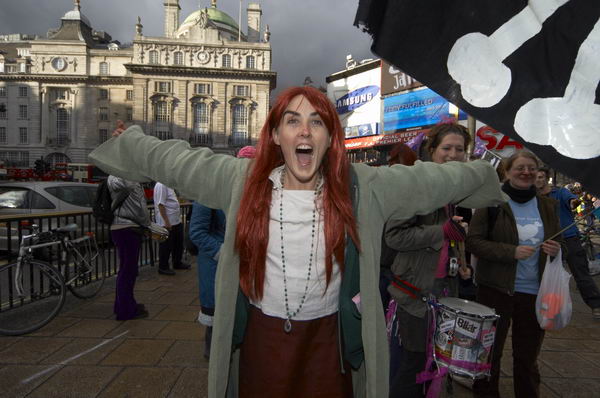
i left them in picadilly and returned to eros, where o-i-l, one in love, were organising a small gathering to “reclaim love” and “send love and healing to all the beings in the world” on the eve of valentine’s day. it’s something we could all do with, and it was good to see people enjoying themselves around the statue of eros, in what is usually one of the most depressing spots on london’s tourist circuit.

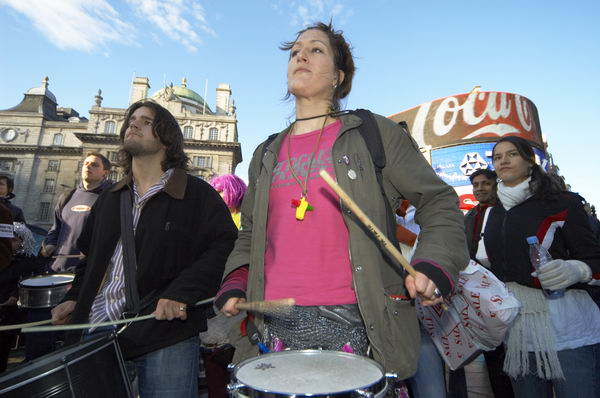
there was the samba band again, rhythms of resistance, (hi guys) and dancing and people generally being happy and friendly and free reclaim love t shirts and apart from the occasional showers it was harmless fun. rather to my surprise, the police either didn’t notice it or decided to ignore it, an unusually sensible strategy.


More pictures of both events on My London Diary.

This year there can be no street party at Eros in Piccadilly Circus, but Venus CuMara invites you to celebrate the 20th anniversary of Operation Infinite Love, Global Annual Love and Peace Meditation/street party by joining her on her Youtube ‘love stream / live stream/ life stream’ Global Love Meditation at 3.33 pm on St Valentine’s Day, Sunday 14th February 2021.

“MAY ALL THE BEINGS IN ALL THE WORLDS BE HAPPY AND AT PEACE”


All photographs on this and my other sites, unless otherwise stated, are taken by and copyright of Peter Marshall, and are available for reproduction or can be bought as prints.

A Busy Monday

Kashmiris call for independence

Monday 11th of February 2019 was an unusually busy day for me covering protests in London, with several unrelated events taking place across Central London.

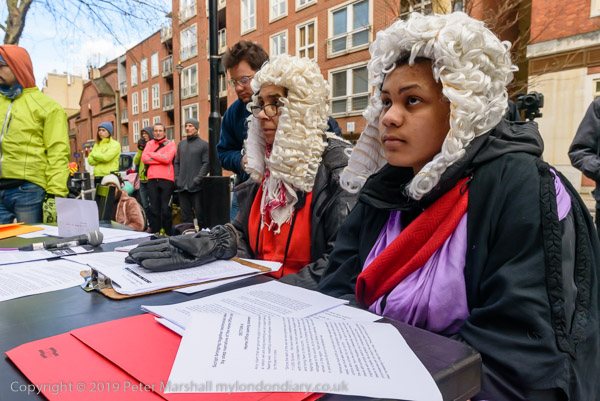
My day began outside in Marsham St, where groups outraged at the callous hostile environment introduced by Theresa May as Home Secretary from 2010 to 2016 and carried on by her successors Amber Rudd and Sajid Javid (and of course from later in 2019 by the despicable Priti Patel) held a mock trial of the the Home Office.

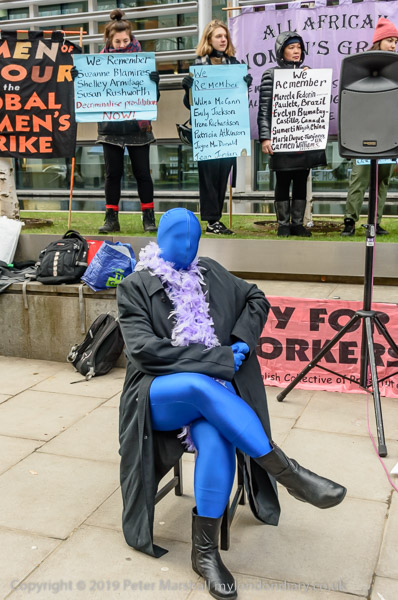
The Home Office were represented by a figure in Tory blue

The Home Office runs a violent, racist, colonial, and broken asylum, detention and deportation regime which treats refugees and asylum seekers as criminals, judged guilty without trial and often faced with impossible hurdles as they attempt to prove their innocence and claim their rights. It puts pressure on police and the CPS to launch false prosecutions – such as that of the Stanstead 15 who peacefully resisted an asylum flight and were charged and convicted under quite clearly ludicrous and inapplicable terrorism laws – and whose conviction was recently quashed on appeal.

Two years ago I wrote:

There were testimonies from individuals, groups and campaigns about suffering under the vicious system of rigged justice, indefinite detention, ill-treatment and arbitrary arrest and deportation. Two judges watched from their bench and those attending were members of the jury; I left before the verdict, but it was never in doubt.

People’s Trial of the Home Office

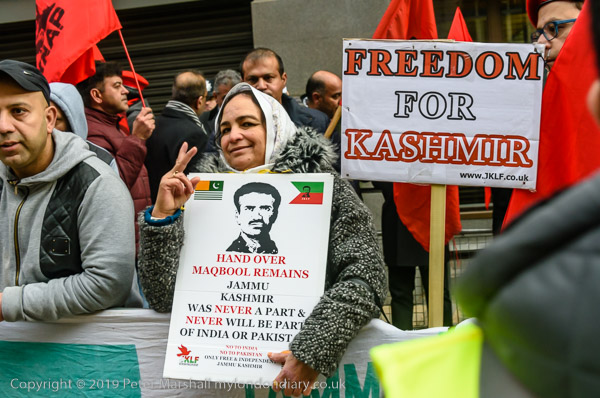
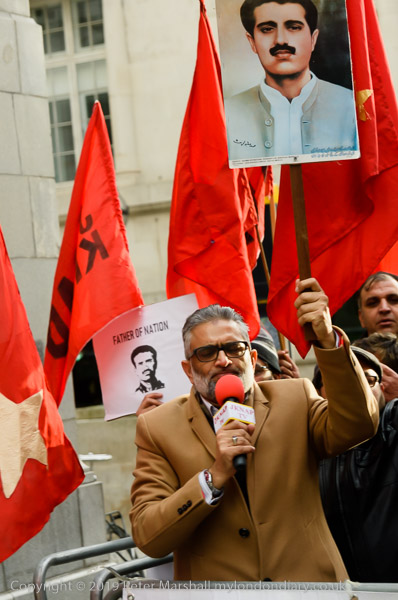
I left early to cover a protest at India House in Aldwych by the Jammu Kashmir Liberation Front calling for freedom, there on this day as it was the 35th anniversary of the hanging by India of Maqbool Bhat Shaheed in 1984. The population of Jammu and Kashmir is around 12.5 million, and India has over 800,000 troops in Kashmir, who shoot to kill, torture, rape and burn homes with impunity, killing over 100,000 Kashmiris since 1988. More recently India has even tightened its control over Kashmir, getting rid of the constitutional limited autonomy of the area, politically integrating it with India although this seems unlikely to lessen the continuing fight of the Kashmiri people for independence.

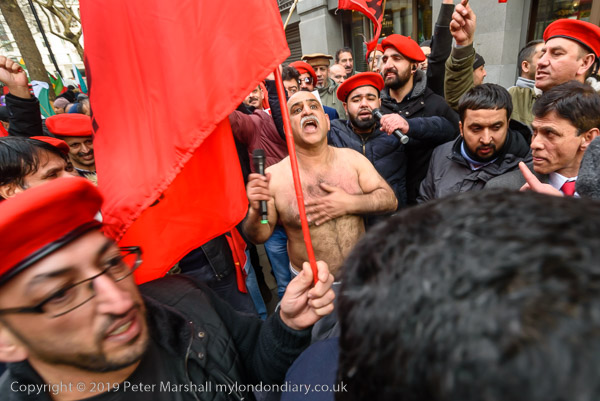
Later I photographed a protest by a second group of Kashmiris, the Jammu Kashmir National Awami Party UK, calling for the remains of Maqbool Bhat Shaheed to be released and for independence for Kashmir.

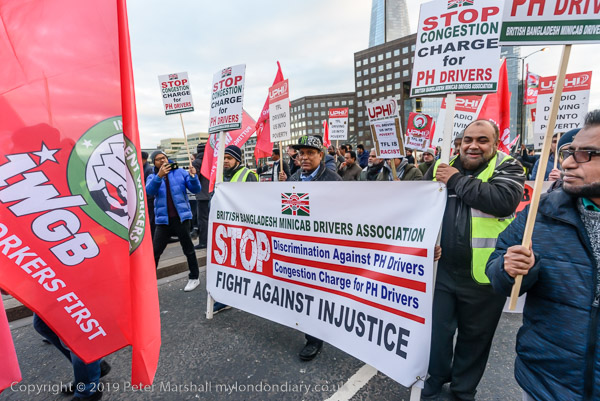
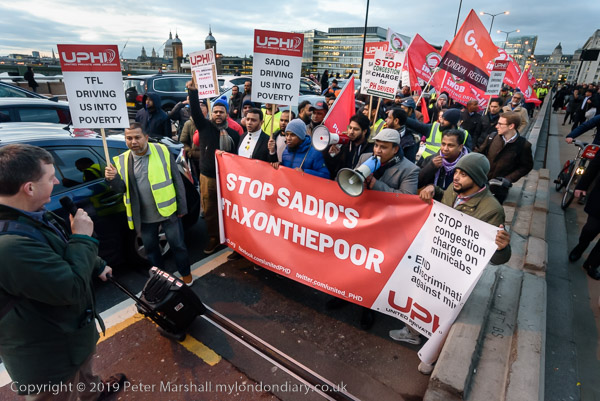
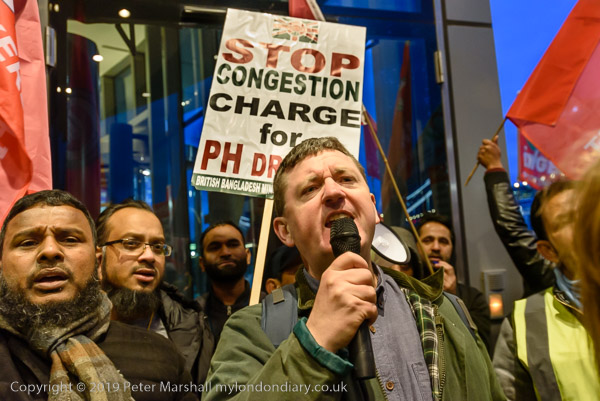
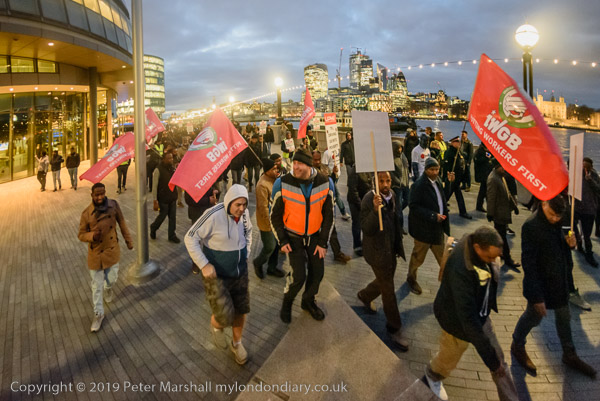
In late afternoon, private hire drivers came to London Bridge in their cars to protest against the decision by Transport for London (TfL) to make them pay the London congestion charge. London’s traditional Licenced Taxis – ‘black cabs’ – will remain exempt in what clearly seems unfair discrimination.

Minicab drivers have been organised by the International Workers Union of Great Britain (IWGB) into the United Private Hire Drivers (UPHD) which includes the British Bangladesh Minicab Drivers Association, the Minicab Drivers Association and the Somali All Private Hire Drivers, SAPHD. Most private hire drivers are from Black, Asian and minority ethnic groups while black cab drivers are almost entirely white and the UPHD claim that TfL’s decision is a case of race discrimination.

London’s Licensed Taxi system dates back to the era of horse-drawn vehicles (Hackney Carriages) and seems largely inappropriate now in the age of smart phones and sat navs. ‘Plying for hire’ creates both congestion and pollution on our overcrowded city streets, and is now unnecessary when cars can be summoned by phone, and good route-planning software with real-time traffic information out-performs the archaic ‘knowledge’ routes.

The drivers parked on London Bridge and blocked both carriageways, then locked their vehicles to march along the bridge and hold a rally, then marched to hold a noisy protest outside City Hall. From there some went to Tower Bridge to block that, but were persuaded by the UPHD stewards to leave and return to their vehicles.

UPHD drivers protest unfair congestion charge
Kashmir Awami Party call for Freedom
Kashmiris call for freedom
People’s Trial of the Home Office


All photographs on this and my other sites, unless otherwise stated, are taken by and copyright of Peter Marshall, and are available for reproduction or can be bought as prints.

Class War v. Qatari Royals

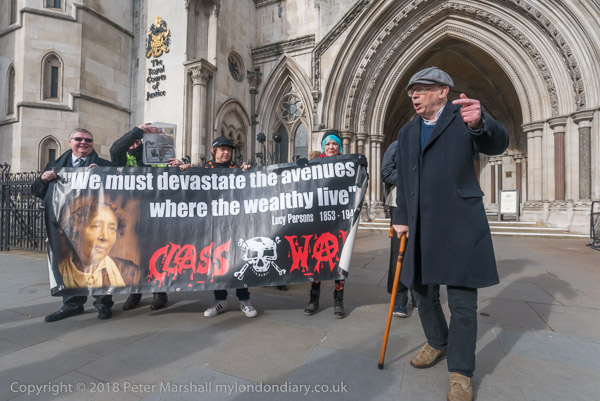
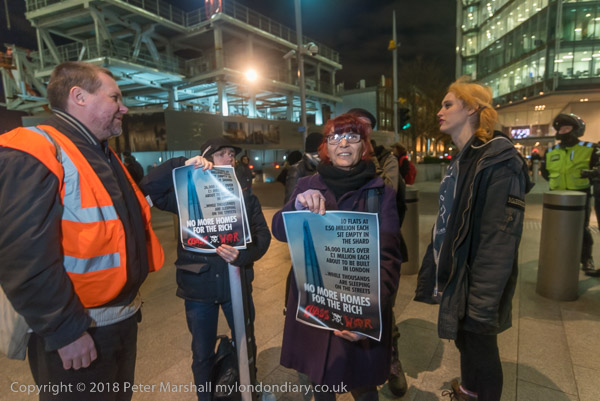
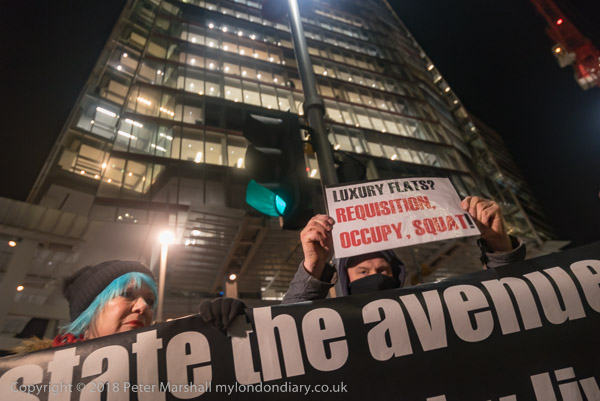
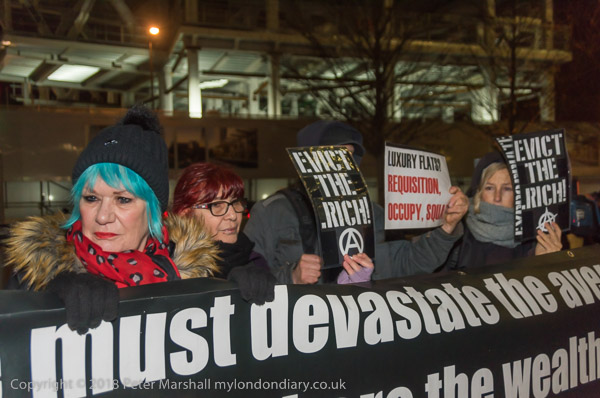
Three years ago today, on 8 Feb 2018, Class War had planned a protest outside London’s tallest building, the Shard, to point out the housing crisis, which is currently affecting many in London. They chose to protest at the Shard, because there are ten £50m apartments there which have remained empty since the building was completed.

We don’t actually have a housing shortage as there are more than enough properties for everyone to have a decent home. The problem is that current policies allow property to be left empty and encourage developers to build high priced flats which either remain unsold or are bought as investments and largely left empty for all or most of the time. There were then plans to build a further 26,000 flats in London costing more than a million pounds each, many on former council estates where social housing has been demolished at a time when London has a huge housing crisis with thousands sleeping on the street, and over 100 families from Grenfell were still in temporary accommodation.

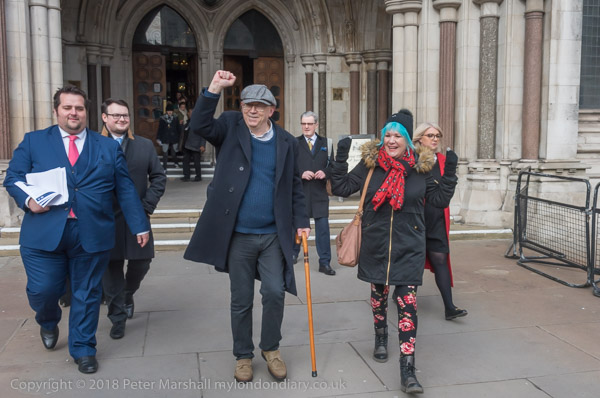
The owners of The Shard, the Qatari royal family, went to court to seek an injunction against the Class War protest, seeking an injunction against Ian Bone and “persons unknown” and, despite their fortune estimated at over £250 million pounds, seeking legal costs of over £500 from the 70 year-old south London pensioner.

Fortunately barrister Ian Brownhill offered to conduct Bone’s defence pro bono and in the High Court hearing the Qatari royals were forced to drop the attempt to ban protests and the demand for fees but Bone accepted a legal restriction on him going inside the Shard and its immediate vicinity. But that meant the planned protest that evening could still go ahead, and Bone and his team emerged from the court victorious. His health issues meant that he was himself in any case unable to attend the protest.

At the protest there were large numbers of police and security, along with many in plain clothes and two officers with search dogs. The protest was always intended to be a peaceful one and the protesters were careful to remain outside the boundary of The Shard, marked with a metal line in the pavement. The police nonetheless harassed them, making a patently spurious claim that they were causing an obstruction to commuters attempting to enter London Bridge station and trying to move them further away from The Shard. Although the protest clearly wasn’t causing any serious problems to those entering or leaving the station, the larger numbers of police and security were.

Three years on, London still has a huge problem, with huge numbers of unaffordable flats still being built, particularly in the huge development area in Vauxhall and Nine Elms, including the developments around the US Embassy and the former Battersea Power Station. Some developments here include small areas of social housing, with ‘poor door’ entrances hidden away around the backs of some of the towers, the residents or which are excluded from the many facilities which are provided for the wealthy.

While blocks have large and well-furnished foyers with a concierge service for the rich, as well as some recreational facilities, social housing tenants typically enter a narrow bleak corridor with no space even for parcel deliveries. Just like the block in Aldgate where Class War’s long series of protests put the issue of ‘poor doors’, where poorer tenants are segregated from their wealthy neighbours on the national agenda back in 2014.

In July 2019, Communities Secretary James Brokenshire was “appalled” by the examples of segregation he had seen and promised to put an end to the use of “poor doors” in housing developments in England. It appears to have been a Broken promise, and Class War are thinking it is time for more action.

Class War protest at Shard
Class War victory against Qatari Royals


All photographs on this and my other sites, unless otherwise stated, are taken by and copyright of Peter Marshall, and are available for reproduction or can be bought as prints.

Friern Barnet Celebrates – Feb 5th 2013

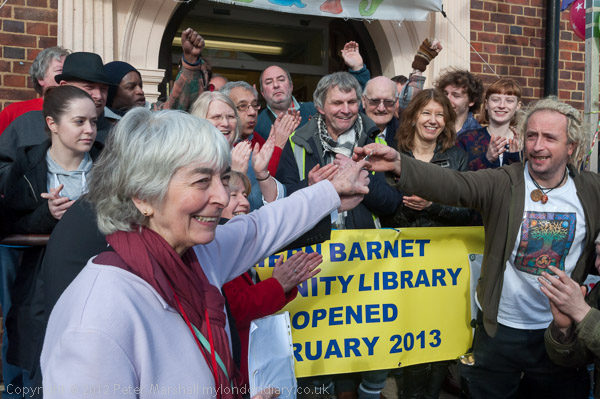
Friern Barnet Library supporters celebrated victory in overturning Barnet Council’s closure decision in a ceremony in which the Occupy squatters who had prevented its sale handed over the library keys to the local community who will now run it.

The victory by local residents, squatters and activists from the Occupy Movement against Barnet Council is not just a local matter, but one of national (and possibly even international) importance. A great example of democracy in action it shows how a combination of campaiging, lobbying, direct action and making use of the law can win against bureacracy and greed.

Today residents and squatters came together to celebrate their victory after Barnet had agreed to lease the building to a community company set up to run it as a library, Friern Barnet Community Library (FBCL).

Friern Barnet Library Victory Celebration

Eight years on, the library is still run by the community and up until closure for Covid lockdown, a thriving centre of community activities. Local residents had set up the ‘Save Friern Barnet Library Group’ when they heard that Barnet Council were proposing to close the library, and organised petitions, lobbied councillors, organised events and got the media involved, but the council wouldn’t listen to them and went ahead and shut it in April 2012. The council saw the site – including the large green space outside as a valuable site for sale to private developers rather than the community asset it was.

In September 2012 community activist squatters, including some who had been part of Occupy London, entered the library and re-opened it, beginning a long occupation. At first some local residents were wary of associating themselves in this direct action, but soon began to work with the squatters to re-establish library services.

The council went to court to regain possession of the building, but in December the judge ruled that they had to try to negotiate some form of licence to keep the library open to preserve proportionality between the rights of protesters and of the council. Eventually they agreed to allow a community company to run it as a library

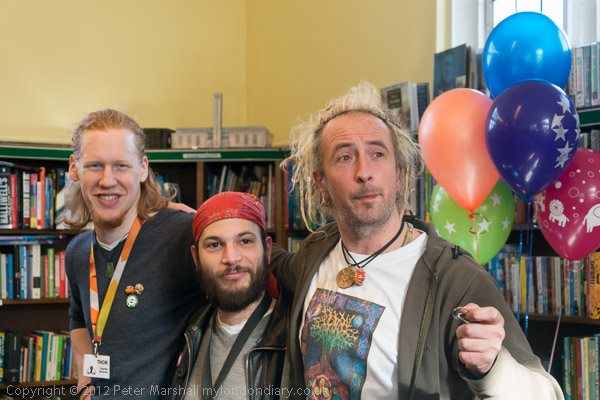
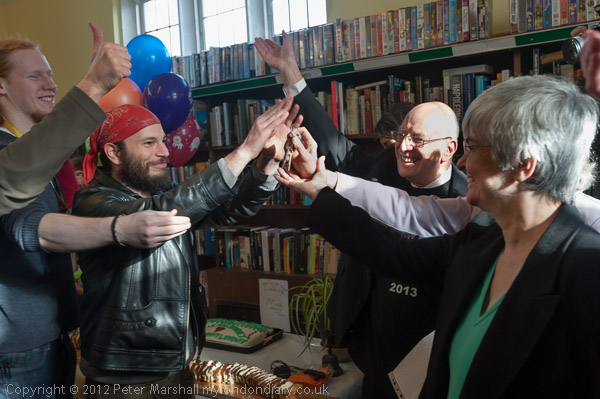
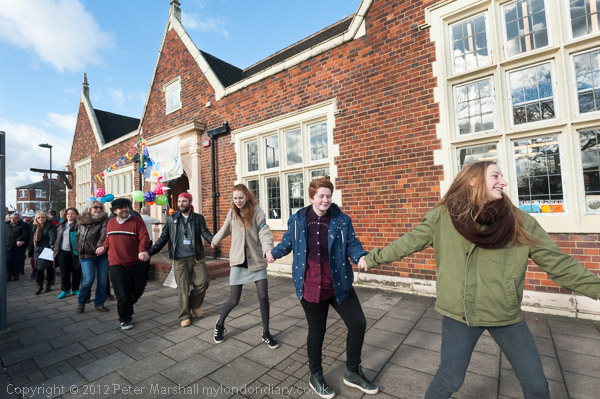
At the celebration inside the library, the occupiers (at left above) handed over the library keys to the FBCL (at right), and we all cheered before getting down to the serious business of eating the cakes and dancing around the green outside.

But some of the press photographers covering the event weren’t happy with the pictures they had (or rather hadn’t got) of the handover, and later got the two groups to restage it outside the library. It just goes to show that you should never believe what you see in the newspapers. Of course as you can see I photographed it too, but made sure my captions made clear it was staged for the photograph rather than the actual handover. Some photographers don’t see it as important, but for me it crosses a vital line of journalistic integrity – it’s my job to record not to stage events.

People went out to dance around the paved area and green spaces in front of the library which are used to hold community events.

The local councillor who had supported the residents then cut a tape to let us all back into the library, where there were some more speeches before getting down to continuing the serious business of celebration.

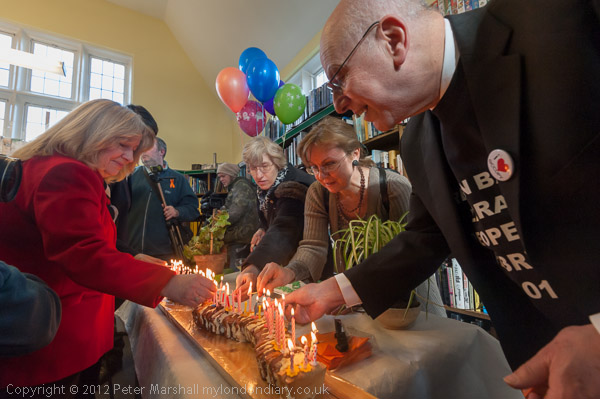
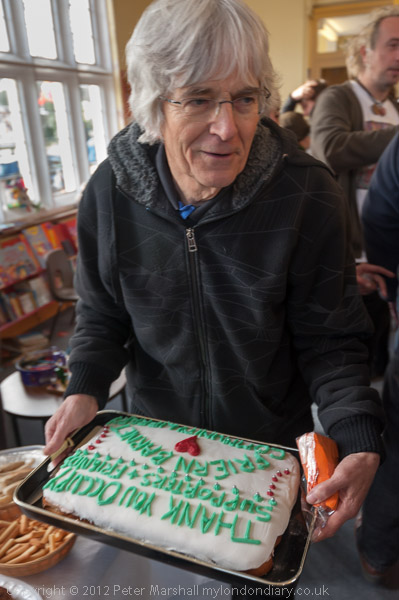
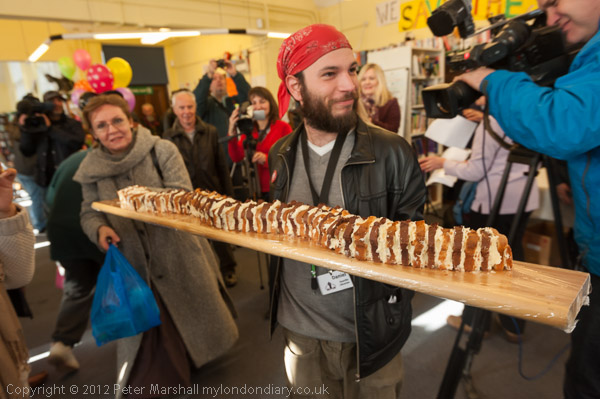
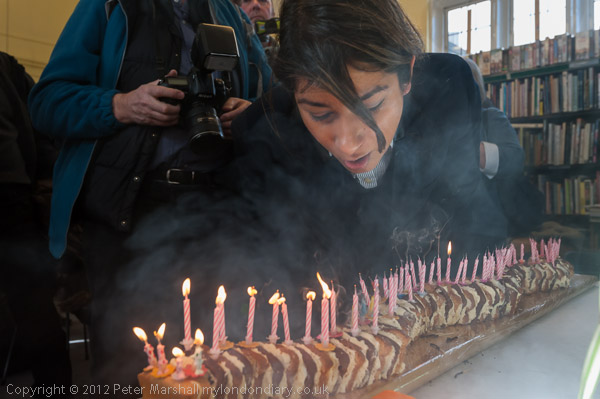
This was the ‘bookworm cake’ and it took a lot of candles and quite a while to light them all,

but was blown out fairly quickly, and later we all ate some.

Many more pictures at Friern Barnet Library Victory Celebration.


All photographs on this and my other sites, unless otherwise stated, are taken by and copyright of Peter Marshall, and are available for reproduction or can be bought as prints.

Gentrification is Class War: 4 Feb 2018

Back when I began taking pictures of London in the 1970s London still had many largely working class areas, many the kind of places where some photographer friends would raise an eyebrow when I said I had been taking pictures there, or even send me dire warnings about the dangers of walking the streets there with a camera around my neck.

They were areas where people in the basic jobs that keep the city running could afford to live – both those whose families had moved to these areas several generations back and those including migrants and refugees who had come more recently. Some were certainly beginning to see a new more affluent population moving in, and many of my pictures featured skips in front of housing that was being renovated, both by developers who were buying up many older properties and young professional couples who were often ‘knocking through’, and pub conversations began to be riddled with terms such as ‘RSJ’.

Since then more and more areas across London have been subject to ‘gentrification’, their character being changed and new businesses coming in to cater for the new wealthier population, while increasingly the low-income inhabitants are forced out to cheaper areas further from central London as house prices and flat rents soar – and as council estates are demolished and replaced by higher density largely private flats at high market rents.

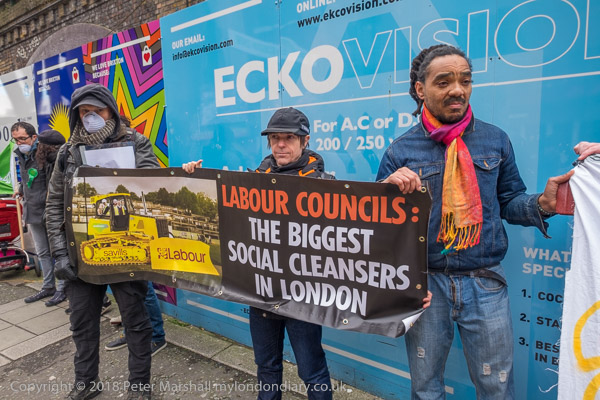
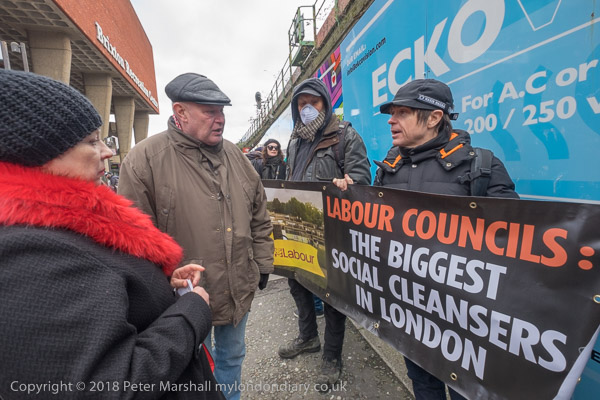
This process of ‘social cleansing’ has been taking place across London, and has been accelerated by many Labour councils since Tony Blair began New Labour’s regeneration programme with a press photo-opportunity on the Aylesbury Estate in Southwark in his first speech as Prime Minister in 1977.

Many of the shops that I photographed back in the 70s and 80s, small local shops – corner stores, cobblers, hairdressers, greengrocers, butchers, etc – and other small local businesses have now disappeared, their premises now often estate agents, and cafés have changed their nature from ‘greasy spoons’ where you could get a filling cheap lunch to serving coffee and cakes, vegetarian food or rather more expensive restaurants catering for the new and wealthier clientèle. Of course tastes generally have changed and so have shopping habits, and some of the new is certainly welcome. But so much of those shops and pubs that were a part of these neighbourhoods have been lost.

Brixton perhaps stood out against gentrification longer than most – with the reputation it had from the disturbances in 1981, 1985 and 1995 deterring many newcomers. All took place following heavy-handed police action; Operation Swamp 81, when over 900 people were stopped and searched in 5 days, with 82 arrested, the shooting of Cherry Groce in 1985, and the death in police custody of Wayne Douglas in 1995. But many young people were attracted to the area by the vibrant atmosphere and Caribbean culture, by music venues, the Roxy, markets, food and pubs, and with its good transport links and closeness to central London it has attracted many young professionals in more recent years.

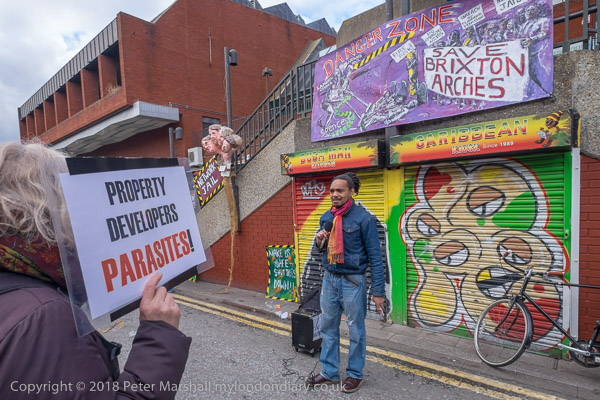
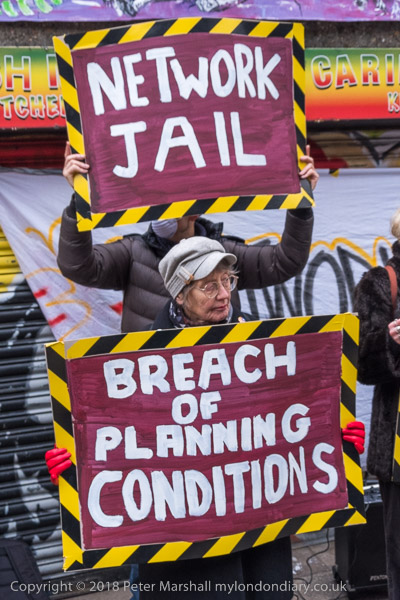
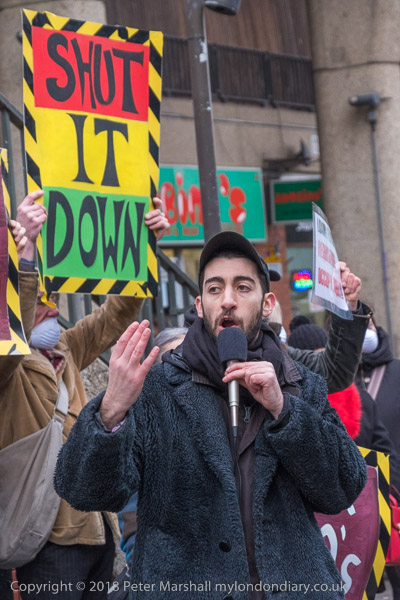
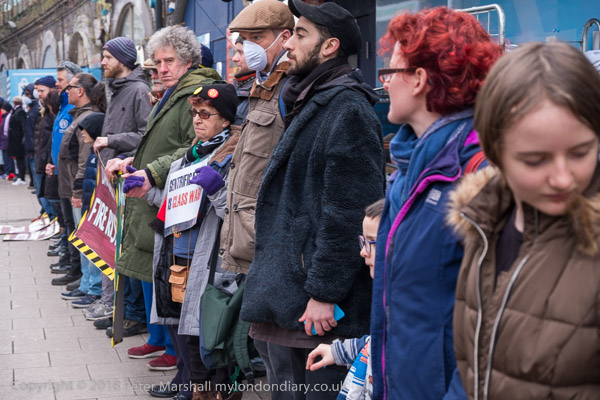
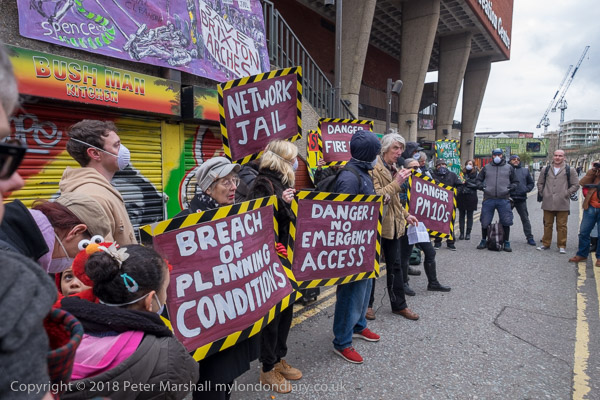
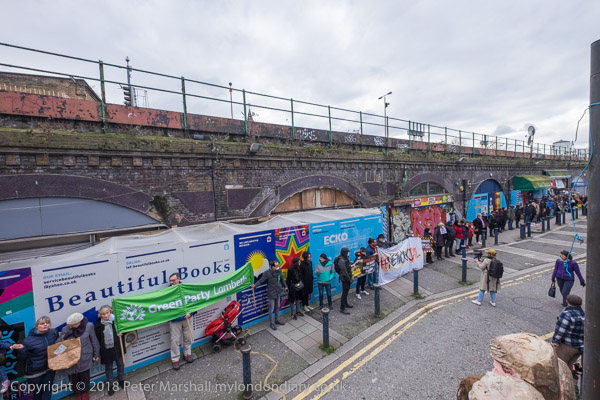
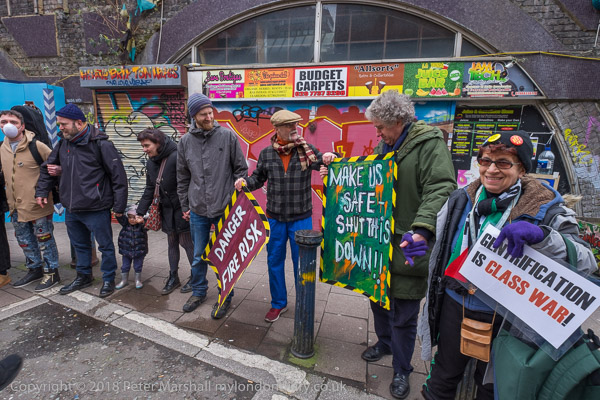
Railway lines run through the centre of Brixton, and the arches underneath them have been an important part of its life, providing low cost premises for businesses and, particularly in Atlantic Road and Brixton Market Road, for shops. They provided what has been called “the heart of Brixton”. But as I wrote in my text for Save Brixton Arches: 3rd Anniversary Action on Sunday 4th February 2018:

Network Rail have colluded with Lambeth Council to get rid of something that gave Brixton its unique character and replace it by trendier shops catering for the new wealthy young population – part of Lambeth Labour’s programme of social cleansing which includes demolishing council estates and replacing them with high cost private accommodation (with a token amount of so-called affordable properties.) The Council ignored the public outcry and large demonstrations to keep the arches.

The plans were accompanied by a great deal of lies and mismanagement by Network Rail and work was supposed to be completed by 2016 but is only scheduled to start tomorrow, and the Save Brixton Arches campaign are calling for it to be abandoned as the plans for the work fail to include proper fire safety precautions and will severely restrict access by emergency services to local businesses and the railway and station.

Save Brixton Arches: 3rd Anniversary Action

Despite the campaign both by the traders and many of the local population the refurbishment of the arches went ahead, though over a year later many had not been re-let. Allies and Morrison, the architecture and urban planning practice which recommended the scheme in 2013 has been involved in many contentious ‘regeneration’ schemes with developers and councils across London which opponents describe as social cleansing. Local Labour MP Helen Hayes was a senior partner in this firm until she left shortly before being elected in 2015, although she has denied any involvement in this particular scheme.

More at Save Brixton Arches: 3rd Anniversary Action.


All photographs on this and my other sites, unless otherwise stated, are taken by and copyright of Peter Marshall, and are available for reproduction or can be bought as prints.

Save the NHS – 3 Feb 2018


We didn’t have Covid in 2018, but the Tory Government was busy laying the groundwork that would lead to our current 100,000 deaths and counting as a part of their longer term intention to privatise the NHS. It looks likely that the total excess deaths due to the virus will rise to over 200,000 before the outbreak is tamed to a fairly small continuing trickle, mainly then killing those who refuse vaccination.

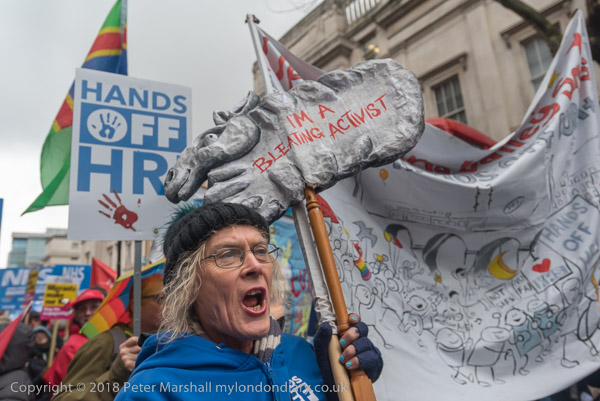
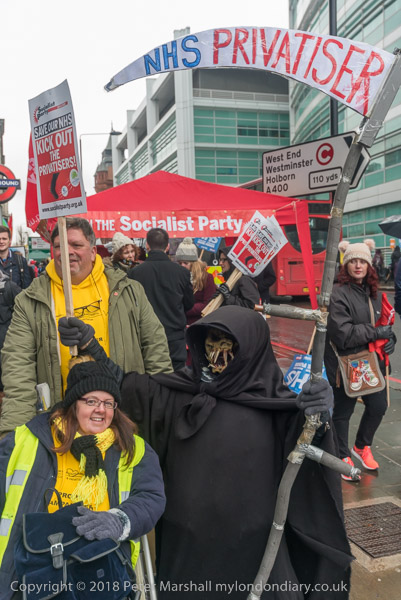
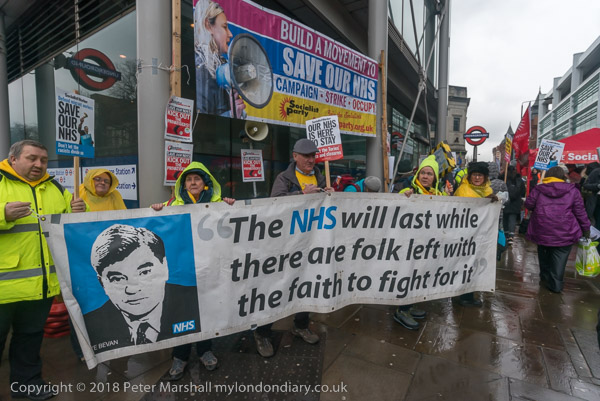
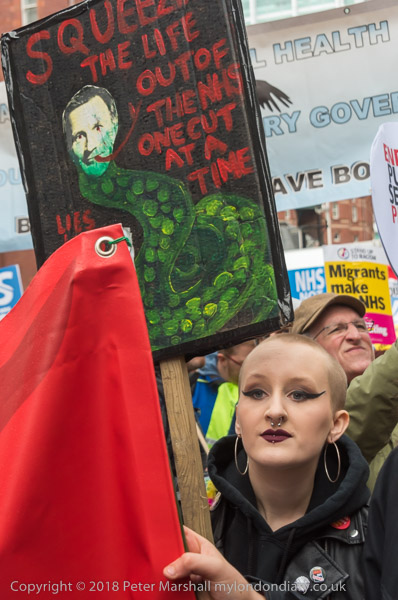
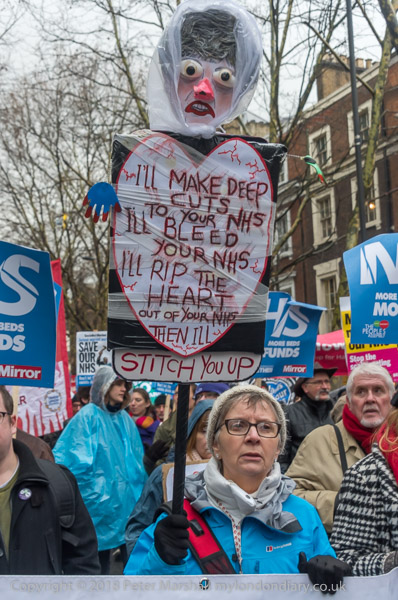
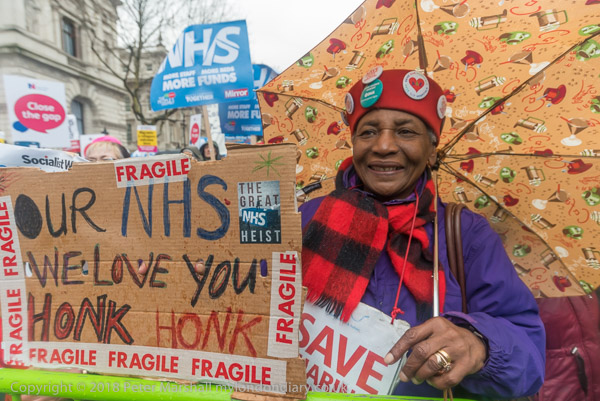
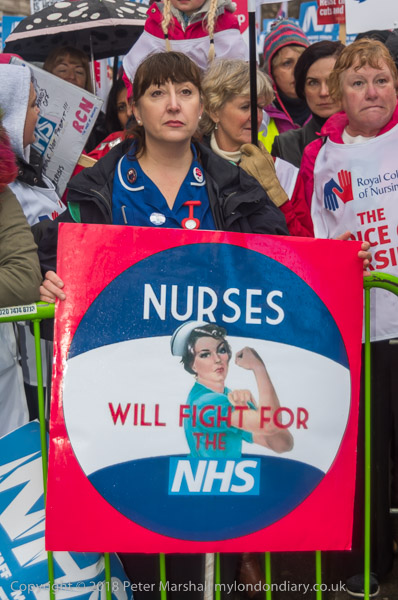
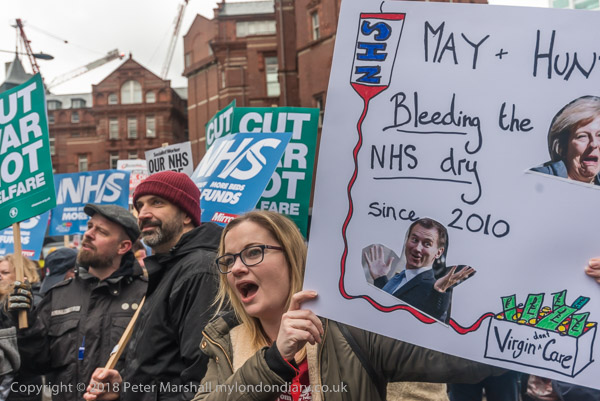
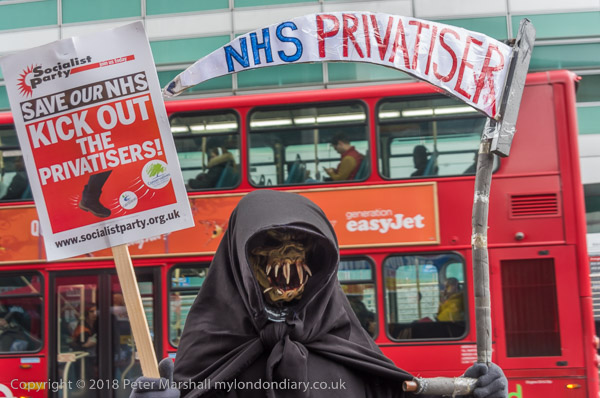
Tens of thousands marched in support of the NHS through London on 3 February to a rally at Downing St calling on the Government to stop blaming patients, nurses, doctors, immigrants, flu and the elderly for the crisis in the health service and to fund it properly and bring it back into public hands from the waste and demands of private profit.

Despite warnings from many in the health sector of the dangers which would arise from any major pandemic, the government ignored many of the warnings and recommendations of the 2016 Exercise Cygnus, which had simulated a flu pandemic causing as many as 400,000 excess deaths, as well as the experience from other countries around the world in dealing with epidemics.

Over a long period, under Tories and New Labour, the increasing outsourcing of services has damaged the efficiency of the NHS and created dangerously low standards of hygiene, while expensive PFI building contracts have left many hospital trusts with impossible long-term debt repayments. Cutting the number of beds was a way to ease the financial problems, but left hospitals unable to meet the extra demands of normal winters, let along Covid.

Cutting bursaries for nurse training exacerbated the shortage of nursing staff, and over the longer term we have failed to provide training places for sufficient doctors, relying increasingly on those trained abroad, both from the EU and also from countries with greater need of doctors than the UK. And changes to pay and conditions, particularly for junior doctors have led to more UK trained doctors and nurses finding work in other countries.

Back in 2018 I pointed out:

Many in the Conservative Party have financial interests in healthcare companies and their policies are clearly designed to carry out a creeping privatisation of the NHS, setting up various devices including STPs and ACSs (Sustainability and transformation partnerships and accountable care systems) which obligate the tendering of NHS services to private healthcare providers, and large areas of NHS services now provided by companies such as Virgin Healthcare.

Fix the NHS Crisis Now

The march on 3 Feb 2018 began in Gower St, which was packed with people making it hard to walk down as I arrived around an hour before it was due to start. I made my way to the front in time for the start and walked with it for a short way before stopping to photograph marchers as they walked past me on Shaftesbury Avenue. They were still filing past – an estimated 50,000 of them – when I had to rush away to Downing St to photograph the rally there. More were still arriving when I left.

Three years later the need to fix the NHS and to stop the increasing privatisation is even greater. Many of those now in government, including my own MP are advocated moving away from a system free at the point of use to a private insurance-based healthcare system similar to that in the USA – where many now are unable to afford insurance or find that more serious conditions are not covered by it. Were I now living in the USA, it is unlikely that the prescriptions that I now get free for my long-term condition would be covered by insurance and they would be costing me over £1000 per month. Many with Covid would also find they were not covered by insurance and would have no way of covering the huge costs of hospitalisation should there condition become serious. We need to keep our NHS and to stop privatisation – and if necessary increase our tax and national insurance payments to fund it.

More at Fix the NHS Crisis Now


All photographs on this and my other sites, unless otherwise stated, are taken by and copyright of Peter Marshall, and are available for reproduction or can be bought as prints.

Protesting Trump’s Deal: 1 Feb 2020

A year ago I was out taking pictures of a protest at the US Embassy in Nine Elms, and it really does seem a huge age ago. I’ve got so used to staying at home, just occasionally going out for a little exercise. But last Thursday I had my first dose of the vaccine, and in a few weeks time I can perhaps be thinking about getting back to work, though until the current lockdown ends (and who knows when that will be) there won’t be many protests for me to photograph.

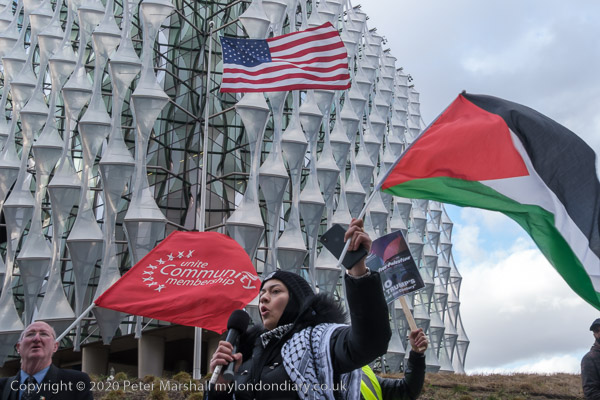
I never much liked the US embassy in Grosvenor Square, and what architectural attraction it had was rather spoiled when it got hidden behind some rather ugly security additions. The new embassy isn’t perhaps a great piece of architecture and the screen which covers three sides is rather a plastic add-on, but at least it does make it stand out from the buildings around, and the moat is rather a nice piece of landscaping. But I think the main motivation behind the move was to move the many protests at the embassy out of the public eye, away from the centre of London to a rather obscure location.

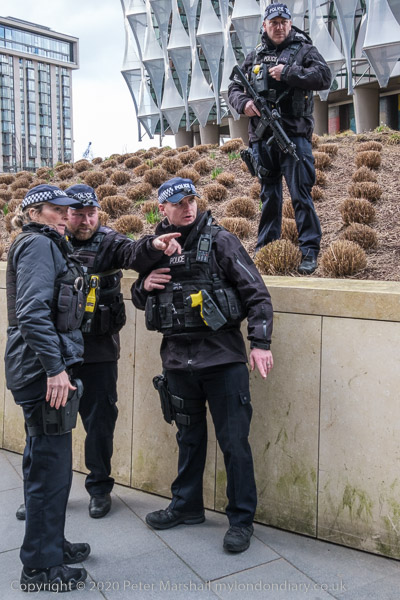
Protests here are invisible, hidden from any road and only seen by the armed guards patrolling the area and by people actually going into or out of the embassy. On a weekday there will be queues for visas, but at the weekend the area is deserted. Of course this does make filming and photography of any protests and the publication of these more important.

Although it is still very much of backwater London, the area around here is also the largest development area in London, with new flats already around the embassy and others going up to the east and the west where there is huge development around Battersea Power Station. It’s already easy to get to, with Vauxhall station, one of London’s larger transport hubs, just a few minutes away, but will be even more accessible once the Northern Line extension to Battersea opens – supposedly this autumn – with a station at Nine Elms.

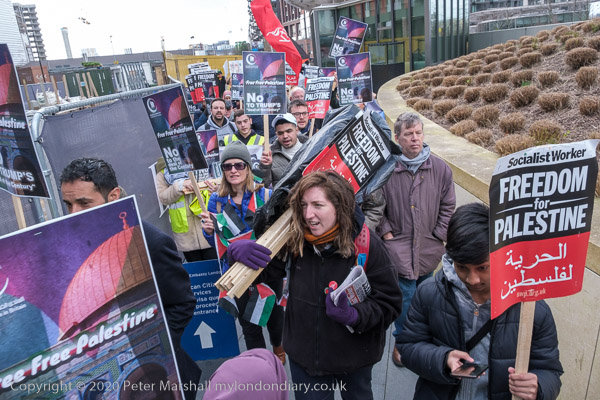
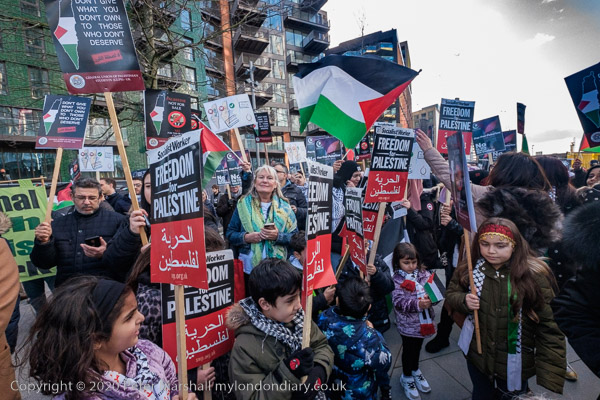
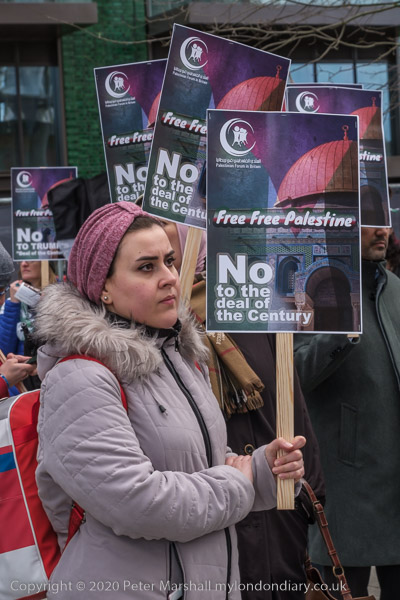
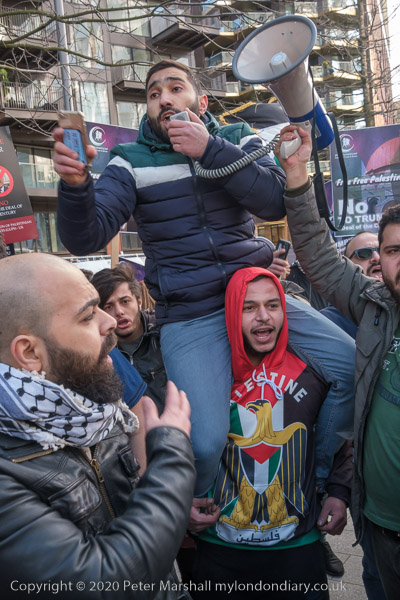
The protest on Saturday 1 Feb was against Trump’s ‘Deal of the Century’ which they say is intended to liquidate the Palestinian cause and minimise sovereignty for the Palestinian people across Palestine, marginalising them in isolated ghettos in a rigid implementation of the current apartheid regime.

It was organised by various Palestinian groups in Britain and supported by the Palestine Solidarity Campaign (PSC), Friends of Al-Aqsa (FoA) and the Muslim Association of Britain (MAB), and there were many Palestinians among the several hundred taking part.

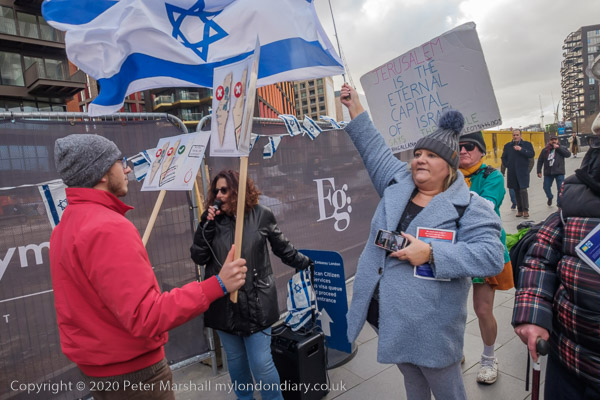
Also coming to protest against the Palestinians was a rather sad group of four Zionists who came to wave Israeli flags and try to disrupt the protest, shouting insults. Some of the protesters confronted them, shouting back, and police stepped in to keep the two groups a short distance apart while the main rally continued.

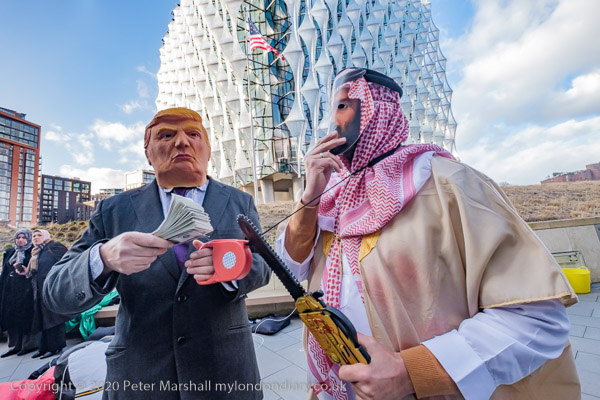
Among the many protesters were a couple posing as President Trump who handed a fistful of dollars to another dressed as Saudi Prince Mohammad bin Salman, who was holding a bone saw like that used to dismember Saudi dissident and journalist for The Washington Post Jamal Kashoggi by the team he ordered to the Saudi consulate in Istanbul, Turkey on 2 October 2018.

More at Palestinians against Trump’s Deal


All photographs on this and my other sites, unless otherwise stated, are taken by and copyright of Peter Marshall, and are available for reproduction or can be bought as prints.

Brexit – One Year On

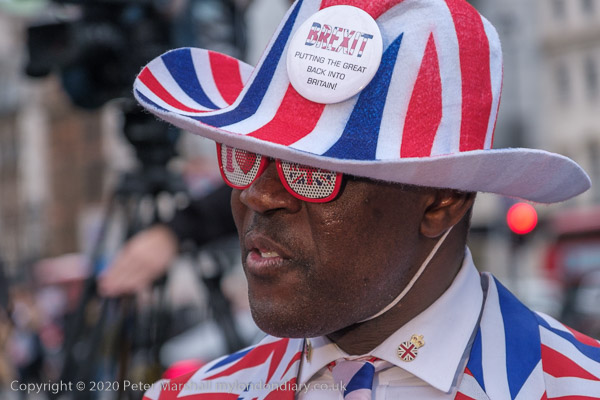
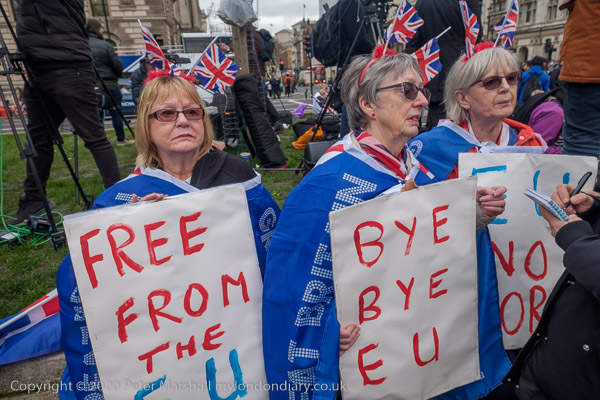
Celebrating Brexit in Parliament Square

A year ago there were people celebrating that we were about to leave Europe. Some of them are probably still celebrating now, though we’ve yet to see any of the many advantages that were promised, and have had to come to grips with a few of the downsides.
People had come from across Britain to celebrate

Of course the virus has rather taken our minds off Europe, and while the date of 31st January 2020 had political significance, the transition period and apparently endless bickering over a trade agreement meant that effectively we only left on Christmas Eve – and with an agreement that, thanks to the ridiculous negotiating strategy of our government who seemed to expect that Europe would somehow cave in if we kept shouting at them in English that we would leave without a deal, was considerably less favourable than was on offer earlier in the process.
It’s been a year in which the sheer incompetence and greed of the Conservatives in handling the virus emergency – and in particular the handing out of contracts to their unsuitable and unqualified friends and donors and a dogmatic attitude towards local government and their efforts over previous years to move the NHS towards privatisation has led to many tens of thousands of avoidable deaths. In particular the near-total failure of a national system of tracking and tracing and a poorly implemented phone-based system seemed deliberately designed to increase transmission, perhaps in line with the government’s initial espousal of developing herd based immunity. This would have required a very high percentage of the population to have become infected, and given what was known at the time about the likely death rate, would have resulted in around 400,000 early deaths. Some in government apparently saw that as a bonus, as these would largely have been among the elderly and unproductive, hugely reducing the payments of pensions and other benefits and, post-covid, the costs of what remained of the NHS.

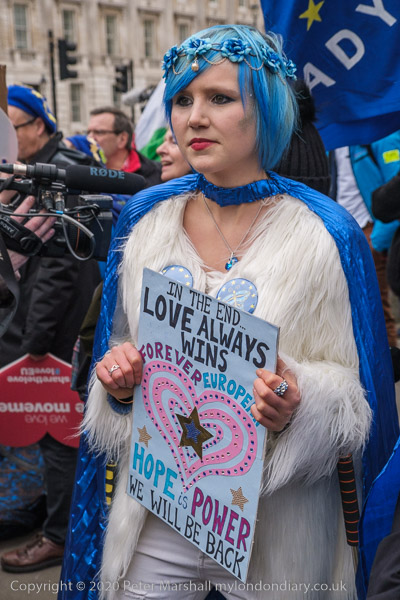
EU Supergirl’ Madeleina Kay – Forever Europe

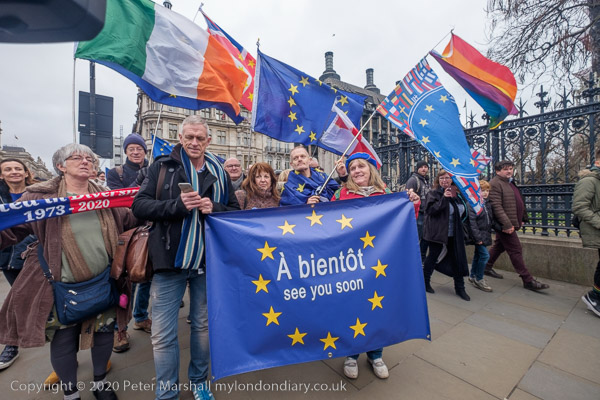
But back on 31st January a year ago, Covid was not much on our minds (I began to get warnings I should isolate though contacts with those scientists advising the authorities a couple of weeks later – and it took another month after that for the government to react.) But Europe very much was, and as well as those celebrating there were others mourning our loss and celebrating “the 47 years we were in the EU and all we contributed and the positive influence it has on our country.”

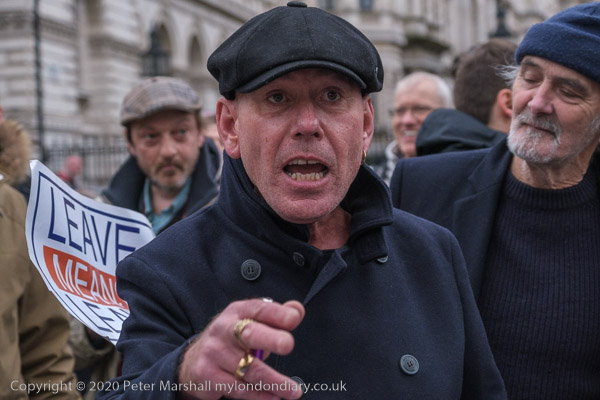
A man shouts insults

The deliberately met several hours before the pro-Brexit celebrations were due to start avoid any clashes as they marched from Downing St to the offices of the European Commission in Smith Square, but despite this triumphant extreme-right Brexiteers came to Downing St to shout insults, calling the EU supporters traitors and telling them they were not British, bad losers and more. After police had managed to separate the more aggressive of them moving them to the centre of Whitehall they then attempted to burn an EU flag. The flag refused to burn, though it melted a little in the parts that were heated and the flames came almost entirely from an aerosol spray and some paper fliers.

Marchers celebrate our 47 years as part of Europe

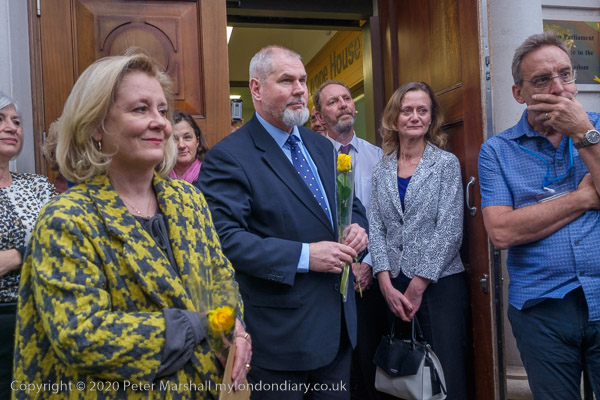
The march went ahead, with just a few jeers as it passed through Parliament Square. At Europe House the European Commission staff came out to welcome them and were given flowers and there was a short speech expressing thanks for what the EU has done for our country and hoping that one day we will rejoin Europe.

European Commission staff meet the march outside Europe House

I went home then not wanting to join in the celebrations that were shortly to take place in Parliament Square. As I wrote at the time:

I’d had enough of Brexit. We will have to live with its consequences for some years and I’m not looking forward to it. Times are likely to be tough for the poor, the disabled, the sick and for workers generally,
including most of those who voted for it and were celebrating in Parliament Square. The wealthy will of course gain – not least by avoiding the clamp down on tax evasion which the EU is now beginning.

My London Diary, Jan 31 2020

À bientôt EU, see you soon
Extremist Brexiteers Behaving Badly
Brexiteers celebrate leaving the EU


All photographs on this and my other sites, unless otherwise stated, are taken by and copyright of Peter Marshall, and are available for reproduction or can be bought as prints.