Windows and Doors 1987

Westbourne Grove, Bayswater, Westminster, 1987 87-7g-21-positive_2400

A man studies the menu of a Chinese restuarant on Westbourne Grove while his partner stands uncomfortably a discrete distance to the side. This corner with Hereford Road is still recognisable, but the New Good World is long gone. It was for a while a Rodizio Rico, a Brazilian grill, then another Brazilian bar and grill and, most recently and possibly still Franco Marco Sourdough Pizza, while Vinyl Solution is now a Moroccan restaurant; opened around 1978 by Yves Guillemot after he sold his record shop in Le Havre it was during the 1980s stuffed with obscure records from around the world attracting collectors, as well as DJs including John Peel. It began its own record label and thrived, so much so that this shop became too small and the business moved to Portobello Rd.

Chepstow Rd, Westbourne Green, Westminster, 1987 87-7g-34-positive_2400

This house is part of a long terrace of mid-19th century houses at 22-68 Chepstow Road in Westbourne Green that was Grade II listed in 1981, and was clearly in rather poor condition and recently sold and about to be renovated. These are large houses and now sell for over £2.5m; they are part of the Westbourne Conservation Area and were probably developed in 1850-55. I took an almost identical image on colour film which was a part of a show around 1990 and which now hangs on my stairs.

Pembridge Villas, Notting Hill,  Kensington & Chelsea, 1987 87-7g-43-positive_2400

A number of the grander houses in Kensington have elaborate extended porches like this over the steps leading from their front doors to the street to protect people walking to and from their carriages . They are sometimes called porte cochères, though more strictly this refers to porches into which a coach may be driven. This one in Pembridge Villas, Notting Hill, is more elaborate than most and comes with a front door and a lion on top which this picture rather distorts. You can just see two more lions by the house, here peeping over the wall.

Pembridge Square, Notting Hill,  Kensington & Chelsea, 1987 87-7g-51-positive_2400

Another extended porch at 27 Pembridge Square has some delightful wrought iron work.

Dawson Place, Notting Hill,  Kensington & Chelsea, 1987 87-7g-66-positive_2400

Some fine calligraphy in graffiti on a wall in Dawson Place, though not easy to read. I think I can make out the word ‘Saint’ but the rest escapes me – let me know if you can decipher more. Above the wall is some kind of creeping plant, which not long before had been trimmed back and you can still see the marks it left below.

Royal Pavillion, Brighton, Sussex, 1987 87-7h-31-positive_2400

Brighton has often been called “London by the sea”, and since the railway was built in 1841 has been a popular destination for days out as well as ‘dirty weekends’. So I felt I could include just a few pictures from one of my days out with family and friends to see the sights. I don’t think the girls were greatly impressed by the Royal Pavillion and we didn’t manage to drag them inside, but they did enjoy the Lanes and the Volk’s railway.

Kensington Garden Square, Kensington, Kensington & Chelsea, 1987 87-7h-66-positive_2400

36 Letterboxes in one door must be something of a record, and it was hard to imagine how 36 flats could be fitted in to this pair of houses, though the one at bottom left is labelled ‘Other Mail’. Presumably the entrance leading to all the flats is the door at left, and as well as the 18 bells which can be seen there is presumably another block of similar size on the wall at the right of the door.

I think most or all of the flats are one bedroom flats, and in this area would probably be rented at around £500 per week, so all 36 would bring in a weekly income of £18,000 – not far off a million a year.


All photographs on this and my other sites, unless otherwise stated, are taken by and copyright of Peter Marshall, and are available for reproduction or can be bought as prints.
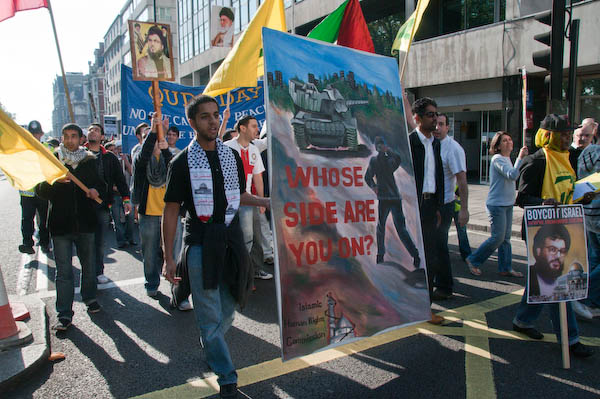
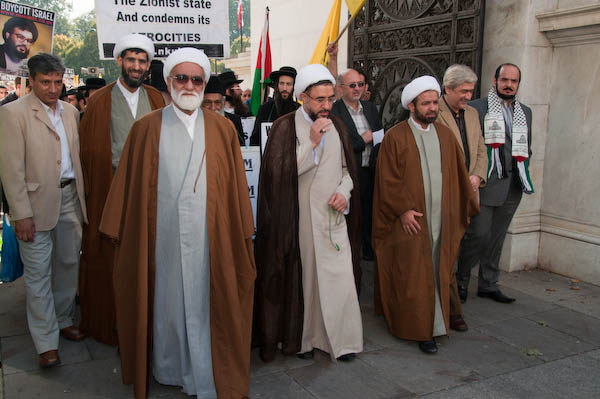

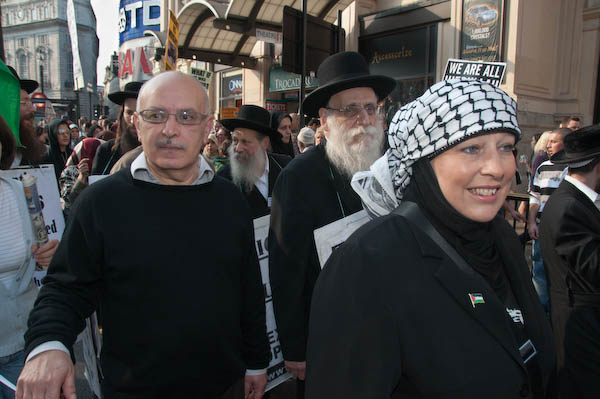
Al Quds march – 28 Sept 2008

Twelve years ago today, rather than sitting at home in front of a computer as I am today, still avoiding the virus, I was photographing one of the more contentious regular protests on the streets of London, the annual Al Quds Day march.

Al Quds is the Arabic name for the city of Jerusalem, literally meaning ‘The Holy One’ and in 1979 Ayatollah Khomeini of Iran announced the last Friday of the month of Ramadan as International Quds Day to express support for oppressed Muslims around the world and in particular to protest against the occupation of Palestine and the oppression of its people.

Ultra-Orthodox Jews opposed to Zionism took a leading role in the march

In the UK, a march through London takes place on the Sunday after the day itself, and is generally attended by several thousand people, mainly Shia Muslim families from mosques around the UK, but supported by many other groups, mainly Muslim but including some Jewish, pro-Palestinian and left-wing groups. This year because of the virus it was celebrated on Friday May 22 by a world-wide on-line event.

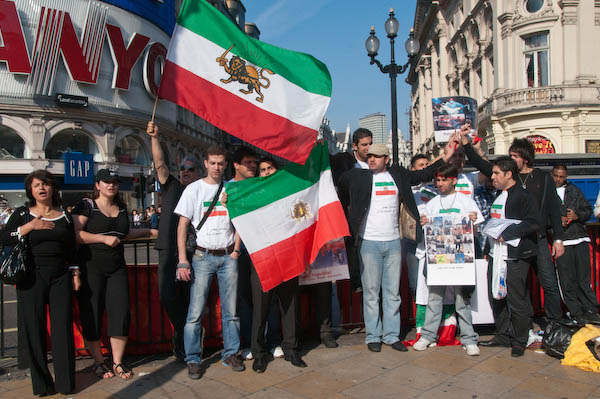
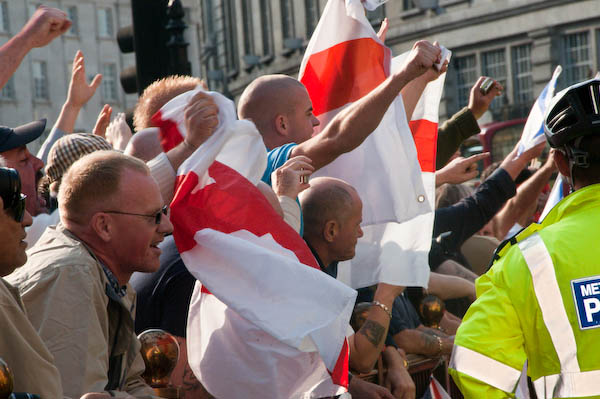
Back in 2008 the main groups opposing the march were Iranian opposition groups, along with a larger number of protesters from extreme right anti-Islamic groups, with just a small number of Zionist supporters of Israel. Police largely managed to keep the two sides apart while allowing both to protest.

But the situation did get rather fraught, particularly when the march was passing the where the opposition groups had been kept behind barriers at Piccadilly Circus, and I found myself getting abuse and threats from both sides. At the time I wrote:

“Things got a little heated at Piccadilly Circus, and some demonstrators objected to me taking pictures of them shouting and gesturing at the counter-demonstration, pushing me out of the march. Doubtless some of the other demonstrators on the other side didn’t like me photographing them either, and the police certainly wanted me back on the other side of the tape again. It is important to record what’s happening, and to stand up for a free press, so I kept taking pictures.”

My London Diary, September 2008

There are many (too many) of these pictures on the pages of this story on My London Diary.


All photographs on this and my other sites, unless otherwise stated, are taken by and copyright of Peter Marshall, and are available for reproduction or can be bought as prints.

Carnival in Colour 1990

Notting Hill Carnival, Notting HIll, 1990 90c8-04-96-positive_2400

Though I think my best pictures of Notting Hill Carnival were in black and white, most years until I moved to using digital cameras I photographed there in both black and white and colour. By 1990, when I first photographed Carnival, for colour I was exclusively using colour negative film.

Notting Hill Carnival, Notting HIll, 1990 90c8-04-40-positive_2400

I could process colour negative film myself, and by this time much of my black and white work was taken using Ilford’s chromogenic films, at first XP1 which had been introduced in 1980, then XP2 which replaced it in Spring 1991, which was designed to be processed in the standard C41 chemicals used for colour neg, though Ilford still produced its own specific processing kit just for the black and white versions.

Notting Hill Carnival, Notting HIll, 1990 90c8-04-7-positive_2400

While it was simple to contact print black and white negatives, producing these in colour from colour negatives was rather more difficult, and it was only after I’d squeezed a colour paper processing line into my diminutive darkroom in the mid 1990s that I began to do so. Even then, getting reasonably correct colour was a problem.

Notting Hill Carnival, Notting HIll, 1990 90c8-04-50-positive_2400

Before that time, I sent away my colour films for trade processing, and being a little short of cash mostly that meant using cheap non-professional processing labs, paying for processing and printing as 4″x6″ enprints. The film processing was fine, but the printing varied from good to a rainbow range of colour casts and variable contrast. Eventually I found a cheap postal amateur service that was reasonably consistent and still cost only around a third of my local pro lab.

Notting Hill Carnival, Notting HIll, 1990 90c8-04-21-positive_2400
Notting Hill Carnival, Notting HIll, 1990 90c8-04-92-positive_2400
Notting Hill Carnival, Notting HIll, 1990 90c8-04-1-positive_2400

Now I’ve digitised most of the colour negatives from the 1990 Notting Hill Carnival, and have found them rather more interesting than I expected. Having them in digital form makes it easier to work on the pictures as I could when making black and white prints, with some dodging and burning where needed.

There are a few pictures in this post, and I’ll put at least one more set from 1990 on here in another post, but if you want to look at more, and at those from later years you can go to page 5 of Notting Hill Carnival – the 1990s. Clicking on any of the pictures above will also take you to a larger version in this Flickr album.


All photographs on this and my other sites, unless otherwise stated, are taken by and copyright of Peter Marshall, and are available for reproduction or can be bought as prints.

A Goddess, Doors, a Dodo and a Lion

Minerva House, North Crescent, Chenies St, Camden, 1987 87-7f-21-positive_2400

Grade II listed Minerva House on the North Crescent of Chenies St , architect George Vernon, was built in 1912-3 for the Minerva Motor company which had begun in Belgium making bicylces before moving on to motorbikes and cars. One of its English dealers in 1903 was Charles Rolls, who the following year joined up with Henry Royce to sell his cars. In 1910 he became the first Briton to be killed in a crash by a powered aircraft when his Wright Flyer lost its tail during an air display in Bournemouth.

When I took this picture Minerva House was the Combined Training School for University College Hospital, training around 300 nurses a year. Since Minerva was the Roman Goddess of poetry, medicine, wisdom, strategic warfare, commerce, weaving, and the crafts this seems appropriate. She was also supposed to have created the olive tree and invented the flute and numbers. Minerva House is now the London home of global media agency OMD.

At right is the bleak Chenies Street concrete blockhouse entrance to the deep-level air raid shelter built in 1942, currently called ‘The Eisenhower Centre’ though it had no real wartime connection to the General. Before the war Minerva House looked out onto gardens.

Pembridge Gardens, Notting Hill, Kensington & Chelsea, 1987 87-7f-24-positive_2400

19 Pembridge Gardens was obviously in rather poor condition in 1987 when I took this picture, with peeling paint and trees growing up in odd places. The house was empty, its front door secured by two padlocks. It had been Grade II listed three years before I photographed it.

It looks in rather better condition now, and it should be as it appears to be home to a firm of “well-established Expert decorators.” Though I think it a shame not to have retained what is I think an illuminated house number above the door.

Pembridge Gardens, Notting Hill, Kensington & Chelsea, 1987 87-7f-25-positive_2400

It’s hard to count the number of bells at the left of the door to this house just a couple of doors up from the house in previous picture, but then obviously in rather better condition. There are 15 of them on the five floors of this house. Built in the mid 19th century (with a later top floor) it was also Grade II listed in 1974.

A Davey, Builder, ghost sign, Portobello Rd, Notting Hill, Kensington & Chelsea, 1987 87-7f-52-positive_2400

A neatly aligned sign indented in the rendering on the wall of an end terrace house in Portobello road still informs us


A. DAVEY.
BUILDER.
M A N U F A C T U R E R O F
EVERY DESCRIPTION OF INSIDE
AND OUTSIDE WINDOW BLINDS.
UPHOLSTERER AND DECORATER
ESTABLISHED 1851.

though I’m sure he was well gone from the premises when I photographed them 136 years later.

Davey the builder was probably one of the original occupiers of this long purpose-built terrace of shops which were developed in 1848-9 by the Rev Brooke Edward Bridges and Thomas Pocock who had bought the land for ‘Portobello Terrace’ from Felix Ladbroke; they were built by various local builders to a similar plan, with a ground floor shop and two floors above for the shopkeeper and his family. More recently extra doors have been added and the upper floors are largely let as expensive flats.

Looking at the text of the sign I think the lettering was probably stamped out while the rendering was still damp rather than cut out. It has certainly lasted well and can hardly be called a ‘ghost sign’. Fitting in some of the longer text was obviously rather tricky and there are just a few places where the letter spacing seems not to be optimal. Though generally rather better than my crude attempt above.

Dodo, Westbourne Grove, Notting Hill, Kensington & Chelsea, 1987 87-7f-64-positive_2400

Dodo and this sign were at 185 Westbourne Grove, no longer something Antiques but now occupied by American Vintage, but Dodo is certainly no longer at 3 Denbigh Rd, a short distance to the west just off Westbourne Grove. You can see a picture of this row of shops with Dodo in place on the RBK Local Studies web site which takes a photographic stroll down Westbourn Grove and comments rather inaccurately “In the centre of the picture a shop called Dodo Designs, wholesalers of fancy goods.”

Dodo, set up by “London’s acknowledged queen of advertising ephemera” Liz Farrow has been “selling genuine vintage advertising posters since 1960” and is still doing so through the Dodo Posters web site.

Ledbury Rd, Notting Hill, Kensington & Chelsea, 1987 87-7f-65-positive_2400

Just around the corner in Ledbury Rd is this row of shops with an entry to Ledbury Mews North. This whole area had a large number of antique shops but now seems largely devoted to fashion.

No 38 to the right of the mews entrance is certainly an attractive building, but I think what particularly attracted me is the lion on the pavement in front of Lacy Gallery – which has of course gone with the Gallery, that shop now split back into two different businesses.

More from Page 5 of 1987 London Photos in another post.

6 Years Ago: 24 Sept 2014 Poor Doors

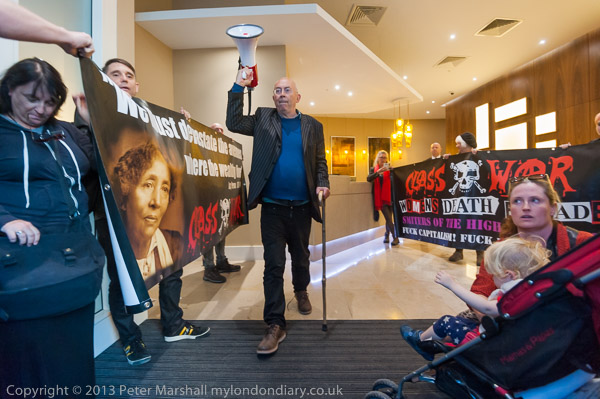
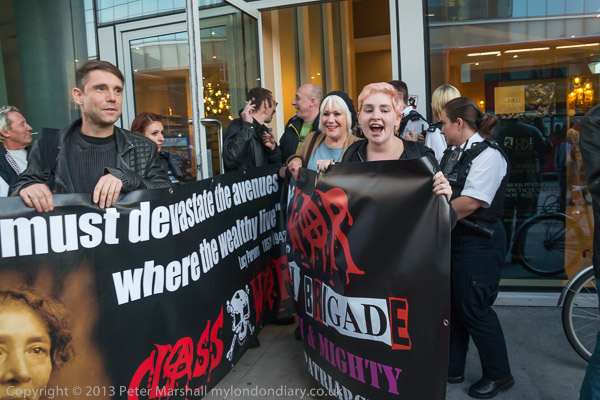
Six years ago Class War were holding weekly protests outside One Commercial St in Aldgate against the seperate entrances to the building for those in social housing and private residents. The private residents came into a spacious foyer with comfortable furniture and a reception desk with a concierge on the main street, while social housing tenants entered a bleak corridor down a filthy and badly lit alley at the side of the building.

This was the ninth weekly protest and I think the eighth I’d photographed in the series, which continued for around another 20 protests. Although it didn’t succeed in its main aim, the protests did take the issue onto the national agenda, and the alley leading to the poor door was cleaned up, resurfaced and given new lighting.

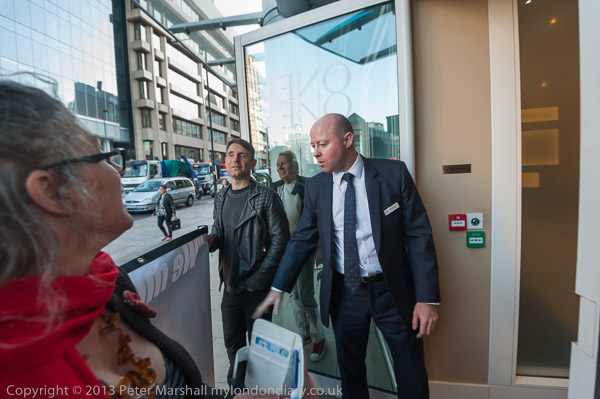
When the building manager came and escorted one of the residents out through the rich door, one of the protesters standing close to it moved in front of it, preventing it being closed. The manager made the mistake of moving away back towards the reception desk, and the protesters walked in.

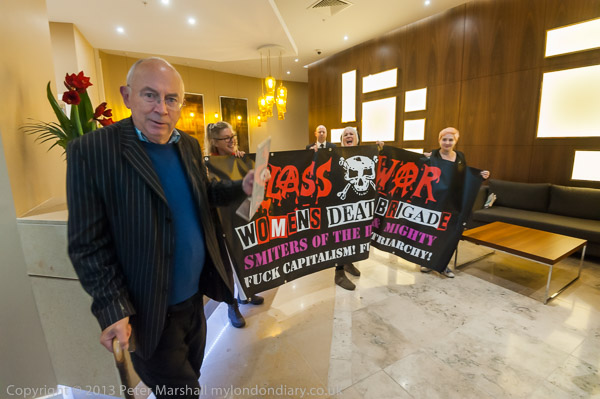
They brought their banners in with them, and Ian Bone of Class War began to speak about the protest. The protesters made no attempt to stop residents who walked in or out past them, mostly taking little interest in what was happening.

Some of them were tourists staying a week in flats that are let on Airbnb; other flats in the building are permanently empty or only used for perhaps a week a year from foreign owners who hold them as investments, taking advantage of rising London housing prices to earn a good income when they sell.

Ian Bone had picked up the framed notice from the concierge desk as he spoke, reading out from it and making comments about how differently the rich were treated compared with the poorer residents. The woman who had been at the desk (it has someone on duty 24/7) had retreated with the building manager and was watching from a distance. He replaced the notice carefully beside a vase of flowers on the desk when he finished speaking, and stood beside them.

Later as I was photographing others I thought I saw out of the corner of my eye Ian hook the curved end of his walking stick around the vase, and we all heard the vase shatter as it hit the floor.

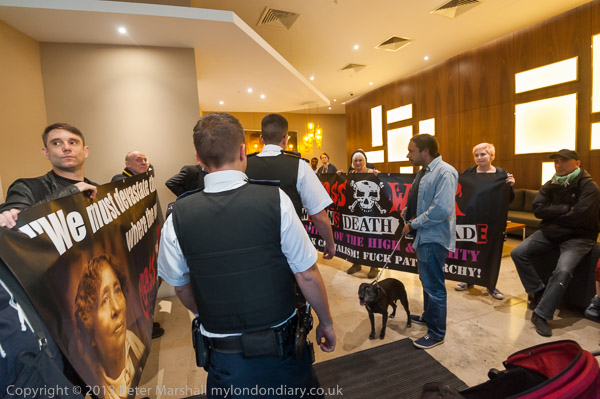
A few minutes later a couple of police officers arrived and talked with the protesters and the building manager.

After a few minutes of argument the protesters left the foyer and continued their protest on the pavement outside. There were more speeches, including from a local resident who stopped as he walked past to talk with the campaigners and backed their protest.

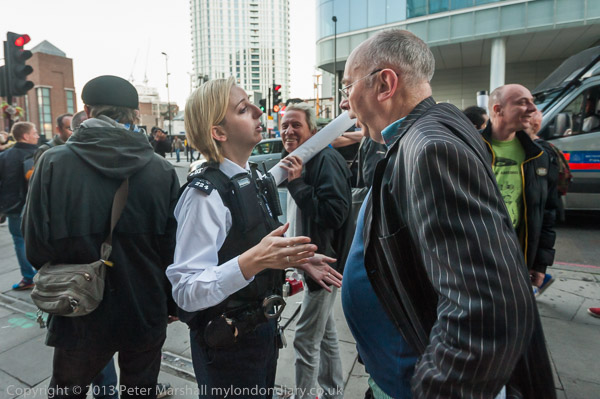
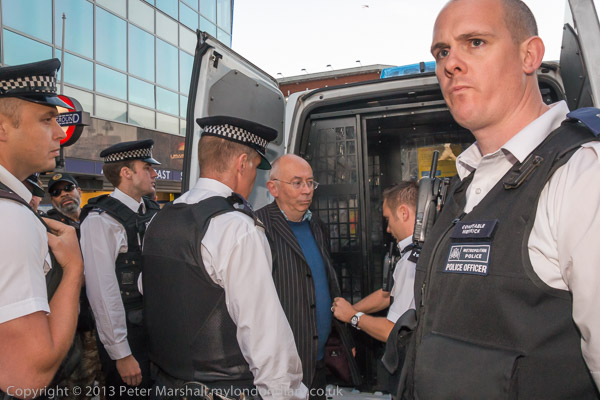
More police had arrived, and as the campaigners decided it was time to end the evening’s protest and began to walk away, a woman officer stood in Ian Bone’s way. Other officers came to surround him, and after some talking he was arrested, put in a police van and driven away.

At the police station he was shown CCTV of him pulling the vase from the desk and then admitted he had deliberately broken it. He was made to pay compensation for the broken vase, but no charges were brought against him.

Class War Occupy Rich Door

Bodies & Urns

Charlotte St, Fitzrovia, Camden, 1987 87-7f-22-positive_2400

Apart from my obsession with doorways which will have become obvious to regular readers of my posts, there are various other sub-themes in my work on London, some explored in black and white, others in the colour work and some in both.

Charlotte St, Fitzrovia, Camden, 198787-7f-23-positive_2400

One of these was the various different representations of the human body, both two and three-dimensional, as in the robot, dress forms and corsetry advertising in these pictures.

Store St, Camden, 1987 87-7f-32-positive_2400

I think I also photographed two of these in colour, and certainly my colour pictures at the time include a remarkable number of shop windows containing heads without bodies.

Pembridge Gardens, Notting Hill, Kensington & Chelsea, 1987 87-7f-26-positive_2400

Urns and other sculptural detail and ornaments were also something I felt worth recording.

Garden, Holland Park,  Holland Park, Kensington & Chelsea, 1987 87-7f-41-positive_2400

One of the photographers whose work I greatly admire is Eugène Atget and his work contains many such images particularly those in grand gardens such as the Parc St Cloud, and in 1984 I had spent several weeks photographing Paris in a homage to his work which you can see in my book In Search Of Atget – the preview there includes many of the best images.

Garden, Holland Park,  Holland Park, Kensington & Chelsea, 1987 87-7f-56-positive_2400

These pictures are from page 5 of my Flickr album 1987 London Photos and clicking on any of them will take you to a larger version there which will also tell you where they were taken.


All photographs on this and my other sites, unless otherwise stated, are taken by and copyright of Peter Marshall, and are available for reproduction or can be bought as prints.

Two Years Ago – 22 Sept 2018

Two years ago I’d spent a quiet week after having been away the previous weekend for a 40th birthday celebration in Belper. For once there didn’t seem to be many events in London to photograph, or at least not that I could easily get too. Living just outside London covering anything starting early in the morning or finishing late at night makes travel difficult and/or expensive, and unless I’m actually commissioned certainly loss-making. And over the past few years I’ve turned down almost all the few commissions that have been offered, suggesting other photographers who I know need the jobs much more than I do.

But on Saturday 22nd September 2018 there were a few things happening in London, though to be honest if I’d had a busy week I might have left them to others to cover. I had five different events in my diary and also there was an art installation in Trafalgar Square that sounded mildly interesting and despite a poor weather forecast I decide to go up to London.

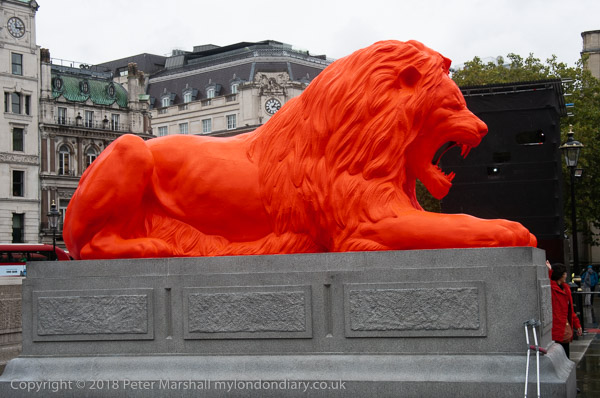
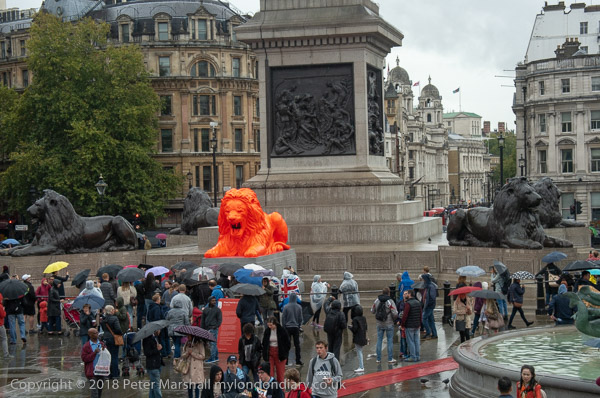
Nelson was getting an extra lion, and in fluorescent orange for the London Design Festival. It was supposed to create and spout poetry as well as roar in response to visitors, but well I was there it had entirely lost the muse. Perhaps it was the rain which dampened its spirits. It’s pretty difficult to get proper detail in anything that is fluorescent orange without making the surroundings far too dark, and most of the pictures I saw published in the papers failed. But I’d had a lot of practice photographing protests against Guantanamo with campaigners dressed in orange jump suits.

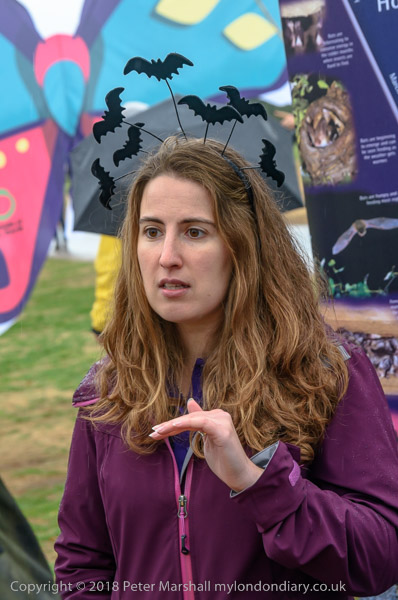
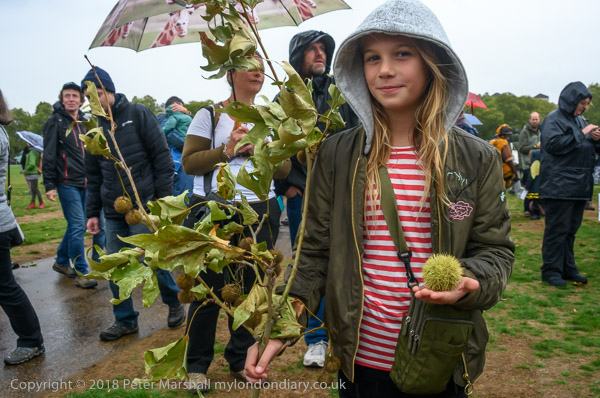
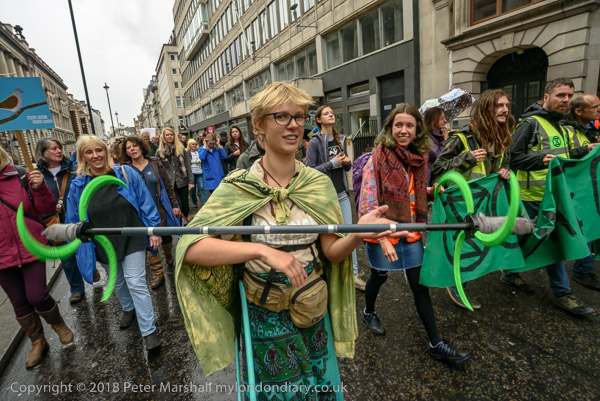
People taking part in The Peoples Walk for Wildlife set up by naturalist and broadcaster Chris Packham showed some remarkable ingenuity in the costumes and despite the rain were in good spirits, though I was getting pretty fed up and my cameras were beginning to suffer. It was weather for underwater cameras an my lenses were beginning to mist up. Wildlife is important and we are just another species in the many that make up our world and the extreme rate of species loss at the moment is already beginning to affect us. Unless we halt climate change and stop the ecocide due to habitat loss, pesticide use, over-fishing and other things that are destroying wild life our own species is also under threat of extinction.

I stuck it out until the march began and then took the tube rather than walk in the rain, coming back to meet them and take pictures again on Pall Mall. They were going on to another rally, but I’d had enough of getting my cameras wet and decided to call it a day.

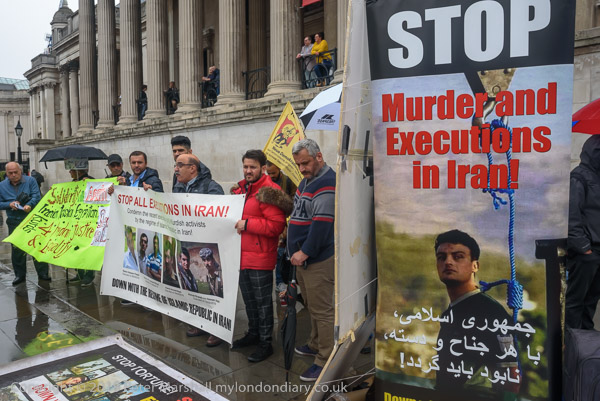
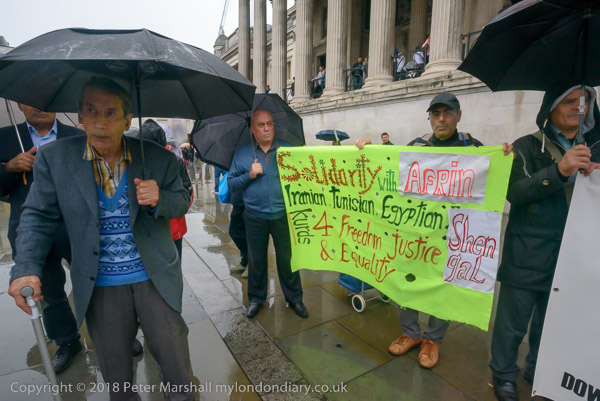
There were some other events in my diary, but none that I felt strongly enough about to make a trip to take pictures. But on my way to Charing Cross station I photographed a protest in Trafalgar Square.

The People The Fadaii Guerrillas of Iran in London and the Democratic Anti-imperialist Organisation of Iranians in London were remembering the massacre of 18,000 political prisoners in between July and September 1988 on the 30th anniversary and calling for an end to the massacres of Azeris, Kurds, Arabs, Turkmen and Balouchis and communists and others in the brutal represssion that is following the mass protests in Iran in January 2018. These have included six Kurdish activists who were executed earlier in the month.

I was pleased then to get on a train and make my way home, though I still had several hours of work to do to edit, process and select images and send them to the agency.

You can see more pictures on My London Diary from all these:
End executions in Iran
People’s Walk for Wildlife
Please feed the lions


All photographs on this and my other sites, unless otherwise stated, are taken by and copyright of Peter Marshall, and are available for reproduction or can be bought as prints.


More Bayswater etc 1987

Bayswater, Westminster, 1987 87-7d-66-positive_2400
Greek Orthodox Cathedral of the Divine Wisdom (Hagia Sophia), Moscow Rd, Bayswater, Westminster, 1987

It’s hard to know where Paddington ends and Bayswater begins, or where Bayswater become Notting Hill. There are two Westminster borough wards called Bayswater and Lancaster Gate which I think most would consider Bayswater, and Notting Hill comes under Kensington & Chelsea, but popular perceptions usually don’t follow local government boundaries – and estate agents have remarkably elastic definitions of areas.

Brunel House, Westbourne Terrace, Orsett Terrace, Bayswater, Westminster 87-7e-22-positive_2400
Brunel House, Westbourne Terrace, Orsett Terrace, Bayswater, Westminster, 1987

My walks by 1987 were generally planned in advance, obviously with a starting point from some Underground or Rail station, but also with an intended destination, and places that looked to be of interest from maps and books marked on an enlarged copies of A-Z pages. But the actual routes I took were subject to considerable deviation from plan, with decisions made at crossroads as to which direction looked more interesting – and I didn’t always end up at the planned destination. I kept notebooks to record my routes and some details of what I photographed, transferring the route to the map copies when I got home and some details to the contact sheets after I developed the films.

Brunel House, Westbourne Terrace, Orsett Terrace, Bayswater, Westminster87-7e-55-positive_2400

When putting the pictures on-line I have tried where possible to verify the locations from the pictures themselves. Some include street names and or house numbers, shop names. My contact sheets usually also have street names and grid references and web searches and Google Streetview or Bing Maps usually enable me to positively identify buildings which are still standing.

Prince of Wales, pub, Cleveland Terrace, Bayswater, Westminster, 1987 87-7e-32-positive_2400
Prince of Wales pub, Cleveland Terrace, Bayswater, Westminster, 1987

But where my pictures show only small details, it has sometimes proved impossible to be sure of the exact location, and this is often also the case in those areas which have undergone extensive redevelopment. But for areas such as Bayswater, where many of the properties have been listed and relatively little has changed it is generally possible to find exact locations.

Bishops Bridge Rd,  Bayswater, Westminster, 1987 87-7e-52-positive_2400
Bishops Bridge Rd, Bayswater, Westminster, 1987

During the 80s and 90s I sold several hundred pictures to the National Building Record, including of a number of buildings that were either already listed when I took their pictures or had been listed after I photographed them. I think there were just a few that I brought to their attention which had previously been unnoticed, mainly in the outer suburbs.

Gloucester Terrace, Bayswater, Westminster, 1987  87-7e-66-positive_2400
Gloucester Terrace, Bayswater, Westminster, 1987

But my work in London came at a time when the worth of many buildings was being recognised both by me and those responsible for listings, which had previously largely concentrated on genuinely ancient structures and some public and ecclesiastical buildings, largely ignoring commercial buildings and those from late Victorian, Edwardian and more modern times. It was a prejudice even reflected in great works such as the many volumes of Pevsner’s The Buildings of England.

Dawson Place, Notting Hill, Kensington & Chelsea, 1987 87-7f-13-positive_2400
Dawson Place, Notting Hill, Kensington & Chelsea, 1987

All photographs on this and my other sites, unless otherwise stated, are taken by and copyright of Peter Marshall, and are available for reproduction or can be bought as prints.


One Year Ago – Sep 20th 2019

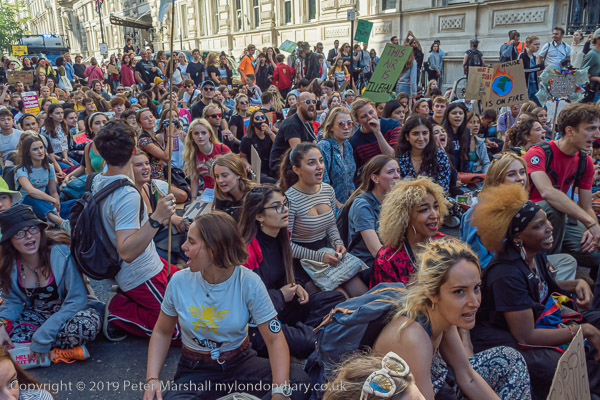
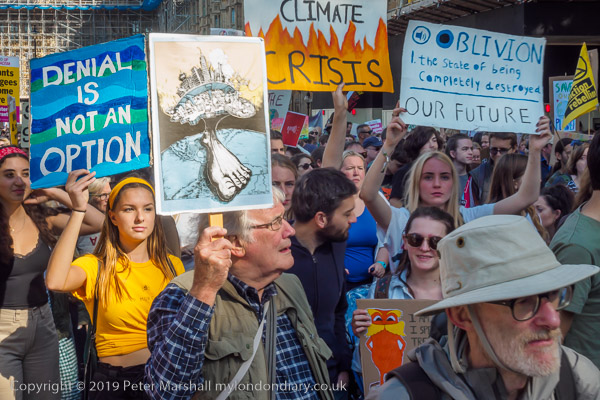
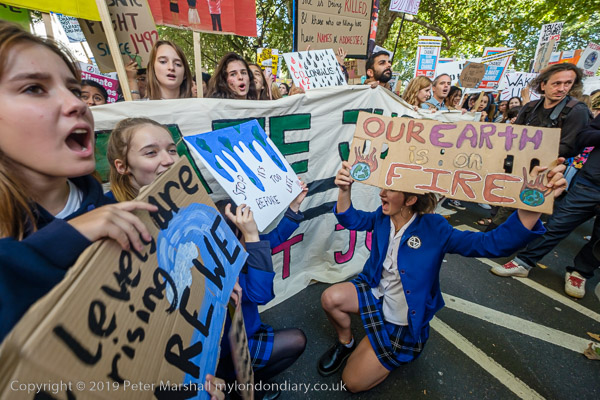
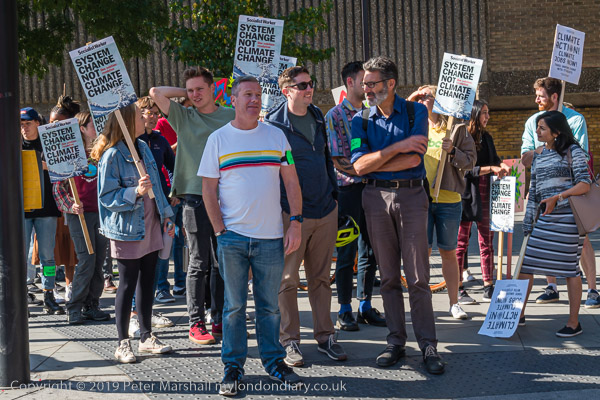
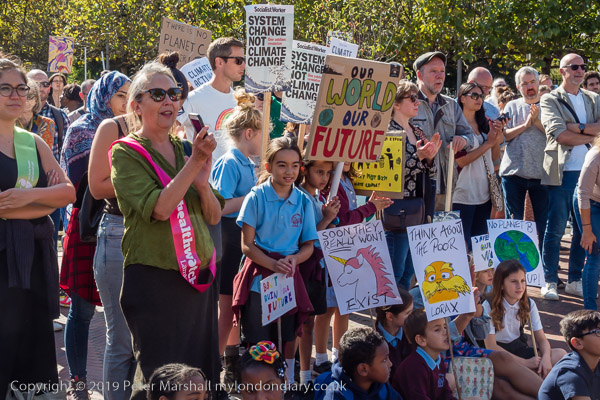
Friday 20 Sep 2019 was a busy day for me, and certainly one without any social distancing. It was the day of the Earth Day Global Climate Strike inspired by Greta Thunberg, and schoolchildren, teachers, parents and supporters from all over London were taking part in several events across the capital, as well as in other towns and cities across the world.

A large rally filled much of Millbank, from outside the Houses of Parliament down almost to Horseferry Road where there were speakers and performers on a lorry, with loudspeakers at intervals along the road to relay the sounds. The crowd was so dense near the bus that I gave up trying to get through and went along sidestreets to make my way to the front.

I made my way out slowly back through the crowd taking pictures, and found that more people were still streaming into Parliament Square as I walked into Westminster station to take the tube to the Elephant.

There was a poster display and short rally outside the University of the Arts there as people gathered to march to join workers at Southwark Council who were also protesting.

Instead I took the tube to Brixton, where teachers had brought children from local schools for a lunchtime rally before going to join the protest in Westminster. I left to avoid the crowd as the rally came to an end and went back to Parliament Square, where as well as the climate protest there were also a group of Kurds protesting about the Turkish invasion of Rojava.

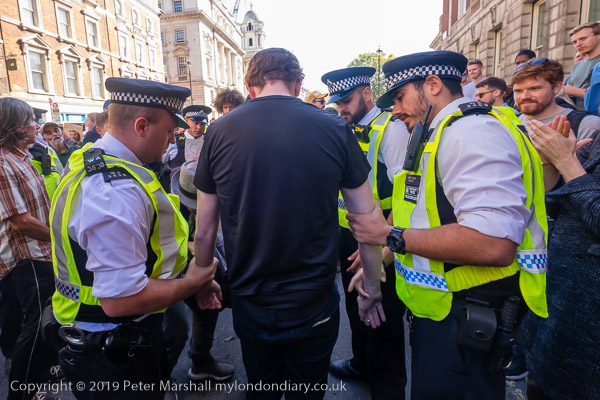
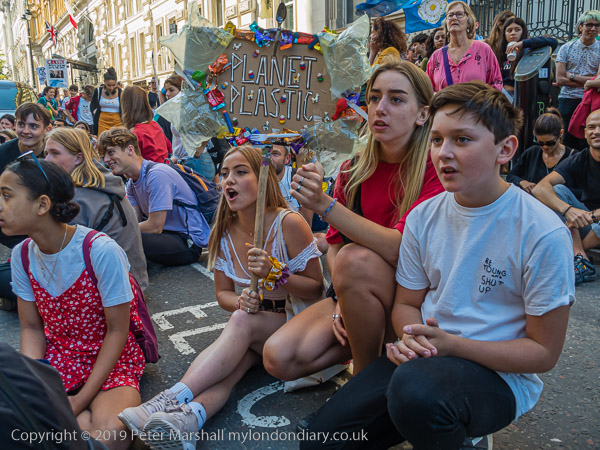
Campaigners, mainly school students, were now also sitting down and blocking Whitehall and police were beginning to make arrests. Eventually the school students decided to march, and turned into Whitehall Court, where police blocked them and they sat down again.

It’s a road the has very little traffic, and I couldn’t understand why police continued to harass them and try to get them to move, as a protest there would inconvenience very few if any. But eventually the students got fed up with the police threats and got up to march again, only to sit back down and block Whitehall again.

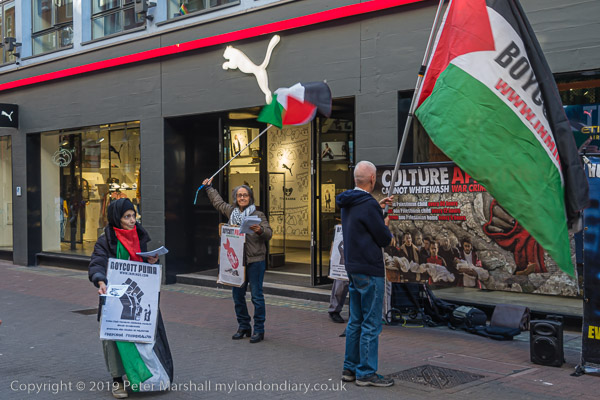
Eventually they decided to get up and march back to Parliament Square to join the other protesters there, but I left them to go to Carnaby St, still a Mecca for tourists sixty years on from the so-called ‘Swinging Sixties’. It’s now a rather dull shopping experience with relatively high prices for the same kind of stuff as almost every high street worldwide, including Puma sports shoes.

This afternoon it was a little livelier and noisier than usual, with the Inminds Islamic human rights group which generally includes both Palestinian and Jewish campaigners outside their store after 215 Palestinian sports clubs have asked Puma to respect human rights and end its sponsorship of the Israel Football Association which includes clubs from illegal settlements built on stolen Palestinian land. Inminds provide some loud and enchanting Palestinian music to enjoy as well as the speeches at their peaceful and well-organised protests, many of which I’ve photographed along with many others in London over human rights issues in this country and others around the world.

At a previous protest outside this store, protesters were physically attacked by a small group of Zionists, but this time I saw just one man who came and screamed abuse for a minute or two, while many other people stopped to talk, read the banners and take leaflets, shocked by the facts they displayed. There is little coverage in the mass media but the campaigners say the Israeli government on average imprisons two Palestinian children every day, kills one every 60 hours and destroys one Palestinian home every nine hours.

COVID-19 has dominated our news for months, and recently the media are full of reports of our governments failures to set up effective testing and tracing and possible new restrictions on us. But the issues these protests a year ago remain vital. And unless we take urgent action to cut our impact on the environment through climate change and environmental damage the consequences for human life will be disatrous, threatening us all. This year the Fridays For Future global climate action day is September 25.

You can see more pictures from the various protests on the day last year on My London Diary:
Carnaby St Puma Boycott
Global Climate Strike Protest continues
Elephant & Brixton Global Climate Strike
Global Climate Strike Rally


All photographs on this and my other sites, unless otherwise stated, are taken by and copyright of Peter Marshall, and are available for reproduction or can be bought as prints.


Bayswater 1987

Westbourne Grove,Garway Rd, Bayswater, Westminster, 1987 87-7d-12-positive_2400

It isn’t clear now whether the first Dickie Dirts, named after Cockney slang for shirts, was in the former ABC Regal in Walham Green which had closed in 1972 or in the small shop opened by former photographer Nigel Wright in 1977 on Westbourne Grove in this picture. But it represented a revolution in fashion retailing, selling casual clothes at low, low prices. If you wanted genuine Levi jeans and lumberjack shirts cheaper than anywhere else it was the place to go, and the shop drove a coach and horses through laws restricting trading hours, opening seven days a week from 9am until 11pm, even on Sundays. The fines he had to pay were simply a business expense, more than made up by the Sunday sales. Dickie Dirts shops opened in Camberwell in 1981 and in Stratford. Dirts was the first UK clothing store to engage in ‘parallel importing’, buying jeans in overseas countries where they were cheaper and then selling these ‘grey imports’ at below the prices the manufacturer charged for ‘genuine’ goods it brought to the UK.
Dickie Dirts didn’t last, though it was still in business in 1987, as others learnt from their example but kept up better with the fashions, but although the building is still there all of the shops have changed hands; where Dirts was at No 58 now offers reflexology.

John p dennis and by the Grace of God his 8 Children, Westbourne Grove, Bayswater, Westminster, 1987 87-7d-13-positive_2400

‘John. p. dennis and by the Grace of God his 8 Children’ was on the shop front at 121 Westbourne Grove, though I think the shop was closed and empty. Dennis was a follower of Sir Oswald Mosley who ran a furniture and junk shop here and was interned for eleven months during the war. In 1931, 18 year old Miss Gladys Rogers moved in with him and remained living with him, apart from two short breaks, until 1949; they had 8 children together but he did not believe in marriage. As well as looking after the children she also helped in the shop.

While in internment, Dennis met Frederick Heyland who was interned for the whole of the war because his parents had been German. Heyland moved in with the couple after the war, and married Miss Rogers in 1947. She left Dennis in 1949 to live with Heyland who was then the owner of a café in Willesden Green. These details are given in from the report of an appeal she made in 1972 against a judgement against an order made against her in 1971 on behalf of Heyland.

Pembridge Square, Notting Hill, Kensington & Chelsea, 1987 87-7d-33-positive_2400

Kensington & Chelsea is a borough of extremes as has been shown very clearly by the council’s failures over Grenfell Tower. Pembridge Square was built between 1856 and 1864 and the architect was Francis Radford.

Linden Mews, Linden Gardens, Notting Hill, Kensington & Chelsea, 1987 87-7d-42-positive_2400

Linden Mews is also part of the Pembridge Estate, and is now a private gated mews of just 8 houses. Where I could simply walk in (and did, though I don’t think I found anything I felt worth photographing) there is now a locked gate with notices marking it as private and banning vans and lorries. In 2014 a 3-bed terraced house here sold for £4.6 million.

George William Joy and Florence His Wife built this house AD 1889, Red Lodge, Moscow Rd, Palace Court, Bayswater, Westminster, 1987  87-7d-53-positive_2400

On the wall of Red Lodge it recoreds that ‘George William Joy and Florence His Wife built this house AD 1889’ and I think the fine gate probably also dates from the same period. Joy (1844–1925) was an Irish painter and married Florence Isabel Mary Masterman, born in 1849 and, according to Google, now 171 years old. I think he painted her portrait before they were married and that she was the model in some of his other pictures.

Russian oligarch and friend of Putin Omar Murtuzaliev bought the £25million property around 2007 and had almost completed a massive six-year building project to make a home for his son. According to the Evening Standard report, “a marble swimming pool had already been fitted, and a basement excavation included a Turkish bath, plunge pool and gym, with a cinema and grand reception room being built in a two-storey roof extension” when a massive fire engulfed the property in January 2013.

Orme Lane, Bayswater, Westminster, 198787-7d-62-positive_2400

Edward Orme, (1775-1848) was a painter and etcher, and made etchings of around 700 paintings, becoming engraver to Geroge III and the Prince of Wales, as well as producing many books of aquatints and etchings. He opened several shops in Mayfair to make and sell prints from 1801-1824. In 1808 he began purchasing plots of land in Bayswater, developing this area on St Petersburgh Place and Moscow road from 1815, the year after a visit to London by Tsar Alexander I. In 1824-6 he developed Orme Square.

This small block on the corner of Orme Lane is clearly from a later century, almost certainly the 1930s, and I think a very interesting building. I think it is probably four flats and I think the plot was probably previously a part of the garden of 1 Orme Square.

You can view more of my pictures of London from 1987 on Flickr. There are also pictures from some earlier years on my Flickr site – and more to come.


All photographs on this and my other sites, unless otherwise stated, are taken by and copyright of Peter Marshall, and are available for reproduction or can be bought as prints.