Dangleway Revisited, Tamils Protest Killings: On Tuesday 23rd July 2013 I revisited the Museum of Docklands and then took the DLR to Royal Victoria for another ride on the Arab Emirates cableway in a detour on my way into central London to photograph a rally by Tamils at Downing Street.
Another Dangleway Ride – Royal Victoria Dock to North Greenwich
It was only a few weeks since my first ride on London’s cable car across the River Thames, but I was in docklands for a second visit to the ‘Estuary’ show at the Museum of Docklands. As one of those featured in the show I had been at the opening, but that was more about meeting people than seeing the work, though I had taken a short look at it all.
The dangleway is fairly pointless in terms of transport, but is one of London’s cheaper tourist attractions, and though short it joins two areas of some interest. I suppose the views might not be to everyone’s interest, though I found them fascinating, and its certainly the cheapest way to do a little aerial photography.
Tamils have long been the subject of discrimination in Sri Lanka, and the Civil War there from 1983 to 2009 against the Liberation Tigers of Tamil Eelam resulted in around 100,000 Tamil civilain deaths, as well as around 50,000 fighters on each side. The figures are unclear as the Sri Lankan government has always refused independent, international investigation to ascertain the full impact of the war.
According to Wikipedia, “Since the end of the civil war, the Sri Lankan state has been subject to much global criticism for violating human rights as a result of committing war crimes through bombing civilian targets, usage of heavy weaponry, the abduction and massacres of Sri Lankan Tamils and sexual violence.”
The Tamil Tigers also became notorious for attacks on civilians, suicide bombings. assassinations and the use of child soldiers. The final stages of the war in 2006-9 were particularly bloody, and ended in a total defeat of the LTTE.
The British Tamil Forum at had come to Downing St on the 30th anniversary of the 1983 Black July when 3000 Tamils died in riots across Sri Lanka in an anti-Tamil pogrom orchestrated by the government.
This was not the first anti-Tamil pogrom, but its unprecedented frenzy of violence was a turning point after which Tamils knew they could never be safe in a state dominated by the Sinhalese.
In the four years since the Mullivaikkal Massacre of 2009 Tamils claim that an estimated 147,000 Tamils are either dead or missing, and they see the only solution as the formation of an independent Tamil state – ‘Tamil Eelam.’
The protest called on the UK to boycott the Commonwealth Heads of Government Meeting (CHOGM 2013) in November 2013 hosted by Sri Lanka. They see this as legitimising a state which has been severley criticised by the UN and human rights organisation for the atrocities it has been committing.
People at the protest signed letters and cards calling on HRH The Prince of Wales to uphold the values of the Commonwealth and reconsider his decision to attend CHOGM 2013.
Shops, Warner, Marx, English & A Lighthouse from my walk on Sunday 24th September 1989.
Shop Window, High St, Walthamstow, Waltham Forest, 1989 89-9c-36
I wasn’t quite sure what I thought about this window display with at right a dress with pictures with rear views of three mice as PRODUCER, DIRECTOR and EDITOR sitting in their directors chairs holding megaphone, script and clapper-board for TAKE 1.
To the left is a mannequin in some kind of underwear and holding another item of lingerie, with other items draped over what looks like a deckchair without its canvase. Behind the two is the larger face of a woman photographed in similar underwear.
I’m not sure how I would describe the faces and hair styles of the two mannequins; perhaps “imperious”?
La Three Shoes, High St, Walthamstow, Waltham Forest, 1989 89-9c-23
I’m unsure if ‘finial’ is the correct architectural term for these decorative features at the division between the shop fronts on the substantial block on the north side of the High Street between Pretoria Avenue and Carisbrooke Rd, I think at 19-35.
This block was developed by The Warner Estate Co. Ltd, registered in 1891 and responsible for much of the development of the area between the 1880s and the First World War, and it probably dates from the early 1890s.
Quite what the significance of the dragon, the flower and the grotesque devilish face are I leave to you. But I took four photographs of this, and another between 27 and 29 in the row.
Clock, Apollo, 4, St James St, Walthamstow, Waltham Forest, 1989 89-9c-25
I tuned south down St James’s Street where on the right are two more blocks of Warner properties with more of the dragons and flowers but without the grinning gargoyles between the shops. Between the first and second floor buildings are mouldings with winged cherubs holding an ornate a bowl of fruit, surrounded by swirls of oak leaves. There is a flower at each bottom corner and in the centre, below the bowl what could be a mushroom or toadstool.
Shops, 2-10, St James St, Walthamstow, Waltham Forest, 1989 89-9c-11
Apollo Dry Cleaners are still I think in the shop at 4 St James St and you can see them in this picture of the row of shops. The clock which was above the Opticians at Number 6 has now gone, although I think two strips of wood which held it are still in place.
These shops – and those on the High Street in the top picture are not even locally listed but they are in the Walthamstow St James Conservation area, with these Warner properties on St James St marked for possible future local listing. There are also desciptions of these and the High Street properties.
Alfred English, Funeral Directors, St James St, Walthamstow, Waltham Forest, 1989 89-9c-14
Funeral Directors Alfred English are still at 70 St James St, but the extension at he side of their large detached house is no longer a shop window and the large sign on the wall to its left and reflected in the window has also gone.
Alfred English have been funeral directors in Walthamstow since 1896, for many years as a family owned firm. It has become a part of Dignity Group which includes 795 Funeral Directors across the UK.
I was rather disappointed to find that Marx House had no connection with Karl, but was named after Marx Gross its first occupier. But while that may be so, I think it may also have a connection with the street name, Markhouse Rd, which apparently derives from an early Marck Manor House. Mearc apparently meant boundary and the estate was on both sides of the boundary between Leyton and Walthamstow.
This was on Markhouse Common which was enclosed in the 1850s and development of this area then started with railways serving the area around. Until 2002 there was a pub at the junction of Markhouse Lane and Queen’s Road, which over the years had various names including the Commongate Hotel, JD’s, Couples and the Sportsman, but is now a hotel with its old name.
This local landmark was built in 1893 and was for many years a popular church in the area. Bullard King & Company, Limited had been founded in 1850 by Daniel King and Samuel Bullard with a fleet of sailing ships trading between London and Natal as The White Cross Line, and they moved to steam vessels in 1879, adding services to carry labourers from India to South Africa.
In 1889 Captain King donated the site on Markhouse Road and paid for the building, begun in 1892, making clear what he wanted to architect J. Williams Dunford. Apparently originally the church had a revolving light shining during services.
The light perhaps helped to attract worshippers and in 1903 it had congregations of over 1,500. The building was Grade II listed in 2007, and the listing text contains an unusually lengthy description including the following: “The lighthouse turret is distinctive, particularly given the church’s inland location, and is an uncommon feature of the design. Despite the obvious link between Christian imagery of Jesus as the Light of the World and the function of a lighthouse, there are no known examples of church designs which use a lighthouse architectural feature. “
The building is still in use as The Lighthouse Methodist Church though I imagine congregations are now considerably smaller.
The Future For Aviation: The protest at London City Airport on Monday 21st July 2014 by ‘The Future‘, a campaigning group set up to fight climate change and ecological devastation by non-violent protest along with some local residents addressed specific issues related to that airport, but also wider questions about the future of aviation, both still very much with us. A decision is expected shortly by our new Labour government on further expansion plans for the airport following a public inquiry which closed in February.
The group used a painted circle around one eye as a symbol that the people are watching those in power, calling on politicians and others to take action rather than let themselves be bought by corporate interests. And they stated “we will judge them if they choose the toxicity of London City Airport over the health of local people and of London.”
Ten years later, ‘The Future’ are forgotten, and while there has been nothing like enough action the growing signs of the coming catastrophe are just perhaps beginning to get some movement, though still too little and too late.
It should now be clear to every thinking person that we have to find ways to reverse the growth in the aviation industry. To end airport expansion and increasing numbers of flights. Not ideas like changing to bio-fuels or specious calculations over planting trees to compensate for the CO2 generated by flights, nor on the pipe-dream of electric aircraft but quite simply reducing the number of flights.
Quite how this can be done is a matter for discussion, but some measures, such as removing the subsidies for aviation and banning incentive schemes with air miles and discounts could be simply implemented.
Heathrow and London City Airport also pose other problems, generating pollution and noise pollution both from their flight and from the traffic and congestion they generate in urban areas of our heavily polluted city.
The history of London City Airport is a case-study in how the aviation industry has operated by deception. When set up it was to be a low traffic site providing limited services between European capitals for business travellers from the nearby Canary Wharf and the City of London using small, quiet aircraft specially built for short take-off and landing.
Even so the Greater London Council opposed its setting up in the former Royal Docks in Newham, surrounded by densely populated areas but were overruled by central government.
Those initial promises have been long been superseded and by 2014 passenger numbers were 25 times as great with the airport no a a major commercial airport, its runway extended to allow use by larger and far more noisy aircraft, including some scheduled trans-Atlantic flights. From a handful of flights a day there were by then around 15 per hour in its allowed operation times. And more new housing in the surrounding areas had made the airport’s site even less tenable.
The airport was then about to make a planning application for further expansion. Then London Mayor Boris Johnson directed Newham Council to turn this down, but in 2016 transport secretary Chris Grayling and communities secretary Sajid Javid overrode the decision and gave the £344 million scheme the go-ahead.
In 2023, Newham Council again turned down further expansion plans but the airport again appealed. A public inquiry took place in December 2023 to February 2024, and a decision was expected by 23rd July 2024. But the general election means that the decision will now be made by our new Labour government. It will be a key indicator in demonstrating if our new government is really serious in its announced intentions to combat climate change and pollution.
Seven Sisters and Walthamstow High St: On Sunday 24th September 1989 I returned to north-east London to continue my walks, this time starting a little to the west on the Middlesex side of the River Lea at Seven Sisters in Haringey. The Lea (or Lee), London’s second largest river, has been a significant boundary at least since the Iron Age when it separated the Catuvellauni from the Trinovantes, later the Middle Saxons from the East Saxons, then England from the Danelaw and until 1965 Middlesex from Essex (though some of Middlesex by then was in the County of London.) It still separates Haringey on the west from Waltham Forest on the east.
House, 176, St Ann’s Rd, South Tottenham, Haringey, 1989 89-9c-44
I can’t remember now why I got off the Victoria Line at Seven Sisters and took a short walk from there on my way to Walthamstow, but possibly there was a temporary problem on the Victoria Line which terminated My train there. But I found this part-demolished house, once quite grand, at 176 St Ann’s Rd in South Tottenham.
The sign above the door is for N Nicolau who had manufactured dresses, jackets, skirts and slacks here, though I think the advertisement for vacancies for machinists, finishers and pressers was rather out of date. There were still plenty of clothing sweatshops in the area, and many were Greek or Cypriot run companies.
This house has been rebuilt in a rather plainer fashion, but there are still some other houses of a similar age on the street, largely developed in the later Victorian period. This is now in the St Ann’s conservation area around the church which was consecrated in 1861. The new building here is mentioned; “constructed of London stock brick … white rendered square bays and a slate roof and respects the character and appearance of this part of the Conservation Area.“
J Reid, Pianos, St Ann’s Rd, South Tottenham, Haringey, 1989 89-9c-45
I liked the PIANOS sign surrounded by keyboards, though the 13 octaves on both top and bottom seemed excessive – our Broadwood manages with only seven and a few extra keys.
J Reid Pianos was established in 1928 and are still in business at 184 St Ann’s Road. You can buy a Reid Sohn piano from them, though these are now made in Indonesia, and they sell other makers too, with the “largesst selection of quality pianos in London“. They have also restored many pianos from “Barraud, Bechstein, Bell, Bernstein, Bluthner, Bosendorfer, Boston, Brinsmead, Broadwood, Carl Schiller, Challen, Challen, D’Este, Erard, Fazioli, Fenner, Feurich, Gaveau, Gebruder, Grotrian, Hoffman, Ibach, Kawai, Kemble, Knake, Knight, Lipp, Matz, Pleyel, Pleyel, Reid-Sohn, Ronisch (Rönisch), Sames, Samick, Sauter, Schiedmayer, Schimmel, Seiler, Squire, Steck, Steinmayer, Steinway (Steinway & Sons), Steinweg, Thurma, Weber, Welmar, Yamaha.“
1858 Model Cottages, Avenue Rd, South Tottenham, Haringey, 1989 89-9c-46
Model cottages were an early form of social housing for the working class and began with the help of Prince Albert who was the President of Society for Improving the Conditions of the Labouring Classes. He was unable to persuade the commissioners of the 1851 Great Exhibition in Hyde Park to include the model cottages designed by the SICLC in the exhibition as they were felt to be too political but he had them built next door at Knightsbridge Barracks – and later they were rebuilt where they still are in Kennington Park.
Following this, many of the housing societies set up in the Victorian era to provide relatively cheap and decent homes for the working class built model cottages at various sites across London. Rents were set at levels those in manual work could afford but still gave a decent return to the company investors.
These Grade II listed Model Cottages are some of the earliest to be built and were perhaps a local initiative linked with the neighbouring St Ann’s School and church. They have been restored since I took this picture, and the doorway at left now has a rather austere woman’s head above it – perhaps a modern version of a Mercer Maiden?
The next picture, Car, House, Leaves, Bedford Rd, 148, West Green Rd, West Green, Haringey, 1989 89-9c-32, was one of those included with text in my book ‘1989‘.
High St, Walthamstow, Waltham Forest, 1989 89-9c-33
Finally I got back onto the Victoria Line to Walthamstow Central and walked to the High St, a very different scene on a Sunday Morning that the crowded market I had photographed recently on a Saturday afternoon.
Palmerston Rd, High St, Walthamstow, Waltham Forest, 1989 89-9c-34
I liked the font used for BEAU.BAGGAGE as well as the STOP PRESS around the window advertising the end of season sale. There was also the three signs at the top right of the shop which somehow seemed joined together. Then there was the street furniture – the waiting man on the traffic lights, the telephone unbox at left and a lamp post with a ‘No Entry’ sign at right.
All very carefully positioned in my frame with probably a little help from the 35mm shift lens which enabled me to choose my position and then slide the lens and view a little to the right or left (and up or down) to position the frame edges where I wanted them. Most of the photographs I took were made with this lens.
High St, Walthamstow, Waltham Forest, 1989 89-9c-35
Another picture of shops on the High Street, showing post-war and probably late Victorian buildings. At left is the Cakemaker’s Centre, with its picture of a balance and I think the name EASY WEIGH and in the centre the entrance to The Walthamstow Working Men’s Club & Institute.
The club celebrated its 150th anniversary in 2012 and claims to be the oldest surviving working men’s club in the country. It was founded in 1862 by Lord Henry Solly (1813-1903), British Unitarian minister, social reformer, and instigator & founder of the Working Men’s Club movement, the Charity Organisation, and the Garden City Movement.
This was a temperance club, with the aim to educate working men and free them from alcoholism. It had a library, a games room and a discussion room. The club is limited to 50 members and in 2012 all were still men. They said nothing prevented women joining but none had applied. It is still a temperance club, though members might sometimes bring a can of beer in, and as it is affiliated to the CIU, members can go to many other clubs across the country (including I think a couple in Walthamstow) and buy a beer.
Unlike most other working mens clubs which rely on bar sales this club gets an income from several of the shops whose premises it owns – I think including some in my picture.
More from Walthamstow on this walk in a later post.
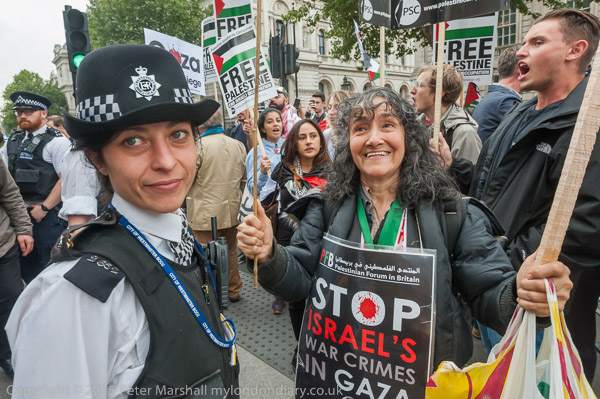
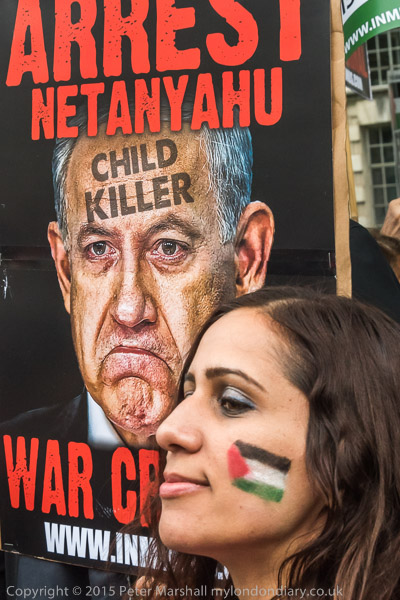
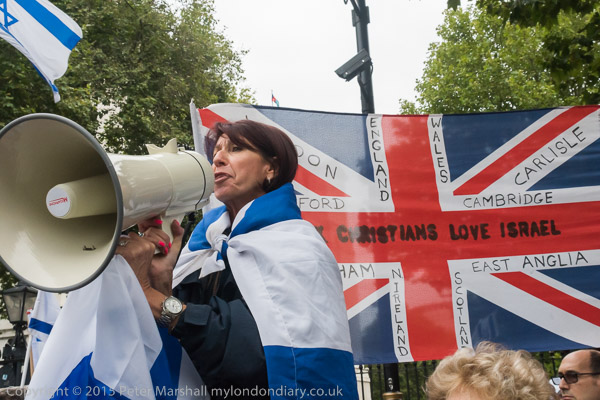
End Gaza Killing Now: Ten years ago today on Saturday 19th July thousands were marching through London towards the Israeli Embassy demanding an immediate end to the invasion and the crippling siege of Gaza and peace with freedom for Palestine.
Of course the situation is much worse in Gaza now where the whole population is under threat from Israeli bombs and increasingly without access to clean water, food and medical treatment. Every day brings news of a new massacre – last Saturday more than 90 Palestinians were killed and 300 injured in a tent camp at al-Mawasi – an area in Gaza that Israel had designated as safe.
Last week 10 independent UN experts issued a statement accusing Israel of carrying out a “targeted starvation campaign” that has resulted in the deaths of children in Gaza. They said this “is a form of genocidal violence and has resulted in famine across all of Gaza.” And the global monitor Integrated Food Security Phase Classification (IPC) recently stated that more than a fifth of the population of Gaza are facing the most severe, or “catastrophic”, level of food insecurity, in danger of starvation despite a small increase in humanitarian aid.
Wikipedia states “As of 12 July 2024, over 39,000 people (38,345 Palestinian and 1,478 Israeli) have been reported as killed in the Israel–Hamas war, including 108 journalists (103 Palestinian, 2 Israeli and 3 Lebanese) and over 224 humanitarian aid workers, including 179 employees of UNRWA.
The vast majority of those deaths have been in Gaza. And these figures do not include “those who have died from ‘preventable disease, malnutrition and other consequences of the war'”. As the Wikipedia article points out, research in 2008 suggested “that that total deaths caused by major conflicts were then a minimum average of five times the count of direct deaths.”
The 2014 Gaza War was one of the more deadly of the many previous conflicts between Israel and Palestinians since the formation of Israel in 1948. Wikipedia reported that “between 2,125 and 2,310 Gazans were killed …and between 10,626 and 10,895 were wounded (including 3,374 children, of whom over 1,000 were left permanently disabled).
What is now taking place is genocide on an industrial scale, and it is being carried out with support and weapons from both the USA and the UK. Although our politicians have called for a ceasefire they have not taken any of the kind of actions that might persuade Israel to stop the killing, and have continued to supply weapons.
There has to be some way to allow peace in the area between Israel and Palestine – and it cannot be through wars. Oslo seemed to show a possible way forward, but Israel decided not to take it, refusing to make concessions that the Palestinians could accept. Recognition around the world of the Palestinian state now by over 75% of UN member states might be a first step on the road to peace, and the UK should do so without delay.
Before the march in 2014 there were speeches in Whitehall. I photographed the marchers as they went up Whitehall, stopping at Trafalgar Square until the end of the march had reached there around 45 minutes after it began. I took the tube to Hyde Park Corner only to find the front of the march had already gone past, so I rushed back down to get the tube to Kensington High Street, close to the final destination a short distance from the Israeli Embassy which is a short distance down a private road.
Several thousand marchers had beaten me there and the street soon became very crowded as more arrived. Eventually it became too crowded to move and take pictures and I retreated into a small area reserved for the press close to the speakers. Among a long list perhaps the most moving was a young Palestinian woman who told us something of what had happened to her own family who were given 90 seconds warning before their home in Gaza was destroyed.
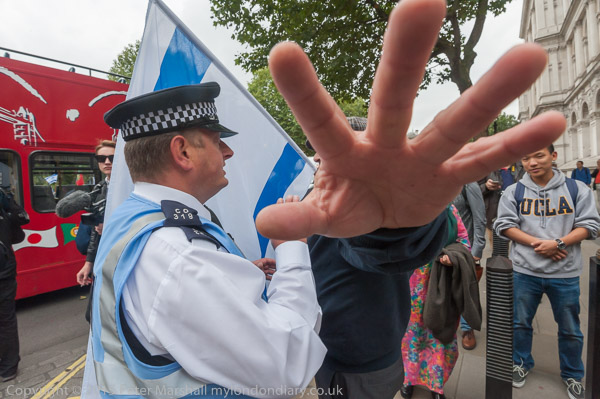
The protest had remained entirely peaceful, but as it ended and we left to go home, there was a minor incident where some police officers appeared to be making trouble, intervening in a heavy-handed fashion in a minor argument between a protester and a shop-worker who had shouted in support of the Israeli attack.
Fire Service Cuts Cost Lives: On Thursday 18th July 2013 I photographed a march and rally by the Fire Brigades Union in London against cuts proposed by then London Mayor Boris Johnson. He had in 2010 repeatedly denied that he would make any cuts to London’s fire services, but the cuts which this protest was against led to the closure of ten fire stations in Greater London and the loss of over 550 firefighters in the force.
There was also a loss of the number of fire engines, at first of 14, but followed later by another 13, a cut of around 15%. Unsurprisingly the response times to fires across the capital increased. The first fire engine should arrive within six minutes of a fire being reported, and in late 2014 the figures showed that this was exceeded in around a third of London’s wards. Although the average increase in response times was only 12 seconds, in the worst case it went up by two minutes and 48 seconds.
Matt Wrack, General Secretary of the Fire Brigades Union
Fast response to fires is essential in saving lives and cutting damage to properties, and although fortunately few lives are lost to fire in London thanks to our firefighters it seems that there was at least one fatality in the following year which was widely attributed to a slower response time. As I wrote in 2013, “7 out of 10 Londoners think that the Mayor’s proposed cuts will put public safety at risk, and the remaining 3 are just not thinking.”
In our great 2017 tragedy at Grenfell Tower, the fire service responded promptly, but it took over half an hour for a turntable ladder to arrive, and at the time the LFB only had ladders that reached under half way up that building. They called in a taller ladder from Surrey which took several hours to arrive. The LFB finally got its first 64m turntable ladder, the tallest in the UK, in 2021.
A Scottish band from Hull sponsored by the FBU and a photo of Boris
Appropriately the march began at The Monument, a 202ft column topped by a bright brass ball of fire erected shortly after the 1666 Great Fire of London as a permanent memorial to the event.
Fire-fighters, many in uniform, and supporters gathered in the area around, along with a fire engine and a small marching band with bagpipes sponsored by an FBU branch. London’s own firefighters were supported by some for other brigades, including at least a couple from the New York Fire Department as well as retired fire-fighters and anti-cuts protesters.
When the march which went across London Bridge to the London Fire Brigade HQ in Southwark for a rally outside where the cuts were being decided at a Fire Authority meeting I had gone up on top of the fire engine.
What I hadn’t realised was that I would be unable to get down until the end of the march, and although it gave me a good viewpoint it was in some ways a limiting one. I always like to take most of my pictures close to people using wide-angle lenses and during the march was unable to do so. And when the marchers sat down briefly to block London Bridge I could only watch from a distance.
I’d also not realised how much vibration there would be on the top of the fire engine, where we were in a fairly small enclosure made with scaffolding tubing on its top. I found myself having to hang on tightly in some of the bumpier parts of the roads, while trying to take pictures largely one-handed.
It was a rather uncomfortable and just a little scary experience, but it did take me close to some of those who had come to first and second floor windows to applaud the protest as it went past. But I was very pleased when we came to a stop at the Fire Brigade HQ and I could get back to ground.
You can read more about the rally at the end of the march and a long list of the speakers on My London Diary and there are photographs of most or all of them as well as many more from the event.
Bonuses are Back Pig Party: I’ve never understood why people who are already paid obscenely high salaries get awarded huge bonuses for the work of people lower down in the organisations they lead. Even less that they still get them when these organisations are obviously failing – as with the water companies. So it was a small piece of good news in February 2024 when the then government announced they would block further bonuses to the water company after they had received £26 million since 2019 despite sewage spills.
Of course many of us felt that they should have been made to repay those bonuses and that the companies that have racked up huge debts while paying out billions to shareholders should be taken into administration to be run to serve the public.
Back in 2008 it was the predatory activities of the banks that led to the financial crash, but in 2009, “Despite everything that has happened over the past year, bankers are still getting bonuses, often at quite obscene levels, far in excess of most people’s annual incomes.”
And on Friday 17th July 2009 ‘The Government of the Dead‘ came to the heart of the City of London to ‘celebrate’ that “City pigs are truly back with their snouts in the trough” with “a ‘Bonuses are Back Pig Party’, wearing pig masks and setting up a trough with ‘Pig Pounds’ mixed with pig swill and getting snouts down and bottoms up to wallow in it.“
The ‘Pig Pounds’ – were deliberately low-tech paper copies of fivers with a pig over the bottom half of the Queen and the pig swill was possibly the real thing but looked like some rather unpleasant and lumpy porridge with cornflakes mixed in.
Some of the protesters had come in fancy dress – city suits – with Chris Knight with his usual top hat and Camilla as Miss Piggy. Many put on latex pig masks and got their heads down in the trough in front of the Royal Exchange, scooping up the swill and the fivers.
More or less together they sang a number of cleverly reworded pig songs “including a number of hits by Miss Piggy, Pinky and Perky, The Simpsons and Piggy Pie“, as will as singing, dancing and miming along with some of the originals between sessions at the trough.
‘Lets Twist Again’, once recorded by Pinky and Perky became “Come on let’s scam again Like we did last summer Come on let’s scam again Like we did last year Come on let’s scam again Scamming time is here.“
“Bonuses Are Back” Chris Knight and the others shouted at City workers on their way home, inviting them to “come and swill in the trough, all provided at the taxpayers expense thanks to Gordon Brown.“
Tourists were bemused, but some stopped to enjoy and photograph the scene, with a few putting on the latex pig masks on offer and joining in.
Even the City of London Police seemed amused rather than worried by the protest, standing back and watching – and without their intervention there was no threat to public order.
After around an hour and a half of watching and taking pictures I decided it was time to go home. I’d taken too many pictures and the fun was wearing off.
Of course the bankers – and other bosses – continued to do well, while the rest of us had to suffer fourteen years of Tory austerity with public services being starved of cash and the NHS, prisons and more deteriorating at pace.
The Labour Party deliberately threw away the chance of getting into government in 2017, when the party under Corbyn got many more votes than in 2024. Starmer didn’t win the election, it was lost by the Tories who were poleaxed by Reform and had become clearly unable to run their own party let alone the country. I have no confidence that our new Labour government will be more than a very slight improvement over their predecessors, though it would be good to be proved wrong.
Against Austerity, Cleaners Flash Mob, EDL & Falun Dafa: The main event on Saturday 16th July 2016 was a well-attended march and rally against austerity and racism following the Brexit referendum, but on the way there I came across a Falun Dafa march, and while people were marching manged to cover a ‘Flash Mob’ by cleaners and a small protest by the far-right EDL.
End Austerity, No to Racism, Tories Out!
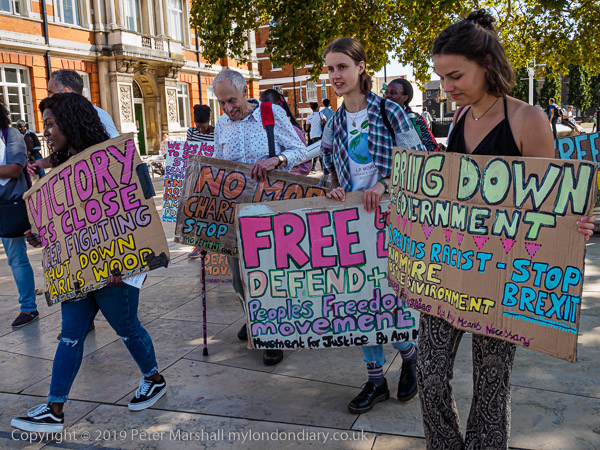
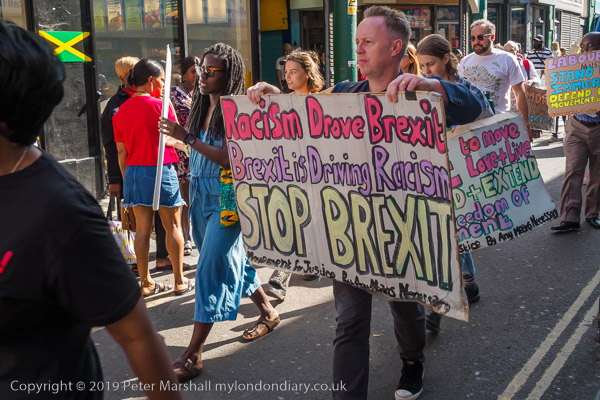
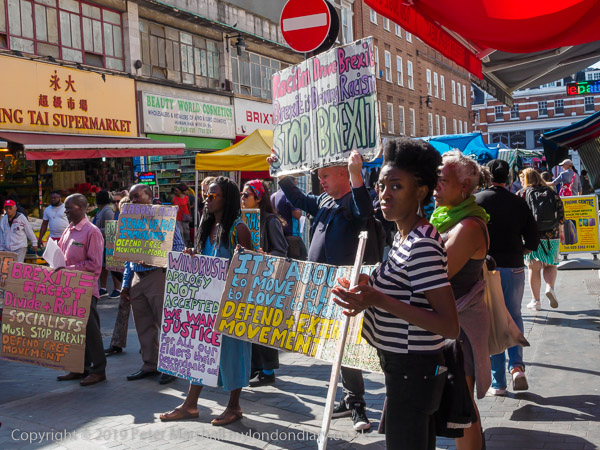
The People’s Assembly and Stand Up To Racism had organised an emergency demonstration following the Brexit referendum against austerity and racism and calling for the Tories to be defeated at a General Election.
The protest assembled outside the BBC in the hope that they might for once notice and report on a large protest in London, but as usual they ignored it. It also showed huge popular support for then Labour Leader Jeremy Corbyn – who only failed to defeat Theresa May the following year because of sabotage by Labour party officials and the right wing of the party.
Immigration had been a major issue in the Brexit referendum, exploited by the Leave campaign and this had resulted in an upsurge in racism and hate attacks. Brexit did result in lowering migration from the EU and since 2017 the number of those born in the EU living in Britain has slowly but slightly declined. But this has been more than matched by an increase of around a million in those born in non-EU countries.
Of course we need these people who fill many useful jobs here and pay taxes. We also need those who work in the shadow economy, estimated in total to be around 10% of the total economy. Although this is often said to be important in attracting undocumented migrants to the UK, our shadow economy is significantly smaller than the average for developed nations, and at a level around half that of Italy, Greece and Spain and a little below Germany and France according to free-market ‘think tank’ the Institute for Economic Affairs.
The UK had been one of the leaders in the establishment of the UN’s Universal Declaration of Human Rights adopted in 1948, and in the European Convention on Human Rights (ECHR) adopted by the Council of Europe, signed in 1950 which came into force in 1953, with a court to enforce it. Many felt that the Tory government’s proposal in 2022 to repeal the Human Rights Act 1998 and replace it by a Bill of Rights was reprehensible. Liz Truss’s one good thing was to stop its progress and in June 2023 Rishi Sunak’s Justice Secretary Alex Chalk confirmed it had been dropped.
As the end of the march left down Regent Street I rushed off to photograph a breakaway group from the march who had left to take part in a flash mob. Following that I trotted along Oxford Street to Park Lane where I photographed a short march by a few EDL supporters before rushing to the tube to make my way to the People’s Assembly and Stand Up To Racist rally in Parliament Square.
The Fire Brigades Union had brought their fire engine to the square to provide a platform for the speakers at the rally chaired by rally chaired by Romayne Phoenix of the People’s Assembly and Sabby Dhalu from Stand Up to Racism.
Islington councillor Michelline Safi Ngongo brought a message of support from Jeremy Corbyn. Other speakers included Green Party London Assembly member Caroline Russell, Weyman Bennett from Stand Up to Racism, Lindsey German of Stop the War, Sam Fairbairn the National Secretary of the People’s Assembly, Zita Holbourne of BARAC and PCS, Rob Williams of the NSSN, NUS Vice President (Further Education) Shakira Martin and Antonia Bright from Movement for Justice who brought an asylum seeker with her to speak.
Falun Dafa march against Chinese repression – Regent St
Practitioners of Falun Dafa (also known as Falun Gong), an advanced Buddhist practice of moral rectitude, meditation and exercise founded by Mr Li Hongzhi in 1992, marched through London to protest the continuing torture and repression they have experience in China since 1999.
When the People’s Assembly / Stand Up To Racism march set off, a small group of striking cleaners from 100 Wood St and supporters left to stage a flash mob protest at the nearby HQ Offices of CBRE in Henrietta Place. The United Voices of the World strike at Wood St for the living wage and reinstatement of sacked workers was then in its 38th day.
Less than a hundred EDL supporters had turned up at Marble Arch to march a few yards down Park Lane and then into Hyde Park for a rally. A few anti-fascists who had turned up to oppose them had mainly left to join the People’s Assembly-Stand Up to Racism march by the time I arrived.
Streatham, Spain and Guantanamo: Three events in London on Saturday 15th July 2006, a festival, a commemoration and a protest.
Streatham Festival Children’s Parade – Streatham
Streatham Festival held it’s first ever Children’s Parade, children working with artists from Arts Community Exchange and Kids’ City to create sculptures, banners and puppets for all to see.
The parade was led by drummers Ancestral Hands and a cycling stilt-walker brought up the rear as it went along Streatham High Road to St Leonard’s Church.
One of my pictures from this parade was used in the remarkable The Streatham Sketchbook by Jiro Osuga and Mireille Galinou with photography by Torla Evans which was published in 2017 by Your London Publishing. Still available, this was described by Graham Gower of The Streatham Society as “superb and one the best books to be published on Streatham as a place – if not the best.”
International Brigade Commemoration – Jubilee Gardens, Waterloo
I’ve attended and photographed a number of the annual commemorations of those who went to fight the fascists in Spain in 1936-9, but this 2006 event was the most memorable. Here’s what I wrote about it in 2006.
Jack Jones
Several hundred people attended the annual commemoration at the International Brigade Memorial in Jubilee Gardens London Organised by the International Brigade Memorial Trust on Saturday 15 July.
Bob Doyle
Between 1936 and 1939 over 35,000 men and women, from more than 50 countries, volunteered for the Republican forces. Of the 2,300 who came from Britain, Ireland and the Commonwealth, over 500 were killed.
Sam Lesser
Volunteers came largely from working class areas across the country. most were members of communist organisations or otherwise active in the trade unions and other socialist bodies, and their average age was 29.
Jack Edwards
Seventy years later there are relatively few still alive and active enough to attend the commemoration, but it was good to see seven there. They were Jack Jones who chaired the event, Sam Lesser who spoke and read, as well as Bob Doyle, Paddy Cochrane, Lou Kenton, Jack Edwards and a surprisingly spry Penny Feiwel. As usual there was a reading of the names of those known to have died since the previous year’s meeting.
Penny Feiwel
Rodney Bickerstaff’s address raised the problem of keeping alive the memory of those who responded to the call to help the Spanish republic, but attendances at this annual event seem to have increased over recent years.
Lou Kenton
There was certainly more media interest than on previous occasions, in part because of the attendance of the Spanish Ambassador and his wife, reflecting the increasing interest from Spain; he also gave a brief speech. As was pointed out, it would have been nice to have a representative of the UK government also present.
Paddy Cochrane
As usual, the event concluded with the singing of the ‘Internationale’.
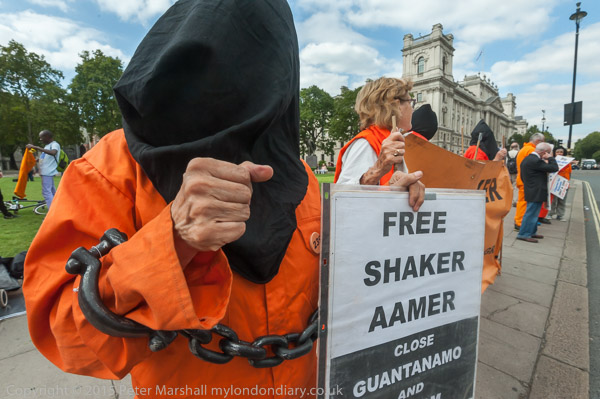
The National Guantanamo Coalition had called for a national demonstration in London to protest the deaths of three Guantanamo detainees earlier in the month.
A group of protesters, mainly from the ‘Save Omar Deghayes’ campaign, but also representing other organisations, walked across London from Marble Arch to the new Home Office building in Marsham Street to hand in the petition calling for an independent enquiry into the three recent deaths at Guantanamo. The petition also calls for the immediate sending of all detainees to countries where their basic human rights would not be abused, an immediate closure of Guantanamo and other prisons where those held were denied proper legal process and for proper access to detainees by family and medical personnel.
It was a long, hot and dusty trek across London, particularly tricky for those with pushchairs as we navigated the Hyde Park subways, and we were all glad to arrive (thanks to helpful directions from the police) at the Home Office. The front of the building was like an oasis, shade, green grass, water and trees.
The police did make us get off the grass and also made some effort to stop the display of placards and banners, but most of these remained visible. They had also attracted some attention from the crowds around Buckingham Palace as we passed by.
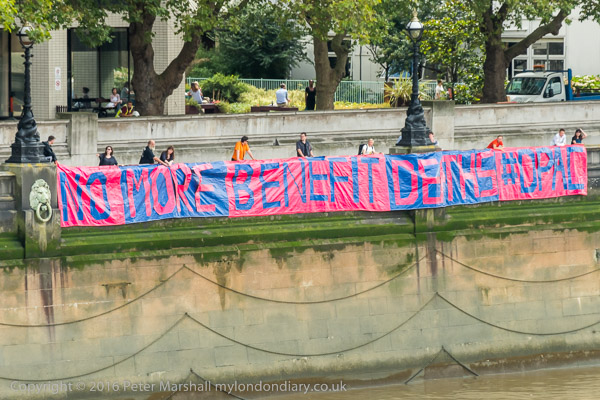
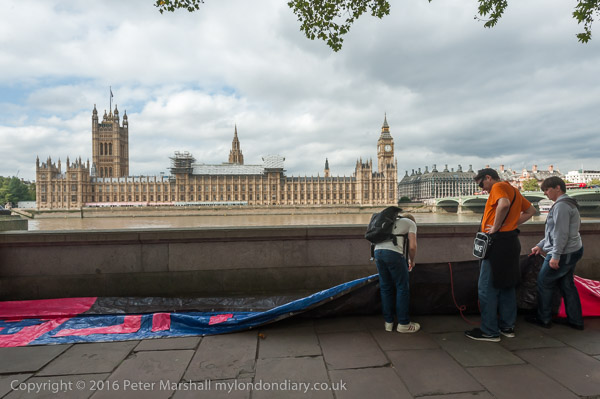
PIP, NHS, Trident & Cleaners: Wednesday 13th July 2016 was a busy day for me, covering two protests in the ‘#PIPFightback’ National Day of Action against the Personal Independence Payments, a rally in favour of a parliamentary bill to stop the ongoing privatisation of the NHS, a party against plans to spend huge amounts on new nuclear weapons and ending with a rally supporting cleaners in the longest running industrial dispute in the history of the City of London.
PIP Fightback – Vauxhall & Westminster
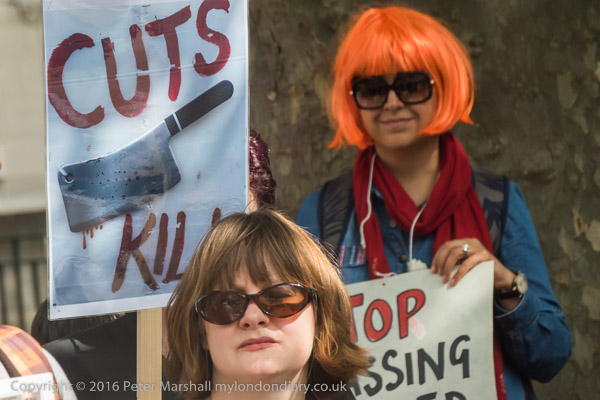
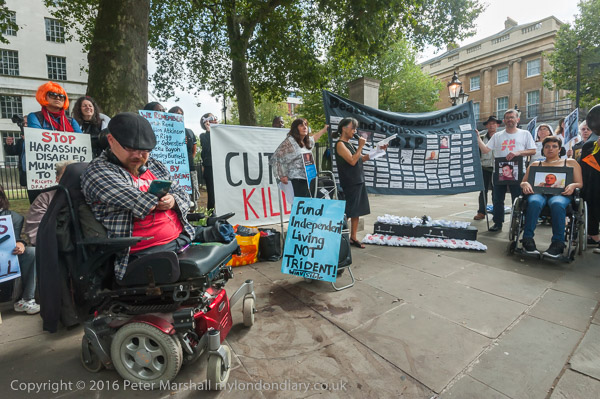
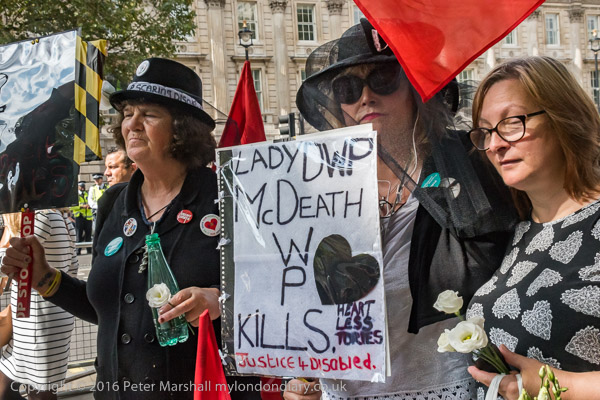
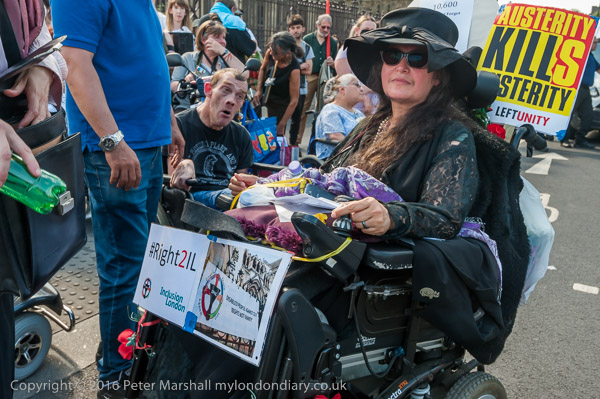
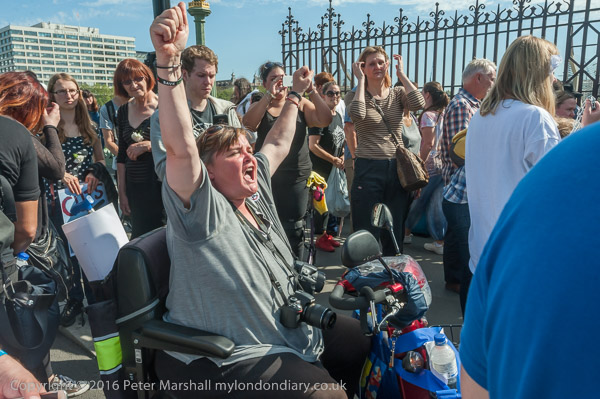
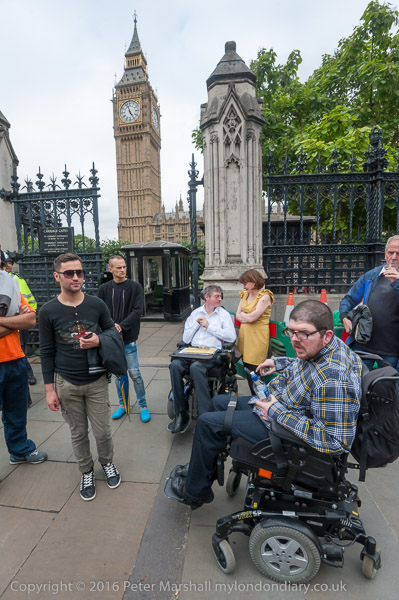
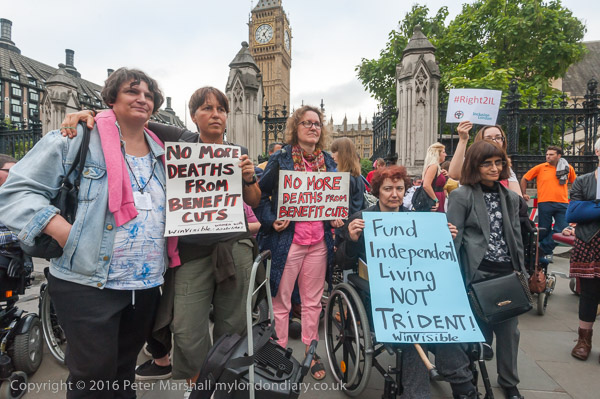
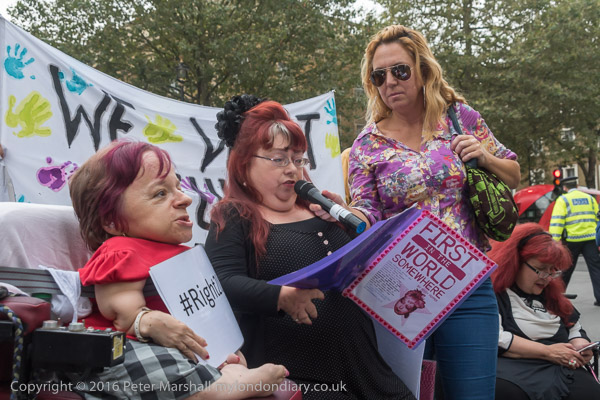
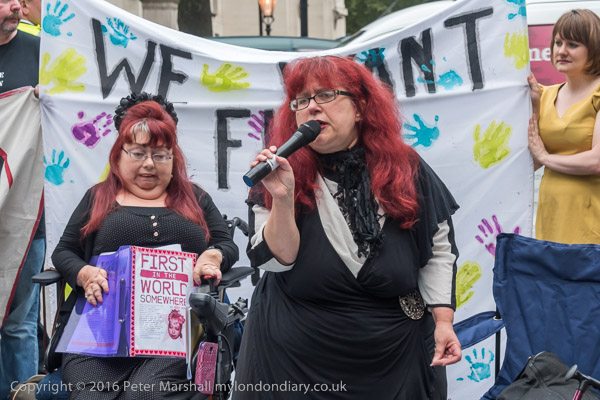
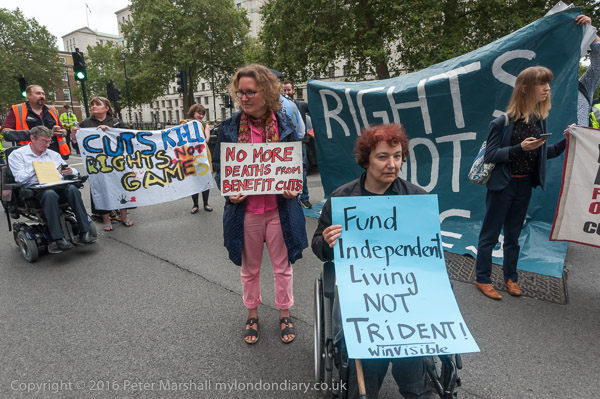
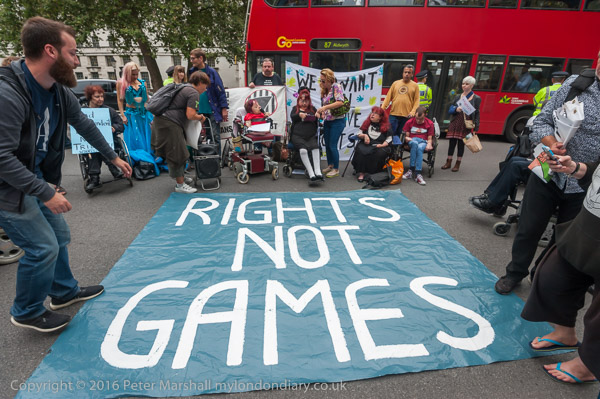
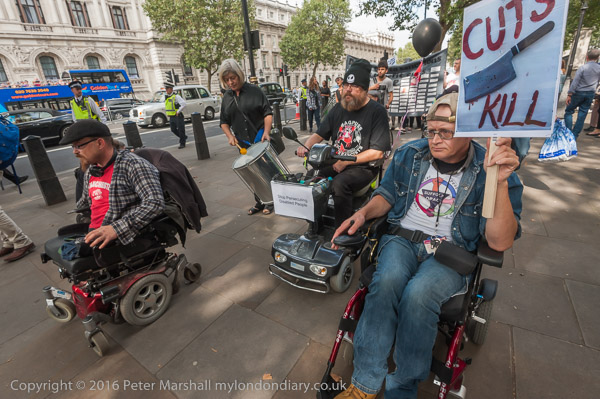
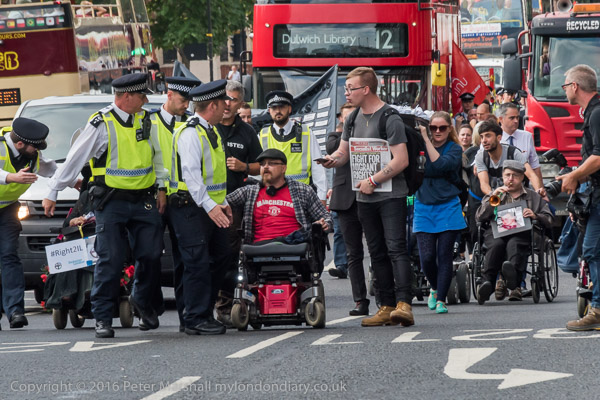
On this day there were around 20 actions by disabled protesters and their supporters as a ‘#PIPFightback’ National Day of Action against PIP, the Personal Independence Payments which have been a totally inadequate replacement for the Disabled Living Allowance which had previously provided support to enable disabled people to work and live on more even terms with the rest of the community.
I began at the Vauxhall PIP Consultation Centre in Vauxhall where ATOS carry out sham Personal Independence Payments ‘assessments’ on behalf of the DWP. These are carried out without without proper consideration of medical evidence and with ATOS haing a financial incentive to fail claimants.
Many genuine claimants have lost essential benefits for months before these are restored by tribunals on appeal. The temporary loss of finance has resulted in some being taken into hospitals and some commiting suicide.
Other claimants lose benefits as job centres ‘sanction’ them, often for trivial or unfair reasons such as arriving late for interviews due to bus or train delays – or because they have not received a letter about the appointment.
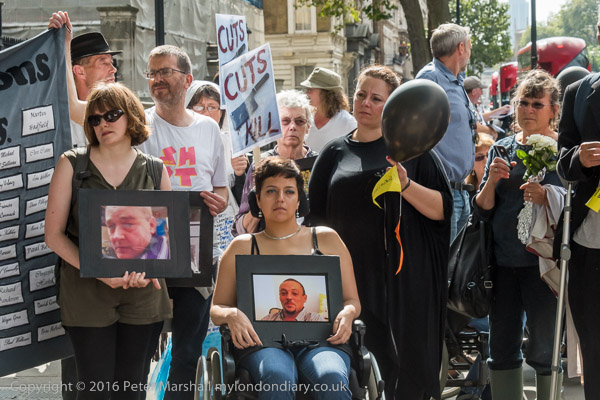
Among those taking part in this protest was Gill Thompson, whose brother David Clapson, a diabetic ex-soldier died in July 2013 after his benefits were ‘sanctioned’. He was left starving without money for food or electricity to keep the fridge containing his insulin running. She carried a banner with the names and a few pictures of around 100 claimants known to have died because of sanctions. This appears to be a relatively small fraction of the total which runs into thousands.
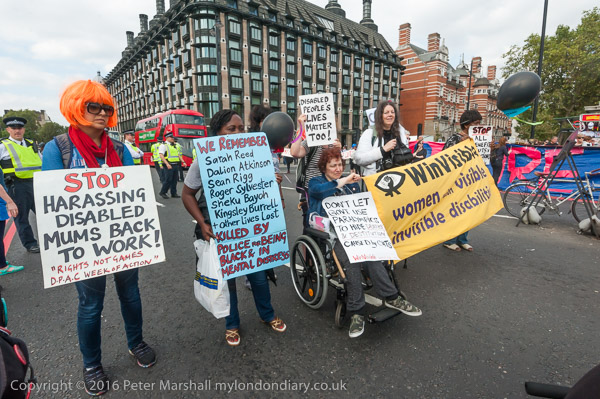
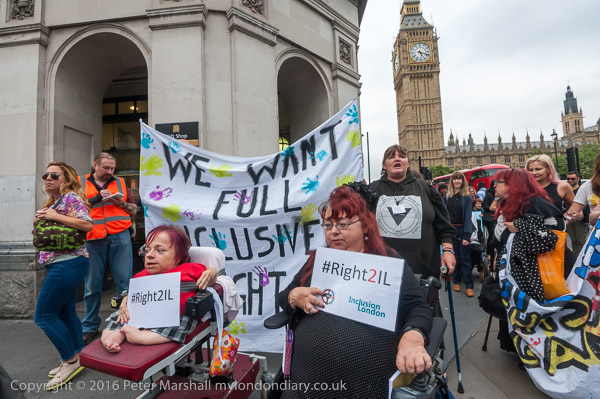
Later I joined a larger protest with members of the Mental Health Resistance Network (MHRN), Disabled People Against Cuts (DPAC) and Winvisible (Women with Invisible and Visible Disabilities) and others in Westminster outside the Victoria Street offices of Capita who also carry out these shoddy assessments.
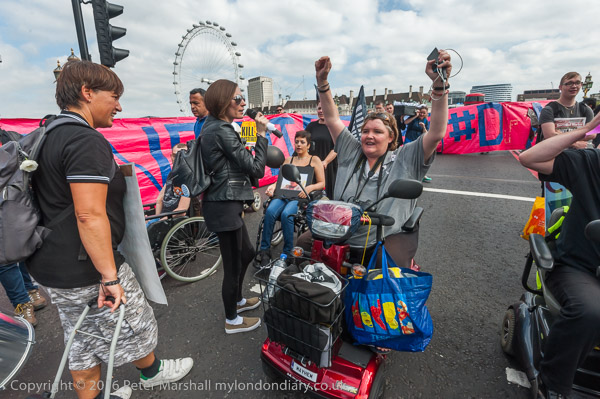
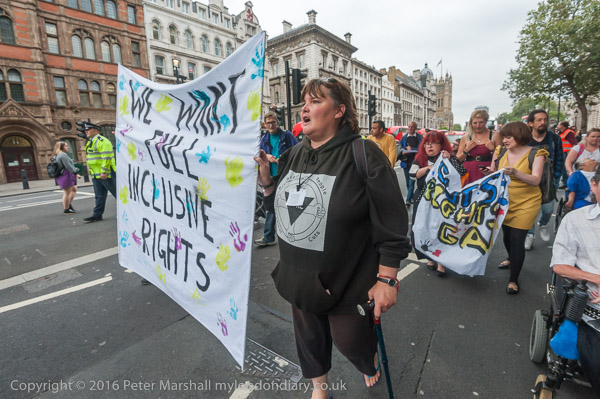
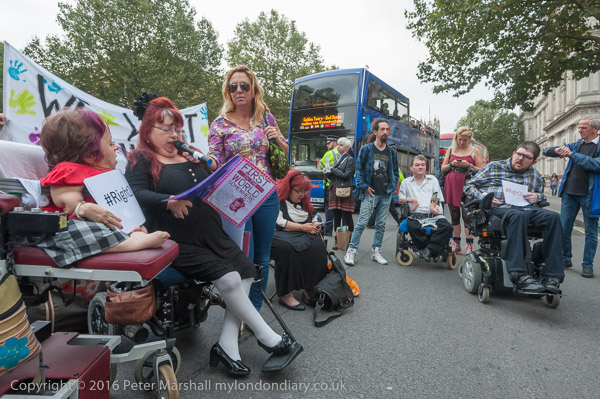
There were speeches on the pavement there before the protesters moved onto the busy road blocking traffic in both directions, though they quickly moved aside to let a ambulance through.
After a few minutes Paula Peters of DPAC announced it was time to move on and the protesters marched along the road past the Met Police HQ at New Scotland Yard and on the the DWP offices at Caxton House.
Here they blocked the road for some more speeches before moving on to Parliament where there was another short rally on the road before they moved on to the media village on College Green where politicians were being interviewed on TV over the appointment of a new Prime Minister, Theresa May.
Police blocked them from going onto the Green, but soon some went past them and refused police requests to move; eventually they were allowed to stand on a path in the middle of the area. Although all the TV crews present could see and hear the protest, only one or two bothered to come across and find out what was happening – and I think these were from foreign news agencies.
Protesters from various campaigns to save the NHS held a protest in support as Labour MP for Wirral West Margaret Greenwood presented a ‘Ten Minute Rule Bill’ with cross-party support to stop the privatisation of the NHS and return it to its founding principles. Labour Shadow Health Secretary Diane Abbott came out to speak in support at the protest.
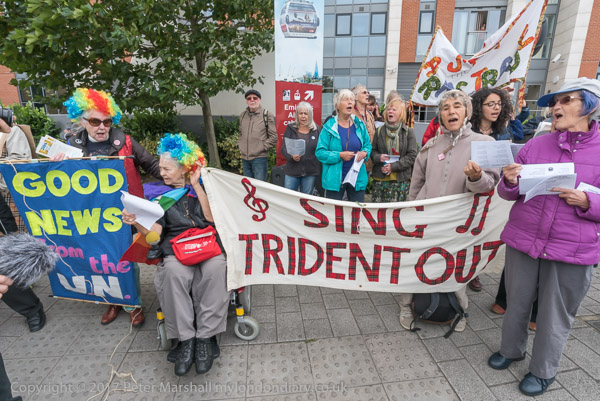
CND members were lobbying MPs at Parliament against plans to replace Trident at a cost of at least £205 billion.
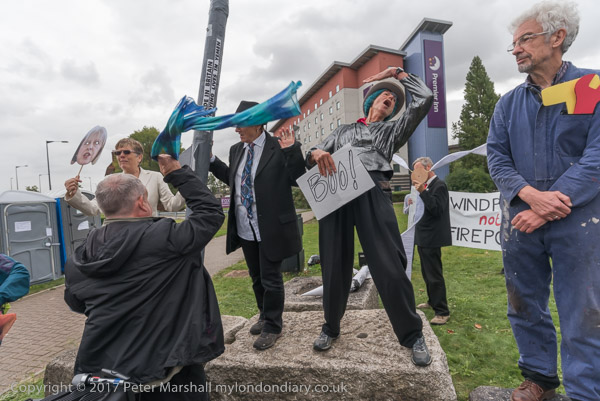
And on the square facing the Houses of Parliament was a ‘Mad Hatters Tea Party’, as well as Christians with placards stating the opposition by churches of the different denominations to the replacement.
The strike by cleaners at the 100 Wood St offices managed by CBRE was now the longest running industrial dispute in the history of the City of London.
The cleaners belong to the United Voices of the World union and are employed by anti-union cleaning contractor Thames Cleaning.
Unite the Resistance, the Haldane Society of Socialist Lawyers, Class War and others had come to support the United Voices of the World. After a rally opposite the Wood Street offices, then marched around the block and then went on hold a rally blocking the street outside the CBRE offices at St Martin’s Court.