A bridge from the Heygate Estate took mothers and children across the busy Rodney Road to Victory Place and the entrance here to the Primary School. It was demolished around 2011, and I think the ‘GIRLS & INFANTS’ entrance has gone but a similar ‘BOYS’ entrance remains.
This building was just off Rodney St; its modern replacement is on the corner of Rodney St with Wadding St and Stead St.
Many Irish Roman Catholics had move into the area and in 1890 the Catholic Bishop of Southwark set up the Walworth Mission with a combined school and chapel just off Flint St and a Presbytery in Rodney Road with apermanent church next-door to this completed in 1903.
I walked north up Balfour St to the junction with Henshaw St. These buildings are all still there, but like so many small shops have been converted into residential use. Much of the area behind me when I took this picture has since been redeveloped.
There are adverts on the shop windows for Lyons Cakes, Tizer the Appetizer, Brooke Bond Tea, New Zealand Butter, Players No 6, Ty-Phoo Tea and Crown Cup Instant Coffee, but thhe curtains and boarding show the shop had already closed down.
St John the Evangelist, Walworth, Charleston St, Southwark, 1989 89-1b-45
I walked back, probably along Victory Place, to Rodney Road and then down Larcom Street, making my way to Charleston St, taking a photograph (not on-line) along this from its Brandon Street end looking towards the church before walking down to take more pictures around the church.
The Anglican Church of St John the Evangelist was built here when the estate was being developed in 1859-60. District Surveyor Henry Jarvis was architect for this gothic church in Kentish Ragstone, and its vestry was added in 1912 by Greenaway and Newberry. Both were Grade II listed in 1998, nine years after I made this picture.
There are two alleys on each side of the church, that on the left in this picture leading to Walcorde Ave and on at the right in the picture below to Larcom St.
St John the Evangelist, Walworth, Charleston St, Southwark, 1989 89-1b-46
This picture is looking down the alley leading to Larcom St and the building at right is St Johns Vicarage at 18 Larcom St.
Post-war Pritchard House (left) has been demolished but the house at 66 Wansey St in the right half of the picture is still there. Everything to its left has now gone with only the steps of No 68 remaining for a small new block of two social housing flats.
The street now continues through where Pritchard House was to Brandon Street and it is now part of the Larcom Street Conservation Area. No 66 probably dates from around 1860 and it and other houses on the street are probably part of the earliest development of the area.
Wansey St, Southwark, 1989 89-1a-15
66 Wansey St comes at the end of a long terrace – longer when built as there is a gap between 46 and 54 with a post-war infill block almost certainly following war damage. The house is the grandest of those surviving and the only one with a carriage entrance. The street then ended here, with Gurney St at right angles.
The area suffered heavily in the Blitz, with houses in the area being damaged or destroyed, including one of the greatest disasters of the bombing. Bombs hit nearby 6 Gurney St, close to the New Kent Road, damaging it and other houses on the last night of the Blitz, 10/11 May 1941, but it was only over a year later than a huge unexploded bomb that had been buried deep under the rubble, totally destroying 6 Gurney St and the two houses on each side and severely damaging many others in the surrounding area. 18 people were killed and 62 severely injures. This house on Wansey St was at the limit of broken glazing, over 200 yards away.
Kingshill, Brandon St, Southwark, 1989 89-1a-16
This block was a part of the Heygate Estate, neglected and demonised by Southwark Council and eventually demolished to allow for development of the area largely as private housing mainly sold to overseas investors.
St Johns Institute, Larcom St, Walworth, Southwark, 1989
Built around 1900 thanks to the efforts of the then vicar of nearby St John’s Church, the Rev. A W Jephson, this remains in use as a community centre. There is now a block of flats to its left.
The Heygate Estate, one of the better planned council estates of its era was by designed by Tim Tinker and completed in 1974. Southwark Council saw an opportunity to profit from redeveloping the area and began a process of demonising the estate, which had been allowed to deteriorate. What had been social housing for around 3000 people provided only 82 socially rented homes in the new development, much of which was sold to overseas investors.
They ended up making a loss as having spent around £65 million on emptying it and scheming for its redevelopment against a strong campaign by residents they sold it to Lendlease for £50 million. However some councillors and officers are said to have done rather well out of it personally.
Another view of the Heygate from the outside. Like many developments of its time a central boiler provided heating efficiently to all or many of the properties, though often inadequate maintenance meant such systems broke down.
I’m unsure of the purpose of this large open area or of the strange markings on it.
The overhead walkway from which I took this picture was a part of the Heygate Estate and demolished with it. Morris Court, the Peabody flats it shows are still there on the corner with Larcom St. The Peabody Walworth Estate was built around 1915 replacing slum housing and modernised in the 1980s. There are a number of blocks around a large central courtyard along Rodney Road, Content St and Wadding St.
This is taken from another walkway on the estate. As a non-resident I found these rather easy to get lost on as they were not shown on my mpas, but although the estate had a bad reputation I never experienced any problems, and it was certainly pleasant to be away from cars which were often a hazard when taking pictures. But it would have possibly seemed more threatening late at night rather than on a Sunday morning.
Another picture from one of the walkways around this corner of the Heygate Estate, which perhaps shows some of my confusion. It also shows a few of the many trees which had been planted in the area, which had just about come to maturity when the estate was demolished.
This building commemorates Michael Faraday (1791-1867), the English chemist and physicist celebrated for his ground-breaking research into electricity and magnetism who was born a short distance away on 22 September 1791. He invented the electric motor, transformer and generator.
The architect was Rodney Gordon (1933 – 2008) and this was his first job in the London County Council Architects department which was completed in 1961. Inside is the sub-station which converts the power for the Northern and Bakerloo lines, both of which have stations nearby.
When I took this photograph, it was at the centre of a large roundabout, with subways taking pedestrians across to the shopping centre descending at its side. The subways have now been replace by routes at ground level and the road layout changed, making this more easily accessible. But now the whole area is being redeveloped, and England’s first purpose-built shopping centre has been demolished.
Metropolitan Tabernacle, Stairs to Shopping Centre, Newington Butts, Elephant & Castle, Southwark, 1989 89-1a-34
Baptists began meeting in Kennington in 1650, when Baptist meetings were still illegal, but moved to a chapel near Tower Bridge in 1688 when they were allowed. It thrived over the years moving to larger chapels and becoming the largest Baptist congregation in England. Under the ministry of Charles Haddon Spurgeon which began in 1853 numbers became so large the services had to be moved to hired halls. The church bought a site on Newington Butts, both because of its prominent location and because it was thought to be the site of the burning of the Southwark Martyrs. The church with seating for 6,000, architect William Willmer Pocock was completed in 1861.
The shopping centre where I was standing was built as one of the first US-style indoor shopping malls in Europe with more than a hundred shops on three levels. Still popular with many, particularly for its market stalls, the centre closed in 2020 in the face of considerable opposition from locals and has been demolished.
Walworth Rd, Southwark, 1989 89-1a-23
Immediately to the south of the Elephant at the start of Walworth Rd, just past the railway bridge you can see at extreme right is this fine row of late-Victorian buildings, still there, although I think all have changed hands and there have been some subtle changes to the frontages as well as new shopfronts, and doubtless rather more change behind some of the facades. But it remains an impressive start to the road, while the other side has been depressing for many years.
Beyond Hampton Street at the end of the row, everything is new and perhaps one of London’s dullest new blocks, while viewing from a different angle across the road the scene is dominated by the 43 storey 487ft Strata Tower, completed in 2010 and decorated at its top by three wind turbines which were such a feature of its advertisement as a ‘green building’ but cause too much noise and vibration to actually be used. Appropriately for their location they are a real ‘white elephant’, and a potent example of ‘greenwashing’. The building was awarded the 2010 Carbuncle Cup for bad architecture as one of the “ugliest buildings in the United Kingdom completed in the last 12 months”.
R R Boast, Walworth Rd, Southwark, 1989 89-1a-24
One of the buildings in the row at 86 had formerly been home to R R Boast, Electrical Contractors and Engineers and Heating Specialists, with two other company names in much smaller letters on the left. A liquidator was appointed for the company in 1975 and the premises were I think still boarded up, though posters on the windows advertised keep fit and dance classes I think these were held elsewhere. Fly-posting across the lower frontage seemed very neatly done.
The building now has an extra floor as The Castle Hotel.
Walworth Rd, Walworth, Southwark, 1989 89-1a-25
Murrays Solicitors at 94-96 Walworth Rd is now a dentists at ground floor level but I think otherwise looks much the same, though it has lost its street nameplate.
Walworth Rd, Southwark, 1989 89-1a-11
At right of this picture you can just make out the top of the Hampton St side of 96 Walworth Rd, and this yard with its heap of tyres was on Steedman Street, just a few yards from its junction with Walworth Rd.
Former Southwark Town Hall, Walworth Rd, Southwark, 1989 89-1a-12
The Italianate Grade II listed Newington Vestry Hall by Henry Jarvis at the left opened in 1865, with a library added to the south east in 1892 and the two buildings joined the following year. In 1900 it became Southwark Town Hall for the Metropolitan Borough of Southwark and was further extended. But in 1965 the larger London Borough of Southwark borough moved its town hall elsewhere and renamed this building Walworth Town Hall.
In 2006 the Cuming Museum moved in, but the building was badly damaged in a fire in 2013. It is currently being restored to provide a space for educational activities, studio spaces and creative workshops.
My walk will continue in a later post. As usual you can see larger versions of any of the pictures by clicking on them which will take you to the picture in one of my Flickr albums.
The previous post on this walk is Evelina, Sassoon, Queens Road, Montpelier and Mazawattee. The pictures here come from the final film on my walk on 18th December 1988. I only finished the film and developed in it January 1989 so they appear in my Flickr album for 1989.
Mural, Sanford Walk, New Cross, Lewisham, 1988 89-1a-61
‘Riders of the Apocalypse’ was painted by Brian Barnes on the end property of Sanford Housing Co-operative in 1983. Student Co-operative Dwellings (SCD) was founded in 1968 by John Hands and colleagues and campaigned for five years lobbying parliament and looking for land until the government and Lewisham Council agreed to allow them the build Sanford Co-operative Dwellings. This was the first purpose-designed co-op scheme for the young and mobile, and was completed in October 1974.
Cold Blow Lane, New Cross, Lewisham, 1988 89-1a-63
Cold Blow Lane in the 19th century led to Cold Blow Farm, now long gone. In the 1850s the Croydon Railway built several tracks over it, and one of these went on the bridge whose two piers can be seen in this picture though the bridge has gone. Railway tracks still go over the lane, and I took this picture close to the exit of the long tunnel that goes under them. At the end of the lane is Mercury Way, and Cold Blow Lane turns at 90 degrees to go south.
Straight ahead, under another railway line, was ‘The Den’, then the home of Millwall Football Club, and I think the top of a stand is just visible in the picture. On the wall at left, among other graffiti is the message ‘Home of the Lions’
Surrey Canal Road, New Cross, South Bermondsey, Lewisham, 1988 89-1a-51
I think I made this and the next picture from a footpath just to the north of the Surrey Canal Road. The contact sheet gives a grid reference 356781 and this may show part of the area which is now Millwall’s ground in Senegal Fields.
Surrey Canal Road, New Cross, South Bermondsey, Lewisham, 1988 89-1a-52
You can still see this long range of buildings on Stockholm Road, just south of The Den. and parallel with Surrey Canal Road, occupied by a range of commercial companies. I imagine they date from when the Surrey Canal bed was filled in and the road bulit by Lewisham Council in the early 1980s.
Footpath, Senegal Rd, New Cross, South Bermondsey, Lewisham, 1988 89-1a-54
Since 1993, the Millwall football ground has been on Senegal Fields. The footpath now runs next to the new Millwall Stadium and then under the railway lines which have some very impressive Victorian brickwork.
These are most of the lines out of London Bridge Station which begin to diverge in this area. You can see all three bridges in this picture. This was a very run-down area and the abandoned parts of a moped at right seemed an appropriate way to express this.
Hill, Bridgehouse Meadows, New Cross, Lewisham, 1988 89-1a-56-Edit
I turned around here and walked back south across the Surrey Canal Road and to Bridgehouse Meadows.
This was the site of the former New Cross Stadium opened as an athletics stadium in the early 1900s but from the 1930s used for greyhound racing and speedway before its closure in 1969. For some years Millwall FC whose old ground was next to it used it for training. The stadium was demolished in 1975 and there were ambitious plans for it be part of the site of a new ground for the club – but these fell through and the new stadium was eventually built further north.
Factory, from Bridgehouse Meadows, New Cross, Lewisham, 1988 89-1a-42
This factory has been demolished and new housing built in its place. I think this site was also part of the over-ambitious plans for expansion by Millwall who wanted to take over a huge area.
Path, Bridgehouse Meadows, New Cross, Lewisham, 1988 89-1a-43
The path through the meadows crosses the Surrey Canal Road on a bridge you can see in the distance, no longer present. Both sides of the park area now have new housing.
Ilderton Rd, South Bermondsey, Southwark, 1989 89-1a-44
This is part of a site for travellers on Ilderton Rd and this house is still there, though there were no Christmas window decorations when I last walked past – but that was on a housing protest march in March 2017, where we stopped briefly at the Bermondsey Travellers Site. Behind is the railway line from South Bermondsey Station next door to the site where my walk ended.
This was the last picture from my walk on December 18th and completed a series of walks around this part of South-East London. My walks in 1989 began around the Elephant.
Protests in London three years ago today on Saturday 14th September 2019 all with some connection to human rights violations.
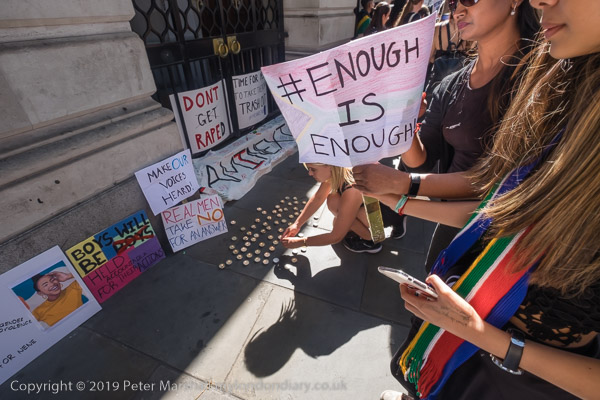
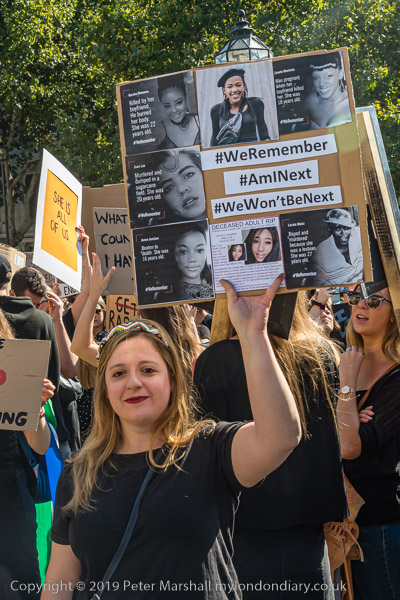
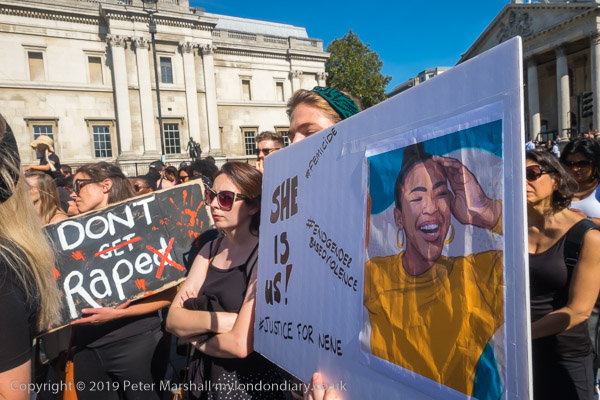
Criminal Abuse of Women in South Africa – Trafalgar Square
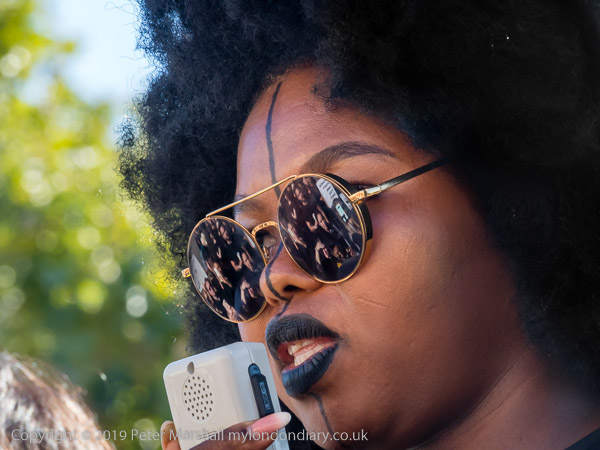
People, mainly women and including many South Africans, dressed in black to protest in Trafalgar Square following the rape and murder of Uyinene Mrwetyana and many other women in South Africa.
Protests were taking place across South Africa calling for the government to declare a state of emergency over gender based violence, and to protest against gender-based violence across the world.
After speeches and silences on the North Terrace they moved to light candles for the victims at the entrance to South Africa House.
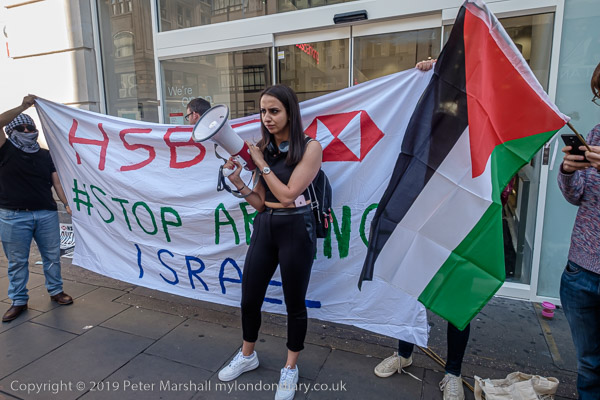
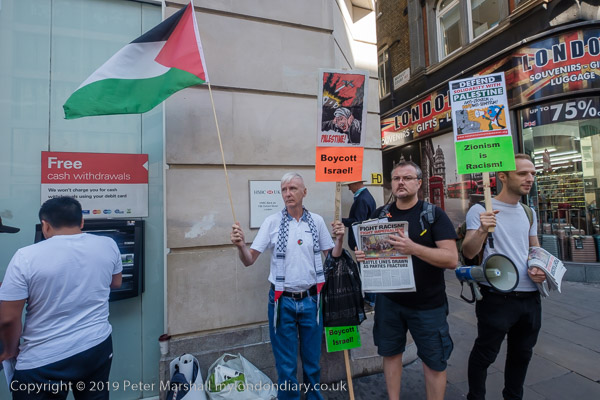
Protesters led by Young London Palestine Solidarity Campaign took part in a National Day of Action outside the Oxford St branch of the HSBC Bank calling on it to stop its support of military and technology companies that sell weapons and equipment to Israel to be used against Palestinians. The bank had closed for the protest.
Although HSBC had divested from Israel’s largest private weapons company, it still owned shares in Caterpillar whose bulldozers are used to destroy Palestinian homes and construct illegal apartheid settlements, BAE Systems whose fighter jets attack Gaza and Raytheon which suppliers the ‘bunker buster’ bombs used to target Palestinian civilians in Gaza.
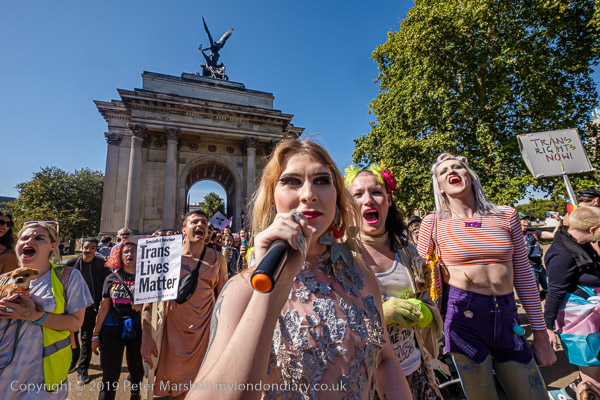
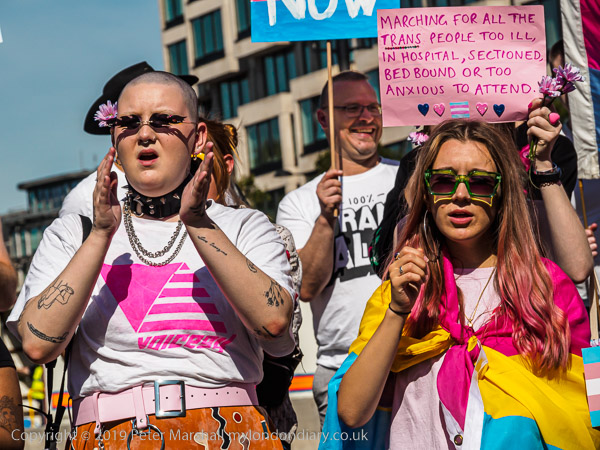
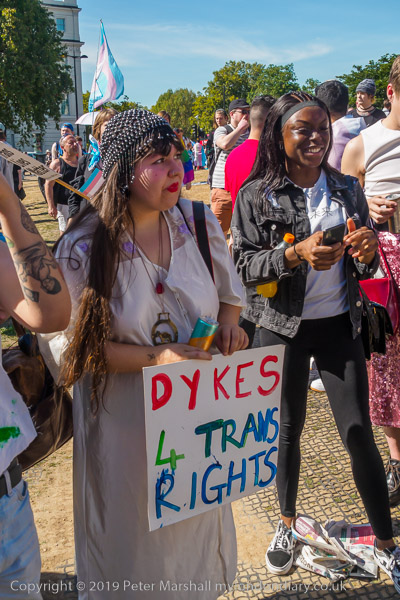
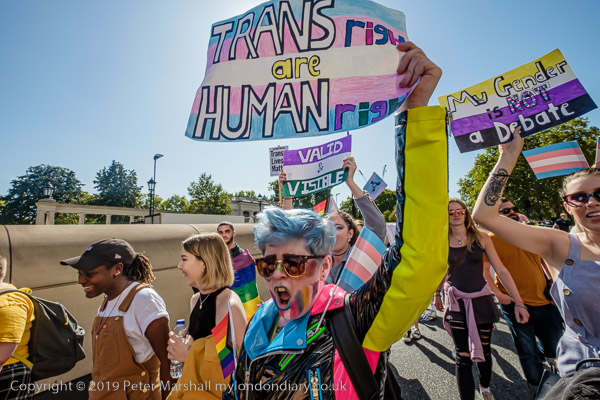
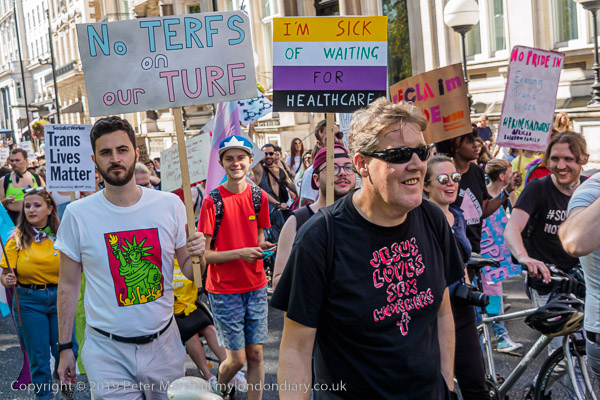
People met at Hyde Park Corner for this first march in the city to celebrate trans, non-binary, intersex, and gender non-conforming individuals and to protest against the continuing discrimination here and around the world against them.
As well as many from the trans+ community there were family, friends and other supporters taking part in an event which aimed to increase the visibility of trans+ people.
Recent years have seen an increasing transphobia in the British media with considerably publicity being given to the views of anti-trans activists. There has been an increase in attacks attacks on trans people on the streets, hate speech by trans-exclusionary feminists, and by right-wing national and state governments around the world.
Too often trans+ people around the world are subject to human rights abuses. They have always been an integral part of the gay community and at the forefront of the fight for gay rights – from the Stonewall rebellion on.
There were a few short speeches before the march set off, going along Piccadilly to a rally in Soho Square. I marched with them as far as Green Park where I caught the Underground for a protest in Brixton.
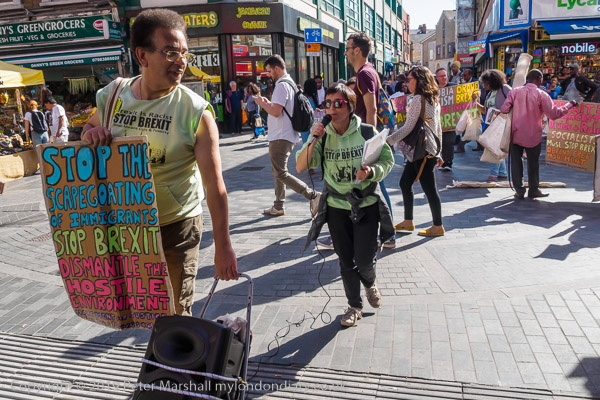
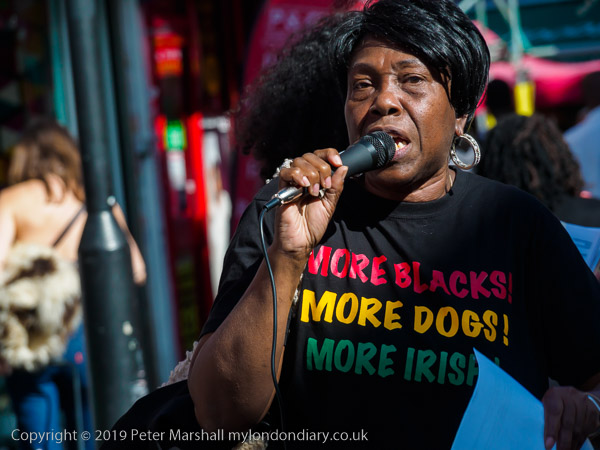
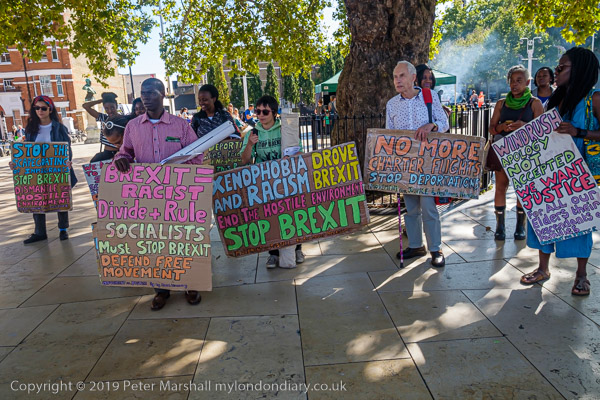
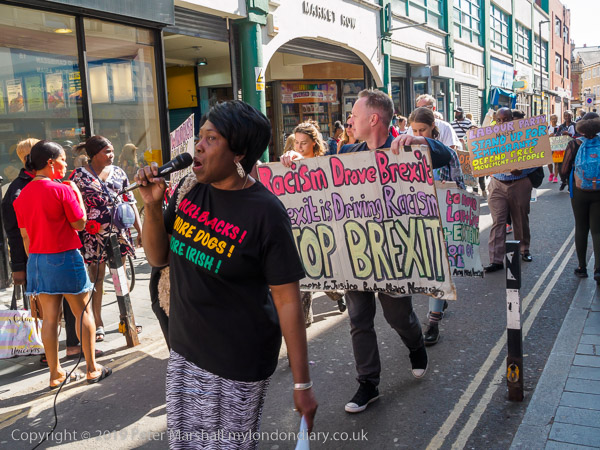
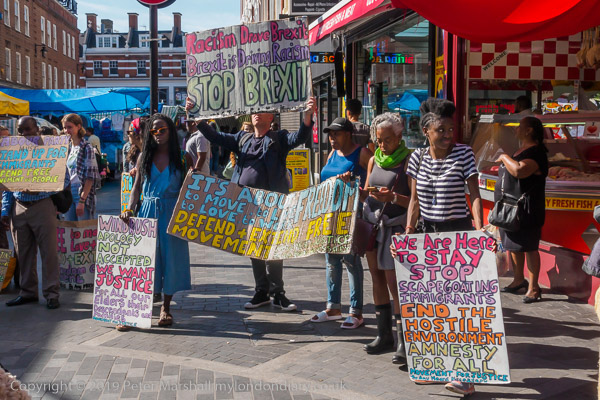
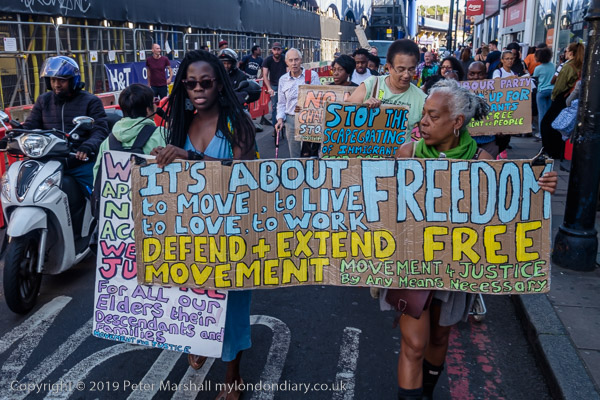
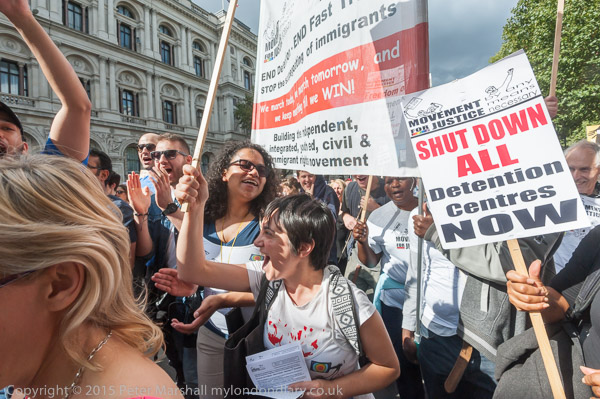
Movement for Justice and Lambeth Unison Black Workers’ Group were protesting in Brixton against the continuing persecution of Windrush family members and other migrants, calling for freedom of movement, the closure of immigration detention prisons, and an end to Brexit which they see being used to whip up immigrant-bashing and nationalism by Boris Johnson.
The event began in Windrush Square, where one of the speakers was Eulalee Pennant, a Jamaican great-grandmother who has been fighting the Home Office for 16 years against deportation. Here uncle was one of the Windrush generation, her grandfather had served in the UK armed forces for his working life, and her cousins, daughter, grandchildren and great-grandson were British. She had worked and paid tax here for many years but was detained days before her 60th birthday and locked up in Yarls Wood, where she contracted a serious stomach infection. She was still vomiting blood when the Home Office tried to put her on a deportation flight.
Eulalee had tried to regularise her and her son’s immigration status with the Home Office in 2003, and among the documents she sent was her passport. The Home Office kept claiming they did not have it, and it was only in court 15 years later they finally admitted they had failed to send in back. Her son spent five years fighting his case to stay in the UK but was deported to Jamaica in 2008, and was murdered there the following June. Her fight against deportation has cost many thousands in legal fees and she has been unable to work since 2003.
There had been relatively few at the gathering in Windrush Square but there was a larger audience when the group marched to Brixton Market to continue the protest there and Green MEP for London Scott Ainslie also came to speak about his LDNlovesEU campaign.
The group then set off to march noisily around central Brixton, returning to Windrush Square for some final speeches.
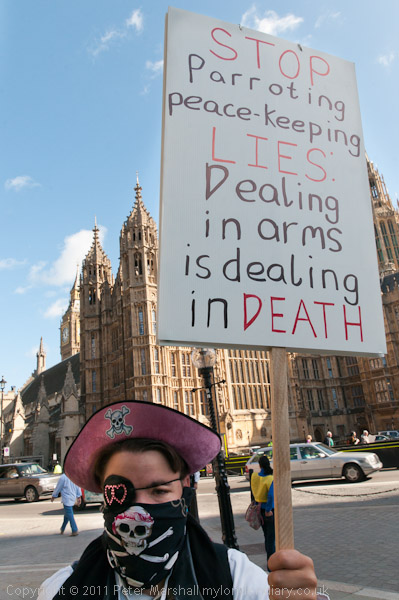
On Tuesday 13th September 2011, protesters against the worlds largest arms fair being held at the Exel Centre in East London brought their protests to some of the companies selling arms and to key sites including Parliament Square and th National Gallery which was hosting a dinner for the arms traders and their customers, including representatives of many of the most repressive regimes around the world.
Arms Fair Protest At Parliament, Old Palace Yard, Westminster
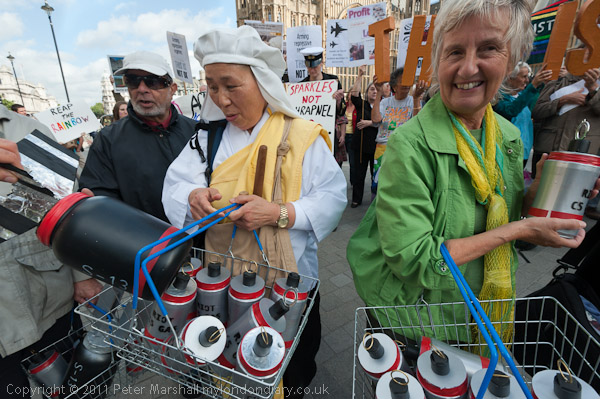
A queue with loaded baskets waits to pay at the arms fair supermarket opposite Parliament
Around 250 people came to protest against the DSEI arms fair which was opening that day in East London. Many were people who had been protesting at the site of the fair during the previous week. The fair is the largest in the world, a private event supported by the UK government, and despite government denials, many deals are made there for illegal arms and arms are sold to some of the worlds most repressive regimes who use them against their own civilians.
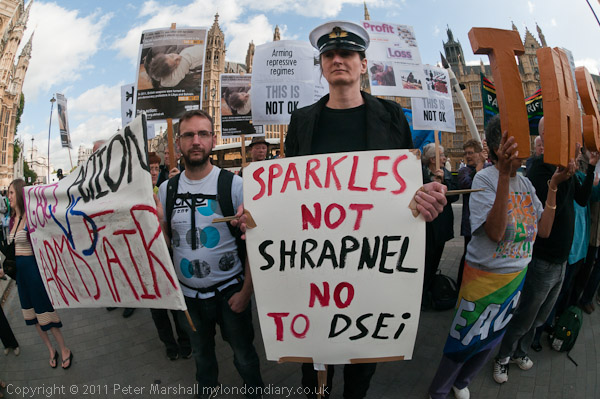
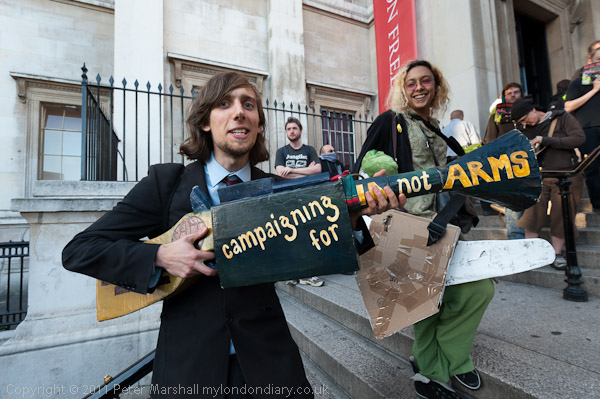
Many had come with posters and placards, but organisers CAAT (Campaign Against Arms Trade) came with fake arms to set up a supermarket where people could queue to buy riot gas, guided missiles, ammunition and other essentiaql supplies to keep their population down.
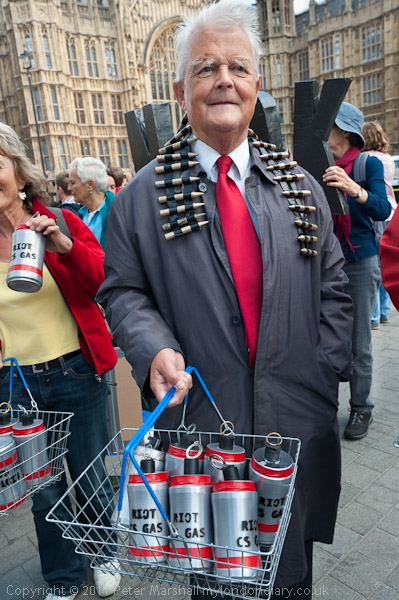
Bruce Kent with Riot Gas
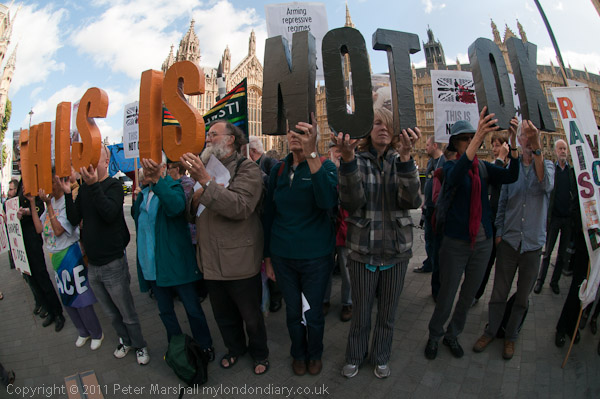
People held up letters spelling out ‘THIS IS NOT OK’ and then other posters and banners.
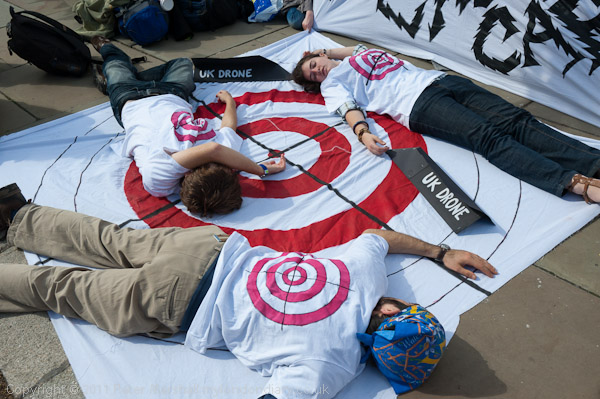
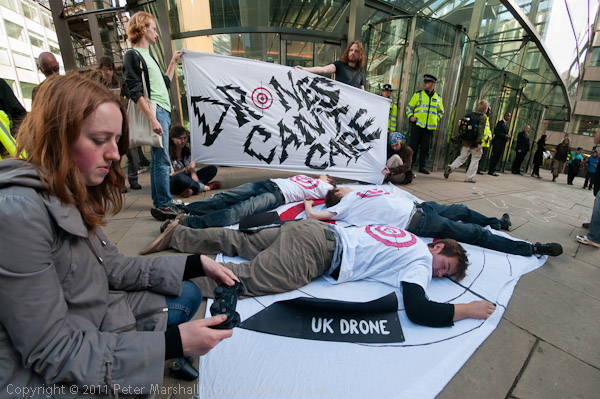
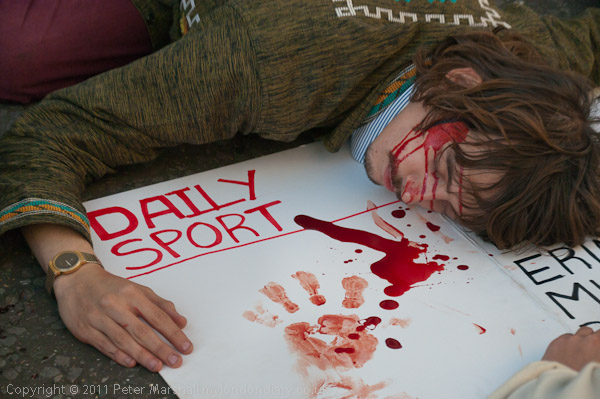
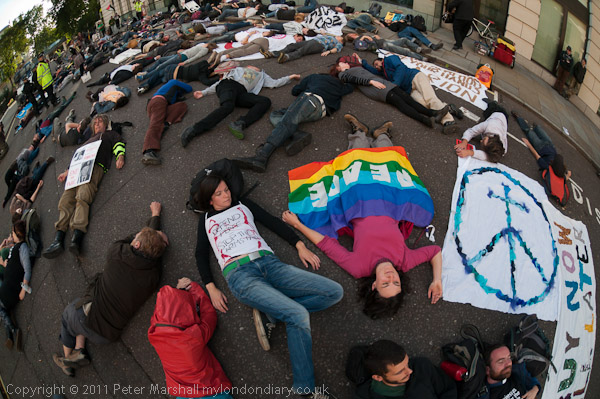
There were some songs, and anti-drone protesters staged a die-in as targets.
The country’s only Green MP (and one of the most sensible in the House of Commons) came to speak.
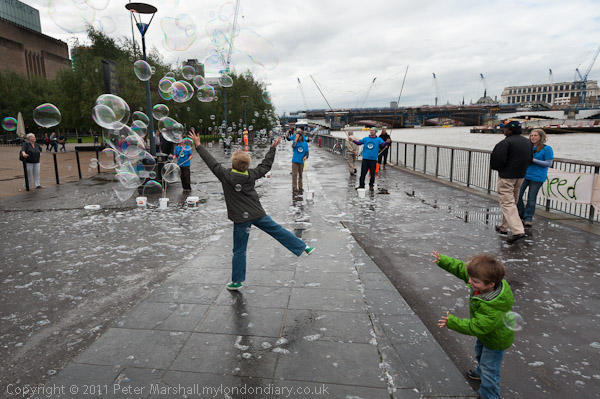
Dr Zig’s ‘Bubbles Not Bombs’ -Thames Embankment, Tate Modern.
‘Kids need human rights NOT cluster bombs’
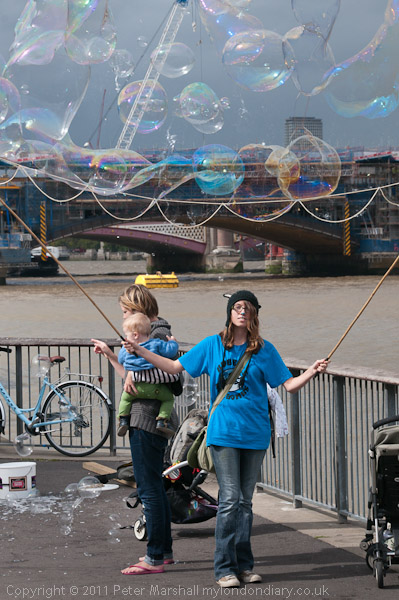
Those remarkable bubbers from Dr Zigs in Wales and made their “seriously HUGE bubbles” on the riverside walk outside Tate Modern, shouting “Bubbles not Bombs” as a child-friendly protest against the DSEi Arms Fair.
They say the DSEI fair is “where bad people the world over can come and buy the latest in guns, drones, warships etc.” and call for it to stop.
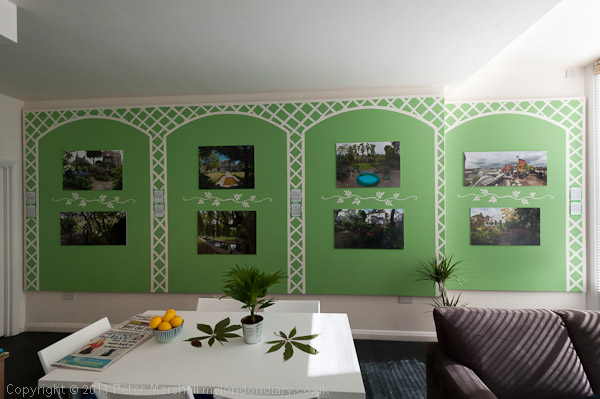
I just had time between protests to pop up to St John’s Wood and the Queens’s Terrace Café, where my show ‘Secret Gardens of St John’s Wood’ had been hung at the weekend when I had been too busy to be there. Jiro Osuga who had done the design and decoration and owner Mireille Galinou whose idea it had been had done a great job and it was ready for the opening.
Down the Drones Arms Fair Protest – Tower 42, Old Broad St
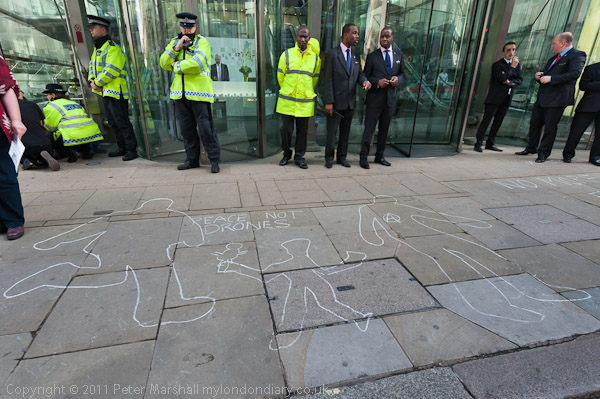
General Atomics ,makers of Predator and Reaper drones had their London office in Tower 42, still better known to many of us as the Nat West Tower, on Old Broad St Although there are wide areas of empty pavement most is land owned by Tower 42 and City police harassed protesters by ensuring they keep to the small area of public highway and then clearing them from most of it as they were then causing an obstruction.
There seemed to me to be no good reason why the police shold enforce the civil property rights of the estate owner which would not be harmed by a small incursion, nor harass the protesters on the public highway when others could easily walk by – as many always do – on the private land.
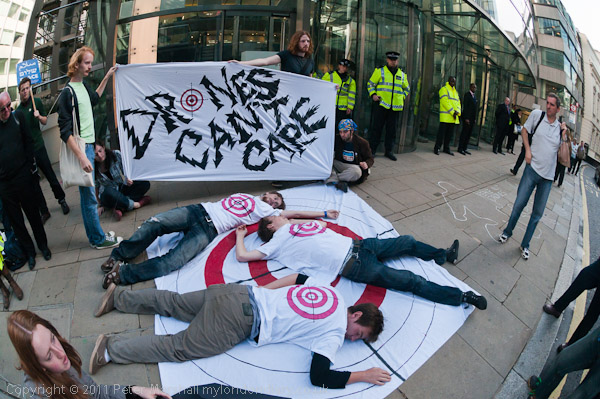
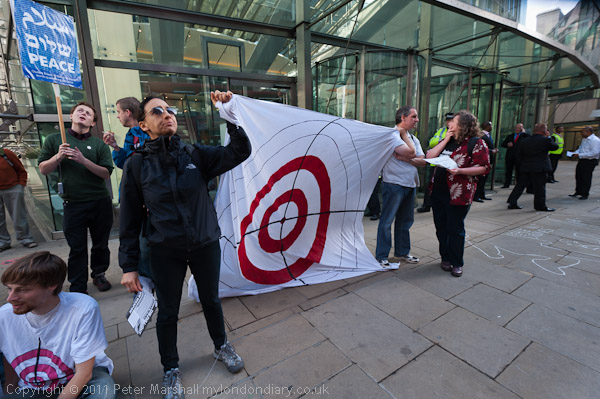
The protesters managed to chalk slogans and body outlines on the pavement, displayed banners, sang and handed out leaflets to passers by about the dangers of militarism but were not allowed to lie down on their target and invite passers by to ‘zap’ them with a Playstation controller in their game of ‘Remote Control Killer Robots’.
The US was then using around 48 Predator and Reaper drones in Iraq and Afghanistan, and the UK around 10 MQ-9 Reapers in Afghanistan, all controlled by pilots in an airforce base in Nevada. Various documents released by whistleblowers show that drone strike often take place on the basis of very limited and often unreliable evidence often killing innocent victims and any males in these countries who appear to be of military age and likely to be targets.
Using drones turns warfare for those ‘piloting’ them from a centre perhaps several thousands of miles from the battlefield into something very much like a computer game, removing any normal human inhibitions about the indiscriminate killing of others.
In the final few minutes police allowed three protesters to lie down on the pavement for a few seconds to enable photographers to take pictures.
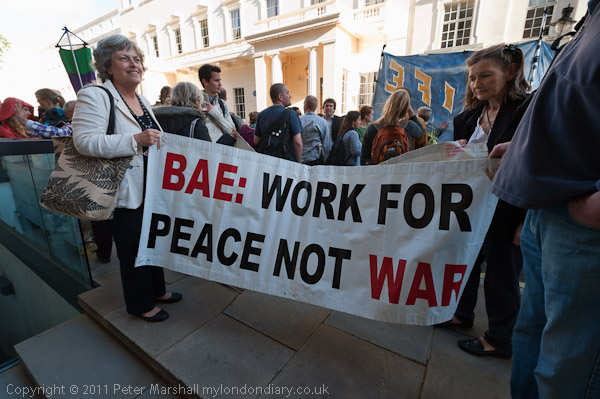
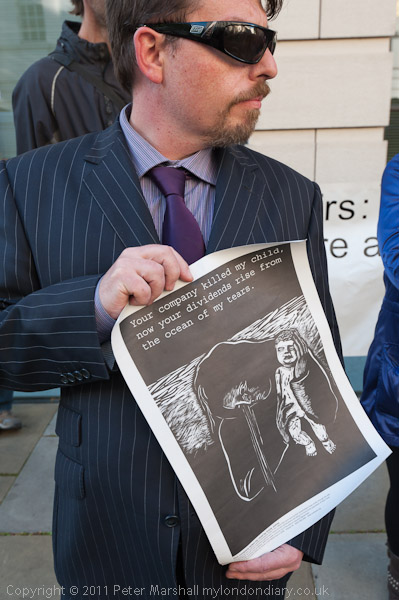
I’m not sure if there were any police for the protest outside BAE Systems in Carlton House Terrace which was the final advertised protest of the day. Perhaps the police were acting on advice from one of their plain clothes operatives who had told them there would be no trouble at this event.
BAE Systems is Britain’s largest manufacturing companies, formed in 1999 by the merger of British Aerospace with parts of Marconi Electronics and traces its history back to 1560 and the Royal Gunpowder Mills at Waltham Abbey, over the years having incorporated many of the famous names in UK industry, particular those involved in aviation and arms manufacture. It also has a US subsidiary, BAE Systems, Inc. The company was a nationalised industry from 1977 to 1981, with the UK government in 1985 selling its remaining shares except for one very special £1 share which it can use to prevent it becoming foreign-owned.
The company has been involved in a number of trade scandals, particularly over its deals with Saudi Arabia. Most recently in 2006 the Serious Fraud Office was forced by the Labour government to drop enquiries into bribery over an arms deal by BAE Systems with Saudi Arabia after a Saudi royal prince threatened cancellation of the order in 2006. The Campaign Against Arms Trade (CAAT) obtained a High Court decision that this government action breached the OECD Anti-Bribery Convention, but the government appealed and the law lords decided that national security should be an overriding principle and overturned the decision. So bribery, as well presumably as any other crime, is OK when it is in the national security interest.
The government’s decision to cancel the investigation was seen by most as an admission of BAE’s guilt in the matter, and they have also been under investigation for bribery in Chile, Romania, South Africa, Tanzania, the Czech Republic and Qatar and possibly elsewhere.
BAE systems are one of the world’s largest arms companies, producing fighter aircraft, warships, missiles and tanks along with other weapons. They are also one of the companies that will profit hugely from the replacement of Trident nuclear missiles, a high-spending and potentially dangerous project with no military significance.
After some short speeches about BAE, almost all of those present laid flat on the pavement for a die-in before getting up and leaving. Although this was the last advertised protest for the day, a message bad been passed around that there would be an action at the National Gallery, which was hosting a dinner for those attending the DSEi arms fair.
After a day of peaceful demonstrations against the DSEi Arms Fair in London, a fracas developed as police attempted to clear the National Gallery steps while a peaceful protest continued below in the North Terrace of Trafalgar Square. Well over a hundred protesters had come to the National Gallery as it was closing to protest at a dinner being given there for those attending the DSEi arms fair, including representatives of many of the most repressive regimes around the world.
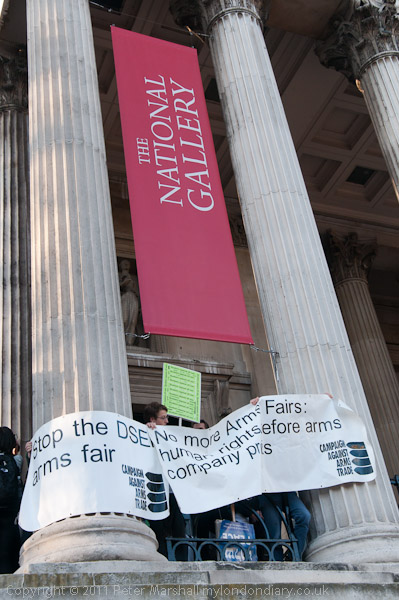
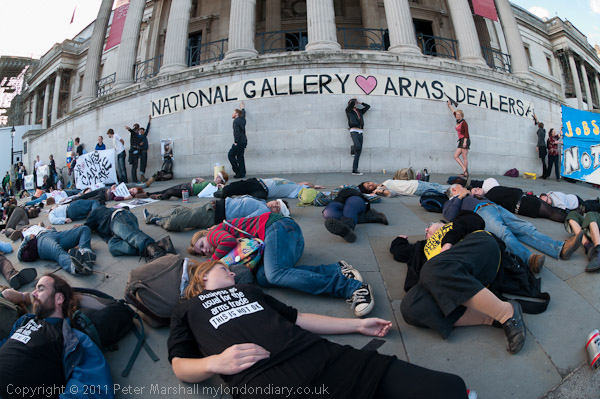
The protesters attempted to enter the Gallery as it was closing but were ushered out by security staff, and then began a peaceful protest on the steps of the gallery. Gallery staff asked protesters to leave the steps but some decided to stay and display banners there, while others continued to protest peacefully on the North Terrace in front of the gallery, displaying banners and holding a ‘die-in.
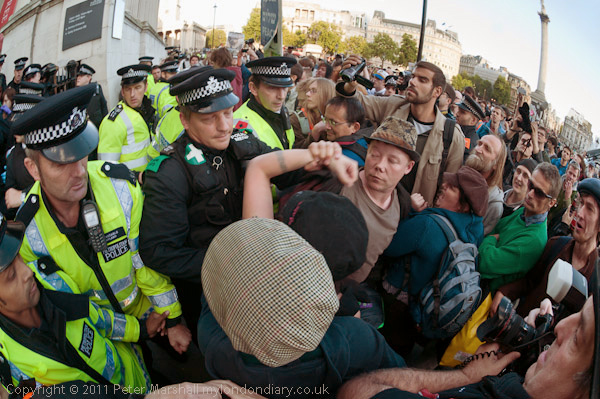
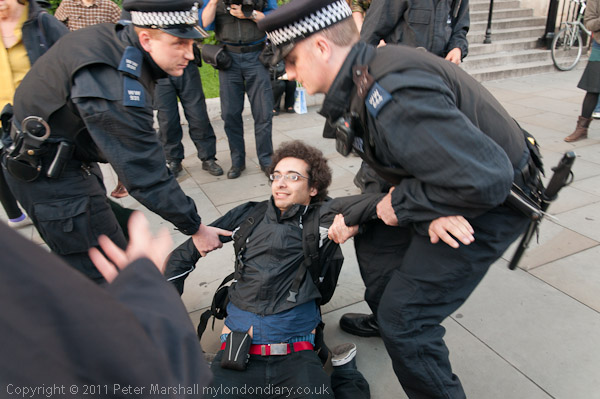
Eventually police got most of them moving slowly down the steps, though a few were still refusing to move. There was quite a lot of joking between some of the police and protesters and the atmosphere was generally friendly, although the protesters were not being very cooperative. Suddenly one of the protesters was seized and roughly carried away by police towards a nearby van. He did not appear to be formally arrested, and police would give no reason for his detention either to press, legal observers or protesters.
This changed the mood completely. Police reinforcements arrived and were able to force the protesters from the steps. There were a few incidents of what seemed thuggish violence towards both men and women. Some were arrested and dragged off to waiting vans; it was hard to be sure but their offence appeared to have been arguing and trying to protect themselves against police violence.
Meanwhile the protest continued peacefully on the North Terrace with a die-in and speakers explaining to the crowd that had gathered that the protest was calling for an end to UK arms sales to authoritarian regimes including Kuwait and Saudi Arabia, both responsible for the ruthless suppression of people in the ‘Arab Spring’ as well as countries involved in major armed conflicts and human rights abuses. I think many were shocked to learn that the UK was playing such a major part in this killing of people around the world – not something our media often dwell on.
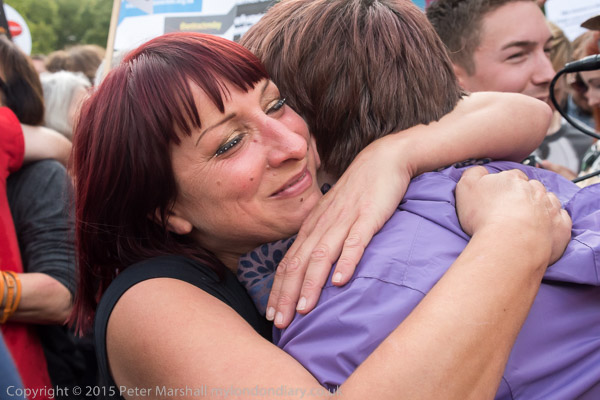
Saturday 12th September was an incredible day for British politics, as the result of the Labour leadership election was announced. Jeremy Corbyn had won what had seemed only a short time before an impossible victory, and one the could have been the start of a campaign which would have made great changes in British politics.
Instead it led to years of unrest in the Labour Party, with the right fighting against their own party leader who was enjoying huge popular support, both inside the party giving new hope to party members but also promoting policies that while enraging the establishment enjoyed a great deal of popular support in the country.
Of course they didn’t suit the powerful oligarchs who have actually run the UK for the last roughly 400 years and their representative who own and run almost all of our media went into full attack mode against Corbyn with lies and exaggerations and words taken out of context.
Had Corbyn been supported by the MPs and others in his party he might have weathered the storm and the result of the next general election could have been different. Of course Theresa May would not then have called an early general election in 2017 as she would have had far less chance of winning – and would not have had the support of Labour to do so.
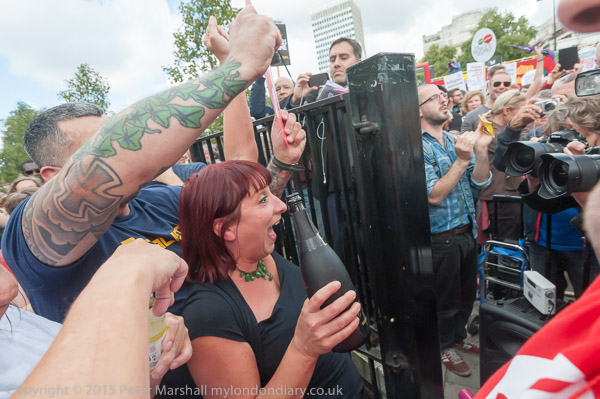
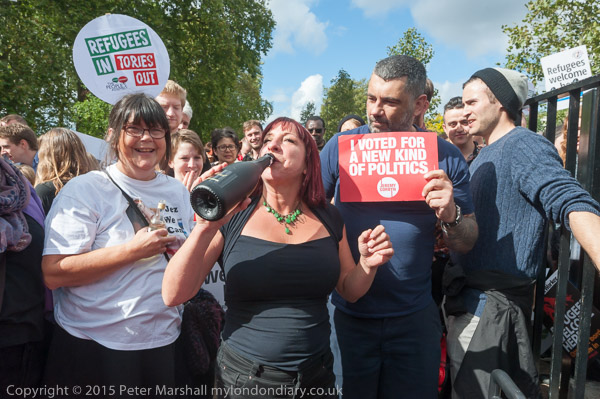
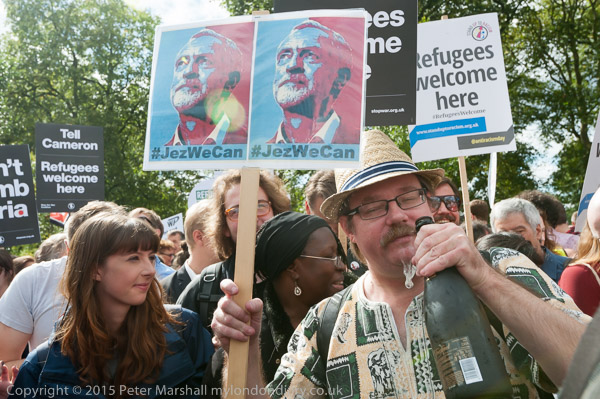
People repose their rejoicing for the cameras who missed the real thing
But instead Labour MPs and party officers set out on a campaign of dirty tricks and lies against Corbyn, including a carefully choreographed series of resignations from his shadow cabinet which severely weakened but failed to remove him. Labour threw away the 2017 election becase money was diverted from key marginals into safe seats, but in the end it was still a close thing – and you could see the relief on some Labour MPs faces after the result that they had lost became clear.
Parts of the anti-Corbyn campaign became clear in the leaked private report from the party to the Equality and Human Rights Commission, which was leaked shortly after Kier Starmer became leader. In particular this made clear the role of senior party officers trying to prevent Corbyn’s election as party leader and then their sabotaging his efforts to deal with antisemitism so as to continue attacks against him on this issue. Having read all 860 pages, which include 10,000 emails, thousands of messages from party’s internal messaging service, and 400,000 words from two WhatsApp groups used by senior party staff, while it may be selective and possibly inaccurate in some areas, its overall conclusions were unassailable. As the final publication of the Forde Report, though trying desperately to make it more palatable and removing much for legal reasons also makes clear on a detailed reading.
But in 2015 it was clear that the public wanted change and saw Corbyn as the man to deliver it. But most Labour MPs were unable to drag themselves out of their own old right-wing ways. It was a disaster for the nation and I think also the party, which show little sign of having learnt its lesson.
But had Corbyn won I think he would have disappointed many of his supporters by diluting policies under pressure from those rich and powerful oligarchs and revolts by Labour MPs who server their interests. And if he had tried to push them through and looked as if he would succeed we might have seen the democratic surface stretched to breaking point and a military government take over. This was the start of a was that Corbyn was destined to lose, and had his own party not stopped him others would have done so with all means necessary.
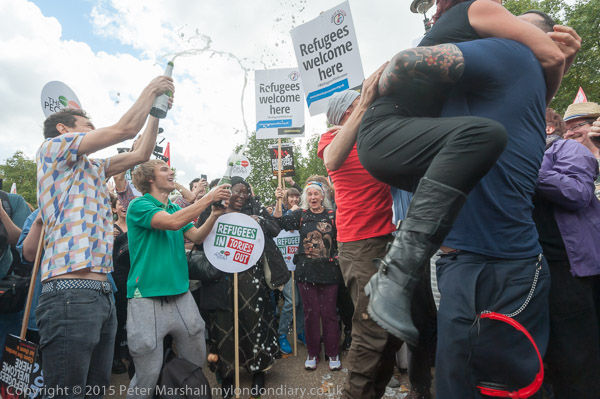
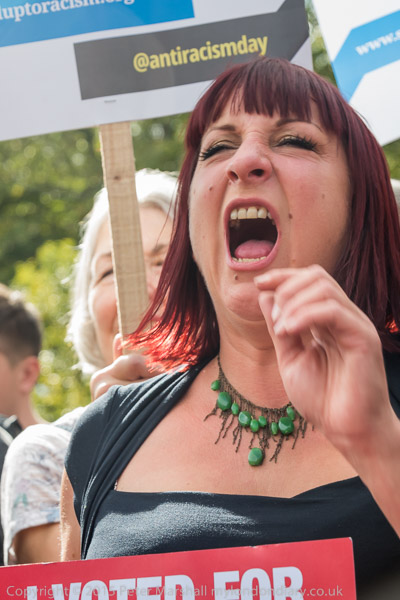
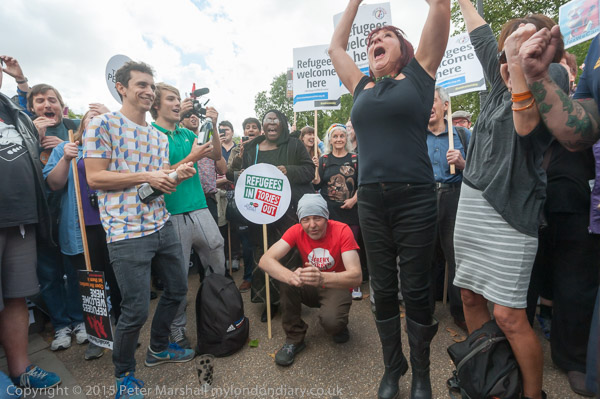
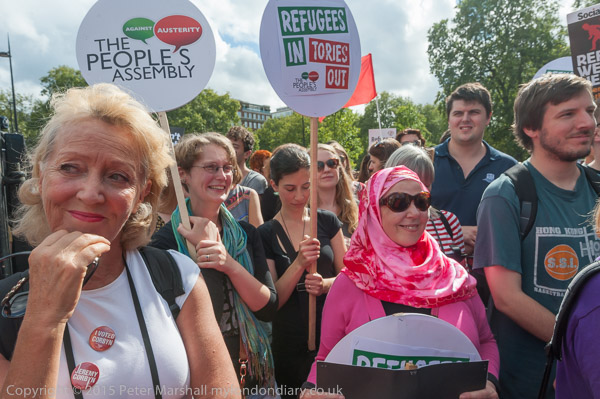
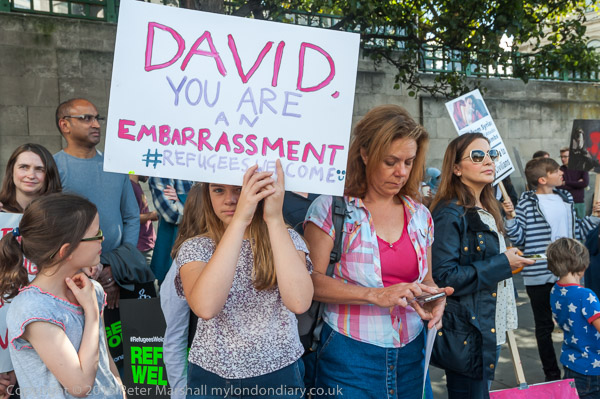
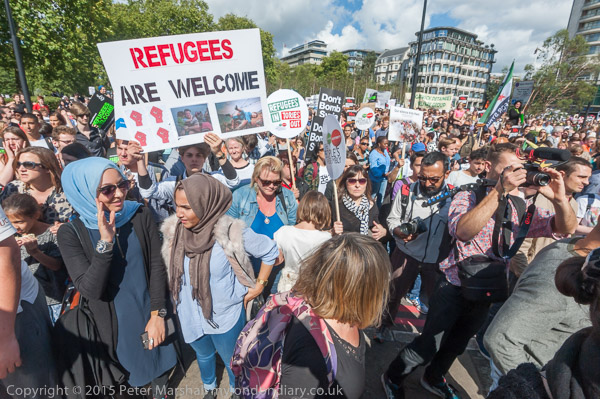
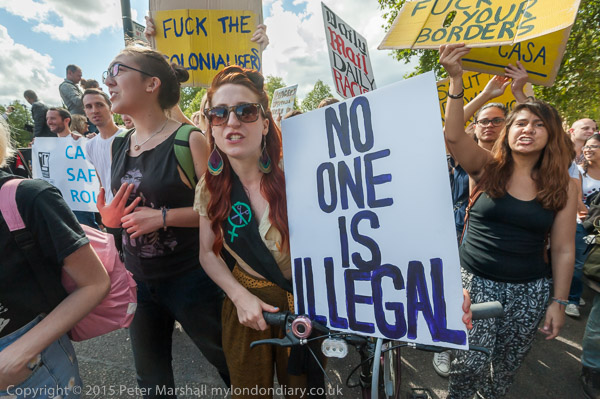
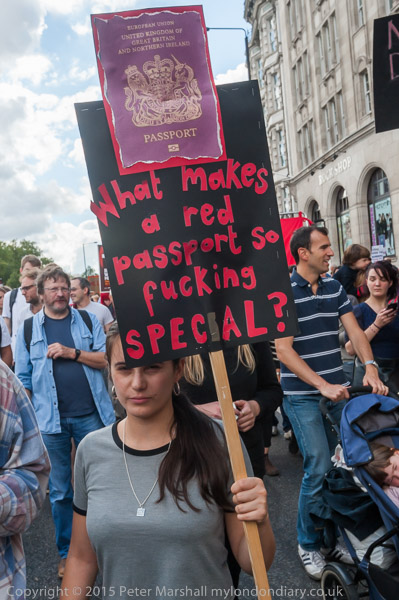
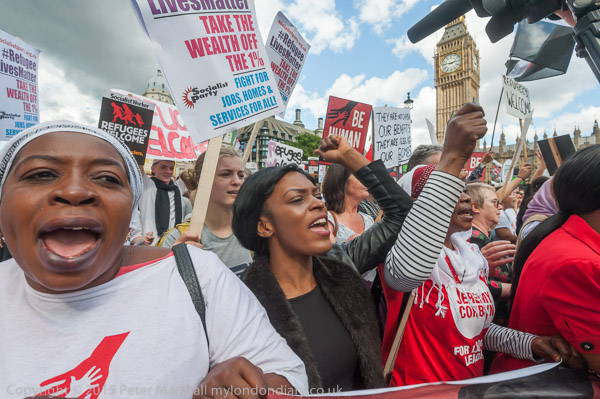
A short distance away from the Corbyn Victory party people were crowding into Park Lane for the Refugees Welcome Here national march against the many reports of refugees fleeing war and persecution, suffering or dying because of the paltry response by ours and other Governments.
The UK has been particularly poor in in its response to the crisis, making it almost impossible for asylum seekers to arrive legally in the UK – and locking up many who do get here indefinitely in our immigration detention centres. Its policy appears to be based on the same racist principles as Theresa May’s ‘hostile’ environment and playing to the racist views of the Tory right.
Before the march began there were a long list of speeches, though many of the crowd would have been too far away to hear them, even with the powerful amplication systems in place. You can see pictures of many of them as well as people in the crowd on My London Diary
Eventually the march set of, with over 50,000 having come from across the UK to show their support for refugees facing death and hardship and their disgust at the lack of compassion and inadequate response of the British government.
I started at the front of the march, then worked slowly with stream after stream of marchers on Piccadilly, eventually giving up at Green Park station, though there there were still marchers coming on as far as I could seen down the road. But I took the tube to Westminster to try and catch the head of the march as it arrived at Parliament Square.
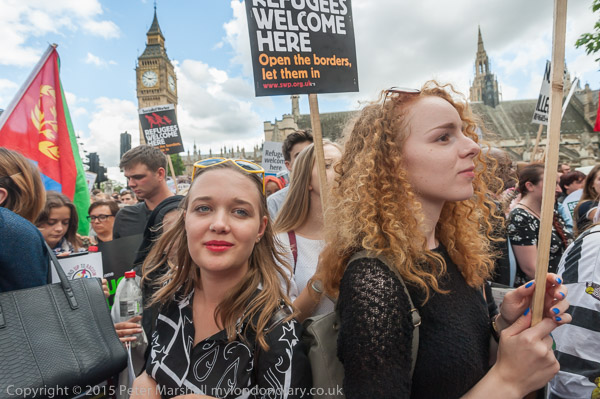
People were exultant as they reached Parliament Square at the end of the march.
Alhough there was still a ring of stewards protecting the front of the march some were friendly and allowed me to go through and photograph the people as they arrived in front of the Houses of Parliament. Many had marched in the white ‘I’m a Refugee’ t-shirts.
People were still flooding in to Parliament Square which was begining to look full, but by now I was feeling very tired, and despite the promise that Jeremy Corbyn would be among the speakers I decided it was time to have a very late lunch and go home. Others could listen to the speeches and photograph the rally which was now taking place.
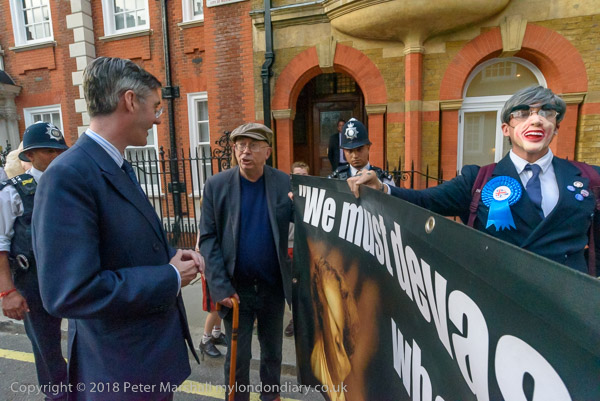
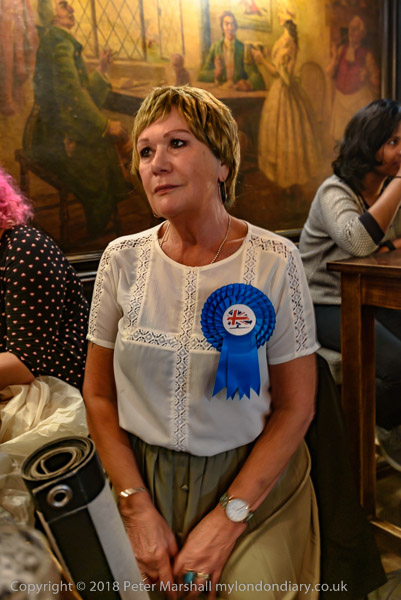
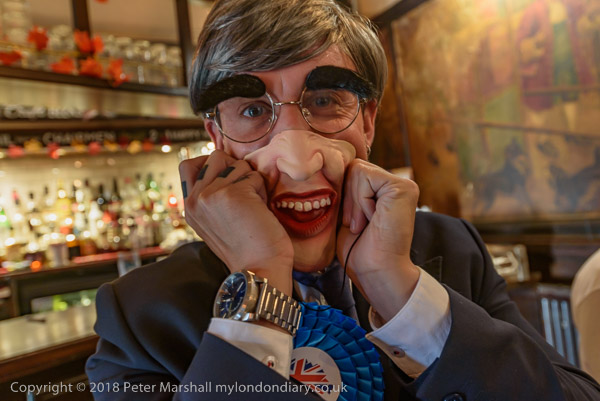
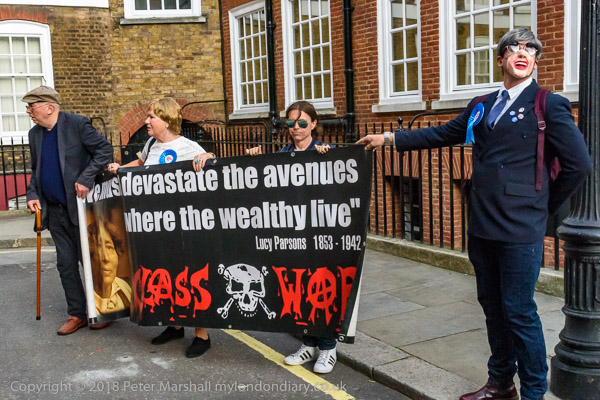
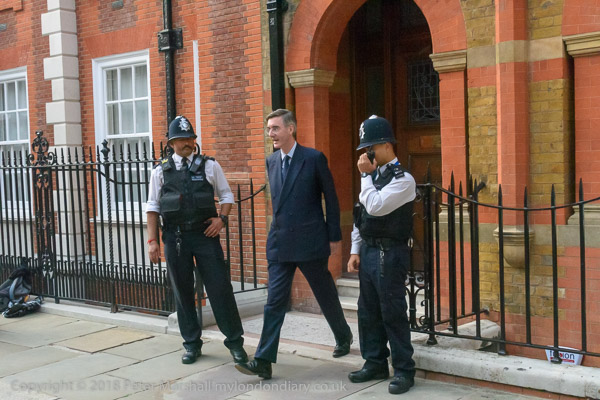
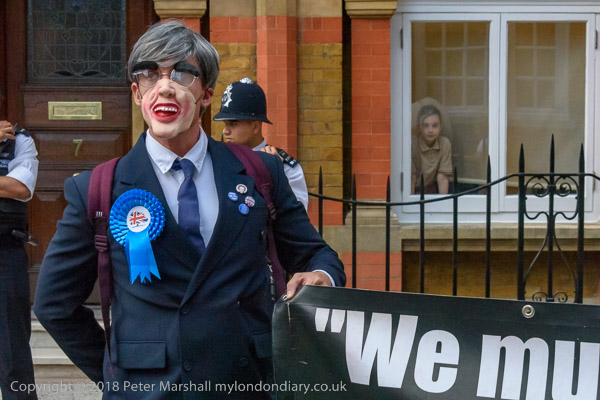
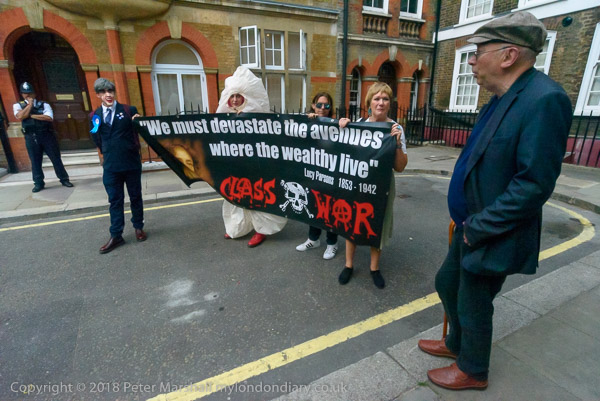
On Tuesday 11th September 2018 I accompanied Class War as they enacted a short theatrical protest outside the Westminster home of Jacob Rees-Mogg. I think it rather amused Rees-Mogg, who deliberately brought out his family and nurse to take part in it, later milking the event for every last ounce of publicity he could. I was impressed by his performance.
Class War had come to call for the release of Rees-Mogg’s nanny, Veronica Cook, who they say ceased to exist as an independent human 50 years ago and has been subsumed into the Mogg family as if she was being confined in the tower of a gothic mansion.
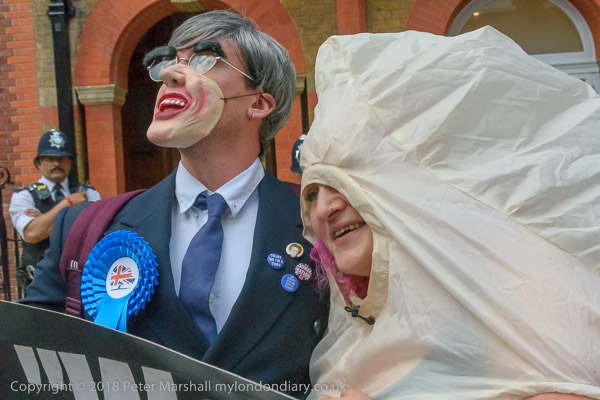
The playlet involved only six protesters, with Ian Bone as himself wearing a cloth cap, former Class War Westminster candidate Adam Clifford as an impressive Jacob Rees-Mogg, Jane Nicholl as a more fetching Nanny Crook and a giant penis, though this had problems in getting inflated and missed much of the action.
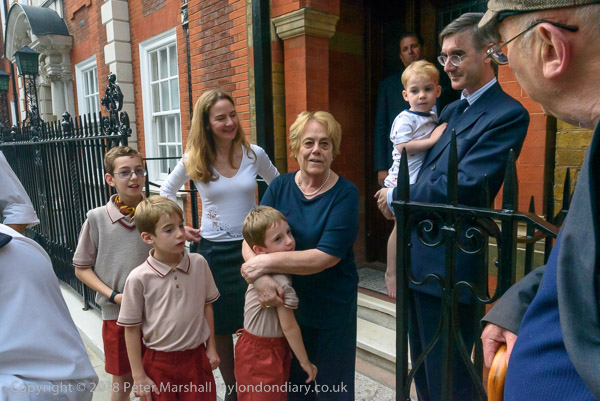
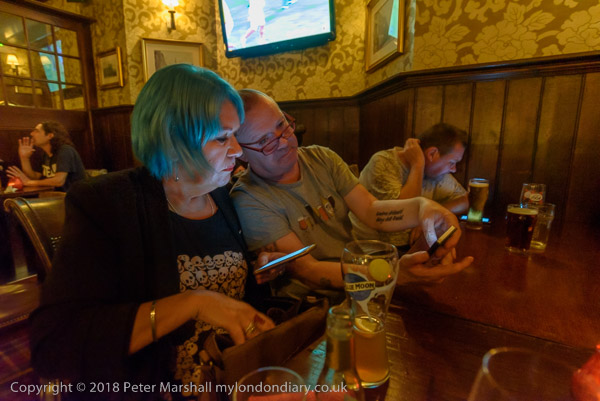
I’d met Class War in a nearby pub, where the performers put on their costumes and then walked along the street to the Mogg house. The performance had been advertised in advance, and family and security were waiting when they arrived and police had a short converstation with Class War who assured them that this would be an entirely peaceful event and there was no intention to cause any damage.
Jacob Rees-Mogg then strode out to meet the protesters, who were not really ready, just finishing unrolling their banner. A loud discussion started, with him being questioned about his nanny and how much she was paid but with him simply welcoming the protesters and refusing to answer. And in the background behind me the woman wearing the inflatable giant penis costume was struggling to get it erected.
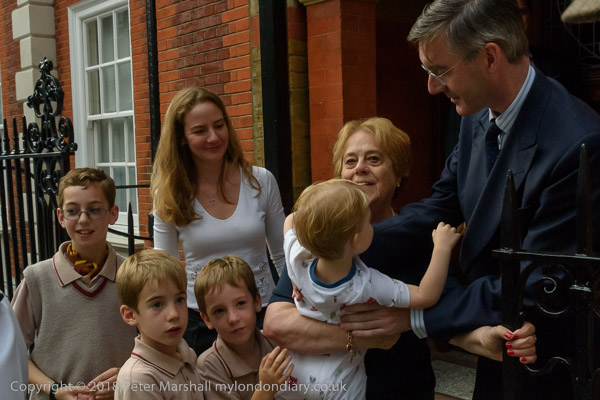
After a minute or two, Rees-Mogg was joined by his wife and eldest son, and shortly after the whole family was there with Nanny Crook carrying the baby which she handed to his father. The two elder boys in particular were clearly very interested in what was going on, and at no point in the event did they seem particularly upset in any way.
Ian Bone continued to loudly question Mr Rees-Mogg about the pay and conditions of Nanny Crook, repeating his questions as he failed to answer. After some time he invited Nanny Crook to speak and she told the protesters that she was very happy with the arrangements, though she did not answer about what these were.
They made Nanny an offer of escape, telling her she is paid at below the minimum wage, calling Rees-Mogg a “Slave Owner – The Leopold of the Mendips” and also suggested that she joined a trade union, offering her membership of the UVW. She only smiled, and her employer made clear that she had no interest in the offer of trade union membership.
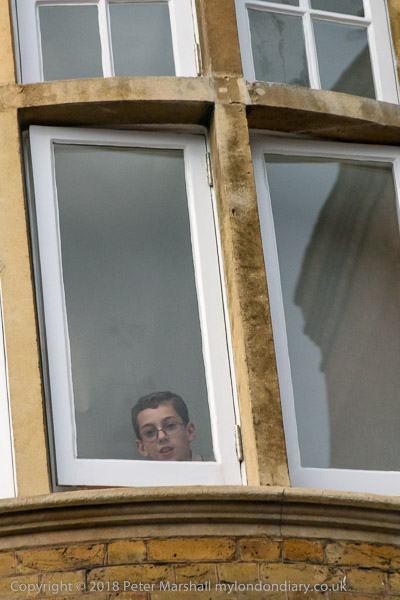
When nanny pulled down the blind the oldest son went upstairs to watch
At one point Bone turned towards the elder of the boys watching the performance, telling him loudly that a lot of people didn’t like his daddy and giving some reasons for this at some length. One of the protesters captured this on a video which was posted on social media and led to a national outcry from press and TV channels.
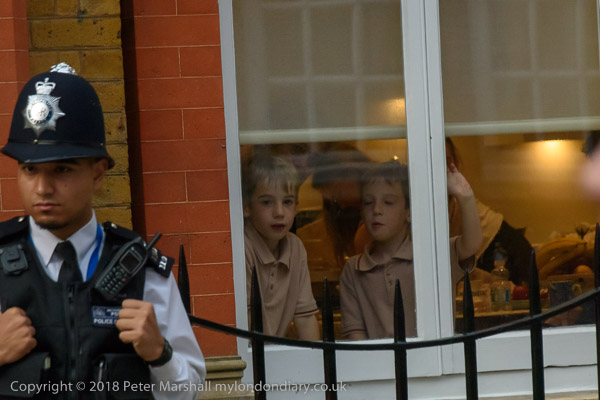
While another squeezed in front of the blind
One other journalist had arrived to photograph the event alongside me, and he rushed off to file his pictures which were widely used. I accompanied Class War back to the pub and only filed work later. One picture editor of a major national newspaper later told me he had failed to find my pictures as he searched for “Mogg” but I had used the keyword “Rees-Mogg” among those on my pictures.
Finally the giant penis joins the other protesters
I’d also filed a report of the event, but that was never even quoted, and I was never contacted by the media for my comments, nor I think was the other journalist. Our accounts would have totally contradicted the headlines used about Class War “ambushing” the family, which was simply a media smear.
As I comment on My London Diary:
“Jacob Rees-Mogg and his family were willing participants in what happened in front of their home. Their children did not seem upset, more fascinated with what was happening – and after they had been taken inside and the protest continued had to be dragged away from the windows. One made his way upstairs to continue to watch without being prevented from doing so. Almost all of the media commentary was a deliberate total misrepresentation of what had taken place.”
Class War watch their video in the pub before they upload it
Both Rees-Mogg and Class War revelled in the publicity they got from the event, with Ian Bone being labelled by one opinated right-wing radio show host as “foul-mouthed” for telling the interviewer he was talking “bollocks” when he raved and blustered at the remarkably level-headed, clear and accurate acount Bone gave of the event. I felt he should have added the word ‘absoute’ in front of it but otherwise it was hard to fault.
I had been following the events around Dale Farm with interest, but had decided that travelling to the site where some colleagues in the NUJ had been covering events for some time was too difficult and time-consuming. What was happening there was already getting considerable media coverage and I could add little to it and my time and very limited resources would be better spent on less high profile events.
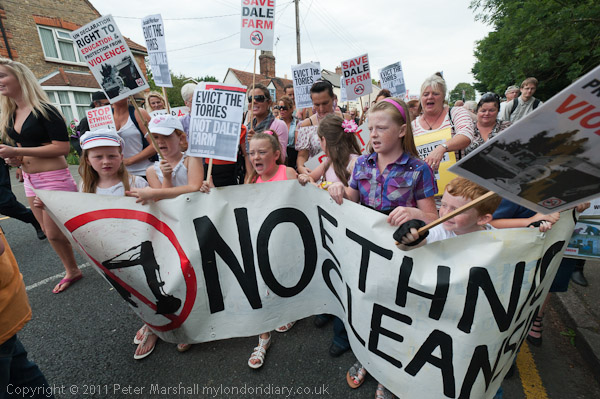
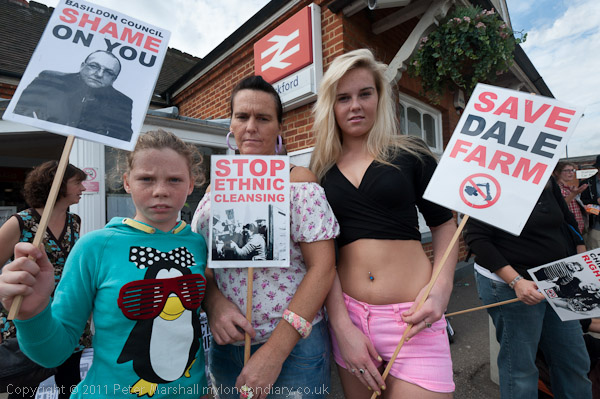
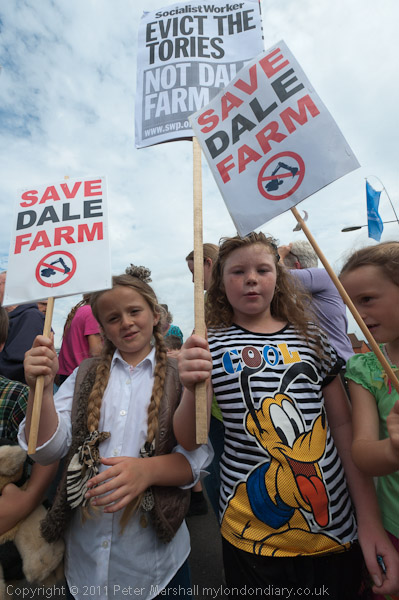
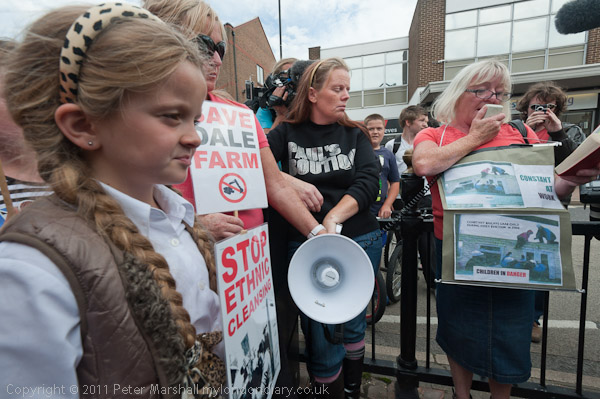
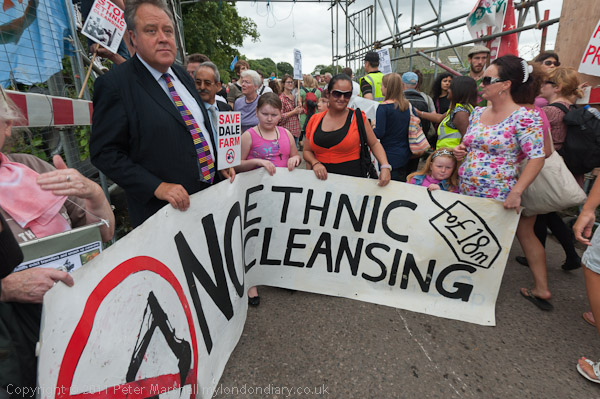
So I’d not been to Dale Farm, and didn’t go to the eviction which finally took place on 19th October, but my interest in what was taking place there did prompt me to go down to a protest march from Wickford Station to the Dale Farm site on Saturday 10th September 2011.
My earliest involvement with travellers had been in the 1960s, when a group who had been evicted from other sites in the city encamped for some time on land close to and owned by the university. Along with many other students I went to the site and met many of the residents as well as attempting to stop the university from evicting them.
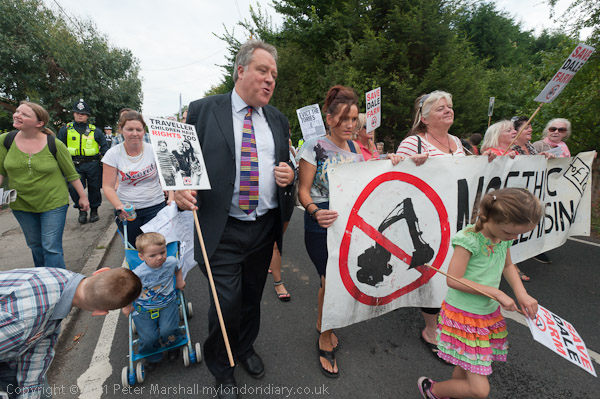
There was a short service before the march
Travellers move around during much of the year but during winter want to settle in a fixed site. Local authorities have the powers to provide sits but not a duty to do so. In January 2011 according to the twice-annual government surveys there were roughly 18,000 traveller caravans with almost 7,000 on authorised public sites and a further 8,000 on authorised private sties, with around 2,500 on unauthorised sites.
Euro MP Richard Howitt talking to Dale Farm residents on the march
In 2021 research showed long waiting lists for pitches on public sites, with almost 1700 on the list but only 59 permanent and 42 transit pitches available nationwide. And many of those available had be labelled as “not fit to use” and “in a terrible state” by locals, with 20 having no electricity available. Travellers call for an end to the increasing harassment of those on unauthorised land and a statutory duty on authorities to meet the need to provide sites – and police also see this as the solution to unauthorised encampments.
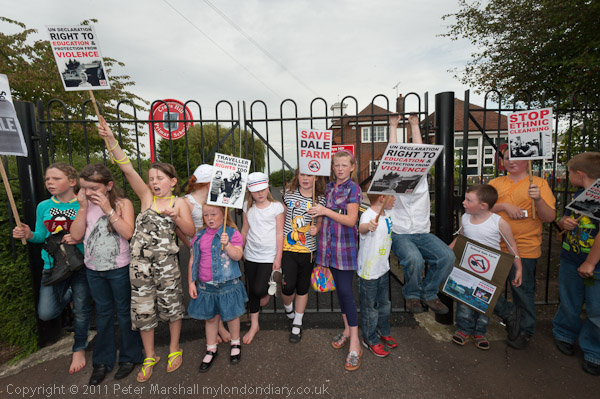
Dale Farm children outside the gates of Cray’s Hill Primary School
Wikipedia states that Travellers first settled around Dale Farm in the 1960s on Green Belt land that was in use as an unauthorised scrap yard. Eventually following legal battles with Basildon Council some on a part of the site were granted limited permission to remain on a small area of the site, Oak Farm, and are still there. Travellers bought the land from the scrap dealer who had been bankrupted by costs for breaching Green Belt provision in 2002 and the site began to grow, becoming the largest Traveller site in Europe.
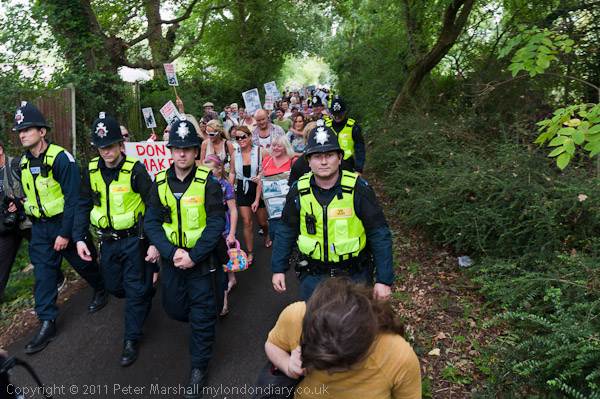
Police escort the march closely as it nears Dale Farm
The council, who had used part of the site as a dumping ground for tarmac and rubble from roadworks refused to give any further permissions on the grounds it was Green Belt, and legal battles continued. Deputy Prime Minister John Prescott became involved in 2003 with an order intended to give the Travellers and Basildon Council two years to come to an agreement, but they made no progress. Legal battles continued, with the residents winning their case in the High Court in 2008 only to see this reversed by the court of appeal in 2010.
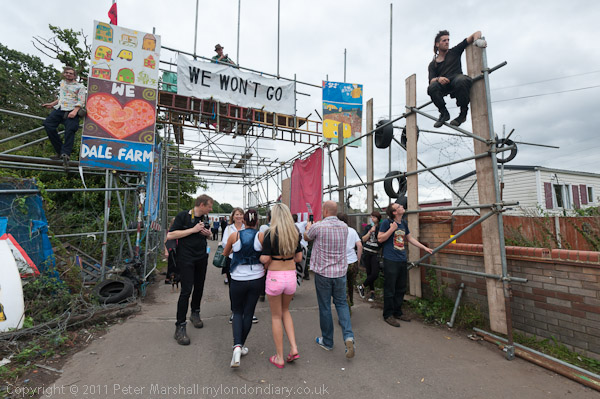
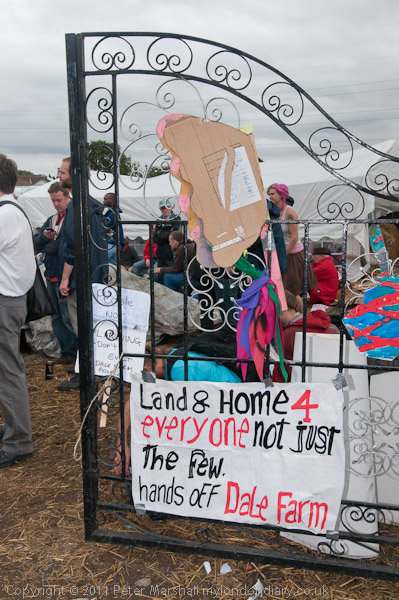
Anti-eviciton activists on the gates to Dale Farm
The Wikipedia article gives considerable details on the legal battles and the process of eviction, carried out with considerable force by bailiffs and police, providing those press who had been barricaded inside the site with residents for some days with some dramatic images. Many of the travellers had left not long after this march several weeks before the eviction to avoid the violence, camping illegally elsewhere.
Years later the rubble of the former illegal settlement created by the eviction remained on the site in what the Daily Mail described as “polluted wasteland blighted by rubbish and the decaying remains” despite Basildon Council’s claim at the time of the eviction it would return the site to Green Belt. It is so bad that many Travellers in the adjoining legal site Oak Farm now want to leave the area.
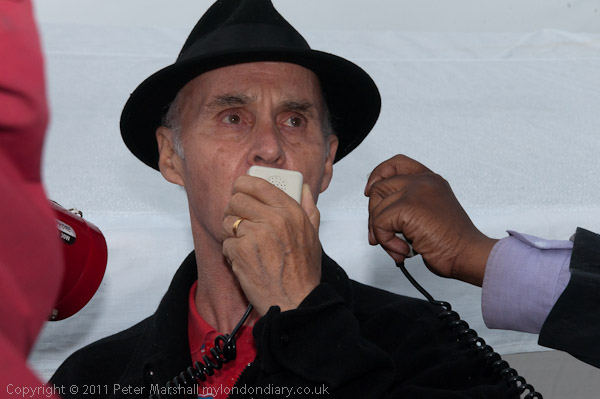
Secretary of the Roma Federation Grattan Puxon
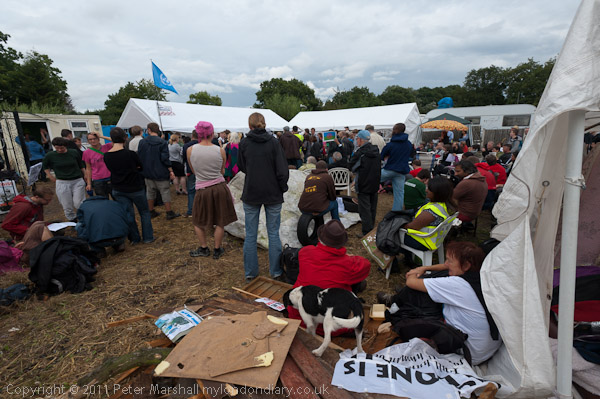
The march on Saturday 10th September took place while Travellers were still living on the site and hoping still to be able to stay there. My report in My London Diary gives a long account of the event and picture captions add to this.
As I noted in it, the only slight unpleasantness came not from the Travellers but one of their supporters who tried to stop the press coming on to the site. After around ten minutes one of the women leading the Travellers insisted we should be allowed in to report the rally.
Basildon Council had throughout seemed determined not to accept solutions to the battle proposed by others, including the Homes and Communities Agency who had put forward an alternative site, and it was hard not to see their attitude to the Travellers as fundamentally driven by racism. The UN Committee on the Elimination of Racial Discrimination had a week or so before the march called on the Council to find a peaceful and appropriate solution and suspend the “immature and unwise” eviction, saying it would “disproportionately affect the lives of the Gypsy and Traveller families, particularly women, children and older people“.
GH Metals is I think still operating in Evelina Rd, although its premises are now covered by graffiti and there are no prices on the list of metals still above the shopfront. Their web site states the family have run successful scrap metal yards all over South London and in Peckham since 1968.
Evelina, or the History of a Young Lady’s Entrance into the World was the title of a novel by Fanny Burney published in 1778 but I suspect the road like the Evelina London Children’s Hospital was named after the English wife of the wealthy Austrian Baron, Ferdinand de Rothschild – she died in 1866, probably around the time the street began to be built up.
R E Sassoon House, St Mary’s Rd, Peckham. Southwark, 1988 88-12e-44
From Evelina Road I went up St Mary’s Road, photographing the strangely squat St Mary Magdalene Church (not digitised) , described on the Twentieth Century Society’s web site as “a bold and innovative 1960s landmark” but sadly demolished by the Church of England and replaced by a building “of no architectural merit”. Designed by Potter and Hare it was built in 1961-2 and demolished in 2010.
Sassoon House designed in an International Modernist style by Maxwell Fry is Grade II listed and was built as a part of the Peckham project around the neighbouring Pioneer Health Centre in 1934 to provide high quality social housing. The Sassoon family were one of the wealthiest in the world, known as the “Rothschilds of the East“ amd when R E Sassoon, the amateur jockey son of the philanthropist Mozelle Sassoon, was killed steeplechasing in 1933 his mother commissioned this block in his memory.
Queens Road, Peckham, Southwark, 1988 88-12e-32
I’ve only digitised one of the six frames I exposed on Queens Road, where there are several listed buildings on the corner and just to the west of St Mary’s Rd. This is Grade II listed as ‘QUEEN’S ROAD (South side) Nos.156 and St Mary’s Court (No.158)’ and the houses date from around 1845.
Montpelier Rd, Peckham. Southwark, 1988 88-12e-21
Montpelier Road (single L) was apparently named in 1875 after Montpellier in France (2Ls) which was a fashionable resort at the time and is now the seventh or eighth largest city in France. As well as one of the oldest universities in the world with an historic centre and the famous the Promenade du Peyrou from which you can on a clear day see the Meditteranean, Montpellier was also well-known for its wine. Montpelier Road has none of these and previously the road had been called Wellington Villas. It may have taken the name from the nearby Montpelier Tavern in Choumert Road, which although in a more modern building probably dates back earlier.
This unusual terrace of houses is fairly typical of most of the west side of the street which ends at Meeting House Lane.Those further up the street are a little more decorated.
London Customs, Hart Lane, New Cross, Lewisham, 1988 88-12e-25
I walked back along Queen’s Road towards New Cross where there is now no trace of the building at No 3, though these is still a garage workshop, now 3a. But the name that had attracted my attention has gone. I imagine it offered the service of customising cars rather than any interest in the customs and traditions of the city. I thought it might make a good title picture.
Cold Blow Lane, New Cross, Lewisham, 1988 88-12e-13
I made a single exposure while walking north up Brocklehurst Street (not digitised) showing the window detailon this long street of identical houses, probably pressing the shutter out of boredom, and then turned into Cold Blow Lane, where there are the solid brick piers of a dismantled railway bridge leading to a narrow tunnel still takes the road under the railway, followed by a newer brodge under more lines with a slightly wider roadway underneath.
It was a rather scary walk underneath, though not as scary as it might be had it been a match day at the Millwall stadium nearby – still then at the Old Den in Cold Blow Lane.
Elizabeth Industrial Estate, Juno Way, Cold Blow Lane, New Cross, Lewisham, 1988 88-12e-15
Juno Way was between the railway bridges over Coldblow Lane, but is now closed off at this southern end by a continuous fence between the bridges and can only be entered from Surrey Canal Road.
The building with the tower carrying the estate name was once the Mazawatee Tea factory, purpose built for them in 1901 when they were the largest tea company in the world. As well as tea they also processed coffee, cocoa, cakes, sweets and chocolates here and doubtless some raw materials would have come here on the Surrey canal from the London docks. It employed up to 2000 people but was heavily damaged by wartime bombing. The name is from the Hindi ‘Maza’ – pleasure – and the Sinhalese ‘Wattee’ – garden – and thus reflects two of the areas from which they brought tea. It was the most advertised brand in the UK until the Second World War.
The tower building was renovated from a complete shell in 2011 and ‘Unit 13’ now houses 12 self-contained studios with high ceilings and good natural light, including the 2300 square foot Tea Room Studio and a number of smaller spaces on the top floor.
I still had a little way to go on my walk and a few more pictures – I’ll post the final instalment of this walk later.