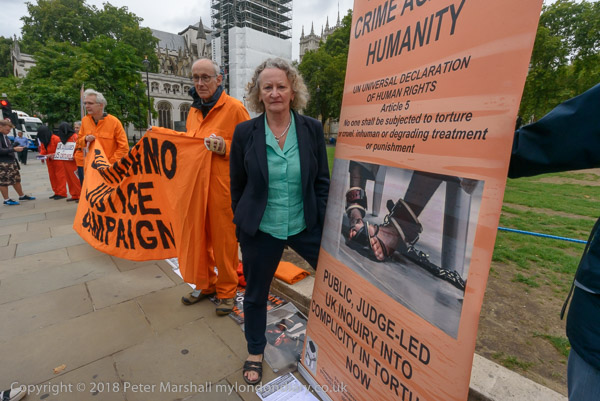
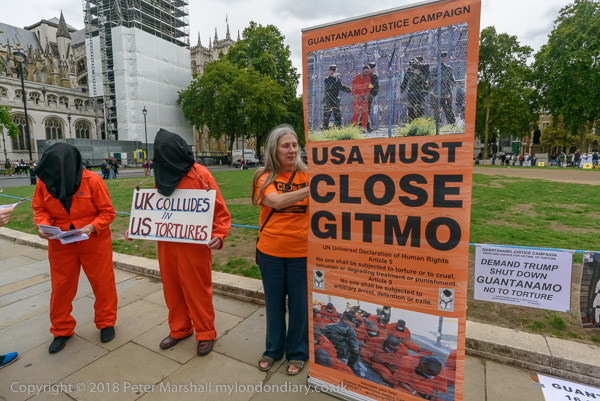
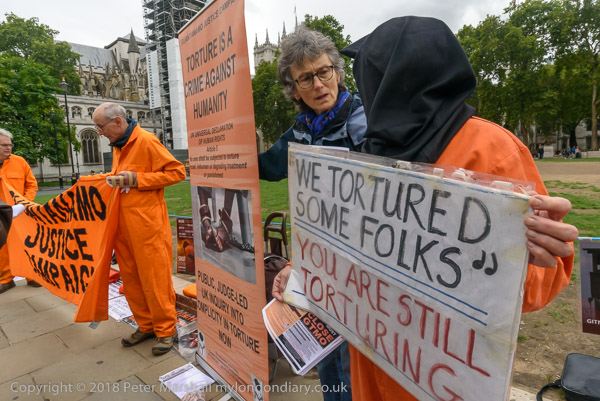
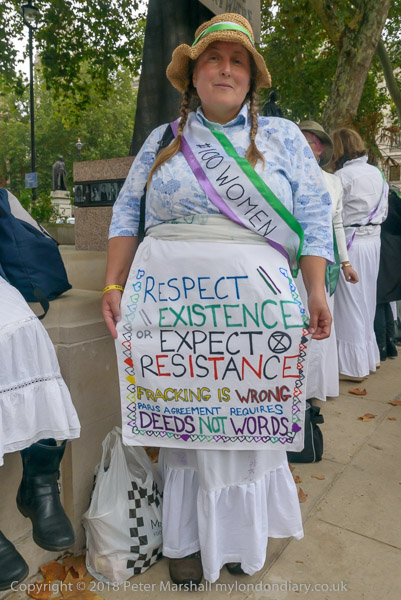
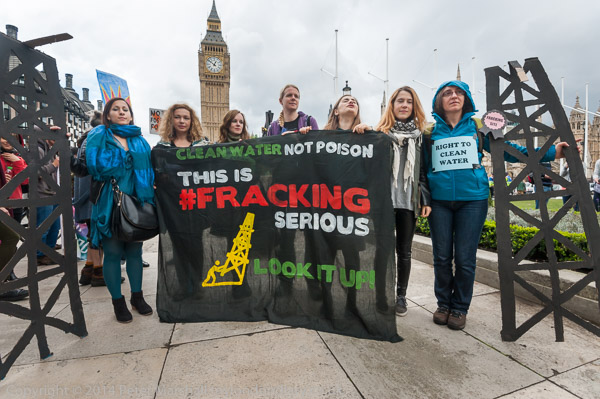
Guantanamo & Nanas Against Fracking: On Wednesday 12th September 2018 I went to Parliament Square where the Guantanamo Justice Campaign was holding a monthly vigil calling for an end to the illegal torture camp at Guantanamo and Nanas from Lancashire with others were calling for the government to end fracking. Later I went with the Nanas who marched to protest at the Department for Business, Energy and Industrial Strategy in Victoria St.
Trump told to close Guantanamo
Parliament Square
Baroness Jenny Jones came to visit the vigil
Another monthly vigil opposite Parliament called on UK Prime Minister Theresa May to make urgent representations to President Trump to close Guantanamo and end the brutality and torture which is continuing against the 40 men then still held there in indefinite detention.
They demanded Trump respect human rights and internation law, saying the illegal camp is a legal and moral outrage and a symbol of US torture and injustice.
The protesters were joined briefly by Green Party member of the House of Lords Jenny Jones, Baroness Jones of Moulsecoomb.
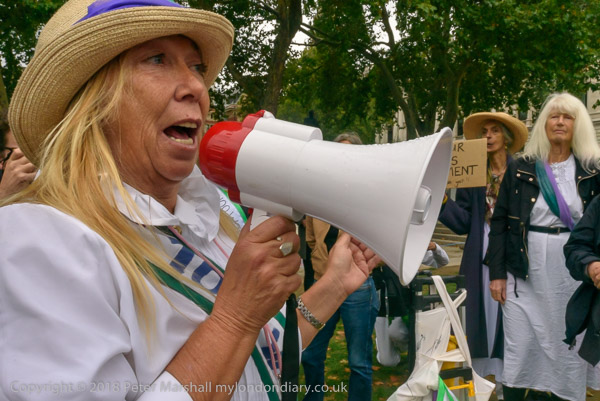
Lancashire Nana Tina-Louise Rothery speaks at the protest
Following 3 months of “Love & Defiance” that took place from April-June in Lancashire by the Nanas they came to London to tell the government to stop ignoring science and the will of the people and ban fracking.
As well as threatening the areas of the country in which it was taking place with earthquakes and pollution, fracking is also a threat to the future of the planet through its high level of carbon emissions.
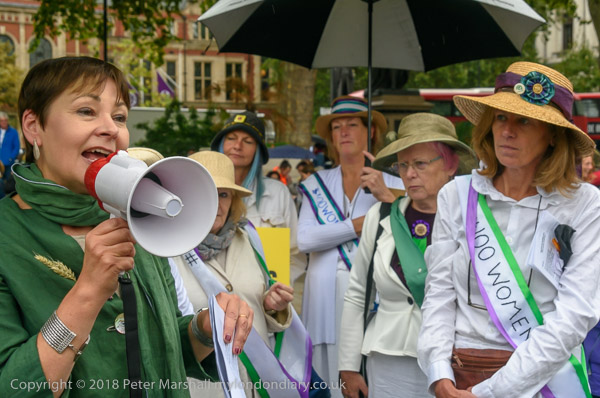
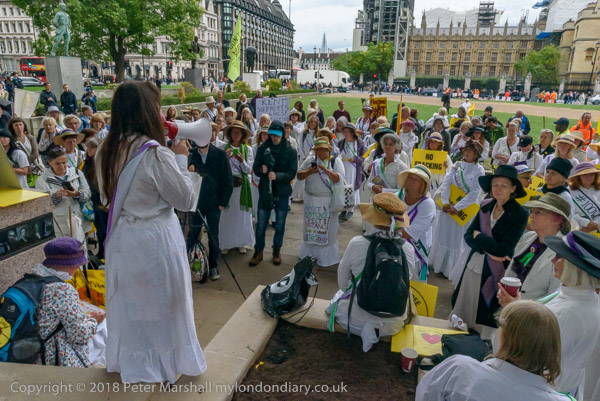
Many of the protesters wore suffragette costumes to mark the 100th anniversary of women first getting the vote in 1918 and called on the government now to make voting mean something. The rally took place in front to the statue of suffragist campaigner Millicent Fawcett.
Green Party MP Caroline Lucas
Speakers at the rally included Ruth George, Labour MP for High Peak, Jenny Jones, Baroness Jones of Moulsecoomb, Mike Amesbury, Labour MP for Weaver Vale, Lancashire Nana Tina-Louise Rothery, Shadow Chancellor John McDonnell and Green Party Deputy Leader Amelia Womack.
Also speaking at the rally were women against a proposed move of the statue of suffragette Emmeline Pankhurst, funded by suffragettes in 1930, from Victoria Tower Gardens next to the House of Lords to Regent’s Park, which they described as an “act of vandalism against women’s history“.
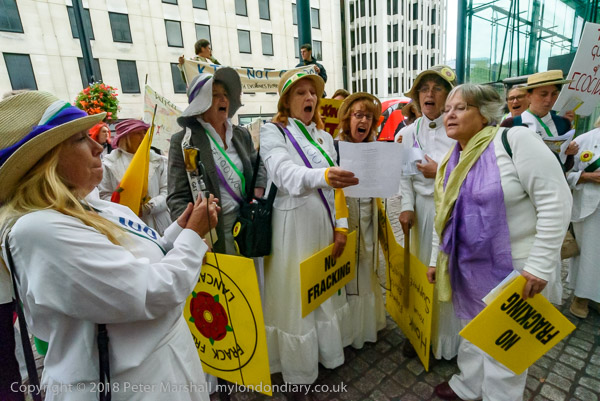
Nanas sing in protest against fracking at the BEIS
At the end of the rally in Parliament Square, the anti-fracking women protesters in Suffragette dress marched around the square and on to the Department for Business, Energy and Industrial Strategy in Victoria St for a noisy protest there.
Women get ready to march to the Department for Business, Energy and Industrial Strategy in Victoria StOutside the Department for Business, Energy and Industrial Strategy
One woman climbed on the low wall in front of the delivery bay at the centre of the frontage and others followed with more moving inside behind to support them.
The protest continued between the two wings of the offices and on the pavement in front with much shouting and singing.
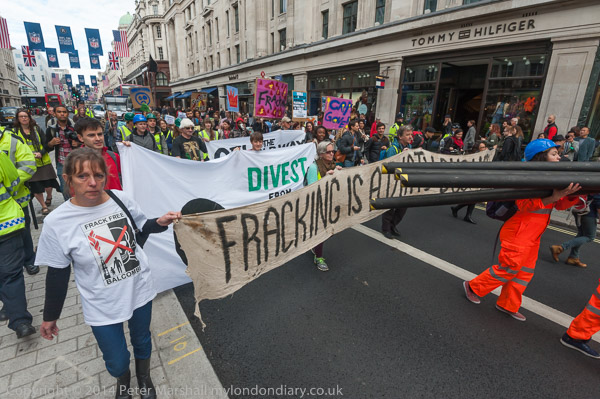
Global Frackdown TTIP & Kobane: On Saturday October 11th 2014 I photographed a protest against HSBC supporting fracking in the UK, against the secret TTIP US/EU trade deal and finally a rally in support of the Kurdish fight against ISIS in Kobane and against Turkish support for the ISIS militants.
Global Frackdown at HSBC
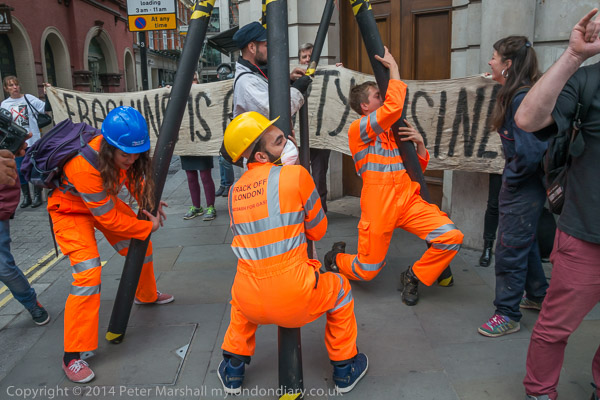
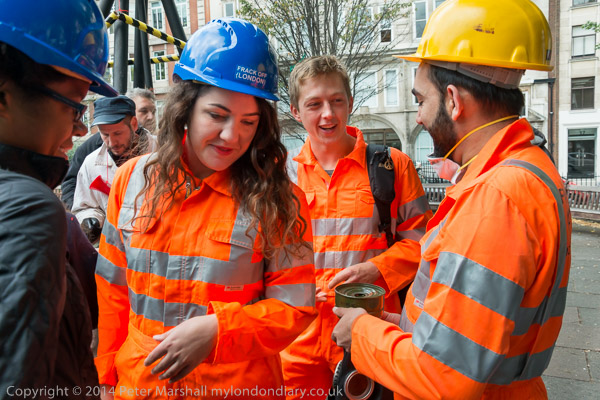
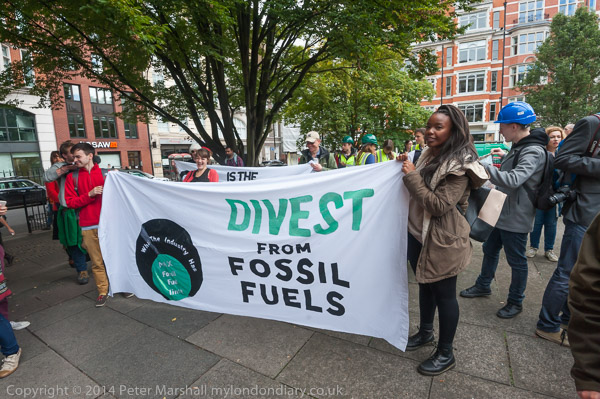
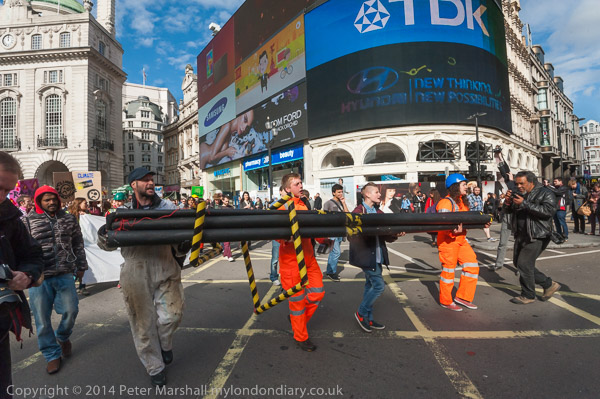
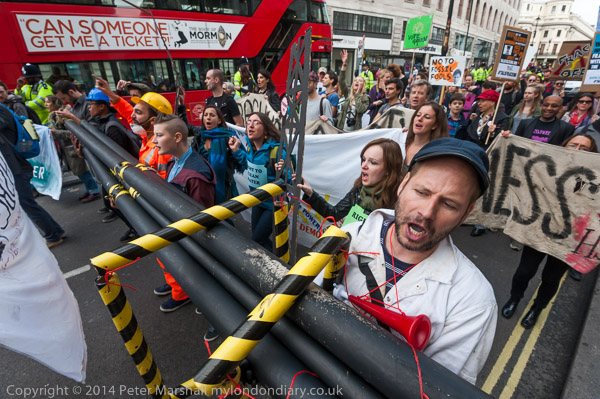
As a part of a ‘Global Frackdown’ by communities around the world against this environmentally destructive industry which leaves a legacy of water contamination, air pollution and health problems, activists took a mock ‘fracking rig’ to two branches of HSBC in central London. UK anti-fracking campaigners were joined by some from Algeria and Romania.
The HSBC bank provides banking services for Cuadrilla the oil and gas exploration and production company developing fracking in the UK and also funds fracking around the world. In Algeria, they are helping to bring this water intensive process to the Sahara and in the US, they underwrite the BG Group responsible for fracking in large parts of the country.
As well as the particular problems caused by fracking produces a dirty fossil fuel whose use deepens the climate crisis. But it was largely the earthquakes caused by Cuadrilla’s exploratory drilling that led to a moratorium on it in 2019 in England & Wales. The ban was briefly lifted by Liz Truss in her short but disastrous time as prime minister, but reinstated by Rishi Sunak.
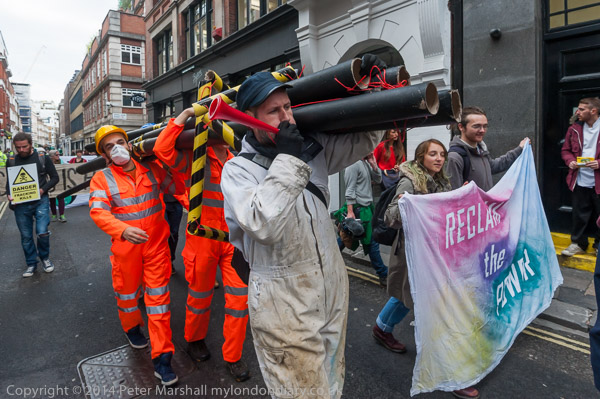
I met with the campaigners in Golden Square in Soho, where they were being closely watched and probably outnumbered by obviously nervous police who tried with no success to find out what they planned to do. After a while a group dressed in orange ‘Frack Off London’ hi-viz suits picked up some long black poles they had brought with them and marched towards Regent Street, with others carrying a banner and joining the procession.
They marched along Regent Street forming a quite impressive small crowd and stepped to erect the poles into their mock fracking rig in front of the HSBC branch, where they held a rally. Supporting the protest were Climate Revolution and Romanian anti-fracking activists who had brought their own drilling rig for some street theatre.
After some speeches the campaigners set off marching again, down Regent Street and past Piccadilly Circus on their way to the Strand branch of HSBC where they erected their rig again.
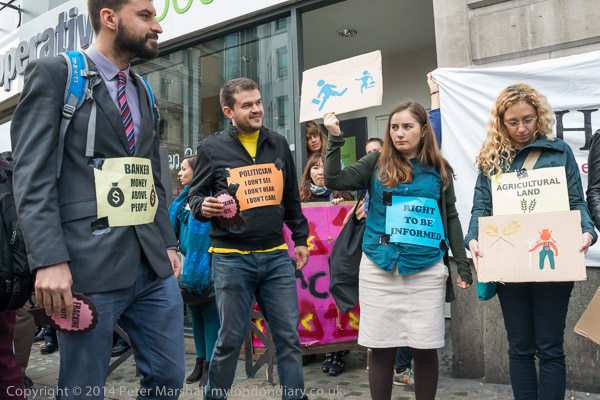
Here there were more speeches and some from the Romanian group put on a short piece of street theatre, fortunately in English, involving a greedy banker, corrupt politicians and people protesting.
The the protest marched off and down Whitehall to Parliament Square for a final short rally and some photographs.
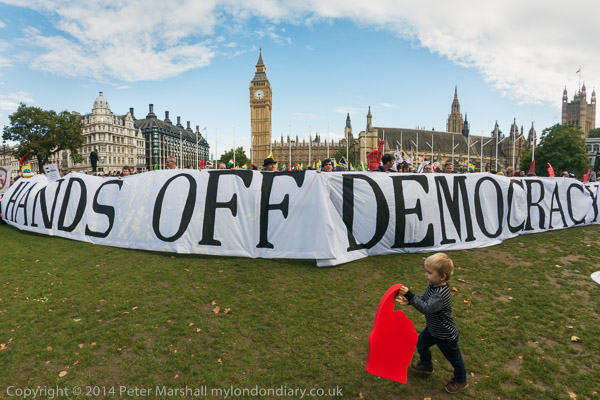
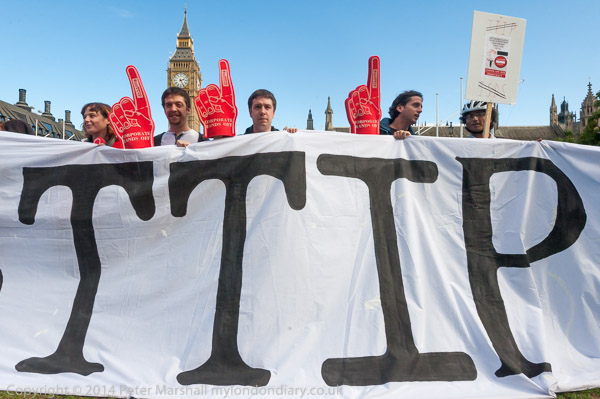
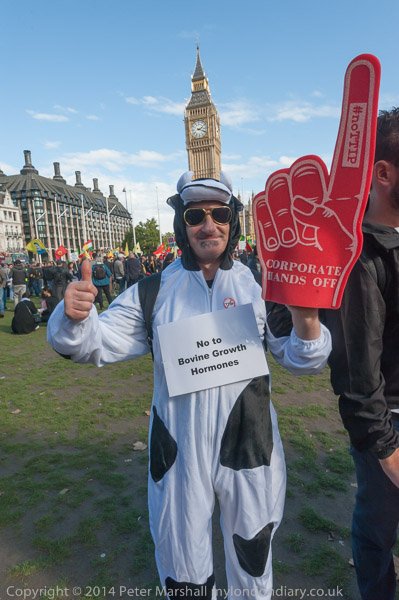
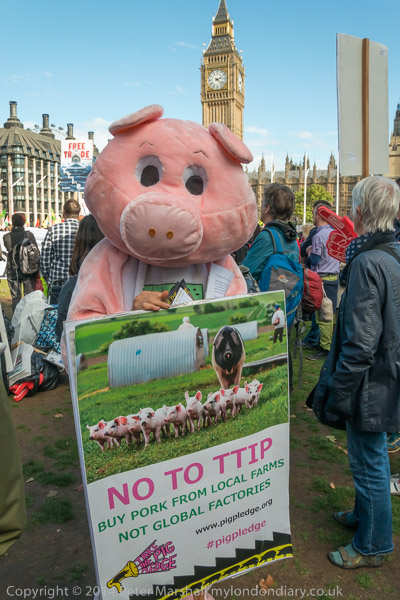
Protesters against the TTIP, a EU-US Trade Deal being negotiated at highly secretive talks would let corporations sue governments, lock in privatisation of our schools and NHS, undermine protection for privacy, workers and the environment and allow fracking and other harmful activities.
Although the talks were secret, some details had emerged and they were extremely worrying. The Transatlantic Trade and Investment Partnership would get the EU to remove the barriers which stopped US agricultural products produced under less hygienic conditions with lower animal welfare standards such as chlorine-washed chickens and beef pumped with high levels of growth hormones as well as GM crops being imported.
EU governments which took actions on environmental grounds could find themselves in industrial kangaroo courts which could impose huge fines if their laws caused US and other companies to lose potential profits from exporting their polluting goods.
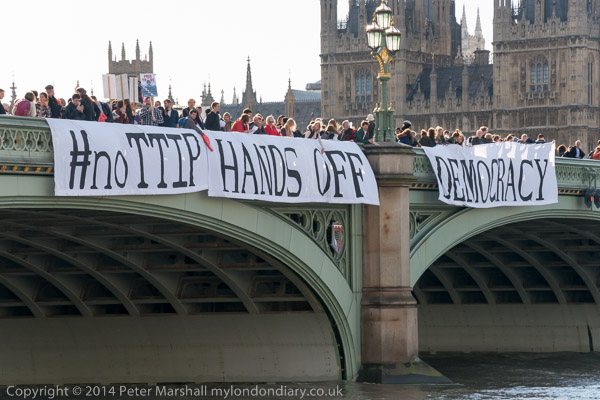
The protesters had brought with them a very long two part banner reading ‘HANDS OFF DEMOCRACY’ which was really too long for Parliament Square – and certainly too long for most photographers. A third part of it read ‘#no TTIP’, and I could only just fit thatin as well using a fisheye lens.
After the rally in the square, the protesters marched on to Westminster Bridge and carried out a ‘Banner Drop’ holding all three parts of the message. I’d run down the busy embankment to where it was possible to get a decent picture of the whole thing, but just as I began taking pictures it was moved, probably at the phoned request of the rather lazier official photographer for the group who was much closer to the bridge. And shortly after I’d started taking pictures at the second position it was on the move again.
Support the Defenders of Kobane – Parliament Square
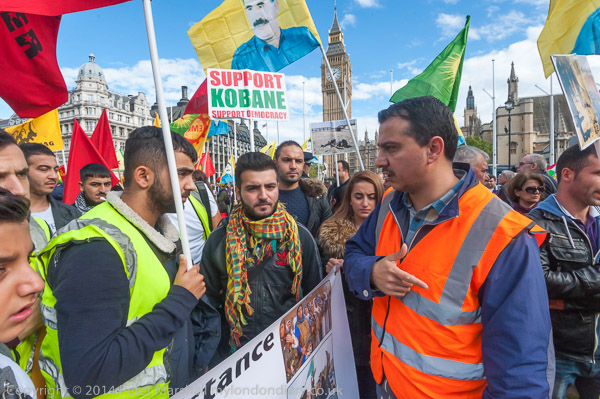
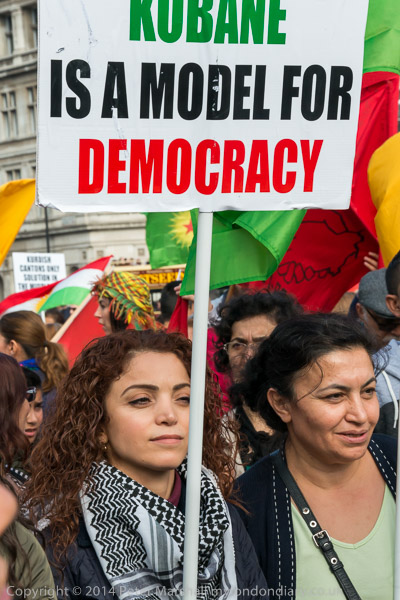
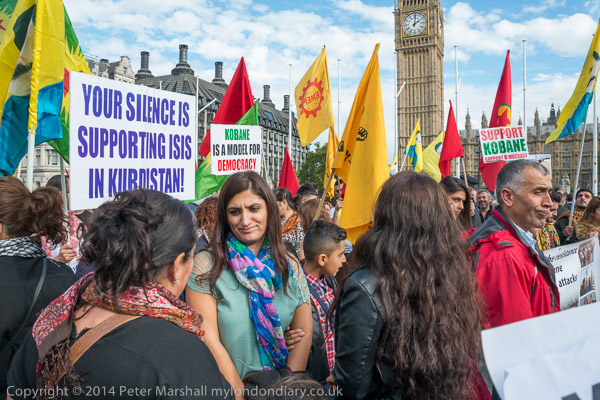
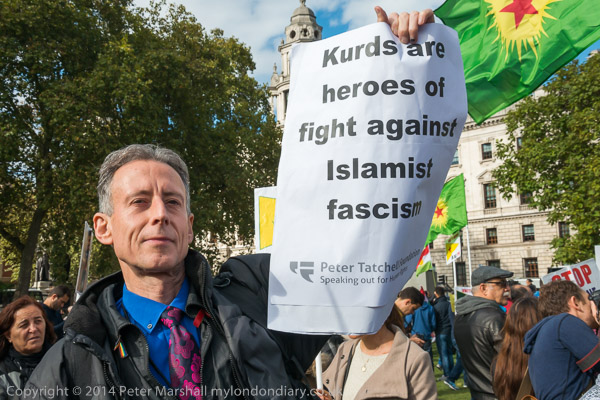
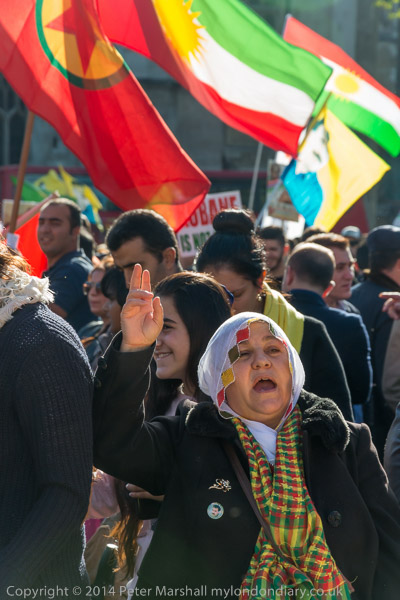
In Parliament Square I also photographed a rally with thousands, mainly of Kurdish or Turkish origin who had stopped for a rally on a march around London supporting the Kurdish fight against ISIS in Kobane, calling for support for the Kurdish fighters and condemning Turkish support for ISIS.
Kobane is a city in Syria and was surrounded by Islamic State of Iraq and the Levant (ISIL) militants in September 2014, forcing most of its inhabitants to flee to Turkey. Bloody battles by Kurdish forces with some help from US air strikes recaptured the city and the surrounding area, and they quickly drove back a later attack by ISIL in June 2015.
Kobane was at the time part of the de facto autonomous region of Syria, Rojava, a remarkable Kurdish democracy with a constitution giving equality to men, women and all ethnic and religious groups. But in October 2019 the city was threatened by an invasion by Turkey and accepted the entry of the Syrian government forces and Russian Military Police into the city, although it still then apparently remained under the de facto control of Rojava.
Turkey has supported the Islamic state militants, hoping that they will defeat the Kurds, many of whom live in Turkey and have been struggling for many years for greater autonomy. Turkey have provided routes for smuggling oil to provide finance for ISIS, and have for some years been fighting with Islamic militants against Kurdish forces in Syria.
Many speakers at the rally in Parliament Square called for the lifting by the UK of the ban on the PKK, the Kurdish Workers Party, whose leader Abdullah Öcalan has been held in jail in Turkey since 1999. In recent years Öcalan has been attempting to negotiate a peaceful end to the conflict, declaring a ceasefire at the Kurdish New Year in March 2013. There were many speakers from the mainstream UK community, including a number of trade unionists, London Green MEP Jean Lambert, and human rights lawyer Margaret Owen.
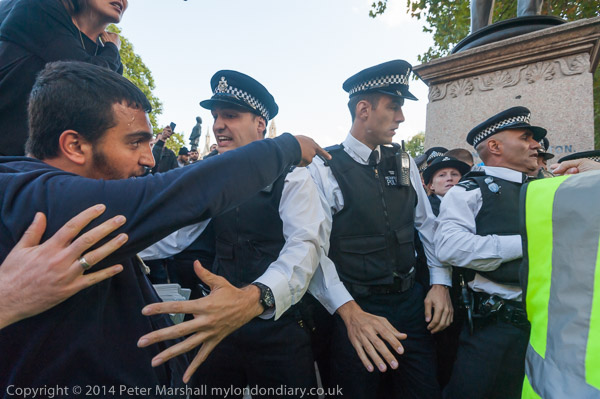
As the protesters marched away from Parliament Square there was a confrontation with police after they had tried to search some of the protesters and make an arrest. There was a lot of pushing and shoving and the marchers who had already left the square sat down on the street in Whitehall. They were still sitting there half an hour later, with negotiations between the police and protesters apparently continuing. Later one of the three men arrested was released and the protest came to and end.
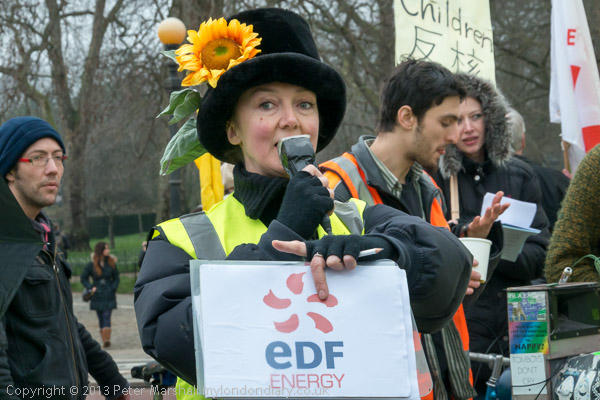
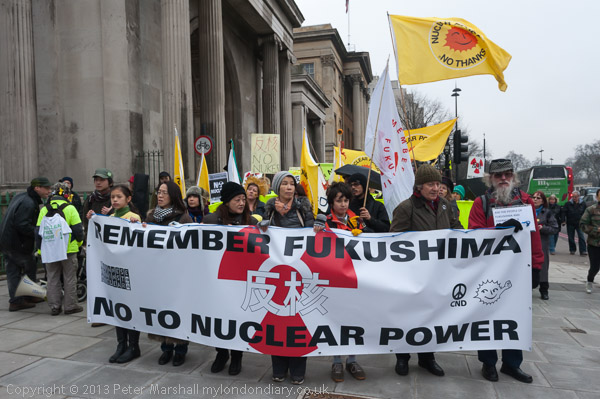
Fukushima Anniversary Questions Nuclear Power Safety – London, 9th March 2013
On 11th March 2011 Japan suffered its most powerful recorded earthquake. The Fukushima power plants fusion reactors were immediately shut down and diesel generators started to pump the coolant needed to keep the reactors safe.
But the earthquake generated a tsunami, with giant 45ft waves which swept over the sea walls of the power plant, flooding and disabling the emergency generators. As Wikipedia states “The resultant loss of reactor core cooling led to three nuclear meltdowns, three hydrogen explosions, and the release of radioactive contamination in Units 1, 2 and 3 between 12 and 15 March.“
Around 110,000 people were evacuated from a 12 mile exclusion zone around the plant because of airborne radioactive contamination, with many losing their livelihoods as well as their homes. The Tokyo Electric Power Company (TEPCO) who owned the site are still carrying out necessary cleanup of the site and removal of the radioactive fuel debris is expected to take until around 2040 or 2050.
A TEPCO report in 2000 had recommended improved safety measures against seawater flooding, designed to stop tsunami waves greater than those that caused the 2011 disaster, but these and several other warnings were dismissed by the company as unrealistic. Earlier scientist had expressed concerns about the dangers of building nuclear power plants in Japan because of the earthquake problems.
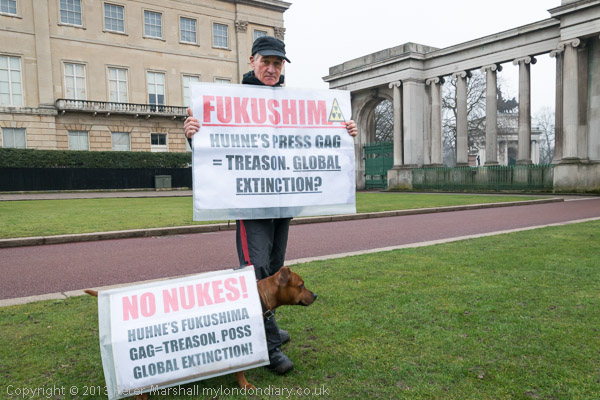
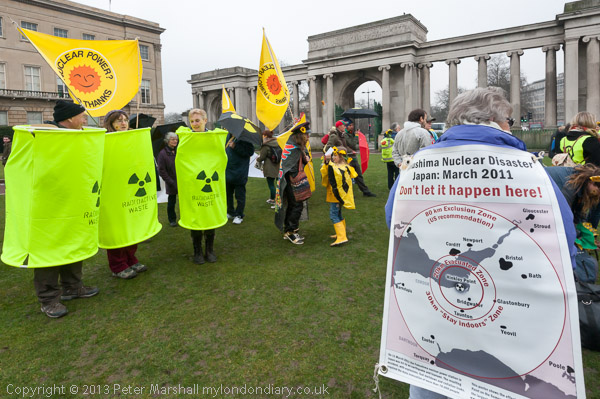
Japanese expatriates in London began a series of weekly protests against nuclear power at the Japanese Embassy on Piccadilly and also protested outside the TEPCO offices in Berkeley Square. The protest on Saturday 9th March was was organised by ‘Japanese Against Nuclear UK’ together with ‘Kick Nuclear’ and CND.
I went to photograph the protesters as they met up for the march at Hyde Park Corner. They intended to make brief protests at several locations including the Japanese embassy, the EDF office and Downing St before ending with a rally and final protest opposite Parliament in Old Palace Yard.
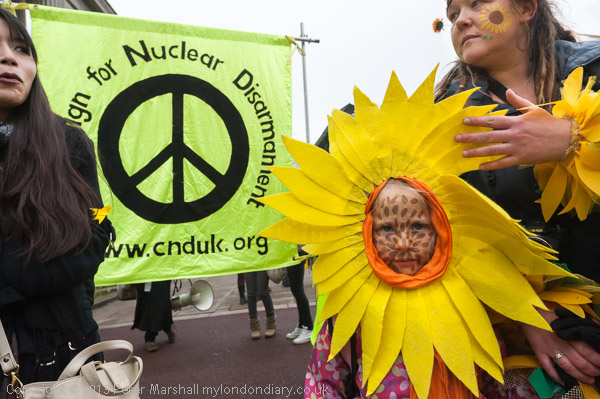
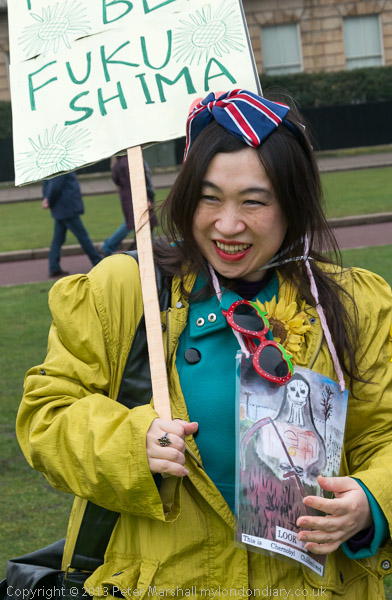
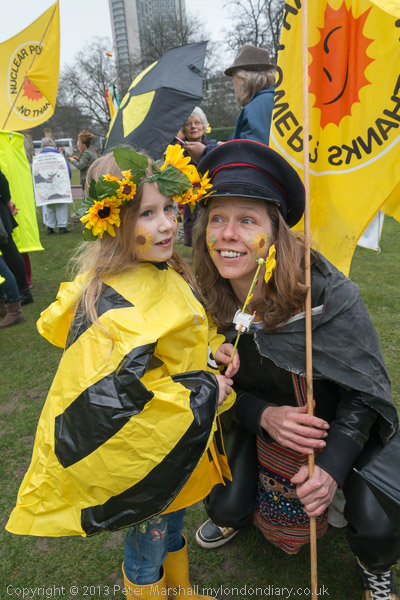
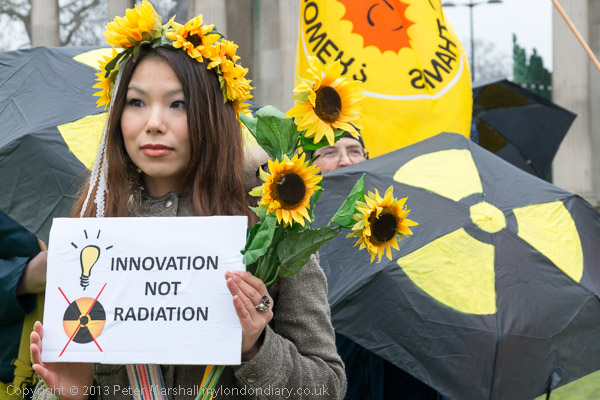
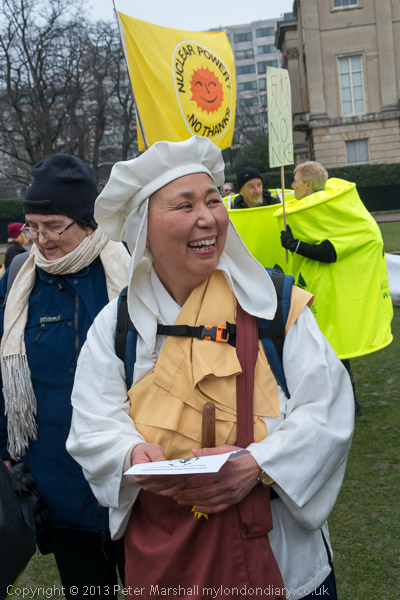
Many of them had come with sunflowers, a symbol of renewable clean energy, particularly solar energy. There were several banners with the smiley sun symbol and the message ‘Nuclear Power? No Thanks’ and a group of people encased in fluorescent yellow barrels with a radioactive danger symbol and labelled ‘Radioactive Waste.’
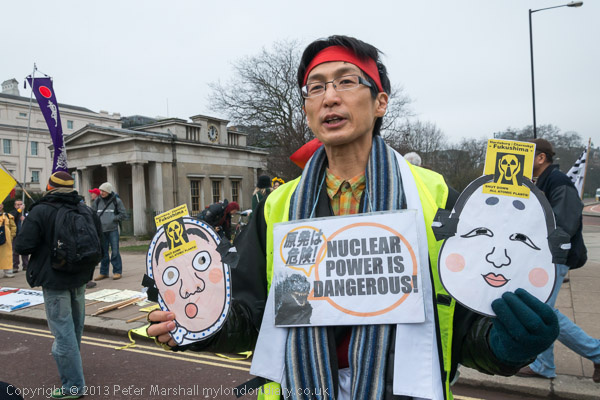
Some of the Japanese protesters had brought Japanese masks used to hide faces at protests in Japan against Fukushima, although many preferred to have sunflowers painted on their faces.
Among those who had come to protest were some who had come on a coach from Somerset, where they were opposing plans by EDF to build a new power station at Hinkley Point. The plans for the first new nuclear reactor in Britain for over 30 years were approved by the EDF board and the UK government in 2016. The first reactor arrived there last month though the project is several years behind time and is now expected by EDF to be completed in 2028.
Although some environmentalists have backed nuclear as a necessary part of our energy supply if we are to cut carbon emissions, it seems likely that increases in the efficiency and the continuing drop in costs of renewable alternatives will make the new power station a huge white elephant, producing electricity at a much higher cost guaranteed by the UK government to the developers.
I left the protesters as the march was about to start to go to the Million Women Rise march which was taking place at the same time. You can see more about that at Million Women Rise.