West India to Blackwall: More pictures from my walk wandering around the Isle of Dogs on Thursday 12th April 1990 in the week before Easter. Parts of the area had by then been fully demolished but there were still some of the old buildings remaining along with the new and plenty of building sites. It wasn’t always easy to know exactly where I was or where I could walk.

This new building is in what is now Lawn House Close and I was standing close to the east end of Marsh Wall. The cranes are on South Dock.
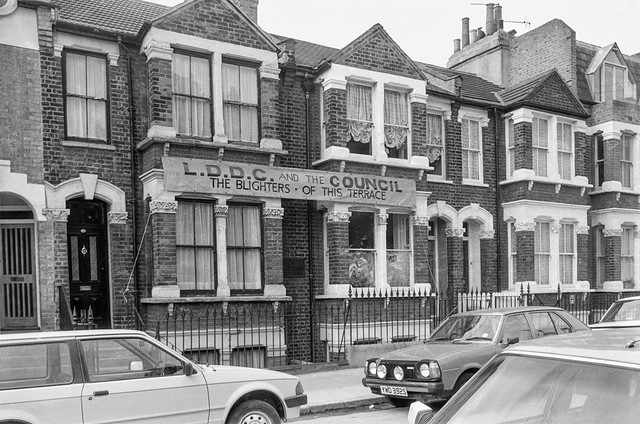
At the end of Marsh Wall I turned into Manchester Road where these houses still stand. A banner states ‘L.D.D.C AND THE COUNCIL – THE BLIGHTERS OF THIS TERRACE’. This is Glen Terrace, built in the 1880s after the dock company sold the land to help fund new docks at Tilbury, and named after the Glen Shipping Line which had previously occupied some of the site. These houses were completed in 1890 and in 1891 were renumbered as a part of Manchester Road. Around 1920 the South Dock entrance lock was lengthened to allow for larger ships, and the main route of Manchester Road was moved a few yards east to its current route.
For many years a fire in one of the houses led to a much photographed gap in the houses which could give a view of ships in the dock. This was later filled in, which I think accounts for a plaque on one of the houses with the date 1974 and four sets of initials. The south end of the terrace was demolished under the LDDC as part of a road widening scheme and some of the houses replace by a small block of flats.You can read much more at the link above to the Island History web site.

Lovegrove Walk got its name from the former landlord of the Brunswick Arms pub at 78 Blackwall Way. The pub dating from 1837 closed in 2006 and was demolished in 2008. The water shown here was built as a part of the West India Graving Dock and was completed and opened in 1878. It later became the London Graving Dock and closed in 1979. It is also known as Blackwall Basin Graving Dock and there is more about it on the Isle of Dogs Life web site. The sculpture in the water is Leap by Franta Belsky, placed here a year or so before I made the picture

Another view of the Blackwall Basin Graving Dock. A graving dock is a traditional dry dock on the edge of a waterway linked to it by a caisson or watertight rages. On its bottom are support blocks which a ship settles on when the water is pumped out to allow it to be worked on from below. Graving meant scraping and removing barnacles after which the hull of a wooden ship would be repaired as needed and coated with tar.
This picture is taken looking east from the concrete bridge over the graving dock in the previous picture leading to new housing on the side of the dock.

Taken from Preston’s Road looking west towards building work taking place at Canary Wharf. Scottish merchant, shipowner, and politician Sir Robert Preston made a fortune working for the East India Company, later running a number of ships for them and working as an insurer. According to Wikipedia, “Preston is likely to have been the sole investor in the Saint Ann slave voyage which, in 1783, purchased 360 enslaved people from West Central Africa and St. Helena and transported them to Kingston, Jamaica.”
Known as “Floating Bob’ for his portly figure and marine connections, Preston owned land in the area and when the West India Dock Company built the road from Poplar High Street to the Isle of Dogs in 1808 it was named after him.
The entrance lock had lost its gates and was now lined on both sides by housing with street entrances in Bridge House Quay and Lancaster Drive.

Hydraulic power was important in all of the docks, using a system of water pumped at high pressure to run much of the machinery. Fire was always a huge risk, particularly when handling powdered cargoes or combustible liquids. The first such public system was built in Hull in 1876 and a few years later the General Hydraulic Power Company had a system across the London, also powering lifts as well as cranes and dock gates etc.
There were also private systems and this hydraulic pumping station was built by the Midland Railway to serve their goods yard and dock at Blackwall in the 1870s in an Italianate style typical of their other railway buildings.
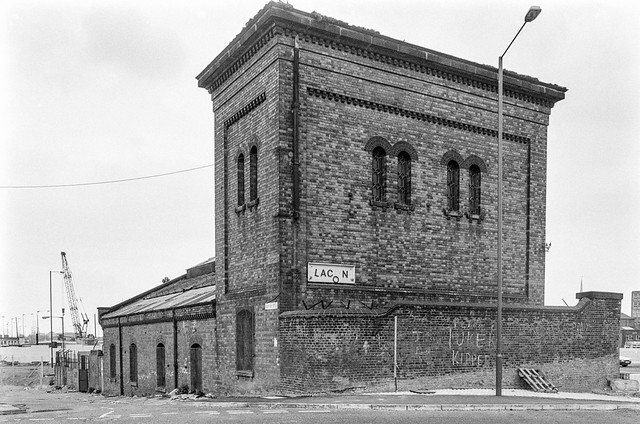
A second view perhpas gives a better idea of the pumping station which later became the Docklands branch of Majestic Wine Warehouse and now has the address The Old Pump House, Preston’s Road.

The ventilation towers were built for the second Blackwall Tunnel which was opened in 1967. They were designed in 1964 by GLC architect Terry Farrell.
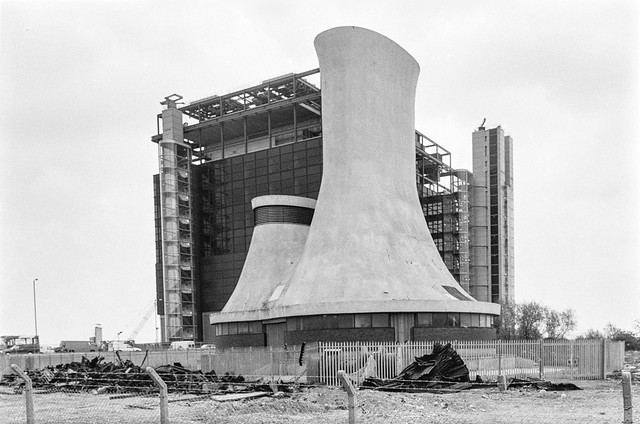
The building behind the ventilation towers, now Telehouse South, was built as Reuters data centre to process news and financial data in 1987–1992, designed by architects John Young, Ivan Harbour, Graham Stirk, and Andrew Morris of the Richard Rogers Partnership with engineers Arup. Initially there were plans for four buildings around a former dry dock, but only this one was ever built.
More from Blackwall later.
Flickr – Facebook – My London Diary – Hull Photos – Lea Valley – Paris
London’s Industrial Heritage – London Photos
All photographs on this page are copyright © Peter Marshall.
Contact me to buy prints or licence to reproduce.