Students March Against Huge Fee Rise

Thursday 9th December 2010 was the day of a third student protest against the three-fold increase in university tuition fees which was being debated in Parliament that day, and the scenes in the area around were probably the most confusing of any I’ve seen in London.

My account of my day on My London Diary runs to around 1,700 words, and I’ll attempt not to repeat myself here, while giving a rather shorter account. The march started outside the University of London Union in Malet St, with a crowd of perhaps 10-20,000 including many sixth-formers who would be hit by the £9,000 a year fees when they went to university as well as current students and supporters.

There was a good atmosphere as the crowd listened to speeches there from trade unionists, John McDonnell MP and two sixthformers from schools that were being occupied in protest who got the largest cheers. As usual with student protests there was plenty to photograph.

The march began well though progress was rather slow, and several hundred students decided to walk in front of the main banner and for some reason police tried to stop them. They thought they were about to be kettled and rushed off towards Covent Garden. The official march continued without obstruction along the agreed route along the Strand. It wasn’t at all clear what the police had intended, and this was something that set the scene for the day.

Many more protesters joined the march at Trafalgar Square, and rather than proceed down Whitehall, police and march organisers had agreed on a route though Admiralty Arch and down Horseguards Road, and then left into Parliament Square. The march was then meant to continue down Bridge Street to an official rally on the Embankment, but most marchers had a different idea and wanted to stay in Parliament Square, the obvious place for the protest to continue.

It’s hard to understand why either police or march organisers had thought people would march on rather than stay outside Parliament – and probably many on the march had simply assumed it would end there. And soon police were actually preventing any who wanted to go on by blocking all the exits from Parliament Square except that into Whitehall (which they later decided to block.)

I managed to move around thanks to my press card, but even with this I was often refused access through police lines even in calm areas, and had to move along and find other officers in the line who would let me through, or take a longer walk around to get to where I wanted. The police didn’t appear to know what they were supposed to be doing and at one point I was being crushed by the crowd against the barriers in front of the riot police who were threatening us with batons unless we moved back – which was impossible because of the crush. Several press colleagues did get injured.

Late in the day students who wanted to leave were told by officers they could do so by going up Whitehall – only to be stopped by other police who were closing the street off. We were pushed back into Parliament Square by riot police and police horses. Police told protesters they were not being detained although they were not being allowed to leave, a kind of police logic most of us find infuriating.

Kettling like this is used by police as a kind of minor but arbitrary punishment, and as in this case it often leads to violent incidents and arrests which are then used to retrospectively justify police actions. After I had managed to get through one of the police lines and catch a bus away from the area I heard that Police had pushed a large group into a very confined space on Westminster Bridge with a total disregard for their safety, with some needing medical treatment for crushing. As I pointed out “there could easily have been more serious or fatal injuries and people pushed into the freezing river below.”

Of course protests like this need to be policed to avoid serious disorder. But the confused and sometimes unnecessarily violent way it was done on this occasion seemed to create most of the problems of the day.

As well as a long account of my day there are many more pictures on My London Diary in Students Against Cuts – Day 3.


Visiting Starbucks

I’ve been a coffee drinker most of my life, and there was a time long ago in my late teens when breakfast meant a large mug of black coffee, a cigarette and Miles Davis. And though I gave up smoking when I reached majority (which was 21 back then) I still have the black coffee though now with rather more carbohydrate in muesli and a slice of homemade brown bread. And since my wife and I have rather different musical tastes we listen to the news.

The coffee I drink now is a Fair Trade blend from Traidcraft – they have a range of ground coffees and most are good, though your taste may vary. With a small metal filter that sits on top of a mug its almost as quick as using instant coffee, though I usually have a cup of that (also fairly traded) when I finish writing these posts in the morning.

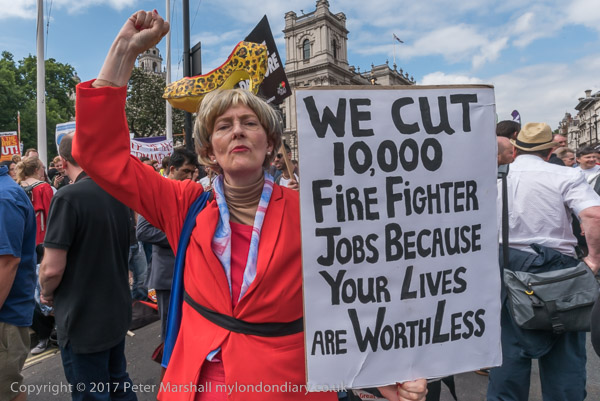
Journalist Polly Toynbee (right) was among the protesters

Back in the last century when I was making long walks around London, often in the suburbs, on the winter days I preferred I always took with me a Thermos of strong black coffee. Back then coffee shops were rare, and if you could find it, coffee bought on the streets unreliable. My top priority back then in choosing a camera bag was whether I could fit the flask in.

But since then I have occasionally bought a coffee (though it pains me to pay £3 for something I could make better at home for 30p), but have avoided Starbucks – because they don’t pay their taxes. Of course the are not unique in this, but they are one of the best known of tax avoiders, and had then paid no tax in the UK since 2009. So when I joined the longish queue inside the Conduit Street Starbucks on Saturday 8th December it was I think my first time, and I was rather hoping that the protest would begin before I reached the counter.

“As noon approached, there were more protesters and photographers standing around inside the store, as well as some seated drinking coffee. Around a minute after noon, one of the protesters got up and started the protest, reading out a lengthy document about Starbucks’ failure to pay tax, and how the amounts that companies including them were avoiding paying were around five times the total of the cuts in services so far made by the coalition government. She announced that they were setting up a crèche inside this branch to compensate for all those and other family services that the government had closed.”

“The protest continued with more speeches and some chanting of slogans calling on Starbucks to pay up. After around 10 minutes a police officer came into the branch and wrongly accused the protesters of behaving in an intimidatory manner towards the staff and customers, which they clearly had not. Nor had they been asked to leave by the store manager. But they were told this was a disorderly protest despite this, and threatened with arrest if they stayed, although at no point did he make clear under what law they might be arrested.”

“The protesters allege that Starbucks uses a whole number of tricks to avoid paying tax. One is to use a Starbucks company in a tax haven to lend them the money to fund their UK operations at a rate 4% above the LIBOR rate – the excessive interest costs the UK business but makes fat profits for them in the tax haven. Another is to buy their coffee beans at high prices from a subsidiary in Switzerland, which pays only 5% tax on them rather than the 24% they would pay in corporation tax in the UK. They also pay 6% of their total sales as a ‘royalty’ to their Dutch company – and they have a secret low rate tax deal with the government in the Netherlands.”

“Several of the speakers talked about the real hardships being faced particularly by women and the disabled in the UK because of the cuts in services. The losses in tax through tricks like those they say are used by Starbucks – Corporate Tax Avoidance – costs the UK £70 billion, which they compare to the benefit cuts of £15 billion.”

I left with the protesters after the police threats, when they continued to protest with a large and noisy crowd who had been unable to get inside, and walked the short distance to Vigo Street, where another protest was taking place inside and outside the Starbucks branch there, and I took more pictures through the large windows and on the street outside.

Later I went to another Starbucks protest at the Euston Road branch, a part of the UK Uncut Day of Action against Starbucks arranged by the Labour Representation Committee (LRC). I found a small group of UK Uncut supporters at the meeting point but there was no sign of the LRC, and after 15 minutes the action began without them as a dozen or so people walked into the branch, took out a poster and began the action. By the time the LRC arrived the doors were locked and they protested outside. A couple of police officers then got out of their van on the opposite side of the road and walked across and were admitted into the coffee shop. There were a few minutes of polite and friendly conversation and the protesters then walked out to join those protesting outside.

The protesters point out that Costa Coffee who have a lower annual turnover than Starbucks in the UK were paying each year “several times per year what Starbucks are offering to cover several years of dubiously legal tax avoidance. Starbucks have avoided paying perhaps ten times what they are now offering.”

Now its time for a coffee.

More on My London Diary:

Starbucks Euston Road – LRC
UK Uncut Visits Starbucks


Christmas Is Coming – 2014

Three of the four posts I made on December 6th 2014 had a Christmas theme, with two of them around the then annual Santacon event in London. In 2014, around a thousand Santas were gathering on Clapham Common and more at two other locations in East and North London, along with the odd elf, reindeer to start to a day-long alcohol-fuelled crawl through London, eventually meeting up somehere in the centre of the city in the early evening.

I followed them for a short distance, but I’d actually come to Clapham for an entirely different event, the South London March for Free Education, part of a national day of education activism against tuition fees, where students and supporters including Lambeth Left Unity and South London Defend Education were meeting to march to a rally in Brixton.

It was a rather smaller march than anticipated – perhaps many students were in Santa costumes on another event, or busy with Christmas shopping but I marched around a mile with them taking pictures before getting the tube into Central London.

The Fossil Free Nativity – Churches Divest! in the area between Westminster Abbey and Methodist Central Hall was organised and performed by Christian Climate Action and Occupy London, and was an entertaining if rather amateur performance starring Westley Ingram who wrote the play and performed as the Angel Gabriel, and George Barda of Occupy who played Joseph with his child as the baby Jesus. It was part of a continuing campaign to get churches to disinvest from fossil fuel companies.

From Westminster I set off in a bus towards north London in search of Santas, jumping off when I saw a red cloud of them in the distance. Or rather ringing the bell and fortunately it was not far from a stop where the driver would open a door. I don’t at all mind wearing a mask for Covid, but still feel something of a loss of freedom over the loss of open-door hop-on, hop-off buses.

Thousands in Santa suits and other Xmas deviations, police trying hard to keep smiling, cans of beer, doubtfully soft drinks, just a few Brussel sprouts in the air, crowded bars, sprawling mass of mainly young people having fun on the streets of London. Santacon!

I’d met a couple of photographer friends also out photographing the Santas and they packed up and left as the light fell, while I continued working with flash for another quarter of hour or so, until a phone call alerted me to a pint awaiting me in a local pub. I’d been photographing people drinking for hours but all that had passed my lips to that point was water, and I was ready to break that particular fast with a little Christmas celebration.

Santacon North London
Fossil Free Nativity – Churches Divest!
South London March for Free Education
Santacon Start in Clapham

Waving to Copenhagen – 5th Dec 2009

Remember Copenhagen? This was COP15, and generally thought to have been a great failure, with developed countries’ refusing to adopt targets on limiting emissions by 2020 and developing countries insisting on their right to develop their economies and catch up with the big polluters.

But 2009 did see an upsurge in general interest in climate change, and one of the largest events in London against it, with many large charities combining in the Stop Climate Chaos Coalition and conducting what seemed more a PR exercise than a protest, culminating in a ‘Big Wave’ outside the empty Houses of Parliament at 3pm. Everybody around Parliament waved, made a lot of noise and then wondered what to do next.

As I wrote at the time:
Although it was good to see a wider participation – although despite that huge potential and massive publicity the march was perhaps only a little more than five times the size of previous years – this year’s event, entitled ‘The Wave’ did seem more a stunt for the media than an informed political event. Surely with the backing of 11 million the coalition should be making demands, not just waving, and it’s perhaps hard to see the significance of blue hands and faces in a demonstration about global warming.

It did appear to have been an opportunity lost to adopt a more robust attitude and push our government at least into some action. The day of protest also involved all the other groups who had been protesting over climate change for some years – and seemed to me to rather be hi-jacking the annual climate march by the Campaign Against Climate Change rather than getting behind them and working with them. That feeling underlies much of my reporting of the day, which I split into the seven sections on My London Diary – as below.

Climate Emergency Bike Ride

After two speeches at Lincoln’s Inn Fields, the ride, organised by the Campaign Against Climate Change went on to hold demonstrations outside the London offices of two multinationals guilty of activities that are contributing to climate change, BP in St James’ Square and E.On in Pall Mall. Speakers there outlined some of the damage the companies were doing to the environment and how their activities were accelerating climate change.

Climate Emergency Bike Ride.

Climate Emergency Rally

The Campaign Against Climate Change had also organised a rally in Hyde Park before the march organised by the Stop Climate Chaos Coalition who were gathering in nearby Grosvenor Square, presumably to avoid anything political. While the Coalition were simply calling for “a fair and effective international agreement” , CACC made clear that “there is no chance of an effective agreement until the North wins the trust of the South and it will only do that if Northern countries like the UK match words with action and take radical emission-reducing measures at home.” The failure of Copenhagen showed they were right.

Climate Emergency Rally

World Association of Carbon Traders

The ‘World Association of Carbon Traders’, group of around 50 smartly dressed ‘city gents’ – who included a few ‘gentesses’ and rather more bad false moustaches – along with power-dressed business women, joined the joined the Stop Climate Chaos Coalition march under the banner ‘Carbon Trading: The Final Solution’. Their ‘ CO2$’ logo and placards including ‘Trust Me, I’m a Banker, Capitalise On The Climate’, ‘In Markets We Trust’, ‘One Solution. Trade Pollution’, ‘Greed is Green’, ‘Carbon Trader = Eco Crusader.’ and ‘Cash In On Climate Change’, which as well as the ‘Permits to Pollute’ they were handing out made their ironic intention clear.

I recognised some of the faces of these agents from previous demonstrations by the Space Hijackers, a group who call themselves ‘Anarchitects’ whose various projects over the last ten years given a new creative face to protest.

World Association of Carbon Traders


The Wave – Before the March

I took a few pictures of the crowds gathering in Grosvenor Square for the Stop Climate Chaos Coalition march on my way to and from the CACC rally.

The Wave – Before the March

Anticapitalist Block – Not Much Waving

For a minute or two this banner led the march as it came through Berkeley Square while march stewards came and argued with them. After a short while and the intevention of a rather stout cop these protesters were persuaded to roll up their banner and suggested they join the march rather further back.

There they joined a few others dressed mainly in black, some carrying red or black flags behind another black banner with the message “NO BOMBS NO BAILOUT NO CAPITALISM“. The block left the march and went to Jubilee Gardens rather than stay for the wave at Parliament.

Anticapitalist Block

Marching to the Wave

Marching to the Wave

The Wave

They waved. And then the stewards tried to get them to disperse. Some stayed on in Parliament Square., and I photographed some of them with banners, including Climate Rush. Their banner with a large heading ‘EQUITY’ carried the message “Emission Quotas Must Be Per Capita. The RIch Have No More Right to Pollute Than the Poor”.

In my caption I commented “It’s a principle seemed certain to prevent real progress at Copenhagen – as the rich and in particular the USA – won’t accept it.” And so Copenhagen was doomed to fail.

The Wave


Dec 4th 2010 in London

UK Uncut protest Topshop Tax Dodge

UK Uncut protested outside and briefly inside Topshop and other Oxford Street stores in Philip Green’s Arcadia Group, one of the major companies who together are alleged to dodge £12 billion per year in UK tax.

Eleven years on we still haven’t seen effective action by our government against the huge amount of tax evaded and avoided by the wealthy in the UK. Hardly surprising since many of those in government and their friends and supporters benefit greatly from these practices.

It was the threat by the EU to clamp down on some of these legal fiddles that was a major factor behind the huge funding and lies of the Brexit campaign, something that we are now paying the price for while the billionaires are doing very nicely thank you – and some profiteering hugely from the government’s Covid contracts for their mates.

It was the threats that a centre left government under Jeremy Corbyn might have made some slight changes that, along with his support for Palestinian rights, led to a hugely vitriolic campaign against him by the press and inside the Labour Party.

UK Uncut labelled Sir Philip Green, the boss of the Arcadia Group, which included include Topshop, Topman, Dorothy Perkins, Burton, Miss Selfridge Wallis and British Home Stores, as “Britain’s most notorious tax-avoider. While Green himself paid tax on his salary, the companies are owned by a holding company in the tax haven of Jersey, which is owned by his wife and immediate family who live in Monaco, and pay no tax. Arcadia are certainly not the only huge scale tax avoiders – and later the protesters also briefly visited Oxford St branches of two others, Boots and Vodafone.

They also point out that when Green awarded himself a huge dividend payout – £1.2 billion – in 2005, it went through various offshore accounts and tax dodges to his wife’s Monaco bank account. The loss in tax to the UK was £285 million.

We should have a tax system based on a simple principle. If people or companies make the money in the UK then you should pay tax on it in the UK, and any of the dodges now still used to avoid this should be illegal. At the moment the large accountancy firms are mainly used to aid the avoidance of tax, and they need to be completely re-purposed to with the role of ensuring the correct tax is paid.

Of course it won’t happen. It would destroy a huge part of the business of the City of London, currently the world capital of financial skullduggery and with a curiously intimate connection to our parliament. All we have seen over the 11 years since this protest are a few sweetheart deals with the tax office with some rather token repayments and things are unlikely to change.

More at March for Zero Carbon UK 2030.


March for Zero Carbon Britain 2030

Happening the same day was a march to Parliament by the Campaign Against Climate Change calling for urgent action over climate change including a Zero Carbon Britain by 2030. The march and rally was the seventh annual climate march organised by the CACC, which has spearheaded the campaign to get effective action to meet the climate challenge since its formation, aiming to put climate change at the top of our political agenda as the greatest threat that humanity faces.

While our government still seems shackled to business as usual and only making rather half-heated committments to tackling climate change with the necessary urgency, most of the rest of us are now convinced of the need for real action. From being regarded by many as cranks, CACC are now a small part of a huge mainstream.

Back in 2010 they were joined on the march largely by other relatively small campaigning groups, including Friends of the Eath, Greenpeace, the World Development Movement, the Climate Rush, the Green Party and many local groups, trade union branches etc. But as with most protests in Britain it was largely ignored by the media, dominated by a press owned by a handful of billionaires.

Things outside government were beginning to move back in 2010, particularly with the publication of an in-depth report compiled for the Centre for Alternative Technology (CAT), ‘Zero Carbon Britain 2030: A new energy strategy earlier in the year, but since then we have seen another largely wasted eleven years.

More at March for Zero Carbon UK 2030.


Ten Years Ago – 3 Dec 2021

City Xmas Celebrations

I thought I’d see how the City of London was celebrating Christmas and took a few pictures of a real life Music Box in front of the Royal Exchange before going inside and being told I couldn’t take photographs. And although I’d been told there were free drinks I think they were only available for the kind of people who looked as if they would spend vast amounts on the luxury items being sold inside. I went out and walked towards St Paul’s Cathedral, pausing briefly to photograph a band and Santa who had come with a couple of reindeer who seemed rather small to me for his lengthy journey.

City Xmas Celebrations


Occupy LSX Climate Justice Workshops

On the steps of St Paul’s Cathedral was a plain coffin with the message ‘25,700 EXCESS WINTER DEATHS’, a rather lower figure than that I photographed at last week’s Fuel Poverty Action protest – last winter the number was 63,000. Of course this can’t all be put down to 10 years of Tory austerity, and Covid will have played a part, though of course flu deaths were down.

Workshops are not generally the most exciting things to photograph, and I only took a few pictures. I left Occupy LSX shortly after they began a ‘Climate Walk of Shame’ around the offices of various climate change villians (‘unsavoury sites of climate criminality’) which began rather later than advertised to make my way to the Climate March (where they were also heading.)

Occupy LSX Climate Justice Workshops


Stand Up For Climate Justice

Ten years ago we had a chance to begin to disastrous climate change, but world leaders failed to lead. The protest was organised by the Campaign Against Climate Change and around a thousand people marched through London calling for Climate Justice, highlighting the fact the 7% of the world’s population cause 50% of the worlds emissions as the Durban climate talks take place. This was COP17 but by the time of COP26 in Glasgow little had changed.

Here’s a few paragraphs from the post I wrote then on My London Dairy:

The 17th UN climate change conference taking place in Durban is widely expected to lead to a breakdown in efforts to combat global climate change, as the US continues to block serious attempts to combat climate change. The continued refusal of the US to accept mandatory limits on carbon emissions seems likely to prevent any progress on global reductions in emissions, and seems certain to lead to catastrophic increases in global temperature. To put it bluntly, our planet is going to fry.

Currently predicted global temperature rises by the end of the century would lead to an environmental crisis that would be expected to lead to huge areas of the world becoming uninhabitable, and billions dying through flood, famine and and other catastrophes. Those who will die will largely be the poor who currently are responsible for only a small proportion of the emissions, while the rich and highly polluting are those who will survive.

There is no longer any serious scientific debate about the reality of climate change, just about the the exact magnitude of the effects and the timescales involved. But all informed opinion agrees that urgent action is needed. We need to make drastic cuts in carbon emissions. The most industrialised countries who have contributed most to the increase in CO2 levels over the past centuries have a particular moral obligation to make drastic cuts.

Deja-vu all over again! Though perhaps now I might have added something about Australia, China and India also heads firmly in the sand, and also about species extinction – including possibly ours.

Stand Up For Climate Justice


Congolese Election Protests Continue

Congolese continued their protests in London against the election fraud, rapes and massacres and called on the British government to withdraw its support from the immoral regime of President Kabila responsible for the atrocities and voted out by the people.

Congolese Protest Against Kabila Vote-Rigging


London Wandering

As often while walking about London between the various events I photographed I took a few pictures, including some in the city centre, and others as I made my way to and from an evening event in North Acton where a photographer friend was appearing. I’ve always meant to take more photographs of London at night, but have never got around to more than the occasional picture like the one above.

And while I’ve taken many thousands of pictures along the River Thames from its source to the estuary, it’s always good to find something just a little different as in this study of bridges.

London Wandering


London, Dec 1st 2012

Adidas ‘Pay Your Workers’

December 1st 2012 was a Saturday and another busy day for protests over various issues in London. The poor are always with us because employers pay rock-bottom wages, even those who sell high-priced goods on London’s premier shopping streets.

But the protest outside Adidas in Oxford Street was not about the poorly paid staff in their store, but about the workers who make their sportswear in Indonesia who make the sportswear they sell and who have not been paid what Adidas owe them for over a year.

The PT Kizone factory in Indonesia had been making sportswear for Adidas, Nike and Dallas Cowboys for many years with many workers being on pitifully low wages, many being paid as little as US $0.60 an hour (37p), hardly enough to keep them alive. But in January 2011 the factory owner fled and the factory closed in April 2011 and the 2,800 workers were left with no jobs.

Under Indonesian law they were entitled to severance pay, a total of around US$2.8 million (about £1.74 million) and the three companies for whom they had made goods for many years were obliged to share the payments. Both Nike and Dallas Cowboys agreed to pay up, but Adidas are refusing to pay the $1.8 million (£1.12 million) they owe, despite a worldwide campaign with a 50,000 signature petition and 5000 posts on their Facebook page demanding they pay.

On December 1st there were protests outside Adidas stores in London and other cities in the UK, with some protesters wearing masks with the face of Justin Bieber, who is the ‘global style icon’ for their NEO label. The protesters point out that Adidas were “happy to pay their $157m to sponsor the Olympics, but won’t pay 1% of that to avoid the destitution of those that made them their profits.”

Adidas ‘Pay Your Workers’


Free West Papua Independence Day

A short distance away at the Indonesian Embassy in Grosvenor Square another protest was taking place against the Indonesian occupation of West Papua in 1962.

On December 1st 1961, West Papua had been set on the road to independence by the Dutch. The Netherlands had controlled the area since 1898 except during the wartime Japanese occupation. Indonesia had become independent in 1945 and claimed all of the Dutch territories in the area, leading to a long-running dispute between the two countries, and just over two weeks later began moving troops into West Papua, and were in the whole area by the end of the following year. But it was due to the United States fear of Soviet influence in Indonesia that the Dutch finally temporarily transferred the control of the region to Indonesian government as a part of the New York Agreement, which called for a later UN referendum on the future of the country.

This referendum took place in 1969, and although called the Act of Free Choice, involved voting by 1025 men and women selected by the Indonesian military who unsurprisingly voted unanimously in favour of Indonesian control. Since then the Free Papua movement has worked to gain independence both by peaceful protest and international pressure but also by guerilla warfare.
Free West Papua Independence Day

Morsi’s Dicatatorial Decree

The Egyptian Embassy is short distance to the south in Mayfair, and in front of it there were over 50 protesters shouting noisily condemning the decree by Egyptian President Mohamed Morsi and calling him a dictator. A few yards down the street, separated by police was a protest by 5 of supporters of his action.

This was one of widespread protests in Egypt and around the world which led to the president announcing the decree would be scrapped a week later. But he proceeded with bringing in a new constitution which was described by many as an ‘Islamist Coup’ and was approved by a referendum later in the month.
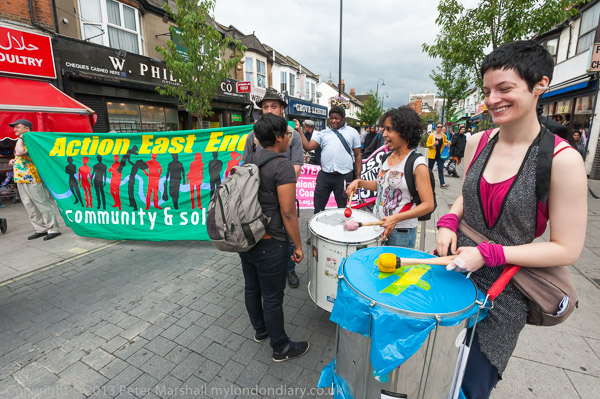

Morsi’s Dicatatorial Decree

Climate March Says ‘NO’ to Fracking

The day’s largest event also started in Mayfair, outside the US Embassy, still in Grosvenor Square. It was the Global Day of Action on Climate Change, and the protest focused attention on the dangers of using shale oil and tar sands for energy, both of which would lead to excessive global warming and make reaching the targets set for carbon emissions impossible.

The US embassy was chosen for the starting rally as the dirty energy lobby in the USA, led by companies including the Koch Brothers, has succeeded in making the US the main barrier to effective climate action over the years.

After the rally they began to lay a mock pipeline from the US Embassy to the Canadian Canadian High Commission at the opposite end of Grosvenor Square to show their outrage at the continued exploitation of high-carbon tar sands. They had brought an impressive number of long pipes for the purpose, but they were not allowed to lay them in the direct route across the square, so didn’t quite make it going around the outside.

The thousand or so marchers then set off towards Parliament Square while I went to cover some of the events elsewhere before meeting them again in Parliament Square just before they erected a mock fracking rig with the message ‘No Fracking in the UK’. After this the rally there continued with speeches from Eve Macnamara from REAF (Ribble Estuary against Fracking), John McDonnell MP (Labour, Hayes and Harlington) and Natalie Bennett (leader, Green party).

Climate March Says ‘NO’ to Fracking


Ten Years Ago – 30 Nov 2011

Occupy protesters outrun police down Haymarket

Ten years ago today on Wednesday 30th November the TUC called a one day general strike over the government plans to cut public service pensions and their failure to enter any meaningful discussion with the trade unions on them.

The Southern & Eastern Region of the TUC, SERTUC, organised a march and rally in London, and at least 20,000 people came for a peaceful march through the capital. At the head of the march was TUC Deputy General Secretary Frances O’Grady, along with leaders of several of the other unions and professional associations taking part in today’s strike by public sector workers.

Frances O’Grady, Dep Gen Sec of the TUC and NASUWT president John Rimmer and a French trade unionist

Along with many strikers, including many taking strike action and marching for the first time there were also others who came to join them, including students and groups including UK Uncut and activist groups such as the Education Activist Network and other student groups, and a number of people wearing ‘Anonymous’ Guy Fawkes ‘V for Vendetta’ masks.

Some of these people began walking ahead of the official march and police stretched a line of officers across Aldwych stopping both them and the march behind them, but eventually they let the march continue. Although the march was going to Parliament along the Embankment, police had closed off Whitehall and created more traffic chaos than the large march.
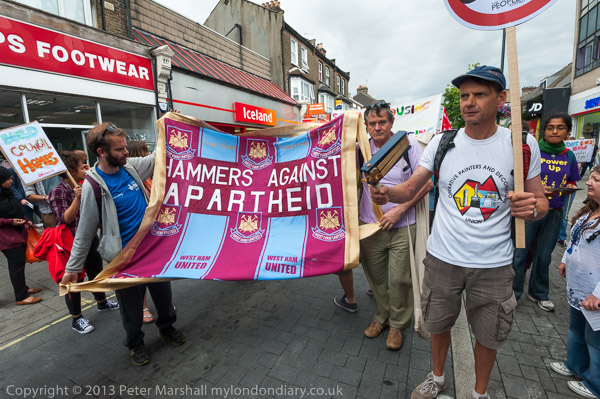
UK Uncut had come to support the march and were handing out cups of tea from a yard in front of some offices on the square in what they called a ‘solidaritea!!’ action to support the strike.

Later around a hundred protesters from Occupy London rushed into the building in which mining company Xstrata has its offices in a protest against Mick Davies, its CEO, who they say “is a prime example of the greedy 1% lining their own pockets while denying workers pensions.”

They met at Picadilly Circus under the eyes of around a hundred police watching and photographing them from the steps around Eros, and after around half and hour in intermittent rain a small group rushed across the road to stand outside a branch of Boots with a banner reading ‘Precarious Workers Brigade’, but made no attempt to enter the store, which then quickly put down its metal shutters.
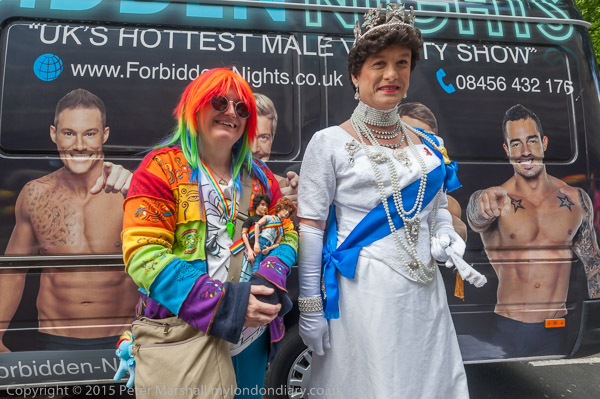
Protesters rush into Panto House

But this was just a diversion, and the rest of the group rushed down Haymarket behind a long banner reading ‘All Power to the 99%’ and then turned abruptly down Panton St and rushed into Panton House. The police had got rather left behind and were unable to stop them, and I followed in after some of the protesters, but got very out of breath rushing up the stairs.

A crowd of protesters make it hard to get up the stairs

I hadn’t picked up completely on what was happening, and failed to get up to the roof where a group of around 20 was continuing the protest against Mick Davies, CEO of mining Company Xstrata and the highest paid CEO in the UK. Police forced me and other protesters still on the stairs to go down and leave the building.

I was disappointed not to get onto the roof with other photographers, but rather pleased that, since it was impossible to take more pictures I could now go home. Those on the roof were kept there by police for rather a long time and those who had hung around on the street outside were also kettled.

See more on My London Diary:

Occupy London Expose Corporate Greed
TUC Nov 30 March


Global South leads Climate March 2015

Global Frontlines bloc banner ‘Still fighting CO2onialism – Your Climate Profits Kill’

Many groups came together for a march through London on 29th November 2015 about the need for action over global warming and climate change on the weekend before the Paris talks. It had been agreed that the march should be led by the Global Frontlines block, as the Global South is already being more affecte by climate change.

But on the day the organisers, representing the large groups including Avaaz, changed their mind. They decided to put the main march banner along with some of those in carnival animal costumes at the front of the march as they felt the Global Frontline was too radical, wanting system change not sops.

The organisers decided to put their main banner and a section of animal costumed carnivalistas in front to hide this more radical group, but not surprisingly the Global Frontlines group were not having this and moved back in front of the carnival. The organisers then sent in the private security guards they had employed to steward the march rather than relying as most other protests do on volunteers, with orders to hold back the more radical block and remove some of the more political placards and coffins that were being carried.

It was hardly surprising that this move was resisted, and the protesters stood their ground, and repelled the security guards. The organisers then called the police to try and enlist their help to move the bloc from the front of the march, but other than passing on the organisers’ request I understand they sensibly refused to try to illegally remove the block. The whole argument was a disgraceful attempt to de-politicise the event and to marginalise those facing the sharp end of climate change, and one which they successfully resisted.

The banner at the front of the Global Frontlines block – and thus march as a whole – read ‘STILL FIGHTING CO2ONIALISM YOUR CLIMATE PROFITS KILL‘ and there were others with anti-colonial messages including ‘Extractivism is Colonialism‘ and other anti-mining sentiments. Apparently what worried the more conservative charities most was the message ‘British Imperialism causes Climate Change‘ as well as two coffins naming companies BP and BHP Billiton.

The organisers held back the rest of the march to leave a longish gap between this group and the rest of the march led by the the ‘The People’s March for Climate & Jobs‘ banner which the organisers had tried to put in the lead, along with its white rabbit and giraffes. But when the Global Frontlines stopped and sat in the road for a protest close the offices of BP in St James Square, many of the more radical groups in the main march streamed past this banner to join the march up again.

It was an unfortunate dispute, and one that for many of us undermined the credentials of some of the more affluent protest groups, who many on the left suspect of being funded by corporations and governments to try to tame the environmental movement rather than effectively oppose climate change. It seems quite clear that without some drastic system change we are doomed to see business as usual taking us to extinction.

More about the march and many more pictures – giraffes and all – on My London Diary:
Global Frontlines lead Climate March
March for Climate Action Starts


Fuel Poverty, NHS Staffing & Zero Hours – 2013

Eight years ago there were protests about fuel poverty and NHS staffing which seem still very much in the news today, and zero hours contracts remain a problem, though unscrupulous employers have found another unfair way to screw their workers with ‘fire and rehire’, although legal actions brought by smaller and more active unions have begun to curb some of the more obviously illegal aspects of the gig economy.

Justice Not Jumpers at NPower HQ

But fuel costs are rising fast and putting many energy companies out of business. Not that they were really energy companies, simply middlemen gambling to make a quick profit, buying energy as cheaply as they could and attracting customers to deals which have become uneconomic to honour as fuel prices have risen. The scheme to rescue their customers, passing them on to those companies still in business makes life tougher for those who have to pick them up, and with the latest company to go under – or at least into administration – means that either taxpayers or possibly electricity customers – we await the details – will have to shoulder the bill.

It’s a crisis that has its roots in the privatisation of the industry and the absurd belief in competition that has created an overpopulated market in companies taking a cut out of our bills, with others profiting from persuading people to switch suppliers. Along of course with a government failure to provide proper support for insulation of homes – as Insulate Britain have been gluing themselves to the M25 and elsewhere to highlight, as well as ending the building of onshore wind farms, failing to put investment into other renewable sources such as tidal power and instead backing climate-destroying wood burning and expensive nuclear schemes. The recent half-hearted support for heat pumps is yet another failure by government. We should have schemes that ensures that new build properties are built with either air or ground source heat pumps and high levels of insulation and provides incentives for them to have solar panels.

On Tuesday 26th November I went with fuel poverty activists to march to the offices of NPower, one of the big six energy providers to protest against the profiteering by them that leads to people having to choose between eating and keeping warm, causing unnecessary deaths.

They included people from Fuel Poverty Action, UK Uncut, the Greater London Pensioners’ Association and Disabled People Against Cuts and were protesting against the huge increase in energy costs and against the deception of the energy companies who blame price rises on ‘green taxes’. The protests, in London and at British Gas’s new Oxford HQ, as well as in Lewes and Bristol were supported by other groups including No Dash for Gas, Campaign Against Climate Change, Climate Revolution, Young Friends of the Earth, Frack Off London, Power for the People, Barnet Alliance for Public Services, Lewes Against the Cuts, SOAS Energy & Climate Change Society and Southwest Against Nuclear.

They went to the NPower offices in Threadneedle Street in the centre of the City of London because NPower is the UK’s most complained about energy company with double the customer complaints of its nearest rival EDF and higher price rises in 2013 than any of the other Big Six companies. It had then paid zero corporation tax for the past 3 years despite a 34% profit rise of £413million and in the previous winter its price hikes were estimated to have pushed 300,000 people into fuel poverty.

Fuel poverty leads to premature deaths – and the figure for these announced that day for winter 2012-3 was a shock, with an increase of almost a third on the previous year, to 31,000 people. The protesters emphasized this by carrying a coffin to the offices, with several of the wearing masks with the faces of the prime minister and chancellor, David Cameron and George Osborne, and wearing jumpers with the logos of major energy companies.

Police protected the offices of NPower while the protesters held a peaceful rally outside, where many testimonies were read from people who were having to chose between heating and eating, already cold and dreading the coming winter. In a press statement, Susan Jarrett of UK Uncut said: ‘The fact that people are dying of fuel poverty as Npower and other energy companies rake in the money and avoid tax is a scandal. This Government is not only unnecessarily cutting our services in the name of austerity but are allowing these energy companies to literally get away with murder which is why we are fighting back today.’

This winter fuel costs are higher. Global warming means our weather is far less predictable, and its possible we may have an unusually cold snap. Or we may be lucky and avoid extremes of cold. But if we do get them, then there will be more deaths.

4:1 legal minimum NHS staffing

Back in 2013, the Dept of Health was still in Richmond House on Whitehall, and nurses were there to campaign for a manadatory staffing level of one nurse for every 4 patients in the NHS. They were joined by other groups protesting against closures and privatisation in the NHS. Its probably because of protests like this and many others that the department moved to obscure offices some way down Victoria St – which at least one protest I photographed marched past without noticing and got several hundred yards down the road before they realised they had missed it. Richmond House is now set to hold Parliament while the old building undergoes extensive and very expensive modernisation.

The protest was a response to various disastrous news stories about the problems of the NHS, including the RCN (Royal College of Nursing) revealing the NHS has over 20,000 nursing vacancies and the Department of Health’s decision to downgrade (effectively close) 100 A&E departments. Protesters also urged people to sign a petition calling for the NHS to be exempted from the provisions of the EU-US trade treaty then being negotiated in secret; and post-Breixt the government has made clear they will not protect the NHS in UK-US negotiations.

Cultural Workers against Zero Hours

Finally I went to photograph PCS members from national cultural institutions in London at Tate Modern and on the Millennium Bridge protesting against zero hour contracts which give them no guaranteed weekly hours or income, while stopping them taking on other work. Employers use zero-hour contracts to cut wages, avoid holiday pay, pensions, and ensure the maximum flexibility and profit for themselves. Workers are also unable to take on other part-time work, as they are obliged to be available for work at the whim of the employer.

There have been some minor changes in the law and in 2015 employers were banned from requiring workers to get permission before accepting other work but zero hours contracts continue to be a problem for many workers. Workers on them have no way of knowing their income week to week and although in theory they have the right to refuse any work offered, this still often leads to them being offered fewer hours in future. And while in theory zero hours workers have employment rights, these are often denied – and virtually impossible for individuals to enforce. All workers – particularly those suffering from zero hours contracts – need to join an effective union.