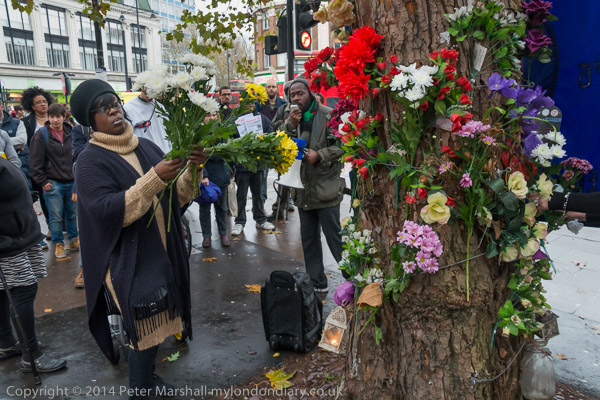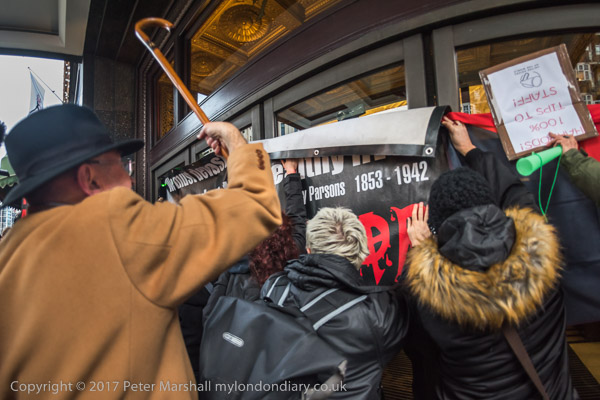
Sparks and Students – 10 Years Ago

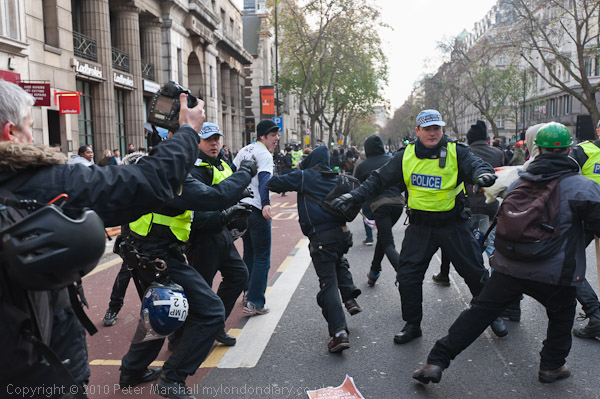
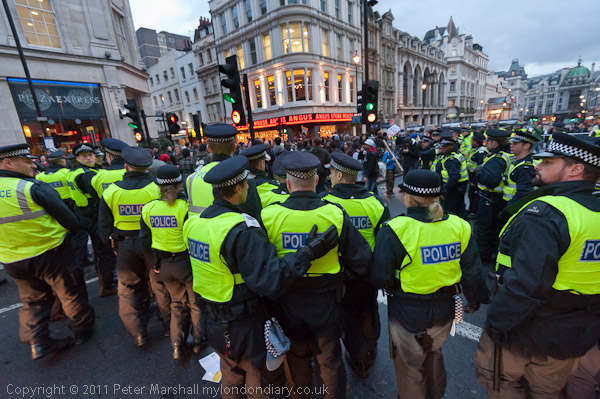
Police surround a grass roots rally before the main Union rally by electricians at the Shard


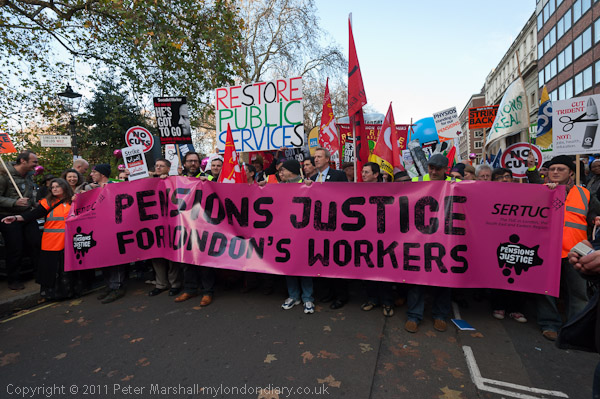
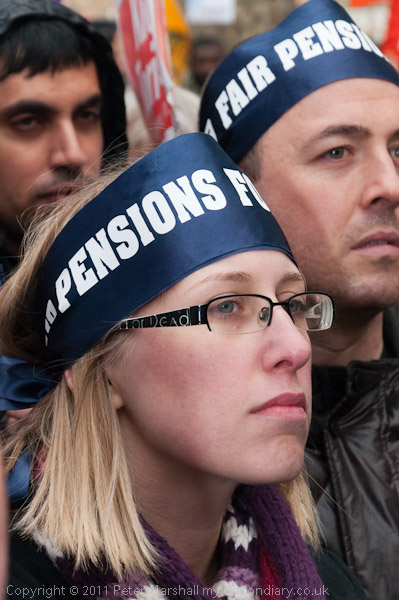
Ten years ago today on 9th November 2011 my work began at The Shard next to London Bridge, where ‘sparks’ (electricians) were protesting over plans by 7 major employers to tear up national agreements and impose worse conditions and pay cuts of at least 26 %.

Electricians listen to Unite union speakers

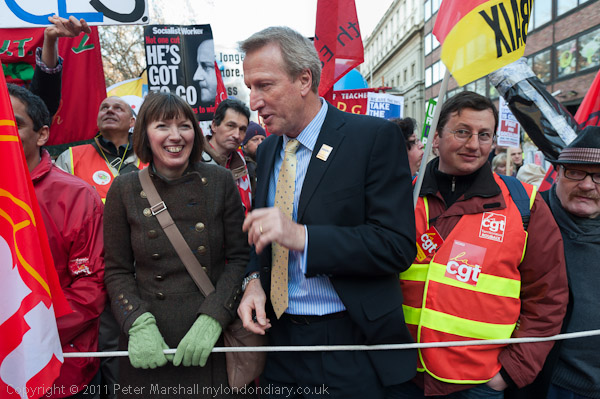
Before the official rally by the Unite union where speakers included several of the union’s leading officials as well as General Secretary of Unite Len McCluskey there was a separate rally with grass roots speakers. Numbers grew as the official rally began and there were over a thousand when it set off to march to another rally at Blackfriars.

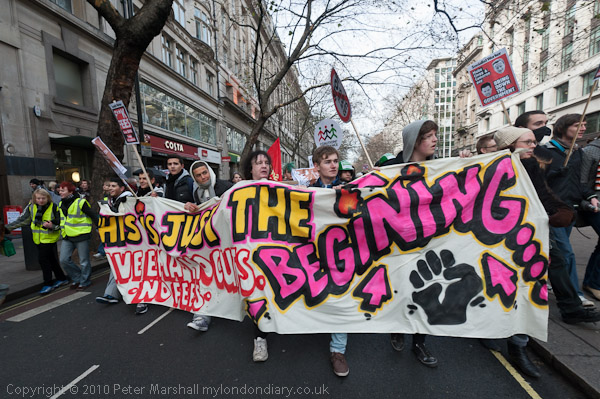
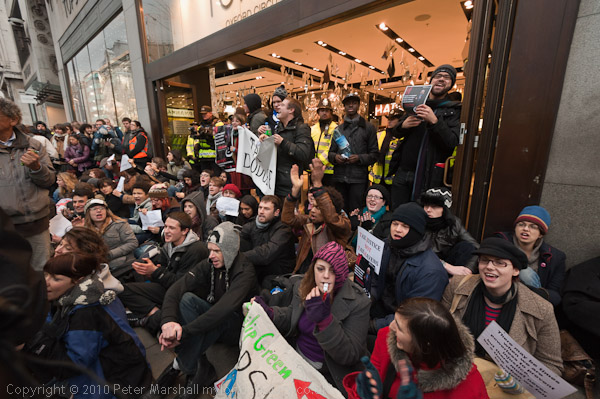
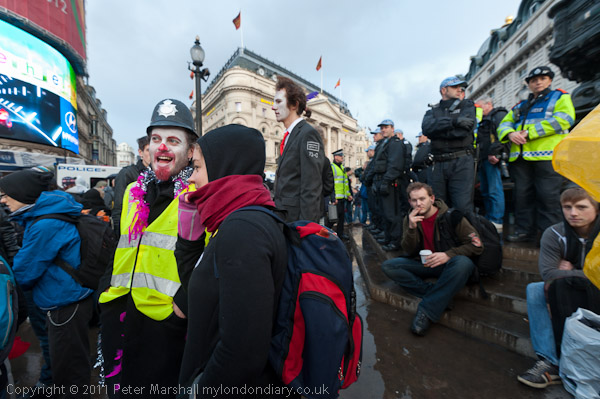
I left the march on Borough High St and headed north over the river to join a large march by student protesters against fees increases and cuts in services. Police had shut down most of central London before this started and there were no buses running and I had to walk around two miles to meet the marchers.

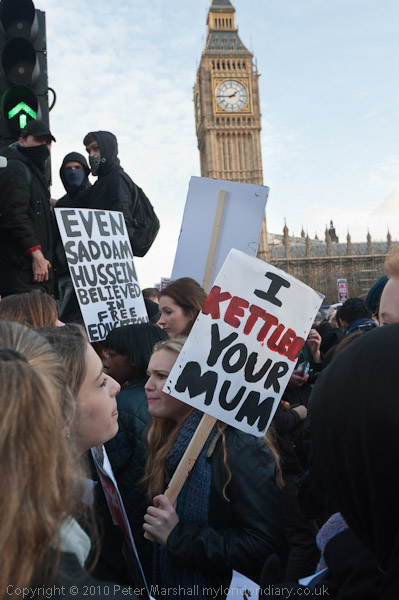
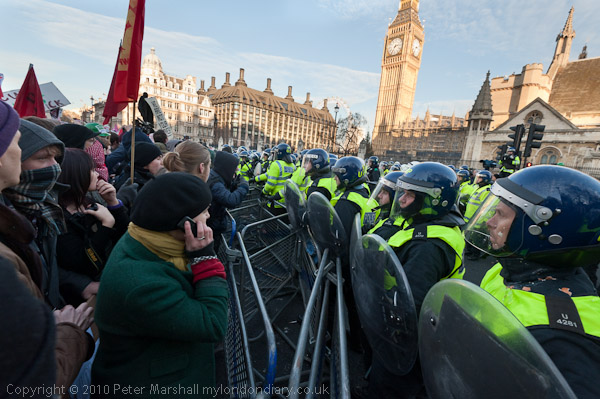
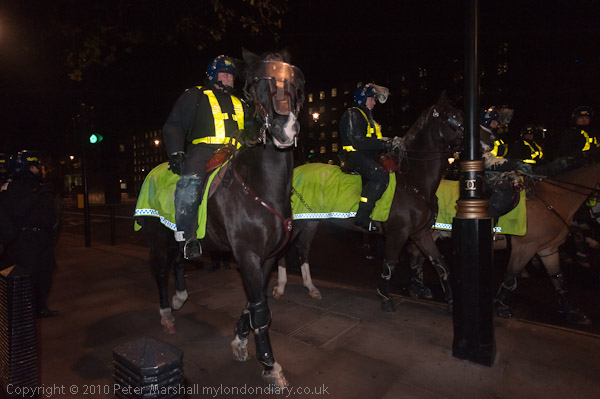
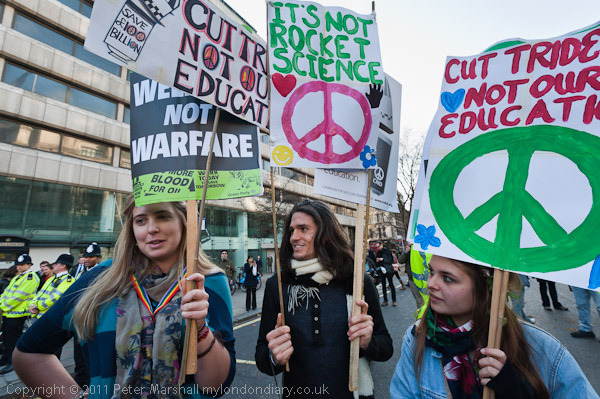
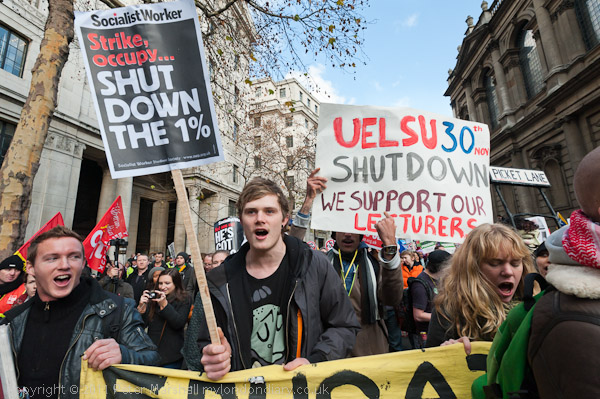
Students were angry about the cuts, particularly about the loss of the Educational Maintenace Allowances but the policing seemed completely excessive. I wrote: “There were perhaps 5000 students, but as the march approached me coming down Shaftesbury Avenue they were largely hidden by the police, with a row of mounted officers leading, followed by several further rows of police in front of the marchers. More police walked along each side of the march, and others stood on the pavement, with lines blocking side roads and others in the doorways of offices, banks and some shops.”

The mood of the marchers seemed to me to be rather cheerful and relaxed, and this was reflected in the humour in many of the posters. Although there were a number of provocative actions by police – including a snatch squad rushing in to grab several marchers – which injured me and some other marchers, as well as various occasions on which they slowed or halted the march, eventually bringing it to a complete stop and ‘kettling’ it in Holborn, which caused it to get a little heated.

Marchers chant “Free the Sparks”

The protesters had been angered to hear that six hundred electricians who had tried to cross the river after their rally in Blackfriars to join the student protest had been stopped at Blackfriars Bridge and London Bridge.

The police seemed to get completely disorganised at this point and I was able to walk past a police line along with several hundred of the protesters while the officers grappled with a few holding them back before more police arrived. After waiting for some time in the hope that others would join them, they continued the march to its intended destination at the Moorgate building of London Metropolitan University where they danced to the sound of a bicycle-hauled sound system while I walked a little further to Finsbury Square where Occupy London had been camping since 21st October.

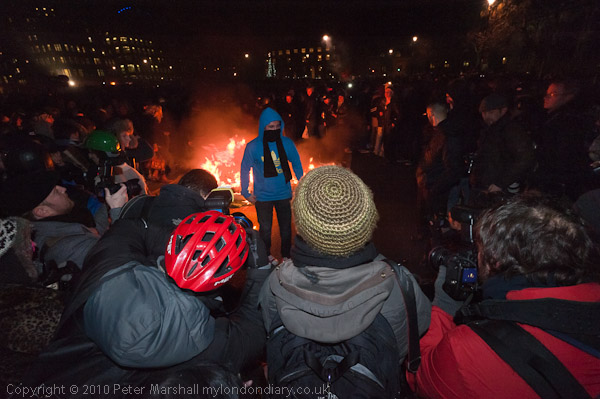
People in Finsbury Square were worried that the the 4000 police officers in London from the march would turn their attention to trying to evict them. I told them it was unlikely they would make an attempt with so many students on the street. Later I saw videos of students being kettled at Moorgate and individuals being attacked by snatch squads of plain clothes police who had posed as protesters but there was no action against Occupy London.

The huge policing of the two marches was clearly a reaction to the criticism of their failures at Millbank and Tottenham, but it came at a considerable cost, bringing movement in much of central London more or less to a halt for most of the day. Much of the City was still closed as I walked along Old Street with traffic outside the area moving at rather less than walking speed. Policing by consent has to involve letting peaceful protest continue and here was clearly an attempt to prevent it.

Students March Against Cuts & Fees
Sparks At The Shard

Remember, Remember

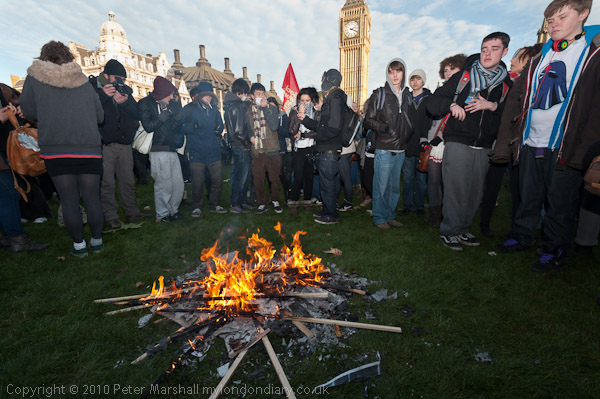
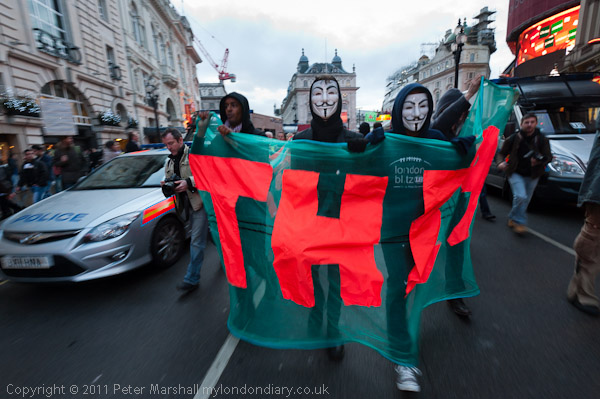
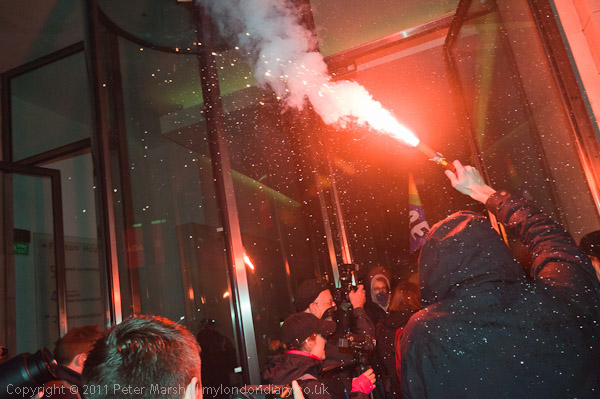
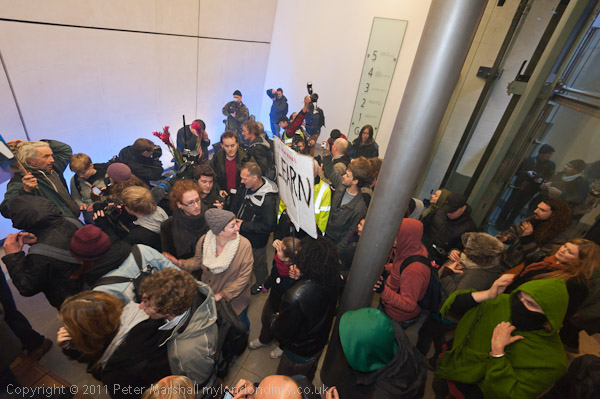
Despite some rumours I wasn’t around to photograph Guy Fawkes as he made his way into Parliament, but I was there in 2012 when ‘Anonymous’ wearing Guy Fawkes masks popularised in the graphic novel and film ‘V for Vendetta’ chose November 5th 2012, Bonfire Night, for their “worldwide Anonymous operation of global strength and solidarity, a warning to all governments worldwide that if they keep trying to censor, cut, imprison, or silence the free world or the free internet they will not be our governments for much longer.”
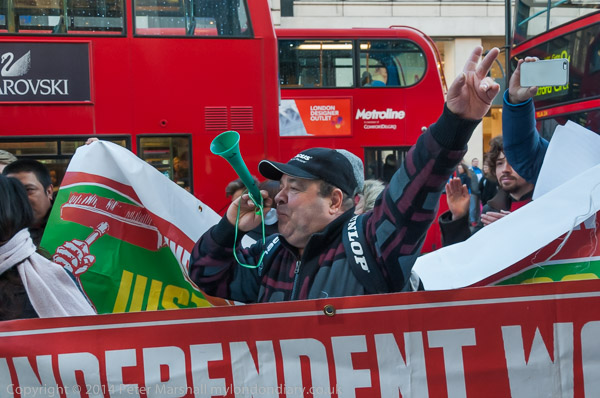
I wrote a fairly long account of the night, or at least those parts I witnessed, on My London Diary at Anonymous March to Parliament where you can also see many more pictures, and I won’t repeat the details here, but it is worth restating the aims of the protest:

In the UK the protest called for an end to cuts in education, health and welfare and the end of ‘austerity measures’ that target the poor and vulnerable, calling on the government to tackle the causes of the problems, including the banks and tax avoidance and evasion. They also want freedom for the Internet, with respect for the privacy of Internet users and the dropping of the Communications Data Bill.

My account also mentions that:

Anonymous also asks for Internet activists who are held as political prisoners to be released, including Julian Assange currently still unable to leave a London embassy, Richard O’Dwyer, the “PayPal 14, Jeremy Hammond, Topiary and the 4 anons of the UK that will stand trial on November 7th.

Everyone will be aware of some of what is still now taking place over Assange, including a CIA plot to kidnap him from the Ecuadorian embassy, then the Ecuadorian government withdrawal of his immunity, calling in the police to remove him, since when he has been kept largely in isolation in the high-secuirty Belmarsh prison as the US authorites continue to press for his extradition. The US appeal last week against a previous court decision that he could not be extradited because of this mental health and the likelihood that he would commit suicide has been largely the subject of a news blackout by the British media.

But the other cases have probably faded from most of our memories – if we were ever aware of them, so here are some brief reminders with information from Wikimedia.

Richard O’Dwyer created a web search engine which linked to copyright infringing sites and was charged in New York with conspiracy to commit copyright infringement and criminal infringement of copyright. He fought against extradition, but after Theresa May as Home Secretary ruled he could be sent to the US to face charges in November 2012 signed a deferred prosecution agreement, paying a £20,000 fine for charges to be dropped.

The PayPal 14 were charged under the Computer Fraud and Abuse Act in July 2011 for attempted denial of service attacks on Paypal in 2010 after it refused to make payments to a Wikileaks account, in what they say as a digital ‘sit-in’. Most later pleaded guilty to misdemeanours to avoid more serious charges and were sentenced to probation with 13 sharing a fine of $6,615 each.

American activist and computer hacker Jeremy Hammond was sentenced to two years in hail for hacking a US pro-Iraq war group in 2005. In December 2011 he was involved in a hack of private intelligence firm Stratfor, which compromised 60,000 credit cards and downloaded 5 million emails, some later published by Wikileaks. Identifying himself as anarchist-communist he defended his actions saying “I did what I believe is right” and was sentenced to the maximum penalty of 10 years in jail. He was released under supervision in November 2020, having been kept in jail longer for refusing to testify to a grand jury investigation into Wikileaks and Julian Assange.

Topiary, British hacktivist Jake Davis, was a member of Anonymous and LulzSec, involved in various online attacks including defacing the goverment websites of Zimbabwe, Syria, Tunisia, Ireland, and Egypt as well as the Westboro Baptist Church. Then aged 18, he was arrested in 2011 at his home in the Shetlands and charged with offences including a conspiracy to launce a denial-of-service attack against the Serious Organised Crime Unit. Tried with three fellow hackers (I think probably the 4 anons of the UK referred to by Anon) in 2013 he pleaded guilty and was sentenced to 24 months in a young offenders institute, with the 21 months he had been electronically tagged before the sentence being counted against it.

Anonymous hackers were also responsible for a number of successful attacks on child pornography sites, and actions against Scientology, a cult they saw was causing harm to many followers. They say “Distributed Denial of Service must be recognised as a legitimate form of protest, as long as an aim and reason has been specified by the protestors.

Anonymous March to Parliament


Free Education – No Barriers, Borders or Business

Free Education – No Barriers, Borders or Business was the call by the National Campaign Against Fees and Cuts (NCAFC) on their march through London on Wednesday 4th November 2015 against the abolition of maintenance grants and demanding free education without fees and huge student debts and an end to turning higher education into a market system impoverishing staff and students.

The march began in Malet St outside what had been the University of London Union, founded in 1921 as the University of London Union Society and was run by students for students. In 2013 the University of London decided to close ULU, taking over the building and running it as ‘Student Central’, now managed by the university, though continuing to offer similar services and resources for the 120,000 students, including bars, restaurants, shops, banks, a swimming pool and a live music venue – though some of these were on a reduced scale. But in 2021 it was announced that Student Central was to close and the building would become a teaching space for neighbouring Birkbeck College.

There were some speeches in Malet St before the march began, with speeches from several student representatives from various universities around the country, teaching staff and some fighting words from Shadow Chancellor John McDonnell MP. Green Party leader Natalie Bennett also marched with the students.

Antonia Bright of Movement for Justice spoke about the UK’s racist immigration policies and invited students to protest at Yarls Wood on the following Saturday.

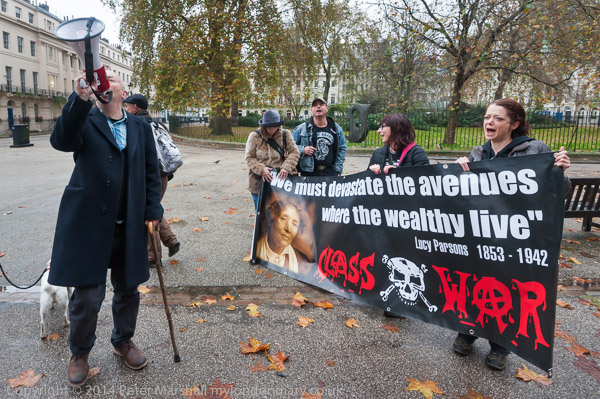
Among the marchers was a ‘black bloc’ carrying red and black anarchist flags and including Class War carrying their ‘WE HAVE FOUND NEW HOMES FOR THE RICH’ banner, along with a ‘book bloc’ carrying large polystyrene padded posters with the names of left wing and anarchist classic books on them or slogans such as ‘Rise, Riot, Revolt.’

The march went through Russell Square Square and down to High Holborn where it turned west and then took Shaftesbury Ave and the Charing Cross Rd to Trafalgar Square.

From there it went down Whitehall to Parliament Square where I left it briefly to photograph campaigners from the Save Shaker Aamer Campaign who had mounted a weekly vigil for his release from Guantanamo and were holding a ‘Welcome Home Shaker’ celebration.

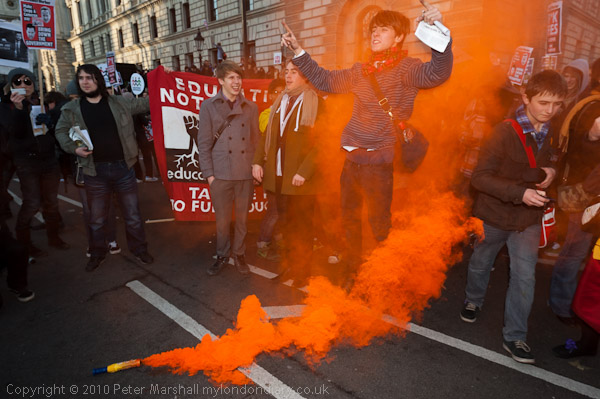
I caught up with the marchers again at the Home Office, where there was a great deal of noise, confusion and coloured smoke before the marchers turned around and walked back towards Victoria St.

They gathered outside the Dept of Business, Innovation & Skills, where a black clad block charged the mass of police protecting the building, but were forcefully repelled. More police arrived and started pushing everyone away, including peaceful protesters and photographers. I was sent flying but fortunately into some of the protesters rather than to the pavement.

Eventually the pushing stopped and the police set up lines across the street which prevented the more peaceful protesters leaving the area. I tried to leave, showing my press card. After some minutes of being refused I found an officer who let me through and I walked along the street to rest and wait to see how the situation would develop. Eventually the students managed to break through the police line and run along to join the others already there, and they moved off. I decided I’d had enough and made my way to Victoria station to catch a train.

More pictures:

Students at Home Office and BIS
‘Welcome Home Shaker’ celebration
Free Education – No Barriers, Borders or Business


Extinction Rebellion Climate Protest 2018

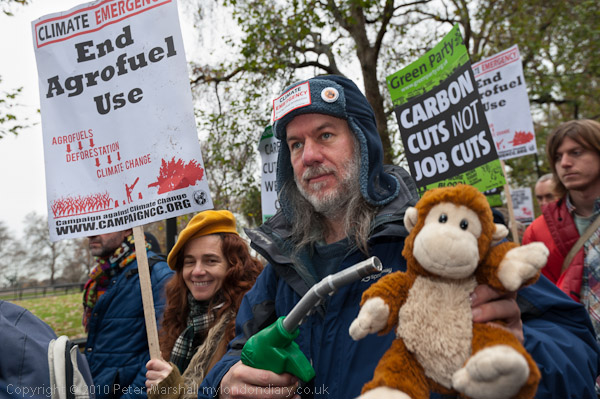
Protesters in Parliament Square on 31st October 2018 heard speeches from climate activists including Swedish schoolgirl Greta Thunberg, campaigner Donnachadh McCarthy, Labour MP Clive Lewis, economist and Green MEP Molly Scott Cato, before making a ‘Declaration of Rebellion’ against the British Government for its criminal inaction in the face of climate change catastrophe and ecological collapse.

Three years ago British campaigners were particularly inflamed by the almost total lack of any measures in the budget to meet the impending catastrophic climate change, and three years later we can say the same about last week’s budget. Sunak still seems to be intent on growth and business as usual, encouraging road building and air travel and there was little or no mention of any green initiatives, something of a pre-COP26 sabotage of stated government policies.

Reading the Declaration of Rebellion

But as Thunberg and others made clear, we have seen some rhetoric but totally inadequate action so far to meet the challenge and the Extinction Rebellion protest made this clear in its ‘Declaration of Rebellion’ against the British Government for its criminal inaction in the face of climate change catastrophe and ecological collapse.

Schoolkids get it – and it led to Greta’s protest outside the Swedish Parliament which has inspired many around the world. Even some of our media are beginning to get it, but governments around the world, including our own seem reluctant to actually make the kind of changes that are needed. And although some MPs speak out, neither Labour nor Conservative parties have embraced the kind of policies that are necessary to avert mass extinction.

Its a shame that many on the left have devoted rather more energy to criticising the actions taken by Extinction Rebellion rather than getting out and doing something positive, with few others organising protests and direct actions. XR have done a lot to raise public awareness and the vicious reaction to their protests with the government pushing prosecutions against them and a draconian Police, Crime, Sentencing and Courts Bill currently in its final stages in Parliament , and threats to rewrite the Human Rights Act and to hobble judges have shown the true colour of our Tory government as we move towards a police state.

After reciting the ‘Declaration of Rebellion’ the protesters moved onto the road and sat down to block it and continue the rally with songs, poems and speeches, including by Caroline Lucas MP and George Monbiot. There were several votes during the sit-down when protesters were asked if they wished to leave the roadway as police were threatening to arrest them which resulted in a near-unanimous show of hands in favour of remaining.

As George Monbiot finished some of the protesters began to leave, and several activists stood up to encourage people to stay behind on the road and be arrested, and several groups continued the protest, including one circle with protesters linking arms including Donnachadh McCarthy and George Monbiot. Police surrounded the group, and then arrested the man to McCarthy’s left, coming back a few minutes later to take McCarthy away – and he later published an account of what appeared to be a symposium on climate change he conducted in the police van. Monbiot shortly after got up and left, apologising to those remaining that he needed to collect his children from school.

The arrests continued slowly, and there was still a group on one side of the road who had been locked together for some hours who police seemed to be largely ignoring and were still there when I left, along with others still sitting on the road.

I have low expectations for next week’s COP 26. We will get more promises to add to those which have already not been kept and not the real shift into action that the world desperately needs. Of course I’d be delighted to be proved wrong. But this side of a revolution I think it unlikely that the ultra-rich can be persuaded to change their ways.

Many more pictures at:
Extinction Rebellion roadblock
Extinction Rebellion rally

United Friends & Families March

Today at noon in London, the the United Families & Friends Campaign (UFFC), a coalition of those affected by deaths in police, prison and psychiatric custody, is holding its annual march from Trafalgar Square along Whitehall to a rally opposite Downing St as it has on the last Saturday in October since 1999. In 2010 the march was also on 30th October and I published a lengthy post about it with many photographs on My London Diary. Here is the text in full (with some minor corrections) and a few of the pictures.


United Friends & Families March

Trafalgar Square to Downing St, London. Saturday 30 Oct 2010

Marcia Rigg-Samuel, sister of Sean Rigg, killed by police in Brixton, tries to deliver a letter at Downing St
more pictures

The United Friends and Families of those who have died in suspicious circumstances in police custody, prisons and secure mental institutions marched slowly in silence down Whitehall to Downing St, where police refused to allow them to deliver a letter to the Prime Minister, David Cameron.

It’s impossible to be sure how many of the suspicious deaths in police custody, prisons and secure mental institutions (and there are around 200 a year) have been as a result of lack of care, the use of excessive force and brutality, but certainly the answer is far too many.


Since 1999, the ‘United Friends and Families’ of some of those who have died have held an annual slow silent funeral march from Trafalgar Square down Whitehall to Downing St. It attracted particular attention in 2008 when the mother and other family members of Jean Charles de Menezes were among those taking part. This year’s event was rather smaller, and received little attention from the mainstream media.

A number of family members spoke with great feeling opposite Downing St, and then the group, by now around a hundred strong, moved across the road to fix flowers to the gates and attempt to deliver a letter to Prime Minister David Cameron. It seemed an unnecessary and pointless snub that the police refused to take the letter and that nobody from No 10 was apparently prepared to come and receive it.

Earlier there had been an argument with the police who had objected to the rally occupying one of the two southbound lanes of Whitehall, but was allowed to go ahead by the officer in charge after those present had refused to move. In previous years the police have usually seemed anxious to avoid confrontation, although in 2008 they insisted on searching all the bouquets before allowing them to be laid on the gates of Downing St.

Jason McPherson’s grandmother speaking opposite Downing St

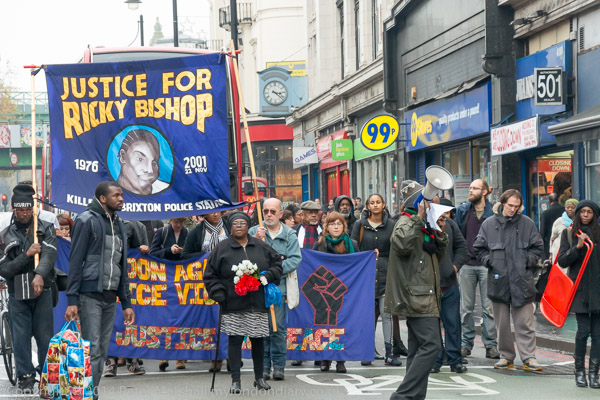
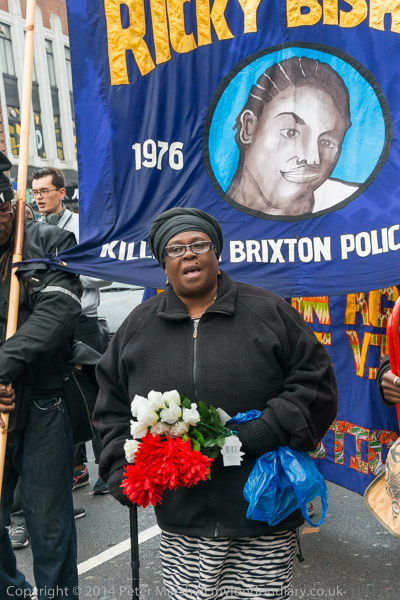
Speakers at the rally opposite Downing St included Stephanie, the twin sister of Leon Patterson, Rupert Sylvester, the father of Roger Sylvester, Ricky Bishop’s sister Rhonda and mother Doreen, Samantha, sister of Jason McPherson and his grandmother, Susan Alexander, the mother of Azelle Rodney, and finally the two sisters of Sean Rigg.

What the families want is simple. Justice. And to know the truth about what happened. What emerged again and again was a shameful history of delay, evasion and covering up by the police, with the collusion of the IPCC, the Crown Prosecution Service and even at times judges, working together to ensure that justice fails to be done. The press have been fed lies – as in the de Menezes case, security cameras have suddenly been found not to have been working, CCTV tapes have been lost or doctored, officers involved have not been questioned until many months after the events, witness statements have been dismissed as ‘unreliable’. Deliberate delays are used as a tactic to prevent the truth coming out, and these also have allowed officers involved to collude in their cover-ups.

Overwhelmingly the victims in these cases are black, but one of the banners on the march reminded us that it affects the whole of our community, with a banner asking why 18 year old Sarah Campbell died in Styal Prison in 2003. Many of us present remembered and sadly miss her mother, Pauline Campbell; after her daughter’s tragic death she devoted herself single-mindedly to campaigning for justice, not just for Sarah but for other victims and to improve the system. Eventually she forced an admission from the authorities that their lack of care had caused Sarah’s death, but she became another victim of injustice when she committed suicide on her daughters grave.

Stephanie LightfootBennett, speaks about the police murder of her twin Leon Patterson

Leon Patterson was arrested in Stockport in 1992 and kept in a police cell for some days despite being in need of hospital treatment. He was found dead in his cell with a fractured skull and severe injuries, his blood covering the walls of the cell and his genitals mutilated, and in such a bad state that she failed to recognise him. The family challenged the initial inquest verdict which found his injuries to be self-inflicted, but there was no legal aid available for them. Fortunately the charity INQUEST supported them and a second inquest in April 1993 returned a verdict of unlawful killing, although this was quashed on appeal by the police on the grounds that the coroner had misdirected the jury on the law.

Roger Sylvester died in 1999 after being arrested by the Met. An inquest jury in October 2003 returned a verdict of unlawful killing, but the verdict was later quashed in the High Court, because the judge claimed the coroner’s summing up had confused the jury. The judge refused to order another inquest and said that no jury in a criminal case would be likely to convict any of the officers concerned of manslaughter.

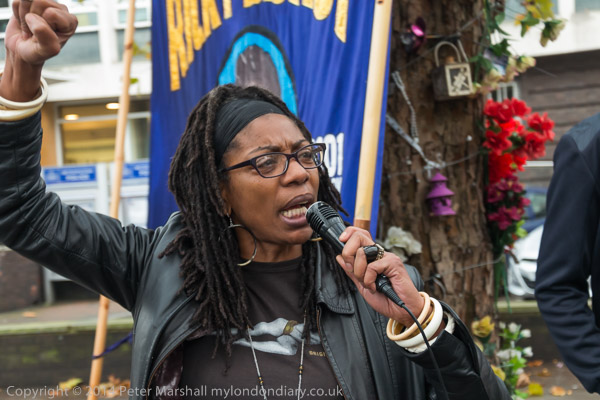
Ricky Bishop was stopped, arrested and taken to Brixton police station on 22 Nov 2001, where he was assaulted and brutalised by police officers, leading to a heart attack. After that the police called a paramedic and he was taken to hospital and died. The family say that the police withheld vital evidence from the inquest and that the jury were not given a proper choice of verdicts at the inquest.

Samantha, sister of Jason McPherson

Jason McPherson died in hospital after being taken there from Notting Hill Police station after having been arrested on suspicion of drug offences on 18 Jan 2007. Police believed he had a wrap of cocaine in his mouth and had used considerable and arguably excessive force on his head and chest to try to get him to open his mouth. A jury at the inquest in January 2010 came to a unanimous ‘narrative verdict’, saying that the procedures were not properly implemented and that “it did not appear Jason was given the opportunity to remove the drugs voluntarily through talking down (tactical communication).”

Azelle Rodney was killed by police in April 2005 after a car in which he was travelling was rammed and stopped by the Met in Barnet. Rodney was not armed, although the officer who fired the shots at close range was sure he was. Various misleading statements from police sources were widely published by the press. An inquiry into the case opened formally earlier this month and there is to be a hearing in the Royal Courts of Justice starting next week.

Marcia Rigg-Samuel, sister of Sean Rigg, who went into Brixton Police station in August 2008 a physically healthy man but was dead a short time later, killed by the actions of a small group of officers, led the procession down Whitehall from Trafalgar Square. She stood beside her sister, Samantha Rigg-David, the last of the families to speak, and then read the letter from the families to Prime Minister David Cameron. The inquest on Sean Rigg, adjourned in 2008, is not now expected until 2012.

The families then moved across the road to the gates to Downing Street, demanding that police open them so they could deliver their letter. Police refused, and a small group of armed police joined the armed officers already present. After considerable amount of angry shouting as the police continued to refuse to allow access or even to take in the letter – a few of the group were allowed to sellotape the flowers, a photo of Sean Rigg and the letter to the gates. The noisy demonstration at the gates was still continuing when I left.
more pictures


UFFC Annual Rally & Procession

Next Saturday, 30th September 2021, I hope to be photographing this years United Families and Friends Campaign annual remembrance procession. Meeting from noon in Trafalgar Square, at 1pm they will march in silent procession along Whitehall, followed by a noisy protest outside Downing Street.

Janet Alder, the sister of Christopher, killed by police in Hull in 1998

The United Families and Friends Campaign (UFFC) mission is to work collaboratively as a network of independent campaigns to address common issues and concerns related to deaths and abuse in police, penal, mental health and immigration detention; and to organise events and activities that promote awareness and support for affected families across the UK. “

Marcia RIgg, whose brother Sean was killed in Brixton Police station in 2008

This procession has taken place on the last Saturday of October every year since 1999 to “to remember loved ones who have died in custody” and the UFFC invite all to “Come and support the families of those who have died at the hands of police, prison and secure medical units in the United Kingdom.”

Among the victims are Christopher Alder, Ibrahim Sey, Joy Gardner, Roger Sylvester, Seni Lewis, Adrian McDonald, Darren Cumberbatch, Rashan Charles, Sean Rigg, Jack Susianta, Sheku Bayoh, Mikey Powell, Paul Coker and Cameron Whelan, and many others whose families are among those involved in organising the event.

Seni Lewis, killed in 2010

The invitation to attend states “The UFFC annual procession is supported by: Black Lives Matter UK, 4WardEverUK, Migrant Media, INQUEST, UNISON, RMT, FBU, UNITE, Tottenham Rights, Sisters Uncut, London Campaign Against Police & State Violence, LARAG, Newham Monitoring Project (NMP), Pan African Society Community Forum, Institute of Race Relations, Edge Fund, National Union of Students and DTRTP.”

I’ve photographed this event, and been deeply moved by it, most years since I first heard about it in 2003. The pictures with this post are all from nine years ago in 2012 when the protest was on 27th October.

The procession ends with a rally opposite Downing St where family members speak

That year as in all years there were new names to add to the list of 3,180 known custody deaths since 1969, chosen as the date when David Oluwale was killed – and two officers convicted of several assault charges. Since then many of those over three thousand have died in situations where foul play seems obvious, but a Full Fact investigation has found only one single police or prison officer has been convicted of murder or manslaughter or assault related to a death in custody – Sergeant Alwyn Sawyer, convicted in 1986 for the manslaughter of Henry Foley. A few other police officers have been prosecuted but the cases against them have collapsed or they have been found not guilty.

Stephanie Lightfoot-Bennet whose twin Leon Patterson was beaten to death by Manchester Police in 1992

Clearly police and others have difficult jobs, but there needs to be transparency and an intention, still sadly lacking, to get at the truth. The immediate response of the police is still normally to deliberately mislead about the circumstances and to cover up on behalf of the officers involved. It has taken years of dogged and dedicated action by family members, often having to do work the police should have done, overcoming obstacles put in their way for a few families to get to the truth about how their family members died – and sometimes to get inquest verdicts which reflect this. But still not to get justice.

Jan Butler holding a photograph of her son Lloyd, who died in a police cell

As the invitation to the event ends “We look forward to seeing you – No Justice No Peace“. No Justice No Peace is a sentiment that will fill Whitehall on Saturday, echoing from the offices which line the street, but which as in previous years will sadly fall on the deaf ears of our establishment.

More from 2012 at No More Police Killings, Time For Justice.


London 22nd October 2014

ILF

The Independent Living Fund enabled many disabled people to continue to live with dignity and to work making a positive contribution to society and the government decision to close it led to many protests and to legal actions to try and stop it under the Equality Act.

Although a court ruled that the minister concerned had acted illegally, all it required was that the new minister reconsidered the plans. He did so, and decided to go ahead, though with a three month delay. And a judge ruled in December 2014 that although in axing the ILF he knew that the closure would mean many disabled people would lose their ability to live independently in the community his decision was legal.

The decision to end ILF was clearly wrong, clearly immoral, but so long as the legal niceties were observed the government was able to go ahead with it, and our law gave no protection.

The vigil outside the court while the case was being heard attracted wide support, including from Inclusion London, Norfolk and Suffolk DPAC local DPACs, the Greater Manchester Coalition of Disabled People, Transport for All, Winvisable, PCS Union, the TUC, and other organisations,and there was even a simultaneous vigil in Toronto, Canada. Three MPs, John McDonnell, Andy Slaughter and Jeremy Corbyn, came to give their support, and there were speeches by campaigners including Paula Peters and Andy Greene, with John Kelly singing.

As expected the vigil ended with a short direct action by DPAC and others, briefly blocking the Strand outside the law courts.

Free Shaker Aamer

This was one of a long series of regular vigils opposite Parliament for Shaker Aamer, an innocent charity worker arrested by bandits and handed over to US forces who have imprisoned and tortured him for over 12 years. He was cleared for release in 2007 but remained in Guantanamo with our government failing to press for his release because his testimony could embarrass MI6 as well as the US.

London Panoramas

I had time before another protest to visit an exhibition at the Museum of London Docklands and on the journey to pause and make some panoramic images.

Probably the most interesting were inside Westminster station, where “the beams and buttresses, designed by Hopkins Architects and completed in 1999 for the opening of the Jubilee Line are also the foundations of the block of parliamentary offices above the station, Portcullis House, and were deliberately Piranesian, though sometimes I get more of the feeling of Escher as you seem to walk endlessly up escalators and around the interior.”
Democracy Camp – Poet Arrested

I returned to Parliament Square where the Democracy Camp was still holding workshops, though police and the GLA ‘heritage wardens’ had fenced off the main grass area.

Danny, one of the protesters had been sitting on the plinth next to the statue of Churchill since the previous afternoon and poet Martin Powell arrived with a pot of food for him, which he tossed up to him, going straight into his hands, despite police warning him he could be arrested.

How can feeding the hungry be a crime?” he asked and he was arrested and led away in handcuffs around two sides of Parliament Squareperforming his poem ‘The Missing Peace’. I left while Danny was still on the plinth, though later that evening police finally found a ladder and brought him down after over 26 hours.

Musical Poor Doors

It was Class War’s 14th weekly protest at the ‘rich door’ of Redrow’s One Commercial St flats and it was a lively affair, with the banners dancing to the music of Rhythms of Resistance, a poetic performance and some rousing speeches against social apartheid.

There were a lot of police present and some stood in front of the door and ushered a few people in and out but made no attempt to stop the hour long protest, which though noisy remained entirely peaceful. Some of the police clearly enjoyed the music and watching the dancing.


More at:
Musical Poor Doors
Democracy Camp – Poet Arrested
Canary Wharf & Westminster Tube
End UK shame over Shaker Aamer
DPAC High Court Vigil for ILF


Pay Rise, Occupy, Blessed Sacrament & Poor Doors

Saturday 18th October 2014 was another long and busy day for me. After briefly looking in at Parliament Square, where a few from Occupy Democracy had defied police to spend the night on the pavement I went to the Embankment where thousands were massing for the TUC ‘Britain Needs a Pay Rise‘ march which was due to begin in a couple of hours time.

I returned to the TUC march a little later for the Press Call, seldom very interesting events to photograph, and then the start of the march where Frances O’Grady was doing her best for the camera.

Things got a little more interesting as the march filed part me, and towards the end of the 80,000 or so I met rather more people I knew, including those with CND, Focus E15, Occupy London, Class War and other radical groups.

An hour and a quarter after the start the people at the back were getting close to the start of the march, and I went back for another look at things in Parliament Square. Not a lot was happening, apart from some illicit sleeping (its a crime there.)

I went on to Westminster Cathedral, arriving in time to meet the Procession of the Blessed Sacrament leaving to walk to St Georges Cathedral in Southwark, and walking with them across Lambeth Bridge, from where I walked back towards Parliament Square.

I arrived back as more people who had been on the TUC march were arriving, including a group from UK Uncut dancing to a music centre on a shopping trolley. Police and a warden from Westminster Council – who are responsible for the pavement opposite the Houses of Parliament came and tried to seize the music centre, but after much argument allowed the to keep it so long as they left the square.

Shortly afterwards others arrived, with a group of anarchists running across the grass with black flags, chased by ‘heritage wardens’, then others poured onto the grass with the two towers with the messages ‘Power’ and ‘Democracy’ they had carried on the TUC march. A rally then took place, gathered around these to protect them, with John McDonnell MP as the first speaker, while police lined the edge of the square watching. Then small groups of police began to gather, ready to charge, and police reinforcements arrived; it seemed only a matter of minutes before they tried to clear the area.

But after Russell Brand arrived to speak, the police rapidly melted away and the many vans drove off. I suspect they knew that had they attacked when he was present there would have been massive media coverage and decided it was better to come back at dead of night after most of the press and TV have left – as they did.

I left to go to Aldgate, where Class War were holding a Poor Doors Saturday Night Special against the separate doors for rich and poor residents at One Commercial St, Aldgate, with a larger than usual group who had come from the nearby Anarchist Book Fair. It was a livelier protest than usual with samba from Rhythms of Revolution and some songs from Cosmo up from Wales for the event, as well as a rather larger than usual police presence.

Inevitably at the end of the protest the group decided to move onto the busy Whitechapel High Street and block it, ignoring orders by the police to leave the highway. It’s a fairly dark area of street and my flash unit was having problems, but I managed to make a few pictures, some by the headlights of the blocked cars. After around ten minutes the protesters decided it was time to leave the road and end the protest, and I went home.

More at:

Poor Doors Saturday Night Special
Procession of the Blessed Sacrament
Britain Needs A Pay Rise
Democracy Camp takes the Square


Architecture is always political

Simon Elmer of Architects for Social Housing (ASH) holds up a poster with the quote ‘Architecture Is Always Political’ from Richard Rogers, Fellow of the Royal Institute of British Architects at a protest on the pavement outside the RIBA on Portland Place on Thursday 15th Oct 2015.

The protest was against the nomination of NEO Bankside, a luxury development beside Tate Modern in London which breaks all planning requirements for social housing and sets a dangerous precedent for social cleansing for the prestigious Stirling Prize. Rogers was responsible for the design by Rogers Stirk Harbour + Partners of “the 217 apartments and penthouses in four Pavilions … with unparalleled views towards The City and St Paul’s Cathedral”. Or, as some might see it, degrading many views from the CIty and St Pauls. Some residents in the new development have taken and lost a case seeking to have the Tate Modern extension’s viewing platform closed as it overlooks their flats – and have now appealed to the Supreme Court, where a hearing is expected in December 2021. I hope it rejects their case. The flat dwellers could readily install blinds or curtains to protect their privacy.

The protesters stated on the reverse of the flyer that “this development is a class war against the poor and on the reverse explained why. NEO Bankside contains 217 homes with a market price ranging from £1.25 million to £19.75 million when 345,000 Londoners, 4% of the city’s population, are on council waiting lists for homes.”
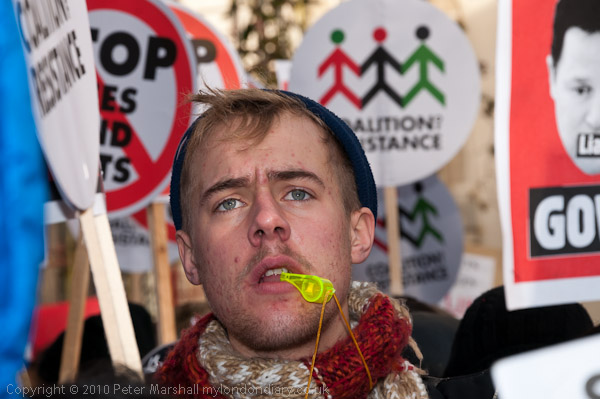
NEO Bankside reduced the percentage of its affordable housing required uder Section 106 of the Town and Country Planning Act from 40% to a paltry 27.5%, by getting the property developers Native Land to undervalue the estimate of sales to just over half of the actual sale value.They then paid Southwark Council £11 million to build its reduced affordable housing quota off-site on land sold to them by the council for a pittance, demolishing a council-run children’s home and day-care nursery in the process.

ASH pointed out that rather than 217 luxury flats mainly for non-resident tax exiles and foreign investors, the cost of NEO Bankside could have built 2,260 Peabody flats at the cost per flat of another of the Stirling nominations. At a time when 42,000 families were evicted from rented accomodation last year and 88,000 London children will be homeless this winter, such buildings are clearly socially unacceptable.

Having made the flyer, at the protest they folded them into paper aeroplanes and made them fly, although the police threatened them with fines for littering (but they picked them all up after flying them) and then attempted to call paper aeroplanes offensive weapons and that flying them could constitute and assault – which was laughed out of court on the pavement as it would surely have also been had any case been taken.

The protest then carried out its own award ceremony, ‘The O J Simpson 2015 Prize for getting away with murder’, The winner was NEO Bankside, but no one from the architects came to claim it. Although most of those going into RIBA for the official ceremony (tickets at over £200 a head including VAT and booking fee) walked past trying to ignore the protest, there were some architects who stopped to share their reservations about NEO Bankside with the protesters, and it seems that RIBA had clearly been embarrassed by the revelations about NEO Bankside and were misled over some aspects of the scheme. The prize instead went to Burntwood School, an impressive revitalisation of a 1950s LCC comprehensive girls’ school in Wandsworth by architects Allford Hall Monaghan Morris (AHMM).

More pictures at NEO Bankside Stirling Prize nomination.


Four Years Ago

Four years ago, on October 14th 2017, I found myself in the unusual position of looking for a Michelin starred restaurant in Mayfair, definitely something well outside of my normal social and financial territory. But I wasn’t looking for somewhere to eat, but to photograph a protest outside calling on the restaurant’s owner and his head chef not to break the Palestinian call for a cultural boycott of Israel by participating in Brand Israel culinary event ‘Round Tables’ in Tel Aviv in November 2017.

The protesters say that events like these are part of an Israeli government’s Public Relations efforts to distract from its policies of occupation and apartheid by bringing international prestige to Israel’s culinary scene and that his event is sponsored by Dan Hotels who have a branch built on stolen Palestinian land in occupied East Jerusalem.

This was a peaceful protest, with Palestinian flags, banners about Israeli apartheid and ethnic cleaning and supporting the campaign for Boycott, Divestment and Sanctions against Israel (BDS) and calling for justice for Palestinians. Those protesting included both Palestinians and Jews. A small group of counter-protesters also came, holding an Israeli flag, one of whom came to tell me that everything it stated on the protesters banners were lies. I told him that I had friends in Palestine and know how they were treated both by the Israeli government and by Jewish settlers who came and destroyed their olive trees while Israeli forces stood and watched taking no action against them.

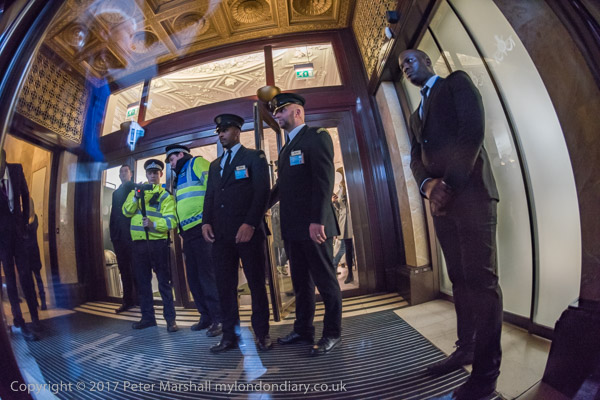
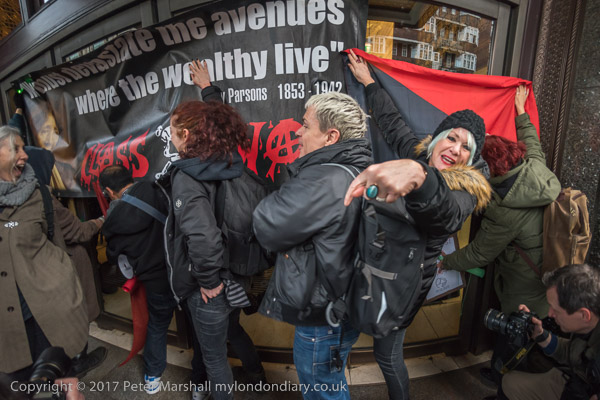
I left to join Class War and London 4th Wave Feminists who were protesting again outside the tacky tourist trap in Cable St which glorifies the exploits of ‘Jack the Ripper‘ and his brutal series of 19th century murders and exhibiting materials relating to the death of working class women who were his victims.

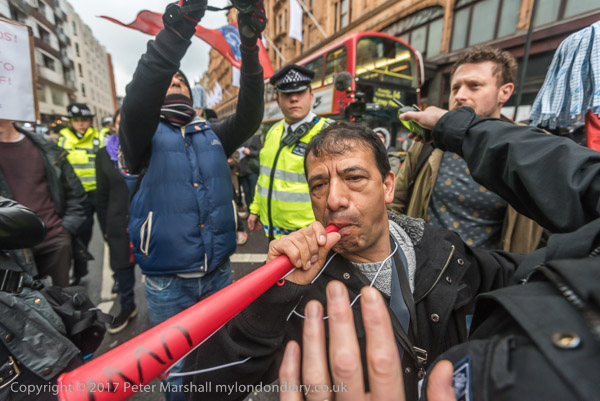
The so-called ‘museum’ only gained planning permission by claiming it would celebrate the history of women in the East End and not their horrific slaughter, and although Tower Hamlets council were unable to withdraw the consent they were now failing to enforce decisions about inappropriate signage and unuathorised metal shutters. Class War came with plastic inflatable hammers to symbolically attacked these.

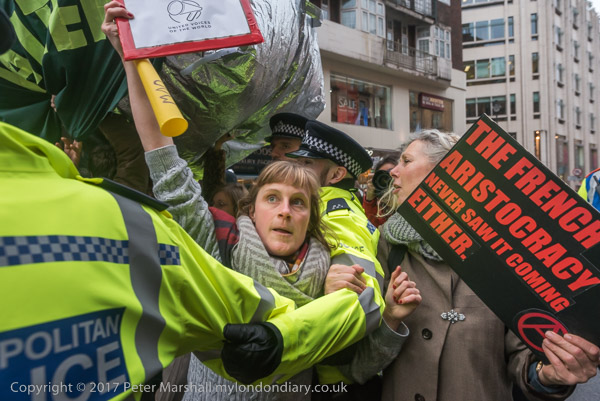
Police tried hard to get the protesters to move away from the shop with no success, and escorted a few customers past the protesters inside. There were few during the hour or so of the protest, and at least one group went away when they heard what the protesters had to say, while another group who had been inside came out and told them that they thought the “museum” was very disappointing in the way it treated the murders.
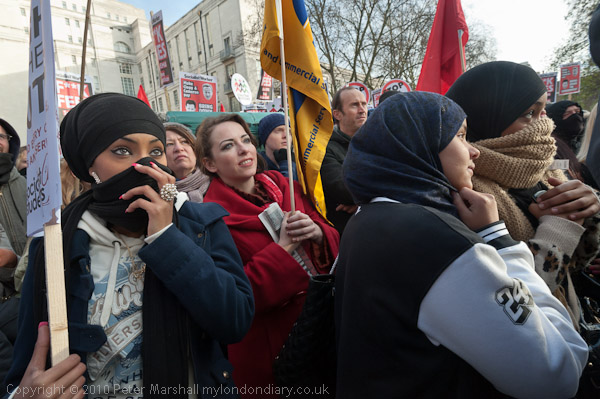
I left as the Ripper protest was coming to an end to go to the Zimbabwe Embassy, where every Saturday afternoon the Zimbabwe democracy and human rights vigil takes place. Today was a special day as the first vigil was held on 12th October 2002 and they were celebrating 15 years (780 vigils) having vowed to continue until the human rights abuses of the Mugabe regime are ended and there free and fair elections in the country.

Among those present were several who had been at that first vigil in 2002 including human rights activist Peter Tatchell who had been badly beaten when he attempted a citizen’s arrest on Mugabe in Brussels in 2001, and his is one of the hands holding the knife to cut the cake.

Zimbabwe vigil celebrates 15 years
Class War return to Ripper “Museum”
Little Social don’t break the cultural boycott