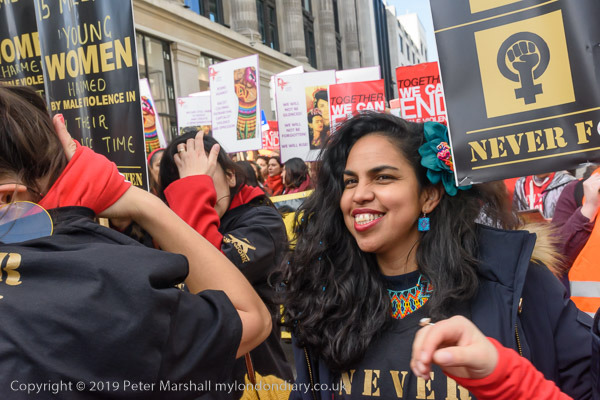
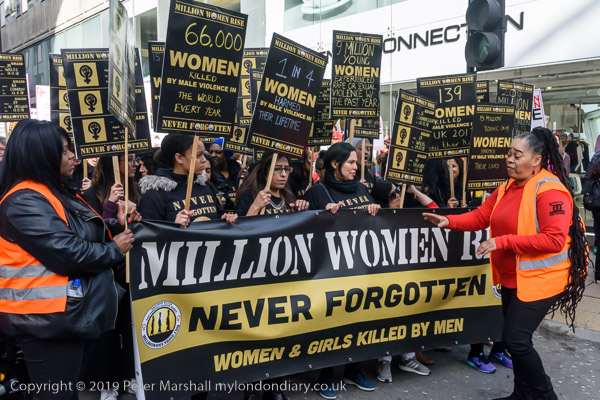
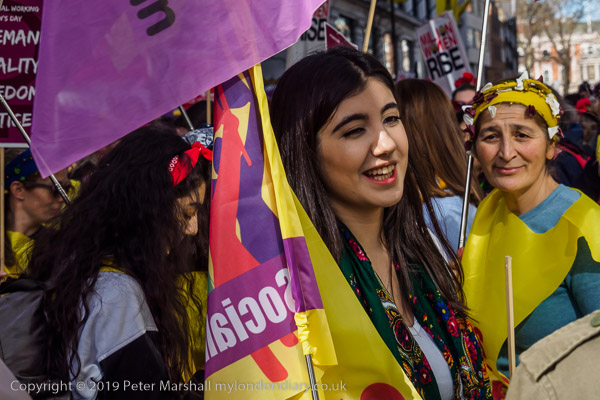
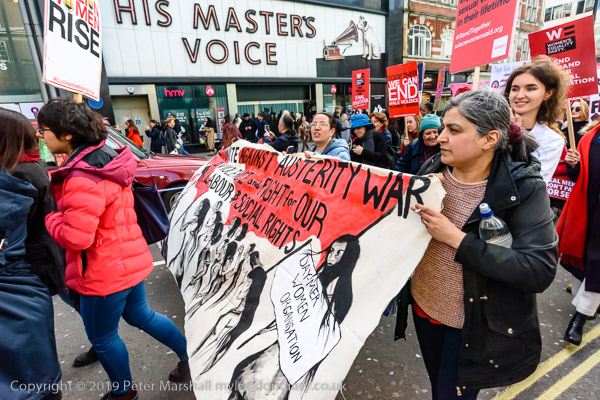
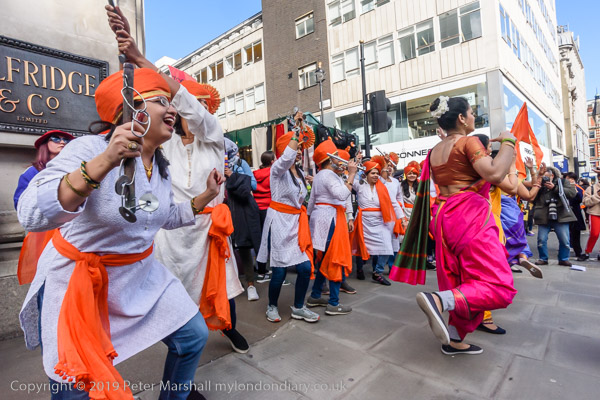
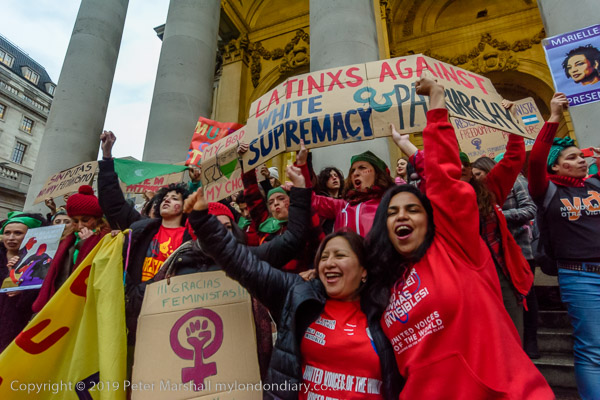
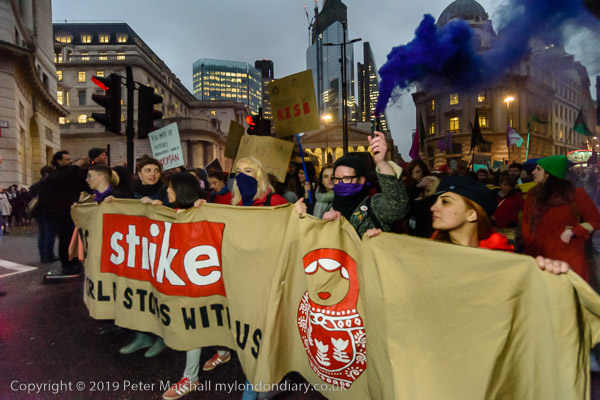
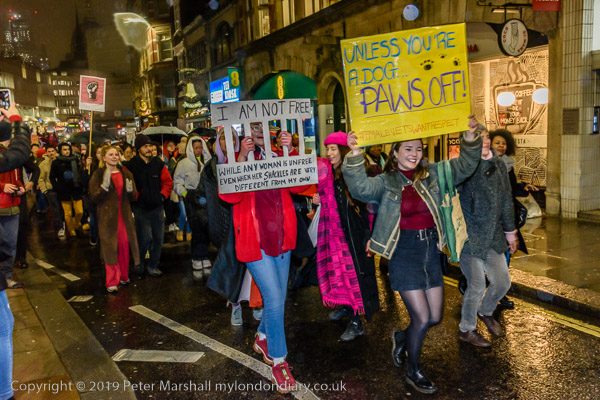
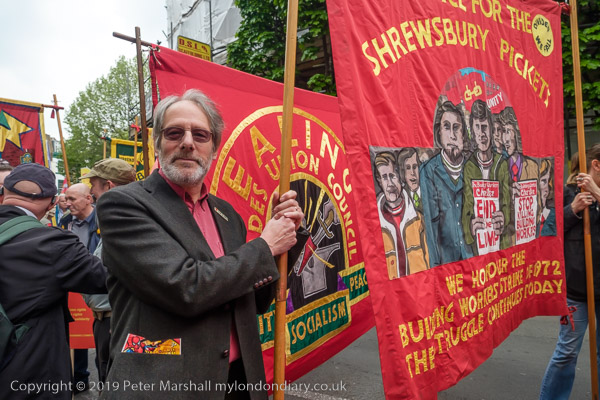
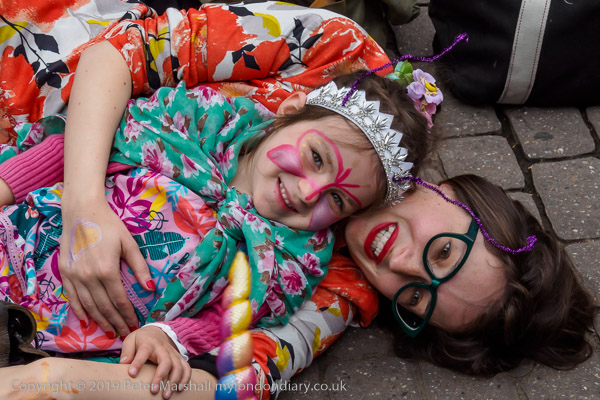
I photographed the first of these all-woman Million Women Rise marches in London in 2008, and have covered the event in most or all years since, always on a Saturday close to International Women’s Day. It’s an event that is supported over a hundred human rights and women’s groups around the country and is “led and organised by a majority of black women” and also includes many from other minority ethnic communities.
It’s an organisation that welcomes support from men in various ways, but on the day of the march asks them to “come and stand on the pavement and cheer us on.” And I do, though most of the time I’m too busy taking pictures to actually cheer.
Their web site has a list of ten demands, beginning with:
To acknowledge the continued discrimination faced by all women, the additional discrimination faced by Black women and women from other minority groups, and reflect this in all public policy in the UK and internationally
Million Women Rise web site- http://www.millionwomenrise.com/demands.html
I took pictures in the side road where the march gathered, where the marchers spill over onto the pavement and I could mix a little with the marchers before the march began, but for the march itself I stayed on the side as requested.
One slightly different aspect of this years march was the Pan Indian Dance Group who danced their way along Oxford St at the rear of the march – and I think went on to dance at the rally in Trafalgar Square, but by then I had left the event.
There are no adverts on this site and it receives no sponsorship, and I like to keep it that way. But it does take a considerable amount of my time and thought, and if you enjoy reading it, please share on social media. And small donations via Paypal – perhaps the cost of a beer – would be appreciated.
All photographs on this and my other sites, unless otherwise stated, are taken by and copyright of Peter Marshall, and are available for reproduction or can be bought as prints.
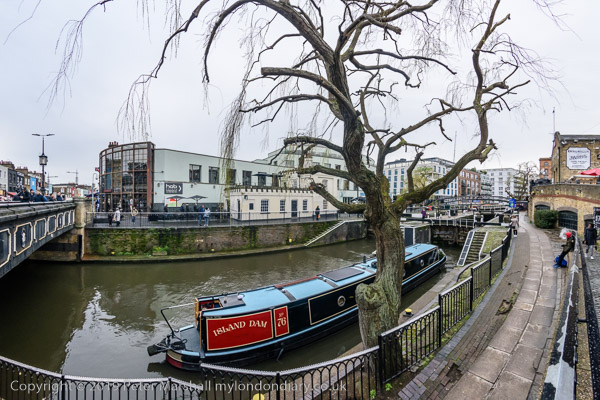
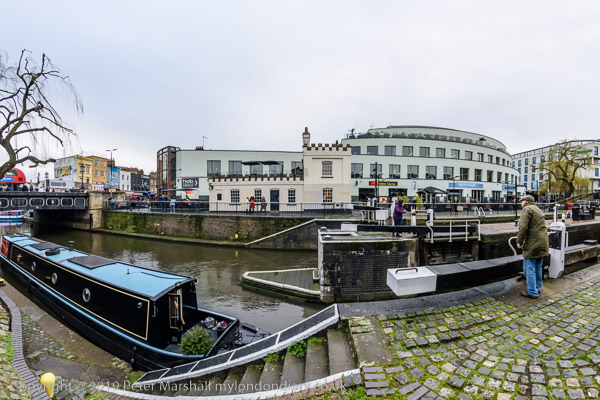
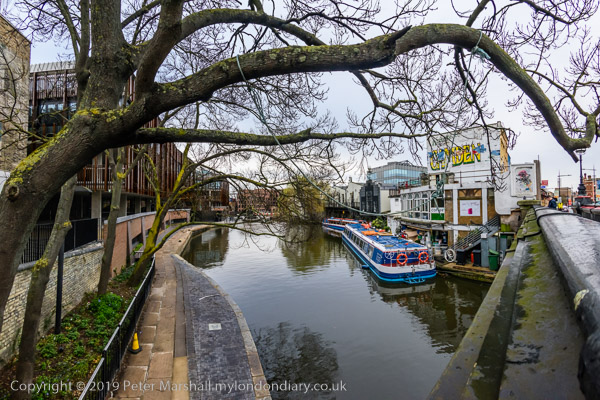
I thought I had plenty of time to go to Camden and take some ictures along the canal towpath between two events – I think after my late lunch there were at least a couple of hours to spare. But I had reckoned without London’s traffic, and by the time my bus from Aldwych reached Camden High St, things were beginning to look a little tight.
Traffic in central London often comes to near standstill, and I could have walked there in the same time, but I can no longer walk the long distances I used to, or at least not without getting exhausted. If you want to get anywhere during the working day, apart from walking, the only reliable methods are now either cycling or using the Underground. It wasn’t feasible to bring my bike to cover the two protests, and I was saving pennies (or rather a couple of pounds) by taking the bus.
By the time I got to the canal there was very little time, and the weather had changed, with a little light rain, which does tend to get more people into their cars, so I knew my journey on to the next event would also be slow.
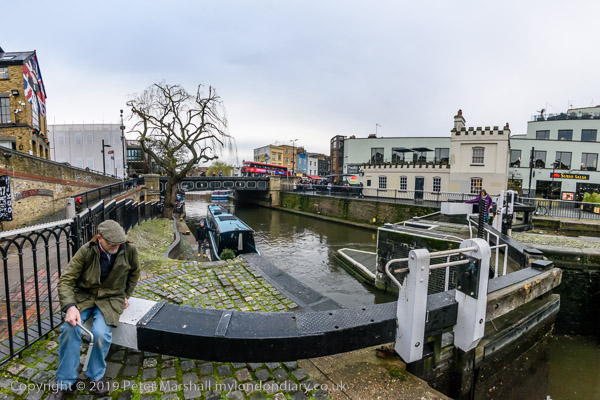
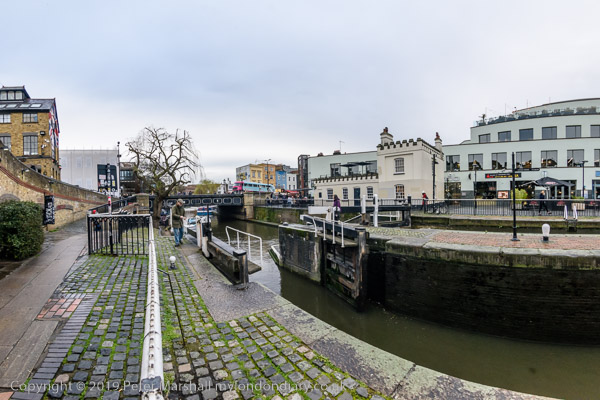
I’d replanned in my mind a shorter walk than anticipated while sitting on the bus, and set out only to find the canal towpath I’d intended to use had been closed for a few weeks because of building work taking place. So this was not my most successful journey. I took a few pictures, and then left, just missing a bus and finding the services were disrupted by the traffic. I did make the next event more or less on time.
The pictures here – with a few slight variations – were all that I managed to make of the canal.
There are no adverts on this site and it receives no sponsorship, and I like to keep it that way. But it does take a considerable amount of my time and thought, and if you enjoy reading it, please share on social media. And small donations via Paypal – perhaps the cost of a beer – would be appreciated.
All photographs on this and my other sites, unless otherwise stated, are taken by and copyright of Peter Marshall, and are available for reproduction or can be bought as prints.
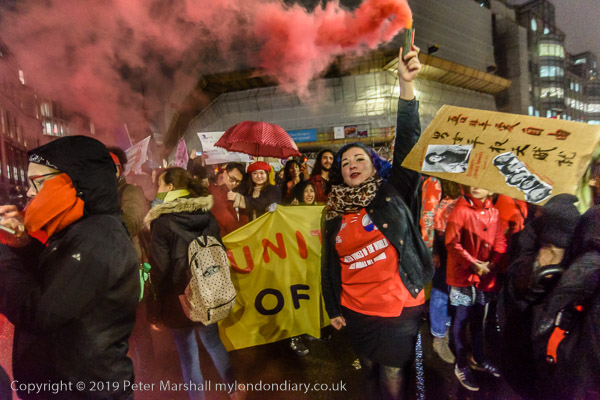
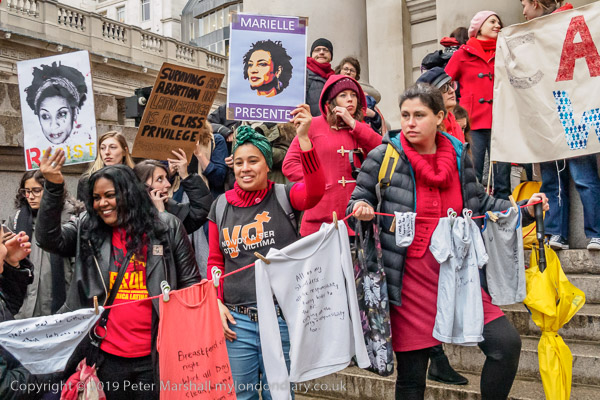
The Women’s Strike Assembly unites a range of feminists (of all genders) and is a part of an international women’s movement which has led protests on the streets in many countries, from “Argentina to Poland, from Ireland to Kurdistan” as well as in London, with women “making connections, building alliances and taking action against our current conditions of womanhood.” It “rejects the decades of economic inequality, criminalization and policing, racial and sexual violence, and endless global war and terrorism.“
On the evening of International Women’s Day, the met in front of the Bank fo England to make the point that “it is our labour that keeps the world turning and profits flowing.“
They had called for a “tidal wave of red feminist energy and righteous rage” at the end of the Women’s Strike day. After speeches they marched towards Soho, where sex workers were taking part in an evening strike in Leicester Square.
My own energy was by this time becoming rather low, having been out taking pictures since the morning, and, inspiring though the event was, my spirits and cameras were rather dampened by the rain, which turned from light to heavy as the march began.
I was also having problems with the light and exposures, and my Nikon SB800 flash was in one of its moods. When it works I think the Nikon flash system is the best there is, and it always works when I test it back at home, either inside or outside in my back yard. But something about the dark streets or perhaps the rain often seems to upset its delicate nature, and the exposures were wildly fluctuating, often washing out the image completely.
I was cold, wet, tired, hungry and fed up by the time the march reached Aldwych, and rushed ahead to catch a bus before they were held up by the march, missing the events in Soho, where some of my friends made some interesting exposures. I’d done all I could and had to accept there are limits to what I can cover.
There are no adverts on this site and it receives no sponsorship, and I like to keep it that way. But it does take a considerable amount of my time and thought, and if you enjoy reading it, please share on social media. And small donations via Paypal – perhaps the cost of a beer – would be appreciated.
All photographs on this and my other sites, unless otherwise stated, are taken by and copyright of Peter Marshall, and are available for reproduction or can be bought as prints.
May always starts with a busy day on May Day, and there were plenty of things happening later in the month, but I’m trying hard to cut down on what I do, partly because I often get rather tired.
There are no adverts on this site and it receives no sponsorship, and I like to keep it that way. But it does take a considerable amount of my time and thought, and if you enjoy reading it, please share on social media. And small donations via Paypal – perhaps the cost of a beer – would be appreciated.
All photographs on this and my other sites, unless otherwise stated, are taken by and copyright of Peter Marshall, and are available for reproduction or can be bought as prints.
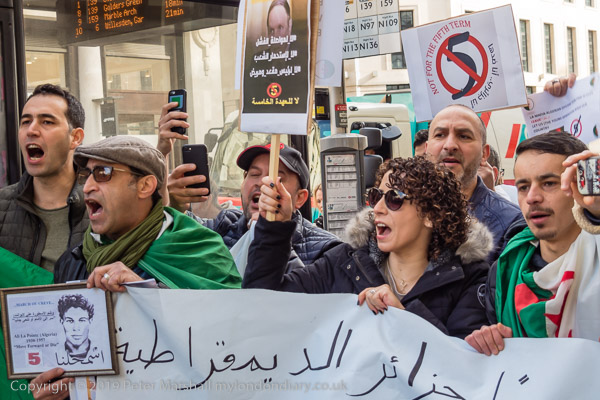
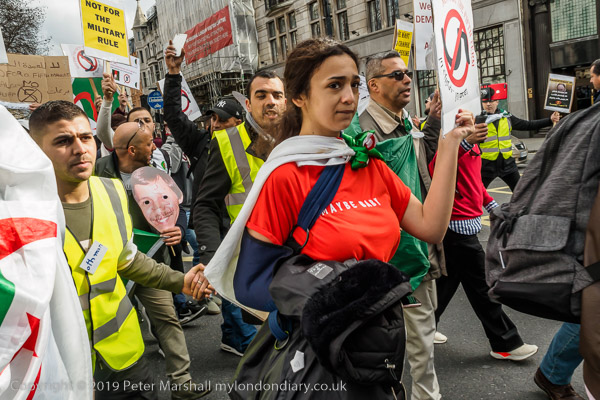
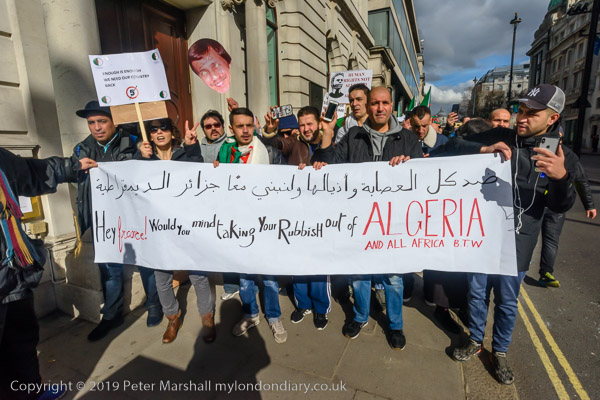
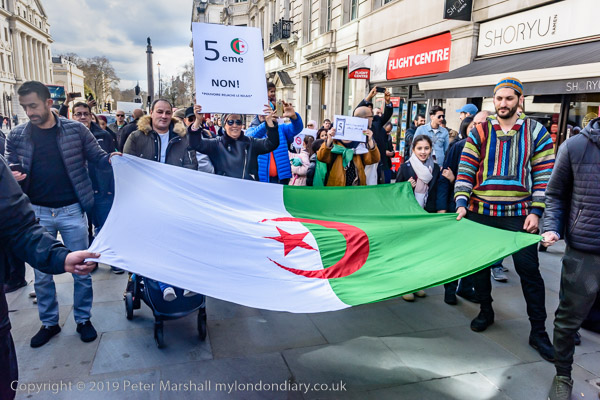
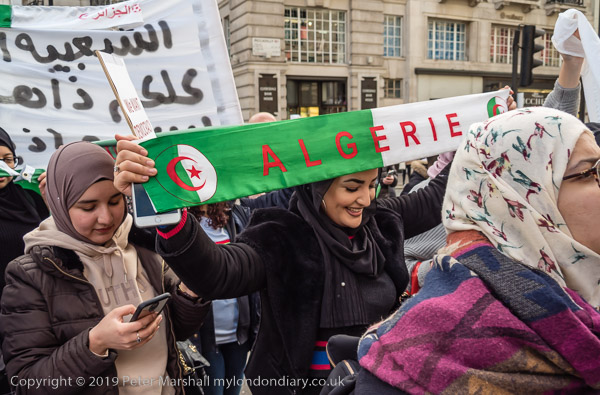
Protests have been taking place every Friday in Algeria for 16 weeks as I write this, and the protest I met in London came close to the start of this peaceful call for change.
The protests in Algeria were triggered in the middle of February when the wheelchair-bound President Abdelaziz Bouteflika, 82 on the day of this protest, announced he would stand for yet another term in office in the April elections. People took to the streets to say he had to go and to call for a civilian-led replacement to the military regime.
Bouteflika was coming to the end of his fourth 5-year term in office, heading a repressive and corrupt military government and has hardly been seen in public since a stroke in 2013. Algeria has seen few benefits from its huge earnings from oil and gas exports, much of which is unaccounted for, and almost a third of young people are unemployed.
Although police have used tear gas and violence against the protests in Algeria, unlike in the Sudan the regime (and protesters) have tried to avoid escalation, probably fearing a repeat of the civil war the country suffered in the 1990s. The regime probably fears that many of its soldiers would refuse to carry out orders to attack the protesters.
So since February there have been attempts to conciliate the protesters. In April Bouteflika was forced to resign, and some of his close associates arrested, with the speaker of the parliament Abdelkader Bensalah being elected as interim President. The protests are now calling for him and others associated with the old regime to also go, including the head of the army, Ahmed Gaid Salah.
I hadn’t been aware that this protest was taking place, and was walking towards Trafalgar Square for another event when I saw the march moving off in the distance and ran to catch up with them. I always take care to read (and photograph) the banners and placards at protests, and with these (at least those that were in English) I was soon clear what this protest was about. Usually when I plan my diary I also do at least a little research about the events and causes, but this time I had to do this after the event.
There are no adverts on this site and it receives no sponsorship, and I like to keep it that way. But it does take a considerable amount of my time and thought, and if you enjoy reading it, please share on social media. And small donations via Paypal – perhaps the cost of a beer – would be appreciated.
All photographs on this and my other sites, unless otherwise stated, are taken by and copyright of Peter Marshall, and are available for reproduction or can be bought as prints.
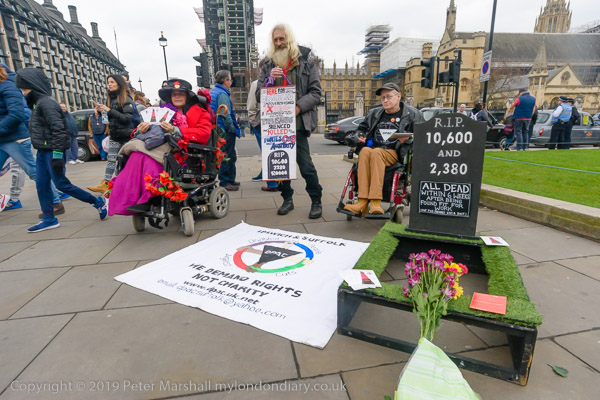
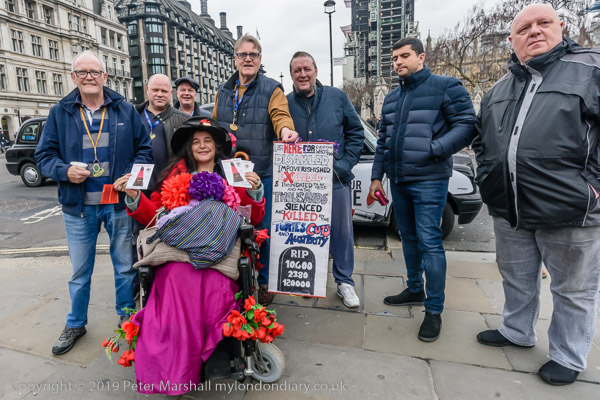
I didn’t expect Friday March 1st to be particularly busy in Westminster. Fridays generally aren’t a very busy day for protests not least because many MPs rush off back to their constituencies for the weekend. I’d gone up to take pictures largely because I knew that protesters from DPAC (Disabled People Against Cuts) were protesting against Universal Credit, which is causing widespread hardship and extreme poverty, particularly for disabled people.
They are a group I admire and the treatment of the sick and disabled by the current government has been calculatedly cruel; as a small gravestone they had brought recorded, over 12,980 people have died within six weeks of being found fit for work by a deliberately ill-designed biased scheme adminstered to make a huge proportion of incorrect decisions – which if people live long enough for their appears to be heard are overturn in over two thirds of cases – though often by the time this happens it it time for another fake assessment. It is all about cutting costs and academic studies point to around 120,000 early deaths from the Tory cuts since 2010.
That protest turned out to be rather smaller than I had hoped – and then those taking part had anticipated. In part the small number reflected the difficulties of travel for disabled people that I’ve also photographed protests about.
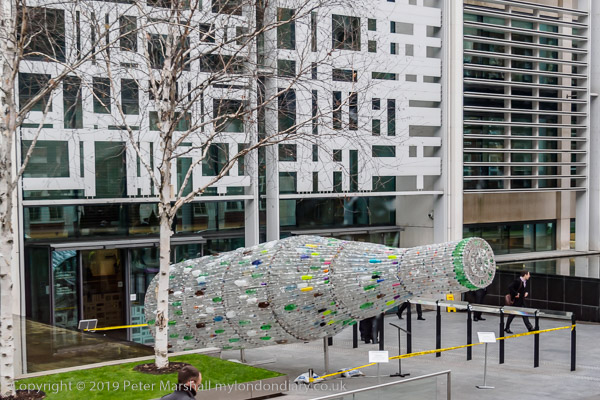
My own travel on that morning took me on a slightly unusual route. Usually I take the train to Waterloo and walk from there to Parliament Square, but I think I was feeling lazy, and instead got off the train at Vauxhall and took a bus from there, which took me past the Home Office, now also home to DEFRA, the Department for Environment, Food and Rural Affairs. In front of their entrance was a giant plastic bottle, made up of single use plastic bottles, drawing attention to the need to take action against the huge amount of plastic waste that ends up in our oceans and in landfill.
Apart from the problem of disposing of this waste, there are also the problems caused by the extraction of the petroleum and the energy required to produce the plastic from this and fabricate it into bottles. I carry a plastic bottle of water in my bag when taking pictures, which I bought on a very hot day a couple of years ago, as a single-use bottle containing a fizzy lime and lemon drink. Since then I’ve refilled it several hundred times with water, rinsing it out every day when I get home, and it is still going strong.
The first person I met on getting off the bus at Parliament Square was a lone protester with sandwich boards and a placard with plastic bottles hanging from it calling for a ban on all disposable plastic trash. This was the first time I’d met him there though I’ve seen him several times since.
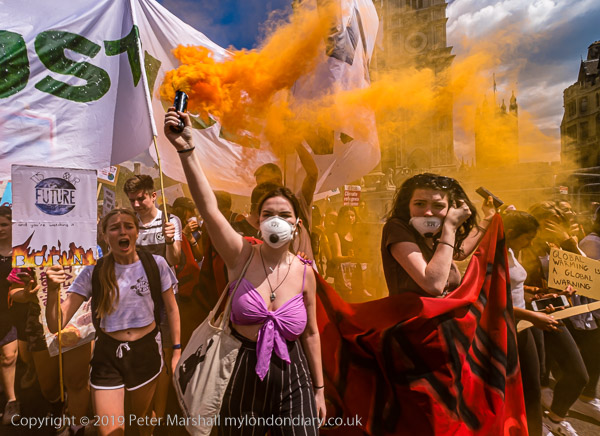
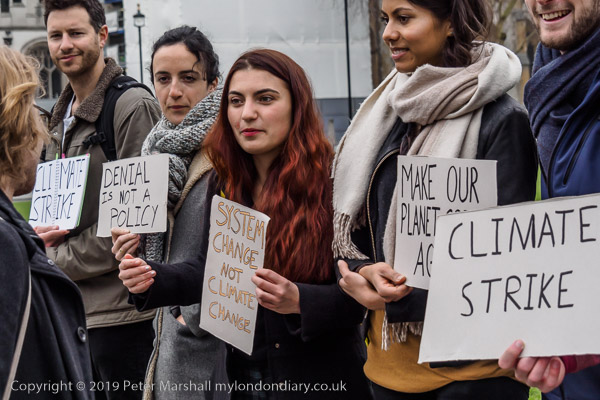
I’d known that there would be other protests taking place in the square, and one was by Climate Strike, one of many weekly #FridaysForFuture events taking place in many cities and towns across the world inspired by the action of 15-year old Greta Thunberg. The weekly protests here – like this one – have not really grown much since they started, but there have been several much larger and noisier protests Friday protests involving many school children.
Another that I hadn’t really been aware of before became apparent when a large number of London’s black cabs came to a halt around Parliament Square, one of a number of protests by them demanding to be allowed to use all roads and bus lanes in London. I think it’s time to look again at taxis in London, and to replace the outdated system of ‘plying for hire’ and ‘the knowlege’ with one based on smartphone apps and professional sat-nav systems. Black cabs cause too much pollution and congestion to keep running as they now do in London. But I was pleased when a group of them came to support the DPAC protest against Universal Credit.
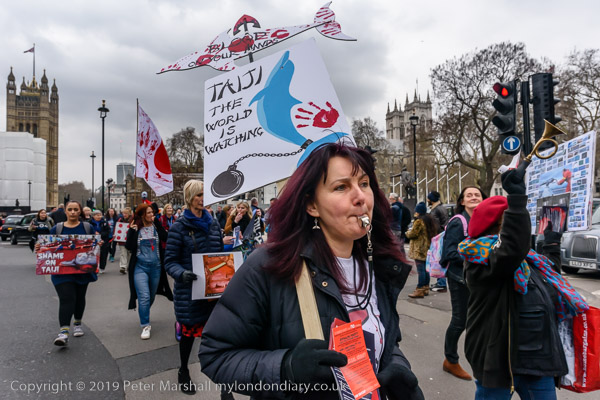
The final group of protesters in Parliament Square were at the start of a march to the Japanese embassy against the barbaric annual slaughter of dolphins in Taiji cove. I went with them as far as Downing St before returning to Parliament Square.
There are no adverts on this site and it receives no sponsorship, and I like to keep it that way. But it does take a considerable amount of my time and thought, and if you enjoy reading it, please share on social media. And small donations via Paypal – perhaps the cost of a beer – would be appreciated.
All photographs on this and my other sites, unless otherwise stated, are taken by and copyright of Peter Marshall, and are available for reproduction or can be bought as prints.
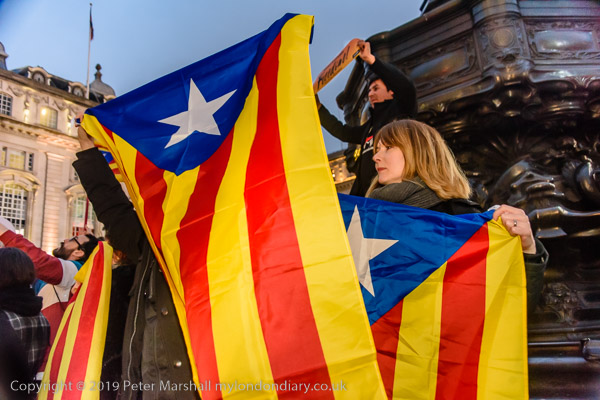
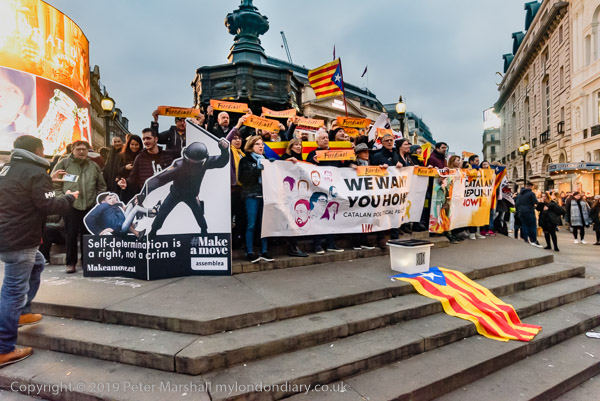
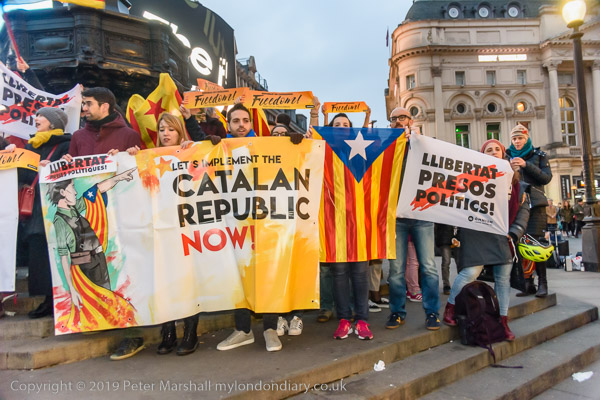
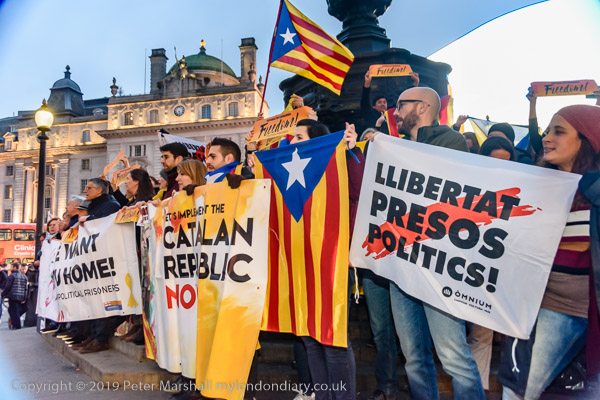
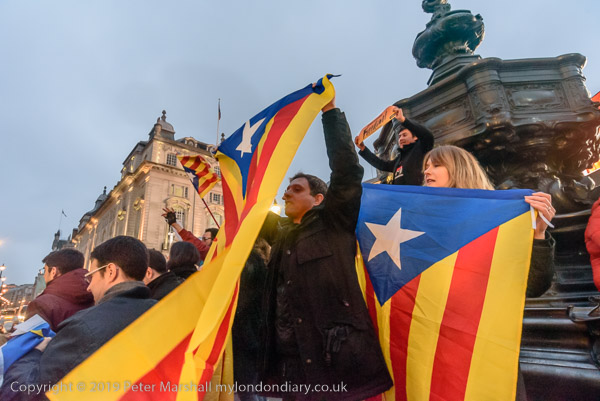
It was around a quarter past five by the time the Catalan protest got going on the steps around Eros, and in mid-February this was sunset, though it seemed rather darker than this suggests. Of course with the amount of street lighting and lights in shop windows and traffic it never really gets dark, but the contrast between the brightness of the advertising display on one side of Piccadilly Circus and the opposite side of the monument was pretty huge, and the protesters seemed to be in very deep shadow,
Using the Nikon D750 and D810, with both set to ISO 6400 allowed me exposures of around 1/125 at f5.6 without flash, though these were deliberately underexposed by a stop or so to keep something of a night look.
I didn’t have any fast lenses with me – and don’t own anything faster than f2.8 for the Nikons, finding them too heavy to carry and unsuited to most of the work I do where wide apertures mean the depth of field is too limited, though there are times when a fast telephoto would certainly help. But apart from the cost of the lenses I’d probably find myself needing the services of an osteopath. Although the Nikon lenses are remarkably good wide-open, when possible I like to stop down just a little, and most of these were taken at 1/2 to one stop down from the variable maximum.
I used flash for about half of these pictures, with a Nikon SB800 in the hot-shoe, but still worked at ISO 3200 to avoid getting people looking like cardboard cutouts in front of a black background, making sure that areas too far away to benefit from the flash were still getting enough exposure from ambient light. Although normally I work with the cameras on the ‘P’ setting (but often altering the selected shutter speed) Nikon’s flash system doesn’t really work with this, and when using flash I switch to aperture or shutter priority or sometimes full manual.
Flash on camera is always a problem where important parts of the subject are at different distances from the camera, and sometimes I make use of the fall-off of flash away from the centre, angling the flash head away from the closer parts of the subject. But inevitably some, often considerable, burning and dodging is needed when processing the images. Even in those taken without flash the lighting was pretty uneven and some correction was needed. If I can tell which of the images was taken with flash and which without except by looking at the EXIF data I don’t think I’ve got it right.
There are no adverts on this site and it receives no sponsorship, and I like to keep it that way. But it does take a considerable amount of my time and thought, and if you enjoy reading it, please share on social media. And small donations via Paypal – perhaps the cost of a beer – would be appreciated.
All photographs on this and my other sites, unless otherwise stated, are taken by and copyright of Peter Marshall, and are available for reproduction or can be bought as prints.
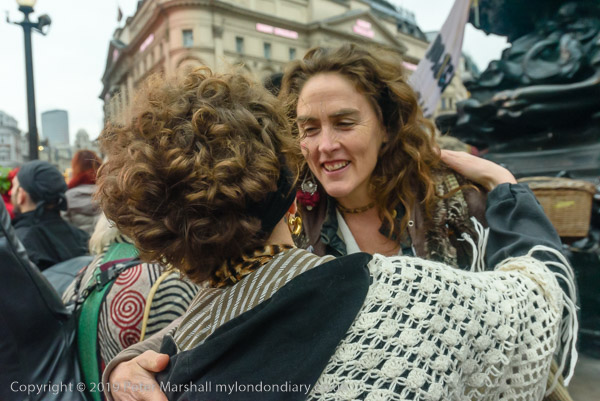
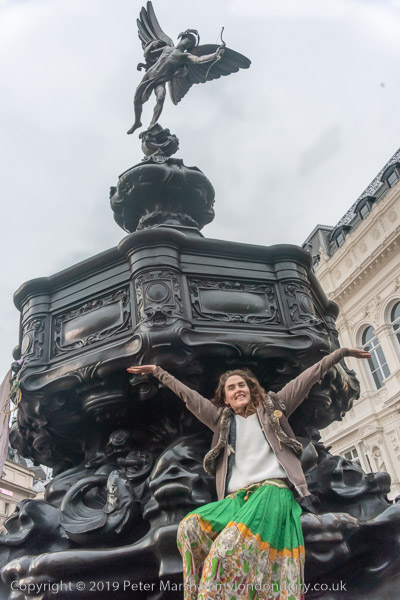
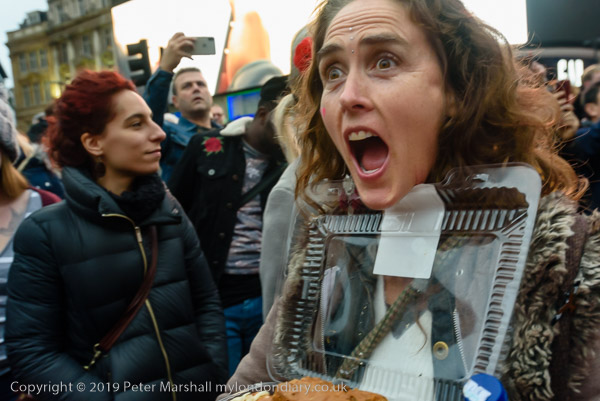
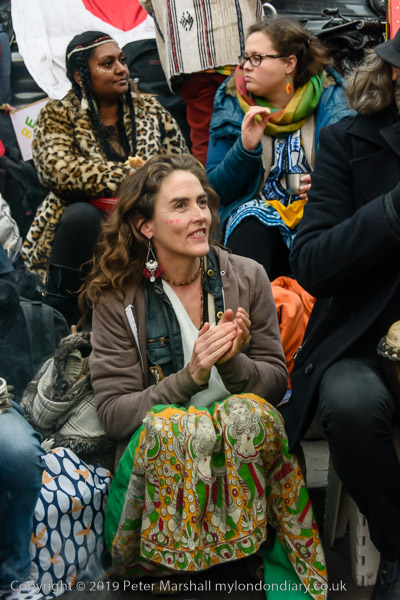
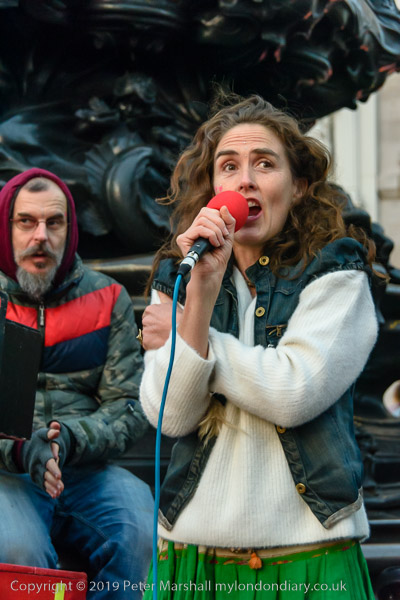
Like everyone else at this year’s Reclaim Love street party I was delighted that Venus CuMara, who founded this remarkable annual street party back in 2004 was there, and to hug her and to hear her speak.
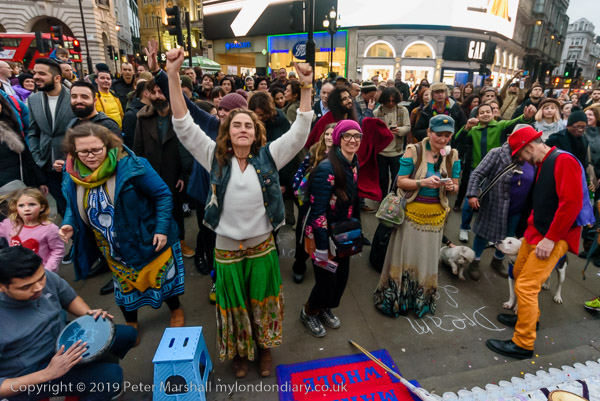
I missed that first event in 2004 as I was in Paris with my wife for Valentine’s Day and her birthday a few days later. This year was the 16th ‘Reclaim Love’ free Valentine’s Day street party and like all except I think the first which began in Trafalgar Square, took place around the statue of Eros in Piccadilly Circus, with drumming, music, dancing poetry to celebrate reclaim love as a manifestation of the human spirit from the sleazy commercialisation which has taken over Valentine’s Day as a festival of profit.
Many of us still have the free t-shirts which were handed out to all who wanted them at several of these events, with their message “MAY ALL THE BEINGS IN ALL THE WORLDS BE HAPPY AND AT PEACE, though mine is now a little stained and doesn’t often get worn.
It was this same mantra that was repeated as those present made a large circle around Piccadilly Circus to share Venus’s message of peace and love around the world. Venus called it a “Massive Healing Reclaim Love Meditation Circle beaming Love and Happiness and our Vision for world peace out into the cosmos“.
Police stood back and watched this unofficial event each year, sometimes coming to persuade those who had climbed up onto the top of the fountain to come down. I think the only more serious intervention came when one year everyone went to the sacred grove of trees in Green Park to make the large circle there, and the police in the park were definitely not amused.
Beginning in 2005, I’ve photographed the street party almost every year and shared the pictures on-line, both on Facebook and on My London Diary. I missed 2016, when I was too ill to go, and 2017 when I was in Hull (both celbrating the city of culture and again my wife’s birthday.)
Venus and I have talked on several occasions about bringing out a book with my pictures of the events and her poems and reflections, but haven’t got around to making it happen.
A couple of years ago we were shocked to hear that Venus was suffering from cancer, and she missed the 2018 party at a retreat in Indonesia. But this year she was back again, though with the cancer still spreading through her body, speaking about it and about how we should all hug ourselves and each other. Her cancer has made her even more determined to spread her message of love.
There are no adverts on this site and it receives no sponsorship, and I like to keep it that way. But it does take a considerable amount of my time and thought, and if you enjoy reading it, please share on social media. And small donations via Paypal – perhaps the cost of a beer – would be appreciated.
All photographs on this and my other sites, unless otherwise stated, are taken by and copyright of Peter Marshall, and are available for reproduction or can be bought as prints.
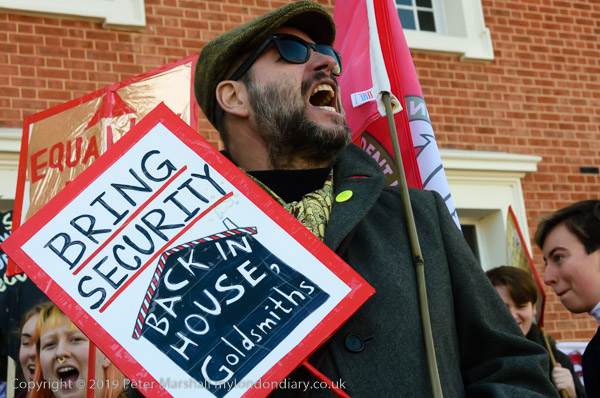
Goldsmith’s University is a part of the University of London located in New Cross in south-east London. Like many other organisations it has outsourced many of the service jobs on campus, paying private companies to provide the vital services that keep the university running.
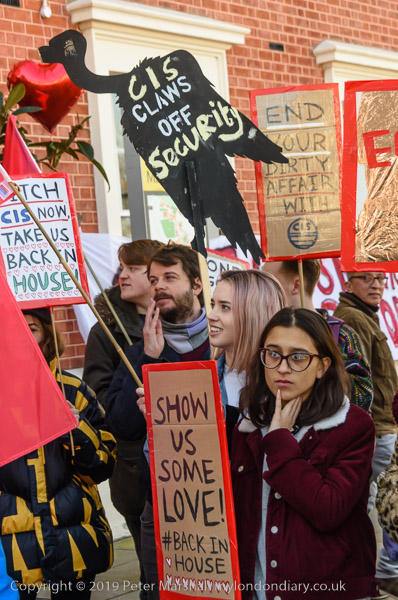
Outsourcing contracts are generally awarded to companies who put in the lowest tender, and they do this largely by cutting corners at the expense of their employees, who are on poor wages, with lousy conditions of service and often greatly overworked by bullying managers. At Goldsmith’s the security guards employed by CIS Security report not getting their statutory sick pay, grievance pay, maternity/paternity pay and public bank holidays off, and feel they are treated as second-class citizens, not allowed to make use of the car park, canteens that other staff can use.
Their campaign to be brought in-house – employed directly by the university – has been supported by the Student Assembly which passed a motion of support for the security guards and the campaign by their trade union, the IWGB, and asking for Goldsmith’s management to recognise the IWGB to which the majority of them belong.
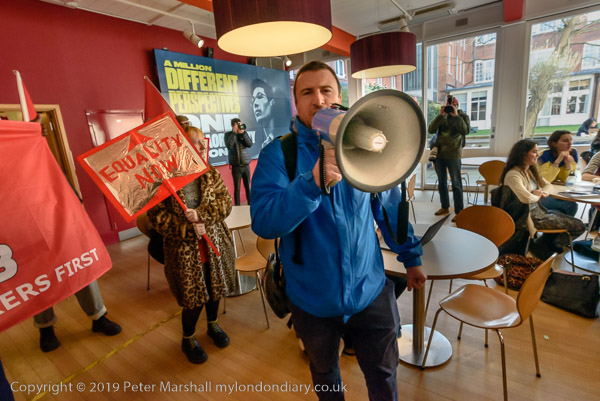
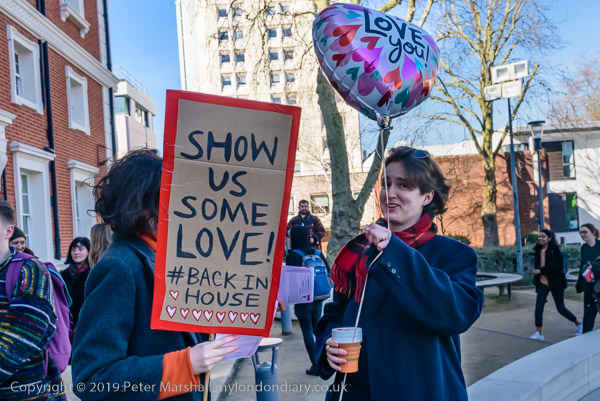
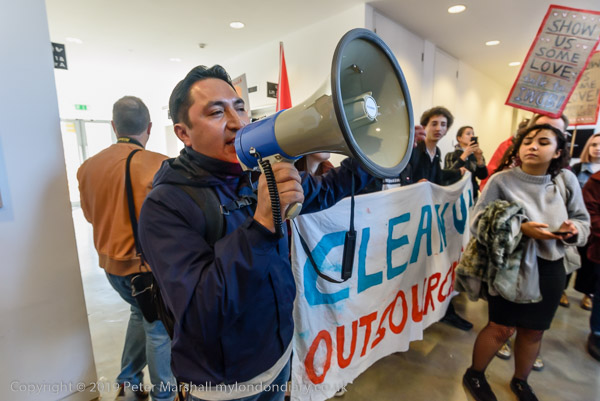
The protest, called by the Independent Workers Union of Great Britain’s (IWGB) Security Guards and Receptionists branch and supported by the Goldsmiths Students union and the Goldsmiths branch of university teachers union UCU, took place on St Valentine’s Day, and placards, posters and balloons reflected this, calling for the university to ‘show some love’ for the people who work there.
It was quite an eventful protest, and after a brief rally in front of the main building, the campaigners went inside and spoke to people eating in two canteen areas before walking through the buildings to emerge on the busy main New Cross Road, where they stopped traffic for some minutes by sitting on the road in front of Deptford Town Hall which now houses some of the university management. They returned onto campus and occupied the foyer of another building for a short rally before walking back to where they had started the protest for a final short rally.
There are no adverts on this site and it receives no sponsorship, and I like to keep it that way. But it does take a considerable amount of my time and thought, and if you enjoy reading it, please share on social media. And small donations via Paypal – perhaps the cost of a beer – would be appreciated.
All photographs on this and my other sites, unless otherwise stated, are taken by and copyright of Peter Marshall, and are available for reproduction or can be bought as prints.
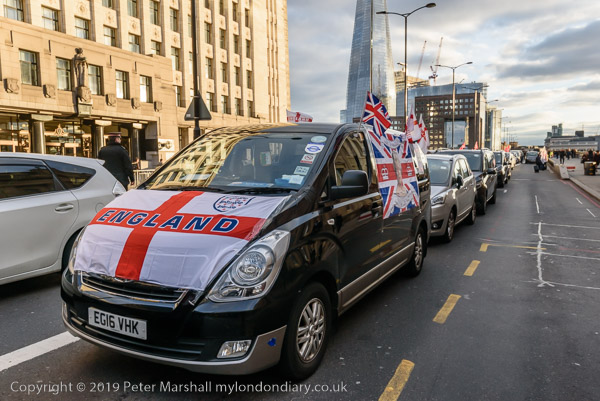
I’m not a fan of Uber and very seldom a user of taxis or private car hire services, regarding them as a necessary evil for those rare occasions when public transport is not practicable. And taxis in particular are evil, causing large amounts of unnecessary pollution – both oxides of nitrogen and particulates – on the city streets both directly and also indirectly from other vehicles caught up in the congestion they cause by ‘plying for hire’ – an archaic system now made redundant by the smartphone.
Also rendered archaic by modern technology is the ‘knowledge’, made unnecessary at least in principle by sat-navs and sat-nav apps, though there is still room for further development on these. But at least in theory they can determine best routes making use of real-time traffic information. An car magazine recently conducted a very unscientific test of black cab, Uber and the writer’s car with an up to the minute sat-nav on a London journey, and the journalist’s satnav – evidently a better one than that in the Uber – won. And despite the ‘knowledge’ many taxi drivers seem to have and use a sat-nav, or at least the “Cabbies Mate” App .
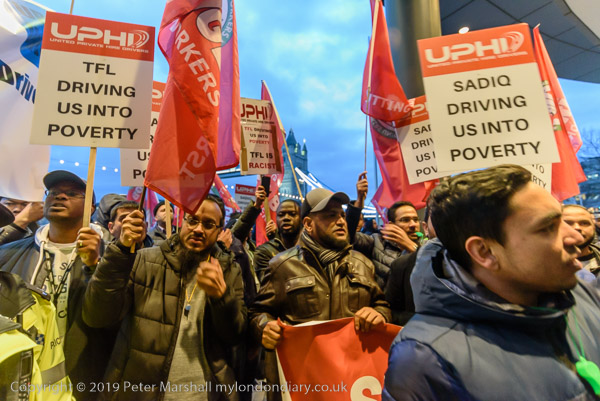
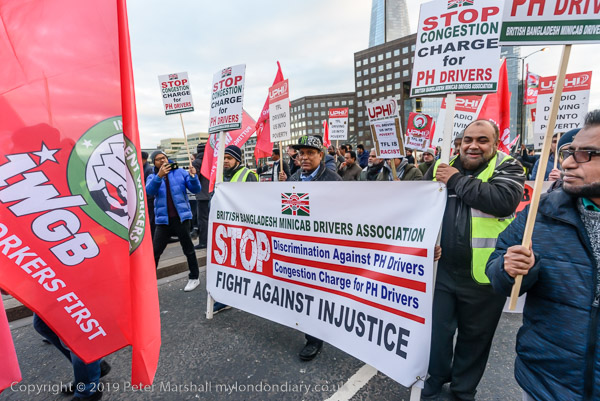
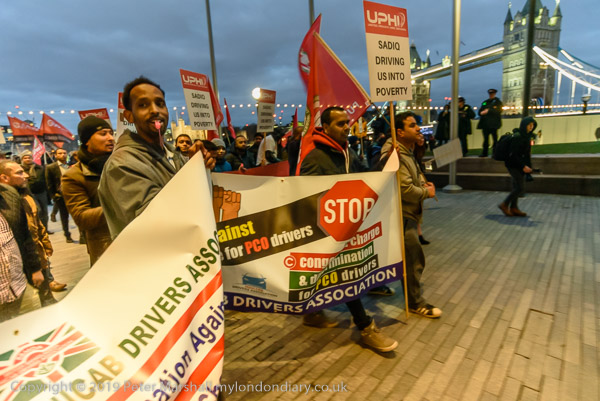
Learning the ‘knowledge’ is certainly a good way to learn your way around London, but largely retained as a method of entry control to the trade. It’s part of the reason why London’s cabs are still largely driven by white British drivers while most private hire drivers come from various BAME communities. The United Private Hire Drivers union (UPHD) would appear to have a good case in claiming that TfL’s decision to apply the congestion charge to minicabs but not to taxis is discriminatory, though it remains to be seen what the court will make of it.
The UPHD also claim that private hire drivers are four times as likely to be stopped by TfL’s enforcement officers “than taxi drivers despite consistently better compliance performance on a licensed driver & vehicle basis. ”
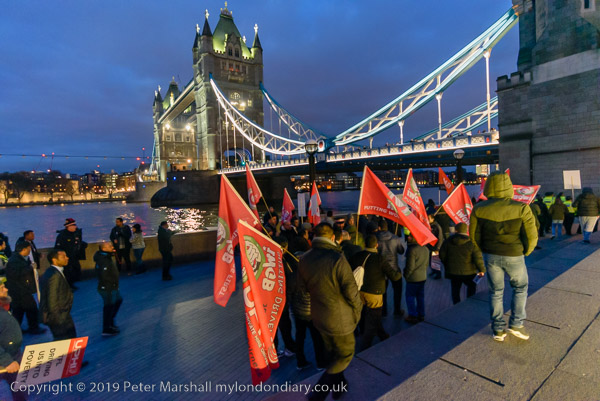
THe UPHD is a part of the IWGB (Independent Workers Great Britain) one of several grass roots unions which are leading the fight for precarious workers in various sectors , including cleaners, cycle couriers and foster carers. As well as this campaign against TfL and the congestion charge, they are also fighting Uber for proper employment rights for the drivers, who are clearly workers for the company rather than self-employed.
Since 2016, successive judgements from the UK’s Employment Tribunal, Employment Appeal Tribunal and Court of Appeal have all said Uber drivers are being unlawfully denied basic worker rights, such as the minimum wage and holiday pay.
(IWGB web sute)
The union says drivers currently only earn around £5 per hour and are demanding an increase in fares to £2 per mile, a reduction in Uber’s commission from 25% to 15% and an end to unfair dismissals.
We need to reduce traffic and congestion in London, though the congestion charge is a blunt instrument and unfairly discriminates against less wealthy car drivers. For all private hire vehicles – taxis and minicabs – a per fare surchage paid by the customer would be a better solution. We need to give far more encouragement to cycling and walking, by providing safe routes and also by changes to some traffic laws and road design to give cyclists and pedestrians priority; more bus-only routes (or rather bus and cycle routes), and greater subsidies for buses, trams and local underground and overground trains; to set dates before very long when non-electirc powered vehicles are banned for our cities .
There are no adverts on this site and it receives no sponsorship, and I like to keep it that way. But it does take a considerable amount of my time and thought, and if you enjoy reading it, please share on social media. And small donations via Paypal – perhaps the cost of a beer – would be appreciated.
All photographs on this and my other sites, unless otherwise stated, are taken by and copyright of Peter Marshall, and are available for reproduction or can be bought as prints.