Marylebone Doors

Duchess St, Marylebone, Westminster, 1987 87-3j-65-positive_2400
Duchess St, Marylebone, Westminster, 1987

This gem of a building is just around a corner from the BBC on a few yards down Duchess St, on the opposite side of Portland Place was built to the plans of Robert Adam in 1769-71 as the stable-coach house to Chandos House, Queen Anne Street, and was altered – according to its Grade II listing text “quite sympathetically” around 1924 by Arthur Bolton. The text states it is now part of the British Medical Association.

The lean of the lamp post emphasises the rectangular formality and symmetry of the building as does the man walking past. I’m not sure if I would have preferred not to have a taxi speeding into the picture. The 35mm shift lens enabled me to keep the verticals upright and get the whole building in frame from the opposite side of a fairly narrow street.

Mansfield St, Marylebone, Westminster, 1987 87-3j-56-positive_2400
Mansfield St, Marylebone, Westminster, 1987

Just around the corner from the previous picture is this magnificent fence with its baskets of flowers. I felt the out of focus bush made a suitable contrast between natural vegetation and its representation.

I think this is the garden screen mentioned in the listing text and probably like the house behind dates from 1914.

Hinde St,  Marylebone, Westminster, 1987 87-3j-22-positive_2400
Hinde St, Marylebone, Westminster, 1987

Doorways are one of the most important architectural features of buildings, and this one very clearly gives an impression of the luxury of the flats inside Hinde House.

Hinde St,  Marylebone, Westminster, 1987 87-3j-21-positive_2400
Hinde St, Marylebone, Westminster, 1987

A similar doorway next door (London streets sometime number in odd ways) is a little plainer, perhaps suggesting that inside are flats for less important people. Though it is certainly not a ‘poor door’ leading to any social housing in the block.

The Royal Society of Medicine, Henrietta Place, Marylebone, Westminster, 1987 87-3i-52-positive_2400
The Royal Society of Medicine, Henrietta Place, Marylebone, Westminster, 1987

My theme of doors continues with the grand entrance for The Royal Society of Medicine in Henrietta Place.

Marylebone Lane, Marylebone, Westminster, 1987 87-3i-42-positive_2400

And another door is a prominent feature in this building with its series of semi-circles on Marylebone Lane. It’s a building with the window at the centre of the picture set a little lower, so it seems to be winking at us.

Again a taxi has crept in. There are far too many of them, often simply cruising around empty in the centre of London, a significant cause of both pollution and congestion. They are slowly changing from diesel to electric which will help with the pollution, but wont ease the congestion. Ridiculously they are exempted from the congestion charge while minicabs have to pay it. We don’t need ‘ply for hire’ when cabs can be summoned by smartphone and its time for change.
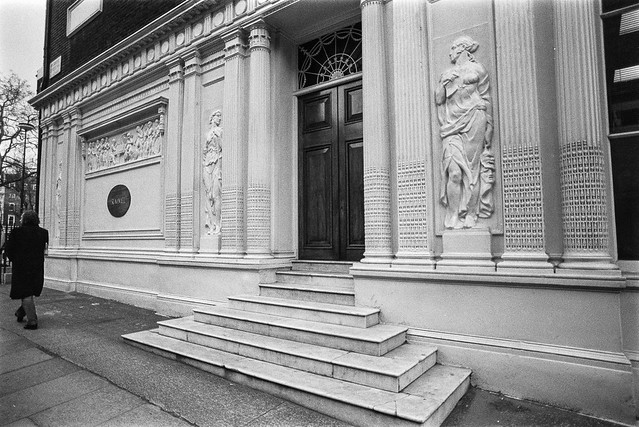
Rimmel, Wigmore St, Marylebone,, Westminster, 1987 87-3i-25-positive_2400
Rimmel, Wigmore St, Marylebone, Westminster, 1987

There are a few more pictures of doors in the area in this section of my 1987 London Photos, but this at Bessborough House on the corner of Cavendish Square is perhaps the most impressive. According to the Grade II listing the house dates from 1770s with c.1800 and early C20 alterations. About this entrance it states “Blind return to Wigmore Street has neo-Adam style pilaster treatment to ground floor with shallow relief modelled “graces” between pairs of pilasters under entablature – all in stucco.”

When I took this picture it had the circular message at left that it was the premises of Rimmel, the cosmetics house founded in 1834 by French-born perfume chemist Eugène Rimmel and often known as Rimmel London. He put on sale a product for darkening eyelashes using the newly invented petroleum jelly and black pigment, marketed under the name mascara which was hugely successful both in the UK and internationally – and mascara is still called ‘Rimmel’ in a number of languages.

More pictures on page 3 of 1987 London Photos.


All photographs on this and my other sites, unless otherwise stated, are taken by and copyright of Peter Marshall, and are available for reproduction or can be bought as prints.
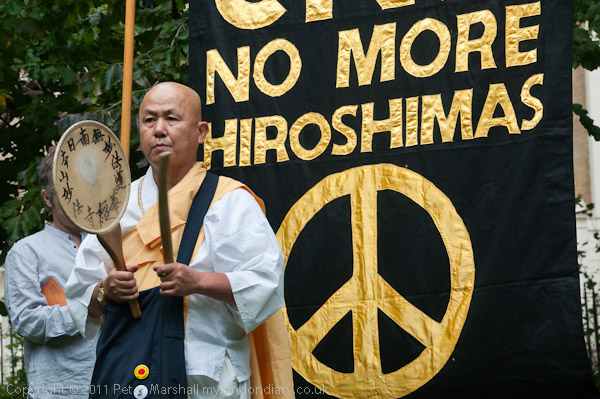
No More Hiroshimas

A prayer by Japanese monk Rev Nagase, from the Battersea Peace Pagoda, 2011

Most years if I am in London at the start of August I attend the London CND Hiroshima Day commemoration in Tavistock Square. This year, the 75th anniversary, I will be at the online event.

The US bombing of Hiroshima and Nagasaki was a war crime on a massive scale and lacked any real military justification. So far, despite a huge number of atomic weapons being manufactured and many billions spent on them and their delivery systems none have been used, though we now know that it was only the refusal of one Russian soldier to obey orders that saved us from nuclear annihilation.

The theory of nuclear deterrence never made sense, and over the years more countries have created their own nuclear weapons, mainly as a status symbol. US, UK, Russia, France, China, India, Pakistan, Israel and North Korea currently have them. South Africa is the only country which has given them up (several soviet republics handed them back to Russia when the USSR broke up) but around 190 countries including South Africa have now signed up the the nuclear Non-Proliferation Treaty, confirming they will not develop them.

The Treaty on the Prohibition of Nuclear Weapons opened for signature at United Nations headquarters in New York on 20 September 2017 having been passed with 122 countries in favour – but none of the nuclear states or other NATO members voted and the Netherlands was the sole vote against. So far only 40 states have ratified the treaty.

The London 75th Anniversary event is one of many around the world you can join in or view online. I’ve posted a few of my pictures from earlier years here, but there are many more on My London Diary – for 2004, 2009, 2011, 2013, 2014, 2015, 2016, 2017, 2018 and 2019.

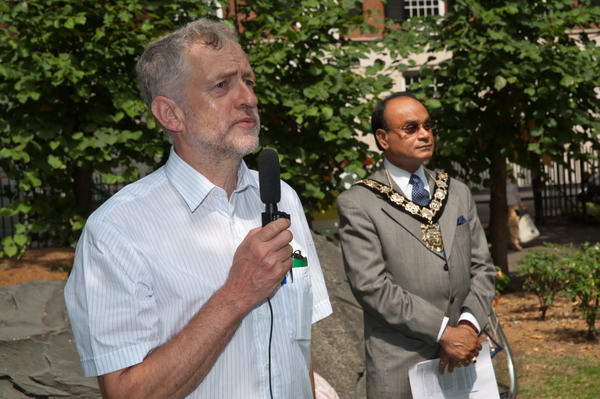
Jeremy Corbyn introduces the Mayor of Camden, Cllr Faruque Ansari, 2009
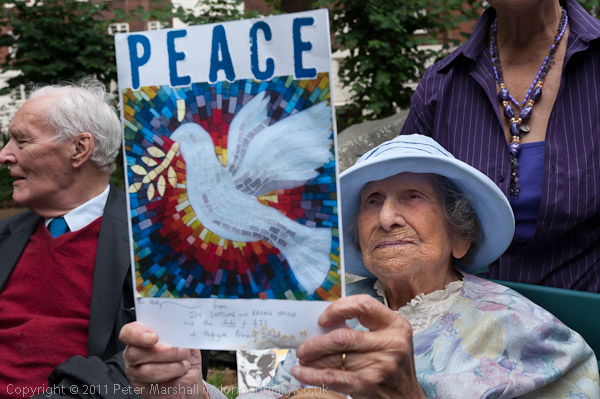
Hetty Bower, 105, holds up a Peace Card given her by a primary school class, 2011
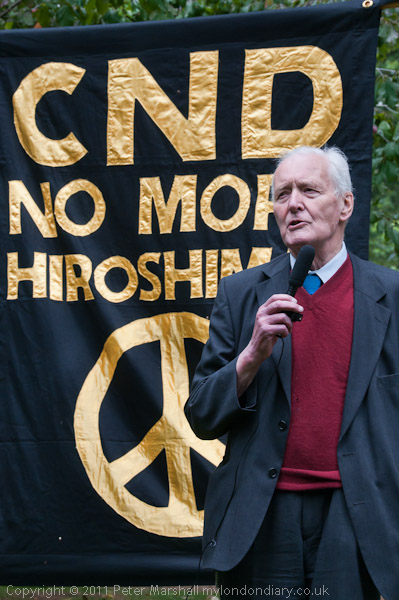
Tony Benn speaks, 2011
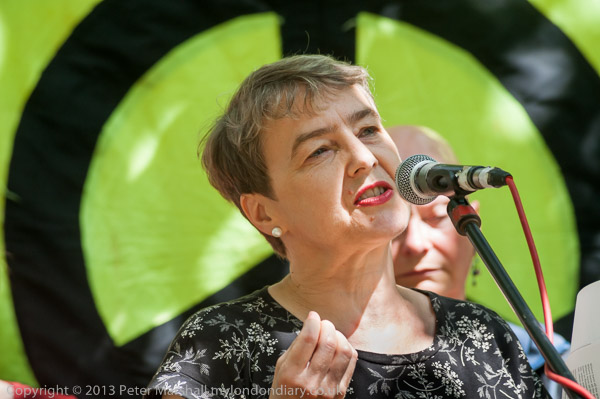
CND Chair Kate Hudson, 2014
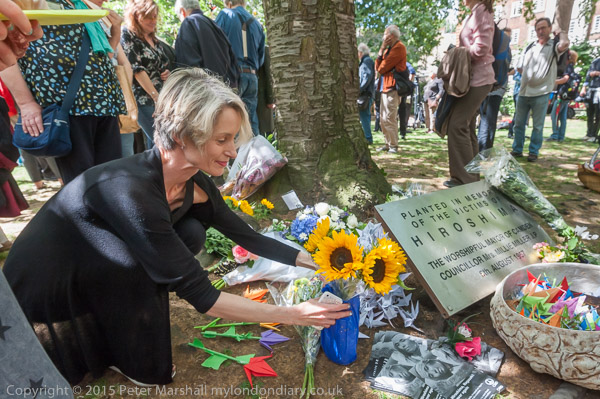
Flowers are laid at the Hiroshima Cherry Tree in Tavistock Square, 2015

All photographs on this and my other sites, unless otherwise stated, are taken by and copyright of Peter Marshall, and are available for reproduction or can be bought as prints.


1987 Fitzrovia and around

Fitzroy Square, Fitzrovia, Camden, 1987 87-2q-24-positive_2400
Fitzroy Square, Fitzrovia, Camden, 1987

I think I had an appointment to see a man who worked for a well-known architect’s firm with plush offices in Fitzroy Square. It was such a different atmosphere from my own workplace, at the time in a sixth-form college. I was offered coffee and a secretary brought it, filter coffee in a cup with a saucer on a tray with biscuits, cream and tinted sugar crystals. When I had visitors at work they got instant served by me from a kettle in the corner of a dingy shared office and if they wanted milk it was powdered granules. Sugar would come in a screwed up bag and if they were lucky I’d find a spoon to stir it, otherwise they might be offered a cleanish spatula or even a pencil. We had a BBC computer with a small green screen in one corner, there I walked past more computers, large graphics tablets and oversize screens than I’ve ever seen in the same building before. It was the first time I’d really seen how things were where the real money was.

The coffee was good, the talk interesting, but I don’t think I sold any of my photographs.

Fish Stall, Goodge Place, Fitzrovia, Westminster, 1987 87-2r-65-positive_2400
Fish Stall, Goodge Place, Fitzrovia, Westminster, 1987

It was only a fairly short meeting, and I had time to walk around the area before and after – and to cut my costs I’d got a train to Charing Cross and walked from there rather than use the Underground. So there are some pictures from Covent Garden and St Giles as well as Fitzrovia.

There are still stalls in Goodge Place, but not I think any dealing in basic foods such as fish, but all selling fast food for lunches for those who work in the area.

H Wolfin, Textiles, Great Titchfield St, Fitzrovia, Westminster, 1987 87-2r-46-positive_2400
H Wolfin, Textiles, Great Titchfield St, Fitzrovia, Westminster, 1987

This shop is still there, but rather than selling fabrics in large rolls to the trade now sells children’s clothes and baby presents to tourists and others, with delivery around the world. H Wolfin is still in business but elsewhere in Greater London, now was Wolfin Textiles in Hatch End, Pinner, and their web site states:

Originally known as Wolfin and Levy, Wolfin Textiles has been established for over 100 years and began in 1900 as an independent family-owned textiles shop in London’s Old Street. Specialising in fabrics for the theatre, film, interior and fashion industries, Wolfin and Levy moved to London’s West End in 1972, before finally relocating to Greater London in 1999 as Wolfin Textiles. Today we continue to hold onto the family ethos of offering the finest quality fabrics and real customer service. We pride ourselves on being able to offer wholesale prices for everyone, with no minimum order.

https://www.wolfintextiles.co.uk
St Charles Borromeo, Church, Ogle St, Fitzrovia, Westminster, 1987 87-2r-24-positive_2400
St Charles Borromeo, Church, Ogle St, Fitzrovia, Westminster, 1987

St Charles Borromeo in Ogle St is one of London’s stranger church buildings, a small Grade II listed Roman Catholic Church in what is described as a simple but “muscular” Gothic. Charles Borromeo was a 16th century Italian cardinal who took an active role in the counter-Reformation and is best known to Protestants for his ruthless suppression in the Swiss valleys; during a pastoral visit to one of them in 1583 he arrested 150 people including the provost, who, along with 11 women was condemned to be burnt alive for witchcraft.

According to Wikipedia, one biographer described him as “an austere, dedicated, humorless and uncompromising personality” and his uncompromising implementation of reforms “brought him into conflict with secular leaders, priests, and even the Pope.” After his death in 1584 he was rapidly venerated, particularly in Milan where he had been archbishop since 1564, and was made a saint in 1610.

Centre Point, St Giles, Camden, 1987 87-2q-66-positive_2400
Centre Point, St Giles, Camden, 1987

The building of Centre Point, designed by architect Richard Seifert, began in 1963 at the start of ‘Swinging London’ and the building, described as London’s first ‘Pop Art Buildings’ has always been controversial – as was its listing in 1995. Completed in 1966 it was then one of London’s tallest buildings and still dominates the area, its 34 floors reaching to 385 ft (117m).

Centre Point stood empty, apart from a brief occupation by squatters to draw attention to its being deliberately left empty during a housing crisis in London in 1974, for nine years until 1975. In 2015-8 the building was converted to residential use with 82 apartments, their interiors designed by  Conran & Partners. The cheapest was on sale in 2017 for £1,825,000 but the owners apparently denied that these were luxury flats.

More on page 3 of my 1987 London Photos.

Brixton Feb 1987

Celestial Church of Christ, Coldharbour Lane, Loughborough Junction, Lambeth, 1987 87-2p-11-positive_2400
Celestial Church of Christ, Coldharbour Lane, Brixton, Lambeth, 1987

Friends and others I showed pictures to at the time or talked about my work with often expressed surprise at some of the areas of London I went to when taking photographs. They saw places like Brixton as crime-ridden and dangerous and wondered that I felt safe, particularly as I was walking around the streets carrying a bag with expensive equipment worth thousands of pounds on my shoulder.

Beds, Coldharbour Lane, Loughborough Junction, Lambeth, 1987 87-2p-23-positive_2400
Beds, Coldharbour Lane, Loughborough Junction, Brixton, Lambeth, 1987

I did think a little about it myself and even once attended a training session – the only man in a group of women – about keeping safe on city streets. But the only times I ever really felt threatened were not in the kind of areas that some reacted with horror to, but in lonelier parts of the plusher suburbs.

Furniture, Coldharbour Lane, Loughborough Junction, Lambeth, 1987 87-2p-25-positive_2400
Furniture, Coldharbour Lane, Loughborough Junction, Brixton Lambeth, 1987

I felt more at home in the many working-class areas of London than in the West End or City, and certainly dressed in a way that fitted in more there. I tried hard to be aware of my surroundings and not to behave in ways that drew attention to myself. And I think I was reasonably street-wise, keeping calm and confident, looking as if I knew what I was doing and where I was going and being aware of others. There were a few times when I decided against going down a particular street or alley, or crossed the street to avoid possible trouble. Because I needed the light I always worked during the day time, when all areas are safer.

White goods, Coldharbour Lane, Loughborough Junction, Lambeth, 1987 87-2p-36-positive_2400
White goods, Coldharbour Lane, Loughborough Junction, Brixton, Lambeth, 1987

Of course taking photographs does make you stand out, but mostly people just ignored me. A few would stop and talk, and I tried to explain why I was taking a picture, though I think they mostly thought I was mad but harmless. Some people thought I must be from the council – or the newspapers, and occasionally people – particularly children – would insist I took there picture. Of course I did.

Flats, Coldharbour Lane, Brixton, Lambeth, 1987 87-2p-41-positive_2400
Flats, Coldharbour Lane, Brixton, Lambeth, 1987
Burroughs, Coldharbour Lane, Brixton, Lambeth, 1987 87-2p-64-positive_2400
Burroughs, Coldharbour Lane, Brixton, Lambeth, 1987

‘Burroughs’ closed as an Eel and Pie shop in the 1990s, but remains as a restaurant. Its shop-front had been replaced by something flat and bland but was recreated a few years ago, and it now serves Japanese soul food rather than cockney.

There are a few more pictures from this area in February 1987 in the album 1987 London Photos.

1987: More Soho

Dance shop, Charing Cross Rd, Soho, 1987 787-2k-41-positive_2400
Dance shop, Charing Cross Rd, Soho, 1987

It’s always difficult to know where London’s districts begin and end, and sometimes it is rather a matter of personal opinion. There are some definite boundaries – postal districts and borough boundaries – though these seldom coincide with our perception of place, and most people – unless they actually live there are unaware that in central London you may be in Camden or Westminster etc. The City is a little more obvious, with its borders on some main streets clearly marked, but who would know when crossing the Charing Cross Road you might move from Westminster into Camden.

Poland St,  Soho, Westminster, 1987 87-2j-64-positive_2400
Poland St, Soho, Westminster, 1987

Names too change with the years. Fitzrovia for example only began to be used in the late 1930s, and other older area names are now seldom used. Building tube stations led to many of their names being used for areas which previously went under other names, and estate agents are notorious for promoting properties into nearby more salubrious areas – or inventing new area names, often by adding the word “village” to an existing name.

Never Park Here, Falconberg Mews, Soho, Westminster, 1987 87-2j-23-positive_2400
Never Park Here, Falconberg Mews, Soho, Westminster, 1987

Soho is perhaps one of the more clearly defined of all London areas, though some might quibble slightly at Googles definition, clearly bounded by major roads – Oxford St, Regent St, Shaftesbury Ave and Charing Cross Road. Many of us would also include Chinatown in its ambit, perhaps going south down Haymarket as far as Orange St to include Leicester Square. And perhaps some of the fringes just across Oxford St might qualify…

Carnaby St, Soho, Westminster, 1987 87-2i-21-positive_2400
Carnaby St, Soho, Westminster, 1987

On the streets themselves, the more modern street names – since the mid 1960s – include the borough name, but many London streets have proudly retained their older signs, sometimes with a postal district (though sometimes the earlier version.)

Taylors Buttons, Silver Place, Soho, Westminster, 1987 87-2h-35-positive_2400
Taylors Buttons, Silver Place, Soho, Westminster, 1987

Like all things, Soho is defined by what it isn’t. It isn’t Mayfair or Fizrovia or Bloomsbury or St Giles or Covent Garden or Westminster (the area not the Borough – which all or almost all of it is inside) or St James. And it’s not just a matter of geography, but also of character.

Walker's Court, Soho, Westminster, 1987 87-2h-25-positive_2400
Walker’s Court, Soho, Westminster, 1987

And it was that character which was uppermost in my mind as I made these pictures.

You can see more of them on page 2 of my Flickr album 1987 London Photos.


All photographs on this and my other sites, unless otherwise stated, are taken by and copyright of Peter Marshall, and are available for reproduction or can be bought as prints.

1987 Holborn

Star Yard, Holborn, Camden, 1987 87-2m-46-positive_2400
Star Yard, Holborn, Camden, 1987

After Bedford Park I turned my attention to Holborn, including the area around the Royal Courts of Justice where there are shops catering for legal necessities as well as premises meeting more general needs.

Urinal, Star Yard, Holborn, Camden, 1987 87-2m-32-positive_2400
Urinal, Star Yard, Holborn, Camden, 1987

The urinal is still in-situ but I think is permanently closed. Just along the street is a Wetherspoons which serves the same purpose. It’s actually one of their more pleasant locations and I’ve several times enjoyed a quick lunch there. The food may only be so-so, (though there are a few things they do quite well) but the service is fast and the price very reasonable for London. Of course they treat the staff badly, but so do most pubs, and if things get back to anything like normal I’ll follow the union advice and not boycott them but refuse to cross any picket line.

Lincolns Inn Fields, Holborn, Camden, 198787-2m-26-positive_2400
Lincolns Inn Fields, Holborn, Camden, 1987

Lincolns Inn fields has plenty of fine architecture and also London’s most intriguing museum, founded by Sir John Soane. Currently closed it hopes to open on October 1st, but with pre-booked timed tickets only. If you’ve never visited I’d advise you to book as soon as you can. You can get some idea of the museum through yhe amazing digital online https://www.soane.org/explore Explore Soane, but the real thing is rather more satisfying. Because of the space limitations in the museum bags have to be left at the door.

Connock & Lockie, New Oxford St, Camden, 1987 87-2l-63-positive_2400
Connock & Lockie, New Oxford St, Camden, 1987

I can do no better than quote from the company’s web site:

A centenarian business

Connock and Lockie was established by cousins William Henry Connock and John Lockie in 1902 on 60 New Oxford Street. Over the years, we have relocated several times and settled at our current address, 33 Lamb’s Conduit Street, in 2004. Throughout our 110 years of trading, we have proudly catered to the bespoke tailoring needs of discerning ladies and gentlemen.

http://connockandlockie.com
Warwick House,Great Russell St, Holborn, Camden, 1987 87-2l-43-positive_2400
107-110 Great Russell Street,

‘Luxury hotel development, Completion 1987’ it states on the notice on the front of this building, and although in February 1987 when I made this picture it seemed unlikely, this is now the Cheshire Hotel, in London terms a budget hotel, with rooms around £70 per night. Quite why it changed its name from the Warwick Hotel to the Cheshire I don’t know, and the plain entrance has changed to a more pretentious one with four columns.

Space House, CAA House, Kemble St, WIld St, Holborn, Camden, 1987 Space House, CAA House, Kemble St, WIld St, Holborn, Camden, 198787-2l-15-positive_2400
Space House, CAA House, Kemble St, WIld St, Holborn, Camden, 1987

Grade II listed Space House was a speculative office development built 1964-8 by George Marsh of Richard Seifert & Partners for the developer Harry Hyams. It was technically innovative, using a precast concrete grid for rapid construction without the use of scaffolding, and remains visually arresting. As the listing text says, it’s assertive styling reflects “the confidence and dynamism associated with the period.”

This building and the connected building on Kingsway were to be vacated at the end of last year and ‘revamped’ for commercial letting.

Flitcroft St, St Giles, Camden, 1987 87-2k-66-positive_2400
Flitcroft St, St Giles, Camden, 1987

This bas-relief is above the old entrance gateway to St. Giles’s Church Yard where a bas-relief of The Resurrection was placed in 1687. It is a plaster copy of the original which is inside the church. The gateway was originally around the corner in the St Giles High St, but rebuilt in 1800 incorporating the old bas-relief and then moved to Flitcroft St in 1865. Flitcroft St gets its name from Henry Flitcroft who was the architect of the church, built in 1733.

The carving was originally in oak, and the carver, a man called Love was paid £27 for his work. The 1800 gate included a stone recreation of the work, now in plaster.

I occasionally used a photographic lab in Flitcroft St, which produced remarkable Cibachrome prints using a laser scanning technique on the transparencies which gave them an unbeatable contrast and clarity. They were also rather expensive!

You can find more from Holborn in my album 1987 London Photos.


All photographs on this and my other sites, unless otherwise stated, are taken by and copyright of Peter Marshall, and are available for reproduction or can be bought as prints.

Feb 1987 Camden, London

Saddler, Monmouth St, Covent Garden, Camden, 1987 87-2c-13-positive_2400
Saddler, Monmouth St, Covent Garden, Camden, 1987

This building is a part of a comprehensive redevelopment of the area, the Comyn Ching triangle, by the Terry Farrell Partnership which took place from 1983-1991, retaining the facades with rebuilt or restored shopfronts. This part of the Grade II listed terrace at 65-71 Monmouth St was only rebuilt in the third and final phase of development which began around two years after I made this picture. The lettering ‘B. FLEGG/ ESTd.1847/ SADDLER & HARNESS MAKER/ LARGE/ STOCK /OF/ SECONDHAND SADDLERY & HARNESS/ HORSE/ CLOTHING/18, with the name B. FLEGG applied diagonally to each side’ was then painstakingly restored.

Though sometimes referred to as a ‘ghost sign’, like many others it should more correctly be called a ‘resurrected sign’.

Thornhaugh St, Bloomsbury, Camden, 1987 87-2b-54-positive_2400
Thornhaugh St, Bloomsbury, Camden, 1987

One of the minor themes in my work at this time concerned the urban tree. London is a city with a great many of them, notably those London Planes, a hybrid of American sycamore and Oriental plane which first appeared by cross-pollination of these two introduced species in the Lambeth garden of London’s best known plantsman, John Tradescant the younger, who named it after the city around the middle of the 17th century. It has been widely grown in streets and parks across the city since the late 18th century.

I think these trees in their regimented rows are probably flowering cherries though probably some with greater aboreal knowledge will correct me. But this was a militarised forest that rather made me shudder. The planting was apparently designed to stop students playing football in the area. It hasn’t lasted and there is now a green area here – though some of the trees in it may be these same specimens, and there are still a couple of large brutalist concrete boxes around a couple of groups of trees.

UCL Institute of Education, Thornhaugh St, Bloomsbury, Camden, 1987 87-2b-43-positive_2400
UCL Institute of Education, Thornhaugh St, Bloomsbury, Camden, 1987

And in the background of the previous image was one of my favourite brutalist buildings, with a playfulness by Denys Lasdun’s that is perhaps more exiting than his National Theatre. It was a part of a larger plan, never completed and much opposed at the time, though in the end it was only a lack of money that really stopped the destruction of more of the area and the building on the open areas such as the ‘garden’ above.

Phoenix Cafe, Chalton St, Somers Town, Camden, 1987 87-2a-64-positive_2400

The Ossulston Estate in Somers Town, close to Euston Station was a remarkable council estate built by the London County Council in 1927-31, taking inspiration from modernist public housing which the LCC’s Chief Architect G Topham Forrest had visited in Vienna. The 7-storey housing blocks are behind a low wall of shop units along Chalton St, of which the Phoenix Cafe was one. Some of these units are still in use as shops, though not this one.

The 310 flats were built to high standards for the time and the development also included The Cock Tavern  – all are now listed. Some of the estate has been extensively refurbished.

St Pancras Church, Euston Rd, Bloomsbury, 1987  87-2a-25-positive_2400
St Pancras Church, Euston Rd, 1987

One of my favourite church exteriors in London is that of St Pancras (New) Church in Euston Rd, built in 1819–22 in Greek Revival style to the designs of William Inwood and his son Henry William Inwood. Perhaps its most remarkable feature are these caryatids, who look to me pretty fed up, perhaps unsurprisingly as they have a stone roof sitting on their heads. They are above the entrance to the burial vault and hold symbols suitable to this position, empty jugs and torches which have gone out.

Mahatma Gandhi, Tavistock Square, Bloomsbury, Camden, 1987  87-2b-01-positive_2400

A short distance away in Tavistock Square is a memorial to Mahatma Gandhi, 1869 – 1948, who studied not far away at UCL in 1888. The powerful likeness is by Fredda Brilliant and the site for it was chosen by V K Krishna Menon who was a member of the Theosophical Society and for some years a St Pancras Councillor before being made High Commissioner for India in the UK. The memorial was erected for the 125 anniversary of his birth and unveiled by then Prime Minister Harold Wilson.

Most years for some time I have visited Tavistock Square each August for the annual remembrance on Hiroshima day around the Hiroshima Cherry tree a short distance from this statue. The square also contains a memorial to the victims of the 2005 bombing here, the Conscientious Objectors Commemorative Stone, a memorial and bust of surgeon Dame Louisa Aldrich-Blake (1865 –1925) and a bust of Virginia Woolf.

More pictures on Flickr in the album 1987 London Photos.


More 1987 – Mainly Soho

Camden Town Cemetery, St Martin's Gardens, Camden St, Camden, 1987 87-1k-46_2400
Camden Town Cemetery, St Martin’s Gardens, Camden St, Camden, 1987

The slow process of putting up my old black and white pictures is continuing, thanks to the lockdown leaving the time on my hands. Although I’m going out of the house for exercise, that only occupies around 50 minutes of the day – and perhaps another half hour to recover.

This picture of the piled up gravestones in Camden Town Cemetery was taken in January and is one of the last from that month I’ve put on line. Although I’ve always liked to wander in cemeteries, often the only real places of peace and quiet in cities, and often good places to rest and eat my sandwiches, I’ve generally tried hard to avoid taking too many pictures in them unless there is a very strong reason to do so.

Partly because as a teacher of photography I saw far too many pictures by students of gravestones and monuments. They were easy to photograph, didn’t move much or complain about being photographed and supposedly said something profound about the human condition. At the in-house moderation of student photography coursework from across the country it was never long before I or another assistant examiner would be exclaiming “Not another sodding angel!”.

Wardour St, Soho, Westminster, 1987 87-2f-55-positive_2400
Wardour St, Soho, Westminster, 1987

In February I turned my attention to Soho, where photography was not always welcomed, though I didn’t intend to emphasise its more sordid aspects. It was one of London’s most varied and interesting areas, and remains so despite the ravages of property developers and Westminster Council.

But I didn’t avoid photographing the frontages offering ‘Intimate Bed Show – No Extras‘ though I didn’t go inside and photographed them in the early mornings when there were few touts or barkers around and any workers who might have occupied them were at home in their own beds. Nor did I meet the ‘Very Sexy Busty Brunette Model‘ whose notice was by a door in D’Arblay St, not even to make my excuses and leave.

Shop WIndow, Berwick St, Soho, Westminster, 1987 87-2f-46-positive_2400

But Soho was remarkable for the variety of shops, a place were almost everything was on sale – and sometimes it was difficult to know exactly what was on offer.

Butterfly, Upper James St, Soho, Westminster, 1987 87-2g-14-positive_2400
Butterfly, Upper James St, Soho, Westminster, 1987

There is still a clothes shop on the corner of Upper James St and Beak St, but it is now larger and more corporate, with a bland plate glass frontage, and Butterfly proved to be as ephemeral as its name suggests. Many other Soho businesses were longer lasting, and Randall & Aubin, late Morin and Cavereau remains in place on Brewer St, though many of the older continental businesses have now gone.

Randall & Aubin, Charcuterie, Brewer St, Soho, Westminster, 1987 87-2e-62-positive_2400

If you look through my pictures of Soho from 1987 you will find some showing the increasing Chinese presence in the area, including one of a crowd watching the New Year celebrations, but far less than in my later pictures of the area.

Charles II, Cibber, Soho Square, Soho, Westminster, 1987 87-2e-24-positive_2400
Charles II, Soho Square, Soho, Westminster, 1987

Soho Square still looked much the same when I was last there a few months before the lockdown, though I do wonder if Cibber’s statue of Charles II looks rather more worn now. Though we may now regret the restoration of the monarchy and feel that the puritanical excesses of the Commonwealth would better have been ended without bringing back a king the so-called ‘Merry Monarch’ does sound in some respects an improvement on our present royal house. And a king with no legitimate children who acknowledged at least a dozen by various mistresses is perhaps a suitable character to be remembered in Soho.

Haverstock Hill, Chalk Farm, Camden, 1987 87-1a-12_2400
More at 1987 London Photos

All photographs on this and my other sites, unless otherwise stated, are taken by and copyright of Peter Marshall, and are available for reproduction or can be bought as prints.

A black woman and a gorilla

Photographers have often I think failed to pay sufficient regard to the people in their photographs. Its something that is particularly important because of the power differential that always exists between the person holding the camera and those being depicted. Its something implicit in the language of photography, when we use the metaphors of the gun or jailer, talking about ‘shooting’ or ‘capturing’ pictures, both terms I try hard to avoid. And particularly important where our work involved people of a different class or race.

It is a question that worried me greatly in my early years as a photographer, and explains why I made relatively few pictures of people in those years, outside my own circles of family, friends and communities, concentrating on the built environment. And it was why, though I had admired his earlier black and white work greatly, I felt considerable disquiet about the colour images of working class families holidaying on beaches which turned Martin Parr from a photographers’ photographer into a celebrity. They seemed the work of an intruder while previously he had worked within communities.

The years have somewhat mellowed my view of this work, and Parr has of course gone on to do so much more, including turning his camera on his own middle class, but I still find those pictures marred by class prejudice and I think that this was at least in part what led to their popularity in the media. But of course we have seen far worse by other photographers here and around the world, and Parr is in many ways one of the good guys of photography, through the foundation he set up to encourage young and emerging photographers from all backgrounds and one whose advice encouraged me on several occasions in my early years in photography.

I wasn’t until very recently aware of the work of Italian photographer Gian Butturini and his 1969 book on London, reissued in 2017 with the text ‘Edited by Martin Parr‘ on the cover. It’s the kind of European approach popular at the time when I first began as a photographer and which I set out in total opposition to in terms of its graphic nature and quest for instant impact rather than a more serious consideration of the subject. I’ve not seen the book, only those images I’ve seen on line, and not seen the particular pairing of images of a black woman and a gorilla at London Zoo a which so shocked student Mercedes Baptiste Halliday when she was given the book as a present that she began her 18-month campaign against the book which she says is “appallingly racist.”

Parr has now said he was ashamed of his association with the book and that he deeply regrets his failure to appreciate its racist implications, something Halliday points out is hard to understand from a visually literate person. Parr also points out that the claim on the cover that he edited the book is incorrect as it he only supplied an introduction to what is otherwise a facsimile of the photographer’s 1969 book. He has also said he will donate the fee he received to charity and has called for the book to be removed from sale and destroyed. It is no longer listed on the Damiani Editions web site.

The book and Parr have come into the news as the campaign has led to both the public apology from Parr and his decision to stand down as the artistic director of the first Bristol Photo Festival. But last year’s protests by Halliday outside Parr’s show at the National Portrait Gallery were brushed aside and ignored by the photographic establishment. Perhaps it was the decision by the photography students from the University of the West of England to cancel their end-of-year show at the Martin Parr Foundation in Bristol that precipitated Parr’s decision.

One supporter of Halliday has been Benjamin Chesterton, known to many in photography and film for his ‘duckrabbit’ blog which I’ve mentioned here on several occasions. Last month he made a post which looked critically at his own family’s history, ‘Our skin in the slave trade. Uncle Sir John Moore and I.‘ which – as ever – is well worth reading. The Guardian quotes him in its article about Parr and the Butturini case as making the very salient point, “The question remains why is it down to a black teenager to confront one of the UK’s leading photographers and curators?”

The Power of Photography

One series of pictures posted through the current lockdown that has often interested or amused me is by Peter Fetterman; in ‘The Power of Photography‘. To see them all in the order he posted them, open the page and scroll down to the very bottom to see the first image, ‘The Wailing Wall, Jerusalem, C. 1860′.

But before you scroll, read his introduction at the top of the page which I reproduce here:

Dear Friends,

I am pleased to introduce a new online series called the Power of Photography, highlighting hope, peace, and love in the world. With every entry, I’ll share personal reflections on my favorite images. I invite you to enjoy and reflect on these works during this time.

Peace & Love,

Peter Fetterman

The Power of Photography

Clicking on each of the images will give you more details about it – in this case that it is by an anonymous photographer and is a 9.75×9.75 inch vintage albumen print – and rather curiously is “Copyright The Artist” who as well as being anonymous is certainly long dead and whose copyright will have expired many years ago.

The negative from which it was printed will I think have been made using the wet plate process, which while it had considerable limitations and required a great deal of manipulative skill was in some respects the absolute pinnacle of the photographic process, with detail and resolution limited only by the lenses of the day. You can enlarge the on-screen image by clicking on it, but it then seems rather soft. Since all printing was by contact, the demand on lenses was not extreme, though you can clearly see some softening towards the edges in this and many images of the time. The print appears to be in excellent condition for its age, though there is clearly some fading at top right, but digital representations are often misleading.

Actually I think the images like this are best seen in reproduction, when some discrete retouching can help to repair the minor ravages of time and restore as best we can the original vision of the photographer, which is of more interest to me than the object.

Strangely the second image of the series seems to be missing, though you will probably have little difficulty in bringing “The Steerage” into your mind. There are other iconic images too, such as Cartier-Bresson’s 1938 ‘On the Banks of the Marne’.

But not all of the pictures are well-known and quite a few entirely new to me and by photographers I have not previously heard of, such as the beautiful Small Apples, 1984 by Finnish photographer Kristoffer Albrecht.

I don’t always share Peter Fetterman’s enthusiasms, but it is good to read the comments of someone so obviously enthusiastic about our medium – and to discover we have at least something in common outside of our interest in photography. So here is a little piece of London he may recognise.

Dobells, Records, Tower Court, Camden, 1987 87-2d-63-positive_2400
Dobell’s Records, Tower Court, Camden, London 1987

All photographs on this and my other sites, unless otherwise stated, are taken by and copyright of Peter Marshall, and are available for reproduction or can be bought as prints.