Class War Victory Over Qatari Royals

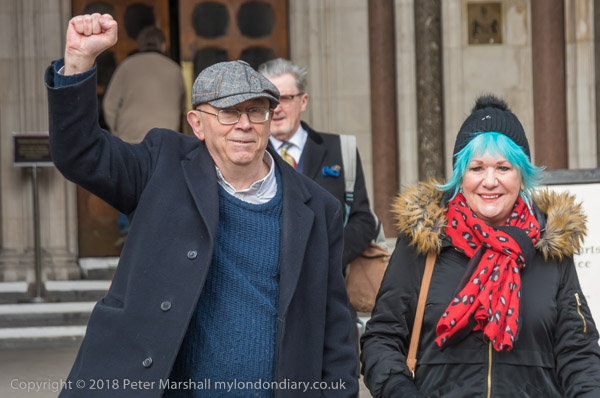
Class War Victory Over Qatari Royals – Thursday 8th February 2018 saw a remarkable victory for Class War against the one of the richest families in the world, the Qatari Royal Family with a $335 billion sovereign wealth fund who are now one of the biggest landowners in the United Kingdom.
Class War Victory Over Qatari Royals

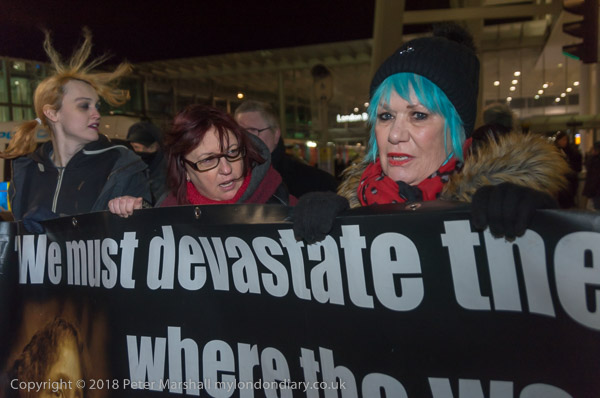
In the morning I had gone to the Royal Courts of Justice on Strand where lawyers acting for the Qatari royal family were trying to prevent a Class War protest against the ten empty £50 million pound apartments in The Shard, the tallest building in the United Kingdom. The Qataris own 95% of the property with the remaining 5% retained by its original developers Sellar Property.
Class War Victory Over Qatari Royals

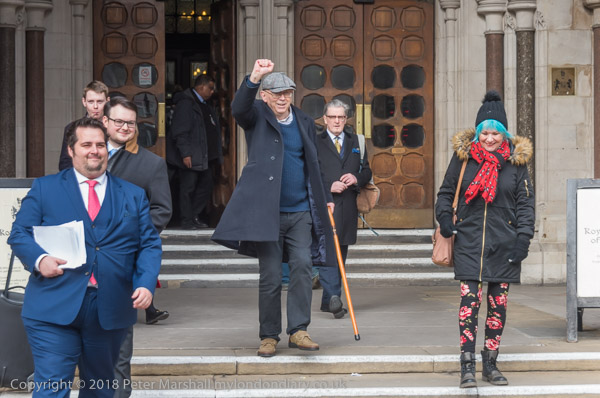
I hadn’t gone into the court but had waited outside, arriving in plenty of time to greet Ian Bone and his barrister Ian Brownhill as they emerged triumphant from the court.
Class War Victory Over Qatari Royals

Lawyers for the Qatari royals had tried to get an injunction against protests by Bone and “persons unknown” and to claim over £500 in legal costs from the 70 year-old south London pensioner for them doing so.
Class War Victory Over Qatari Royals

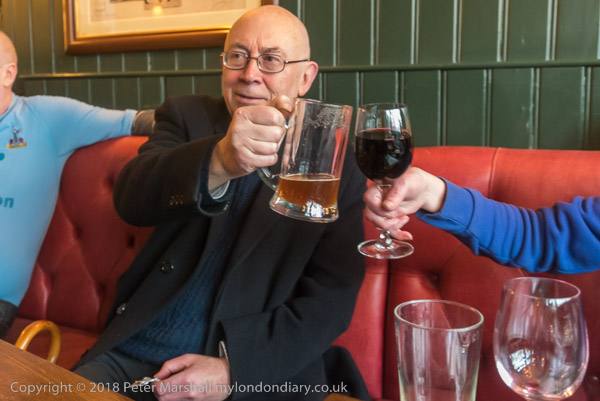
Brownhill had contacted Bone and offered to take up his case pro bono, and as soon as he contacted the Qataris’ lawyers they offered to drop the case if Class War ‘would stop attacking the Shard’. Class War would of course not agree to giving up their protest. The Qatari attempt to stifle protest led to articles in the national and international press and radio and TV coverage.
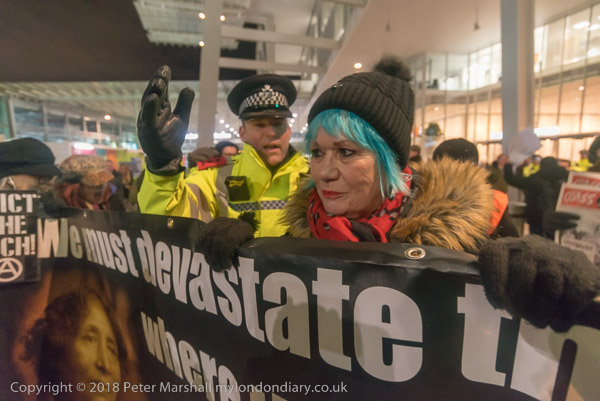
In the High Court the Qataris’ lawyers were forced to drop the attempt to ban protests and their demand for fees but Bone accepted a legal restriction on him going inside the Shard and its immediate vicinity.
Among documents supplied to the court for the Qataris were some clearly defamatory statments about another person connected with Class War but not named in the injunction and other information which had clearly been obtained from police sources. The Head of Security at the Shard got his job after retiring as a police commander.
Police have over the years carried out a number of clearly malicious arrests of people from Class War during protests, aimed at harassing people engaged in peaceful protest. The cases have either been dropped before coming to court or have been thrown out by the courts.
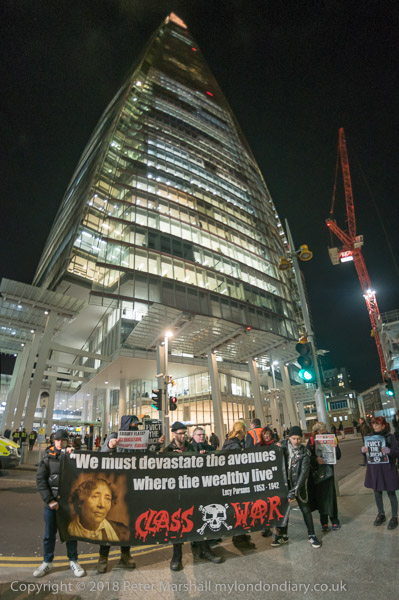
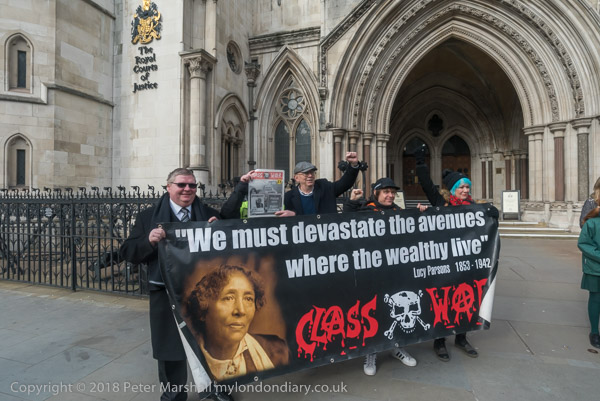
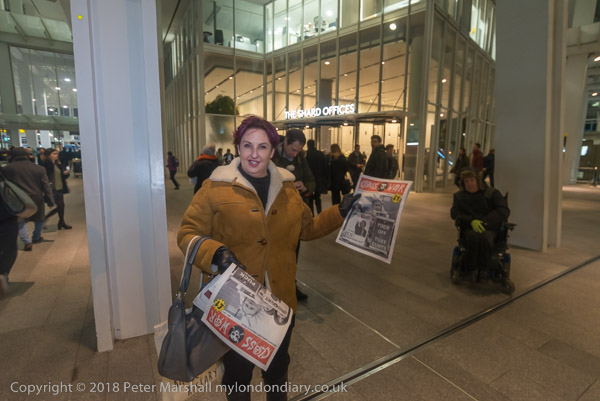
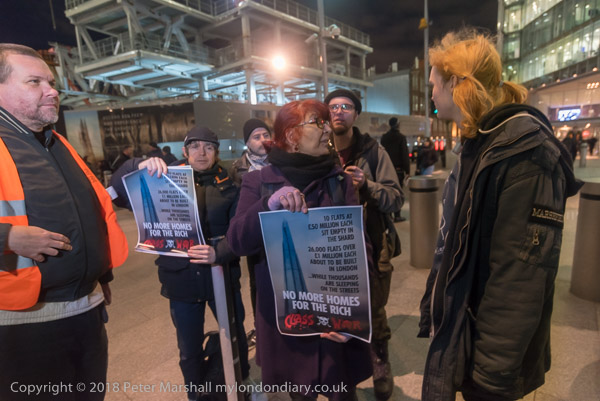
Class War’s protest went ahead as planned, pointing out that the ten £50 million pound apartments in the Shard have remained empty since the building was completed.

There appeared to be several times as many police as the protesters outside the Shard, as well as a large number of security men and plain clothes police, along with two men with search dogs when the protesters arrived. It seemed a huge overkill for what was always intended – and was – an entirely peaceful but noisy small protest.
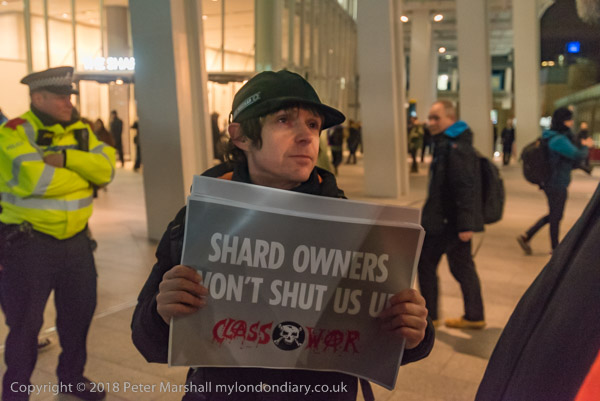
Ian Bone’s health problems meant he would not in any case have attended the protest, and the other protesters were careful to remain outside the boundary of the Shard which is marked by a metal line in the pavement.
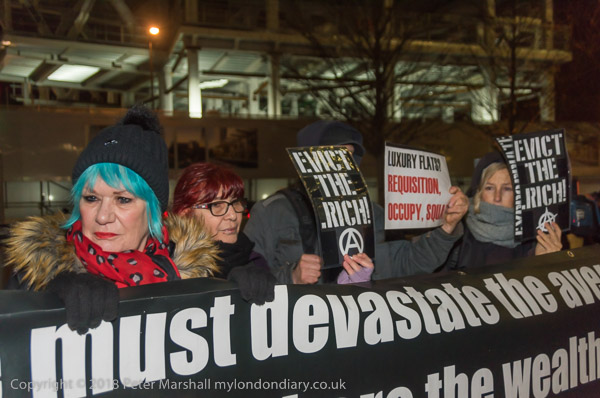
Despite this police still tried to move them away to the other side of the road, making the patently spurious claim that they were causing an obstruction to commuters attempting to enter London Bridge station. it was very clear that it was the police were obviously causing a rather larger obstruction than Class War.
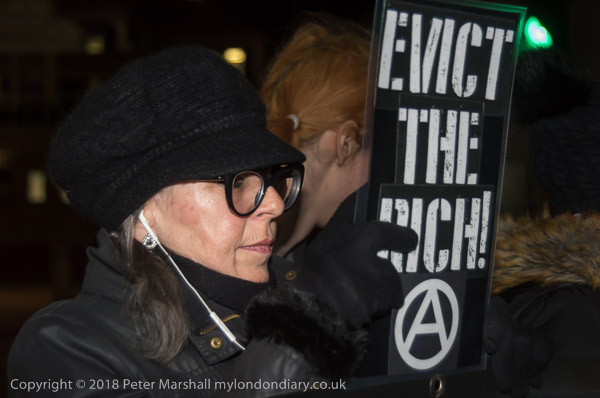
The protesters pointed out that there are now a huge number of empty properties in London at the same time as a huge housing crisis – at the time including over 100 families from Grenfell who were in temporary accommodation.
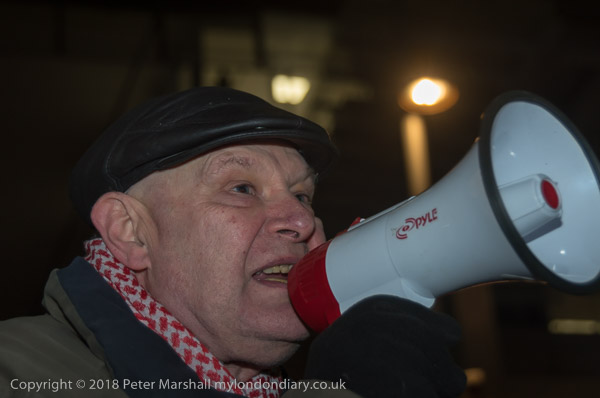
There are large developments of high-prices flats taking place, totally unaffordable for those in housing need, many of which are bought simply as investments to take advantage of rising house prices and remain empty all or most of the year.
In 2018 there were plans to build 26,000 more flats costing over a million pounds each, including many on former council estates being redeveloped and replacing social housing – when thousands are sleeping on the streets and councils have huge housing lists. Currently in 2023 both Lambeth and Newham have over 35,000 waiting for housing and nine other boroughs have lists with over 10,000 names, with a total of over 323,000 over the whole of Greater London.

George Monbiot last Saturday wrote an important article In a world built by plutocrats, the powerful are protected while vengeful laws silence their critics. Class War in February 2018 showed it is sometimes possible to take on the powerful and win. Though the Qataris are still laughing all the way to the bank which they own anyway.

More pictures on My London Diary:
Class War protest at Shard
Class War victory against Qatari Royals


FlickrFacebookMy London DiaryHull PhotosLea ValleyParis
London’s Industrial HeritageLondon Photos

All photographs on this page are copyright © Peter Marshall.
Contact me to buy prints or licence to reproduce.
Bank of England Told Return Venezuela’s Gold

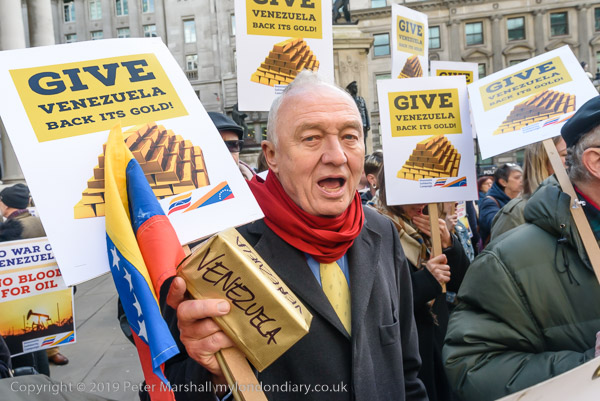
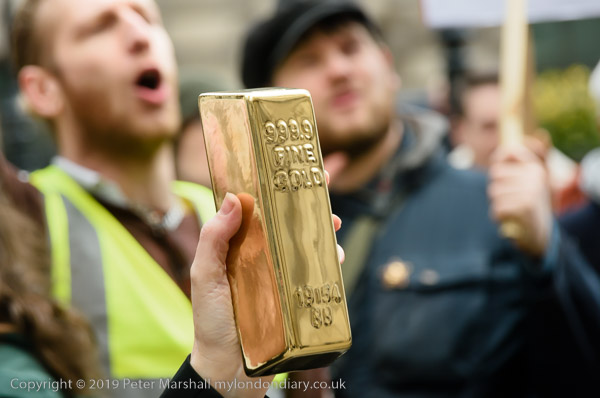
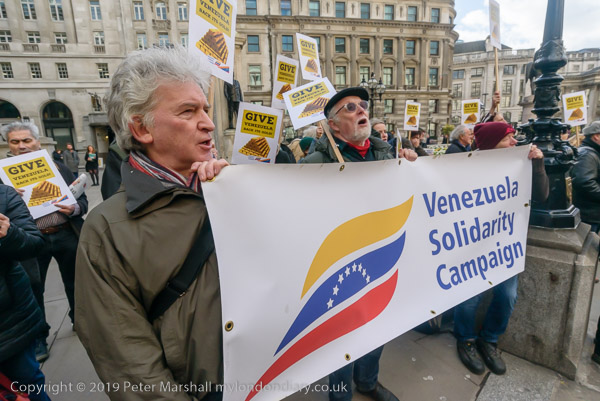
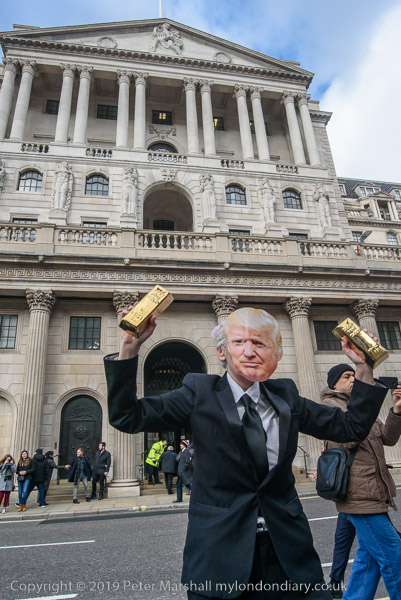
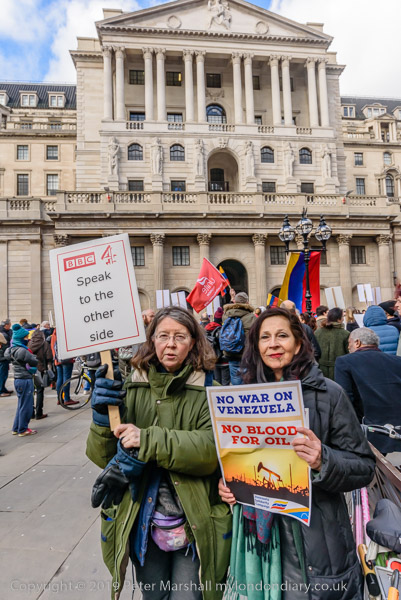
Bank of England Told Return Venezuela’s Gold: Back in 1980 the Central Bank of Venezuela (BCV) deposited almost a hundred tons of the Venezuelan government’s gold reserves in the Bank of England for safe keeping, and around 31 tons of that are still held in the Bank’s vaults.The value of gold goes up and down, but the around 2,500 standard gold bars would be worth around £1.3 billion.

Bank of England Told Return Venezuela's Gold
Ken Livingstone

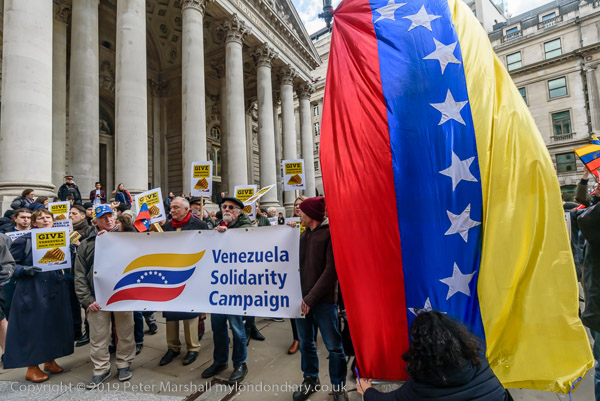
In 2019, shortly before this protest on Thursday 7th Feb 2019 organised by the Venezuela Solidarity Campaign, the BCV asked to have its gold back and the Bank of England refused to return it. It is still their in its vaults.

Bank of England Told Return Venezuela's Gold
An actual gold bar weighs over 12kg – these were rather lighter

Venezuela had entered a crisis after the 2018 elections when the National Assembly declared the poll which had elected President Maduro invalid. There had been some irregularities in how the election had been run (and many unproven allegations) and some parties had boycotted the polls or not been allowed to stand. The turnout was low, with less than half of those registered voting, but even so the result seemed clear as Nicolás Maduro had gained two thirds of the votes cast, more than three times his closest rival.

Bank of England Told Return Venezuela's Gold

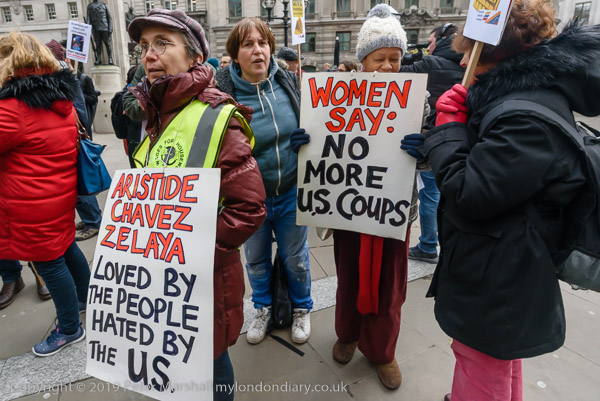
Juan Guaidó and the National Assembly declared him to be the acting president of Venezuela in January 2019 and a long power struggle ensued. Many foreign governments, led by the US and including the UK, Canada and various Latin American and European countries recognised Guaidó as the head of the legitimate Venezuelan government, though after his interim government was dissolved in January 2021, many ended their recognition.

Bank of England Told Return Venezuela's Gold

After a disputed period in 2019 to 2023 Maduro is now firmly back as President with Guaidó expelled from Venezuela in April 2023 and now living in exile in Florida. The UK had supported Guaidó but its position now seems deliberately unclear.

Both Maduro and Guaidó had set up their own governing boards for the Central Bank, and both claimed the gold in the Bank of England leading to a number of battles in the UK courts. But although Maduro has clearly emerged as the legitimate leader of Venezuela the Bank of England is still refusing the BCV request – and will probably continue to do so until the UK government makes its position clear.

Ken Livingstone when Mayor of London had negotiated a deal with the Venezuelan state oil company to provide cheap fuel for London buses in exchange for help with urban planning. Later he blamed an “establishment elite” for the problems that Maduro was having and accused the US of meddling in the country.

Media coverage of the struggle between Maduro and Guaidó in the UK by the BBC and newspapers was almost entirely one-sided, largely relying on the views of the Venezuelan middle and upper classes who see themselves as severely threatened by the policies of Hugo Chávez and his successor Maduro who have done much to increase literacy and improve conditions for the poorest in the country.

Bank of England return Venezuela’s Gold


FlickrFacebookMy London DiaryHull PhotosLea ValleyParis
London’s Industrial HeritageLondon Photos

All photographs on this page are copyright © Peter Marshall.
Contact me to buy prints or licence to reproduce.

Ash Wednesday, Charcoal and Condi Rice – 2008

Ash Wednesday, Charcoal and Condi Rice – pictures from Ash Wednesday in London on 6th February 2008, with an Ash Wednesday Witness and prayer against War at the Ministry of Defence and a Downing Street protest against a visit by US warmonger and then US Secretary of State Condoleezza Rice. A week tomorrow, on Ash Wednesday Wednesday 14th February 2024, Pax Christi together with Christian CND and others will again be meeting at 3.30pm for a similar witness against war.


Ash Wednesday Liturgy of Repentance and Resistance – Ministry of Defence, Whitehall

Ash Wednesday, Charcoal and Condi Rice

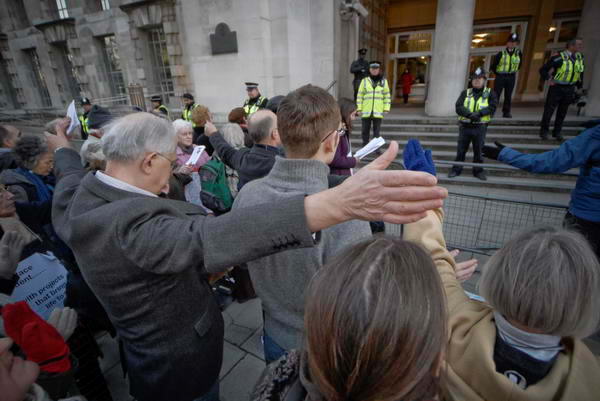
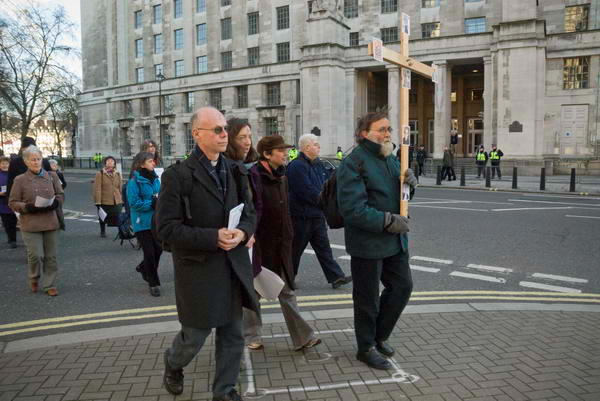
Pax Christi, Catholic Peace Action and Christian CND began their an annual liturgy of Repentance and Resistance around the Ministry of Defence in protest against the continued reliance on nuclear weapons on Ash Wednesday 1982, 42 years ago, and the 2008 event was their 26th.

Ash Wednesday, Charcoal and Condi Rice

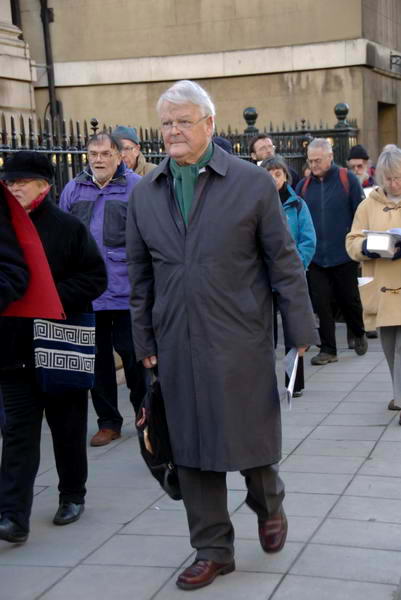
Looking back at the pictures I made in 2008 has a particular resonance for me, in that two of those in them are people that I knew who have died in the past couple of years. One was the well-known peace campaigner Bruce Kent who I’d photographed at various events since around 1990 if not earlier and though I didn’t know him well we often exchanged a few words when I took his photograph and had a little joke in recent years. Bruce died in June 2022 and in March 2023 I photographed Jeremy Corbyn planting a memorial tree to him in Finsbury Park.

Ash Wednesday, Charcoal and Condi Rice

The other was a family friend who died recently and we were disappointed other appointments meant we were not be able to go to his funeral last week. He also appears in a some of my photographs of this and other peace events, sometimes singing in the Raised Voices choir.

Ash Wednesday, Charcoal and Condi Rice

Here is the description of the event I wrote in 2008, although the story is mainly told in the pictures and their captions on My London Diary:

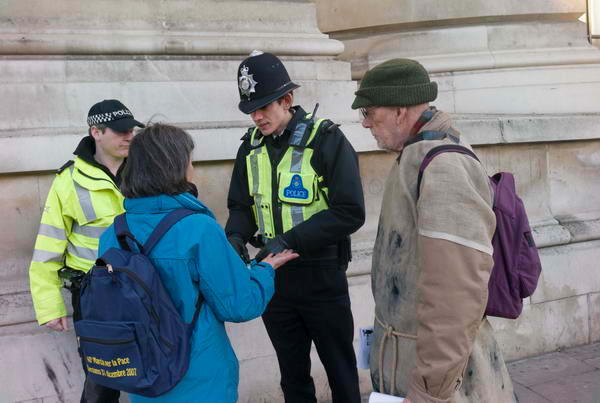
Although the ministry and nearby buildings such as the Old War Office were surrounded by police – rather as if they were expecting a massive attack, the police made no attempt to disperse what was undoubtedly an illegal unauthorised protest under the terms of SOCPA. They did hold a couple of people they caught writing on the walls of the Old War Office, and were at least threatening to charge one of them with causing damage to the building, but otherwise watched benignly, at least until I left to catch my train shortly before the liturgy had finished.

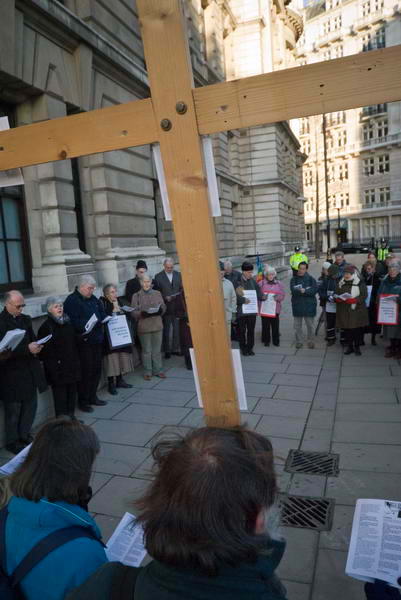
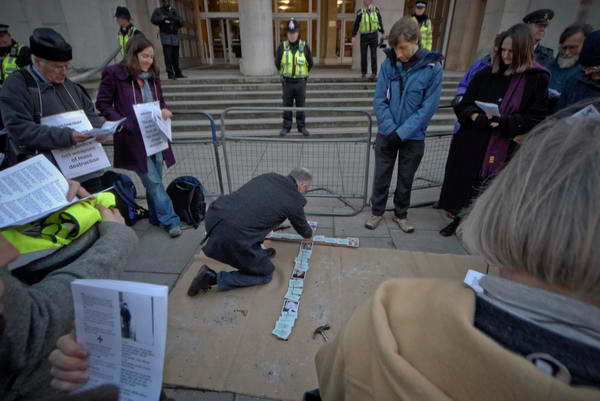
The most moving part of the liturgy was outside the Defence Ministry, where a wooden cross was laid on sackcloth. Ashes were sprinkled on it, and then while those present chanted a ‘litany of the martyrs’, including the names of Franz Jaegerstaetter, Dorothy Day, Martin Luther King, Oscar Romero and Mary Lampard, 21 ‘Theses for today’s church’ by Philip Berrigan were read and then nailed to the cross.

Ash Wednesday Liturgy of Repentance and Resistance


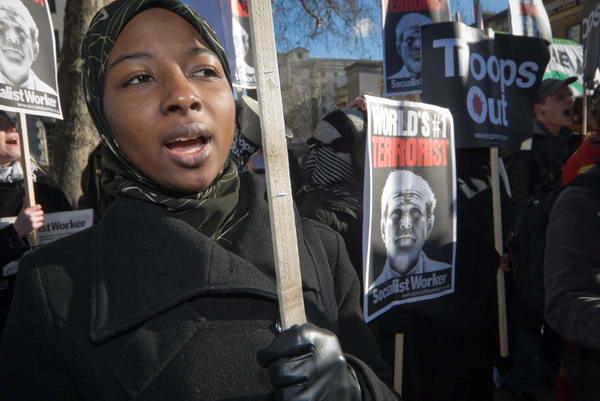
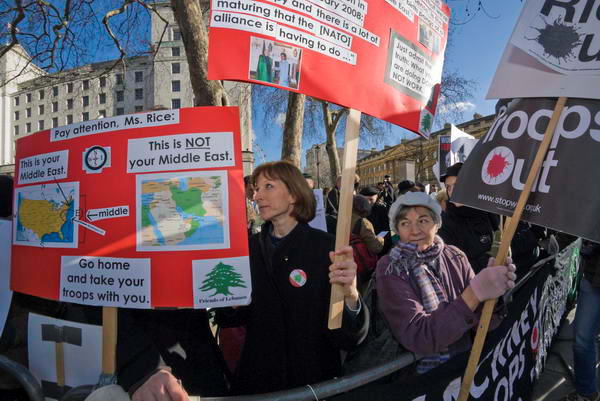
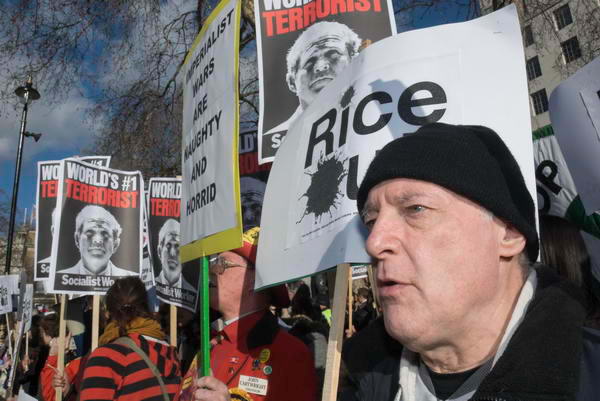
Protest at Condi Rice’s London Visit – Downing St

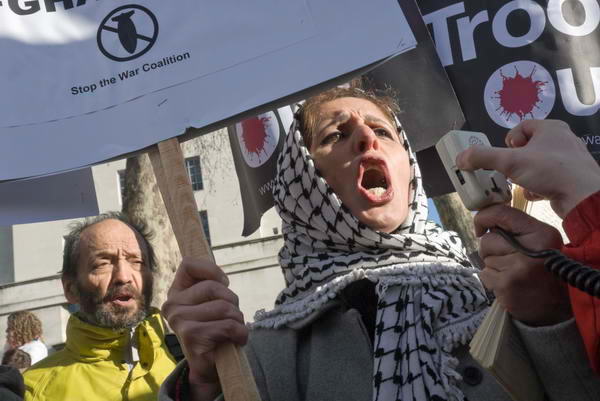
A couple of hundred ‘Stop the War’ demonstrators were on the pavement facing Downing Street. They had come with a clear message to give Condoleezza Rice, that it was time for the US to get out of other people’s affairs in other countries.

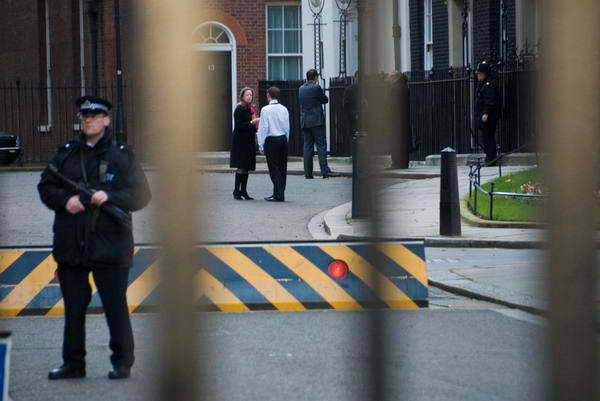
However there was no sign of Condi, who had obviously avoided using the front entrance to miss the protesters, either entering by the back entrance or through another Government building, possibly making use of the extensive network of tunnels underneath Whitehall.

A large crowd of press photographers were also waiting impatiently opposite the front door of Number 10, waiting for her to appear for a press call along with Gordon Brown, but I think they were waiting until after the protesters dispersed.

I could have joined them, but although the press likes to use pictures taken in front of the famous door I find the great majority of them supremely boring. And I don’t carry the long heavy lenses you really need for the situation to take the one in a million images that has some interest. It’s been years since I bothered to go through the security check and into Downing Street.

Welcome for Condi Rice


FlickrFacebookMy London DiaryHull PhotosLea ValleyParis
London’s Industrial HeritageLondon Photos

All photographs on this page are copyright © Peter Marshall.
Contact me to buy prints or licence to reproduce.

More Support to Gaza – 27th January 2024

More Support to Gaza: Local actions took place across the country last weekend calling for an end to the genocide in Gaza and for an immediate ceasefire and freedom and a just peace in Palestine.

More Support to Gaza - 27th January 2024
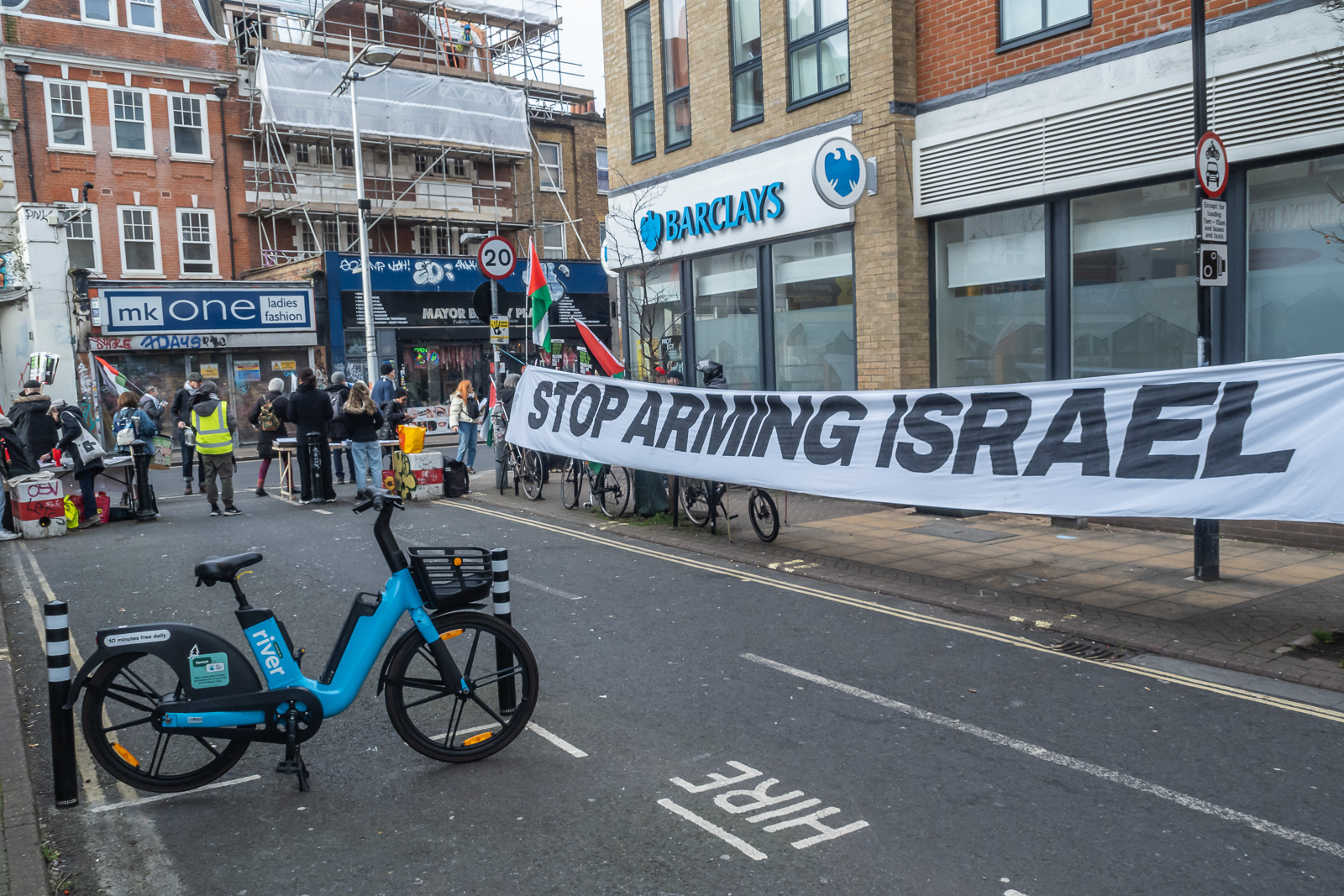
Barclay’s Peckham branch

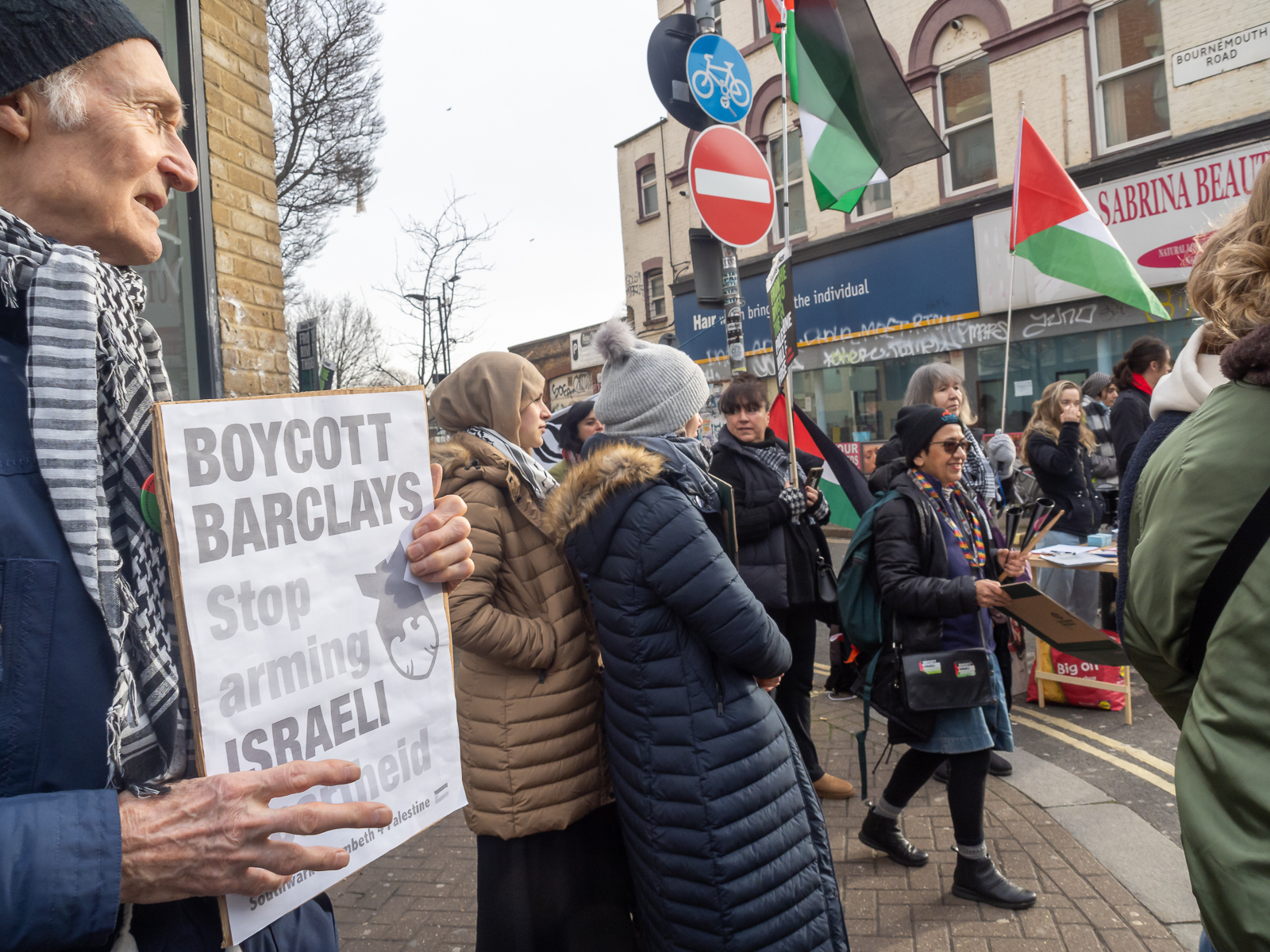
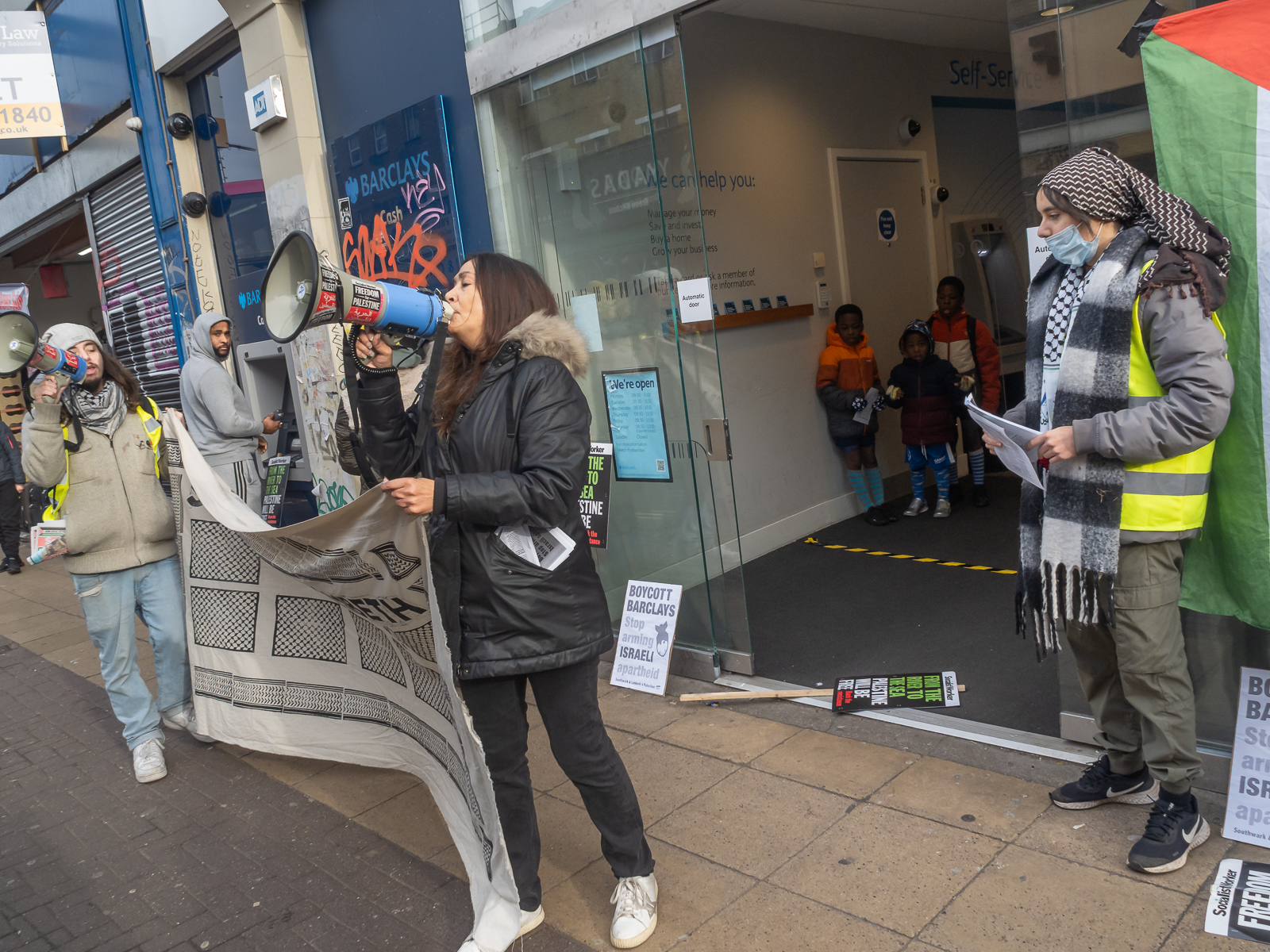
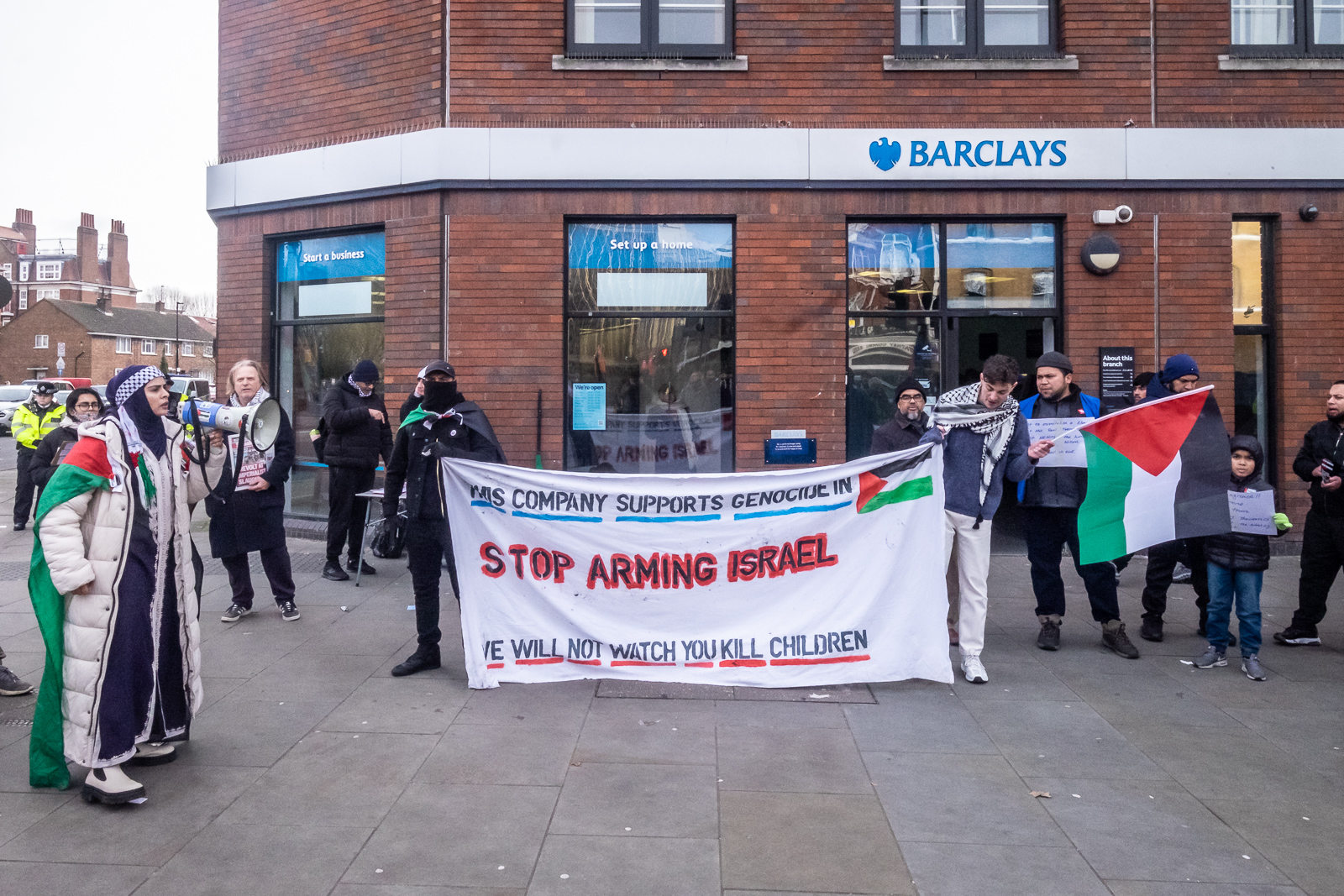
Most of the protests last Saturday were directed against local branches of Barclays Bank, demanding they stop bankrolling Israel’s attacks on Palestinians and calling customers to boycott the bank. Barclays has investments in weapons companies BAE Systems, Boeing, Elbit Systems, Raytheon all producing weapons and systems used in Gaza and Caterpiller whose bulldozers are used to demolish Palestinian homes, schools and civilian infrastructure.

More Support to Gaza - 27th January 2024
Barclay’s Peckham branch

The protests came the day after the International Court of Justice (ICJ) at The Hague, the UN’s top court, had ruled that there was a plausible case against Israel under the 1948 Genocide Convention, and that the Palestinian population in Gaza was at real risk of irreparable damage.

More Support to Gaza - 27th January 2024
Barclay’s Peckham branch

The ICJ stopped short of ordering an Israeli ceasefire and instead directed Israel to take every measure possible to avoid genocide while also ensuring humanitarian aid. The six provisional measures the court voted on to protect Palestinians from “irreparable” damage were all passed by overwhelming votes by the 17 judges, with even an Israeli judge supporting two of them, while a Ugandan judge voted against them all (although the Ugandan government issued a statement backing the ICJ).

More Support to Gaza - 27th January 2024
Barclay’s Whitechapel branch

Media reports here in the UK have generally been rather lacking in detail and have underplayed the ICJ judgement. You can read it on the ICJ web site in full or as their lengthy unofficial summary. The court demanded that Israel must:

  • take all measures in its power to prevent all acts against Palestinians in Gaza violating the Genocide Convention;
  • ensure its military does not commit any acts of genocide;
  • punish all incitements to commit genocide;
  • take immediate and effective steps to provide basic services and humanitarian assistance in Gaza;
  • take effective measures to preserve evidence related to allegations of genocide;
  • report to the ICJ within one month on actions it has taken over these orders.

The ICJ has no powers to enforce its decisions and statements from Israeli government and military have been defiant, while the UK and USA governments seem determined to continue their support for genocide and to continue giving support to Israel, including supplying weapons

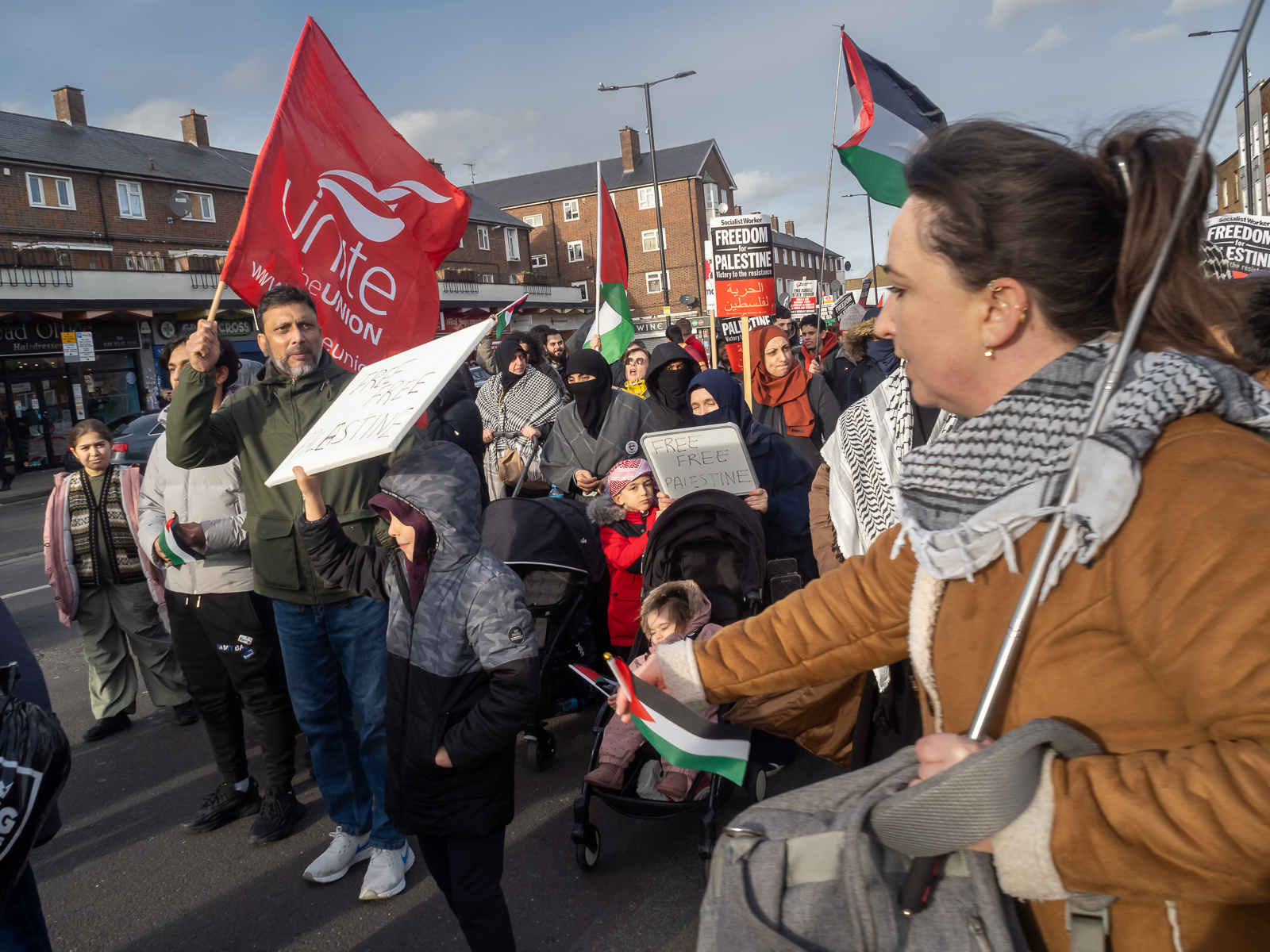
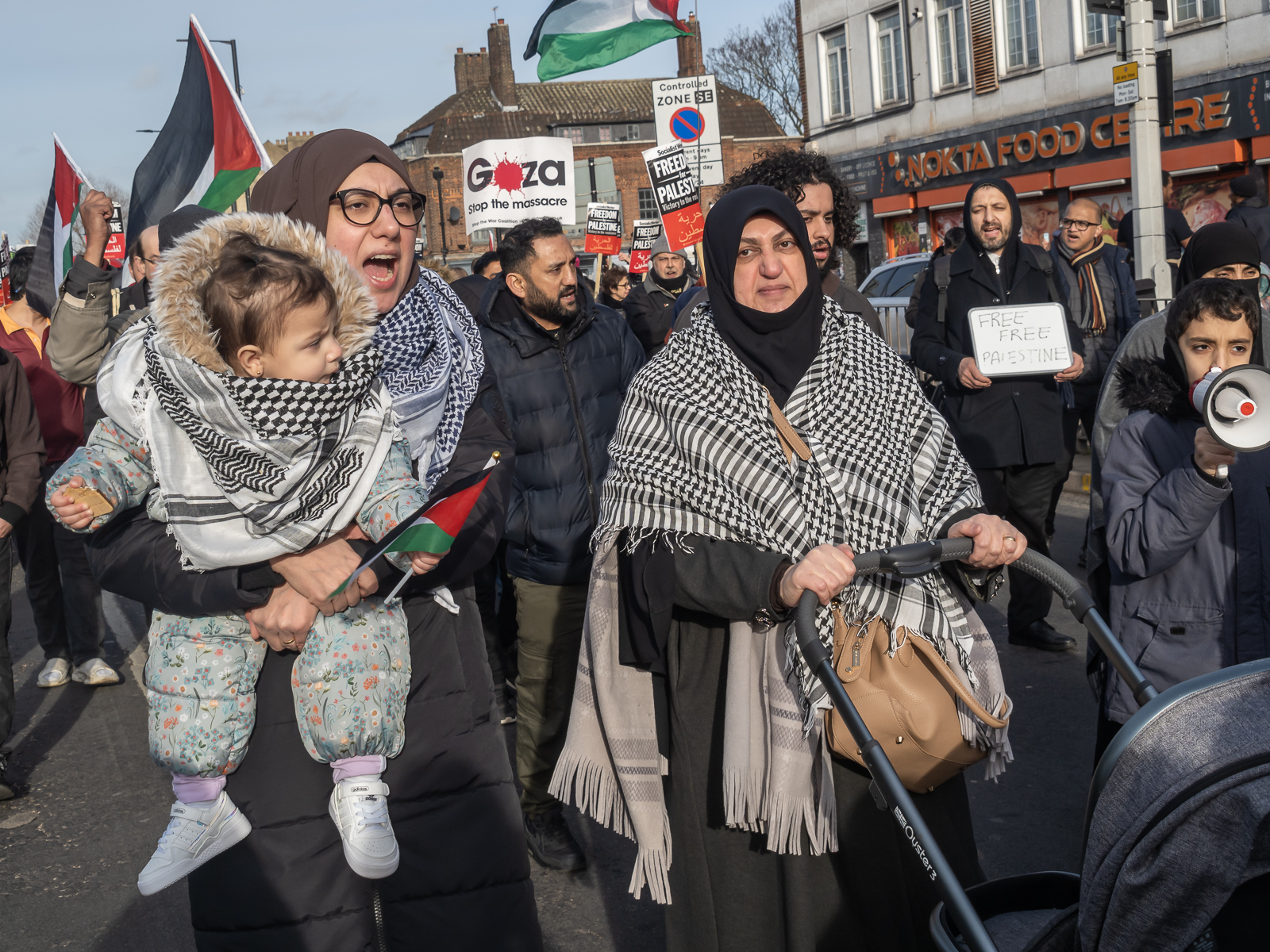
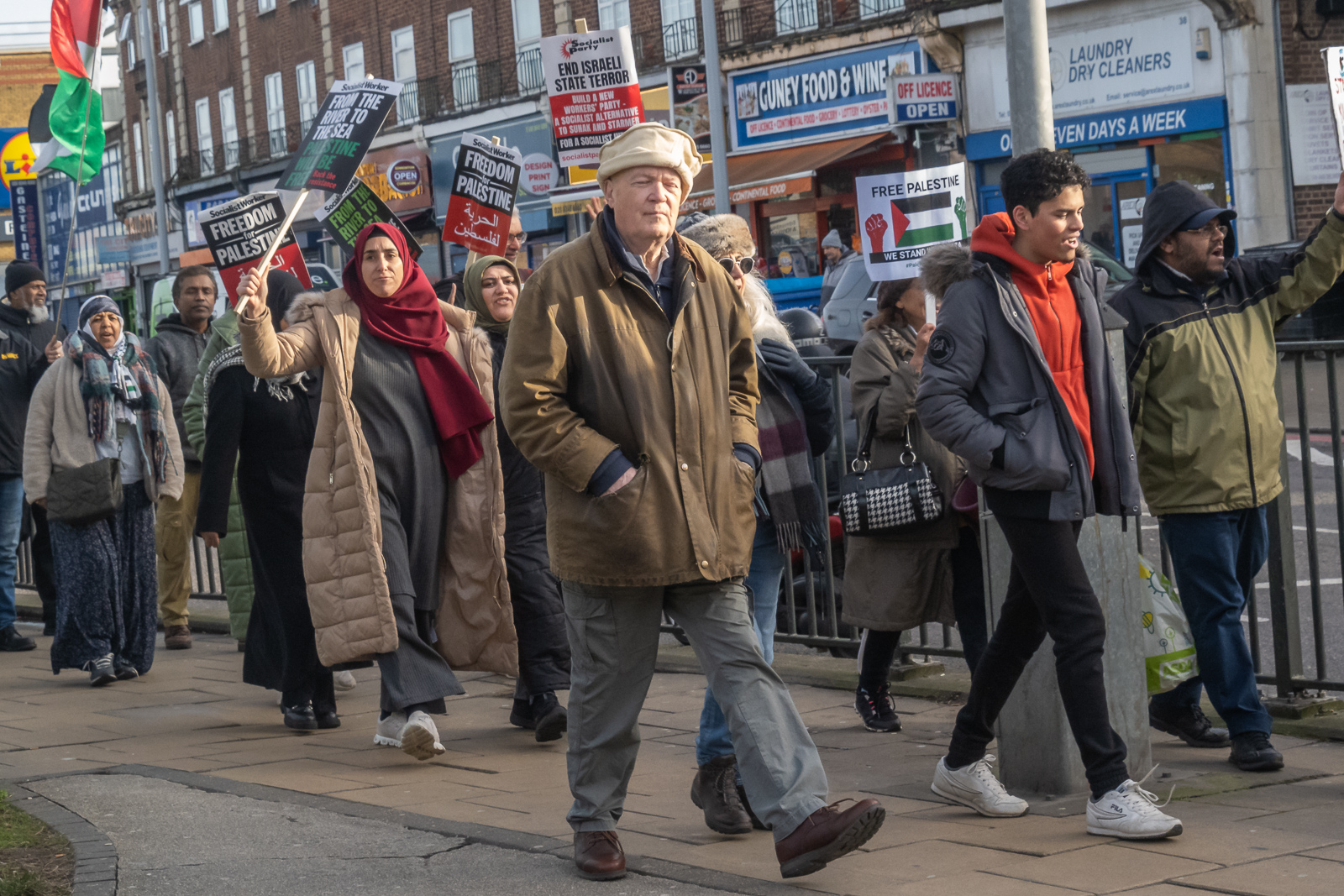
Edmonton Green march to a rally at Silver St

The ICJ decision came after South Africa brought the case, but protesters around the world have been clear that this is genocide. And in December the Lemkin Institute for Genocide Prevention, continuing the work of Raphael Lemkin, the Polish lawyer of Jewish descent who coined the term genocide and campaigned to establish the Genocide Convention, issued a statement explaining “the reasons why we believe the Israel-Palestine situation constitutes an instance of genocide.”

Edmonton Green march to a rally at Silver St

The killing in Gaza continues, with over 26,000 Palestinians now known to be killed including over 10,000 children. More than 8,000 are missing, probably most of them buried under the rubble, and over 65,000 are severely injured.

Edmonton Green march to a rally at Silver St

A BBC report states that more than half of all buildings in Gaza have been destroyed or damaged by the Israeli assault. There are also said to be almost 20,000 children in Gaza who have been orphaned or separated from their families. Other reports suggest that around three-quarters of Hamas fighters are men who became orphans, and so the current attacks are likely to be a powerful recruiting ground for future militants against Israel.

Edmonton Green march to a rally at Silver St

The whole Israeli policy over the years has been counter-productive. Peace in the region requires a thriving Palestine, not an area subjected to military occupation, under an apartheid system and subjected to destructive attacks – and certainly will not be achieved by genocide.

Edmonton Green march to a rally at Silver St

It’s very hard to see how any positive outcome can emerge now for Israel and Palestine, but perhaps the ICJ ruling is a small glimmer of hope – as years ago was Oslo. But hope then was soon defeated by Israel’s determination not to accept peace.

Edmonton Green march to a rally at Silver St

Last Saturday made my way around London on National Rail, Overground, Underground and Elizabeth Line to visit several pickets outside Barclays branches and then to Edmonton Green.

Edmonton Green march to a rally at Silver St

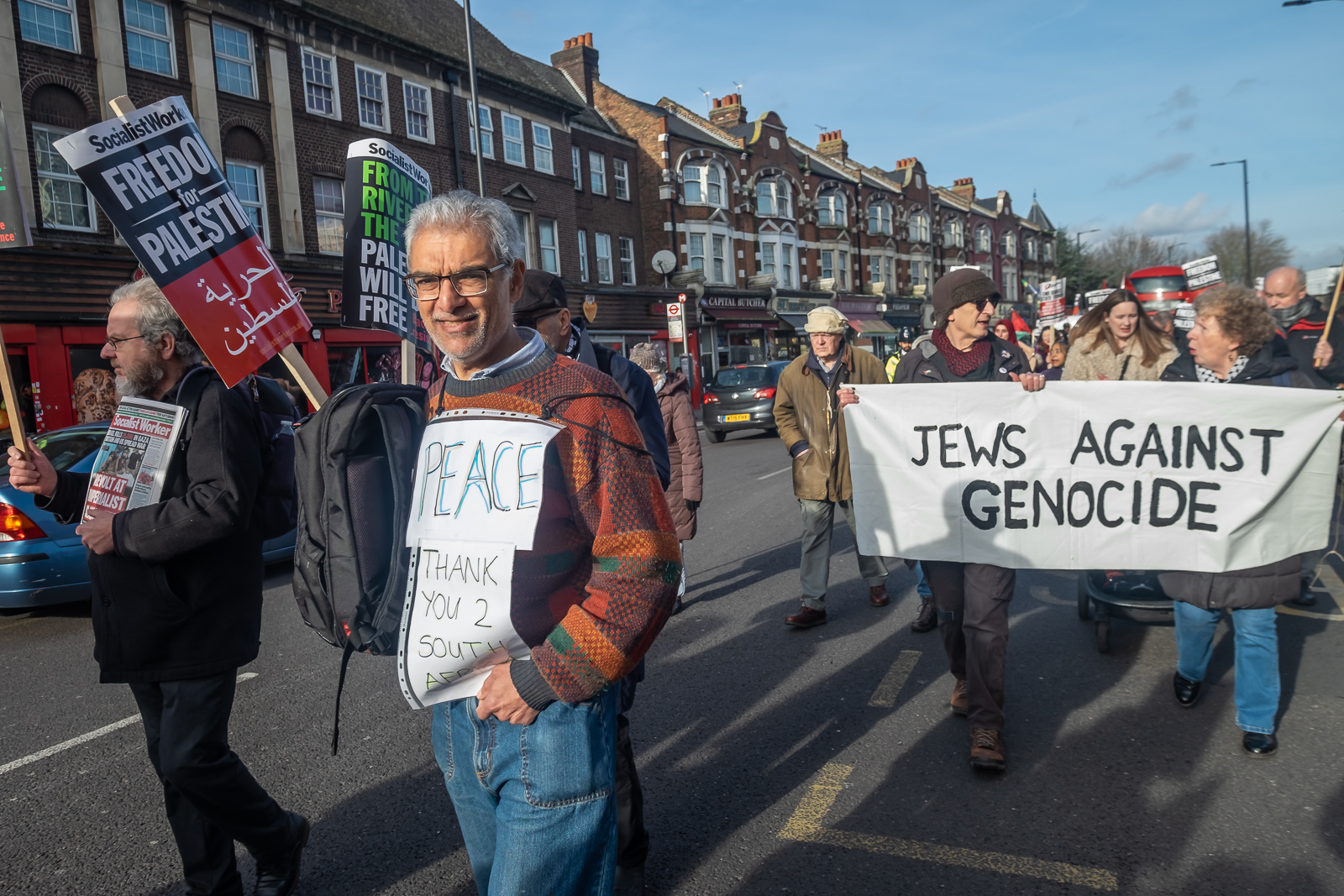
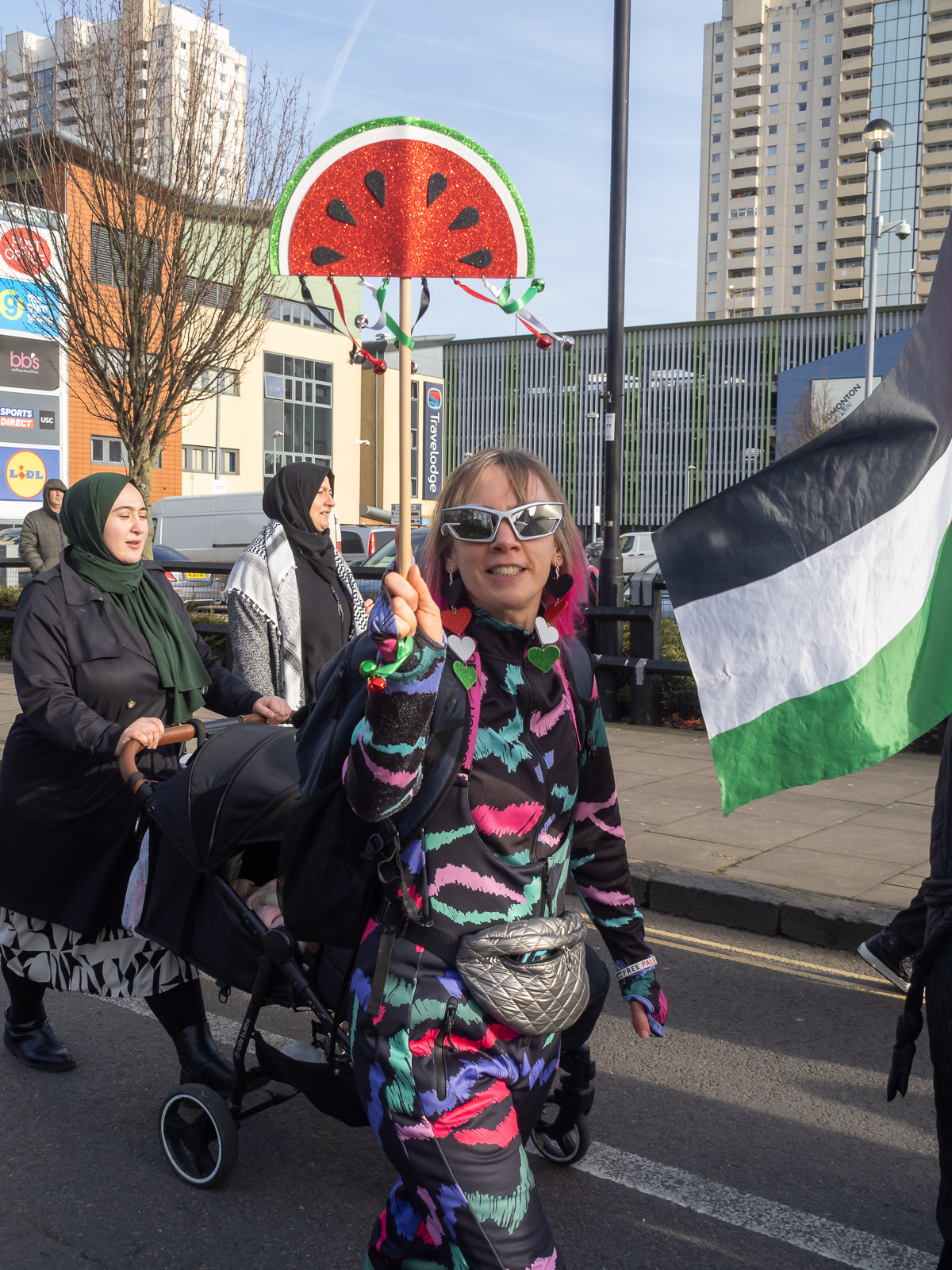
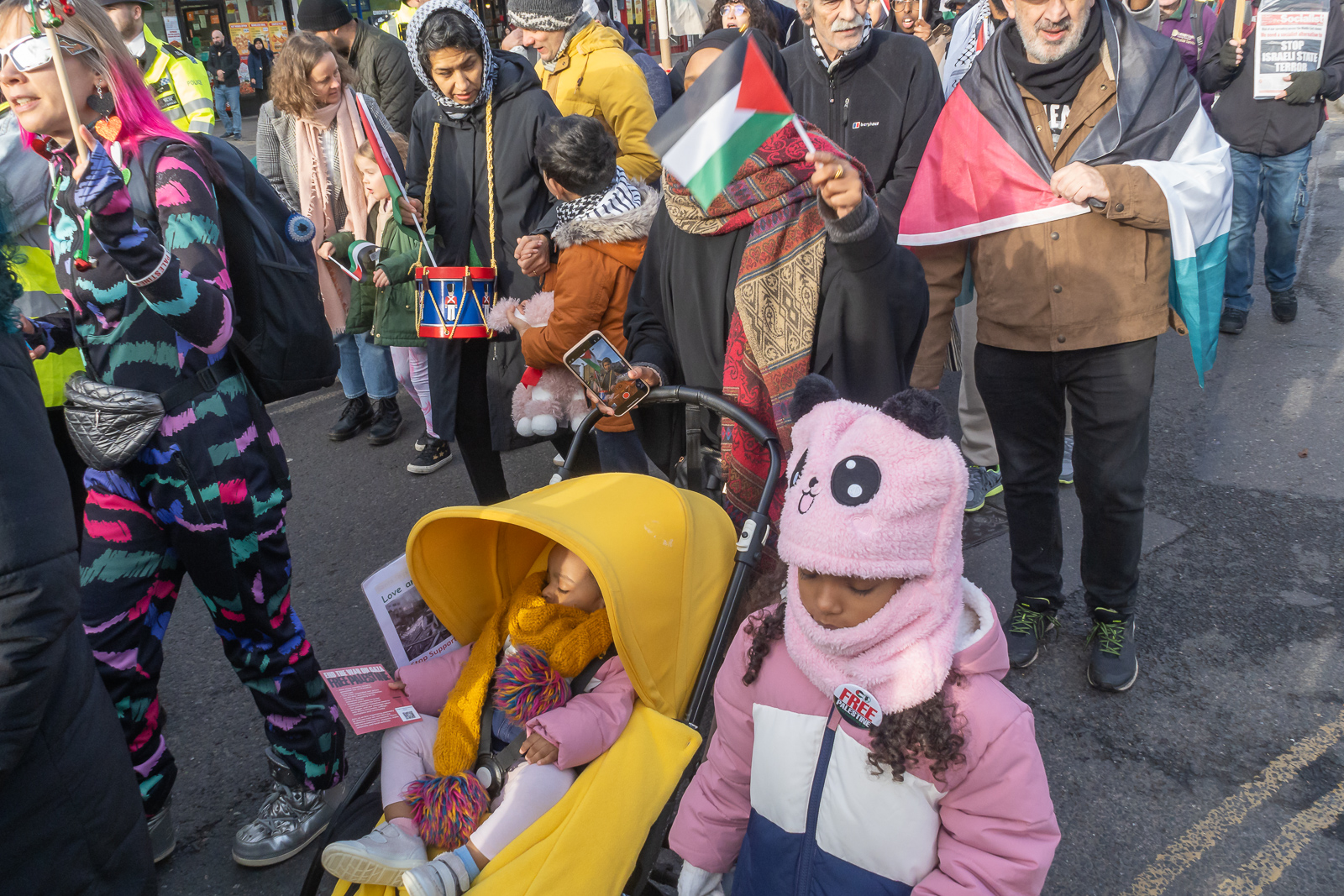
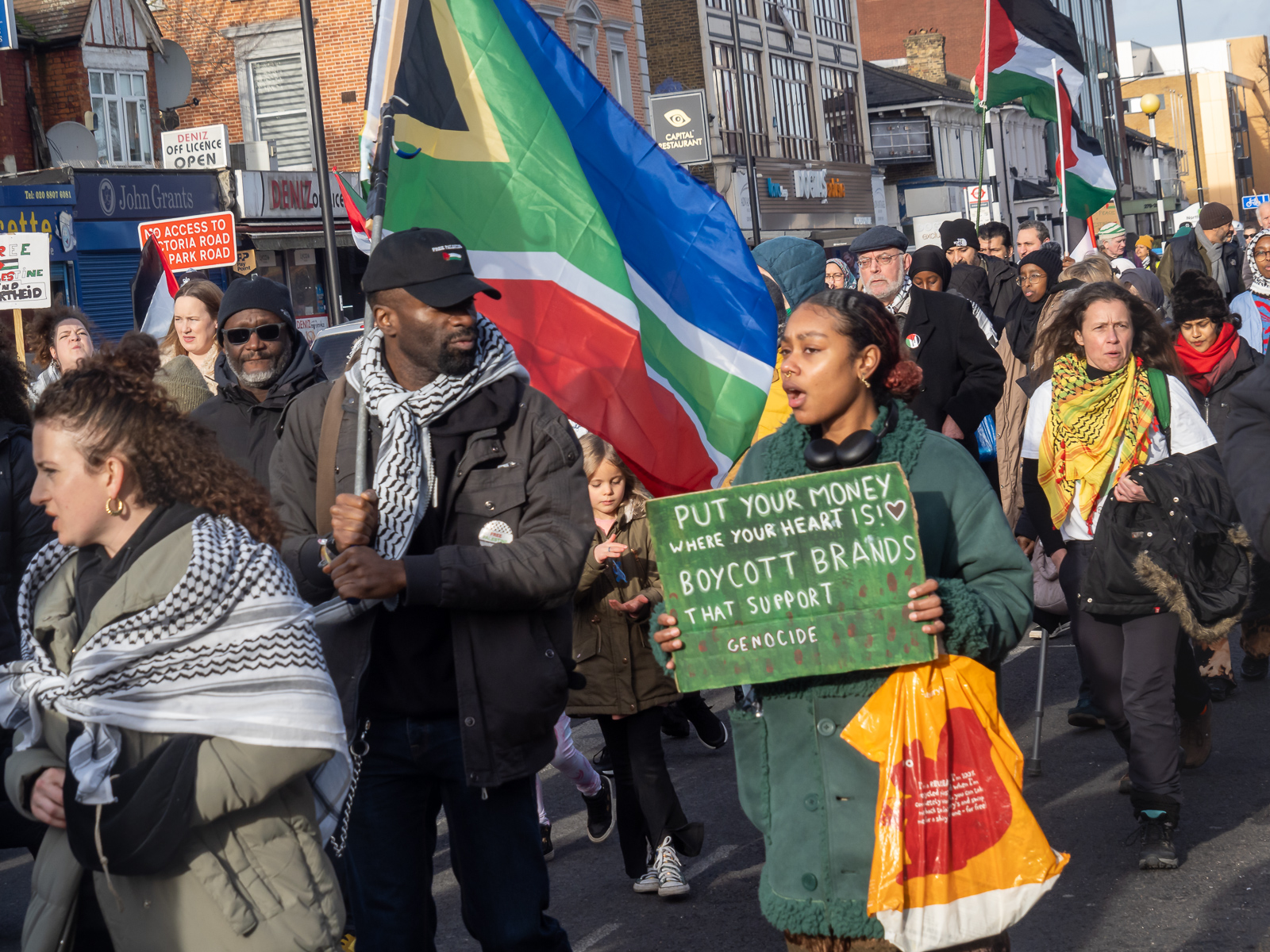
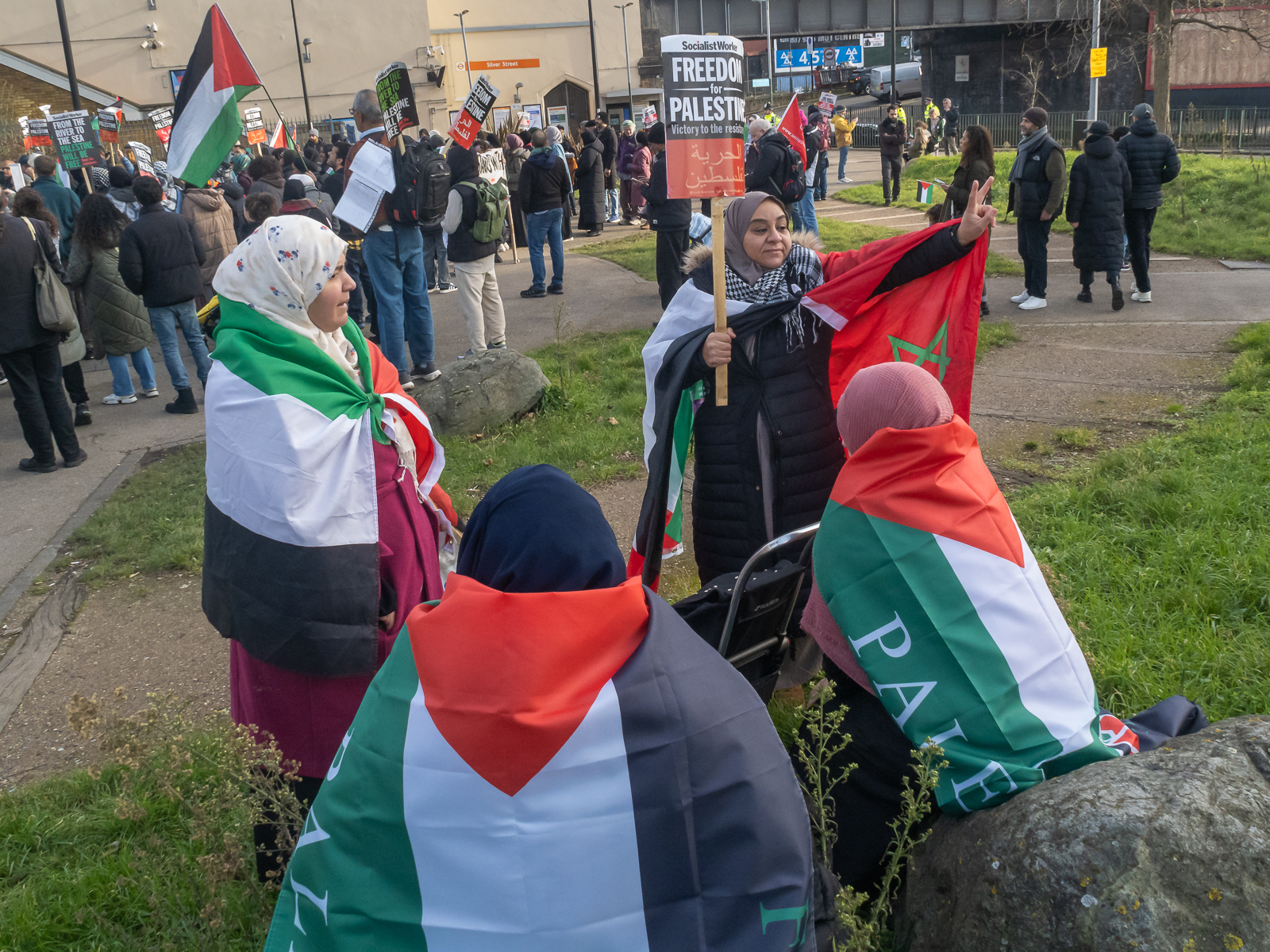
I arrived at Edmonton Green just in time for the march organised by the Enfield branch of the Palestine Solidarity Campaign to a rally at Silver Street. They demanded Israel ends its genocidal attack on Gaza, calling for an immediate ceasefire and an urgent programme of humanitarian aid to end famine and provide shelter, medicine and water. They praised South Africa for taking Israel to court for genocide and called for a just peace with freedom for Palestine.

At the start of the rally at Silver St

The pictures here come from protests outside Barclays branches on Rye Lane, Peckham and Whitechapel High Street and from the Edmonton march. You can see more pictures online at Barclays Told Stop Banking On Genocide and Enfield for Gaza Ceasefire, End to Occupation.


FlickrFacebookMy London DiaryHull PhotosLea ValleyParis
London’s Industrial HeritageLondon Photos

All photographs on this page are copyright © Peter Marshall.
Contact me to buy prints or licence to reproduce.

EDL Saved by Police in Slough – 2014

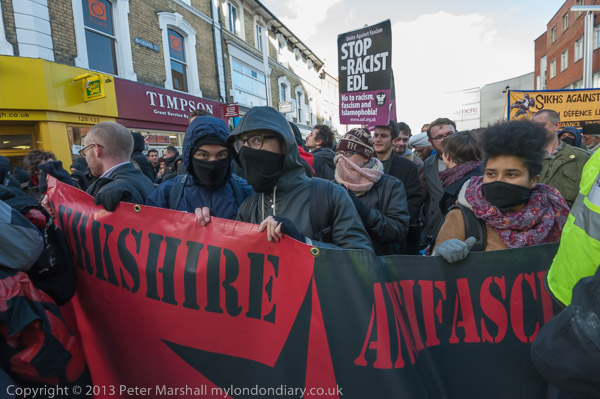
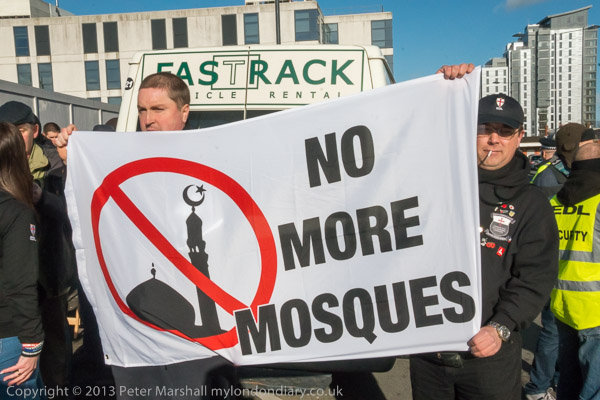
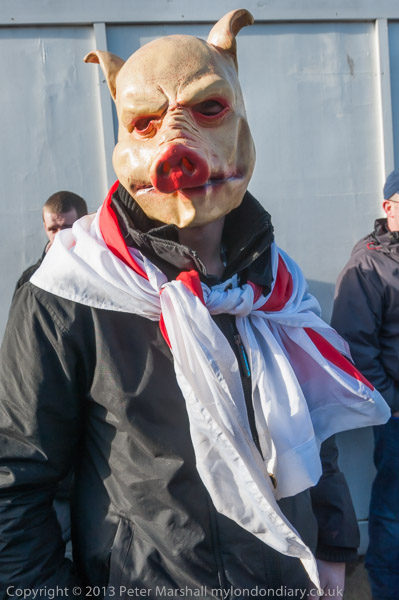
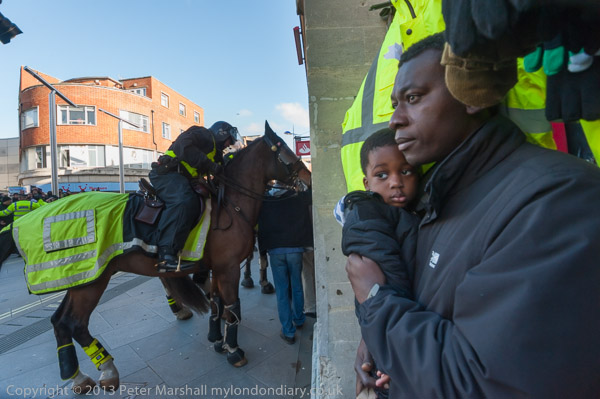
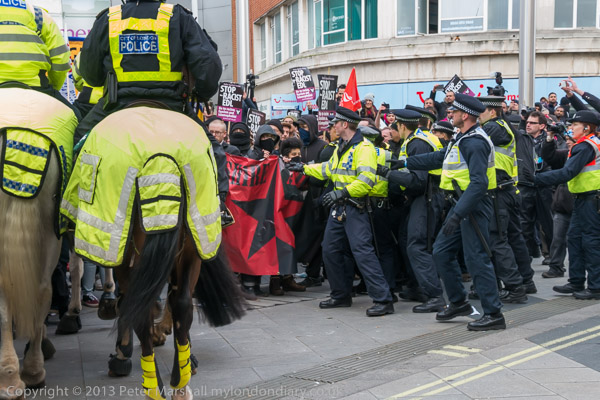
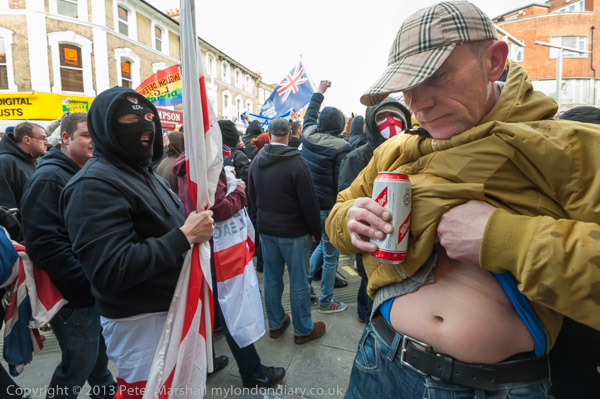
EDL Saved by Police in Slough: Ten years ago today around two hundred EDL supporters had come from around the country to march to a rally in the centre of Slough on Saturday 1st February 2014, sparked by plans to convert a failed social club on the outskirts of Slough to be used as a mosque and Islamic centre.

EDL Saved by Police in Slough

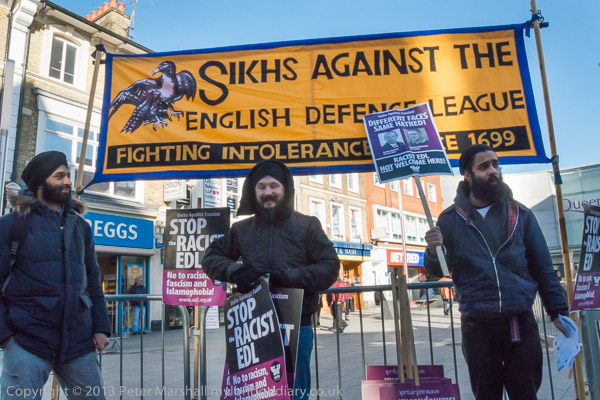
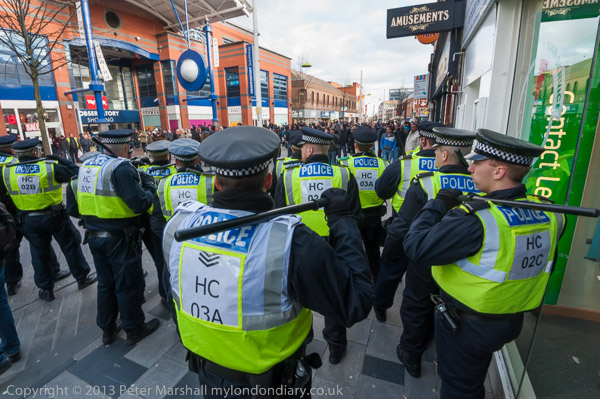
Their protest was opposed by a much larger counter-protests by black clad anti-fascist groups, the UAF and trade unionists, a large group of local mainly Asian youths and other local residents. Police had to clear a route for the EDL march with charges by police horses and with riot police with raised batons, and also protect them from having to run for their lives from angry counter-protesters to allow their rally to proceed. A large police presence seperated them from a rally by the UAF and trade unionists a short distance away.

EDL Saved by Police in Slough

Langley Village Club on Cheviot Road, Langley ceased trading in 2013 and was bought by Dawat-e-Islami who gained planning permission to convert it into an Islamic community and teaching centre and place of worship, Faizon-E-Madina.

EDL Saved by Police in Slough

Langley is on the eastern outskirts of Slough just north of the M4 and A4 and the small medieval village became a major manufacturing ventre, at first for building the Hawker Hurricane and other fighters during and after the war including the Hawker Hunter. When Hawker Siddeley left in 1959 the entire site was taken over by the Ford Motor Company who had been making parts for commercial vehicles there since 1949. The club was a part of the large estates that grew up here in the 1960s and 70s to house the workers in these and other factories around Slough and at Heathrow.

EDL Saved by Police in Slough

Some local residents had objected to the change of use, in particular fearing it might generate large volumes of traffic, although it is a relatively small building and the planning permission imposed a limit of 300 people at events there. The area now has a fairly high number of Muslims living within walking distance of the centre and the charity argued that the 35 parking places on site were sufficient, though the planning committee was not convinced.

The opposition to the plans by the EDL were not largely about parking but Islamophobia. EDL leaflets talked about “the disturbing proliferation of poorly regulated mosques” and linked the protest with its actions to highlight the activities of “vile grooming gangs“; they alleged that residents living around other mosques have been “driven to anger, tears and despair” because of the mosques, and suggested that the centre will “antagonise, perhaps even terrorise, local residents.”

They also claimed that Dawat-e-Islami “overtly supported the assassination of Pakistani politician Salmaan Taseer by Mumtaz Qadri, a member of the organisation who disagreed with Taseer’s opposition to Pakistan’s blasphemy law.”

They raised other local issues too, including the setting up of a Muslim faith-based school under the Free Schools programme which opened in September 2015 as Eden Girl’s School. Many others -including probably most of those who came to protest against the EDl would agree with there opposition to this, some opposed to all faith-based schools and those who oppose the whole divisive approach of ‘Free Schools’, agreeing as I do with the teacher’s union NUT (now NEU) that “We believe it is wrong that state funding should be given to small groups of individuals to run schools that are unaccountable to their local communities.”

I don’t visit Slough often, although I live only a few miles away – though it takes a while on the bus. I arrived a couple of hours before the EDL rally was due to start and was able to photograph and talk with the EDL about their protest for some time before a few of them objected to my presence.

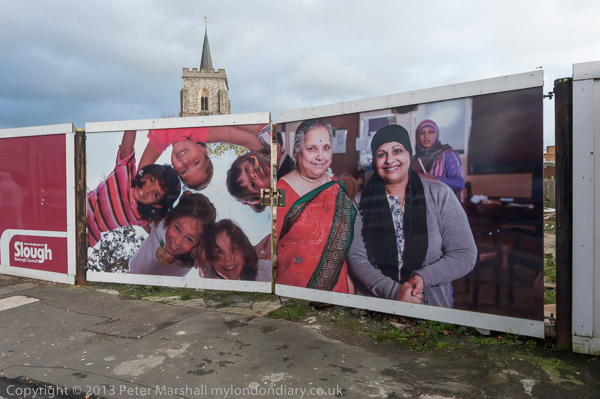
The pictures on My London Dairy at EDL Saved by Police in Slough and my account there give a very full account of what happened and I won’t repeat it here. Slough is one of the UK’s most ethnically diverse towns and its industries have brought people to it from across the country and around the world since the 1920s. The population of the borough is now over 150,000 and the various communities seem largely to live together with few problems.

According to Wikipedia, “the 2011 census showed that 41.2% of Slough’s population identified as Christian, 23.3% as Muslim, 10.6% as Sikh, 6.2% as Hindu, 0.5% as Buddhist, 0.1% as Jewish, 0.3% as having other religions” and Slough has the highest proportion of Sikh residents of any town in the country and “the highest percentage of Muslim and Hindu residents in the South East region.”

Much more about what happened along with many more pictures at EDL Saved by Police in Slough.


FlickrFacebookMy London DiaryHull PhotosLea ValleyParis
London’s Industrial HeritageLondon Photos

All photographs on this page are copyright © Peter Marshall.
Contact me to buy prints or licence to reproduce.

March For Homes – 2015

March For Homes: St Leonard’s Church to City Hall

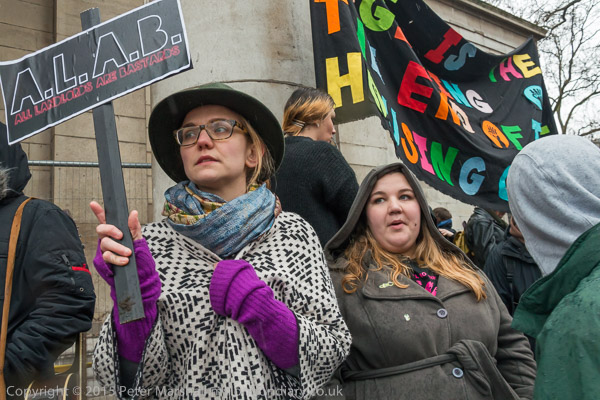
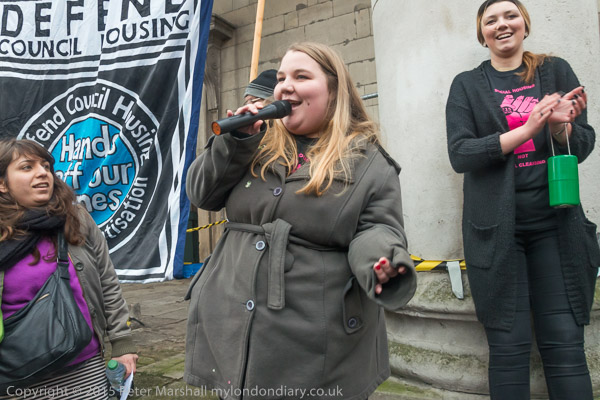
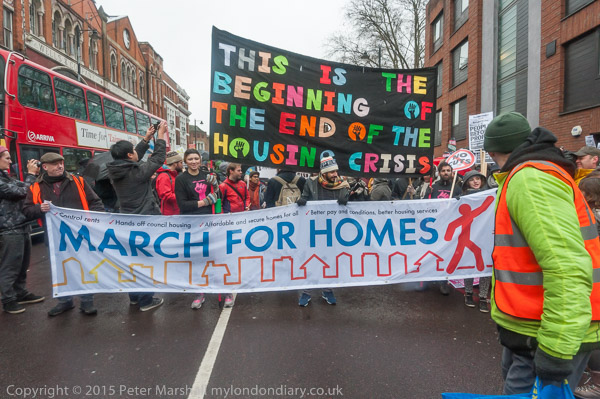
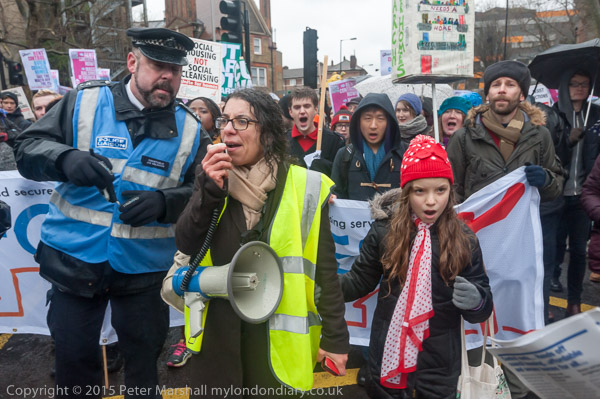
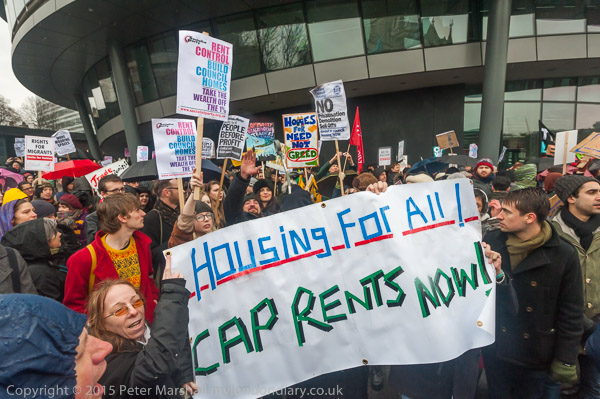
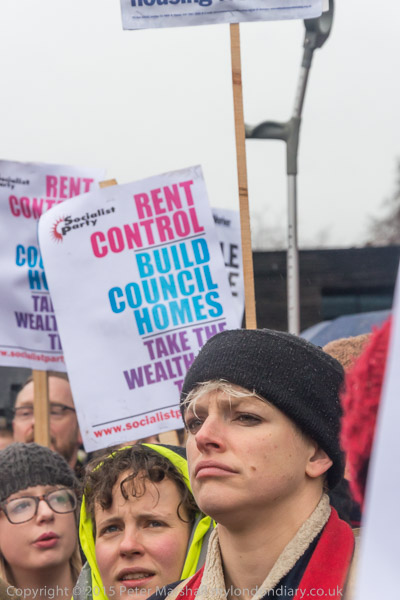
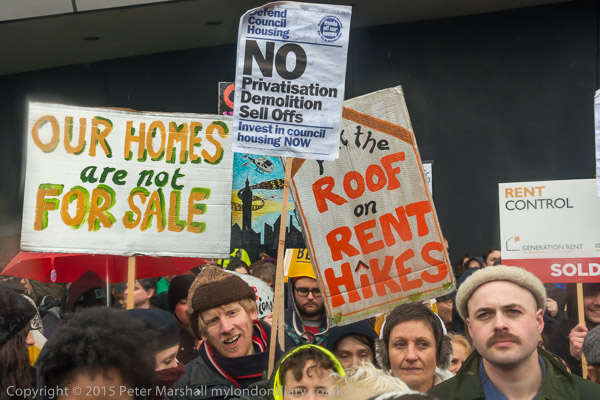
Defend Council Housing, South London People’s Assembly and Unite Housing Workers Branch had called for a march to draw attention to the crisis in housing, particularly in London where council housing lists are huge and many councils are failing to meet their legal requirements to rehouse homeless families.

March For Homes

These requirements generally do not extend to single homeless people and in London alone over 6,500 people had slept rough at some time in the previous year with around one in twelve of 16-24 year-olds having been homeless at some point. Government figures comprehensively and deliberately underestimate the numbers.

March For Homes

It isn’t really a housing crisis, but a crisis of affordable housing. There are more than enough empty properties to house the homeless, but those who need housing are unable to afford the high rents or house prices being asked.

March For Homes

There has been a huge surge in building high-rise properties in London, with whole areas like Battersea and Nine Elms as well as elsewhere across inner and outer London being increasingly filled with them, but almost all are high-price properties, many sold overseas before the buildings are completed not as homes but as investments. Others are low specification student housing and also do nothing for the housing crisis.

March For Homes

What is needed is a crash programme of housing at social rents for family units of all sizes. Developers have become adept at evading what laws there are about providing social housing in new developments, fiddling the books to claim they cannot make sufficient profits which ridiculously lets them off the hook.

Much of the UK problems over housing go back to the Thatcher administration which both sold off council housing piecemeal under ‘right to buy’ but also stopped councils replacing what they had lost.

In earlier years both Tory and Labour councils had built generally high quality low cost housing though of course there were some examples of poor planning (often when councils were forced to cut costs) and shoddy work as well as unfortunate government encouragement of high-rise system building, which many of us were campaigning against in the 60’s and 70s.

But perhaps even more importantly under Tory administrations council housing became something just for what they regarded as ‘feckless’ and the ‘dregs of society’, those unable to fend for themselves. We got this ridiculous concept of the ‘housing ladder’ and very much it is a ladder that expresses “pull up the ladder, Jack. We’re alright“.

Municipal housing can provide housing for all at low cost and provided a rational approaching to providing decent housing for all, getting away from the poor conditions and high cost of private rented housing at much lower cost than owner occupation.

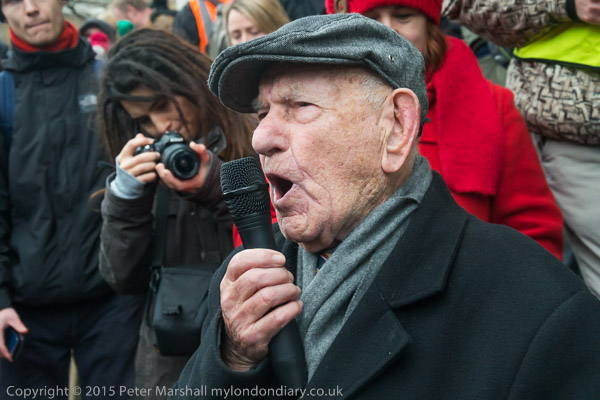
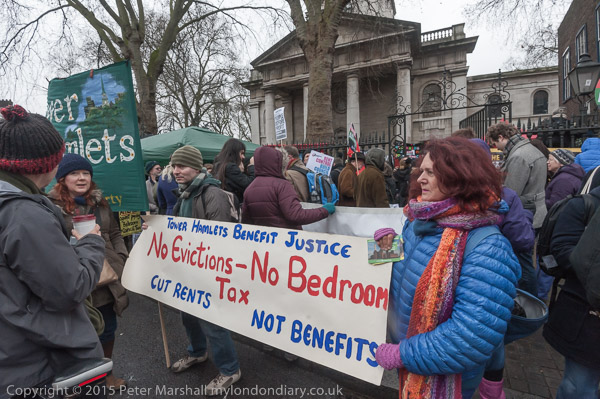
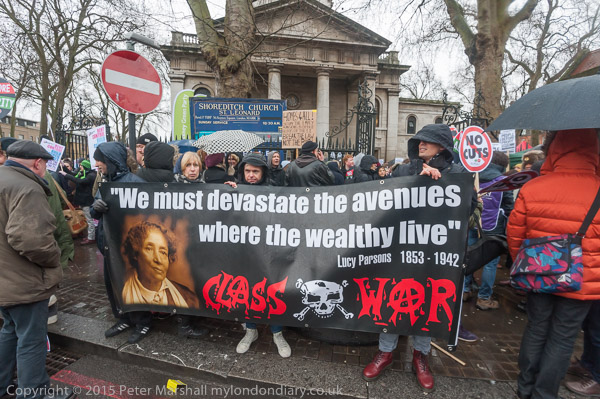
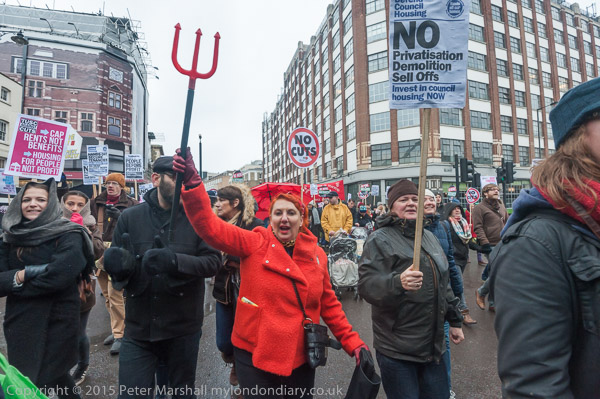
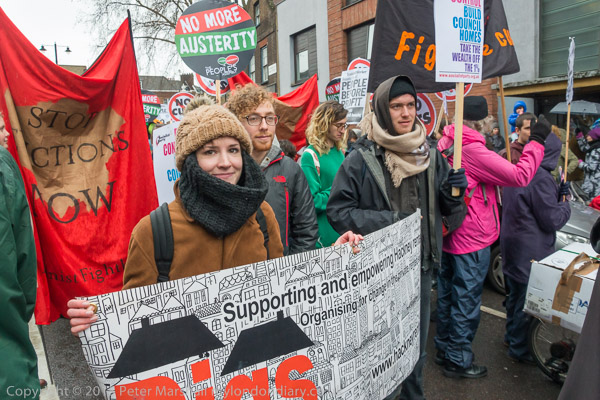
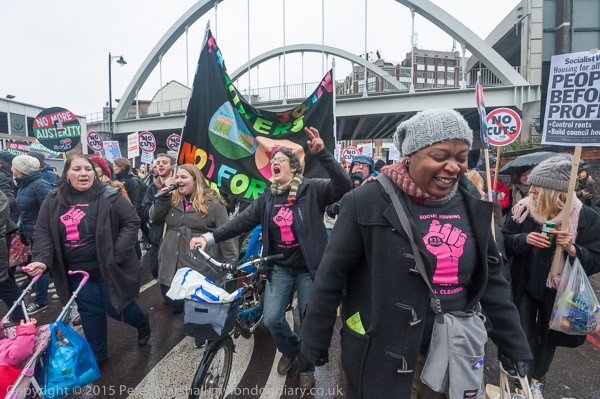
The March for Homes on Saturday 31st January was actually two marches, one from the Elephant in South London and the other from East London which I photographed at Shoreditch, calling for more social housing and an end to estate demolition and evictions. On My London Diary at March for Homes: Shoreditch Rally I published a very long list of some of the various groups which supported the march, as well as some of the speakers at the rally there. Eventually the march set off on its way towards City Hall, making its way towards Tower Bridge.

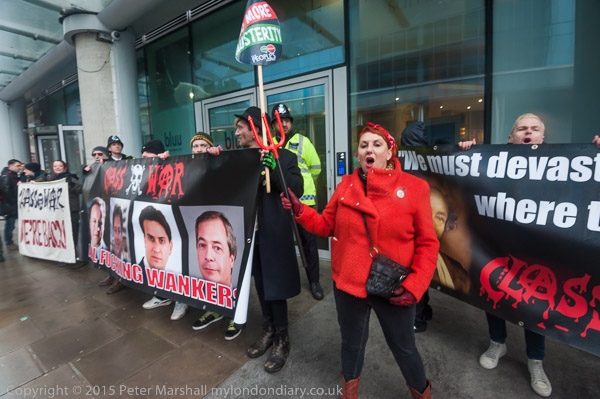
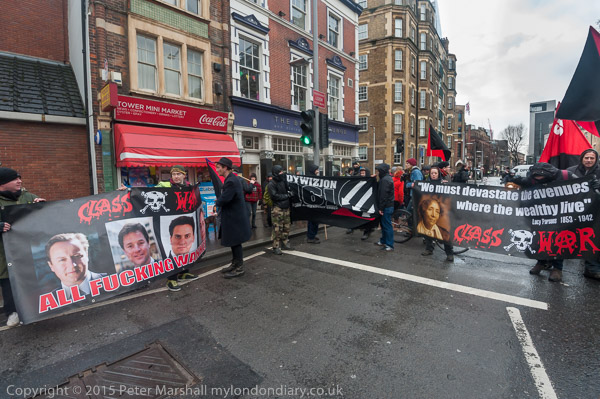
Class War left the march briefly to protest as it went past One Commercial St, where they had been holding a long series of weekly ‘Poor Doors’ protests against the separate door down a side alley for the social housing tenants in the block. They had briefly suspended the protests a few weeks early when new owner for the building had offered talks about the situation, but these had broken down.

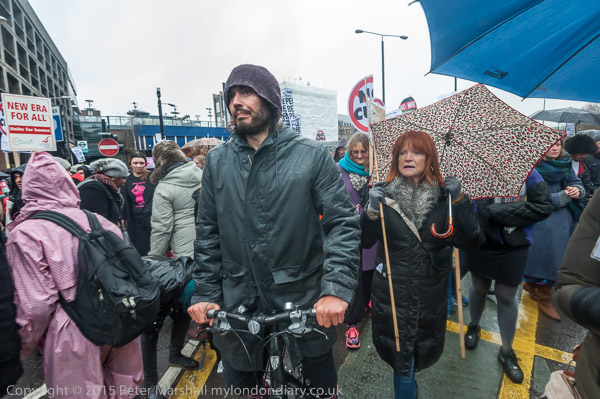
Approaching the Tower of London the protest was joined by Russell Brand riding a bicycle. He had earlier lent support to a number of housing campaigns by residents in estates threatened by evictions.

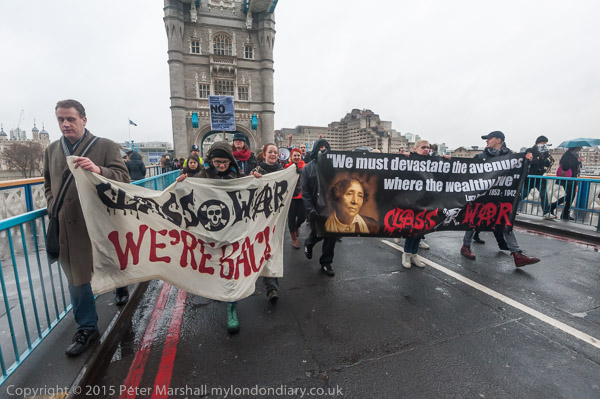
By the time the march was going across Tower Bridge Class War had rejoined it, and their banners were in the lead.

The march was met on the other side of Tower Bridge by the South London March for Homes, a similar sized protest called by Defend Council Housing and South London People’s Assembly which had started at the Elephant, marching past the former Heygate Estate. The two marches merged to walk on to Potters Fields for the rally outside City Hall.

We had been marching most of the day in light rain, and this got rather heavier for the rally outside City Hall. Together with a large crowd being jammed into a fairly small space it made photography of the rally difficult.

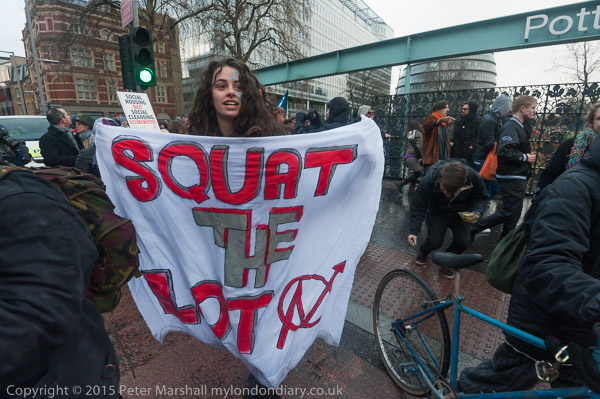
While the rally was still continuing some of the protesters began to leave Potters Fields to protest more actively, led by Class War and other anarchit groups and accompanied by the samba band Rhythms of Revolution.

They moved onto Tooley Street and blocked it for a few minutes, then decided to move off, with police reinforcements who had arrived than taking over their role of blocking the road as the protesters moved off eastwards.

I watched them go, and later heard that after a brief protest at One Tower Bridge, a new development mainly for the over-rich next to Tower Bridge they had taken a long walk to join occupiers on Southwark’s Aylesbury Estate.

But I was cold, wet and tired, and my cameras too, having been exposed to the weather for several hours were becoming temperamental and I waited for a bus to start my journey home.

Much more on My London Diary:
March for Homes: After the Rally
March for Homes: City Hall Rally
March for Homes: Poor Doors
March for Homes: Shoreditch to City Hall
March for Homes: Shoreditch Rally


FlickrFacebookMy London DiaryHull PhotosLea ValleyParis
London’s Industrial HeritageLondon Photos

All photographs on this page are copyright © Peter Marshall.
Contact me to buy prints or licence to reproduce.

Education Cuts & Egyptian Revolution – 2011

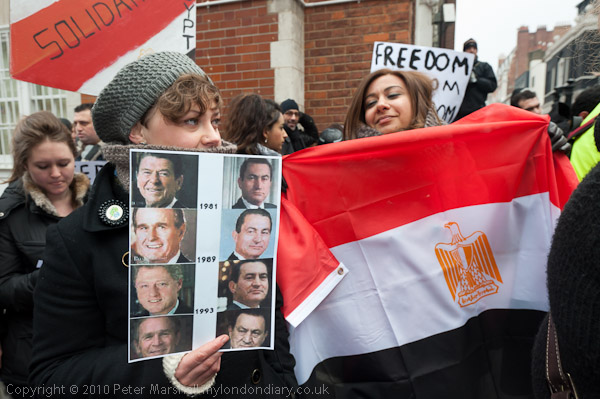
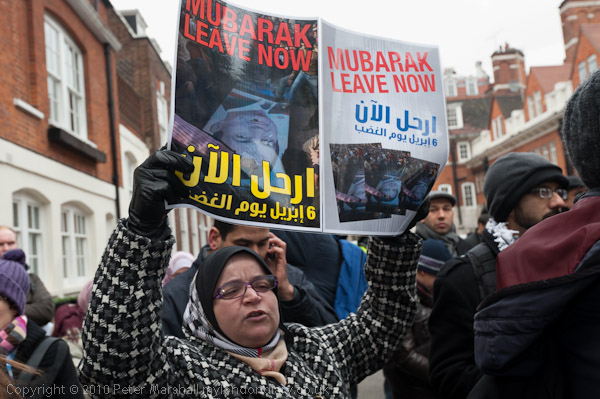
Education Cuts & Egyptian Revolution: People were protesting on the streets of London on Saturday 29th January 2011 in solidarity with demonstrations in Egypt at the Egyptian Embassy. Elsewhere students, teachers, parents and others took part in a large peaceful march against increases in student fees and cuts in education and public services.


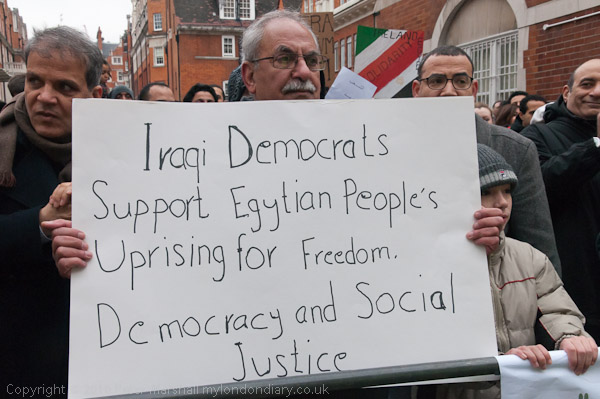
Solidarity with the Egyptian Revolution – Egyptian Embassy, South St. Mayfair

Education Cuts & Egyptian Revolution

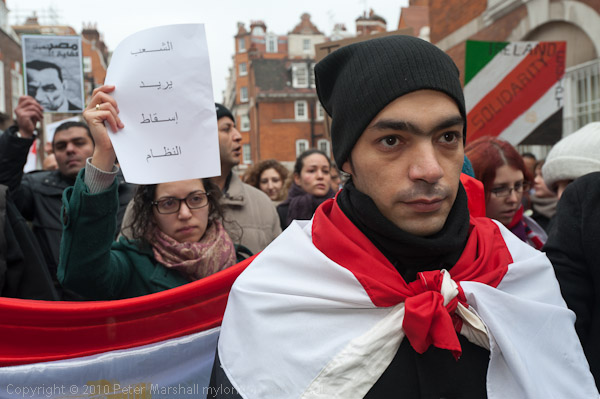
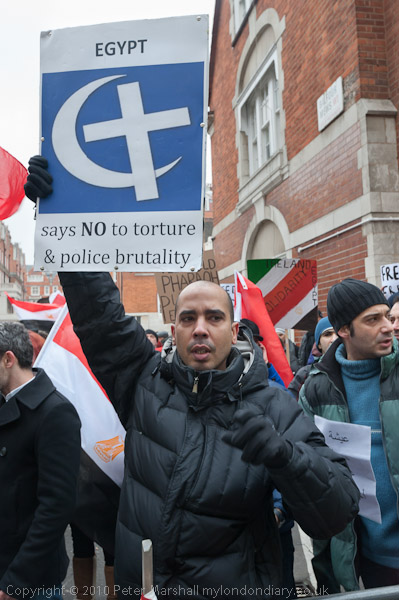
Around 200 people, mainly Egyptians living in the UK had come to the street outside the embassy for peaceful but noisy protest “to show our solidarity & support of our fellow Egyptians in our beloved country, who decided on making Tuesday 25/01/2011 a day of protests & demonstrations in Egypt against the unfair, tyrant, oppressive & corrupt Egyptian regime that has been ruling our country for decades.

Education Cuts & Egyptian Revolution

The protest had brought together Egyptians from differing political & ideological backgrounds, inviting “inviting all supporters of human rights & civic democracy to come & support us in delivering our message to the Egyptian regime.”

Education Cuts & Egyptian Revolution

Their stated goal was to achieve “a democratic, free & civil nation capable of ensuring a dignified, honourable & non-discriminatory life for all Egyptians.

Education Cuts & Egyptian Revolution

Although the Arab uprising in Egypt in 2011 achieved some of its aims, including the end of the 30 year dictatorship of President Hosni Mubarak, it was followed by a struggle with the Muslim Brotherhood gaining power and Mohamed Morsi being elected as president in June 2012 only to be overthrown a few months later and the countrycpoming under the military regime led by Abdel Fattah el-Sissi since 2014.

In an interview with German news organisation DW ten years after the upraising an Egyptian activist commented “The counterrevolution has pushed the country into a state that is even more oppressive than before the 2011 revolution. The uprising has taken a terrible turn and has led to a tremendous regression.”

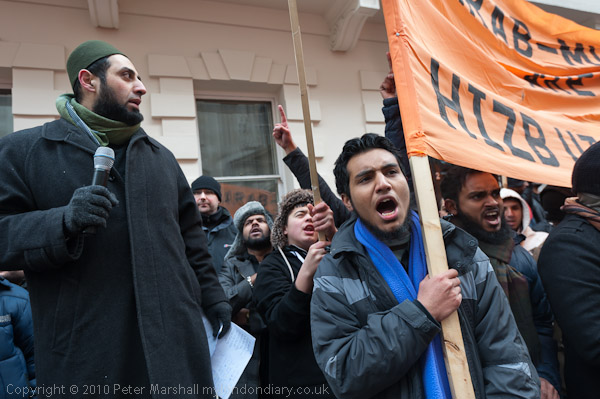
The protesters aimed to bring together people from across a wide range of political viewpoints, they refused to allow Hizb Ut-Tahrir protesters to join them, as they are opposed to human rights and democracy.

More pictures Solidarity with the Egyptian Revolution


Hizb ut-Tahrir Turned Away – South Audley St

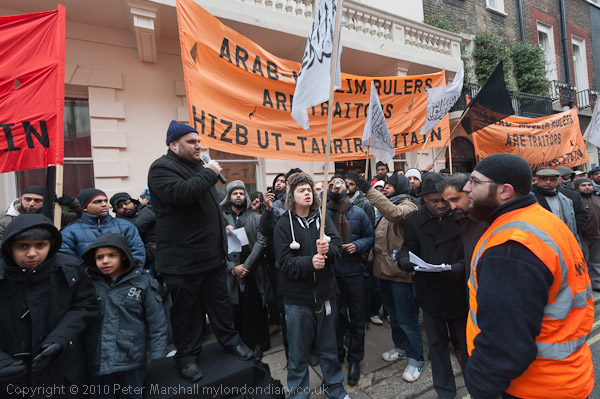
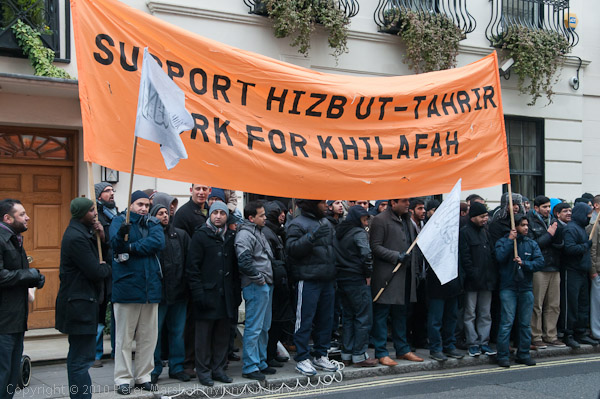
Hizb Ut-Tahrir Britain, an Islamist group calling for the establishment of a Muslim caliphate, marched to the Egyptian Embassy to take part in the protest there but were turned away.

When they arrived they were met by Egyptians taking part in the protest and told very firmly that the embassy protest – like the Egyptian revolution – was to be entirely non-sectarian and that they were not welcome there.

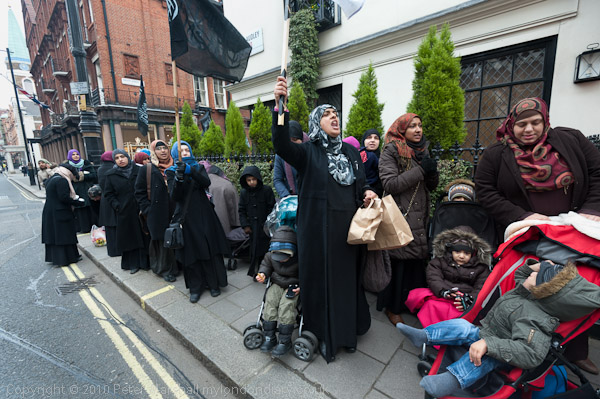
Instead they had to hold their own separate demonstration around a hundred yards away around the corner along South Audley St, where they were spread out along the pavement between South Street and Hill Street.

As always at their events, everyone was dressed in black and the men and women were segregated. The men filled most of the pavement along South Audley St, with just a few women at one end, with most of them around the corner eastwards on South Street, away from the loundspeakers and the embassy.

As I commented it seemed a clear demonstration of the lack of equality they would like to impose. None of the speeches while I was there was in English, but I was able to gather that they were calling for Egypt to come under the rule of an Islamic Khalifah (caliphate), the “real change” which they see as the answer to everything.

It was a call diametrically opposed to the aims of the Egyptian revolution, which aimed to get rid of the oppressive regime and make Egypt a free and democratic nation, a secular state where there is no discrimination based on gender, religion or political views. The last thing they wanted was to replace one repressive regime by another, though depressingly that was what the future held for their country.

Hizb ut-Tahrir Turned Away


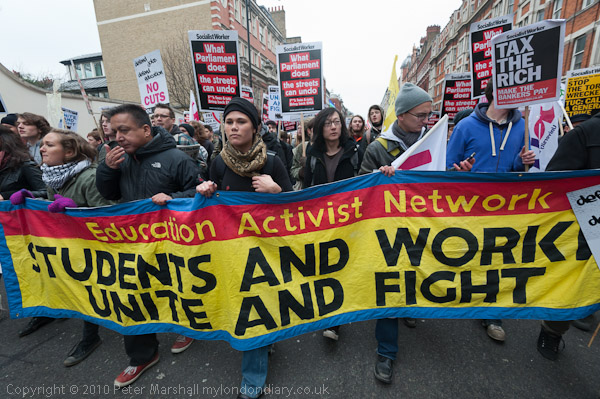
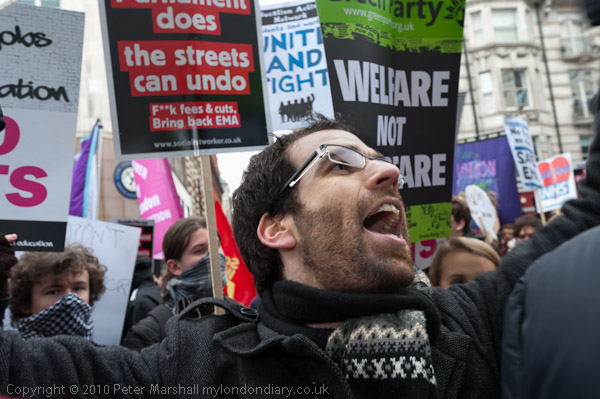
No Fees, No Cuts! Student March

The National Campaign Against Fees and Cuts had organised two large national protests in London and Manchester to defend education and the public sector. They took place a little over two months after another large student march had ended with a small group walking into the Tory HQ at Millbank and occupying it.

On that occasion the police had tried to carry out a brutal eviction and were met with an angry response, with the protesters smashing large plate glass windows to allow others to enter, though few did. A number of protesters and press were injured by police (and a few police injured too), though most of those at the scene simply watched from outside in the courtyard and were appalled when a stupid idiot threw an empty fire extinguisher from the roof and began to chant against him. Fortunately no-one was killed. But the event made the headlines of those media organisations which generally turn their blind eye to protests, though the reports didn’t much engage with the reasons for the protest or report fairly on all that had happened.

Police seemed to have learnt some lessons from their mistakes on that occasion and made much greater efforts to communicate sensibly with the protesters and not to kettle them or push them around. As I wrote “Despite the number of protesters in anarchist dress with facemasks, most students are not out to cause trouble.”

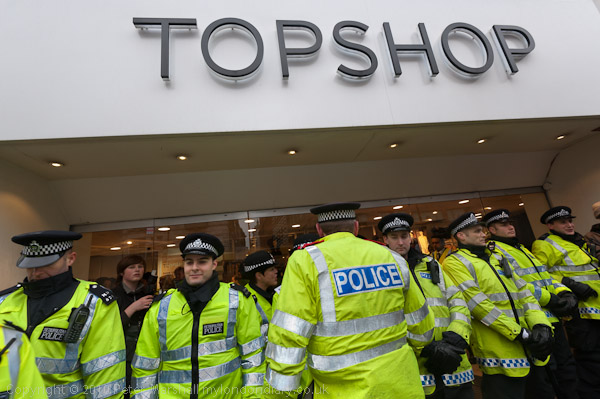
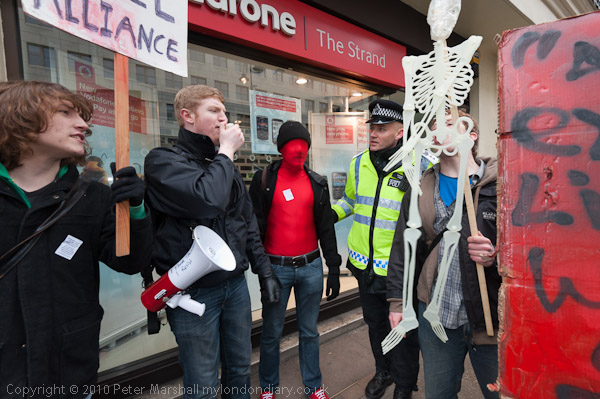
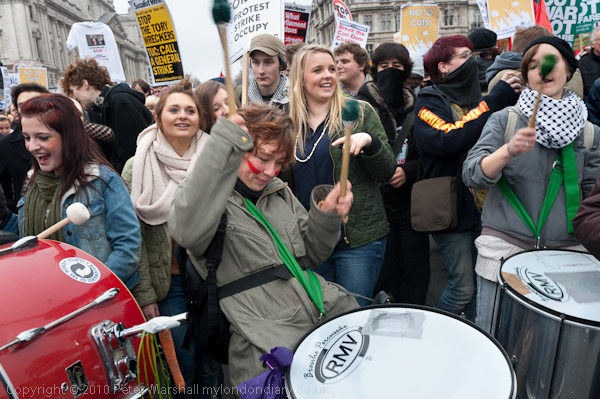
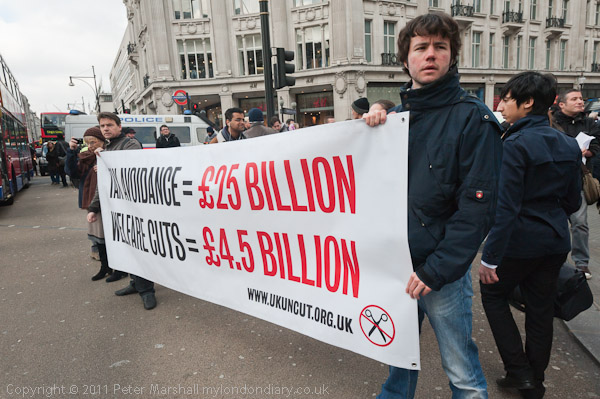
The march had begun with a short rally in Malet Street and I met it as the front was making its way out of Russell Square walking with it and taking pictures of the marchers and of short protests at Topshop and Vodaphone shops in Strand against their tax avoidance. Police lined the front of the shops and soon persuaded the protesters to move on.

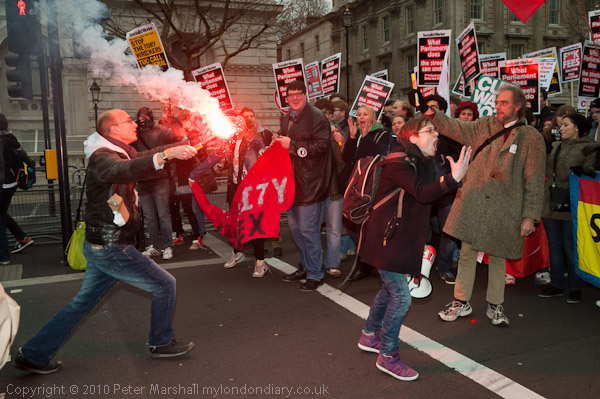
Things livened up a little outside Downing Street were the march paused for some angry shouting and several people let of smoke flares before moving on. Many stopped for a while in Parliament Square, with some dancing to a samba band, but after a while everyone moved off to where the march was to end outside Tate Britain on Millbank.

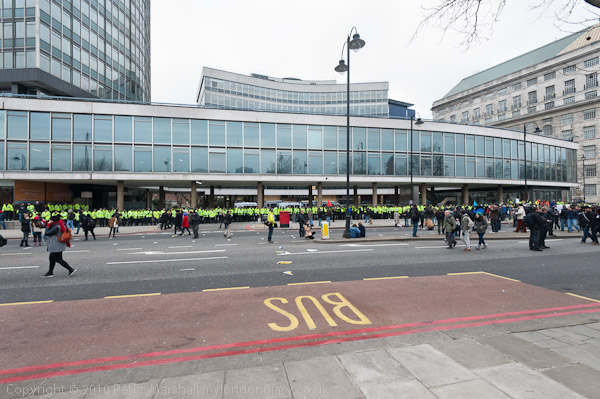
Unlike in the previous November there was a large group of police lined across the entire frontage of the Millbank tower complex – bolting the stable door as I think it unlikely that there would have been any trouble.

The only sign of any conflict between police and protesters I saw did come outside here, when there was a brief sit-down after police tried to drive two vans full of reinforcements through the crowd. Sensibly the police simply brought in a line of officers to allow the vans to drive along the pavement rather than try to force people to move.

By the time I arrived outside Tate Britain with the tail of the march they rally there had ended and I decided it was time to leave, though some of those on the protest were planning to continue elsewhere – including going to the Egyptian Embassy where I had been earlier. Later at home I read reports on-line that half a dozen people had been arrested in minor incidents.


FlickrFacebookMy London DiaryHull PhotosLea ValleyParis
London’s Industrial HeritageLondon Photos

All photographs on this page are copyright © Peter Marshall.
Contact me to buy prints or licence to reproduce.

Disabled Welfare Reform & Syria – 2012

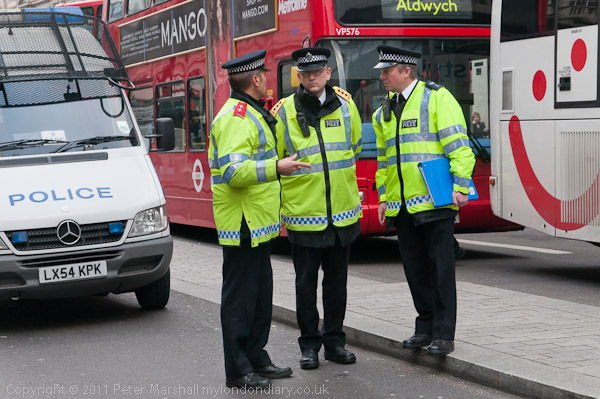
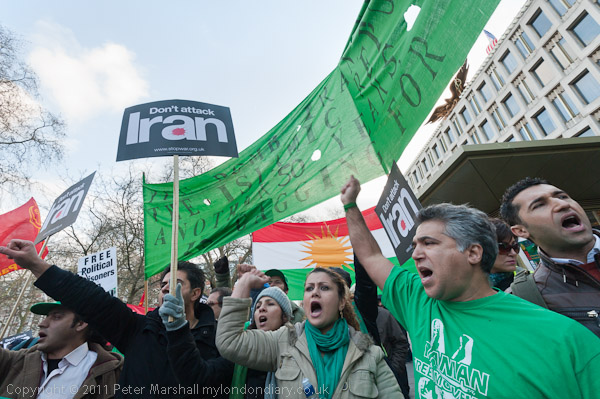
Disabled Welfare Reform & Syria: On Saturday 28th January 2012 I photographed two major protests in London, with disabled protesters calling for the dropping of the Welfare Reform Bill and later several groups of protesters outside the US Embassy in Grosvenor Square arguing for various reasons against US or Western Intervention in Iran or Syria.


Disabled Welfare Reform Road Block – Oxford Circus

Disabled Welfare Reform & Syria - 2012

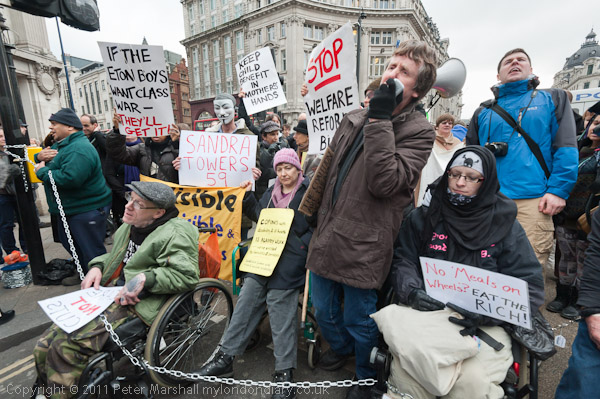
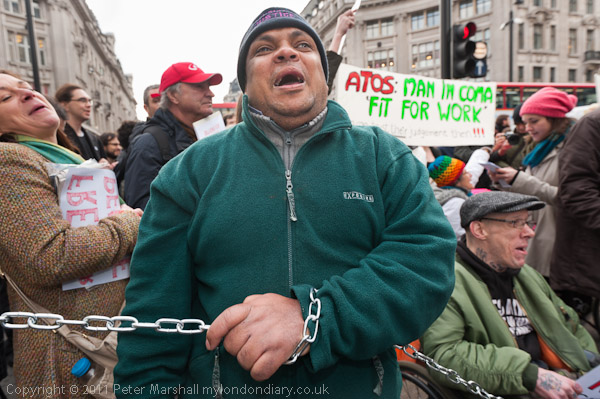
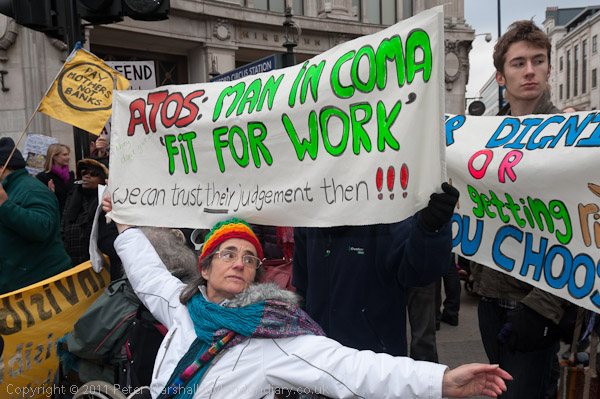
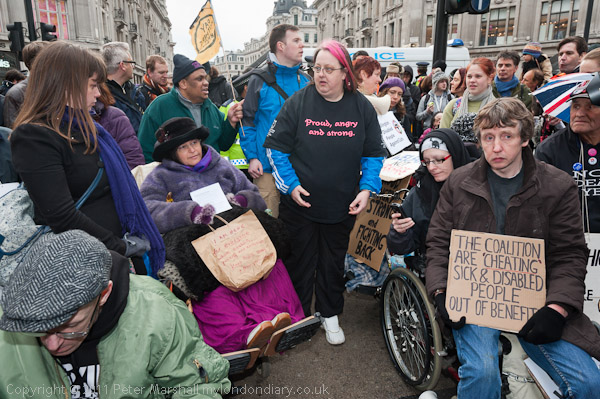
Disabled People Against Cuts, DPAC, protested at Oxford Circus, chaining wheelchairs together & calling for the dropping of Welfare Reform Bill, urging savings cutting tax evasion by the rich rather than penalising the poor and disabled.

Disabled Welfare Reform & Syria - 2012

I met with some of the protesters outside Holborn Station and others who had arrived by taxi at Great Portland Street. I’m not sure why they had chosen these two meeting points as they are both – like most Central London stations – without step-free access. London Underground has been painfully slow in providing disabled access.

Disabled Welfare Reform & Syria - 2012

I went with them from Great Portland Street to Oxford Circus where they met up with others who had just begun to block the road, going in a line across the end of Regent Street when the lights changed to allow pedestrians to cross and passing a chain through their wheelchairs which they locked to posts on each side.

Disabled Welfare Reform & Syria - 2012

Others walked on the road with placards and banners to support them, but there were enough police in the area to enable them to stop the protesters blocking Oxford Street.

Selma James speaking

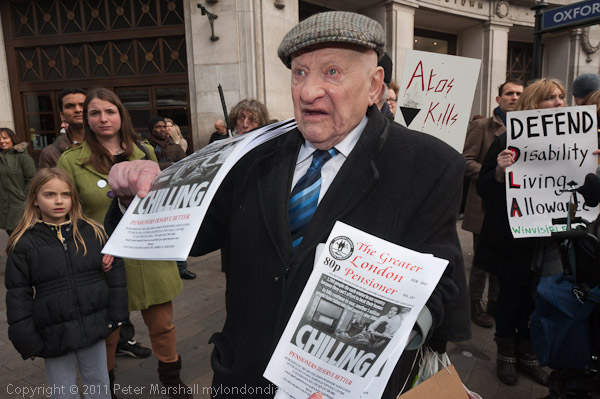
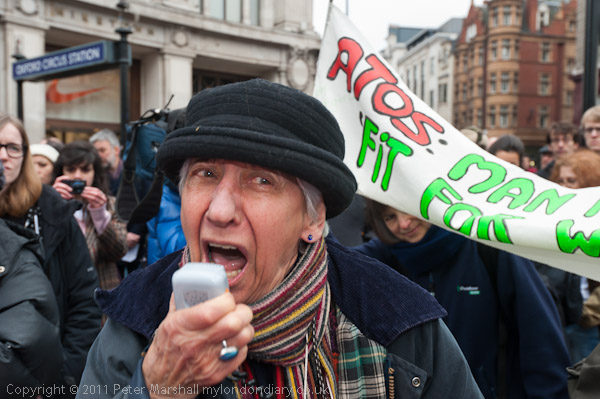
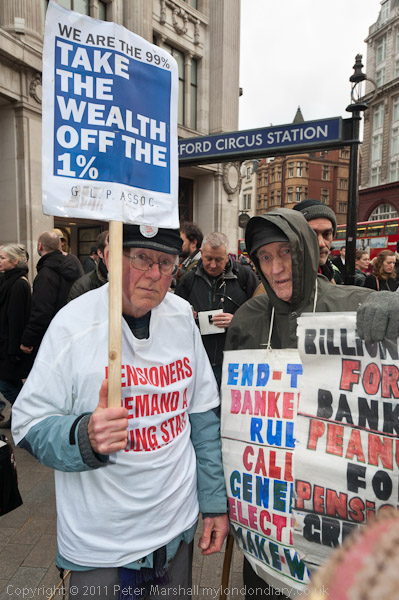
Among groups supporting DPAC’s protest were UK Uncut, the Greater London Pensioners and the women’s groups from the Crossroads Centre in north London who had brought their public address system.

Shortly after the street band Rhythms of Resistance turned up and added their sounds to the protest.

Police had quickly managed to divert traffic on streets to get around the protest and were having discussions about how to handle the protest. A FIT team had arrived to photograph everyone (press included) and TSG officers were standing nearby with bolt cutters. But arresting people in wheelchairs is difficult as police need to supply suitable safe transport.

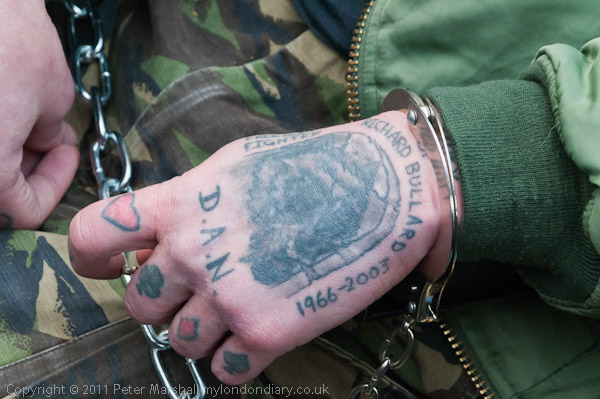
Eventually the officer in charge read out a statement telling the protesters their presence on the road is breaking the law – as of course they knew. He and other officers then went to ask the protesters if they would move. They didn’t and some got out their own handcuffs to handcuff themselves to the chain.

Police kept smiling and talking to the protesters, waiting for them to leave rather than trying to move or arrest them. Eventually after about an hour and a half they did so, having decided they had made their point successfully and it was time to pack up. Probably too nature was beginning to call!

The protest attracted a great deal of coverage in the press for the campaign, while earlier efforts to get their arguments against the bill including earlier less active protests have received very little publicity.

More pictures at Disabled Welfare Reform Road Block.


No War Against Iran & Syria – US Embassy

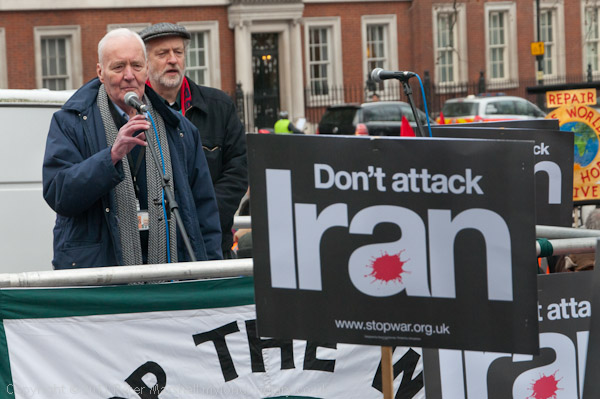
Tony Benn started the speeches. Jeremy Corbyn waits to speak

I’d left a few minutes before the DPAC protest ended to walk to the US Embassy in Grosvenor Square where Stop the War were holding a protest against sanctions and war on Iran and Syria.

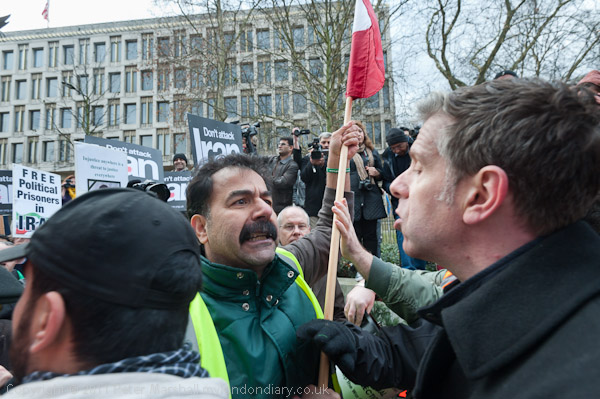
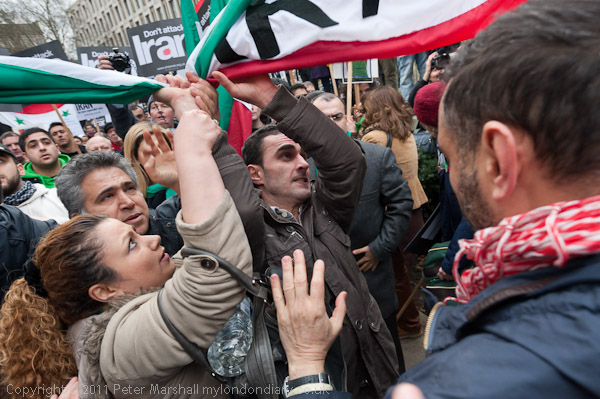
When I arrived I found a very confusing situation with several groups of protesters and some noisy heckling with scuffles with the Stop the War stewards.

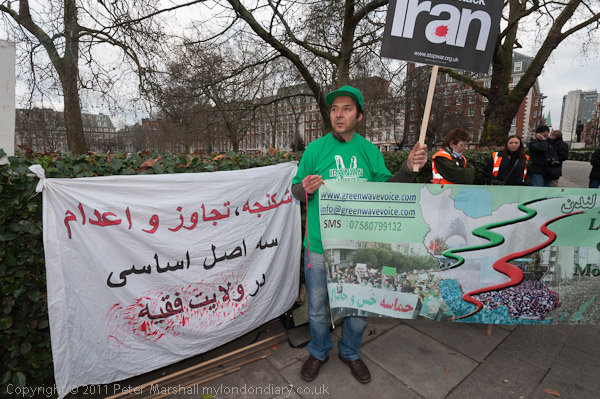
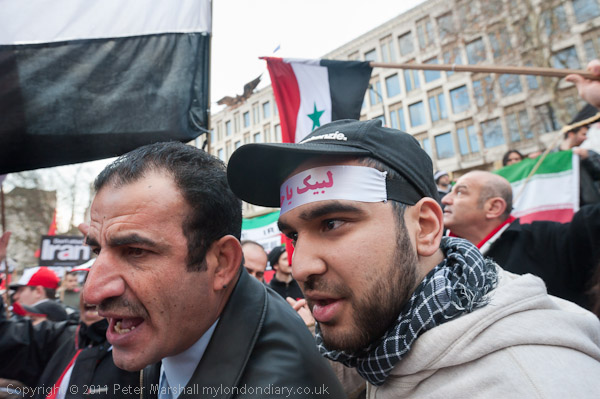
I think everyone there was against US or Western Intervention in Iran or Syria, but some noisy protests which came to a head while Abbas Eddalat of the Campaign Against Sanctions and Military Intervention in Iran was speaking, from protesters representing the Free Iran ‘Green Movement’ who wanted to make a clear statement of their opposition to the current Iranian regime with its religious bigotry and persecution.

The stewards first tried to argue with them but soon became physical, pushing them roughly away from the protest. Supporters of the Iranian regime joined in along with supporters of Syrian President Asad.

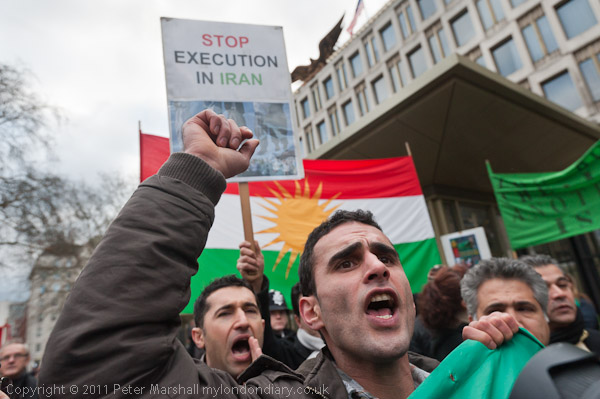
Police seemed bewildered as they tried to sort out the various groups – and there were also some Kurds with a large Iraqi Kurdistan flag.

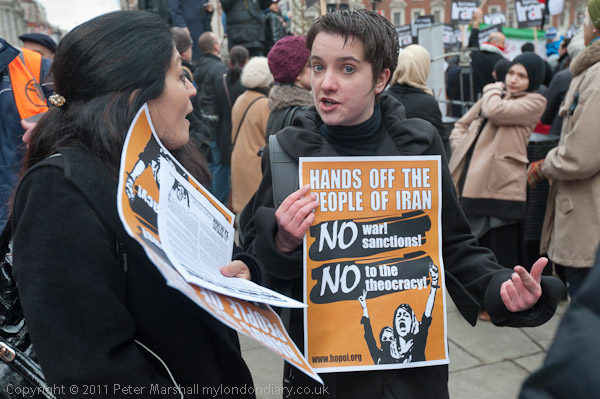
Eventually the Free Iran protesters were persuaded to hold their own separate protest a few yards away in front of the embassy, though some of them rejoined the Stop the War protest later. Another group, Hands Off the People of Iran were also present and handing out leaflets, against Stop the War which has favoured links with supporters of the regimes in both Syria and Iran.

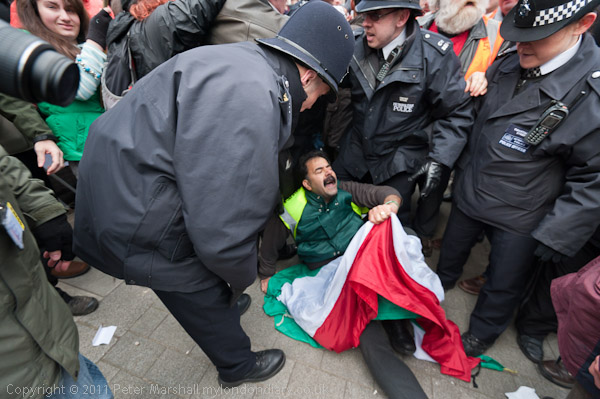
Police briefly held one young man who was wearing the current Iraqi flag but then released him, with a police officer trying to prevent press taking pictures, saying “He has a right to privacy” – which clearly as I told the officer he has not under UK law when protesting on the public street.

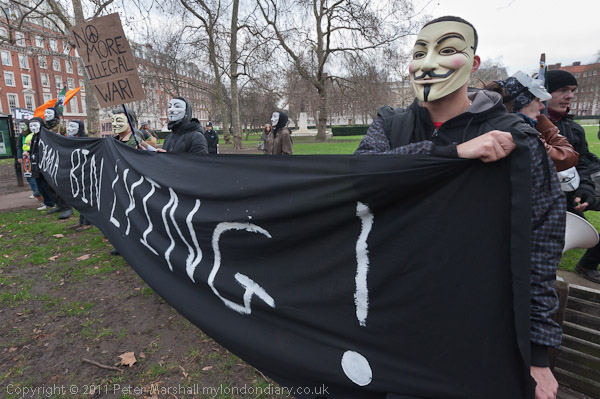
Then there were ‘Anonymous’ in their ‘V for Vendetta’ masks protesting on the other side of the hedge around the gardens to the main protest, and later Stop the War stewards again sprung into action to stop the free expression of dissent when pro-Asad Syrians began their own protest.

Various speakers including Tony Benn, Lindsey German, John McDonnell and others made a clear case against any Western intervention at the main rally – and I give some of their arguments on My London Diary.

More at No War Against Iran & Syria.


FlickrFacebookMy London DiaryHull PhotosLea ValleyParis
London’s Industrial HeritageLondon Photos

All photographs on this page are copyright © Peter Marshall.
Contact me to buy prints or licence to reproduce.

No To Arms Fair At Twickenham

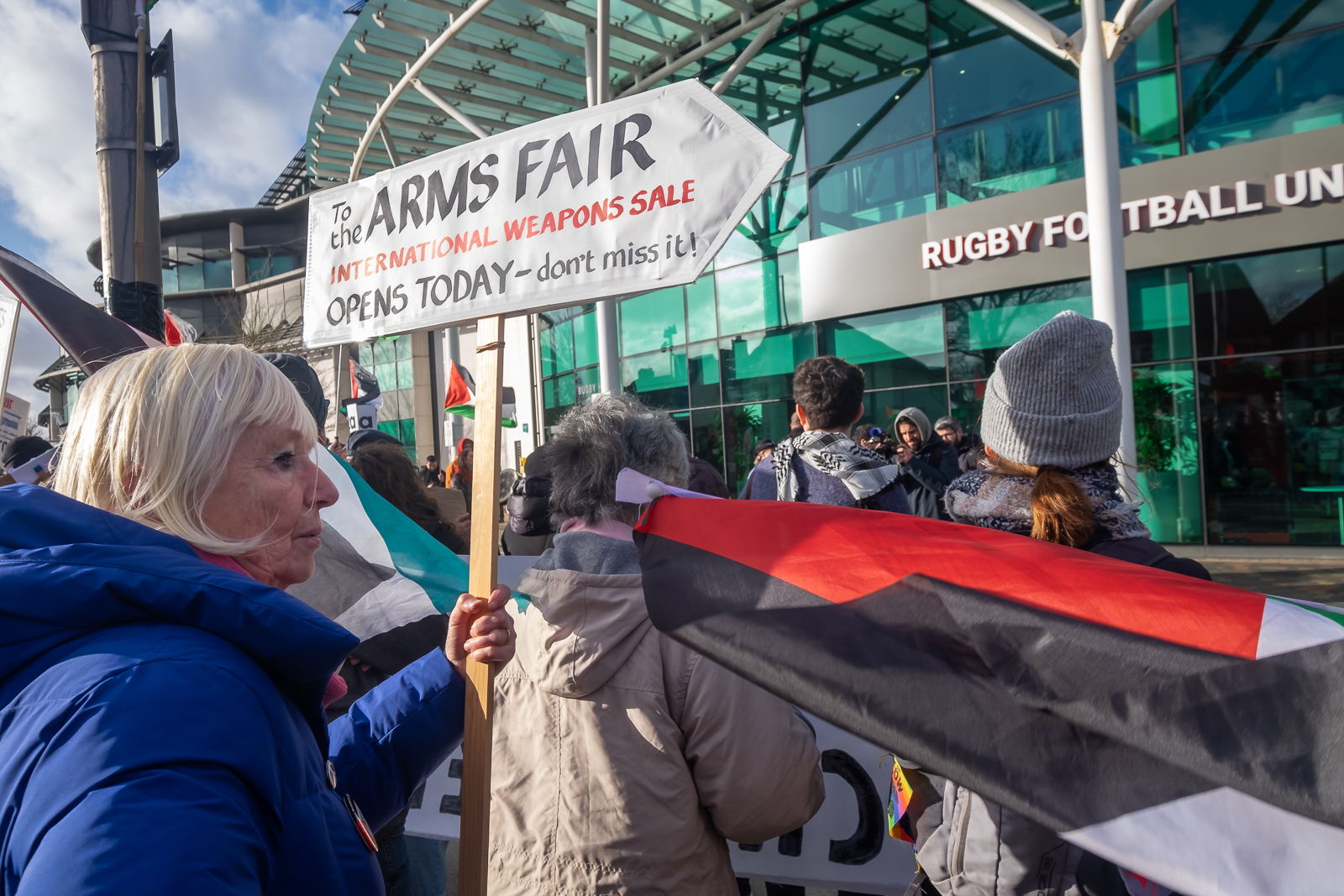
No To Arms Fair At Twickenham: This Monday, 22nd January 2024, Richmond & Kingston Palestine Solidarity Campaign organised their third annual protest at Twickenham Rugby Stadium which was hosting the International Armoured Vehicles Fair for the third year in a row from 22-25th January. The arms fair claims to be the largest of its type in the world, attracting around a thousand delegates from over 40 nations,

I came to the bus stop outside Twickenham Station to find several people clearly on their way to the stadium, and found more on the bus when it arrived – the bus more or less emptied when we arrived at the stop in front of the stadium. We walked across the road and joined a hundred or so who had already come to protest.

I had to leave after around an hour for a meeting, and people were still arriving to the protest which had another couple of hours to run. This was a considerably larger protest than in the two previous years having become more important because many of the companies selling weapons inside are suppliers of weapons which are being used now to kill Palestinians in Gaza.

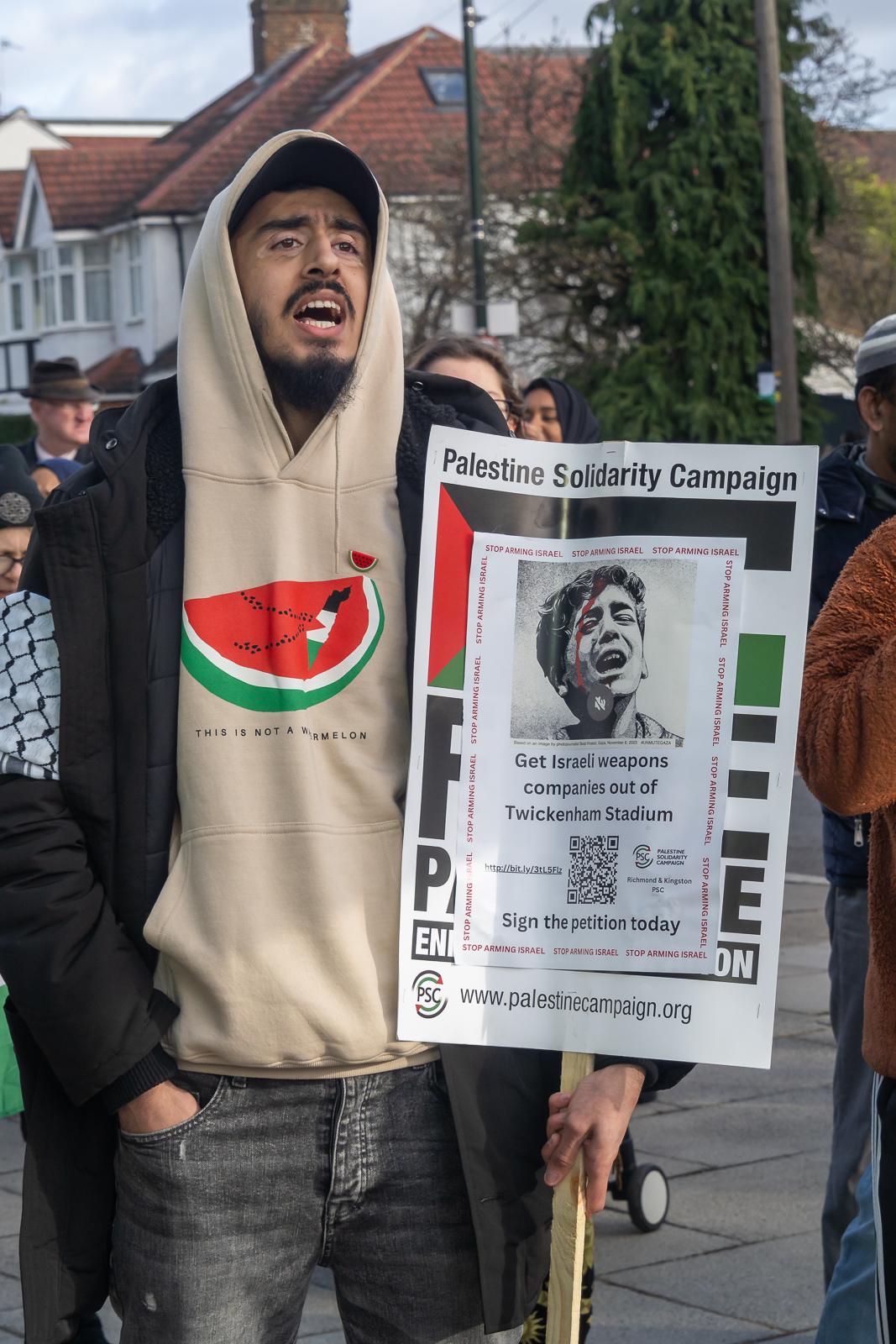
Richmond & Kingston Palestine Solidarity Campaign is an active local group campaigning for the rights of Palestinians, justice and freedom against Israeli occupation and apartheid. Their numbers at this protest were swelled by others who had come from other areas of London to tell the Rugby Football Union to stop hosting arms fairs. As well as the International Armoured Vehicles Fair this week they are also hosting the International Military Helicopter conference from 27th to 29th February 2024.

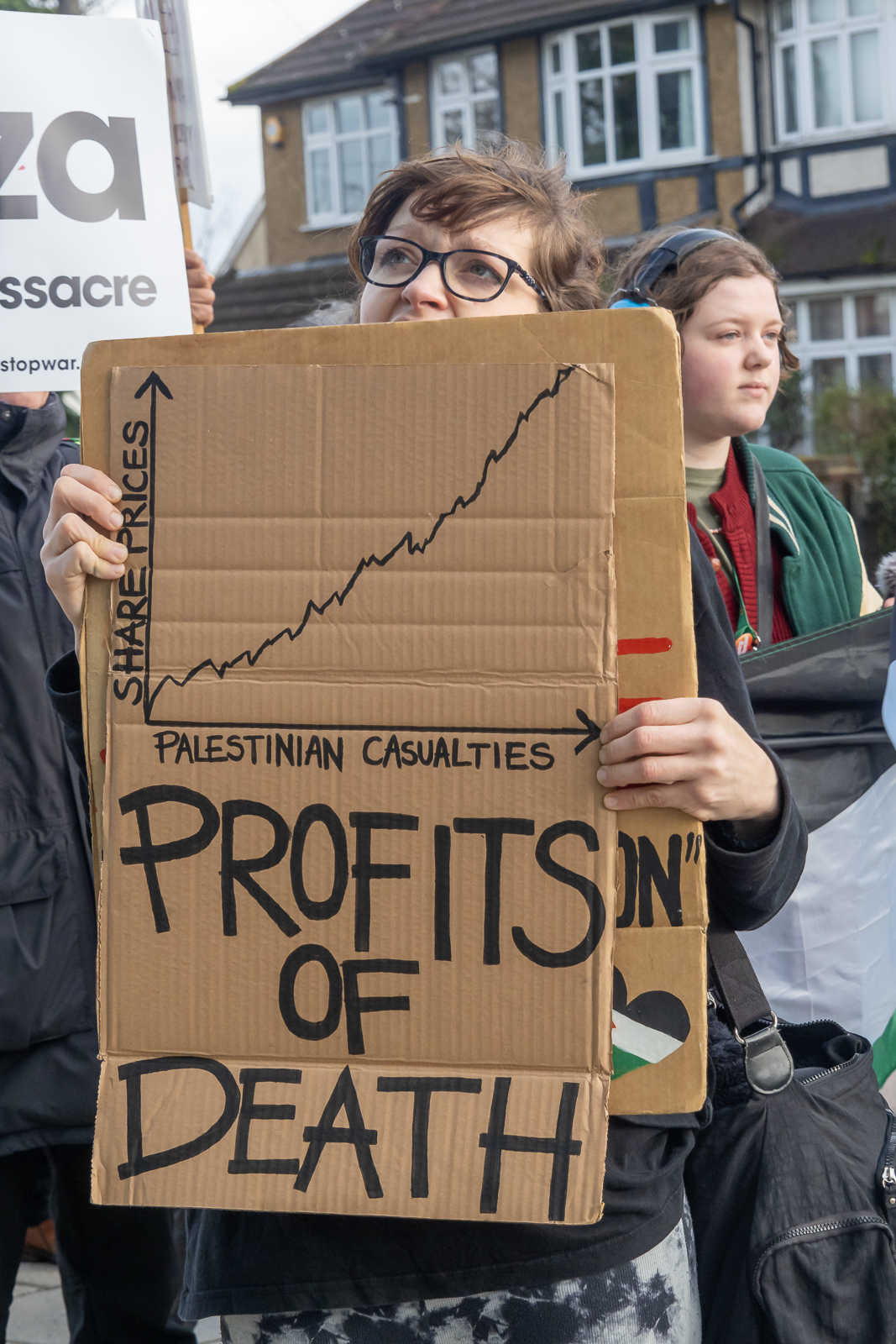
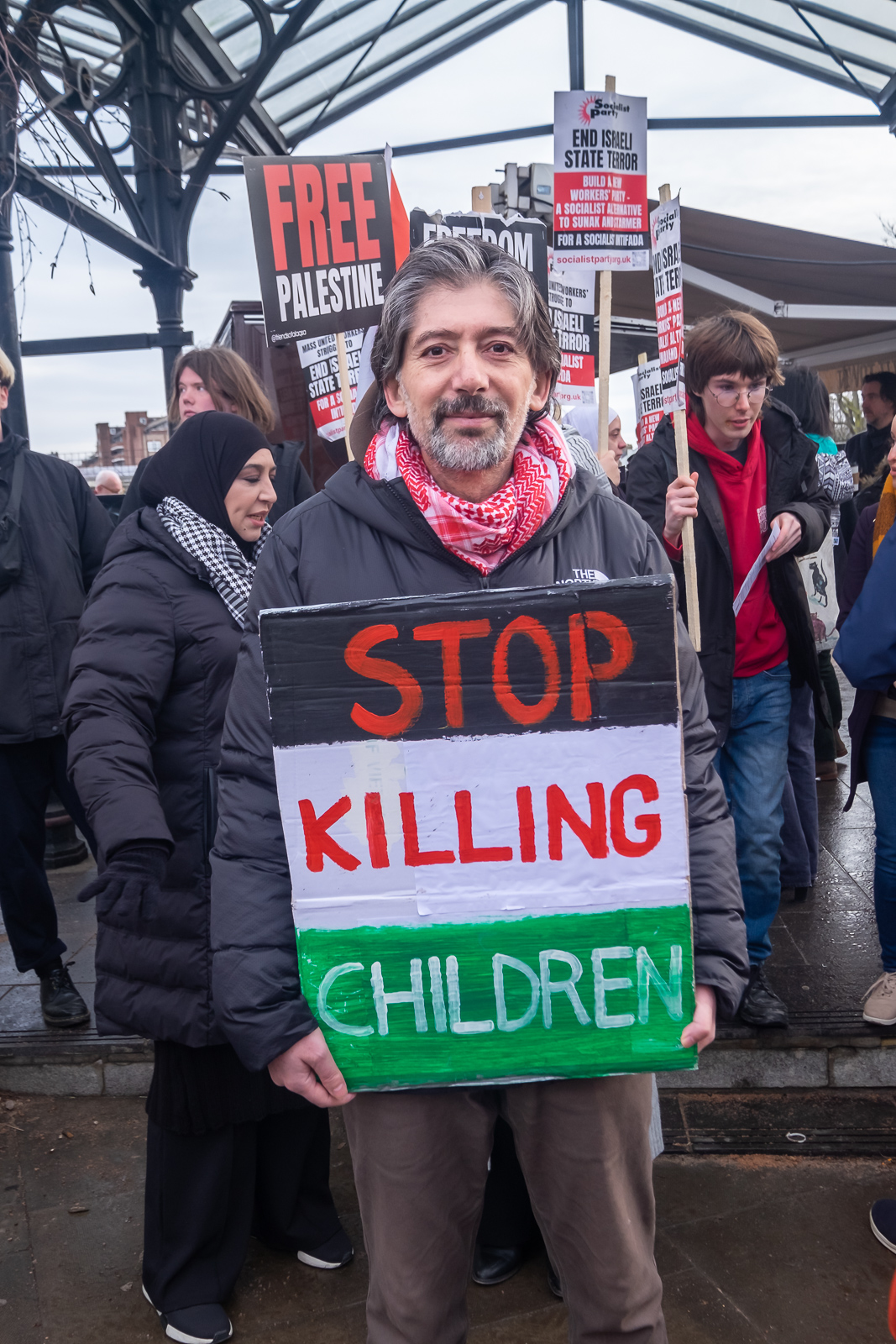
Many of the posters and placards at the protest called for an end to the Israeli genocide taking place in Gaza now, and there were others more specific to Twickenham, calling for fair play and an end to the promotion of killing by the Rugby authorities.

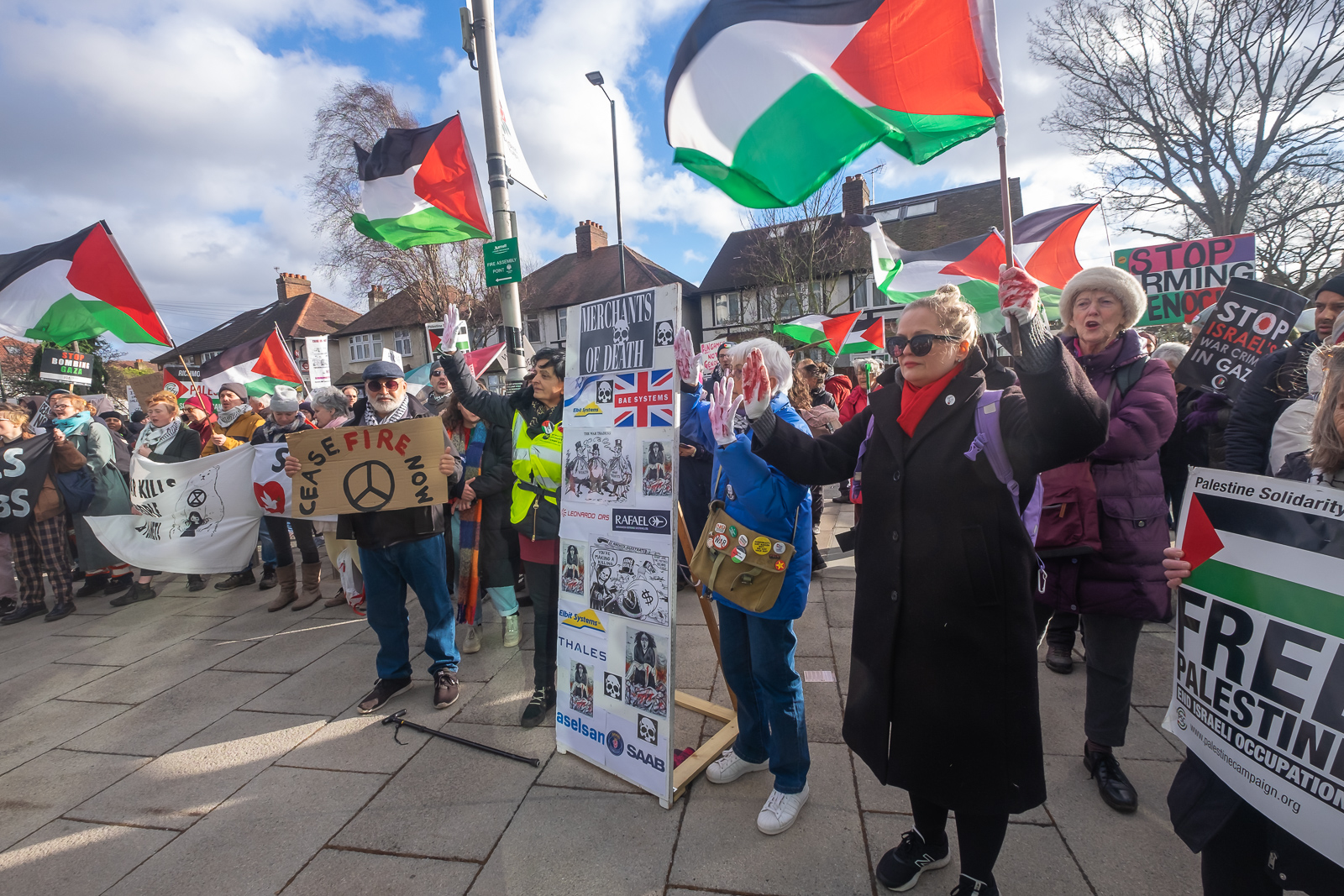
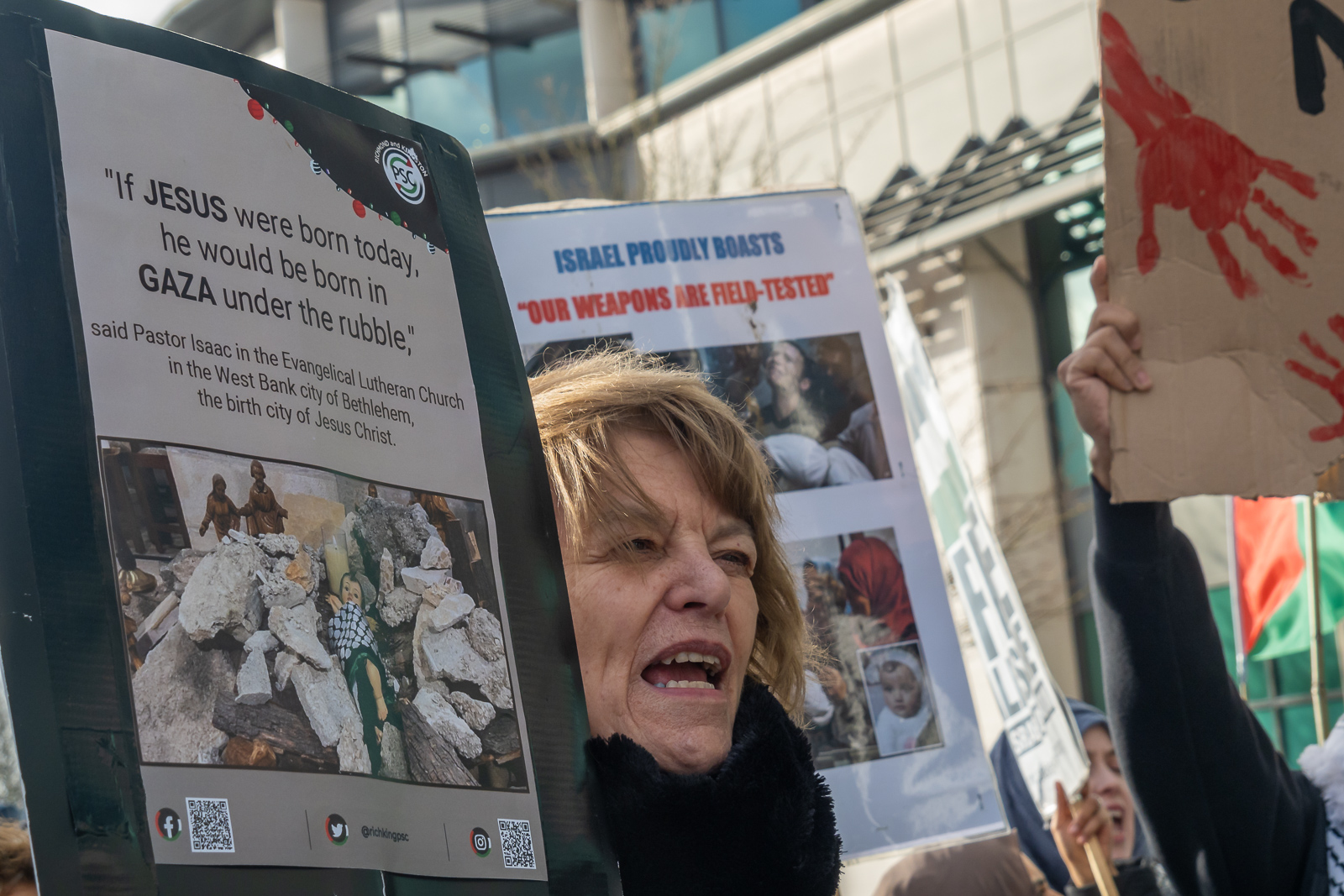
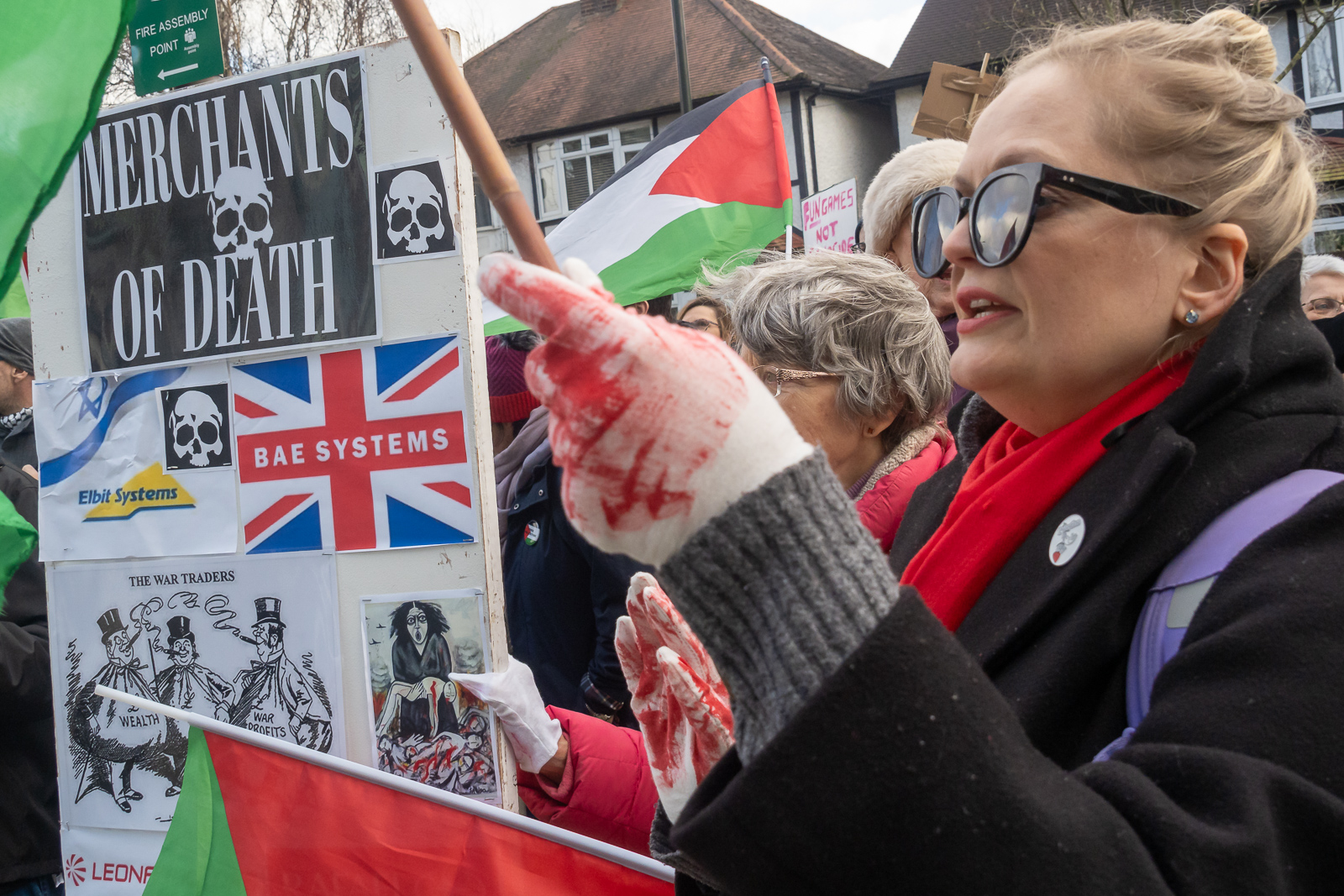
At the centre of the protest was a large poster with the heading ‘MERCHANTS OF DEATH’ naming companies taking part in the arms fair, including BAE Systems, Elbit Systems and Thales, with cartoons of arms dealers making vast profits from war. Most of the companies involved supply Israel with armoured vehicles and other weapons used in its devastating assault on Gaza and used to repress, terrorise, abduct and kill civilians and children in Palestine as well as in Saudi Arabia, Egypt, Yemen and elsewhere around the world. And as some posters and speakers reminded us, Israeli arms manufacturers proudly boast ‘OUR WEAPONS ARE FIELD-TESTED’ – on Palestinians in the killing fields of Gaza and the West Bank.

Standing around the poster were members of Richmond & Kingston PSC, holding up their hands in white gloves stained with fake blood, with one holding a Palestinian flag. Others held posters and banners, ‘CEASEFIRE NOW’, ‘WAR KILLS PEOPLE & PLANET’, ‘STOP BOMBING CHLDREN’

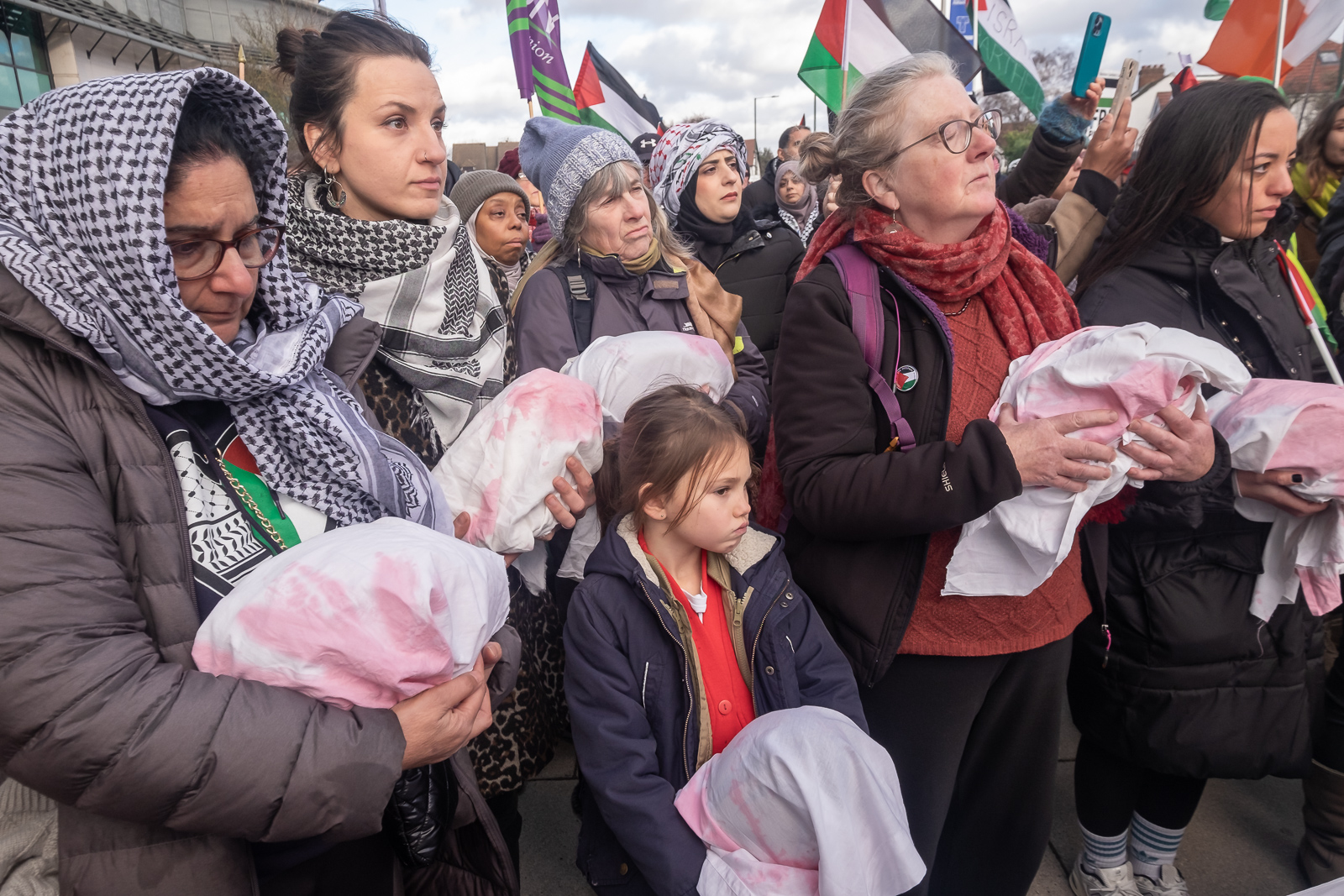
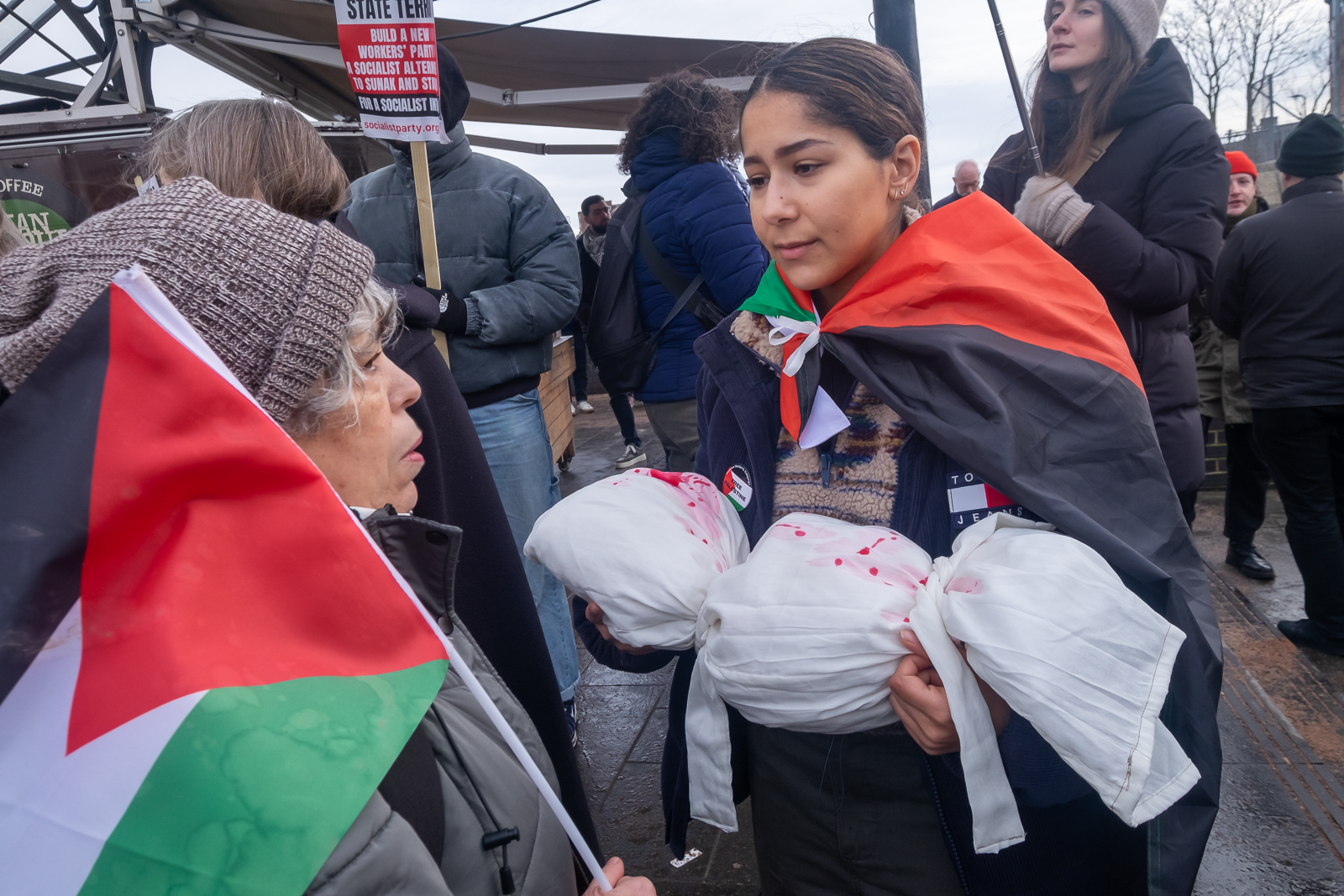
Shortly before I had to leave a group arrived carrying cloth bundles stained with red dye, representing the children killed by the Israeli attacks. A report by Save The Children from Ramallah on 11th January began with the following:

More than 10,000 children have been killed by Israeli airstrikes and ground operations in Gaza in nearly 100 days of violence, according to the Ministry of Health in Gaza, with thousands more missing, presumed buried under rubble, Save the Children said.

Save The Children

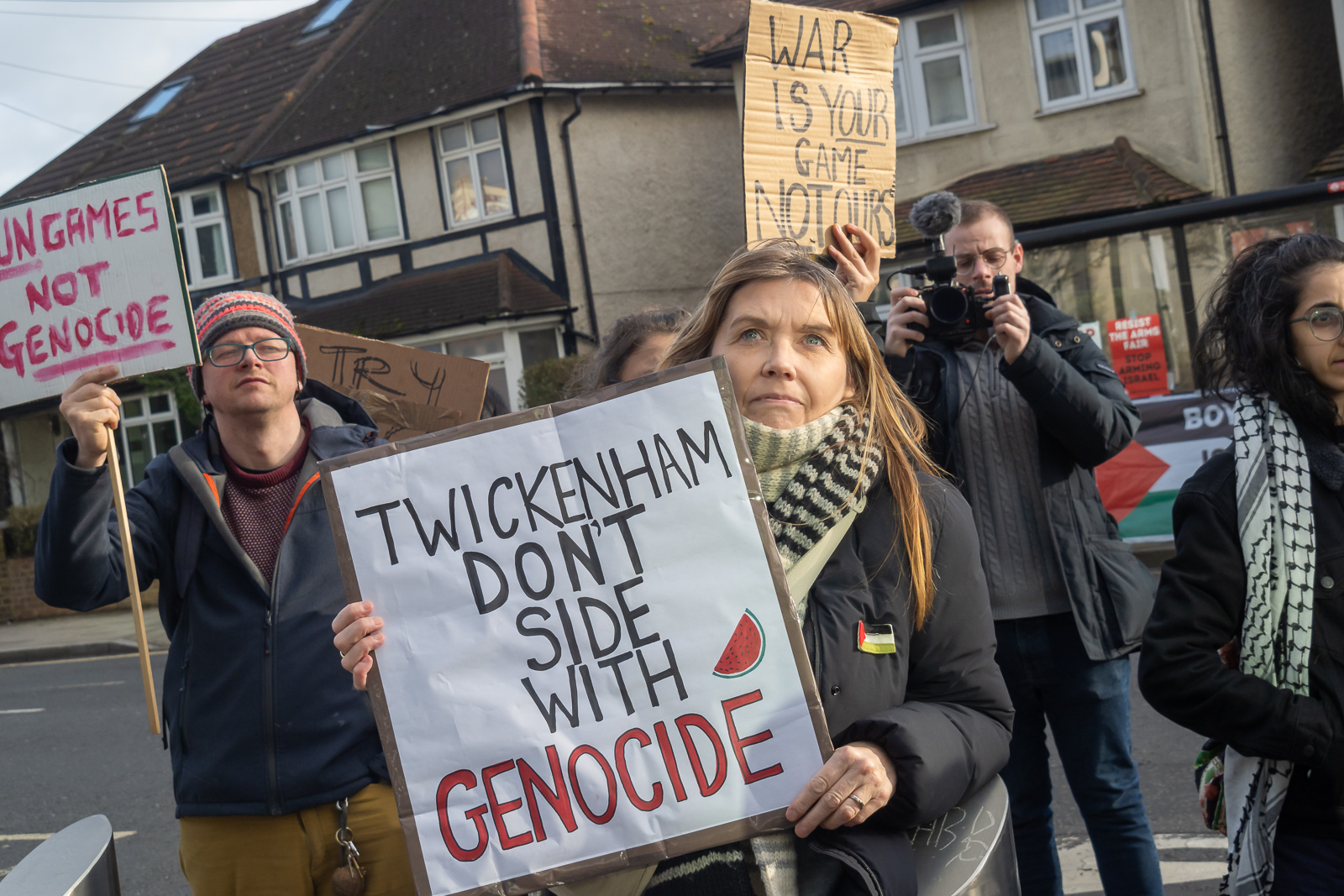
By now the number will be many more. As one poster stated: ‘TWICKENHAM DON’T SIDE WITH GENOCIDE’.
More pictures

London Gaza Marches & End Guantanamo – 20 Jan 2024

London Gaza Marches and End Guantanamo: Last Saturday, 20th January 2024 the main protest against the ongoing genocide by Israel against Gaza was taking place in Birmingham, but there were half a dozen local events around London, and I decided to photographed some of these, as well as a protest calling for the closure of Guantanamo, 22 years after the first prisoners were taken there to be tortured.

Rail engineering works made it much slower than normal for me to get up to London and back and I abandoned plans to go to some of the events and I was only able to pay a fleeting visit to the Camden march because this was meeting at Kentish Town tube station which has been closed since last Summer for extensive refurbishment.


Gaza Ceasefire March, Camden, London, UK

London Gaza Marches and End Guantanamo
London, UK. 20 Dec 2024. A woman holds a blood-stained bundle representing a dead child. Protesters met at Kentish Town to march to a rally outside Camden Council offices on a day of local actions for Palestine as rage grows over the ever-increasing death toll. Genocidal Israeli attacks have killed over 22,000, mainly women and children, with many bodies still hidden over the rubble. Almost the entire medical capacity has been destroyed with many medical staff killed or arrested and hospitals bombed and almost the entire population of Gaza displaced and in danger of famine and disease. Peter Marshall
I took the tube to Camden Town and just missed a bus going up to Kentish Town. The stop had an electronic display that told me I would have to wait 6 minutes for the next and I decided to walk. It turned out to be a little further than I had remembered – almost a mile and the bus would have been rather quicker. People at Kentish Town were waiting for others to arrive before they started and also expected some to join them on the over two mile route to the rally.

London Gaza Marches and End Guantanamo

I had expected the march to have left, and to meet it coming down the road, but it had not yet moved off. After a few minutes of taking pictures I realised I would be too late back in central London unless I left, and caught a bus to Mornington Crescent and the tube to Charing Cross. Camden Town tube is always crowded with tourists and it takes a long time to get down to the platforms.

More pictures: Gaza Ceasefire March, Camden


Close Guantanamo – 22 Years of Injustice Must End

London Gaza Marches and End Guantanamo
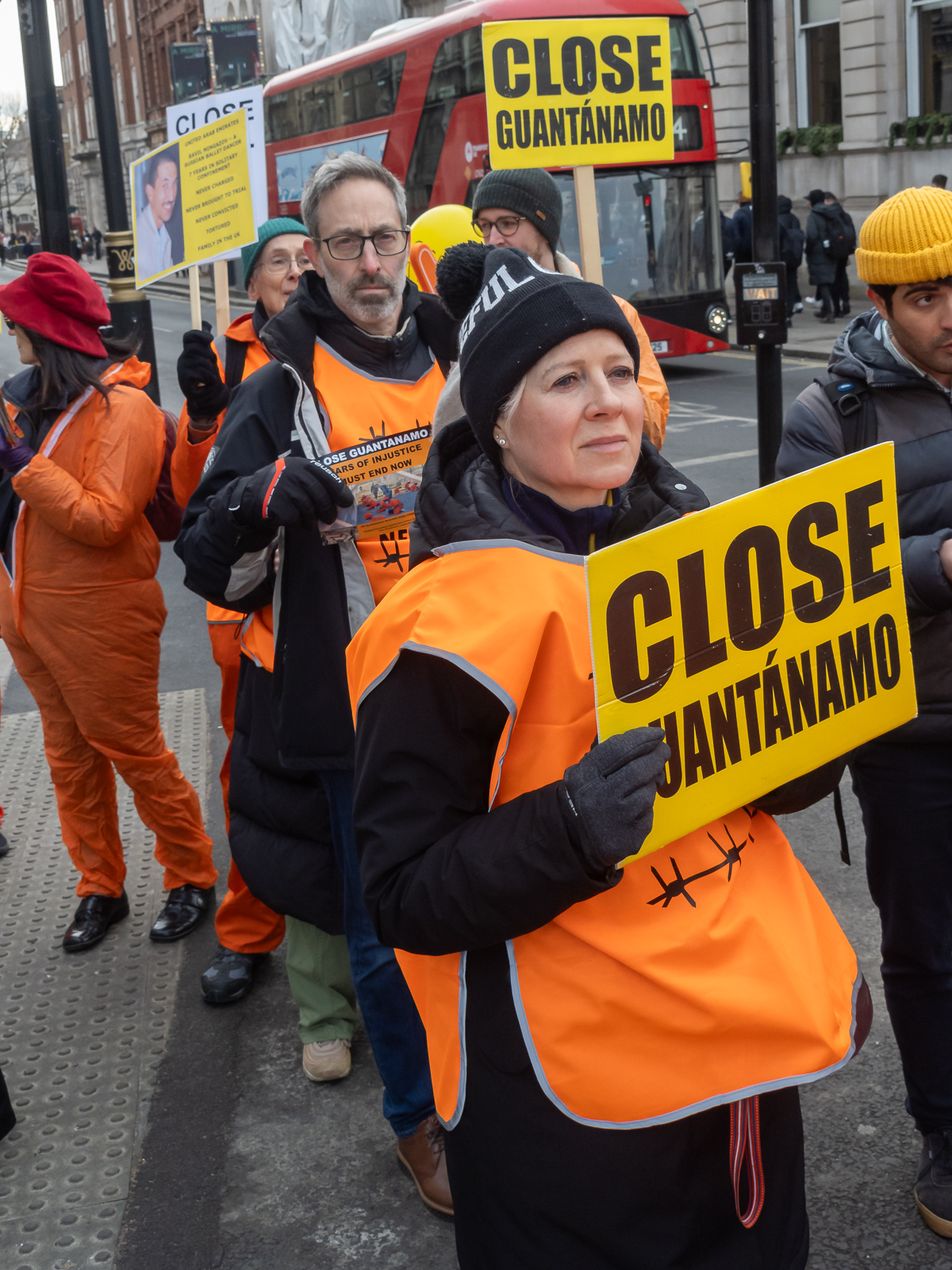
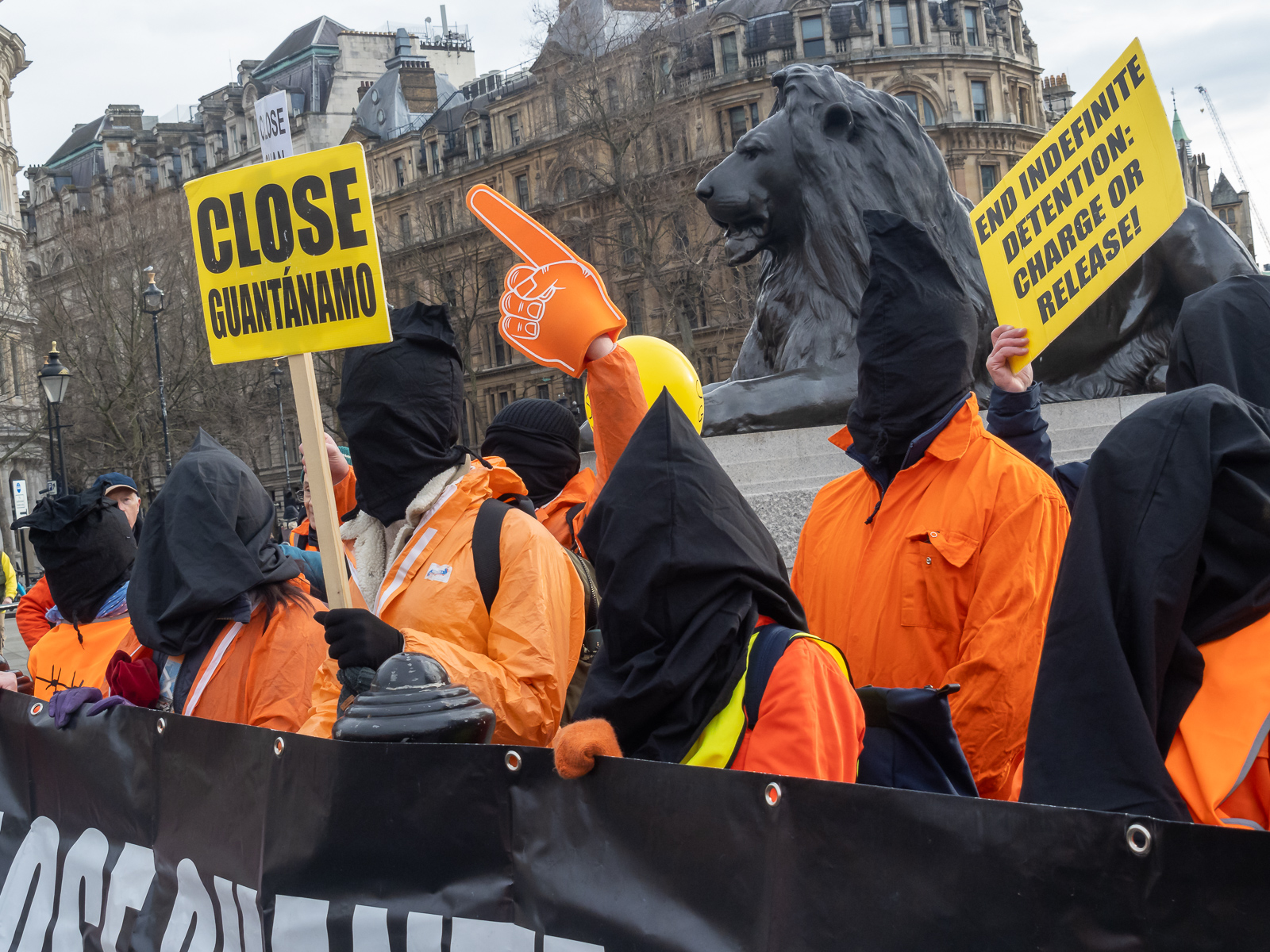
London, UK. 20 Jan 2024. Members of the UK Guantanamo Network walked from Parlament past Downing Street in single file wearing orange jumpsuits 22 years after the arrival of the first prisoners at the illegal US camp to a rally in Trafalgar Square. They highlight the abuse, torture, lack of human rights, force-feeding and indefinite detention there and call for its closure. 30 Prisoners are still held there. Peter Marshall

I came out of Charing Cross Station and met the group of marchers wearing orange Guantanamo-style jumpsuits just coming up to the traffic crossing at the top of Whitehall. The protest was organised by the UK Guantanamo Network which includes Amnesty International, Freedom From Torture, Guantanamo Justice Campaign, Close Guantanamo and the London Guantanamo Campaign. They had met in Old Palace Yard opposite the House of Lords and changed into the jump suits there before proceeding in single file around Parliament Square and up Parliament Street and Whitehall to Downing Street and were now coming up Whitehall for a long rally in Trafalgar Square.

London Gaza Marches and End Guantanamo

They demand US President Biden should act rapidly to close Guantanamo, where a total of over 800 prisoners were illegally tortured over they years, the great majority of them having no connection at all with terrorism. Most have since been allowed to return home or to safe countries, but 30 remain held there, although half of them have been cleared for release. “The Guantanamo network calls for Guantanamo to be closed and for an end to depriving people of their legal and human rights, and an end to indefinite detention and torture.”

I left after taking pictures before the rally began as I was already late for the start of the final event I wanted to photograph in Tower Hamlets.

More pictures at Close Guantanamo – 22 Years of Injustice Must End


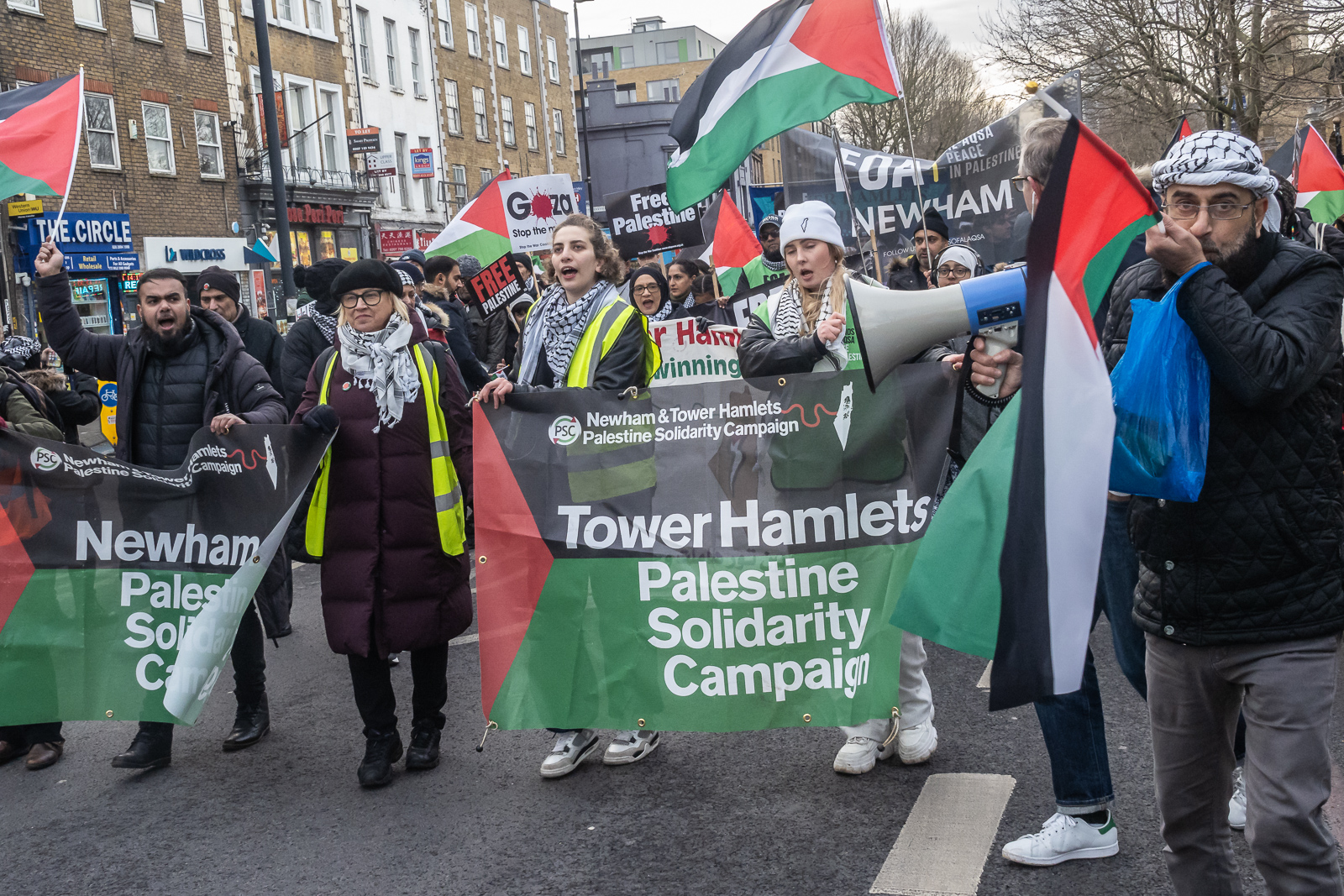
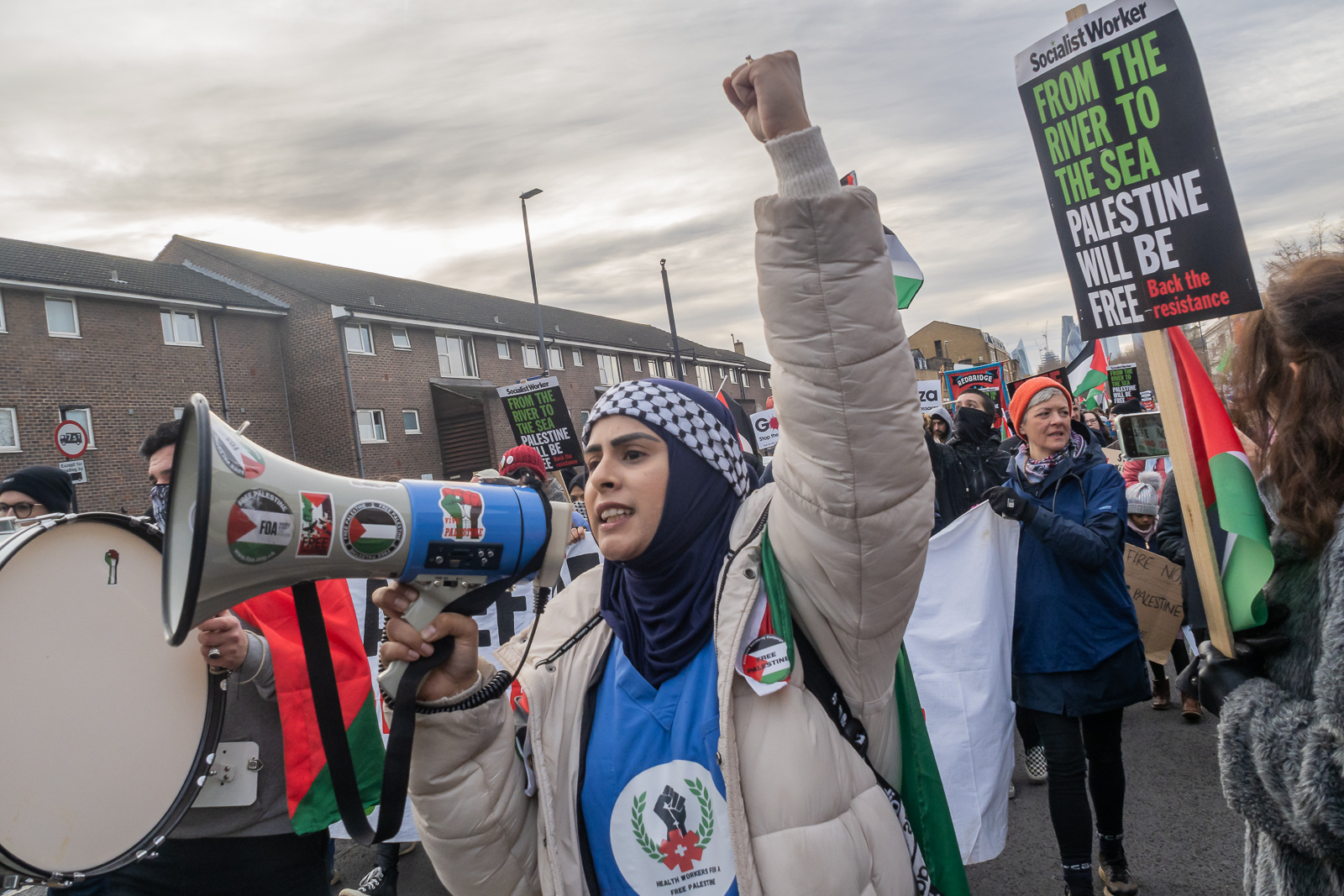
Gaza Ceasefire March, Tower Hamlets, London, UK

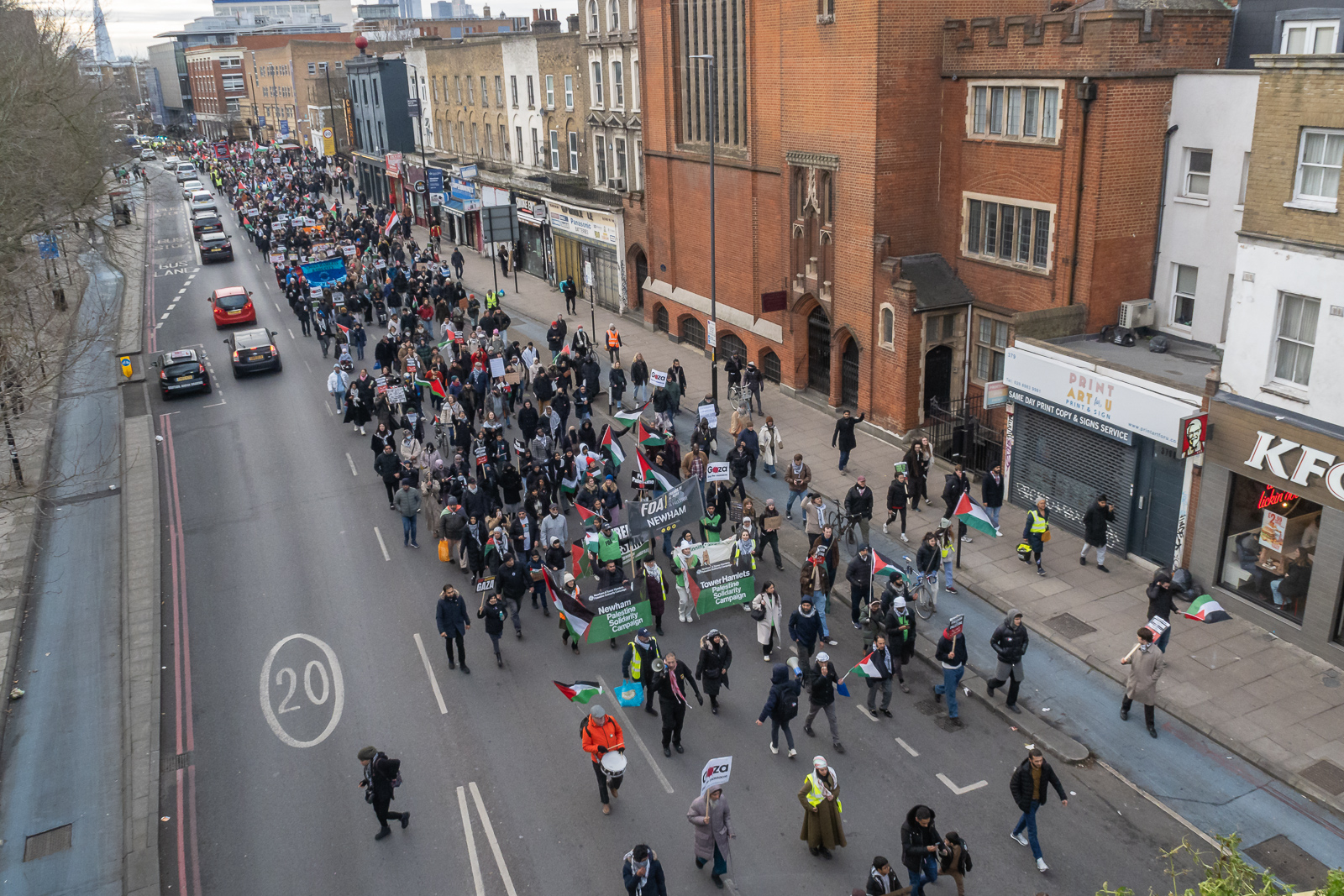
London, UK. 20 Dec 2024. Front of the march. Over a thousand marched from Whitechapel to a rally at Mile End on a day of local actions for Palestine as rage grows over the ever-increasing death toll. Genocidal Israeli attacks have killed over 22,000, mainly women and children, with many bodies still hidden over the rubble. Almost the entire medical capacity has been destroyed with many medical staff killed or arrested and hospitals bombed and almost the entire population of Gaza displaced and in danger of famine and disease. Peter Marshall

I sat on the District Line going east trying to guess where the Tower Hamlets march might have got to as I was too late for the start. Marchers had met in Altab Ali Park in Whitechapel, close to Aldgate East Station but was marching through Whitehchapel and Stepney to Mile End. I looked at the time and took a guess about when they would have started to march and how far they would have got, and decided to leave the train at Stepney Green station.

Fortunately my guess had proved correct and as I looked down the Mile End Road towards Whitechapel I could see the front of the march in the distance and walked down to meet and photograph it. I walked with the marchers going back and forth and taking pictures over the last mile or so. When we got close to the Green Bridge which takes Mile End Park across the busy road. I left it a little late and had to run up the steps to be able to photograph the front of the march and its long tail behind as it came up to the bridge.

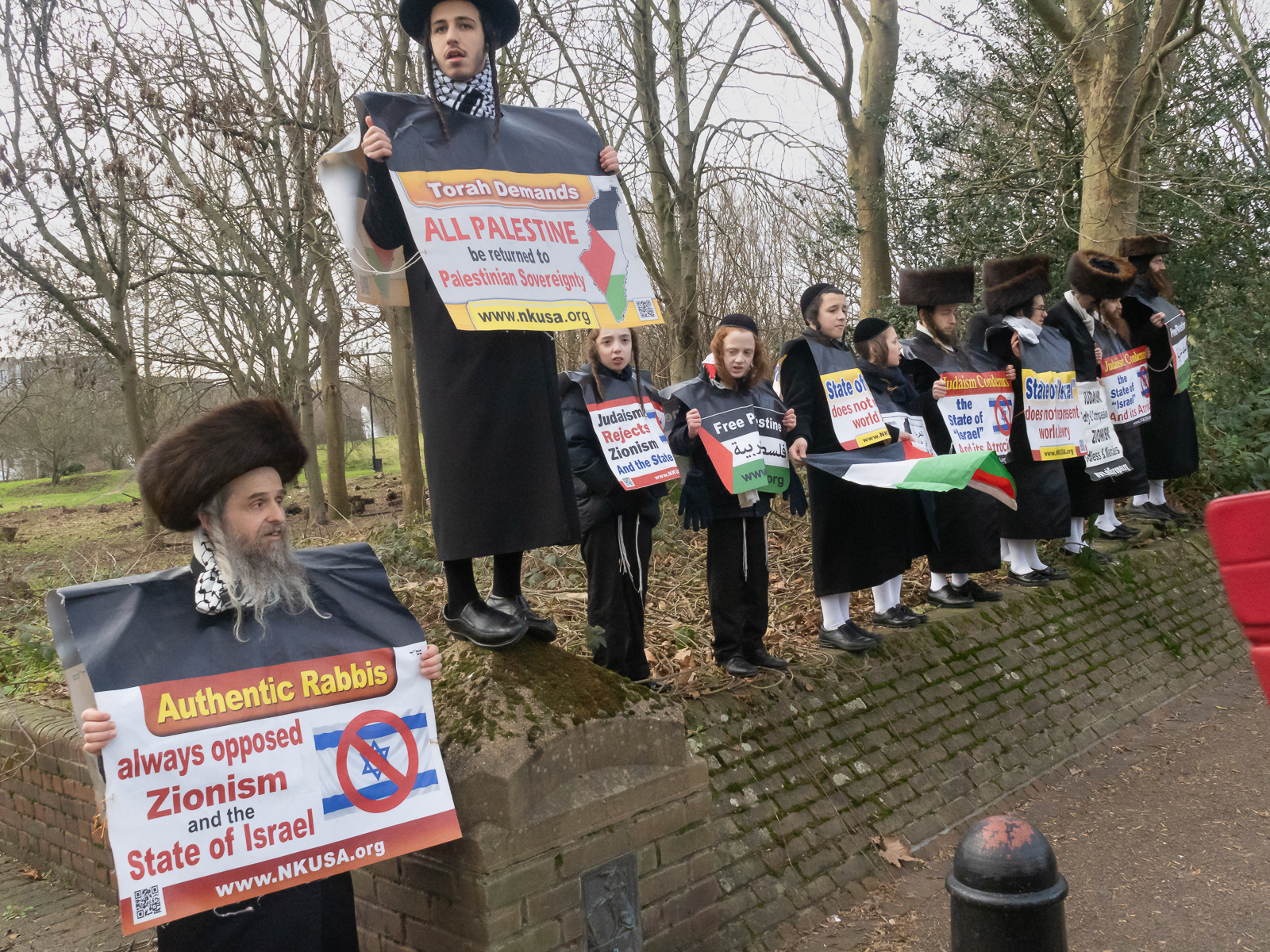
Then I came down and walked with them the final short stretch to the large area of Mile End Park where the rally was being held. I’d photographed the ultra-Orthodox, Neturei Karta anti-Zionist Jews earlier as they were taking part in the march and took some more pictures when a group of them stood on the wall at the entrance to the park.

I took some photographs as the rally started and heard the first of the speakers. The rally was interrupted by a speaker from Movement for Justice using their own megaphones. He complained that they had been refused permission to speak at the event. Stewards argued that he was disrupting the meeting. As I left there were some discussions taking place over whether he might be allowed to make an announcement to the rally. But I was tired and had a long journey home, so I left.

More pictures: Gaza Ceasefire March & Rally


FlickrFacebookMy London DiaryHull PhotosLea ValleyParis
London’s Industrial HeritageLondon Photos

All photographs on this page are copyright © Peter Marshall.
Contact me to buy prints or licence to reproduce.