Save Our NHS

The past year has made all of us appreciate both what a great national asset our National Health Service is and also – unless we are blinkered Tories – to realise how much it has been run down as a deliberate Conservative policy ever since the Tories came into power in 2010. Though of course its problems also come from decisions taken by earlier governments, and in particular the disastrous PFI contracts taken out under New Labour which involve huge and continuing debt repayments by parts of the NHS.
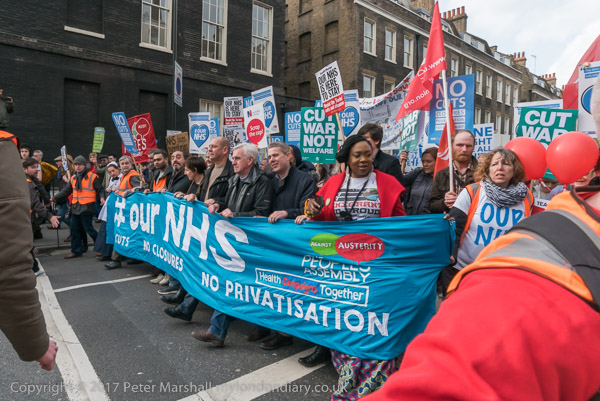
Even the Tories have come to realise that the NHS reorganisation under Andrew Lansley’s 2012 Health and Social Care Act were a mistake, although the fine print of their 2021 White Paper makes clear that they are still – as in 2017 when I photographed this ‘Save Our NHS’ march – pursuing their goal of rapid stealthy privatisation with medical services increasingly being run for private profit rather than public benefit, threatening an increasingly under funded public service which delivers high quality service at low cost and remains the envy of the world.
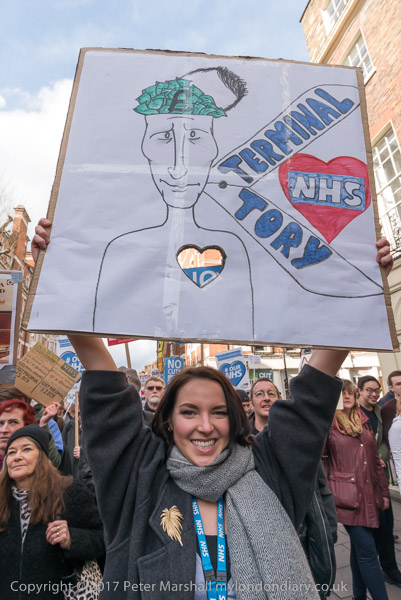
This privatisation is continuing. Last month it was announced that Operose Health Ltd, a UK subsidiary of one of the larger US health insurance companies, is taking over AT Medics, which runs 49 General Practice surgeries across London, with around 370,000 Londoners registered at them. When the takeover was finalised on 10th Feb, the six GPs who had been the directors of AP Medics resigned and were replaced by Operose staff – who include two who had in previous years held high-level positions in NHS England, a public body of the Department of Health set up to oversee the commissioning side of the NHS under that 2012 Act.
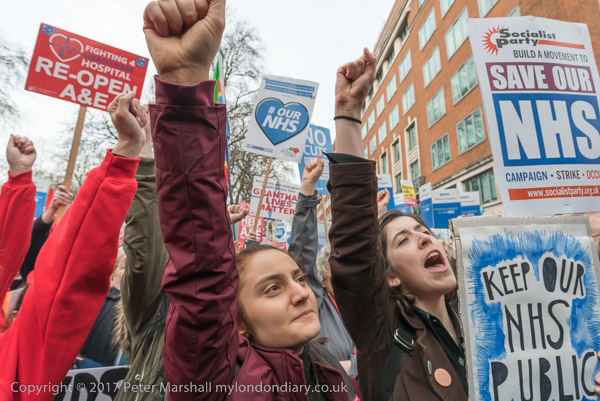
The Save our NHS March on March 4th, 2017 pointed out that the Sustainability and Transformation Plans which NHS organisations and local authorities were made to produce as 5 year plans from 2016-21, intended to counteract some of the worst effects of the 2012 Act, were leading to cuts in services and hospital closure and had already caused many premature deaths. They are a part of the rapid stealthy privatisation with medical services increasingly being run for private profit rather than public benefit, threatening an increasingly under funded public service which delivers high quality service at low cost and remains the envy of the world.
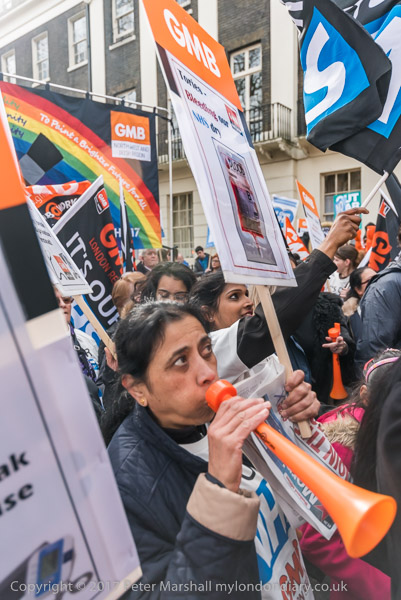
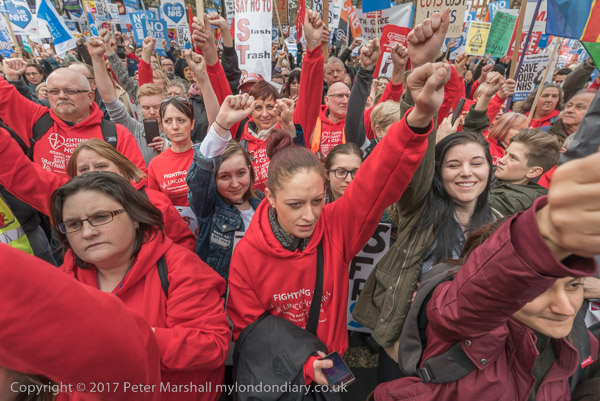
It was a large march, and made up largely of those who work in various parts of the NHS and have clear view of the actual consequences of the effects of government actions, and many of them spoke before the march set off. Most medical professionals do the work they do through a strong sense of vocation rather than being motivated by money, and as we have seen over the past year, many have worked long over their paid hours, and often with inadequate personal protection because of decisions taken to lower the stocks of supplies and the cuts in beds, the cutting of support for the training of nurses, changes to contracts for junior doctors and other measures.
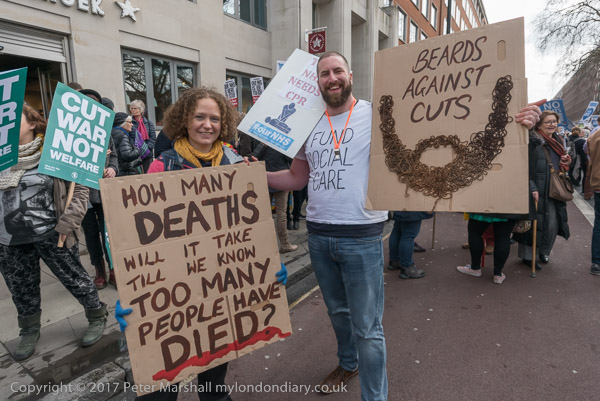
Looking at the faces in these pictures – and I took many more on the day – I wonder how many of them have died because of their dedication to their job of saving our lives. I wonder how many are suffering the prolonged debilitating effects of ‘long covid’, how many mental illness because of a year of working under extreme stress.
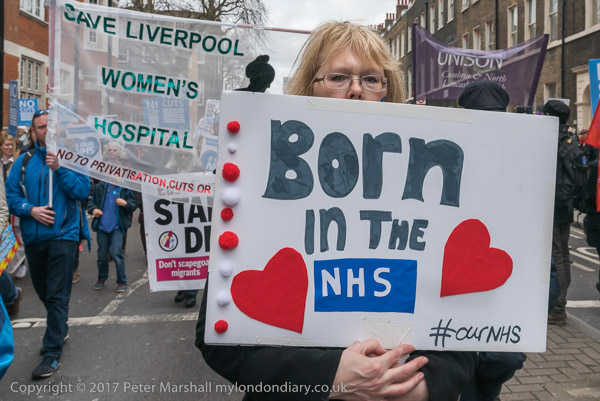
Some carried signs ‘Born in the NHS’. I wasn’t but I grew up with it and it was there when I needed it, and still is. Others carried that quote attributed to Aneurin Bevan, though he probably never said it,”The NHS will last as long as there are folk left with the faith to fight for it.” There were perhaps 50,000 on this march showing they were ready to do so.
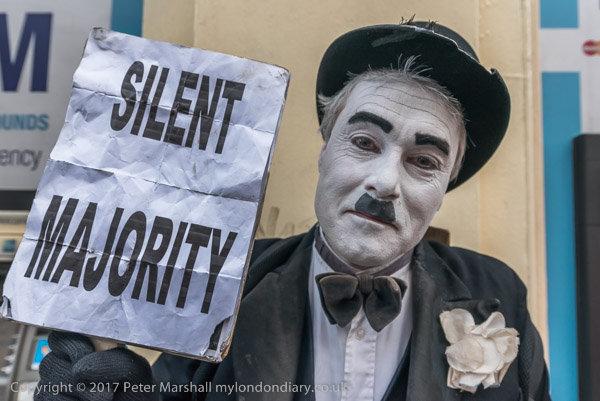
More pictures in My London Diary: Save our NHS March


All photographs on this and my other sites, unless otherwise stated, are taken by and copyright of Peter Marshall, and are available for reproduction or can be bought as prints.
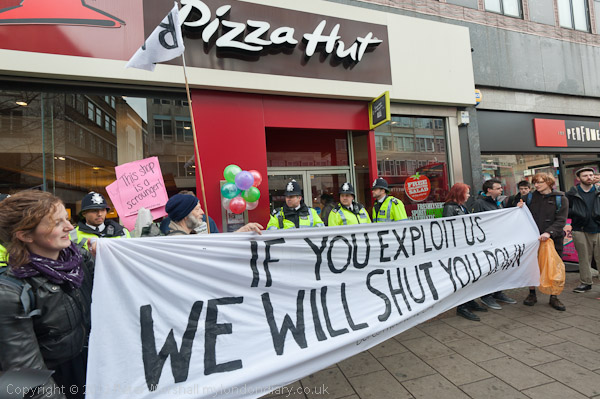
End Workfare & more – 3rd March 2012

Workfare is a controversial policy first begun in the UK in the 1990s by the Conservative government of John Major, although it developed from earlier schemes which put active pressure on claimants to seek work. Under various different programmes and names workfare continued under New Labour, but it was under the Tory-led coalition in 2011-2 that it came into widespread use.

Workfare is used to describe schemes where in order to receive unemployment benefit people have to undertake unpaid work, either in the commercial or public sector or for charities. In 2011 the coalition government announced that those who had failed to find jobs after being unemployed for some time would have to work unpaid for 30 hours a week for six months, setting up a number of schemes to this end.

THe proponents of ‘workfare’ say that those forced to take part in these schemes benefit from the experience or working and that it will prepare them for paid work and that the experience will make it easier for them to find employment. They say it isn’t unfair to ask people to do something in exchange for the benefits they receive.

Academic studies by the DWP of international workfare schemes had shown that these claims were unsound. There was little evidence that workfare increased the chances of finding work, and that it might even reduce this, firstly because if people were on workfare they had less time to look for jobs, but also because workfare placements seldom provided the kind of skills and experience that potential employers were looking for.

Trade unions and others point out that every person on workfare actually cuts out a job that would otherwise be carried out by a paid employee – so there are fewer jobs for those seeking employment. Workfare is largely a subsidy to employers, supplying them with free labour – essentially a form of slave labour. Workfare schemes – whether in the private sector or public or charity work – fail to provide any of the employment status and protection that employees or workers receive.

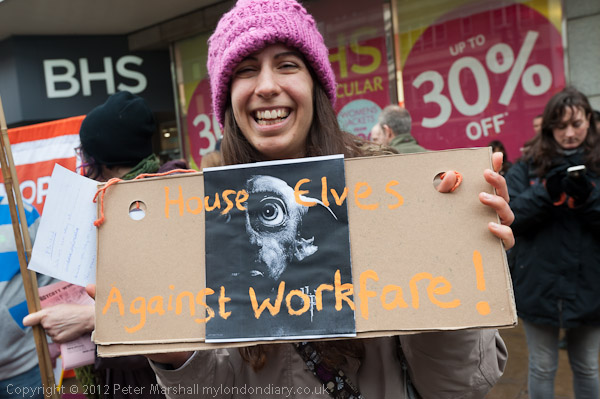
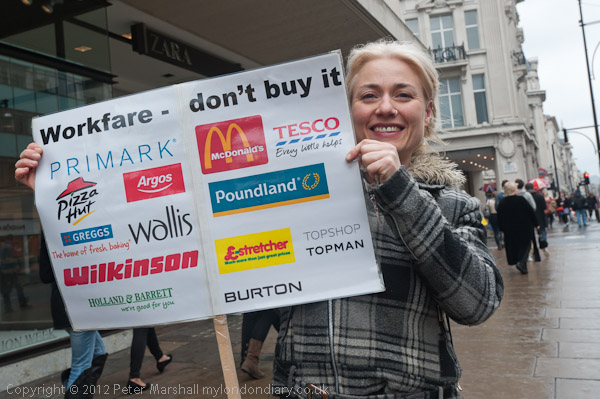
Strong negative reactions to these schemes – such as those demonstrated by the Boycott Welfare protest in Oxford St, London I photographed on Saturday 3rd March 2012 – led to many companies withdrawing from the scheme, and others ending talks with the government about taking part in it. According to Wikipedia, the campaign group ‘Boycott Welfare’ ‘very successful in making companies and charities pull out of “workfare”.’ By August 2016, “more than 50 organisations have ended their involvement in workfare, because of negative publicity.”

But workfare still continues, and as Boycott Welfare write on their web site, “Workfare forms a key tool of ‘compliance’ with the regime of Universal Credit, and is enforced via sanctions.” As well as Universal Credit, workfare also continues under the government’s Sector-Based Work Academies, Work and Health Programme and Youth Obligation schemes.


Also on the same day I photographed other events. Firstly the Million Women Rise March, a women-only march through the centre of London against domestic abuse, rape and commercial sexual exploitation and for the prevention of abuse and support and protection for women. I was shocked to learn from a member of one of the more active women campaigning groups that has been the among the leaders in previous celebrations around International Women’s Day and had taken part in previous years that they had been told they were not welcome on the march, though I think they have taken part in more recent years.

I left that march as it went down Oxford St on its way to a rally at Trafalgar Square and took the tube to St Paul’s where Greeks were protesting in solidarity with students and workers in Greece against the austerity measures being imposed as a part of the Eurozone rescue package for the country. They had planned to protest at the Occupy London camp, but that had been cleared a few days previously, but some of the occupiers had returned to hold a general meeting on the St Paul’s Cathedral steps.

More on these events from Saturday 3rd March on My London Diary:
Greeks Protest At St Paul’s
Million Women Rise March
Boycott Workfare – Oxford St


All photographs on this and my other sites, unless otherwise stated, are taken by and copyright of Peter Marshall, and are available for reproduction or can be bought as prints.
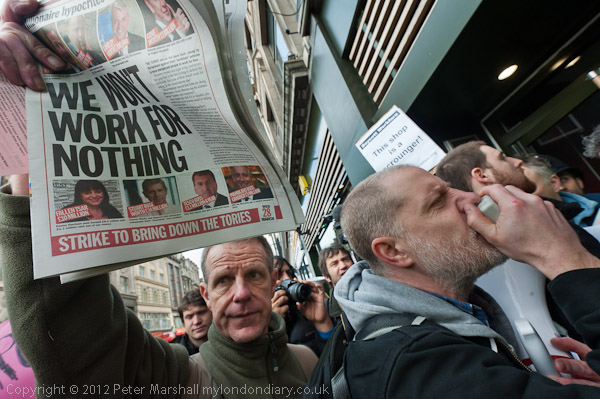

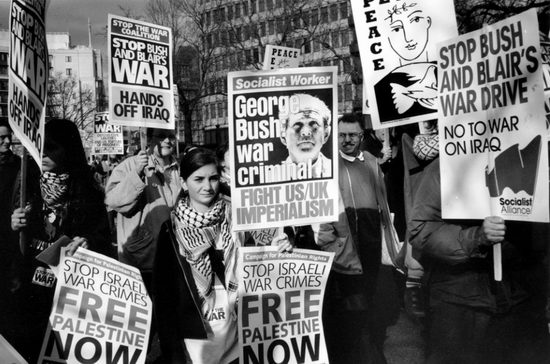
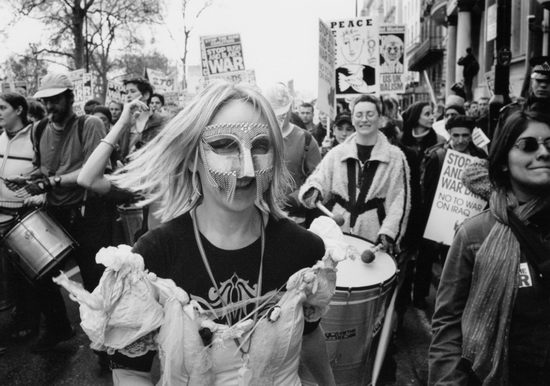
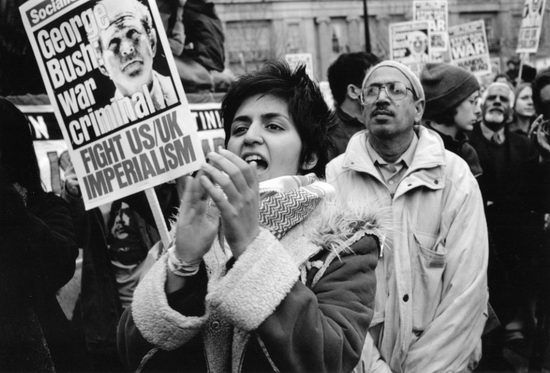
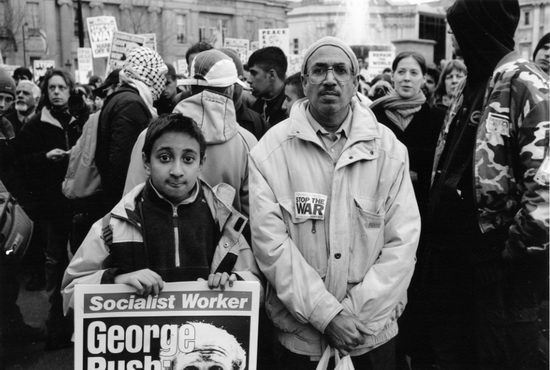
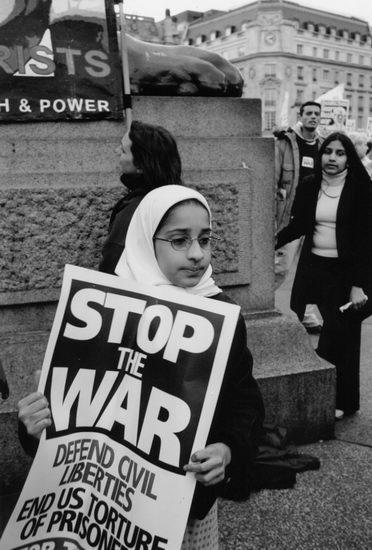
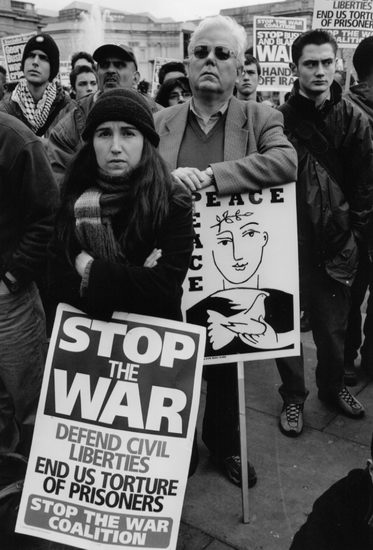
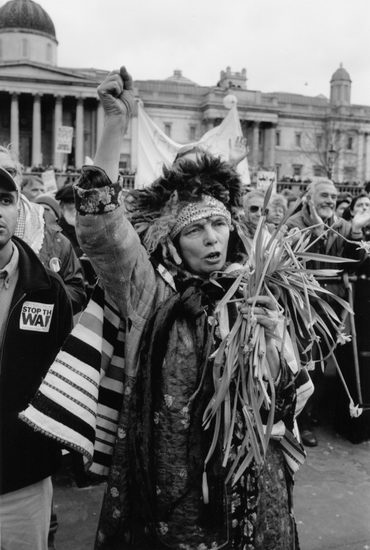
2 March 2002: Stop the War, Hands off Iraq

Back in 2002, protests were still in black and white – or rather I was still using film for my photographs and the library I was putting pictures into was still only taking colour pictures as transparencies – something I had given up taking seventeen years earlier as I found colour negative far better to work with.

For the huge Stop The War protest on March 2nd, 2002 against the war in Afghanistan and the forthcoming invasion of Iraq I was actually working with three cameras, one with black and white film, a second with colour negative and the third a panoramic camera also loaded with colour negative film. Although I contact printed the developed films from all three, it was only selected images from the black and white work that was printed and went to the library.

Some day I hope to get around to printing some selected images from the seven or eight colour films I exposed on that day, but at the time I had no particular incentive to do so. It was difficult for me to use colour even on the web site, as my flatbed scanner at that time was a monochrome only scanner – and all the pictures on My London Diary from this event are black and white scans from the black and white prints I made to send to the library.

There are a few colour pictures from this era on my web sites, mainly those taken on a pocket-sized 2Mp digital camera I had begun to use as a notebook a year or two earlier, but the images were generally unsuitable for publication. Prints from them at much more than postcard size were poor quality.

Around this time I did get my first film scanner, but it was very slow to use and the quality wasn’t great. And at the end of 2002 I began using my first DSLR, the 6Mp Nikon D100, and soon began submitting digital images to agencies that would handle digital work.

Newspaper reports at the time rather followed the police in giving figures of 10-15,000 people at the protest, though I think the true number was at least twice this. As I reported, “people were still leaving hyde park at the start of the march when trafalgar square was full to overflowing two and a half hours later.” It takes more than 15,000 to fill Trafalgar Square and the tailback over the 2 mile route adds considerably to that number.

As I wrote back then:

police estimates of the number were risible as usual – and can only reflect an attempt to marginalise the significant body of opinion opposed to the war or a complete mathematical inability on behalf of the police.

In my comments I also quote Tony Benn telling us photographers at the start of the march that it wasn’t worth us taking his picture, “it won’t get in the papers unless i go and kick a policeman” and he was quite right. They didn’t report his speech either, in which he said that for the first time in his life he though the situation was so desperate that he was advocating non-violent resistance, calling for everyone to stop work for an hour at the moment the bombing begins. “Stop the buses. Stop the trains. Stop the schools. It’s all very well going to Downing Street, I’ve spent half my life at Downing Street, in, outside Downing Street. It has to be more than that, its got to be something we take up in every town and village.” This he said would get the debate going. His speech received a huge reception from the crowd.

It was hardly a very radical suggestion – and after the bombing started it would have been too late. But had ‘Stop The War’ called for similar action before the parliamentary debate – and not just another A to B march planned months in advance – it might have made a difference. The message that this was simply a war for control of oil resources and would be a disaster for the region was getting through – and there were regular protests in towns and villages across the nation, including in the true-blue town where I live, and more radical actions could have prevented the UK joining in the US action.

More at http://mylondondiary.co.uk/2002/03/mar.htm


All photographs on this and my other sites, unless otherwise stated, are taken by and copyright of Peter Marshall, and are available for reproduction or can be bought as prints.
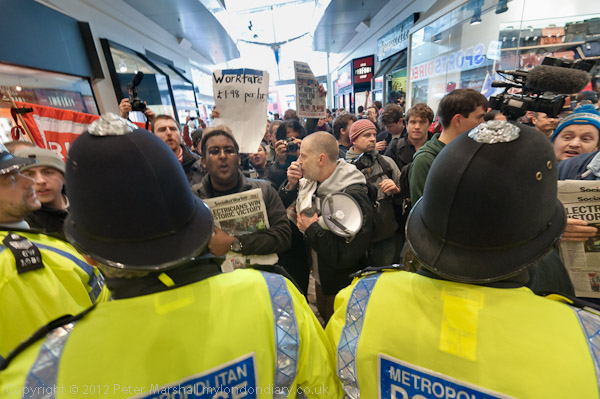

2015: Grow Heathrow at Five

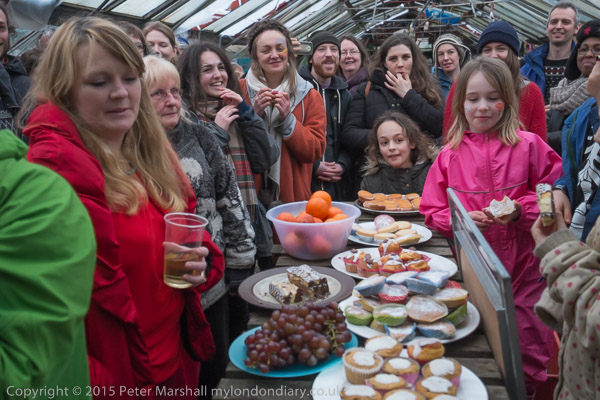
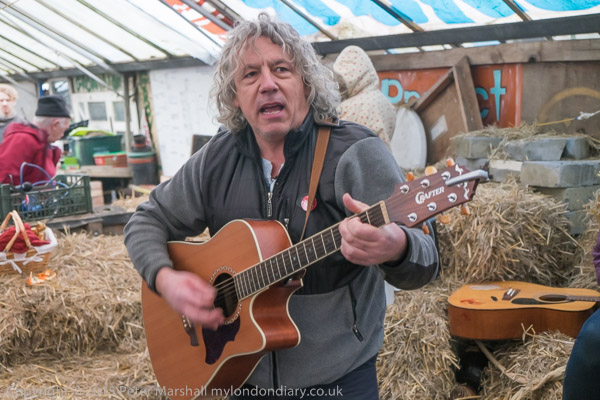
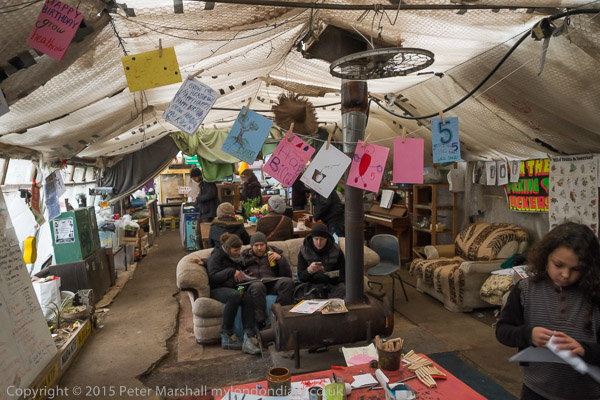
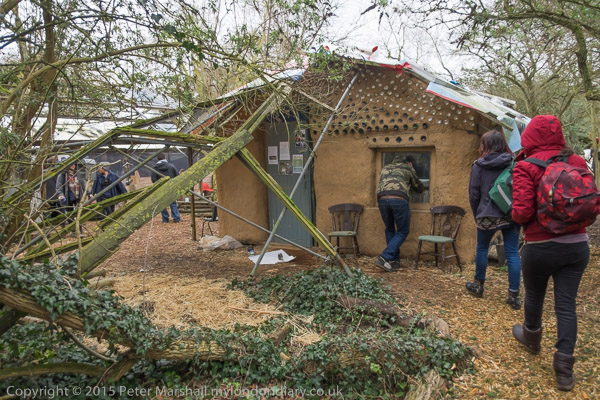
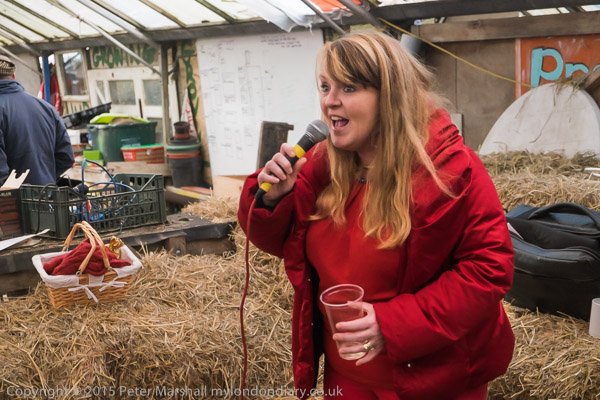
On 28th February 2015, Grow Heathrow, a non-hierarchical free community in an occupied derelict nursery at Sipson, just north of Heathrow Airport celebrated 5 years with open workshops and a party.

It had been set up as a symbol of community resistance to the economic, ecological and democratic crises and to oppose the increasing development of the aviation industry and Heathrow, at a time when local residents, myself included, were protesting against the building of a “third runway” to the north of the current airport.

Local protests had begun back in 2003, and by the time squatters occupied the long-abandoned market garden victory on the specific issue of the new runway seemed more or less assured. Transition Heathrow’s ‘Grow Heathrow’ had longer term and more far reaching goals, hoping to create more sustainable and resilient Heathrow villages after the dropping of the third runway and more widely to build long-term infrastructure and networks to deal with peak oil and the threat of climate change. On their site they set out to demonstrate how we could live differently, ‘off grid’ and with a different and cooperative lifestyle.

I wasn’t particularly closely involved with Grow Heathrow, though I visited the site a number of times for various events, as well as taking part in the local protests and events at the nearby Greenpeace ‘Airplot’, where I was one of the 91,000 of beneficial owners of a very small area of land. It’s an area I knew from my youth, when I often cycled through Sipson ,Harmondsworth, Longford, Horton and Colnbrook.

Grow Heathrow weathered a number of legal battles to stay in occupation, but were evicted from the front half of the site where most of these celebrations took place two years ago at the end of February 2019 after around 9 years of occupation and growth. I’ve not visited since the eviction but so far as I am aware there are still some residents on the back part of the site – which had a different owner, but visits have not been possible since the start of the pandemic.

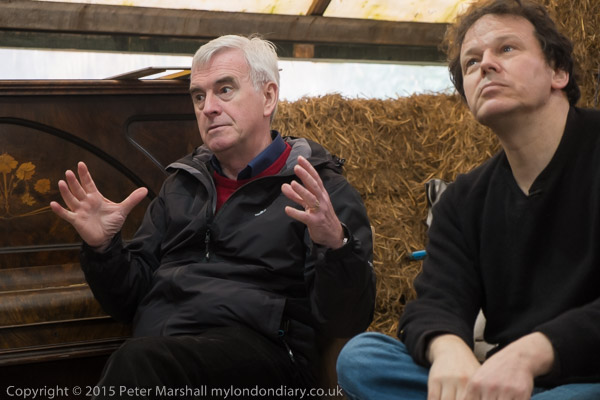
The project was an important one and brought together many people from different backgrounds, including local residents and international visitors, some who stayed for months and years. Among those who came to the 5th birthday party to join the celebrations and speak were local MP John McDonnell, Tristram Stuart, a pioneer of the radical food movement with his 2009 book on food waste, anthropology professor David Graeber and activist Ewa Jasiewicz.

Grow Heathrow was an inspiration to many, though some of us were unable to envisage its rather spartan lifestyle for ourselves there were lessons that could be learnt in particular from its involvement with the wider community. Heathrow expansion is back on the agenda today, though it is hard to believe it will go ahead given the growing realisation of the vital importance of the climate crisis. Aviation as we know it is incompatible with the kind of Green future our government now plays lip-service too – and will need putting into action for civilisation to survive.

Many more pictures at Grow Heathrow’s 5th Birthday.


All photographs on this and my other sites, unless otherwise stated, are taken by and copyright of Peter Marshall, and are available for reproduction or can be bought as prints.
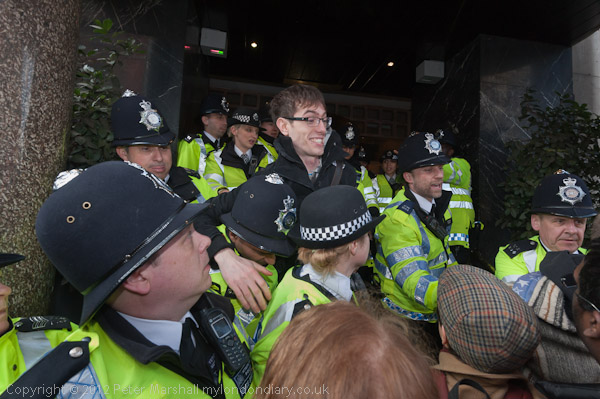

Stop Trident, Save Refugees…

Last Tuesday I watched John Pilger’s 2010 film, The War You Don’t See, a film that takes an honest look at wars and the failure of most journalists to report honestly on them – and how those that do find their work fails to get broadcast or printed. It’s an at times harrowing view of war and lays open the whole huge PR web of lies that is used to persuade the public that they are necessary and to support them, based mainly around the propaganda over Iraq and Afghanistan.

It is now a matter of official record that all of the reasons put forward at the time for the invasion of Iraq, notably in the UK by Prime Minister Tony Blair were lies; but not only that, were known at the time to be false. It was simply a war for the control of Iraqi oil, and to keep the military industry growing. Of course many of us outside the
CIA and other agencies also knew that at the time, including the over a million who went to protest in London.

Pilger managed to get interviews with a wide range of people, including journalists and others who admit that they failed for various reasons to inform the public what was really going on. Those from other news sources, including the BBC, make a wholly unconvincing attempt to justify the approach they took, visibly squirming as Pilger asks his questions, trying to defend their toeing the government line rather than examining the evidence and reporting objectively.

We are in an age of perpetual war, not largely because of real disputes that could not be solved by other means, but manufactured and promoted by a huge web of deceptions to feed what is sometimes called the military-industrial complex, a term coined by Eisenhower for his final public speech in 1961 when he warned of the “economic, political, even spiritual” dangers of “the disastrous rise of misplaced power” it it could – and has – produced.

Pilger’s film deals briefly with the bombing of Hiroshima and Nagasaki, which it is now clear served no military purpose as the war with Japan was rapidly drawing to a close when they were dropped. The film includes an interview he made in the 1980s with Australian journalist Wilfred Graham Burchett who managed to evade the military security that kept almost all journalists simply taking down and passing on the military briefings which denied the existence of radiation sickness and went to Hiroshima and reported on the terrible effects of the bomb.

Despite censorship and other attempts to stop his report reaching the outside world, the first 200 words of his 3,000 word report reached the Daily Express who put it on the front page – and the world learnt of how 30 days after the bombing apparently uninjured people were still “dying, mysteriously and horribly” from what Burchett described as “the atomic plague.”

Journalists who step out from the official line can expect to suffer, and many. particularly those who refuse to be led and “embedded” have been killed reporting on wars. Others, such as Julian Assange find themselves the subject of deliberate campaigns to harass and discredit them – and in his case to imprison him in solitary confinement – possibly to be extradited to life in solitary in the USA – despite an extradition treaty that excludes those accused of political crimes.

Our so-called Independent Nuclear Deterrent is wholly a programme to feed that military-industrial complex, with its chilling threat hanging over us all, something that at least one US president has been prepared to consider using and which only the willingness of one Russian soldier to disobey orders saved us from its accidental unleashing.

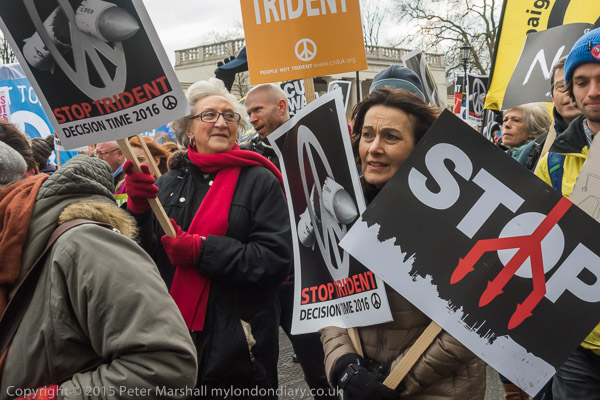
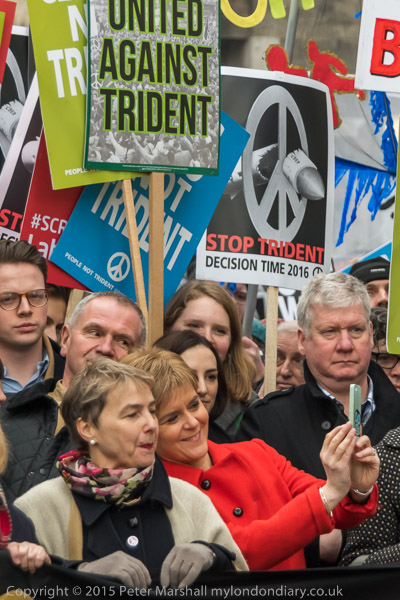
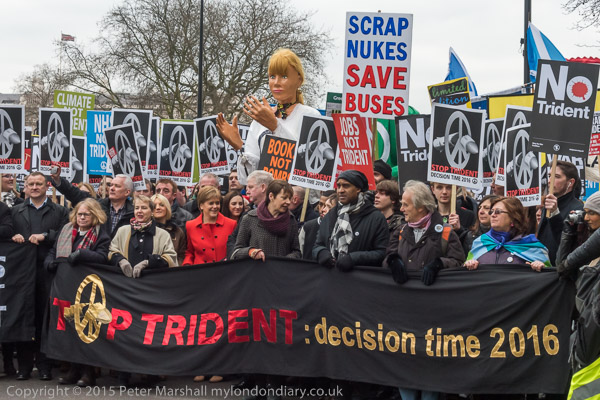
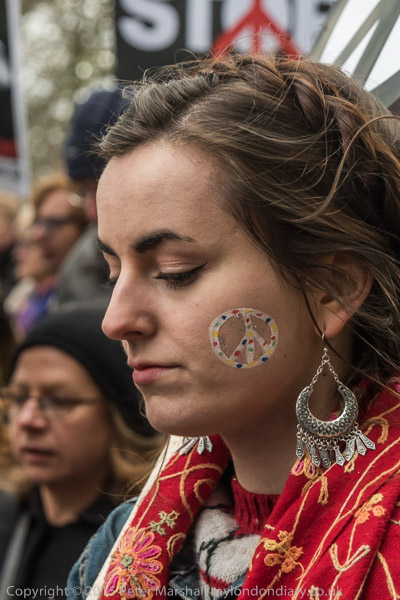
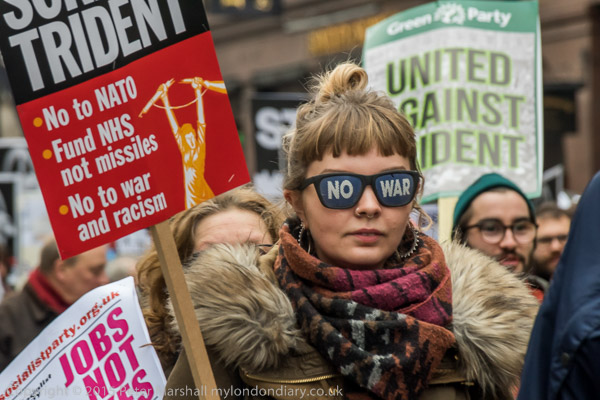
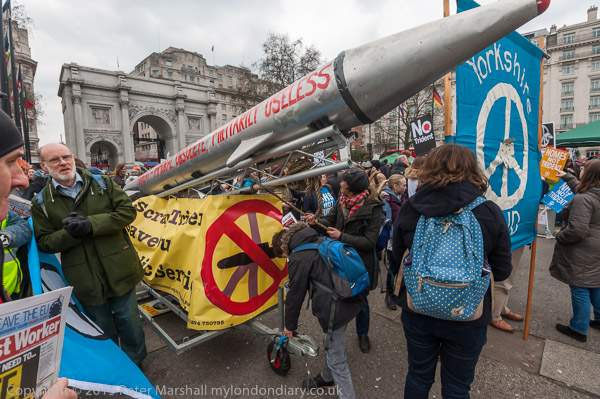
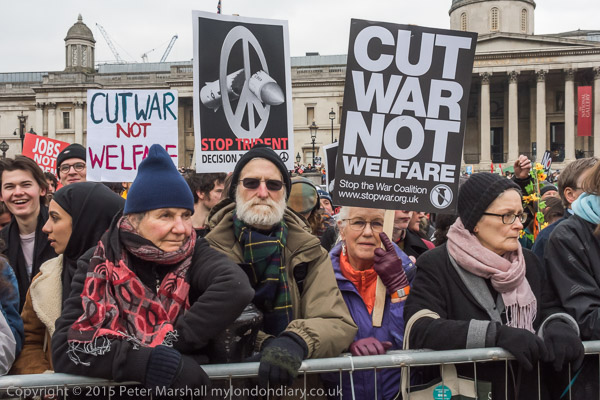
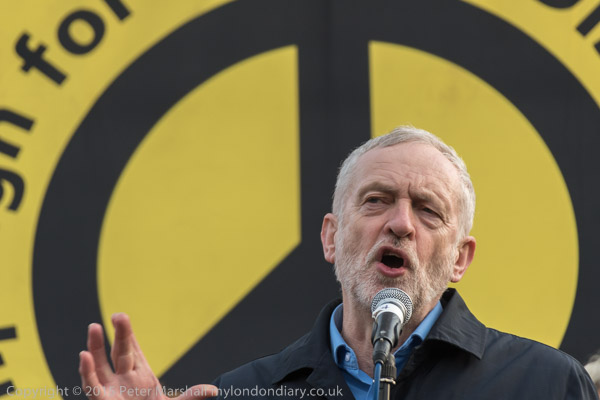
On Saturday 27th February, around 60,000 came to Marble Arch to march from there to a rally in Trafalgar Square against government plans to replace the UK’s Trident nuclear weapons at a cost of £180 billion or more. They said Trident is immoral and using it would cause catastrophic global damage; these weapons of mass destruction don’t keep us safe and divert resources from essential spending on services like the NHS, schools and housing.

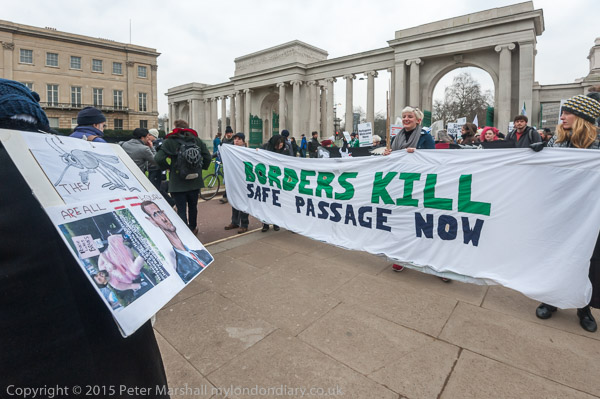
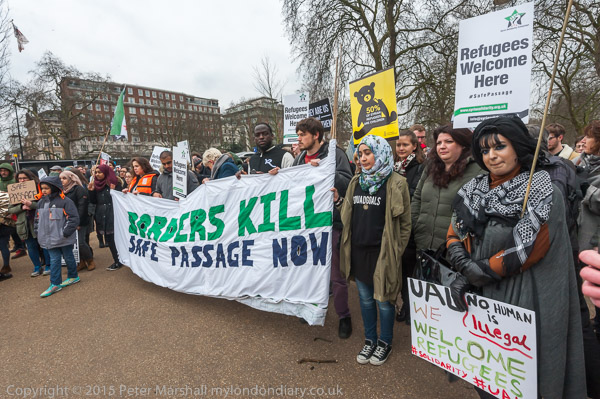
I was a little late to the official photocall because of the dense crowds as I made may way from the European March for Refugee Rights which had finished with a rally a short distance away in Hyde Park. This was taking place in various cities across Europe and demanding that governments take action now to open secure safe passage routes for all refugees and asylum seekers seeking protection in Europe. They called for an end to deaths at borders and for refugees to be allowed to keep their possessions and be reunited with their families.

At the end of this march, many of those taking part went to join the Stop Trident march, some forming up as a group ahead of the official front of the march despite attempts by the Stop the War stewards to move them. Eventually the stewards halted the main march for around ten minutes to create a gap between the two groups.

Stop Trident Rally
Stop Trident March
European March for Refugee Rights


All photographs on this and my other sites, unless otherwise stated, are taken by and copyright of Peter Marshall, and are available for reproduction or can be bought as prints.
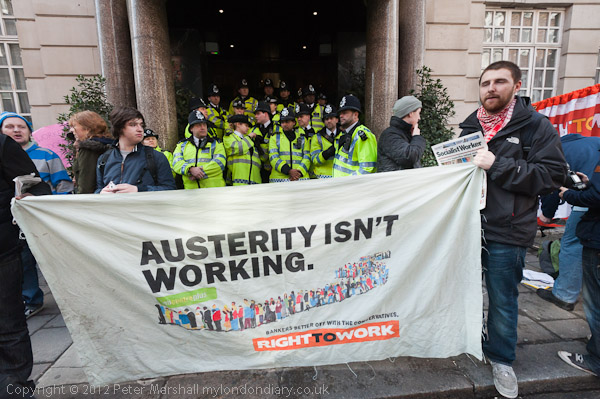

Two years ago – 26 Feb 2019

Class War protest Rees-Mogg freak show

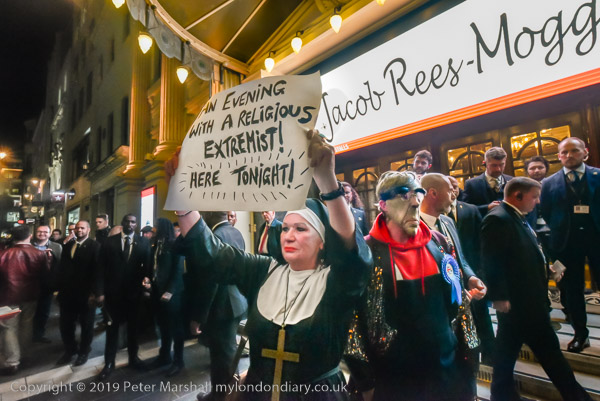
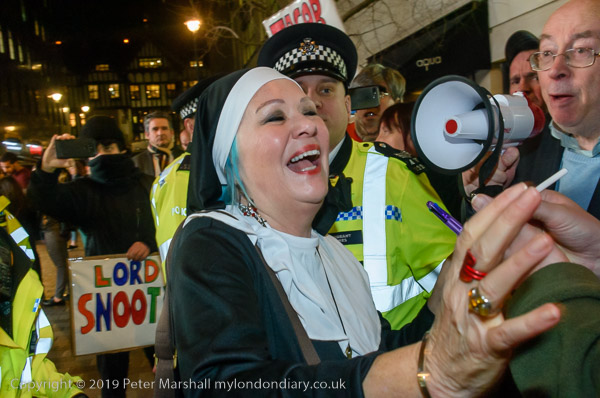
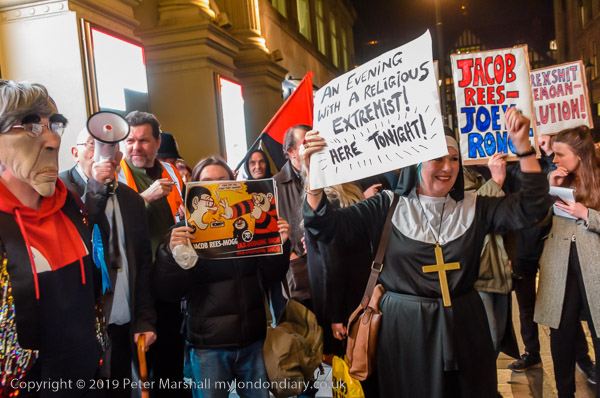
Two years ago today Class War protested outside the London Palladium against Jacob Rees-Mogg, who they accused of spouting “homophobic, transphobic, racist, pro-hunting, misogynist, classist, privileged” nonsense. Rees-Mogg had booked London’s best known venue to preach more of this to his fans, who had paid £38 for a ticket to this freak show.

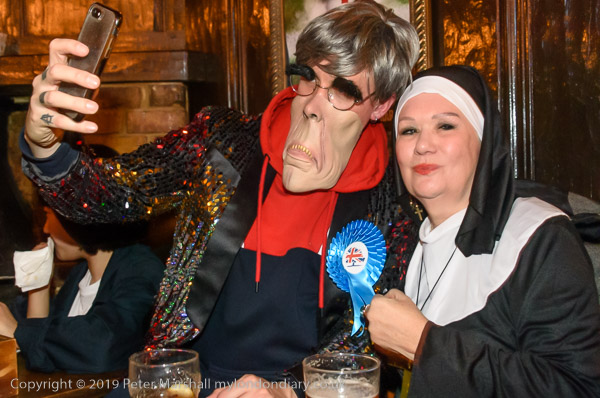
I met up with Class War at a pub a short walk from the Palladium and found a small group there with Jane Nicholl dressed as a nun, Mother Hysteria, and Adam Clifford as Jacob Rees Mogg and there was time for them to take a selfie and everyone to finish their drinks before the small group moved off to the entrance to the Palladium where a few more of there supporters were waiting and long queues were waiting to enter for the performance inside.

As well as the fans there were of course a large group of security men and police in attendance (all probably thanking Class War for the overtime.) And when Class War held up posters and banners the waiting crowd had their hopes for what they had paid to come and see confirmed. One or two did come across to insult the protesters, and a few others passing by came to share their similar views of Mogg with Class War.

Police did their best to render the protest less effective and moved the group to the opposite side of the pedestrianised street and issued various warnings to harass them. Eventually they stopped and searched Jane Nicholl, threatening her with arrest as they found stink bombs in her handbag which they claimed were offensive weapons. I stood for almost 20 minutes watching the officer writing out “her notice of stop and search, perhaps because he is at a loss trying to find some way that doesn’t make the police action sound stupid” before deciding I had to go home and file my pictures.


Rally for an end to Outsourcing

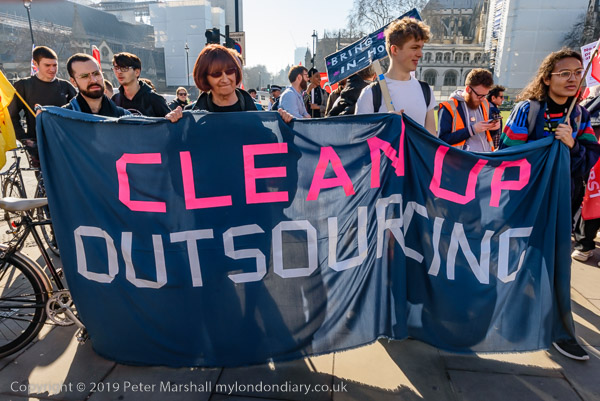
This protest had come at the end of a long and varied day for me, which had begun with a coordinated action by the UVW, IWGB, and the BEIS PCS branch demanding an end to outsourcing and the insecurity, discrimination and low pay it causes. A legal challenge was demanding better rights for the 3.3 million outsourced workers in the UK, and protesters had met at the University of London at 8am to march to a protest outside the High Court before moving on to a rally in Parliament Square where I joined them a couple of hours later.


Outsourced Workers protest at BEIS

From Parliament Square it was a short walk to the Dept for Business, Energy & Industrial Strategy in Victoria St where outsourced workers including catering and security staff in the PCS were striking in support of their demand for the London Living Wage as well as end to outsourcing and the insecurity, discrimination and low pay it causes.


Outsourced Workers at Justice ministry

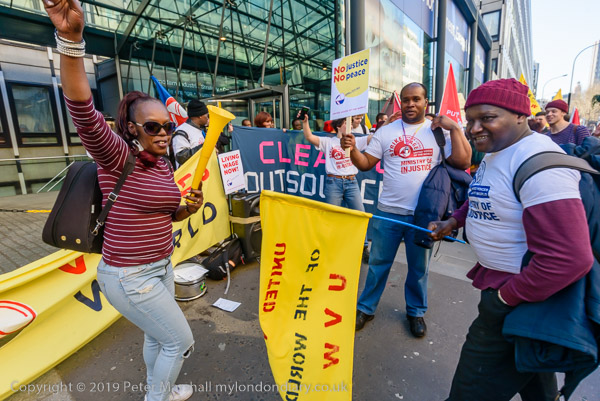
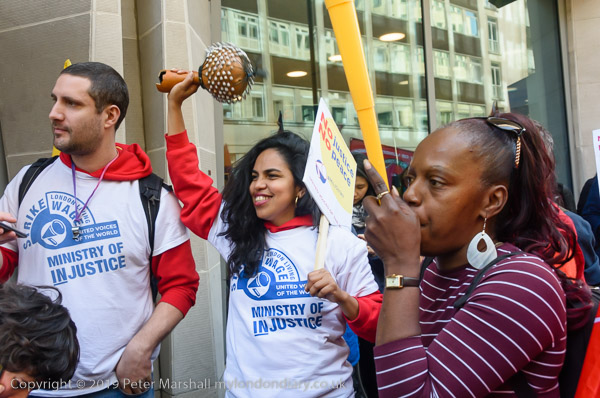
After a rally and speeches at the BEIS, the protest by outsourced workers moved on to the Ministry of Justice (though they call in the Ministry of Injustice) where low paid workers belonging the the United Voices of the World union who had been on strike for 24 hours were going back to work. They also want the London Living Wage and fair conditions of service rather than the poverty and insecurity of outsourcing.


North Woolwich

When the protest at the Justice Ministry came to an end I went to have a quick lunch and, as I had several hours to spare before the Class War action, went to take some photographs at North Woolwich. Unfortunately I arrived at Bank station for the DLR only to find there were no trains running – and no information as to when they might resume service.

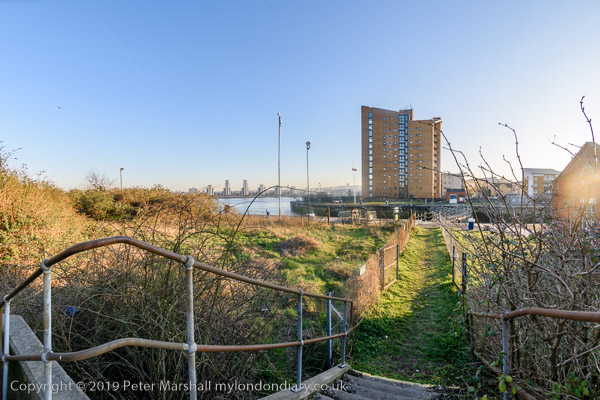
It took me rather longer than anticipated to get there, taking the Northern Line to London Bridge and a train to Woolwich Arsenal. Fortunately by then services were running from there to North Woolwich, saving me a walk across the river but I still had rather less time than I needed and had to rush away before finishing my planned route, mainly beside the River Thames. It was a pleasant day for a walk, but a clear blue sky is not good for panoramic views.

As usual, more about all these on My London Diary:
Class War protest Rees-Mogg freak show
North Woolwich
Outsourced Workers at Justice ministry
Outsourced Workers protest at BEIS
Rally for an end to Outsourcing


All photographs on this and my other sites, unless otherwise stated, are taken by and copyright of Peter Marshall, and are available for reproduction or can be bought as prints.
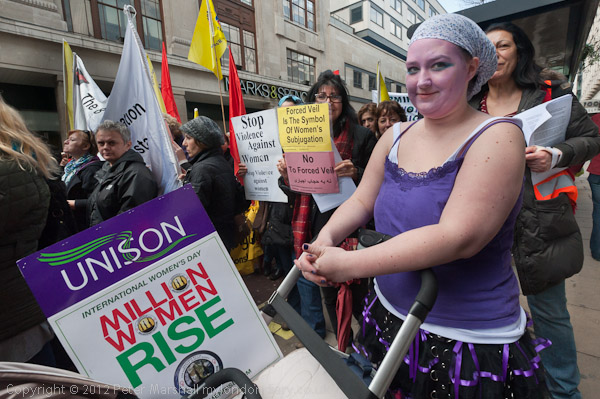

The Spice of Life

Perhaps the hardest thing I’ve found about the last eleven months has been the lack of variety. I’ve been fortunate to probably avoid the virus – I was quite ill early in March 2020 but my symptoms didn’t match those then thought to typify Covid-19, though they did match some of those being reported by Covid sufferers – and none of my family or close friends have died from it.

But days mainly spent at home in front of a computer screen have followed days mainly spent at home in front of a computer screen relentlessly, though I have tried to get out for walks or bike rides most days. As someone of an age and medical condition that makes me vulnerable I decided not to travel up to London on public transport, although as a journalist I count as a key worker and could have done so. Apart from usually solitary exercise (occasionally a walk with my wife on Sundays) I’ve made a couple of trips out for pub meals with family or friends when these were allowed, and a few short journeys for medical and dental appointments – including most recently my first Covid vaccination.

There’s Zoom of course, and I hate it, though taking part in a few regular events. It’s a little better on my desktop computer which hasn’t got a camera, but on the notebook or tablet I find it disconcerting to see myself in close-up (and sometimes move out of frame and sit in a more comfortable chair watching the screen from a distance.) It’s perhaps more seeing the others, mainly in head and shoulders close-up that makes me uncomfortable with Zoom; in real life we would be sitting around at a sensible distance, seeing each other at full length and as a part of the overall scene, looking away when we want to at other things. Not those relentless talking or muted full-face heads.

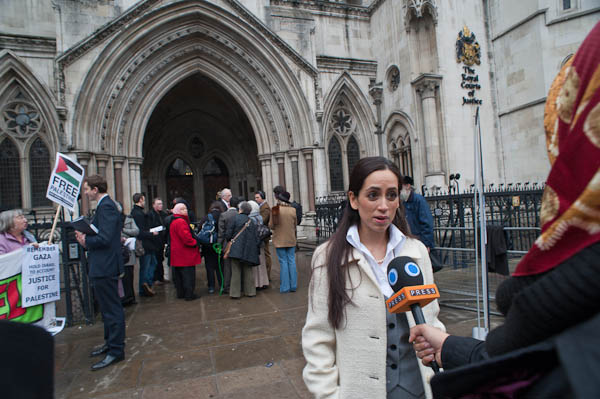
Tuesday 24th February 2009 wasn’t a typical day, and that’s really the point. Few days then were typical. I caught the train to Waterloo and took a bus across to Aldwych, a short journey but faster than walking. A short walk then took me to the Royal Courts of Justice where protesters were supporting the application for judicial review by Palestinian human rights group Al-Haq challenging the government’s failure to fulfil its obligations with respect to Israel’s activities in Palestine.

It was Shrove Tuesday, and from the Royal Courts another bus took me on one of my favourite central London bus journey, up Fleet St and Ludgate Hill to Bank, from where I hurried to Guildhall Yard to the Worshipful Company of Poulters Pancake Races. It perhaps wasn’t one of my better attempts to photograph the event, perhaps because I tried too hard to show the actual running and tossing of pancakes.

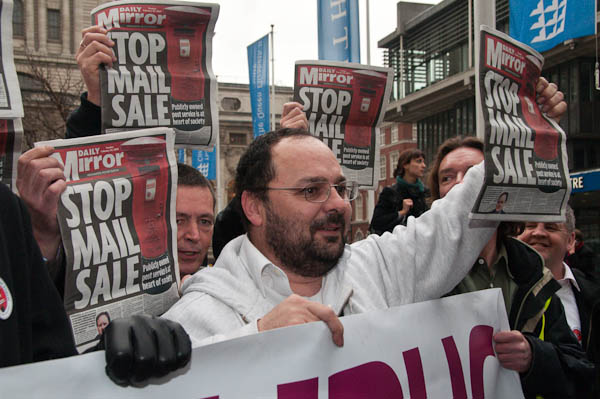
I couldn’t stay for the finals of the pancake race but hurried down to Mansion House for the District and Circle Line to Westminster to meet postal workers as they came out of a rally at Methodist Central Hall to protest at government plans to part-privatise the postal service and then proceeded to a short protest in front of Parliament.

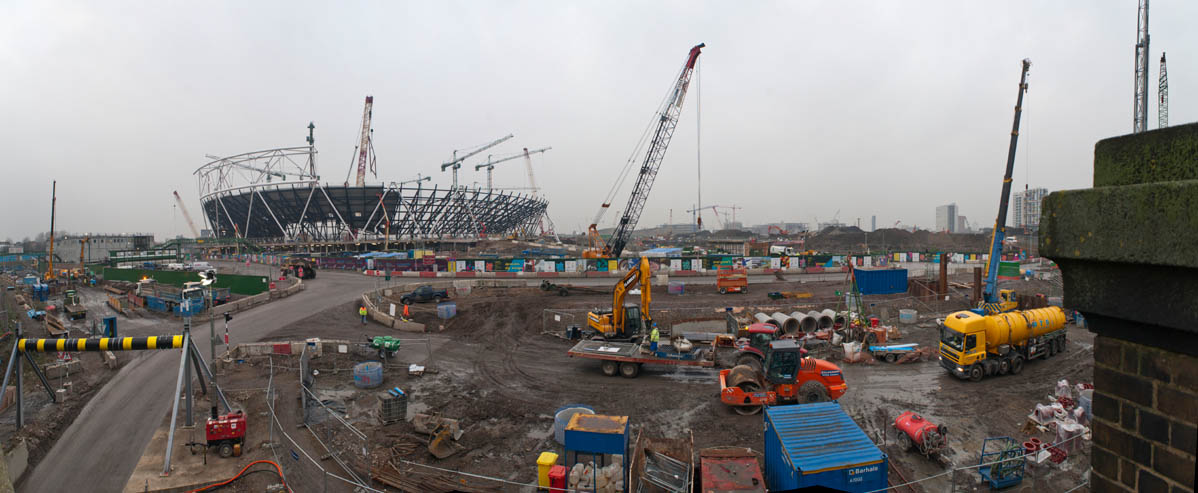
There was nothing in my diary for the next few hours, so I took the opportunity to jump onto the Jubilee Line to Stratford and then walk towards the Olympic site for one of my occasional reports on what was happening in the area – which I had been photographing since the 1980s.

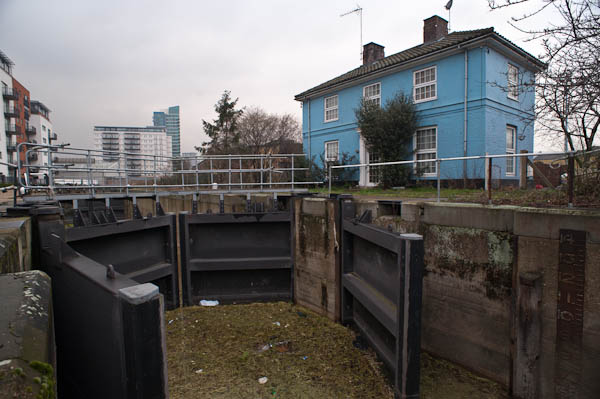
I made my way through the Bow Back Rivers, photographing the new lock gates at City Mill Lock. The Olympic site was sealed off to the public by the ‘blue fence’ but I was able to walk along the elevated path on the Northern Outfall Sewer to take a panoramic view of the stadium under construction. It was rather a dull day and not ideal for such wide views with such a large expanse of grey sky.

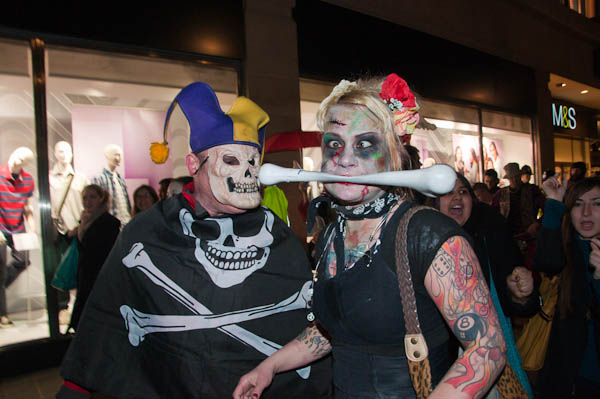
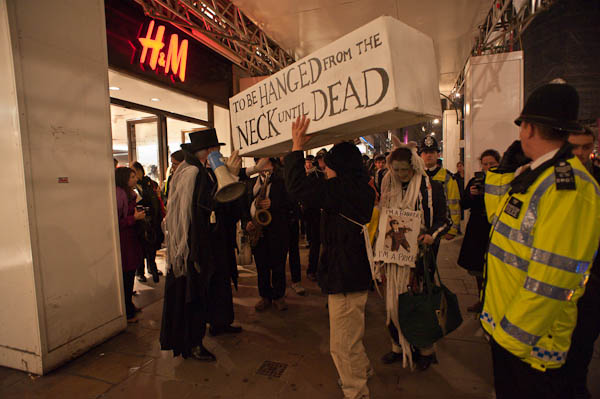
I took the Central Line back to Oxford Circus for the March of the Corporate Undead, advertised as a “Zombie Shopping Spree” along Oxford Street from Oxford Circus to Marble Arch, complete with coffins, a dead ‘banker’, posters, various members of the undead and a rather good band.

I left the zombies at Marble Arch where they were hanging an effigy of a banker and hurried to my final appointment, a London Bloggers Meetup. The evening’s meeting was being sponsored by Bacardi who were supplying free drinks, including blue and green Breezers which I thought would have been rather suitable for the zombies, but fortunately there was also free beer. I probably took a few pictures, but haven’t published them.

All just a little more interesting than staring at a screen, though there was rather a lot of that to do when I finally got home.

March of the Corporate Undead
Olympic Site Report
London Olympic site pans
Keep the Post Public
Poulters Pancake Race
Al-Haq Sue UK Government


All photographs on this and my other sites, unless otherwise stated, are taken by and copyright of Peter Marshall, and are available for reproduction or can be bought as prints.


Gentlemen o’ Fortune in London

Ahoy! Some years ago I let me younger son, then in his 30s, use me ‘puter while he was stayin’ wit’ us, ‘n afterwards found that he had changed t’ language on me Facebook t’ “Pirate”. It loot a wee while fer me t’ change it back ‘n certainly wasn’t made easier by havin’ all th’ menus ‘n explanations in ‘Pirate’.

Or to put that in English rather than blabberin’ on in Pirate;

Pirates in London

Some years ago I let my younger son, then in his 30s, use my computer while he was staying with us, and afterwards found that he had changed to language on my Facebook to “Pirate”. It took a little while for me to change it back and certainly wasn’t made easier by having all the menus and explanations in ‘Pirate’.

As you may know, though I didn’t afore now, there are several online English to Pirate translators should you ever for any reason (or unreason) wish to convey your thoughts in that medium. England’s fortune was of course largely plundered by pirates including such well-known names as Sir Walter Raleigh, though now instead of galleons our pirates sail in the plush offices of hedge funds often registered in those distant tax havens around which many of the older pirates sailed in search of vessels to board and rob – and in whose sands they may have buried a little of their stolen treasures. Arrhh Jim Lad!

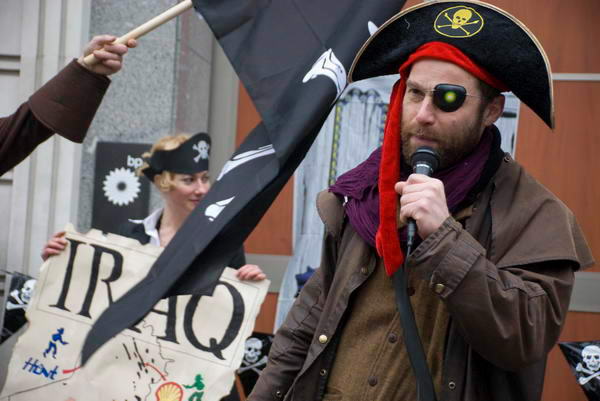
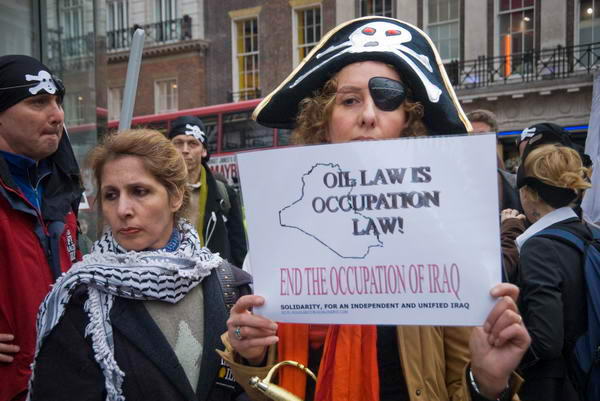
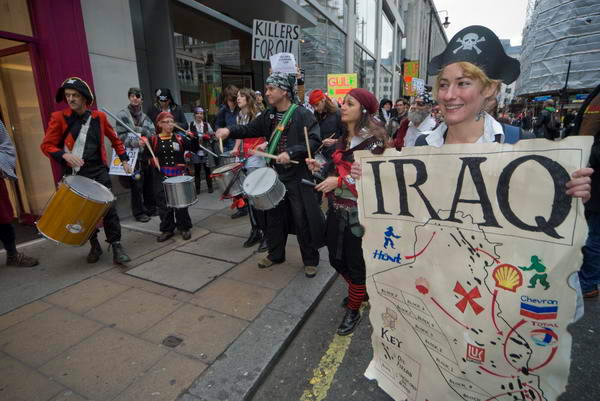
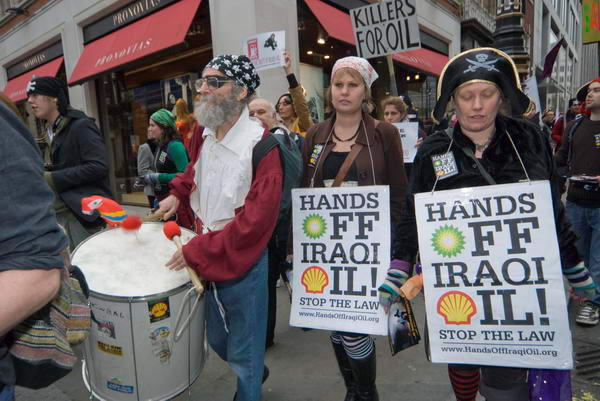
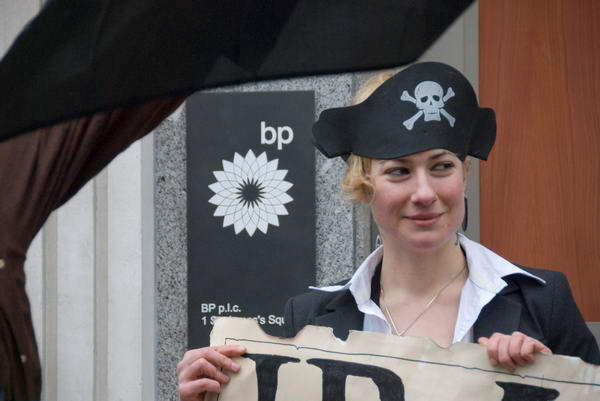
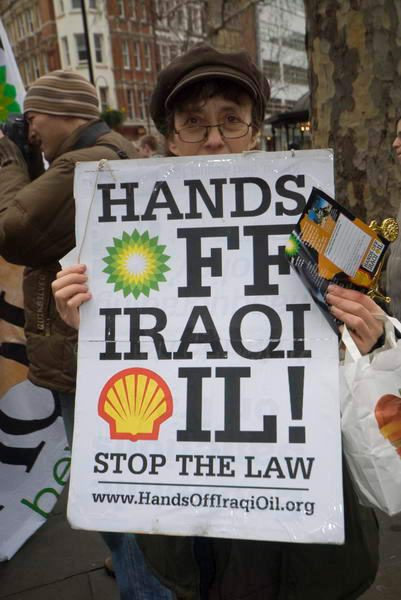
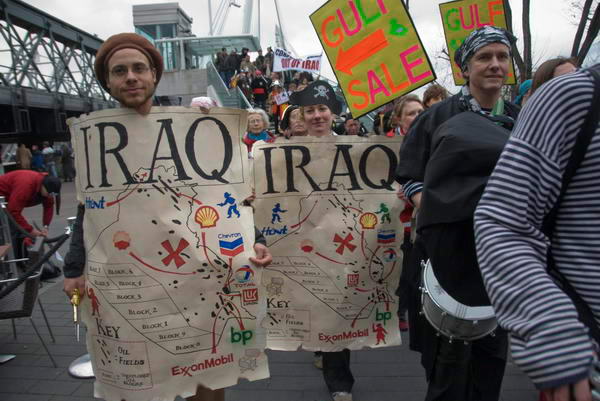
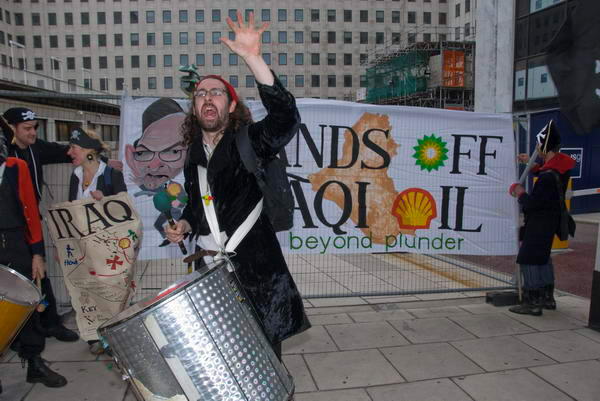
But on Saturday 23 Feb 2008 I was with pirates in London, taking part in the ‘Hands off Iraqi Oil Piratical Action Tour of London’, part of an international campaign in solidarity with the Iraqi people against the corporate theft of Iraq’s oil. The real pirates were of course the largely US oil companies busy profiteering in Iraq following the illegal US and UK invasion of that country.

Saddam was a dictator and committed many crimes, though producing weapons of mass destruction as the invaders claimed largely in contravention of the evidence of their spies, to justify their invasion was not one of them. Far more important but not stated was the fact that as long as he remained dictator, oil would remain a public sector industry in Iraq. So obviously, to further the interests of Shell, BP and other majors in the oil business and capitalism generally he had to be removed.

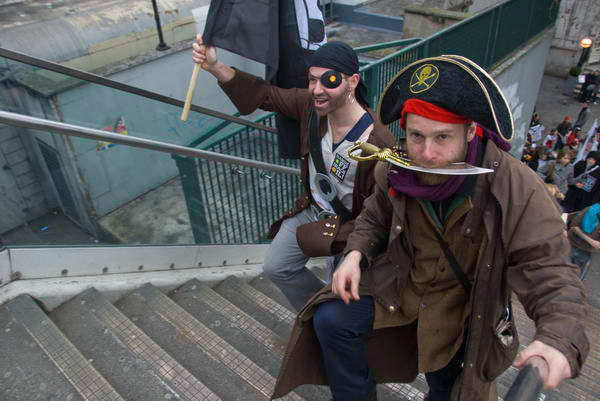
The pirate-themed protest included a number of protesters in pirate dress along with a samba band to make a great deal of noise and draw attention to the banners, posters and placards calling for corporate killers to get out of Iraq along with a small group with blacked faces in a large black sheet representing Iraqi crude.

The protest marched to the premised of various companies involved in the invasion or seeking to exploit Iraqi oil, stopping at them to speak about their activities and protest noisily. Before I met them some had gone inside the National Portrait Gallery to protest inside against BP sponsorship of their major awards.

The tour visited Erinys International Limited, a private military security company with a reputation for using excessive force which provides security services in Iraq as well as training Iraq’s Oil Protection force, BP whose former CEOs worked as advisors to the Iraqi Oil Ministry telling them let companies like BP come in a make vast profits and helping to draft new Iraqi hydorcarbon laws, and the International Tax and Investment Centre, which is paid by the big oil companies to lobby for a free-market approach which would let them dominate Iraqi oil.

Running late, the tour missed the Foreign and Commonwealth Office, whose policies have largely been to run around in support of BP and Shell, employing former oil executives as advisers on economic policy in the Middle East. And Development Program Worldwide Ltd (previously Windrush Communications) has offices too far away in the City for the tour; it promotes the establishment of private capital enterprises in places such as conflict zones where there are few controls over their activities and no effective government to represent the public interest.

The pirates stormed up the Jubilee footbridge, crossing it to reach the Shell Centre for a longer rally to end the tour. Shell executives have played a leading role in the re-purposing of the Iraqi oil industry from a state asset to a multinational profit opportunity and plan for three major oil fields there.

More at Hands off Iraqi Oil Piratical Action Tour.


All photographs on this and my other sites, unless otherwise stated, are taken by and copyright of Peter Marshall, and are available for reproduction or can be bought as prints.
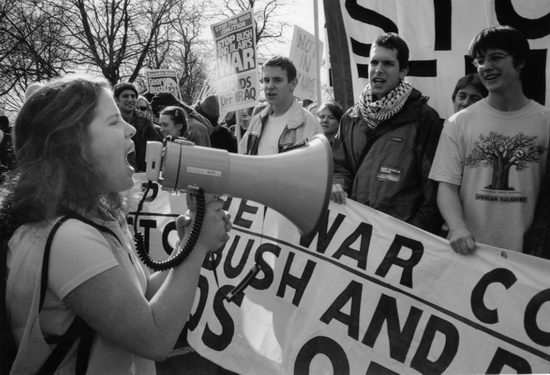

A Bad Day Out

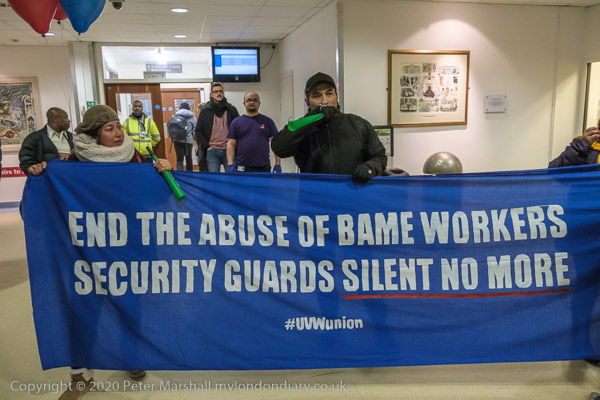
I didn’t much enjoy Thursday 20th Feb 2020, though I was pleased to be able to cover a protest by UVW Security guards working at St George’s University Hospital in Tooting. They had been on strike for 3 weeks demanding to be directly employed rather than outsourced to a private contractor and working under the minimum legal terms and conditions of service.

Although they belong to the United Voices of the World union, the university had refused recognise or talk with their union, and has called on the police to intimidate the workers and try to break their strike – and police even carried out an unlawful arrest of a UVW staff member and barrister. I’d arrived too late on that occasion to photograph the picket, when everyone had left the area.

On 20th Feb I arrived too early. Although when I had first been sent details of the protest planned to take place on an Open Day for postgraduate students they were planning to start at 4pm, the time had later been changed to 6pm and I’d not checked before setting out. So I arrived two hours early and was surprised to find that I was the only one there.

After a little checking on my phone I found out what was happening, and decided that rather than missing the event I’d go for a walk around the area. It wasn’t a bad day for February, and I enjoyed the walk by the Rover Wandle, but by the time the sun had gone down it did start to get rather cold.

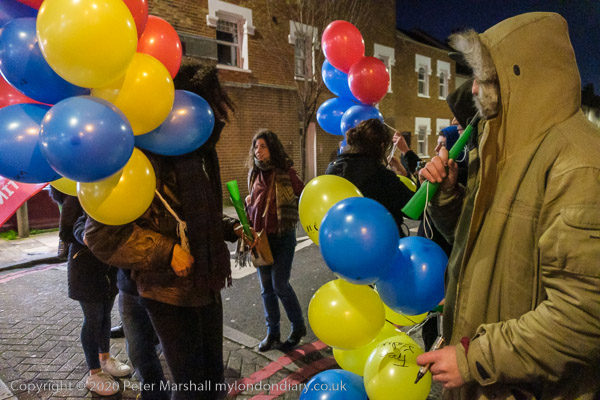
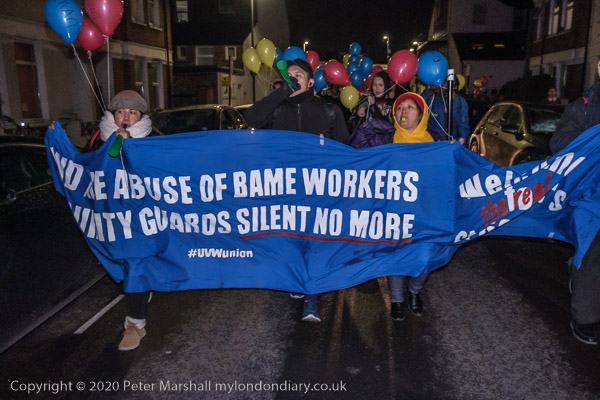
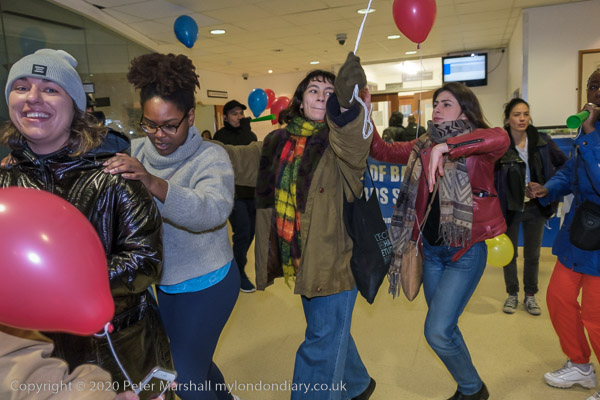
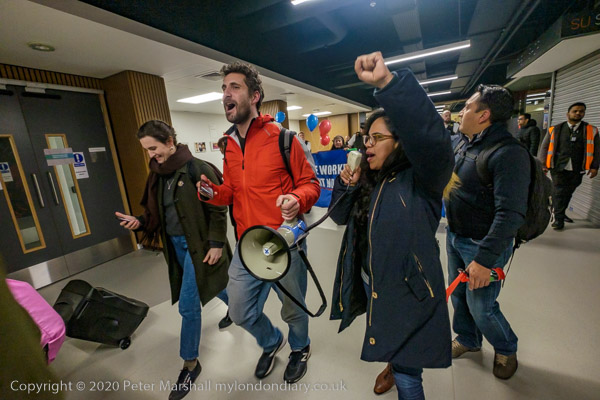
There was still no sign of the protesters, but after a phone call I met up with them close to Tooting Broadway station, where they had a large number of balloons to give the protest a party theme, and were writing slogans on them, which proved a little difficult. After some short speeches on a rather dark street corner they marched down to the hospital. It was hard to take photographs as they marched as the street lighting was poor and they were moving at a fast walking pace.

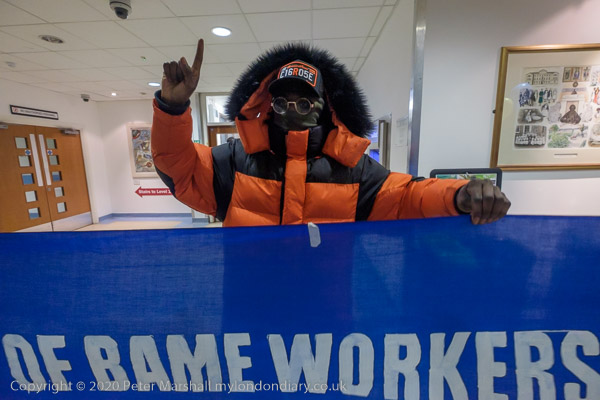
At the hospital they walked in though the main doors to a corridor area; there were very few security staff on duty, perhaps because most were on strike. I think perhaps the change of time for the protest had misled the hospital management as well as me, as there were no police present, though I had seen some when I arrived around 4pm.

Once inside there were more speeches with the union making their demands for the security guards to be made direct employees of St George’s University London and for them to receive pay and T&Cs of employment in line with SGUL standards. Among those to speak in support was drill music star Drillmaster who is standing for London Mayor.


It was a noisy protest, with music and dancing as well as speeches. Police arrived and after some fairly terse discussion came to an agreement with the protesters that they would leave in a few minutes time.

My day was not over, though I was already a couple of hours later than expected. I ran across Clapham Junction to jump on a train for home just as it was leaving, only for it to make an unscheduled stop at the next station, Wandsworth Town. After around 15 minutes we were all told to get off as the train would be going no further as the line was closed at Barnes where someone had committed suicide by throwing themselves under a train. Despite this being an unfortunately common happening at Barnes, South West Trains appeared to have absolutely no contingency plans. Eventually I got a bus back to Clapham Junction, a well-staffed station but where nobody seemed to know what was happening, and joined hundreds of passengers going from platform to platform in search of a train that would take one of the two alternative routes that avoid the accident location.

I took a chance and jumped on a Kingston train. No one on the platform or on the train knew how far it was going, but I knew that if necessary I could catch a bus home from Kingston. At Kingston the guard thought they might get to Twickenham – where again I might get a bus. Eventually it reached Twickenham, where everyone was told to leave the train. Fortunately by that time – two hours after the incident – someone had the sense to
set up a shuttle service for stations further west, and eventually I arrived home, around five hours later than I had expected when I set out and fuming at the incompetence of South West Trains.

More at:
St Georges’s Hospital Security Guards
Wandle Wander


All photographs on this and my other sites, unless otherwise stated, are taken by and copyright of Peter Marshall, and are available for reproduction or can be bought as prints.
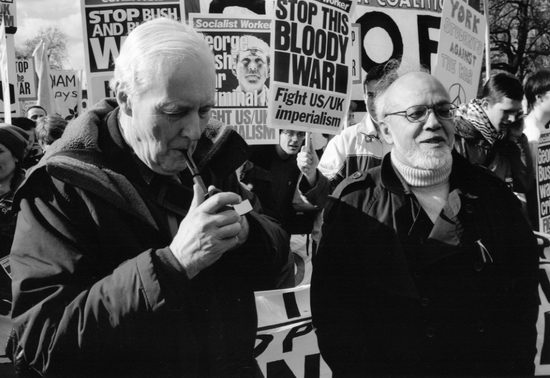

Atos & more – 19 Feb 2014

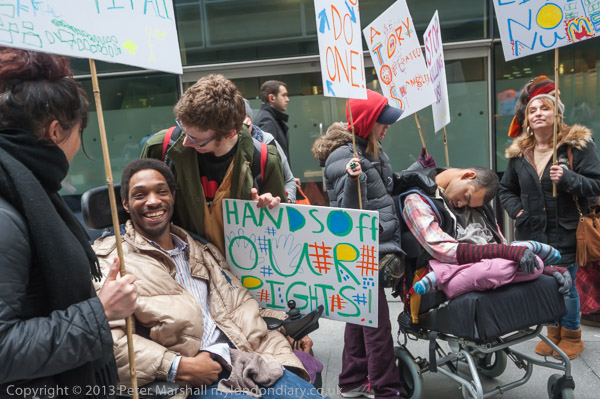
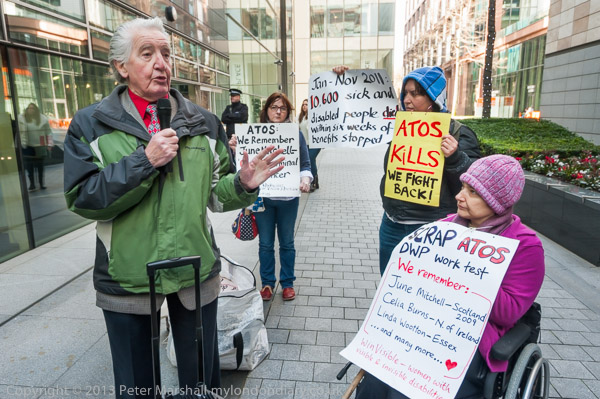
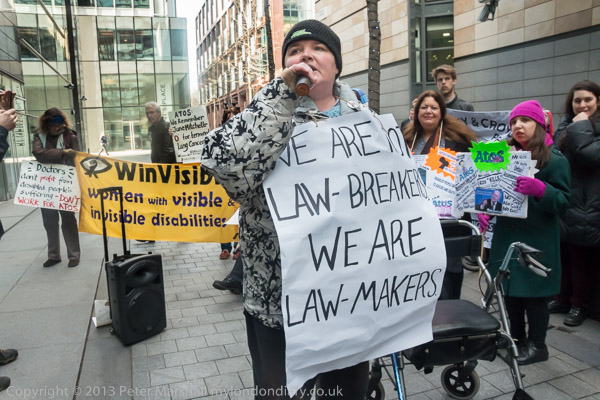
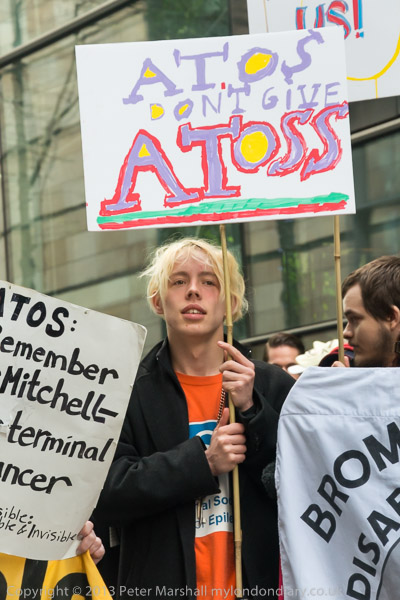
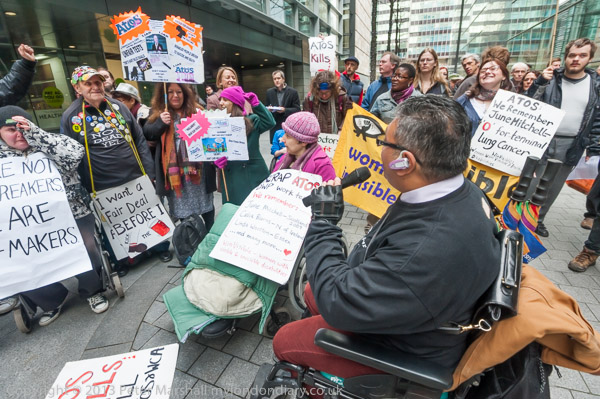
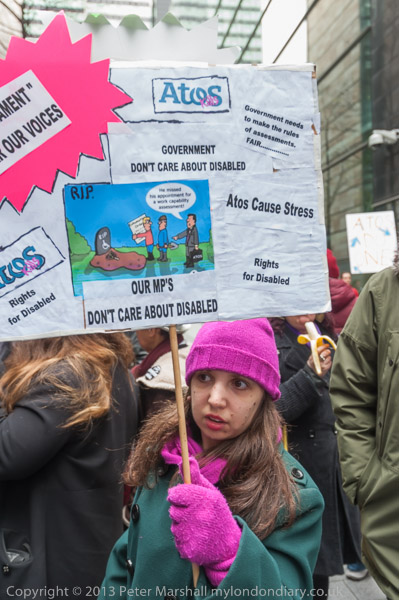
Seven years ago, 19 Feb 2014 was a big day for protests, particularly as campaign groups Disabled people Against Cuts (DPAC), Black Triangle, Atos Miracles, the Green Party, NUS, Occupy New Network, PCS, Unite and many others were taking part in a National Day of Action against Atos for its institutionally incompetent Work Capability Assessment testing of disabled people which has resulted in many disabled people being unfairly refused benefits.

There were protests at each of the 144 Atos testing centres around the country, including those at Wimbledon, Neasden, Marylebone, Highgate, Ealing, Balham and Croydon in London, but I only photographed them at the Atos offices in Triton Square, just north of the Euston Rd.

Even a report commissioned for the government pointed out serious flaws, and over 40% of appeals after people have had their benefits cut by Atos assessments have been allowed a figure rising to over 70% where the appellants have been assisted in their appeals by benefits experts. These appeals take months, during which people are thrown into abject poverty, and often having won on appeal claimants are within a few weeks again penalised by a new Atos assessment.

Atos apparently get paid more for finding people fit to work, and use simplistic tests and often tricks to do so, with no quality control or penalty for those tests which are overturned on appeal. The protesters called for the company to lose its contracts and be prosecuted for its mishandling of the tests, and for these tests to be abandoned and the Minister responsible, Ian Duncan Smith to be sacked.

Many disabled people have been driven to suicide by these failed tests and the stressful appeals procedures. The government figures for January to November 2011 showed that 10,600 people, an average of 223 a week, died withing six weeks of having been found fit for work by ATOS. The Department of Work and Pensions scandalous response to the public outcry when these figures were released was not to take action to make the improvements that were clearly needed, but simply to refuse to respond to requests for similar information for later years. The campaigners say that assessments of fitness to work should be made by qualified medical doctors, ideally by “the GP who regularly sees and treats the sick or disabled individual in question” who they say “is the only person able to decide if an individual is fit for work.”

Among those I heard speaking outside Atos HQ were MP Dennis Skinner, Paula Peters of DPAC, Among those I heard speaking outside Atos HQ were MP Dennis Skinner, Paula Peters of DPAC, Green Party leader Natalie Bennett, journalist Sonia Poulton and the Rev Paul Nicolson of Taxpayers Against Poverty. You can read more about the protest and see more pictures at Atos National Day of Action.


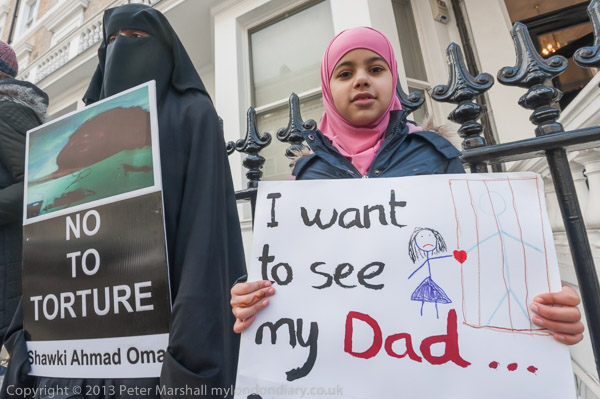
I left the Atos protest briefly to cover three further events. The first at the Iraqi consultate in Kensington was a solidarity vigil by the wife and daughter of Shawki Ahmed Omar, an American citizen held and tortured in Iraq by US and Iraqis since his arrest in 2004, and now in Abu Ghraib. They were accompanied by two supporters at one of their regular vigils calling for his release. You can read more about the vigil and the case at Solidarity vigil for Shawki Ahmed Omar.


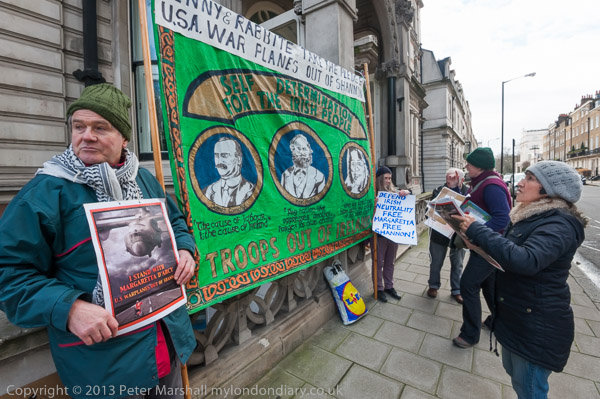
Next was a picket at the Irish Embassy close to Marble Arch to demand the immediate release of Margaretta D’Arcy, imprisoned for protesting against illegal US flights from Shannon Airport, and now in Mountjoy Women’s Prison, Dublin. More about this at Free Margaretta D’Arcy picket.


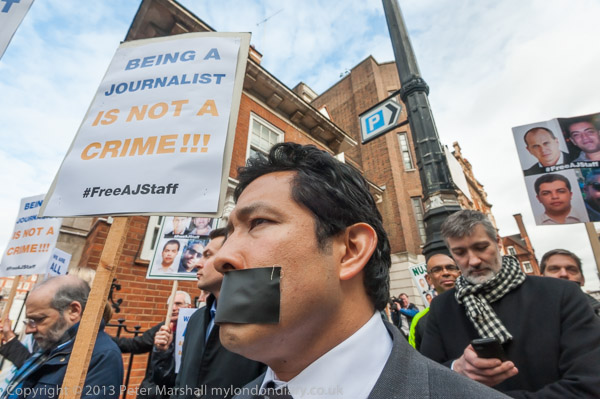
Third was a protest called by my own union the NUJ at the Egyptian Embassy in Mayfair, for press freedom in the country and calling for the release of all jailed journalists, including the four Al Jazeera journalists. More at NUJ demands Egypt release jailed journalists.

All photographs on this and my other sites, unless otherwise stated, are taken by and copyright of Peter Marshall, and are available for reproduction or can be bought as prints.