More Around Mayfair 1987

South Audley St, Mayfair, Westminster, 1987 87-5i-52-positive_2400

Mayfair is one of my least favourite areas of London, and one where I often felt uncomfortable photographing. And one where I often had to point out to people that the law allows photography in public places including taking pictures of people and private property. But it was an area I felt I had to photograph, and where there is a great wealth of architecture and architectural detail. These pictures are just a few from page 4 of my album 1987 London Photos.

South Audley St, Mayfair, Westminster, 1987 87-5i-53-positive_2400

Many of these buildings will have been photographed many times before, but I think some have been overlooked, and what pictures are available don’t always show them well or in their setting.

New Bond St, Mayfair, Westminster, 1987 87-5j-43-positive_2400

As well as buildings, these are also pictures of cityscape, and arguably bad buildings have as much place as good ones in a record of the city. Since I took these pictures there have been changes, both in the city and also so far as images of it are concerned. Around the Millenium, volunteers from the Royal Photographic Society photographed most of our listed buildings for the National Building Record – with very mixed results, but more comprehensively we now can all view the streets though Google’s roving camera – of great use to me for finding the locations where I photographed. But useful though this is, it often does not include the exact view I want to see or which shows the subject best – and certainly never penetrates the alleys and off-street viewpoints of many of my pictures.

Brook St, Mayfair, Westminster, 1987 87-5j-46-positive_2400

Excessive wealth seldom seems to come with a great sense of taste, as the shops of Mayfair (and some of its buildings) bear witness. And in one shop window I found a dummy that seemed to me to express the arrogance of wealth so clearly. Of course in some of the art dealers there were paintings and prints which I admired, and I did go into a few of the galleries to see more.

South Audley St, Mayfair, Westminster, 1987 87-5j-01-positive_2400
Brook St, Mayfair, Westminster, 1987 87-5j-34-positive_2400
Mount St, Mayfair, Westminster, 1987 87-5j-53-positive_2400
Mount St, Mayfair, Westminster, 1987 87-5j-65-positive_2400

There is a long tradition of photographers taking self-portraits, and in one shop window I couldn’t resist giving myself a new head and making the square of the plinth below seeming to be in my hands as a large plate camera. It took a little guesswork to get it right, and ideally I should have been just a few inches closer so that my hair wasn’t visible as a small crescent above the head in the window., but I was surprised to get it as close as I did.

Mount St, Mayfair, Westminster, 1987 87-5j-55-positive_2400

Nowadays a flip-down screen on the back of the camera would let me line this up without problems. Then I had to look through the viewfinder to try and get myself in the right position, then lower the camer and hope. You can see the reflection of my camera lens and camera in the middle of the plinth, and also the unintended tilt of the image as I failed to keep the camera completely level.

More on page 4 of my album 1987 London Photos.


All photographs on this and my other sites, unless otherwise stated, are taken by and copyright of Peter Marshall, and are available for reproduction or can be bought as prints.


Notting Hill 1996

for sep 4th

Notting Hill Carnival, 1996. Peter Marshall 96-823-46-16_2400

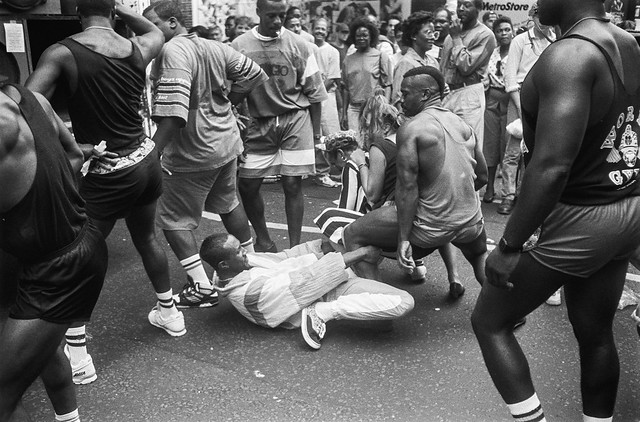
For 1996 I was back to working with black and white, and it was a year which produced a few of my favourite images of Carnival. I’d looked at the results from the previous year and found the colour often distracting. It was the people that attracted me, not the colourful costumes.

Notting Hill Carnival, 1996. Peter Marshall 96-89-34_2400

I took around 800 black and white pictures over the two days of carnival in 1996, but cannot find a single colour image. Unlike for some of the earlier years I haven’t recently reviewed the whole set of pictures and there may be a few more to add when I do so.

Notting Hill Carnival, 1996. Peter Marshall 96-814-54-16_2400
Notting Hill Carnival, 1996. Peter Marshall 96-816-24 (2)_2400
Notting Hill Carnival, 1996. Peter Marshall 96-817-41s_2400
Notting Hill Carnival, 1996. Peter Marshall 96-823-14-16_2400

You can see more of the pictures from 1996 (and other years) in my album Notting Hill Carnival in the 1990s. The pictures from 1996 start towards the bottom of page 2.

I’ll post some more from Notting Hill later in the year when I’ve added more pictures to this album.


All photographs on this and my other sites, unless otherwise stated, are taken by and copyright of Peter Marshall, and are available for reproduction or can be bought as prints.


Notting Hill 1995

Notting Hill Carnival, London, 1995 Peter Marshall 95-8-20-63_positive_2400

Notting Hill was in colour for me in 1995. Although I’d taken a few colour pictures in earlier years, this was the first year I decided to work entirely in colour – except for a few frames finishing a black and white film in one of my cameras.

Notting Hill Carnival, London, 1995 Peter Marshall 95-8-21-70_positive_2400

I’ve never really gone back to look at the colour pictures I took in earlier years – something now on my ‘to do list’, as the black and white interested me rather more. But I think I had been encouraged to cover the event in colour by one of my potential clients – not an actual commission, but a suggestion that they might be more interested in colour, and I’d thought it would be interesting to try and see if I could do the kind of things I’d already done in black and white.

Notting Hill Carnival, London, 1995 Peter Marshall 95-8-11-47-positive_2400
Notting Hill Carnival, London, 1995 Peter Marshall 95-8-11-37-positive_2400

It wasn’t of course the first time I’d worked in colour. I’d taken colour pictures for as long as I’d been involved in photography, alongside black and white, but generally of rather different subjects. I’d switched from using colour transparency to colour negative film ten years before I took these pictures, but still hadn’t really worked out a good system for dealing with the work. At first I’d had everything trade processed and getting enprints. It’s a good system for the occasional film such as holiday snaps, but when you get thousands of them it becomes a little difficult to organise.

Notting Hill Carnival, London, 1995 Peter Marshall 95-8-15-57-positive_2400

By 1985 I was developing my own colour films – along with the mainly chromogenic black and white films I was also using which could be developed in the same chemicals. Making contact sheets from colour negatives on colour paper was a little more difficult because I had to work in total darkness (or virtually so) and colour filters had to be used to expose them. The results were often not very useful, unlike those from black and white, and selecting images from them was rather hit and miss.

Notting Hill Carnival, London, 1995 Peter Marshall 95-8-18-55-positive_2400

Last week I digitised every frame of all 18 films I took at carnival in 1985 – around 670 pictures – batch processing the results to give a roughly balanced image, discovering quite a few pictures I had previously overlooked. Around a third were worth further processing, and after eliminating some near duplicates and a further round of culling I was left with around 140 I felt were worth adding to the album Notting Hill Carnival – the 1990s. The colour work begins on page 3.

Notting Hill Carnival, London, 1995 Peter Marshall 95-8-18-60-positive_2400

None are great pictures, though I think all have some interest. As a whole I felt they backed up my decision to work mainly in black and white in other years. But while some are similar to my black and white pictures, others do show another view of carnival.


All photographs on this and my other sites, unless otherwise stated, are taken by and copyright of Peter Marshall, and are available for reproduction or can be bought as prints.


Notting Hill 1994

I had a good year at Carnival in 1994, taking some of the pictures of the event I like best, and I think rather more varied than some years, as these pictures show:

Notting Hill Carnival, 1994. Peter Marshall 94-8bj-65_2400
Notting Hill Carnival, 1994. Peter Marshall 94-8bk-46_2400
Notting Hill Carnival, 1994. Peter Marshall 94-8bl-62_2400
Notting Hill Carnival, 1994. Peter Marshall 94-8bl-63-8_2400
Notting Hill Carnival, 1994. Peter Marshall 94-8bn-43-16_2400
Notting Hill Carnival, 1994. Peter Marshall 94-8bc-51-16_2400
Notting Hill Carnival, 1994. Peter Marshall 94-8bf-43_2400
Notting Hill Carnival, 1994. Peter Marshall 94-8bf-52-16_2400
Notting Hill Carnival, 1994. Peter Marshall 94-8bh-36-16_2400

You can see more pictures from 1984 – and other years – in my Flickr album.


All photographs on this and my other sites, unless otherwise stated, are taken by and copyright of Peter Marshall, and are available for reproduction or can be bought as prints.


Notting Hill 1993

I’ve started, so I might as well finish. Here are a few of my pictures from Notting Hill Carnival in 1993, still in black and white. I did take a few in colour, probably using up a film already in the camera, but I’ve not really looked at them yet. Perhaps in a few days I’ll find time.

In the 1990s I was still working as a full-time teacher in a Sixth Form and Community College, and too often we seemed to start the term the Tuesday after carnival and I would go into work with ears still ringing part-deafened from the previous day. Carnival wasn’t just loud on the ears, the tarmac of the street vibrated with the beat, and so too did your internal organs, your whole body dancing to the music. It took me a few days to recover. Fortunately the first few days of term were mostly taken up with administration and not actual teaching.

It’s now around 20 years since I left full-time teaching to earn a living through writing and photography so even had I been able to go to carnival I wouldn’t be worried about going in to work today.

I seem to have taken rather fewer pictures than usual in 1993, or at least to have scanned rather fewer. I was in Notting Hill on both the Sunday and Monday and made almost 500 exposures, but there are only 17 in the album from that year. Looking at the contact sheets I think there are probably a few more worth adding when I have time.

Notting Hill Carnival, 1993. Peter Marshall 93-8bl-61_2400
Notting Hill Carnival, 1993. Peter Marshall 93-8bm-33_2400
Notting Hill Carnival, 1993. Peter Marshall 93-8bp-62_2400
Notting Hill Carnival, 1993. Peter Marshall 93-8bf-43_2400
Notting Hill Carnival, 1993. Peter Marshall 93-8bg-12_2400
Notting Hill Carnival, 1993. Peter Marshall 93-8bj-21-8_2400
Notting Hill Carnival, 1993. Peter Marshall 93-8bl-53_2400

More in the album Notting Hill Carnival – the 1990s


All photographs on this and my other sites, unless otherwise stated, are taken by and copyright of Peter Marshall, and are available for reproduction or can be bought as prints.


Notting Hill 1992

We can’t go to carnival this year so I’m posting some pictures from previous years – today from 1992.

Notting Hill Carnival, 1992. Peter Marshall 92-8aa-12_2400
Notting Hill Carnival, 1982. Peter Marshall 92-8ab-15-16_2400
Notting Hill Carnival, 1992. Peter Marshall 92-8ac-55_2400
Notting Hill Carnival, 1992. Peter Marshall  92-8af-33_2400
Notting Hill Carnival, 1992. Peter Marshall  92-8ag-014_2400
Notting Hill Carnival, 1992. Peter Marshall 92-8ag-46_2400
Notting Hill Carnival, 1992. Peter Marshall 92-8ab-23_2400
Notting Hill Carnival, 1992. Peter Marshall 92-8ac-52_2400

I think all except one of these pictures were taken on Ladbroke Grove north of the station, the odd one out being the Kensington Food Centre a few yards away on the corner of Chesterton Rd and St Lawrence Terrace.

More pictures on Flickr in Notting Hill Carnival – the 1990s.


All photographs on this and my other sites, unless otherwise stated, are taken by and copyright of Peter Marshall, and are available for reproduction or can be bought as prints.


Notting Hill 1991

Notting Hill Carnival, 1991. Peter Marshall 91-8au-36-Edit_2400

We can’t go to carnival so I’m posting some pictures from previous years – today from 1991. These pictures are now on Flickr in an album of my black and white pictures from the event in 1990-2000.

Notting Hill Carnival, 1991. Peter Marshall 91-8au-33-Edit_2400
Notting Hill Carnival, 1991. Peter Marshall 91-8aq-11-Edit_2400
Notting Hill Carnival, 1991. Peter Marshall 91-8ap-43-Edit_2400
Notting Hill Carnival, 1991. Peter Marshall 91-8ap-16-Edit_2400
Notting Hill Carnival, 1991. Peter Marshall 91-8an-11-16_2400
Notting Hill Carnival, 1991. Peter Marshall 91-9a-52_2400

Some of these pictures have already been widely published – and one has appeared this year in various publicity features about the Museum of London’s show opening this October, ‘Dub London: Bassline of a City’ such as ‘BOOM! There’s a new show about dub at the Museum of London‘ in Time Out.

I took a look back through all of the contact sheets – well over a hundred – in 2018 while I was putting together a set of images for a Café Royal book. Several of the new images I found made their way into ‘Notting Hill Carnival in the 1990s’ but many others are in the Flickr album. The book sold well, and is now only available from them in an archive set, Archive 4, a limited edition of 100 different books, costing around a thousand pounds. I still have a few copies of this and also ‘Pride Not Profit London 1993-2000’ and can supply direct to UK addresses for £8 each including postage – contact details here. Several other of my books are still available at Café Royal.


All photographs on this and my other sites, unless otherwise stated, are taken by and copyright of Peter Marshall, and are available for reproduction or can be bought as prints.

Notting Hill 1990

Notting Hill Carnival, 1990. Peter Marshall 90-821-51_2400

Were we in normal times, today I would be thinking about going to Notting Hill tomorrow for the first of two days of Carnival. Much to my surprise I find it was eight years ago that I last went, having been on holiday away from London several years, and deciding the weather wasn’t really right some others. But perhaps I’m just getting old and was finding the music and the crowds too much some other times. At least this year I don’t have to make a decision.

Notting Hill Carnival, 1990. Peter Marshall 90-822-63_2400

The Notting Hill Carnival’s origins are in a ‘Caribbean Carnival’, an indoor event organised by Claudia Webb in 1959, the year after the Notting Hill race riots. The first procession was an impromptu one in 1966 from a neighbourhood street party, but it was in the mid-1970s that in began to be a major festival with a large attendance. But heavy-handed policing led to battles between mainly Caribbean youth and the police, luridly reported by newspapers and broadcast media which made many of us reluctant to attend the annual event.

Notting Hill Carnival, 1990. Peter Marshall 90-820-14_2400

August was in the 1980s was also a month when I was often in Paris and it was only in 1990 that I decided I had to go and photograph Carnival, and was both deafened and exhilarated by the energy and joy of the event. For the next twenty or so years – with a few exceptions when I was out of the country or crippled by injury – I photographed the event, at first mainly in black and white but later on colour film and then digital.

Notting Hill Carnival, 1990. Peter Marshall 90-822-64_2400

I’ve just spent a day putting my black and white pictures from the first ten years I attended, starting in 1990, onto Flickr. Some of them have been seen before in a number of group shows, including one in Notting Hill itself. I had a small one-person show at the Museum of London in the late 1990s, and put some on the web at Fixing Shadows, one of the first sites showcasing ‘straight photography’ on the web. This led to a 20 print portfolio with comments by George Mentore, published as ‘Notting Hill in Carnival’ in Visual Anthropology Review in 1999. I also showed the same number of prints in ‘English Carnivals‘ at the Shoreditch Gallery and Barbican Library in 2008, and later in the 2018 Café Royal volume, ‘Notting Hill Carnival in the 1990s’.

Notting Hill Carnival, 1990. Peter Marshall 90-828-45_2400

But for the Flickr album, which now contains 260 photographs, most of them published for the first time, I went back to the contact sheets. Most of those early years I went on both the Sunday – Children’s Day and the Bank Holiday Monday, probably averaging around 300 exposures on each. Probably a total of over 6000 images. But some of those were in colour, a few panoramic, so the 260 are from perhaps 4500 black and white frames. They include quite a few I wonder why I haven’t shown them before.

Notting Hill Carnival, 1990. Peter Marshall 90-824-13_2400

Technically they are quite varied, including some I’ve carefully balanced and retouched for publication and others that are untouched raw scans. Not every picture is critically sharp, as I was often working with no time to refocus and sometimes while in the middle of dancing crowds and concentrating on emotion rather than technique.

Notting Hill Carnival, 1990. Peter Marshall 90-818-56_2400

All the pictures in today’s post are from my first year at Carnival in 1990, when I think I was just beginning to get into the subject. More from 1991 and later to follow.


All photographs on this and my other sites, unless otherwise stated, are taken by and copyright of Peter Marshall, and are available for reproduction or can be bought as prints.


Meridian 3

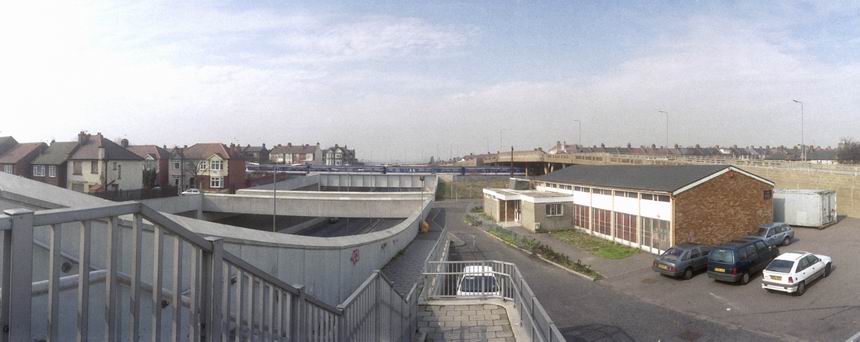
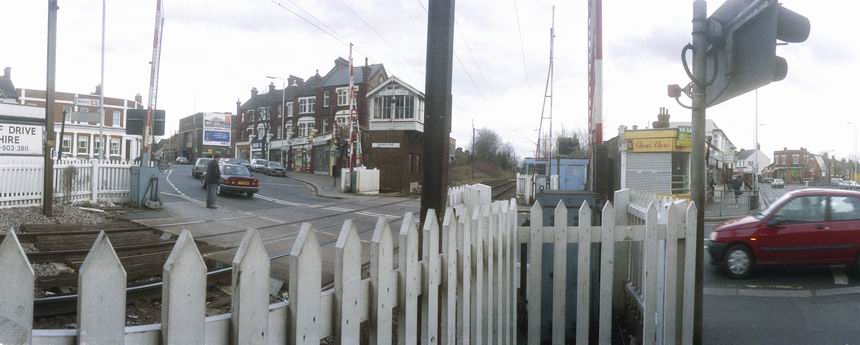
Following the Greenwich Meridian is rather easier since the Ordnance Survey helpfully added it to their 1:25000 maps in 1999, but these pictures were made five years earlier in my project in preparation for the Millennium. I’d had to draw my own pencil line in their maps, which fortunately did show in their outer margins the Longitude at one minute intervals, including 0°00′, so it wasn’t hard to add the line.

I’ve never quite understood why the National Grid doesn’t quite align with this, the Prime Meridian, but presumably there were good reasons for choosing another starting point and working very slightly at an angle. The street maps which I needed to work out my actual route as they had the street names follow the National Grid, though they rather hide this behind their own system of letters and numbers based on half-kilometre squares.

For the northern part of my walk, the Meridian ran roughly down the gap between two pages of my Master Atlas of Greater London, a book too large and heavy to carry on my walks, and I marked out my route with highlighter pens on illegal photocopies of its pages.

There are several crossings of Southend Road, the North Circular Road at this point close to the Meridian which I think was actually a few yards to my east as I took a picture looking roughly west. But the road layout had changed a little from that since my OS map had been revised. It was a view which made a better picture – and close enough to the line for me, as was the level crossing at Highams Park – where again the actual line is a few yards behind me – to the west.

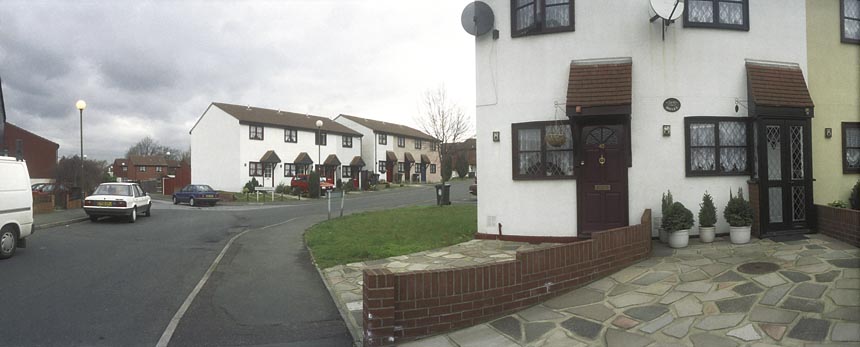
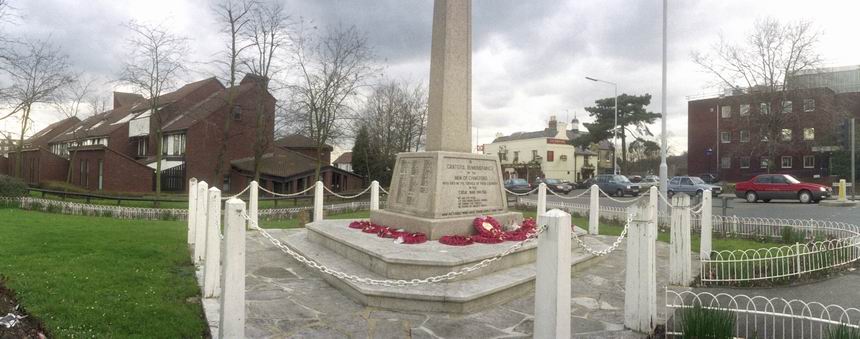
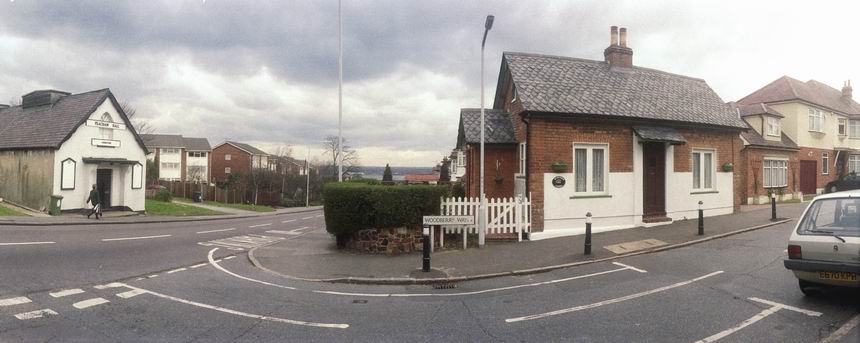
The view of Mapleton Rd and Stapleton Close (wrongly titled Mapleton Drive in my notes) is perhaps a hundred yards west of the Meridian, but close enough for me. The war memorial at the junction of The Ridgeway and Kings Head Hill is spot on target, while Woodberry Way is perhaps around a hundred yards to the west.

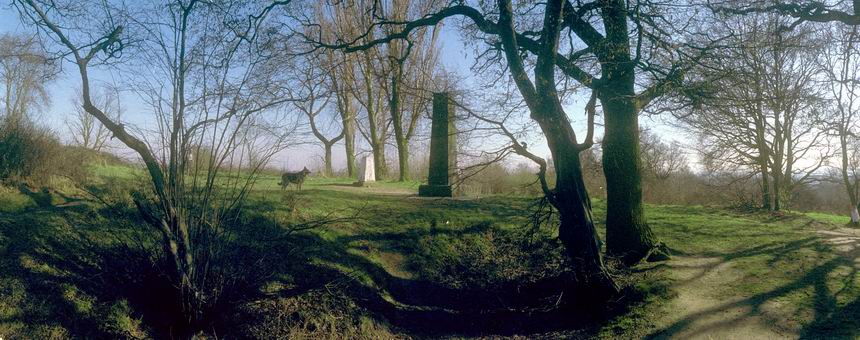
Finally, Pole Hill has two markers; the obelisk, set up by the Astronomer Royal to align his telescope in Greenwich due north is on the old Meridian, but the trig point to its left is on the version adopted internationally (except by France) in 1884. Nowadays we use GPS based on the International Terrestrial Reference Frame which has its zero meridian 102.478 metres further east.


All photographs on this and my other sites, unless otherwise stated, are taken by and copyright of Peter Marshall, and are available for reproduction or can be bought as prints.


Sharp Pictures

Jack Sharp, (1928-1992), born in Bedfordshire became an engineer and moved in 1955 to take up a job at CERN , the European Organization for Nuclear Research which had been founded the previous year and is based in Geneva, Switzerland. CERN is now best known for investing the World Wide Web and as the home of the Large Hadron Collider, but this large scientific community also – at least then – had an amateur photographic club, which Sharp joined and which stimulated an interest in photography that lasted at least until 1970 when, for reasons unknown, he apparently stopped taking pictures.

In a self-portrait he looks a typical scientist of the time, with carefully brushed hair and bow tie, looking into the eyepiece of his tripod-mounted Asahi Pentax SLR camera, his other eye closed as he presses the short cable release. Sharp was obviously a man who took his photography very seriously – as you might expect from his scientific training – with details of each frame taken noted on index sheets.

Of course records such as this were common practice at the time, with photographic magazines and books publishing shutter speeds and aperture in the photo captions. There were special photographer’s Notebooks sold, and filing sheets to hold film negatives in binders often came together with paper sheets to record the details. Photography at this time was largely taught as a science rather than an expressive practice. At the end of Bill Brandt’s ‘Camera in London‘ (1948) is a section of technical data, listing his cameras, lenses and films and with a fold-out table listing each picture in the book with ‘Subject’, ‘Camera’, film speed, ‘Stop’, ‘Exposure’ (time), year and lighting conditions.

Even when I began to get pictures published you would often be asked for such details, though by the 1970s I think most of us simply looked at the picture and made them up. But when I started I carried little cards on which to record exposures even if I seldom used them.

I first read his story in a PetaPixel post, Man Inherits Treasure Trove of Unseen Street Photos From His Grandfather, which tells the story of how Sharp’s grandson, Dylan Scalet, a marketing professional who came to England 8 years ago to take a university photography course had time on his hands because of COVID-19 and started to look at and digitise some of his grandfather’s collection and found some truly interesting images.

You can see these images larger on the web site set up by Scalet, who is also publishing a new image each day on Instagram. Scalet estimates he has inherited over 5,000 of his grandfather’s images and has bought an Epson V850 flatbed to scan them. It isn’t a bad scanner for scanning film, though more suitable for larger formats than the 35mm used by Sharp. But I’ve made several books for friends scanned using this or a similar Epson model and used it to scan some of my own work.

Though much faster than a dedicated film scanner, using the Epson is considerably slower than photographing negatives using a macro lens and digital camera – and can’t match either the resolution or quality. But it is simpler and more or less foolproof and comes with reasonable software.

Sharp’s work – or what I’ve seen so far of it – is often interesting and certainly technically very competent as you would expect. It isn’t work that is going to change our view of the history of photography, fitting well into the general run of photography in the times that he worked and at least sometimes a delight to look at. But it does certainly bear out my often voiced opinion that the photography we know and admire is just the tip of a very large iceberg.