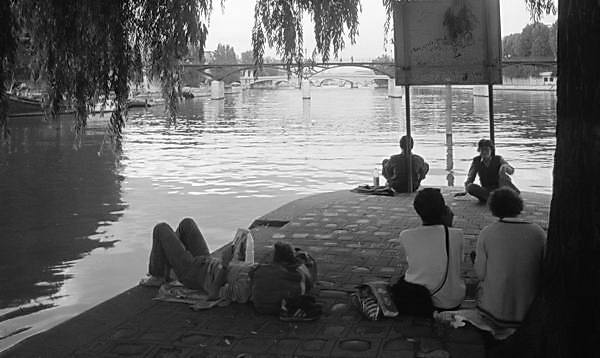
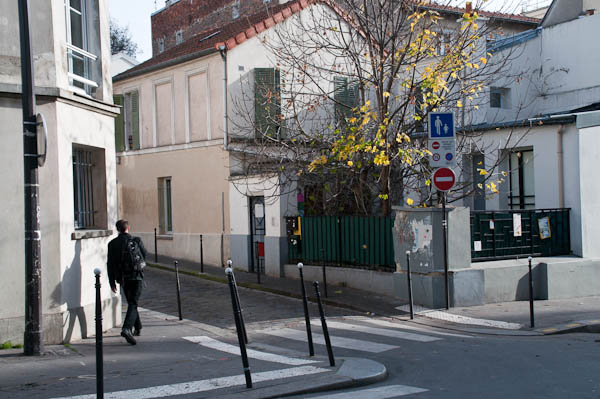
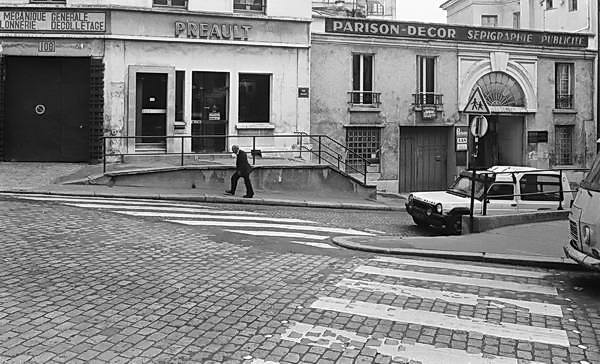
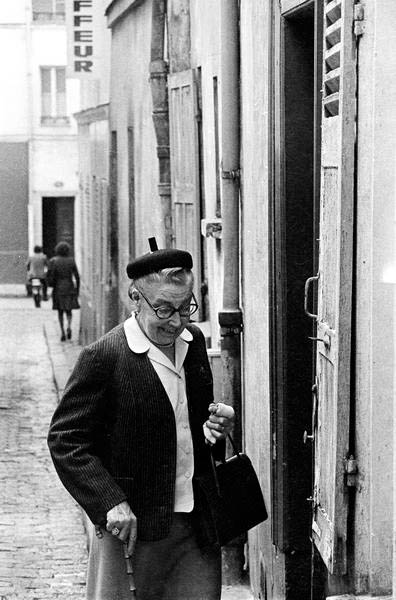
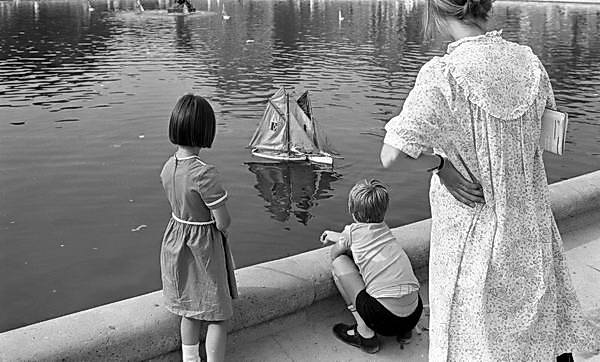
Montreuil is of course not Paris, not inside the old walls or the modern municipality, but a commune at its eastern edge, only four miles from the centre of Paris, an ancient settlement now separated from the city by its modern wall, the Boulevard Périphérique.
I don’t now recall exactly where we stayed, somewhere a short walk from Robespierre (the Metro Station not the man) and just a little further from the RER at Vincennes.
Rue Douy Délcupe, Montreuil,
Long before the days of Airbnb we had leased a flat from a colleague of my brother-in-law’s wife who had gone south for a month in a gîte for August – like most of Paris. It was a spacious flat for its usual single occupant, but a little cramped for our family of four, and while the boys shared a bed, we slept on a mattress on the floor, which was comfortable enough.
Most days I went out for a walk before breakfast to buy bread and sometimes croissants, often with one of my sons, and always with a camera. Many of the bakers were closed for August and others took it in turns to be open for a week, making some of these walks a little longer, and I often diverted down streets that looked interesting.
We also went for family walks around the area, though on the first Monday of our visit went to a photo-booth to get portraits for the boys to get them their ‘Carte Orange (we still had cards from a previous visit) and then bought our ticket for what seemed a ridiculously cheap week of travel on the Metro system – I think little more than the cost of a day travelcard in London.
Once equipped with these we spent most of our time in Paris, but still occasionally walked around Montreuil on our way back to the flat or after our evening meal there rather than return to the city.
There are more pictures of Montreuil and other places in and around Paris in the album ‘Around Paris 1988‘ and clicking on the pictures above will take you to a larger version in the album, from where you can browse them others. The images here all come from the first day or two we were staying there and are all a short walk away from the flat. I’ll feature some more in later posts.
All photographs on this and my other sites, unless otherwise stated, are taken by and copyright of Peter Marshall, and are available for reproduction or can be bought as prints.
I’m missing Paris. My first visit there was in 1966, when I spent a week or two in a Protestant student hostel a few miles south of the centre with my future wife – though in separate double rooms, each with another of the same sex – and students from around the mainly Francophone world. After breakfast each day we took the train for the short journey to the Left Bank and spent the day as tourists in the city and nearby attractions, though mainly just walking around the city as we were both still penniless students.
Paris 2008
We lunched outdoors in parks and squares, buying baguettes and stuffing them with chocolate or pate as we couldn’t afford cafes or bars, eating cheap fruit for afters. We went out of Paris to Versailles, where I managed to drop my camera in the lake as we climbed into a boat to row around the lake. The boatman fished it out and handed it back to me as we got out of the boat, rather obviously expecting a reward, but all I could afford was my thanks. The camera never worked reliably after that, and it was five years before I could afford to replace it.
We returned to the hostel for an evening meal, which introduced me to some very strange dishes – and I think one evening as a special treat we were given a kind of horsemeat stew; it tasted fine, but I’ve never sought to repeat the experience. After dinner we crowded into a room with the rest of the inhabitants to watch the games of the World Cup, though I’d gone home before the final.
Quai de Jemappes / Rue Bichat, 10e, Paris, 1984
It was some years before we could afford another foreign holiday – we’d spent our honeymoon in Manchester with a day trip to the Lake District, a visit to Lyme Park and some walks around Glossop. But in 1973 we were back for a couple of weeks in Paris, this time at a hostel in the centre and sharing a room. We took with us the Michelin Guide (in French) and I think followed every walk in the book, which took us to places most tourists never reach – it was then much more thorough than the later English versions.
Monmartre, 1973
In 1973 I had two cameras with me. A large and clunky Russian Zenith B with its 58mm f/2 Helios lens and a short telephoto, probably the 85mm f2 Jupiter 9, but also the more advanced fixed lens rangefinder Olympus SP, with its superb 42mm f1.7 lens, a simple auto exposure system as well as full manual controls. I needed my Weston Master V exposure meter to work with the Zenith. You can see more of the photographs I took on my Paris Photos web site. Some of these pictures were in my first published magazine portfoliolater in 1973.
It was a while before we returned to Paris, though we went through it by train on our way to Aix-en-Provence and on bicycles from between stations on our way to the Loire Valley in the following couple of years. Then came two children, and it was 1984 before we returned to the city with them when I came to photograph my ‘Paris Revisited‘ a homage to one of the great photographers of Paris, Eugene Atget, which you can see in the Blurb Book and its preview as well as on my Paris Web site.
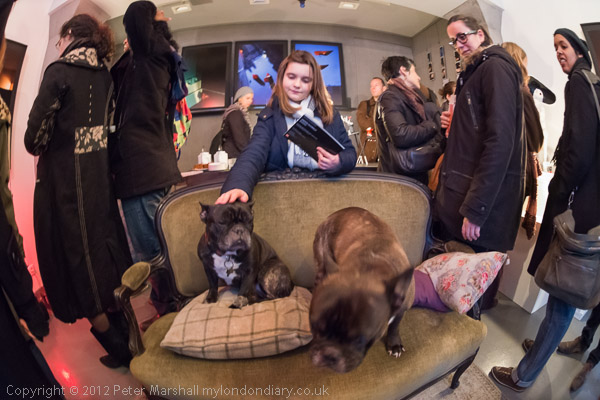
Placement libre-atelier galerie, Paris 2012
We returned to the city several times later in the 1980s and 1990s, and more regularly after 2000, when I went in several Novembers for a week, usually with my wife, to visit the large Paris Photo exhibition as well as many other shows which took place both as a part of the official event and its fringe. One week there I went to over 80 exhibitions, including quite a few openings.
1988
But the last time I was in Paris was in November 2012. Partly because Paris Photo changed and there seemed to be less happening around it in the wider city than in previous years. We’d planned to go in 2015 but were put off by Charlie Hebdo shooting and later the November terrorist attack. More attacks in 2018 also put us off visiting France, but we’d promised ourselves a visit to Paris in 2020 – and then came the virus.
1988
While I’ve been stuck at home since March, I have been visting France virtually, going back to my slides taken in 1974 in the South of France, of our ride up the Loire Valley in 1975 and of Paris in 1984, all of which are now on Flickr. Most recently I’ve returned to Paris in 1988, with over 300 black and white pictures from Paris and some of its suburbs.
All photographs on this and my other sites, unless otherwise stated, are taken by and copyright of Peter Marshall, and are available for reproduction or can be bought as prints.
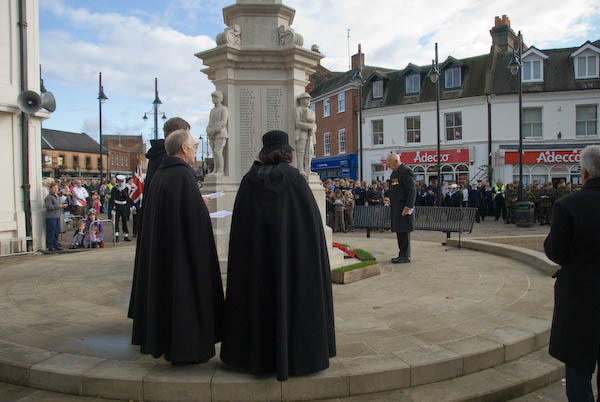
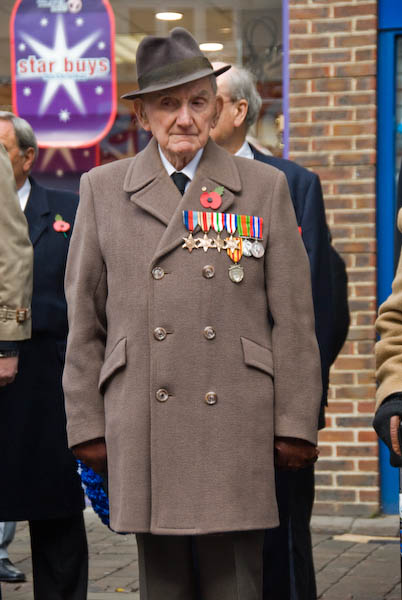
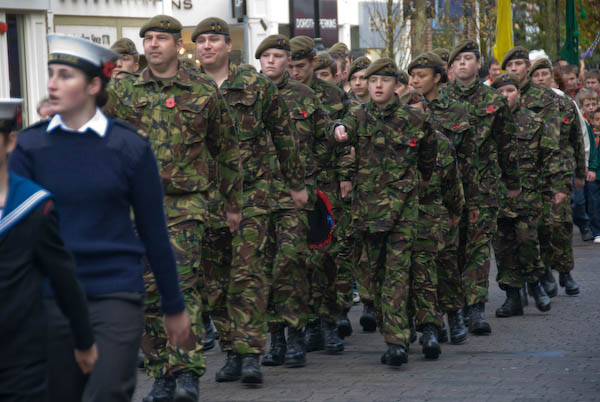
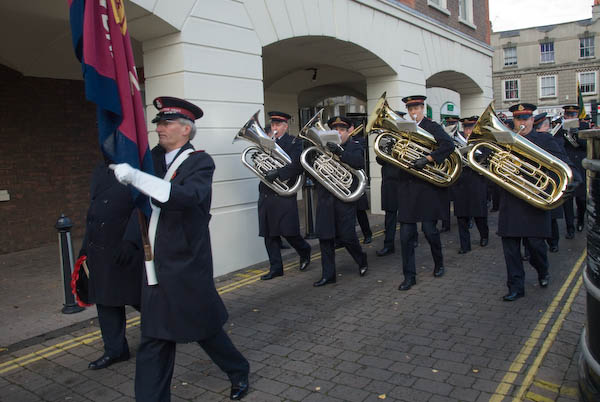
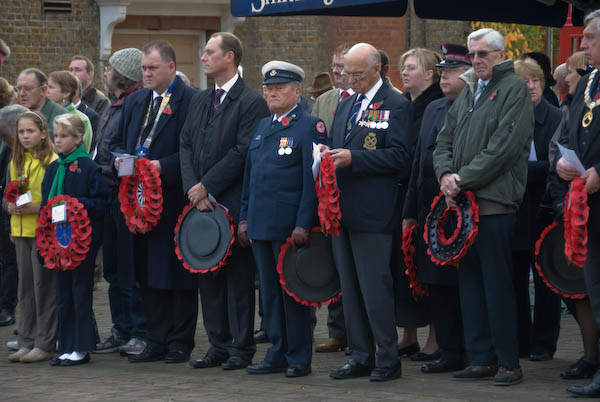
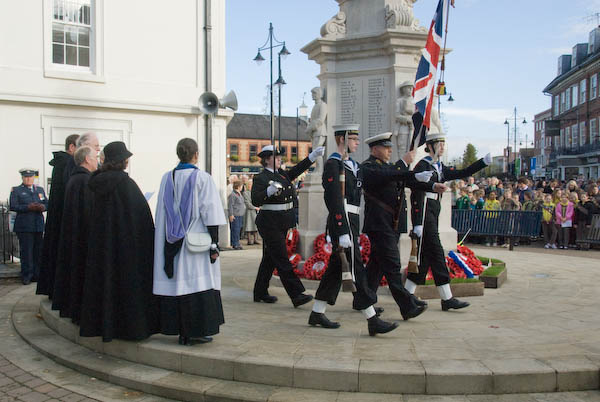
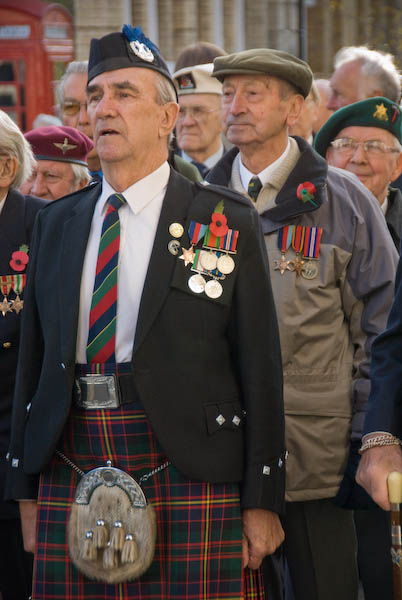
I have mixed feelings about Remembrance Day. Of course we should remember those who have died in wars, but the events which take place on Remembrance Sunday often seem to glorify war, and rejoice in military victory. Remembrance Day – or Armistice Day as we used to call it – is a day for more sombre observance and reflection, though it often passes most people by. Gone are the days when traffic across the nation stopped and cars pulled to the side of the road to observe the two-minute silence on the “eleventh hour of the eleventh day“.
My father served in the Great War, though he only joined up at the start of 1918. Before he had worked in a munitions factory, but had been laid off, and was called to a medical around his 18th birthday in December 2017. He was examined and the medical officer, after finding he was deaf in one ear asked him if he really wanted to join the army – and only passed him as fit when he said he did.
“I was given the number 119377 and the rank of 3rd Air Mechanic (called 3rd Ack Emma), and awarded the magnificent wage of one shilling plus one penny a day, seven days a week – the extra penny because I was designated Clerk.”
Fortunately for him it wasn’t until July 1918 that he arrived in France, and the airfields had to be a little back from the front line, and they only once came under fire. Dad was impressed by the many nationalities working together – more from his short life story he wrote in his 80s:
“Chinese coolies prepared our sites and probably erected buildings; and of course they dug the petrol holes out. There was every nationality represented amongst the troops and auxiliaries. It was amazing how varied an organisation the armies were. There were lots of horses, mules and bullocks pressed in to do the work. Then there were the Tommies and the Frenchies and all the other fighting men, all colours, marching backwards and forwards – Colonials, Indians, Africans; we had an Empire then!”
And this is his account of the Armistice:
“We were up near Courtrai when the armistice was announced – cwas it alled Bissingham or something like that? We stayed there until after Christmas and a lot of the old hands went home from there. I don’t remember doing much there. I think we had an inkling that it was coming, and I was crossing over to the flight sheds which were old “Jerry” ones when I met a civilian who shouted “La guerre fini ; tres bon, monsieur”; I replied “tres bon, m’sieur”. On Christmas Day we had a concert, and all of us who did not usually do guard duty were detailed to take a two hourly turn throughout the night. I went over to do my turn at the appointed hour. I saw no one there and came away when I thought the time was up.”
As one of the latest to join the war effort, Dad stayed on in what was now the Royal Air Force, becoming a part of the occupying British Army on the Rhine (BAOR) . It was only at the very end of 1919 that he was finally returned to England and demobbed early in 1920 – with back pay of £75 – equivalent to over £3000 allowing for inflation.
Of course Dad had a very easy though not entirely uneventful war compared to most, and he had made his choice to serve, although under conscription. But many of those who went – in this and the Second World War – had little choice. Dad did his bit back at home in the Second World War in various ways too, and a younger member of my wider family was killed in action. But like many I think his experiences of the war left him convinced of its futility, and although at home we observed Remembrance Day respectfully, there was none of the militarism that seems to be a part of the Remembrance Sunday parades which often seem to encourage the anti-German spirit of “Two World Wars and one World Cup”. That Great War was supposed to be the war that ended all wars, but sadly only led to more.
As a Wolf Cub, and later a Boy Scout I had to go and march with the troop and to stand in short trousers in the cutting November wind while bugles sounded and soldiers marched. As a photographer I’ve more recently photographed some of these events, though always with a little reluctance. In quite a few years I’ve been in Paris in November and back in 2013 I was in Germany, where they do not celebrate the armistice, but instead have a more inclusive national day of mourning to remember members of the armed forces of all nations and civilians who died in armed conflicts, and now include victims of violent oppression. As here there are church services and parades to lay flowers at war memorials but it seemed a much healthier event than those in this country.
Thomas Tenison (1636- 1715) was Archbishop of Canterbury from 1694 until his death. Archibishop Tenison School, Lambeth High St, and according to Wikipedia founded boys schools in Lambeth in 1685 and Croydon in 1714. A school for 12 girls began in Lambeth in 1706, and this was built as a new girls’ school in 1863. In 1961 the school amalgamated with a nearby Church of England boys school and this building went out of use, though it was later used as an annexe to the combined school until this closed in 1974. It has since been demolished and replaced by a hostel.
Bennett House in Page St, Wesminster is a Grade II listed tenement courtyard block of flats built in 1928-30. It was a part of the Westminster Housing Scheme for the Grosvenor Estate and Sir Edwin Lutyens acted as consultant; the listing text calls it “An imaginative Lutyens treatment of a standard LCC type of housing block.”
I admired the stark simplicity of the Unemployment Benefit Office on Chadwick St, Westminster. It remained in use – with changes in name – closing as a Job Centre Plus in 2017.
New office buildings seen from Old Pye Street in 1987. Parts of this still remain though rather more difficult to see.
The building on this corner still has the foundation stone laid by James S Burroughes in 1893, though it has moved a few yards around the corner and I think the site is now occupied by “modern purpose-built flats for single people and couples set in a city centre location” built by SAHA, the Salvation Army Housing Association and allocated through Westminster Borough Council’s housing register.
Avocet House at 92-96 Vauxhall Bridge Road was the home of Avo Ltd, a company founded by Post Office engineer Donald Macadie who was fed up with having to carry separate meters for different measurements and in 1923 designed a meter than would measure Amperes, Volts and Ohms. The Avometer was the leading electical test equipment for many years. The company became too large for this site and bought land for a new factory at Dover in 1962. The company is now called Megger, and its testers are still made and in use around the world.
This 1865 Grade II listed building in a free version of Italian Renaissance style by H A Darbishire was an orphanage for children of Crimean War guardsmen. Later it became a Franciscan friary, and they added the statue of St Francis just visible at the far corner around 1960. When they moved on it became offices. Close to Westminster Cathedral, in 2017 it was bought by the cash-strapped Roman Catholic Diocese of Westminster to be refurbished as a pre-prep for Westminster Cathedral Choir School, at a cost thought to be around £10million. The school is said to be the most expensive prep school in London, and sends pupils on to public schools including Eton and Winchester.
I don’t know which shop this was in Upper Tachbrook Street, but it appeared to be selling clothing, jewellery and similar items. From the few details of the shop front which can be seen it looks rather like that now occupied by ‘Mr CAD – For Everything Photographic’. This began around 1960 in Croydon, and although it at one time had nine branches at various sites from Colindale in north London to Brighton became just a giant Aladdin’s cave in Windmill Rd full of secondhand gear, moving to these rather smaller premises in Pimlico but also supplying mail order around the world as “the largest independent photographic dealer in the UKW with “the biggest stock of used analogue photographic equipment worldwide specialising in film, cameras, lenses, enlargers, chemicals, paper, all manner of studio & darkroom hardware & software.”
Clicking on any of the images above will take you to my Flickr album of over 750 images of London in 1987 selected from several thousand exposures I made that year
All photographs on this and my other sites, unless otherwise stated, are taken by and copyright of Peter Marshall, and are available for reproduction or can be bought as prints.
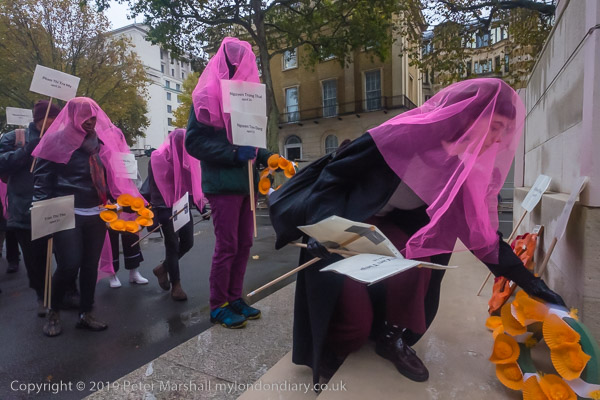
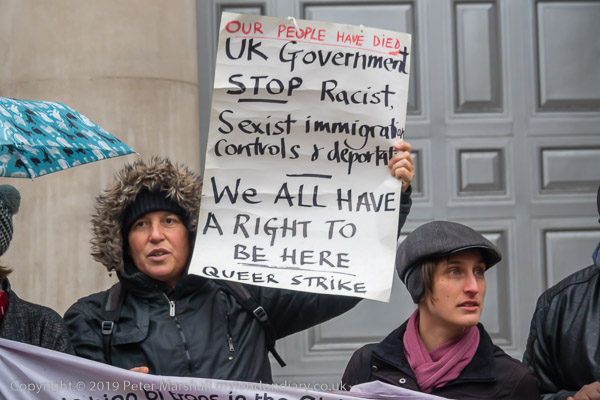
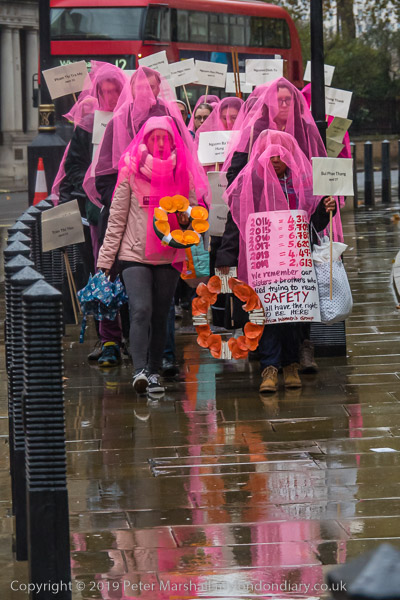
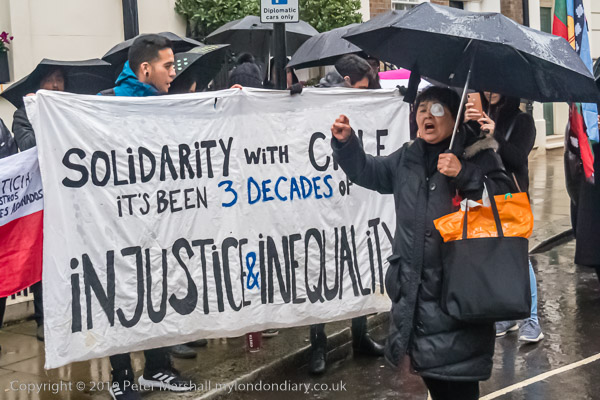
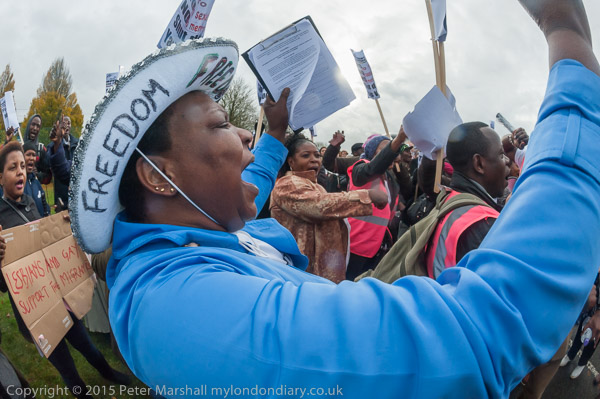
There is good news and bad news over the issues behind the two protests I photographed a year ago on a wet Saturday 9th November.
First the bad news: the UK has maintained its racist immigration policies which lead desperate refugees to endanger their lives to enter this country illegally. Although recent deaths among those crossing the channel have not been on the scale of the terrible deaths of the 39 Vietnamese who died in a container in Essex shortly before last year’s protest took place, the rhetoric against refugees has certainly been stepped up, with Home Secretary Priti Patel considering the use of the navy and even wave machines to sink the boats.
The death in late October of Kurdish-Iranians Rasoul Iran-Nejad, 35 years old, Shiva Mohammad Panahi, 35, Anita, nine, and Armin, six when a boat carrying around 20 people sank close to the French coast was a reminder of the dangers than many face. The government’s response was to blame the criminal activities of people smugglers, but these are only in business because legitimate routes are unavailable. Our government has failed to set up proper systems for allowing asylum seekers and refugees with family connections in the UK to come here despite being urged to do so.
Labour MP Yvette Cooper called for “effective support for refugees who’ve fled persecution to stop them getting sucked into the arms of criminal gangs or making such desperate journeys”. The UK and its allies bear a great deal of the responsibility for the wars and exploitation that cause desperate people to uproot themselves from their homes and seek the safety they see at the end of their dangerous journeys.
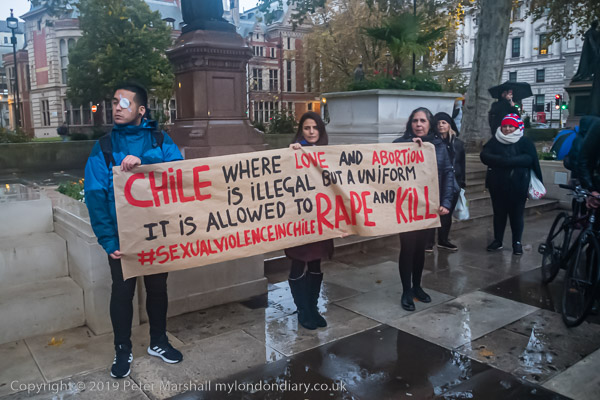
The second event I attended was a march and protest by Chileans against state violence in Chile. On My London Diary I wrote:
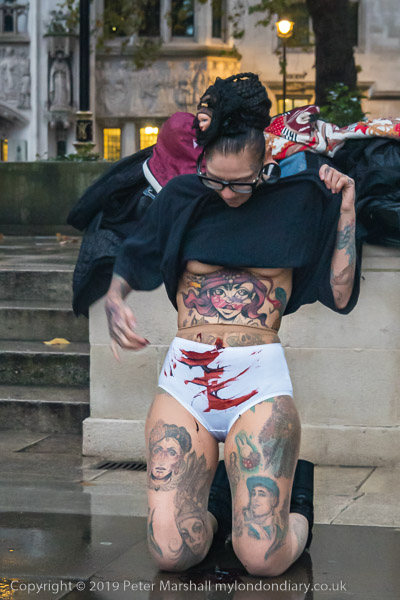
Police attacks on peaceful protesters have over 20 and injured thousands since protests began in mid-October. Many have been blinded and protesters wore with a gauze pads on one eye. They call for President Piñera to go. The protests have met with human rights violations including torture, sexual abuse and rape and thousands have been arbitrarily detained.
The march halted at Parliament Square where a group of women dressed in black performed in protest against the sexual abuses, smearing fake blood on pairs of white pants which they then removed and held above their heads.
Chile’s constitution had been written under the fascist Pinochet regime; Pinochet had come to power in a military coup on 11 September 1973, and in 1980 a new constitution was produced and approved by a rigged referendum. Another referendum in 1988 voted for his removal and led in 1990 an electionwhich removed him from office, though he remained as Commander-in-Chief of the Chilean Army until he retired in 1998.
The brutal repression by police of protests in Chile in October 2019 recalled the terrible human rights abuses of the Pinochet regime, when around 3,000 of his political opponents were killed, and many thousands held in jail and tortured under a US-supported campaign of political repression and state terror. Sickening methods of torture were used, with a huge amount of sexual violence against women. There were notorious cases with over a hundred people being thrown out of helicopters or aircraft. Around 2% of the population were forced into exile, gaining asylum in other countries. Before he left office Pinochet passed a law giving immunity from prosecution for these human rights abuses.
Sparked off by a metro fares increase, police violence soon made last October’s protests into a call for a new constitution and led to a referendum that, delayed by Covid-19, finally took place in October 2020, with a resounding 78% vote in favour, with many Chileans turning out to vote for the first time.
All photographs on this and my other sites, unless otherwise stated, are taken by and copyright of Peter Marshall, and are available for reproduction or can be bought as prints.
Although my caption states than this modern house is in Campden Hill Rd, its address is in Campden Street which leads off at the left of the picture. The building by architect Douglas Stephen is said to be in the style of pioneering Italian modernist architect Giuseppe Terragni, (1904-43), something perhaps best seen in his 1937 Villa Bianca in Seveso. I think like a similar larger block by Stephen in Bedford Gardens it was probably built in the mid-60s.
Le Gourmet Gascon gives I think a fairly clear idea of the population of this area of Kensington, where there is a takeaway service offering Quenelles au Brochet. The shop is no longer there and a short walk away you can now get rather more plebian food for tourists at Notting Hill Gate, though I think there is still no shortage of over-priced restaurants in the area and of course Fortnum & Mason still deliver.
Later in September I was back south of the river in Lambeth, and photographing in Lambeth. The terracotta carving above the doorway on the corner of Black Prince Rd and Lambeth High St is of Mr Doulton in his studio, and seated at left Hannah Bolton Barlow paints on one of the vases from his pottery, her pet cat under her chair.
Pottery was produced not far from this site in Vauxhall Walk by Jones, Watts & Doulton from 1815 and they moved to Lambeth High St in 1826. In the early years their most successful product was ceramic sewage pipes, for which their was a surge in demand driven by the 1846-60 cholera pandemic.
The company had several parts and a complex history but by the time this building was erected as their museum, school and design studio in 1871, with close links to Lambeth School of Art. The Lambeth studio pottery was producing signed works of art as well as more mundane items in the rest of the factory – and they later bought a factory in Burslem for making bone china tableware. The company only became Royal Doulton when it obtained a Royal Warrant in 1902. Production at Lambeth was forced to end in 1956 with the Clean Air Act which prohibited their salt glazing in this urban area, and all work went to the Potteries.
Doultons were major producers of the architectural terracotta or stoneware which adorns many Victorian buildings, and their building acted as a real life catalogue for their wares, though they also produced many specifically commissioned pieces as well as the more general stock.
A few yards up Lambeth High St is a view of this rather strange obelisk in the yard beside the (now former) headquarters of the London Fire Brigade, which moved to a new building here on a part of the former Doulton pottery factory site in 1937. This obelisk or ‘snorkel tower’ was built to provide ventilation for the war-time underground control room, according to the listing text “constructed to withstand a direct hit and a gas attack, with its own reserve electric light installation and forced ventilation.”
A short distance away in Lambeth Rd is another rather bulkier structure, also a ventilator, for the underground Metropolitan Police Central Communications Command Centre. A new special operations room was opened there in 2008, but there are also other communications centres in Bow and Hendon.
As this and other pictures in the Flickr album 1987 London Photos show, there was rather more evidence of the area’s industrial past then. This chimney and works was a former soap factory.
All photographs on this and my other sites, unless otherwise stated, are taken by and copyright of Peter Marshall, and are available for reproduction or can be bought as prints.
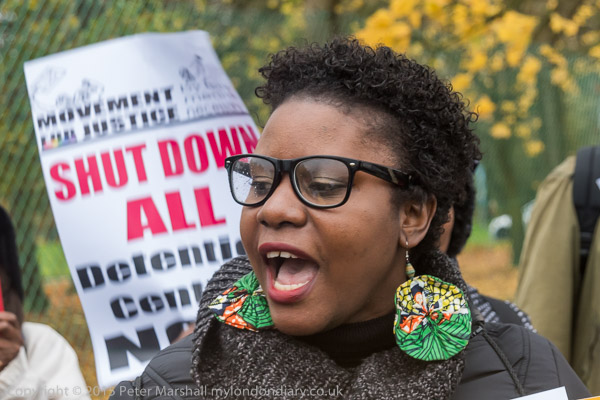
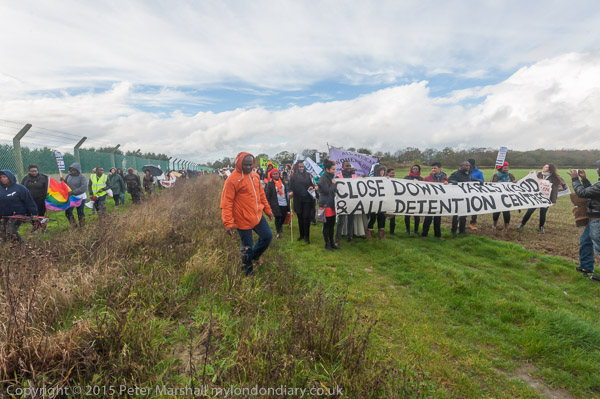
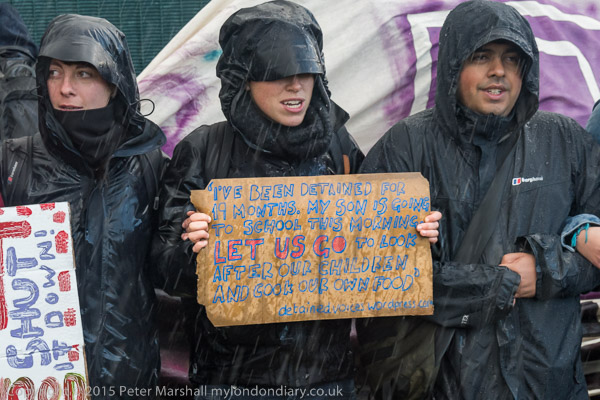
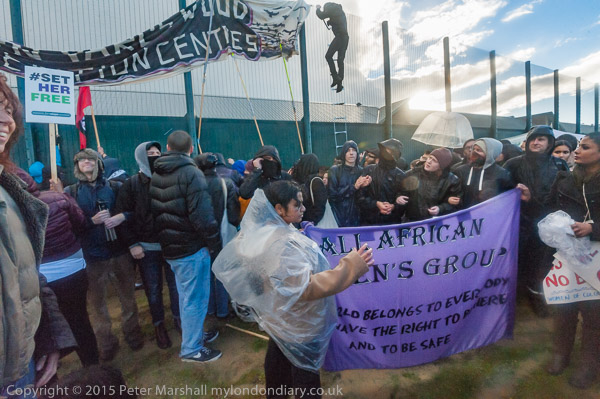
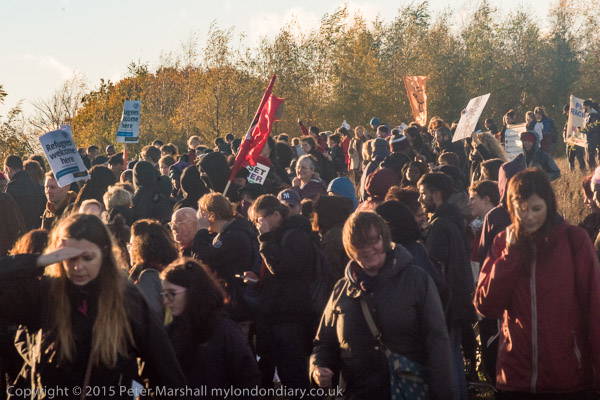
On November 7th 2015 I went to a protest outside Yarl’s Wood organised by Movement for Justice, calling for this and all immigration detention centres to be closed down. It was a cold and wet day, but fortunately the rain eased off at times.
As a result of the Covid-19 pandemic, the Home Office began moving detainees out from the Yarl’s Wood immigration centre, and all of them had gone by the middle of August. The centre which opened in 2001 had been used mainly to hold women, though there were also some families there. But the centre is not to be closed down, but is being used to house migrants who have come across the Channel. It seems likely they will be treated just as badly as the previous residents.
There was very little reason for most of those housed there over the nineteen years it was in operation to be held in a secure unit. They presented no danger to the rest of us and the centre provided none of the support that many needed, with inadequate health care, poor food and little or no counselling for the many vulnerable people who who had fled their countries because of violence against them including rape. Holding them in this fairly remote location with limited contact with the outside world made it difficult for them to prepare themselves for immigration hearings.
Some were found to have been illegally deported and many more were not given proper consideration before they were deported. But over half of those held there are simply eventually released, amny after months or even years of imprisonment – one woman was held for just a few days under 4 years. These people are not criminals but we treat them as if they were – though worse in some ways as their detention is indefinite at the the whim of the Home Office.
Yarl’s Wood had a particularly bad record, with abuse and sexual harassment and a failure to provide adequate care, highlighted both by official inspections and by undercover reporting for Channel 4 News. Many of those held inside have reported horrific stories of their mistreatment.
Yarl’s Wood is run for profit by Serco, whose CEO Robert Soames is the brother of former Tory MP Sir Nicholas Soames and is a grandson of Winston Churchll and a nephew of former Defence secretary Duncan Sandys. Like many of our leading Tory politicians he studied PPE at Oxford and was a member of the Bullingdon Club. Perhaps these kind of connections help the company in getting lucrative government contracts despite their poor record on delivery.
Serco have been given the most Covid-related government contracts among UK-listed companies and despite their failures with test and trace were recently awarded another £57 million contract for it – as with the others without any competitive tendering. Shadow Cabinet Office secretary Rachel Reeves commented “This government seems obsessed with shovelling huge sums of public money to a handful of outsourcing companies without competition, rigour or accountability“. Serco’s share price shot up by 17% on news of the latest government handout and they revised their profit forecast for the year upwards to £165m.
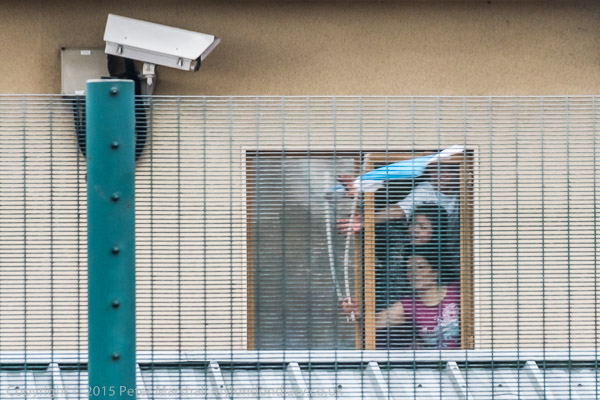
Yarl’s Wood is on an industrial estate created on a former Second World War air base in the middle of nowhere on the top of hills a little over 5 miles north of Bedford. Around 20 coaches brought campaigners from around the country, with a shuttle service bringing some from Bedford Station and others arriving by car, taxi and bicycle. Among them were a number of Movement for Justice supporters who had previously been held in this and other detention centres. Most of the speakers at the rally were former inmates, and we also heard from some of those inside who are allowed mobile phones and held up their numbers in the windows.
The protesters are not allowed into the Business Centre and instead walk along the road and across a several fields on a public footpath to reach a field on the edge of the centre which is surrounded by a 20 foot high fence. The bottom ten feet of the fence is made of solid metal panels and the centre can only be seen through the top half which is covered with a metal mesh.
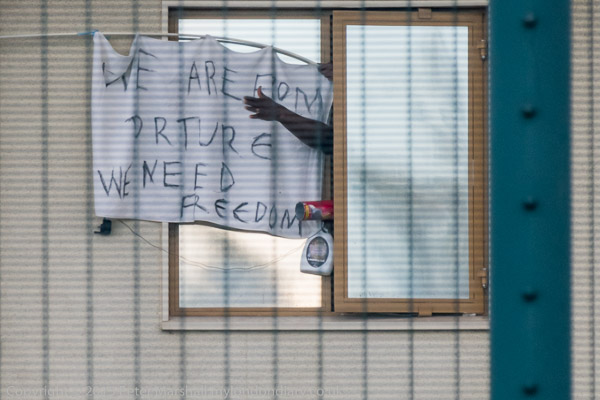
Photographing through this mesh presents some problems. Apart from partly blocking the view, my cameras autofocus systems prefer to focus on the mesh and it is generally easy to use manual focus. Standing on the small hill facing the centre gives a view of the top two floors of one wing of the centre above the solid metal fence. The windows of the centre can only be opened a few inches – just enough for those inside to wave a towel or clothing etc. And Serco staff try to keep the women inside away from the windows and in other parts of the centre, sometimes assaulting them to prevent them reaching these windows.
‘We Are From Torture We Need Freedom’
To get good views of the windows long lenses are needed, and require fast shutter speeds to avoid camera shake. I don’t really have the most suitable lenses for the job.
All photographs on this and my other sites, unless otherwise stated, are taken by and copyright of Peter Marshall, and are available for reproduction or can be bought as prints.
All photographs on this and my other sites, unless otherwise stated, are taken by and copyright of Peter Marshall, and are available for reproduction or can be bought as prints.
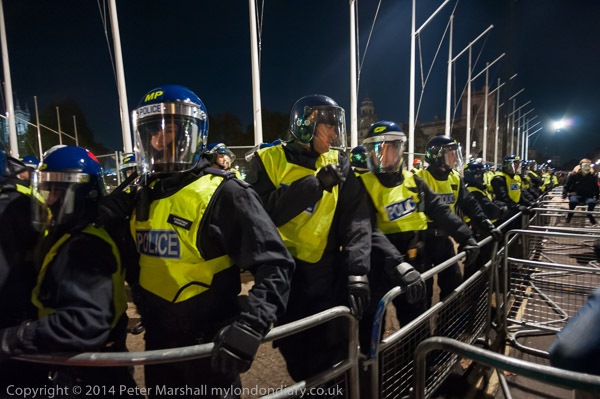
As England begins four weeks of partial lockdown I ponder briefly on the significance of the date and the incompetence of our government before looking at some protests in recent years on November 5th.
Nov 5th 2014
Guy Fawkes was it is often said, the only person to enter Parliament with honest intentions, perhaps a slightly harsh judgement on our politicians, but events over the past few years have certainly shown that being honest has not served Jeremy Corbyn well. Although we no longer openly torture prisoners and Corbyn, though clearly put on the rack by the media is unlikely to be actually hung, drawn and quartered – much though some might revel in it – and he is unlikely to have to jump from the scaffold like Fawkes to avoid this excruciatingly gory fate. But the establishment have become no less weak, simply more devious and discrete in protecting their enormous wealth and privileges against all-comers.
And Covid has given the government an excuse to clamp down on protests across the board, though some have still continued. But with various police actions and Acts of Parliament we are clearly moving closer to a police state, with the active support of a failing opposition in Parliament.
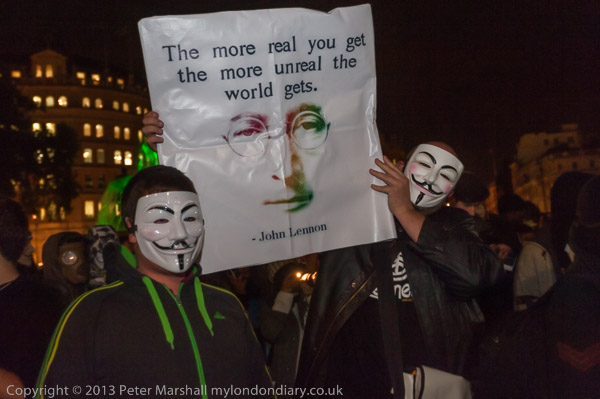
Nov 5th 2013
Fawkes was the inspiration behind the anonymous anti-hero of the graphic novel ‘V For Vendetta’ written by Alan Moore and illustrated by David Lloyd later made into a film. It shows an England without political or personal freedom caused not by a pandemic but after a devasting war.
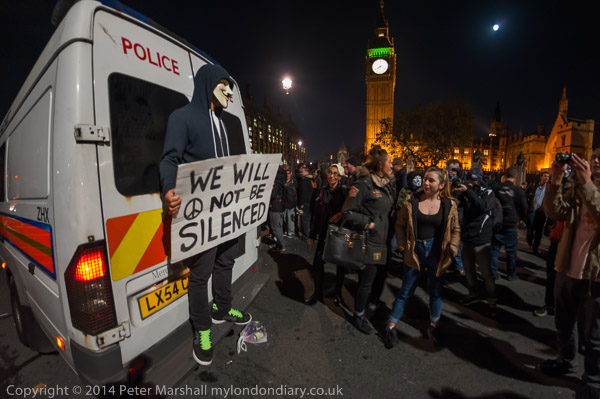
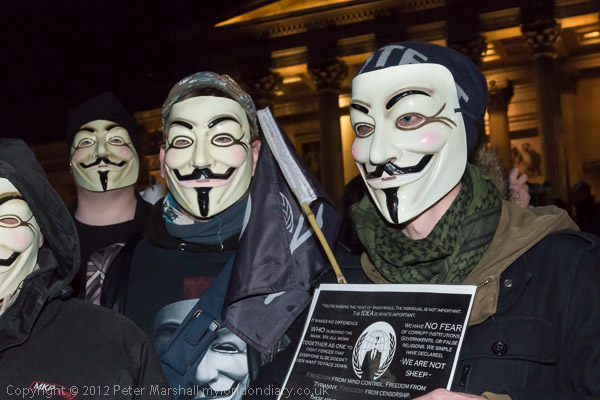
Anonymous, a loose internet based movement of hacker activists took on the Guy Fawkes mask from the film as a symbol, uniform and disguise for their activities, in online videos and street protests – ironically greatly benefiting the mask copyright owners Time Warner who get a royalty from every official sale. And one of their main protests in ‘meat life’ is the ‘Million Mask March’ taking place on November 5th every year.
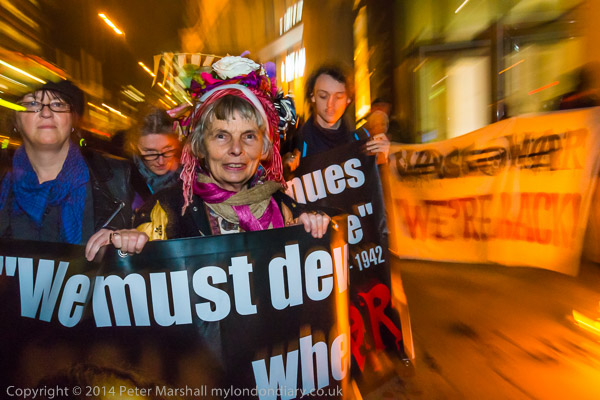
Nov 5th 2014
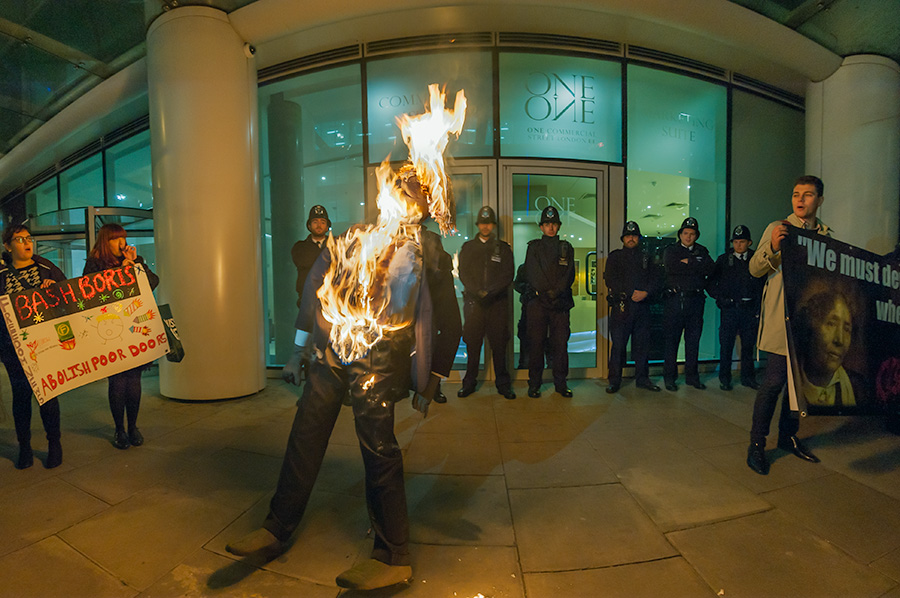
But Anonymous is not the only Nov 5th game in town. Guy Fawkes celebrations traditionally include bonfires, and in 2014 Class War took their own guy, an effigy of then London Mayor Boris Johnson to their ‘Poor Doors’ protest at One Commercial St in Aldgate.
Class War’s guy dressed as London Mayor Boris Johnson burns vigorously at the protest at One Commercial St, Aldgate against separate doors for rich and poor residents. Nov 5th 2014
I wasn’t quite clear how Boris got set on fire (my back was possibly deliberately turned at the time as I don’t seem to have any pictures), though it was always inevitable, and he burned merrily but safely in the middle of the wide pavement.
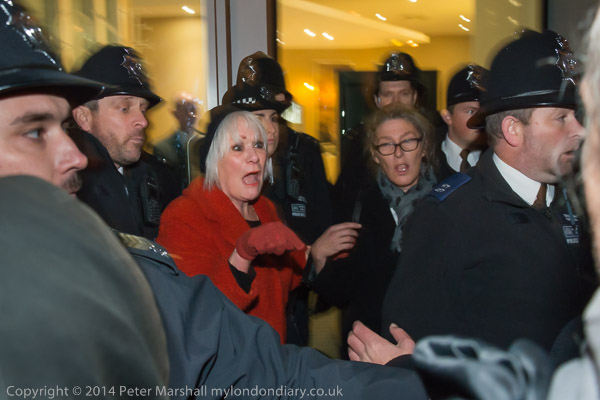
For reasons best known to them, the police went ballistic, calling in first the Fire Brigade, who were clearly not pleased to have been troubled and arrived some time later with just a bucket of water when the fire was already more or less burnt out, and then making the scene a major emergency with police vans, cars and blue flashing lights, before surrounding and arresting Class War’s Jane Nicholl.
Jane is arrested – Nov 5th 2014
The crowd surrounded them and tried to prevent her being taken to the police van, but there were now probably more police then protesters and they managed to force their way through. Another protester was also arrested and taken to a van, I think for being one of the fifty or more who had tried to stop Jane’s arrest.
Surprisingly Jane Nicholl’s case was actually taken to court, but the police were unable to produced any evidence that anyone had been ‘injured, interrupted or endangered’ by the burning Boris – with the prosecution having already admitted that burning effigies on Bonfire night was perfectly lawful and the case – which had already been altered three times to try to find different offences – collapsed. Clearly the police and Crown Prosecution Service were using the arrest and trial simply to harass and intimidate Class War into ending their ‘Poor Doors’ protests. As they did with other arrests on other occasions, none of which led to a conviction.
I don’t know if there will be people trying to take part in a ‘Million Mask March’ in London this year despite the lock-down; the Facebook pages have only small numbers signed up though already well over 6,000 have expressed an interest for Nov 5th 2021. I suspect police will be out in force as in previous years to stop the event taking place. But I’ll certainly be staying at home.
All photographs on this and my other sites, unless otherwise stated, are taken by and copyright of Peter Marshall, and are available for reproduction or can be bought as prints.
Another set of pictures from the 1997 Notting Hill Carnival.
Various organisations take part in carnival, including religious groups, notably The Nation of Islam,
and some trade unions who show a little more of the carnival spirit.
It’s a time for dancing on the streets, and at times its difficult to hold the camera steady, with music you don’t just hear but which sets your internal organs vibrating and even the tarmac under your feet.
It’s hard to capture the intensity of the event, and a kind of glorious disorder on the streets.
Some people are insistent that I take their picture – and of course I oblige.
But it all gets a bit too much for some. And after some hours I get to feel rather like this and decide to go home and rest. Because after the Children’s Day on the Sunday comes the main day on Monday when the streets are more crowded and the dancing more frenetic.
All photographs on this and my other sites, unless otherwise stated, are taken by and copyright of Peter Marshall, and are available for reproduction or can be bought as prints.