November 2014

I had a busy week at the end of November 2014, with protests on Monday, Tuesday, two on Wednesday and three on Friday. Fortunately there was only one event I felt I needed to cover on the Saturday and I took the Sunday off; I think there were some things happening but I needed another day of rest.

2020 is rather different. The only real event in my diary is a visit to the health centre for my regular six-monthly diabetic review, though there are a couple of virtual events. Back in 2014 I got plenty of exercise covering events, but this week I’ll be going out for my now usual 10 mile bike rides most mornings. Otherwise I’ll be stuck in front of a computer writing things like this or digitising, editing and contextualising pictures I made in the 1980s, sometimes a tricky process. Back then we didn’t have metadata or geolocation and I wasn’t always good at record keeping. And when I start falling asleep at the keyboard I’ll probably watch a film.
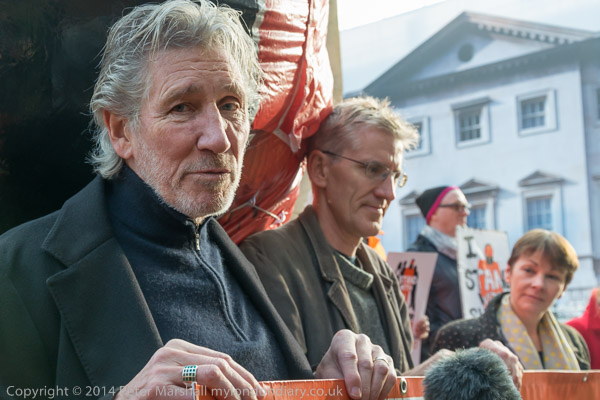
Roger Waters, Clive Stafford Smith and Caroline Lucas hold a banner

Monday’s protest, on 24th November 2014, We Stand With Shaker, was in Old Palace Yard, Westminster in front of the Houses of Parliament. Present were two of my favourite MPs, Caroline Lucas and John McDonnell, as well as civil rights activist including Peter Tatchell and Clive Stafford Smith, my favourite comedian Jeremy Hardy and of course people from both the We Stand With Shaker campaign and the ‘Free Shaker Aamer Campaign’ whose regular protests I’ve often photographed.
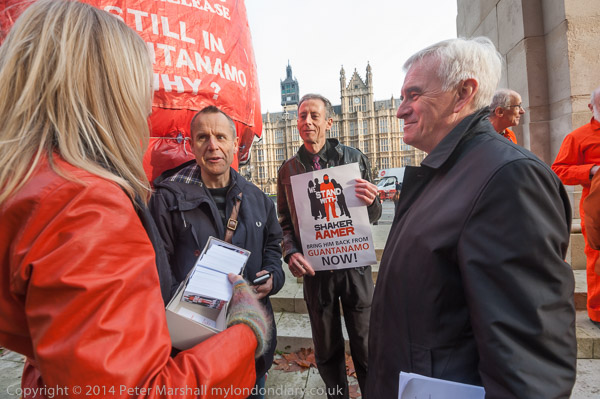
Jeremy Hardy, Peter Tatchell and John McDonnell

Attracting a little more media attention (though not much) was music legend Roger Waters, Pink Floyd’s chief songwriter, who had become involved in the campaign after hearing that Shaker Aamer recited some of his lyrics in his Guatanamo prison cell to help him keep sane in long spells of solitary confinement.
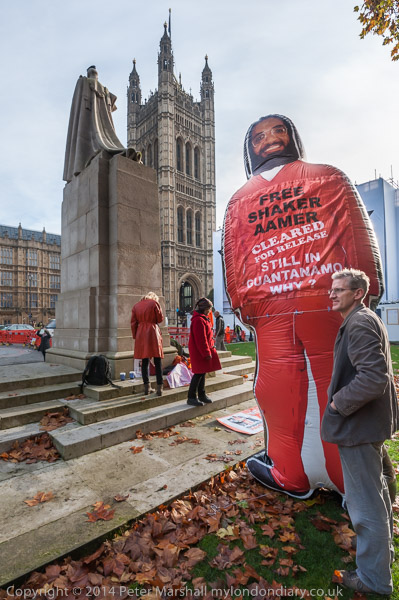

And there was Shaker Aamer. Not the man himself, still held in Guantanamo seven years after being cleared for release, but a giant inflatable figure of him for people to be photographed with holding the message ‘I stand with Shaker.‘ Someone took my picture too, but I don’t think it was ever seen again. You can see more at We Stand With Shaker. Thanks to the long campaign, Shaker Aamer, the last British resident to be held in Guantanamo was finally released on 30 October 2015.
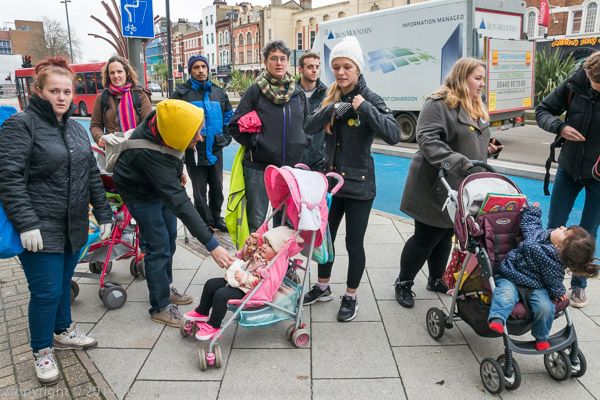

Protesters meet in front of Newham Council’s Housing Office

I caught the train rather earlier than I liked on a cold Tuesday morning to travel across London to Stratford where I met with a small group of protesters from the housing protest group Focus E15 and Fight Racism! Fight Imperialism! (FRFI) to support a young mother and her child. Newham council had a statutory obligation to rehouse Candice and her child, but were trying to do so by sending her over 200 miles from the borough and her community to private rented accommodation in Liverpool.
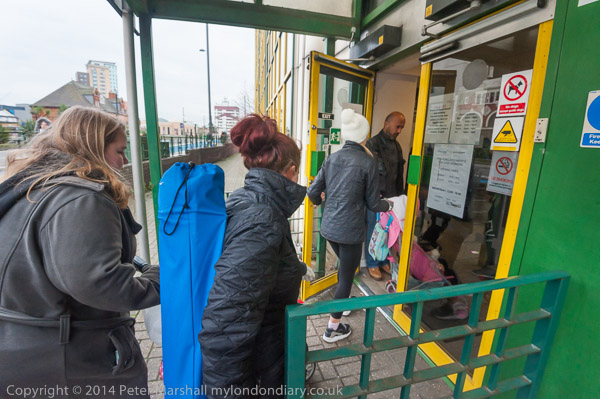
Candice is allowed into the offices for her interview

The group accompanied her to the Housing Office to support her claim to be rehoused locally. Candice wanted two of them to go in with her as support in her meeting with the officials to discuss her case, but they were refused entry by council staff. Something of a ruckus with security staff on the door eventually led to the two, Jasmine and Sam, being pushed past them along with one other protester, but the rest of the group were kept outside, along with myself and two videographers.
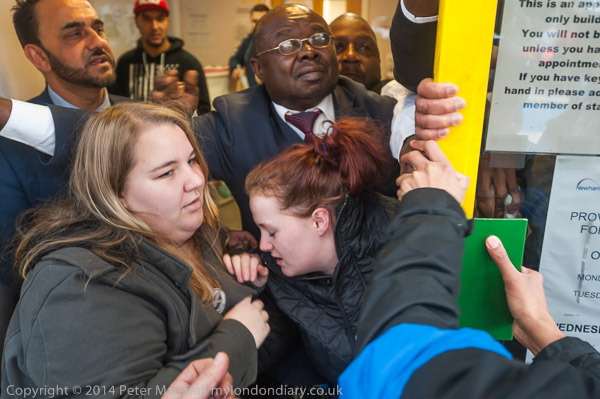
Security stop Jasmine and Sam from going in to advise Candice

It was difficult to take photographs, though I made a few through the windows and doors despite the security staff attempting to block the view of what was happening inside.
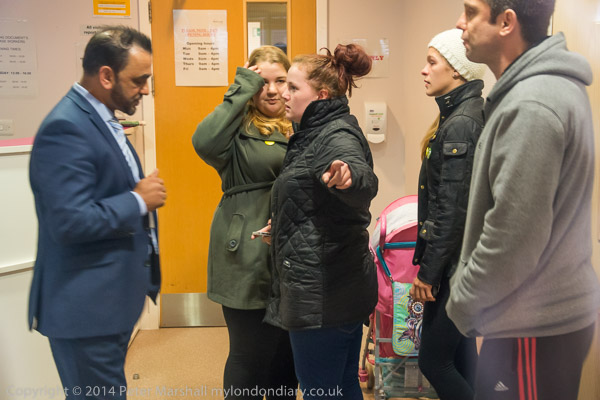
Sam and Jasmine argue with a council official to be allowed to support Candice

I was also restricted by wanting to respect the privacy of other clients inside the office. The police arrived and went inside – and I think told the council officials to It wasn’t easy to know what was happening inside, though Sam did occasionally come to a window to try and tell us what was going on.
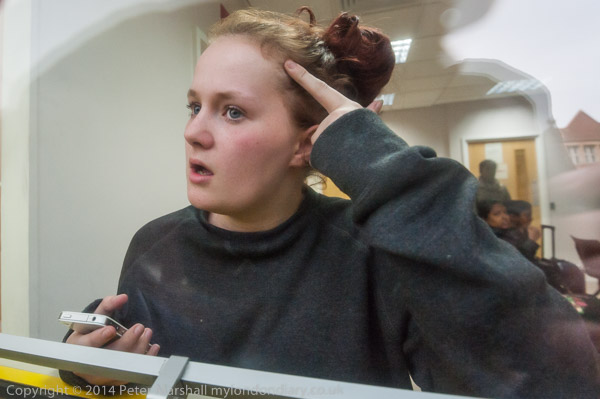
Sam tries to speak through a window to let those outside know what is happening

The protest continued outside the door, and unfortunately the security staff decided not to admit others who had come for interviews, despite promises by the protesters outside not to impede them or rush in.
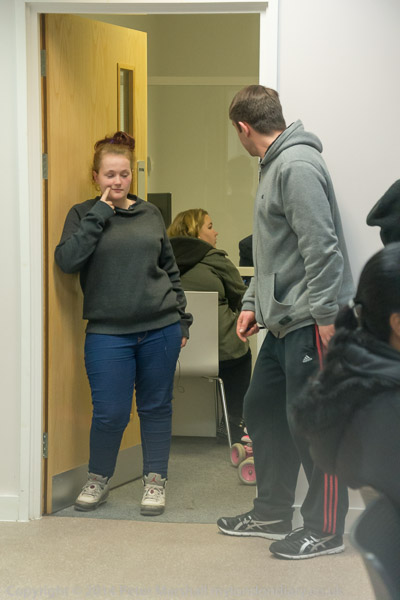
Sam and Stan at the door to the meeting – with Jasmine sitting inside

The meeting with a housing officer was taking place inside, and through a window when Sam held the door open I could see Jasmine’s back as she sat giving her support and advice.

The protest continued outside the door, and unfortunately the security staff decided not to admit others who had come for interviews, despite promises by the protesters outside not to impede them or rush in.

Eventually one of the protesters negotiated with security to allow clients to enter by a rear door which they would not protest outside but would direct the clients too. The protesters were rather more concerned than council staff at allowing them access.

There was a bitter wind and it was wet outside, and after the meeting had been going on inside for over an hour I was shivering, despite being warmly dressed. I would have liked to have photographed the group coming out and sharing the news that Candice would be rehoused in the borough at Canning Town but decided I had to leave. By the time I was home and writing up the story I’d got the news on the group’s Facebook page.

More pictures at Focus E15 Support Homeless Mother


My week in November 2014 continues in another post…

Architectural Icing

Brunswick Gardens, Kensington, Kensington & Chelsea 87-10d-35-positive_2400

I suppose my photography is always a catalogue of obsessions, but at times and in particular places this shows more strongly.

Palace Garden Terrace,  Kensington, Kensington & Chelsea 87-10d-43-positive_2400

Most of these pictures were taken in Kensington, with just a couple in Primrose Hill.

Brunswick Gardens, Kensington, Kensington & Chelsea 87-10d-32-positive_2400

Photographically there is a certain interest in rendering these essentially white surfaces – as some photographers have found with subjects like white eggs on a white plate.

Inverness Gardens, Kensington, Kensington & Chelsea 87-10d-26-positive_2400

But I suppose that there might be more Freudian interpretations of at least some of these pictures.

Inverness Gardens, Kensington, Kensington & Chelsea 87-10d-24-positive_2400

London developed hugely in the nineteenth century with stock brick for the workers and stucco for the middle classes, and I still feel something of an outsider in these wealthy areas, although some had become pretty down-at-heel by the 70s and 80s when I was making these pictures.

Inverness Gardens, Kensington, Kensington & Chelsea 87-10d-22-positive_2400

Since then, most of them have been tidied up and refurbished, and more divided into flats now often worth rather my than my own outer suburban house.

St Mark's Square, Primrose Hill, Camden, 1987 87-10c-53-positive_2400

There are times I find myself rather despising what appears to be overdone icing on the architectural cake, and looking for something with a little more depth and variation.

Park Village East, Regent's Park Camden, 1987 87-10c-31-positive_2400


Kensington Church St, Kensington, Kensington & Chelsea 87-10c-15-positive_2400

There is something of the fairly tale about these houses and the pictures, and although I had committed myself to photographing all of London I felt a longing to get away from Kensington and back to the real world.


Clicking on any of the pictures above will take you to my Flickr Album 1987 London Photos where you can view larger versions.


All photographs on this and my other sites, unless otherwise stated, are taken by and copyright of Peter Marshall, and are available for reproduction or can be bought as prints.


Paris 2010 (final)

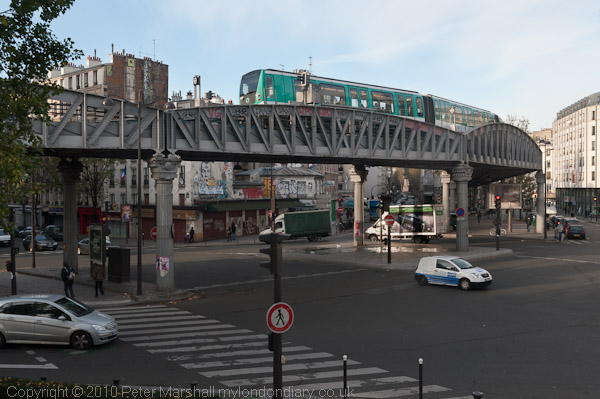
After breakfast on Saturday we went for a walk, first making our way alongside the Metro Aerienne to La Rotonde de la Villette, one of my favourite Paris buildings, and then walking a little beside the canal, first to the north and then turning and going south to where there was a street photography show displayed as single images in each of a number of shop windows in the streets around the Rue de Lancry. It was a nice idea, but not really much of a way to display photographs, though we did enjoy the hunt for them. See more about the exhibition and the wedding here on >Re:PHOTO and more photographs in my diary at  Street Photography in the 10e.

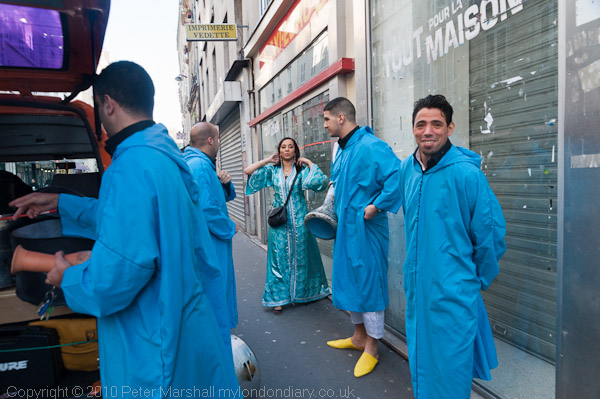
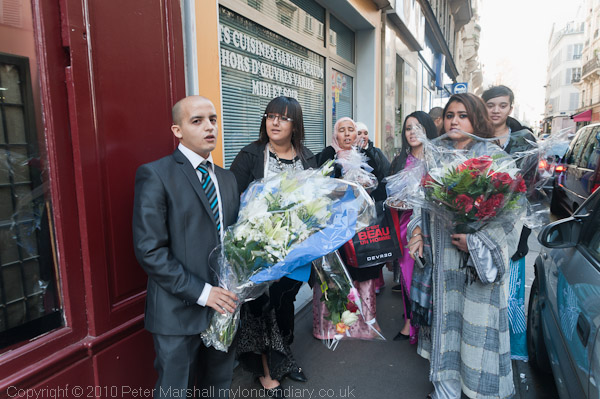
Of course I was taking pictures, and for a short while became an unofficial wedding photographer, though I turned down an opportunity to join the party as we had other things to do.

The largest photographic event taking place in Paris was not the dealer show Paris Photo, nor even the Mois de la Photographie, though that had the most prestigious shows, but the fringe, the Mois de la Photo-Off. This is a well organised event, with a free booklet listing the many events accepted for it (and there is also a fringe of the fringe with many other photography shows), but also a series of organised tours around the shows in different areas of Paris on each Saturday afternoon in November.

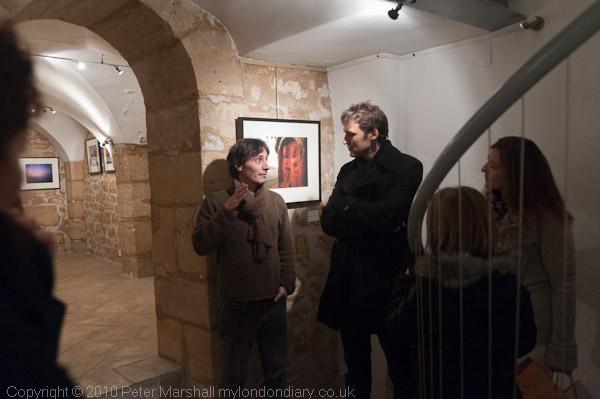
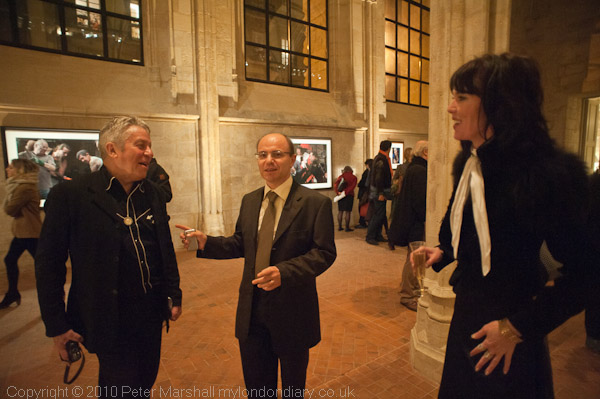
Photographer Loïc Trujillo (left) talks with Neil Atherton, Commissaire General of the Mois de la Photo-OFF, who led the tour, in Galerie Impressions

On November 20th we had a choice of two areas, and picked ‘Beabourg’, going to eight shows and meeting the photographer or gallerist at all but one of them. We spent around 15-20 minutes in each gallery before walking the short distance to the next. At times it was rather taxing on my hazily remembered ‘O’ Level French, and I was pleased to have my interpreter with me. You can read more about the shows on the tour in two posts here, Photo-Off – A Guided Tour – 1 and Photo-Off – A Guided Tour – 2, and again there are more pictures in my diary.

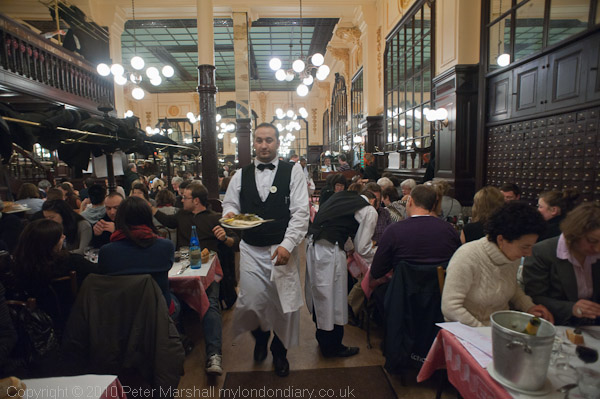
We had to hurry away at the end of the tour to change and meet Linda’s brother and his wife for a dinner in one of Paris’s institutions, Chartier. It has become a must for tourists and it’s best to go early to avoid a long queue.

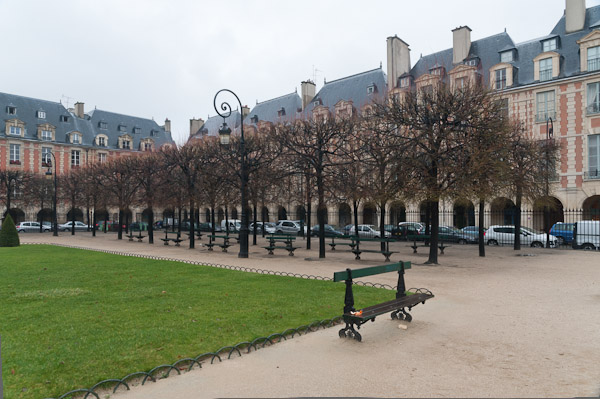
I spent Sunday morning at the Maison Européenne de la Photographie and you can read about what I saw there in Sunday Worship at the MEP, though there are no illustrations as photography is forbidden there. Linda chose instead to attend the culte at the Temple de l’Oratoire du Louvre, and we met afterwards for lunch, buying some delicious slices of quiches and cakes on the rue St Antoine and sitting and eating them on a bench out of the light rain in the Place des Vosges.

Afterwards we wandered aroung the Marais, visiting several shows open on a Sunday afternoon, including ten Swedish photographers of the collective Tio Fotgrafer and A Few Shows in the 4e, before making our way across the Seine to the Bibliothèque nationale de France (BnF), to view France 14, the work of 14 younger photographers selected by Raymond Depardon, and then another Metro ride to FIAP Jean Monnet in the 14e, to view a show celebrating 40 years of women’s liberation. And then it was time for dinner and to return to our hotel and rest. There are more photographs from the afternoon in my diary at The Marais and BnF and FIAP.

We had a day before catching our Eurostar back to London on Monday evening for a final walk, rather more relaxed than in the previous days with hardly a visit to a photographic exhibition. You can see the pictures at  Monday Wandering and read a little more about the walk at Monday in Paris.


All photographs on this and my other sites, unless otherwise stated, are taken by and copyright of Peter Marshall, and are available for reproduction or can be bought as prints.


Paris 2010 (continued)

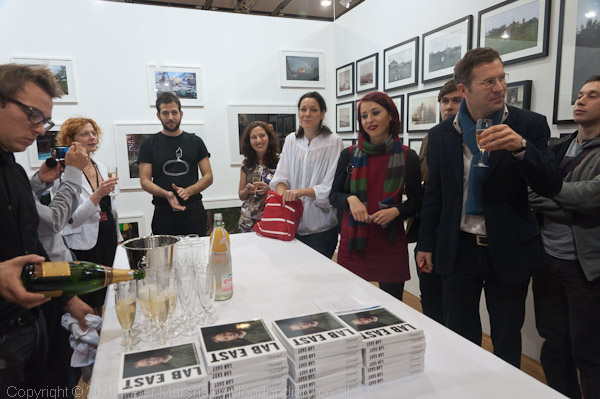
On Friday 19th November I rushed from lunch to make my final visit to Paris Photo, mainly to attend the launch of the book Lab East, showcasing 30 young photographers and to take a few pictures. You can read what I thought about the book and a few of the contributions in Paris Photo – Lab East, probably written in my hotel room late at night, which perhaps excuses the fact that I got the title of the book wrong twice (now corrected.)

I have mixed feelings about Blurb, and the post I wrote perhaps reflects that. Print on demand is I think an important part of photographic publishing, and one that puts control back into the hands of the photographer which I’m very much in favour of, but there are two great problems which I feel Blurb has failed to address. The first is simply cost – and I think better technology (and lower profit margins) could do much to decrease this, and the second is distribution.

There were just a few more stalls at Paris Photo to visit, and I did so before leaving. It is a huge show, and I feel sorry for anyone who tries to make just a single visit, as many paying visitors do. Fortunately with a press pass I was able to make a number of shorter visits and still see all I wanted to see. But there was far more happening outside the Paris Photo exhibition halls, and I left and strolled through the Jardin du Carrousel admiring the naked women (only sculpture) and walked beside the Seine to the Pont des Arts and across to the Institut De France to view the impressive landscape show by Thibaut Cuisset, which again I wrote about here, along with a little of my own work in  More Paris – French Landscapes. Leaving this I called in at a number of small galleries in the area, some of which were taking part in the Mois de la Photo or it’s fringe, L’Off, before meeting my wife as arranged in St Germain.

We were on the Left Bank for a reason, as this evening around 30 galleries were keeping open until 7pm, listed in a leaflet Photo Saint-Germain-Des-Prés, and we visited most of them, though we needed a brief rest in a café too. I wrote about some of them here in Parcours Saint-Germain-des-Prés, and there are more pictures from my afternoon and early evening walk in my diary at To Saint-Germain-des-Prés.

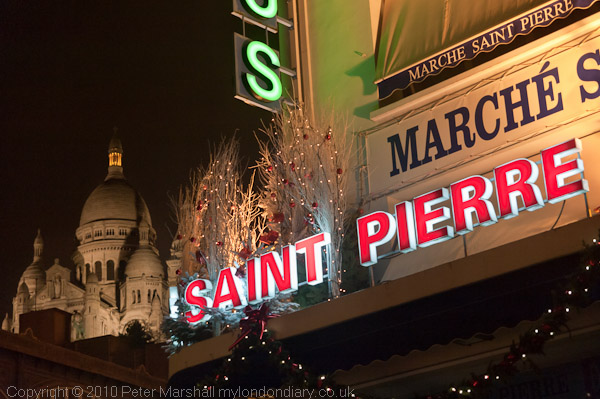
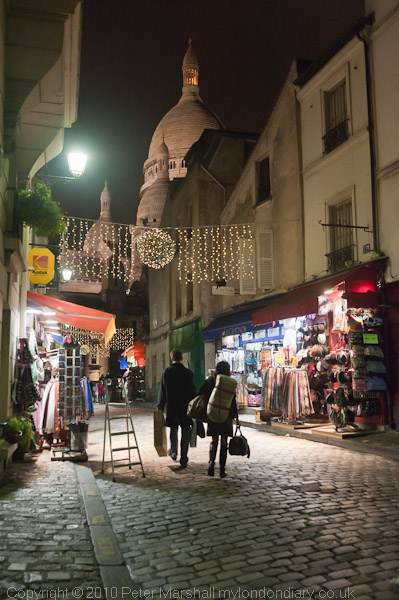
We took the Metro back to the north of Paris and after dinner took the funicular in Montmatre for a walk around. It was late and many places were shut and there were relatively few people were around. A bus came along and we jumped on it, getting a tour of the area and fortunately it took us to Place Pigalle, from where we walked along the backstreets and back to our hotel on the edge of the 10e. Pictures at  Montmartre at Night.

…to be continued

Paris 2010

Ten years ago today I was in Paris, having arrived there for Paris Photo two days earlier on Wednesday 17th, where after queing to get my accreditation I attended the opening of the event. I didn’t much enjoy it – too many reminders that I wasn’t a VIP and too many cliques around most of the gallery stands, though I did meet just a few old friends in the crowds.

But it was too crowded and too hot and I was pleased to leave early and meet my wife for a rather good meal in a Latin Quarter restaurant and then a short walk around the centre of Paris before taking the Metro to our hotel room in the Goutte-d’Or. You can read more about my initial thoughts on the show in a long blog here on >Re:Photo, and there are a few more pictures on My London Diary.

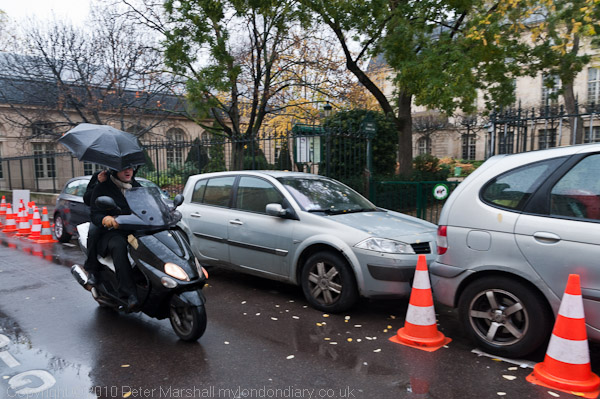
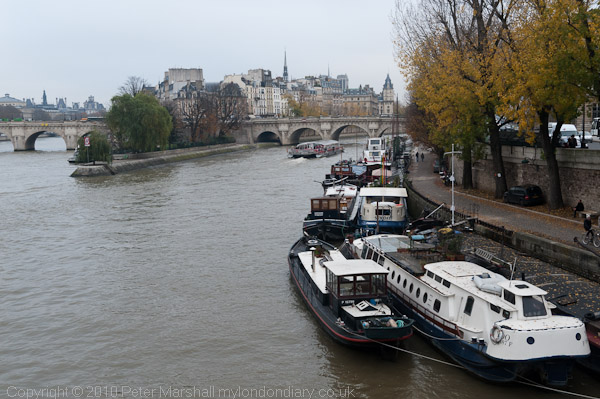
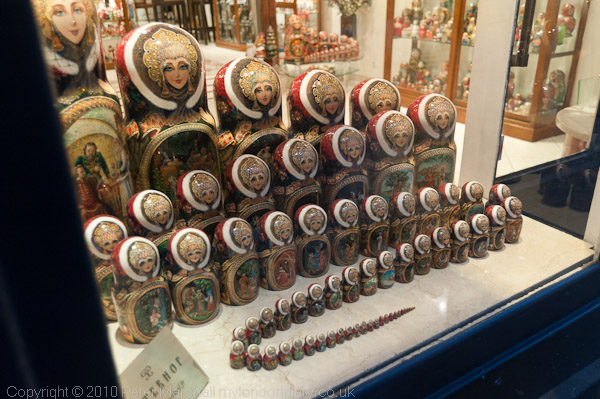
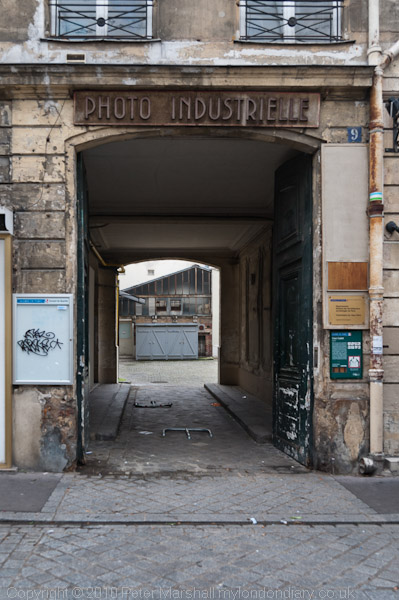
Thursday after breakfast and a short move to another hotel there was plenty of time to take a leisurely walk and some photographs on my way to Paris Photo which opened at 11am.

The pictures I made on the walk are I think rather more interesting than those inside Paris Photo, and a couple of hours inside the show were enough for the day – and I wrote about it at some length for readers of >Re:PHOTO, as well as a more general piece Thoughts on Paris Photo.

I met my wife for a pleasant lunch and then we began a tour of photo exhibitions in the 3e – and I wrote about some of them here, as well as taking more pictures on our walk.

The highlight of our day was the opening of Brian Griffin’s The Black Country, and again I posted a lengthy piece here on >Re:PHOTO.

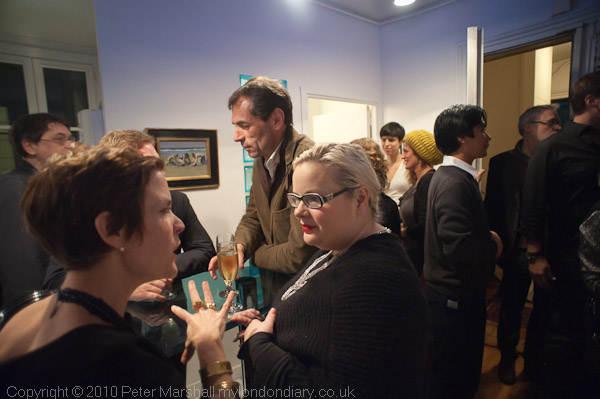
We finished the day at a fine Party, hosted by Jim and Millie Caspar of Lensculture in their flat on the rue Saint Antoine, and after a few glasses of champagne I couldn’t stop myself taking more pictures. There was also a room set up as a studio where all the guests were invited to take photographs of themselves. On this site I mainly talk about the technical details, but there are again more pictures in my diary.

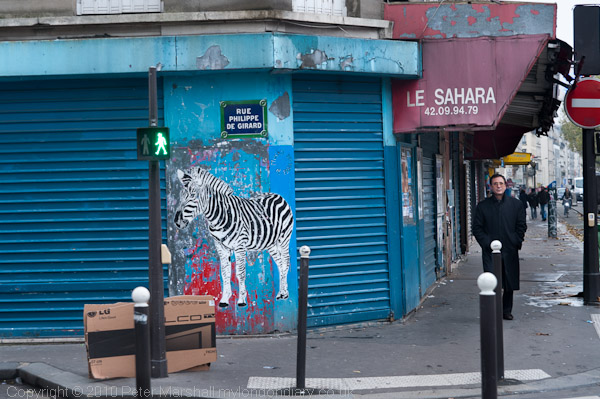
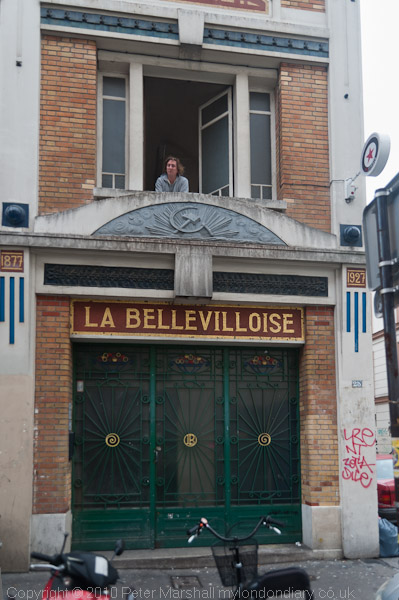
We had to leave early at around 11.30 to take the Metro back to our hotel, but the party was still going strong. I slept well that night after a long day, and the following morning was out again for another wander around Ménilmontant and Belleville in the north-east of the city until lunchtime. Again you can see more on >Re:PHOTO and in my diary.

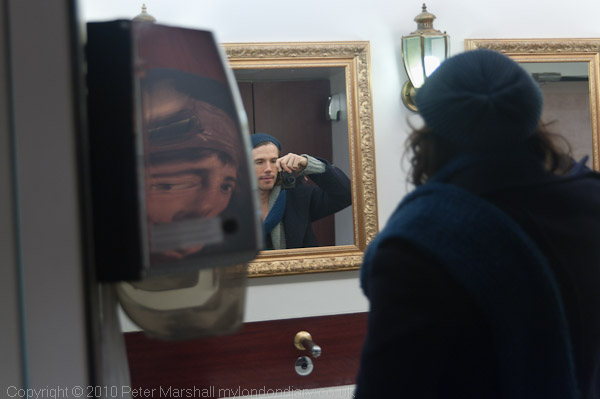
I’ll end with a picture I took in Paris Photo (there are more online.) The face reflected in the towel-holder looks rather as if a man is wearing a mask (or just a gag), though it is just a label. As I walked into the toilettes pour hommes another photographer was taking his self-portrait in the rather fancy mirrors.

(to be continued in a later post)


All photographs on this and my other sites, unless otherwise stated, are taken by and copyright of Peter Marshall, and are available for reproduction or can be bought as prints.


Violence or Photography?

According to some I should be confessing my sins for the criminal behaviour of taking pictures of people in public places like this without first gaining their permission. Of course I don’t see it that way.

On the streets we have no “reasonable expectation of privacy” and while I think we should all – whether taking photographs or not – generally try not to behave in ways that give others reasonable call for upset, making a photograph does not usually fall into that category. Of course there are some photographers who have adopted a very aggressive approach which I feel is questionable, and there are offences such as stalking and ‘up-skirting’, but in general photographing people in public is not a criminal offence, even if those being photographed may not like it. And of course there is sometimes a strong public interest in photographing people who make it clear that they do not want to be photographed.

Mostly those I’ve photographed, at least in recent years, have been involved in protests, and making a protest implies a clear statement that you wish your actions to be recorded and there is also a clear public interest in doing so. But there is also a public interest in the recording and making statements about everyday life, the ordinary behaviour of people often unaware they are being photographed. So while I may occasionally have upset people by taking their pictures, and I may apologise that they feel upset, I’m not apologising for taking pictures or for my actions, but that I’m sorry that they think that way.

This doesn’t mean that I never ask people if I may take their picture. There are times and places where I do, usually when I need to work closely with them and take more than a single image, but more often to do so would mean missing the moment and failing to express what I saw as important to say.

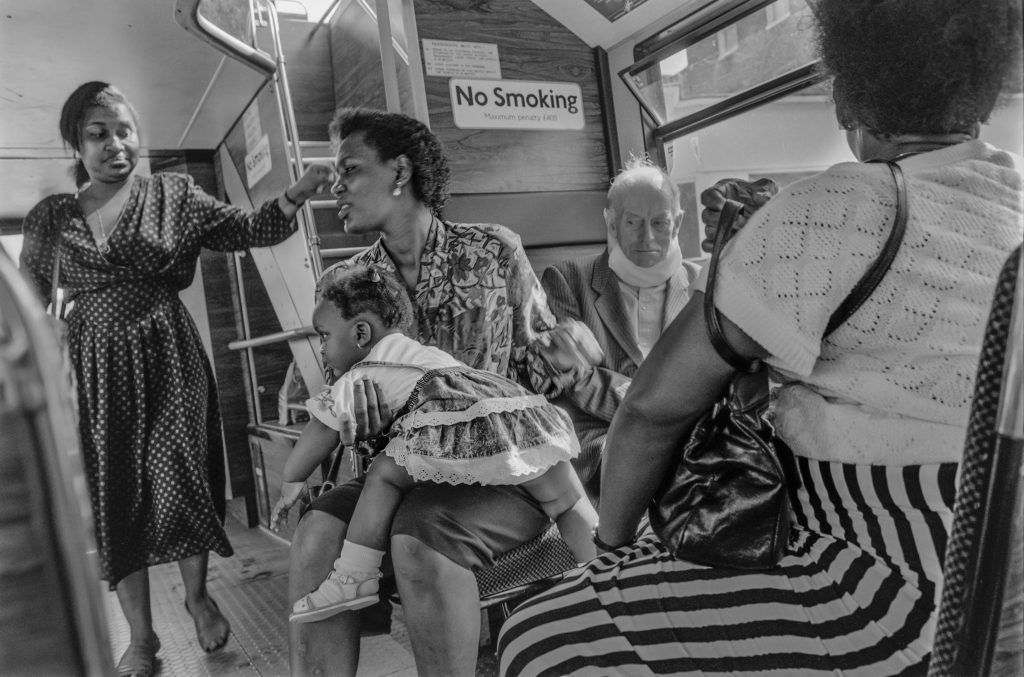
I had to sort through my own ideas on this back around 1990 when I worked on a transport project taking pictures of people on buses. I don’t think there is a single picture I took for that where I asked for permission, and few that I could have made had I done so. Some were clearly aware that I was taking their picture, but most were not.

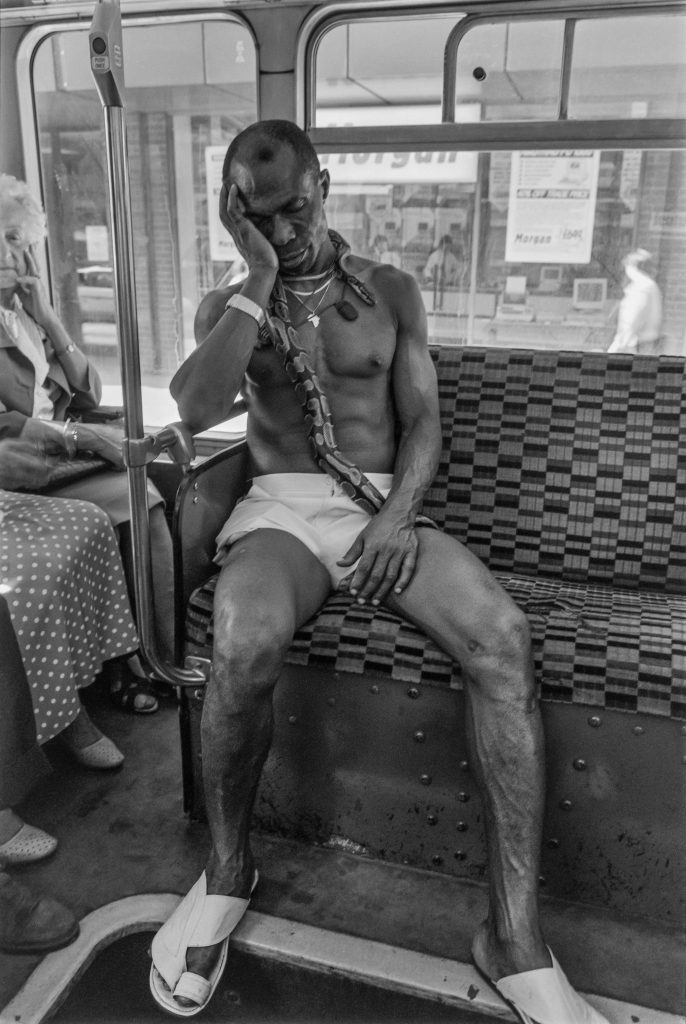
Only one person actually objected. He was a man sitting on a seat in a bus dressed in shorts with a snake around his bare upper body. I didn’t get a chance to reply to him, as two elderly women sitting to one side immediately butted in, telling him clearly that if he travelled on buses dressed like that he should expect to be photographed. I think his real objection was that I was not paying him – this was his working outfit, and he was on his way to pose with tourists in Covent Garden for a fee.

These thoughts were aroused by an article on PetaPixel, a response by Kansas City photographer Brandon Ballweg to an opinion piece published in the New York Daily News by writer Jean Son titled “When your photograph harms me: New York should look to curb unconsensual photography of women“. In Street Photography Is Not a Crime. Let’s Keep it That Way Ballweg describes her premise that any photographing of women in public places constitutes “gender-based violence“, as “hyperbolic and irresponsible” and goes on to comment on her behaviour and and arguments, as well as what seems to him (and me) her totally inconsistent later claim that “Garry Winogrand is one of my fave artists btw“. Somehow it was fine to photograph women (and men) on the street without their consent in the 1950s, 1960s, 70s and 80s as he so consistently did but now she considers it an offence.

Ballweg ends his piece – worth reading and illustrated by a number of Winogrand images – with a suggestion of a “rational, mature, adult way of dealing with a situation of you’ve been photographed” and don’t like it and goes on to suggest that if having someone take your picture causes you “such distress that you lobby to convene a task force to ban it” then it may be due to “some underlying personal issues that you need to work through and confront as an individual” rather than a problem with photography.

It’s perhaps a little harsh a statement, but reflects Son’s failure to distinguish between actual gender-based violence and the taking of photographs. It’s a vital line to draw if not always clear exactly where it lies, and one which the US Legal system has clearly failed to do in some cases as Son rightly points out.


All photographs on this and my other sites, unless otherwise stated, are taken by and copyright of Peter Marshall, and are available for reproduction or can be bought as prints.


Victoria & Kensington

Victoria Palace, theatre, Victoria St, Victoria, Westminster, 1987 87-9g-25-positive_2400

The car in the foreground seemed appropriate for ‘High Society’ at the Victoria Palace, but I would have preferred it without the foreground post. But this wasn’t a planned photoshoot, just a car that happened to stop at the traffic lights while I was looking at the threatre, and it moved off before I could change my position.

Morpeth Terrace, Victoria, Westminster, 1987 87-9g-31-positive_2400

Morpeth Terrace runs along the west side of Westminster Cathedral, and its mansion flats have over the years housed some notable residents. A few doors down the street a black plaque records that Winston and Clementine Churchill lived here from 1930-39.

They had apparently bought the flat on the fifth and sixth floor from Lloyd George, who reportedly had housed his mistress there. It was in the study of the flat that Churchill held a meeting with other MPs and wrote a letter to Prime Minister Neville Chamberlain urging him to send Hitler an ultimatum the day before war was declared in 1919.

Later the same flat is said to have been home to Stalin’s daughter, Svetlana Alliluyeva. But if so, her stay there was probably brief as she defected while on a trip to India, going to the US embassy in New Delhi and became a US citizen, though later moved for a short while to Cambridge before returning to Russia and then back to the USA.

I photographed this end of building rather than the part of the block with the Churchill plaque as it seemed more interesting. You can also see it was in rather poor external condition at the time – it has since been refurbished.

Baxendale & Sadler, Hatherley St, Victoria, Westminster, 1987 87-9g-52-positive_2400

It looked as if Baxendale & Sadler, Electrical Engineers and Contractors might still have been in business, though their shop front was rather the worse for wear. I think it had once said they were established in 1956.

The shop, a few yards from Vauxhall Bridge Road, is now residential.

Empire Hospital, for Paying Patients, Vane St, Westminster, 1987 87-9g-54-positive_2400

The Empire Hospital for Paying Patients in Vane St, Westminster obviously rather predated the National Health Service, and according to the Lost Hospitals of London web site was “opened in December 1913, intended to receive paying patients, primarily visitors from overseas” and was a nursing home with no doctors or surgical staff. Taken over as a military hospital it became the “Empire Hospital for Officers (for Injuries to the Nervous System)” and closed in 1919.

Later it became the Grange Rochester Hotel and is now the the Rochester Hotel by Blue Orchid, and looks rather more welcoming, with the text above the door covered by a hotel sign.

Palace Garden Terrace, Kensington, Kensington & Chelsea 87-10d-56-positive_2400

Wyndham Lewis (1882-57) disliked the name ‘Percy’ and dropped it, but others continued to use it and it appears on the GLC plaque in Palace Garden Terrace, Kensington which does not record when he lived here.

Born on a yacht, Lewis went to Rugby School and the Slade before studying in Paris before settling in London. A founder member of the ‘Camden Town Group’ he became one of Britains leading painters, best known for what Ezra Pound named as ‘vorticism’. After serving as an officer in the Great War he was made a war artist. In the late 1920s he turned mainly to writing and had produced over 40 books before his death.

Between the houses you can see Courtlands, described as a former coach house, though it looks rather more grand than that. The terrace seemed overpowering with long and largely unbroken stretches of largely white stucco, and these brick houses with a vista of a white villa attracted me.

Mall Chambers, Kensington Mall,  Kensington, Kensington & Chelsea 87-10d-55-positive_2400

The Grade II listing for Mall Chambers on Kensington Mall is unusually concise, at least at its start: “Improved industrial dwellings. 1865-8. J Murray. Yellow brick, stone dressings. Five storeys. Corner site, with corner entrance.” Towards the end it quotes Building News from 1868 “”intended for a class somewhat above ordinary mechanics and labourers”.

That is of course even more true now. A three bed flat here sold for £741,000 in 2014.

Kensington Church St, Kensington, Kensington & Chelsea 87-10d-52-positive_2400

Joseph Yates Timber Merchants were suprisingly still in business here until fairly recently and its timber yard now houses a luxurious four bedroom town house. Yates’ shop on the left of its carriage entrance is now The Kensington Cigar Shop.

The planning permission granted in 2004 required the retention of the lettering on the front of the building.

You can click on any of the images to see the larger version on Flickr and to browse more of the album 1987 London Photos.


London Protests: 17 November 2018

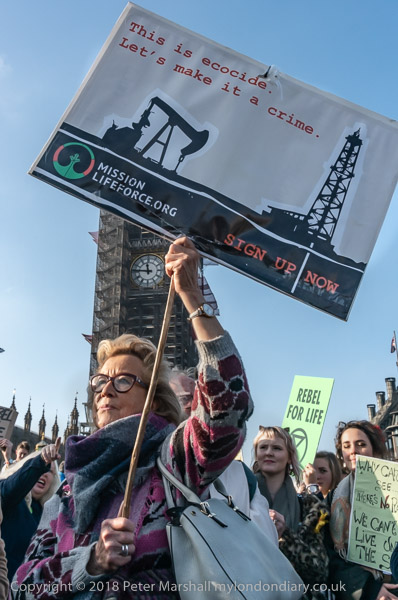
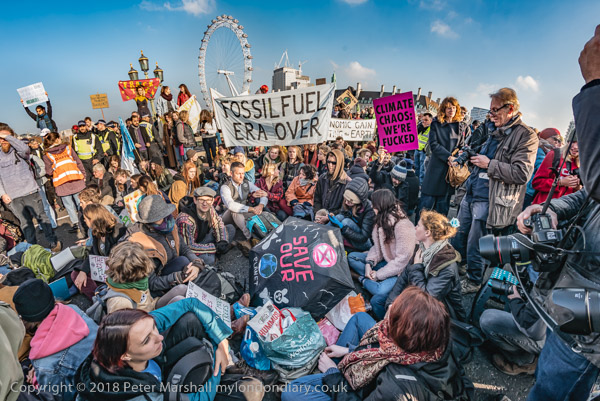
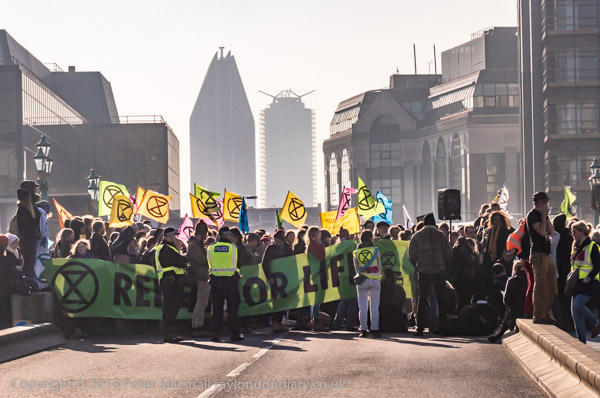
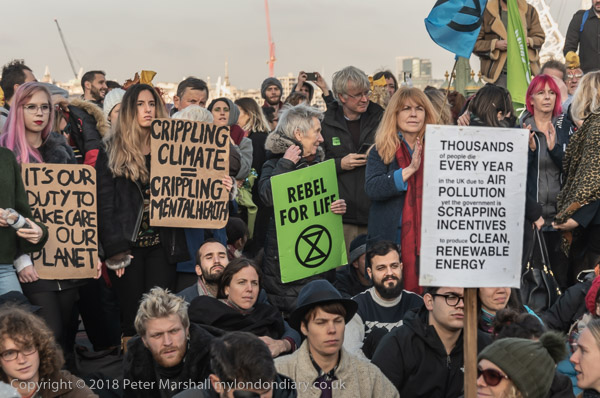
Saturday November 17th 2018 saw the start of Extinction Rebellion’s beidge blocade in central London, bringing the city to a standstill by blocking Lambeth, Westminster, Waterloo, Blackfriars and Southwark bridges. I joined them for the first couple of hours on Westminster Bridge.

From there I went to pay brief visits to three of the other four bridges that XR had blocked, choosing those downstream which were relatively easy to reach on foot.

I didn’t go to Lambeth Bridge, upstream from Westminster, as I ran out of time before another event I wanted to cover. It would have meant too long a walk as the nearest tube station is some distance away and there were no buses able to run. Later I found that it was at Lambeth that the police had been more active in making arrests and attempting to clear the bridge.

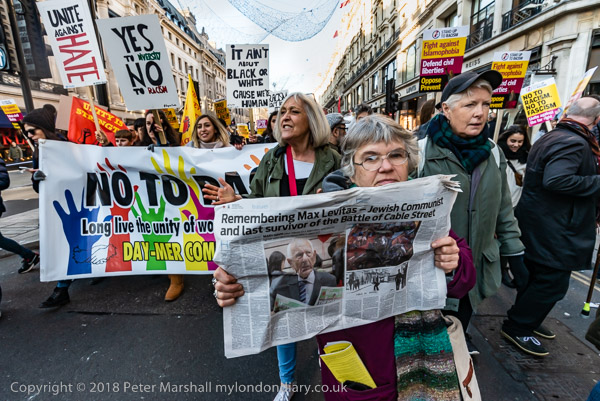
I arrived too late for the start of the march organised by Stand Up To Racism, co-sponsored by Unite Against Fascism and Love Music Hate Racism, and supported by many other groups and individuals including Diane Abbott MP and John McDonnell MP against the against the rising threat of Islamophobia and Antisemitism by far-right groups in the UK.

It was a large march and had gathered outside the BBC in Portland Place because the organisers wanted to point to the failure of the BBC to recognise the threat of these extremist groups with a level of support for fascism not seen since the 1930s.

The BBC does appear to have a policy limiting reporting on issues such as this, and of ignoring or minimising protests in the UK against failures of government. When they have reported, they have often talked of ‘hundreds’ of protesters when a more objective view would have said ‘thousands’ or perhaps even ‘tens of thousands.’ They do a far better job in reporting protests in foreign cities than in London.

Half an hour after I began taking pictures the marchers were still walking past me, but I thought that it was nearing the end and I left, not to go to the rally in Whitehall but to return to Westminster Bridge for the Exctinction Rebellion protest where there were speakers from around the country and around the world, some of whom travelled to speak on several of the five blocked bridges. After the speeches there was a Citizen’s Assembly but by then I was tired and left to go home, edit and file my pictures – more hours of work.

Protests by XR have done a little to shake the complacency of our government and others around the world and move them to action to avoid the rapidly approaching climate disaster, but it remains a case of too little, too late. Certainly so for many countries in the global South already suffering dire consequences, but probably also for us in the wealthier countries. Covid-19 has shown that governments can take drastic actions, (if ours cost many thousands of lives by making decisions too late and avoiding basic precautions) but it will need a similar upending of priorities and changes in our way of life to avoid the worst effects of climate change – and there can be no vaccine to end climate change.

More about the events and more pictures on My London Diary:

Extinction Rebellion Bridge blockade starts
Extinction Rebellion: Southwark, Blackfriars, Waterloo
Unity Against Fascism and Racism
Extinction Rebellion form Citizens’ Assembly


All photographs on this and my other sites, unless otherwise stated, are taken by and copyright of Peter Marshall, and are available for reproduction or can be bought as prints.


The Perfect Camera

I recently came across a post on Petapixel, My 10 Year Search for the Perfect Camera Brought Me Back to APS-C written by international photographer and filmmaker based in San Francisco Kien Lam. Although I try to avoid thinking too much about gear, like most photographers I suffer from a considerable amount of insecurity and the feeling that somehow a better camera or lens would improve my work.

It’s a feeling that over the years has led me to buy numerous cameras and lenses, most of which now lie unused in cupboards either because I can’t be bothered to sell them, or because of a feeling that one day I might just take them out and use them again.

Things were rather easier in the days of film, and there were usually what seemed to be very good reasons to change to a new camera. I got fed up with the Zenith B because it was a clunky beast that required so much force to wind on film that it was easy to rip a film in two. Its one camera I didn’t hang on to when I moved to the Olympus OM1, which compared to it seemed an almost perfect camera – and one I used until various bits fell off and I replaced it with an OM4. I still have two of these, to my mind still the most perfect cameras of their type.

But I still bought other cameras. For some types of photography I preferred a rangefinder Leica. Starting with a battered secondhand Leica M2, I later bought a nearly new Minolta CLE, another great camera with decent exposure metering well before Leica’s own. Leica’s shutter was noisy and intrusive compared to the Hexar F, another camera I loved, though its fixed 35mm lens wasn’t quite wide enough. The main problem I had with its silent mode was that I was often not sure if I’d actually taken a picture or not.

Then there were cameras of a more specialist nature, each with their uses. Several swing lens panoramic models, medium format and even 4×5″ cameras, and another favourite, the Hassleblad X-Pan.

The came digital. After some compact cameras I started seriously with the Nikon D100. The pictures were fine but the viewfinder was abysmal, reason enough to upgrade to D70, then the D200 when that came out. Then the D300… Cameras were beginning to seem disposable, each new model offering more pixels. Then came full-frame, and really I should have resisted, but I didn’t. I didn’t really need the extra pixels, but again the viewfinder was better, though I ended up taking a lot of images in DX mode and enjoying being able to view outside the frame lines.

Most of those digital cameras I’ve actually passed on to friends or swapped including the disastrous Leica M8 with its colour problems. It was that swap that really got me into Fuji, with the X Pro1. A nice optical viewfinder but rather poor with lenses outside its range which needed th electronic version.

I’ve still got my Nikon kit, two working bodies, though a couple went beyond economic repair, and various lenses. The D810 is now mainly used to ‘scan’ negatives, though occasionally taken out until the virus lockdown for its low light capability. But I find the kit too heavy for me now, and looked around for a lighter system.

For a while I used an Olympus OM-D E-M5 Mark II which seemed in some ways very similar to my old and well-loved OM film cameras. Some fine lenses – both Olympus and Panasonic Leica – but just occasionally I felt there was something lacking in the images from the smaller sensor.

Eventually I went back to APS-C, and like Kien Lam to Fuji, though to the less expensive options of a Fuji XT-1 and an XT-30. It was the latter than decided it for me, roughly as small and as light as the Olympus, and I bought it rather than commit to Olympus by buying a second Olympus body. Unlike Kien Lam I’m not searching for a perfect camera, and I certainly spend a lot of time swearing at the Fuji cameras with their complicated buttons and menus. But the lenses are excellent (though some are rather expensive) and I’ve yet to find myself thinking that any particular image would have been better on full-frame.

Vaterland

I probably won’t be buying J M Colberg’s book Vaterland, to be published by Kerber, as my bookshelves are already groaning under the stress of far too many volumes. But it was interesting to see a book of photographs by someone much of whose critical writing – which I’ve often referred to on this site – has been about photography books.

The latest post on Colberg’s online Conscientious Photography Magazine is Vaterland, where he writes about the state of his native Germany and the rise of right-wing extremism there. In 2016 he went to take photographs exploring ” the region in Europe’s heart whose largest parts are made out of Germany and Poland, Central Europe” without the intention of producing his first photo book.

He writes that living for 20 years away from Germany has resulted in him being more engaged with the changes that are happening there than had he stayed and he sees the book as a metaphorical “expression of my unease, of my worries, of my upset, of my realization to what extent Germany and its past are an integral part of my own life.”

There are more pictures from it on Colberg’s web site – I think almost half of those that will be in the book, along with more text. As would be expected they seem very precise and carefully framed, but they seem to me to perhaps be both at times too obvious – a headless statue, rubble, grass like a stain punctured by some kind of fence – and too controlled, too cold.

In part I think this represents something that I was aware of in my visits to Germany and in some aspects of German photography. A few of the photographs I took there in the very different 1980s would certainly fit into a book like Colberg’s, though the exhibition of images and text I showed in 1986 had a very different feeling.

Of course things have changed since then though when I went back to Germany to stay in the same place and with the same family in 2013 my experience was rather more positive than his.

You can view the book I produced based on my pictures from the 1980s on the preview at Blurb, and if you make the preview full page can read the texts that I wrote back in 1986 to accompany them in the show, which represent both some of my feelings about the pictures and my experiences in Germany and my sometimes odd sense of humour which these brought out.

German Indications
German Indicat…
By Peter Marshall
Photo book