Seven years ago on Saturday 22 November 2014 I photographed four very different events.
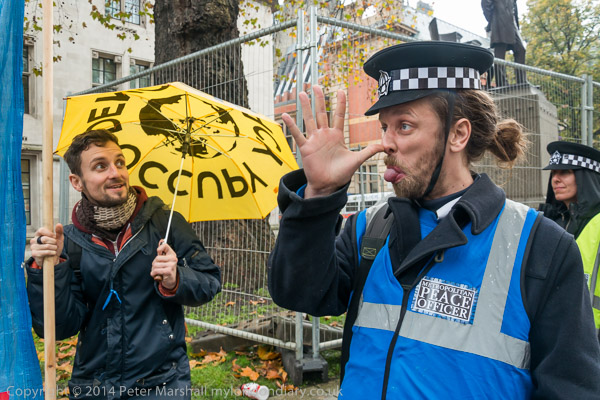
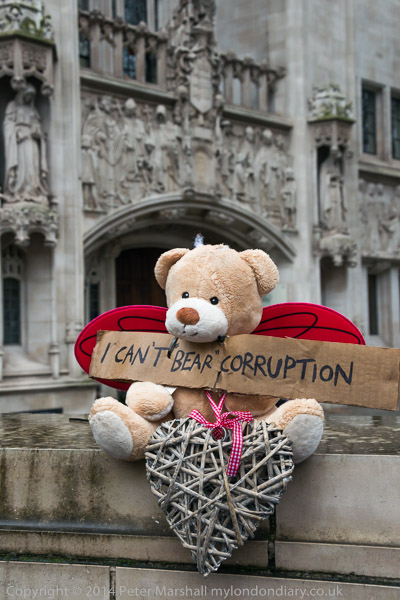
Occupy Democracy at Supreme Court
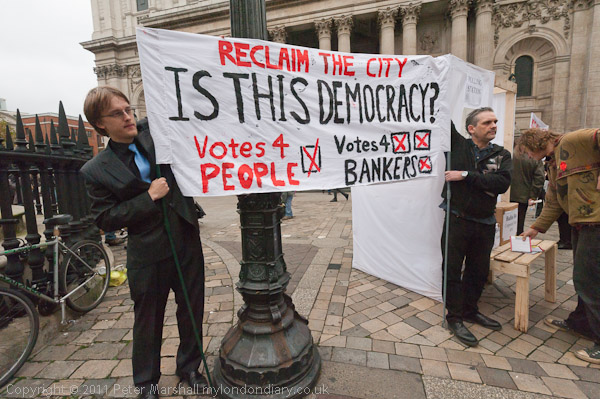
Occupy Democracy activists had camped out overnight in front of the Supreme Court, watched by police who had fenced in almost all of the grassed areas in Parliament Square to prevent them being occupied. The activists were hoping to hold two days of workshops there, but things had not started when I left after taking pictures.
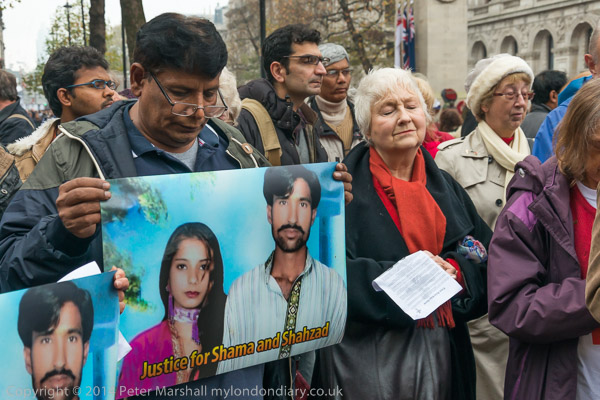
Justice for Shahzad & Shama
Pakistani Christians and others were protesting opposite Downing St calling for justice for the brutal murder in Pakistan of Shahzad Masih and Shahzad Masih , bondedlabourers at a brick kiln, who were falsely accused of burning pages of the Quran, attacked by a Muslim mob, tortured and burnt alive.
There are around 4 million Christians in Pakistan, a little under 2% of the population and they face extreme persecution, with those who have converted from Islam at greatest danger. Christians are treated as second-class citizens, discriminated against in employment, where they largely do the lowest status jobs, and girls are at risk of abduction and rape, sometimes being forced to convert to Islam and marry their attackers. Christians are often accused of blasphemy, as in this case to settle civil disputes, with those accused being attacked or killed by Islamic extremist groups, whose criminal acts are largely ignored by the authorities.
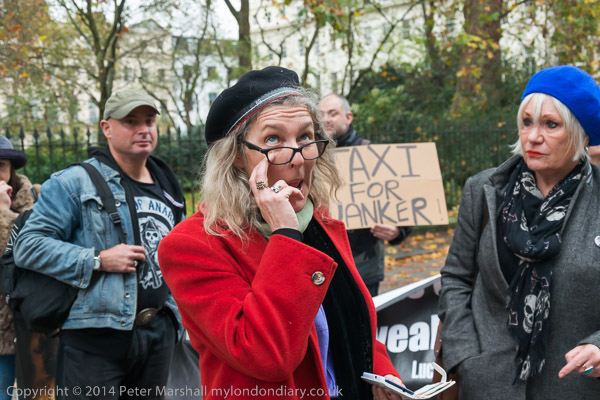
Class War Griff Rhys Jones Mansion Tax
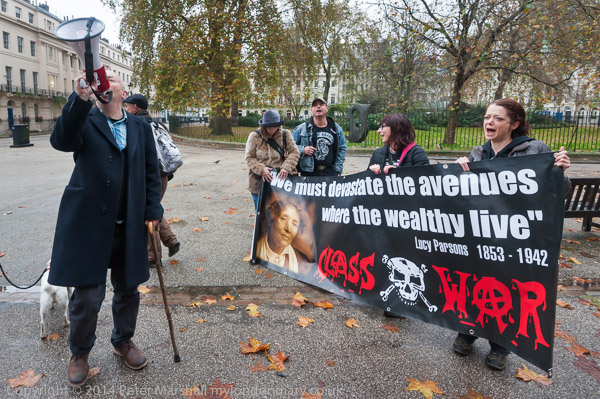
Class War went to the £7m Fitzroy Square home of Griff Rhys Jones who said he would leave the country if Labour levieda mansion tax, telling him to “f**k off now”, offering to pay the fare. Class War’s manifesto for the 2015 general election includes a 50% mansion tax.
No one came to answer the door when they put their leaflet through and after a few minutes making their presence felt outside, the walked around to the south side of the square to protest outside the outside the home of Guy Ritchie, another millionaire objector to a mansion tax. They put a few stickers on other places around the square, including the Magistrates Association and the gates to the private garden in the centre of the square, returned for another short protest outside Griff Rhys Jones’s house before retiring to the pub. Unfortunately I couldn’t join them as I had another event to photograph in Brixton.
Still No Justice for Ricky Bishop
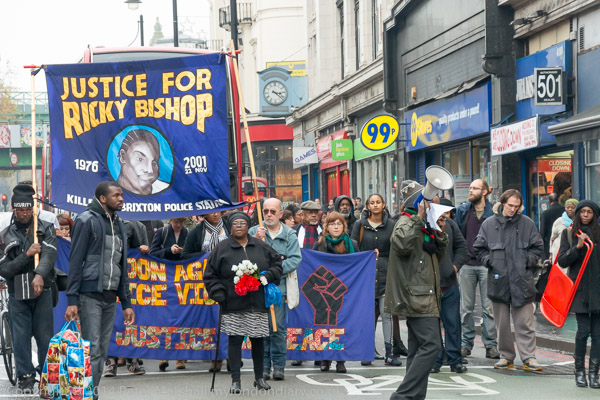
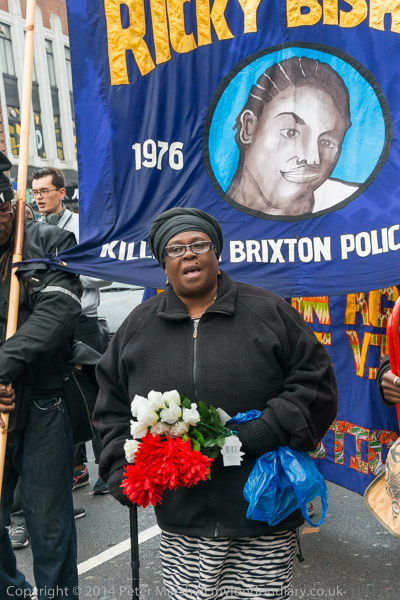
Ricky Bishop, a fit young black man, died from unexplained injuries hours after being taken to Brixton Police Station on 22 Nov 2001. Family and supporters call it a modern day lynching and march annually to remember him and call for justice.
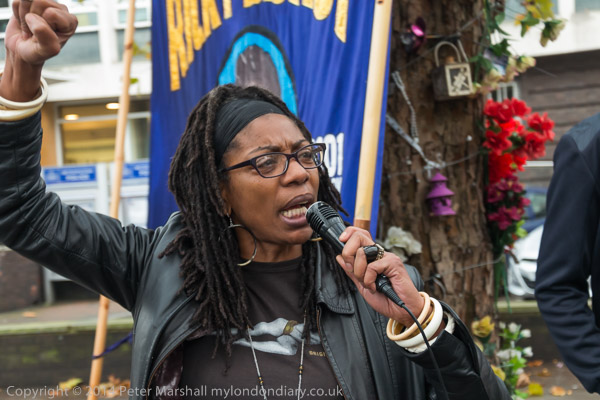
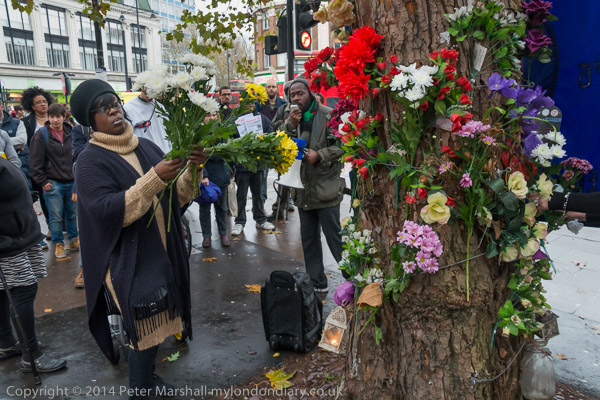
The marchers met up at Windrush Square and then marched slowly through the centre of Brixton to the police station, where a tree outside has been adopted as a remembrance tree for Ricky Bishop and the others killed there by police.
At the tree there were speeches, including a detailed and forceful presentation by Marcia Rigg of the battle she and others faced to get any proper investigation into the death there of her brother Sean Rigg in August 2008.
These two are not the only young black men to have died at the hands of Brixton police, but so far there has been no police officer bought to justice from the crimes they committed. The only real action by the police has been to remove all of the photographs and momentos placed by some of the families from the tree in front of the police station.
COP26 was in some respects a great disappointment, or rather would have been had we expected very much to arise out of it. But there were some advances, and just a slight glimmer of hope that it may prompt a little more progress in our efforts to save our future on the planet. But that it happened at all and in the way it did is very much down to the efforts of people on the street to raise awareness of the realities of climate change.
Without groups that have been campaigning for years we would have no hope at all, and whatever people think about some of the policies of Extinction Rebellion, it has been one of the more effective movements in bringing the message to the attention of the media, politicians and the public.
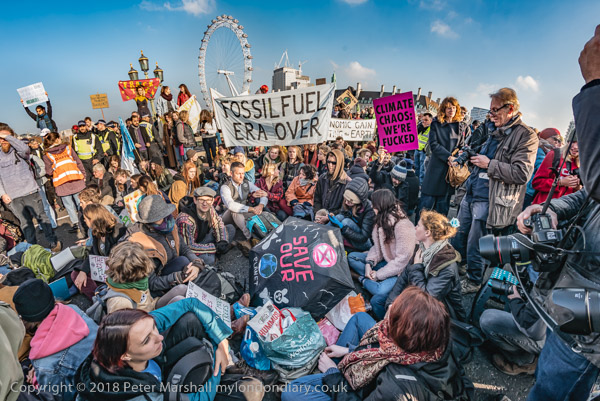
Even in the unfortunately toned down words of the COP26 final resolution, the message from the banner in the assembly at the top of this post is now clear: ‘FOSSIL FUEL ERA OVER’ though it still remains to be seen if it can be brought to an end fast enough for us to survive.
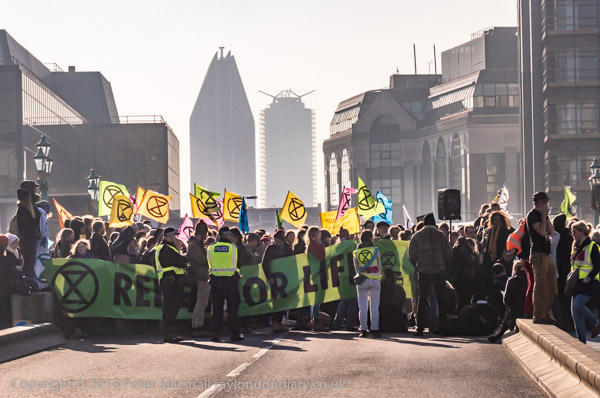
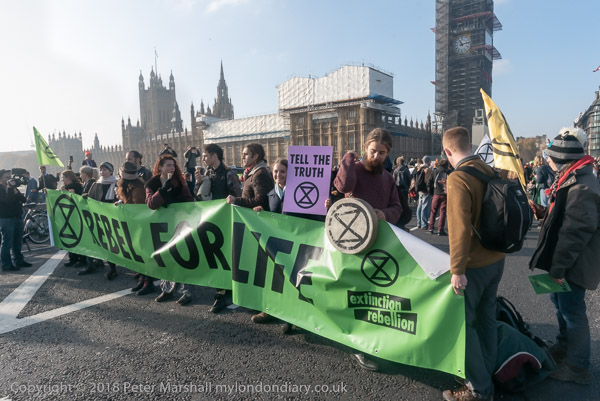
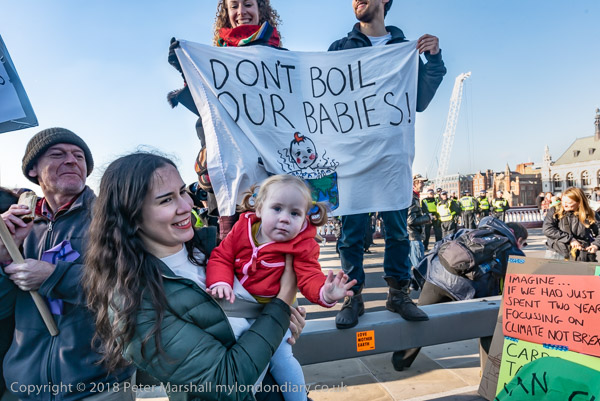
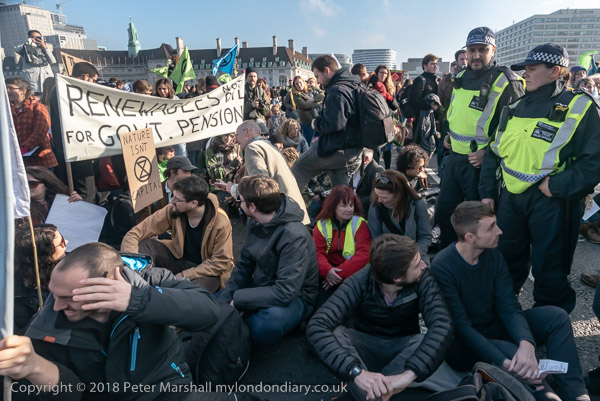
On Saturday 17th November 2018, Extinction Rebellion rebels managed to block five of the bridges in central London: Lambeth, Westminster, Waterloo, Blackfriars and Southwark. It was an ambitious project that brought much of London’s traffic to a standstill and gauranteed extensive media coverage. You can march 50,000 through London and it won’t merit a mention on the BBC unless windows are broken or police injured – but this was something that could not be ignored, and despite the interests of the billionaire media owners, at least some journalists began asking the right questions and writing the right answers.
I tried to photograph events on as many of the bridges as possible, though with no buses able to run in central London this involved rather a lot of walking. In the end I failed to make it to Lambeth Bridge, where some of the more robust actions by police against the protesters took place.
Here’s my description of XR from one of the three posts I made about them that day:
Extinction Rebellion is a non-violent rebellion against the British government for its criminal inaction in the face of the climate change catastrophe and ecological collapse which is currently on course to make human life extinct. They demand the government tell the truth about the climate emergency, reverse their inconsistent policies and work to communicate and educate everyone, that they bring in legally binding policies to reduce carbon emissions to net zero by 2025 and reduce our consumption of all resources, with a national Citizen’s Assembly to oversee the changes and create a real democracy.
More protests will be needed around the world to make politicians do what needs to be done – and I was photographing Extinction Rebellion in London last Saturday when they protested in the annual Lord Mayor’s Show.
My day was made busier as there was another unrelated event taking place that I also wanted to photograph, a Unity against Fascism and Racism march from the BBC to a rally in Whitehall calling for unity against the rising threat of Islamophobia and Antisemitism by far-right groups in the UK, with a level of support for fascism not seen since the 1930s. I missed the start but spent around half an hour taking pictures as it came down Regent St.
More on all these and more pictures on My London Diary:
A few weeks ago I came to the end of a walk with friends and we stood at a bus stop on the edge of the A3 in south-west London with a relentless flow of traffic moving past in all four lanes in both directions. We were a few yards away on a slip road, but the noise was making my head throb and I could smell and taste the pollution, though I hope the Covid mask I was wearing might filter out some of the particulates. It was a horrible reminder of the mad dedication to traffic which is killing so many of us, poisoning adults and particularly children and playing a significant role in killing the planet through the huge carbon emissions in manufacturing vehicles, building yet more roads and of course burning fossil fuels. Fortunately our bus came earlier than expected.
The switch to electric cars will help a little, and reduce some of the pollution, though not its possibly most dangerous aspect, the particulates that come mainly from rubber tyres and from brakes. And there is still a huge carbon footprint from their manufacture – roughly equivalent to running around 150,000 miles of burning petrol or diesel, and much of the electricity used to power them will come from power stations burning gas or forest-destroying wood.
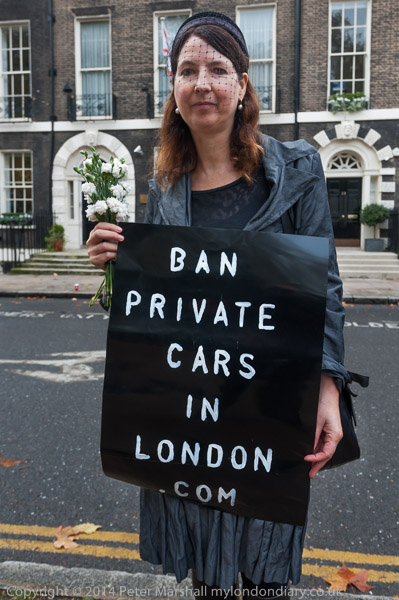
We can only have a sustainable future if we wean ourselves as a species away from travel, and take what journeys are still necessary by ways that reduce the carbon footprint as much as possible. Going on foot or by bicycle, using public transport and severely limiting the more polluting and high-carbon forms of transport. It means measures such as banning private cars in cities, giving priorities to buses, building more light rail and tram systems, ending subsidies to air travel, stopping new road-building and more. But also it means great changes in our way of life.
It’s something I realised over 50 years ago when I sold the only car I’d ever owned. Something I considered very carefully in choosing where to live and what jobs to take. And something which has constrained the holidays I’ve chosen to take and other aspects of my life, but not anything I really regret. I’ve only ever made three trips by air related to my work – where no real alternative was possible, and only taken two holidays which involved flights.
Of course there are some things and situations where cars are essential. It’s very hard to manage without one for those who live in more remote areas, and some need to. I’ve chosen always to live in towns or cities and have been healthy enough to be able to ride a bicycle or walk. In 2019, George Monbiot wrote for the Guardian a piece with the sub-head ‘Cars are ruining our lives. We should cut their use by 90% over the next 10 years’. Like other posts on his web site its worth reading and goes into much greater and well-argued detail than this piece.
Donnachadh McCarthy
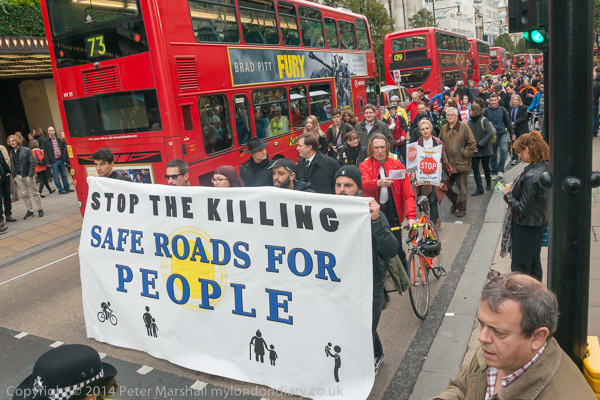
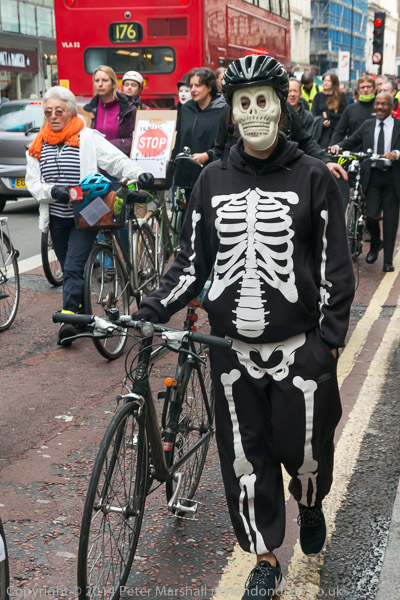
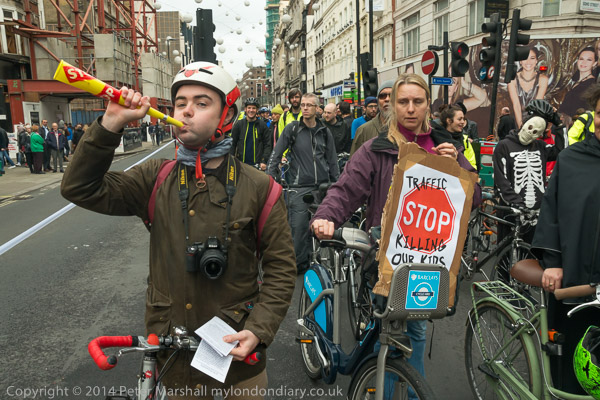
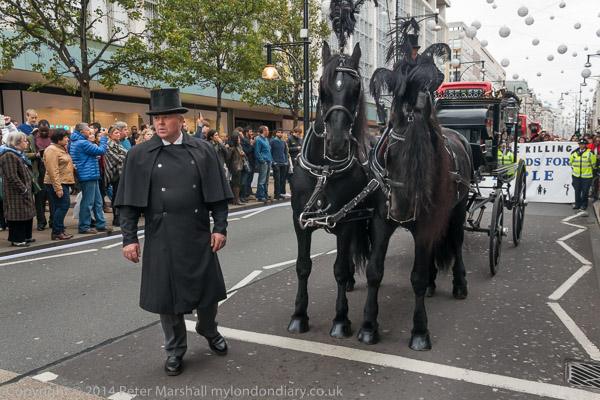
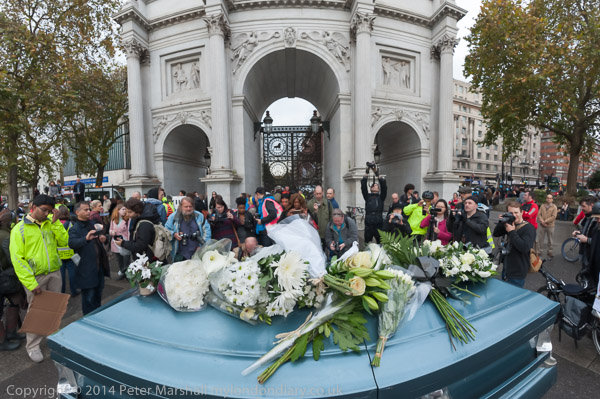
On 15th November 2014 I photographed the ‘Funeral for the Unknown Victim of Traffic Violence’ organised by environmental campaigner Donnachadh McCarthy and ‘Stop Killing Cyclists’. It made its way through the centre of London from Bedford Square going along Oxford St, with a bagpiper playing and a horse-drawn hearse carrying a coffin for a mock funeral ceremony at Marble Arch.
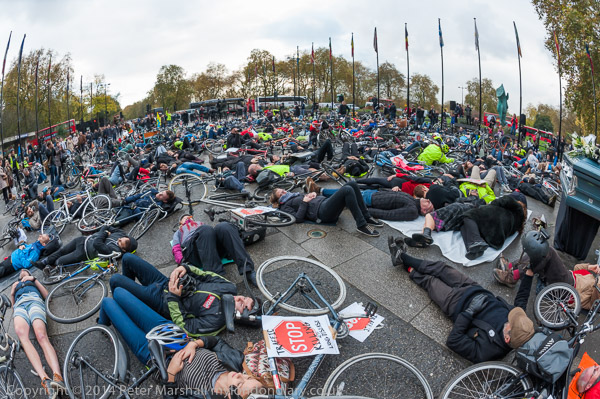
It made the point that while too many pedestrians and cyclists are still killed and maimed by cars and lorries on a road system largely engineered for the convenience of motorised transport, their numbers are dwarfed by the many thousands of premature deaths each year caused by the pollution from road traffic, with pollution levels in many places being well above legal limits. After the funeral, there was a die-in by cyclists more or less filling the hard standing at Marble Arch, and a trumpeter sounded the Last Post.
Here is a list of the demands made by the protesters:
Stop the Killing of Children with a national, multi-billion pound programme to convert residential communities across Britain into living-street Home Zones and abolish dangerous rat-runs.
Stop the Killing of Pedestrians by a national programme to fund pedestrianisation of our city and town centres, including the nation’s high-street, Oxford Street.
Stop the Killing of Pensioners from excessive speed with an enforced speed limit of 20 mph on all urban roads, 40 mph on rural roads/lanes and 60 mph on all other trunk roads.
Stop the Killing of Cyclists, investing£15 billion in a National Segregated Cycle Network over the next 5 years.
Stop the Killing by HGVs by banning trucks with blind spots, making safety equipment mandatory and strictly enforcing current truck-safety regulations; currently around 30% are illegally dangerous.
Stop the Killing without liability with a presumed civil liability law for vehicular traffic when they kill or seriously injure vulnerable road-users, unless there is evidence blaming the victim.
Stop the Killing from Lung, Heart and other Diseases caused by vehicular pollutants with mandatory for particulate filters that meet latest EU emission standards on all existing buses, lorries and taxis.
Stop the Killing at Junctions with pedestrian crossing times long enough for elderly disabled to cross, filtered junction crossings by cyclists and strict legal priority for pedestrians and urgently provide physically protected left-hand turns for cyclists.
Stop the Killing from Climate Crisis caused by CO2 emissions by insisting that all transport fuels are from truly environmentally-sustainable, renewable sources within 10 years.
Focus on Life! with transport governance making safety and quality of life the top priority. Reform all council transport departments, the Department of Transport and Transport for London into Cycling, Walking and Transport Departments with formal pedestrian and cyclist representation.
Again you can read more detail and more evidence in Guardian posts by George Monbiot, available on his own web site such as Don’t Breathe.
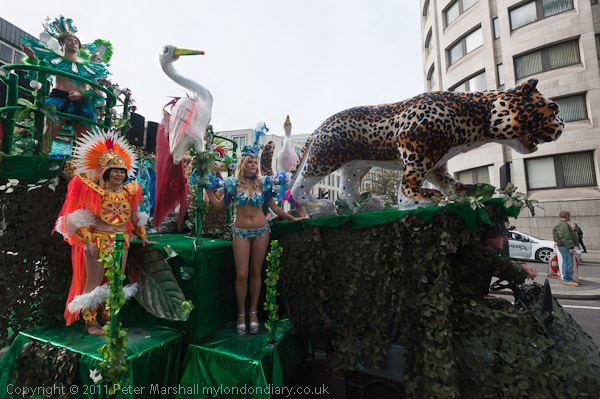
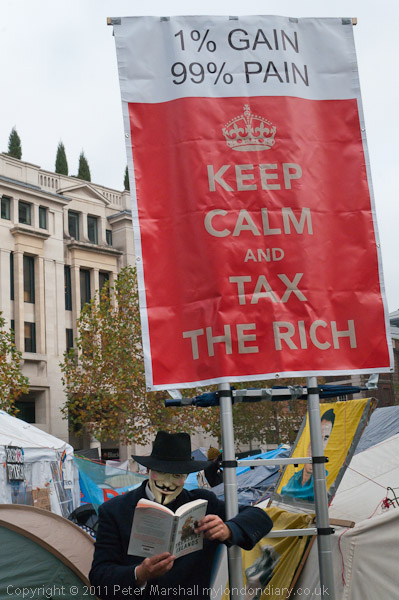
Ten years ago was a very busy day for me in London. Saturday 12th November was the day of the annual Lord Mayor’s Show, which I’d photographed occasionally in previous years, but probably would not have bothered with, but it was made far more interesting this year by the presence of the Occupy London camp outside St Paul’s Cathedral.
I went up quite early to photograph the camp where later in the day Occupy LSX were to hold there own alternative ‘Not the Lord Mayors Show’ festival of entertainment, and wandered around talking to people and taking a few pictures.
I also went to take photographs of some of those preparing to take part in the Lord Mayor’s Show, and then took pictures as the parade began. As I commented, “I found the marching servicemen, military vehicles and weapons and military bands that are a major element of it disturbing. Of course the event as a whole reflects earlier times, with the city aldermen and liverymen in quaint costumes, but it would be appropriate for it to present a rather more civilised face to the world.
As in other years, the Lord Mayor’s coach stopped at St Pauls for him to be blessed by the Canon in Residence Rt Revd Michael Colclough. Occupy LSX asked the cathedral staff if the Canon would bless them too, and though the staff were very doubtful, the Canon came to talk with the people from Occupy and then blessed them too.
Entry to St Pauls, other than to take part in services usually involved paying a fee – back in 2011 it was £14.50 – but is free on the day of the Lord Mayor’s Show, and I took the opportunity to go in and up to the ‘Stone Gallery’ around the base of the dome (the higher ‘Golden Gallery’ was closed because of the crowds) and take some pictures there.
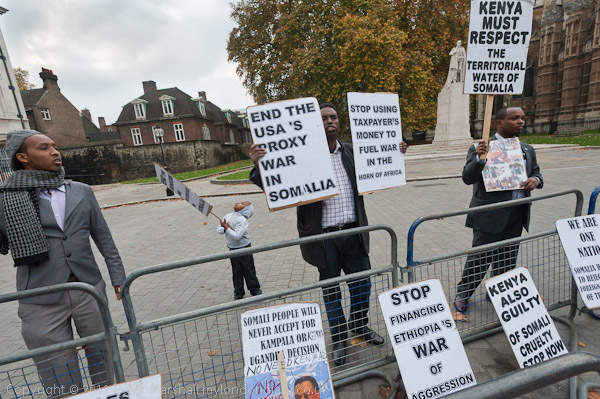
I took the District Line to Westminster for an advertised protest against Ethiopia’s war against Somalia, only to find there were only three men and a small boy at the advertised starting time, though they had a number of placards against what they describe as genocide and ‘Obama’s Proxy War’. They assured me more people would arrive and that the protest would continue for five or six hours, but when I came back again two house later there was no sign of it.
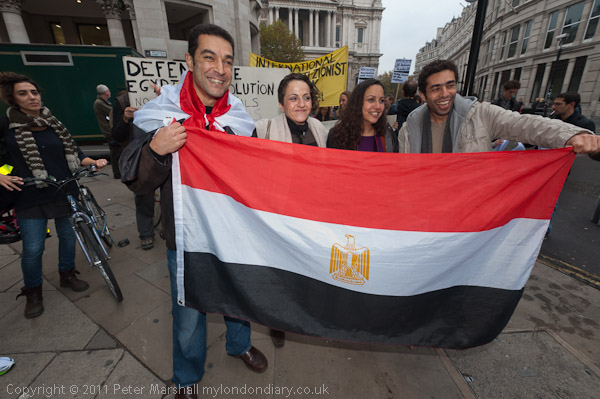
I returned to the City, where some protesters were setting off from the OccupyLSX camp at St Paul’s Cathedral for a ‘tour of shame’, visiting the offices of 3 arms dealers, Qinetiq, BAE and Rolls Royce, who went with David Cameron to Egypt in February to sell arms to the Egyptian army. This was a part of the International Day to Defend the Egyptian Revolution which had toppled the Mubarek regime, but the army had taken charge and there had been more than 12,000 trials in military courts, without the ability to call witnesses or access to lawyers in a programme of repression against the people. They called on the UK government to end support for the Egyptian military and stop selling them arms which might be used in further massacres such as that in Maspero a month earlier when soldiers opened fire killing 27 Coptic Christians and injuring over 300.
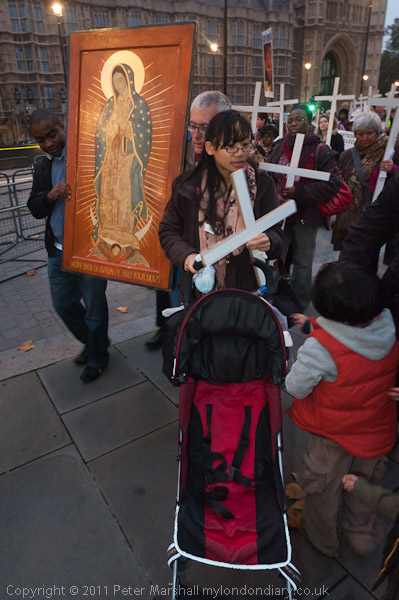
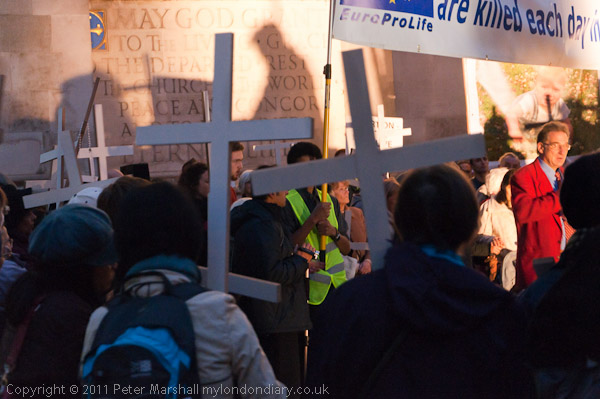
I left the marchers at Ludgate Circus and walked back to see what was happening with Occupy SLX at St Paul’s, then took the District Line again to Westminster to see if the Somali protest had grown. There was no sign of it, but I found another protest just leaving Old Palace Yard for a rally outside Westminster Abbey. This was the ‘500 Crosses for Life’ prayer procession, organised by EuroProLife UK, a “European ecumenical initiative” based in Germany with the full title “European Voice of the Unborn Children: Protect Our Life”, and there were several hundred people carrying white crosses.
They had walked from Westminster Cathedral to a rally here and a speaker at the rally was describing and applauding protests outside clinics in Germany where abortions take place. I found this disturbing – and commented on My London Diary “People have a right to their views on abortion, and to hold peaceful protests such as this and of course to pray about the matter. But isn’t harassing women who go to clinics at what is almost certainly for them a very stressful time morally offensive, a demonstration of an un-Christian lack of love as well as a statement of lack of faith in the power of prayer?”
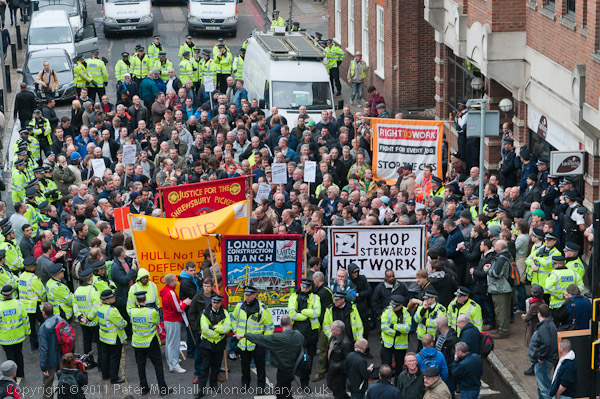
Police surround a grass roots rally before the main Union rally by electricians at the Shard
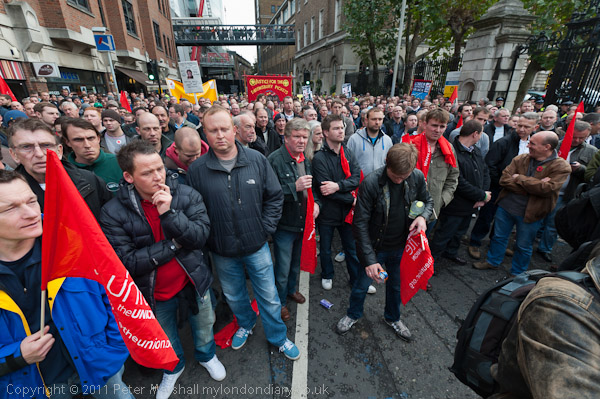
Ten years ago today on 9th November 2011 my work began at The Shard next to London Bridge, where ‘sparks’ (electricians) were protesting over plans by 7 major employers to tear up national agreements and impose worse conditions and pay cuts of at least 26 %.
Electricians listen to Unite union speakers
Before the official rally by the Unite union where speakers included several of the union’s leading officials as well as General Secretary of Unite Len McCluskey there was a separate rally with grass roots speakers. Numbers grew as the official rally began and there were over a thousand when it set off to march to another rally at Blackfriars.
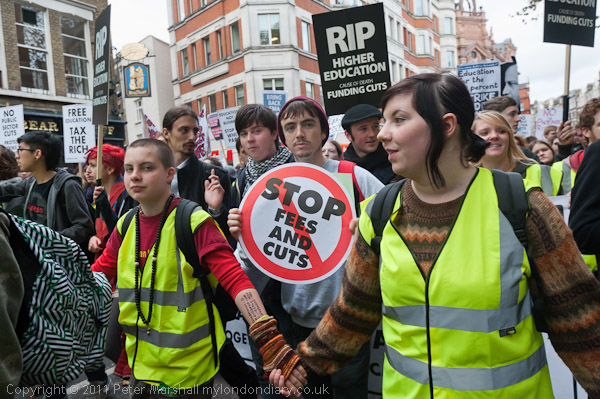
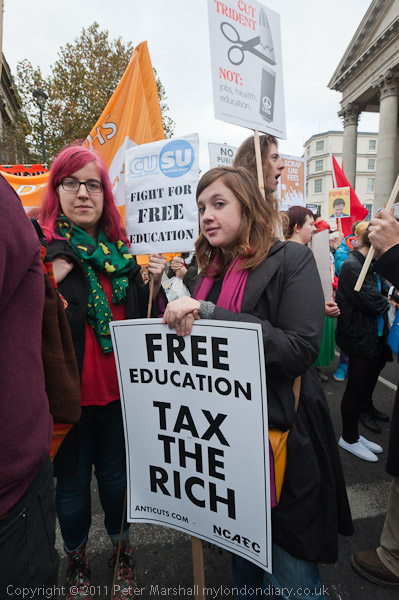
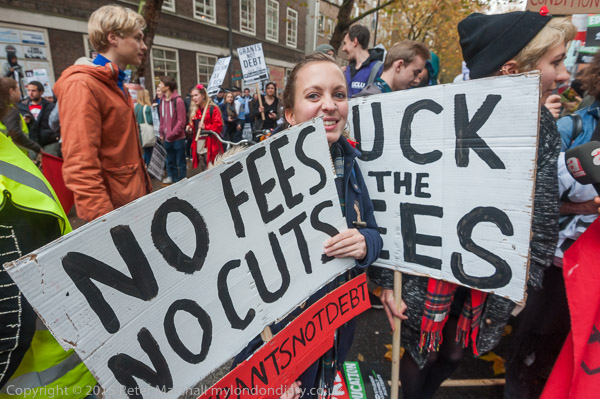
I left the march on Borough High St and headed north over the river to join a large march by student protesters against fees increases and cuts in services. Police had shut down most of central London before this started and there were no buses running and I had to walk around two miles to meet the marchers.
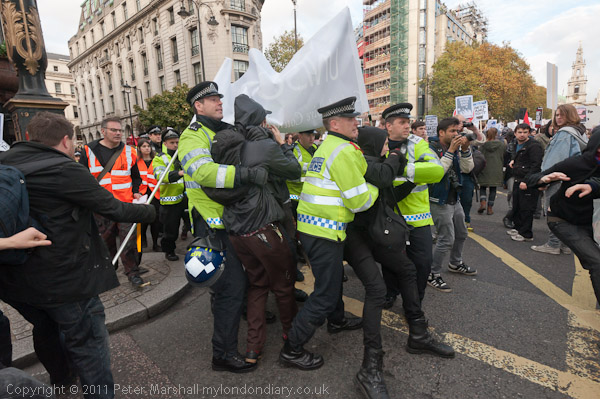
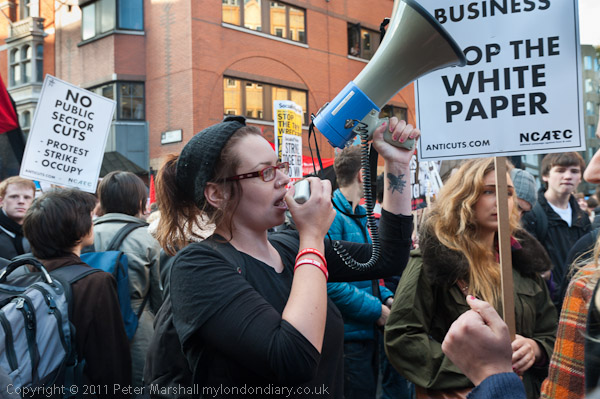
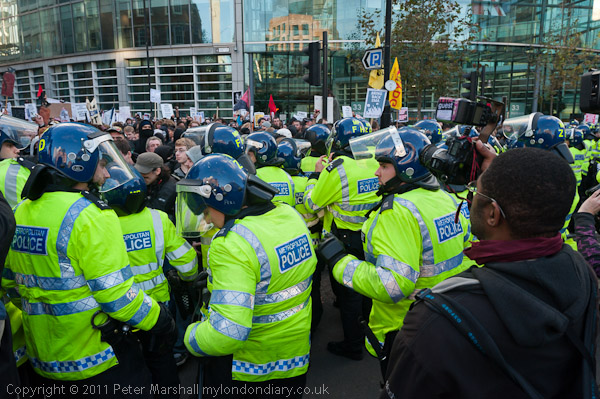
Students were angry about the cuts, particularly about the loss of the Educational Maintenace Allowances but the policing seemed completely excessive. I wrote: “There were perhaps 5000 students, but as the march approached me coming down Shaftesbury Avenue they were largely hidden by the police, with a row of mounted officers leading, followed by several further rows of police in front of the marchers. More police walked along each side of the march, and others stood on the pavement, with lines blocking side roads and others in the doorways of offices, banks and some shops.”
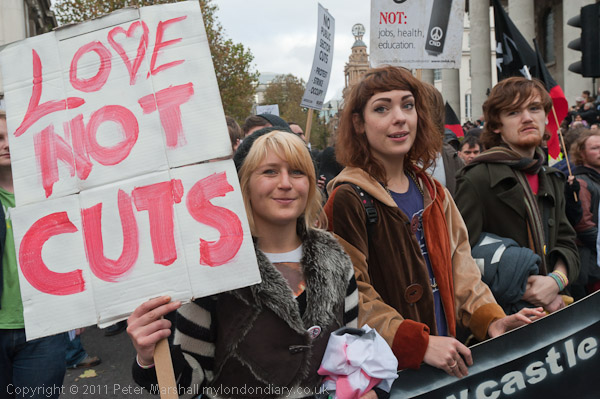
The mood of the marchers seemed to me to be rather cheerful and relaxed, and this was reflected in the humour in many of the posters. Although there were a number of provocative actions by police – including a snatch squad rushing in to grab several marchers – which injured me and some other marchers, as well as various occasions on which they slowed or halted the march, eventually bringing it to a complete stop and ‘kettling’ it in Holborn, which caused it to get a little heated.
Marchers chant “Free the Sparks”
The protesters had been angered to hear that six hundred electricians who had tried to cross the river after their rally in Blackfriars to join the student protest had been stopped at Blackfriars Bridge and London Bridge.
The police seemed to get completely disorganised at this point and I was able to walk past a police line along with several hundred of the protesters while the officers grappled with a few holding them back before more police arrived. After waiting for some time in the hope that others would join them, they continued the march to its intended destination at the Moorgate building of London Metropolitan University where they danced to the sound of a bicycle-hauled sound system while I walked a little further to Finsbury Square where Occupy London had been camping since 21st October.
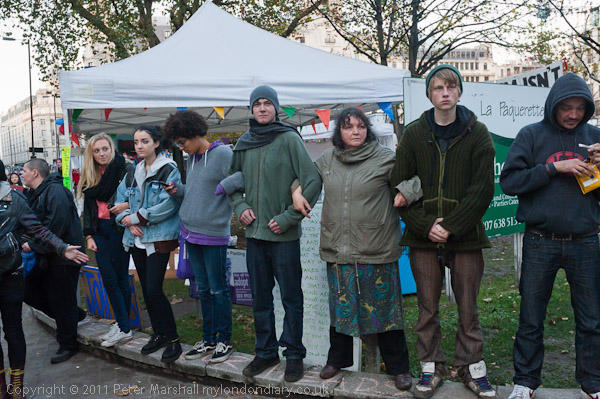
People in Finsbury Square were worried that the the 4000 police officers in London from the march would turn their attention to trying to evict them. I told them it was unlikely they would make an attempt with so many students on the street. Later I saw videos of students being kettled at Moorgate and individuals being attacked by snatch squads of plain clothes police who had posed as protesters but there was no action against Occupy London.
The huge policing of the two marches was clearly a reaction to the criticism of their failures at Millbank and Tottenham, but it came at a considerable cost, bringing movement in much of central London more or less to a halt for most of the day. Much of the City was still closed as I walked along Old Street with traffic outside the area moving at rather less than walking speed. Policing by consent has to involve letting peaceful protest continue and here was clearly an attempt to prevent it.
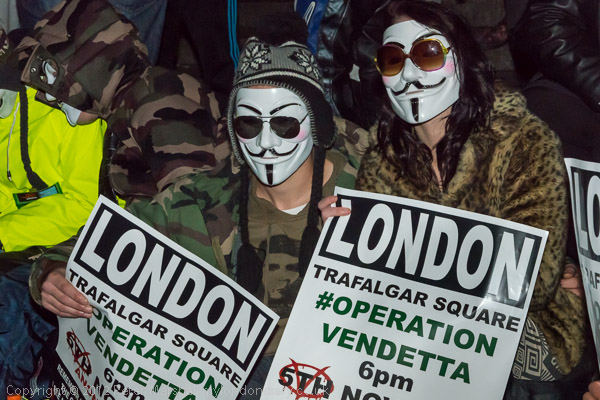
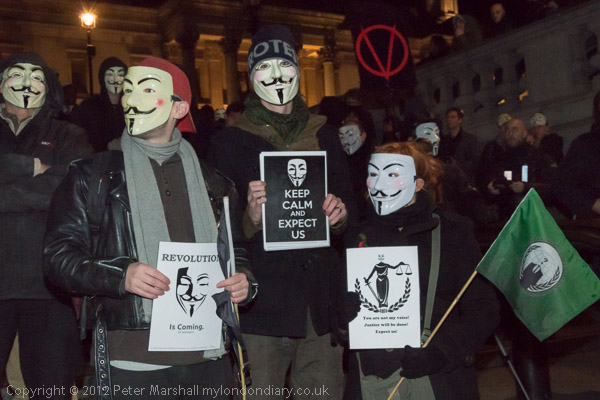
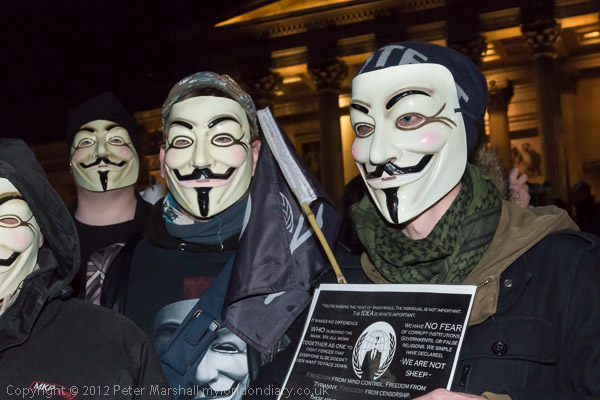
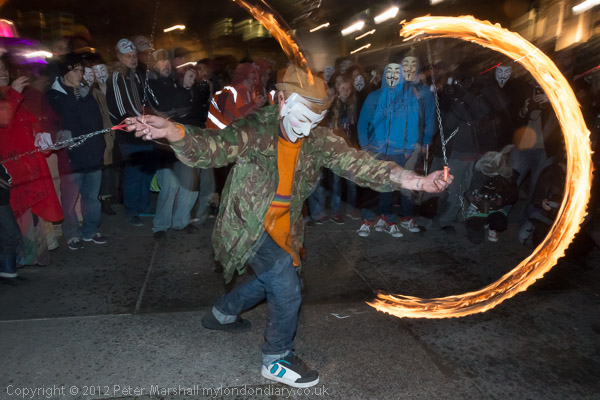
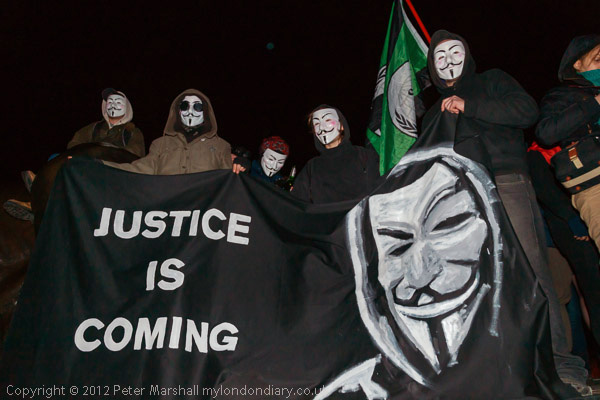
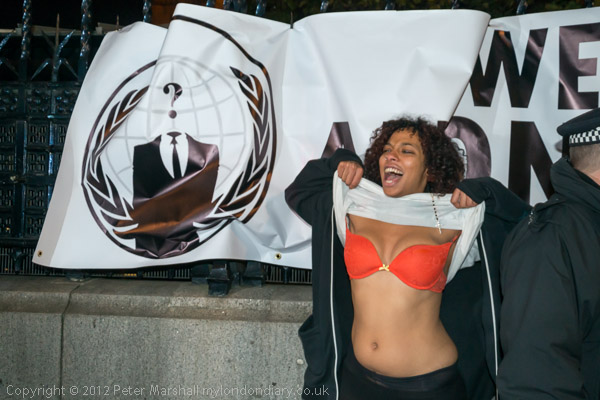
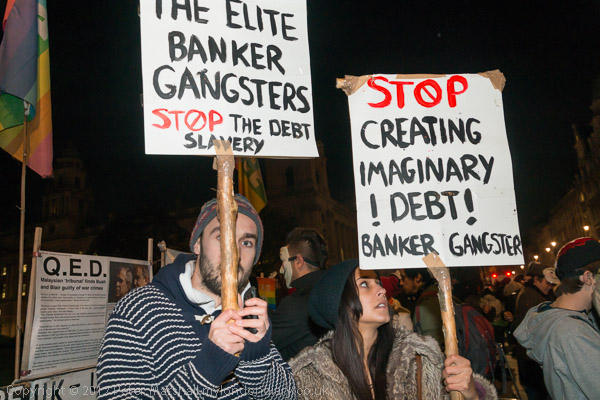
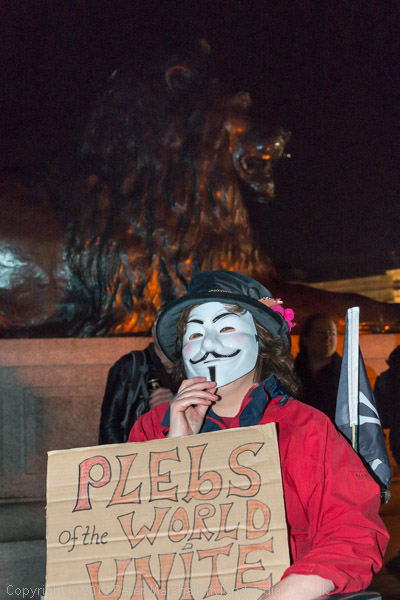
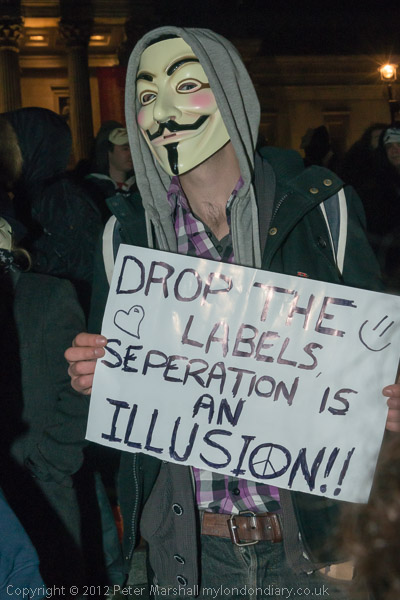
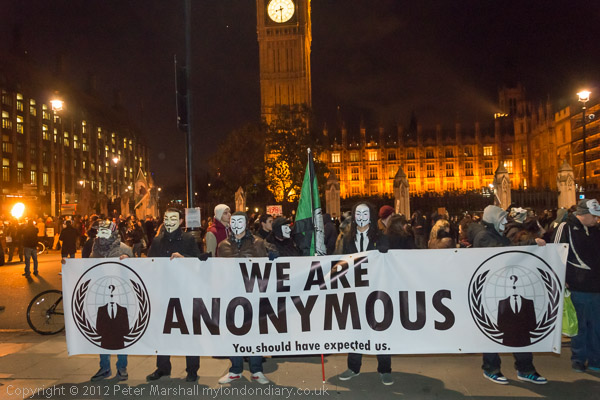
Despite some rumours I wasn’t around to photograph Guy Fawkes as he made his way into Parliament, but I was there in 2012 when ‘Anonymous’ wearing Guy Fawkes masks popularised in the graphic novel and film ‘V for Vendetta’ chose November 5th 2012, Bonfire Night, for their “worldwide Anonymous operation of global strength and solidarity, a warning to all governments worldwide that if they keep trying to censor, cut, imprison, or silence the free world or the free internet they will not be our governments for much longer.”
I wrote a fairly long account of the night, or at least those parts I witnessed, on My London Diary at Anonymous March to Parliament where you can also see many more pictures, and I won’t repeat the details here, but it is worth restating the aims of the protest:
In the UK the protest called for an end to cuts in education, health and welfare and the end of ‘austerity measures’ that target the poor and vulnerable, calling on the government to tackle the causes of the problems, including the banks and tax avoidance and evasion. They also want freedom for the Internet, with respect for the privacy of Internet users and the dropping of the Communications Data Bill.
My account also mentions that:
Anonymous also asks for Internet activists who are held as political prisoners to be released, including Julian Assange currently still unable to leave a London embassy, Richard O’Dwyer, the “PayPal 14, Jeremy Hammond, Topiary and the 4 anons of the UK that will stand trial on November 7th.”
Everyone will be aware of some of what is still now taking place over Assange, including a CIA plot to kidnap him from the Ecuadorian embassy, then the Ecuadorian government withdrawal of his immunity, calling in the police to remove him, since when he has been kept largely in isolation in the high-secuirty Belmarsh prison as the US authorites continue to press for his extradition. The US appeal last week against a previous court decision that he could not be extradited because of this mental health and the likelihood that he would commit suicide has been largely the subject of a news blackout by the British media.
But the other cases have probably faded from most of our memories – if we were ever aware of them, so here are some brief reminders with information from Wikimedia.
Richard O’Dwyer created a web search engine which linked to copyright infringing sites and was charged in New York with conspiracy to commit copyright infringement and criminal infringement of copyright. He fought against extradition, but after Theresa May as Home Secretary ruled he could be sent to the US to face charges in November 2012 signed a deferred prosecution agreement, paying a £20,000 fine for charges to be dropped.
The PayPal 14 were charged under the Computer Fraud and Abuse Act in July 2011 for attempted denial of service attacks on Paypal in 2010 after it refused to make payments to a Wikileaks account, in what they say as a digital ‘sit-in’. Most later pleaded guilty to misdemeanours to avoid more serious charges and were sentenced to probation with 13 sharing a fine of $6,615 each.
American activist and computer hacker Jeremy Hammond was sentenced to two years in hail for hacking a US pro-Iraq war group in 2005. In December 2011 he was involved in a hack of private intelligence firm Stratfor, which compromised 60,000 credit cards and downloaded 5 million emails, some later published by Wikileaks. Identifying himself as anarchist-communist he defended his actions saying “I did what I believe is right” and was sentenced to the maximum penalty of 10 years in jail. He was released under supervision in November 2020, having been kept in jail longer for refusing to testify to a grand jury investigation into Wikileaks and Julian Assange.
Topiary, British hacktivist Jake Davis, was a member of Anonymous and LulzSec, involved in various online attacks including defacing the goverment websites of Zimbabwe, Syria, Tunisia, Ireland, and Egypt as well as the Westboro Baptist Church. Then aged 18, he was arrested in 2011 at his home in the Shetlands and charged with offences including a conspiracy to launce a denial-of-service attack against the Serious Organised Crime Unit. Tried with three fellow hackers (I think probably the 4 anons of the UK referred to by Anon) in 2013 he pleaded guilty and was sentenced to 24 months in a young offenders institute, with the 21 months he had been electronically tagged before the sentence being counted against it.
Anonymous hackers were also responsible for a number of successful attacks on child pornography sites, and actions against Scientology, a cult they saw was causing harm to many followers. They say “Distributed Denial of Service must be recognised as a legitimate form of protest, as long as an aim and reason has been specified by the protestors.“
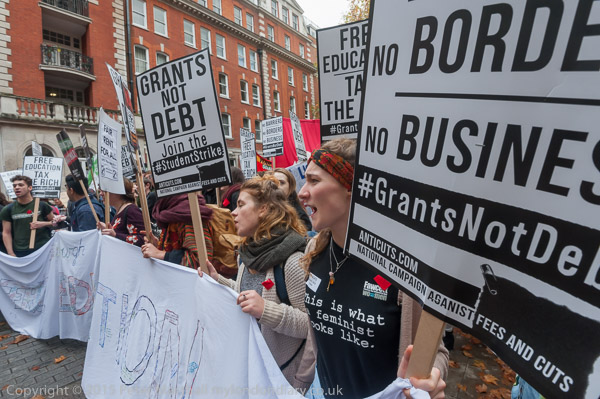
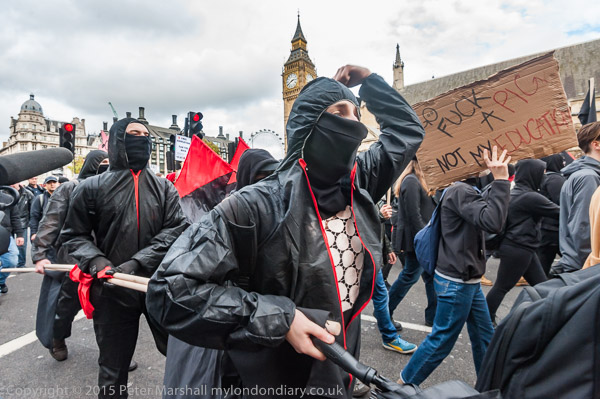
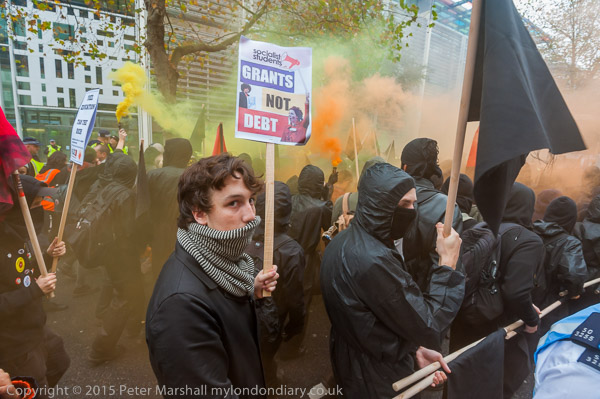
Free Education – No Barriers, Borders or Business was the call by the National Campaign Against Fees and Cuts (NCAFC) on their march through London on Wednesday 4th November 2015 against the abolition of maintenance grants and demanding free education without fees and huge student debts and an end to turning higher education into a market system impoverishing staff and students.
The march began in Malet St outside what had been the University of London Union, founded in 1921 as the University of London Union Society and was run by students for students. In 2013 the University of London decided to close ULU, taking over the building and running it as ‘Student Central’, now managed by the university, though continuing to offer similar services and resources for the 120,000 students, including bars, restaurants, shops, banks, a swimming pool and a live music venue – though some of these were on a reduced scale. But in 2021 it was announced that Student Central was to close and the building would become a teaching space for neighbouring Birkbeck College.
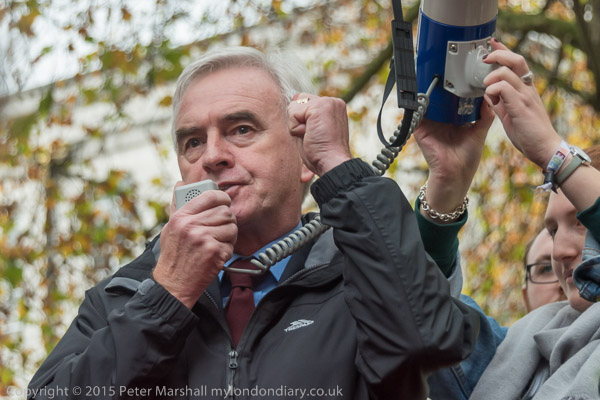
There were some speeches in Malet St before the march began, with speeches from several student representatives from various universities around the country, teaching staff and some fighting words from Shadow Chancellor John McDonnell MP. Green Party leader Natalie Bennett also marched with the students.
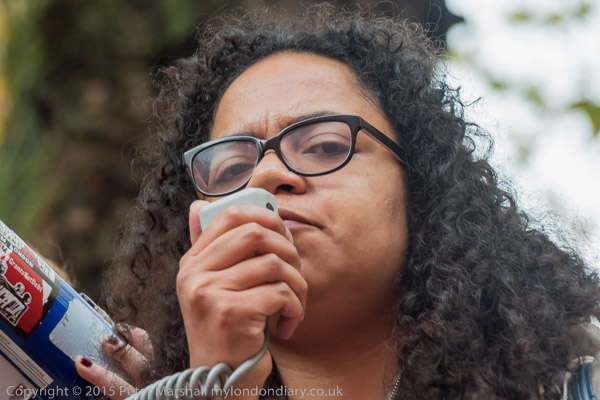
Antonia Bright of Movement for Justice spoke about the UK’s racist immigration policies and invited students to protest at Yarls Wood on the following Saturday.
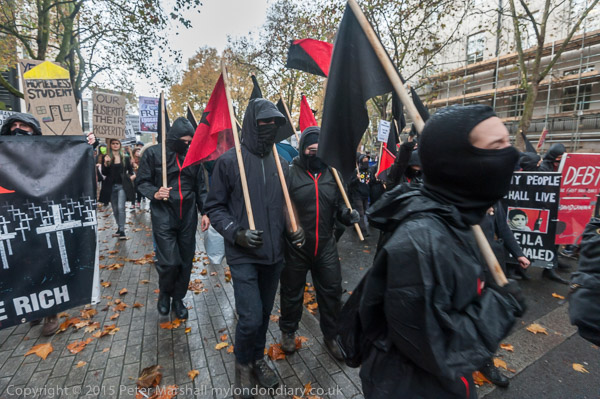
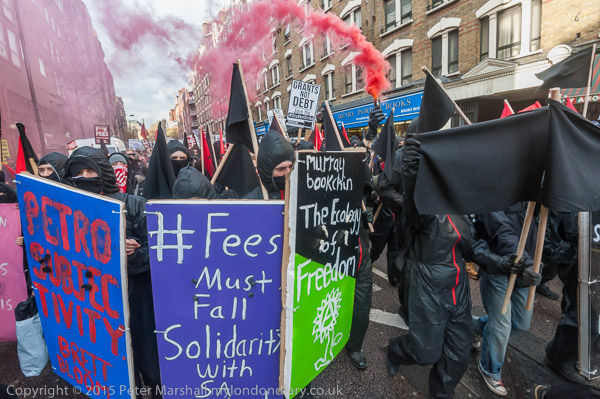
Among the marchers was a ‘black bloc’ carrying red and black anarchist flags and including Class War carrying their ‘WE HAVE FOUND NEW HOMES FOR THE RICH’ banner, along with a ‘book bloc’ carrying large polystyrene padded posters with the names of left wing and anarchist classic books on them or slogans such as ‘Rise, Riot, Revolt.’
The march went through Russell Square Square and down to High Holborn where it turned west and then took Shaftesbury Ave and the Charing Cross Rd to Trafalgar Square.
From there it went down Whitehall to Parliament Square where I left it briefly to photograph campaigners from the Save Shaker Aamer Campaign who had mounted a weekly vigil for his release from Guantanamo and were holding a ‘Welcome Home Shaker’ celebration.
I caught up with the marchers again at the Home Office, where there was a great deal of noise, confusion and coloured smoke before the marchers turned around and walked back towards Victoria St.
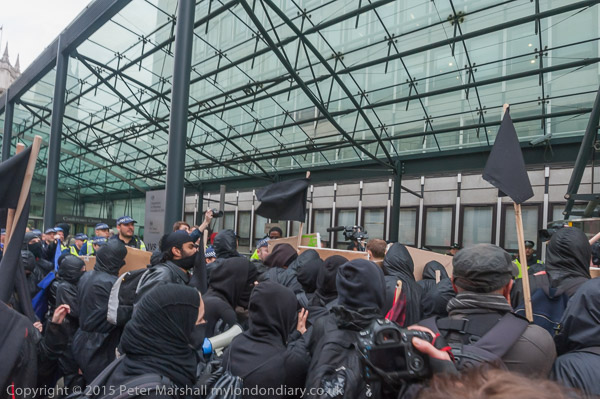
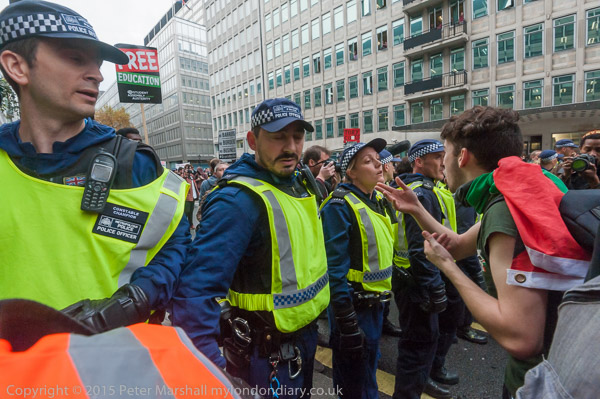
They gathered outside the Dept of Business, Innovation & Skills, where a black clad block charged the mass of police protecting the building, but were forcefully repelled. More police arrived and started pushing everyone away, including peaceful protesters and photographers. I was sent flying but fortunately into some of the protesters rather than to the pavement.
Eventually the pushing stopped and the police set up lines across the street which prevented the more peaceful protesters leaving the area. I tried to leave, showing my press card. After some minutes of being refused I found an officer who let me through and I walked along the street to rest and wait to see how the situation would develop. Eventually the students managed to break through the police line and run along to join the others already there, and they moved off. I decided I’d had enough and made my way to Victoria station to catch a train.
Twenty years ago today on 3rd November 2001 I wrote:
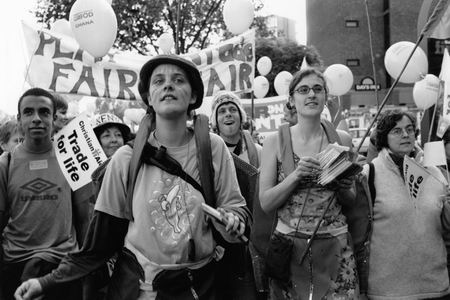
the trade justice parade was a serious event but also we were having some fun. the world trade organisation isn’t at all amusing, but i loved the t-shirt that said ‘wto – unsuitable for anyone with a conscience.
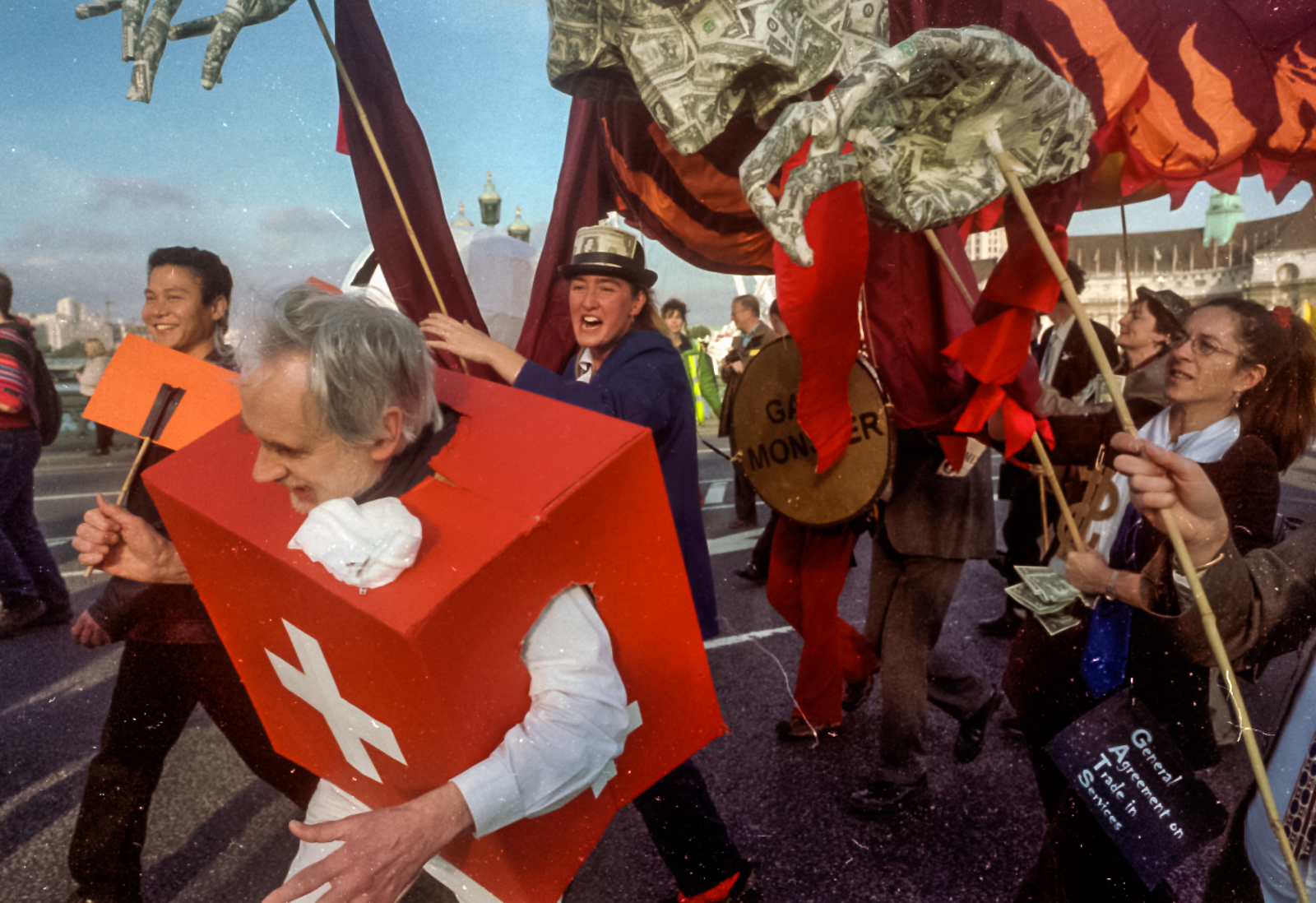
giant pound signs, balloons, a hug fat cat, the wto dragon, pirates and everyone made it an event to remember.
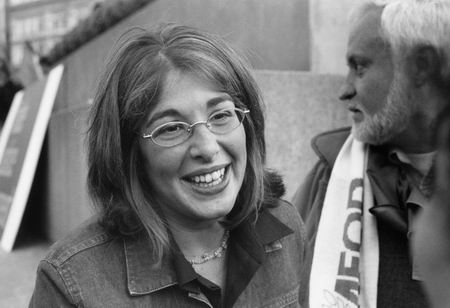
speakers included naomi klein (author of ‘no logo’) and sergio cobo from mexico.
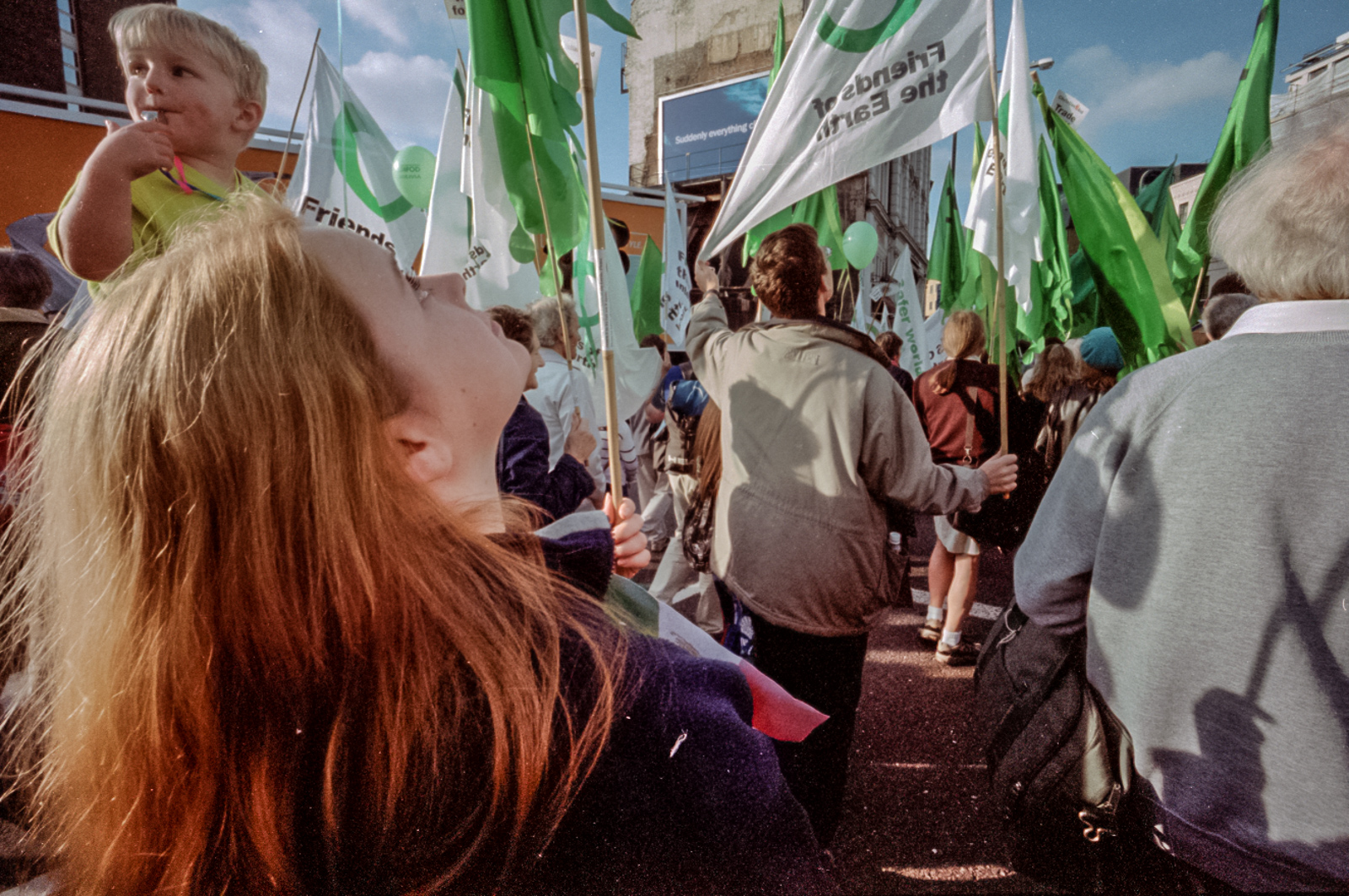
And with the article I posted the two black and white images shown here. But I think most of the pictures I took of the parade were in colour, taken on colour negative film. But the only work I was putting in to a picture library back then was in black and white – and then still 8×10″ prints. There was still greater demand for black and white, and some of the pictures I took in colour I printed as black and white. The library would have taken colour, but mostly they worked with colour transparencies.
But I had recently bought a scanner with which I could scan colour negative film and it had software that could produce positive results with something like the correct colours. The results were not great and seemed to accentuate the faults in the negatives and exaggerate flare. The results were certainly not of professional quality as you can probably see – even after I have improved the pictures in Lightroom.
A year after I made these pictures I bought my first DSLR and things changed, though it took a while for the library and some other outlets to shift to accept digital files, and for a little while I was still taking black and white film for the prints they wanted as well as digital colour. But things changed quite rapidly to an all-digital world.
Going back to the negatives I’m sure I could now make much improved digital versions than these by ‘camera scanning’ – using a DSLR to photograph them and then Negative Lab Pro software to convert them to positives. It’s good news for those of us with archival material on colour negative film. But I can see no reason at all for wanting to take film again when digital produces so much better results with much less hassle.
The issues people were protesting about in the Trade Justice Parade are still very much with us – and in the UK the government last week passed yet another act hastening the privatisation of our NHS, while many of the same issues that were brought up by the protest are behind the failures to deal effectively with climate change. The huge greed for consumption and wealth of a small minority of the ultra-rich underlie both; they are not ‘high net worth’ but ‘high global liability.’
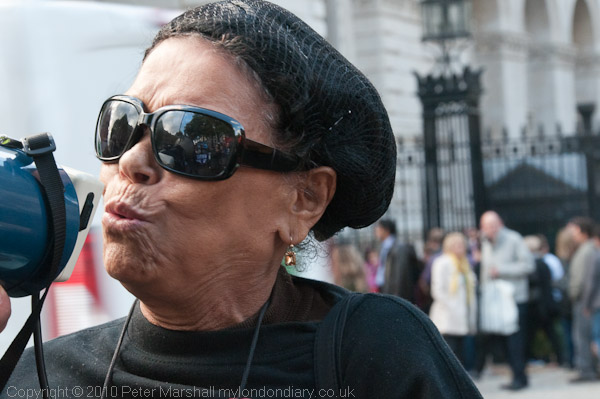
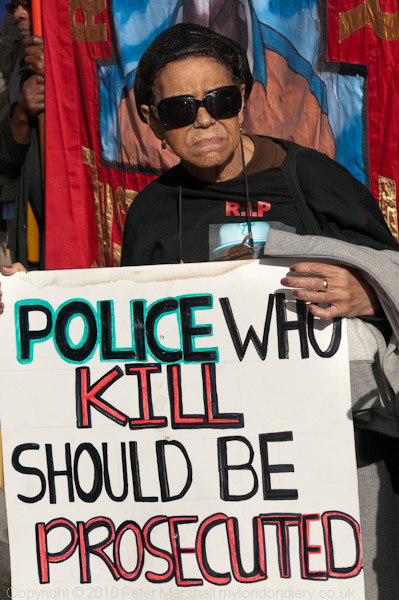
Today at noon in London, the the United Families & Friends Campaign (UFFC), a coalition of those affected by deaths in police, prison and psychiatric custody, is holding its annual march from Trafalgar Square along Whitehall to a rally opposite Downing St as it has on the last Saturday in October since 1999. In 2010 the march was also on 30th October and I published a lengthy post about it with many photographs on My London Diary. Here is the text in full (with some minor corrections) and a few of the pictures.
United Friends & Families March
Trafalgar Square to Downing St, London. Saturday 30 Oct 2010
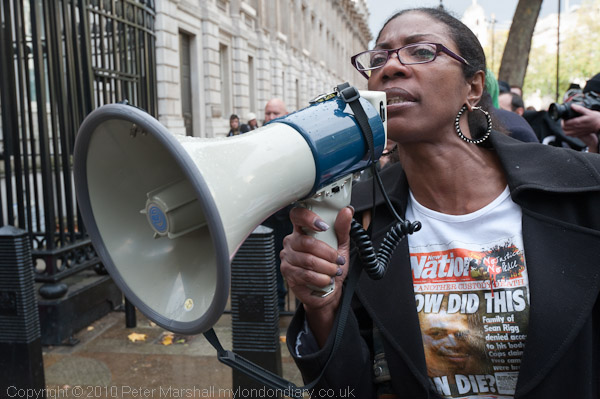
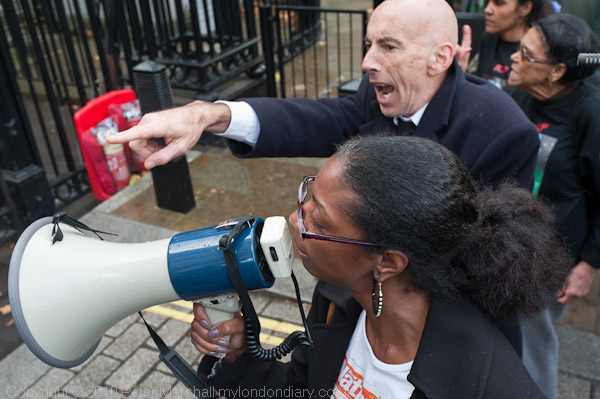
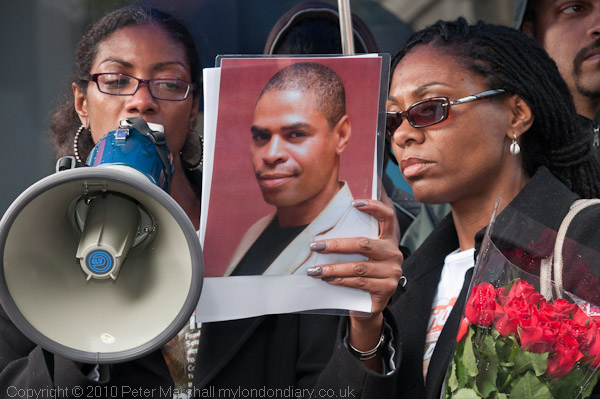
Marcia Rigg-Samuel, sister of Sean Rigg, killed by police in Brixton, tries to deliver a letter at Downing St more pictures
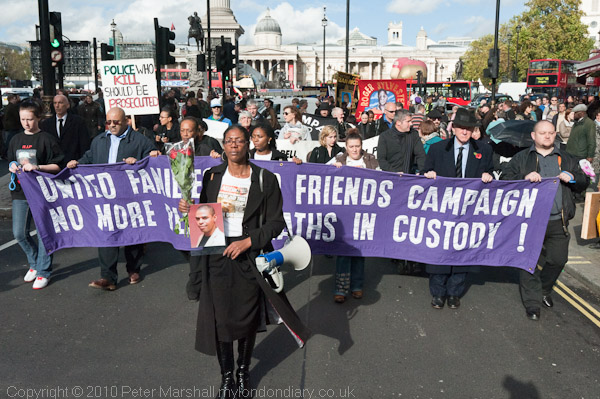
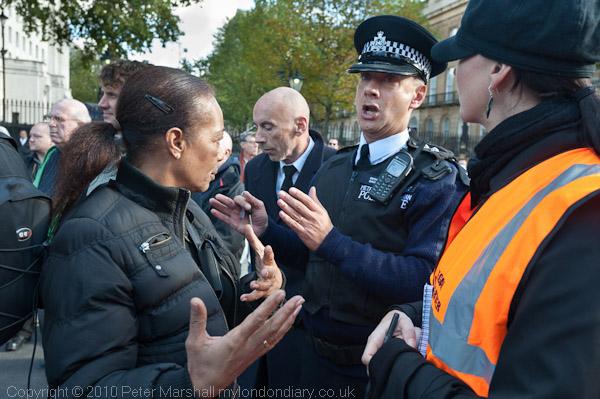
The United Friends and Families of those who have died in suspicious circumstances in police custody, prisons and secure mental institutions marched slowly in silence down Whitehall to Downing St, where police refused to allow them to deliver a letter to the Prime Minister, David Cameron.
It’s impossible to be sure how many of the suspicious deaths in police custody, prisons and secure mental institutions (and there are around 200 a year) have been as a result of lack of care, the use of excessive force and brutality, but certainly the answer is far too many.
Since 1999, the ‘United Friends and Families’ of some of those who have died have held an annual slow silent funeral march from Trafalgar Square down Whitehall to Downing St. It attracted particular attention in 2008 when the mother and other family members of Jean Charles de Menezes were among those taking part. This year’s event was rather smaller, and received little attention from the mainstream media.
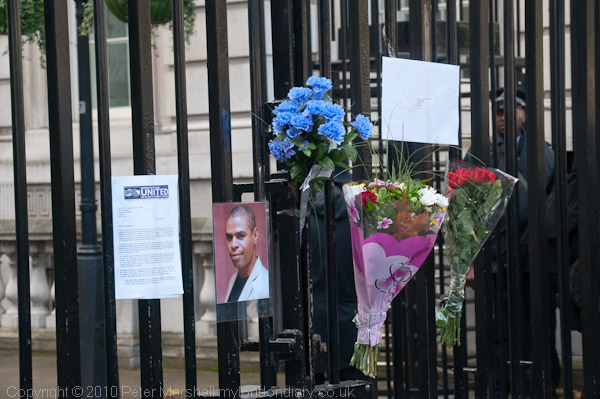
A number of family members spoke with great feeling opposite Downing St, and then the group, by now around a hundred strong, moved across the road to fix flowers to the gates and attempt to deliver a letter to Prime Minister David Cameron. It seemed an unnecessary and pointless snub that the police refused to take the letter and that nobody from No 10 was apparently prepared to come and receive it.
Earlier there had been an argument with the police who had objected to the rally occupying one of the two southbound lanes of Whitehall, but was allowed to go ahead by the officer in charge after those present had refused to move. In previous years the police have usually seemed anxious to avoid confrontation, although in 2008 they insisted on searching all the bouquets before allowing them to be laid on the gates of Downing St.
Jason McPherson’s grandmother speaking opposite Downing St
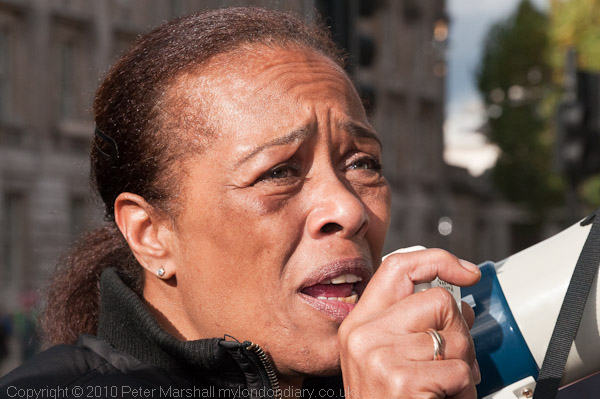
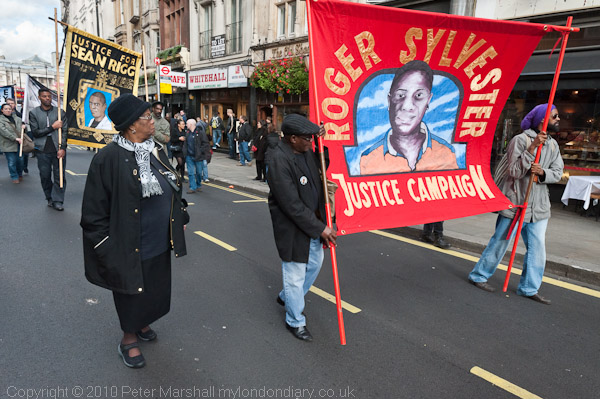
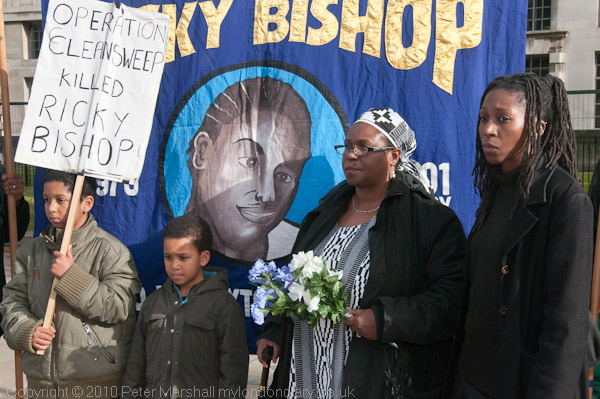
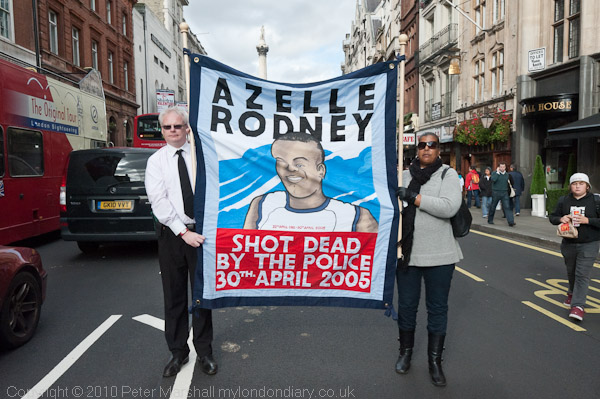
Speakers at the rally opposite Downing St included Stephanie, the twin sister of Leon Patterson, Rupert Sylvester, the father of Roger Sylvester, Ricky Bishop’s sister Rhonda and mother Doreen, Samantha, sister of Jason McPherson and his grandmother, Susan Alexander, the mother of Azelle Rodney, and finally the two sisters of Sean Rigg.
What the families want is simple. Justice. And to know the truth about what happened. What emerged again and again was a shameful history of delay, evasion and covering up by the police, with the collusion of the IPCC, the Crown Prosecution Service and even at times judges, working together to ensure that justice fails to be done. The press have been fed lies – as in the de Menezes case, security cameras have suddenly been found not to have been working, CCTV tapes have been lost or doctored, officers involved have not been questioned until many months after the events, witness statements have been dismissed as ‘unreliable’. Deliberate delays are used as a tactic to prevent the truth coming out, and these also have allowed officers involved to collude in their cover-ups.
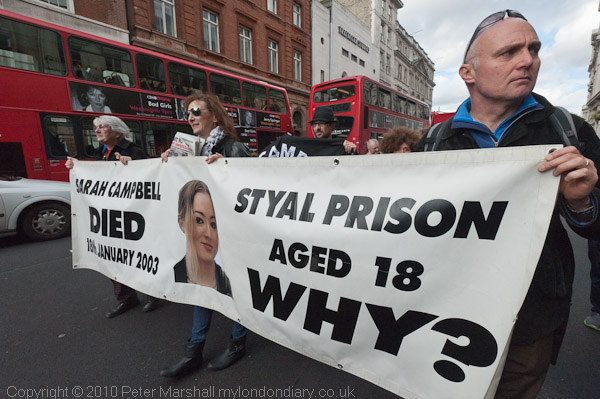
Overwhelmingly the victims in these cases are black, but one of the banners on the march reminded us that it affects the whole of our community, with a banner asking why 18 year old Sarah Campbell died in Styal Prison in 2003. Many of us present remembered and sadly miss her mother, Pauline Campbell; after her daughter’s tragic death she devoted herself single-mindedly to campaigning for justice, not just for Sarah but for other victims and to improve the system. Eventually she forced an admission from the authorities that their lack of care had caused Sarah’s death, but she became another victim of injustice when she committed suicide on her daughters grave.
Stephanie Lightfoot–Bennett, speaks about the police murder of her twin Leon Patterson
Leon Patterson was arrested in Stockport in 1992 and kept in a police cell for some days despite being in need of hospital treatment. He was found dead in his cell with a fractured skull and severe injuries, his blood covering the walls of the cell and his genitals mutilated, and in such a bad state that she failed to recognise him. The family challenged the initial inquest verdict which found his injuries to be self-inflicted, but there was no legal aid available for them. Fortunately the charity INQUEST supported them and a second inquest in April 1993 returned a verdict of unlawful killing, although this was quashed on appeal by the police on the grounds that the coroner had misdirected the jury on the law.
Roger Sylvester died in 1999 after being arrested by the Met. An inquest jury in October 2003 returned a verdict of unlawful killing, but the verdict was later quashed in the High Court, because the judge claimed the coroner’s summing up had confused the jury. The judge refused to order another inquest and said that no jury in a criminal case would be likely to convict any of the officers concerned of manslaughter.
Ricky Bishop was stopped, arrested and taken to Brixton police station on 22 Nov 2001, where he was assaulted and brutalised by police officers, leading to a heart attack. After that the police called a paramedic and he was taken to hospital and died. The family say that the police withheld vital evidence from the inquest and that the jury were not given a proper choice of verdicts at the inquest.
Samantha, sister of Jason McPherson
Jason McPherson died in hospital after being taken there from Notting Hill Police station after having been arrested on suspicion of drug offences on 18 Jan 2007. Police believed he had a wrap of cocaine in his mouth and had used considerable and arguably excessive force on his head and chest to try to get him to open his mouth. A jury at the inquest in January 2010 came to a unanimous ‘narrative verdict’, saying that the procedures were not properly implemented and that “it did not appear Jason was given the opportunity to remove the drugs voluntarily through talking down (tactical communication).”
Azelle Rodney was killed by police in April 2005 after a car in which he was travelling was rammed and stopped by the Met in Barnet. Rodney was not armed, although the officer who fired the shots at close range was sure he was. Various misleading statements from police sources were widely published by the press. An inquiry into the case opened formally earlier this month and there is to be a hearing in the Royal Courts of Justice starting next week.
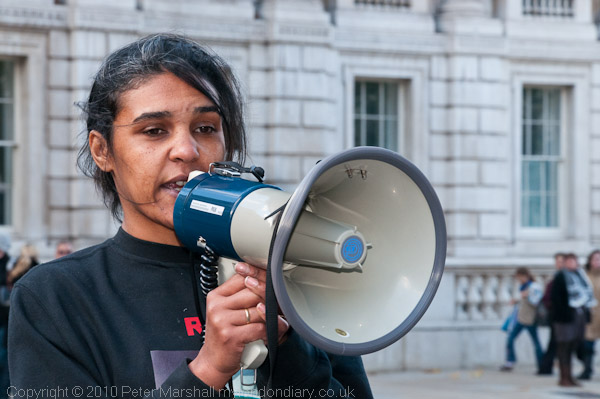
Marcia Rigg-Samuel, sister of Sean Rigg, who went into Brixton Police station in August 2008 a physically healthy man but was dead a short time later, killed by the actions of a small group of officers, led the procession down Whitehall from Trafalgar Square. She stood beside her sister, Samantha Rigg-David, the last of the families to speak, and then read the letter from the families to Prime Minister David Cameron. The inquest on Sean Rigg, adjourned in 2008, is not now expected until 2012.
The families then moved across the road to the gates to Downing Street, demanding that police open them so they could deliver their letter. Police refused, and a small group of armed police joined the armed officers already present. After considerable amount of angry shouting as the police continued to refuse to allow access or even to take in the letter – a few of the group were allowed to sellotape the flowers, a photo of Sean Rigg and the letter to the gates. The noisy demonstration at the gates was still continuing when I left. more pictures
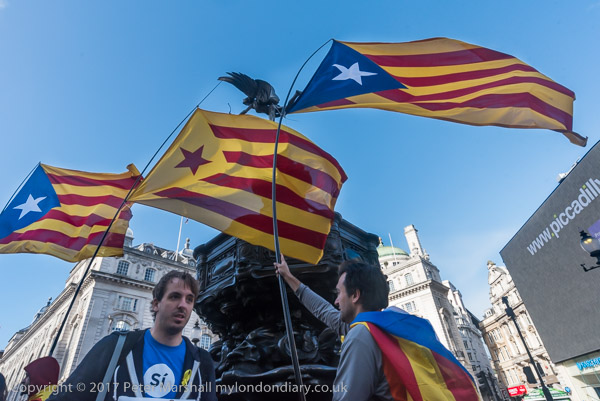
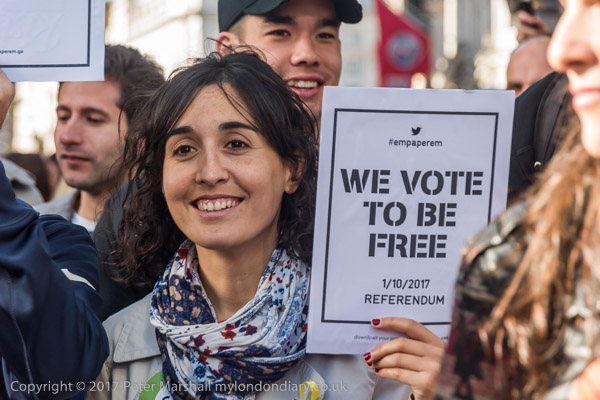
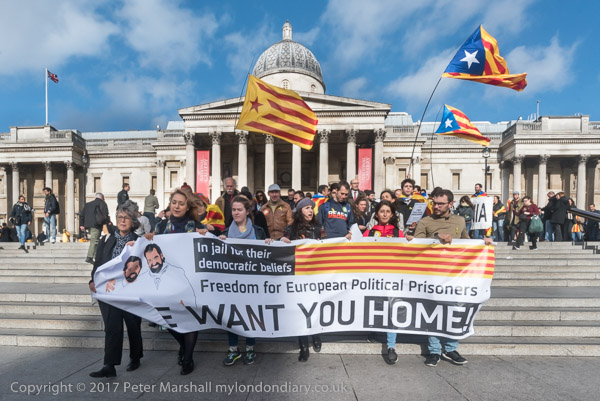
I began work on Saturday October 21st 2017 with a large group of Catalans at Piccadilly Circus, demanding immediate release of the political prisoners Jordi Cuixart and Jordi Sanchez, and end to the repression and the start of dialogue to accept the electoral mandate of the Catalan Referendum.
After several speeches they set of to march to Trafalgar Square for photographs and then on to Downing St where they called on the UK Government to condemn the violence towards civilians during the referendum vote in Catalonia and to support a democratic solution.
In June 2021 the nine separatist leaders who had been jailed for sedition in 2017 were released, and talks finally restarted in September, with the Catalan government demanding an amnesty for the many pro-independence politicians still facing legal action over their part in the 2017 independence referendum and for the Spanish government to acknowledge their right to hold a referendum on self-determination, both demands still resisted by the government.
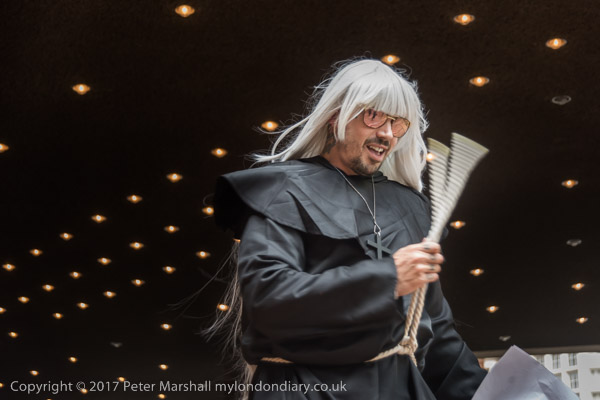
I left the Catalans at Parliament Square, where it wasn’t clear if their protest was ended but I was on my way to meet Class War’s Levitation Brigade of Ian Bone and shaman Jimmy Kunt (aka Adam Clifford) who were celebrating the 50th anniversary of the Yippee levitation of the Pentagon during anti-Vietnam War protests with a similar action at Kensington Town Hall.
Standing on the steps of the entrance to the town hall of the Royal Borough of Kensington and Chelsea, the council responsible for the disastrous fire at Grenfell Tower, Adam called out the demons of councillors including Nicholas Paget-Brown, Rock Feilding-Mellen & Elizabeth Campbell and attempted to levitate the town hall to a height of over 70 metres. “Out, demons, out! Out, demons, out!”
A security officer told them that they couldn’t do that here, but they told her it wasn’t possible to stop a levitation or exorcism and the ceremony went ahead.
Afterwards Ian Bone repeated a well-known quote from 1967 “You mean you didn’t see it, man?”
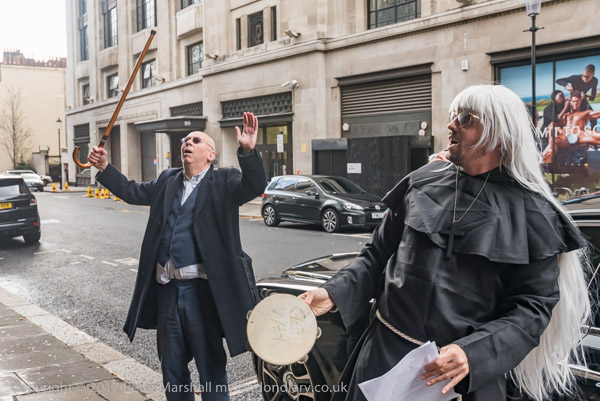
Flushed with success the Levitation Brigade decided to cross Kensington High St and repeat the exorcism and levitation at the offices of the Daily Mail, standing on the pavement outside between the offices and a highly polished Rolls-Royce.
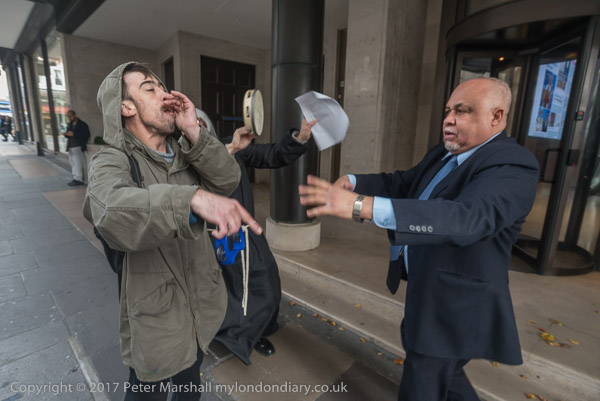
Security staff there reacted angrily to Class War calling out the demon of Paul Dacre and their attempt to raise the building by over 70 metres, perhaps fearing it might damage the Rolls-Royce parked outside, but the levitation ceremony went ahead despite considerable interference.
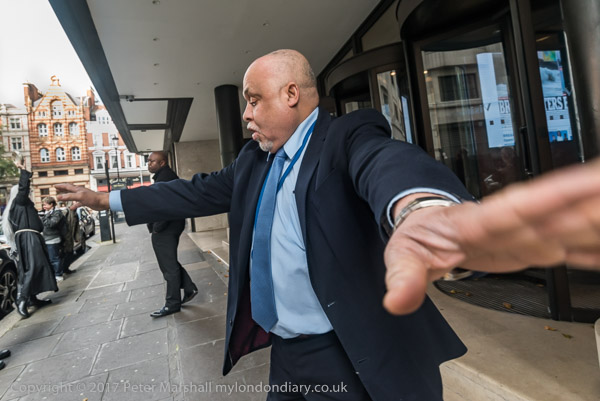
Security here reacted rather more aggresively, coming to push the crew away and telling me I could not take photographs. I was standing on the pavement and told them I had every legal right to photograph whatever I chose, but had to move back rahter smartly to avoid getting fingerprints on my lens.
Class War of course found the over-reaction by the Daily Mail extremely amusing and continued to bait the security for some minutes after the levitation before leaving as you can see on My London Diary.