Unite Against Racism

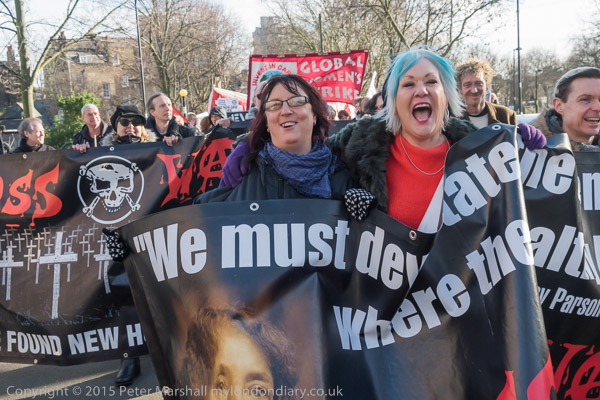
Two years ago today, 27 April 2019, I joined with a large crowd in Southall remembering the murders there of Gurdip Singh Chaggar and Blair Peach, calling for unity against racism.

The march took place on the Saturday after St George’s Day, and marked the 40th anniversary of Blair Peach’s murder by police officers. Several thousand police had packed the town to defend the National Front who were holding a meeting at Southall Town Hall. A large group of the local community and supporters from across London had come to oppose the meeting, and and police rioted and attacked what had been a determined but largely peaceful protest. Wikipedia has a long and well referenced article on the murder from which many of the facts below are taken, though speeches at the 2019 protest also included some eye-witness accounts. Peach was a member of my own union at the time, the NUT, which also made me very aware of the events and was prominent in the fight to see justice.

Blair Peach was in a group of friends who tried to escape the violent police attacks on Southall Broadway and make their way home down a side street, but unfortunately this led nowhere and the police Special Patrol Group drove up in several vans and began attacking the crowd there, who responded with bricks and bottles. Witnesses, including residents on the street say the police were hitting everybody and fourteen saw a police officer hitting Peach on the head.

People obseve a minute of silence where Gurdip Singh Chaggar was killed

Forensic evidence found he had been hit with an illegal weapon, probably a lead-filled cosh or pipe, and searches of the lockers of the SPG unit involved found 26 illegal weapons. None of the witnesses were able to identify the police officer involved – perhaps because one officer had shaved off his moustache and another grew a beard and refused to take part in the identity parades. Many also had their uniforms dry-cleaned before the police investigation inspected them.

Although the police investigation had produced a great deal of evidence against the SPG, the DPP decided it was insufficient to justify a prosecution. The report was kept secret, though parts appeared in the press early in 1980, and the inquest was hampered as the legal team acting for the Peach family were not allowed access to it. The verdict of the inquest, ‘death by misadventure’ was widely considered – even by The Times – to have been inappropriate. The coroner afterwards wrote an article including his comments that some of the civilian witnesses had lied as they were “politically committed to the Socialist Workers Party” of which Peach was a member and that some Sikh witnesses “did not have experience of the English system” to enable them to give reliable evidence but was persuaded not to publish it.

At Ramgarhia Sabha Gurdwara


The fight to get justice over the murder continued, but none of the officers involved was ever brought to trial. Apparently all left the police force shortly after the investigaton. Peach’s family were awarded £75,000 compensation in a tacit admission of police guilt by the Metropolitan Police in 1988, but requests for a public inquiry were turned down by the Home Office. The SPG was disbanded in 1987, but replaced by a very similar Territorial Support Group. It was only following a member of the TSG killing newspaper vendor Ian Tomlinson as he was walking home past the G20 protests at Bank in 2009 that the report of the police investigation into Blair Peach’s death was finally made public.

The 2019 march and rally in Southall convened close to where Gurdip Singh Chaggar, an 18 year old student, was murdered by racist skinheads in June 1976 as he left the Dominion Cinema and began, at the request of his family with a karate display. It paused for a minute of silence where his was killed before moving on to stop at the Ramgarhia Sabha Gurdwara which the Chaggar family attend, where prayers were said.

Flowers were handed out which were then laid at the street corner where Blair Peach was murdered before we moved on to a rally outside Southall Town Hall where the National Front held their meeting. Peach’s murder inspired the formation of both the anti-racist grassroots group The Monitoring Group, whose founder and director Suresh Grover introduced the event and of Southall Black Sisters, whose founder Pragna Patel who was one of the speakers, along with other community leaders and anti-racists.

Perhaps surprisingly absent was the local Labour MP, Virendra Sharma, who in 2019 lost a vote of no-cofidence by the local party apparently due to his low attendance at party meetings, slow responses to constituents and failure to campaign over local redevelopment issues. John McDonnell, Labour MP for a neighbouring constituency and then Shadow Chancellor was there from the start of the march and made a powerful speech.

More about the event and many more pictures: Southall rally for unity against racism

Scientists Call For Research-Based Policies

Recent events have brought scientists much more into centre stage, and politicians now claim to be “following the science” although this often means simply picking and choosing those bits from the wide range of scientific advice that suits their particular agenda.

Science isn’t monolithic, and its predictions are generally in terms of probabilities rather than certainties. Different disciplines may bring rather different emphases to aspects of complex problems and sometimes we need a wider view than that of a particular specialism – and even some common sense.

It seems clear that at the beginning of the Covid outbreak our government placed to much confidence in the advice of some mathematical modellers and failed to follow that based on medical experience in dealing with earlier pandemics on wearing masks and tightly controlling international travel that kept infection rates near zero in some countries. And that they had dismissed the evidence of earlier exercises in pandemic control and failed to follow the conclusion that we needed stockpiles of protective equipment.

Simple mathematical predictions close to the start of 2020 – like those I made metaphorically on the back of an envelope from then available data – suggested that by leaving the progress of the virus essentially unchecked we might expect around 400,000 deaths. It was perhaps calculations such as these that led to a massive programme of ordering vaccines.

Our various lockdown control measures – too little and too late – and gradual improvements in the care of those infected have so far managed to keep the numbers down to a little under half that initial estimate, though another wave may take us rather closer, particularly if variants prove more resistant to current vaccines.

A couple of days ago I was invited to complete an online opinion survey about the political challenges facing our government. One question asked me to pick one from a list as the major political challenge facing the UK government. I read through the list, which began with something about immigration and was shocked to find after reading the 10 choices I had to pick ‘Other’ and type in ‘Climate Change’.

It was climate change that essentially prompted the protest by scientists on April 22nd 2017 to march through London from the Science Museum to a rally at Parliament. They came to celebrate the vital role that science plays in our lives and to call for an end to the fake news and fake science such as climate denial by politicians such as Trump which will prove disastrous.

The march drew attention to the need for international cooperation to combat the existential challenge of man-made global warming – and warned of the danger to this from Brexit and isolationism around the world.

It was an unusual event in many respects. As I pointed out on My London Diary and elsewhere:

“It was a considerably more nerdy protest than most, and some of the posters and placards were difficult event for someone like me with a couple of science degrees in my past to understand. Many scientists do seem to have a problem in communicating with the rest of us and write slogans like ‘Do I have large P-value? Cos I feel Insignificant’ or ‘dT=α.ln(C1/C0)’.”

My London Diary

As well as covering the march and rally by scientists I also photographed campaigners calling for the reform of our secretive Family courts, Poice and Social Services which cover up their failures and corruption by gagging orders, and a protest outside the Consular department of the Russian Embassy to show solidarity with LGBT people in Chechnya, where over a hundred men suspected of being homosexual have been rounded up an put into camps and tortured, with three thought to have been killed. You can see more about these events and the scientists’ protest on the links below.
Reform Family Courts
LGBT rights abuses in Chechnya
Scientists Rally for Science
Scientists march for Science


All photographs on this and my other sites, unless otherwise stated, are taken by and copyright of Peter Marshall, and are available for reproduction or can be bought as prints.


Saturday 16th April 2016

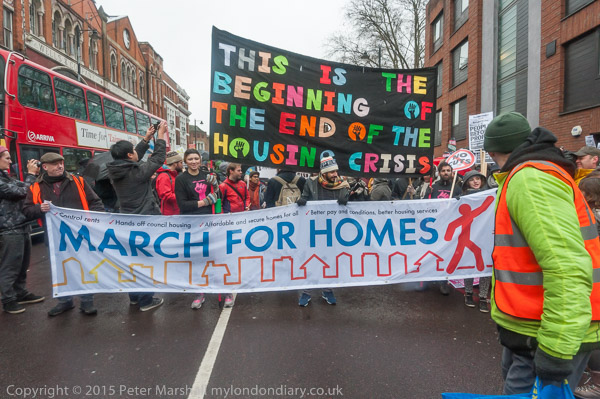
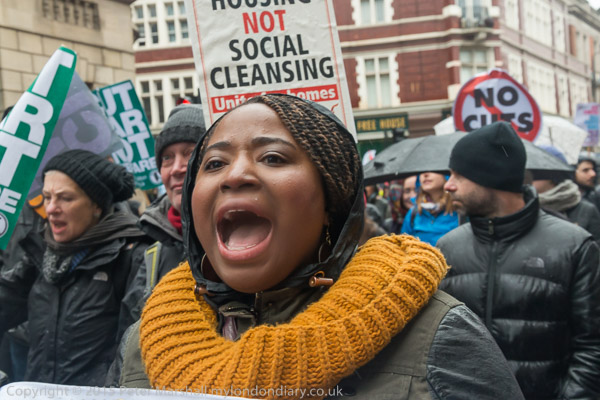
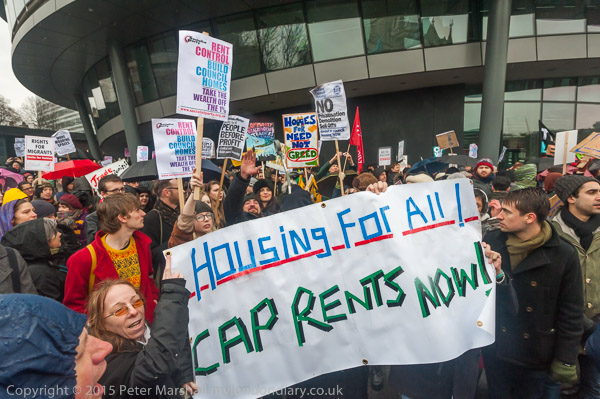
There was a lot happening in London on Saturday 16th April 2016, and I managed to catch some of it. The largest march was organised by the Peoples Assembly Against Austerity. It demanded an end to privatisation of the NHS, secure homes for all, rent control and an end to attacks on social housing, an end to insecure jobs and the scrapping of the Trade Union Bill, tuition fees and the marketisation of education.

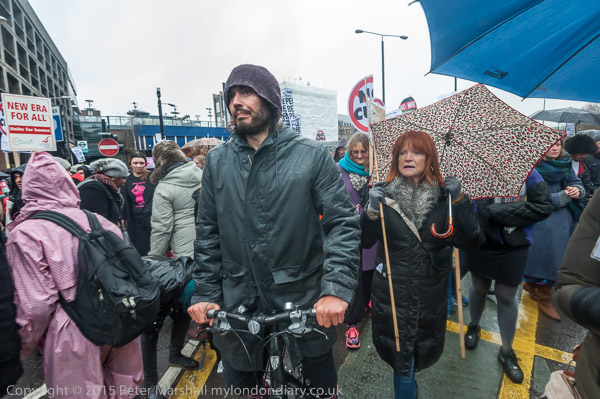
It was a large march and by the time I arrived people were fairly tightly packed on around 500 metres of Gower St waiting for the march to start, and it took me some time to make my way through to the gazebo where speeches were being made before the start of the the march – though I found plenty to photograph as I moved through the crowd.

Finally I made my way to the front of the march and photographed some of the main banners lined up there, but police held up the start of the march and I had to leave before it moved off.

I was disappointed in Whitehall as there was no sign of an event I had been expecting to take place there – or perhaps I was too late. But in Parliament Square I met Ahwazi Arabs from the Ahwazi Arab People’s Democratic Popular Front and the Democratic Solidarity Party of Alahwaz who have demonstrated London in solidarity with anti-government protests in Iran every April since 2005, on the anniversary of the peaceful Ahwazi intifada in which many were killed and hundreds arrested by the Iranian regime.

The Ahwaz region, an autonomous Arab state, was occupied by Iran in 1925 iand they incorporated it into the country in 1935 largely to allow the British Anglo-Iranian Oil Company (BP since 1954) to exploit its rich oil reserves. Since then Iran has pursued a campaign to eliminate Ahwazi culture and change the ethnic makeup of the region by encouraging Persian settlers. BP dominated Iranian oil until Iran nationalised it in 1951, and again became an important force there after the CIA (and MI6) engineered coup in 1953 and the company is still the major partner supplied by the National Iranian Oil Company.

I walked back up Whitehall to Trafalgar Square, by which time the Peoples Assembly marchers were arriving for a rally.

Things were visually rather more interesting on the North Terrace, where people were dancing to the ‘dig it sound system’, which carried a message from Tom Paine: “The World is my country – All people are my brethren – To do good is my religion”.

And in one corner the Palestine Prisoners Parade were attracting attention with juggling, hula hoops and speeches to the often arbitrary detention without proper trial suffered by many Palestinians held in Israeli jails. Many of them are on rolling detention orders, released and immediately re-arrested and put back in prison.

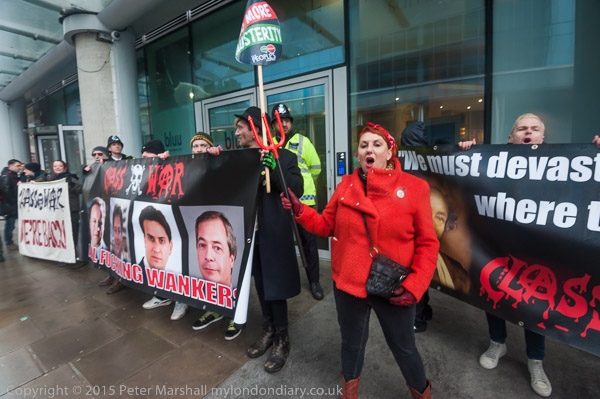
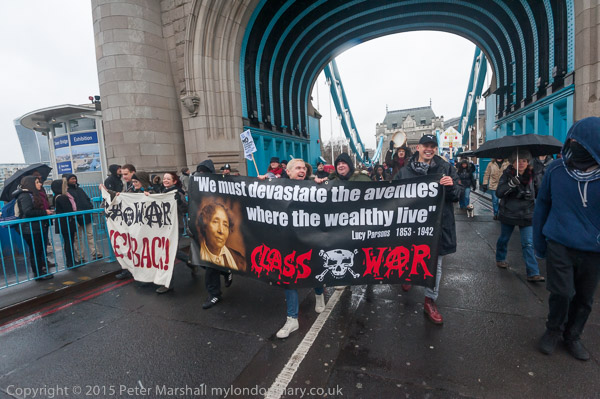
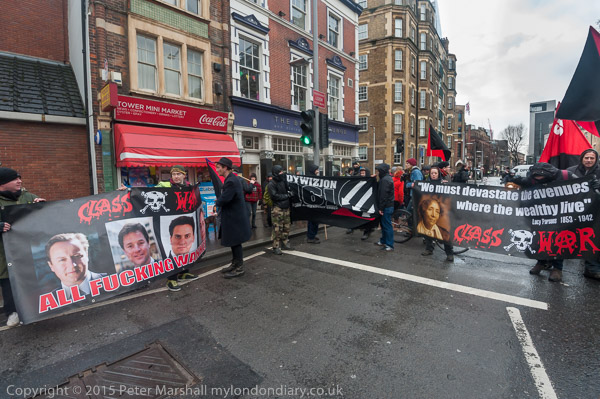
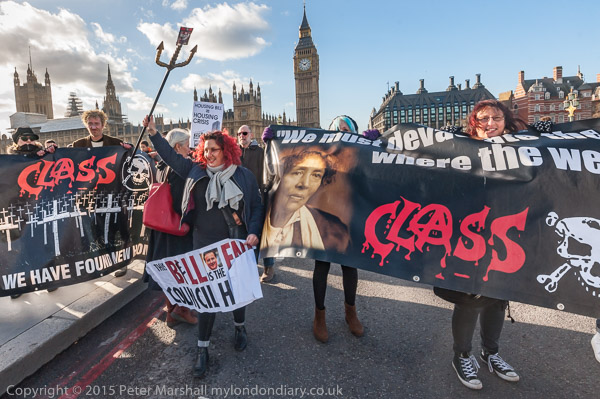
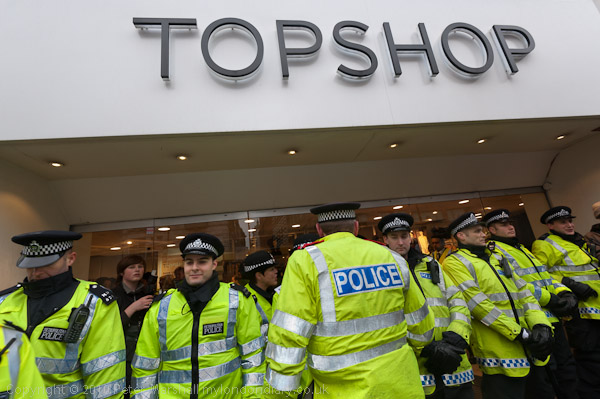
As the rally came to an end the United Voices of the World trade union began a protest a short distance away on the Strand, supported by Class War and others, demanding the reinstatement of 2 workers suspended by cleaning contractor Britannia for calling for the London Living Wage of £9.40 an hour for all those working at Topshop. The UVW say Brittania is systematically victimising, bullying and threatening cleaners and Topshop refuse to intervene.

The fairly small crowd held a noisy protest outside the shop entrance, with was blocked by security men, and a large group of police arrived and began to try to move the protesters, and began pushing them around. The protesters didn’t retaliate but simply moved back; some holding up placards in front of the police cameraman who was filming the event were threatened with arrest.

Eventually the protesters marched away, walking back along the North Terrace of Trafalgar Square where they picked up a few more supporters and then on to Top Shop at Oxford Circus for another protest and stand-off with the police.

After a fairly short protest there the protesters marched on to John Lewis, where the UVW have a long-standing dispute calling for the cleaners to be treated equally with others who work there. As they approached the store some police became more violent and one woman was thrown bodily to the ground several yards away.

Other police and protesters went to help her and the protesters called for – and eventually got – an apology for the inappropriate use of force. Things calmed down and the protest continued, but as it moved off after several speeches with many leaving for home the police picked on two individuals and began searching them and threatening arrest and the situation became more tense, with police threatening both protesters and press.

More on My London Diary
UVW Topshop & John Lewis Protest
UVW Topshop 2 protest – Strand
Palestine Prisoners Parade
Dancing for Homes, Health, Jobs, Education
Homes, Health, Jobs, Education Rally
Ahwazi protest against Iranian repression
March for Homes, Health, Jobs, Education

London, Sat 9th April 2016

Over a thousand campaigners had come to applaud those who had occupied the Carnegie Library in Herne Hill for 10 days to oppose Lambeth Council’s plans to turn the building into a fee-charging gym run by Greenwich Leisure Ltd, leaving just a small unstaffed room with a few books in place of a proper libary. The occupation made national headlines and attracted the support of many leading authors.

After the occupiers emerged to rousing cheers there were some short speeches before campaigners set off to march via another closed library to a rally opposite Lambeth Town Hall in Brixton, but I left them at Loughborough Junction to catch a train to my next appointment. The library was miraculously opened on a reduced scale a couple of weeks before the 2018 council elections and in 2020 a lottery grant was given to the Carnegie Community Trust to run the library – an organisation linked to Labour councillors – rather than the community organisation the Friends of Carnegie Library. Security during the 2 years of closure cost the council three times as much as keeping the library open would have done, and the basement excavations for the gym ended up costing Lambeth over four times their original estimate.

In Whitehall around 2,000 protesters blocked the road in front of Downing St calling on Prime Minister David Cameron to resign because of the lack of trust about his financial affairs following the revelations in the Panama papers. Many protesters had come in party mode, with flowered garlands, Panama hats and suitably Central American dress or pig flavoured posters.

The party was still continuing but in a more angy mood when I returned several hours later have covered three other events, although there were fewer protesters. I was pleased to photograph two people in pigs heads – referring to the initiation ceremony Cameron had gone through when a student at Oxford for the “ultra-exclusive, ultra-posh Piers Gaveston Society” (which he later denied) with the placard ‘He’s Got To Go’. Despite the damning revelations of the Panama Papers against the ultra-rich and the offshore finance industry little if anything has changed.

Protesters outside Channel 4 on the Horseferry Road were calling for a ban on the Grand National horse race taking place today. Already 4 horses had been killed following accidents at this year’s meeting at Aintree – and around 46 in the last 15 years.

And at the Polish Embassy in Portland Place several hundred Poles and supporters protested in solidarity with the large protests in Poland against the bill proposed by the Law and Justice Party (PiS) which will outlaw abortion in all cases, protecting the life of the unborn child even where this may cause extreme distress or even death for the mother. They hung wire coathangers – the traditional crude tool of back-street abortionists – on the embassy door and fence. Huge protests continue in Poland where a near-total ban on abortion came into effect in January this year after the Consitutional Court ruled that a 1993 law allowing abortion in cases of severe and irreversible foetal abnormalities was unconstitutional.
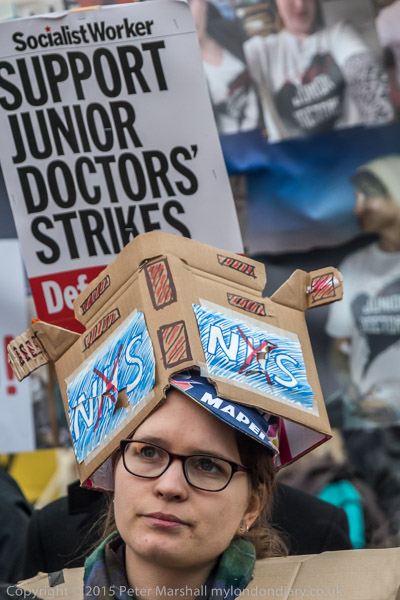
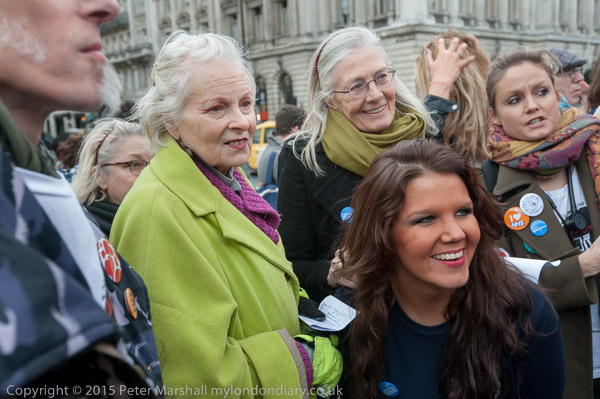
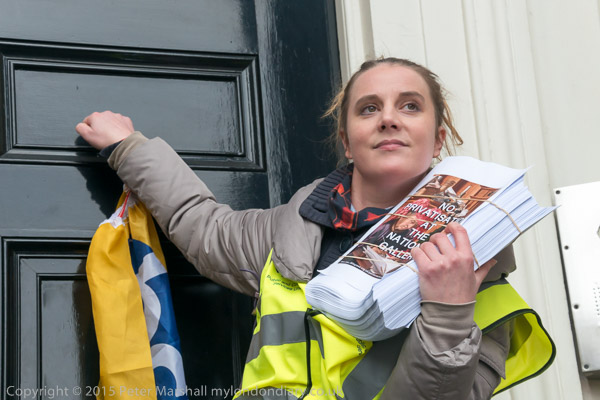
Colombia has a long history of protests and their violent repression, at least since the late 1940s when the assassination of the Liberal presidential candidate provoked riots across the country, with a brief period of respite under a ‘National Front’ in the 1950s. But from the 1960s on the country suffered an armed conflict, with the USA encouraging the military to attack leftist groups in the rural areas and the involvement of right-wing paramilitaries and mercenaries for multinational companies in human rights abuses in the fight against guerilla groups such as FARC. Drug cartels have also played an increasing role in the violence since the 1970s.

The government negotiated a peace deal with FARC which was rejected by a referendum later in 2016, but a revised deal was ratified by Congress shortly after. However agreements reached were largely dismantled by a right wing government voted in in 2018 and since then protests and police repression have again risen. Colombia, according to the World Bank, is the seventh most unequal country in the world.

A protest took place in Trafalgar Square on the same day as protests in Colombia against political persecution, calling for an end to paramilitary killings. People want peace, human rights and democracy in Colombia.

More at:
End Killings in Colombia
Party against Cameron
Don’t Criminalise Abortion in Poland
Stop Grand National horse slaughter
Cameron must go!
March to Save Lambeth’s Libraries
Carnegie Library Occupation Ends


All photographs on this and my other sites, unless otherwise stated, are taken by and copyright of Peter Marshall, and are available for reproduction or can be bought as prints.


Latin Village, Zuma, Boat Dwellers & Syria

A human chain surrounds the block containing the Latin Village at Seven Sisters

Four Years ago today on Saturday 8th April 2017 I was travelling around London photographing a very varied set of protests, ending the day at Seven Sisters where London’s most vibrant community market has been under threat since 2006.

The Latin Village or Seven Sisters Indoor Market a few yards from the Underground station exit on the High Rd is a vibrant place in an Edwardian building, Wards Furnishing Stores, a department store which closed in 1972. The ground and mezzanine floors of part of the site house around 60 independent businesses, mainly run by people of Latin American origin but with others from the Caribbean and Middle East and when open it is a vibrant area to walk around, full of music. Covid has of course meant its closure, and the building owners Transport for London in 2010 closed the mezzanine area as unsafe and banned the on-site cooking of food which had been such an important aspect of the market.

Haringey Council and developers Grainger PLC want to clear the site and replace it with a “mixed use development” which would include expensive flats and chain stores – and although it may include a small market it will lose the character of the Latin Village and almost certainly be at rents which would make any of the current businesses uneconomic. Protests against the plans are still continuing.

My work had begun outside South Africa House in Trafalgar Square, where a large group of South Africans were protesting in defence of South Africa’s democracy and calling for the removal of President Zuma.

Jacob Zuma had been president since 2009, and had a long history of legal challenges both before and during his presidency, particularly for racketeering and corruption, and https://en.wikipedia.org/wiki/Jacob_Zuma Wikipedia states his time in office is estimated to have cost the South African economy around 83 million USD. Facing a vote of no confidence he finally resigned in February 2018, succeeded by Cyril Ramaphosa, who has also been criticised for various financial irregularities and his call for action against striking miners which resulted in the Marikana Massacre in 2012 in which 34 miners were killed by South African police.

In 2012 the Canal & River Trust (CRT), a charity, took over the running of our canals and rivers from British Waterways and since then have begun a series of evictions of boat dwellers who do not have permanent moorings. The say that it is unlawful for the CRT to impose limitations on their right to live on boats unless they meet arbitrary limitations based on a minimum distance or movement or pattern of travel.

Permanent moorings are expensive – perhaps £6,000 a year along with a licence cost of £1,000, so families who live on boats because they cannot afford houses are being priced out, with moorings going to the wealthy who often only use their boats for a few weeks each year, gentrifying the canal and destroying communities who live on boats. Boat dwellers came to Embankment Garden to picnic and hold a rally against the CRT. As well as opposing evictions they also called for proper maintenance of locks, bridges and waterway banks, more mooring rings, more water taps and more sanitary facilities.

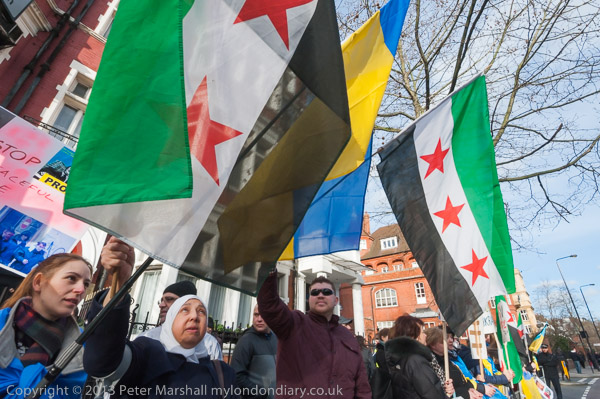
Syrians gathered a Marble Arch for a march to Downing St calling on the UK government to support Syrians against the use of chemical weapons by President Assad’s forces in Syria.

They say that the attack four days earlier at Khan Sheikhoon near Idlib, like that on Ghouta three years previously, used Sarin nerve agent, this time killing over 100 and injuring over 400. Unfortunately our government, along with that of the US, has firmly set itself against any real action in Syria, despite encouraging the uprising against Assad, and is leaving it to Russia (and later Turkey) to ensure that the revolution fails.

More pictures from all these events on My London Diary:
Human Chain at Latin Village
Against Chemical Warfare in Syria
Boat dwellers fight evictions
Zuma Must Go


All photographs on this and my other sites, unless otherwise stated, are taken by and copyright of Peter Marshall, and are available for reproduction or can be bought as prints.


Hunger, Housing and Injustice

My work on Saturday 29th March 2019 began in north London at Bruce Castle Park in Tottenham, where the indefatigable Rev Paul Nicolson of Taxpayers Against Poverty had organised a march demanding living incomes and decent truly affordable homes, calling for an end to the bedroom tax, the housing benefit cap, unfair taxes, hunger and cold homes.

The Reverend Paul Nicolson who died peacefully on Thursday 5th March 2020 aged 87 had long campaigned on these issues, and had commissioned the work on poverty that helped groups such as London Citizens and Unison to persuade the Mayor of London Ken Livingstone to introduce the London Living Wage.

His Christian principles led Nicolson to found the Zacchaeus Trust, an anti-poverty charity providing frontline services on Social Security benefits, housing and homelessness as well as the campaigning organisation TAP, and he supported and spoke at many protests calling for justice for disabled and others on low wages and often inadequate benefits.

I left the march as it passed Tottenham Police Station on its way to a rally at Tottenham Green to make my way to Kilburn, where the Counihan Battlebus Housing For All campaign, along with the TUSC Against Cuts and Unite Community were holding a protest in Kilburn Square over child hunger and housing problems, calling for rents to be capped and for everyone to have a home.

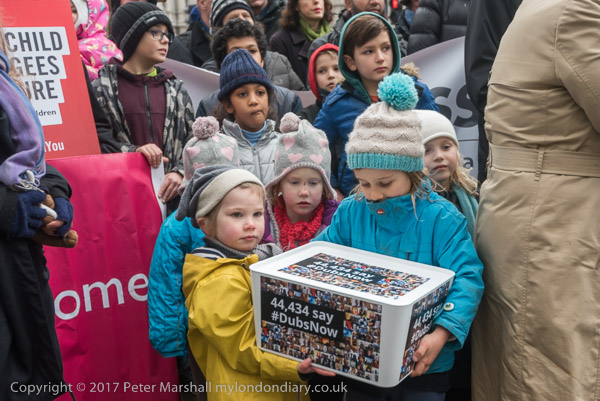
Children played a large part in the protest and were having fun, but also making a serious point, with placards “Going to school hungry is not fair!” As I pointed out in my rather long article on the protest:

Children going to school hungry is a direct result of government policy and its inhumane (they call it ‘tough’ to make it sound positive) sanctions policy. What we need is not this kind of vindictive approach but more jobs and an end to poverty wages. And it would be far more productive to attack the huge sums involved in tax evasion and tightening up the rules on tax avoidance than the relatively small amounts of benefit fraud or the largely mythical workshy.

The journey from Kilburn to Parliament Square was fortunately a simple one on the tube and I arrived as students and staff from Oasis Academy Hadley came from Enfield to protest against the planned deportation of one of their students, 19-year-old Yashika Bageerathi. She had come to the UK with her family in 2011 to escape a dangerous situation in Mauritius and was in the final year of her A level course, in which she was expected to get high grades.

The Home Office decided that since she was 19 she could be deported without her family, and had already detained her in Yarl’s Wood ten days earlier. Two deportation attempts failed when both British Airways and Air Mauritius refused to fly her to Mauritius, possibly because of the huge public campaign to allow her to stay and complete her exams.

It was impossible to see why Home Office minister Theresa May was so keen on this deportation – other than wanting to seem to have a tough policy on immigration, and as I wrote, morally their position seemed indefensible. But deport her they finally did.

Despite spells in Yarl’s Wood which disrupted here education and the deportation which took place six weeks before her A Level exams, she was able to take the exams and passed with straight A grades. She then issued a statement thanking everyone – both in the UK and on her return in Mauritius for their support, and clearly stating “I have no desire for a life in the public eye any longer” and that she wished to begin a new chapter in her life.

More at:
Fellow Students Fight for Yashika
Kilburn Uniform Day
Mothers march for justice

Climate Change and the Budget

Once again the recent budget has failed to show any real commitment to make the changes we need to combat the climate crisis. The chancellor’s speech and the treasury details were strong on rhetoric, telling use that we need to make radical changes and that cutting carbon was a major government priority, but there were few and only minor changes announced that will combat climate change, while more major announcements that will accelerate it.

Perhaps one of the more disappointing areas were the announcements on infrastructure and on road building. The expected UK national infrastructure strategy was not yet available and is now expected “later in the spring” but it is unlikely to change the commitment made already to wrongheaded project of which HS2 is the most glaring. And the promise of the “largest ever investment in England’s motorways and major A roads” goes completely against the need to get more people using sustainable public transport and will certainly lead to increased road traffic.

Another way the budget encourages car use is of course the continued freezing of fuel duty, which has remained at 58p per litre (+VAT) since 2011. Had the increases promised in the June 2010 budget taken place it would now be at 84p. While fuel duty has been frozen, rail fares have continued to rise.

Although there were minor changes intended to encourage the decarbonisation of heating buildings, any long term plans on the scale needed are still lacking. It is an area which could be addressed in that long promised infrastructure strategy, and one that could be an important source of ‘green jobs’ so fingers are firmly crossed – but I fear we will get yet another disappointment.

There are other disappointments in this budget too. The support for measures to combat the increasing risks of flooding seems lukewarm, and the ambitious programme of tree planting seems to be only roughly a fifth of that in earlier promises, and clearly insufficient. The budget also restates a commitment to invest in carbon capture and storage which still seems very unlikely to deliver any real dividends. It is also very unclear if the £900m for research into nuclear fusion, space and electric vehicles will make any positive contribution to combating climate change.

Six years ago, on Saturday 7th March, I was with over 20,000 protesters marching through London to a rally outside Parliament demanding action on climate change with divestment from fossil fuels, an end to fracking and damaging bio-fuel projects and for a 100% renewable energy future which would create a million new jobs.

The case then was clear and the protest made it firmly, but since then governments had spent six years talking about it but doing very little, listening more to the lobbyists from fossil fuel companies rather than the science. Slowly there have been some changes, and more politicians are now saying the right kind of things, but there has been precious little action. It’s probably now too late to avoid some pretty disastrous effects of the inevitable global temperature rise, but we may still be able to mitigate them and avoid the worst possible consequences. But it will need governments to stop fiddling while the planet burns.

More on My London Diary:
Climate Change Rally
Time to Act on Climate Change


All photographs on this and my other sites, unless otherwise stated, are taken by and copyright of Peter Marshall, and are available for reproduction or can be bought as prints.


Save Our NHS

The past year has made all of us appreciate both what a great national asset our National Health Service is and also – unless we are blinkered Tories – to realise how much it has been run down as a deliberate Conservative policy ever since the Tories came into power in 2010. Though of course its problems also come from decisions taken by earlier governments, and in particular the disastrous PFI contracts taken out under New Labour which involve huge and continuing debt repayments by parts of the NHS.

Even the Tories have come to realise that the NHS reorganisation under Andrew Lansley’s 2012 Health and Social Care Act were a mistake, although the fine print of their 2021 White Paper makes clear that they are still – as in 2017 when I photographed this ‘Save Our NHS’ march – pursuing their goal of rapid stealthy privatisation with medical services increasingly being run for private profit rather than public benefit, threatening an increasingly under funded public service which delivers high quality service at low cost and remains the envy of the world.

This privatisation is continuing. Last month it was announced that Operose Health Ltd, a UK subsidiary of one of the larger US health insurance companies, is taking over AT Medics, which runs 49 General Practice surgeries across London, with around 370,000 Londoners registered at them. When the takeover was finalised on 10th Feb, the six GPs who had been the directors of AP Medics resigned and were replaced by Operose staff – who include two who had in previous years held high-level positions in NHS England, a public body of the Department of Health set up to oversee the commissioning side of the NHS under that 2012 Act.

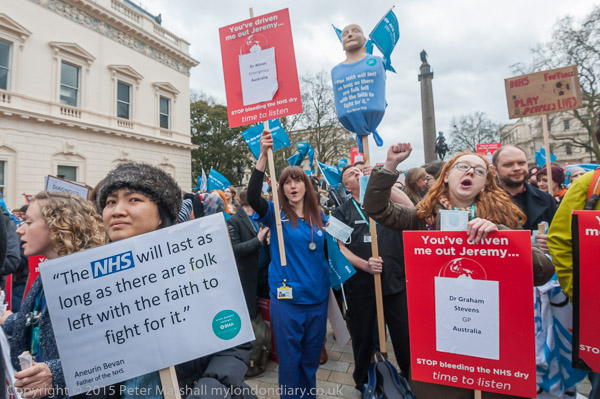
The Save our NHS March on March 4th, 2017 pointed out that the Sustainability and Transformation Plans which NHS organisations and local authorities were made to produce as 5 year plans from 2016-21, intended to counteract some of the worst effects of the 2012 Act, were leading to cuts in services and hospital closure and had already caused many premature deaths. They are a part of the rapid stealthy privatisation with medical services increasingly being run for private profit rather than public benefit, threatening an increasingly under funded public service which delivers high quality service at low cost and remains the envy of the world.

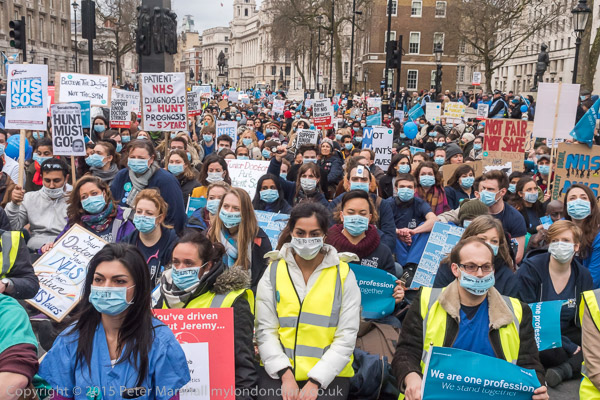
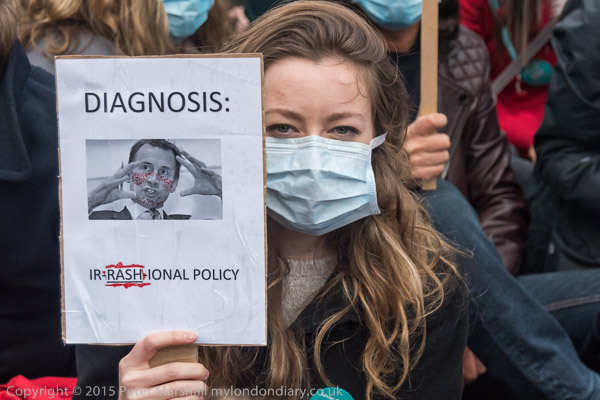
It was a large march, and made up largely of those who work in various parts of the NHS and have clear view of the actual consequences of the effects of government actions, and many of them spoke before the march set off. Most medical professionals do the work they do through a strong sense of vocation rather than being motivated by money, and as we have seen over the past year, many have worked long over their paid hours, and often with inadequate personal protection because of decisions taken to lower the stocks of supplies and the cuts in beds, the cutting of support for the training of nurses, changes to contracts for junior doctors and other measures.

Looking at the faces in these pictures – and I took many more on the day – I wonder how many of them have died because of their dedication to their job of saving our lives. I wonder how many are suffering the prolonged debilitating effects of ‘long covid’, how many mental illness because of a year of working under extreme stress.

Some carried signs ‘Born in the NHS’. I wasn’t but I grew up with it and it was there when I needed it, and still is. Others carried that quote attributed to Aneurin Bevan, though he probably never said it,”The NHS will last as long as there are folk left with the faith to fight for it.” There were perhaps 50,000 on this march showing they were ready to do so.

More pictures in My London Diary: Save our NHS March


All photographs on this and my other sites, unless otherwise stated, are taken by and copyright of Peter Marshall, and are available for reproduction or can be bought as prints.


End Workfare & more – 3rd March 2012

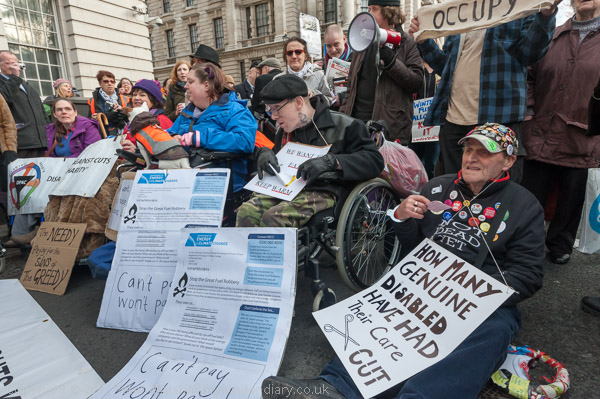
Workfare is a controversial policy first begun in the UK in the 1990s by the Conservative government of John Major, although it developed from earlier schemes which put active pressure on claimants to seek work. Under various different programmes and names workfare continued under New Labour, but it was under the Tory-led coalition in 2011-2 that it came into widespread use.

Workfare is used to describe schemes where in order to receive unemployment benefit people have to undertake unpaid work, either in the commercial or public sector or for charities. In 2011 the coalition government announced that those who had failed to find jobs after being unemployed for some time would have to work unpaid for 30 hours a week for six months, setting up a number of schemes to this end.

THe proponents of ‘workfare’ say that those forced to take part in these schemes benefit from the experience or working and that it will prepare them for paid work and that the experience will make it easier for them to find employment. They say it isn’t unfair to ask people to do something in exchange for the benefits they receive.

Academic studies by the DWP of international workfare schemes had shown that these claims were unsound. There was little evidence that workfare increased the chances of finding work, and that it might even reduce this, firstly because if people were on workfare they had less time to look for jobs, but also because workfare placements seldom provided the kind of skills and experience that potential employers were looking for.

Trade unions and others point out that every person on workfare actually cuts out a job that would otherwise be carried out by a paid employee – so there are fewer jobs for those seeking employment. Workfare is largely a subsidy to employers, supplying them with free labour – essentially a form of slave labour. Workfare schemes – whether in the private sector or public or charity work – fail to provide any of the employment status and protection that employees or workers receive.

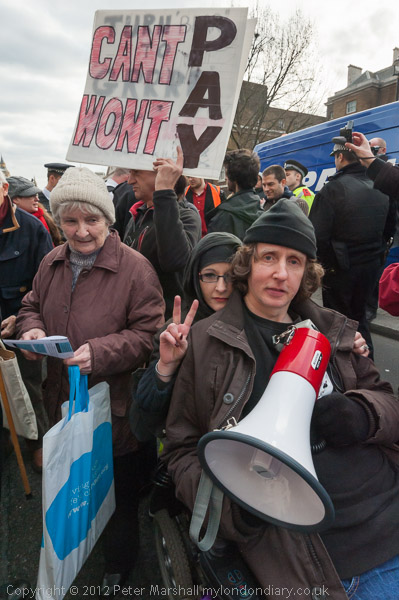
Strong negative reactions to these schemes – such as those demonstrated by the Boycott Welfare protest in Oxford St, London I photographed on Saturday 3rd March 2012 – led to many companies withdrawing from the scheme, and others ending talks with the government about taking part in it. According to Wikipedia, the campaign group ‘Boycott Welfare’ ‘very successful in making companies and charities pull out of “workfare”.’ By August 2016, “more than 50 organisations have ended their involvement in workfare, because of negative publicity.”

But workfare still continues, and as Boycott Welfare write on their web site, “Workfare forms a key tool of ‘compliance’ with the regime of Universal Credit, and is enforced via sanctions.” As well as Universal Credit, workfare also continues under the government’s Sector-Based Work Academies, Work and Health Programme and Youth Obligation schemes.


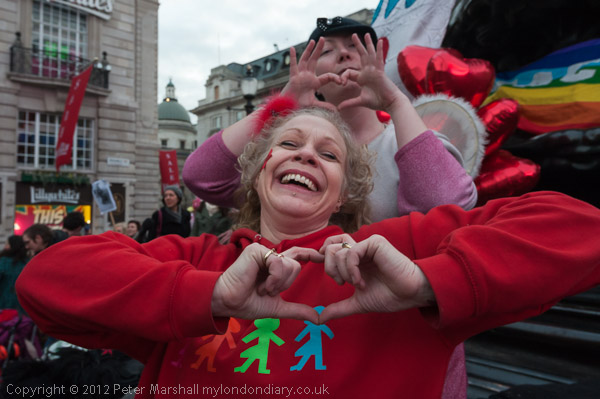
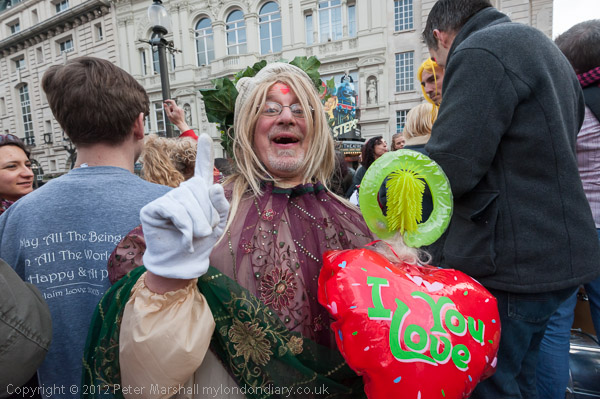
Also on the same day I photographed other events. Firstly the Million Women Rise March, a women-only march through the centre of London against domestic abuse, rape and commercial sexual exploitation and for the prevention of abuse and support and protection for women. I was shocked to learn from a member of one of the more active women campaigning groups that has been the among the leaders in previous celebrations around International Women’s Day and had taken part in previous years that they had been told they were not welcome on the march, though I think they have taken part in more recent years.

I left that march as it went down Oxford St on its way to a rally at Trafalgar Square and took the tube to St Paul’s where Greeks were protesting in solidarity with students and workers in Greece against the austerity measures being imposed as a part of the Eurozone rescue package for the country. They had planned to protest at the Occupy London camp, but that had been cleared a few days previously, but some of the occupiers had returned to hold a general meeting on the St Paul’s Cathedral steps.

More on these events from Saturday 3rd March on My London Diary:
Greeks Protest At St Paul’s
Million Women Rise March
Boycott Workfare – Oxford St


All photographs on this and my other sites, unless otherwise stated, are taken by and copyright of Peter Marshall, and are available for reproduction or can be bought as prints.


2 March 2002: Stop the War, Hands off Iraq

Back in 2002, protests were still in black and white – or rather I was still using film for my photographs and the library I was putting pictures into was still only taking colour pictures as transparencies – something I had given up taking seventeen years earlier as I found colour negative far better to work with.

For the huge Stop The War protest on March 2nd, 2002 against the war in Afghanistan and the forthcoming invasion of Iraq I was actually working with three cameras, one with black and white film, a second with colour negative and the third a panoramic camera also loaded with colour negative film. Although I contact printed the developed films from all three, it was only selected images from the black and white work that was printed and went to the library.

Some day I hope to get around to printing some selected images from the seven or eight colour films I exposed on that day, but at the time I had no particular incentive to do so. It was difficult for me to use colour even on the web site, as my flatbed scanner at that time was a monochrome only scanner – and all the pictures on My London Diary from this event are black and white scans from the black and white prints I made to send to the library.

There are a few colour pictures from this era on my web sites, mainly those taken on a pocket-sized 2Mp digital camera I had begun to use as a notebook a year or two earlier, but the images were generally unsuitable for publication. Prints from them at much more than postcard size were poor quality.

Around this time I did get my first film scanner, but it was very slow to use and the quality wasn’t great. And at the end of 2002 I began using my first DSLR, the 6Mp Nikon D100, and soon began submitting digital images to agencies that would handle digital work.

Newspaper reports at the time rather followed the police in giving figures of 10-15,000 people at the protest, though I think the true number was at least twice this. As I reported, “people were still leaving hyde park at the start of the march when trafalgar square was full to overflowing two and a half hours later.” It takes more than 15,000 to fill Trafalgar Square and the tailback over the 2 mile route adds considerably to that number.

As I wrote back then:

police estimates of the number were risible as usual – and can only reflect an attempt to marginalise the significant body of opinion opposed to the war or a complete mathematical inability on behalf of the police.

In my comments I also quote Tony Benn telling us photographers at the start of the march that it wasn’t worth us taking his picture, “it won’t get in the papers unless i go and kick a policeman” and he was quite right. They didn’t report his speech either, in which he said that for the first time in his life he though the situation was so desperate that he was advocating non-violent resistance, calling for everyone to stop work for an hour at the moment the bombing begins. “Stop the buses. Stop the trains. Stop the schools. It’s all very well going to Downing Street, I’ve spent half my life at Downing Street, in, outside Downing Street. It has to be more than that, its got to be something we take up in every town and village.” This he said would get the debate going. His speech received a huge reception from the crowd.

It was hardly a very radical suggestion – and after the bombing started it would have been too late. But had ‘Stop The War’ called for similar action before the parliamentary debate – and not just another A to B march planned months in advance – it might have made a difference. The message that this was simply a war for control of oil resources and would be a disaster for the region was getting through – and there were regular protests in towns and villages across the nation, including in the true-blue town where I live, and more radical actions could have prevented the UK joining in the US action.

More at http://mylondondiary.co.uk/2002/03/mar.htm


All photographs on this and my other sites, unless otherwise stated, are taken by and copyright of Peter Marshall, and are available for reproduction or can be bought as prints.