October 12th 2019

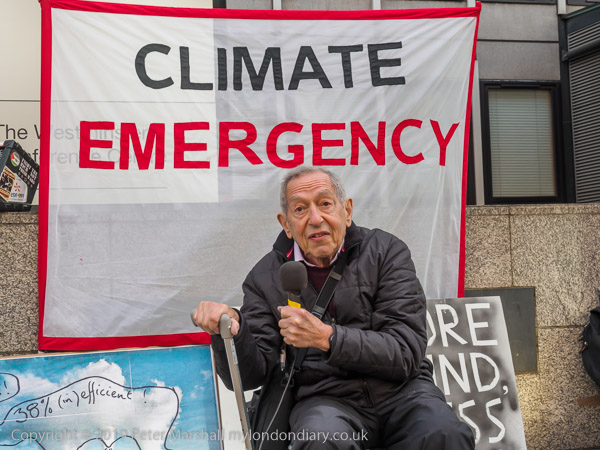
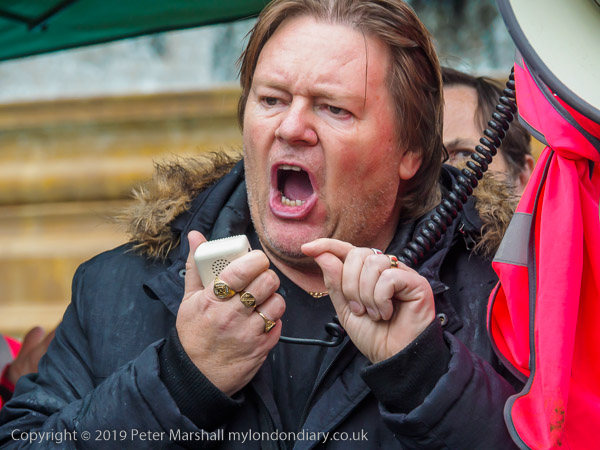
Ian Hodson, National President of the Baker’s Union BFAWU speaking

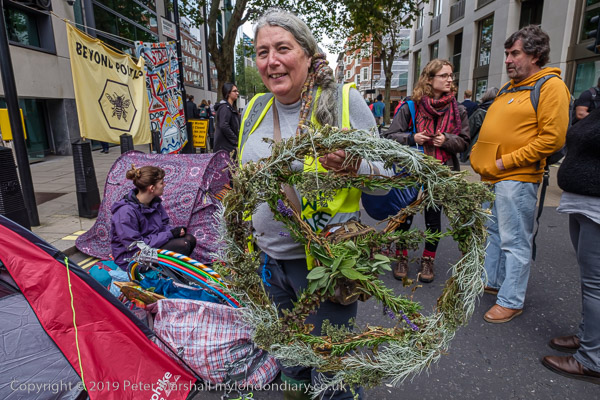
I was back with Extinction Rebellion on Saturday 12th October 2019, beginning in a rather wet Trafalgar Square, where Trade unionists were holding a rally in driving rain to show their solidarity with Extinction Rebellion and the school climate strikers. It was raining hard enough to make it difficult to take pictures, with rain drops settling immediately on my lens filters as soon as I wiped them off with my chamois leather held in my left hand.
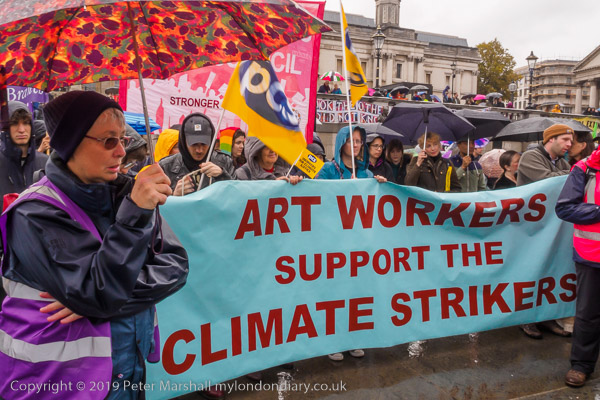
It’s hard to hold an umbrella and take photographs, though I did for some pictures, and sheltered under other people’s for others. But umbrellas both greatly restrict movement and also other people’s view and I don’t like to use one.
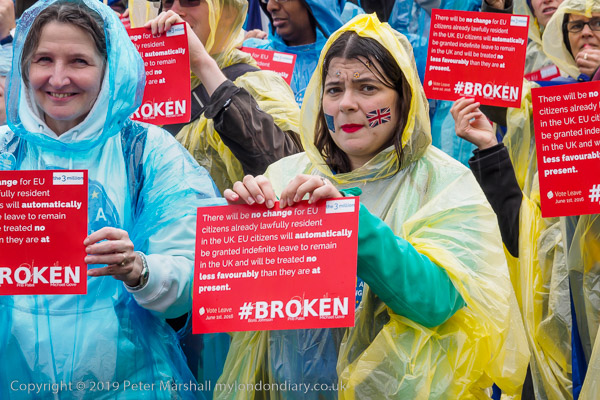
But Global Extinction was the only issue that campaigners were protesting about in Trafalgar Square, there were also a hundred or two campaigners from the 3 million organisation, EU residents living in the UK who were protesting against the promise broken by Vote Leave that “There will be no change for EU citizens already lawfully resident in the UK. EU citizens will automatically be granted indefinite leave to remain in the UK and will be treated no less favourably than they are at present.” They had dressed for their protest in blue and yellow rain ponchos, highly suitable for the weather.
From Trafalgar Square I got on a bus to take me to Marble Arch. Although police had cleared XR from their road blocks and got the buses running, rain in London always results in slow-moving traffic, but the journey did give me time both to dry off a little myself and more importantly to clear most of the interior condensation which was misting up my lenses.
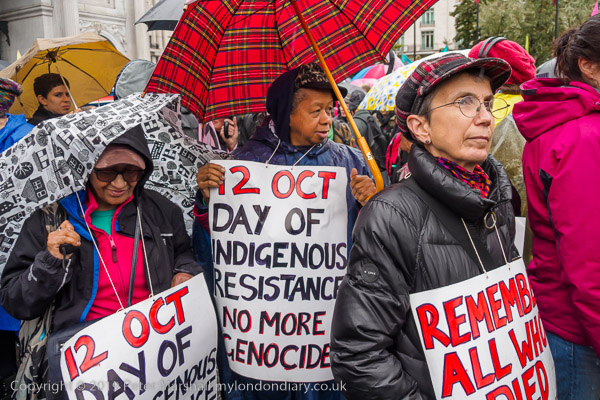
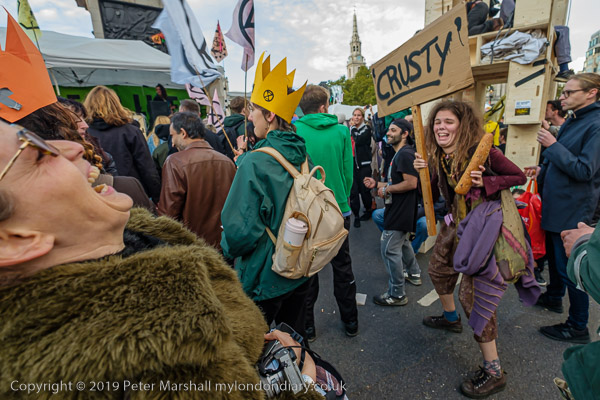
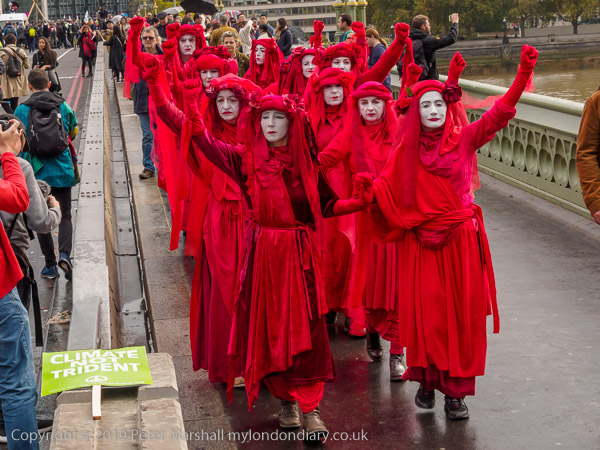
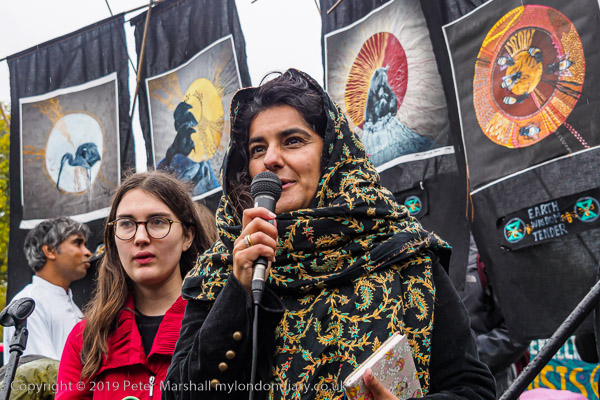
Extinction Rebellion’s main event was their ‘Strength in Grief ‘ procession on the Day of Indigenous Resistance marking the anniversary of Colombus’s landing in the Americas. It began with a number of speakers representing various communities across the world as well as others reflecting on both injustice and grief and the effects of global climate change already causing deaths and suffering across the Global South.
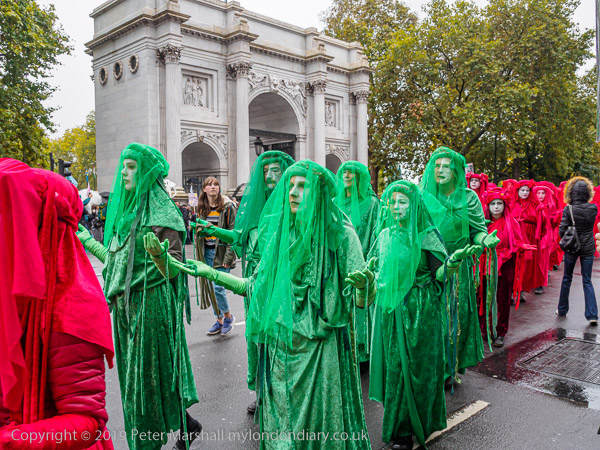
Fortunately the rain had eased off considerably, and had almost stopped by the time the rally ended and the march moved off down Oxford St, going to another rally outside the BBC who are largely failing in their duty to inform us about the threat of global extinction and the failures of our political systems to respond to it.
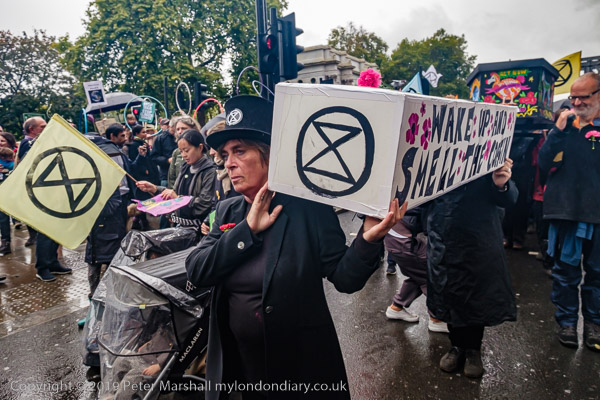
The campaigners marched on, but I’d had enough. I’d been working with my jacket open at the top so I could put my camera under it, but that meant the rain could get in around my neck, and after several hours I was rather cold and wet, and my lenses were steaming up again. I stopped close to Bond Street station and photographed the rest of the march – several thousand, many in interesting costumes – as it went along Oxford Street until the last marchers had passed me, then made my way down to the station.
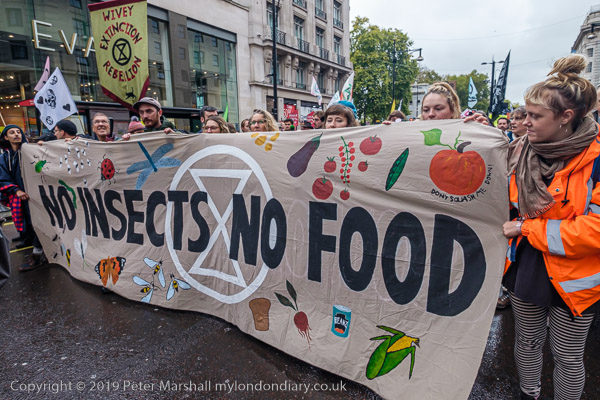
Many more pictures from the three events on My London Diary:

XR Strength in Grief Procession
Brexit unfair for EU citizens
Trade Unionists join the Rebellion


All photographs on this and my other sites, unless otherwise stated, are taken by and copyright of Peter Marshall, and are available for reproduction or can be bought as prints.


Panoramic Carnival 1992

Panorama, Notting Hill Carnival 1992

Although I’d been making the occasional panoramic image over the years, taking a series of pictures and painstakingly cutting and pasting several prints to produce a seldom quite convincing join, it was only late in 1991 that I finally bought a camera capable of taking true panoramic images.

Panorama, Notting Hill Carnival 1992 nh92001_2400

It’s hard now to imagine how difficult it was to produce panoramic images back in those pre-digital days – unless you could afford an expensive panoramic camera. Nowadays many cheaper digital cameras come with a ‘panoramic’ mode (though I’ve never managed to use one to produce an image that survived close scrutiny) and both specialised “stitching” software and more general programs such as Photoshop make joining several frames just a matter of a few clicks.

Panorama, Notting Hill Carnival 1992 nh92004_2400

It was the Soviet Union, and Krasnogorsky Mechanicheskiy Zavod  (KMZ) that first introduced a reasonably priced panoramic camera to a wider audience, with the Horizont, available from 1966-73, but at the time I wasn’t interested in panoramic photography. Like their Zenith SLR cameras which I started serious photography with this was pretty basic and had a possibly undeserved reputation as being something of a problem to use.

Panorama, Notting Hill Carnival 1992 nh92011_2400

When I bought my first panoramic camera in 1991 it was a Japanese model, a Widelux F8, a similar swing lens camera to the Horizont but with a wider 140 degree angle of view and rather smoother operation. It was also considerably more expensive and I think cost me almost a month’s salary.

Panorama, Notting Hill Carnival 1992 nh92020_2400


Although the camera worked smoothly, its viewfinder was abysmal, and I made landscape pictures with the camera on a tripod and using two arrows showing the field of view on the top of the camera body, with a spirit level in the accessory shoe to level the camera. But for the carnival and similar images of events I used it handheld.

Panorama, Notting Hill Carnival 1992 nh92022_2400

In later years I bought the revised version of the Russian camera, now with a similar mechanism encased in a plastic body and called Horizon (there were several slightly different models.) The viewfinder was so much better than than Widelux and thankfully incorporated a spirit bubble – and the cameras were less than a tenth of the price (I used at least two over the years, one ridiculously cheap from a clearly illegal operation in the Ukraine, evading any customs duties.)

Panorama, Notting Hill Carnival 1992 nh92024_2400

The only colour images I can find from Notting Hill Carnival in 1992 were taken with the Widelux, and appear to have been taken in two relatively short periods, one on Ladbroke Grove and the other on Elkstone Rd. There are some more, some rather similar to those in this post, in my Flickr album Notting Hill Panoramas -1992.


All photographs on this and my other sites, unless otherwise stated, are taken by and copyright of Peter Marshall, and are available for reproduction or can be bought as prints.


XR Rebellion – Day 3

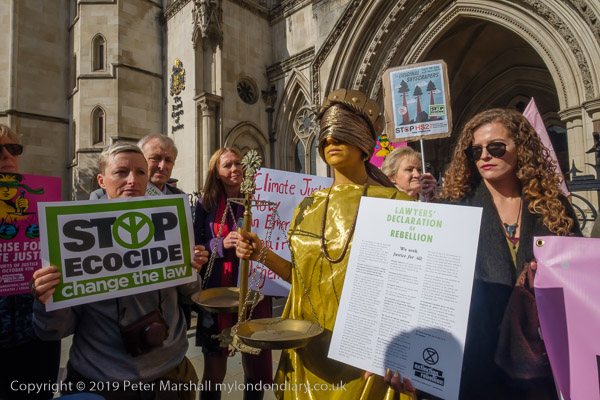
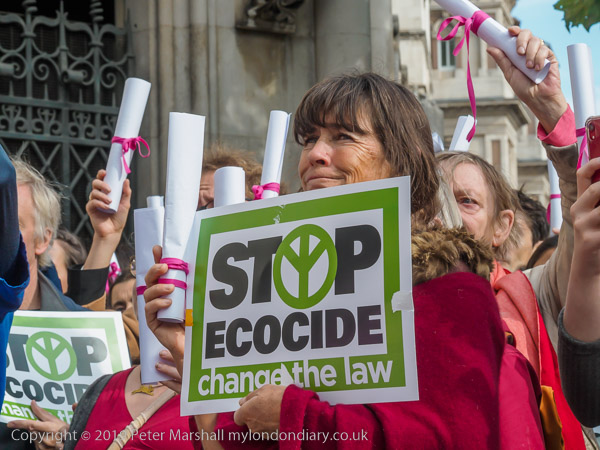
On 9th October 2019 I was with Extinction Rebellion outside the Royal Courts of Justice. Perhaps not surprisingly, this protest organised by Lawyers for XR had a rather different feel to most other XR events. The ‘All Rise for Climate Justice’ event stressed the need for a law against ecocide to protect the planet.

Rather a lot of people, many of them lawyers and including some distinguished name, were crammed into the relatively small area of pavement in front of the courts. This made it a difficult event to cover as it was hard to move around much without being obtrusive.

The event launched the ‘Lawyers Declaration of Rebellion’ and copies of it were handed out rolled up an tied with pink ribbon in the traditional manner used for the bundles of papers taken into court by defence barristers. Pink ribbons are now used to distinguish briefs from private citizens from those from the Crown which are tied with white ribbon.

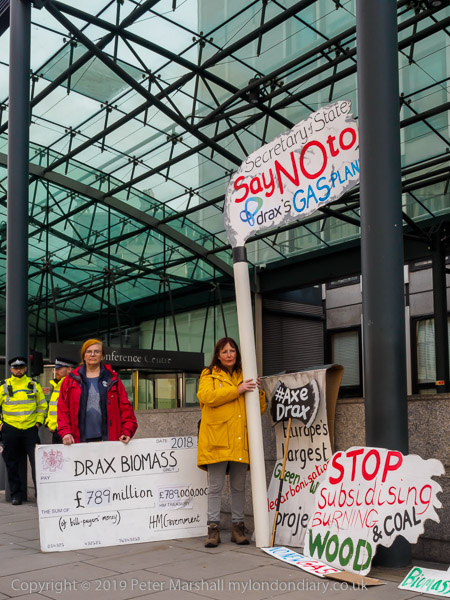
As the event at the Royal Courts of Justice ended I left quickly and rushed down to Victoria St where Axe Drax were protesting outside the Department for Business, Energy & Industrial Strategy (BEIS) calling for an end to the subsidies given to fossil fuels and biomass which produce climate destroying carbon dioxide. They called for the closure of Drax power station which burns wood pellets and coal, pointing out the absurdity of paying them £2 million a day in ‘renewable’ subsidies taken from our electricity bills as thepower station is the greatest single producer of carbon dioxide in the UK.

Usually I would have taken a bus for the journey, but the centre of London was still blocked to traffic and I had to walk – with a little running now and then – covering the mile and a half in 15 minutes. Even so I arrived halfway through the protest, but was pleased to be in time to hear Mayer Hillman, 88 year old Senior Fellow Emeritus at the Policy Studies Institute and a leading Green campaigner for many years speaking.

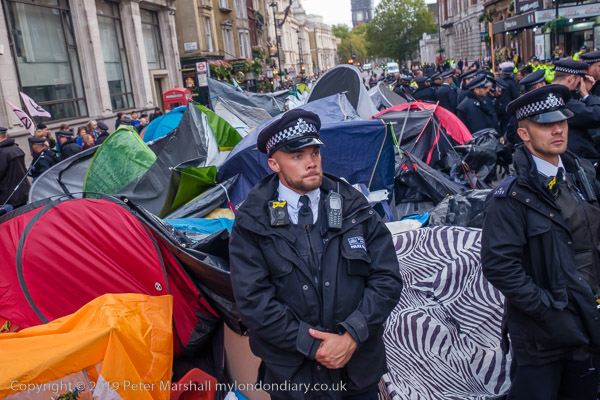
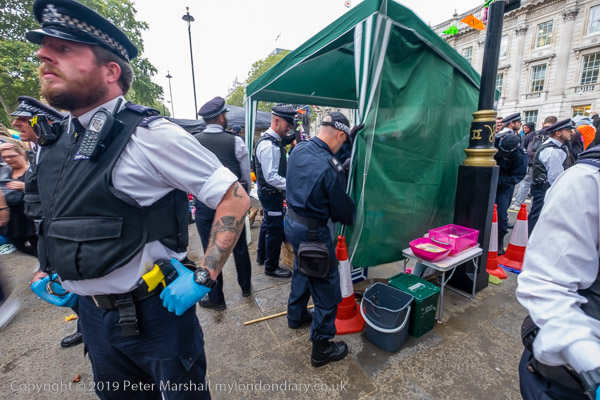
After that protest ended I walked around the other sites still occupied by XR. Although police were continuing to force them off some locations, trashing some tents and making more arrests, there was still no traffic in key locations and workshops and other events continued, with protesters still in fine spirits and something of a festival atmosphere. It isn’t every day that you get your beard pulled (gently) by a giant wallaby.

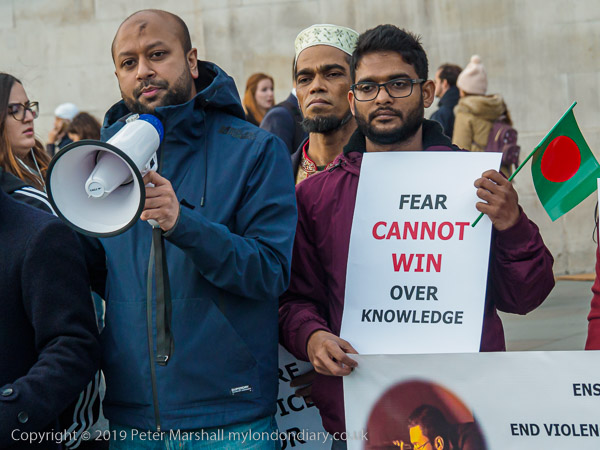
XR were not the only protesters in Trafalgar Square, and I was also able to cover a protest by Bangladeshi students demanding an end to violence on campus in Bangladesh universities after the beating to death of student Abrar Fahad by leaders of the Bangladesh Chhatra League, the student wing of Prime Minister Sheikh Hasina’s Awami League, at the Bangladesh University of Engineering and Technology on 7 Oct 2019.

It was another long day for me as I then went on to meet friends at the launch of Paul Trevor’s book Once Upon a Time in Brick Lane‘, before wandering down Brick Lane and taking a few photographs on my way to the tube. It was around 2am before I finished processing and filing my pictures for the day, and I needed to take the next day off to have a rest.

Many more pictures on My London Diary:

Brick Lane Night
Bangladeshi students protest campus violence
Extinction Rebellion Day 3
Biofuel Watch – Axe Drax at BEIS
All Rise For Climate Justice


All photographs on this and my other sites, unless otherwise stated, are taken by and copyright of Peter Marshall, and are available for reproduction or can be bought as prints.


XR October 2019

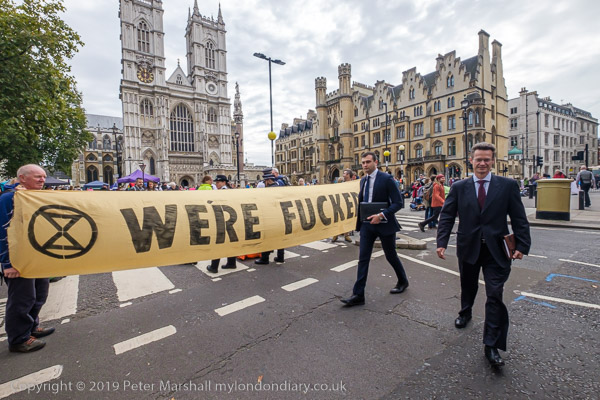
A year ago in October I was having a busy few days covering Extinction Rebellion’s International Rebellion in London. The event had started early on the 7th October when XR supporters occupied eleven locations at government ministries, outside Downing St, on The Mall, and blocking both Westminster and Lambeth bridges, bringing traffic in that area of central London to a halt. Outside the actual areas blocked, traffic was also largely gridlocked over a much wider area.

For the next couple of days the only ways to get around in the area was by tube and on foot. Police were initially overwhelmed by the sheer number of campaigners and the area covered by the protests, and added to the chaos by themselves closing off some routes to traffic and pedestrians.

The protests of course got considerable coverage in the press and broadcasting media, mainly around the disruption the protest was causing with rather less attention to the reasons why XR felt their actions were necessary to try and get our government to take the actions we need to avoid disaster and possible extinction of human life.

Probably few who only followed the media reports would have become aware of XR’s three demands, that the government tell the truth about the climate and ecological emergency, act to halt biodiversity loss, reduced emissions to net zero and create and set up a Citizens Assembly to ensure that proper action is taken. Our democracy is failing because politicians serve the sectional interests of the powerful few rather than the needs of us all.

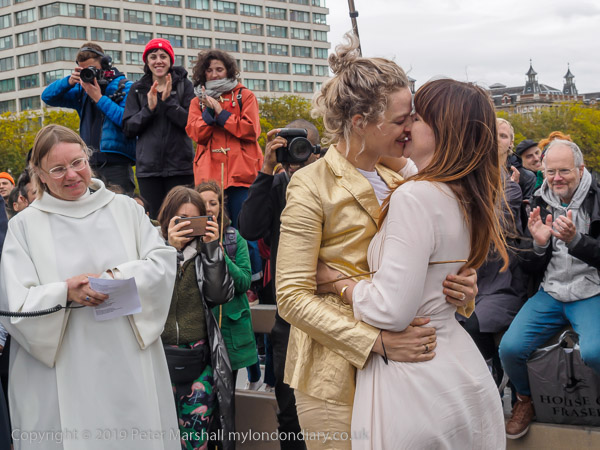
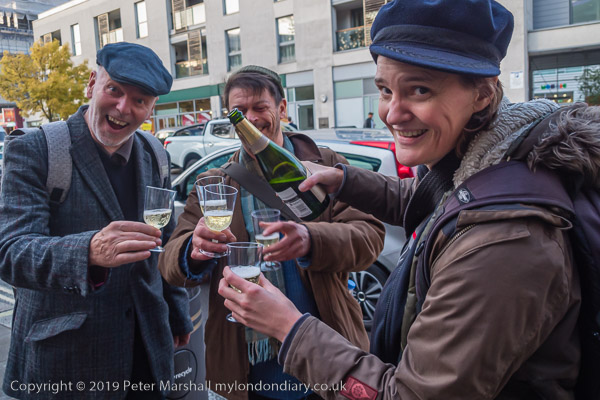
I didn’t quite manage to get to all eleven of the occupied sites on Monday, though I did visist and photograph most of them. The highlight of the day for me was the wedding in the centre of Westminster Bridge between two campaigners, Tamsin and Melissa. I’d first photographed Tamsin when Climate Rush re-enacted the 1908 Suffragette storming of Parliament on its 100th anniversary and had got to know her better during later protests including those against the third runway at Heathrow, but hadn’t seen her for five years.

A year ago today, October 8th, was the second day of XR’s protests. By now the police were beginning to take back parts of the area, having made many arrests overnight.

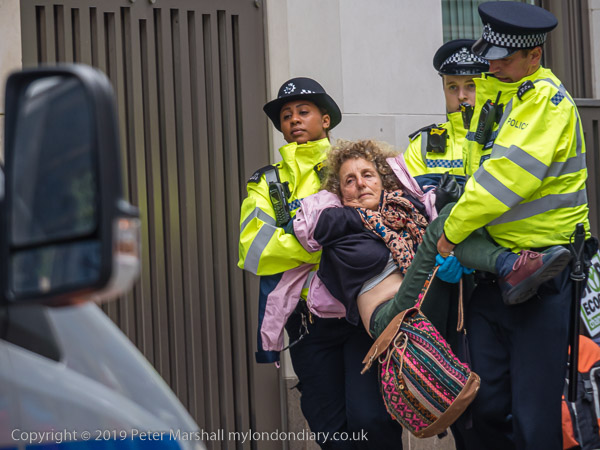
I think many of the protesters were shocked as I was at the deliberate violence and destruction of property when occupied areas were trashed by police, and for some it perhaps made them question the XR policy of non-violence. Standing and shouting ‘Shame on You’ as police assaulted protesters and trashed tents and food stalls turned out not to be very effective.

The day turned out to be a long one for me, as after spending my time with XR I made my way to Camden for a protest by Architects for Social Housing (ASH) outside the champagne reception at the Royal Institute of British Architects awards ceremony for the Stirling Prize. Architects, like our politicians, are largely the servants of the rich and the awards reflect this. ASH were particularly angered by the new Neave Brown Award, supposedly honouring the recently deceased champion and architect of council housing at the Dunboyne Road Estate (formerly known as Fleet Road) and Alexandra Road Estate both in Camden, being awarded to a scheme for a commercial company owned by Norwich Council which demolished council housing to build properties which will not be offering secure council tenancies, with nothing to stop the company raising the service charges or converting the few social rent homes in it to so-called ‘affordable’ rents in the future.

The images here are a small and fairly random selection from the many that I took, and you can see more of them and read more about the protests on My London Diary:

Extinction Rebellion continues
XR Rebels marry on Westminster Bridge
Extinction Rebellion occupy Westminster

Stirling Prize for Architecture


All photographs on this and my other sites, unless otherwise stated, are taken by and copyright of Peter Marshall, and are available for reproduction or can be bought as prints.


Carnival 1991 in colour

In 1991 I photographed Carnival in both black and white and in colour. I went on both days, but I think it was only on Sunday, the Children’s Day, that I took any colour pictures. Nearly all were taken on Ladbroke Grove as the floats and groups went down, often stopping for quite long periods.

I’ll post a few pictures here, but there are quite a few in the album, Notting Hill Carnival – the 1990s, starting at this one if you want to see more.

Notting Hill Carnival, Notting Hill, London, 1991 91c8-nh-036-positive_2400
Notting Hill Carnival, Notting Hill, London, 1991 91c8-nh-070-positive_2400
Notting Hill Carnival, Notting Hill, London, 1991 91c8-nh-073-positive_2400
Notting Hill Carnival, Notting Hill, London, 1991 91c8-nh-083-positive_2400
Notting Hill Carnival, Notting Hill, London, 1991 91c8-nh-099-positive_2400
Notting Hill Carnival, Notting Hill, London, 1991 91c8-nh-120-positive_2400
Notting Hill Carnival, Notting Hill, London, 1991 91c8-nh-152-positive_2400

The picture above is the last colour image from 1991 in the album.


All photographs on this and my other sites, unless otherwise stated, are taken by and copyright of Peter Marshall, and are available for reproduction or can be bought as prints.


More from West London: 1987

Horse, Craven Hill, Bayswater, Westminster, 1987 87-7i-55-positive_2400
Horse, Craven Hill, Bayswater, Westminster, 1987

One of William the Conquerers companions in his 1066 invasion was Ralph Baynard, and among the rewards for his services was an area of land in Paddington. Bayswater was in the 14th century Baynard’s Watering Place, where the River Westbourne or Bayswater rivulet passed under the Uxbridge Rd and horses could drink from it.

Lord Craven bought Upton Farm close to here in 1733 and soon after called the area Craven Hill. The Westbourne rises in Kilburn but springs on Craven Hill added to its flow. Large houses – like this one largely Grade II listed – were developed on Craven Hill and the surrounding area in the early 19th century and in the 1830s it became fashionable as a place of residence, particularly for the literary and artistic. The grand town houses here date mainly from the 1830s to 50s. The horse is an appropriate decoration for the area, but I can tell you nothing more about it or when it disappeared.

Chilworth St, Bayswater, Westminster, 1987 87-7i-63-positive_2400
Chilworth St, Bayswater, Westminster, 1987

This ornate doorway is in Chilworth St, and not as the note on my contact sheet suggested in Devonshire Terrace, which is just around the corner. There is more carved brickwork on the frontage of this building, which is rather grudgingly Grade II listed for its ‘group value’.

Westbourne St, Paddington, Westminster, 1987 87-7i-21-positive_2400
Westbourne St, Paddington, Westminster, 1987

This area of London has been home to many ethnicities and nationalities at least since the Victorian era.

The Fountains, Hyde Park, Bayswater, Westminster, 1987 87-7i-35-positive_2400
The Fountains, Hyde Park, Bayswater, Westminster, 1987

The River Westbourne used to emerge into the open in Hyde Park, and Queen Caroline had a dam built to make the Serpentine Lake in 1730. By the 1830s, with Bayswater being developed the river had become a sewer, and water was instead pumped from the Thames – and is now from deep boreholes into the chalk below the park. One borehole is in the Italian Gardens, which were built in the 1860s when Prince Albert decided it would be nice to have something here like those which he had made at Osborne House. The pavilion which held a pump for the fountains was designed by Sir Charles Barry and the gardens by James Pennethorne with sculpture by John Thomas.

Bayswater Rd, Bayswater, Westminster, 1987 87-7i-46-positive_2400
Bayswater Rd, Bayswater, Westminster, 1987

This rather ugly truncated column on the corner of Lancaster Gate marks the service road in front of the building at left (now the Columbia Hotel) as a private road, running parallel to the Bayswater Rd. Planned in 1856-7, this was one of the grandest developments in London and took around ten years to complete. The architect for the two long terraces facing Hyde Park was Sancton Wood (1815–1886) who worked for his cousins Robert and Sydney Smirke and also designed many railway stations.

All Saints Rd, Notting Hill, Kensington & Chelsea, 1987 87-7j-25-positive_2400
All Saints Rd, Notting Hill, Kensington & Chelsea, 1987

‘DOC ALIMANTADO SAY FREE SOUTH AFRICA’. Dr Alimantado, born in Kingston Jamaica in 1952 as Winston Thompson and also known as ‘The Ital Surgeon’ is a Jamaican reggae singer, DJ and record producer, best known in the UK for his ‘Born For A Purpose’, made after he was knocked down and injured by a bus and for his 1978 album Best Dressed Chicken in Town. He gained success for his ‘toasting’ over the work other singers and his own recordings as a vocalist were less successful.

All Saints Rd, Notting Hill, Kensington & Chelsea, 1987 87-7j-26-positive_2400
All Saints Rd, Notting Hill, Kensington & Chelsea, 1987

‘REMAIN CAREFUL OF YOUR TRUE CONDUCT, DIGNITY, STEER AWAY FROM TRASHY INTEGRATION, BE WORTHY OF THE BEST’

This graffiti on one of Notting Hill’s best-known streets was based on advice given given to the young Dr Martin Luther King:
Remain careful of your conduct. Steer away from ‘trashy’ preachers. Be worthy of the best.”

More on page 5 of my album 1987 London Photos.


All photographs on this and my other sites, unless otherwise stated, are taken by and copyright of Peter Marshall, and are available for reproduction or can be bought as prints.

More Carnival 1990

A few more colour pictures from Notting Hill Carnival in 1990 – there are more on page 5 of the Flickr album.

Notting Hill Carnival, Notting HIll, 1990 90c8-04-31-positive_2400

This was the first year I went to Carnival, and set a pattern I followed in most years, taking the train from Hammersmith to Westbourne Park station, arriving around the middle of the day, before things really got going then walking along to All Saints Rd and photographing around there and Talbot Rd and the surrounding streets.

Notting Hill Carnival, Notting HIll, 1990  90c8-04-11-positive_2400

Later I’d walk up Portobello Rd and under the Westway and take pictures in the north of the area where the streets were less busy and I could still move around. I found the procession route in the south of the area very crowded and impossible for my kind of photography.

Notting Hill Carnival, Notting HIll, 1990 90c8-04-14-positive_2400
Notting Hill Carnival, Notting HIll, 1990 90c8-04-25-positive_2400
Notting Hill Carnival, Notting HIll, 1990 90c8-04-2-positive_2400

I think all these colour pictures were taken on the Sunday – Children’s Day, and that on Monday I worked only in black and white. Most of the pictures I made of the actual procession were on Ladbroke Grove.

Notting Hill Carnival, Notting HIll, 1990 90c8-04-3-positive_2400
Notting Hill Carnival, Notting HIll, 1990 90c8-04-5-positive_2400

If you want to look at more, and at those from later years you can go to page 5 of Notting Hill Carnival – the 1990s. Clicking on any of the pictures above will also take you to a larger version in this Flickr album.


Windows and Doors 1987

Westbourne Grove, Bayswater, Westminster, 1987 87-7g-21-positive_2400

A man studies the menu of a Chinese restuarant on Westbourne Grove while his partner stands uncomfortably a discrete distance to the side. This corner with Hereford Road is still recognisable, but the New Good World is long gone. It was for a while a Rodizio Rico, a Brazilian grill, then another Brazilian bar and grill and, most recently and possibly still Franco Marco Sourdough Pizza, while Vinyl Solution is now a Moroccan restaurant; opened around 1978 by Yves Guillemot after he sold his record shop in Le Havre it was during the 1980s stuffed with obscure records from around the world attracting collectors, as well as DJs including John Peel. It began its own record label and thrived, so much so that this shop became too small and the business moved to Portobello Rd.

Chepstow Rd, Westbourne Green, Westminster, 1987 87-7g-34-positive_2400

This house is part of a long terrace of mid-19th century houses at 22-68 Chepstow Road in Westbourne Green that was Grade II listed in 1981, and was clearly in rather poor condition and recently sold and about to be renovated. These are large houses and now sell for over £2.5m; they are part of the Westbourne Conservation Area and were probably developed in 1850-55. I took an almost identical image on colour film which was a part of a show around 1990 and which now hangs on my stairs.

Pembridge Villas, Notting Hill,  Kensington & Chelsea, 1987 87-7g-43-positive_2400

A number of the grander houses in Kensington have elaborate extended porches like this over the steps leading from their front doors to the street to protect people walking to and from their carriages . They are sometimes called porte cochères, though more strictly this refers to porches into which a coach may be driven. This one in Pembridge Villas, Notting Hill, is more elaborate than most and comes with a front door and a lion on top which this picture rather distorts. You can just see two more lions by the house, here peeping over the wall.

Pembridge Square, Notting Hill,  Kensington & Chelsea, 1987 87-7g-51-positive_2400

Another extended porch at 27 Pembridge Square has some delightful wrought iron work.

Dawson Place, Notting Hill,  Kensington & Chelsea, 1987 87-7g-66-positive_2400

Some fine calligraphy in graffiti on a wall in Dawson Place, though not easy to read. I think I can make out the word ‘Saint’ but the rest escapes me – let me know if you can decipher more. Above the wall is some kind of creeping plant, which not long before had been trimmed back and you can still see the marks it left below.

Royal Pavillion, Brighton, Sussex, 1987 87-7h-31-positive_2400

Brighton has often been called “London by the sea”, and since the railway was built in 1841 has been a popular destination for days out as well as ‘dirty weekends’. So I felt I could include just a few pictures from one of my days out with family and friends to see the sights. I don’t think the girls were greatly impressed by the Royal Pavillion and we didn’t manage to drag them inside, but they did enjoy the Lanes and the Volk’s railway.

Kensington Garden Square, Kensington, Kensington & Chelsea, 1987 87-7h-66-positive_2400

36 Letterboxes in one door must be something of a record, and it was hard to imagine how 36 flats could be fitted in to this pair of houses, though the one at bottom left is labelled ‘Other Mail’. Presumably the entrance leading to all the flats is the door at left, and as well as the 18 bells which can be seen there is presumably another block of similar size on the wall at the right of the door.

I think most or all of the flats are one bedroom flats, and in this area would probably be rented at around £500 per week, so all 36 would bring in a weekly income of £18,000 – not far off a million a year.


All photographs on this and my other sites, unless otherwise stated, are taken by and copyright of Peter Marshall, and are available for reproduction or can be bought as prints.

Al Quds march – 28 Sept 2008

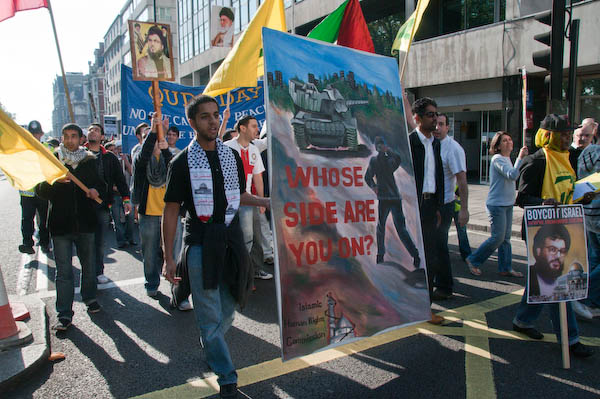
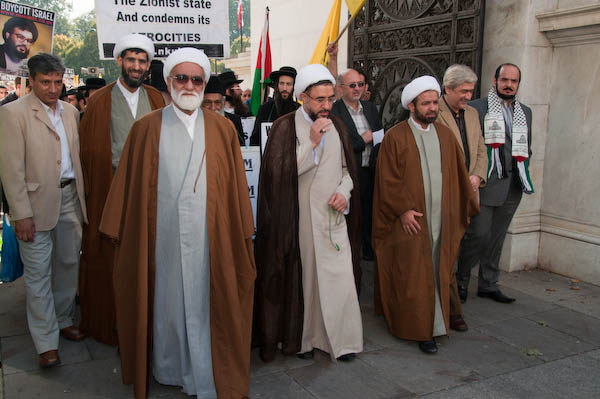
Twelve years ago today, rather than sitting at home in front of a computer as I am today, still avoiding the virus, I was photographing one of the more contentious regular protests on the streets of London, the annual Al Quds Day march.

Al Quds is the Arabic name for the city of Jerusalem, literally meaning ‘The Holy One’ and in 1979 Ayatollah Khomeini of Iran announced the last Friday of the month of Ramadan as International Quds Day to express support for oppressed Muslims around the world and in particular to protest against the occupation of Palestine and the oppression of its people.

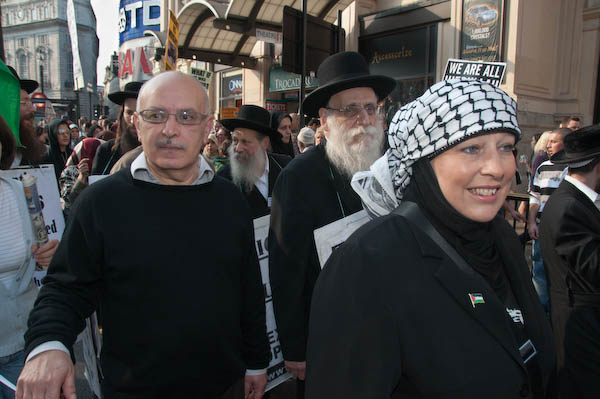
Ultra-Orthodox Jews opposed to Zionism took a leading role in the march

In the UK, a march through London takes place on the Sunday after the day itself, and is generally attended by several thousand people, mainly Shia Muslim families from mosques around the UK, but supported by many other groups, mainly Muslim but including some Jewish, pro-Palestinian and left-wing groups. This year because of the virus it was celebrated on Friday May 22 by a world-wide on-line event.

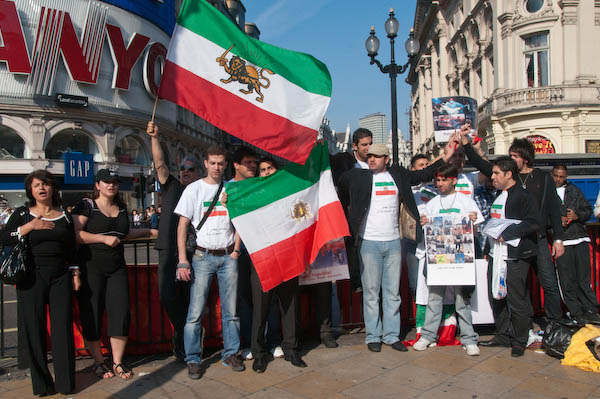
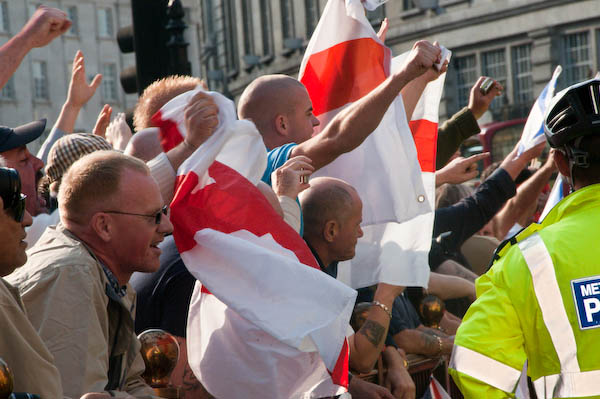
Back in 2008 the main groups opposing the march were Iranian opposition groups, along with a larger number of protesters from extreme right anti-Islamic groups, with just a small number of Zionist supporters of Israel. Police largely managed to keep the two sides apart while allowing both to protest.

But the situation did get rather fraught, particularly when the march was passing the where the opposition groups had been kept behind barriers at Piccadilly Circus, and I found myself getting abuse and threats from both sides. At the time I wrote:

“Things got a little heated at Piccadilly Circus, and some demonstrators objected to me taking pictures of them shouting and gesturing at the counter-demonstration, pushing me out of the march. Doubtless some of the other demonstrators on the other side didn’t like me photographing them either, and the police certainly wanted me back on the other side of the tape again. It is important to record what’s happening, and to stand up for a free press, so I kept taking pictures.”

My London Diary, September 2008

There are many (too many) of these pictures on the pages of this story on My London Diary.


All photographs on this and my other sites, unless otherwise stated, are taken by and copyright of Peter Marshall, and are available for reproduction or can be bought as prints.

A Goddess, Doors, a Dodo and a Lion

Minerva House, North Crescent, Chenies St, Camden, 1987 87-7f-21-positive_2400

Grade II listed Minerva House on the North Crescent of Chenies St , architect George Vernon, was built in 1912-3 for the Minerva Motor company which had begun in Belgium making bicylces before moving on to motorbikes and cars. One of its English dealers in 1903 was Charles Rolls, who the following year joined up with Henry Royce to sell his cars. In 1910 he became the first Briton to be killed in a crash by a powered aircraft when his Wright Flyer lost its tail during an air display in Bournemouth.

When I took this picture Minerva House was the Combined Training School for University College Hospital, training around 300 nurses a year. Since Minerva was the Roman Goddess of poetry, medicine, wisdom, strategic warfare, commerce, weaving, and the crafts this seems appropriate. She was also supposed to have created the olive tree and invented the flute and numbers. Minerva House is now the London home of global media agency OMD.

At right is the bleak Chenies Street concrete blockhouse entrance to the deep-level air raid shelter built in 1942, currently called ‘The Eisenhower Centre’ though it had no real wartime connection to the General. Before the war Minerva House looked out onto gardens.

Pembridge Gardens, Notting Hill, Kensington & Chelsea, 1987 87-7f-24-positive_2400

19 Pembridge Gardens was obviously in rather poor condition in 1987 when I took this picture, with peeling paint and trees growing up in odd places. The house was empty, its front door secured by two padlocks. It had been Grade II listed three years before I photographed it.

It looks in rather better condition now, and it should be as it appears to be home to a firm of “well-established Expert decorators.” Though I think it a shame not to have retained what is I think an illuminated house number above the door.

Pembridge Gardens, Notting Hill, Kensington & Chelsea, 1987 87-7f-25-positive_2400

It’s hard to count the number of bells at the left of the door to this house just a couple of doors up from the house in previous picture, but then obviously in rather better condition. There are 15 of them on the five floors of this house. Built in the mid 19th century (with a later top floor) it was also Grade II listed in 1974.

A Davey, Builder, ghost sign, Portobello Rd, Notting Hill, Kensington & Chelsea, 1987 87-7f-52-positive_2400

A neatly aligned sign indented in the rendering on the wall of an end terrace house in Portobello road still informs us


A. DAVEY.
BUILDER.
M A N U F A C T U R E R O F
EVERY DESCRIPTION OF INSIDE
AND OUTSIDE WINDOW BLINDS.
UPHOLSTERER AND DECORATER
ESTABLISHED 1851.

though I’m sure he was well gone from the premises when I photographed them 136 years later.

Davey the builder was probably one of the original occupiers of this long purpose-built terrace of shops which were developed in 1848-9 by the Rev Brooke Edward Bridges and Thomas Pocock who had bought the land for ‘Portobello Terrace’ from Felix Ladbroke; they were built by various local builders to a similar plan, with a ground floor shop and two floors above for the shopkeeper and his family. More recently extra doors have been added and the upper floors are largely let as expensive flats.

Looking at the text of the sign I think the lettering was probably stamped out while the rendering was still damp rather than cut out. It has certainly lasted well and can hardly be called a ‘ghost sign’. Fitting in some of the longer text was obviously rather tricky and there are just a few places where the letter spacing seems not to be optimal. Though generally rather better than my crude attempt above.

Dodo, Westbourne Grove, Notting Hill, Kensington & Chelsea, 1987 87-7f-64-positive_2400

Dodo and this sign were at 185 Westbourne Grove, no longer something Antiques but now occupied by American Vintage, but Dodo is certainly no longer at 3 Denbigh Rd, a short distance to the west just off Westbourne Grove. You can see a picture of this row of shops with Dodo in place on the RBK Local Studies web site which takes a photographic stroll down Westbourn Grove and comments rather inaccurately “In the centre of the picture a shop called Dodo Designs, wholesalers of fancy goods.”

Dodo, set up by “London’s acknowledged queen of advertising ephemera” Liz Farrow has been “selling genuine vintage advertising posters since 1960” and is still doing so through the Dodo Posters web site.

Ledbury Rd, Notting Hill, Kensington & Chelsea, 1987 87-7f-65-positive_2400

Just around the corner in Ledbury Rd is this row of shops with an entry to Ledbury Mews North. This whole area had a large number of antique shops but now seems largely devoted to fashion.

No 38 to the right of the mews entrance is certainly an attractive building, but I think what particularly attracted me is the lion on the pavement in front of Lacy Gallery – which has of course gone with the Gallery, that shop now split back into two different businesses.

More from Page 5 of 1987 London Photos in another post.