There is still a doorway here between 56 and 58 Peckham Rye, but the lock above it has gone and it now has a sign for Ezel Court at 56 A and B and 58 A and B. The Antique shop was for some years Delta Tavern, an Arfican Restaurant, then a café called Pedler and most recently a bar and restaurant Good Neighbour. The building building to the right of the doorway is also now a bar.
At top left of my picture who just get a glimpse of the rather finely decorated upper storeys of the two late Victorian buildings at 58 and 60, though for some reason I didn’t bother to cross the road to photograph these.
This window was just a few doors further down at No 64 and I liked the symmetry of its display, though broken by the two identical photographs of a woman looking in the same direction. I don’t think I was at all clear as to what was behind this window – or what the woman in her strongly patterned dress and gloves was meant to represent. And at the centre of the window display is a thick book on a table, a Thesaurus.
The attractive grille above the door is no longer there, and was probably salvaged and sold when the shopfront was updated. In more recent years this has been occupied by an estate agent, a pizza takeaway and beauty salons.
In the reflection you can see the extensive premises of G Austin & Sons Ltd offering secondhand furniture and antiques, now I think replaced by a three-storey block of flats.
I was always happy to photograph people who saw me taking pictures and wanted to have their picture made, though I very seldom took down details so I could give them pictures. So this young man, posing for me in 1989 will not have seen this picture, unless he has visited the page on Flickr only since January 2021 – it has never been published elsewhere.
The Regency Carriage Company has long gone from this site, though the building remains, rather altered. It was for some time an estate agents but has for around ten years been Rye Cars. But the yard in which the cars for sale were neatly aligned is now covered by flats.
St John the Evangelist, East Dulwich Road, East Dulwich, Southwark, 1989 89-2c-66
St John the Evangelist was built in 1865 to the designs of local architect Charles Bailey, but was badly bombed in 1940. Reconstruction began in 1947, incorporating the remaining apse and tower which dominate my picture and was completed in 1951.
House, East Dulwich Road, East Dulwich, Southwark, 1989 89-2c-52
126 East Dulwich Road faces the west end of Goose Green on the corner of Grove Vale and I liked the uncompromising stare of the head above its simple but impressive doorway.
Houses, East Dulwich Road, East Dulwich, Southwark, 1989 89-2c-53
A pair of doorways with heads, with a simiilar design and I think on the same row of houses facing Goose Green as the previous image.
Goose Green School, Grove Vale, East Dulwich, Southwark, 1989 89-2c-54
I walked a few yards north up Grove Vale to photograph this fine Grade II listed example of a school built as Grove Vale School for the School Board for London in 1900 to the Baroque Revival designs of T J Bailey
I turned around here and walked down to Lordship Lane where my next post on this walk will begin.
Although I’ve been photographing protests in London for many years it was only after I left a full-time teaching job in 2000 that I was really able to photograph more than the occasional event, and only after I began to use a digital SLR camera at the end of 2002 that pictures from them appeared regularly in My London Diary. For a couple of years after that I was still using both film and digital, largely because I only had one Nikon lens and it was a few years before I got a real wide-angle for digital, but the on-line posts were almost entirely from the digital images.
But the huge growth in internet use as people organising protests more and more began to put details on their web sites, use e-mail and Facebook meant that with a few hours searching each week I was able to find more and more events to photograph. Before it had only been easy to find out about the protests organised by groups I was a member of and major national organisations. Some I found from fly-posted notices in parts of London, and others from a little intelligent guesswork based on events in the news, anniversaries and other significant dates. And back then and still now, if I’m in London I’ll take a look at places like Trafalgar Square, Downing Street, Parliament Square and find things I had now prior knowledge of taking place.
By 2011 there was a great deal of information on-line and I think I took the train to London with a list of all the events I managed to cover that day, three by UK Uncut, Kurds and Congolese protesting at Downing St, Iraqis, Syrians and supporters of Bradley (now Chelsea) Manning at the US Embassy, and Egyptians at their Embassy. I sent pictures on each to Demotix (no longer with us) along with a story and later wrote a total of nine posts on My London Diary, possibly a record for any single day for me – peak protest!
With so many protests I’m not going to write much about any of them today – but you can click any of the links to read the roughly 2700 words I wrote about the nine events in 2011. All of the pictures in this post are from Saturday 17th December 2011.
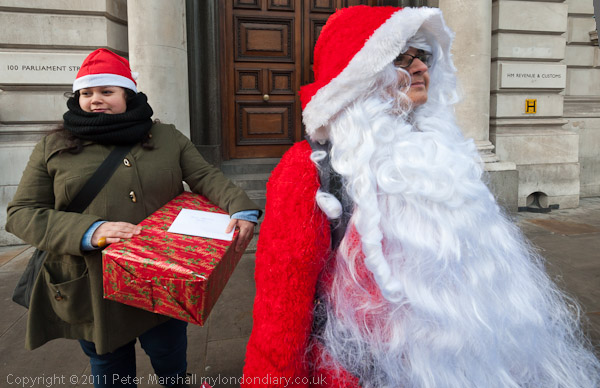
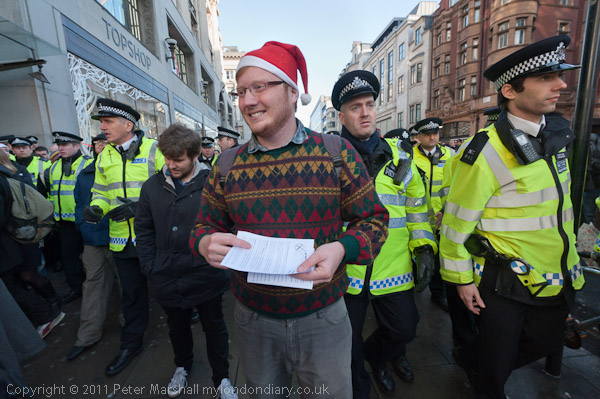
UK Uncut Santa Calls on Dave Hartnett – HMRC, Parliament St
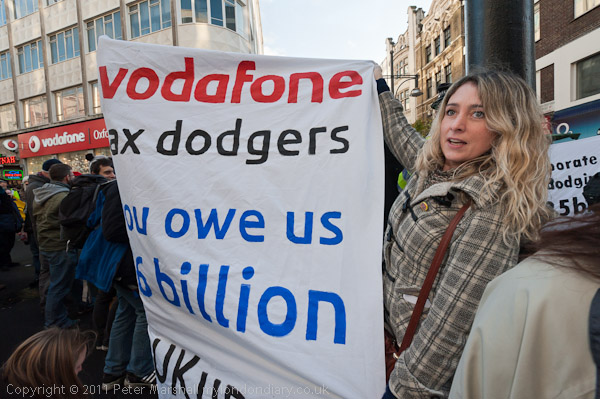
UK Uncut brought a Christmas present to Dave Hartnett, the UK’s top tax man, shortly to retire with a massive pension despite a huge series of blunders. And he had also let major companies off paying huge amounts of tax they owed – including £4.75 billion for Vodaphone and around £8 million for Goldman Sachs.
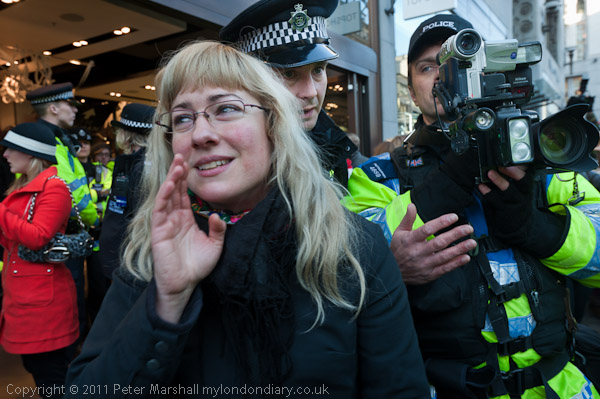
A group from UK Uncut protested briefly inside the Oxford Circus Topshop at the failure of Arcadia group to pay UK tax on its UK earnings, continuing their protest with others on the pavement outside until cleared away by police.
UK Uncut moved to Vodaphone to protest about their dodging of UK tax. Police kept them a few yards from the shop but otherwise did not interfere with the peaceful demonstration.
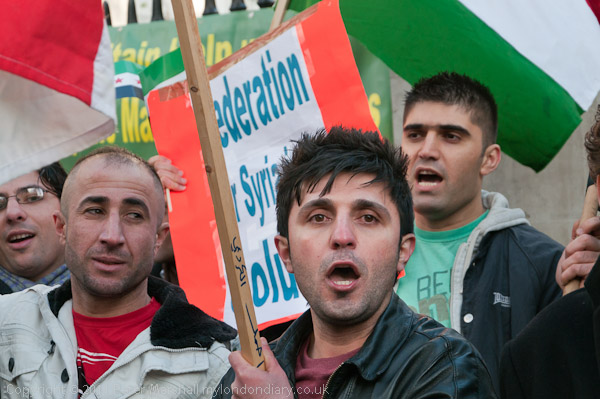
Kurds Call For A Stop To Syrian Massacres – Downing St, Whitehall,
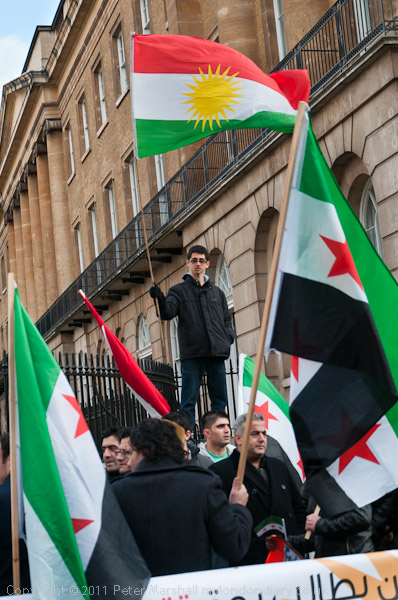
The Syrian Kurdish community protested at Downing St as massacres continue in Syria, calling for Britain to help to stop them. They want freedom for Syria and also for Kurds in Syria in a federation to replace the Assad regime.
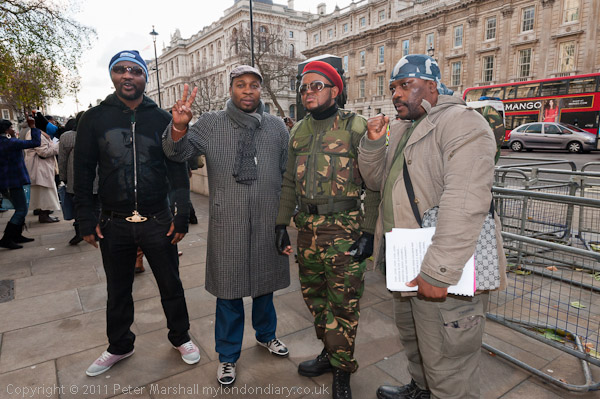
Congolese continued their protests in London against the election fraud, rapes and massacres and called on the British government to withdraw its support from the immoral regime of President Kabila responsible for the atrocities and voted out by the people.
Iraqis and Syrians Protest At US Embassy – Grosvenor Square
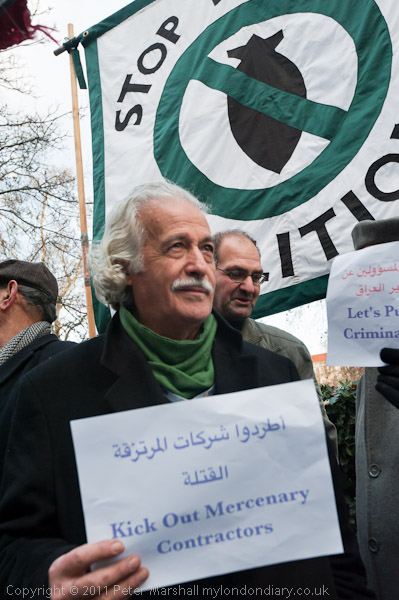
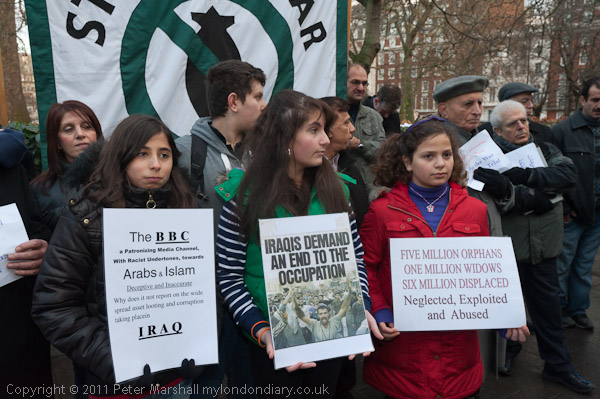
Iraqis met to celebrate their defeat of the occupation on the day US troops left Iraq, and called for the mercenaries to go too, as well as for proper coverage of Iraq by the BBC. They were joined by Syrian supporters of President Bashar al-Assad, at the embassy to demand no US intervention in Syria.
Bradley Manning Birthday Demo – US Embassy, Grosvenor Square
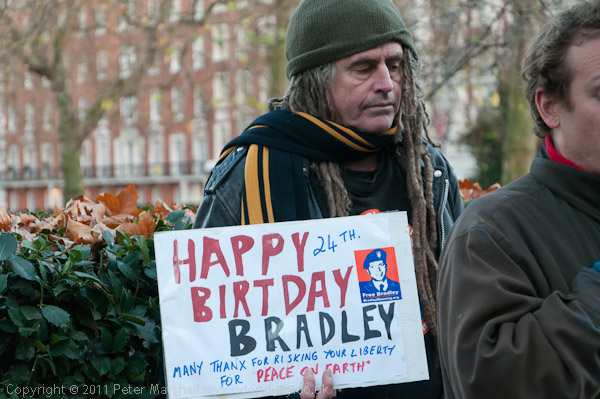
Supporters of Bradley Manning (now Chelsea Manning) held a vigil at the US Embassy on Saturday afternoon, his 24th birthday, and on the second day of his pre-trail hearing, calling him an American Peace Hero.
Egyptians Protest Against Attacks on Protesters – Egyptian Embassy, Mayfair
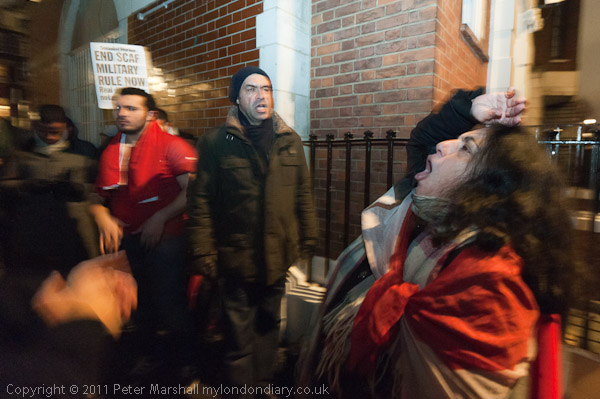
News of the deaths and injuries in Cairo as armed forces attacked protesters prompted Egyptians to protest at the London Embassy, calling for the Supreme Council of the Armed Forces to halt the attacks and hand over power.
From Blenheim Grove I turned into Choumert Grove. George Choumert (1746-1831) was a Frenchman from Lorraine, a tanner who married into a wealthy Bermondsey family. When he became a British citizen in 1796 he probably didn’t have to pass a silly exam asking questions that few British people could answer. People could just come and live and work here as foreigners but it isn’t too clear that there was any real way for foreigners to become British back then, though they could become a British subject by a process known as denization, which granted them all the rights of citizens except political rights.
Choumert Grove, Choumert Road and Choumert Square are all named after him. Before his wife’s death he was responsible in 1815-1822 for building part of Rye Lane and Holly Grove, then called George Street. When Choumert’s wealthy wife died in 1825, he inherited her estates which gave him a very healthy income.
The grandly named Choumert Square is a later development, a narrow lane with no vehicular access, infill in the extensive back garden of a house in Rye Lane, but accessed from Choumert Grove. IdealHome ran an interesting piece on one of the small one-bed houses in it in 2018 under the headline Would you be brave enough to buy this London house of horrors for £525,000?
I turned left into Choumert Road to photograph Girdler’s Almshouses, also known as Palyn’s Almshouses. The Grade II listing begins “Row of 5 almshouses. 1852. By Woodthorpe.” The 2018 Trustees Report of the THE WORSHIPFUL COMPANY OF GIRDLERS BEESTON’S, ANDREWES’ AND PALYN’S CHARITY informs us “Palyn’s Almshouses were built in 1980 to replace six almshouses built in 1852 in Montpelier Road, now known as Choumert Road, Peckham, which themselves replaced the original six almshouses founded in 1609 in Pesthouse Row, St Luke’s, Finsbury, as a result of a bequest from George Palyn, Citizen and Girdler.“
Girdlers were makers of belts and girdles and the Worshipful Company of Girdlers were granted the right to regulate trade in these items in the City of London in 1327 – and could seize and destroy any such items that did not meet their craft standards. Palyn was a Master of the guild and his will left money for the Finsbury almshouses.
I walked up Choumert Road to Rye Lane turning south down it. The rather impressive frontage of No 213, previously Bonanza stores was the site of an “EXCITING NEW DEVELOPMENT’ retaining the frontage but with an arcade of 10 shops.
Later it became the London Seafood Superstore and was renamed LOBO House. More recently it has again been redeveloped, along with the fish factory behind.
Co-operative House proudly had its name across the top of the building, along with the dates 1868 and 1932. 1868 was the date when 20 workers at the Royal Arsenal in Woolwich formed the Royal Arsenal Supply Association which a few years later became the Royal Arsenal Co-operative Society with branches across south-east London, including this large store in Peckham, presumably built in 1932, though replacing an older store on the site.
Co-operative societies had stores like this across the whole country, and they played an important part in getting decent products including foodstuffs to working people. We shopped at the Co-op when I was a child and my mother’s six-digit Co-op number which we had to recite at the till is still deeply etched in my memory. Every year we got a ‘divi’ based on the amount we had spent, and I think it paid for us to have a few treats and presents at Christmas which our family could not otherwise have afforded.
There is now a new block here, with ground floor shops and flats above and it carries three large dates, 1862, 1932 and 2008.
Sternhall Lane is a turning off Peckham Rye opposite the north end of Co-operative House. Timber yards like this were common in 1989, but most like this one have since been redeveloped. About all that is left from this picture is the lamp post. Buying timber now usually means driving to the outskirts rather than finding it in town centres. The wall sign COOPER’S TIMBER AND intrigued me slightly though I think the stacked timber might only be obscuring the letters D.I.Y which are on the boards on the front of the premises. Appropriately this range of buildings appeared to me to have something of a D.I.Y quality.
Nigel Rd also leads off Rye Lane just a few yards to the south of Sternhall Lane. The buildings on the opposite side of Rye Lan in the centre of this picture are still there, but at the left of the row is the end of the Co-op buildings replaced in 2008. The buildings on the corner of Rye Lane at left are still there, but there is no longer a careers office out of picture whose notice is shown here.
The road layout has changed a little and the triangle in the foreground with its keep left signs, one toppled presumably by a driver who failed to obey has gone. It was hard to see what point it had back in 1989, opposite an un-named street leading to a block of council flats, built in the early 1950s.
Grove Park changes to Chadwick Road on a bridge across the railway which separates Camberwell from Peckham and continues on, with a considerably less wealthy vibe, one side with long terraces of two-storey two bed working-class houses which now sell for around £900,000.
The north side was more varied, with an industrial estate but nothing attracted my photographic interest until this printers and its multiple signs on the corner with Bellenden Road. The sign on the wall is still there but the rest have gone and the ground floor frontage on Bellenden Road looks very different.
The building is now home to MOCA London, The Museum of Contemporary Art, Londonfounded in 1994 as a project based museum which opened a project space here in the Bellenden Renewal Area in 2004.
Front Garden, Ady’s Rd, East Dulwich, Southwark, 1989 89-2b-33
I turned south down Bellenden Road, made a couple of pictures on Maxtead Road and then went down Oglander Road and into Adys Road where I found this front garden. I couldn’t resist the two donkeys and the gnome in a small car in front of those net curtains. You can see the decorations by the windows of these late Victorian houses which also have fairly impressive rusticated doorways paired together down the street.
Back on Oglander Road a little south of Adys Road was Padwick’s Crash Repairs at the end of a terrace of small houses. Those beyond the garage further down the street are larger and semi-detached. I particularly liked the faces on the two archways and the truncation of both archways, the decorage element at each end of the shopfront suggesting it might have been originally built like this rather than a later addition.
Coach entrances like this were common to many businesses in the days of horse-drawn vehicles – and this certainly predates the era of motor transport. This was once a diary and had large associated buildings in a yard behind. The ‘Old Diary’ was demolished in 2020 and I think is being rebuilt as a new gateway to a mews development behind.
Oglander Rd, Maxted Rd, East Dulwich, Southwark, 1989 89-2b-35
The junction of Oglander Road with Maxtted Road, with Wingfield Street more or less opposite, and shops on the street corners. There is still a shop on the other corner of Oglander Road but this Auto Electrics and the ‘Bottle & Cork’ are now residential.
I went up Maxted Rd to Bellenden Rd where I photographed this chapel on the corner of Danby St. Previously this was Hanover Chapel, but was bought by the Pentecostal Faith Chapel in 1978 in a “grossly dilapidated condition, which took nearly a year to renovate.”
The church was built as a United Methodist Free Church and opened in 1885, eight years after its memorial stones had been laid. It had been planned with a spire which was never built. It was sold in 1920 to Hanover Chapel, the oldest non-conformist worshipping community in Peckham, Congregationalists with a history going back to 1657 when the dispossessed Vicar of St Giles, Camberwell the Rev. John Maynard founded a chapel or meeting House in Meeting House Lane.
Blenheim Grove, Rye Lane, Peckham, Southwark, 1989 89-2b-23
I continue up Bellenden Road to Blenheim Grove, walking down this almost to Rye Lane where I photographed the rather fine building at 133 housing Murrays Meat Market and Ralph Haeems & Co Solicitors. Considerable renovation of this building, the entrance to Copeland Park, took place around 2018-9 and it is now ‘MARKET PECKHAM’, whose developer responded to public pressure to drop plans to turn it into luxury flats.
In earlier years from 1908 to 1915 this was the Electric Theatre – and after I took this picture the first floor became home to The Redeemed Christian Church of God-House of Praise.
Ralph Haeems, Blenheim Grove, Peckham, Southwark, 1989 89-2b-24
I walked back down Blrenheim Grove, and made this picture of another building of Ralph Haeems & Co Solicitors at No 9. This early 19th century villa was Grade II listed in 1998 and was acquired by Southwark Council for use as offices in 2002. They ceased to use it in 2010 after the council acquired its new offices in Tooley St in 2007 and the council decided to sell it in 2011.
The building is now two residential properties, 9 and 91/2 Blenheim Grove.
My account of the walk in Peckham in 1989 will continue in a later post.
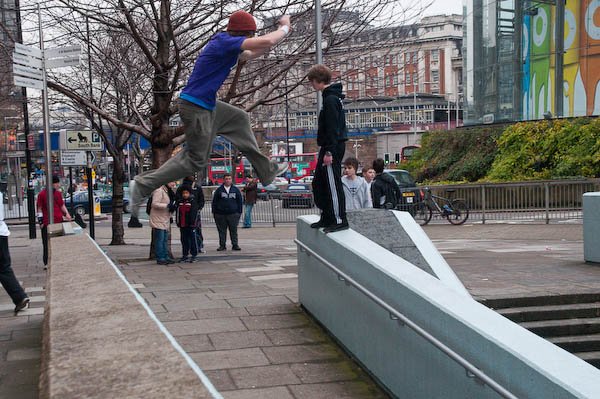
Sunday December 14th 2008 was a cold and cloudy but bright winter day as I made my way from Waterloo Station to Columbia Market, stopping to take a few pictures of the young men jumping around the street structures by the Waterloo roundabout before catching a bus to Bethnal Green to photograph in Columbia Market.
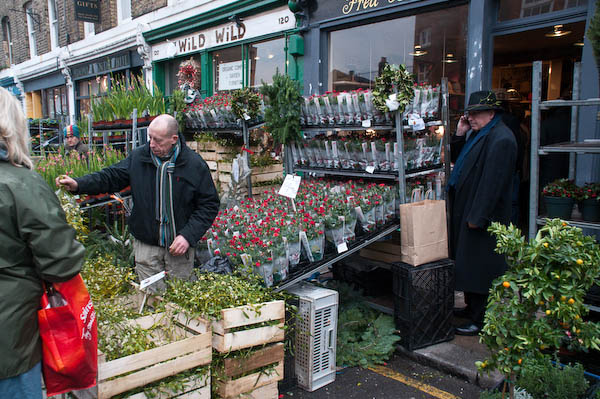
The market was busy with people buying Christmas trees, decorations and flowers, but I hadn’t really come with the right camera to work unobtrusively, but was using the DSLR-size Nikon D300 with the rather bulky original DX Nikkor 18-200mm zoom, a versatile combination but not the best for this kind of work. I wandered around taking a few pictures before leaving to walk to Brick Lane.
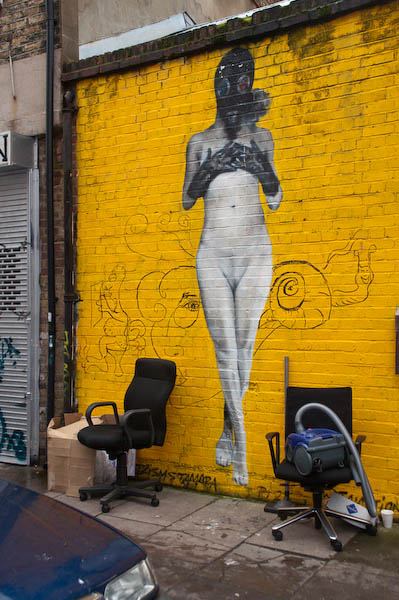
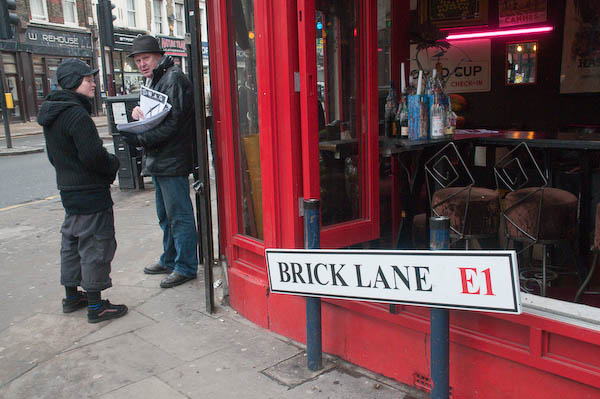
I was early for the protest which was to take place there, and took some pictures, mainly of graffiti while I was waiting. As I noted, “Somehow the people seem less interesting than in the old days, less eccentric and dodgy characters, and,except on the very fringes, the market seems rather more commercial in character.”
But the market was also useful for me, as I was getting a little cold, and when I put my hand in my coat pocket found my woolly hat was no longer there. ” A couple of stalls along I found a new one for a quid, with a label calling it a fashion hat and a £9.99 price tag. And there were fancy chocolates like the ones I couldn’t bring myself to pay the ridiculous prices in Waitrose going for around a quarter of the cost… ” But there wasn’t room for anything else in my camera bag.
Solidarity with Whitechapel Anarchists! – Brick Lane, 14th December 2008
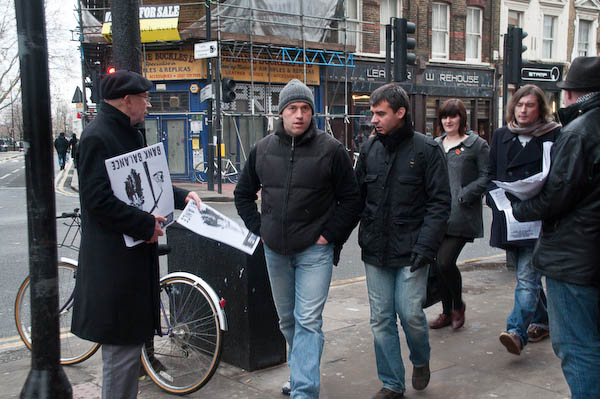
The previous week members of Whitechapel Anarchist Group were harassed by police while distributing their newsletter at the top of Brick Lane and had called for support this week to carry out their entirely legal activities here.
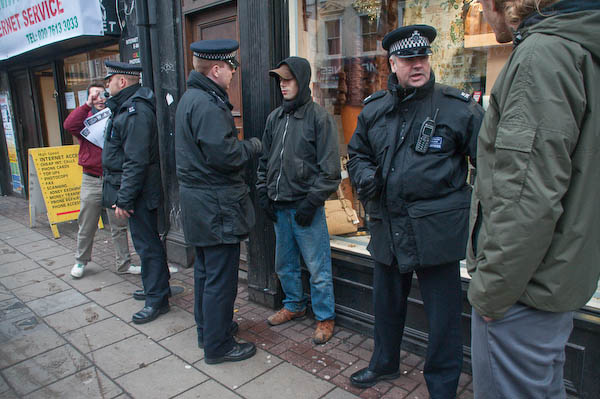
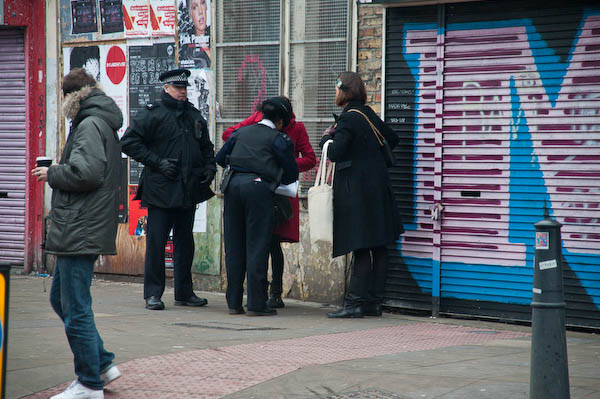
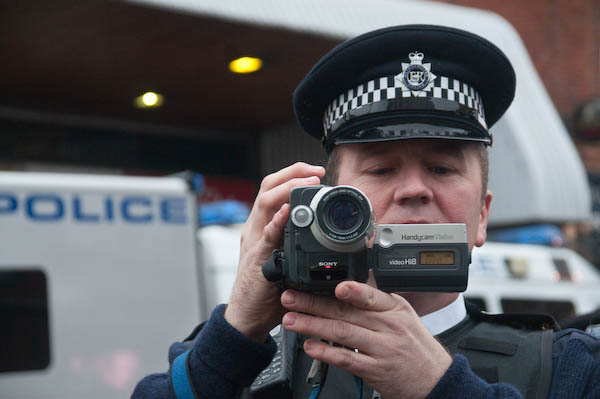
This week a largish contingent of police had come along to watch, obviously expecting trouble, but at first they mainly stood on the opposite side of the road, observing and photographing the protesters. When one protester stood in front of an officer taking pictures he was hauled off a short distance down the road and questioned before being marched away to a waiting police van. I photographed this, taking care to keep at a distance where I was clearly not obstructing the police. Apparently they decided to arrest him for swearing when he was being questioned, although this Is clearly not an offence.
The police spent rather a lot of time photographing and videoing me during the event, in a way that was obviously meant to harass me, as well as similarly harassing the protesters. This happens regularly at protests, and the police have at times admitted keeping a photographic database in which they can look up people and see which demonstrations they have attended. Though as I noted, all those I go to are recorded in My London Diary.
Police search a woman – I think just someone passing by the protest
Some time later I submitted a Freedom of Information request to the Metropolitan Police to try and find out what photographs and videos they had in their files showing me, giving a list of some of the occasions where I knew they had taken pictures. The response denied they had any pictures of me.
As my account ended, “Clearly their activities around Brick Lane today were a waste of public money, and worse than that. They don’t make us any safer and were not combating any real threat to public order. If they have an agenda it seems purely political.”
Solidarity with Revolt in Greece – Dalston, 4th December 2008
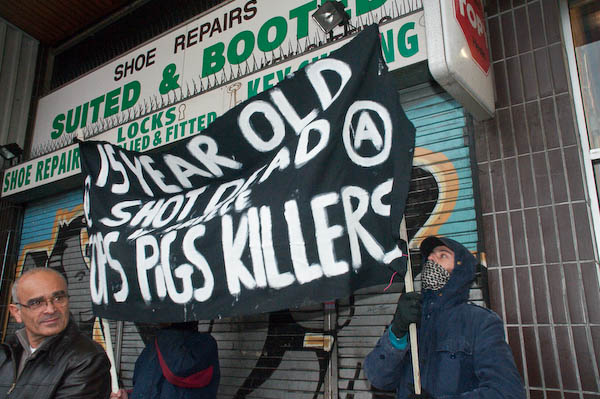
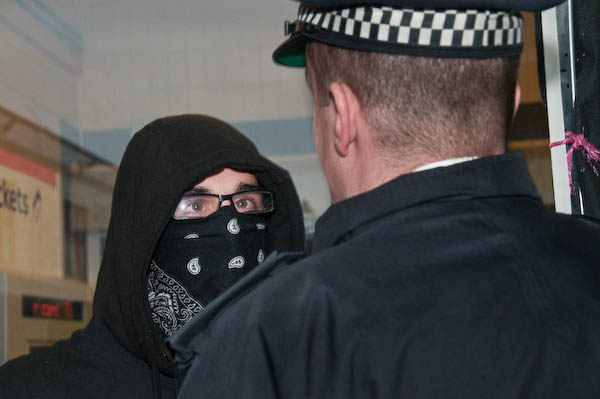
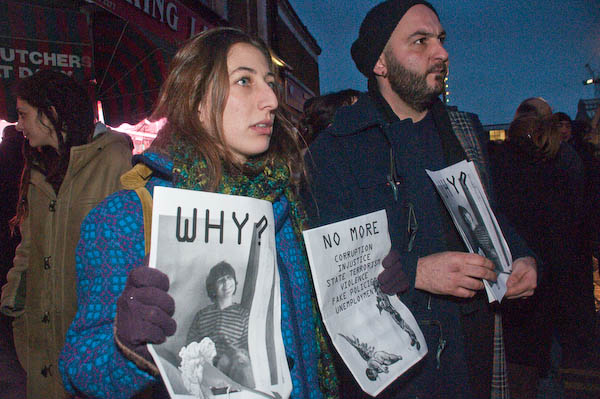
I arrived outside Dalston Kingsland station at 2.30pm to find a group of around 50 protesters waiting on the pavement outside station for a protest march in solidarity with protests by Greek anarchists following the killing of a 15 year old youth by the Athens police.
The police had come in force to the starting point of a march which would have walked peacefully along the streets to the peace mural on Dalston Lane for a rally with some speeches and some noisy chanting. It would only have caused a few minutes stoppage to traffic as they had marched the short distance along the road.
At the end of the rally the couple of hundred who had turned up would probably have dispersed to their homes and local pubs and the event would have ended with no trouble. But police decided to provoke a confrontation by taking action against people wearing scarves across their faces – part of the anarchist ‘uniform’.
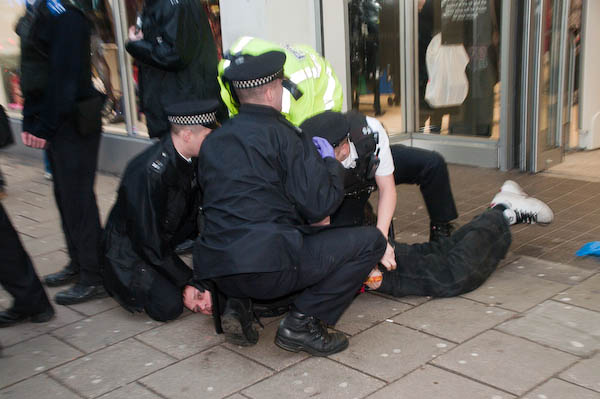
Another protester is arrested and searched
But this makes it hard for the police to take photographs for the database that they usually deny they have. Section 60(4A) of the Criminal Justice and Public Order Act 1994, Act gives the police powers to require the removal of face coverings that an officer is satisfied is worn wholly or mainly to conceal identity, provided that an officer of or above the rank of inspector has given an authorisation for such action within a given area for a period of up to 24 hours.
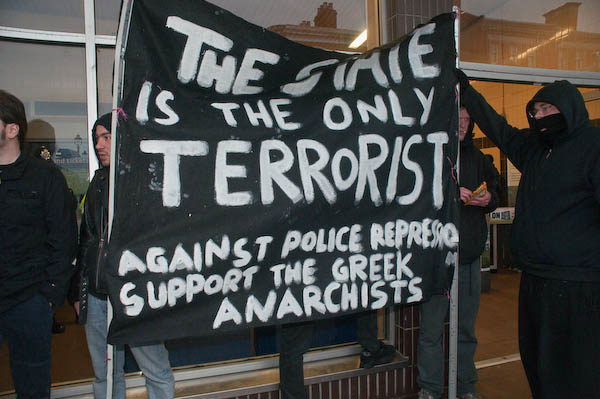
So either they were acting illegally or clearly they had decided in advance to obtain this authorisation and were determined to make use of it. Obviously this was going to cause trouble. They began by approaching one of a men beside a banner with the message ’15 YEAR OLD SHOT DEAD BY GREEK COPS PIGS KILLERS’ and told him to remove his mask. An argument ensued and eventually, still wearing his mask he was led away.
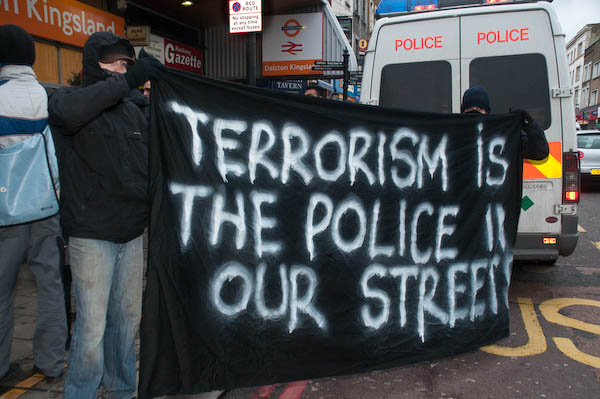
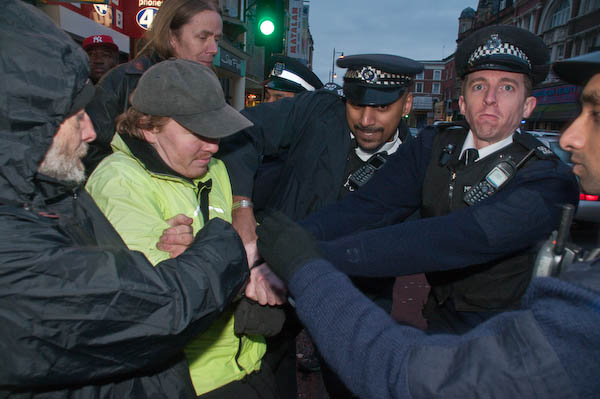
Police then grabbed another protester who was alleged to have punched a policeman, ppushing him to the pavement and searching him. Other people protested at the violence being used and I think at least one of these was also arrested. Others held up a banner with what seemed now to be a rather appropriate slogan for London as well as Greece, ‘TERRORISM IS THE POLICE IN OUR STREETS’.
A police officer who apparently failed to photograph me :-)
More masked protesters were grabbed by police, though I’m not sure how many were actually arrested. Police began to form a cordon around the protesters in front of the station and photographers were made to go outside this – and there were quite a few protesters now on the opposite side of the street – being photographed and videoed by police.
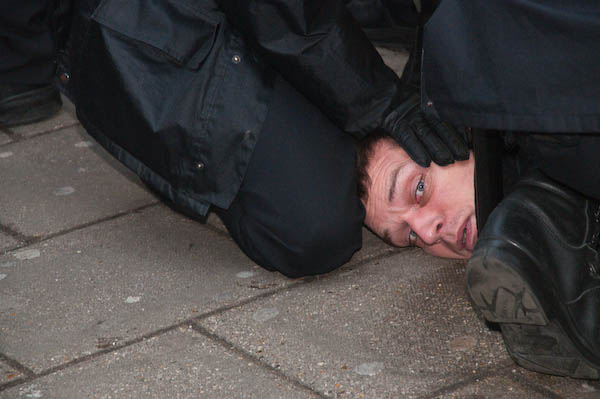
Arresting for arguing his legal rights
Police vans were then moved up between the photographers and the main part of the protect, conveniently hiding most of what was taking place from the press. But we saw a protester who tried to argue his legal rights with police being handcuffed – in a rather panotmime fashion in my series of pictures. Those protesters who were not yet held inside the police cordon then surged out onto the main road – a red route – and blocked traffic entirely until police – at least one officer using his baton – pushed them back.
By this time, many of the black-clad and masked anarchists who were not inside the police kettle had moved away leaving mainly Greek supporters of the protest on the opposite side of the road.
It seemed clear that the police had come to the event determined to turn it into a show of force between police and protesters – and that the police had won. But in doing so they had spent a small fortune in public money and caused an hour and a half of disruption to normal life and to traffic on one of North London’s main arteries. And what may I thought may have been meant as “some kind of political charade organised to increase public support for increasing surveillance and repressive legislation” had in fact rather suggested the truth of the largest banner at the protest’s opening statement ‘THE STATE IS THE ONLY TERRORIST’.
Shops, Melbourne Grove, East Dulwich, Southwark, 1989 89-2b-61
Nothing much caught my attention on the walk from the hospital and then up Melbourne Grove until I came to this hosrt row of shops just before reaching Grove Vale. I think all of these buildings are still there but the bus stop has gone and all of the buildings have changed use and there is no longer a Grove Vale Library opposite the top of the road, it having moved into a new building around the corner on Railway Rise, behind M&S.
House, Camberwell Grove, Camberwell, Southwark, 1989 89-2b-63
I walked up Grove Vale under the railway bridge where it becomes Dog Kennel Hill and up there to turn into Grove Hill Road which led me to the southern end of Camberwell Grove – this picture was taken at their junction. When Hermitage at 220 Camberwell Grove was built the road was known as 220 Camberwell Grove. Its Grade II listing describes it as an early 19th century cottage. It was built as a rustic cottage with these timber posts supporting the deeply overhanging roof to form this verandah.
The cottage was one of the properties built for John Coakley Lettsom (1744 – 1815) a doctor who founded the Medical Society of London and had a considerably grander villa a little to the south at Grove Hill, demolished in the early 1800s. is now rather more covered by greenery, making photography more difficult.
Houses, Camberwell Grove, Camberwell, Southwark, 1989 89-2b-64
Immediately north of the cottage is this impressive row of houses. Nos 200-218 are Grade II listed and were built as a block from around 1845.
House, Camberwell Grove, Camberwell, Southwark, 1989 89-2b-66
This unusual verandah and window was at the side of one of the houses on Camberwell Grove, at No 195.
Many if not most properties in Camberwell Grove and nearby are Grade II listed, and 195 seems to be the only one unlisted on this section of the road, all fine Regency properties, though this part of the house appears to be a later addition. Perhaps 195 is unlisted because unlike the other properties it it built up to the pavement edge and some may feel it spoils the long vista of houses well back from the pavement.
House, Grove Park, Camberwell Grove, Camberwell, Southwark, 1989 89-2b-52
On the corner with Grove Park is this rather odd conglomerate with what appears to have been a classical entrance lodge welded unhappily into a later mansarded house.
Houses, Camberwell Grove, Camberwell, Southwark, 1989 89-2b-54
Perhaps the gem of Camberwell Grove, this is Grove Crescent, a Grade II listed terrace of 4 linked pairs of houses dating from around 1830 at 169-183 Camberwell Grove.
House, Grove Park, Camberwell, Southwark, 1989 89-2b-55
Grove Park has a few large villas from the 1830s and 40s, but is mainly a late Victorian speculative development of large houses probably from the 1890s, with a few variations on three versions of large semi-detached houses. It is made up of several roads, all confusingly called Grove Park. This detail shows the entrance at the west of 125 Grove Park, just a few yards from Camberwell Grove.
House, Grove Park, Camberwell, Southwark, 1989 89-2b-56
This is White Lodge at 55 Grove Park, which stands out in this short leg of the road in a row of late-Victorian red-brick houses, which it presumably pre-dates.
House, Grove Park, Camberwell, Southwark, 1989 89-2b-41
This grandly Italianate mansion, Pelham House, 14 Grove Park, is on the corner with Pelham Grove, and is now flats with a considerably more recent block of flats at The Birches on the opposite corner.
House, Grove Park, Camberwell, Southwark, 1989 89-2b-43
This house, one of three similar houses at 17-19 Grove Park was in a derelict state back in 1989 but looks very smart now.
There were many other buildings in Grove Park which I might have photographed and a couple I did but haven’t digitised, but I felt it was time to move on, and walked to the east along Grove Park to where my next post will begin in Chadwick Road in Peckham.
I walked up Champion Hill to Denmark Hill and Ruskin Park, pausing briefly to take a photograph – not online – of what I later found to be a Grade II listed shelter before going further north towards the two hospitals further north.
Maudsley Hospital, Denmark Hill, Camberwell, Southwark, 1989 89-2a-32
Donations of £40,000 from psychiatrist Dr Henry Maudsley (1835-1918) went towards the establishment of a specialist hospital for the early treatment of recoverable mental disease, which was completed in 1915 when it was requisitioned for use as a military hospital, finally opening for civilian patients in 1923. Architects were William Charles Clifford-Smith, EP Wheeler and G Weald.
Although I’ve visited several of my family over the years in various mental hospitals, none has been in the Maudsley, which is the leading mental health training school in the UK. This was perhaps fortunate as it’s treatments have often been controversial over the years.
Statue, Robert Bentley Todd, Kings College Hospital, Denmark Hill, Camberwell, Lambeth, 1989 89-2a-34
Surgeon Robert Bentley Todd (1809-60) became a Professor at King’s College London in 1836 and took the lead in setting up King’s College Hospital in 1840 in Portugal St. The hospital moved to this new building designed by William Pite on Denmark Hill in 1909. The statue of Todd, financed by donations from his colleagues and friends was placed in the lobby of the Portugal St hospital in 1861, the year after his death, and moved here in 1913. The statue was not made to be displayed in the open air and has eroded.
Kings College Hosptial seems a rather random collection of buildings, few of any architectural interest. The photograph shows the statue in front of the Guthrie Wing, an Art Deco building dating from 1937 which is a private patients wing inside the main hospital, but was moved elsewhere on the campus when a new ambulance entrance and A&E department opened in 1997.
Rose Garden, Gateway, Ruskin Park, Camberwell, Lambeth, 1989 89-2a-35
I walked back to Ruskin Park and made a second picture of the Grade II listed shelter from the Rose Garden, which was looking a little sad, with no blooms but just the pruned growths with the odd leaf remaining. The shelter and its flanking walls was Grade II listed as long ago as 1951 and was built in the late 18th century as a part of the house which once stood here.
John Ruskin (1819-1900) moved to Herne Hill when he was five and the family moved to 163 Denmark Hill in 1842. The following year the first volume of his influential Modern Painters was publishing, promoting the work of JMW Turner. In 1871 he sold the house on Denmark Hill and it was demolished in 1949. Ruskin Park opened in 1907.
One of the few volumes I saved from my father’s books after his death was his copy of ‘WORK; FROM THE CROWN OF WILD OLIVE’ by John Ruskin, a miniscule volume designed to fit the waistcoat pocket of a working man and published I think in the 1920s when my father was just such a young working man in his 20s. This roughly 3″ by 4″ book is the text of a lecture he delivered to the Working Men’s Institute in Camberwell in 1865.
Saint Faith’s Church, Red Post Hill, Dulwich, Southwark, 1989 89-2a-25
I walked on southwards on Denmark Hill and then turned down Sunray Avenue to go down Red Post Hill. Early street direction signs were often painted red and one on the crossroads at the top of this road giving distance and directs to nearby villages was here by the mid-eighteenth century. It became a well-known local landmark by the 1800s, and the street it was at the top of was renamed from Ashpole Road (possibly also a reference to the post which could have been made from ash, a strong and durable wood) to Red Post Hill soon after. The post disappeared probably in the mid-nineteenth century, but in 2010 a new red post, the only one in London, was placed on the corner.
St Faith’s Church, North Dulwich began as an attractive Arts & Crafts church hall in 1908 which is now the neighbouring St Faith’s Centre. The church a large and rather plain brick box was only built and consecrated in 1957. On its west end is the sculpture at the right of my picture of Christ on the Cross with St John the Evangelist and St Mary Magdalene by Ivor Livi. The church no longer has what appears to be an excessively large flagpole.
House, Red Post Hill, Dulwich, Southwark, 1989 89-2a-11
The road has a number of large suburban houses, including a row of similar semi-detached houses to this detached property and its neighbour close to North Dulwich Station.
Bistro Italiano, restaurant, East Dulwich Grove, Dulwich, Southwark, 1989 89-2a-12
I don’t think Italian bistros were common – certainly not in the areas of London which I knew well, but I think this one stood out for the crudeness of its lettering and strange letter-spacing.
Dulwich Hospital, East Dulwich Grove, Dulwich, Southwark, 1989 89-2a-13
Like many hospitals, Dulwich Hospital began life as a workhouse infirmary, built for the Guardians of the Poor of the parish of Southwark St Saviour and opened in 1887, though the building has the date 1886 at left. It became a military hospital in the First World War and in 1921 was renamed Southwark Hospital, becoming Dulwich Hospital ten years later.
The ward buildings in this picture were demolished around 18 months ago.
Dulwich Hospital, East Dulwich Grove, Dulwich, Southwark, 1989 89-2a-15
The land for building the infirmary was sold with the stipulation that the public building erected “should be of an ornamental character” and local architects Henry Jarvis & Son did their damndest, though not entirely to my taste, receiving praise in the local press at the time. The hospital was built with a central adminstration building and long pavilions of ‘Nightingale Wards’, long narrow rooms with large windows for light and ventilation with beds along both sides. I spent around ten days in a similar ward in St George’s Tooting shortly before it was closed twenty years ago.
Until fairly recently this was still Dulwich Community Hospital, though most medical services had ceased in 2005. Part of the hospital has been demolished to build a school and health centre, but the buildings in this picture are still there.
House, Windsor Walk, Denmark Hill, Camberwell, Southwark, 1989 89-2a-51
I ended my previous post with pictures of William Booth College and a statue of Catherine Booth. Before-crossing the railway I had gone down Windsor Walk, and the overall picture of the college was taken from there across the cutting containing the lines and platforms. Even from there the top of the tower was only just in frame, and unfortunately I cropped it slightly when I made the scan. I think more recent building at Denmark Hill station now partly obscures the view.
This impressive house at 16 Windsor Walk is a part of local development in the 1860s-80s, largely a speculative development built as private houses but many pressed into service in post-war years as nurses homes and medical centres for the nearby Maudsley and Kings College Hospital. Although this house looks in good condition, it deteriorated rapidly and was boarded up for years before extensive refurbishment in 2014-6. From the outside it again looks much as it did in 1989.
House, Windsor Walk, Denmark Hill, Camberwell, Southwark, 1989 89-2a-53
These houses at 17-18 Windsor Walk were also derelict a few years ago and have also been restored along with the next two properties on the street.
Phoenix Firkin, Denmark Hill Station, Camberwell, Southwark, 1989 89-2a-55
Denmark Hill Station and its offices were Grade II listed only in 1998. The buildings date from 1864-66 and were gutted by fire in 1980. By 1989 the station was home to the Phoenix Firkin pub, named as it had arisen from the ashes. It remains in business, though now called simply The Phoenix. Denmark Hill, a busy station, is entered through the southern part of the building at right, from which several people are emerging in my picture.
William Booth statue, William Booth College, Salvation Army, Champion Park, Denmark Hill, Southwark, 1989. 89-2a-41
The station buildings with their pub are on a bridge over the railway lines, here in a cutting, and this leads to Champion Park with its Salvation Army College. Here I photographed both the statue of Catherine Booth in the previous post and this one of her husband and co-founder of the Army, William Booth, born April 10th 1829. Promoted to glory August 20th 1912. Sculpture by George Wade, 1929.
Their two statues are situated symmetrically on the lawn in front of the college, close to the road.
Champion Park leads to Grove Lane, and a few yards down from the corner is a narrow turning, Canning Cross, next to the George Canning pub, which leads to Stories Mews, and as a footpath only to Camberwell Grove. I took this picture from Canning Cross looking roughly north up Stories Mews, and although there has been considerable rebuilding in the area I think this view remains much the same.
Canning, a prominent Tory politician was until recently the British Prime Minister to have been in office for the shortest time, being Prime Minister for only 119 days in April to August 1827. But his time in office was cut short by his death and not as Liz Truss’s by disgrace. Canning was also the last PM to have fought a duel after he, then Foreign Secretary was challenged by the Secretary of State for War and the Colonies. Fought with pistols on Putney Heath, Canning’s shot went extremely wide of the mark, but the war minister was a rather better shot and Canning was wounded in the leg.
House, Champion Hill, East Dulwich, Southwark, 1989 89-2a-46
I walked on down Grove Lane to Champion Hill, turning down here and going past a two houses in what seemed to me an Arts and Crafts style dating from 1907, as the lozenge on the central chimney records. Champion Hill is an odd street with several branches and a central cross-roads where all four signs point to Champion Hill. Fortunately I had a map and knew to turn right to take me towards Denmark Hill and Ruskin Park, where the next post on this walk will continue.
My next opportunity for a walk in South London was on Sunday 5th February 1989 a week after my previous walk. I returned to Camberwell, getting off the bus from Vauxhall on Peckham Road at Camberwell Green and walked down Grove Lane.
The Grove House Tavern, Mary Boast Walk, Camberwell Grove, Camberwell, Southwark, 1989 89-1i-12
At the end of an alley leading to Camberwell Grove I found the Grove House Tavern, then a Taylor Walker pub. I liked the way its chimney seemed to complement the spire of St Giles’s Church on the other side of my frame and the rather elegant pair of houses facing the end of Mary Boast walk at 53 and 55 Camberwell Grove, both Grade II listed along with many other houses on that street.
Mary Joyce Boast (1921-2010) was a local history librarian, and became a great expert on the history of Southwark. She was the borough’s first Local Studies Librarian, but had retired a few years before I first visited the John Harvard Library on Borough High St. I think this passage was unnamed when I took this picture and only got a name after her death in 2010.
The fence at left stops the balls for a tennis club. There was a pub on this corner in 1826, though the building in my picture dates from around a century later and has a rather unusual Mansard roof. For a while it became the Grand Union, but was renamed Grove House in 2017 and was taken over by new management in 2021.
The curved building reflected in the glass here is the former Odeon Cinema on the corner of Coldharbour Lane. I had walked back up Grove Lane and then along Daneville Road to here. The handwritten sign ‘CLOSED EARLY – Gone Fishing’ seemed to me to reflect a very healthy attitude to life.
Looking back up Daneville Rd from the corner with Denmark Hill I photographed the faded wall sign for DAREN, the Best Brown Bread. Only faint traces of this ‘ghost sign’ now remain. The ‘lower ‘Great Expectations’ section was painted over in white and then around 2010 with a colourful graffiti mural, perhaps related to the GX Gallery to its right down Daneville Road. Later this too was painted over, and became ‘Muhammad Ali’ after his death in 2016, only to be over-painted again more recently.
‘Daren The Best Brown Bread’ was a non-wholemeal brown loaf baked from flour ground at the Daren Mill at Dartford in Kent, at the time it was painted as big a brand as Hovis. The mill went bankrupt in the 1930s and the brand merged with Hovis. Personally I think their loaves are rather like eating sawdust and stick to proper wholemeal, fortunately home-made.
Former Odeon cinema, Denmark Hill, Coldharbour Lane, Camberwell, Lambeth, Southwark, 1989 89-2a-01
Looking across Denmark Hill with Coldharbour Lane and Valmar Ave visible at right. The Odeon here was the largest Odeon built in London and opened in 1939, seating almost 2,500. It had entrances on both Denmark Hill and Coldharbour Lane, and had shops on the corner here. It closed in 1975 and was empty until taken over briefly in 1981 by Dickie Dirt selling cut-price jeans and other clothing. But they went bust and the former cinema was empty for another ten years until demolished in 1993, when a block of flats for homeless young people was built on the site.
Tony’s Corner Shop, 108a Denmark Hill, Camberwell, Lambeth, 1989 89-2a-61
Tony’s is still there on the corner of an alley off Denmark Hill, though the former cinema which housed the Camberwell branch of Dickie Dirts which can be glimpsed at top right has been replaced by a block of flats. The alley, Coldharbour Place, leads through to Coldharbour Lane. There are no longer windows on the side of the shop which is covered other and now painted with graffiti.
House, Grove Lane, Camberwell, Southwark, 1989 89-2a-63
I think I may have been attracted by the name to walk down Love Lane, though I took no pictures on it. On Grove Lane I photographed Cliftonville at No 83, a Grade II listed early 19th century villa with rather unusual ogge or ogive curves on the door and windows.
William Booth College, Salvation Army, Champion Park, Denmark Hill, Southwark, 1989 89-2a-66
I walked down Grove Lane and turned right into Champion Park to admire the Salvation Army’s William Booth College. Designed by Sir Giles Gilbert Scott, the college opened in 1929 and is a memorial to William Booth who died in 1912. It was completed in 1932 and has a similar monumental impressiveness to Scott’s power stations at Battersea and Bankside (now Tate Modern.)
The simplicity of this building was not by design but because of budget cuts which fortunately meant that originally planned Gothic stone detailing could not be afforded. This resulted in the Grade II listed building becoming a spiritual power station. It has recently been renovated and is still in use by the Salvation Army.
Catherine Booth statue, William Booth College, Salvation Army, Champion Park, Denmark Hill, Southwark, 1989. 89-2a-41
Mrs Catherine Booth was the wife of William Booth and co-founder with him of the Salvation Army. Known as ‘The Army Mother’ she died – or rather was ‘Promoted to glory October 4th 1890’. This sculpture by George Wade was erected in front of the new college in 1929.
This picture shows more of that Gothic stonework details that were meant to be rather more widely applied.
Seventeen years ago on Friday December 9th 2005 I sspent the day photographing in London, and posted an account on My London Diary. Like all posts in the first few years of the site the text was entirely lower case, an affection I now regret, and so rather hard to read, and although there were plenty of pictures they weren’t well-connected with the text, a design fault that I only finally corrected in posts from 2007 on. So I thought today I would put things right for that one day. This is the post from 2005 in normal case and with a few typos and other minor corrections, with text and pictures connected and I hope not too many new mistakes.
Fathers4Justice: 24 Days of Christmas Chaos – Westminster, 9 Dec 2006
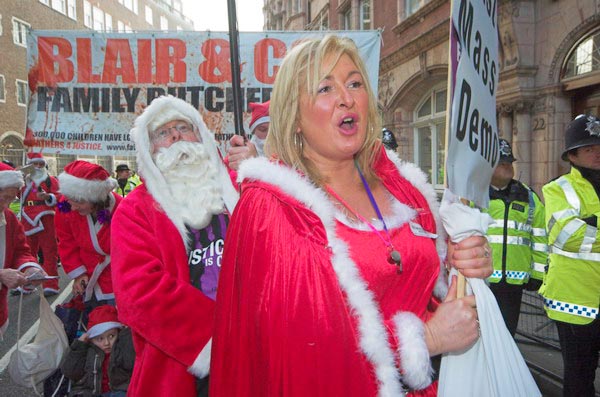
Santas and Mama Santas protest at Church of England and Dept of Education & Skills, Westminster
I’ve photographed Fathers4justice on several previous occasions. Today they were taking advantage of Christmas and the Father Christmas idea to protest against the Church of England. being on a Friday, there were rather fewer Father and Mother Christmases (and Santa’s Little Helpers were mainly at school, though some of their dads behind the whiskers were pulling a sickie.) It was still an arresting sight to see so many figures dressed in red on the street, including some rather inflated figures in inflatable suits.
After rather a slow start events warmed up a bit outside the offices of the Church of England, and, a few yards down the road, the Department for Education and Skills. Of course our ‘serious crimes’ law now forbids the use of amplified sound in demonstrations in Westminster, so the fathers simply had to shout rather loud. The next place for a stop was of course opposite Downing Street, where there were more shouted comments. I left the march as it turned down Whitehall Place on its way to the law courts in the Strand. more pictures
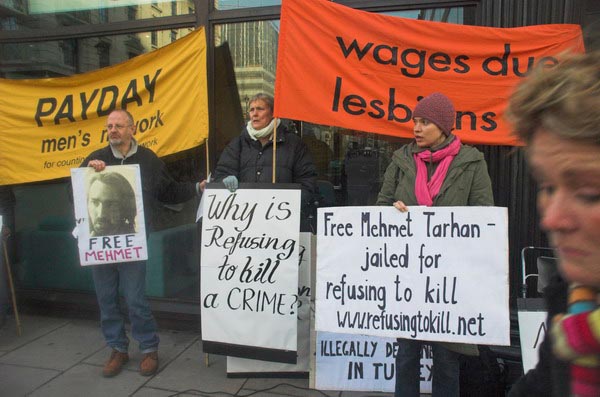
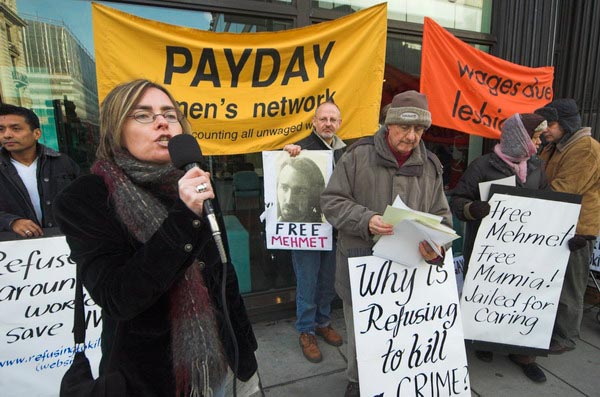
Free Mehmet Tarhan – Turkish Airlines, Pall Mall, Dec 9, 2005
Outside Turkish Airlines at the bottom of Haymarket there was a picket protesting against Turkish imprisonment of protesters, in particular Mehmet Tarhan, a gay conscientious objector.
Recently, his 4-year sentence for refusing military service was overruled on procedural grounds, and he is to be retried for insistent insubordination with the intent of evading military service.
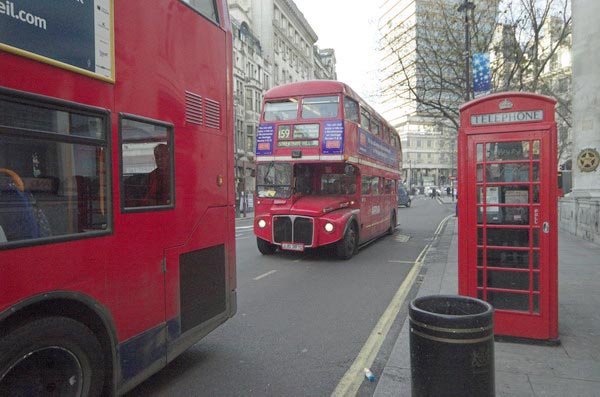
London Transport – Last day for the Routemaster, 9 Dec 2005
One of the last regular service journeys by a London Routemaster bus
The last proper bus service to use London’s signature Routemaster double-decker buses, route 159, ceased today, with its buses being replaced by more modern designs. I caught one of the last to run to take me down to Westminster, then photographed it. Although the official ‘last bus’ had already run, there were several others following on, with the final pair passing Big Ben 28 minutes after I made my picture.
There will still be a few Routemasters running in London on two special short ‘heritage routes’ both running. [The last of these came to an end in 2021 – and there is now a private company running ‘Route A’ at £5 for a day ticket – not covered by your Oyster or Travelcard.]
More pictures of this and other London Transport related images
Victorian Christmas Market – Chrisp St, Poplar, Dec 9, 2005
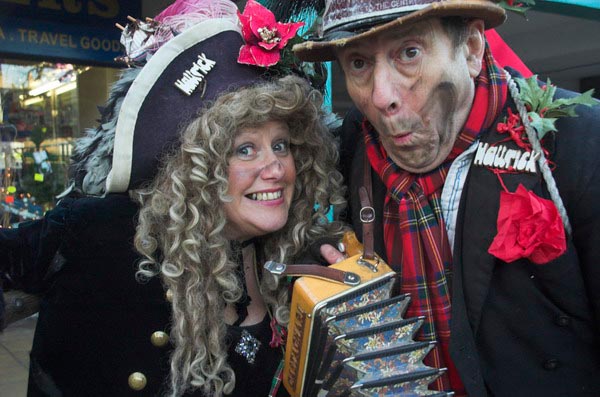
Hat Trick – Jim and Bev James Singing Chimney Sweeps
Chrisp street market was part of an early post-war public housing redevelopment, the Lansbury estate, built for the 1951 Festival of Britain. Fifty or so years later it was beginning to show its age and there has been some tidying up and its pedestrian precincts are now rather tidier than a few years ago.
The market is bustling with life, more so than usual when I visited, as there were two days of a special Victorian Christmas event. There were various special stalls in the market, and also entertainers wandering around and performing on a small stage. There were kids from two local schools who had come to perform but unfortunately I had to leave before they had really started.
I’d hoped to return on the Saturday, when things would have been livelier, but in the end I just couldn’t make it.
The Ethiopian Tragedy – Stop UK Support – Marble Arch, Dec 9, 2005
Ethiopians from across Europe protest against Ethiopian concentration camps and ask for end to UK support.
At Marble Arch there was a crowd gathering of Ethiopians from across Europe, come to protest at the British government’s support of the oppressive communist regime in their country.
More than 70,000 people are detained by the regime, being tortured and dying in concentration camps. Britain is spending £30 million of our money to support the regime that is violating human rights there. The protesters want the British public to urge their MPs to support motions on the situation in Ethiopia and demand an end to these crimes.