Marikana, Bangladesh, Bahrain & Lula – 2018

Marikana, Bangladesh, Bahrain & Lula: Monday August 13th 2018 was a day of protests around London concerned with overseas events, though also about the freedom to protest here. There is a very long history of political movements across the world, particularly from the British Empire protesting here, often when protests were not permitted in their home countries, now mainly carried on by those from them who have settled here.


Justice For Marikana – 6th Anniversary Protest

City of London
Marikana, Bangladesh, Bahrain & Lula - 2018

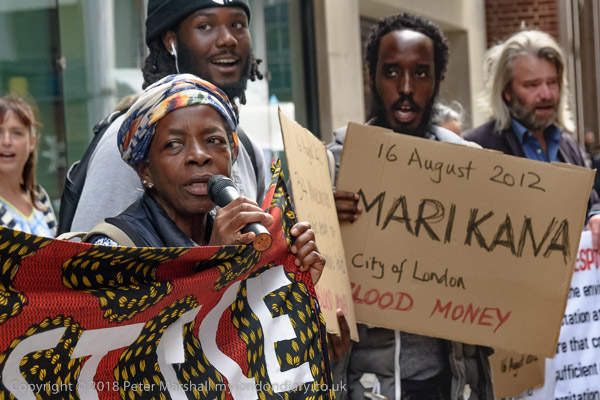
The mining industry in southern Africa was largely developed by British companies and much is still owned and financed by companies based in the City of London, which also provides financial services including insurance.
Marikana, Bangladesh, Bahrain & Lula - 2018

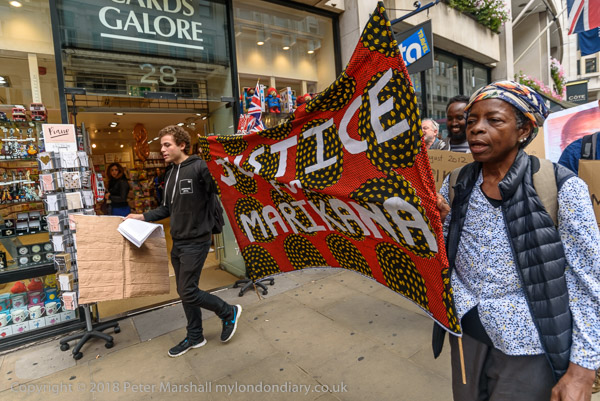
The London and Rhodesian Mining and Land Company Limited was set up in London in 1909, and later became Lonhro and later Lonmin, still listed on the London Stock Exchange on 16th August 2012 when 34 striking miners were shot dead by South African police at its Marikana platinum mine.
Marikana, Bangladesh, Bahrain & Lula - 2018

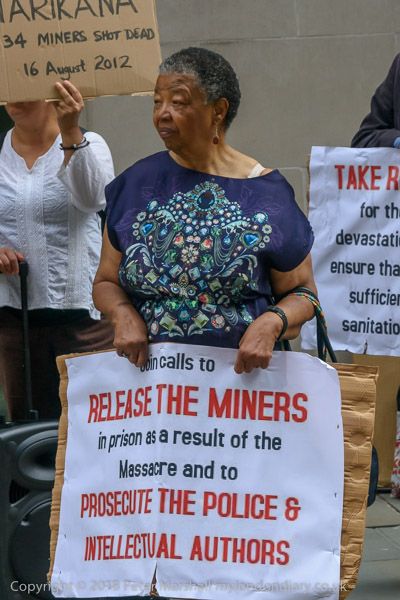
The miners were striking for better wages and living and working conditions and were trying to disperse and hide when they were shot; another 10 had been killed previously since the strike began. Among those who encouraged the police violence against strikers was Lonmin board member Cyril Ramaphosa, a former mining union leader who since 2018 has been president of South Africa.
Marikana, Bangladesh, Bahrain & Lula - 2018
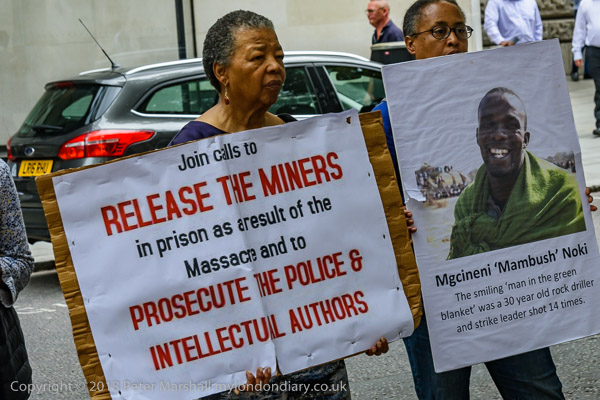
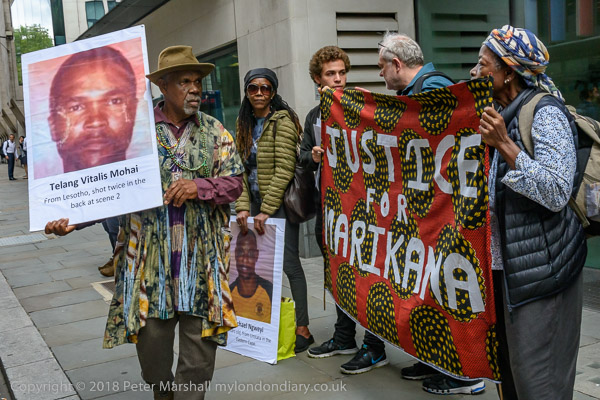
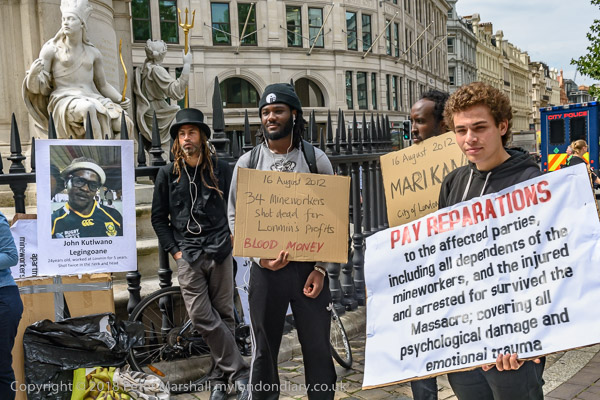
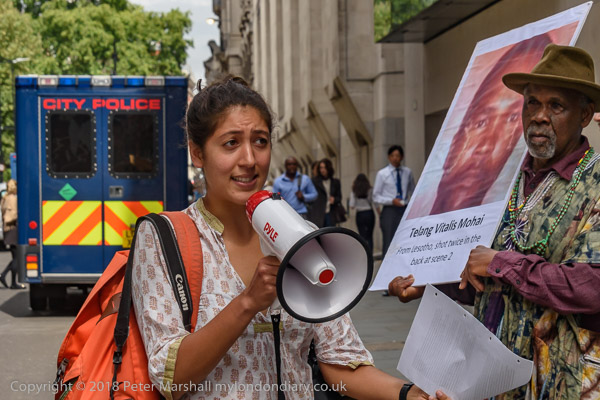
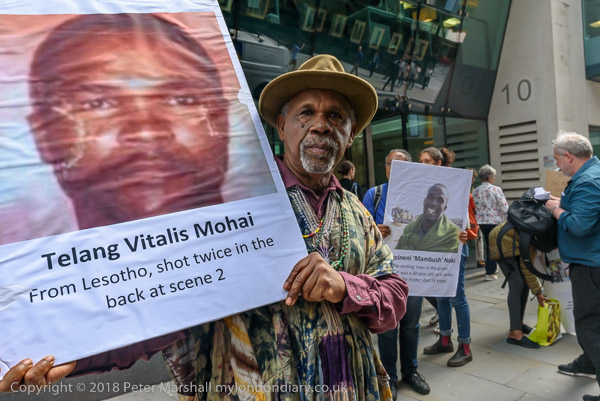
People carried large photographs of some of those who were killed by the police shooting

I photographed a tour of City of London investors, insurers and shareholders who profited from the violence against people and nature in Marikana. It stopped outside each of the offices for speeches giving details of their involvement and about the colonial roots of the huge wealth of the City of London. There were brief protests outside Majedie, Schroders, Investec, Legal & General and BASF, the major customers for Marikana’s platinum.
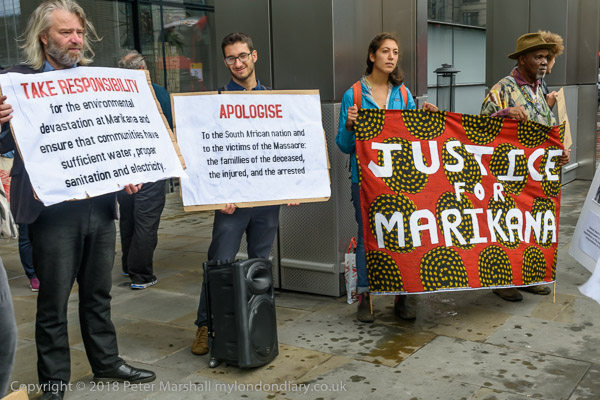
Marikana, Bangladesh, Bahrain & Lula - 2018

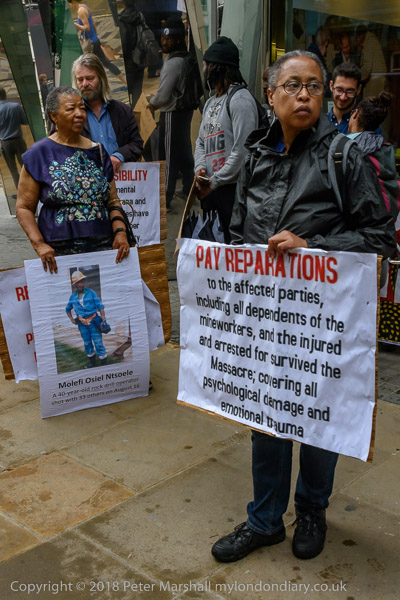
There had been no compensation for the victims’ families or for the injured mineworkers. The protest by the Marikana Solidarity Collective supported the demands of women’s organisation Sikhala Sonke and victims’ representatives that Lonmin must fulfil a social covenant with the community instead, including reparations, releasing the imprisoned mineworkers, prosecuting the physical and intellectual authors of the massacre, and taking responsibility for the environmental destruction in Marikana.
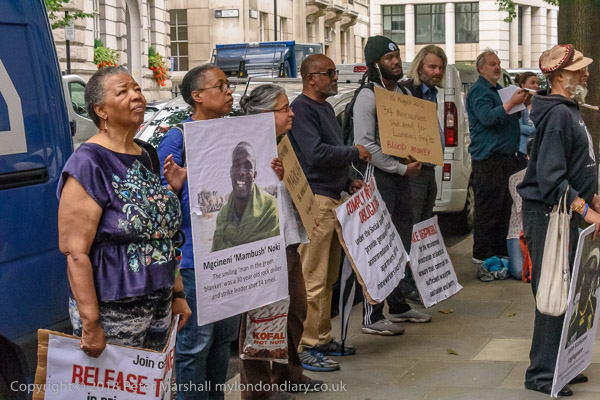
Marikana, Bangladesh, Bahrain & Lula - 2018

The international outcry over the massacre eventually led to Lonmin being acquired in 2019 by multinational mining and metal processing group Sibanye-Stillwater.

More pictures on My London Diary at Justice For Marikana – 6th Anniversary.


Release Bangladeshi opposition leader Khaleda Zia

Downing St
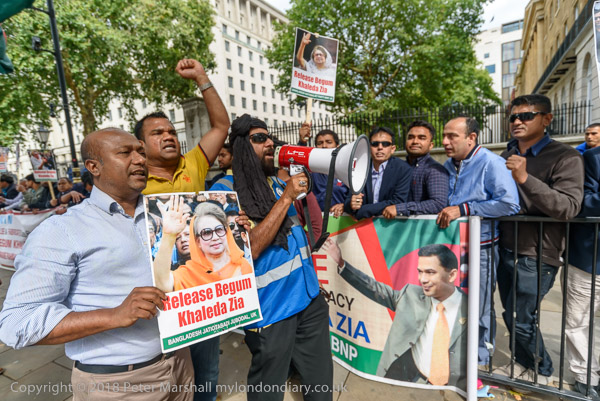
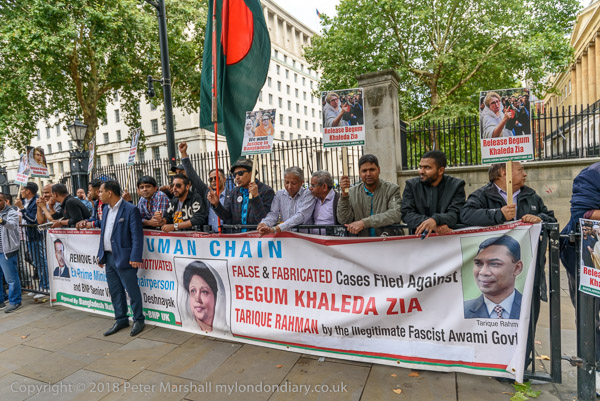
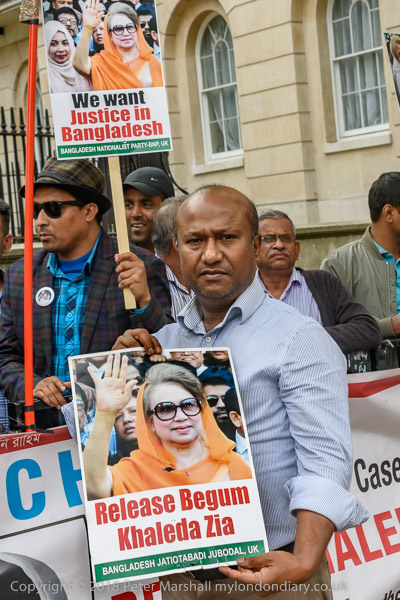
Protesters from the Bangladeshi Nationalist Party UK called for the release of their party leader, Begum Khaleda Zia, jailed in February for five years for embezzlement of international funds donated to Zia Orphanage Trust.
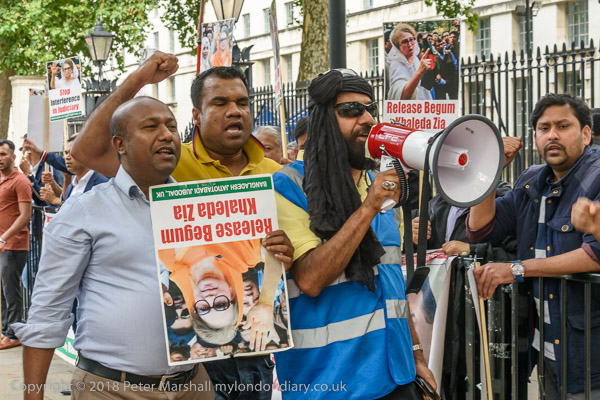
The BNP claim the charges are politically motivated, though there appeared to be many charges and a great deal of evidence against the woman who became Bangladesh’s first female head of government from 1991-6 after the BNP won the country’s first democratic election in 20 years, and served as prime minister later in 2001-6. Her sentence was later increased to 10 years.

In 2020 she was released from prison on medical grounds and was later acquitted on some charges and in 2025 allowed to go to London for medical treatment. She died in Dhaka as the end of December 2025.
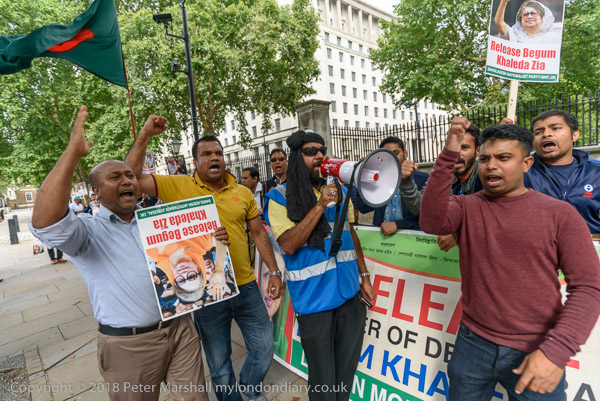
Some Bangladeshi friends tell me there was little to chose between the her and her political rival Sheikh Hasina Wazed and their parties, and that both are corrupt and neither represented the interests of the people of their country.

More pictures at Release Bangladeshi opposition leader.


Against attack on Bahrain Embassy hunger striker

Bahrain Embassy, Belgrave Square
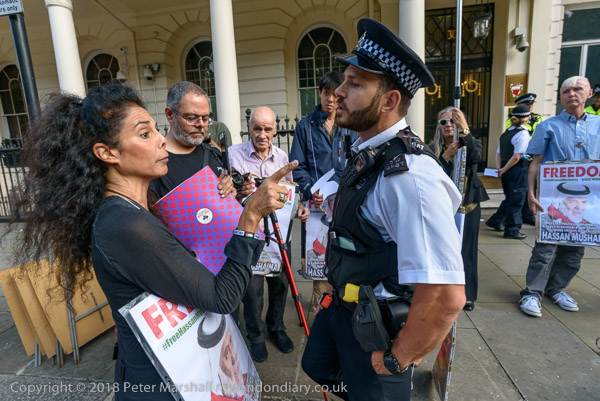
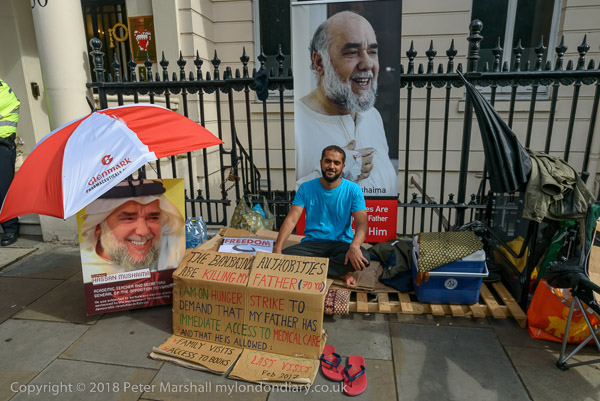
Islamic human rights group Inminds came to protest outside the Bahrain Embassy on Monday after hunger striker Ali Mushaima who was protesting outside there had been attacked early on Sunday morning by staff inside the embassy. A bucket of an unknown liquid was thrown on him from the ambassador’s balcony.
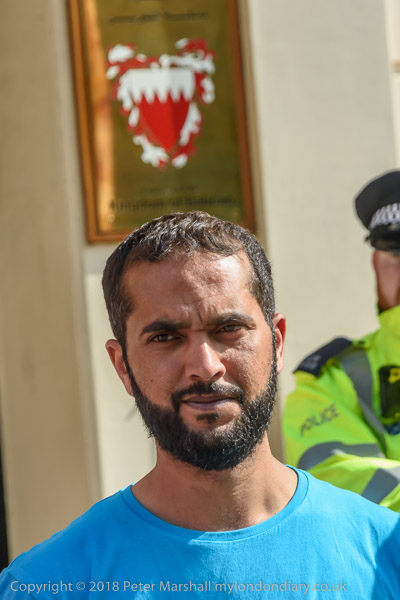
Mushaima’s hunger strike, which had begun on August 1st, was calling for his 70-year old father in prison in Bahrain to be given urgently needed medical care, family visits (stopped 18 months ago), and access to books.
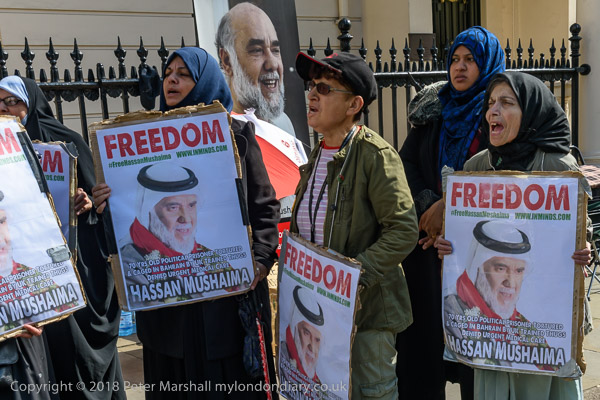
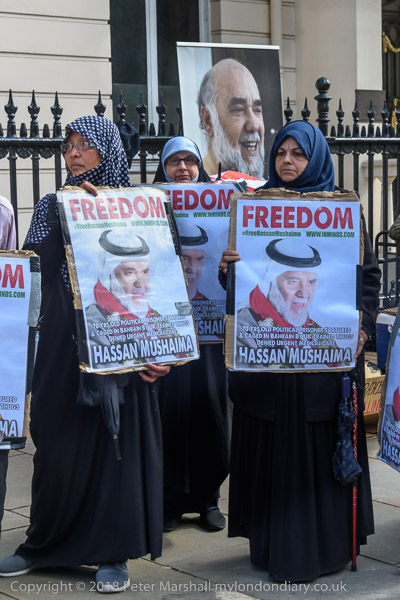
Hassan Mushaima and other human rights defenders and opposition leaders were abducted in March 2017, brutally tortured and given life sentences in mock trials for calling for democracy in Bahrain.
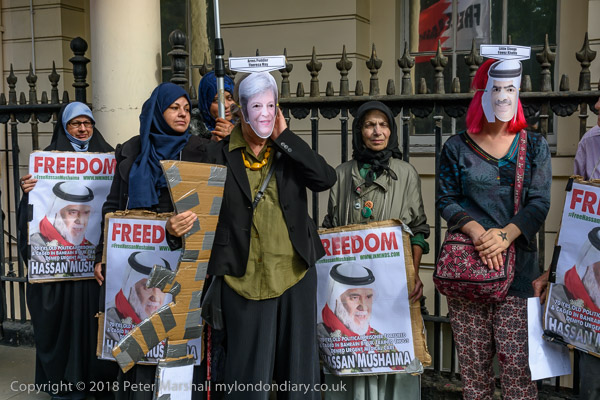
The cast included Theresa May, with the Butcher of Bahrain Hamad Khalifa and Little Stooge Fawaz Khalifa

Inminds called for his release along with that of around 5,000 other Bahraini prisoners of conscience languishing in the Al-Khalifa regimes jails, as well as an end to UK complicity in the Al Khalifa dictatorship and Saudi crimes against the Bahraini people.
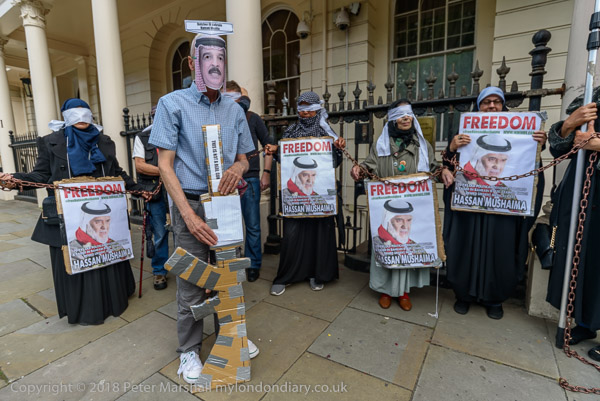
Britain sells arms which are used to shoot Bahraini people

The attack had been reported to police who had failed to investigate it fully, but did come to harass the protesters, telling them they could not protest on the pavement outside the embassy.
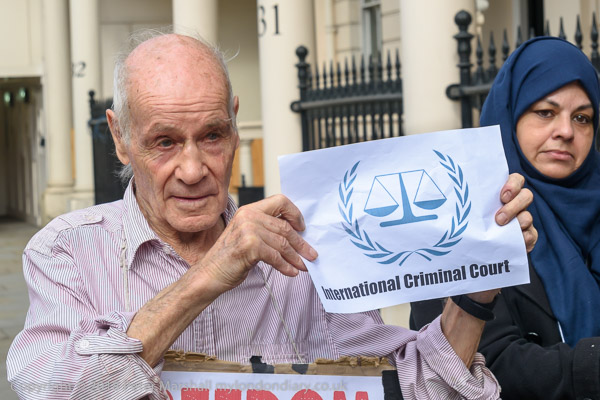
The International Criminal Court arrived and the members of the criminal regime were brought to justice.

Inminds refused to move and continued their protest with some street theatre in which Theresa May sold arms to the Bahraini dictator which he used to shoot protesters, who were then chained up. Unlike in real life the International Criminal Court came to their rescue, released them and condemned the Bahraini regime for their crimes against humanity.

More at Attack on Bahrain Embassy hunger striker.


Free Lula – Brazilians for Democracy & Justice

Brazilian Embassy, Cockspur St
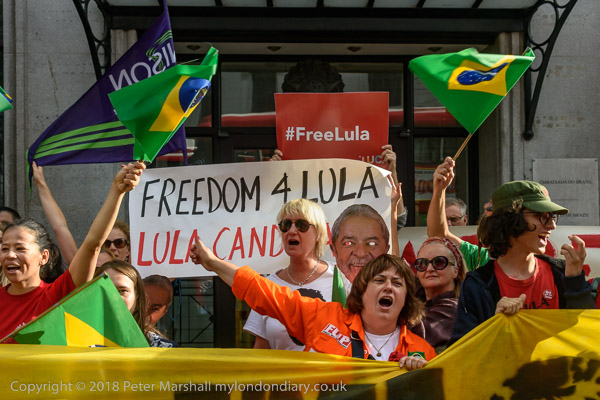
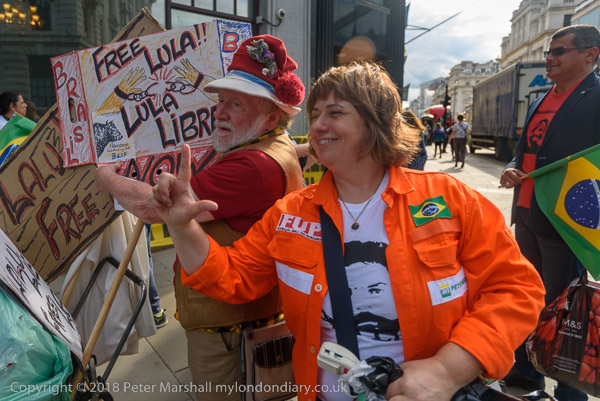
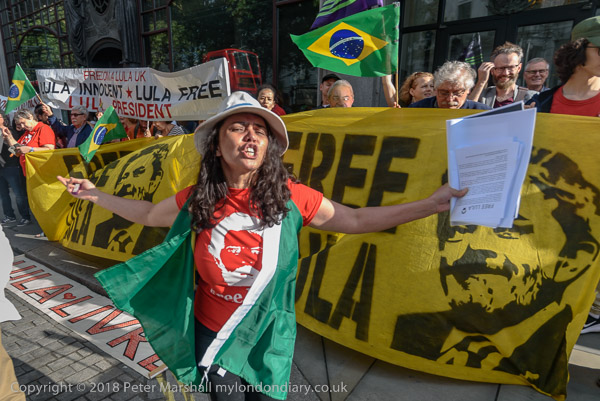
Finally I joined protesters outside the Brazilian Embassy calling for the release of Lula – Luiz Inacio Lula da Silva – a former trade union leader who was President of Brazil for two terms from 2003-11- to enable him to stand for election again in October.
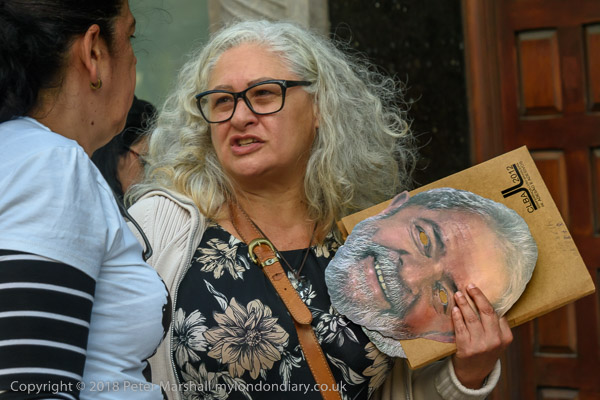
Lula had announced in late 2017 that he would stand in the 2018 presidential election against right-wing incumbent President Jair Bolsonaro and opinion polls showed him clearly in the lead. But in April 2018 he was finally imprisoned on charges of having taken bribes to help an engineering firm gain contracts from the state oil company.
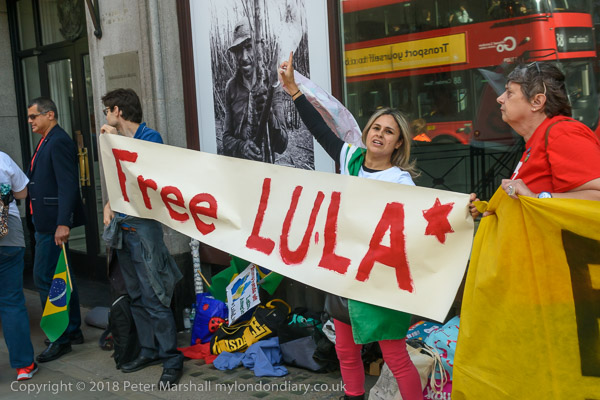
Despite his imprisonment he was kept as the Worker’s Party candidate although being in prison made him ineligible to take part in the election. Brazil ignored the protests and a suggestion from the UN Human Rights Committee that he be allowed to stand and Lula withdrew shortly before the vote in which Bolsonaro won another term.
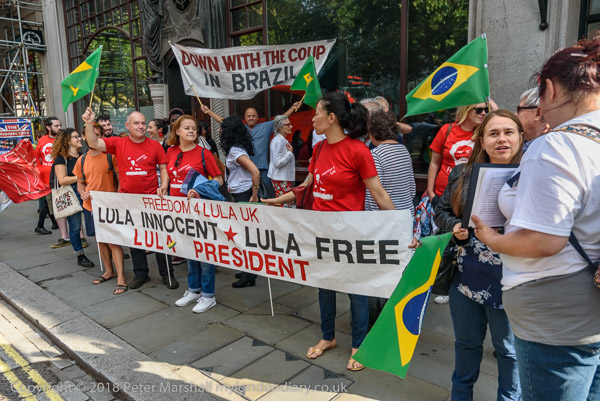
All convictions against Lula were annulled in 2021 and in October 2022 he was elected for a third term as president.

More pictures


FlickrFacebookMy London DiaryHull PhotosLea ValleyParis
London’s Industrial HeritageLondon Photos

All photographs on this page are copyright © Peter Marshall.
Contact me to buy prints or licence to reproduce.
Marikana, Bangladesh, Bahrain & Brazil – 2018

Marikana, Bangladesh, Bahrain & Brazil – 2018. One of the joys of London is its multi-cultural nature with so many people from different countries and nationalities working here and many for various reasons choosing to make a new life in the city, and the four protests I photographed on Monday 13th August 2018 reflected that diversity.

Marikana, Bangladesh, Bahrain & Brazil - 2018

London has long been a cosmopolitan place, and has a long history of welcoming people fleeing from persecution and oppression, certainly from the days of the Huguenots and in the late nineteenth century the Jews fleeing pogroms in Eastern Europe. London has also memorials to a number of the liberators of South America who were given refuge here, as well as European revolutionaries such as Karl Marx and Giuseppe Mazzini.

Marikana, Bangladesh, Bahrain & Brazil - 2018

In the twentieth century things began to change, beginning with the Aliens Act 1905 which was aimed at denying entry to ‘undesirable’ Jewish and Eastern European immigrants. But subjects of the British Empire still had free movement, though restrictions were tightened up against those from South Asia after the First World War.

After the Second World War we needed immigrant workers to run public services but also began to set up tight barriers against immigration from the Commonwealth. In the current century we have clearly racist anti-immigrant policies and now even plans to forcibly deport asylum seekers to Rwanda.

There are now many different national communities living in London, often gathered mainly in particular areas of the city. And from these are many groups still highly concerned about events in their countries including some who have come here as political refugees. Often their concerns are shared with others on the left in the UK who come to protest with them.


Justice For Marikana – 6th Anniversary – City of London

Marikana, Bangladesh, Bahrain & Brazil - 2018

South Africa was once a key part of the British Empire, and its mines in particular contributed greatly to the wealth of London and many mining companies are still based in the city. The earliest demonstrations I attended were against British companies and the UK government who supported Apartheid and these and the boycott continued for many years.

34 Striking miners were shot dead by South African police at Lonmin’s Marikana platinum mine in 2012, and three days before the 6th anniversary of the massacre the Marikana Solidarity Collective organised a tour of the City of London protesting outside the premises of investors, insurers and major shareholders profiting from the violence against people and nature in Marikana.

Lonmin plc was founded in London in 1909 as The London and Rhodesian Mining and Land Company Limited and became a huge company. As well as mines the company diversified its interests and for 12 years from 1981-93 was the owner of the Observer newspaper. Even Prime Minister Edward Heath described the company, then notorious as Lonrho, in 1973 as “an unpleasant and unacceptable face of capitalism” for its busting of sanctions against Rhodesia.

The protesters carried banners and large portraits of some of the murdered miners. They met up at St Paul’s Cathedral and then left to march to the offices of several investors, insurers and shareholders profiting from the violence at Marikana, calling for those responsible to be brought to justice and for reparations to be made to their dependents and to those survivors who were injured and arrested. The tour ended outside the London offices of BASF who are the major customers for the platinum mined at Marikana.

Justice For Marikana – 6th Anniversary


Release Bangladeshi opposition leader Khaleda Zia -Downing St

The Bangladeshi Nationalist Party UK protested opposite Downing St for the release of their party leader, Begum Khaleda Zia, jailed in February for five years for embezzlement of international funds donated to Zia Orphanage Trust.

Khaleda Zia was the First Lady of Bangladesh during the presidency of her husband Ziaur Rahman who founded the Bangladesh Nationalist Party (BNP) in the late 1970s, was Bangladesh’s first female head of government from 1991-6 after the BNP won the country’s first democratic election in 20 years, and served as prime minister later in 2001-6.

The BNP claim the charge against her was politically motivated. Her son has also been sentenced to 10 years in jail but remains in London. Some Bangladeshi friends say there is little to chose between Zia and her rival, Sheikh Hasina Wazed, leader of the Awami League and Prime Minister of Bangladesh since January 2009. They say both are corrupt and neither represents the interests of the people of their country.

Release Bangladeshi opposition leader


Attack on Bahrain Embassy hunger striker – Bahrain Embassy, Belgrave Sq

Inminds Islamic human rights organisation protested outside the Bahrain embassy after an attack in the early hours of the previous morning on hunger striker Ali Mushaima who was on hunger strike there since the start of August to save the life of his father Hassan Mushaima, one of the leaders of the 2011 mass movement that peacefully called for human rights and democratic reforms in Bahrain.

Inminds had protested in support of the Ali Mushima three days earlier, calling for the release of his father and all the other 5000 Bahraini prisoners of conscience languishing in the Al-Khalifa regimes jails and for and end of the dictatorship’s crimes against the Bahraini people.

Police had failed to properly investigate the early morning attack when a bucket of an unknown liquid was thrown over the hunger striker on the pavement below from the Ambassador’s balcony, but came to harass the protesters, trying to prevent them protesting in front of the balcony.

The protesters refused to move and then performed a rather unrehearsed short play in which Theresa May sold arms to the Bahraini dictator which he used to shoot protesters, who were then chained up. Unlike in real life the International Criminal Court came to their rescue, released them and condemned the Bahraini regime for their crimes against humanity.

Attack on Bahrain Embassy hunger striker


Free Lula – Brazilians for Democracy & Justice – Brazilian Embassy, Cockspur St, St. James’s

Brazilians protested outside the Brazilian embassy calling for the release of Lula – Luiz Inacio Lula da Silva – the former trade union leader who was President of Brazil from 2003-11 in order to enable him to stand for election again in October 2018.

The right-wing Brazilian government had brought highly dubious charges against both then President Dilma Rousseff and Lula to impeach Dilma in 2016 for what was not an impeachable offence and to send Lula to prison in an attempt to prevent the Worker’s Party (TP) winning in the forthcoming elections.

Unfortunately he was not able to stand in 2018, and the far-right Bolsonaro became President. But Lula was released pending appeal in November 2019 and in March 2021 the Brazil Supreme Court ruled the judge in his trial was biased and the following month restored his political rights and all his convictions were nullified. He is now the front runner for the 2022 presidential elections.