Visiting Starbucks

I’ve been a coffee drinker most of my life, and there was a time long ago in my late teens when breakfast meant a large mug of black coffee, a cigarette and Miles Davis. And though I gave up smoking when I reached majority (which was 21 back then) I still have the black coffee though now with rather more carbohydrate in muesli and a slice of homemade brown bread. And since my wife and I have rather different musical tastes we listen to the news.

The coffee I drink now is a Fair Trade blend from Traidcraft – they have a range of ground coffees and most are good, though your taste may vary. With a small metal filter that sits on top of a mug its almost as quick as using instant coffee, though I usually have a cup of that (also fairly traded) when I finish writing these posts in the morning.

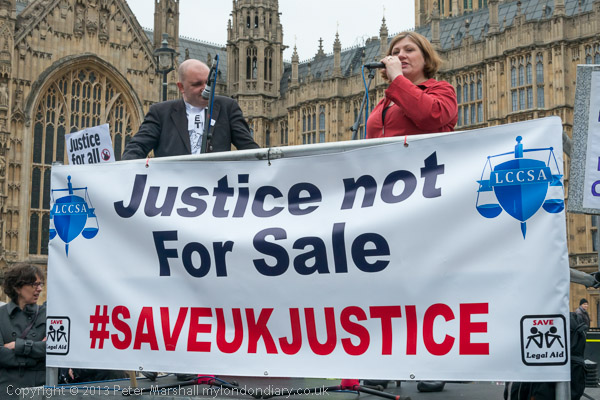
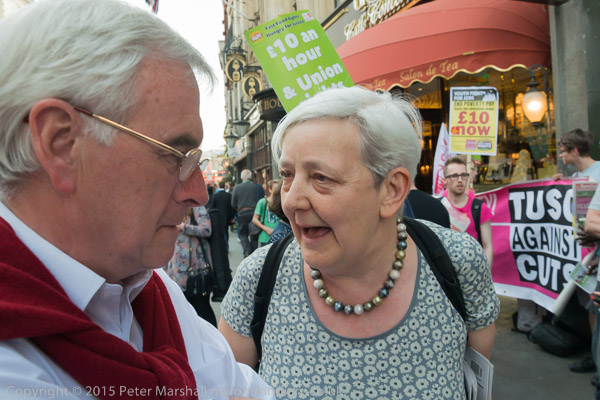
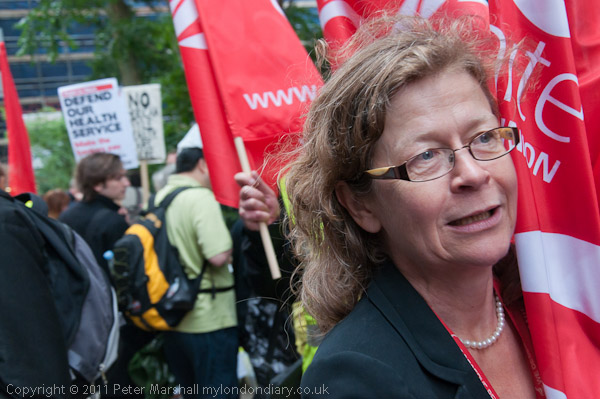
Journalist Polly Toynbee (right) was among the protesters

Back in the last century when I was making long walks around London, often in the suburbs, on the winter days I preferred I always took with me a Thermos of strong black coffee. Back then coffee shops were rare, and if you could find it, coffee bought on the streets unreliable. My top priority back then in choosing a camera bag was whether I could fit the flask in.

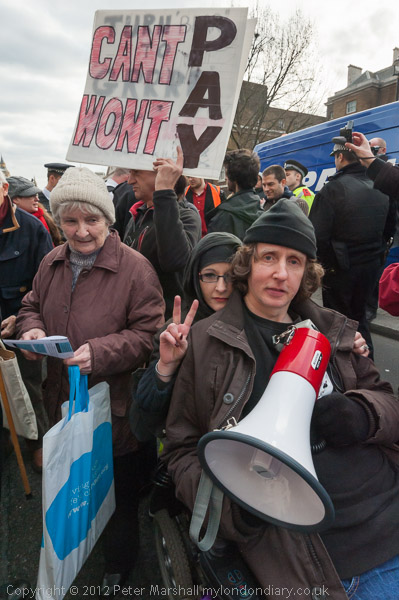
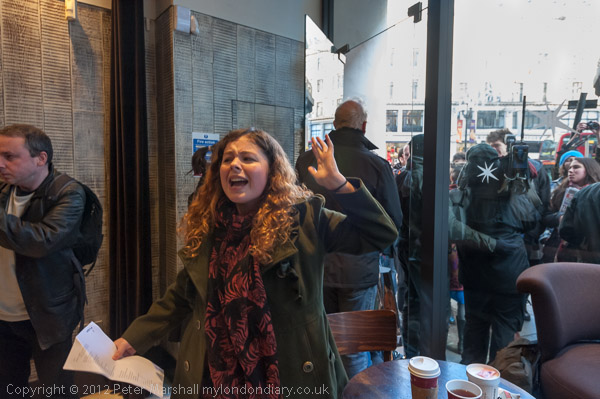
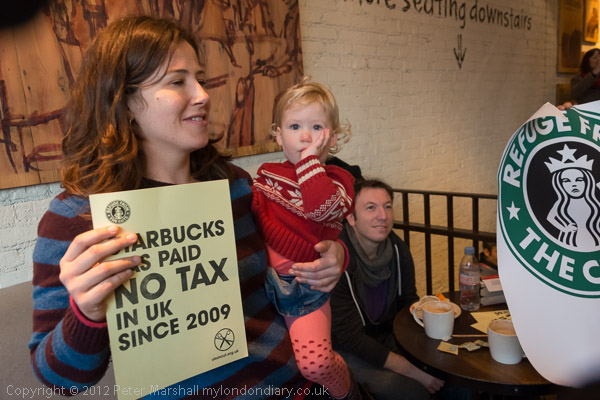
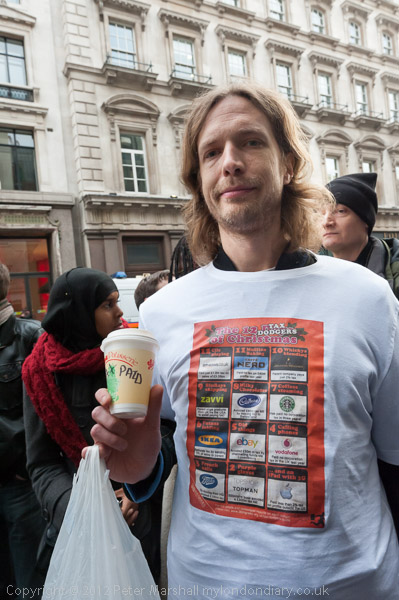
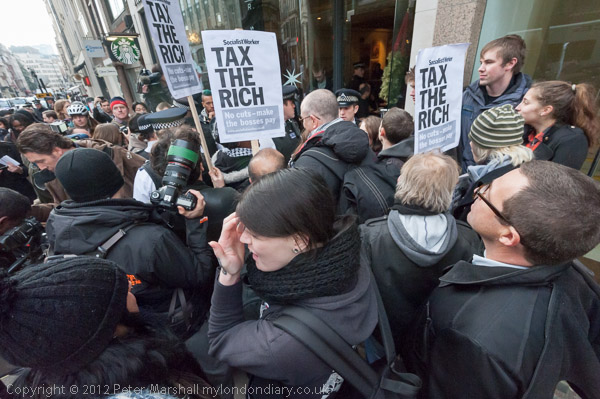
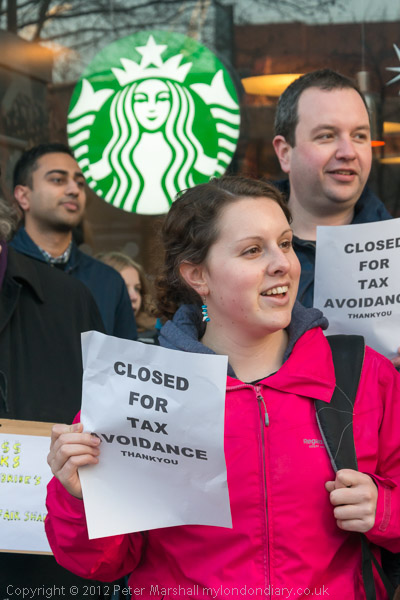
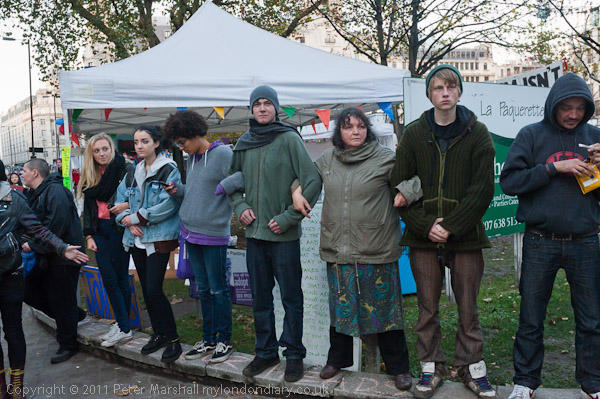
But since then I have occasionally bought a coffee (though it pains me to pay £3 for something I could make better at home for 30p), but have avoided Starbucks – because they don’t pay their taxes. Of course the are not unique in this, but they are one of the best known of tax avoiders, and had then paid no tax in the UK since 2009. So when I joined the longish queue inside the Conduit Street Starbucks on Saturday 8th December it was I think my first time, and I was rather hoping that the protest would begin before I reached the counter.

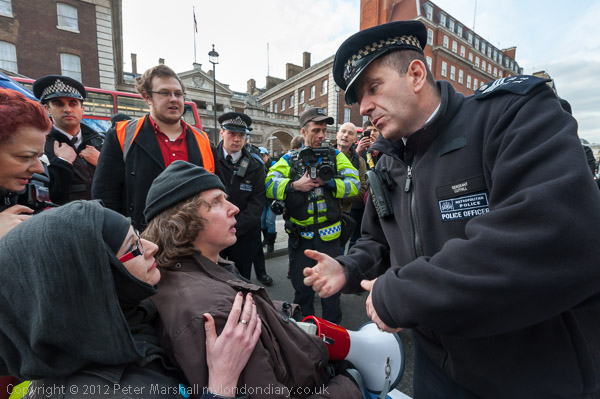
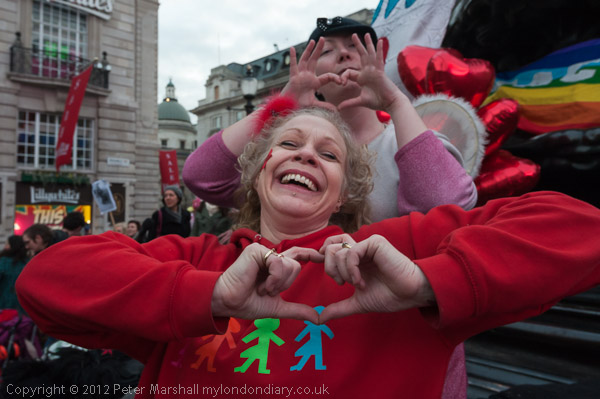
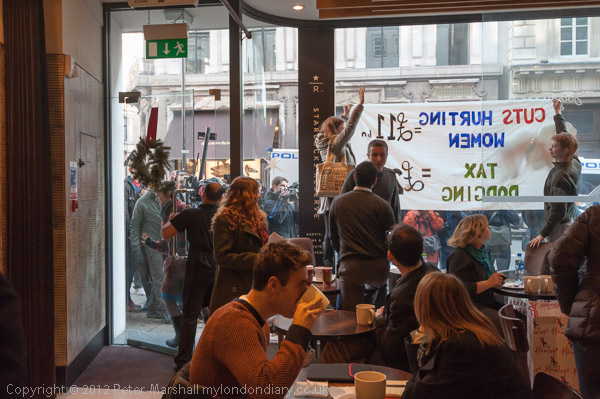
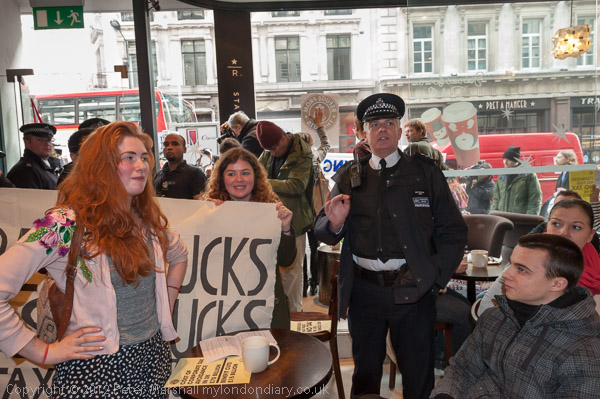
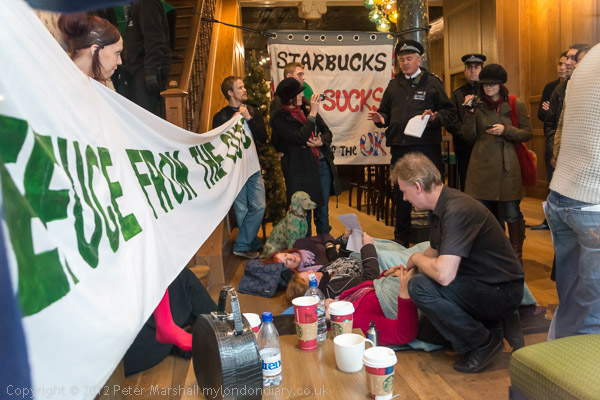
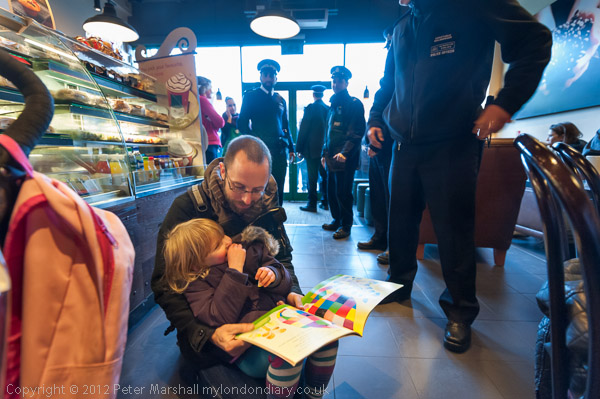
“As noon approached, there were more protesters and photographers standing around inside the store, as well as some seated drinking coffee. Around a minute after noon, one of the protesters got up and started the protest, reading out a lengthy document about Starbucks’ failure to pay tax, and how the amounts that companies including them were avoiding paying were around five times the total of the cuts in services so far made by the coalition government. She announced that they were setting up a crèche inside this branch to compensate for all those and other family services that the government had closed.”

“The protest continued with more speeches and some chanting of slogans calling on Starbucks to pay up. After around 10 minutes a police officer came into the branch and wrongly accused the protesters of behaving in an intimidatory manner towards the staff and customers, which they clearly had not. Nor had they been asked to leave by the store manager. But they were told this was a disorderly protest despite this, and threatened with arrest if they stayed, although at no point did he make clear under what law they might be arrested.”

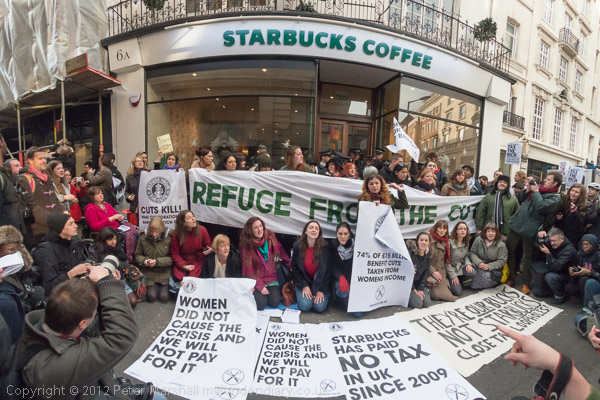
“The protesters allege that Starbucks uses a whole number of tricks to avoid paying tax. One is to use a Starbucks company in a tax haven to lend them the money to fund their UK operations at a rate 4% above the LIBOR rate – the excessive interest costs the UK business but makes fat profits for them in the tax haven. Another is to buy their coffee beans at high prices from a subsidiary in Switzerland, which pays only 5% tax on them rather than the 24% they would pay in corporation tax in the UK. They also pay 6% of their total sales as a ‘royalty’ to their Dutch company – and they have a secret low rate tax deal with the government in the Netherlands.”

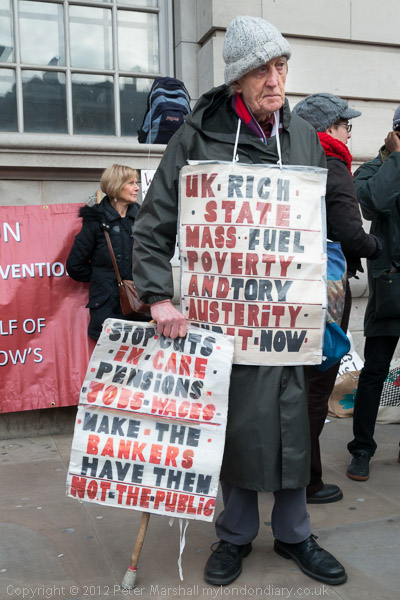
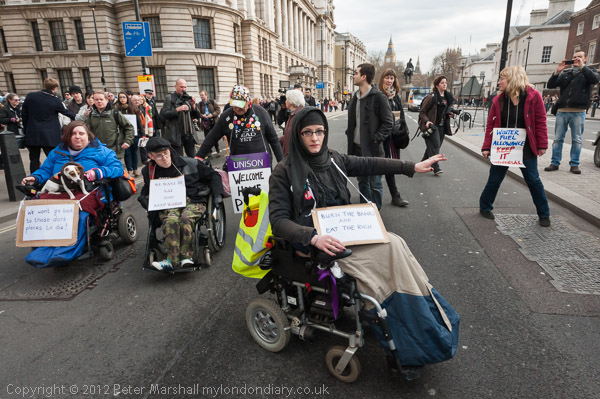
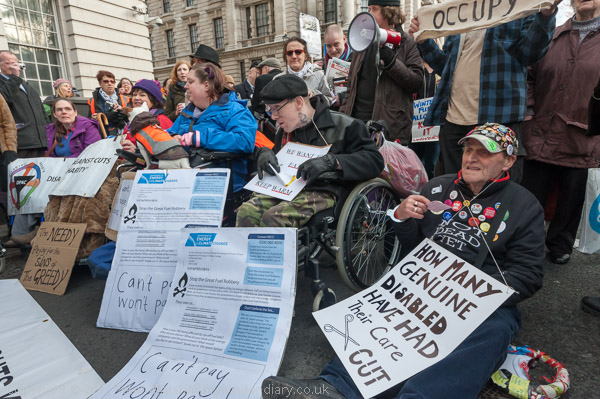
“Several of the speakers talked about the real hardships being faced particularly by women and the disabled in the UK because of the cuts in services. The losses in tax through tricks like those they say are used by Starbucks – Corporate Tax Avoidance – costs the UK £70 billion, which they compare to the benefit cuts of £15 billion.”

I left with the protesters after the police threats, when they continued to protest with a large and noisy crowd who had been unable to get inside, and walked the short distance to Vigo Street, where another protest was taking place inside and outside the Starbucks branch there, and I took more pictures through the large windows and on the street outside.

Later I went to another Starbucks protest at the Euston Road branch, a part of the UK Uncut Day of Action against Starbucks arranged by the Labour Representation Committee (LRC). I found a small group of UK Uncut supporters at the meeting point but there was no sign of the LRC, and after 15 minutes the action began without them as a dozen or so people walked into the branch, took out a poster and began the action. By the time the LRC arrived the doors were locked and they protested outside. A couple of police officers then got out of their van on the opposite side of the road and walked across and were admitted into the coffee shop. There were a few minutes of polite and friendly conversation and the protesters then walked out to join those protesting outside.

The protesters point out that Costa Coffee who have a lower annual turnover than Starbucks in the UK were paying each year “several times per year what Starbucks are offering to cover several years of dubiously legal tax avoidance. Starbucks have avoided paying perhaps ten times what they are now offering.”

Now its time for a coffee.

More on My London Diary:

Starbucks Euston Road – LRC
UK Uncut Visits Starbucks


Sparks and Students – 10 Years Ago

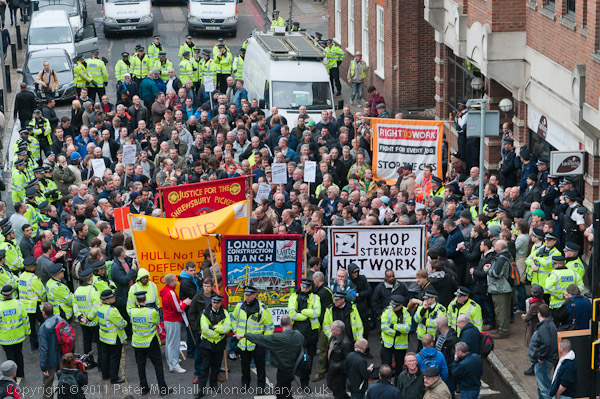
Police surround a grass roots rally before the main Union rally by electricians at the Shard


Ten years ago today on 9th November 2011 my work began at The Shard next to London Bridge, where ‘sparks’ (electricians) were protesting over plans by 7 major employers to tear up national agreements and impose worse conditions and pay cuts of at least 26 %.

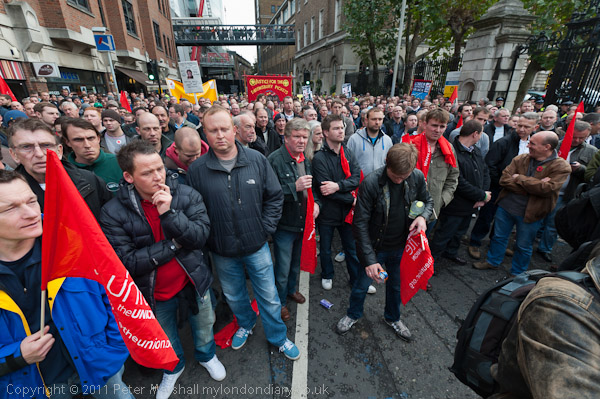
Electricians listen to Unite union speakers

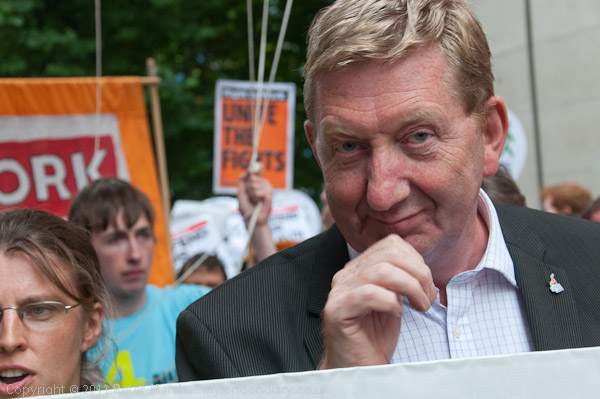
Before the official rally by the Unite union where speakers included several of the union’s leading officials as well as General Secretary of Unite Len McCluskey there was a separate rally with grass roots speakers. Numbers grew as the official rally began and there were over a thousand when it set off to march to another rally at Blackfriars.

I left the march on Borough High St and headed north over the river to join a large march by student protesters against fees increases and cuts in services. Police had shut down most of central London before this started and there were no buses running and I had to walk around two miles to meet the marchers.

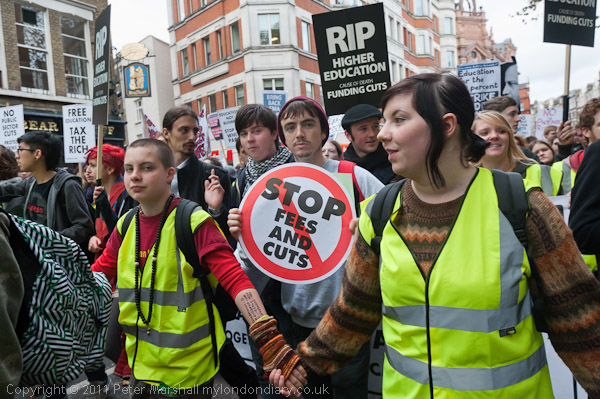
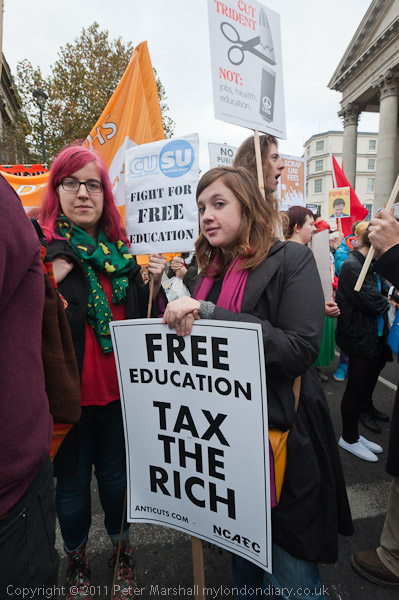
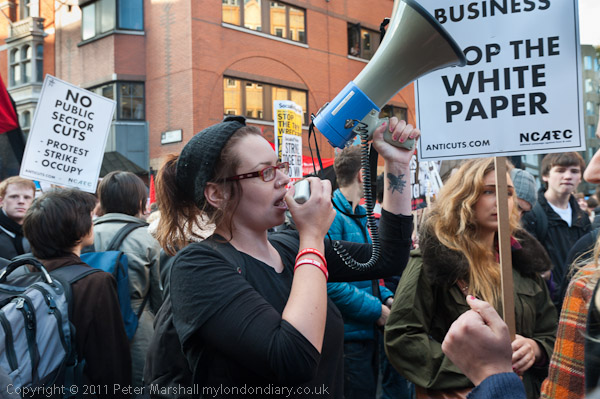
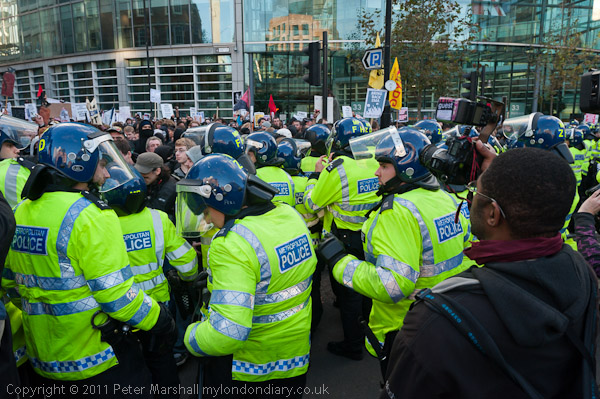
Students were angry about the cuts, particularly about the loss of the Educational Maintenace Allowances but the policing seemed completely excessive. I wrote: “There were perhaps 5000 students, but as the march approached me coming down Shaftesbury Avenue they were largely hidden by the police, with a row of mounted officers leading, followed by several further rows of police in front of the marchers. More police walked along each side of the march, and others stood on the pavement, with lines blocking side roads and others in the doorways of offices, banks and some shops.”

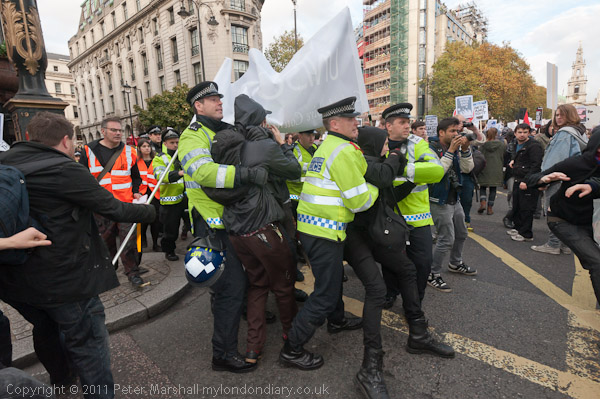
The mood of the marchers seemed to me to be rather cheerful and relaxed, and this was reflected in the humour in many of the posters. Although there were a number of provocative actions by police – including a snatch squad rushing in to grab several marchers – which injured me and some other marchers, as well as various occasions on which they slowed or halted the march, eventually bringing it to a complete stop and ‘kettling’ it in Holborn, which caused it to get a little heated.

Marchers chant “Free the Sparks”

The protesters had been angered to hear that six hundred electricians who had tried to cross the river after their rally in Blackfriars to join the student protest had been stopped at Blackfriars Bridge and London Bridge.

The police seemed to get completely disorganised at this point and I was able to walk past a police line along with several hundred of the protesters while the officers grappled with a few holding them back before more police arrived. After waiting for some time in the hope that others would join them, they continued the march to its intended destination at the Moorgate building of London Metropolitan University where they danced to the sound of a bicycle-hauled sound system while I walked a little further to Finsbury Square where Occupy London had been camping since 21st October.

People in Finsbury Square were worried that the the 4000 police officers in London from the march would turn their attention to trying to evict them. I told them it was unlikely they would make an attempt with so many students on the street. Later I saw videos of students being kettled at Moorgate and individuals being attacked by snatch squads of plain clothes police who had posed as protesters but there was no action against Occupy London.

The huge policing of the two marches was clearly a reaction to the criticism of their failures at Millbank and Tottenham, but it came at a considerable cost, bringing movement in much of central London more or less to a halt for most of the day. Much of the City was still closed as I walked along Old Street with traffic outside the area moving at rather less than walking speed. Policing by consent has to involve letting peaceful protest continue and here was clearly an attempt to prevent it.

Students March Against Cuts & Fees
Sparks At The Shard

Legal Aid & Illegal Confinement

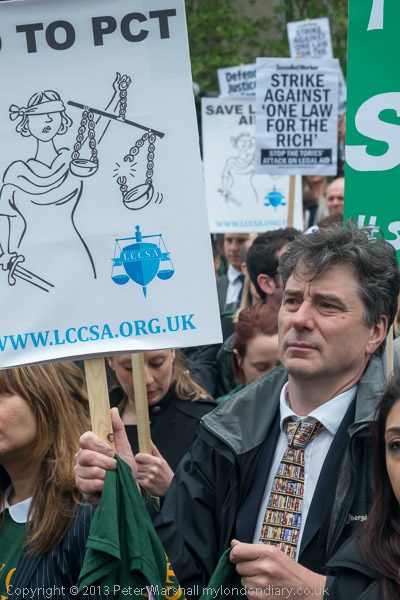
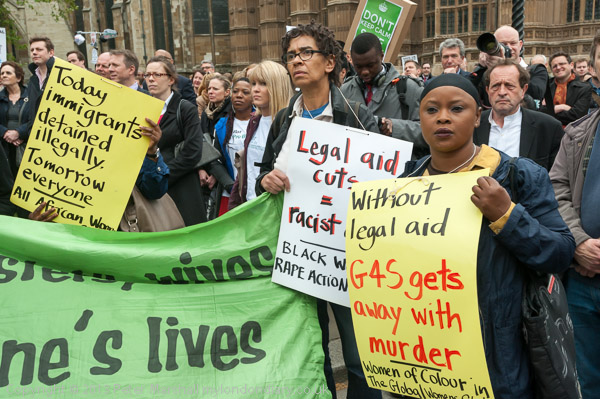
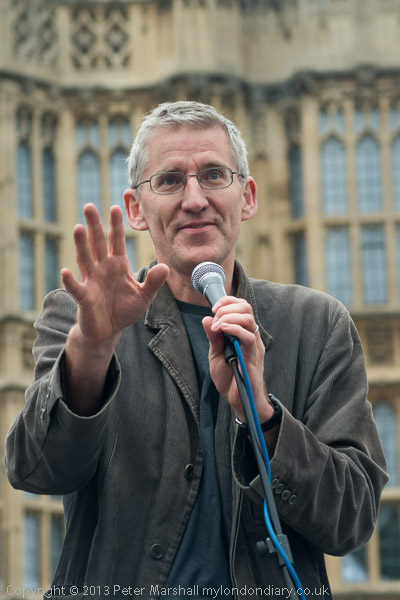
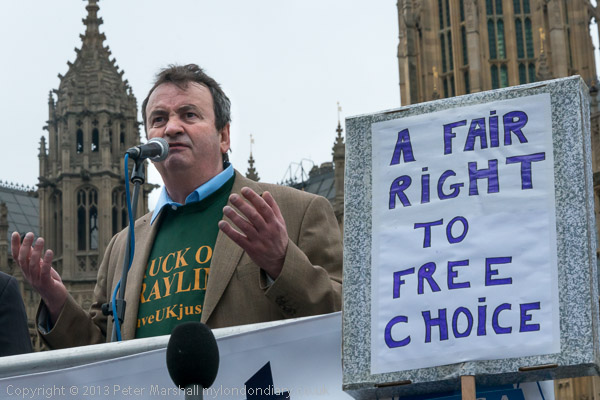
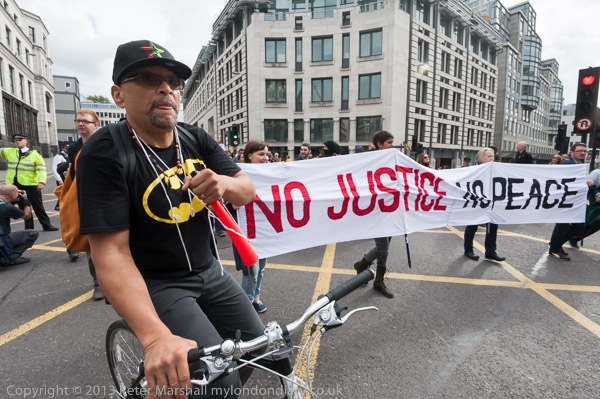
Eight years ago on Saturday October 5th 2013 I turned up outside the Old Bailey to cover a protest against the governments proposals to demolish a vital part of our justice system, Legal Aid. The proposals will mean that justice becomes largely only available to the very rich, with one law for the rich and another for the poor.

Of course our system of law in the UK is one which has as its base the protection of the wealthy and the establishment and in particular the rights of property owners, dating back to the ideas of private ownership of land introudced and used for its appropropriation by our Norman conquerers, but legal aid has provided a small and important gesture towards equality. The rich and powerful can still use the law to protect their interests, with injunctions and threats of libel and other actions. They can still call upon the police to protect their property and rely on our secret services to work for their interests.

Lee Jasper

The protest came after the government had been consulting on the changes to the legal aid system which proposed making it more restrictive and also cutting the fees to solicitors and barristers. Our combative in nature system of law is complex, time-consuming and allows those who can pay large fees to prolong litigation and have a better chance of success, with costs in some cases being in £millions. It’s a system that favours not the establishment of truth, but those who can employ the most persuasive liars.

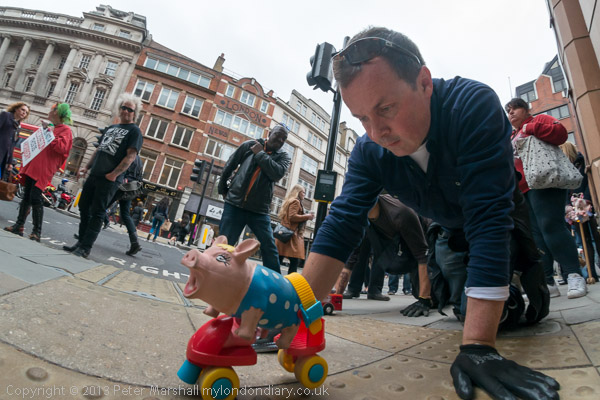
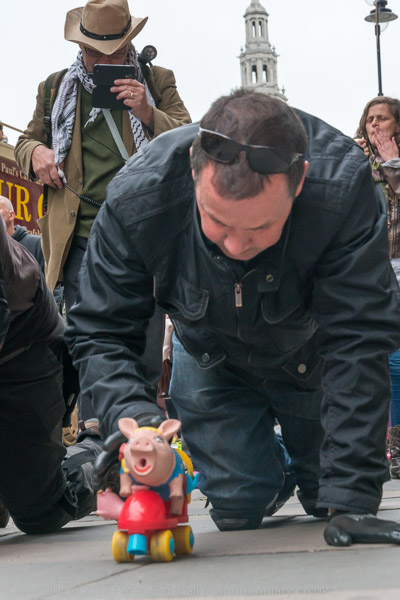
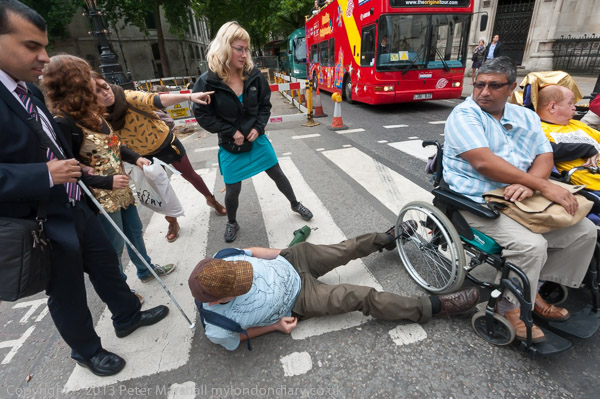
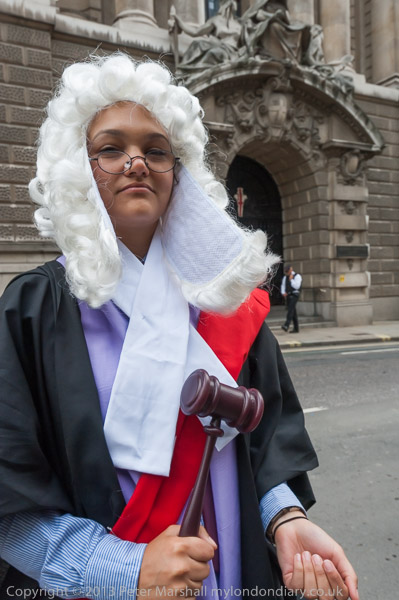
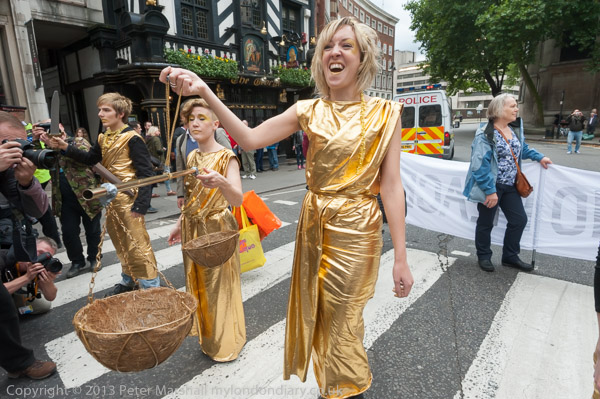
From the Old Bailey the march made its way to the Royal Courts of Justice in the Strand, where I rushed ahead to find DPAC (Disabled Activists Agains Cuts) already making their way onto the pedestrian crossing to block the road. “They stopped on it and began to padlock together to form a block. The far half of the crossing was blocked by a line of figures dressed in gold, one holding the (plastic) Sword of Justice, and another her Scales.”

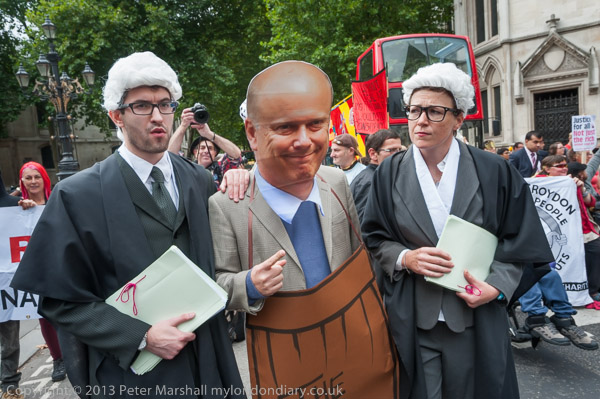
Police came and asked them politely to move but they didn’t respond. The marchers arrived for a noisy protest and then a mock trial of Justice Secretary Chris Grayling. A number of witnesses were called, some giving testimony of how without Legal Aid they would have been unable to fight their cases, and others reading written testimony from others, and then there was more chanting and drumming as well as poetry and some legal advice before the inevitable guilty verdict.

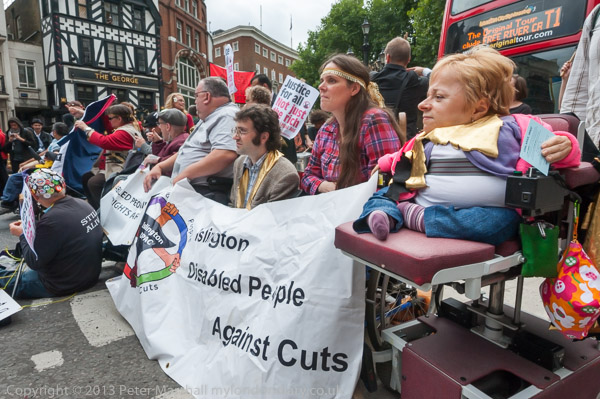
Police had been getting more impatient and insistent about the protesters leaving the road. They don’t like to arrest people in wheelchairs, partly because it looks bad in the photographs and videos, partly because of the difficulty of providing suitable transport, but also because like the rest of us (except possibly Tory ministers) they have a human sympathy with the disabled. “The DPAC activists in wheelchairs who were still blocking the road consulted with each other and decided it was time to leave, and that they would have a final five minutes of protest and then all leave together.”

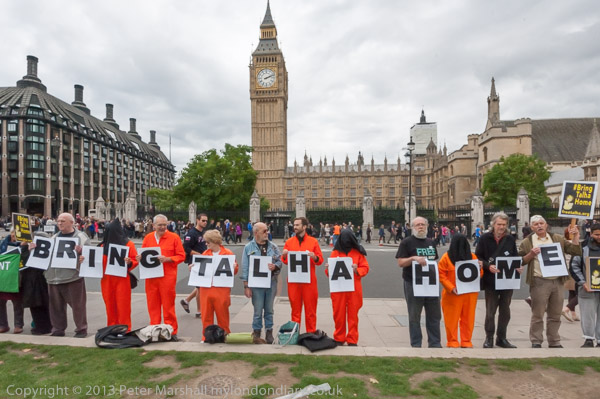
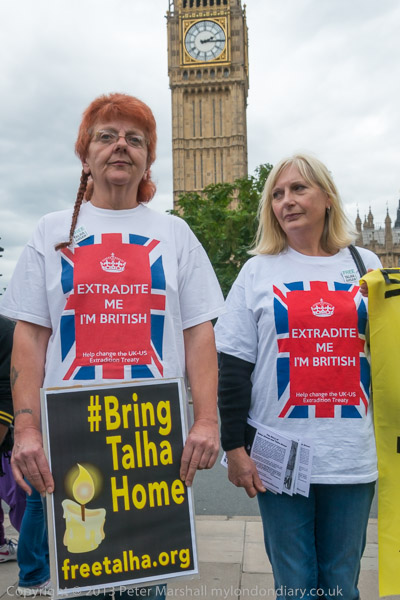
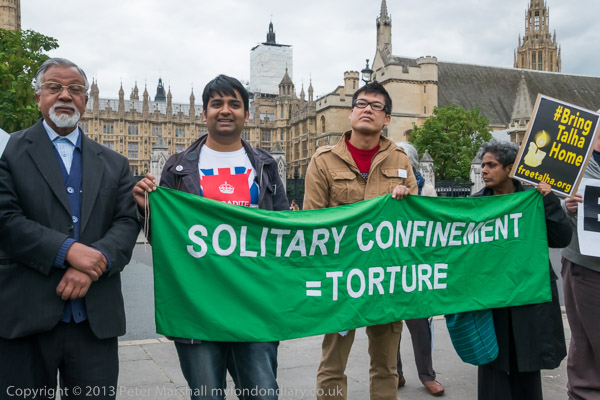
I left for Parliament Square where a peaceful vigil was marking a year since British poet Talha Ahsan was extradited to the US. Those taking part, including his brother Hamsa and other family members said that his long-term solitary confinement comes under the UN definition of torture and call for him to be returned home and unjust US-UK extradition laws repealed.

As I wrote:
“Talha Ahsan, an award-winning British Muslim poet and translator has been detained for over seven years without trial and was extradited to the USA on 5th October 2012 with his co-defendant Babar Ahmad. Although he was diagnosed with Asperger’s syndrome, the Home Secretary Theresa May refused to prevent his extradition, unlike that of Gary McKinnon, raising suspicions that this relected an anti-Muslim predjudice.”

Talha is a UK citizen and his supporters say that he should have been tried in the UK. Eventually in the US he accepted a plea bargain and pleaded guilty to one of the several charges and was sentenced. The time he had already served meant he was then free and was returned to the UK. His six years before extradition in detention without trial or charge here remains among the longest in British legal history.

More at:

Bring Talha Ahsan Home
UK Uncut Road Block for Legal Aid

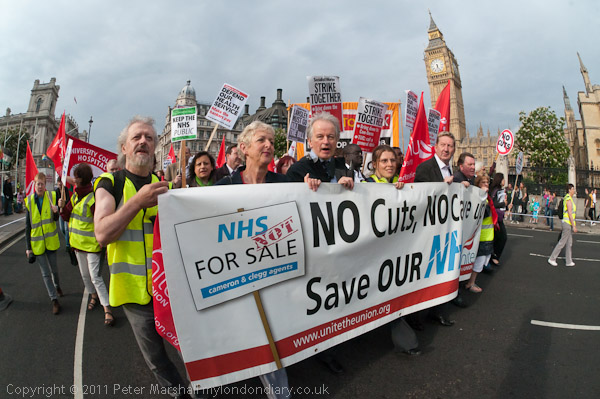
NHS Birthday March – July 5th 2011

The UK’s National Health Service began on 5 July 1948, 73 years ago today. Earlier in 1946 doctors had voted 10:1 against, but compromises were made to bring more of them on side. It had taken the Labour government a fierce battle to get the proposals through parliament, with the Conservative Party under Winston Churchill voting against its formation 21 times when the bill was being passed.

Churchill followed the example of a former chair of the British Medical Association and compared its formation to Nazism, calling it the “first step to turn Britain into a National Socialist economy.”

It was their often unprincipled opposition that lead Aneurin Bevan to make a famous speech two days before the NHS began that included the following:
That is why no amount of cajolery, and no attempts at ethical or social seduction, can eradicate from my heart a deep burning hatred for the Tory Party that inflicted those bitter experiences on me. So far as I am concerned they are lower than vermin.”

In recent years various Tory MPs have claimed that the Conservative Party should be credited for setting up the NHS, when in fact the party fought tooth and nail against it. They also claim that the NHS is ‘safe in their hands’ while increasingly selling off parts of it, largely to US based healthcare companies. Many MPs have financial interests in healthcare and their votes reflect this, in what seems a clear conflict of interest.

One of the compromises needed to get the bill through was that GP surgeries would remain private businesses that could be bought and sold. Doctors in general practice were to remain independent, with the NHS giving them contracts to provide healthcare. What is now happening is that GP surgeries are increasingly becoming owned by large healthcare companies who organise how they are run and employ doctors.

At the moment we still get to see the doctor for free, though it has become more and more difficult for many to do so, in part because of the systems set up by these healthcare companies. But we have now and then heard proposals for charges to be introduced. We do currently have to pay to see a dentist, and even with these charges it has become difficult for many to get dental treatment under the NHS. Many cannot afford the higher charges for private treatment and even the lower rates under the NHS are a huge problem for those on low pay who are not entitled to exemptions.

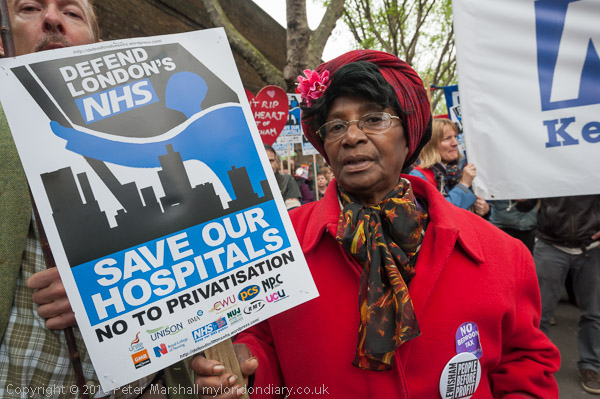
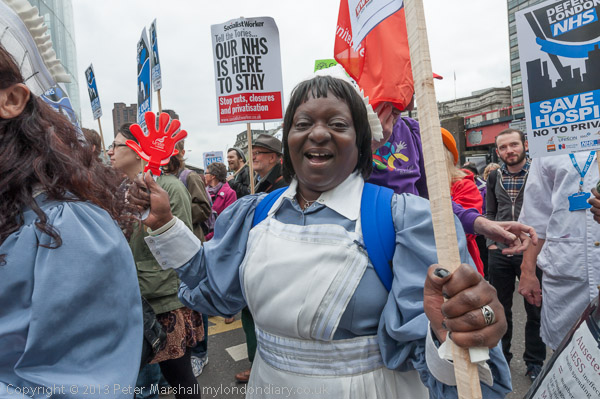
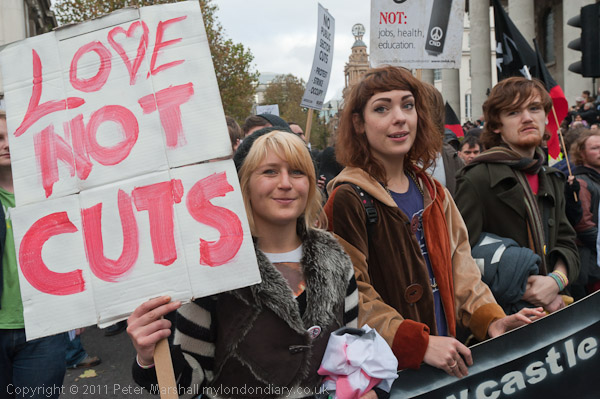
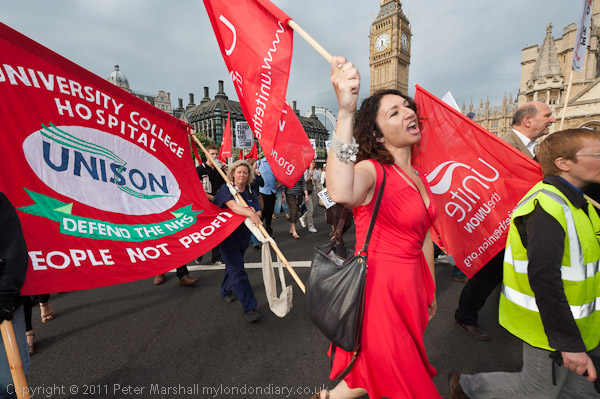
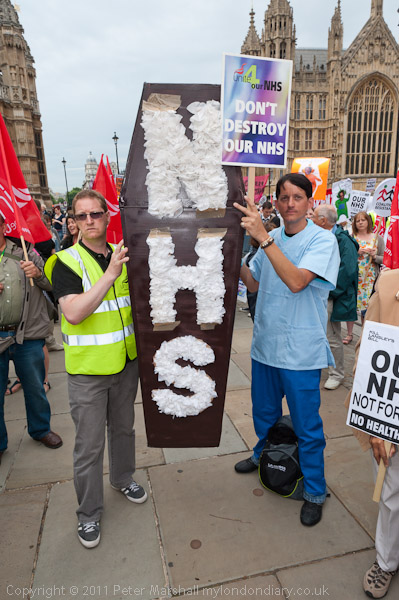
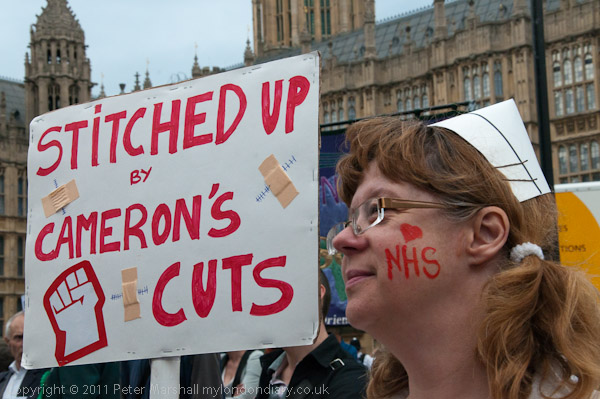
This year there were protests around the country last Saturday, a few days before the NHS’s 73rd anniversary. Ten years ago around a thousand people marched through central London on the actual 63rd anniversary of the foundation of the NHS in a protest to defend the NHS against cuts and privatisation, ending with a rally outside the Houses of Parliament. The changes then being debated under Andrew Lansley’s bill made radical changes which brought in private companies to take over the straightforward and highly profitable areas of NHS services. Now a new bill is under consideration which will make for further back door privatisation of the NHS.

More at NHS 63rd Birthday.


All photographs on this and my other sites, unless otherwise stated, are taken by and copyright of Peter Marshall, and are available for reproduction or can be bought as prints.


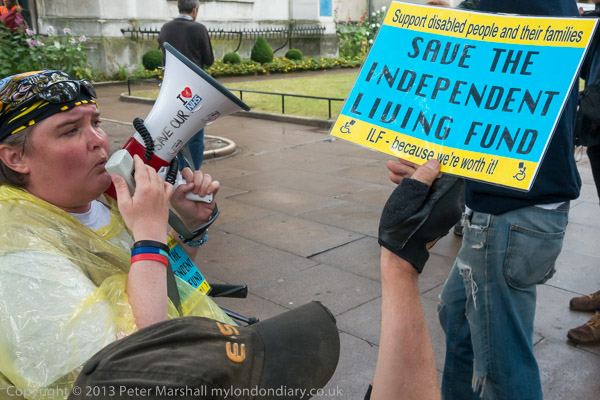
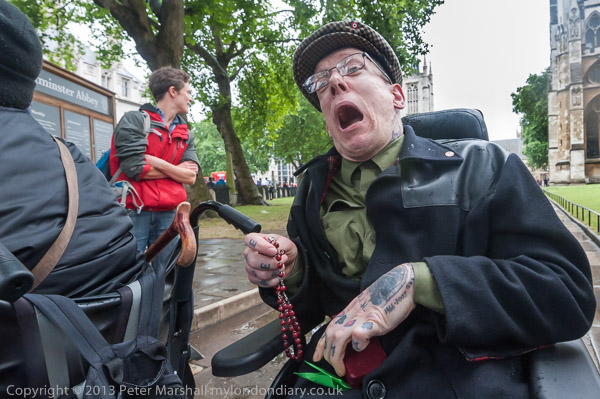
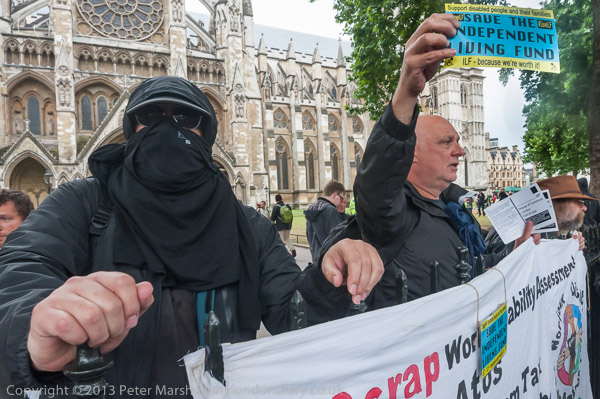
Occupy Westminster Abbey – save the ILF

Broad Sanctuary, Westminster Abbey. 28th June 2014

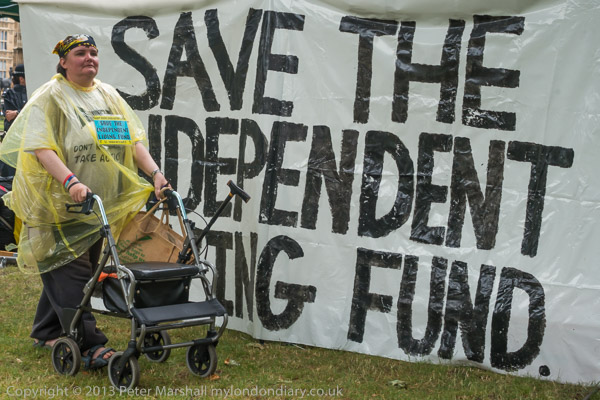
The Independent Living Fund, ILF, was introduced in 1988 to provide financial support to disabled people with high support needs, including those with severe learning difficulties, cerebral palsy, and a variety of other conditions.

Around 18,000 people relied on the ILF, mainly using the average of £300 a week it provided to employ personal assistants or carers to enable them to live independently, enabling some to work and pursue careers. It was administered independently from the Department for Work and Pensions (DWP) who provided the funding.

The ILF scheme was closed to new applicants in 2010 and the responsibility for providing support in England was passed to local authorities with the ILF ending on 30th June 2015.

There were various problems with the ILF, with regional variations, but the primary reason behind the changes was probably to cut costs. Although the government promised to provide funding to the local authorities for a transitional period, this was around 13% less than under the ILF, and the money, given to cash-strapped authorities already subject to swingeing cuts was not ring-fenced, and so likely to be appropriated for other purposes.

Local authorities were also not given any clear instructions or advice on how to proceed and there were great variations between local authorities in the support that was provided. A survey a year after the end of the scheme showed extreme differences, with some authorities providing similar levels of support to the ILF, but others operating at much reduced levels, creating the real hardship that protests such as this on Saturday 28th June 2014 campaigned against. The loss of ILF was indeed a disaster for many disabled people.

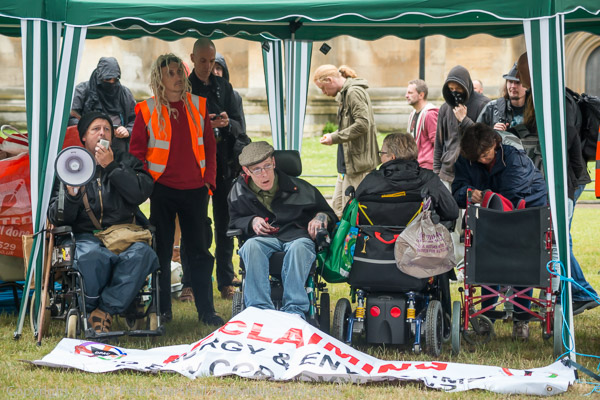
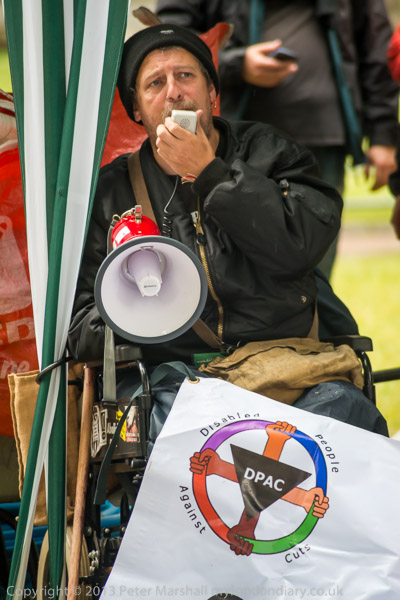
DPAC and others involved in the protest had managed to keep the details hidden from the police, perhaps because it is more difficult for able-bodied police working as undercover officers to infiltrate disabled groups. UK Uncut has provided a diversion with a protest outside Boots on Victoria St when DPAC and Occupy London supporters moved on to the green area in front of Westminster Abbey.

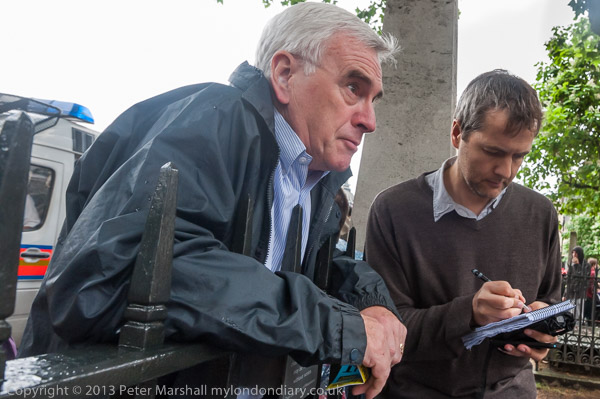
The protesters had hoped for some support from Westminster Abbey authorities as many Christians had called the government’s actions immoral. But they had picked the wrong place, and the Dean of Westminster refused even to talk to the protesters, calling on the police to get rid of them. Labour MP John McDonnell tried without success to phone the Dean who refused to take his call or to phone back.

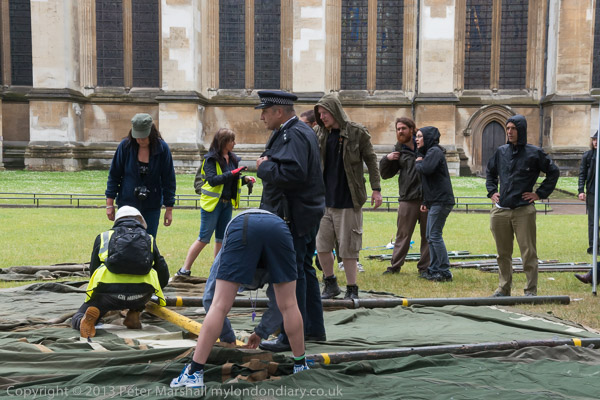
The weather too was against the protesters, with rain falling steadily, and for once a police officer showed some quick thinking, moving to stand in the middle of the main tent the protesters were attempting to erect, without which there was simply not enough shelter for a lengthy occupation.

I was unsure whether I wanted to go inside the area or not when I arrived, and soon police were surrounding the fairly low wall stopping people from climbing over. But I was able to take pictures from outside and move around freely – and to go home when I decided there seemed to be little point in staying.

Occupy Westminster Abbey – save the ILF
UK Uncut ‘Boot Out Boots’

Six years ago: 30 May 2015

May 30th, 2015 was one of those days where I travelled around London stopping off for various reasons en-route. As always on such occasions I give thanks to the GLC for their efforts which resulted in the London-wide travel card before they were sadly eliminated by Mrs Thatcher, leaving the city largely rudderless for a crucial 15 years when it fell behind other cities in the world – except of course for the financial City of London which further cemented its reputation as the corruption capital of the world.

London is very much a world city, and my first event, outside the Daily Mail offices in Kensington reflected this, with protest by Filipino health workers over their coverage of the case of Victorino Chua, a nurse found guilty of murdering two patients and injuring others. The newspaper used the case to insult Filipino NHS workers who have for years formed a vital part of the NHS. When I came round in intensive care in 2003 it was to see a Filipino nurse who greatly impressed me with his care and attentiveness over the next few days.

It had taken around an hour for me to get to Kensington, and the journey across London to Peckham Rye was around another 50 minutes. I was there not for a protest but for the proposed Peckham Coal Line, an elevated linear urban park whose proponents compared in extremely misleading publicity to New York’s ‘High Line’ walk. And while the public were invited to walk the Coal Line, we were largely unable to do so as it is still an active part of the railway network – and one I took a train along after following around its length and back on existing local roads and paths.

Despite that it was an interesting walk, including a visit to the roof of the multi-storey car park and the Derek Jarman memorial garden. Part of the proposed walk is already open to the public as a small nature reserve, cleared beside the railway line for a massive inner-ring road – part of the proposed London Ringways motorway scheme which was fortunately abandoned after the terrible impact of building its earliest sections including the A40(M) Westway in Notting Hill became clear.

A train from Peckham Rye station took me along the route of the Coal Line to Queen’s Road Peckham and then on to London Bridge, and the Underground to Waterloo where I met with UK Uncut who were to go to an undisclosed location for some direct action. This turned out to be Westminster Bridge, where the protesters blocked the road.

The then unrolled a large yellow banner and began to fill in the slogan that had been marked out on it with black paint. After some parading around on the bridge with it, they then lowered it over the upstream side of the bridge and lit a couple of smoke flares. I’d run down across the bridge and a little along the embankment in front of St Thomas’s Hospital to take pictures of the banner drop.

The banner drop was really on the wrong side of the bridge for photographs and it seemed something of an anti-climax. It was hard to read the banner and its message ‘£12 bn more cuts £120 bn tax dodged – Austerity is a lie’ ” was perhaps a little understated. I think may of those present had expected something rather more direct, both in message and action. I went on with many of them to join another protest in Parliament Square which was just coming to an end, against government plans to get rid of the Human Rights Act.

It was then a short walk to Trafalgar Square, where on the anniversary of the 1967 declaration of Biafran independence, Biafrans were calling on the UK government for support in getting back the country which they claim was taken away from them by the Berlin Conference in 1884 and incorporated into Southern Nigeria. They say Biafra was successor of the Kingdom of Nri of the Igbo people, which lasted from the 10th century to 1911 and was one of Africa’s great civilisations before the European colonisation. As well as backing the call for independence the protest also remembered those who died in the Nigerian-Biafran War.

In the main body of the square, striking National Gallery staff and supporters were holding a rally after PCS rep Candy Udwin was sacked for her trade union activities against the plans to privatise gallery staff.

At the end of the rally, people moved towards the Sainsbury Wing, where security is already run by a private company and exhibitions guarded by outsourced staff. Police blocked the doors to stop them entering, and they sat down to hold a further rally blocking the gallery.

Mass rally Supports National Gallery strikers
Biafrans demand independence
UK Uncut Art Protest
Walking the Coal Line
Filipino Nurses tell Daily Mail apologise

State Opening, Class War and Student Protests

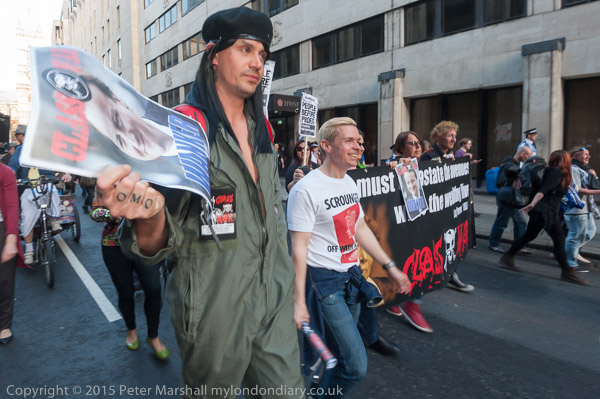
I usually make a point of keeping away from the big occasions such as the State Opening of Parliament, but made an exception on Wednesday May 27th 2015, partly because I had been told that Class War were planning to come and protest, but mainly as there were other events I was intending to photograph later in the day.

Class War arrived too late to reach the centre of Parliament Square where they had hoped to display their banner and the area was already tightly sealed off by police. Police security for royal events is always very tight and as on this occasion often goes well beyond what is legal. So although they managed to briefly display their banner well before the Queen’s coach arrived they were quickly forced to take it down and pushed away. Around 50 police then followed the dozen or so as they made their way to a nearby pub and a few more supporters, and stood around for an hour or so looking as if arrests were imminent before most of them moved off, but police continued to follow the group until they left Westminster. Two other people who had been showing posters against austerity in Parliament Square were arrested despite their actions being perfectly within the law; they were released without charge a couple of hours late.

I walked from the pub up to Downing St, where a line of people from Compassion in Care where holding up posters and calling for ‘Edna’s Law’ which would make it a criminal offence to fail to act on the genuine concerns of a whistle-blower, and would make the state protect whistleblowers rather than them having to spend thousands of pounds on taking their cases for unfair dismissals to industrial tribunals. They say current law, the Public Interest Disclosure Act 1998 which has failed to protect the public, the victims or the whistle-blowers. So far nothing has changed.

As I arrived in Trafalgar Square where people were gathering for a protest against education fees and cuts there was an angry scene when a squad of police surrounded and arrested a man, refusing to talk with any of those in the crowd around about their actions. Had they explained at the time that the man being arrested had been identified as someone who was wanted for an earlier unspecified offence and was being taken in for questioning, it would have defused the incident, but this was only revealed after the man – and one of the protesters who had questioned the police about their action – had been put into a police van a short distance away and driven off.

Back in Trafalgar Square there was music as we were waiting for the National Campaign Against Fees and Cuts protest to begin, provided by ‘Disco Boy’ Lee Marshall from Kent who had brought a mobile rig to Trafalgar Square. Apparently as well as running local discos he has a huge social media following.

Finally the NCAFC protest got under way, with a good crowd of mainly students in Trafalgar Square and speakers on the plinth of Nelson’s Column.

Class War came along (still followed by police) and there were cheers as they displayed their several banners; also taking the stage and marching with the students were the Hashem Shabani group of Ahwazi Arabs, who later held their own protest.

After the speeches in Trafalgar Square the NCAFC protesters set off to march to Parliament. Police tried to stop them with a line of officers and barriers at Downing St, but there were too few officers and many of the protesters walked around them and the barriers. Police apparently randomly picked on a few of the demonstrators and tackled them with unnecessary force making several arrests. The protesters continued marching around Westminster for some hours, but I left them at Parliament Square.

I finished my day’s work in Parliament Square with the Ahwazi Arabs who protested there against the continuing Iranian attacks on their heritage and identity since their homeland, which includes most of Iran’s oil was occupied by Iran in 1925. The occupation was important in protecting the interests of the Anglo-Persian Oil Company, effectively nationalised by the UK government in 1914 (later it became the Anglo-Iranian Oil Company and then in 1954, BP) and even after the nationalisation of Iran’s oil, BP remained a leading player in the consortium marketing Iranian oil.

Cuts, Yemen, Shopping Problem & Police Violence

Back in 2009 we had a Labour government, but public services were still under threat and public sector jobs being cut. The euphoria with which many had greeted the Labour victory in 1997 to the theme music of “Things Can Only Get Better” had long evaporated, thanks to the country being dragged against its will into a illegal war which had ended with Iraq in chaos and the failure to reverse or ameliorate disastrous privatisations and the attack on social housing.

New Labour had also proved themselves inept in the huge expansion of the Private Finance Initiative, PFI, which gave a continuing huge windfall to the private sector and left public bodies, particularly parts of the NHS, with huge debts. The financial crisis in which hit stock markets around the world in September and October 2008 was a final straw, and while the actions of prime minister Gordon Brown may have helped saved the banks this came at enormous cost.

Government cuts were felt keenly in North London, where there were massive job losses including those of 550 mainly support workers from London Metropolitan University, 500 civil servants from Archway tower and more at City University, where adult education is under threat. On Saturday 23 May, 2009 around 500 met in Higbbury Fields for a march to a rally at Archway to defend jobs, services and education Among the mainly trade union speakers at the rally was just one local MP, Jeremy Corbyn.

From the rally I took the Northern line to Charing Cross and walked down Whitehall to Downing St. Protesting on the pavement opposite were Yemenis from the Southern Democratic Assembly. Yemen has been a split country for years, with two civil wars in the 1980s as well as the current ongoing war. Southern Yemen and North Yemen had agreed in principle to unite in 1972, and did so in 1990, but the Southern Yemenis revolted in 1994, accusing the government of grabbing land and property and of human rights abuses. Their protest in 2009 was calling for an end to the repression and military occupation by the North and for the release of jailed Southern leaders. In 1994 and now, the situation is complicated both by religious differences – Sunni and Shia – and by the interventions of a wide range of foreign powers – with often some strange bedfellows. The current was is of course led by Saudi Arabia, whose see it as a fight against the regional Shia power, Iran.

Opposite, on the pavement in front of the security gates to Downing St, I photographed a performance by the Reverend Billy and his ‘Life After Shopping’ Gospel choir from New York who were in London on their 2009 UK Shopocalypse Tour. Clearly the police didn’t quite now how to handle the holy activists, and the officer who stopped the Reverend to question him failed to make much progress – other than being diagnosed by Billy as having a “shopping problem.”

Like me, the Rev Billy and his team from the Church of Life After Shopping were on their way to the National Demonstration against Police Violence in London organised by the United Campaign Against Police Violence, set up following the G20 demonstration in London in which Ian Tomlinson, a man not taking part in the demonstration, was assaulted by and killed by a police officer.

Prominent among those taking part were members of two families of men who were killed in Brixton Police Station, Ricky Bishop and Sean Rigg. Ricky Bishop, a 25 year old black man died after being detained and brought into the police station in 2001. Sean Rigg, also black – like the majority of those who have died in custody – was taken into Brixton police station in August 2008 and within hours this fit 40 year old was dead. Police issued a number of misleading statements – as they did around the death of Ian Tomlinson, and failed to make a timely investigation.

Gradually over the years, dedicated work, led by his sister Marcia led to an inquest verdict ‘that the police had used “unsuitable and unnecessary force” on Rigg, that officers failed to uphold his basic rights and that the failings of the police “more than minimally” contributed to his death’. Further pressure by the campaign resulted in an IPCC report and eventual request of three officers. The CPS decided to drop the all charges against two of them, while the third was charged with perjury, though only after the Rigg family had forced a review. Despite the officer accepting he had given false evidence, a jury acquitted him. Further pressure led to an independent review of the IPCC investigation which ‘concluded that the IPCC committed a series of major blunders and that there had been “inappropriate conduct” by the Police Federation of England and Wales.’ (More details on Wikipedia). There have been several thousand deaths in police custody, prisons or other secure institutions in the last 50 years but only one officer brought to justice for the killings – convicted of manslaughter in 1986.

Police kept a close eye on the protesters and formed a line to protect Downing St, but otherwise acted reasonably until the protest held a solemn ceremony outside the police headquarters at New Scotland Yard on Victoria St, linking hands and holding a silence in memory of those who have died. This was rudely and provocatively interrupted by an woman officer sitting inside a police van blasting out a warning from her chief over the loudspeakers. Presumably as intended this produced an angry reaction from the crowd, and for a few seconds it seemed likely would provoke violence and lead to arrests, but those leading the event quietened the crowd and the ceremony continued, ending with the release of a large cloud of black balloons in memory of the dead.

Demonstration against Police Violence
Rev Billy Performs at Downing St
Southern Yemenis Demonstrate
March to Defend Jobs, Services & Education


All photographs on this and my other sites, unless otherwise stated, are taken by and copyright of Peter Marshall, and are available for reproduction or can be bought as prints.


Extinction Rebellion and more

Extinction Rebellion (XR) began 11 days of protest which initially brought most of central London traffic to a halt on Monday 15th April 2019. They didn’t manage to keep up the protest until “the government takes necessary action on the global climate and ecological emergency” as we have yet to see that two years later, but they did considerably raise public and media awareness about the severity of the problem the world faces.

Unfortunately there seems to be little chance that effective action will be taken in time to halt biodiversity loss and reduce greenhouse gas emissions to net zero by 2015 as they demanded, though perhaps the half-hearted measures that will come out of the delayed climate summit later this year will do just a little to slow the rate our our planet’s decline, possibly enough to see my life out, though I worry about the future of my children and despair for that of my grandsons and daughters.

XR have now very much lost the initiative, mainly I think because of internal dissensions, perhaps inevitable because of some of the rather odd characters that they attracted. But some of their ideas, particularly over the police and arrests cut them off from many on the left who attacked them as a movement funded by shady capitalists and led by wacky idealists, more a Glastonbury festival than a political movement. Much of the criticism was ill-founded but not all.

The major effect they had on our government was for them to put pressure on the police to get rid of these pesky protesters – first by more arrests and prosecutions and now by the Police, Crime, Courts and Sentencing Bill to give the police greater powers to control all protests.

Early on the Monday morning, XR protesters set up camp at a number of key locations in London in a well-planned exercise. I turned up rather later to take photographs, first at Waterloo Bridge, which XR had turned into a ‘garden bridge’, blocking all traffic and bringing flowers and trees. There had been arrests earlier, but police had been unable to stop the protesters and the bridge – despite many further arrests – remained closed for over a week.

Because of the XR actions traffic all around the centre of London was at a halt, with buses not moving. Fortunately the tube was unaffected and took me to Oxford Circus, which now had a large pink yacht at its centre, named after the Honduran environmental activist and indigenous leader, Berta Cáceres, assassinated for her activism in 2016. It was here that I met the dance troupe dressed in red that were such a visible presence in XR protests.

XR were not the only environmental game in town, and I took the Underground to St Paul’s Cathedral for a protest organised by the Green Anti-Capitalist Front, Earth Strike and London Students for Climate Justice. I arrived when there protest was due to start, but there were only a few of them present. I hung around for half an hour or so, and then gave up and left. Later I saw the accounts of their protest which did eventually attract a small crowd and was sorry I’d missed the action.

But there was rather more happening at Marble Arch, one of London’s main gyratory systems, where XR had blocked Oxford St, Park Lane, Edgware Road and a couple of other routes and had set up a stage, workshops and a tent village as well as the road blocks.

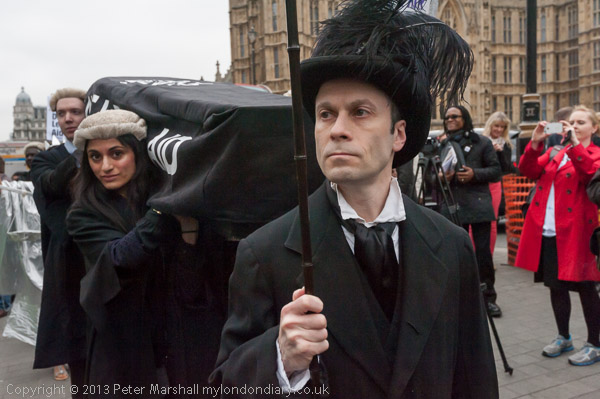
But XR had also planned an event for Parliament Square, where the roads around were blocked for a New Orleans funeral procession with jazz band to make its way around the square.

The funeral was perhaps also designed as a diversion for some more direct action, which I again missed at the Shell Centre on the South Bank. A small group of activists daubed slogans across the front of the building and two occupied the glass porch over the door. The activists had deliberately broken the glass in one of the doors, with the intention that this would result in a trial before a jury rather than by magistrates, enabling them to present the reasons for their action, and three had been arrested and taken away by the time I arrived, but the two were still up on the porch and others holding banners on the street in front.

My day had not quite finished as I made a small diversion on my way home to visit Brixton, where staff, families and children from children’s centres were protesting against plans by Lambeth Council to close five centres and make drastic cuts at seven others. The council had recently spent £68 million on refurbishing the Town Hall and building a new Civic Centre.

Save Lambeth Children’s Centres
Extinction Rebellion at Shell
Extinction Rebellion Funeral Procession
Extinction Rebellion Marble Arch
Anti-capitalist environmental action
Extinction Rebellion Sea at Oxford Circus
Extinction Rebellion Garden Bridge


All photographs on this and my other sites, unless otherwise stated, are taken by and copyright of Peter Marshall, and are available for reproduction or can be bought as prints.


St Pat’s Day

I don’t think March 17th 2002 was the first time I photographed St Patrick’s Day celebrations in London, but it is the earliest that I have pictures of on My London Diary. It looks as if the picture above was taken outside Westminster Cathedral, and later images are clearly in Trafalgar Square.

In later years the parade went from Hyde Park to Trafalgar Square, and the event, with backing from London Mayor Ken Livingstone and considerable sponsorship grew larger and trickier to photograph. I became more interested in smaller St Patrick’s Day events taking place elsewhere in the capital, and especially in Brent, where there was usually a parade on the actual day itself, with a large local Irish population coming out on their own streets.
The London Borough of Brent for years supported a number of community events including this, but also others that reflected the multicultural nature of its population – until government cuts made this impossible to continue, and funding was withdrawn in 2013. These were events that drew the communities together, with others joining in with their Irish neighbours and local schools getting all their pupils involved. They also celebrated Diwali, Eid, Christmas, Chanukah and Navrati, as well as Holocaust Memorial Day, and had a black history programme, their own ‘Respect’ festival and a world food and music festival.

I think I first photographed the Brent parade in 2007, going there with several photographer friends, including Bronx-born Irish-American John Benton-Harris who has covered St Patrick’s Day celebrations for many years and whose Saint Patrick’s People is available from Cafe Royal books.

I went to Brent again in several years, and it was always a great event to cover. The only problem with it was that once the parade was over the local pubs were far too crowded and we had to go elsewhere to get a drink.

There are far too many pictures to show here – I’ll add some links at the bottom of the piece as usual.

In these later years I did find myself faced with a problem. While the Irish were celebrating their saint, a Romano-British missionary who converted Ireland to Christianity at some time in the early Fifth century – Syrians in the UK were marking the anniversary of their revolution – which was being brutally repressed by the Assad regime. While timings made it possible to cover both stories, it did mean rushing away from one or the other, perhaps missing the end of the events, and I found the necessary switch in mood difficult.

St Patrick’s Day on My London Diary
2002
2004 (scroll down the page)
2005 (scroll down the page)
2006 (scroll down the page)
2007 (scroll down the page – 2 stories)
2008
2009 – London and Brent
2010
2011
2012
2013


All photographs on this and my other sites, unless otherwise stated, are taken by and copyright of Peter Marshall, and are available for reproduction or can be bought as prints.