1st December 2018

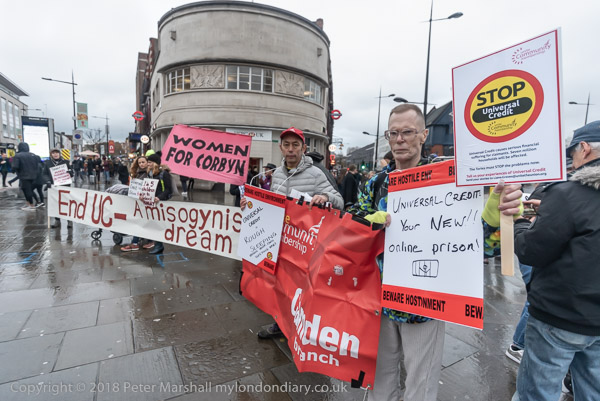
Two years ago, the first day in December had been declared Stop Universal Credit day of action by Unite Community and small groups around the country were holding protests and handing out leaflets in busy town centres about the many failures and great hardship caused by this poorly though out and badly administered benefit. They called for an end to the long wait before claimants receive money, for applications to be allowed at job centres as well as online, for better help when the system fails people, for direct payments to landlords to avoid rent arrears and evictions and an end to benefit sanctions for all claimants.

Universal Credit was intended to simplify the benefits system, but it failed to take into account the huge range and complexity of situations ordinary people face, and assumed that claimants would have the same kind of support that the middle-class and wealthy take for granted from families, friends and resources. And its failures were compounded by making it a vehicle for cutting costs. As I commented in 2018:

“UC has created incredible hardship, pushing many into extreme poverty and destitution, making them reliant on food banks and street food distributions, greatly increasing the number of homeless and rough sleepers. Thanks to Tory policies, more than 120,000-plus homeless children in Britain will spend Christmas in hostels and B&Bs, many without the means or facilities to provide a Christmas meal.

Some have said that UC is a part of a “state euthanasia” system for the poor, with academic estimates that it and other benefit cuts and sanctions since the 2010 elections having caused 110,000 early deaths, including many suicides. A cross party committee has called for its rollout to be halted until improvements are made, but the government has dismissed virtually all criticism of the system, making only insignificant changes.”

http://mylondondiary.co.uk/2018/12/dec.htm#universal

I took a detour on my journey into London to photograph the protest outside Camden Town station, where protesters were also pointing out that Universal Credit “hands more financial power to male claimants making it a misogynist’s dream, forcing women in violent relationships into greater dependency on their violent male partners.”
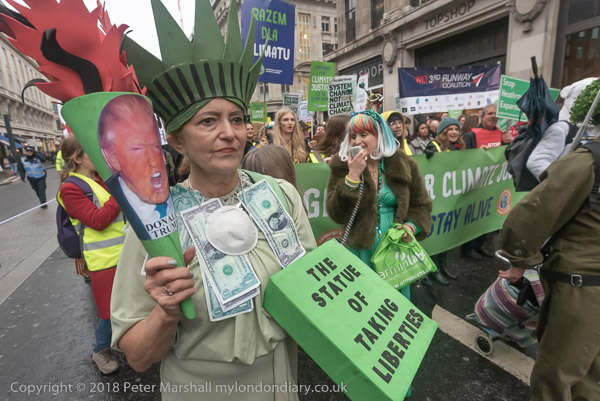

The major protest taking place in London was a march and rally organised by the Campaign against Climate Change. Together for Climate Justice began with a rally outside the Polish Embassy, in advance of the following week’s UN climate talks in Katowice, Poland.
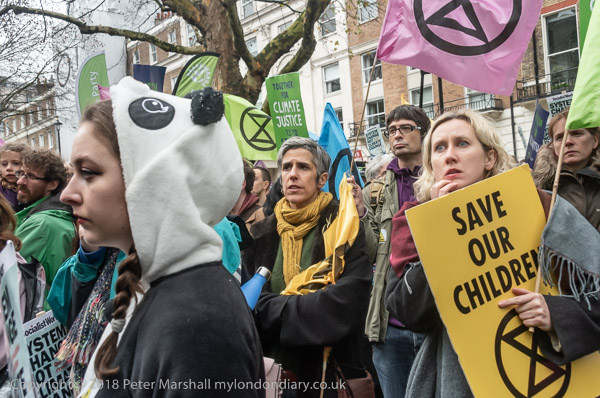
Despite the impending global disaster, little real action is being taken by countries around the world and we still seem committed to a course leading inevitably to mass extinction. Behind the failure to act is the intensive lobbying of companies exploiting fossil fuels who have spent many billions in sowing doubt about the scientific consensus of global warming, and continue to produce vast quantities of coal and oil and explore for further resources, increasingly in the more ecologically sensitive areas of the Earth.
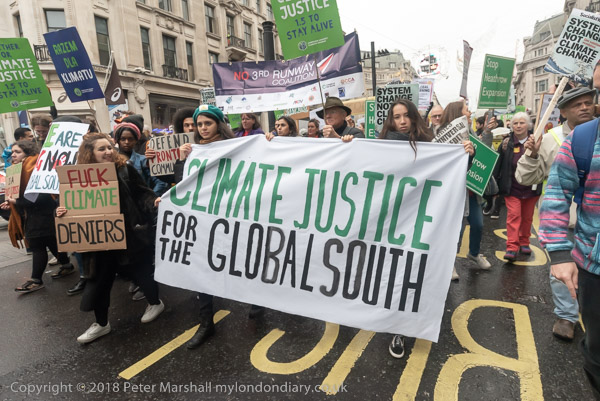
At the rally a wide range of speakers expressed their concerns that the talks in Poland are being sponsored by leading firms in Poland’s fossil fuel industry. And at the rally opposite Downing St where Frack Free United were to hand in their petition at the end of the march, a speaker from the Global South reminded us of the urgency of the situation; people there are already dying because of climate change.
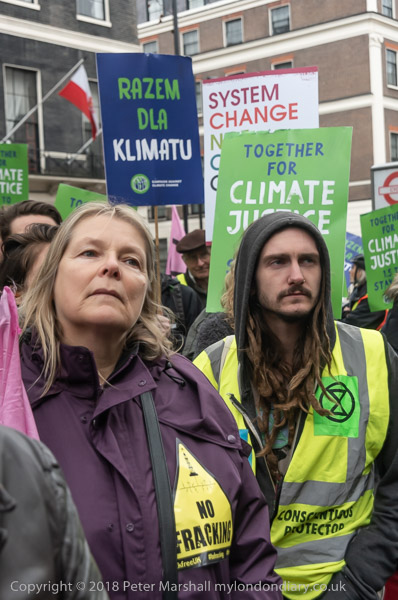
Before the march we were all taught to say a few slogans in Polish, including ‘Razem dla klimatu‘ (Together for the Climate) which appeared on a number of placards, and the rather less pronounceable Polish for ‘Time to limit to 1.5’, as well as for ‘Climate, jobs, justice!’.
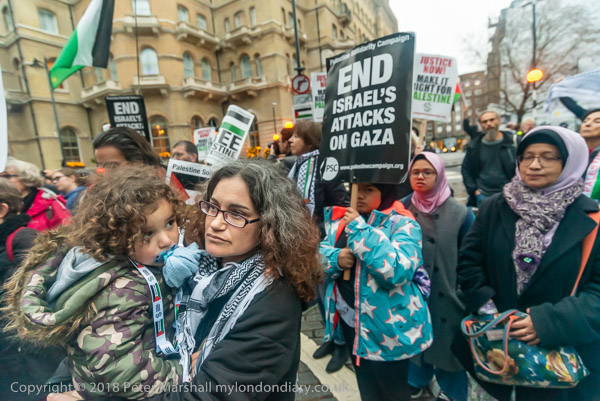

Finally I made my way to Broadcasting House, where The Palestine Solidarity Campaign and others were calling on the BBC to withdraw from the 2019 Eurovision Song Contest hosted by Israel, to avoid being complicit in Israel’s ongoing violations of Palestinian human rights.
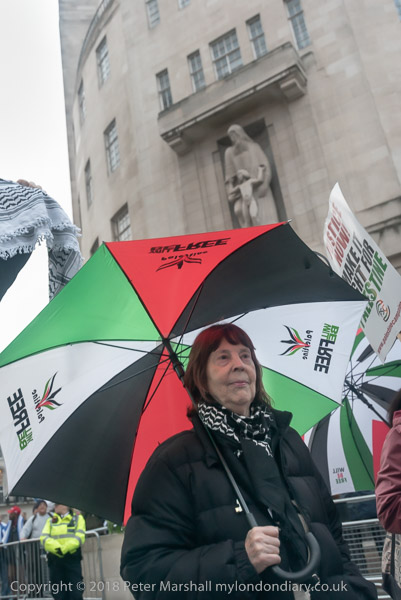
Campaigners say the contest ‘artwashes’ Israel’s human rights record, including the killing of at least 205 Palestinians by Israeli forces in the besieged Gaza Strip since protests began at the end of March, and the passing of the Jewish nation state law which formalises an apartheid system in Israeli law.
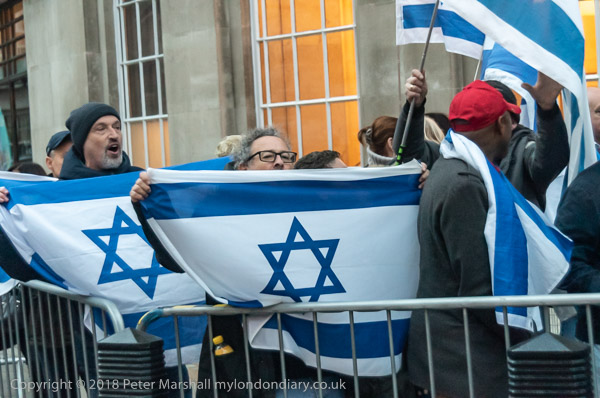
A small group of Zionists had come to oppose the protest, but made it clear that they did not want me to photograph them. Some lifted the Israeli flags they were holding to hide their faces when I pointed my camera in their direct or turned away.


More at:

BBC Boycott Eurovision Israel 2019
Together for Climate Justice
Stop Universal Credit day of action


All photographs on this and my other sites, unless otherwise stated, are taken by and copyright of Peter Marshall, and are available for reproduction or can be bought as prints.


1988 Free Mandela march

Free Nelson Mandela - Birthday March and Rally - London 1988 88-7h-66
Camden Town

Although I first took pictures at protests in the 1970s, I had been taking part in protests since the middle of the 1960s. But I was then a penniless student with no idea about how you could cut costs by developing and printing your own films; I did own a camera, a Halina 35X, but had dropped it in the lake at Versailles and it never worked reliably after that, delivering random but usually very slow shutter speeds from its rusty leaf shutter.

Free Nelson Mandela - Birthday March and Rally - London 1988 88-7h-55

Even after I had taken a short photographic course and got a job and could afford a new camera (a cheap Russian Zenith SLR) and had rigged up a temporary darkroom in the kitchen of our flat, I was still going on protests as a protester and took few if any photographs.

Free Nelson Mandela - Birthday March and Rally - London 1988 88-7h-31
BBC

Of course there were fewer protests back in the 70s and 80s, or at least it was harder to find out about them in the days before the World Wide Web. There were of course huge events such as the Miners’ Strike, but unless you lived in the mining areas or could travel to them, which didn’t fit with my full-time job you read about most of these after the events were given newspaper coverage if at all. Many other protests related to strikes and union issues were simply impossible to know about unless they concerned your own union.

Free Nelson Mandela - Birthday March and Rally - London 1988 88-7i-43

My attendance at protests was largely limited to the big national demonstrations organised by groups I belonged to – such as CND and the Anti-Apartheid movement and a few others that were advertised in advance in the alternative press. Many protests were only advertised by fly-posting on walls mainly in the areas they were to take place in – and there were few if any such postings in the area where I lived.

Free Nelson Mandela - Birthday March and Rally - London 1988 88-7j-65

I began to be more a photographer of protests than an actual protester in the 1980s, particularly after a few of my photographs were accepted for an exhibition on protest (and I think one won a prize.) I began to realise that I could make a great contribution to the various causes with a camera than simply marching or attending rallies, and, a little later, began contributing my photographs to a picture library concerned with social issues, and later still providing my services directly to some protest groups.

Free Nelson Mandela - Birthday March and Rally - London 1988

As more and more people and groups went on-line things began to change. I found out about more and more protests, at first as groups set up web sites to promote their activities. I’d spend an evening or more a week going through a list of perhaps 20 or thirty different groups and using sites which listed bus and travel diversions and various search engines to find out about events and put them in my diary. Then Google arrived and made searching easier and finally Facebook and I had little time to photograph anything but protests.

Free Nelson Mandela - Birthday March and Rally - London 1988 88-7j-13

The Free Nelson Mandela march in London was on Saturday 17th July 1988, the day before his 70th birthday and two years before he was released from prison. I walked with the protesters taking pictures from Camden Town to Hyde Park, and took a few pictures in the crowds in Hyde Park, but none of the stage and speakers at the rally. You can see more of the pictures in the Flickr album uploaded a couple of days ago. Clicking on any of the pictures above will take you to the larger version in the album.


All photographs on this and my other sites, unless otherwise stated, are taken by and copyright of Peter Marshall, and are available for reproduction or can be bought as prints.


Rojava, Bolivia & Ecuador

One of the things that makes it hard to leave London is the diversity of the communities that have made their homes here, making this an exciting place. Throughout its history Britain’s population has been enriched by immigration and although immigrants have not always been made welcome they have made a very positive contribution to our society. Among them have been many religious and political refugees and asylum seekers, and many continue to support the causes in their home countries while in London.

While our media generally give little attention to protests – except for those rare occasions involving individual violent acts or anti-establishment acts such involving insults against national heroes such as the writing of graffiti on the plinth of the Churchill statue or attacking statues of slave traders, the protests by ethnic communities against events in their home countries are almost entirely dismissed as what one newsroom at least refers to as “tribal matters”.

Of course they are wrong, as well as being xenophobic. We live in a world that is increasingly interconnected and globalised, and Brexit, taking us out from under the wing of Europe will give even more importance to events happening around the rest of the world, including Rojava, Ecuador and Bolivia.

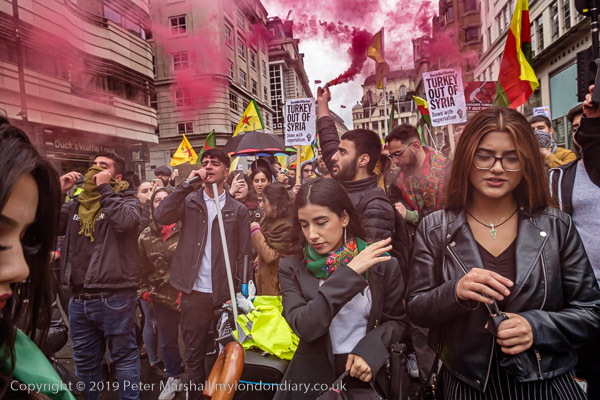
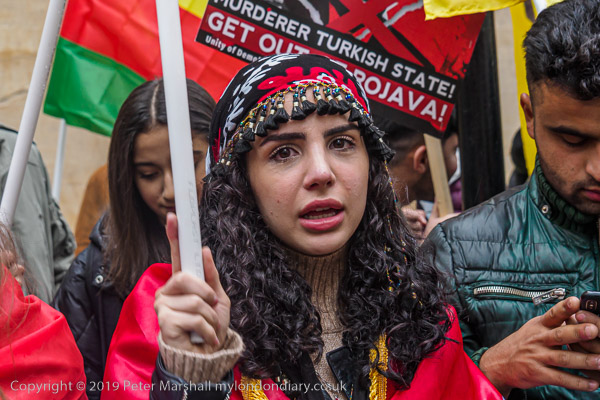
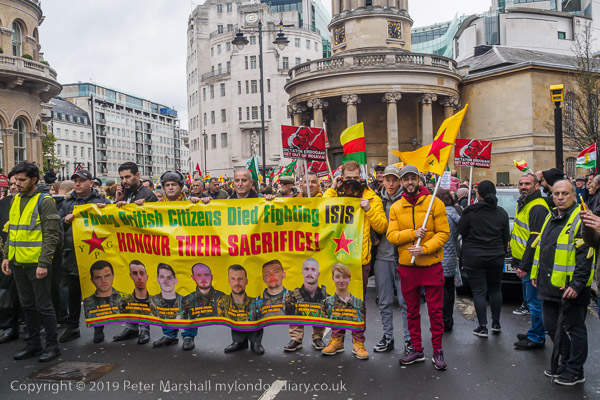
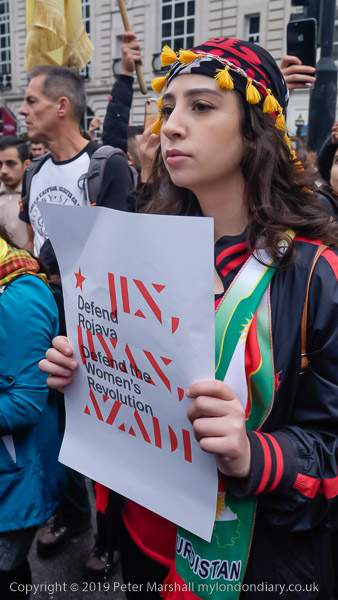
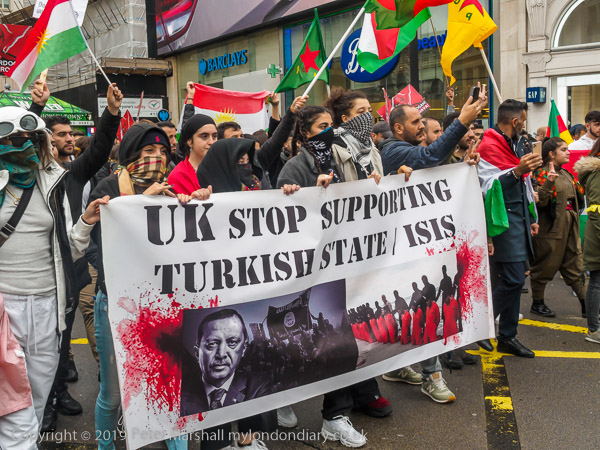
Rojava is important not just to those who live in this Kurdish-controlled part of Syria and to Kurds in general but the rest of us around the world. It was the Syrian Kurds who with US air support who were able to defeat ISIS but as a model of a democratic system dedicated to equality, the liberation of women and ecological justice that could serve to provide the system change we need to overcome climate disaster and to resolve the problems of the middle east and elsewhere.

After ISIS were defeated, Trump brought US forces out of the area, leaving it open for Turkey to advance into Syria – with the aid of Islamist forces and the aim of destroying the Kurds. Through NATO we give Turkey support and doubtless supply arms while Russia, backing President Assad are happy to see Syrians who don’t support him exterminated. The Turks have huge superiority in weapons and seem very likely to acheive their aims, but are then likely to establish an Islamic state in the area rather than withdraw back to Turkish territory and we could well then see a war between Russia and NATO forces.

If you rely on the BBC for your news you will know probably know very little about what is going on in northern Syria and the protesters, mainly Kurds but with some support from the British left, gathered outside Broadcasting House a year ago today on Sunday October 13th 2019 to condemn the poor BBC coverage and hope to persuade them to do more. I met them there and marched with them as far as Trafalgar Square; they went on towards Parliament but I stopped to cover two other protests over events abroad.

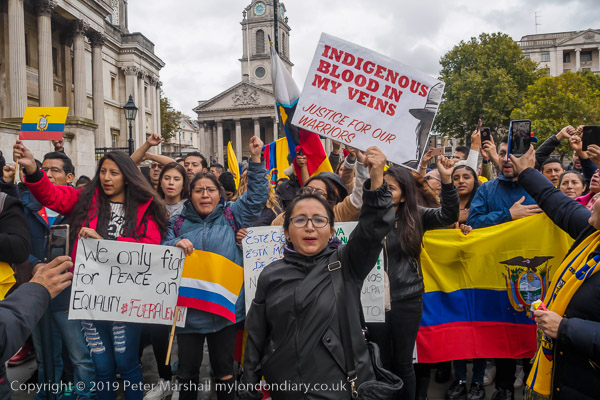
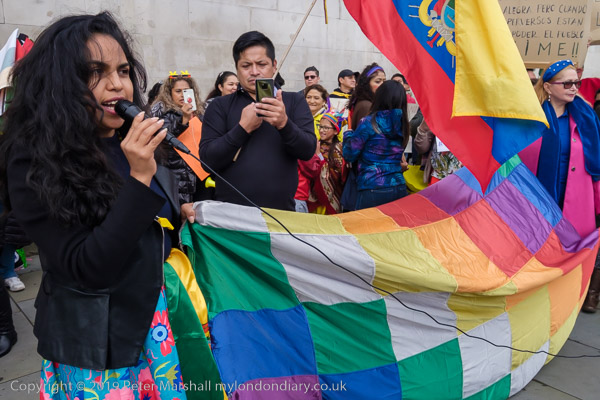
Ecuadorians living in the UK had come to call for the resignation of President Lenin Moreno who they say is their worst president ever. Many there were from indigenous groups who have been hardest hit by public service cuts, particularly the ending of fuel subsidies. Protests had been causing chaos in the capital Quito since these were announced two weeks earlier. The austerity measures had been demanded by the International Monetary Fund in order for the country to get a £3.4bn loan. After Brexit we could well see Britain having to meet similar IMF demands whose aim is to protect and promote international capital and corporations at the expense of the poor.

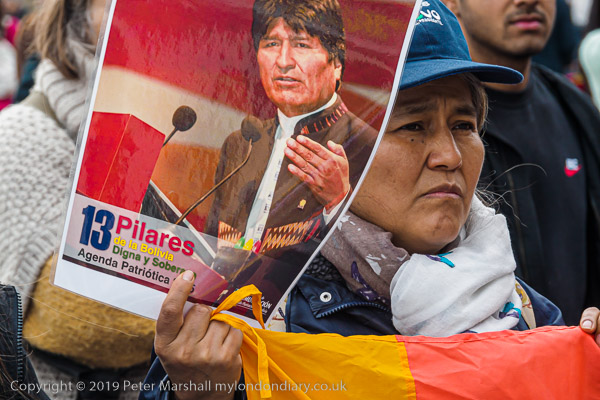
As the Ecuadorians left they were replace by Bolivians who held a lively rally with music and dancers in support of President Evo Morales, who was seeking a fourth term in elections a week later on 20 October.

Morales, the first Indigenous president, and his Movement for Socialism (MAS) greatly reduced poverty, cut the influence of the USA and multinational companies and made Bolivia a model of economic growth. Although popular among the poorer citizens, his policies had not endeared him to the wealthy or to the United States.

Although the election results made Morales a clear winner, with just enough votes to win on the first round, it was followed by violent insurrection amid claims of electoral fraud. Morales fled the country and resigned as President claiming there had been a coup after armed intruders broke into his home. He was offered political asylum first in Mexico and later moved from there to asylum in Argentina.

Although an Organization of American States investigation found there had been voting fraud, later studies by US political scientists and experts on Latin American politics concluded there was no statistical evidence of fraud. Despite being voted in by the Bolivian people, a warrant was issued in December for the arrest of Morales on charges of sedition and terrorism.

More about the three protests on My London Diary:

Rally supports Bolivia’s Evo Morales
Against Ecuadorian President Moreno
Solidarity with Rojava – Kurdish Syria


All photographs on this and my other sites, unless otherwise stated, are taken by and copyright of Peter Marshall, and are available for reproduction or can be bought as prints.