Human Rights Day

Today, 10th December is UN Human Rights Day. I think the 10th December 2016 may have set a personal record in that I covered seven events, although one was only a fleeting meeting with a Rhino as I passed through Parliament Square. But five were human rights protests.

My work began in Old Palace Yard, in front of the House of Lords and around the rather ugly statue of George V. On 10th December 1948 the UN General Assembly adopted the Universal Declaration of Human Rights (UDHR) and since then the day has been celebrated in countries around the world as Human Rights Day.

The UK was one of the countries that played a large part in both the establishment of the UN, whose first General Assembly was held in the early months of 1946 just a few hundred yards away in Methodist Central Hall, and in the UDHR, which “proclaims the inalienable rights which everyone is entitled to as a human being”.

But our current government finds some of its provisions inconvenient and one of the driving forces of Brexit is that it will provide the opportunity to weaken compliance with the UDHR, threatening our human rights including workers rights to paid holidays, maternity leave and fair treatment at work, disability rights and the right to freedom from discrimination.

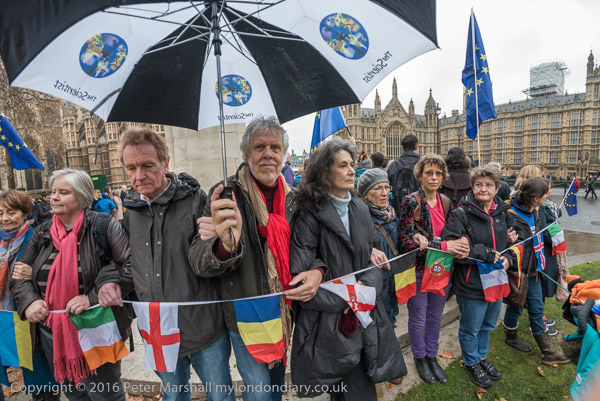
Supporters of the UK remaining in Europe were protesting in silent chains in towns and cities across the country and several hundred had come to do so in the centre of London. I didn’t find it easy to produce interesting pictures of what was a rather static event.
Silent Chain for Europe


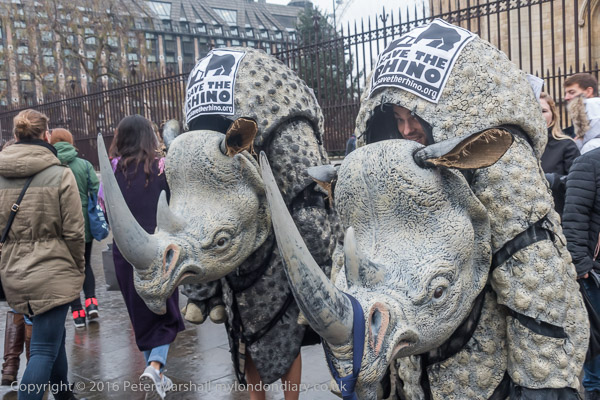
As I walked across the front of Parliament towards Westminster tube station I came across two people in rather impressive rhinoceros costumes who were being photographed in front of the House of Commons, and paused briefly to take a couple of pictures.

What rather surprised me was the almost total lack of interest in them shown by the many tourists walking past. After all it isn’t every day you pass two rhinos on the street.
Save the Rhino


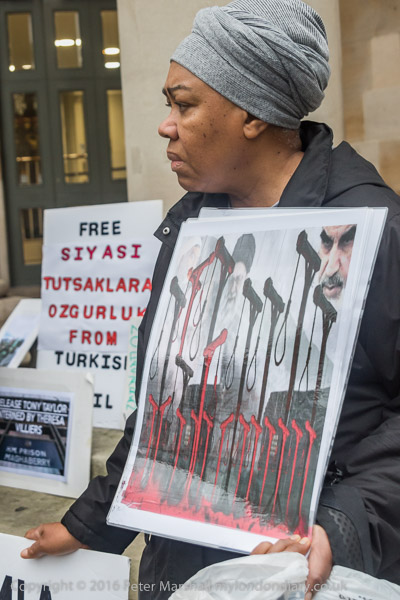
People from various campaigns had come to Broadcasting House to protest and hand in a letter about the BBC’s failure to report on political prisoners held unjustly in jails around the world. They accuse the BBC of an institutional policy of ignoring such cases, including a hundred Irish Republican prisoners, former Black Panther Mumia Abu Jamal held on Death Row in the USA for over 30 years, many Palestinians held in Israeli jails, the victims of Erdogan’s purge in Turkey, the many hanged in Iran and other cases of illegal imprisonment around the world.
BBC censors prison struggles


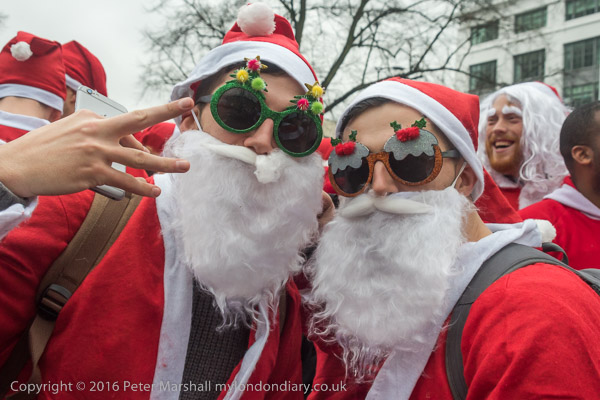
From the BBC I made my way north to Mornington Crescent, where I met one of the four groups of Santacon; the north London group had met up in Camden and were coming down into Central London and soon stopped in a small park.

I found it a little disappointing – as I wrote then,

“this year the event did seem rather more organised and tame, lacking some of the anarchic charm and chaos that brought much of London’s traffic to a halt in previous years – or perhaps I just took these pictures earlier in the day before the Christmas spirits, wine and beer had really kicked in. “

London Santacon 2016

I think police had leaned rather heavily on the organisers and insisted that they move off the streets into areas such as this for much of the event. I didn’t stay with the Santas long because there were other Human Rights Day events to photograph.


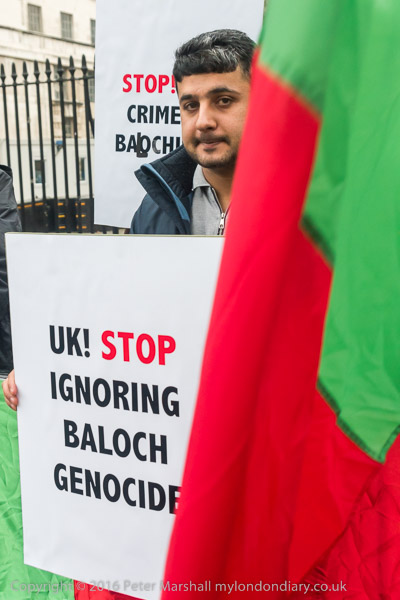
I took the tube back to Westminster where I found Balochs protesting opposite Downing St, calling on Theresa May to speak up for the Baloch people and their freedom against the Pakistan regime which they claim has a policy of genocide against the Baloch people and has killed thousands of Baloch activists and abducted more than 25,000 of them.

They say those abducted are tortured and then killed, with their bodies being dumped in deserted areas. Balochistan was an autonomous kingdom on the border of Pakistan and Iran, and was merged with Pakistan in 1948, the year after Pakistan was created. Since then there have been various Baloch separatist movements which have been brutally repressed by both Pakistan and Iran.
Balochs UN Human Rights Day protest.


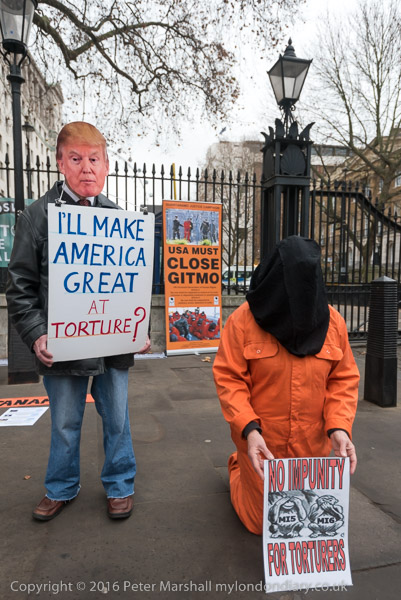
I’d come to Whitehall to report on the Guantanamo Justice Campaign protest on UN Human Rights Day opposite Downing St calling for an end to torture, the closure of Guantanamo and an end to British complicity in torture.

It wasn’t a well attended protest probably because there had been relatively little publicity, but also reflecting the problem of keeping up interest in long running issues such as this which no longer attract much if any attention from our news media. They will argue that it is no longer news, but that is only because they choose not to cover it, instead filling pages and programmes with empty speculation and inconsequential affairs of insignificant so-called celebrities rather than matters of importance.
Human Rights Day call close Guantanamo


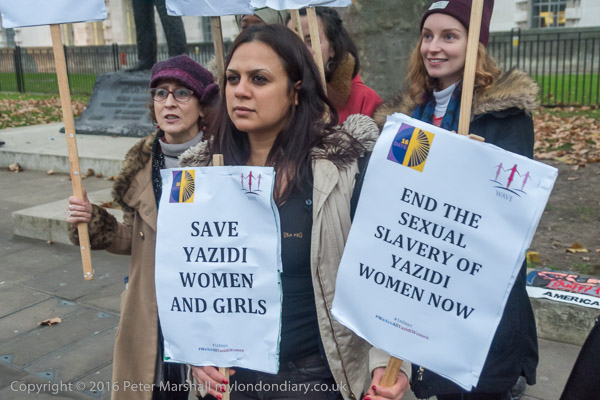
Another issue which has slipped almost completely off the news agenda is the plight of the Yazidi women and girls targeted and captured by ISIS (Da’esh) in Iraq. According to UN reports, more than 5000 Yazidis had been murdered and 5-7,000 abducted. Over 3,400 are believed to be still held, the women subjected to physical and sexual violence, including systematic rape and sex slavery.

The visit to the UK by UN goodwill ambassador Nadia Murad Basee Taha for 16 days of action prompted little or no news coverage.
Save Yazidi women and girls


More about all these events and more pictures on My London Diary.

Save Yazidi women and girls
Human Rights Day call close Guantanamo
Balochs UN Human Rights Day protest
London Santacon 2016
BBC censors prison struggles
Save the Rhino
Silent Chain for Europe


All photographs on this and my other sites, unless otherwise stated, are taken by and copyright of Peter Marshall, and are available for reproduction or can be bought as prints.
November 2014 (3)

Fortunately there was nothing in my diary for the last Thursday in November 2014, as I think it was probably past 2am before I had finished editing and filing my pictures from the two events on Wednesday evening. But on Friday it was another early start for me, though not very early, catching the first train on which I can travel at reduced – but still excessive – rail fares.

I’m fortunate to be reasonably well-off, largely thanks to pension contributions paid during 30 years of full-time employment, though by no means rich. More importantly I live in a house which we finished paying for around 25 years ago, and which, though not grand serves its purpose. It means that we can afford both to eat and to keep warm – though I’m typing this with an extra jumper on in a room that is sometimes cold enough for me to wear a woolly hat.

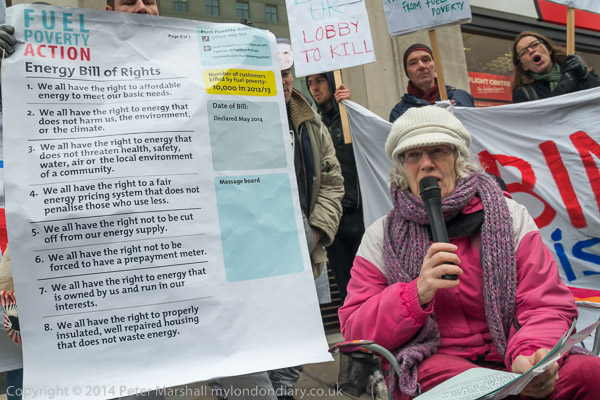
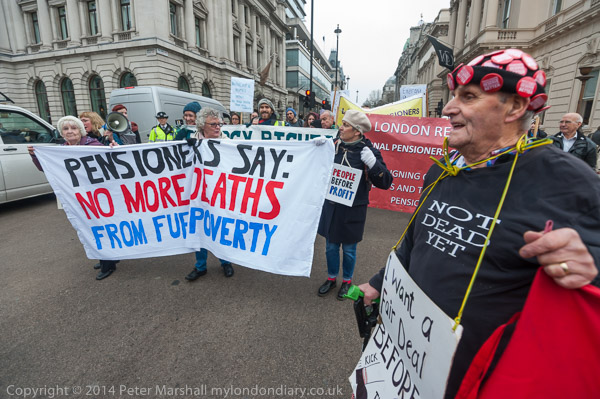
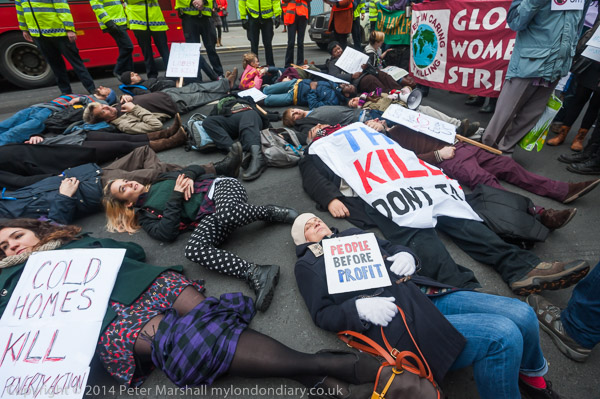
But for many – and particularly many who are elderly and disabled – the choice between keeping warm and eating is a desperate one, eased only slightly by the annual ‘Winter Fuel Payment’ of £200 per household. As I wrote in 2014, ‘The official statistics show that in the year 2012/2013 over 10,000 people died from fuel poverty, including thousands of people in London, and figures for last winter are likely to be higher.’

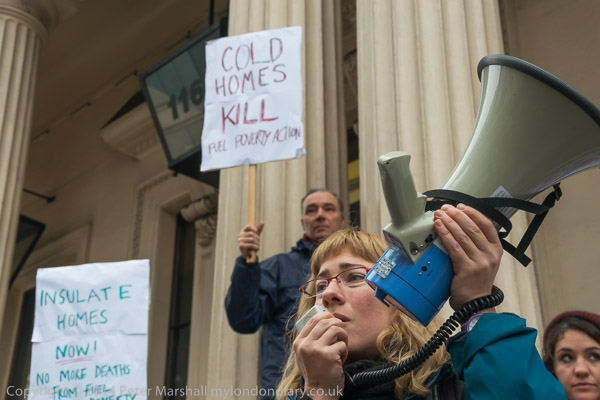
The protest by pensioners, Fuel Poverty Action and No Dash for Gas was against Energy UK, the lobbying organisation of the Big Six energy companies who together made profits of £3.7 billion in 2012/3, and they marched from Charing Cross Station to their Regent St offices, stopping on the way for a short action outside the Institute of Directors on Pall Mall.

They then held a 15 minute die-in stopping traffic on the road outside the Energy UK offices before continuing with a rally.


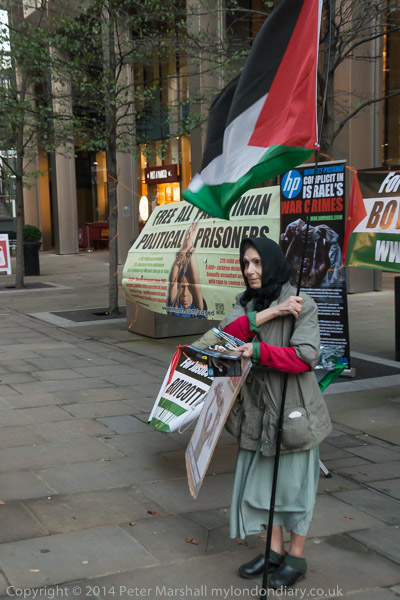
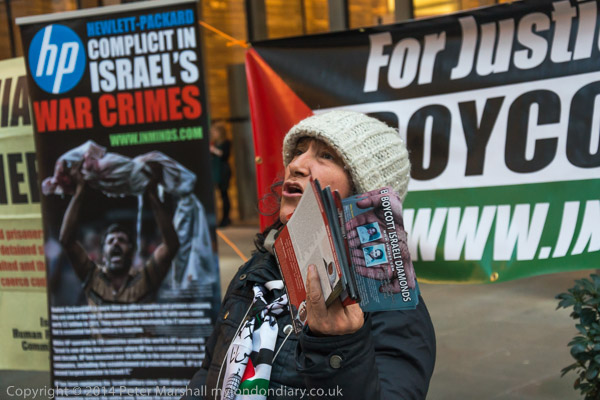
Later in the day I joined the Palestinian Prisoners Campaign for a protest outside the City offices of Hewlett Packard. Saturday was the ‘UK Stop Arming Israel’ day of action, but they came on Friday as the HP offices are closed at the weekend. HP is one of the 20 top US armaments companies and has a $6 billion investment in Israel where they provide the IT backbone for the entire Israeli war machine – from the army, to the navy, to the Ministry of Defense, as well as for the prisons and intelligence services, backing up the repression, imprisonment and torture of Palestinians.

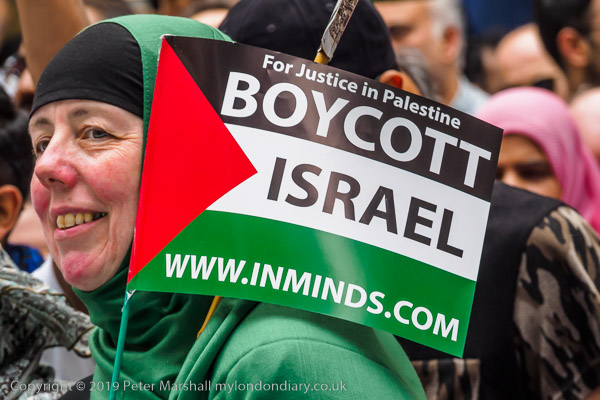
The group protests regularly at companies providing support for the Israeli regime, and includes a number of Palestinian and Jewish protesters and is supported by the Islamic Inminds Human Rights Group which has links with Iran.


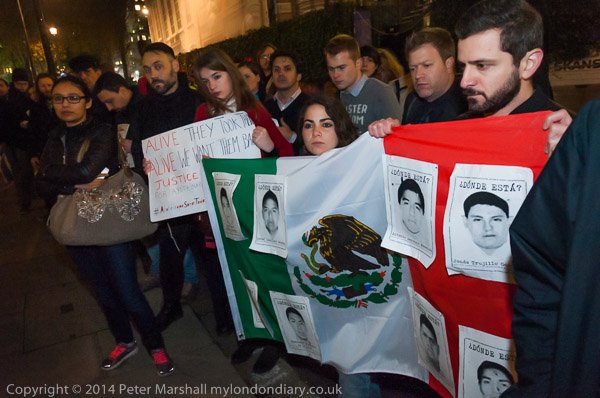
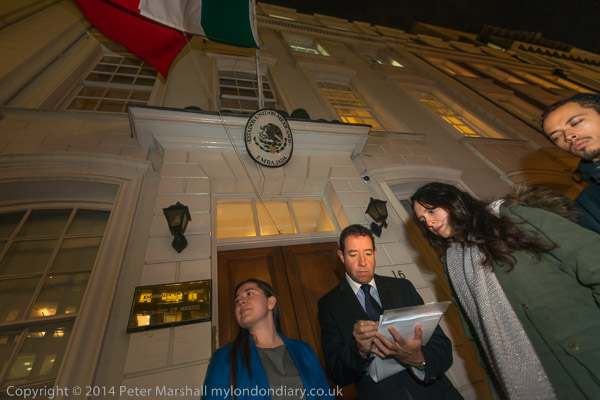
Finally I made my way to the Mexican Embassy in Mayfair for a protest over the disappearance and almost certain massacre of 43 Ayotzinapa college students in Iguala on 26 September who appear to have been arrested by police and handed over by the local mayor to the local crime syndicate Guerreros Unidos (“United Warriors”) to be murdered.

It was now quite dark and the street was badly lit – with most of what light there was coming from the windows of the buildings around. Many held posters with pictures of the missing students and asking in Spanish ‘Where are they now?’ but in seems very unlikely that any are still alive. Although the scale of this massacre caught the attention of the Mexican people – and briefly that of the world – unfortunately similar murders are not unusual in Mexico.

Two embassy staff came out to receive a letter to the Mexican government from the protesters and spent some minutes on the steps listening to the speeches.


More about all three events on My London Diary:
Solidarity with Mexican students
Stop Arming Israel protest at HP
No More Deaths from Fuel Poverty


All photographs on this and my other sites, unless otherwise stated, are taken by and copyright of Peter Marshall, and are available for reproduction or can be bought as prints.

Al Quds march

The Al Quds (Jerusalem) Day march is always a contentious event in London, and one that I often find difficult to photograph, and I had my problems this year.

Of course many of those who protest regularly for freedom for Palestine know me as I photograph many of their protests – as you can see on My London Diary.

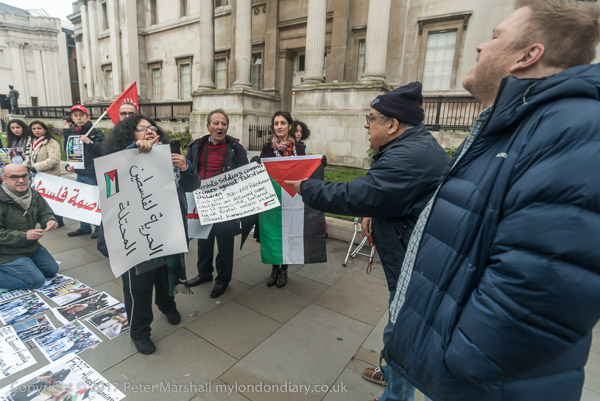
Some of those who have organised the Al Quds day marches over the years also now recognise me and are friendly, but it is an event that does meet with a lot of opposition by some Zionist groups and where many of those attending are rather wary about being photographed. So I found myself several times being stopped by people asking who I was taking pictures for and some trying to prevent me photographing.

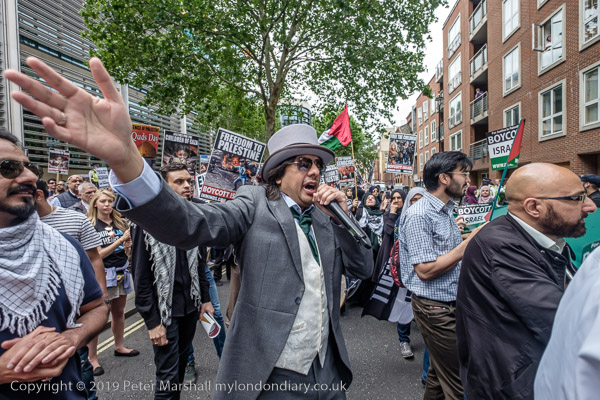
As regular readers will know, I like to take pictures close to those I’m photographing, though I don’t particularly like the kind of distortion you can see in the hand of the organiser above, taken with the lens on the Fuji set at 11mm – 16.5mm full-frame equivalent. I’ve long felt that the ideal photographic distance is one where you can reach out and touch the person you are photographing, as if you were talking with them, though sometimes a little greater distance is necessary.

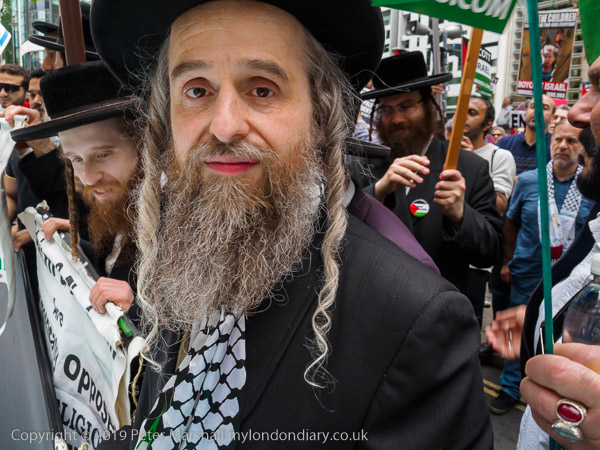
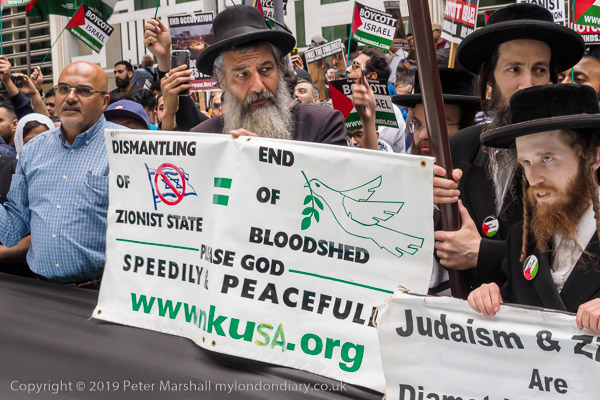
Of course there are times when you do have to stand further back. There was a giant Palestinian flag between me and the Neturei Karta ultra-orthodox Jews when I made the picture showing their recipe for a peaceful end to the bloodshed in Palestine. There the distance was a necessity.

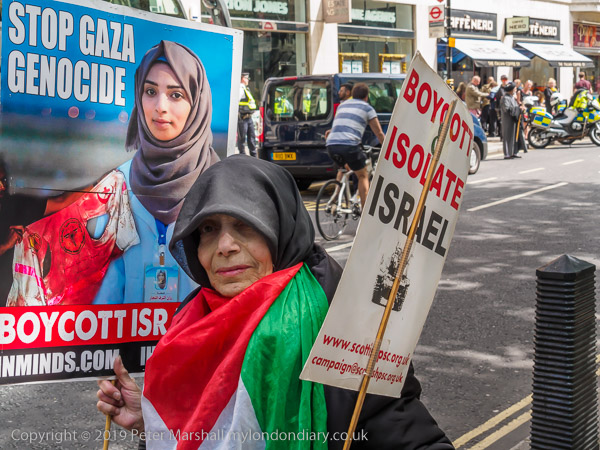
And there are pictures that need a longer focal length to isolate the subject, as in this picture, made with the remarkable 18-150mm on the Olympus E-M5MarkII at 135mm (270mm equivalent.) Long lenses certainly do have their photographic uses, and this one comes in an incredibly small and light package.

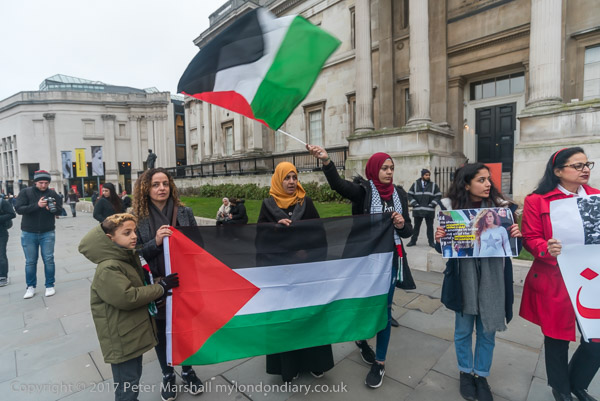
I’m not sure I will go to photograph this event next year, despite my support for the Palestinians and my hope that one day they will gain justice and be able to live in peace with their Jewish neighbours, to make good the neglected second part of the Balfour declaration that “nothing shall be done which may prejudice the civil and religious rights of existing non-Jewish communities in Palestine.”  I’ll continue to photograph other pro-Palestinian events in London, but this one was just too much aggravation. I ended up feeling more welcome photographing the Zionists opposing the event.