Goldsmith’s Security

Goldsmith’s University is a part of the University of London located in New Cross in south-east London. Like many other organisations it has outsourced many of the service jobs on campus, paying private companies to provide the vital services that keep the university running.
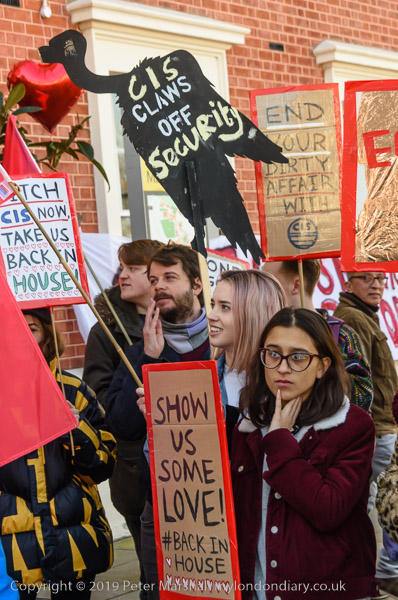
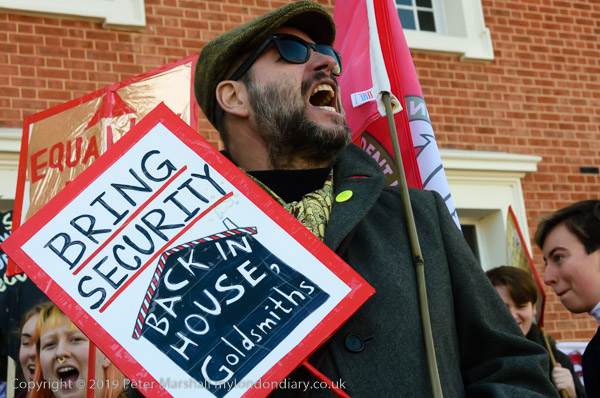
Outsourcing contracts are generally awarded to companies who put in the lowest tender, and they do this largely by cutting corners at the expense of their employees, who are on poor wages, with lousy conditions of service and often greatly overworked by bullying managers. At Goldsmith’s the security guards employed by CIS Security report not getting their statutory sick pay, grievance pay, maternity/paternity pay and public bank holidays off, and feel they are treated as second-class citizens, not allowed to make use of the car park, canteens that other staff can use.
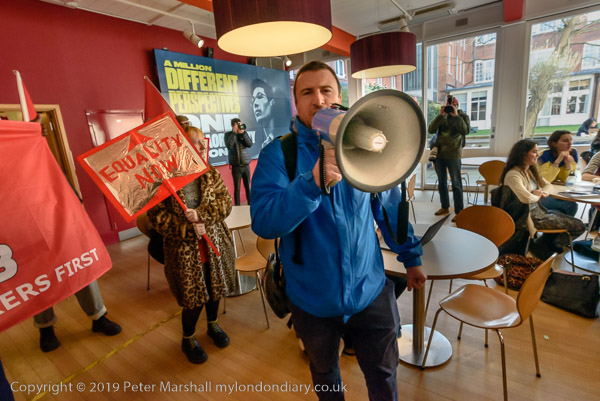
Their campaign to be brought in-house – employed directly by the university – has been supported by the Student Assembly which passed a motion of support for the security guards and the campaign by their trade union, the IWGB, and asking for Goldsmith’s management to recognise the IWGB to which the majority of them belong.
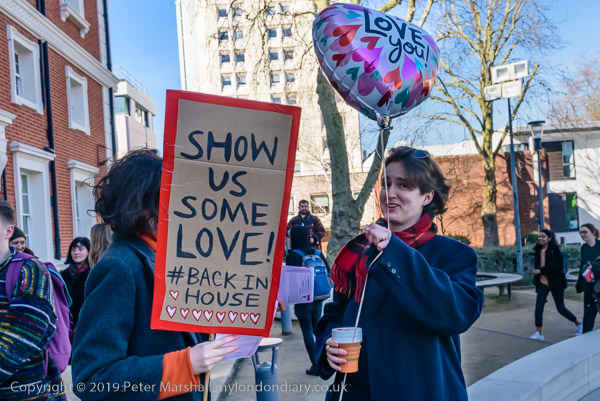
The protest, called by the Independent Workers Union of Great Britain’s (IWGB) Security Guards and Receptionists branch and supported by the Goldsmiths Students union and the Goldsmiths branch of university teachers union UCU, took place on St Valentine’s Day, and placards, posters and balloons reflected this, calling for the university to ‘show some love’ for the people who work there.
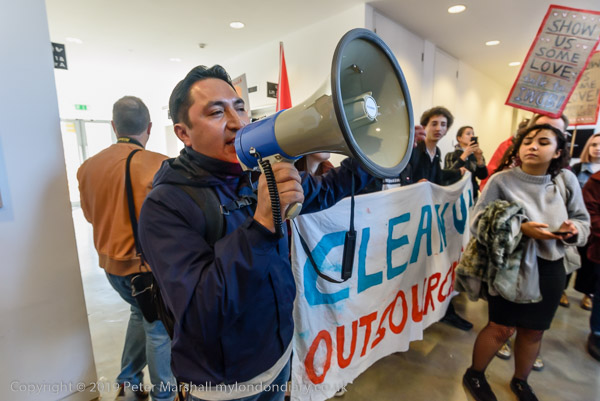
It was quite an eventful protest, and after a brief rally in front of the main building, the campaigners went inside and spoke to people eating in two canteen areas before walking through the buildings to emerge on the busy main New Cross Road, where they stopped traffic for some minutes by sitting on the road in front of Deptford Town Hall which now houses some of the university management. They returned onto campus and occupied the foyer of another building for a short rally before walking back to where they had started the protest for a final short rally.

More at Bring Goldsmith’s Security In-House.


There are no adverts on this site and it receives no sponsorship, and I like to keep it that way. But it does take a considerable amount of my time and thought, and if you enjoy reading it, please share on social media.
And small donations via Paypal – perhaps the cost of a beer – would be appreciated.

All photographs on this and my other sites, unless otherwise stated, are taken by and copyright of Peter Marshall, and are available for reproduction or can be bought as prints.

To order prints or reproduce images


Tripod rethink

I am not a tripod user. Of course like many photographers I own a small collection of these objects, but they stay tucked away in boxes or cupboards or gathering dust in a corner. They range from a hefty large Manfrotto job which used to be able to hold a 4×5 camera down to a tiny twisty table-top thingy that came free with a roll of film. Somewhere in the loft there may be still an even more massive beast from Linhof. It’s several years since any of them have left the house.

Of course tripods are sometimes essential. I used one when photographing ‘The Secret Gardens of St John’s Wood‘ in 2011, where I needed to take multiple pictures from the same camera position to build up panoramic images, though more to mark the spot than support the Nikon I was using which I often didn’t actually bother to attach, as I didn’t have a proper (and expensive) panoramic head.

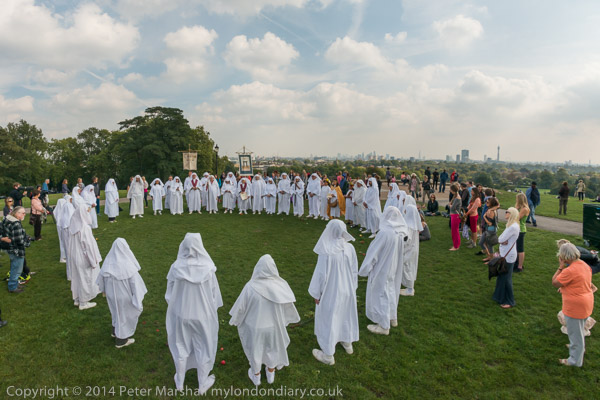
I’ve also occasionally resorted to a monopod, though not to hold the camera steady but to hold it in places I could not otherwise put a camera – around 5 foot above my head for the picture of the druids on Primrose Hill. This picture was taken with a Nikon, and peering at the screen on the back of the camera at a very distant arms length iinvolved considerable luck to get the camera level. Using a mirroless camera would be an advantage as it is rather easier to operate them remotely from a phone app.

Tripods have changed a little over the years, with various attempts to make them smaller or lighter. I’ve used ones made of wood, aluminium and steel and cursed them all. Even plastic, though I’ve never paid the extra for carbon fibre. But there is a general rule, that if a tripod is light enough to carry it’s too flimsy to be of much use. Of course if you can afford an assistant, things are different, and he or she can add the tripod to the umbrella, step ladder and lighting gear. But that isn’t my sort of photography.

Peak Design have embarked on a new project to redesign the tripod and are now seeking funding on Kickstarter to produce their Travel Tripod, which they claim is “A full-featured tripod in a truly portable form.” And it does look to be a decent tripod. They claim too that it can be fully erected ready for use in 9 seconds. The project has already been funded to around 6 times it’s goal with a couple of months still to go, so clearly plenty of relatively wealthy photographers beleive their claims and want to save the $61 off the aluminium version or $121 from the carbon version for a tripod which should arrive around Christmas. The carbon version has so far attracted almost 3 times as many pledges – at US$ 479 (or more). Spiked feet are extra and you’ll need more than the one standard plate to fit on the bottom of your camera provided if you want to be able to use more than one camera, though Peak say it can be adapted to take similar third-party plates.

It does look a nice tripod, but that’s around £377 (or a little more as the exchange rate falls), which to me seems rather a lot and even the cheapskate aluminium at US$289 (£227) seems prohibitive. But if you are a genuine tripodophile it’s worth a look, if just to drool. The Kickstarter offer ends Fri, July 19 2019 1:00 AM BST.

Mostly the improvements seem small; a different leg profile that makes them fit neatly when folded so it takes up less space; cam levers to lock the legs (rather similiar to some on at least one of the tripods I’ve owned.) The big improvement to me seems to be in the ball head. For some the phone adapter that hides away in the centre column until needed will be useful. But you still end up with a package that is 15.5 inches long and weighs 1.56 or 1.27 kg to cart around.


There are no adverts on this site and it receives no sponsorship, and I like to keep it that way. But it does take a considerable amount of my time and thought, and if you enjoy reading it, please share on social media.
And small donations via Paypal – perhaps the cost of a beer – would be appreciated.

All photographs on this and my other sites, unless otherwise stated, are taken by and copyright of Peter Marshall, and are available for reproduction or can be bought as prints.

To order prints or reproduce images

UPHD protest discrimination

I’m not a fan of Uber and very seldom a user of taxis or private car hire services, regarding them as a necessary evil for those rare occasions when public transport is not practicable. And taxis in particular are evil, causing large amounts of unnecessary pollution – both oxides of nitrogen and particulates – on the city streets both directly and also indirectly from other vehicles caught up in the congestion they cause by ‘plying for hire’ – an archaic system now made redundant by the smartphone.

Also rendered archaic by modern technology is the ‘knowledge’, made unnecessary at least in principle by sat-navs and sat-nav apps, though there is still room for further development on these. But at least in theory they can determine best routes making use of real-time traffic information. An car magazine recently conducted a very unscientific test of black cab, Uber and the writer’s car with an up to the minute sat-nav on a London journey, and the journalist’s satnav – evidently a better one than that in the Uber – won. And despite the ‘knowledge’ many taxi drivers seem to have and use a sat-nav, or at least the “Cabbies Mate” App .

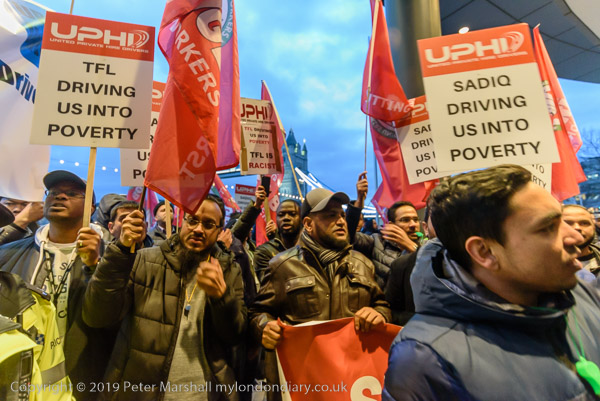
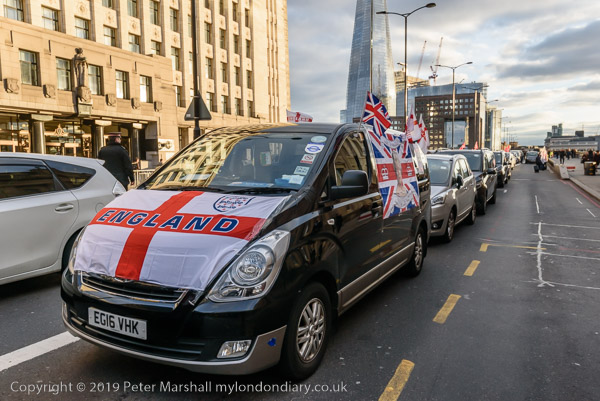
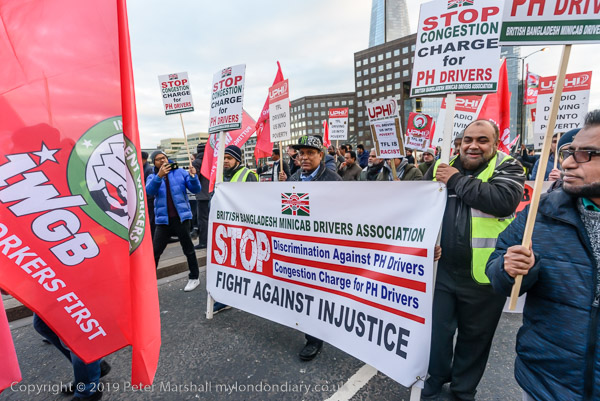
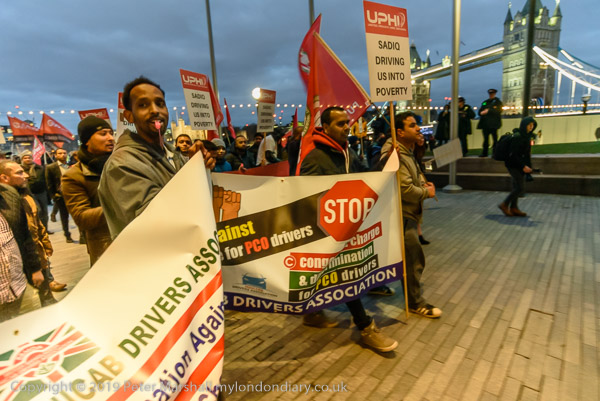
Learning the ‘knowledge’ is certainly a good way to learn your way around London, but largely retained as a method of entry control to the trade. It’s part of the reason why London’s cabs are still largely driven by white British drivers while most private hire drivers come from various BAME communities. The United Private Hire Drivers union (UPHD) would appear to have a good case in claiming that TfL’s decision to apply the congestion charge to minicabs but not to taxis is discriminatory, though it remains to be seen what the court will make of it.

The UPHD also claim that private hire drivers are four times as likely to be stopped by TfL’s enforcement officers “than taxi drivers despite consistently better compliance performance on a licensed driver & vehicle basis. ”

THe UPHD is a part of the IWGB (Independent Workers Great Britain) one of several grass roots unions which are leading the fight for precarious workers in various sectors , including cleaners, cycle couriers and foster carers. As well as this campaign against TfL and the congestion charge, they are also fighting Uber for proper employment rights for the drivers, who are clearly workers for the company rather than self-employed.

Since 2016, successive judgements from the UK’s Employment Tribunal, Employment Appeal Tribunal and Court of Appeal have all said Uber drivers are being unlawfully denied basic worker rights, such as the minimum wage and holiday pay. 

(IWGB web sute)

The union says drivers currently only earn around £5 per hour and are demanding an increase in fares to £2 per mile, a reduction in Uber’s commission from 25% to 15% and an end to unfair dismissals.

We need to reduce traffic and congestion in London, though the congestion charge is a blunt instrument and unfairly discriminates against less wealthy car drivers. For all private hire vehicles – taxis and minicabs – a per fare surchage paid by the customer would be a better solution. We need to give far more encouragement to cycling and walking, by providing safe routes and also by changes to some traffic laws and road design to give cyclists and pedestrians priority; more bus-only routes (or rather bus and cycle routes), and greater subsidies for buses, trams and local underground and overground trains; to set dates before very long when non-electirc powered vehicles are banned for our cities .

There are no adverts on this site and it receives no sponsorship, and I like to keep it that way. But it does take a considerable amount of my time and thought, and if you enjoy reading it, please share on social media.
And small donations via Paypal – perhaps the cost of a beer – would be appreciated.

All photographs on this and my other sites, unless otherwise stated, are taken by and copyright of Peter Marshall, and are available for reproduction or can be bought as prints.

To order prints or reproduce images
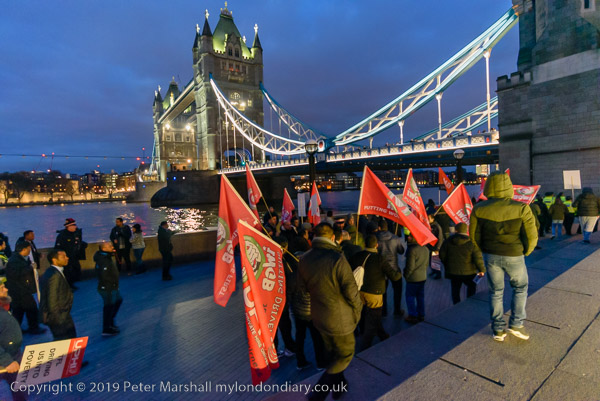
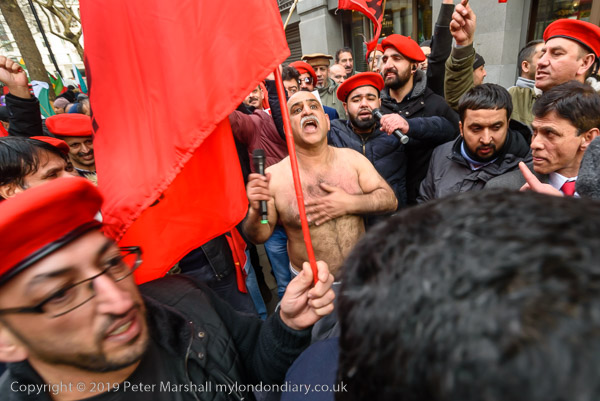
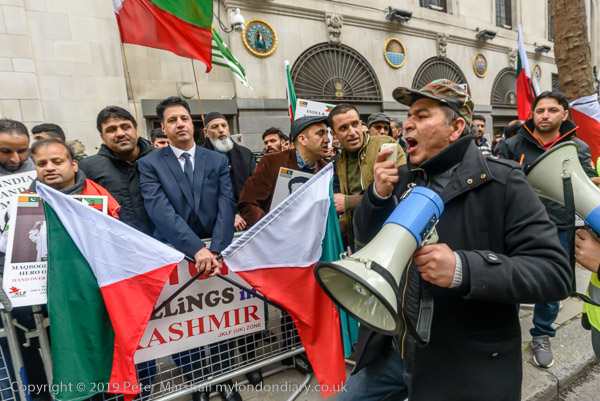
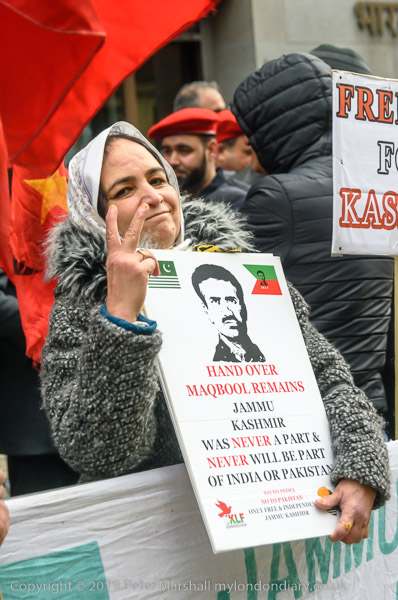
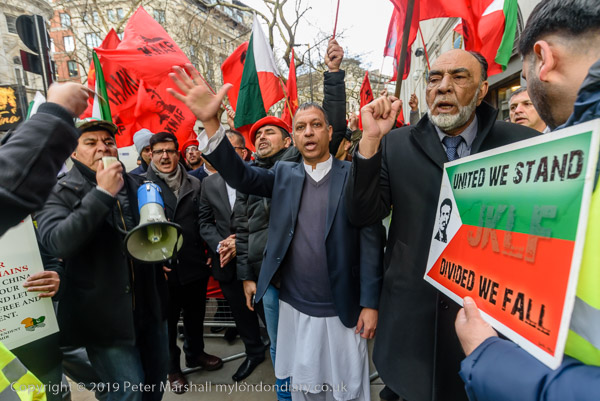
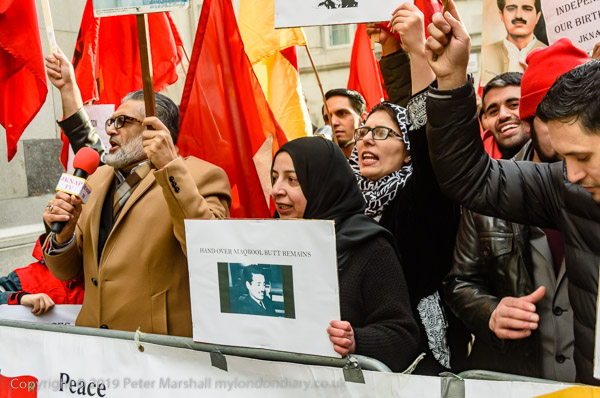
Kashmiris call for freedom

A YouGov survey back in 2016 found that 43% of UK respondents still felt that the British Empire was a good thing, over twice as many as those who felt it was bad, with a similar figures for those who think we should be proud of colonialism as part of our history or regret it.

I wasn’t one of those asked for my opinion (the chances of that were small, as the sample was only 1733 out of the UK population of around 65.65 million) and would probably have refused to give an answer as there wasn’t a category that expressed my feelings. Clearly the British Empire was a good thing for Britain, as the opulent architecture of our major cities from the 19th and early 20th centuries demonstrates. And while the disastrous effects on other civilisations and many brutal and immoral acts in the building and maintenance of our Empire are clear, there are also more positive instances. And in some countries we took over from earlier invaders or rulers who were even less principled and more harsh and brutal, though for Kashmir this was less clear.

The history of Kashmir is complex but certainly at the start of the ‘Common Era’ (still AD to most of us) it was a considerably more developed and ancient civilisation than anything in Britain. Originally an important centre of Hinduism and Buddhism it largely converted to Islam in the 13th and 14th centuries and around 1580 was conquered and became part of the Mughal empire. Around 1820, it was conquered again by Sikhs, who imposed harsh anti-Muslim laws and exorbitant taxes. The First Anglo-Sikh war waged by the East India Company between 1845 and 1846 resulted in Jammu and Kashmir becoming a princely state under British suzerainty. The persecution of Muslims, now by Hindus, continued under what was a tyrannical feudal system.

Logically, Kashmir, over three-quarters Muslim should have become a part of Pakistan, but after popular protests and a guerrilla campaign supporting this, the country’s ruler appealed to Lord Mountbatten, Governor General of India, for help – and Mountbatten only granted this on condition that Kashmir became a part of India. Pakistan disputed this and the countries went to war over Kashmir, ending with a truce and a UN resolution that the people of the country should have a referendum. This never happened and there were further wars in 1965, 1971 and 1999. Pakistan now controls around a third of the country, India about half and a smaller area is held by China.

The country is still a ‘disputed territory’ and the is a huge presence of Indian military and para-military forces in the area under their control, estimated at around 1 for every 17 Kashmiris. At the 1948 ceasefire Kashmir was promised special status with a substantial autonomy by India, but increasingly this has been abandoned. Recent years have seen greater activity by movements calling for the restoration of autonomy and for freedom and independence.

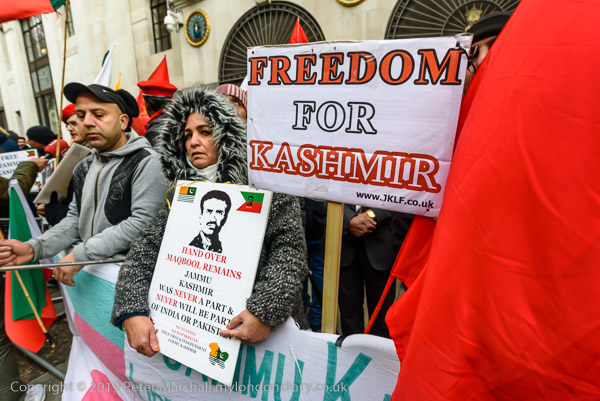
Maqbool Bhat Shaheed was the pioneer of the Kashmiri Freedom Struggle and in 1968 was captured in Kashmir and sentenced to death following the murder of an Indian CID officer. With others also sentenced he escaped from prison through a tunnel and made his way to the Pakistan administered area – were he was arrested and tortured for several months. In 1971 masterminded the hijacking of an Indian Airlines plane which was forced to land in Lahore, Pakistan. The hijackers demanded the release of over 20 members of the Jammu Kashmir Nationalist Liberation Front (JKNLF) in Indian prisons, asked for political asylum in Pakistan and wanted a guarantee from the Indian government that their relatives in Kashmir would not be persecuted.

Although the hijackers were first welcomed in Pakistan, when it was realised that the JKNLF wanted the Pakistan occupied area of Kashmir also to be liberated they were tried in a special court charged with collaboration with the Indian intelligence services. Released after 2 years he returned to Indian administered Kashmir where he was captured in 1976. Bhat appealed for clemency stating that the original trial had been unfair, but after the murder of an Indian diplomat kidnapped in Birmingham demanding his release, his appeal was dismissed and he was executed on 11th February 1984.

Kashmiris call for freedom

Kashmir Awami Party call for Freedom


There are no adverts on this site and it receives no sponsorship, and I like to keep it that way. But it does take a considerable amount of my time and thought, and if you enjoy reading it, please share on social media.
And small donations via Paypal – perhaps the cost of a beer – would be appreciated.

All photographs on this and my other sites, unless otherwise stated, are taken by and copyright of Peter Marshall, and are available for reproduction or can be bought as prints.

To order prints or reproduce images

Simple Cyanotypes

Congratulations are due to Mike Ware for both his development of a new ‘Simple Cyanotype‘ process and for his generosity in making the details of this and all his other contirbutions over the years to alternative photographic processes freely available to all.

Back in the days when I had time for such things, in the 1980s and 90s, I played a little with most of the methods for photographic print-making using hand-coated paper, largely out of interest in the history of our medium, which was one area of my writing and teaching. I made cyanotypes, along with kallitypes, palladium and platinum prints, gum prints, salted paper prints, carbon prints, photogravure and more, some more successfully than others.

I’ve written before about how I started in this area, together with friends Terry King (and here) and Randall Webb, both sadly no longer with us. Terry went on to make a considerable reputation and something of a living as both a teacher and printmaker using these processes, developing his own tweaks on various of them. He came to alternative processes as a poet and an artist, and occasionally I and later several others helped him out a little with the science.

Mike Ware is a scientist, and approached the processes in a much more scientific way, though that did not stop him making the impressive images you can see on his web site galleries. But it did mean that he was able to develop the chemistry in new ways, notably in his improved cyanotype process, and now with the new Simple Cyanotype.

You can read a discussion of the short-comings of the traditional cyanotype, first invented by Herschel in 1842 (and used most effectively by Anna Atkins the following year) and the advantages of Ware’s new simple and safe method in Towards an Unproblematic Cyanotype Chemistry. I found it particularly illuminating in helping to explain why I never encountered some of the problems so many others had – simply the good fortune of having purchased an excellent sample of the light sensitive but “ill-characterised” ferric ammonium citrate, and chosing the right papers to use it on.

The Simple Cyanotype uses readily available chemicals which are relatively safe, though still need handling with care, particularly ammonia. I once made the mistake of sniffing from a bottle whose label had fallen off (having trained as a chemist I should have known better) which turned out to be concentrated ‘880’ ammonia, and staggered back as if punched with my nostrils cauterized.

We are now much more environmentally conscious, and some of those materials which we handled carefully but perhaps disposed down our drains with too little thought are now often rightly subject to much tighter controls. I was rather pleased a few years ago to dispose of virtually all of my extensive chemical collection collected over the years I worked in alternative processes rather than leave a possibly tricky and expensive problem for my executors. Chemical safety is important – and some of those needed for old processes are now unobtainable by private individuals in some countries.

It also allows control of contrast, something which was always a problem in making cyanotypes, where negatives had to be produced specially for the process. It relies on the production of a relatively newly discovered iron complex, made in solution from the cheap and pure iron(III) nitrate – perhaps coincidentally the same starting material that I had used for many of my later iron process prints, though I used it with the much more toxic oxalates. It wasn’t then an orginal idea, but one I adapted from another source and used the same solution with its excess nitrate ions still present to produce various types of print.

Ware gives full details of how to make the solution, coat paper, expose and develop, and it does really seem to be a useful new process, and I feel quite excited by its possibilities. If I had the time and not so much else I want to do it might be something I would try again, but exactly the same thing that stopped me making cyanotypes twenty or more years ago would do so again.

I didn’t really want blue prints. But if you do, this seems the way to go.

April 2019 complete

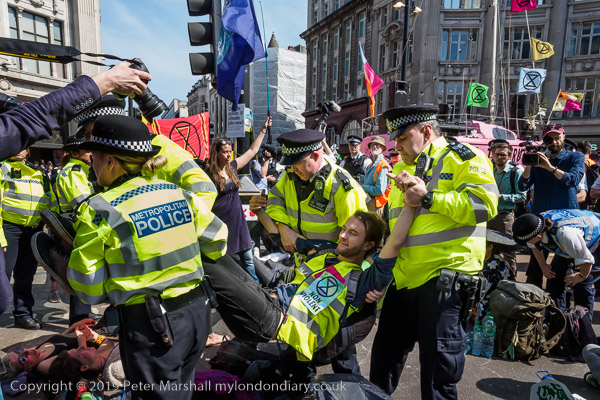
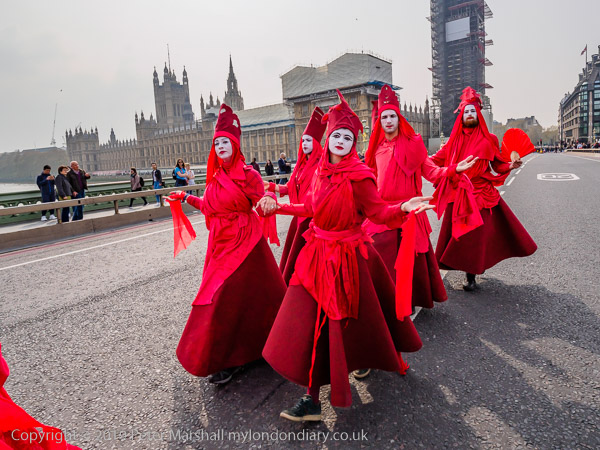
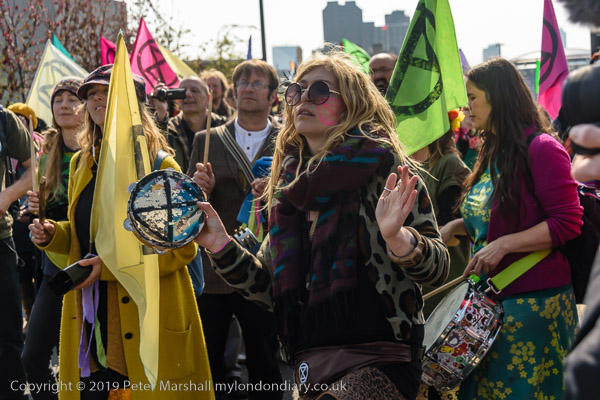
April may only have had 30 days, but it was a very long month for me, particularly because of the actions by Extinction Rebellion, XR. Though many friends have reservations (or worse) about them and their methods, particularly over their attitude to the police and arrests, their protests have begun to change the debate, though so far not actually got our government to take any of the actions needed to save life on earth. Perhaps the only action the Conservative government have so far taken is to put pressure on the Met police to be tougher on any further protests.

I suspect that the total of 41 posts probably is the most I’ve made in any month on My London Diary, though I’ve not gone through the site to check, As you will see from the list below XR was not the only thing happening in April.

My London Diary – Apr 2019

Protest against Israeli Army Recruitment
XR Families and Children at the Treasury
50 days anti-racist occupation at Goldsmiths
Protests at Anglo-American mining AGM


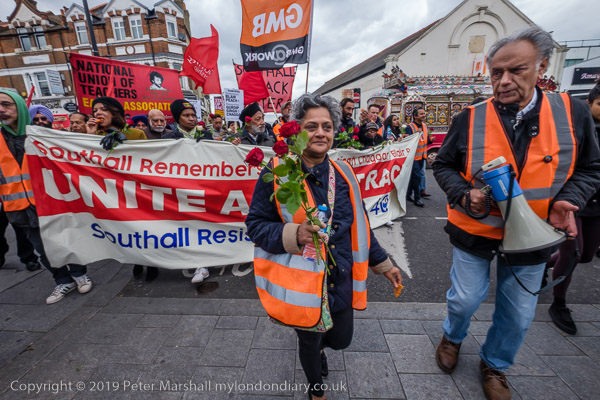
Southall rally for unity against racism
Disabled protest against Facebook
XR March back from City protests
Azerbaijanis & Armenians at Turkish Embassy
Extinction Rebellion at Marble Arch
Extinction Rebellion in Parliament Square
Free Julian Assange
Capital Ring – Hendon to Highgate
Police clear XR from Oxford Circus

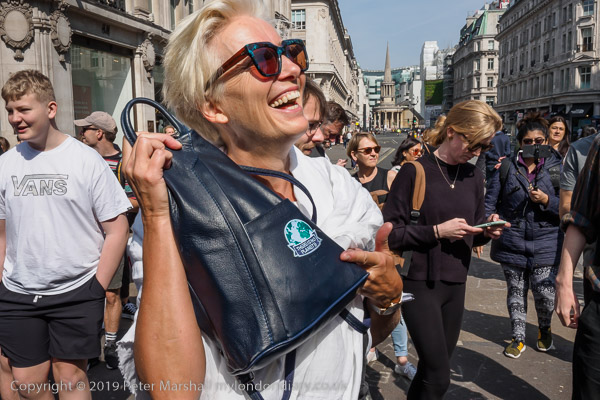
Emma Thompson speaks at XR
Knife crime Operation Shutdown
Drax Protest at BEIS

XR around Parliament Square
Drax wood burning must end
XR Waterloo ‘Garden Bridge’ continues
Save Lambeth Children’s Centres
Extinction Rebellion at Shell
Extinction Rebellion Funeral Procession
Extinction Rebellion Marble Arch
Anti-capitalist environmental action
Extinction Rebellion Sea at Oxford Circus

Extinction Rebellion Garden Bridge
Brexiteers march at Westminster
Sewol Ferry Disaster 5 years on
Love the Elephant
Against extinction and trophy hunting
Times end transphobic articles
Regent’s Canal
Scrap Universal Credit Jobcentre protest
Tottenham and Spurs
Brexit protesters
Living wage at Dept of Business
Staines Walk

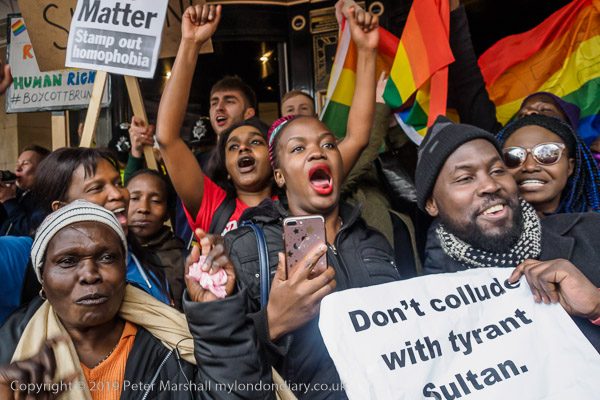
Brunei Sultan gay sex stoning protest
Sudanese for Freedom, Peace and Justice
Private hire drivers protest congestion charge
Windsor walk

London Images


There are no adverts on this site and it receives no sponsorship, and I like to keep it that way. But it does take a considerable amount of my time and thought, and if you enjoy reading it, a small donation – perhaps the cost of a beer – would be appreciated.

My London Diary : London Photos : Hull : River Lea/Lee Valley : London’s Industrial Heritage

All photographs on this and my other sites, unless otherwise stated, are taken by and copyright of Peter Marshall, and are available for reproduction or can be bought as prints.

To order prints or reproduce images

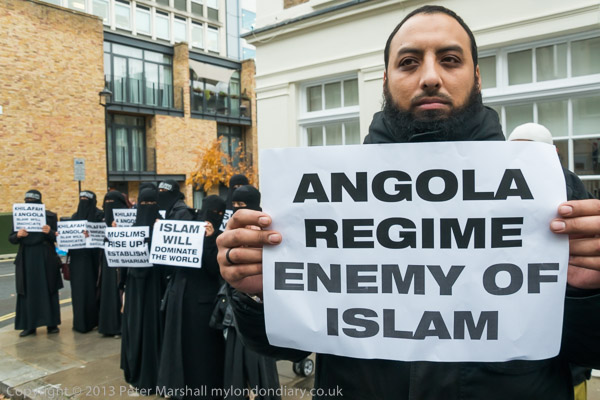
Angola & Muslims

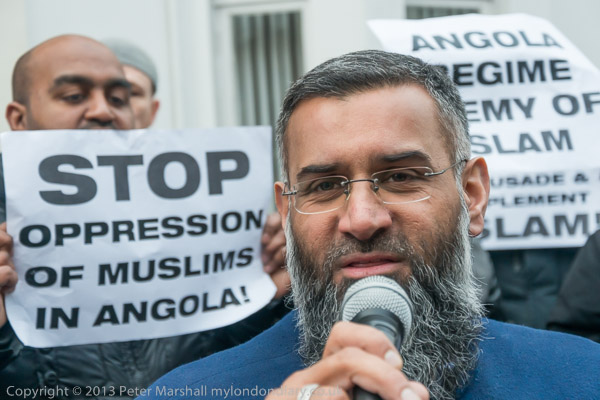
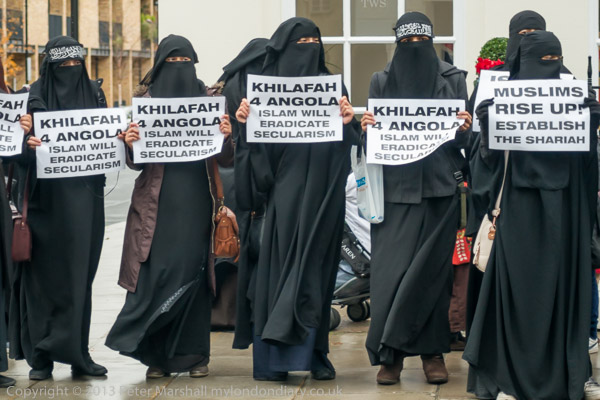
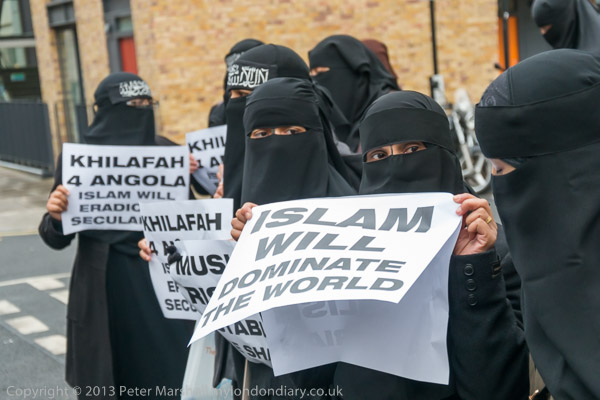
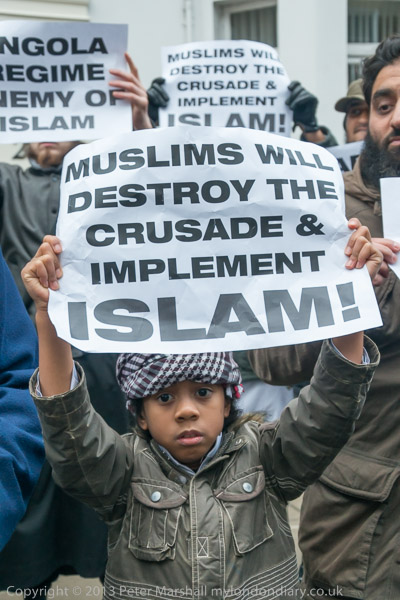
I don’t know how much you know about Muslims in Angola, but when I took the picture above outside the Angolan Embassy just off Baker St in London I knew very little. So of course I Googled it, and came up with several articles, including one in The Guardian and I think on Wikipedia, and wrote a little about why this protest was taking place to go with my pictures, along with rather more about Anjem Choudary who came along to speak at the event.

Thanks to a post by AFP Fact Check, from AFP Kenya, I now know that these pictures have in recent months been shared on social media along with pictures from various countries showing mosques being demolished in posts falsely claming that Islam has been banned in Angola

Mary Kulundu, the author of ‘No these pictures are not evidence of Angola banning Islam‘ searched for the pictures online:

Finally, there are two photographs of Muslims protesting against the Angolan government. A reverse image search on Tineye showed that these two images were originally published in 2013 by the British photographer Peter Marshall on his website, My London Diary.

It isn’t of course true that Islam was banned in Angola, but an Islamic organisation had failed to get legal recognition in Angola, along with many other non-Christian organisations, which greatly restricts their activities. Several mosques have been destroyed and others closed and Wikipedia gives some some details, though the article may not be not up to date. But there are said to be 60 mosques still open in the country and Muslims are free to practice their religion.

But Muslims in Angola are still trying to get official recognition almost six years later, though apparently there is less opposition now, and the number of signatures required by any religious congregation to acheive recognition has been lowered from 100,000 to 60,000. Estimates of the total number of Muslims in Angola vary wildly from around 80,000 to 800,000, almost all of them Sunni Muslims.

Back in November 2013 I speculated on why Choudary had not yet been arrested, and a couple of years later he was, and sentenced for urging others to support ISIS. Of course when I took these pictures in November 2013, few had heard of ISIS, which was only proscribed in June 2014 . When Choudary talked about Sunni armies being on the move and establishing the Khalifa (caliphate) I thought he was being a fantasist, but all too soon the reality became clear.

See and read more at Islamists Protest Angolas Ban on Muslims


There are no adverts on this site and it receives no sponsorship, and I like to keep it that way. But it does take a considerable amount of my time and thought, and if you enjoy reading it, a small donation – perhaps the cost of a beer – would be appreciated.

My London Diary : London Photos : Hull : River Lea/Lee Valley : London’s Industrial Heritage

All photographs on this and my other sites, unless otherwise stated, are taken by and copyright of Peter Marshall, and are available for reproduction or can be bought as prints.

To order prints or reproduce images


Whose face in the surf?

The detailed and forensic investigation of Capa’s D-Day pictures by A. D Coleman and his co-workers continues to come up with fresh information and insights. Ordinarily I wouldn’t be much interested in the precise events of Tuesday, 6 June 1944, or indeed of any other day of World War Two, but two things make it of great interest.

The first is that whatever the precise circumstances (and we now can be sure what with remarkable accuracy what these were) Robert Capa produced on of photography’s most iconic photographs there, and one that has accreted to itself a remarkable body of largely incorrect legend in writing and film, and secondly that in a couple of weeks time the events of that day will be the subject of major celebrations, which will doubtless parade much of the imaginative inventions around the ten or eleven pictures Capa made duing the landing.

The latest addition to our knowledge comes again from ‘combat veteran and amateur military historian Charles Herrick’ and gives us some insight into about how legends about such events arise, through what Coleman has called “borrowed glamour”.

Apparently quite a few ex-soldiers over the years came to believe that they were the ‘face in the surf’ in Capa’s most famous picture, and in the first of three parts of his latest investigations Herrick examines the claims made by two of the men who actually took part in those D-Day landings .

The best known of the contenders is Huston “Hu” Riley, who landed with Company E, 2nd Battalion, 16th Infantry Regiment in the first wave of infantry, and claimed that a man wearing a war correspondent’s patch on his shoulder helped him up out of the surf. Herrick points out that Capa didn’t wear the patch and wasn’t on the beach at the time the first wave arrived. Whover helped Riley up, it wasn’t Capa.

The second account he discusses is by Charles Hangsterfer, Headquarters Company commander and adjutant of the 1st Battalion, 16th Infantry Regiment, who claimed to have met Capa on the beach, but Herrick shows the details of his story and Capa’s movements on the day make this impossible.

These memories of “borrowed glamour” from the stories recorded by those who took part in the landings usually 50 or 60 or 70 years later are not a case of deliberate deception, but as Herrick writes “When memories fade, it is human nature to reinterpret events in more favorable lights, or place oneself in slightly more important or significant circumstances.” Retelling our stories we always add a little, often confusing our own memories with what others have told us, and with what we have read in books and films (and for D-Day veterans particularly ‘Saving Private Ryan‘) , and bit by bit our memories shift from experience to fabulation.

I don’t expect it will ever be possible to make a positive identification of the face in that surf. Capa’s picture isn’t clear enough to really recognise anyone and too much time has passed. Although we can be sure that whoever it was made it safely onto what was by then a relatively safe beach, he could have been killed minutes, hours or days later during the war; even if he made it safely back to the USA he may well have forgotten the incident and would probably have been unable to recognise himself in the photograph.

But perhaps among those who have put themselves forward as that man, there may be one – or more – who could possibly have been that man. I await parts two and three of Herrick’s post to see if he can cast any more light. But in the end it perhaps doesn’t matter. Like the grave of the unknown soldier, Capa’s picture perhaps gains from his anonymity, the photograph of an unknown man.

Swansong

Another blog ends, along with that of Lens I wrote about yesterday.

I was very sorry to read that David Secombe has written his last post for ‘The London Column‘, a blog I’ve occasionally read over the years and which has featured the work of several people I know, mainly photographers. It’s “Pictorial reports from the life of a city 1951 to now” began in 2011 and they make some interesting reading, featuring “contributions from some of the best writers and photographers from the past sixty years“.

Swansong, published a couple of weeks ago, but which I only came across yesterday, takes a look at the work of Marketa Luskacova, with her pictures from Spitalfields in the late 1970s and early 80s along with her earlier pictures of middle-European pilgrims and the villagers of Sumiac, a remote Czech hill village, both of which featured in her show which closed last Sunday at Tate Britain.

It’s a show I mentioned on >Re:PHOTO in February, though really only in passing, in a piece mainly about the anti-Brexit SODEM protesters. In it I wrote:

‘Finally arriving at Tate Britain I had to find the show, which wasn’t easy – the gallery does really need to look at its signage. Finally I asked one of the gallery staff who didn’t really know but gave me a map and pointed in roughly the right direction. The show does continue until May 12th 2019, so if you start now there is some chance of finding it by then.’

This was echoed at the start of Secombe’ post:

‘Anyone staggering out of the harrowing Don McCullin show currently entering its final week at Tate Britain might easily overlook another photographic retrospective currently on display in the same venue. This other exhibit is so under-advertised that even a Tate steward standing ten metres from its entrance was unaware of it.’

But Secombe goes on to write at some length about Luskacova’s work, around eight well-chosen examples, concluding with the statement “It seems appropriate to close The London Column with Marketa’s magical, timeless images.”

So far as I can recall, I’ve never met Secombe, though we share many interests and his ‘Blogroll’ is largely of web sites which I visit at least occasionally and I’m sure we must have at least occasionally found ourselves at some of the same places at the same time. I do hope that he keeps the site online, as there is much on it that remains of interest.

Keeping up a blog like ‘The London Column’ takes a lot of time and effort – as does this one, and even more so, My London Diary (a blog in spirit though all my own website code, started back when blogs were in their infancy) I’ve often thought about bringing both to an end, but while this still gets a few thousands of readers everyday it seems as useful a way of spending my time.

Lens Ends

Sad news to hear that the New York Times Lens blog is to end at the end of this month, May 2019. You can read more about it on PDN News. The closure, described by the NYT as a “hiatus” for an indefinite period means the end of one of the more thoughtful and innovative blogs about our medium after around ten years, with a number of posts by James Estrin and his co-editors that I’ve mentioned here – though not as many as I might.

Meaghan Looram, NYT director of photography, says it is time to rethink and “give serious thought to how to better position Lens for the future.” I suspect that means a dumbing down and an end to contributions by people with any great love or knowledge of photography, though I sincerely hope I’m wrong.

Lens has been more than just another photography blog. As PDN points out it has promoted many emerging photographers as well as highlighting work from earlier eras that has often been overlooked or under-appreciated. And importantly, as it states “Lens is one of the few photo blogs to pay the photographers whose work it features.”

That’s an important point, not just because many photographers need the money – it’s very tough for many, particularly young photographers to make a living, but because so many others seem to assume that photographers can live on ‘exposure’. But exposure won’t pay the bills. Are the journalists, the printers and others involved in publications and campaigns working for free? When anyone asks me if they can use my pictures without payment I have a simple question to whoever is asking – ‘Are you being paid for your work? ‘

Of course my suspicions about Lens are based on my own experience with the NYT, who bought a company I worked for and ruined it because the bean counters were determined to aim at the lowest common denominator and forced out those of us who wanted to write intelligently. By the time they sold it on it had lost most of its financial value and virtually all of its credibility.