Sri Guru Singh Sabha Gurdwara 2005

Sixteen years ago on Saturday 1st October 2005 I was fortunate to be able to go with friends from the now long defunct London Arts Café on a visit to the Sri Guru Singh Sabha Gurdwara completed in Southall in 2003 with the building’s architect Richard Adams of Architect Co-Partnership and one of the Sikh volunteer guides. The temple, built with over £17m of local donations was said to be the largest in the western hemisphere, intended to be “a temple second only to the Golden Temple in Amritsar, with a life expectancy of a minimum of 100 years“.
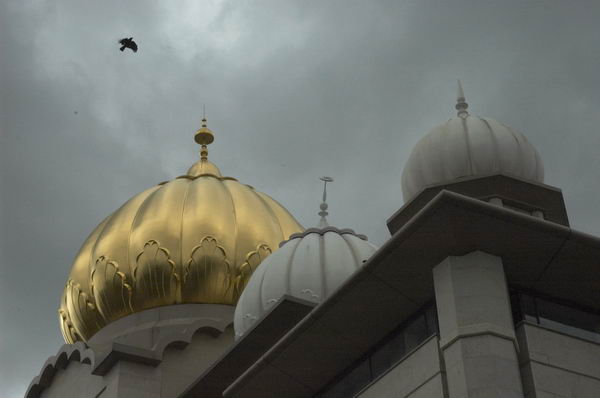
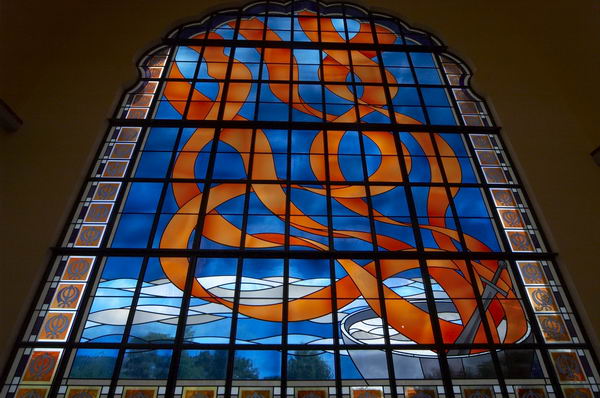
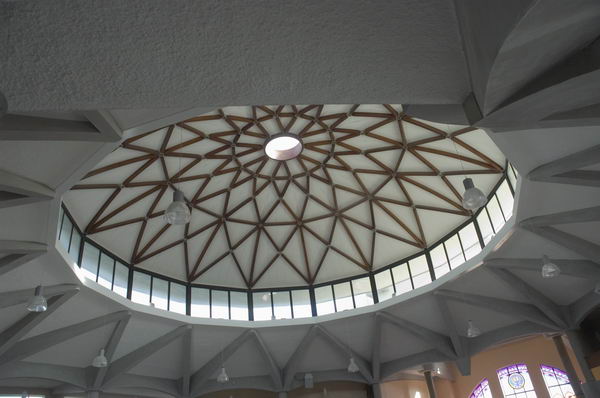
The architects had won the commission in open competition and working with the Sikh community and had produced what I described as “a building suited to their needs, and it does so impressively:clean simple surfaces, powerful colour in the windows and light streaming into the central stairway and lobby from the large window and glass roof areas.” I hope my pictures convey something of this.
Here’s some of the text I wrote about the visit at the time, when I was posting entirely in lower case:

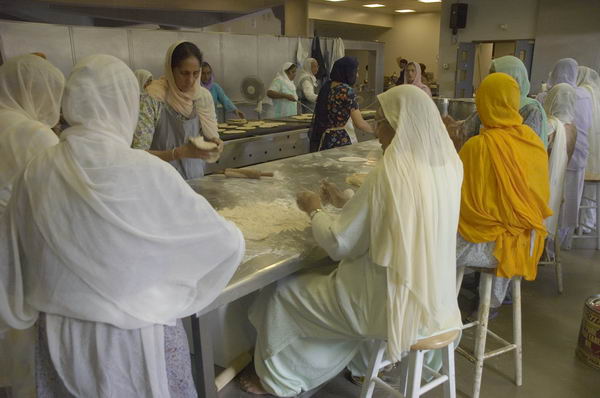
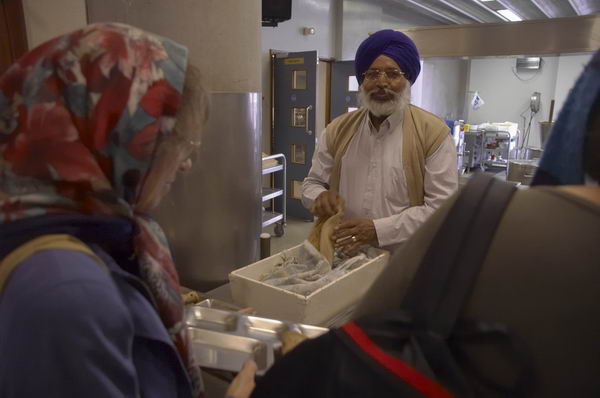
the sri guru singh sabha gurdwara serves the community, both for workship and for other needs. as well as a vast prayer hall officially capable of seating up to 3,000 people (and actually holding rather more at major festivals) there is a fine marriage room, and various other facilities including a langar (dining hall); this free community kitchen can serve over 20,000 vegetarian meals over a festival weekend.
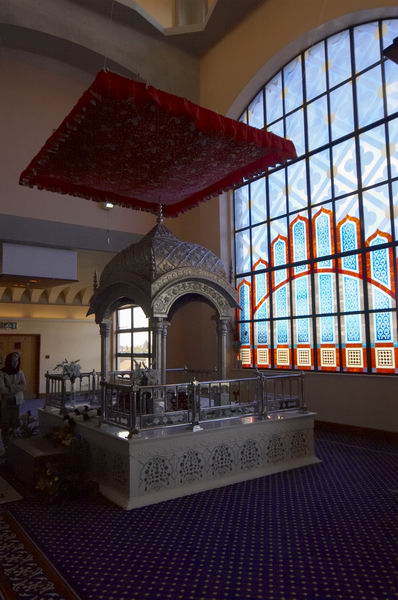
the gurdwara had a powerfully religious atmosphere. on entering we followed the customary practice of removing our shoes, covering our heads with the scarves provided and washing our hands before commencing our visit. at various points both our guide and the architect explained how the building served the basic sikh tenets of service, humility and equality, and also the spiritual guidance from the sri guru granth sahib, the religious writings which are were appointed as spiritual head of the sikh religion, the eternal guru, by guru gobind singh around three hundred years ago.
although the architecture and the prayer hall in particular were impressive, what made the strongest impression on me was the kitchen, especially the team of women working together. the food was excellent, a real pleasure to eat, although my still rather painful knee made it easier for me to stand and eat at one of the tables rather than in the traditional manner seated on the floor. although food is free, those eating may perform some service to the temple in thanks for their food, or give an donation of some kind, which we gladly did.
southall is now britain’s holy city, apparently with places of worship for over 50 religions or denominations. brother daniel faivre’s ‘glimpses of a holy city’ published in 2001 after more than 20 years of living in southall gives a good insight into some of this diversity.

More pictures on My London Diary.


All photographs on this and my other sites, unless otherwise stated, are taken by and copyright of Peter Marshall, and are available for reproduction or can be bought as prints.
Unite Against Racism

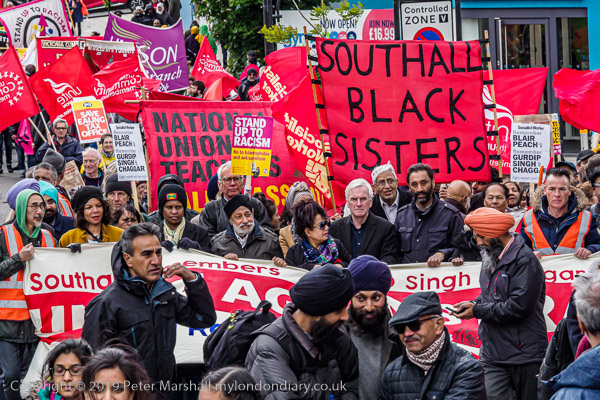
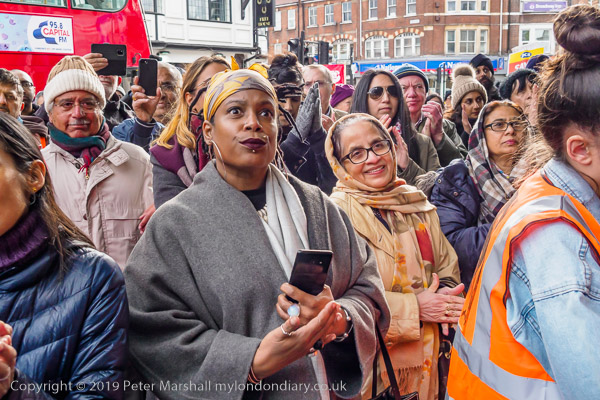
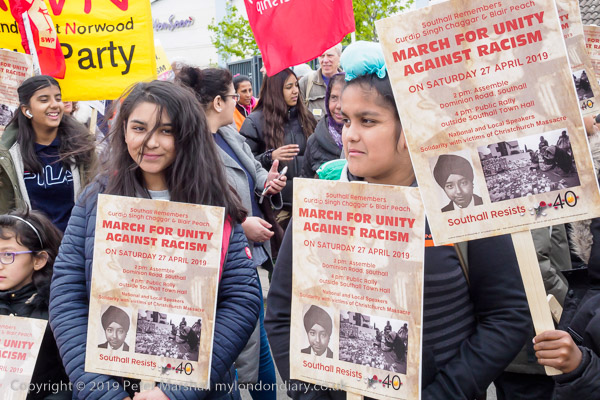
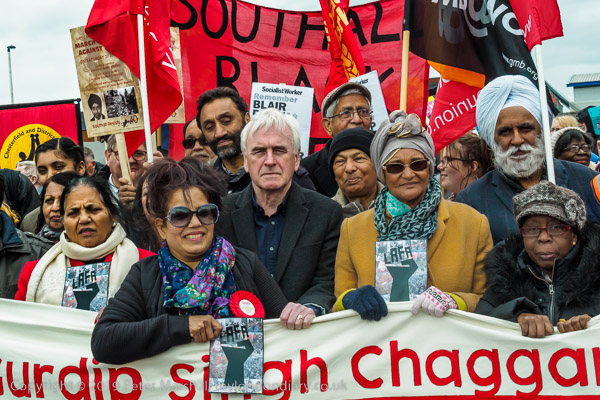
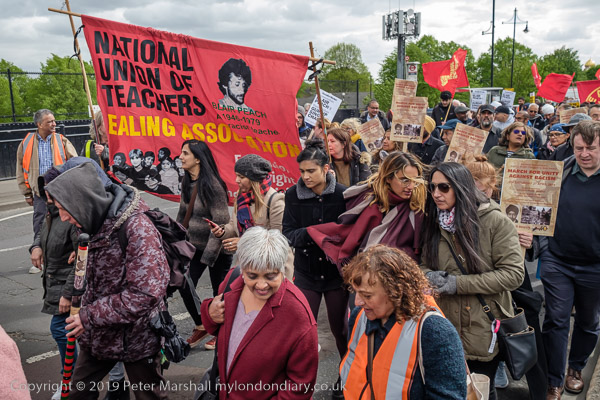
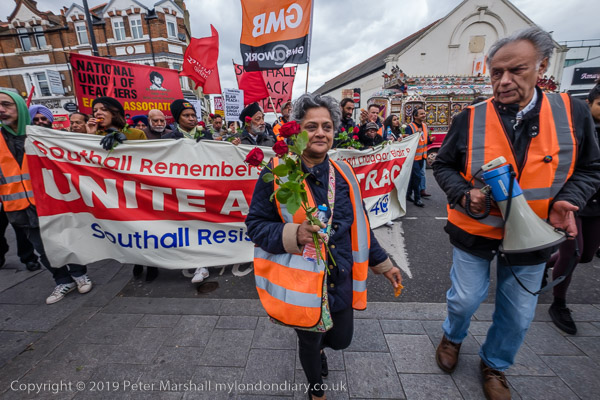
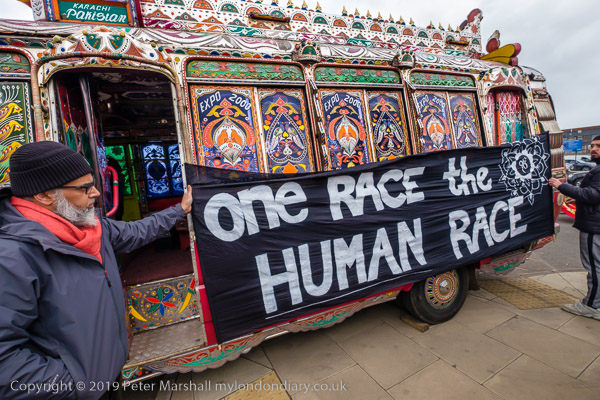
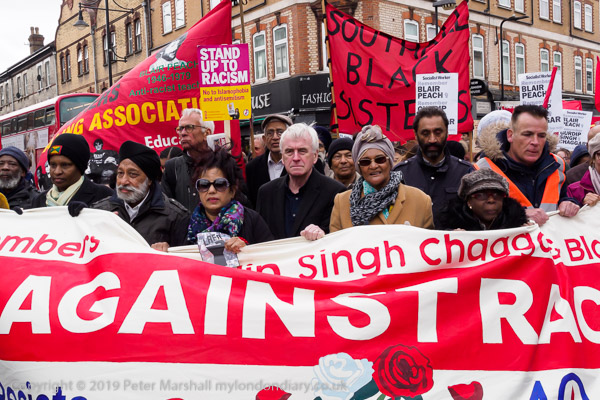
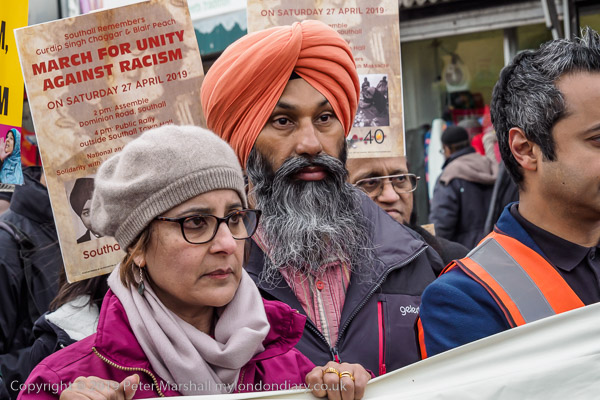
Two years ago today, 27 April 2019, I joined with a large crowd in Southall remembering the murders there of Gurdip Singh Chaggar and Blair Peach, calling for unity against racism.

The march took place on the Saturday after St George’s Day, and marked the 40th anniversary of Blair Peach’s murder by police officers. Several thousand police had packed the town to defend the National Front who were holding a meeting at Southall Town Hall. A large group of the local community and supporters from across London had come to oppose the meeting, and and police rioted and attacked what had been a determined but largely peaceful protest. Wikipedia has a long and well referenced article on the murder from which many of the facts below are taken, though speeches at the 2019 protest also included some eye-witness accounts. Peach was a member of my own union at the time, the NUT, which also made me very aware of the events and was prominent in the fight to see justice.

Blair Peach was in a group of friends who tried to escape the violent police attacks on Southall Broadway and make their way home down a side street, but unfortunately this led nowhere and the police Special Patrol Group drove up in several vans and began attacking the crowd there, who responded with bricks and bottles. Witnesses, including residents on the street say the police were hitting everybody and fourteen saw a police officer hitting Peach on the head.

People obseve a minute of silence where Gurdip Singh Chaggar was killed

Forensic evidence found he had been hit with an illegal weapon, probably a lead-filled cosh or pipe, and searches of the lockers of the SPG unit involved found 26 illegal weapons. None of the witnesses were able to identify the police officer involved – perhaps because one officer had shaved off his moustache and another grew a beard and refused to take part in the identity parades. Many also had their uniforms dry-cleaned before the police investigation inspected them.

Although the police investigation had produced a great deal of evidence against the SPG, the DPP decided it was insufficient to justify a prosecution. The report was kept secret, though parts appeared in the press early in 1980, and the inquest was hampered as the legal team acting for the Peach family were not allowed access to it. The verdict of the inquest, ‘death by misadventure’ was widely considered – even by The Times – to have been inappropriate. The coroner afterwards wrote an article including his comments that some of the civilian witnesses had lied as they were “politically committed to the Socialist Workers Party” of which Peach was a member and that some Sikh witnesses “did not have experience of the English system” to enable them to give reliable evidence but was persuaded not to publish it.

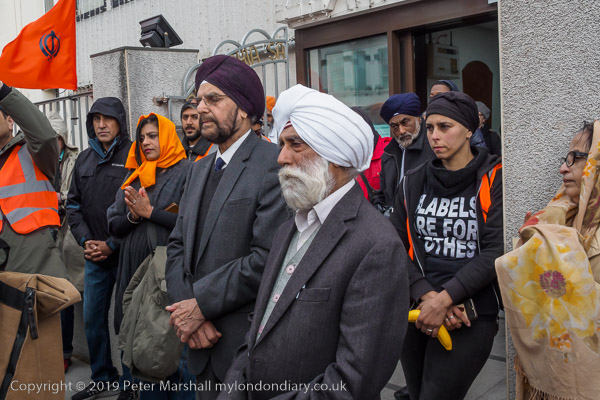
At Ramgarhia Sabha Gurdwara


The fight to get justice over the murder continued, but none of the officers involved was ever brought to trial. Apparently all left the police force shortly after the investigaton. Peach’s family were awarded £75,000 compensation in a tacit admission of police guilt by the Metropolitan Police in 1988, but requests for a public inquiry were turned down by the Home Office. The SPG was disbanded in 1987, but replaced by a very similar Territorial Support Group. It was only following a member of the TSG killing newspaper vendor Ian Tomlinson as he was walking home past the G20 protests at Bank in 2009 that the report of the police investigation into Blair Peach’s death was finally made public.

The 2019 march and rally in Southall convened close to where Gurdip Singh Chaggar, an 18 year old student, was murdered by racist skinheads in June 1976 as he left the Dominion Cinema and began, at the request of his family with a karate display. It paused for a minute of silence where his was killed before moving on to stop at the Ramgarhia Sabha Gurdwara which the Chaggar family attend, where prayers were said.

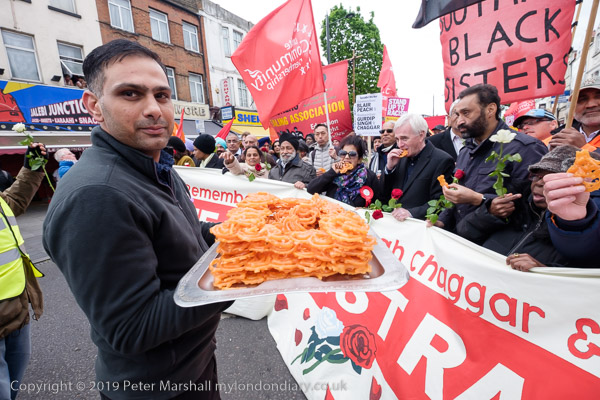
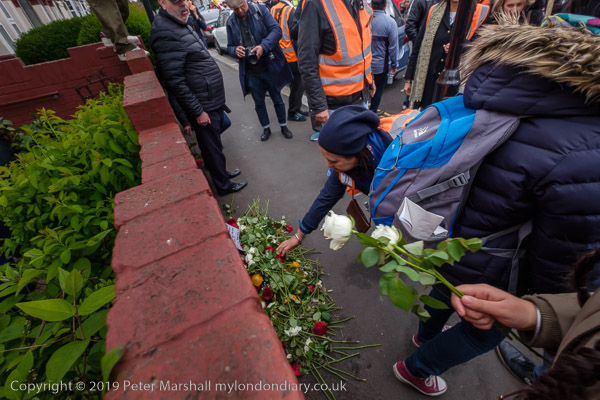
Flowers were handed out which were then laid at the street corner where Blair Peach was murdered before we moved on to a rally outside Southall Town Hall where the National Front held their meeting. Peach’s murder inspired the formation of both the anti-racist grassroots group The Monitoring Group, whose founder and director Suresh Grover introduced the event and of Southall Black Sisters, whose founder Pragna Patel who was one of the speakers, along with other community leaders and anti-racists.

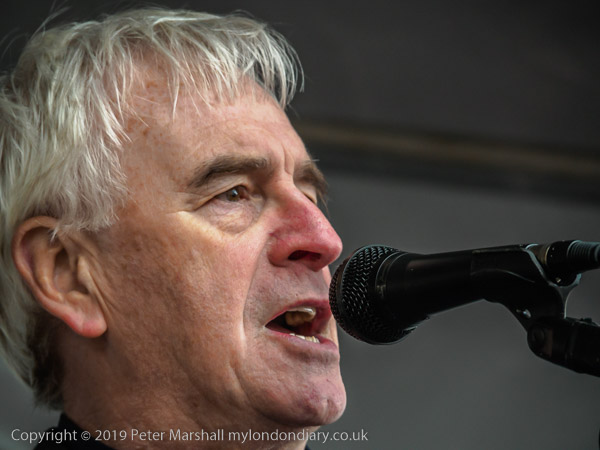
Perhaps surprisingly absent was the local Labour MP, Virendra Sharma, who in 2019 lost a vote of no-cofidence by the local party apparently due to his low attendance at party meetings, slow responses to constituents and failure to campaign over local redevelopment issues. John McDonnell, Labour MP for a neighbouring constituency and then Shadow Chancellor was there from the start of the march and made a powerful speech.

More about the event and many more pictures: Southall rally for unity against racism

Gurdip Singh Chaggar & Blair Peach

This wasn’t the first time I’d been to Southall for a rally remembering the murder there of Blair Peach by the police Special Patrol Group in 1979, though I don’t remember if Gurdip Singh Chaggar’s murder was also remembered at those earlier events.

Blair Peach had come to the UK from New Zealand in 1969 and he was roughly my age. He was working as a teacher in the East End, and like me was an active member of the National Union of Teachers, though I didn’t come across him as I was working around 40 miles away and only involved at a local level.

I suspect we went to some of the same protests agains apartheid in South Africa and against racism, but I was not at the Anti-Nazi League demonstration in Southall on the day he was murdered, probably because although it was not far from where I was living, it was a week after Easter Monday and I was probably working and could not have arrived until it was due to finish.

The racist National Front had called a meeting in Southall Town Hall for 7.30pm, and because it was in the run-up to the forthcoming General Election on 3rd May in which the NF had a candidate (he got 1545 votes, 3.0% of the vote) Ealing Council were unable to refuse them the use of the hall, despite a petition from 10,000 local residents.

Several local groups as well as the Anti-Nazi League organised protests across the day, including the Indian Workers’ Association, outside whose offices Gurdip Singh Chaggar, coming home from the Dominion Cinema, had been set upon and murdered by skinheads in June 1976, and Peoples Unite, a largely Afro-Carribean group who along with others had been involved in disturbances which followed Chaggar’s murder.

Although there had been some reports of bricks and bottles being thrown, the real violence began when the police Special Patrol Group decided to raid a squat being used by People’s Unite as a first aid post. Two officers were reported as wounded and the SPG took out vengeance on all those in the house, and Clarence Baker was hit on the head by a police truncheon, fracturing his skull and putting him in a coma for five months.

Police had kept a cordon around the Town Hall, and escorted the fascists in. Once the meeting had begun they decided to clear the area, allowing protesters to move away westwards along Southall Broadway. Peach and a group of friends were leaving, going back to where they had parked, and turned off south down Beachcroft Road. Unfortunately for them, this road stops short, running into Orchard Rd and then going back towards the Broadway. As they approached Orchard Rd they were met by the SPG, who jumped out of their vans and were now rioting out of control and lashing out at everyone on the road. It’s unclear whether the baton wielded by the officer who killed Peach was standard police issue or as some report soemthing rather heavier. Conscious but in obvious difficulties he was taken into a nearby house and an ambulance called, but he died in hospital four hours later.

Today’s protest started close to where Gurdip Singh Chaggar was murdered and the march halted there for a minute’s silence before going on to stop outside the Gurdwara where he and his family worhsipped. Later it took Peach’s route from Broadway down Beechcroft Road and people laid flowers on the corner of Orchard Road where he received the fatal blow, before going on to a rally outside the Town Hall.

More about the protest at Southall rally for unity against racism.


All photographs on this and my other sites, unless otherwise stated, are taken by and copyright of Peter Marshall, and are available for reproduction or can be bought as prints.
There are no adverts on this site and it receives no sponsorship, and I like to keep it that way. But it does take a considerable amount of my time and thought, and if you enjoy reading it, please share on social media.
And small donations via Paypal – perhaps the cost of a beer – would be appreciated.