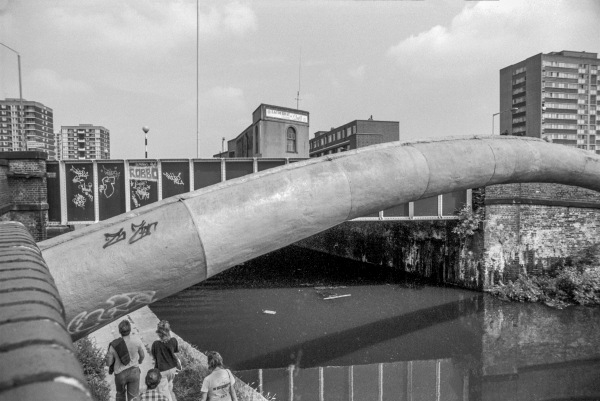
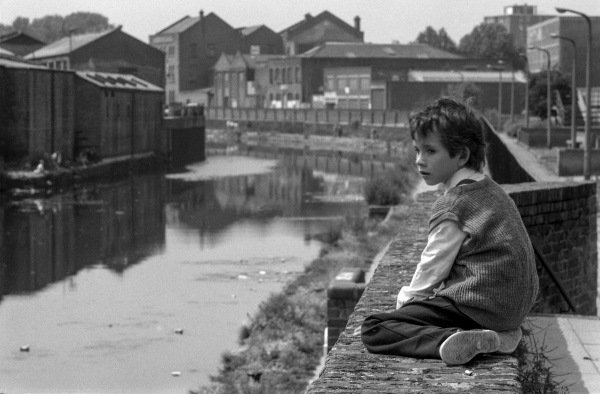
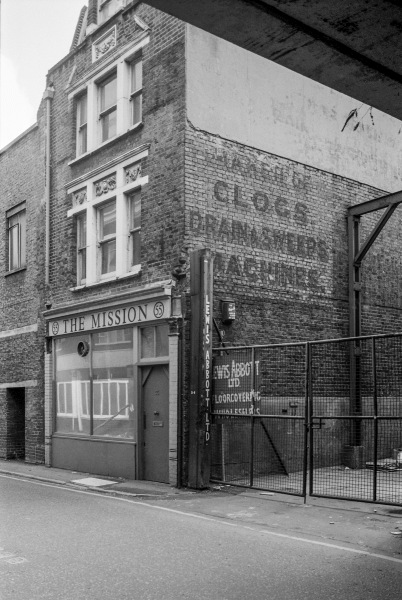
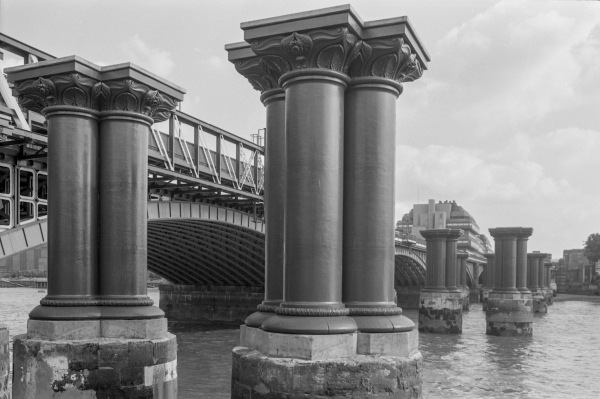
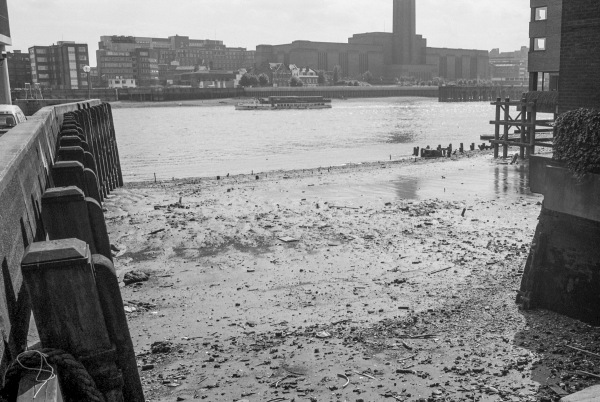
The pictures on page 6 of my 1986 London Photographs were all taken in the City of London or close to its edges in Tower Hamlets and Finsbury and include a few of its better known buildings but are mainly less well-known streets and aspects that caught my attention.

There is still a Beaufort House on St Botolph St, but it isn’t the same building. This one, dating from the 1950s with a nautical feel, was built as offices for the P & O shipping company. As I turned the corner and it hove into site it always gave me the impression of a huge liner with many deck levels that had somehow been marooned in the city.
Shortly after I took this and the other pictures on Page 6 it was demolished, with construction starting later in the year and completed in 1988 to an overblown postmodern design by RHWL Architects, a “distinctive office building” which many find hideous. In 2016 Amazon took around 47,000 square ft of its space in one of the largest office deals of that year.

While many of these buildings are still there, often they have changed a little. Permutt Fashion Stores are no longer there at 11 Wentworth St in Petticoat Lane market, which is now ‘Queen of Textile’s’ with a rather curious apostrophe but without the advertising on the upper floors – though the rectangle above the first floor window with the name C PERMUTT when I took my picture is still there, but empty. A Permutt’s at number 13 is now a nameless Dry Cleaners and Tailors. The café at No. 9 is still a café and looks very similar but is now called Simply Tasty rather than being named for the Italian city of Vernasca, though it still appears to offer home-cooked food at reasonable prices.
Searching for more about A Permutt on the web reveals little other than that in 1934 there were bankruptcy proceedings at Carey St against an Abraham Permutt, trading as A Permutt & Co, a timber merchant in nearby Brick Lane. I don’t know if there was any connection with the A Permutt whose shop was in Wentworth St.

The NatWest Tower is still there, though now longer called that, now known as Tower 42. Completed in 1980, it was the first skyscraper in the City, and still one of its taller buildings at 600ft. It has 47 floors, with 42 of them cantilevered out from a central core, and was renamed Tower 42 in 1995. The tower was extensively damaged by the IRA bomb in Bishopsgate in 1993 and required several years of work and after the refurb NatWest decided to sell it rather than move back in.
The picture shows two of the cantilevered sections. There are several walkways around the base of the building but all are private property and after I had taken several pictures I was approached by a very polite security officer who told me that photography was not permitted, showing me exactly where the boundary of the property was on the pavement and saying I could take as many pictures as I liked from there.

Although much of the area has been destroyed, this fine row of properties on Worship St remains. The street was once called Hog Lane and there are at least two suggestions for the name change. One says it got its new name from a merchant tailor, John Worshop, who owned several acres of land in the area, while others suggest it was because the first houses on the street were built with stone from the old church of St Mary Islington.
This row of artisans workshops with living accommodation above replaced older slum properties on the site, possibly dating from before 1680. The area was owned from around 1740 by the Gillum Family and in 1862 Lieutenant-Colonel William Gillum commissioned leading Arts and Crafts architect Phillip Webb in 1862 to design this block as affordable properties for craftsmen in line with the ideas of honest handwork advanced by Webb and his colleague and friend William Morris. At the right of the row you can just see the V-shaped porch over a water fountain he incorporated into the design.

13 Sun Street is now a part of the One Crown Place development which claims to have retained “the elegant row of Georgian terraces on Sun Street” as a boutique hotel and members’ club. It will perhaps have kept some elements of the facade, but I doubt if the diary will be recognisable. The whole length of the terrace which had been boarded up for years was covered with scaffolding in 2018.
Some London Dairies actually had cows in their backyards, but I think this one seems unlikely to have done so. More likely the milk would have come in churns from farms in the countryside, perhaps to the nearby Liverpool St station, on early morning milk trains.

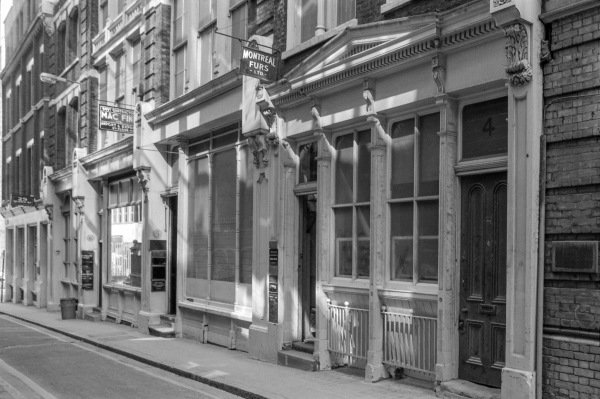
Close to Mansion House station at the bottom of Garlick Hill is Skinners Lane. Skinners and their trade were important in London and the Worshipful Company of Skinners who have a hall in Dowgate Hill were one of the 12 great livery companies, getting their charter from Edward III in 1327. Back in 1986 there were still a number of fur companies still trading in the area, particularly in Great St Thomas Apostle, including Montreal Furs, just a few doors down from Queen St. Presumably its name indicates it was trading in fur skins from Canada, where trappers still operate cruelly supplying companies such as Canada Goose.
You can still see its rather finely decorated shopfront, now a part of Wagamama.
There are 100 pictures on Page 6 of my Flickr Album 1986 London Photographs
All photographs on this and my other sites, unless otherwise stated, are taken by and copyright of Peter Marshall, and are available for reproduction or can be bought as prints.