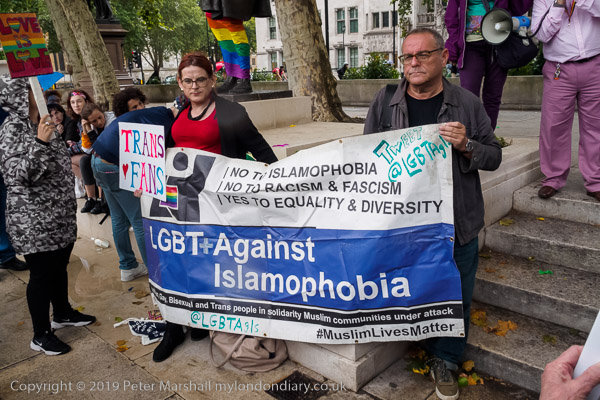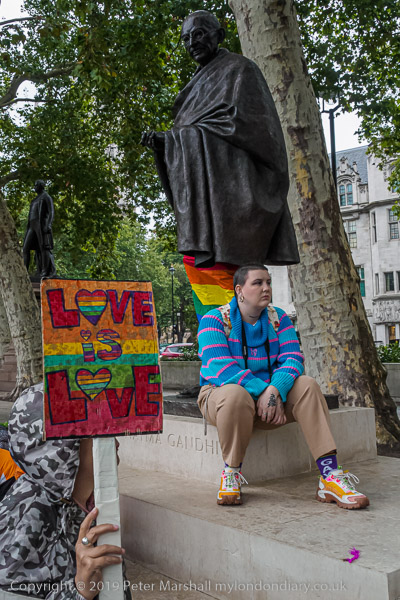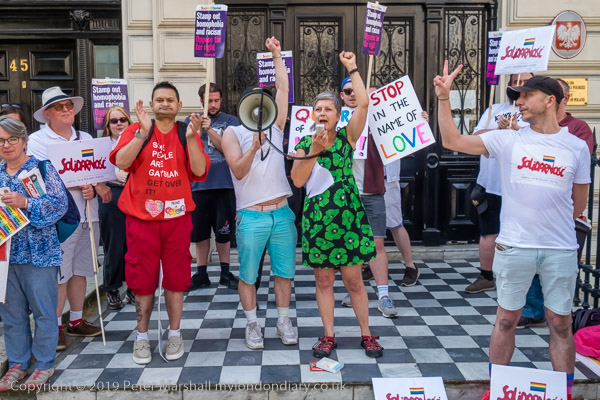
LGBTQ+ in Poland under threat

Poland has a long history of tolerance, with homosexuality only being criminalised by occupying powers (most recently during the second world war), and consensual same-sex acts were decriminalised under the Penal Code of 1932 with the age of consent being set at 15.
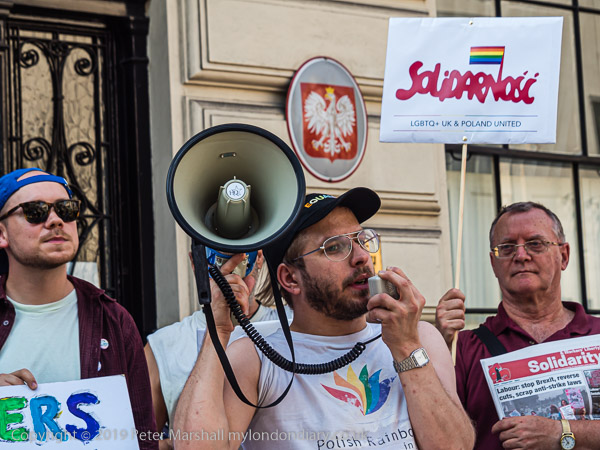
But Poland is also in many respects a deeply conservative country, with a 95% Roman Catholic population. Many basic human rights are still denied in Poland, and various EU directives on equal treatment get ignored as “unconstitutional”. Amnesty, quoted by Wikipedia, in 2015 concluded that “the LGBTI community in Poland faces widespread and ingrained discrimination across the country” and that “Poland’s legal system falls dangerously short when it comes to protecting lesbian, gay, bisexual, transgender and intersex (LGBTI) people and other minority groups from hate crimes”.
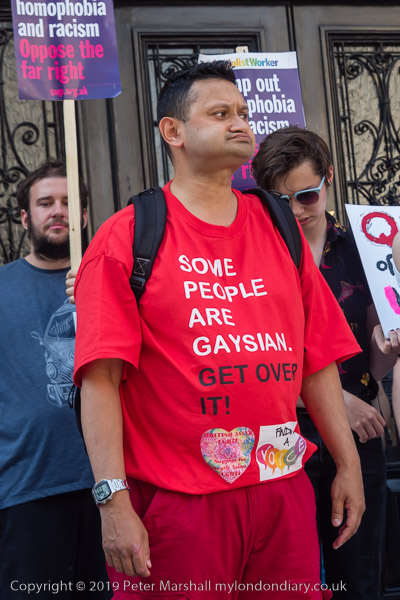
Things have got succesively more difficult since the Law and Justice (PiS) party came to power, becoming a majority government in the 2015 elections. Their campaign in the 2019 elections was strongly around opposition to gay rights, and several cities and provinces covering most of south-east Poland issued declarations of ‘ LGBT free zones’, later amended to be called ‘LGBT ideology-free zones’. In December December 2019, the European Parliament voted by over 4 to1 to condemn the over 80 LGBTI-free zones in Poland.
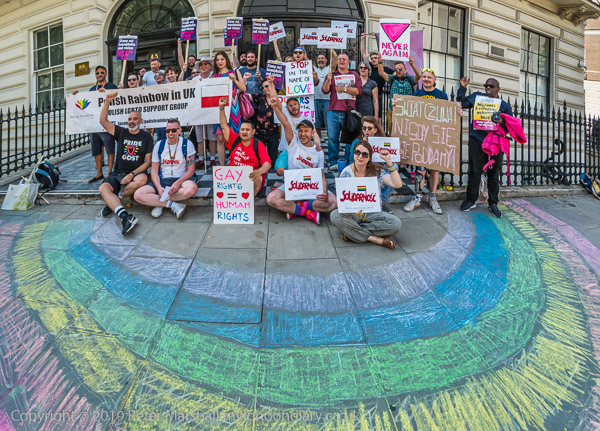
One small photographic problem was with a large chalk rainbow which the protesters had drawn in front of the protest. Showing it all in a picture that made sense was not easy. Even using the full-frame fisheye lens it was difficult.
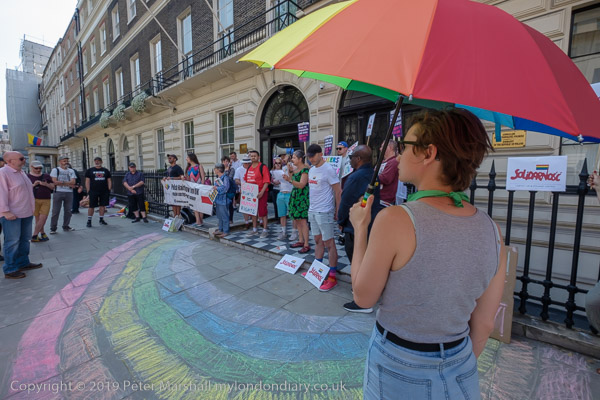
A view from one side was perhaps an improvement, and the rainbow umbrella certainly helped.

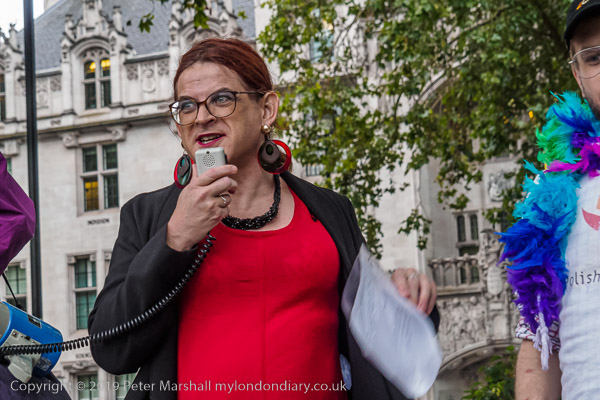
The event was a strong expression of solidarity with the Polish LBGTQ+ community, and included speeches by Peter Tatchell, Nicola Field of Lesbians and Gays Support The Miners and Weyman Bennett of Stand Up to Racism as well as by Polish Rainbow in UK.

More at Solidarity with Polish LGBTQ+ community.


All photographs on this and my other sites, unless otherwise stated, are taken by and copyright of Peter Marshall, and are available for reproduction or can be bought as prints.

There are no adverts on this site and it receives no sponsorship, and I like to keep it that way. But it does take a considerable amount of my time and thought, and if you enjoy reading it, please share on social media.
And small donations via Paypal – perhaps the cost of a beer – would be appreciated.
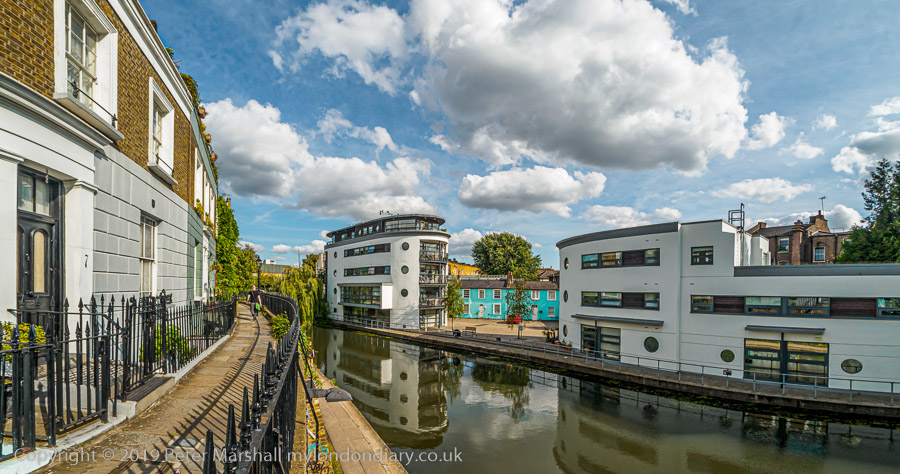
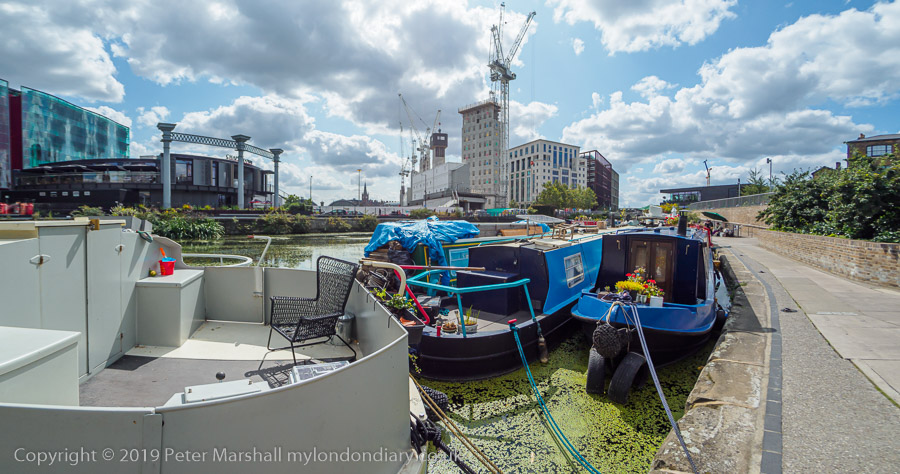
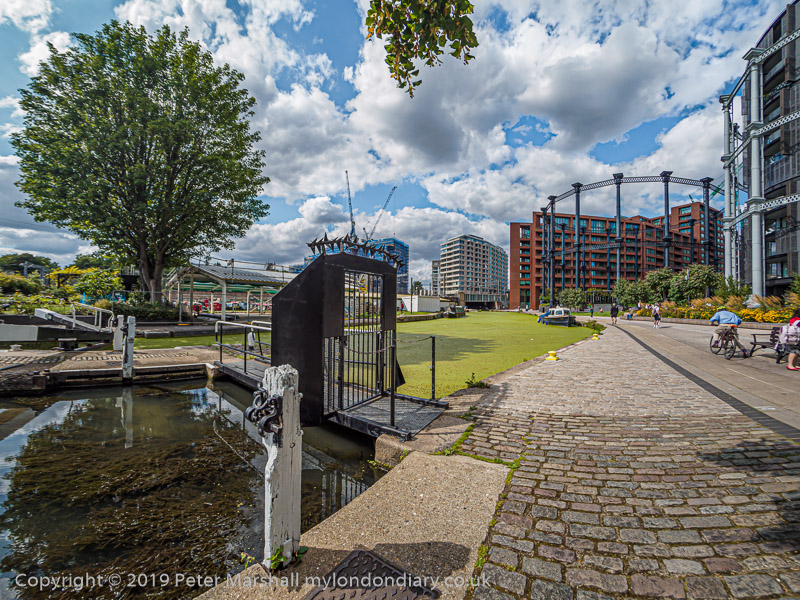
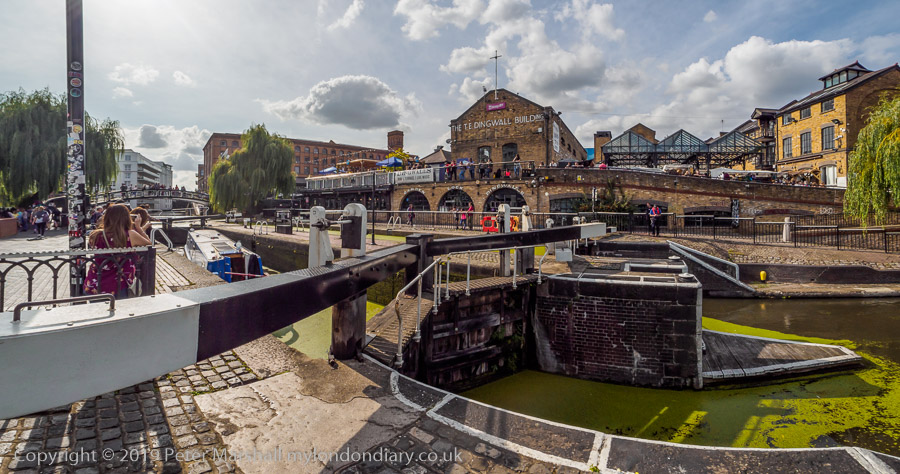
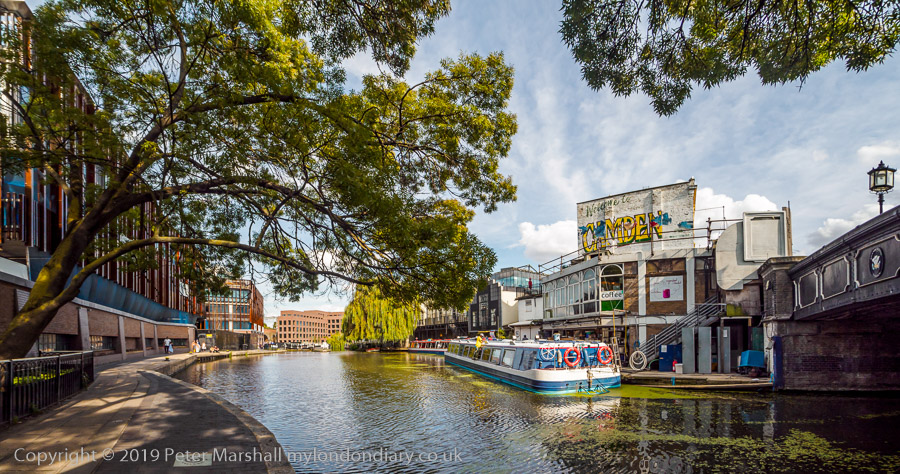
Regent’s Canal Camden

200 years ago the Regent’s Canal was opened. In some respects it was like HS2 today, cutting travel times, though for goods, providing a more direct link between London’s Docks and the canal system which served Birmingham and much of the rest of England. Perhaps more importantly it brought coal and building materials into the centre of London at City Road Basin, and other basins and Samuel Plimsoll’s (remembered for his line) coal drops north of King’s Cross.

And like HS2 it came in late (though at the moment it is still doubtful if HS2 will come in at all, and it certainly will never deliver what was promised.)

The canal was first proposed in 1802, but only got Parliamentary approval in 1812, after it had been adopted by the Prince Regent (later George IV) and John Nash as a part of their scheme for redeveloping Regent’s Park.

Like HS2, the canal had its controversies and problems. In 1815 Thomas Homer, who had first proposed the canal and remained in charge with Nash although neither knew anything about building canals, was found to have stolen company funds and was sentenced to transportation (though it appears the sentence was never carried out.) The first length of the canal, from Little Venice to Camden was completed and opened on the birthday of the Prince Regent in August 1816, but there wasn’t enough money to complete the rest.

The government came to the rescue with the Poor Employment Act of 1817, designed to give work to those unemployed after the end of the war against Napoleon, which provided cheap labour so the scheme could continue.

There were technical problems too, particularly with at Hampstead Road, where a hydro-pneumatic boat lift had been built to an innovative design by William Congreve (better known for his military rockets.) Designed to save water, as the canal had problems with water supply, although the design worked when first installed it quickly broke down when handed over to the canal company, possibly because the materials then available for pneumatic seals were not up to prolonged use. There was a lengthy and acrimonious dispute between the inventor and the canal company, who eventually replaced the lift with a two chamber conventional lock as used elsewhere on the canal.

Also like HS2, there were huge cost increases. The canal eventually cost £772,000 which was twice the original estimate.

I’d begun my walk at Camden Road station, walking from there through the Maiden Lane estate and new developments to York Way where I met a colleague with whom I will be having an exhibition in March 2020. My contribution to the joint show will be a set of around a dozen pictures commemorating the canal anniversary. We made our way together along the towpath to Kentish Town Rd, with several stops where she sat down to sketch and I wandered around making photographs. After leaving her I walked on to Cumberland Basin before returning to Camden Road station.

Many more pictures and displayed large on My London Diary at Camden, Kings X & Regent’s Canal


All photographs on this and my other sites, unless otherwise stated, are taken by and copyright of Peter Marshall, and are available for reproduction or can be bought as prints.

There are no adverts on this site and it receives no sponsorship, and I like to keep it that way. But it does take a considerable amount of my time and thought, and if you enjoy reading it, please share on social media.
And small donations via Paypal – perhaps the cost of a beer – would be appreciated.


Train windows and London’s best view

Back in the old days of British Rail (and at times after privatisation) I often used to enjoy taking pictures out of train windows. Then many carriages on suburban routes had doors between every pair of seats, and the doors had windows that you could slide down to around waist level and so take pictures unobstructed, though it might make it rather draughty for your fellow passengers. There were stern warnings about not leaning out of windows, and unless you braced yourself against the door frame it might have been possible to fall out, but you could photograph in any direction.

Some of the older rolling stock you needed to open the window to actually open the door at stations, as the doors only had handles on the outside, a useful safety precuation which made the carriages childproof and avoided any accidental opening, but sometimes meant infrequent travellers were trapped inside, unable to work out how to open them. Older readers too may remember the thick leather straps with holes to fit around a pin to hold the windows open at various levels.

Slightly more recent carriages came with a stiff handle you had to move sideways, protected by a raised surround, which only trapped mainly elderly ladies whose hands were no longer strong enough to move them and relied on other passengers to allow them to alight.

Now we have automatic opening doors and fixed windows with air conditioning on almost all services (though some still have narrow windows that don’t open enough to be useful) and can be sweat boxes when the air conditioning fails in summer or chill you if it can’t be switched off in winter. But more importantly for photographers, they have windows that are often scratched inside by bored travellers and almost always filthy outside. I have at times travelled with a cloth so when joining a train at the start of its journey I could select my seat and then step off the train to clean the window I was going to sit at so as to get a clearer view.

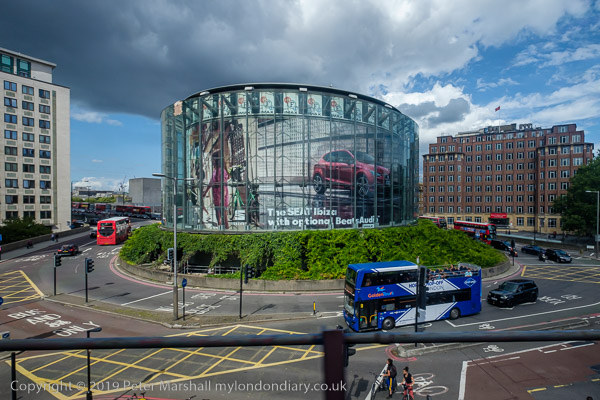
But either the train I joined at Charing Cross was new (and it did have that toxic smell of plasticiser) or had been recently cleaned, and for once I had a clear view. I hadn’t got onto the train to take pictures, just to get me to Blackheath, but it seemed to be too good a chance to miss, so I made a number of exposures.

The problem with photographing through glass is of course reflections. You can cut these down by removing any lens hood that would interfere and holding the front of the lens (or lens filter) directly against the glass. However this can cause vibration, so a small gap is a good idea, particularly while the train is in motion. Modern train windows are double glazed and while this close approach can avoid reflections from the pane you are in contact with, you still get them from the outer pane.

It also only works when the edge of the lens is in contact with the window all around, meaning you are restricted to views directly opposite the window and cannot aim the camera to left or right.

There is a solution to these problems, and it is in the form of a giant floppy lens hood with a hole at the centre which stretches to fit on the body of any lens. It’s called ‘The Ultimate Lens Hood‘ and is around 25cm across, and I have one sitting on my desk. The main problem with it (apart from looking rather eccentric) is that although it is a silicone rubbery thing that can squeeze down considerably, it is still too large to easily fit in my normal camera bag, at least without leaving out something essential like my sandwiches. So it was sitting there on my desk while I made these pictures 25 miles away. Slightly smaller versions are available and I think I might get one. Even a normal cheap rubber hood as I’ve used in the past can help a lot.

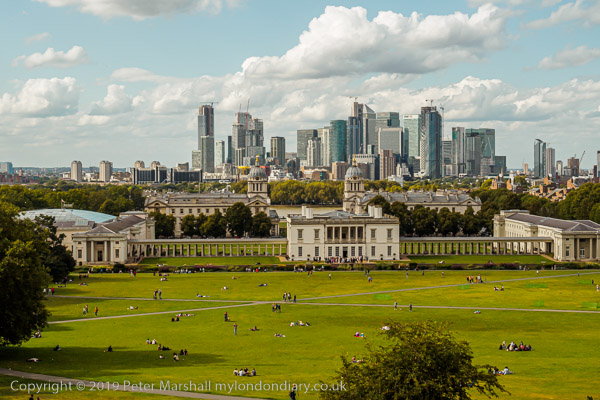
I was on my way to Blackheath to photograph an event that ended at the Royal Observatory at Greenwich, and my final pictures in this set were taken without benefit of any windows of the incredible view from the terrace in Greenwich Park north across the River Thames. It’s a view I first saw and photographed many years ago, and though rather changed since the building of Canary Wharf remains London’s most splendid.

I did try to take more pictures from the train on my return from Maze Hill to Waterloo, but the windows were not so clean, and only a few were usable – and then required considerable retouching.

More pictures at Charing Cross to Greenwich


All photographs on this and my other sites, unless otherwise stated, are taken by and copyright of Peter Marshall, and are available for reproduction or can be bought as prints.


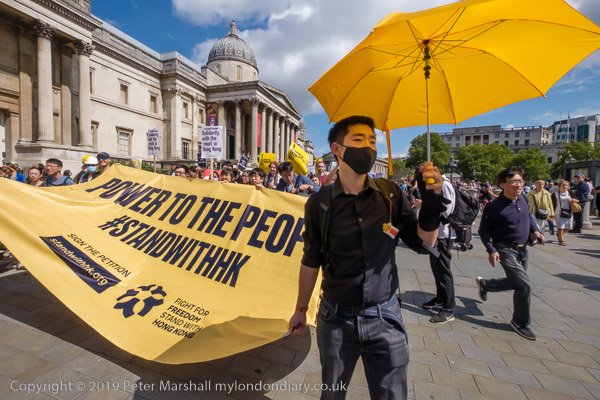
Stand with Hong Kong

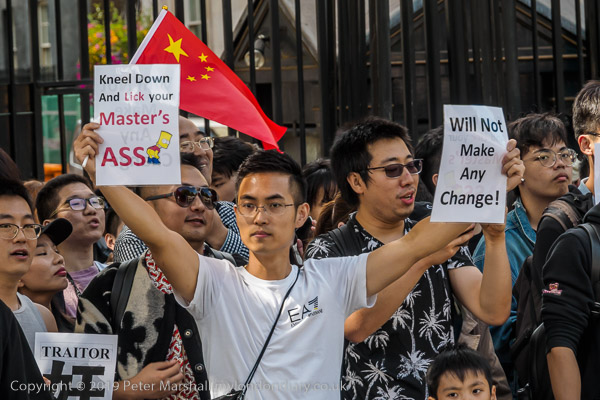
Supporters of Hong Kong and the protests there march from Trafalgar Square towards Downing St.

History is catching up on Hong Kong and Britain. Back in the 17th century the British East India Company had begun cultivating large quanties of opium in Bengal which was then imported into China in order to pay for the luxury Chinese goods much desired in Europe. This led to a huge increase in opium addiction in China, and in 1839 the Emperor decided the trade had to stop.

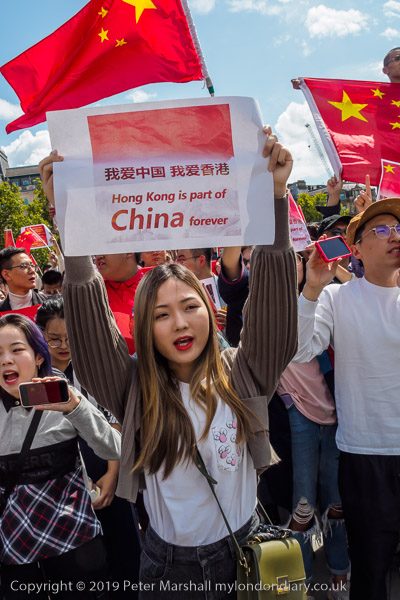
Chinese students and others in Trafalgar Square oppose the pro-Hong Kong march

The trade went through the port of Canton, and the Emperor’s man there tried to persuade the foreign merchants to hand over their opium in exchange for tea, and when they refused, seized around 1200 tons of the drug and publicly destroyed it. We sent in the Navy to fight this ‘First Opium War’, and Chinese war junks were no match for our gunboats. In 1842 China was defeated and forced to sign the Treaty of Nanking, opening up China to free trade and ceding Hong Kong to Britain.

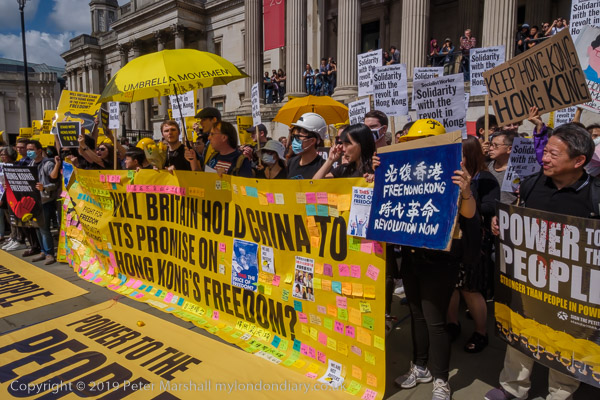
Protesters pose for photographs before they march in support of the Hong Kong protests

This wasn’t the end of our quarrel with China over the opium trade, and in 1856 we picked a second fight with the Chinese to get greater access and to legalise the opium trade, ending in the 1869 Convention of Peking which also ceded a part of Kowloon to join Hong Kong. The final area of Hong Kong, the New Territories were added on a 99 year lease in 1898.

At the rally on Whitehall facing Downing St. But the British Government can no longer send a gunboat and dictate to China.

In 1984 when the end of that lease was only a dozen years away, Margaret Thatcher signed the Sino–British Joint Declaration with China, returning all of Hong Kong to China on 1 July 1997. Under this agreement Hong Kong would be a ‘Special Administrative Region‘ which would retain its capitalist system and way of life unchanged for 50 years until 2047 in what is known as the “one country, two systems” principle.

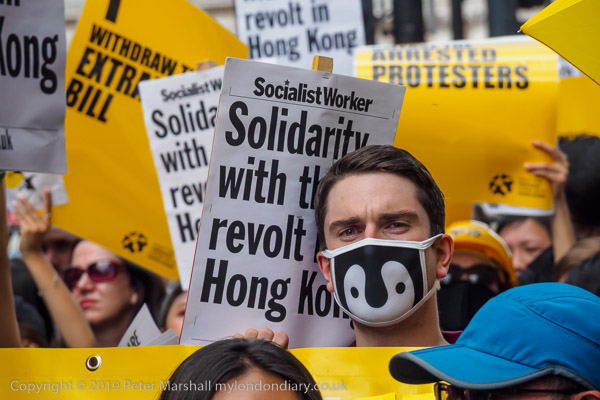
Posters make the Chinese response to the Hong Kong protests clear.

China now considers the joint declaration to be only of historical significance, while the UK government and the G7 still regard it as an important international treaty. In practice there is probably little Britain can do to see that either the letter or the spirit of the agreement is adhered to. China – and the Chinese students and others who came out to oppose the protest supporting the Hong Kong protesters see Hong Kong as a matter of China’s internal affairs.

More pictures from the pro-Hong Kong and Chinese protests at Stand with Hong Kong & opposition.


All photographs on this and my other sites, unless otherwise stated, are taken by and copyright of Peter Marshall, and are available for reproduction or can be bought as prints.

There are no adverts on this site and it receives no sponsorship, and I like to keep it that way. But it does take a considerable amount of my time and thought, and if you enjoy reading it, please share on social media.
And small donations via Paypal – perhaps the cost of a beer – would be appreciated.


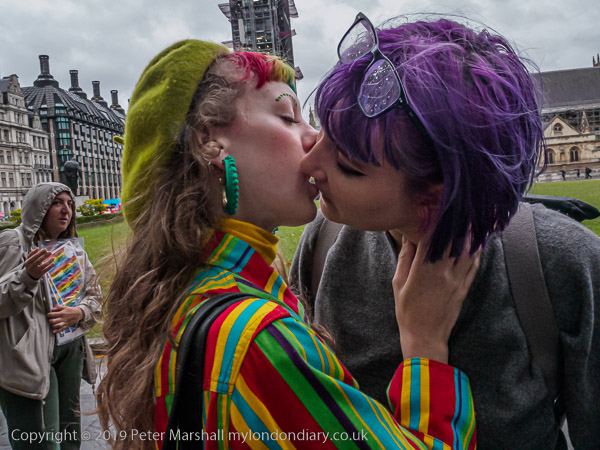
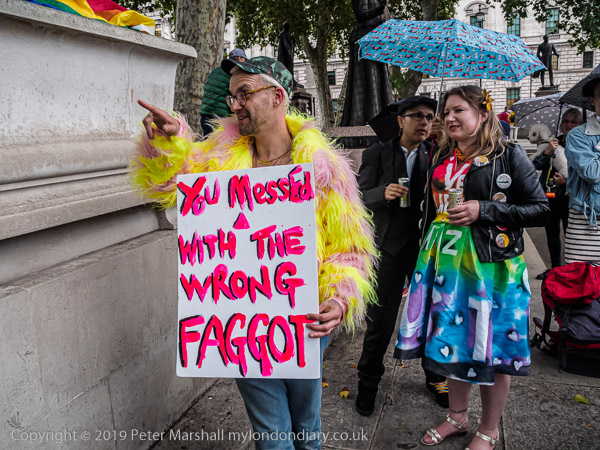
Kiss-in against LGBT+ hate

Hate crime attacks on LGBT+ people on our streets and on public transport are on the increase. Between 2014 and 2018 there was a 150% increase and in recent months more and more have been reported, with some disturbing videos posted on social media.

The shift to the right in British politics under the Tories have encouraged anti-gay sentiments and made them come to the surface. A small but very vocal group of feminists have also been very active in campaigning against trans people on social media, with meetings and protests – including at London’s Pride parade. These “trans-exclusionary radical feminists” or TERFs (a label they dislike) include a number of high-profile largely older feminists who often appear on mainstream media and make their views clear.

Trans people have always been an important part of the gay scene, and played an vital role in the Gay Liberation movement, including the Stonewall riots which were really its starting point.

Stand up to LGBT+ Hate Crime, the organisers of this kiss-in have decided that a more active opposition is needed to these attacks:

It is 50 years since the Stonewall Uprising and the birth of the Gay Liberation Front. Our movement was born out of rage and riots. We will not be driven back into the closet. We will meet all attacks with resistance and protest.”

This protest held in Parliament Square in persistent light rain was the first of a series of protests to combat this increasing hate.

Stand up to LGBT+ Hate Crime Kiss-In


All photographs on this and my other sites, unless otherwise stated, are taken by and copyright of Peter Marshall, and are available for reproduction or can be bought as prints.

There are no adverts on this site and it receives no sponsorship, and I like to keep it that way. But it does take a considerable amount of my time and thought, and if you enjoy reading it, please share on social media.
And small donations via Paypal – perhaps the cost of a beer – would be appreciated.


More on Kashmir

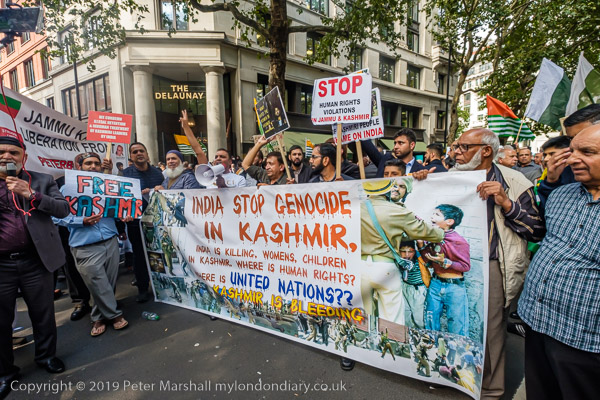
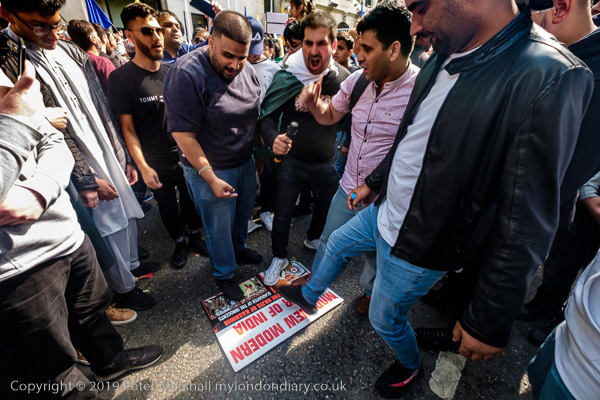
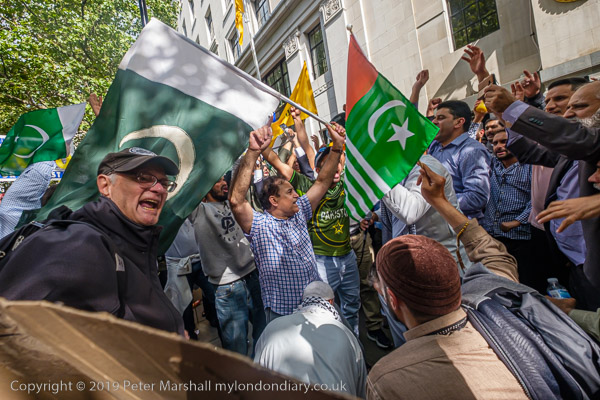
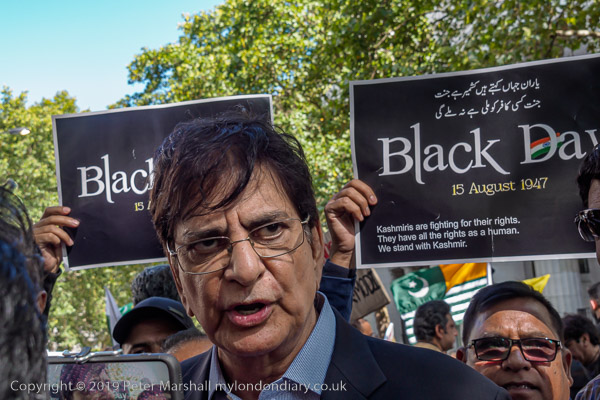
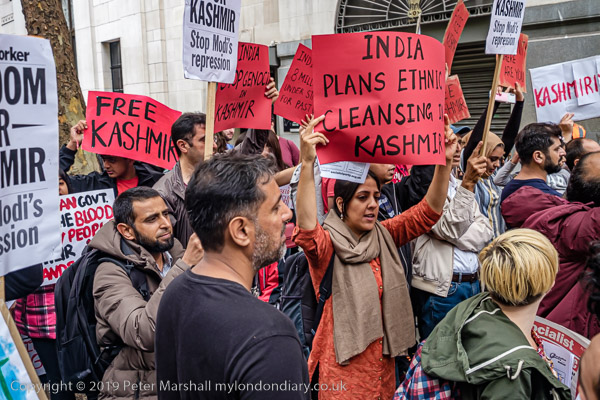
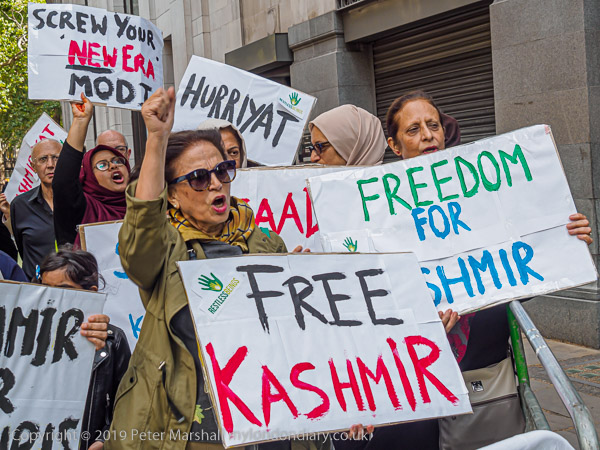
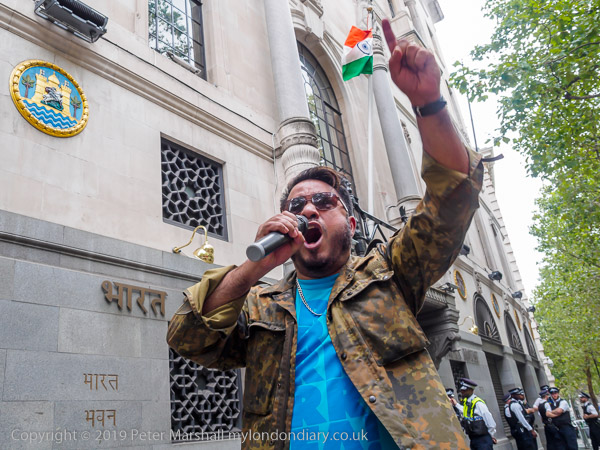
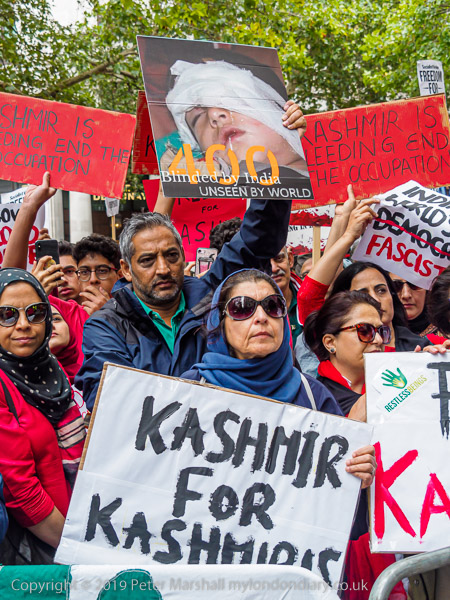
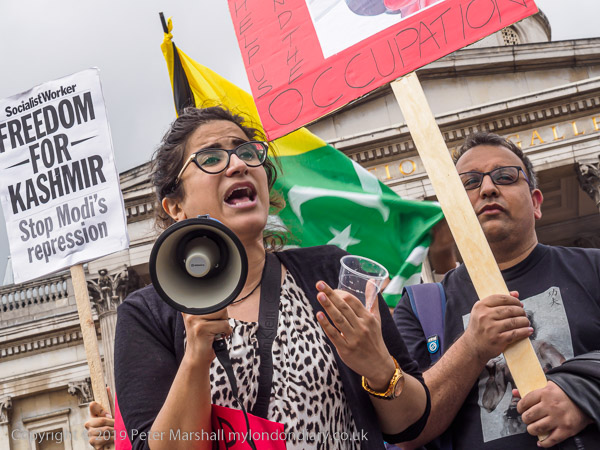
Indian Independence Day, August 15th, saw a much larger protest at the Indian High Commission against Prime Minister Modi’s revocation of Article 370 of the Indian Constitution and calling for freedom for Kashmir. The protesters call the 15th August 1947 ‘Black Day’ .

The size of the protest became evident long before I reached the protest as Waterloo Bridge was closed to traffic and I had to walk across. Aldwych was packed with people and it was difficult to get close to the High Commission, where police and police horses faced the crowd behind barriers.

A lot of noise was coming from India Place at the west side of the building, but it was impossible to get there for the crush of protesters and a solid wall of police blocking the way. Later I heard from a colleague who had been there and who had got sprayed with fake blood which protesters threw at the building and I was pleased to have missed this.

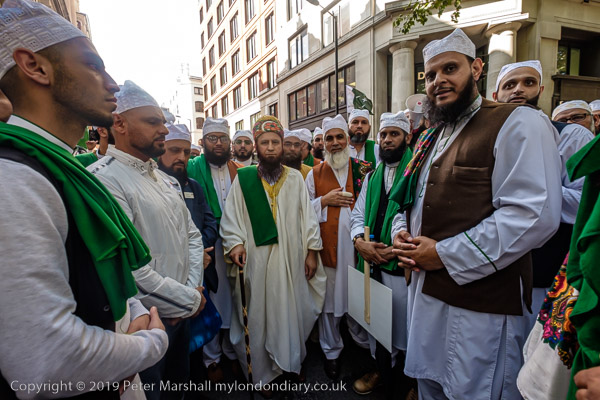
On Aldwych the protest was made up of a number of clearly separate groups, some rather noisier than others. As well as those representing the Indian occupied Jammu and Kashmir, there were also Pakistanis, including some from Azad Kashmir, the Pakistan administered region of Kashmir. Among them I met Sahibzada A Jahangir, spokesman to the Prime Minister of Pakistan. 

Later after the protest in Aldwych there was another protest in Trafalgar Square where differences between the various groups emerged more clearly. While the Kashmiris from the Indian occupied area are calling for an independent Kashmir, the position of Pakistan is a little unclear, with some from the Pakistan administered area supporting independence and other calling for the integration of the whole country into mainland Pakistan, with possibly the small area long under Chinese occupation being officially ceded to China.

More about both protests:
Kashmir Indian Independence Day Protest
Stand with Kashmir


All photographs on this and my other sites, unless otherwise stated, are taken by and copyright of Peter Marshall, and are available for reproduction or can be bought as prints.

There are no adverts on this site and it receives no sponsorship, and I like to keep it that way. But it does take a considerable amount of my time and thought, and if you enjoy reading it, please share on social media.
And small donations via Paypal – perhaps the cost of a beer – would be appreciated.


Kurds protest against Turkish invasion

Kurds have lived in the area around what is now southern and western Turkey and northern Syria and Iraq and north-western Iran at least since the time of Alexander the Great, and in more modern times were a part of the Ottoman Empire until the end of the First World War. At the end of the war their region was split between several countries, including Armenia and a rather smaller area called Kurdistan, but soon after this was occupied by Turkish forces under Kemal Atatürk  and by 1923 the whole area was incorporated into modern Turkey.

There were various uprisings by the Kurds against Turkish rule, and Turkey tried to eliminate Kurdish culture, banning the language and even the use of the terms  “Kurds”, “Kurdistan”, or “Kurdish”, re-christening the Kurds as “Mountain Turks”. Many Kurds were jailed.

In the 1980s and 90s there was a guerilla war led by the Kurdistan Workers’ Party (PKK) with the Turks destroying thousands of villages and killing over 20,000 Kurds. In 1999 Kurdish leader Abdullah Öcalan (“Apo”) was captured by the CIA in Nairobi and handed over to the Turks. He was tried in Turkey and sentenced to death, but this was later commuted to life imprisonment. He was held in solitary confinement in an island prison until 2009, when a few more PKK prisoners were moved with him to a new jail on the island, and he remains in prison, but still acts as a highly regarded leader of his people.

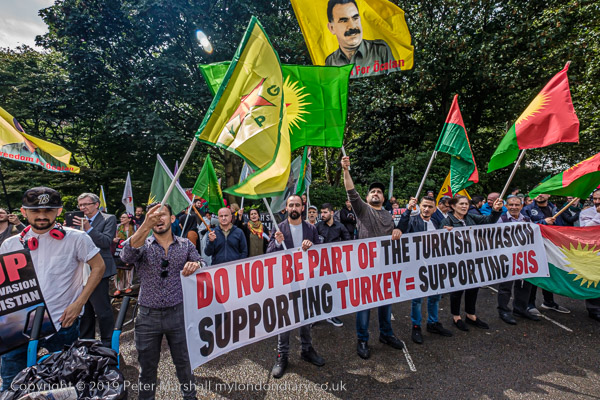
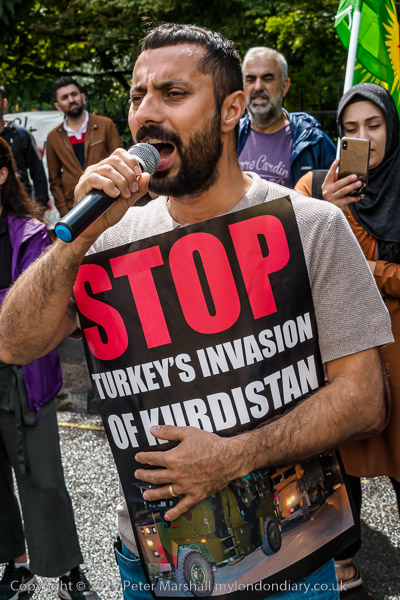
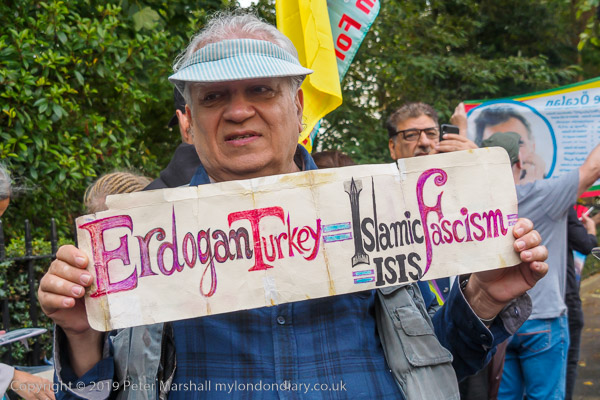
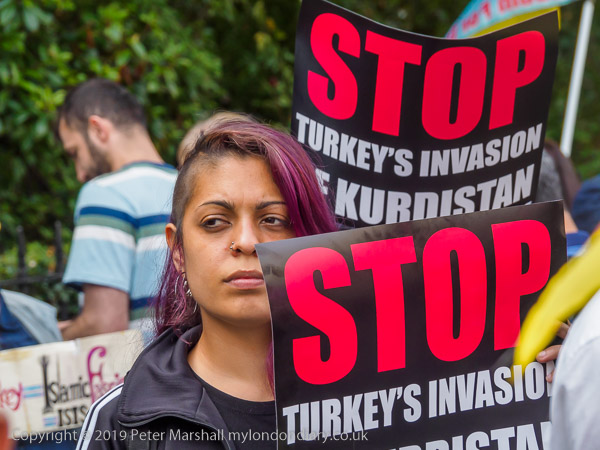
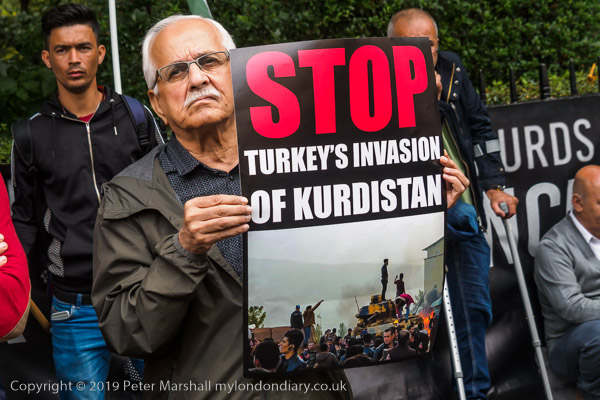
The protest at the Turkish embassy followed further threats by Turkish President Recep Tayyip Erdoğan to invade more Kurdish areas of Northern Syria, where the Kurdish state of Rojava has been set up with a  “democratic confederalism” constitution based on the ideas of Murray Bookchin which enshrines the values of environmentalism, self-defense, gender equality, and a pluralistic tolerance for religion, politics, and culture.

The call out for the protest states:

Through invasion, destruction & annihilation the fascist Turkish State, with its media, secret intelligence services and the Kurds he has pulled to his side is now trying to destroy the hard works of the Kurdish people in Northern Syria.

Its aim is to annihilate the Kurds and their existence. To protest this, the kurdish community and their friends will stand honourably against the atrocities being committed by the Turkish state and strengthen the struggle for freedom.

On this basis, Kurds and all the people who believe in democracy and peace are invited to protest against this fascist regime.

Stop Turkey’s Invasion of Kurdistan


All photographs on this and my other sites, unless otherwise stated, are taken by and copyright of Peter Marshall, and are available for reproduction or can be bought as prints.

There are no adverts on this site and it receives no sponsorship, and I like to keep it that way. But it does take a considerable amount of my time and thought, and if you enjoy reading it, please share on social media.
And small donations via Paypal – perhaps the cost of a beer – would be appreciated.

Kashmiris say ‘India Out!’

By 1947 Britain had boxed itself into an impossible position in India (not least by the earlier actions of Lord Curzon as Viceroy in Bengal in 1905) and it was clear that the only option was for a British withdrawal from the whole area. Clement Atlee who had become UK prime minister since the 1945 election had long been a supporter of Indian independence and the question was not whether this should happen, but how it could be managed in a way that satisfied both Muslim and Hindu communities and avoided catastrophic bloodshed.

It was indeed a hugely complex situation. As well as the British Raj, there were also several hundred princely states in a looser arrangement with British rule. And as well as Muslims and Hindus, there were also some areas where Sikhs, Buddhists and Jains were in the majority. The British Government ruled that the area would become independent at the latest by June 1948, but Lord Mountbatten, newly appointed Viceroy announced his plan on June 3 1947 with independence only just over 2 months away on 15 August 1947.

The plan called for various existing Indian legislatures to vote on whether to be a part of India or Pakistan or be partitioned and set up a boundary commission to establish partition, but failed to deal with the princely states, where the decision of which dominion to join would be a matter for the prince alone.

Protesters in Kashmir have been killed and many deliberately blinded bu Indian forces

Mountbatten was clearly poorly advised and was as he said a soldier not a civilian and he assured those who predicted a bloodbath at partition that the army would be able to control the situation: ” I shall see to it that there is no bloodshed and riot.” In the event around 10 million people were displaced and somewhere between 200,000 and 2 million killed, with violence being encouraged by some of the princely rulers, including in Kashmir.

Kashmir had a Muslim majority but a Hindu prince who was hesistant to join Pakistan and went to Mountbatten for military help when Pakistani forces invaded part of the area; Mountbatten agreed to help on condition it would become a part of India. In 1948 the UN intervened and brokered a ceasefire, declaring that a referendum of Kashmiris be held – which never happened. There were further military conflicts between India and Pakistan in Kashmir in 1965 and 1999.

Since then the Indian controlled area named Jammu and Kashmir has been under military occupation by Indian troops. The severity of control by police and army increased following an armed revolt by Kashmiris calling for independence in 1989. Elections in the area are now widely thought to be rigged in favour of pro-India groups.

The special position of the area was recognised in 1954 by Article 370 of the Indian constitution, with separate laws on  citizenship, the ownership of property and fundamental rights. In particular these prevented non-citizens of the area buying land and property in the state.

On 5th August 2019 the Indian government cancelled the 1954 provisions, bringing Jammu and Kashmir under the same conditions as other Indian states. Kashmiris protested and there was a further security clampdown, with communications to the country being severed and a further influx of Indian soldiers – there are now around 800,000 there.

Kashmiris protest at India House
Kashmiris protest in Trafalgar Square

City and Thames

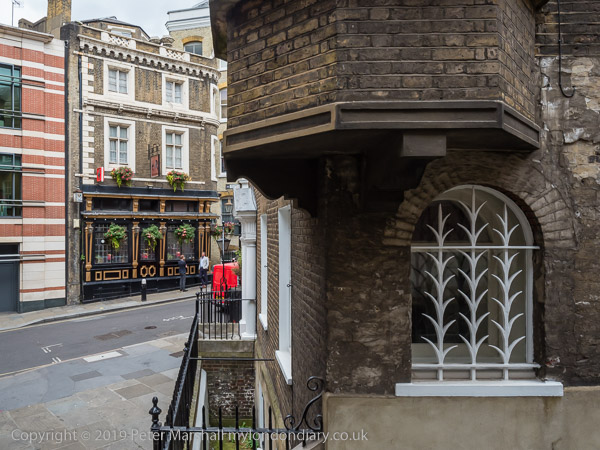
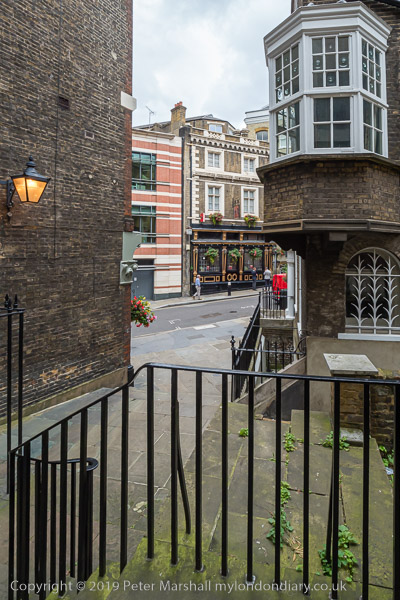
The area by St Andrew-by-the-Wardrobe, an Anglican church a few hundred yards south of St Paul’s Cathedral fascinated me when I first walked by it in the 1970s, and of course I’ve tried to photograph it over the years with various success, though mainly failure.

This picture, taken from the steps up to a locked door into the church is one that I found impossible on colour film, with the gloomy alley – with a light on even in the middle of the day when I took this picture contrasting with the more brightly lit street with The Cockpit pub. But the day was overcast, reducing the contrast and the digital camera coped well, though needing some dodging and burning in Lightroom to give the results here.

I didn’t go into the church though I have been inside on at least one previous occasion, just following an Indian Orthodox service there, when the atmosphere was thick with incense. The site has an interesting history, with a church here for perhaps a thousand years or more, though the first written mention is in 1170 or . It became part of an ancient royal residence, Baynard’s Castle, and in 1361 Edward III or Edward IV moved his royal clothes and arms from the Tower of London to a more handy site in a building close by.

Like most of London it was destroyed in the Great Fire of 1666, and was rebuilt in 1695 to one of the simplest and last of Christopher Wren’s many church designs. Although it now looks ancient, it was mostly destroyed again by German bombing in 1940 and rebuilt and reconsecrated in 1961, with most of its internal decor being salvaged from previously demolished Wren churches. Among the memorials on its walls is a modern carved wood one for William Shakespeare, a parishoner for 15 years.

From the church I crossed Queen Victoria St and made my way down to the riverside walkway. There was an extremely low tide and I went down the steps onto the foreshore, which here is sand and shingle with many remains of wooden posts.

I walked the short distance along to Queenhithe, a historic monument as London’s first dock though the Roman and Saxon docks are now all buried beneath the mud and stones or hidden behind the visible more modern river walls and the area is surrounded by rather boring modern offices.

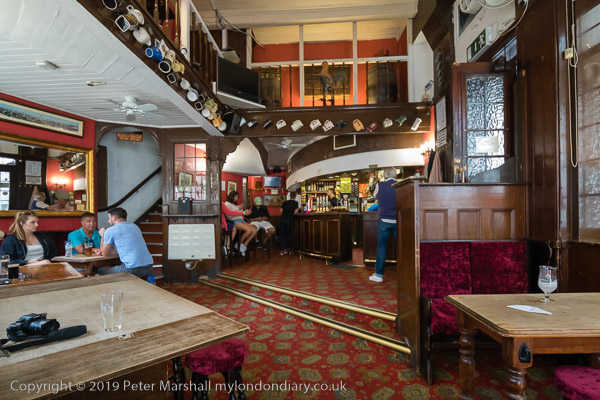
I went back and up onto the riverside walkway and then made my way to meet with friends for a short walk through the city, on which I took a few more photographs. One of the places we visited was where I had begun taking pictures, and this time we went inside The Cockpit on St Andrews Hill opposite the church, one of London’s smaller and more fascinating places.

Although the text for it’s grade II listing states tha the building is ca 1860, but the interior is in part older. The pub claims to have been established in 1787 and to have been rebuilt in 1842 and that it was once Shakespeare’s home – and certainly it is on the corner of Ireland Yard where he is known to have lived.

The interior is literally a ‘cockpit’ and the bar and seating is on the very floor where the pair of gamecocks, equipped with razor-sharp metal spurs would be set to fight to the death while gamblers looked on from the balcony above. Cock-fighting was banned in England and Wales by the  Cruelty to Animals Act 1835 and the last fight in this pub was said to have been in 1849. Apparently there are still some illegal fights in the UK.

More pictures at City & Thames.


All photographs on this and my other sites, unless otherwise stated, are taken by and copyright of Peter Marshall, and are available for reproduction or can be bought as prints.

There are no adverts on this site and it receives no sponsorship, and I like to keep it that way. But it does take a considerable amount of my time and thought, and if you enjoy reading it, please share on social media.
And small donations via Paypal – perhaps the cost of a beer – would be appreciated.
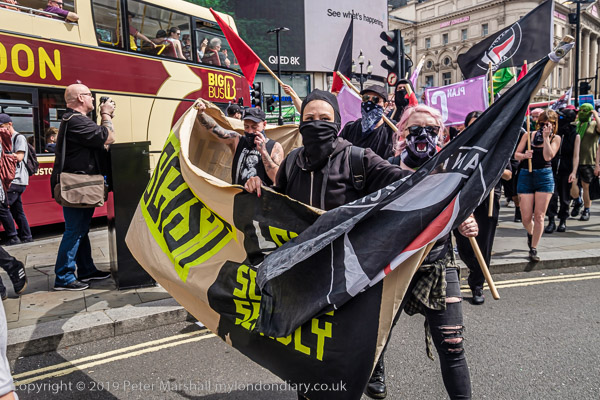
Stop the Fascists

London has a long tradition of standing up to attempts by fascists to march through the city, not least of Cable St in 1936 and the battle of Bermondsey a year later.

Of course it’s also true that many of the supporters of Mosley were Londoners – and Bethnal Green in particular was one of their stronger areas with Mosley claiming 4,000 members there. And many of those who came to Shoreditch in 1978 when the National Front moved its HQ there were also Londoners, as were the 2000 who packed the top of Brick Lane attempting to stop them.

More recently anti-fascists have come out on the streets to stop the marches of the EDL in Walthamstow and Whitechapel and against supporters of Tommy Robinson.

While the crowd were trying to defend Brick Lane in Shoreditch in 1978, the Anti-Nazi League, formed by the Socialist Workers party and others was holding their event in opposition to the NF, a much larger Carnival Against the Nazis miles away in Brockwell Park, Brixton, seen by many in East London as a diversion from the real fight against the fascists.

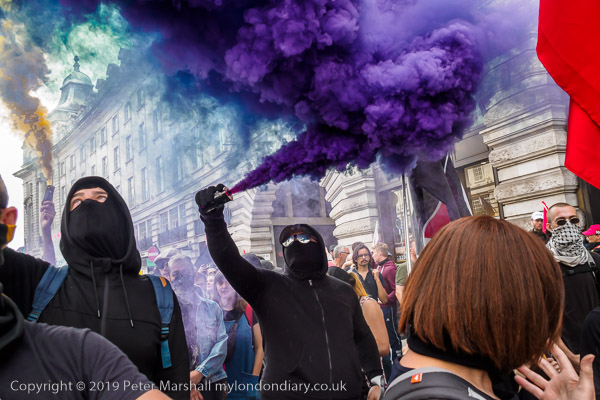
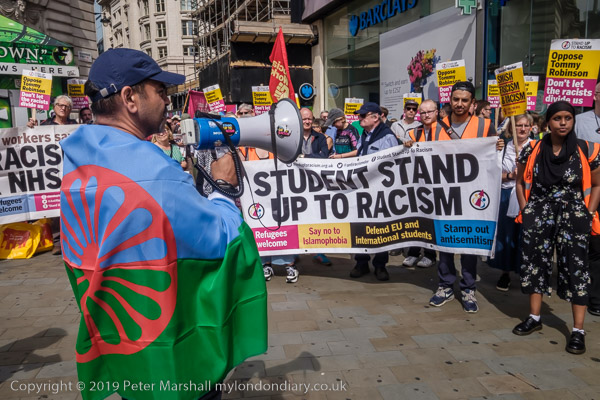
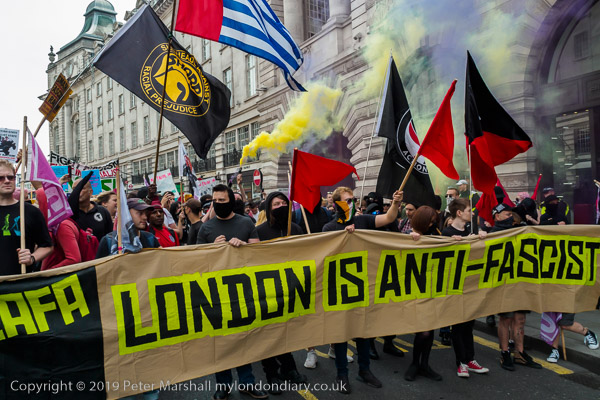
On this occasion there was a similar split of the opposition to the ‘Free Tommy’ protesters, but at least they were roughly in the same place, with London Anti-Fascist Alliance meeting around Eros in Piccadilly Circus and across the street on the wide pavement outside Boots and Barclays was a small rally by Stand Up to Racism.

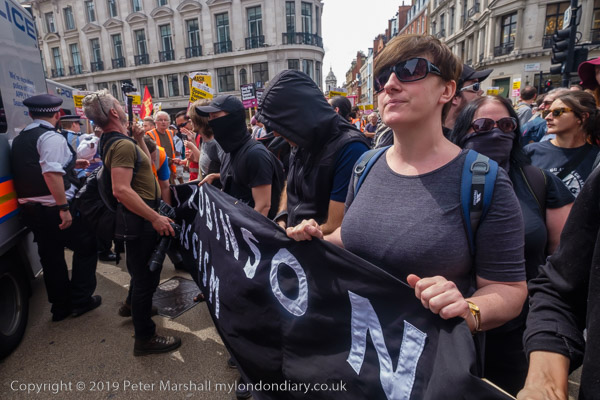
And once the London Antifascists began the march up Regent St towards the Free Tommy protesters who were gathering outside the BBC, most or all of the Stand Up to Racism supporters joined in behind them. Police stopped the combined march at the junction with Hanover St. The anti-fascists made a tentative effort to turn into Great Marlborough St, but were blocked by a police line in front of a row of police vans. They then left as directed by the police who took them down Hanover St, and from Hanover Square turned up to cross Oxford St and go up to Cavendish Square.

Police again blocked an attempt to turn right and return to Regent St and the march came to a halt. I left at this point, first to go and briefly view the ‘Free Tommy’ protesters who were being held by police in front of the BBC, and then to photograph a small protest taking place at Downing St.

I returned to the BBC around an hour later, and the right wing protesters were still there, fed up with the police not allowing them to march. By that time the anti-fascists had apparently come close enough to make their presence felt and after some spending some time shouting appeared to have dispersed. I felt it was time for me to go home as well.
After I got home I heard that finally the police did allow the fascists to march, several hours later than intended. There were apparently a few incidents on their way, and some of them attacked pro-democracy protesters outside the Algerian embassy, presumably because they were foreign.
More at Anti-Racists march against the far right and ‘Free Tommy’ protest.


All photographs on this and my other sites, unless otherwise stated, are taken by and copyright of Peter Marshall, and are available for reproduction or can be bought as prints.

There are no adverts on this site and it receives no sponsorship, and I like to keep it that way. But it does take a considerable amount of my time and thought, and if you enjoy reading it, please share on social media.
And small donations via Paypal – perhaps the cost of a beer – would be appreciated.